EP0213146B1 - Verfahren zur Erweiterung des Temperaturbereichs für die smektische A-Phase einer Flüssigkristallzusammensetzung - Google Patents
Verfahren zur Erweiterung des Temperaturbereichs für die smektische A-Phase einer Flüssigkristallzusammensetzung Download PDFInfo
- Publication number
- EP0213146B1 EP0213146B1 EP86900663A EP86900663A EP0213146B1 EP 0213146 B1 EP0213146 B1 EP 0213146B1 EP 86900663 A EP86900663 A EP 86900663A EP 86900663 A EP86900663 A EP 86900663A EP 0213146 B1 EP0213146 B1 EP 0213146B1
- Authority
- EP
- European Patent Office
- Prior art keywords
- cyano
- liquid crystal
- compound
- smectic
- carbon atoms
- Prior art date
- Legal status (The legal status is an assumption and is not a legal conclusion. Google has not performed a legal analysis and makes no representation as to the accuracy of the status listed.)
- Expired - Lifetime
Links
Classifications
-
- C—CHEMISTRY; METALLURGY
- C09—DYES; PAINTS; POLISHES; NATURAL RESINS; ADHESIVES; COMPOSITIONS NOT OTHERWISE PROVIDED FOR; APPLICATIONS OF MATERIALS NOT OTHERWISE PROVIDED FOR
- C09K—MATERIALS FOR MISCELLANEOUS APPLICATIONS, NOT PROVIDED FOR ELSEWHERE
- C09K19/00—Liquid crystal materials
- C09K19/04—Liquid crystal materials characterised by the chemical structure of the liquid crystal components, e.g. by a specific unit
- C09K19/42—Mixtures of liquid crystal compounds covered by two or more of the preceding groups C09K19/06 - C09K19/40
- C09K19/44—Mixtures of liquid crystal compounds covered by two or more of the preceding groups C09K19/06 - C09K19/40 containing compounds with benzene rings directly linked
-
- C—CHEMISTRY; METALLURGY
- C09—DYES; PAINTS; POLISHES; NATURAL RESINS; ADHESIVES; COMPOSITIONS NOT OTHERWISE PROVIDED FOR; APPLICATIONS OF MATERIALS NOT OTHERWISE PROVIDED FOR
- C09K—MATERIALS FOR MISCELLANEOUS APPLICATIONS, NOT PROVIDED FOR ELSEWHERE
- C09K19/00—Liquid crystal materials
- C09K19/04—Liquid crystal materials characterised by the chemical structure of the liquid crystal components, e.g. by a specific unit
- C09K19/06—Non-steroidal liquid crystal compounds
- C09K19/08—Non-steroidal liquid crystal compounds containing at least two non-condensed rings
- C09K19/10—Non-steroidal liquid crystal compounds containing at least two non-condensed rings containing at least two benzene rings
- C09K19/12—Non-steroidal liquid crystal compounds containing at least two non-condensed rings containing at least two benzene rings at least two benzene rings directly linked, e.g. biphenyls
-
- C—CHEMISTRY; METALLURGY
- C09—DYES; PAINTS; POLISHES; NATURAL RESINS; ADHESIVES; COMPOSITIONS NOT OTHERWISE PROVIDED FOR; APPLICATIONS OF MATERIALS NOT OTHERWISE PROVIDED FOR
- C09K—MATERIALS FOR MISCELLANEOUS APPLICATIONS, NOT PROVIDED FOR ELSEWHERE
- C09K19/00—Liquid crystal materials
- C09K19/04—Liquid crystal materials characterised by the chemical structure of the liquid crystal components, e.g. by a specific unit
- C09K19/42—Mixtures of liquid crystal compounds covered by two or more of the preceding groups C09K19/06 - C09K19/40
Definitions
- the present invention relates to a method for making liquid crystal compositions which exhibit a smectic A phase of relatively low melting point and wide smectic range.
- Such compositions may be used in liquid crystal cells, not only in display or optical information processing applications, but also for instance in temperature sensing applications.
- the operation of such cells may involve laser addressing, thermal or electrical addressing.
- Smectic A liquid crystals are highly viscous and therefore often require substantially greater energy, in the form of heat, light or electric field, to effect any molecular change in the phase than do typical nematic or cholesteric liquid crystals.
- the smectic A phase From a practical point of view, for most applications, it is desirable for the smectic A phase to exist at room temperature. It is also desirable for this smectic A phase to be present over a relatively wide temperature range in order that it may be used, without recourse to thermostatting, in equipment that is designed for use in situations involving a wide range of service temperature. Typical smectic A mixtures that are currently commercially available exhibit somewhat inconveniently narrow ranges of smectic A phase for a number of applications. Thus it is seen from the following table of smectic A phase materials commercially available from BDH Chemicals Ltd.
- An object of the present invention is the provision of liquid crystal mixtures with an extended temperature range for the smectic A phase, typically one that extends to cover the range from about -10 o C to about +70 o C, but the scope of the invention is not restricted to this temperature range.
- the smectic A liquid crystal mixtures must also possess other appropriate properties in addition merely to the smectic A phase.
- many of the display principles involved depend upon reorienting the liquid crystal to a homeotropic state by means of an external electric field to erase information written on the display. This reorientation may be performed in the smectic phase, in the nematic phase, or in the isotropic phase just above the N-I transition where sufficient post-transitional order remains. So that this reorientation may be achieved by the minimal electric field (i.e.
- the smectic A components possess a relatively high positive dielectric anisotropy.
- many of the types of smectic displays described above depend for their optical contrast on a difference in texture between the part upon which information is written and the part upon which information is not written.
- Various means are adopted according to the display technology to induce a light scattering texture in the part where information is written.
- the efficacy of the scattering process towards incident light of visible wavelengths depends upon the optical birefringence of the smectic liquid crystal, and this, therefore, preferably should also be relatively high.
- an attractive feature of the smectic A type of display depends upon the fact that the scattering texture so induced is permanent so that information written into the display does not need to be refreshed continuously as in the twisted nematic or phase-change types of display, thus simplifying the electronic driving circuits.
- the stability of the scattering texture does not persist throughout the whole of the S A phase but diminishes with increasing temperature of the display because at a particular temperature the scattering texture is reoriented from the surrounding unwritten homeotropic part, thus spontaneously erasing the written information. It is important that the temperature at which reorientation occurs be well above any temperature that the display will experience. In general this temperature is proportional to the S A -N transition temperature of the mixture.
- the additives incorporated for the purpose of raising the S A -N transition temperature must be stable optically and thermally, and must not suffer electrochemical degradation under the voltages necessary to operate the display. It is an object of this invention to provide additives with the properties described above.
- compositions may be used as they are, or they may form a base mixture to which may be added up to 10% by weight in aggregate of one or more chiral, ionic, surfactant, and/or guest dye and the like additions.
- a method for the extension of the temperature range for the smectic A phase of a base liquid crystal composition consisting essentially of materials selected from the following six compound classes, wherein R is in every instance an alkyl chain containing between 2 and 18 carbon atoms, and R' is in every instance an alkyl chain containing between 1 and 17 carbon atoms wherein one or more non-adjacent CH2 groups are replaced by oxygen atoms, and wherein there are present compounds from classes (1) and (2) where R is a straight chain alkyl group containing more than 7 carbon atoms, comprising including in said base composition as a second part between 1 and 60 % by weight of one or more materials of high birefringence and high positive dielectric anisotropy which raise the S A -N transition temperature.
- the second part material comprises between 3 and 60 %, in particular between 10 and 30 % by weight of the liquid crystal composition.
- the second part materials are of high birefringence, i.e. ⁇ n >0,15, in particular > 0,17.
- the dielectric anisotropy of the second part materials is > + 8, in particular > + 10.
- the second part materials are compounds comprising three or four ring structures. They preferably contain at least two 1,4-phenylene rings preferably a 4-cyanobiphenyl-4'-yl group, a bridging element selected from the group consisting of -O-CO-, -CO-O-and -CH2CH2- and/or one trans-1,4-cyclohexylene ring.
- a method for the extension of the temperature range for the smectic A phase of a base liquid crystal composition wherein the composition either consists exclusively of a base mixture or consists of a base mixture together with not more than 10 % by weight in aggregate of one or more other constituents, characterized in that the base mixture contains, as a first part, between 40 and 90 % by weight in aggregate of one or more materials selected from one or more of the compound classes (1), (2), (3), (1'), (2') and (3'), and in that the balance of the base mixture is provided by a second part consisting of one or more materials selected from one or more of the following eleven compound classes, wherein R is in every instance an alkyl chain containing between 2 and 18 carbon atoms and R' is in every instance an alkyl chain containing between 1 and 17 carbon atoms, wherein one ore more non-adjacent CH2-groups are replaced by oxygen atoms.
- the compound classes (1) and (2) of the first part of the mixture, where R is a straight chain alkyl group containing more than 7 carbon atoms, are known smectic A phase liquid crystals, some of which have an S A phase in the vicinity of room temperature.
- the n -octyl homologue of compound of class (1) 4-cyano-4'- n -octyl biphenyl, has the transition temperatures K-S A , 21.5 o C; S A -N, 33.5 o C; N-I, 40.5 o C.
- the temperature range of the smectic phase can be extended somewhat by mixing two or more homologues.
- Compounds of class (2) where R is a straight chain alkyl group containing more than 7 carbon atoms, have higher S A -N transition temperatures, typically about 70 o C, but their melting points are also much higher, typically 50-60 o C. Mixtures composed only of compounds of class (2) can be prepared with S A -N transition temperatures approaching 70 o C, but their melting points are typically in the range 30 to 40 o C, rendering them unsuitable for use in displays operating at ambient temperatures. Compounds of class (2) are nonetheless useful when mixed with compounds of class (1) in depressing the freezing point.
- n -octyl homologue of class (1) has the transition temperatures K-S A , -1 o C; S A -N, 48 o C; N-I, 49 o C.
- the elevating effect of a single additive of the second part of the base mixture on the transition temperatures of the first part is typically proportional to its concentration as exemplified below.
- the proportion of a single additive that can be used is limited by its solubility in the first part, too high a concentration also raising the melting point. Judicious choice of the concentration however, can result in a depression of the melting point, which is desirable.
- Some additives raise the N-I transition faster than the S A -N; some have the reverse effect, thus enabling the width of the nematic range, which is an important characteristic in some types of smectic displays, to be controlled.
- Example 1 (use of a compound of class (5) )
- a smectic mixture was formed with the following composition by weight :- 47.5% 4-cyano-4'- n -octylbiphenyl 37.05% 4-cyano-4'- n decylbiphenyl 10.45% 4-cyano-4'- n -decyloxybiphenyl 5.0% 4-cyano-4''- n -nonylterphenyl.
- mixture A has transition temperatures S A -N, 54 o C: N-I, 56.2 - 59.4 o C.
- Mixture A was mixed in different proportions by weight with 1-(4-cyano-4'-biphenylyl)-2-(4- n -octylphenyl) ethane (compound 5.1), and the table records measured transition temperatures for those mixtures :
- Mixture A Compound 5.1 S A -N Transition temperature N-I Transition temperature 95% 5% 57.0 o 58.0-60.0 o 90% 10% 60.5 o 61.0-63.5 o 85% 15% 64-68 (S-I: no nematic phase)
- Example 2 (use of a compound of class (6) )
- a smectic mixture was formed with the composition by weight : 58.8% 4-cyano-4'- n -octylbiphenyl 28.4% 4-cyano-4'- n decylbiphenyl 18.8% 4-cyano-4'- n -octyloxybiphenyl
- mixture B has transition temperatures S A -N, 46.6 o C; N-I, 50.8-51 o C.
- Mixture B was mixed in different proportions by weight with 4-cyano-4'-(4- n -pentylcyclohexyl)-biphenyl (compound 6.1), and the table below records measured transition temperatures for those mixtures :
- Mixture B Compound 6.1 S A -N Transition temperature N-I Transition temperature 98% 2% 48.1 o 53.5-53.7 o 96% 4% 49.5 o 55.8-56.3 o 94% 6% 50.8 o 58.0-58.8 o 92% 8% 51.9 o 59.9-60.9 o
- Example 3 (use of a compound of class (7) )
- Mixture A was mixed in different proportions by weight with 4-cyano-4'-biphenylyl 4- n -heptylbiphenyl-4'-carboxylate (compound 7.1), and the table below records measured transition temperatures for those mixtures :
- Mixture A Compound 7.1 S A -N Transition temperature N-I Transition temperature 99% 1% 55.7 o 57.5-59.2 o 98% 2% 56.9 o 58.8-61.6 o 97% 3% 58.4 o 60.2-64.0 o 96% 4% 59.7 o 61.7-66.7 o 95% 5% 61.0 o 62.8-69.1 o
- Example 4 (use of a compound of class (9) )
- Mixture A was mixed in different proportions by weight with 4-cyano-4'-biphenylyl 4- n -decylbenzoate (compound 9.1), and the table below records measured transition temperatures for those mixtures :
- Mixture A Compound 9.1 S A -N Transition temperature N-I Transition temperature 95% 5% 58.5 o 60.3-62.3 o 90% 10% 63.8 o 65.2-68.6 o 85% 15% 69.3 o 69.3-75.2 o
- Example 5 (use of a compound of class (9) )
- Mixture A was mixed in different proportions by weight with 4-cyano-4'-biphenylyl 4- n -dodecylbenzoate (compound 9.2), and the table below records measured transition temperatures for those mixtures :
- Mixture A Compound 9.2 S A -N Transition temperature N-I Transition temperature 97% 3% 56.7 o 57.9-60.0 o 94% 6% 59.4 o 60.5-63.4 o 91% 9% 62.5 o 63.4-66.9 o
- Example 6 (use of a compound of class (10) )
- Mixture A was mixed in different proportions by weight with 4-cyano-4'-biphenylyl trans -4- n -ethylcyclohexane -1-carboxylate (compound 10.1), and the table below records measured transition temperatures for those mixtures :
- Mixture A Compound 10.1 S A -N Transition temperature N-I Transition temperature 97% 3% 55.4 o 58.8-60.0 o 94% 6% 57.3 o 61.9-63.4 o 91% 9% 59.1 o 65.6-67.5 o 88% 12% 60.6 o 69.0-71.2 o 85% 15% 62.0 o 73.2-75.5 o
- Example 7 (use of a compound of class (10) )
- Mixture A was mixed in different proportions by weight with 4-cyano-4'-biphenylyl trans -4- n -pentylcyclohexane -1-carboxylate (compound 10.2), and the table below records measured transition temperatures for those mixtures :
- Mixture A Compound 10.2 S A -N Transition temperature N-I Transition temperature 97% 3% 56.7 o 59.0-61.1 o 94% 6% 58.5 o 61.5-63.5 o 91% 9% 60.8 o 64.8-67.1 o 88% 12% 63.6 o 68.6-71.8 o 85% 15% 65.8 o 72.0-75.3 o
- Example 8 (use of a compound of class (10) )
- Mixture A was mixed in different proportions by weight with 4-cyano-4'-biphenylyl trans -4- n -heptylcyclohexane -1-carboxylate (compound 10.3), and the table below records measured transition temperatures for those mixtures :
- Mixture A Compound 10.3 S A -N Transition temperature N-I Transition temperature 95% 5% 59.4 o 60.9-64.1 o 90% 10% 63.8 o 66.1-69.8 o 85% 15% 69.0 o 72.5-71.1 o 80% 20% 74.8 o 79.5-84.6 o
- Example 9 (use of a compound of class (12) )
- Mixture A was mixed in different proportions by weight with 2-cyano-6-naphthyl trans -4- n -heptylcyclohexane -1-carboxylate (compound 12.1), and the table below records measured transition temperatures for those mixtures :
- Mixture A Compound 12.1 S A -N Transition temperature N-I Transition temperature 94% 6% 56.7 o 59.8-61.5 o 90% 10% 58.6 o 62.8-64.1 o 85% 15% 60.7 o 67.0-68.2 o 80% 20% 63.3 o 71.0-72.5 o
- Example 10 (use of a compound of class (13) )
- Mixture A was mixed in different proportions by weight with 4-cyano-4'-biphenylyl 4- n -octyloxybenzoate (compound 13.1), and the table below records measured transition temperatures for those mixtures :
- Mixture A Compound 13.1 S A -N Transition temperature N-I Transition temperature 97% 3% 56.5-56.9 o 59.6-61.4 o 94% 6% 59.4-59.7 o 62.2-65.6 o 91% 9% 61.9-62.2 o 66.2-69.8 o
- Example 11 (use of a compound of class (4) )
- Mixture A was mixed in different proportions by weight with 4-cyanophenyl 4- n -heptylbiphenyl carboxylate (compound 4.1), and the table below records measured transition temperatures for those mixtures :
- Example 12 (use of a compound of class (11) )
- Mixture A was mixed in different proportions by weight with 2-cyano-6-naphthyl 4- n -dodecylbenzoate (compound 11.1), and the table below records measured transition temperatures for those mixtures :
- Mixture A Compound 11.1 S A -N Transition temperature N-I Transition temperature 90% 10% 58.0 o 60.8-61.9 o 85% 15% 61.0 o 63.9-65.4 o
- Example 13 (use of a compound of class (8) )
- Mixture A was mixed in different proportions by weight with 4-cyano-4'-biphenylyl trans -4- n -heptylcyclohexylbenzoate (compound 8.1), and the table below records measured transition temperatures for those mixtures :
- Mixture A Compound 8.1 S A -N Transition temperature N-I Transition temperature 99% 1% 55.0 o 56.8-59.4 o 98% 2% 57.3 o 58.9-62.7 o 97% 3% 58.1 o 59.9-64.3 o 96% 4% 59.3 o 62.0-66.4 o 95% 5% 60.8 o 63.6-71.5 o
- Example 14 (use of a compound of class (14) )
- Mixture A was mixed in different proportions by weight with 2-cyano-6-naphthyl 4- n -octyloxybenzoate (compound 14.1), and the table below records measured transition temperatures for those mixtures :
- Mixture A Compound 14.1 S A -N Transition temperature N-I Transition temperature 90% 10% 59.0 o 63.8-65.1 o 85% 15% 62.1 o 67.7-69.2 o
Landscapes
- Chemical & Material Sciences (AREA)
- Crystallography & Structural Chemistry (AREA)
- Engineering & Computer Science (AREA)
- Materials Engineering (AREA)
- Organic Chemistry (AREA)
- Liquid Crystal Substances (AREA)
- Liquid Crystal (AREA)
Claims (12)
- Verfahren zur Erweiterung des Temperaturbereichs der smektisch A Phase einer Basis-Flüssigkristallmischung, welche im wesentlichen besteht aus Materialien ausgewählt aus den folgenden sechs Verbindungsklassen,

- Verfahren nach Anspruch 1, wobei die Mischung entweder ausschließlich aus einer Basismischung besteht oder aus einer Basismischung mit insgesamt nicht mehr als 10 Gew.-% an einem oder mehreren anderen Bestandteilen, dadurch gekennzeichnet, daß die Basismischung als ersten Teil insgesamt 40 bis 90 Gew.-% an einem oder mehreren Materialien ausgewählt aus einer oder mehreren Verbindungen der Substanzklasse (1), (2), (3), (1'), (2') und (3') enthält, und der Rest der Basismischung einem zweiten Teil entspricht, welcher aus einem oder mehreren Materialien besteht ausgewählt aus einer oder mehreren der folgenden elf Verbindungsklassen
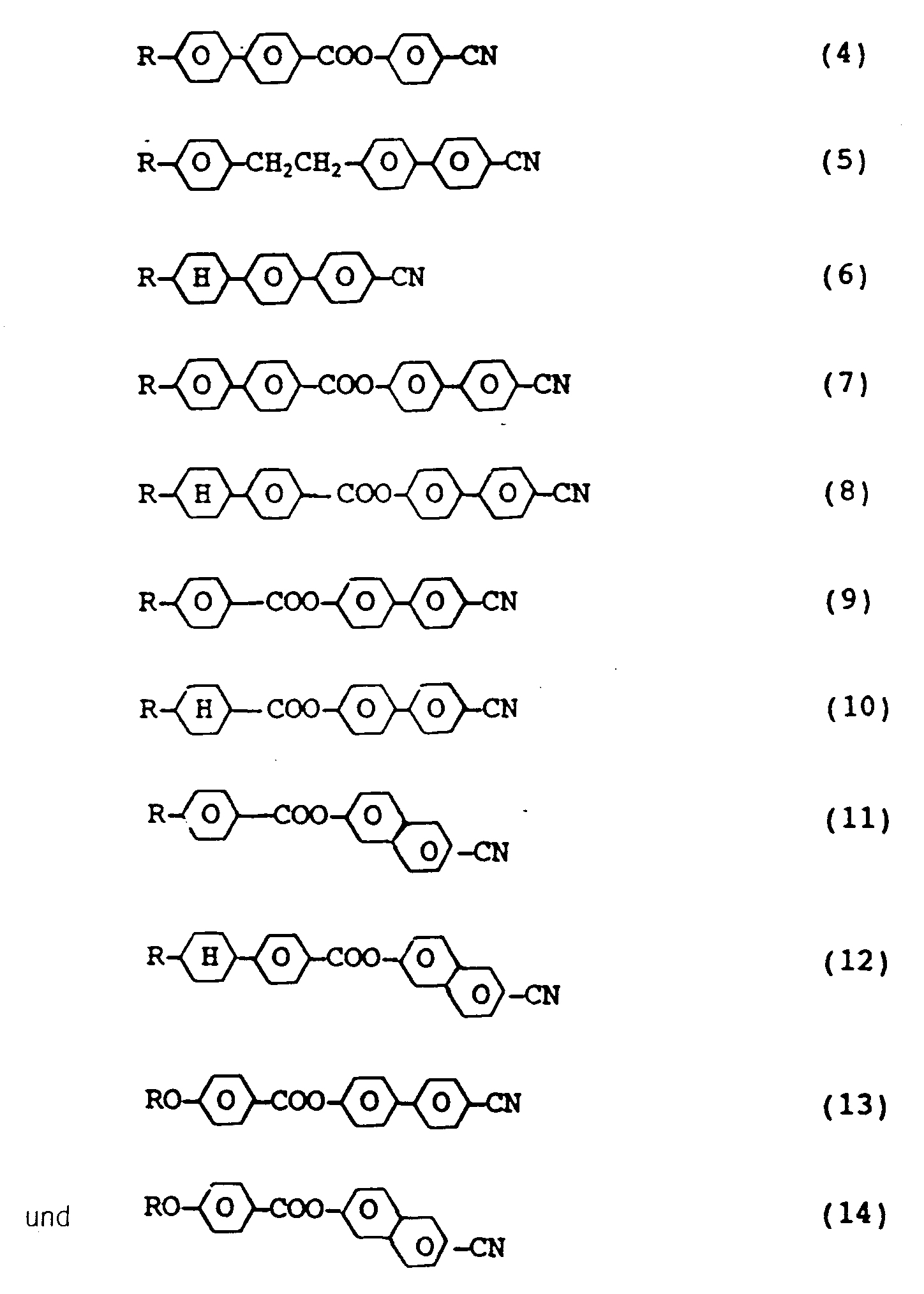
- Verfahren nach Anspruch 1 oder 2, dadurch gekennzeichnet, daß R jeweils geradkettiges Alkyl ist.
- Verfahren nach Anspruch 2 oder 3, dadurch gekennzeichnet, daß der (die) andere(n) Bestandteil(e) chirale, ionische, oberflächenaktive und/oder Gastfarbstoff-Zusätze sind.
- Verfahren nach Anspruch 2, dadurch gekennzeichnet, daß die Verbindungen des zweiten Teils aus den Klassen (5), (6) und (10) ausgewählt sind.
- Verfahren nach Anspruch 1, dadurch gekennzeichnet, daß die Basis-Flüssigkristallmischung mindestens die drei folgenden Verbindungen enthält:
4-Cyan-4'-n-oktylbiphenyl
4-Cyan-4'-n-decylbiphenyl
4-Cyan-4'-decyloxybiphenyl. - Verfahren nach Anspruch 6, dadurch gekennzeichnet, daß die Basis-Flüssigkristallmischung zusätzlich eine Verbindung aus der Klasse (3) enthält.
- Verfahren nach Anspruch 7, dadurch gekennzeichnet, daß die Basis-Verbindung aus Klasse (3) 4-Cyan-4''-n-pentylterphenyl ist.
- Verfahren nach Anspruch 1, dadurch gekennzeichnet, daß die Basis-Flüssigkristallmischung im wesentlichen aus Verbindungen der Klassen (1), (2) und gegebenenfalls (3) besteht, worin R jeweils eine n-Alkylkette mit 8 bis 10 Kohlenstoffatomen ist.
- Verfahren nach Anspruch 9, dadurch gekennzeichnet, daß die Basis-Flüssigkristallmischung im wesentlichen aus den Verbindungen 4-Cyan-4'-n-oktylbiphenyl, 4-Cyan-4'-n-decylbiphenyl, 4-Cyan-4'-n-decyloxybiphenyl und 4-Cyan-4''-n-pentylterphenyl besteht.
- Flüssigkristallzelle zur Anzeige oder Verarbeitung optischer Informationen oder auf Temperatur ansprechende Anwendung, in welcher eine smektisch A Flüssigkristall-Mischung benutzt wird, dadurch gekennzeichnet, daß die Zelle mit einer Mischung nach einem der Ansprüche 1 bis 11 befüllt ist.
- Flüssigkristallzelle nach Anspruch 11 deren Betrieb Laser- oder thermische Aussteuerung beinhaltet.
Applications Claiming Priority (2)
| Application Number | Priority Date | Filing Date | Title |
|---|---|---|---|
| GB8501548 | 1985-01-22 | ||
| GB8501548 | 1985-01-22 |
Publications (2)
| Publication Number | Publication Date |
|---|---|
| EP0213146A1 EP0213146A1 (de) | 1987-03-11 |
| EP0213146B1 true EP0213146B1 (de) | 1992-03-25 |
Family
ID=10573213
Family Applications (1)
| Application Number | Title | Priority Date | Filing Date |
|---|---|---|---|
| EP86900663A Expired - Lifetime EP0213146B1 (de) | 1985-01-22 | 1985-12-20 | Verfahren zur Erweiterung des Temperaturbereichs für die smektische A-Phase einer Flüssigkristallzusammensetzung |
Country Status (8)
| Country | Link |
|---|---|
| US (1) | US4834906A (de) |
| EP (1) | EP0213146B1 (de) |
| JP (1) | JPS62501915A (de) |
| KR (1) | KR870700088A (de) |
| AU (1) | AU589597B2 (de) |
| CA (1) | CA1277828C (de) |
| DE (1) | DE3585740D1 (de) |
| WO (1) | WO1986004324A1 (de) |
Families Citing this family (15)
| Publication number | Priority date | Publication date | Assignee | Title |
|---|---|---|---|---|
| DE3515374C2 (de) * | 1985-04-27 | 1998-02-26 | Hoechst Ag | Chirale getilte smektische flüssigkristalline Phasen und deren Verwendung in elektrooptischen Anzeigeelementen |
| GB8814327D0 (en) * | 1988-06-16 | 1988-07-20 | Secr Defence | Fluorinated 4"-cyano substituted terphenyls |
| US5312563A (en) * | 1988-06-16 | 1994-05-17 | The Secretary Of State For Defence In Her Britannic Majesty's Government Of The U.K. Of Great Britain And Northern Ireland | Fluorinated 4"-cyano substituted terphenyls |
| JPH02274794A (ja) * | 1989-04-17 | 1990-11-08 | Chisso Corp | 液晶組成物および該組成物を用いた液晶表示素子 |
| JP2711714B2 (ja) * | 1989-04-18 | 1998-02-10 | チッソ株式会社 | 液晶組成物および該組成物を用いた液晶表示素子 |
| AU5738090A (en) * | 1989-05-25 | 1990-12-18 | Optical Shields, Inc. | High speed optical protection using smectic liquid crystal |
| US5159475A (en) * | 1989-05-25 | 1992-10-27 | Optical Shields, Inc. | High speed optical protection using smectic liquid crystal |
| WO1991005029A1 (de) * | 1989-10-02 | 1991-04-18 | MERCK Patent Gesellschaft mit beschränkter Haftung | Elektrooptisches flüssigkristallsystem |
| US5958290A (en) * | 1989-10-02 | 1999-09-28 | Merck Patent Gesellschaft Mit Beschrankter Haftung | Electrooptical liquid crystal system |
| US5417885A (en) * | 1993-08-03 | 1995-05-23 | Showa Shell Sekiyu Kabushiki Kaisha | Antiferroelectric liquid crystal compound |
| JPH0940959A (ja) * | 1995-05-19 | 1997-02-10 | Dainippon Printing Co Ltd | 記録表示媒体用スメクチック液晶組成物、記録表示媒体及びその使用方法 |
| GB2395487B (en) * | 2002-09-09 | 2007-03-14 | Polydisplay Asa | Liquid crystal dopants |
| CN101533162B (zh) | 2008-03-14 | 2011-09-07 | 苏州汉朗光电有限公司 | 电控调光介质 |
| CN103666482B (zh) * | 2012-09-10 | 2016-05-25 | 苏州汉朗光电有限公司 | 一种近晶a相液晶材料 |
| TWI490321B (zh) * | 2013-08-30 | 2015-07-01 | Chunghwa Picture Tubes Ltd | 液晶組成物 |
Family Cites Families (14)
| Publication number | Priority date | Publication date | Assignee | Title |
|---|---|---|---|---|
| US3925238A (en) * | 1974-06-28 | 1975-12-09 | Rca Corp | Novel liquid crystal electro-optic devices |
| US3925237A (en) * | 1974-06-28 | 1975-12-09 | Rca Corp | Novel liquid crystal electro-optic devices |
| FR2297201A1 (fr) * | 1975-01-10 | 1976-08-06 | Thomson Csf | Produits mesogenes pour cellules a cristal liquide, et procede de fabrication desdits produits |
| US4013582A (en) * | 1976-06-17 | 1977-03-22 | Rca Corporation | Liquid crystal compounds and electro-optic devices incorporating them |
| US4113647A (en) * | 1976-08-13 | 1978-09-12 | The Secretary Of State For Defence In Her Britannic Majesty's Government Of The United Kingdom Of Great Britain And Northern Ireland | Liquid crystalline materials |
| GB1596012A (en) * | 1976-08-16 | 1981-08-19 | Secr Defence | Optically active liquid crystal materials and liquid crystal devices containing them |
| GB2009219B (en) * | 1977-11-02 | 1982-04-28 | Secr Defence | Liquid ctystal material mixtures and devices incorporating such mixtures |
| GB2031010B (en) * | 1978-09-13 | 1983-02-09 | Secr Defence | Liquid crystal materials |
| EP0008956B1 (de) * | 1978-09-13 | 1983-10-12 | The Secretary of State for Defence in Her Britannic Majesty's Government of the United Kingdom of Great Britain and | Verbesserungen an Flüssigkristall-Zusammensetzungen und Vorrichtungen |
| JPS5721359A (en) * | 1980-07-15 | 1982-02-04 | Chisso Corp | 4'''-cyano-4"-biphenylyl 4-(trans-4'-alkylcyclohexyl)benzoate |
| FR2486955A1 (fr) * | 1980-07-18 | 1982-01-22 | Thomson Csf | Cristal liquide smectique de type a presentant une anisotropie dielectrique positive |
| JPS60112741A (ja) * | 1983-11-24 | 1985-06-19 | Hitachi Ltd | 液晶性化合物,液晶組成物及び液晶表示素子 |
| FR2561250B1 (fr) * | 1984-03-16 | 1987-03-06 | Thomson Csf | Compose organique presentant une phase smectique a, melange comprenant ce compose et procede de fabrication |
| JPS60255753A (ja) * | 1984-06-01 | 1985-12-17 | Hitachi Ltd | 液晶性化合物 |
-
1985
- 1985-12-20 DE DE8686900663T patent/DE3585740D1/de not_active Expired - Fee Related
- 1985-12-20 KR KR1019860700650A patent/KR870700088A/ko active Pending
- 1985-12-20 EP EP86900663A patent/EP0213146B1/de not_active Expired - Lifetime
- 1985-12-20 AU AU53566/86A patent/AU589597B2/en not_active Ceased
- 1985-12-20 WO PCT/EP1985/000731 patent/WO1986004324A1/en not_active Ceased
- 1985-12-20 US US06/923,794 patent/US4834906A/en not_active Expired - Lifetime
- 1985-12-20 JP JP86500678A patent/JPS62501915A/ja active Pending
-
1986
- 1986-01-20 CA CA000499866A patent/CA1277828C/en not_active Expired - Fee Related
Also Published As
| Publication number | Publication date |
|---|---|
| JPS62501915A (ja) | 1987-07-30 |
| WO1986004324A1 (en) | 1986-07-31 |
| CA1277828C (en) | 1990-12-18 |
| DE3585740D1 (de) | 1992-04-30 |
| EP0213146A1 (de) | 1987-03-11 |
| KR870700088A (ko) | 1987-02-28 |
| AU5356686A (en) | 1986-08-13 |
| US4834906A (en) | 1989-05-30 |
| AU589597B2 (en) | 1989-10-19 |
Similar Documents
| Publication | Publication Date | Title |
|---|---|---|
| EP0315455B1 (de) | Ferroelektrische Flüssigkristall-Zusammensetzungen | |
| EP0213841B1 (de) | Secundäre Alkoholderivate verwendbar in flüssigkristallinen Materialien und Vorrichtungen | |
| EP0206228B1 (de) | Ferroelektrische chiralsmektische Flüssigkristallzusammensetzung und Lichtschalter | |
| EP2358846B1 (de) | Smektisch flüssigkristalline materialien mit breitem temperaturbereich | |
| AU589597B2 (en) | Smectic a liquid crystal compositions | |
| US4769176A (en) | Biphenyl esters and liquid crystal materials and devices containing them | |
| EP0525737B1 (de) | Antiferroelektrische flüssigkristalline Zusammensetzung | |
| EP0571916B1 (de) | Flüssigkristallzusammensetzung und sie enthaltende Anzeigevorrichtung | |
| EP0392432B1 (de) | Ferroelektrische Flüssigkristall-Zusammensetzung | |
| GB2198743A (en) | Ferroelectric smectic liquid crystal mixtures containing terphenyls | |
| JPH01221488A (ja) | 強誘電性液晶組成物 | |
| US5695683A (en) | Ferroelectric liquid crystal mixture | |
| JPH0762349A (ja) | スメクチック液晶混合物 | |
| JPH0882778A (ja) | 反強誘電性液晶組成物 | |
| JPH02265986A (ja) | 強誘電性液晶組成物及びそれを用いた光スイッチング素子 | |
| EP0353708A2 (de) | Ferroelektrische Flüssigkristallzusammensetzung | |
| EP0350510A1 (de) | Ferroelektrische flüssigkristallzubereitung | |
| JP3052817B2 (ja) | 反強誘電性液晶組成物 | |
| JPH0931460A (ja) | 液晶組成物および液晶表示素子 | |
| KR100544105B1 (ko) | 네마틱 액정조성물 및 이를 이용한 액정표시소자 | |
| EP0678566A1 (de) | Antiferroelektrische Flüssigkristallzusammentsetzung | |
| JP2775495B2 (ja) | 強誘電性液晶組成物 | |
| JPH0726101B2 (ja) | 強誘電性液晶組成物および光スイッチング素子 | |
| EP1029022B1 (de) | Flüssigkristall -zusammensetzung und flüssigkristall-lichtverschluss | |
| JPH1088139A (ja) | 液晶素子及びその製造方法 |
Legal Events
| Date | Code | Title | Description |
|---|---|---|---|
| PUAI | Public reference made under article 153(3) epc to a published international application that has entered the european phase |
Free format text: ORIGINAL CODE: 0009012 |
|
| 17P | Request for examination filed |
Effective date: 19861202 |
|
| AK | Designated contracting states |
Kind code of ref document: A1 Designated state(s): BE CH DE FR GB IT LI NL SE |
|
| 17Q | First examination report despatched |
Effective date: 19900125 |
|
| GRAA | (expected) grant |
Free format text: ORIGINAL CODE: 0009210 |
|
| AK | Designated contracting states |
Kind code of ref document: B1 Designated state(s): BE CH DE FR GB IT LI NL SE |
|
| PG25 | Lapsed in a contracting state [announced via postgrant information from national office to epo] |
Ref country code: IT Free format text: LAPSE BECAUSE OF FAILURE TO SUBMIT A TRANSLATION OF THE DESCRIPTION OR TO PAY THE FEE WITHIN THE PRESCRIBED TIME-LIMIT;WARNING: LAPSES OF ITALIAN PATENTS WITH EFFECTIVE DATE BEFORE 2007 MAY HAVE OCCURRED AT ANY TIME BEFORE 2007. THE CORRECT EFFECTIVE DATE MAY BE DIFFERENT FROM THE ONE RECORDED. Effective date: 19920325 Ref country code: NL Effective date: 19920325 Ref country code: BE Effective date: 19920325 Ref country code: LI Effective date: 19920325 Ref country code: SE Effective date: 19920325 Ref country code: CH Effective date: 19920325 Ref country code: FR Effective date: 19920325 |
|
| REF | Corresponds to: |
Ref document number: 3585740 Country of ref document: DE Date of ref document: 19920430 |
|
| REG | Reference to a national code |
Ref country code: CH Ref legal event code: PL |
|
| EN | Fr: translation not filed | ||
| NLV1 | Nl: lapsed or annulled due to failure to fulfill the requirements of art. 29p and 29m of the patents act | ||
| PLBE | No opposition filed within time limit |
Free format text: ORIGINAL CODE: 0009261 |
|
| STAA | Information on the status of an ep patent application or granted ep patent |
Free format text: STATUS: NO OPPOSITION FILED WITHIN TIME LIMIT |
|
| 26N | No opposition filed | ||
| PG25 | Lapsed in a contracting state [announced via postgrant information from national office to epo] |
Ref country code: DE Effective date: 19930901 |
|
| REG | Reference to a national code |
Ref country code: GB Ref legal event code: IF02 |
|
| PGFP | Annual fee paid to national office [announced via postgrant information from national office to epo] |
Ref country code: GB Payment date: 20021218 Year of fee payment: 18 |
|
| REG | Reference to a national code |
Ref country code: GB Ref legal event code: 732E |
|
| PG25 | Lapsed in a contracting state [announced via postgrant information from national office to epo] |
Ref country code: GB Free format text: LAPSE BECAUSE OF NON-PAYMENT OF DUE FEES Effective date: 20031220 |
|
| GBPC | Gb: european patent ceased through non-payment of renewal fee |
Effective date: 20031220 |