EP0213355A1 - Constellation de satellites à configuration tétraédrique et à recouvrement continu - Google Patents
Constellation de satellites à configuration tétraédrique et à recouvrement continu Download PDFInfo
- Publication number
- EP0213355A1 EP0213355A1 EP86109844A EP86109844A EP0213355A1 EP 0213355 A1 EP0213355 A1 EP 0213355A1 EP 86109844 A EP86109844 A EP 86109844A EP 86109844 A EP86109844 A EP 86109844A EP 0213355 A1 EP0213355 A1 EP 0213355A1
- Authority
- EP
- European Patent Office
- Prior art keywords
- satellites
- constellation
- satellite
- hemisphere
- visibility
- Prior art date
- Legal status (The legal status is an assumption and is not a legal conclusion. Google has not performed a legal analysis and makes no representation as to the accuracy of the status listed.)
- Granted
Links
Images


Classifications
-
- B—PERFORMING OPERATIONS; TRANSPORTING
- B64—AIRCRAFT; AVIATION; COSMONAUTICS
- B64G—COSMONAUTICS; VEHICLES OR EQUIPMENT THEREFOR
- B64G1/00—Cosmonautic vehicles
- B64G1/10—Artificial satellites; Systems of such satellites; Interplanetary vehicles
- B64G1/1085—Swarms and constellations
-
- B—PERFORMING OPERATIONS; TRANSPORTING
- B64—AIRCRAFT; AVIATION; COSMONAUTICS
- B64G—COSMONAUTICS; VEHICLES OR EQUIPMENT THEREFOR
- B64G1/00—Cosmonautic vehicles
- B64G1/10—Artificial satellites; Systems of such satellites; Interplanetary vehicles
- B64G1/1007—Communications satellites
-
- B—PERFORMING OPERATIONS; TRANSPORTING
- B64—AIRCRAFT; AVIATION; COSMONAUTICS
- B64G—COSMONAUTICS; VEHICLES OR EQUIPMENT THEREFOR
- B64G1/00—Cosmonautic vehicles
- B64G1/22—Parts of, or equipment specially adapted for fitting in or to, cosmonautic vehicles
- B64G1/24—Guiding or controlling apparatus, e.g. for attitude control
- B64G1/242—Orbits and trajectories
-
- H—ELECTRICITY
- H04—ELECTRIC COMMUNICATION TECHNIQUE
- H04B—TRANSMISSION
- H04B7/00—Radio transmission systems, i.e. using radiation field
- H04B7/14—Relay systems
- H04B7/15—Active relay systems
- H04B7/185—Space-based or airborne stations; Stations for satellite systems
- H04B7/195—Non-synchronous stations
Definitions
- This invention relates generally to a multi-satellite constellation or array and more particularly to such an array which provides continuous and complete global coverage.
- geostationary circular, equatorial, 24-hour satellites
- geostationary satellites which appear to be stationary in the sky to a ground observer, since their period of rotation matches the earth's by virtue of their placement at a precise and unique altitude.
- geostationary satellites are extensively used for commercial and military communications; they are also used for weather satellites (cloud cover and weather patterns being quite clear even from the geostationary altitude of roughly 19,325 nautical miles), and in a number of other applications.
- GPS/NAVSTAR position-fixing system capable of locating platforms equipped with receiver sets to within a few dozen feet.
- This system operates with 21 satellites placed in a precisely-coordinated circular twelve-hour constellaion or array since it is required that at least four satellites be in view of the terrestrial user with sufficient separation between satellites to facilitate the calculation of an accurate fix.
- Another system for satellite communications consists of four satellites in geostationary orbits around the equator. Unfortunately, due to their equatorial location, there are gaps at and near the polar regions. These regions are assuming a greater importance in the future.
- the present inventor designed a three satellite cubic array, or constellation, which provided complete, continuous coverage of one hemisphere (either the Northern or Southern Hemisphere).
- I also invented an agumented cubic array by the addition of one extra satellite in a circular equatorial orbit and having one-half the period of the other three satellites.
- These constellations were disclosed in a paper presented by the inventor at the August 1984 meeting of AIAA/AAS Astrodynamics Conference entitled "AIAA-84-1996 Three-and Four-Satellite Continuous-Coverage Constellations". This array provides continuous global coverage with four satellites.
- the satellites in these constellations do not have a common period, thus the design gain margins or resolutions of the three common-period satellites must be increased over that of the fourth (circular-orbit) satellite (which is at a lower altitude).
- the minimum constellation period i.e. period of the higher satellites
- the two hemispheres are covered unevenly with greater mean coverage being provided in the selected hemisphere containing the apogees of the three longer-period satellites.
- Provision of continuous global coverage with a multi-satellite constellation or array which neither interferes with, nor receives interference from, satellites in more conventional arrays, and particularly with those satellites placed in geostationary orbits at or near the plane of the equator.
- Provision of a higher than synchronous (greater than 24-hour period) multi-satellite array which is more survivable against possible hostile attack due to the fact that it is more difficult to locate, track and target by virtue of being orbited at a greater distance from earth.
- Provision of a multi-satellite array intentionally designed to be non-synchronous so as to even satellite exposure to natural or man-made interference within the array, and/or to move or rotate new, remaining array satellites into operational positions should such interference succeed in negating one of the array satellites.
- each satellite serves as host platform to a variety of sensor or mission payloads, the latter then being capable of benefitting from the continuous coverage positioning of the host platform.
- an improved, optimized, four-satellite tetrahedral constellation using common period elliptic orbits which provides continuous global coverage (i.e., any point on the earth can always maintain line-of-sight visibility with at least one of the four satellites).
- the constellation consists of two satellites having perigees in one hemisphere, and two satellites having perigees in the other hemisphere. All satellites have a common period, and positive visibility angles can be maintained down to a constellation (or satellite) period of 27 hours. At higher altitudes (longer periods) both the minimum visibility angles and the mean visibility angles will tend to increase. Replication may be provided by overlaying arrays with convenient offset.
- the invention is applicable to any celestial body wherein two satellites have periapses in one hemisphere and the other two satellites have periapses in the other hemisphere.
- the orbital parameters (ephemerides) of a perturbed tetrahedral array for any selected period are given in the following table for a four-satellite continuous global coverage common-period, elliptic constellation.
- This constellation was derived from the regular polyhedron, or Platonic solid, known as the tetrahedron.
- the tetrahedron is assumed to be initially placed with two edges in horizontal planes.
- the tetrahedron is then perturbed, or flattened, such that the angles of inclination from the horizontal are decreased.
- the planes of the satellite orbits lie parallel to the planes of this perturbed tetrahedron.
- Each of the satellite orbits is made elliptic, rather than circular, with the eccentricity lying in a suitable range.
- the ellipses are so arranged that two opposing satellites have their peri gees in the Northern Hemisphere, while the other two have their perigees in the Southern Hemisphere.
- the mean anomalies for the starting positions of the satellite orbits are selected so that one opposing satellite pair has one satellite at perigee and the other at apogee. The other pair are placed midway (in time) between apogee and perigee (i.e., one at 90° mean anomaly and the other at 270° mean anomaly). It should be noted that, while the present description relates to Northern and Southern Hemisphere, any hemispheres may be selected, if desired.
- Figs. 1(a) and 1(b) are isometric views of a circular orbit tetrahedron constellation with the satellites in their starting positions.
- Fig. 1(a) shows the pair of satellites S1 and S3 while
- Fig. 1(b) shows the pair of satellites S2 and S4.
- Satellite S1 is in a circular orbit whose orbital plane is parallel to face ACD of the regular tetrahedron.
- Satellite S3 is in a circular orbit whose orbital plane is parallel to face BCD of the regular tetrahedron.
- the orbital planes pass through the center of mass of the tetrahedron.
- Satellites S1 and S3 are assumed to have arguments of perigee of -90° for reference purposes. Satellite S1's starting position is at a true (and mean) anomaly of 0°, while the corresponding true (and mean) anomaly for satellite S3 is 180°.
- satellites S2 and S4 are occupying the same starting position. Since the reference arguments of perigee for these two planes are +90°, the mean (and true) anomalies of satellites S2 and S4 are 270° and 90° respectively.
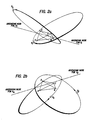
- Figs 2(a) and 2(b) are isometric views of a perturbed tetrahedral constellation with elliptic orbits. Satellites are shown in their starting positions, again (as in Figs. 1(a) and 1(b)), treating them in pairs for easier viewing. All satellites are shown in their starting positions.
- Satellites S2 and S4 are shown in their elliptic orbits parallel to faces ABC and ABD of the flattened tetrahedron respectively. These two orbits have their periapses in the Northern Hemisphere. Satellites S2 and S4 have mean anomalies of 270° and 90° respectively, which are their starting positions. Note that in this perturbed (elliptic) constellations the two satellites S2 and S4 do not now occupy the same location in the starting position. This separation is the result of making the orbits eccentric.
- FIG. 1 is a plan view of the constellation, as described above, showing satellites 1, 2, 3 and 4 in their starting position. (Looking down from the North Pole with nearer portions of orbits being indicated by heavier lines.) Ground tracks of the satellites are shown on the Mercator chart in Fig. 2 also indicating the starting position.
- this particular constellation was given a selected 48-hour period. Since the ephemerides in Table I are given in inertial coordinates, these values can be used for any constellation or satellite period selected. This permits variation of the period, subject to the limits for complete and continuous satellite visibility, which has been found to be 27 hours, after optimizing all of the other orbital parameters.
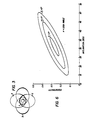
- Fig. 3 shows the minimum visibility angle obtainable as a function of constellation period. It should be noted that this minimum visibility angle only occurs periodically in time, and then only in a limited geographical region. Most of the time, over the surface of the earth, much larger visibility angles are the rule. Further, the entire constellation could be reoriented, by rotation through an angle or angles, to yield constellations which would be entirely equivalent in an inertial sense, but would present radically different ground tracks due to earth rotation and/or changes in period.
- these perturbations are generally quite small - about 1° or 2° per year.
- they may be easily controlled by a relatively small amount of station-keeping or periodic thrusting of the satellites by means of an on board maneuvering unit, so as to maintain the constellation ephemerides in the optimal or near-optimal configuration.
- Such maneuvering units are well known in the art.
- the optimum combination for this 48-hour constellation appears to be obtained with satellites having orbital inclinations of 33° and eccentricities of 0.28.
- the minimum global look angle anywhere on the surface of the earth to a satellite would 2.1°. It is to be understood that the 48-hour period was selected for purposes of illustration and is not to be considered as a limitation of the present invention.
- a multi-satellite array may be provided by means of replication, overlay, and/or time-phasing similar or identical four-satellite arrays in order to give added redundancy in the number of satellites visible from ground observation. For example, overlaying four continuous coverage arrays with convenient offset will ensure at least quadruple continuous coverage by satellites at any point on earth. For n-tuple coverage, n arrays will suffice in the general sense.
- the present invention solves the problem of providing continuous earth coverage with the minimum number of artificial satellites, at the nearest possible distance from earth (i.e., at the minimum satellite periods). Concurrently, for any period higher than this minimum the constellation will provide consistently higher visibility angles than the only other known four-satellite full-coverage constellation. Another problem this invention solves is the provision of equal mean coverage, as between the two hemispheres.
Landscapes
- Engineering & Computer Science (AREA)
- Remote Sensing (AREA)
- Aviation & Aerospace Engineering (AREA)
- Physics & Mathematics (AREA)
- General Physics & Mathematics (AREA)
- Astronomy & Astrophysics (AREA)
- Radar, Positioning & Navigation (AREA)
- Chemical & Material Sciences (AREA)
- Combustion & Propulsion (AREA)
- Computer Networks & Wireless Communication (AREA)
- Signal Processing (AREA)
- Radio Relay Systems (AREA)
- Digital Transmission Methods That Use Modulated Carrier Waves (AREA)
- Position Fixing By Use Of Radio Waves (AREA)
- Developing Agents For Electrophotography (AREA)
Priority Applications (1)
| Application Number | Priority Date | Filing Date | Title |
|---|---|---|---|
| AT86109844T ATE43311T1 (de) | 1985-07-19 | 1986-07-17 | Tetraeder-satellitenkonstellationen mit ununterbrochener ausleuchtzone. |
Applications Claiming Priority (2)
| Application Number | Priority Date | Filing Date | Title |
|---|---|---|---|
| US756635 | 1985-07-19 | ||
| US06/756,635 US4854527A (en) | 1985-07-19 | 1985-07-19 | Tetrahedral multi-satellite continuous-coverage constellation |
Publications (2)
| Publication Number | Publication Date |
|---|---|
| EP0213355A1 true EP0213355A1 (fr) | 1987-03-11 |
| EP0213355B1 EP0213355B1 (fr) | 1989-05-24 |
Family
ID=25044376
Family Applications (1)
| Application Number | Title | Priority Date | Filing Date |
|---|---|---|---|
| EP86109844A Expired EP0213355B1 (fr) | 1985-07-19 | 1986-07-17 | Constellation de satellites à configuration tétraédrique et à recouvrement continu |
Country Status (4)
| Country | Link |
|---|---|
| US (1) | US4854527A (fr) |
| EP (1) | EP0213355B1 (fr) |
| AT (1) | ATE43311T1 (fr) |
| DE (1) | DE3663504D1 (fr) |
Cited By (5)
| Publication number | Priority date | Publication date | Assignee | Title |
|---|---|---|---|---|
| EP0331567A1 (fr) * | 1988-03-02 | 1989-09-06 | Centre National D'etudes Spatiales | Système de communications avec des mobiles à l'aide de satellites |
| WO2010096592A3 (fr) * | 2009-02-19 | 2010-12-16 | Korb C Laurence | Procédés d'optimisation de la performance, du coût et de la conception de constellations de satellites pour une couverture terrestre entière et partielle |
| CN105511483A (zh) * | 2015-12-02 | 2016-04-20 | 上海宇航系统工程研究所 | 鸟巢式星座及其设计方法 |
| CN104180810B (zh) * | 2014-08-26 | 2016-08-31 | 上海微小卫星工程中心 | 一种卫星测控出入境判定方法及装置 |
| EP3380400A4 (fr) * | 2015-11-27 | 2019-07-24 | Telesat Canada | Système de satellite et procédé de couverture globale |
Families Citing this family (29)
| Publication number | Priority date | Publication date | Assignee | Title |
|---|---|---|---|---|
| US5199672A (en) * | 1990-05-25 | 1993-04-06 | Orbital Sciences Corporation | Method and apparatus for deploying a satellite network |
| US5433726A (en) * | 1991-04-22 | 1995-07-18 | Trw Inc. | Medium-earth-altitude satellite-based cellular telecommunications system |
| US5439190A (en) * | 1991-04-22 | 1995-08-08 | Trw Inc. | Medium-earth-altitude satellite-based cellular telecommunications |
| IL98893A (en) * | 1991-07-19 | 1996-07-23 | Mass Jonathan | Artificial satellite communication system |
| DE4135034C2 (de) * | 1991-10-23 | 1995-04-13 | Deutsche Forsch Luft Raumfahrt | Einrichtung zur Bahnkontrolle von mindestens zwei kopositionierten geostationären Satelliten |
| US5788187A (en) * | 1992-06-02 | 1998-08-04 | Mobile Communications Holdings, Inc. | Elliptical orbit satellite, system, and deployment with controllable coverage characteristics |
| US5582367A (en) * | 1992-06-02 | 1996-12-10 | Mobile Communications Holdings, Inc. | Elliptical orbit satellite, system, and deployment with controllable coverage characteristics |
| US5931417A (en) * | 1992-06-02 | 1999-08-03 | Mobile Communications Holdings, Inc. | Non-geostationary orbit satellite constellation for continuous coverage of northern latitudes above 25° and its extension to global coverage tailored to the distribution of populated land masses on earth |
| IT1261940B (it) * | 1993-09-24 | 1996-06-04 | Alenia Spazio Spa | Sistema per telecomunicazioni e telerilevamento via satellite basato sull'uso di orbite eliosincrone ellittiche di breve periodo. |
| US5641134A (en) * | 1994-12-27 | 1997-06-24 | Motorola, Inc. | Satellite cellular telephone and data communication system at an inclined orbit |
| US5971324A (en) * | 1995-10-03 | 1999-10-26 | Trw Inc. | Multiple altitude satellite relay system and method |
| US5890679A (en) * | 1996-09-26 | 1999-04-06 | Loral Aerospace Corp. | Medium earth orbit communication satellite system |
| WO1998051022A1 (fr) * | 1997-05-02 | 1998-11-12 | Uscx | Systeme de satellite geostationnaire a haute latitude |
| US20030189136A1 (en) * | 1998-05-20 | 2003-10-09 | Toshihide Maeda | Communication system, communication receiving device and communication terminal in the system |
| US6182927B1 (en) | 1998-09-24 | 2001-02-06 | The Boeing Company | Medium earth orbit augmentation of a global positioning system for global navigation |
| US6305646B1 (en) * | 1999-12-21 | 2001-10-23 | Hughes Electronics Corporation | Eccentricity control strategy for inclined geosynchronous orbits |
| US6453220B1 (en) * | 2000-01-31 | 2002-09-17 | Space Systems/Loral, Inc. | Low earth orbit satellite constellation stationkeeping algorithm with absolute altitude control |
| US6695260B2 (en) * | 2000-02-03 | 2004-02-24 | Virtual Geosatellite Llc | Virtually geostationary satellite array |
| US6714521B2 (en) * | 2000-12-29 | 2004-03-30 | Space Resources International Ltd. | System and method for implementing a constellation of non-geostationary satellites that provides simplified satellite tracking |
| DE10132723B4 (de) * | 2001-07-05 | 2006-03-30 | Deutsches Zentrum für Luft- und Raumfahrt e.V. | Satellitenkonfiguration zur interferometrischen und/oder tomografischen Abbildung der Erdoberfläche mittels Radar mit synthetischer Apertur (SAR) |
| US20040211864A1 (en) * | 2003-04-25 | 2004-10-28 | Less Gregory P. | Efficient communications utilizing highly inclined, highly elliptic orbits |
| US7370566B2 (en) * | 2003-09-04 | 2008-05-13 | Harris Corporation | Complimentary retrograde/prograde satellite constellation |
| US7629926B2 (en) * | 2004-10-15 | 2009-12-08 | Telecommunication Systems, Inc. | Culled satellite ephemeris information for quick, accurate assisted locating satellite location determination for cell site antennas |
| US7840180B2 (en) * | 2006-12-22 | 2010-11-23 | The Boeing Company | Molniya orbit satellite systems, apparatus, and methods |
| US8016240B2 (en) * | 2007-03-29 | 2011-09-13 | The Boeing Company | Satellites and satellite fleet implementation methods and apparatus |
| US9857475B2 (en) * | 2008-09-09 | 2018-01-02 | Geooptics, Inc. | Cellular interferometer for continuous earth remote observation (CICERO) |
| US9254781B2 (en) * | 2010-02-02 | 2016-02-09 | Craig David Applebaum | Emergency vehicle warning device and system |
| CA2716174C (fr) * | 2010-10-01 | 2019-11-26 | Telesat Canada | Systeme satellitaire |
| IT201900012498A1 (it) * | 2019-07-22 | 2021-01-22 | D Orbit S P A | Modulo satellitare per la determinazione di assetto |
Citations (1)
| Publication number | Priority date | Publication date | Assignee | Title |
|---|---|---|---|---|
| DE1224159B (de) * | 1964-10-03 | 1966-09-01 | Telefunken Patent | Satellitensystem |
Family Cites Families (1)
| Publication number | Priority date | Publication date | Assignee | Title |
|---|---|---|---|---|
| DE59454C (de) * | Dr. L. VON ORTH in Berlin N.W., Klopstockstr. 53 I | Vorrichtung zum Reguliren von Uhren auf elektrischem Wege |
-
1985
- 1985-07-19 US US06/756,635 patent/US4854527A/en not_active Expired - Lifetime
-
1986
- 1986-07-17 AT AT86109844T patent/ATE43311T1/de not_active IP Right Cessation
- 1986-07-17 DE DE8686109844T patent/DE3663504D1/de not_active Expired
- 1986-07-17 EP EP86109844A patent/EP0213355B1/fr not_active Expired
Patent Citations (1)
| Publication number | Priority date | Publication date | Assignee | Title |
|---|---|---|---|---|
| DE1224159B (de) * | 1964-10-03 | 1966-09-01 | Telefunken Patent | Satellitensystem |
Non-Patent Citations (1)
| Title |
|---|
| JOURNAL OF GUIDANCE, CONTROL AND DYNAMICS, vol. 8, no. 6, November/December 1985, pages 725-730, AIAA Publication, New York, US; J.E. DRAIM: "Three- and four-satellite continuous-coverage constellations" * |
Cited By (12)
| Publication number | Priority date | Publication date | Assignee | Title |
|---|---|---|---|---|
| EP0331567A1 (fr) * | 1988-03-02 | 1989-09-06 | Centre National D'etudes Spatiales | Système de communications avec des mobiles à l'aide de satellites |
| FR2628274A1 (fr) * | 1988-03-02 | 1989-09-08 | Centre Nat Etd Spatiales | Systeme de communications avec des mobiles a l'aide de satellites |
| US4943808A (en) * | 1988-03-02 | 1990-07-24 | Centre National D'etudes Spatiales | Communications system with moving bodies with the aid of satellites |
| AU614336B2 (en) * | 1988-03-02 | 1991-08-29 | Centre National D' Etudes Spatiales | Communications system with moving bodies with the aid of satellites |
| WO2010096592A3 (fr) * | 2009-02-19 | 2010-12-16 | Korb C Laurence | Procédés d'optimisation de la performance, du coût et de la conception de constellations de satellites pour une couverture terrestre entière et partielle |
| US8238903B2 (en) | 2009-02-19 | 2012-08-07 | Korb C Laurence | Methods for optimizing the performance, cost and constellation design of satellites for full and partial earth coverage |
| AU2010215963B2 (en) * | 2009-02-19 | 2015-08-06 | Andrew Robert Korb | Methods for optimizing the performance, cost and constellation design of satellites for full and partial earth coverage |
| US9132925B2 (en) | 2009-02-19 | 2015-09-15 | C. Laurence Korb | Methods for optimizing the performance, cost and constellation design of satellites for full and partial earth coverage |
| CN104180810B (zh) * | 2014-08-26 | 2016-08-31 | 上海微小卫星工程中心 | 一种卫星测控出入境判定方法及装置 |
| EP3380400A4 (fr) * | 2015-11-27 | 2019-07-24 | Telesat Canada | Système de satellite et procédé de couverture globale |
| CN105511483A (zh) * | 2015-12-02 | 2016-04-20 | 上海宇航系统工程研究所 | 鸟巢式星座及其设计方法 |
| CN105511483B (zh) * | 2015-12-02 | 2018-01-12 | 上海宇航系统工程研究所 | 鸟巢式星座及其设计方法 |
Also Published As
| Publication number | Publication date |
|---|---|
| ATE43311T1 (de) | 1989-06-15 |
| DE3663504D1 (en) | 1989-06-29 |
| US4854527A (en) | 1989-08-08 |
| EP0213355B1 (fr) | 1989-05-24 |
Similar Documents
| Publication | Publication Date | Title |
|---|---|---|
| US4854527A (en) | Tetrahedral multi-satellite continuous-coverage constellation | |
| US4809935A (en) | Satellite continuous coverage constellations | |
| US5326054A (en) | Apogee at constant time-of-day equatorial (ACE) orbit | |
| CA2216399C (fr) | Systeme de satellite a orbite elliptique reproduisant les caracteristiques des satellites geosynchrones | |
| US6325332B1 (en) | Coordinatable system of inclined geosynchronous satellite orbits | |
| US6102335A (en) | Elliptical orbit satellite, system, and deployment with controllable coverage characteristics | |
| Draim | A common-period four-satellite continuous global coverage constellation | |
| EP0654403B1 (fr) | Méthode pour le maintien en position d'un satellite | |
| US5788187A (en) | Elliptical orbit satellite, system, and deployment with controllable coverage characteristics | |
| Maini et al. | Satellite technology: principles and applications | |
| RU2273591C2 (ru) | Система негеостационарных спутников, обеспечивающая упрощенное сопровождение спутников, спутниковая система связи и способ спутниковой связи | |
| US5931417A (en) | Non-geostationary orbit satellite constellation for continuous coverage of northern latitudes above 25° and its extension to global coverage tailored to the distribution of populated land masses on earth | |
| US6868316B1 (en) | Satellite constellation system | |
| US20020160710A1 (en) | Fixed satellite constellation system employing non-geostationary satellites in sub-geosynchronous elliptical orbits with common ground tracks | |
| US5871181A (en) | Artificial satellite communication system | |
| US6678519B2 (en) | Elliptical satellite system which emulates the characteristics of geosynchronous satellites | |
| US6795687B1 (en) | Elliptical satellite system emulating characteristics of geosynchronous satellites during the apogee portion of an elliptical orbit | |
| US8106815B2 (en) | System for positioning a terrestrial user | |
| Dondl | LOOPUS opens a new dimension in satellite communications | |
| Castiel et al. | Ellipso-coverage optimization using elliptic orbits | |
| JP2000036788A (ja) | 天頂方向での滞在時間が長い軌道の人工衛星とその軌道制御方法及びそれを用いた通信システム | |
| Draim | Optimization of the ELLIPSO™ and ELLIPSO 2G™ Personal Communications Systems | |
| WO2001024383A2 (fr) | Systeme de constellation de satellites fixe, utilisant des satellites non geostationnaires sur des orbites elliptiques sous-geosynchrones a traces communes | |
| Ilcev | Integration Architecture of the Satellite Space Segment within the Modernization of the GMDSS Networks | |
| KR100237383B1 (ko) | 시간동기형 비정지궤도 위성군 설계 구조 |
Legal Events
| Date | Code | Title | Description |
|---|---|---|---|
| PUAI | Public reference made under article 153(3) epc to a published international application that has entered the european phase |
Free format text: ORIGINAL CODE: 0009012 |
|
| AK | Designated contracting states |
Kind code of ref document: A1 Designated state(s): AT BE CH DE FR GB IT LI LU NL SE |
|
| 17P | Request for examination filed |
Effective date: 19870227 |
|
| 17Q | First examination report despatched |
Effective date: 19870921 |
|
| GRAA | (expected) grant |
Free format text: ORIGINAL CODE: 0009210 |
|
| AK | Designated contracting states |
Kind code of ref document: B1 Designated state(s): AT BE CH DE FR GB IT LI LU NL SE |
|
| PG25 | Lapsed in a contracting state [announced via postgrant information from national office to epo] |
Ref country code: CH Effective date: 19890524 Ref country code: IT Free format text: LAPSE BECAUSE OF FAILURE TO SUBMIT A TRANSLATION OF THE DESCRIPTION OR TO PAY THE FEE WITHIN THE PRE;WARNING: LAPSES OF ITALIAN PATENTS WITH EFFECTIVE DATE BEFORE 2007 MAY HAVE OCCURRED AT ANY TIME BEFORE 2007. THE CORRECT EFFECTIVE DATE MAY BE DIFFERENT FROM THE ONE RECORDED.SCRIBED TIME-LIMIT Effective date: 19890524 Ref country code: BE Effective date: 19890524 Ref country code: AT Effective date: 19890524 Ref country code: SE Effective date: 19890524 Ref country code: NL Effective date: 19890524 Ref country code: LI Effective date: 19890524 |
|
| REF | Corresponds to: |
Ref document number: 43311 Country of ref document: AT Date of ref document: 19890615 Kind code of ref document: T |
|
| REF | Corresponds to: |
Ref document number: 3663504 Country of ref document: DE Date of ref document: 19890629 |
|
| PG25 | Lapsed in a contracting state [announced via postgrant information from national office to epo] |
Ref country code: LU Free format text: LAPSE BECAUSE OF NON-PAYMENT OF DUE FEES Effective date: 19890731 |
|
| PGFP | Annual fee paid to national office [announced via postgrant information from national office to epo] |
Ref country code: DE Payment date: 19890731 Year of fee payment: 4 Ref country code: FR Payment date: 19890731 Year of fee payment: 4 |
|
| ET | Fr: translation filed | ||
| REG | Reference to a national code |
Ref country code: CH Ref legal event code: PL |
|
| NLV1 | Nl: lapsed or annulled due to failure to fulfill the requirements of art. 29p and 29m of the patents act | ||
| PLBE | No opposition filed within time limit |
Free format text: ORIGINAL CODE: 0009261 |
|
| STAA | Information on the status of an ep patent application or granted ep patent |
Free format text: STATUS: NO OPPOSITION FILED WITHIN TIME LIMIT |
|
| 26N | No opposition filed | ||
| PG25 | Lapsed in a contracting state [announced via postgrant information from national office to epo] |
Ref country code: GB Effective date: 19900717 |
|
| GBPC | Gb: european patent ceased through non-payment of renewal fee | ||
| PG25 | Lapsed in a contracting state [announced via postgrant information from national office to epo] |
Ref country code: FR Effective date: 19910329 |
|
| PG25 | Lapsed in a contracting state [announced via postgrant information from national office to epo] |
Ref country code: DE Effective date: 19910403 |
|
| REG | Reference to a national code |
Ref country code: FR Ref legal event code: ST |