EP0213405B1 - Verfahren und Vorrichtung zur Massenproduktion von entomophagen Insekten und Anwendung zur biologischen Schädlingsbekämpfung - Google Patents
Verfahren und Vorrichtung zur Massenproduktion von entomophagen Insekten und Anwendung zur biologischen Schädlingsbekämpfung Download PDFInfo
- Publication number
- EP0213405B1 EP0213405B1 EP86110569A EP86110569A EP0213405B1 EP 0213405 B1 EP0213405 B1 EP 0213405B1 EP 86110569 A EP86110569 A EP 86110569A EP 86110569 A EP86110569 A EP 86110569A EP 0213405 B1 EP0213405 B1 EP 0213405B1
- Authority
- EP
- European Patent Office
- Prior art keywords
- inoculum
- cage
- parasitized
- eggs
- host eggs
- Prior art date
- Legal status (The legal status is an assumption and is not a legal conclusion. Google has not performed a legal analysis and makes no representation as to the accuracy of the status listed.)
- Expired - Lifetime
Links
Images


Classifications
-
- A—HUMAN NECESSITIES
- A01—AGRICULTURE; FORESTRY; ANIMAL HUSBANDRY; HUNTING; TRAPPING; FISHING
- A01K—ANIMAL HUSBANDRY; AVICULTURE; APICULTURE; PISCICULTURE; FISHING; REARING OR BREEDING ANIMALS, NOT OTHERWISE PROVIDED FOR; NEW BREEDS OF ANIMALS
- A01K67/00—Rearing or breeding animals, not otherwise provided for; New or modified breeds of animals
- A01K67/30—Rearing or breeding invertebrates
- A01K67/34—Insects
- A01K67/36—Industrial rearing of insects, e.g. insect farms
- A01K67/362—Containers or crates
Definitions
- the present invention relates generally to the multiplication and mass production of an entomophagous insect such as Trichogramma ma ⁇ dis, from a replacement host such as the egg of the European mealworm Ephestia kuehniella, said entomophagus being in this case used in seasonal flood releases as part of the biological control against a pest of corn crops, Ostrinia nubilalis or European corn borer.
- an entomophagous insect such as Trichogramma ma ⁇ dis
- a replacement host such as the egg of the European mealworm Ephestia kuehniella
- the invention therefore relates more particularly to a method of mass production of an entomophagous insect, with a device for its implementation, as well as the application of said method in biological control by means of micro-containers intended for laucher in the field.
- the production of this entomophagus is carried out, according to FR-A-2 202 644 in so-called "climatic" chambers where host eggs are presented in monolayer on plates with an amount of adult Trichograms, or inoculum, in a ratio determined according to the Trichogram chosen, and previously emerged from parasitized eggs arranged in plates in the chamber.
- the duration of parasitism of the host eggs by the inoculum of Trichogrammes must be limited to 48 hours at 25 ° C (cf. work by Madame PIZZOL on the induction of diapause in Trichogramma ma ⁇ dis allowing this cold storage). On average 75% of the host eggs thus presented are parasitized. Part of the eggs thus parasitized is however recycled as an inoculum for the next generation.
- the parasitism time of the part recycled as an inoculum must not exceed these 48 hours either to avoid too great a spread of the emergences in the cages. Even in this case, it is then necessary to wait at least 48 hours after the first emergences of the inoculum to introduce the host egg plate.
- the present invention therefore aims to remedy these drawbacks, in particular by providing a method of multiplication and mass production of entomophagous insects by the formation of parasitized host eggs in a population cage, finding an advantageous application in the case of the Trichogram and of the biological control of the European Corn Borer.
- the solution according to the present invention consists in a process for the mass production of an entomophagous insect, in a multiplication cage where adult insects originating from a previously constituted inocultim formed from first parasitized host eggs and placed on a first support, are placed in the presence of second host eggs to be parasitized placed on a second support, a portion of which is taken to form said inoculum, a process characterized in that a constant population of adult insects is maintained at constant temperature from said inoculum to which it was subjected to a prior incubation, that said inoculum is activated in the cage for a period corresponding to the time necessary for the emergence of the adult at said temperature, which is continuously scrolled at the same speed in said cage said first and second supports, said speed making it possible to present continuously and regularly for a period of p determined resentation the second host eggs to be parasitized by the insect having emerged from said inoculum, while feeding said insect, and then the second host eggs thus parasitized are continuously collected from which the fraction
- the second parasitized host eggs After having collected the second parasitized host eggs, they are applied as an inoculum in the presence of healthy eggs from the entomophagus, in the form of a metered mixture introduced into a micro-container intended to be released in the field and treated according to the spread of emergence of the entomophagous insects desired.
- the device comprises an illuminated and temperature-controlled enclosure constituting a population cage, and is characterized in that the first support intended for the inoculum is constituted by a strip narrow conveyor, the second support intended for the host eggs to be parasitized being constituted by a wide conveyor belt, that the cage comprises an inlet of said wide belt and a housing for activating the inoculum, as well as an outlet from said wide band and winding of a narrow coil intended for the formation of said inoculum, said conveyor belts being guided on rollers and driven continuously at the same speed by a motor unit said activation housing may contain narrow coils during the duration of activation of the inoculum and that said cage is also associated with external means for recovering the host eggs parasitized and reconditioning of said broadband.
- the first support intended for the inoculum is constituted by a strip narrow conveyor
- the second support intended for the host eggs to be parasitized being constituted by a wide conveyor belt
- the cage comprises an inlet of said wide belt and a housing for activating the inoculum
- the Trichogram In the case, for example, of the Trichogram, a population of said Trichograms is kept in a cage, constant in terms of its quantity and its biological potential, and the host eggs are brought in continuously and regularly for their parasitism.
- a regular supply of Trichograms compensating for mortality is necessary and provided by the cage itself, in the form of the first host eggs parasitized and incubated for two weeks at 22 ° C, introduced into a housing provided for this purpose on the cage where the Trichogrammes will be able to emerge and parasitize the second host eggs which are presented to them continuously.
- the time of presence in the cage of the inoculum is days and that of the second host eggs is 24 hours, as will be better explained below.
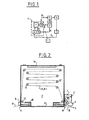
- the device for implementing the above method comprises different stations relative to a general reference unit E comprising the cage proper 7 in which two conveyor belts A and B pass continuously, respectively narrow for the first host eggs constituting the inoculum-cage and wide double-faced for the second host eggs, both driven at the appropriate speed by a power unit 1.
- the turns are introduced at 8 into the cage, in a housing where five turns 2 take place.
- the introduction of a turn 2 causes the expulsion of a turn 2 at 9 out of the cage.
- a turn 2 therefore remains in the cage for five days, which is suitable for complete emergence of the Trichograms from the first host eggs.
- the wide strip B supporting by gluing the second parasitized host eggs is brushed in 3 on its two faces, the eggs being recovered in 10 in the form of powder for their subsequent treatment.
- the strip B is cleaned in 4, rinsed, then again glued and filled with healthy host eggs on its two sides in 5 before its reintroduction in 6 in the cage 7.
- the path between the external stations 3 and 6 in cage 7 also lasts 24 hours.
- the cage 7 is constituted by an enclosure provided with an inlet 11 representing the two stations 6 and 8, respectively for the band B and for the band A. These two bands are guided on rollers coaxial 12, one for band A (13) and the other for band B (14).
- the first roller 15 of the inlet 11 is advantageously provided with a conventional brake 16 intended to adjust the tension of the bands.
- the cage further comprises a movable bottom 17, intended in particular to eliminate dead Trichograms.
- an appropriate light source 18 is arranged on the upper internal face of the cage 7 in order to maintain the main part of the population of Trichogrammes towards the top of the cage, while the latter are supplied for example by means of honey can be placed either automatically on the edge of the strips, or manually at the level of said upper internal face.
- the bands A and B are driven by a motor unit 1, at a speed such that these bands travel their path at the same speed between the inlet 11 and the outlet 19 of the cage in 24 hours.
- strip A is extracted, while a new strip of parasitized eggs which have been subjected to incubation in a separate station (not shown) is introduced in the form of a turn 20 at station 8.
- Band B is directed on its side on a brush roller 3 from where the second host eggs, parasitized, are collected in the form of powder in a receptacle 10.
- Band B is then rinsed in a bath 4, re-glued in 5 on both sides and filled with healthy host eggs, then introduced into the cage through the entrance 11.
- the strip A coming from the incubation station, introduced in the form of a coil 20 into one of the housings 8 of the cage 7, progresses for its activation at such a speed that its total journey takes five days, duration corresponding to the time necessary for the emergence of Trichograms.
- the host eggs collected in the receptacle 10 of the production device are then applied, as an inoculum placed in the presence of third healthy host eggs in micro-containers, each in the form for example of a capsule. in 1.2 cm diameter cardboard in two half-spheres glued and then later drilled and intended for release in the field.
- the principle consists in parasitizing the host eggs directly in this capsule by associating the appropriate inoculum-capsule with it. This is calculated so that the number of parasitized eggs is maximum while limiting superparasitism to an acceptable threshold. In the case of capsules, the ratio of parasitized "black” eggs (inoculum) / "white” eggs to be parasitized is 1/15.
- the grouping of the outputs is also essential in the case of conditioning the development of the Trichogram in the cold for the induction of a diapause allowing the long-term storage of the biological product, as described in French patent n ° 79 17 774
- lots of eggs were submitted parasites, where the very first adult appeared, at relatively low temperatures (10, 14 and 18 ° C and for periods of 24 to 48 hours) so as to slow down nymphal development and consolidate the exit of adults.
- these batches are exposed to high temperatures (22 to 25 ° C with morning and evening checks of trips for three days) to obtain trips for adult Trichograms in a short time.
- a control batch was further subjected to development at a constant temperature of 22 ° C.
- Table 1 The results grouped in Table 1 below show that it is the inoculum exposed to 10 ° and 14 ° C for 24 to 48 hours and subjected to a passage at 25 ° C for 15 hours, which provide the optimal conditions for output (> 90%).
- the parasitism mode described above allows a capsule inoculum-healthy egg ratio of the host at least equal to 1/15 with negligible superparasitism, hence a substantial saving of inoculum-capsule.
- the assembly of the present invention makes it possible to obtain an automated production chain, from the basic inoculum to the capsule to let go in the field, said capsule being able moreover to produce entomophagous insects with grouped or spread emergence. , while ensuring the possibility of storage of ready-to-use packaged items.
- the capsules naturally need to be pierced to allow the release of emerged insects, for example by means of an automatic needle device.
- the drilling must however be carried out according to the mode of use adopted, namely, either just before the treatment at 10-14 ° C, or after storage at 3 ° C following the diapause.
- Trichogramma ma ⁇ dis can naturally apply for the production of another insect, since it is then sufficient to adapt the conditions of temperature and duration to the biological characteristics of the individual considered. .
Landscapes
- Life Sciences & Earth Sciences (AREA)
- Environmental Sciences (AREA)
- Animal Behavior & Ethology (AREA)
- Zoology (AREA)
- Animal Husbandry (AREA)
- Biodiversity & Conservation Biology (AREA)
- Micro-Organisms Or Cultivation Processes Thereof (AREA)
- Agricultural Chemicals And Associated Chemicals (AREA)
- Catching Or Destruction (AREA)
- Breeding Of Plants And Reproduction By Means Of Culturing (AREA)
- Farming Of Fish And Shellfish (AREA)
- Meat, Egg Or Seafood Products (AREA)
Claims (8)
Priority Applications (1)
| Application Number | Priority Date | Filing Date | Title |
|---|---|---|---|
| AT86110569T ATE54043T1 (de) | 1985-08-07 | 1986-07-31 | Verfahren und vorrichtung zur massenproduktion von entomophagen insekten und anwendung zur biologischen schaedlingsbekaempfung. |
Applications Claiming Priority (2)
| Application Number | Priority Date | Filing Date | Title |
|---|---|---|---|
| FR8512115 | 1985-08-07 | ||
| FR8512115A FR2585924B1 (fr) | 1985-08-07 | 1985-08-07 | Procede et dispositif de production en masse d'un insecte entomophage, son application en lutte biologique |
Publications (2)
| Publication Number | Publication Date |
|---|---|
| EP0213405A1 EP0213405A1 (de) | 1987-03-11 |
| EP0213405B1 true EP0213405B1 (de) | 1990-06-27 |
Family
ID=9322083
Family Applications (1)
| Application Number | Title | Priority Date | Filing Date |
|---|---|---|---|
| EP86110569A Expired - Lifetime EP0213405B1 (de) | 1985-08-07 | 1986-07-31 | Verfahren und Vorrichtung zur Massenproduktion von entomophagen Insekten und Anwendung zur biologischen Schädlingsbekämpfung |
Country Status (11)
| Country | Link |
|---|---|
| US (1) | US4765274A (de) |
| EP (1) | EP0213405B1 (de) |
| JP (1) | JPS6255034A (de) |
| AT (1) | ATE54043T1 (de) |
| BR (1) | BR8603750A (de) |
| CA (1) | CA1255550A (de) |
| DE (1) | DE3672186D1 (de) |
| ES (1) | ES2001068A6 (de) |
| FR (1) | FR2585924B1 (de) |
| HU (1) | HUT42676A (de) |
| IL (1) | IL79618A (de) |
Cited By (1)
| Publication number | Priority date | Publication date | Assignee | Title |
|---|---|---|---|---|
| CN104521903A (zh) * | 2014-12-30 | 2015-04-22 | 中国农业科学院柑桔研究所 | 柑桔矢尖蚧室内生物活性测定方法及其应用 |
Families Citing this family (26)
| Publication number | Priority date | Publication date | Assignee | Title |
|---|---|---|---|---|
| US5178094A (en) * | 1990-05-02 | 1993-01-12 | Crop Genetics International Corporation | Method and apparatus for mass producing insects entomopathogens and entomoparasites |
| US5113799A (en) * | 1990-05-02 | 1992-05-19 | Crop Genetics International Corporation | Method and apparatus for mass producing insects entomopathogens and entomoparasites |
| US5927004A (en) * | 1996-10-25 | 1999-07-27 | Stocker; Russell | Beneficial insect compositions and method of making same |
| US6010390A (en) * | 1998-06-08 | 2000-01-04 | Harper; William A. | Crop pollination method by insects |
| US6244213B1 (en) * | 2000-01-24 | 2001-06-12 | The United States Of America As Represented By The Secretary Of The Agriculture | Device and method for rapidly loading insect eggs into rearing containers |
| US10264769B2 (en) | 2016-08-21 | 2019-04-23 | Daniel Michael Leo | Insect production systems and methods |
| US10188083B2 (en) * | 2016-08-21 | 2019-01-29 | Daniel Michael Leo | Insect production systems and methods |
| FR2852937B1 (fr) | 2003-03-26 | 2006-01-20 | Biotop | Conditionnement pour insectes et/ou acariens auxiliaires, son procede de fabrication et son utilisation en lutte biologique contre les ravageurs des plantes |
| FR2852935A1 (fr) | 2003-03-26 | 2004-10-01 | Biotop | Conditionnement pour insectes et/ou acariens auxilliaires, son procede de fabrication et son utilisation en lutte biologique contre les ravageurs des plantes |
| US20080295774A1 (en) * | 2005-02-11 | 2008-12-04 | Chesapeake Perl, Inc. | Automated Packaging, Inoculation, and Harvesting of Lepidopterous Larvae for Protein Manufacturing |
| WO2011010308A2 (en) | 2009-07-23 | 2011-01-27 | Bio-Fly Ltd | System and method of feeding beneficial insects |
| US8408164B2 (en) * | 2009-09-04 | 2013-04-02 | Richard David Robinson, Jr. | System and method for release and dispersion of flies or other biological control |
| KR101365703B1 (ko) * | 2012-04-03 | 2014-03-12 | 진병규 | 파리 애벌레 연속사육장치 |
| CN102669064A (zh) * | 2012-06-26 | 2012-09-19 | 常熟南师大发展研究院有限公司 | 盒式昆虫孵化器 |
| FR3007945B1 (fr) * | 2013-07-03 | 2015-08-07 | Invivo Agrosolutions | Methode de conservation sous vide d'oeufs d'ephestia kuehniella |
| US9642344B2 (en) * | 2014-07-05 | 2017-05-09 | Livin Farms Ltd. | System and method for breeding and harvesting insects |
| US10159229B2 (en) * | 2014-07-21 | 2018-12-25 | Enterra Feed Corporation | Continuous production system for culturing dipteran insects |
| KR101656689B1 (ko) * | 2014-07-29 | 2016-09-12 | 창원대학교 산학협력단 | 권연벌레살이금좀벌을 이용한 권연벌레의 방제방법 |
| FR3034623B1 (fr) * | 2015-04-13 | 2017-04-14 | Ynsect | Procede d'elevage d'insectes |
| FR3034622B1 (fr) * | 2015-04-13 | 2017-05-19 | Ynsect | Atelier d'elevage d'insectes |
| US10188084B2 (en) | 2016-08-21 | 2019-01-29 | Daniel Michael Leo | Insect production systems and methods |
| US10264768B2 (en) | 2016-08-21 | 2019-04-23 | Daniel Michael Leo | Insect production systems and methods |
| US10058080B2 (en) | 2016-08-21 | 2018-08-28 | Daniel Michael Leo | Insect production systems and methods |
| US10028491B2 (en) * | 2016-09-22 | 2018-07-24 | Verily Life Sciences Llc | Insect egg conveyor |
| US10568308B2 (en) * | 2017-01-24 | 2020-02-25 | Verily Life Sciences Llc | Systems and methods for mobile automated mass release of insects |
| JP7595893B2 (ja) * | 2021-03-04 | 2024-12-09 | 株式会社ジェイテクト | 飼育装置 |
Family Cites Families (9)
| Publication number | Priority date | Publication date | Assignee | Title |
|---|---|---|---|---|
| US2539633A (en) * | 1946-09-11 | 1951-01-30 | Austin W Morrill | Device for breeding insects |
| FR2202644A1 (en) * | 1972-09-26 | 1974-05-10 | N Proizv | Mass prodn. of parasitic insects - for destruction of harmful insects in the egg stage |
| NL169022C (nl) * | 1972-09-26 | 1982-06-01 | N Proizv Objedinenie Agropribo | Werkwijze voor het zich op grote schaal laten voortplanten van parasitaire insekten. |
| NL156300B (nl) * | 1972-12-27 | 1978-04-17 | N Proizv Ob Agropribor | Inrichting voor het gelijkmatig op een bewegende bandvormige onderlaag plakken van korrelig materiaal, in het bijzonder insekteneieren. |
| NL156299B (nl) * | 1972-12-28 | 1978-04-17 | N Proizv Ob Agropribor | Verzamelinrichting voor imago's en de eieren daarvan. |
| US4207637A (en) * | 1978-08-17 | 1980-06-17 | Niebur Mark J | Beehive |
| FR2460620A1 (fr) * | 1979-07-09 | 1981-01-30 | Agronomique Inst Nat Rech | Procede de conditionnement et de conservation d'oeufs de parasites oophages d'insectes |
| FR2460617B1 (fr) * | 1979-07-10 | 1983-10-14 | Agronomique Inst Nat Rech | Unite de production en masse d'oeufs d'un insecte |
| JPS6187243U (de) * | 1984-11-13 | 1986-06-07 |
-
1985
- 1985-08-07 FR FR8512115A patent/FR2585924B1/fr not_active Expired
-
1986
- 1986-06-06 HU HU863421A patent/HUT42676A/hu unknown
- 1986-07-31 AT AT86110569T patent/ATE54043T1/de not_active IP Right Cessation
- 1986-07-31 DE DE8686110569T patent/DE3672186D1/de not_active Expired - Lifetime
- 1986-07-31 EP EP86110569A patent/EP0213405B1/de not_active Expired - Lifetime
- 1986-08-04 US US06/894,495 patent/US4765274A/en not_active Expired - Lifetime
- 1986-08-04 IL IL79618A patent/IL79618A/xx not_active IP Right Cessation
- 1986-08-05 JP JP61184974A patent/JPS6255034A/ja active Pending
- 1986-08-06 ES ES8600895A patent/ES2001068A6/es not_active Expired
- 1986-08-06 BR BR8603750A patent/BR8603750A/pt unknown
- 1986-08-07 CA CA000515539A patent/CA1255550A/en not_active Expired
Cited By (1)
| Publication number | Priority date | Publication date | Assignee | Title |
|---|---|---|---|---|
| CN104521903A (zh) * | 2014-12-30 | 2015-04-22 | 中国农业科学院柑桔研究所 | 柑桔矢尖蚧室内生物活性测定方法及其应用 |
Also Published As
| Publication number | Publication date |
|---|---|
| JPS6255034A (ja) | 1987-03-10 |
| ATE54043T1 (de) | 1990-07-15 |
| EP0213405A1 (de) | 1987-03-11 |
| HUT42676A (en) | 1987-08-28 |
| FR2585924B1 (fr) | 1988-03-18 |
| CA1255550A (en) | 1989-06-13 |
| IL79618A (en) | 1989-12-15 |
| DE3672186D1 (de) | 1990-08-02 |
| BR8603750A (pt) | 1987-03-10 |
| IL79618A0 (en) | 1986-11-30 |
| US4765274A (en) | 1988-08-23 |
| ES2001068A6 (es) | 1988-04-16 |
| FR2585924A1 (fr) | 1987-02-13 |
Similar Documents
| Publication | Publication Date | Title |
|---|---|---|
| EP0213405A1 (de) | Verfahren und Vorrichtung zur Massenproduktion von entomophagen Insekten und Anwendung zur biologischen Schädlingsbekämpfung | |
| Paffenhöfer | Cultivation of Calanus helgolandicus under controlled conditions | |
| Jokiel et al. | Night irradiance and synchronization of lunar release of planula larvae in the reef coral Pocillopora damicornis | |
| Papandroulakis et al. | First results of greater amberjack (Seriola dumerili) larval rearing in mesocosm | |
| Bohlken et al. | The effect of photoperiod on female reproductive activity and growth of the freshwater pulmonate snail Lymnaea stagnalis kept under laboratory breeding conditions | |
| Páll et al. | Androgen and behavior in the male three-spined stickleback, Gasterosteus aculeatus: II. Castration and 11-ketoandrostenedione effects on courtship and parental care during the nesting cycle | |
| Weissburg | Functional analysis of fiddler crab foraging: sex-specific mechanics and constraints in Uca pugnax (Smith) | |
| Barillé et al. | Modélisation de l'écophysiologie de l'huître Crassostrea gigas dans un environnement estuarien | |
| WO2009122019A1 (fr) | Procédé de production massive de chromobotia macracanthus | |
| Papadaki et al. | Growth, sex differentiation and gonad and plasma levels of sex steroids in male‐and female‐dominant populations of Dicentrarchus labrax obtained through repeated size grading | |
| Nielsen et al. | Greater wax moth: Behavior of larvae | |
| WO1981000037A1 (fr) | Procede de conditionnement et de conservation d'oeufs de parasites oophages d'insectes | |
| Combs et al. | The effect of controlled light on the maturation of adult blueback salmon | |
| Brian | Caste determination through a queen influence on diapause in larvae of the ant Myrmica rubra | |
| Enriquez Diaz | Variabilité et bioénergétique de la reproduction chez l'huître creuse Crassostrea gigas | |
| Lysyk | USE OF LIFE HISTORY PARAMETERS TO IMPROVE A REARING METHOD FOR HORN FLY, HAEMATOBIA IRRITANS IRRITANS (L.)(DIPTERA: MUSCIDAE), ON BOVINE HOSTS1 | |
| Paulet et al. | Cycles saisonniers, reproduction et qualité des ovocytes chez Pecten maximus en rade de Brest | |
| Lee et al. | Influence of manure availability and nesting density on the progeny size of Onthophagus gazella | |
| CN117598225B (zh) | 一种中华蜜蜂蜂王定向交尾的装置及方法 | |
| FR2460625A1 (fr) | Procede de lutte biologique contre les lepidopteres depredateurs de plantes | |
| Bochert et al. | Marenzelleria viridis (Verrill, 1873)(Polychaeta: Spionidae), an invader in the benthic community in Baltic coastal inlets–Investigation of reproduction | |
| Hopkins et al. | In vitro colonization of the goat biting lice, Bovicola crassipes and B. limbata | |
| Folsom et al. | The population biology of Dugesia tigrina (Platyhelminthes: Turbellaria) in a thermally enriched Alberta, Canada lake | |
| Backman et al. | Comparison of three techniques for the capture and transport of impounded subyearling American shad | |
| Honěk et al. | Mating activity of Pyrrhocoris apterus (Heteroptera: Pyrrhocoridae) in nature |
Legal Events
| Date | Code | Title | Description |
|---|---|---|---|
| PUAI | Public reference made under article 153(3) epc to a published international application that has entered the european phase |
Free format text: ORIGINAL CODE: 0009012 |
|
| AK | Designated contracting states |
Kind code of ref document: A1 Designated state(s): AT BE CH DE GB IT LI LU NL SE |
|
| 17P | Request for examination filed |
Effective date: 19870828 |
|
| 17Q | First examination report despatched |
Effective date: 19880419 |
|
| GRAA | (expected) grant |
Free format text: ORIGINAL CODE: 0009210 |
|
| AK | Designated contracting states |
Kind code of ref document: B1 Designated state(s): AT BE CH DE GB IT LI LU NL SE |
|
| REF | Corresponds to: |
Ref document number: 54043 Country of ref document: AT Date of ref document: 19900715 Kind code of ref document: T |
|
| REF | Corresponds to: |
Ref document number: 3672186 Country of ref document: DE Date of ref document: 19900802 |
|
| ITF | It: translation for a ep patent filed | ||
| GBT | Gb: translation of ep patent filed (gb section 77(6)(a)/1977) | ||
| PLBE | No opposition filed within time limit |
Free format text: ORIGINAL CODE: 0009261 |
|
| STAA | Information on the status of an ep patent application or granted ep patent |
Free format text: STATUS: NO OPPOSITION FILED WITHIN TIME LIMIT |
|
| 26N | No opposition filed | ||
| EPTA | Lu: last paid annual fee | ||
| ITTA | It: last paid annual fee | ||
| EAL | Se: european patent in force in sweden |
Ref document number: 86110569.0 |
|
| PGFP | Annual fee paid to national office [announced via postgrant information from national office to epo] |
Ref country code: SE Payment date: 19970703 Year of fee payment: 12 |
|
| PGFP | Annual fee paid to national office [announced via postgrant information from national office to epo] |
Ref country code: GB Payment date: 19970725 Year of fee payment: 12 |
|
| PGFP | Annual fee paid to national office [announced via postgrant information from national office to epo] |
Ref country code: LU Payment date: 19970827 Year of fee payment: 12 |
|
| PG25 | Lapsed in a contracting state [announced via postgrant information from national office to epo] |
Ref country code: LU Free format text: LAPSE BECAUSE OF NON-PAYMENT OF DUE FEES Effective date: 19980731 Ref country code: GB Free format text: LAPSE BECAUSE OF NON-PAYMENT OF DUE FEES Effective date: 19980731 |
|
| PG25 | Lapsed in a contracting state [announced via postgrant information from national office to epo] |
Ref country code: SE Free format text: LAPSE BECAUSE OF NON-PAYMENT OF DUE FEES Effective date: 19980801 |
|
| GBPC | Gb: european patent ceased through non-payment of renewal fee |
Effective date: 19980731 |
|
| EUG | Se: european patent has lapsed |
Ref document number: 86110569.0 |
|
| PGFP | Annual fee paid to national office [announced via postgrant information from national office to epo] |
Ref country code: AT Payment date: 20020724 Year of fee payment: 17 |
|
| PGFP | Annual fee paid to national office [announced via postgrant information from national office to epo] |
Ref country code: NL Payment date: 20020731 Year of fee payment: 17 |
|
| PGFP | Annual fee paid to national office [announced via postgrant information from national office to epo] |
Ref country code: BE Payment date: 20020808 Year of fee payment: 17 |
|
| PGFP | Annual fee paid to national office [announced via postgrant information from national office to epo] |
Ref country code: DE Payment date: 20020821 Year of fee payment: 17 |
|
| REG | Reference to a national code |
Ref country code: CH Ref legal event code: PUEA Free format text: INSTITUT NATIONAL DE LA RECHERCHE AGRONOMIQUE;SOCIETE COOPERATIVE AGRICOLE DE SEMENCES DE LIMAGNE LIMAGRAIN;UNION DES COOPERATIVES AGRICOLES D'AGROFOURNITURE (UNCAA) TRANSFER- INSTITUT NATIONAL DE LA RECHERCHE AGRONOMIQUE;SOCIETE COOPERATIVE AGRICOLE DE SEMENCES DE LIMAGNE LIMAGRAIN;SIGMA, UNION NATIONALE DES COOPERATIVS AGRICOLES DE COLLECTE Ref country code: CH Ref legal event code: PFA Free format text: INSTITUT NATIONAL DE LA RECHERCHE AGRONOMIQUE;SOCIETE COOPERATIVE AGRICOLE DE SEMENCES DE LIMAGNE LIMAGRAIN;SIGMA, UNION NATIONALE DES COOPERATIVS AGRICOLES DE COLLECTE TRANSFER- INSTITUT NATIONAL DE LA RECHERCHE AGRONOMIQUE;SOCIETE COOPERATIVE AGRICOLE DE SEMENCES DE LIMAGNE LIMAGRAIN;UNION INVIVO * INSTITUT NATIONAL DE LA RECHERCHE AGRONOMIQUE;SOCIETE COOPERATIVE AGRICOLE DE SEMENCES DE LIMAGNE LIMAGRAIN;UNION NATIONALE DES COOPERATIVES AGRICOLES D'APPROVISIONNEMENT TRANSFER- INSTITUT NATIONAL DE LA RECHERCHE AGRONOMIQUE;SOCIETE COO |
|
| BECN | Be: change of holder's name |
Owner name: *INSTITUT NATIONAL DE LA RECHERCHE AGRONOMIQUE Owner name: *UNION INVIVO Owner name: SOC. COOPERATIVE AGRICOLE DE SEMENCES DE LIMAGNE * |
|
| PGFP | Annual fee paid to national office [announced via postgrant information from national office to epo] |
Ref country code: CH Payment date: 20021004 Year of fee payment: 17 |
|
| PG25 | Lapsed in a contracting state [announced via postgrant information from national office to epo] |
Ref country code: LI Free format text: LAPSE BECAUSE OF NON-PAYMENT OF DUE FEES Effective date: 20030731 Ref country code: CH Free format text: LAPSE BECAUSE OF NON-PAYMENT OF DUE FEES Effective date: 20030731 Ref country code: BE Free format text: LAPSE BECAUSE OF NON-PAYMENT OF DUE FEES Effective date: 20030731 Ref country code: AT Free format text: LAPSE BECAUSE OF NON-PAYMENT OF DUE FEES Effective date: 20030731 |
|
| BERE | Be: lapsed |
Owner name: *INSTITUT NATIONAL DE LA RECHERCHE AGRONOMIQUE Effective date: 20030731 Owner name: *UNION INVIVO Effective date: 20030731 Owner name: SOC. COOPERATIVE AGRICOLE DE SEMENCES DE LIMAGNE * Effective date: 20030731 |
|
| PG25 | Lapsed in a contracting state [announced via postgrant information from national office to epo] |
Ref country code: NL Free format text: LAPSE BECAUSE OF NON-PAYMENT OF DUE FEES Effective date: 20040201 |
|
| PG25 | Lapsed in a contracting state [announced via postgrant information from national office to epo] |
Ref country code: DE Free format text: LAPSE BECAUSE OF NON-PAYMENT OF DUE FEES Effective date: 20040203 |
|
| REG | Reference to a national code |
Ref country code: CH Ref legal event code: PL |
|
| NLV4 | Nl: lapsed or anulled due to non-payment of the annual fee |
Effective date: 20040201 |
|
| PG25 | Lapsed in a contracting state [announced via postgrant information from national office to epo] |
Ref country code: IT Free format text: LAPSE BECAUSE OF NON-PAYMENT OF DUE FEES;WARNING: LAPSES OF ITALIAN PATENTS WITH EFFECTIVE DATE BEFORE 2007 MAY HAVE OCCURRED AT ANY TIME BEFORE 2007. THE CORRECT EFFECTIVE DATE MAY BE DIFFERENT FROM THE ONE RECORDED. Effective date: 20050731 |