EP0214329A1 - Procédé de moulage par rotation pour la fabrication d'articles en matière plastique et bac à plantes obtenu par ce procédé - Google Patents
Procédé de moulage par rotation pour la fabrication d'articles en matière plastique et bac à plantes obtenu par ce procédé Download PDFInfo
- Publication number
- EP0214329A1 EP0214329A1 EP85111338A EP85111338A EP0214329A1 EP 0214329 A1 EP0214329 A1 EP 0214329A1 EP 85111338 A EP85111338 A EP 85111338A EP 85111338 A EP85111338 A EP 85111338A EP 0214329 A1 EP0214329 A1 EP 0214329A1
- Authority
- EP
- European Patent Office
- Prior art keywords
- plant container
- plant
- plastic
- polystyrene
- container according
- Prior art date
- Legal status (The legal status is an assumption and is not a legal conclusion. Google has not performed a legal analysis and makes no representation as to the accuracy of the status listed.)
- Withdrawn
Links
- 238000000034 method Methods 0.000 title claims abstract description 12
- 238000000465 moulding Methods 0.000 title claims abstract description 8
- 229920003023 plastic Polymers 0.000 title claims description 29
- 239000004033 plastic Substances 0.000 title claims description 29
- 239000004793 Polystyrene Substances 0.000 claims abstract description 24
- 229920002223 polystyrene Polymers 0.000 claims abstract description 24
- 239000000843 powder Substances 0.000 claims abstract description 11
- 239000008187 granular material Substances 0.000 claims abstract description 8
- IJGRMHOSHXDMSA-UHFFFAOYSA-N Atomic nitrogen Chemical compound N#N IJGRMHOSHXDMSA-UHFFFAOYSA-N 0.000 claims abstract description 6
- 229910052757 nitrogen Inorganic materials 0.000 claims abstract description 3
- XLYOFNOQVPJJNP-UHFFFAOYSA-N water Substances O XLYOFNOQVPJJNP-UHFFFAOYSA-N 0.000 claims description 25
- 238000001175 rotational moulding Methods 0.000 claims description 20
- 238000004519 manufacturing process Methods 0.000 claims description 12
- 239000003501 hydroponics Substances 0.000 claims description 6
- 239000000945 filler Substances 0.000 claims 1
- 239000000463 material Substances 0.000 abstract description 5
- 230000006750 UV protection Effects 0.000 abstract description 3
- 230000003678 scratch resistant effect Effects 0.000 abstract description 2
- 229920002635 polyurethane Polymers 0.000 abstract 1
- 239000004814 polyurethane Substances 0.000 abstract 1
- 239000004698 Polyethylene Substances 0.000 description 10
- 229920000573 polyethylene Polymers 0.000 description 10
- 230000000694 effects Effects 0.000 description 2
- 230000007613 environmental effect Effects 0.000 description 2
- VEXZGXHMUGYJMC-UHFFFAOYSA-N hydrochloric acid Substances Cl VEXZGXHMUGYJMC-UHFFFAOYSA-N 0.000 description 2
- 229920000642 polymer Polymers 0.000 description 2
- KZBUYRJDOAKODT-UHFFFAOYSA-N Chlorine Chemical class ClCl KZBUYRJDOAKODT-UHFFFAOYSA-N 0.000 description 1
- 230000015572 biosynthetic process Effects 0.000 description 1
- 238000000071 blow moulding Methods 0.000 description 1
- 239000000969 carrier Substances 0.000 description 1
- 239000004927 clay Substances 0.000 description 1
- 239000003086 colorant Substances 0.000 description 1
- 238000001816 cooling Methods 0.000 description 1
- 238000011161 development Methods 0.000 description 1
- 230000018109 developmental process Effects 0.000 description 1
- 238000001125 extrusion Methods 0.000 description 1
- 238000000227 grinding Methods 0.000 description 1
- 238000001746 injection moulding Methods 0.000 description 1
- 238000009434 installation Methods 0.000 description 1
- 239000007788 liquid Substances 0.000 description 1
- 230000007774 longterm Effects 0.000 description 1
- 238000005461 lubrication Methods 0.000 description 1
- 239000000155 melt Substances 0.000 description 1
- 239000011490 mineral wool Substances 0.000 description 1
- 239000002991 molded plastic Substances 0.000 description 1
- 235000015097 nutrients Nutrition 0.000 description 1
- 230000003287 optical effect Effects 0.000 description 1
- 238000010422 painting Methods 0.000 description 1
- -1 polyethylene Polymers 0.000 description 1
- 230000005855 radiation Effects 0.000 description 1
- 239000007779 soft material Substances 0.000 description 1
- 239000002689 soil Substances 0.000 description 1
- 239000000758 substrate Substances 0.000 description 1
- 239000002341 toxic gas Substances 0.000 description 1
Images


Classifications
-
- B—PERFORMING OPERATIONS; TRANSPORTING
- B29—WORKING OF PLASTICS; WORKING OF SUBSTANCES IN A PLASTIC STATE IN GENERAL
- B29C—SHAPING OR JOINING OF PLASTICS; SHAPING OF MATERIAL IN A PLASTIC STATE, NOT OTHERWISE PROVIDED FOR; AFTER-TREATMENT OF THE SHAPED PRODUCTS, e.g. REPAIRING
- B29C41/00—Shaping by coating a mould, core or other substrate, i.e. by depositing material and stripping-off the shaped article; Apparatus therefor
- B29C41/003—Shaping by coating a mould, core or other substrate, i.e. by depositing material and stripping-off the shaped article; Apparatus therefor characterised by the choice of material
-
- A—HUMAN NECESSITIES
- A01—AGRICULTURE; FORESTRY; ANIMAL HUSBANDRY; HUNTING; TRAPPING; FISHING
- A01G—HORTICULTURE; CULTIVATION OF VEGETABLES, FLOWERS, RICE, FRUIT, VINES, HOPS OR SEAWEED; FORESTRY; WATERING
- A01G9/00—Cultivation in receptacles, forcing-frames or greenhouses; Edging for beds, lawn or the like
- A01G9/02—Receptacles, e.g. flower-pots or boxes; Glasses for cultivating flowers
- A01G9/021—Pots formed in one piece; Materials used therefor
-
- B—PERFORMING OPERATIONS; TRANSPORTING
- B29—WORKING OF PLASTICS; WORKING OF SUBSTANCES IN A PLASTIC STATE IN GENERAL
- B29B—PREPARATION OR PRETREATMENT OF THE MATERIAL TO BE SHAPED; MAKING GRANULES OR PREFORMS; RECOVERY OF PLASTICS OR OTHER CONSTITUENTS OF WASTE MATERIAL CONTAINING PLASTICS
- B29B13/00—Conditioning or physical treatment of the material to be shaped
- B29B13/10—Conditioning or physical treatment of the material to be shaped by grinding, e.g. by triturating; by sieving; by filtering
-
- B—PERFORMING OPERATIONS; TRANSPORTING
- B29—WORKING OF PLASTICS; WORKING OF SUBSTANCES IN A PLASTIC STATE IN GENERAL
- B29C—SHAPING OR JOINING OF PLASTICS; SHAPING OF MATERIAL IN A PLASTIC STATE, NOT OTHERWISE PROVIDED FOR; AFTER-TREATMENT OF THE SHAPED PRODUCTS, e.g. REPAIRING
- B29C41/00—Shaping by coating a mould, core or other substrate, i.e. by depositing material and stripping-off the shaped article; Apparatus therefor
- B29C41/02—Shaping by coating a mould, core or other substrate, i.e. by depositing material and stripping-off the shaped article; Apparatus therefor for making articles of definite length, i.e. discrete articles
- B29C41/04—Rotational or centrifugal casting, i.e. coating the inside of a mould by rotating the mould
-
- B—PERFORMING OPERATIONS; TRANSPORTING
- B29—WORKING OF PLASTICS; WORKING OF SUBSTANCES IN A PLASTIC STATE IN GENERAL
- B29K—INDEXING SCHEME ASSOCIATED WITH SUBCLASSES B29B, B29C OR B29D, RELATING TO MOULDING MATERIALS OR TO MATERIALS FOR MOULDS, REINFORCEMENTS, FILLERS OR PREFORMED PARTS, e.g. INSERTS
- B29K2025/00—Use of polymers of vinyl-aromatic compounds or derivatives thereof as moulding material
-
- B—PERFORMING OPERATIONS; TRANSPORTING
- B29—WORKING OF PLASTICS; WORKING OF SUBSTANCES IN A PLASTIC STATE IN GENERAL
- B29K—INDEXING SCHEME ASSOCIATED WITH SUBCLASSES B29B, B29C OR B29D, RELATING TO MOULDING MATERIALS OR TO MATERIALS FOR MOULDS, REINFORCEMENTS, FILLERS OR PREFORMED PARTS, e.g. INSERTS
- B29K2105/00—Condition, form or state of moulded material or of the material to be shaped
- B29K2105/25—Solid
- B29K2105/251—Particles, powder or granules
-
- B—PERFORMING OPERATIONS; TRANSPORTING
- B29—WORKING OF PLASTICS; WORKING OF SUBSTANCES IN A PLASTIC STATE IN GENERAL
- B29L—INDEXING SCHEME ASSOCIATED WITH SUBCLASS B29C, RELATING TO PARTICULAR ARTICLES
- B29L2031/00—Other particular articles
- B29L2031/712—Containers; Packaging elements or accessories, Packages
- B29L2031/7136—Vases, pots, e.g. for flowers
Definitions
- the invention relates to a rotary molding process for the production of plastic objects, powdered plastic being added to a mold, in particular for the production of a plastic plant container for hydroponics or the like.
- the invention also relates to a plant container produced by the rotational molding process.
- the rotational molding process has in addition to the usual techniques such as injection molding, extrusion or blow molding has recently gained increasing economic importance.
- the rotational molding process is based in principle on a biaxial movement, one or more shapes simultaneously rotating about two axes which are usually arranged perpendicular to one another.
- the molds are previously filled with powdered plastic.
- the molds are heated so that the powdered plastic material melts and is distributed on the inner wall of the mold.
- the mold is then cooled while maintaining the biaxial movement, so that the molten liquid plastic mass solidifies and can be detached from the inner wall of the hollow mold.
- the molded plastic container can then be removed lukewarm from the hollow mold, which is usually made up of two parts, but possibly also three parts.
- PE polyethylene
- PE plastic is known not to have particularly good UV resistance and is therefore susceptible to solar radiation. As a result, the manufactured item becomes even more unsightly after a while. Furthermore, PE plastic is relatively soft and therefore hardly scratch-resistant. These properties also contribute to the fact that the objects made of PE plastic are only of limited use and look optically disadvantageous.
- Plant containers made of PE plastic which according to the Rotational molding processes are made. It is known that plastic plant containers are required and used to a considerable extent today for different common plant systems such as hydroponics, soil culture with long-term care, etc.
- the disadvantages of the known rotational molding method described above have an unfavorable effect, particularly in the case of plant containers.
- the lack of UV resistance, the hardly existing scratch resistance as well as the soft material properties of PE plastic disadvantageously lead to an optically unsightly appearance, which is in contrast to the purpose of the plant containers, namely to take up flowers or the like in order to create a friendly, pleasant To create environmental image.
- a complete plant container for example for a hydroponics, must also include, among other things, a water chamber, a culture chamber, a water inlet and one or more guides for capillary mats.
- Polystyrene has a very high impact resistance, and a plant container made of polystyrene can also be easily painted with a desired color. This makes it possible to make the plant container visually pleasant and to adapt it to customer requirements with regard to the colors.
- the paintability means that the new plant container is extremely UV-resistant.
- polystyrene polymers can be used for the first time in the invention, this has the further advantage that no toxic gases, hydrochloric acid or chlorine gas compounds escape or are released in the fire, which is an urgent requirement the customer is complied with.
- polystyrene is now generally only available as a plastic in the form of granules, which is not suitable for the rotational molding process.
- the granules are extremely difficult to grind into powder, and for this reason the use of polystyrene in the rotational molding process has hitherto been avoided.
- Polystyrene has a very high impact resistance, which is also sought after in the production of plant containers. However, the more impact-resistant the polystyrene is, the greater the rubber content in the polystyrene. This would lead to the fact that when attempting to grind the polystyrene granules into powder, the knives would become lubricated due to the high temperatures arising with the high strength and would make the production of powder impossible.
- the invention treads the path to making polystyrene as a powder to use the polystyrene in the rotational molding process. This is made possible by adding nitrogen during the grinding of the granules, which has the effect that the granules and the knives remain relatively cold, thus avoiding the above-mentioned lubrication of the knives and the granules being able to be ground into powder.
- Another decisive advantage of the invention is that for the first time a plant container made of polystyrene is created which, together with the configurations required for accommodating a plant system, is formed in one piece as an integrated unit.
- the new one-piece plant container is therefore completely manufactured and already contains all parts that enable it to be used for plant systems such as hydroponics. This creates a universal applicability and it is no longer necessary to assemble the plant container by hand to form the complete container.
- the plant container according to the invention already includes an intermediate floor in one-piece design for the formation of a water chamber, and openings or guides for receiving capillary mats immersed in the water chamber are already arranged in the intermediate floor.
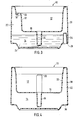
- the plant container 10 shown in FIGS. 1-5 comprises a culture chamber 12 and a water chamber 14.
- the culture chamber 12 is on the one hand and the water chamber 14 on the other hand separated by an intermediate floor 16.
- the plant container 10 is hollow-walled, so that the outer side wall 30 and the inner side wall 32 form a cavity 22 between them. This annular cavity 22 merges into the water chamber 14 already mentioned below.
- the inner side wall 32 is directed radially inward at one point, and on the associated approximately horizontal surface of the corresponding radial projection there is a filling opening 18 which can be closed by means of a closure cover 20.
- the water chamber 14 can be filled with water 24 (see FIG. 3) through the filling opening 18.
- the water chamber 14 is also assigned an overflow 26 in the plant container 10, and in FIG. 1 the maximum fill level is designated by the reference number 28. When the water rises above this level, it flows down through the overflow 26.
- 5 shows a capillary mat 38 as a capillary carrier. The capillary mat 38 thus dips into the water chamber 14 or into the water 24 and can transport moisture into the region of the culture chamber 12.
- Rock wool, lava, expanded clay, etc. can be used for the capillary carrier or for the capillary mats 38.
- the purpose of the capillary mats 38 is to guide water up from the water chamber 14 into the culture chamber 12, which is filled with a substrate as a nutrient medium for plants or the like.
- attack surfaces 36 In the area of the bottom of the plant container 10 there are also inwardly directed attack surfaces 36, which advantageously allow the plant container 10 to be transported with the aid of a forklift.
- the contact surfaces 36 form the contact surfaces for the fork of a forklift.
- FIG. 6 shows the detailed structure of the capillary mat guide 34 within the intermediate floor 16 in a detailed cross-sectional representation.
- a plurality of holes 40 are provided in the bottom wall of the guide 34 projecting into the water chamber 14 so that the water can get into the guide 34, into which - cf. Fig. 5 - a capillary mat 38 can be used. It is of course also possible to provide 34 holes for the passage of water in the vertical side walls of the guide.
- the plant container 10 described so far is formed in one piece as an integrated unit and consists of polysyrene.
- the plant container 10 is produced by the rotational molding method known per se, using polystyrene in powder form.
- FIG. 7 shows a schematic plan view of a further embodiment of a plant container 10 ', which here is square.
- the cover 20 'and the intermediate floor 16' can be seen in the illustration.
- the guides 34 ' are provided as openings arranged separately from one another in the intermediate floor 16', each guide 34 'being able to receive a capillary mat.
- the plant container 10 ' is made in one piece from polystyrene and contains, as integrated components, all accessories for a plant system.
Landscapes
- Engineering & Computer Science (AREA)
- Mechanical Engineering (AREA)
- Life Sciences & Earth Sciences (AREA)
- Environmental Sciences (AREA)
- Cultivation Receptacles Or Flower-Pots, Or Pots For Seedlings (AREA)
Priority Applications (1)
| Application Number | Priority Date | Filing Date | Title |
|---|---|---|---|
| EP85111338A EP0214329A1 (fr) | 1985-09-07 | 1985-09-07 | Procédé de moulage par rotation pour la fabrication d'articles en matière plastique et bac à plantes obtenu par ce procédé |
Applications Claiming Priority (1)
| Application Number | Priority Date | Filing Date | Title |
|---|---|---|---|
| EP85111338A EP0214329A1 (fr) | 1985-09-07 | 1985-09-07 | Procédé de moulage par rotation pour la fabrication d'articles en matière plastique et bac à plantes obtenu par ce procédé |
Publications (1)
| Publication Number | Publication Date |
|---|---|
| EP0214329A1 true EP0214329A1 (fr) | 1987-03-18 |
Family
ID=8193750
Family Applications (1)
| Application Number | Title | Priority Date | Filing Date |
|---|---|---|---|
| EP85111338A Withdrawn EP0214329A1 (fr) | 1985-09-07 | 1985-09-07 | Procédé de moulage par rotation pour la fabrication d'articles en matière plastique et bac à plantes obtenu par ce procédé |
Country Status (1)
| Country | Link |
|---|---|
| EP (1) | EP0214329A1 (fr) |
Cited By (1)
| Publication number | Priority date | Publication date | Assignee | Title |
|---|---|---|---|---|
| EP0400421A1 (fr) * | 1989-05-31 | 1990-12-05 | Eternit Ag | Récipient pour des plantes |
Citations (8)
| Publication number | Priority date | Publication date | Assignee | Title |
|---|---|---|---|---|
| US2609150A (en) * | 1949-11-05 | 1952-09-02 | Union Carbide & Carbon Corp | Mechanical pulverization of refrigerated plastics |
| US2983076A (en) * | 1959-06-29 | 1961-05-09 | Patterson D Merrill | Hydroponic gardening device |
| US3329751A (en) * | 1966-06-10 | 1967-07-04 | Phillips Petroleum Co | Molding using a material yielding an inert atmosphere in mold |
| US3451162A (en) * | 1967-02-14 | 1969-06-24 | Technicraft Corp The | Hydroponic apparatus |
| US3525788A (en) * | 1967-05-24 | 1970-08-25 | Cosden Oil & Chem Co | Rotocasting of polystyrene |
| GB1270450A (en) * | 1968-08-05 | 1972-04-12 | Gerhard Baumann | Receptacle for hydroponics |
| US3969475A (en) * | 1973-08-31 | 1976-07-13 | Asahi Kasei Kogyo Kabushiki Kaisha | Powder molding process for producing thermoplastic articles |
| US4106235A (en) * | 1976-08-09 | 1978-08-15 | Smith Walton J | Horticultural improvements |
-
1985
- 1985-09-07 EP EP85111338A patent/EP0214329A1/fr not_active Withdrawn
Patent Citations (8)
| Publication number | Priority date | Publication date | Assignee | Title |
|---|---|---|---|---|
| US2609150A (en) * | 1949-11-05 | 1952-09-02 | Union Carbide & Carbon Corp | Mechanical pulverization of refrigerated plastics |
| US2983076A (en) * | 1959-06-29 | 1961-05-09 | Patterson D Merrill | Hydroponic gardening device |
| US3329751A (en) * | 1966-06-10 | 1967-07-04 | Phillips Petroleum Co | Molding using a material yielding an inert atmosphere in mold |
| US3451162A (en) * | 1967-02-14 | 1969-06-24 | Technicraft Corp The | Hydroponic apparatus |
| US3525788A (en) * | 1967-05-24 | 1970-08-25 | Cosden Oil & Chem Co | Rotocasting of polystyrene |
| GB1270450A (en) * | 1968-08-05 | 1972-04-12 | Gerhard Baumann | Receptacle for hydroponics |
| US3969475A (en) * | 1973-08-31 | 1976-07-13 | Asahi Kasei Kogyo Kabushiki Kaisha | Powder molding process for producing thermoplastic articles |
| US4106235A (en) * | 1976-08-09 | 1978-08-15 | Smith Walton J | Horticultural improvements |
Cited By (1)
| Publication number | Priority date | Publication date | Assignee | Title |
|---|---|---|---|---|
| EP0400421A1 (fr) * | 1989-05-31 | 1990-12-05 | Eternit Ag | Récipient pour des plantes |
Similar Documents
| Publication | Publication Date | Title |
|---|---|---|
| DE69102673T2 (de) | Baustein. | |
| DE4137463C2 (de) | Verfahren zur Herstellung von Naturstein-Imitationen, insbesondere großvolumiger Felsblock-Imitationen | |
| DE2535750A1 (de) | Verfahren zur herstellung eines schuhs | |
| DE3135735A1 (de) | "behaelter" | |
| DE3742719A1 (de) | Verfahren zum herstellen einer deckel und dichtung umfassenden baugruppe fuer fahrzeugdaecher | |
| DE3509519A1 (de) | Tastenkoerper sowie verfahren und vorrichtung zu seiner herstellung | |
| EP0868275B1 (fr) | Procede de fabrication d'un objet usuel ou de consommation courante, et objet de ce type en un materiau biodegradable et/ou apte au compostage | |
| EP0214329A1 (fr) | Procédé de moulage par rotation pour la fabrication d'articles en matière plastique et bac à plantes obtenu par ce procédé | |
| DE8525768U1 (de) | Pflanzenbehälter aus Kunststoff | |
| EP3854473A1 (fr) | Installation à teinter pour un système à teinter en kit, procédé de fabrication d'un système de peinture ou de nettoyage teinté ainsi qu'utilisation de l'installation à teinter | |
| DE10239319B4 (de) | Zweikomponenten Kunstoffbehälter | |
| DE102005028355A1 (de) | Innenverkleidungsteil für Kraftfahrzeuge sowie Verfahren zur Herstellung eines Innenverkleidungsteils | |
| DE2149072A1 (de) | Untersatz mit wasserreserve fuer blumentoepfe u.dgl | |
| DE3408975A1 (de) | Verfahren und vorrichtung zur herstellung eines profilteils | |
| DE2731081A1 (de) | Verfahren zur herstellung dekorativer embleme | |
| DE2935955A1 (de) | Verfahren und vorrichtung zur herstellung von schuhsohlen aus einspritzbaren werkstoffen | |
| DE69628164T2 (de) | Verfahren zur Herstellung von spritzgegossenen Gegenständen, Vorrichtung zur Durchführung dieses Verfahrens und neue geformte Gegenstände | |
| DE1704122A1 (de) | Verfahren und Maschine zum oertlichen Versteifen von biegsamen Werkstuecken,insbesondere zur Herstellung von Schuhkappen | |
| DE102006048569B4 (de) | Transportkasten aus Kunststoff, insbesondere für den Transport von Flaschen, und ein Verfahren zu seiner Herstellung | |
| AT399281B (de) | Ski, insbesondere alpinski oder langlaufski | |
| CH421168A (de) | Markierungskörper | |
| WO1995029743A1 (fr) | Ski | |
| EP0311145B1 (fr) | Procédé et dispositif pour fabriquer des récipients ouverts d'un côté au moins, en ciment ou en mortier de ciment et une armature | |
| DE60105059T2 (de) | Spritzgegossene verpackung für kosmetisches produkt | |
| CH626775A5 (en) | Cultivation receptacle |
Legal Events
| Date | Code | Title | Description |
|---|---|---|---|
| PUAI | Public reference made under article 153(3) epc to a published international application that has entered the european phase |
Free format text: ORIGINAL CODE: 0009012 |
|
| AK | Designated contracting states |
Kind code of ref document: A1 Designated state(s): AT BE CH DE FR GB IT LI LU NL SE |
|
| 17P | Request for examination filed |
Effective date: 19870909 |
|
| 17Q | First examination report despatched |
Effective date: 19880511 |
|
| RAP1 | Party data changed (applicant data changed or rights of an application transferred) |
Owner name: SCHUMACHER, HANS PAUL Owner name: BEHRENS, WOLFGANG Owner name: GOEBEL, WILLI |
|
| STAA | Information on the status of an ep patent application or granted ep patent |
Free format text: STATUS: THE APPLICATION IS DEEMED TO BE WITHDRAWN |
|
| 18D | Application deemed to be withdrawn |
Effective date: 19880922 |