EP0214536A2 - Méthode de restructuration automatique de données - Google Patents
Méthode de restructuration automatique de données Download PDFInfo
- Publication number
- EP0214536A2 EP0214536A2 EP86111643A EP86111643A EP0214536A2 EP 0214536 A2 EP0214536 A2 EP 0214536A2 EP 86111643 A EP86111643 A EP 86111643A EP 86111643 A EP86111643 A EP 86111643A EP 0214536 A2 EP0214536 A2 EP 0214536A2
- Authority
- EP
- European Patent Office
- Prior art keywords
- input
- output
- fields
- components
- order
- Prior art date
- Legal status (The legal status is an assumption and is not a legal conclusion. Google has not performed a legal analysis and makes no representation as to the accuracy of the status listed.)
- Withdrawn
Links
Images








Classifications
-
- G—PHYSICS
- G06—COMPUTING OR CALCULATING; COUNTING
- G06F—ELECTRIC DIGITAL DATA PROCESSING
- G06F8/00—Arrangements for software engineering
- G06F8/10—Requirements analysis; Specification techniques
-
- G—PHYSICS
- G06—COMPUTING OR CALCULATING; COUNTING
- G06F—ELECTRIC DIGITAL DATA PROCESSING
- G06F40/00—Handling natural language data
- G06F40/10—Text processing
- G06F40/12—Use of codes for handling textual entities
- G06F40/151—Transformation
-
- G—PHYSICS
- G06—COMPUTING OR CALCULATING; COUNTING
- G06F—ELECTRIC DIGITAL DATA PROCESSING
- G06F8/00—Arrangements for software engineering
- G06F8/30—Creation or generation of source code
-
- Y—GENERAL TAGGING OF NEW TECHNOLOGICAL DEVELOPMENTS; GENERAL TAGGING OF CROSS-SECTIONAL TECHNOLOGIES SPANNING OVER SEVERAL SECTIONS OF THE IPC; TECHNICAL SUBJECTS COVERED BY FORMER USPC CROSS-REFERENCE ART COLLECTIONS [XRACs] AND DIGESTS
- Y10—TECHNICAL SUBJECTS COVERED BY FORMER USPC
- Y10S—TECHNICAL SUBJECTS COVERED BY FORMER USPC CROSS-REFERENCE ART COLLECTIONS [XRACs] AND DIGESTS
- Y10S707/00—Data processing: database and file management or data structures
- Y10S707/99941—Database schema or data structure
- Y10S707/99942—Manipulating data structure, e.g. compression, compaction, compilation
Definitions
- This invention relates to a method for generating object code, which code at execute time conforms an input data structure into that of a prespecified output data structure.
- a method for generating object code which object code conforms the input data into the output data structure at execution time, comprising the steps of: (a) ascertaining the shape of a given input and output data structure as being either (1) of a flat form, (2) of a one-branch form, or (3) of a tree form; (b) determining the minimal operations selected from the set of trimming, flattening, grafting, or stretching for conforming the input into the output data structure according to the difference in ascertained shapes; (c) determining each instance when a selected operation is to be invoked; and (d) executing the order of operations specified by steps (a) through (c) upon said input data structure.
- the method utilises graphical models for characterising the prespecified forms and a series of operations based upon the difference in the complexity and distribution of the graphs for conforming the input structure to that of the output.
- Step (c) is further modified for the case where the output data structure is more complex than the input structure.
- the output structure is recursively decomposed into its component flat, one-branch, or tree forms. This recursive decomposition continues until each of the subcomponents of the output structure can be obtained by a basic operation on the input data structure.
- step (d) is modified such that the subcomponents are combined step by step to synthesise the desired final output structure.
- the present method Given an unambiguous description of an output format, sources for the components of the output, an unambiguous description for each of the inputs, and the match fields to tie the inputs, the present method will generate executable object code to carry out data restructuring caused by the differences of the output and input data structures.
- the inputs and output may have hierarchical structures of arbitrary complexity. If selection criteria and desired ordering of instances are made known, the tailored object code will also perform the requested selection and sorting while the output form is being constructed.
- the data model is a tree, a graph of no cycles.
- the nomenclature consists of the now well-appreciated terms from forest management.
- the operations include trimming, flattening, stretching, and grafting.
- the trimming operation cuts away unwanted fields and/or groups from a data structure. That is, it extracts data from an input and places such data into the output without any alteration in existing hierarchical relationships between or among fields. Arithmetic and string functions can be performed on the extracted data before the resulting value is placed in a predetermined output field. Further, if a condition has been specified, only input instances of data that satisfy the condition will be used to construct the output instances.
- the flattening operation transforms an input branch into a flat form by propagating parent key values along a hierarchical path.
- a flat form means a form in which the structure has no repeating groups.
- the stretching operation expands the levels of a hierarchy by factoring out key values from the root level of an input structure.
- the grafting operation combines two hierarchies horizontally to form a wider hierarchy by matching the value of matched fields at the root (top) level.
- the first step is ascertaining the shapes of the data structures of the relevant files.
- Data structures are classified into three different shapes, i.e. flat, one-branch, or tree form.
- Shape determination proceeds by traversing the descriptions of the components and identifying any repeating groups of fields. During the traversal, the number of repeating groups of fields is counted, and the maximum level of repeating groups of fields is recorded. Since the level number of repeating groups of fields increases with the nesting of said fields, one of three cases can occur when the traversal is completed.
- the basic operations are (1) trimming, (2) flattening, (3) flattening followed by trimming, (4) stretching, or (5) case two or three followed by stretching. These five basic operations are termed "first order operations".
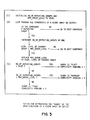
- FIG. 4 there is shown the test to determine whether an output can be produced by "trimming" a given input.
- trimable the hierarchical relationships among components must not be disturbed during restructuring. That is, there must be no change of heritage, even though positioning of components within a group of fields may be altered. Significantly, some of the fields and/or groups of fields may be omitted, and new fields may be derived and added to the output.
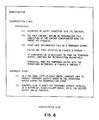
- the flattening operation will be a natural candidate.
- Two conditions in addition to flatness must be satisfied.
- the first condition is that the source components essential for the creation of the output structure must belong to a single branch. This source branch can be either a branch form or a branch within a tree-shaped form.
- the second condition is that at least one field of the input structure must be extracted from each hierarchical level along the branch.
- Figure 2 and taken together with Figure 5 if the output does not have a flat structure, it is clearly not the object of the flattening operation. However, in the event that an output does have a flat structure, it must be subject to several additional tests to ascertain its suitability.
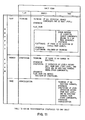
- Hybridization involves two stages. These stages are decomposition and synthesis. At the decomposition stage, the output data structure is decomposed into its subtrees (i.e. repeating groups of fields). Each of the subtrees concatenated with parent key fields is then treated as an intermediate file and compared with its counterpart in the input. Since these subtrees are components of the targeted output structure, they have simpler structures.
- the synthesis stage begins. Essentially, the operations (marked during the decomposition phase) are applied to produce the intermediate files from the input in a top-to- bottom, left-to-right order. The intermediate files are then grafted pairwise in a bottom-up, right-to-left order until the desired output structure can be produced. Grafting of two intermediate files is indistinguishable from the grafting of two input data structures.
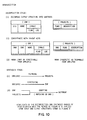
- Figure 9 when taken together with Figure 10, there is depicted in Figure 9 an input and output data structure of respectively a flat and tree form.
- the output structure is substantially more complex than the input. Since hybridization requires a decomposition phase, it is necessary to decompose the more complex (output) structure into subtrees. These are then concatenated with parent keys. Parent keys are used to tie together the subtrees. In the synthesis stage, it is desired in a top-down, left-to-right order to generate a code to produce temporary outputs based on the operations marked during the decomposition stage. The next step is to take the temporary outputs pairwise in a bottom-up, right-to-left order until a desired output can be produced. Note, in Figure 10, the parent key is the DNO and the operations of trimming, stretching, and grafting are used to attain the desired output structure.
- a grafting operation ties two hierarchies side by side by matching the value of correspondingly matching fields of the input structures.
- the matching fields must be extracted from the root level of both inputs and must appear at the root level of the output structure.
- each of the input structures is carried in its entirety into the output structure. No restructuring of any part is allowed during this operation.
- transformation from the prespecified input to the desired input must be performed before grafting.
- grafting ties two input structures side by side. Complexity enters into the fact that data structures having the complexity of trees, for example, may be involved.
- the source file can be used directly as the desired input structure to the grafting operation. Otherwise, the subpart other than the source file is treated as a desired input to said grafting operation.
- the method must consider the strategy of transforming a source file into this subpart. The problem is now reduced to creating an intermediate file from only one input structure. This has been previously described. When both of the desired input structures are ready, a grafting operation may then be performed. As previously pointed out, a grafting operation ties two input structures side by side. Thus, when components from two source files are neatly separated from each other in the output, a grafting operation is able to produce the user-specified output.
- a trimming operation would have to be applied so that positioning of the components could be rearranged according to the user's specification of the targeted output. For example, assume input 1 contains x, y, z and input 2 contains x, a, b. Grafting input 1 with input 2, matched on x, produces x, y, z, a, b. In the case where the prespecified output is x, y, b, a, z, a trimming operation following the said grafting would be necessary.
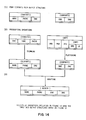
- the prespecified output structure contains NAME, PHONE, and ENO from DIRECTRY as source, and DNO from DEP as source. Including the matching field, ENO, two subparts (as shown in Figure 14) are formed. When these two subparts are compared with the prespecified inputs, it is obvious that neither subpart can be used directly as the desired input to the grafting operation to produce the prespecified output.
- SUBPART1 can be transformed from DIRECTRY by a trimming operation
- SUBPART2 can be transformed from DEP by a flattening operation. Grafting SUBPART1 with SUBPART2 gives the output as prespecified, thus no more operation is needed after grafting.
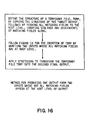
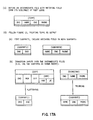
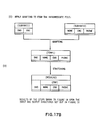
- FIG. 15 when taken together with Figures 16 and 17, there are shown input and output structures when some of the matching fields are not at the root level of the output.
- an intermediate file is created to hold the results of the grafting operation.
- the intermediate file is prepared by first copying the structure of the target output, followed by pushing all matching fields to the root level. During the push, siblings and descendants of the matched fields are carried along as a unit.
- the problem is now reduced to grafting where all matched fields are at the root level. This has been previously described. What remains to be done is to apply a stretching operation to transform the output of grafting into the final output.
- the present method enables data restructuring of varying degrees of complexity to be performed because they are dependent only on the prespecified input and output data structures.
- the input and output data structures may have hierarchical structures of arbitrary complexity.
Landscapes
- Engineering & Computer Science (AREA)
- Theoretical Computer Science (AREA)
- General Engineering & Computer Science (AREA)
- Software Systems (AREA)
- Physics & Mathematics (AREA)
- General Physics & Mathematics (AREA)
- Health & Medical Sciences (AREA)
- Artificial Intelligence (AREA)
- Audiology, Speech & Language Pathology (AREA)
- Computational Linguistics (AREA)
- General Health & Medical Sciences (AREA)
- Information Retrieval, Db Structures And Fs Structures Therefor (AREA)
- Management, Administration, Business Operations System, And Electronic Commerce (AREA)
Applications Claiming Priority (2)
| Application Number | Priority Date | Filing Date | Title |
|---|---|---|---|
| US775868 | 1985-09-13 | ||
| US06/775,868 US4680705A (en) | 1985-09-13 | 1985-09-13 | Automatic data restructurer |
Publications (2)
| Publication Number | Publication Date |
|---|---|
| EP0214536A2 true EP0214536A2 (fr) | 1987-03-18 |
| EP0214536A3 EP0214536A3 (fr) | 1991-07-17 |
Family
ID=25105779
Family Applications (1)
| Application Number | Title | Priority Date | Filing Date |
|---|---|---|---|
| EP19860111643 Withdrawn EP0214536A3 (fr) | 1985-09-13 | 1986-08-22 | Méthode de restructuration automatique de données |
Country Status (3)
| Country | Link |
|---|---|
| US (1) | US4680705A (fr) |
| EP (1) | EP0214536A3 (fr) |
| JP (1) | JPS6267634A (fr) |
Cited By (2)
| Publication number | Priority date | Publication date | Assignee | Title |
|---|---|---|---|---|
| EP0471867A1 (fr) * | 1988-05-04 | 1992-02-26 | Supply Tech, Inc | Procédé et appareil de transmission de données électroniques |
| EP0447157A3 (en) * | 1990-03-14 | 1993-03-31 | Digital Equipment International Limited | Data format conversion |
Families Citing this family (17)
| Publication number | Priority date | Publication date | Assignee | Title |
|---|---|---|---|---|
| CA1248238A (fr) * | 1985-10-17 | 1989-01-03 | Francis D. Lawlor | Compilateur a generation de donnees reajustable |
| JP2565310B2 (ja) * | 1986-08-28 | 1996-12-18 | 株式会社日立製作所 | 知識ベースからデータベースへの変換装置 |
| US5123103A (en) * | 1986-10-17 | 1992-06-16 | Hitachi, Ltd. | Method and system of retrieving program specification and linking the specification by concept to retrieval request for reusing program parts |
| US5008819A (en) * | 1987-10-07 | 1991-04-16 | Gorbatenko George G | Memory spaced array |
| JP2585311B2 (ja) * | 1987-11-06 | 1997-02-26 | 株式会社日立製作所 | プログラム作成方法 |
| JPH07104868B2 (ja) * | 1988-04-08 | 1995-11-13 | インターナシヨナル・ビジネス・マシーンズ・コーポレーシヨン | データ記憶検索システム |
| US5410675A (en) * | 1989-08-21 | 1995-04-25 | Lisa M. Shreve | Method of conforming input data to an output data structure and engine for accomplishing same |
| US5151899A (en) * | 1991-02-11 | 1992-09-29 | Digital Equipment Corporation | Tracking sequence numbers in packet data communication system |
| JP2972419B2 (ja) * | 1991-11-27 | 1999-11-08 | 日本電気株式会社 | データベース運用制御方式 |
| US5423038A (en) * | 1992-10-14 | 1995-06-06 | Davis; Marilyn | Specialized data management method |
| US5613118A (en) * | 1994-06-20 | 1997-03-18 | International Business Machines Corporation | Profile-based preprocessor for optimizing programs |
| US5553227A (en) * | 1994-08-26 | 1996-09-03 | International Business Machines Corporation | Method and system for visually programming state information using a visual switch |
| US5933834A (en) * | 1997-10-16 | 1999-08-03 | International Business Machines Incorporated | System and method for re-striping a set of objects onto an exploded array of storage units in a computer system |
| US6772180B1 (en) | 1999-01-22 | 2004-08-03 | International Business Machines Corporation | Data representation schema translation through shared examples |
| US6754666B1 (en) * | 1999-08-19 | 2004-06-22 | A2I, Inc. | Efficient storage and access in a database management system |
| US7472044B2 (en) * | 2004-03-22 | 2008-12-30 | Delphi Technologies, Inc. | Horizontally structured CAD/CAM modeling-vertical to horizontal conversion |
| US8136121B2 (en) | 2005-03-16 | 2012-03-13 | International Business Machines Corporation | Graphical message format builder |
Family Cites Families (1)
| Publication number | Priority date | Publication date | Assignee | Title |
|---|---|---|---|---|
| US4044334A (en) * | 1975-06-19 | 1977-08-23 | Honeywell Information Systems, Inc. | Database instruction unload |
-
1985
- 1985-09-13 US US06/775,868 patent/US4680705A/en not_active Expired - Fee Related
-
1986
- 1986-08-22 EP EP19860111643 patent/EP0214536A3/fr not_active Withdrawn
- 1986-09-12 JP JP61214222A patent/JPS6267634A/ja active Pending
Non-Patent Citations (4)
| Title |
|---|
| 2ND ACM-SIGOA CONFERENCE ON OFFICE INFORMATION SYSTEMS, 25th - 27th June 1984, pages 132-142; H. KITAGAWA et al.: "Form document management system SPECDOQ - Its architecture and implementation" * |
| ACM TRANSACTIONS ON DATABASE SYSTEMS, vol. 7, no. 2, June 1982, pages 235-257; B. SHNEIDERMAN et al.: "An architecture for automatic relational database system conversion" * |
| COMMUNICATIONS OF THE ACM, vol. 18, no. 10, October 1975, pages 557-567; N.C. SHU et al.: "CONVERT: A high level translation definition language for data conversion" * |
| COMPUTER, vol. 18, no. 8, August 1985, pages 38-49; N.C. SHU: "FORMAL: A forms-oriented, visual-directed application development system" * |
Cited By (2)
| Publication number | Priority date | Publication date | Assignee | Title |
|---|---|---|---|---|
| EP0471867A1 (fr) * | 1988-05-04 | 1992-02-26 | Supply Tech, Inc | Procédé et appareil de transmission de données électroniques |
| EP0447157A3 (en) * | 1990-03-14 | 1993-03-31 | Digital Equipment International Limited | Data format conversion |
Also Published As
| Publication number | Publication date |
|---|---|
| EP0214536A3 (fr) | 1991-07-17 |
| JPS6267634A (ja) | 1987-03-27 |
| US4680705A (en) | 1987-07-14 |
Similar Documents
| Publication | Publication Date | Title |
|---|---|---|
| US4680705A (en) | Automatic data restructurer | |
| Pettie et al. | An optimal minimum spanning tree algorithm | |
| Achterberg | SCIP-a framework to integrate constraint and mixed integer programming | |
| Kececioglu et al. | Combinatorial algorithms for DNA sequence assembly | |
| CA2360286C (fr) | Parallelisation d'applications d'outils pilotes par script | |
| Geoffrion | Integrated modeling systems | |
| US20220147529A1 (en) | Generation of optimized logic from a schema | |
| US7668888B2 (en) | Converting object structures for search engines | |
| JP3779431B2 (ja) | リレーショナルデータベース管理装置,中間リンクテーブル自動作成処理方法およびプログラム記憶媒体 | |
| Goguen et al. | Software component search | |
| KR19980702170A (ko) | 통신네트워크 데이터베이스 구축 방법 및 장치 | |
| US20030084061A1 (en) | Directed non-cyclic graph walking system and method | |
| CN120409302A (zh) | 结合llm与mcp的建筑设计自动化建模方法及系统 | |
| US7010539B1 (en) | System and method for schema method | |
| CN109545285A (zh) | 一种核反应堆数字实验平台的知识使用方法 | |
| US20020095422A1 (en) | Method for creating a balanced binary tree | |
| EP2063363A2 (fr) | Calcul rapide de certificats d'isomorphie de relations d'ordre partiel compacts | |
| Shu | Automatic data transformation and restructuring | |
| Kamper et al. | A reverse engineering methodology for data processing applications | |
| CN109522356B (zh) | 一种核反应堆数字实验系统 | |
| Ma | Co-linear chaining on graphs with cycles | |
| Zhang et al. | Automated strategy invention for confluence of term rewrite systems | |
| CN114896687B (zh) | 一种lca系统数字样机导出方法 | |
| JPH05197534A (ja) | プログラムデータベースシステム | |
| Yamada et al. | Better practical algorithms for rSPR distance and hybridization number |
Legal Events
| Date | Code | Title | Description |
|---|---|---|---|
| PUAI | Public reference made under article 153(3) epc to a published international application that has entered the european phase |
Free format text: ORIGINAL CODE: 0009012 |
|
| AK | Designated contracting states |
Kind code of ref document: A2 Designated state(s): DE FR GB IT |
|
| 17P | Request for examination filed |
Effective date: 19870728 |
|
| PUAL | Search report despatched |
Free format text: ORIGINAL CODE: 0009013 |
|
| AK | Designated contracting states |
Kind code of ref document: A3 Designated state(s): DE FR GB IT |
|
| 17Q | First examination report despatched |
Effective date: 19920410 |
|
| STAA | Information on the status of an ep patent application or granted ep patent |
Free format text: STATUS: THE APPLICATION IS DEEMED TO BE WITHDRAWN |
|
| 18D | Application deemed to be withdrawn |
Effective date: 19920821 |
|
| RIN1 | Information on inventor provided before grant (corrected) |
Inventor name: SHU, NAN-CHIANG |