EP0214565A1 - Verfahren zur Herstellung von Bis-(fluorbenzoyl)-Verbindungen - Google Patents
Verfahren zur Herstellung von Bis-(fluorbenzoyl)-Verbindungen Download PDFInfo
- Publication number
- EP0214565A1 EP0214565A1 EP86111947A EP86111947A EP0214565A1 EP 0214565 A1 EP0214565 A1 EP 0214565A1 EP 86111947 A EP86111947 A EP 86111947A EP 86111947 A EP86111947 A EP 86111947A EP 0214565 A1 EP0214565 A1 EP 0214565A1
- Authority
- EP
- European Patent Office
- Prior art keywords
- bis
- formula
- fluorobenzoyl
- compounds
- production
- Prior art date
- Legal status (The legal status is an assumption and is not a legal conclusion. Google has not performed a legal analysis and makes no representation as to the accuracy of the status listed.)
- Withdrawn
Links
- 238000000034 method Methods 0.000 title claims description 8
- KRHYYFGTRYWZRS-UHFFFAOYSA-N Fluorane Chemical compound F KRHYYFGTRYWZRS-UHFFFAOYSA-N 0.000 claims abstract description 8
- GDTBXPJZTBHREO-UHFFFAOYSA-N bromine Substances BrBr GDTBXPJZTBHREO-UHFFFAOYSA-N 0.000 claims abstract description 6
- 229910052794 bromium Inorganic materials 0.000 claims abstract description 6
- 150000001875 compounds Chemical class 0.000 claims abstract description 5
- 125000006332 fluoro benzoyl group Chemical group 0.000 claims abstract description 5
- 229910017053 inorganic salt Inorganic materials 0.000 claims abstract description 3
- NROKBHXJSPEDAR-UHFFFAOYSA-M potassium fluoride Chemical compound [F-].[K+] NROKBHXJSPEDAR-UHFFFAOYSA-M 0.000 claims description 8
- 235000003270 potassium fluoride Nutrition 0.000 claims description 4
- 239000011698 potassium fluoride Substances 0.000 claims description 4
- 238000002360 preparation method Methods 0.000 claims description 3
- 125000001246 bromo group Chemical group Br* 0.000 claims description 2
- 125000002837 carbocyclic group Chemical group 0.000 claims description 2
- 125000001301 ethoxy group Chemical group [H]C([H])([H])C([H])([H])O* 0.000 claims description 2
- 125000001495 ethyl group Chemical group [H]C([H])([H])C([H])([H])* 0.000 claims description 2
- 229910052739 hydrogen Inorganic materials 0.000 claims description 2
- 239000001257 hydrogen Substances 0.000 claims description 2
- 125000004435 hydrogen atom Chemical class [H]* 0.000 claims description 2
- 125000000956 methoxy group Chemical group [H]C([H])([H])O* 0.000 claims description 2
- 125000002496 methyl group Chemical group [H]C([H])([H])* 0.000 claims description 2
- 229910052760 oxygen Inorganic materials 0.000 claims description 2
- 239000000126 substance Substances 0.000 claims description 2
- 229910052717 sulfur Inorganic materials 0.000 claims description 2
- KBZFWPQVUMTSJH-UHFFFAOYSA-N [4-(2-chlorobenzoyl)phenyl]-(2-chlorophenyl)methanone Chemical compound ClC1=CC=CC=C1C(=O)C1=CC=C(C(=O)C=2C(=CC=CC=2)Cl)C=C1 KBZFWPQVUMTSJH-UHFFFAOYSA-N 0.000 claims 1
- WKBOTKDWSSQWDR-UHFFFAOYSA-N Bromine atom Chemical compound [Br] WKBOTKDWSSQWDR-UHFFFAOYSA-N 0.000 abstract description 4
- 229910052801 chlorine Inorganic materials 0.000 abstract description 4
- ZAMOUSCENKQFHK-UHFFFAOYSA-N Chlorine atom Chemical compound [Cl] ZAMOUSCENKQFHK-UHFFFAOYSA-N 0.000 abstract description 2
- 239000000460 chlorine Substances 0.000 abstract description 2
- MVPPADPHJFYWMZ-UHFFFAOYSA-N chlorobenzene Chemical compound ClC1=CC=CC=C1 MVPPADPHJFYWMZ-UHFFFAOYSA-N 0.000 description 8
- 239000002904 solvent Substances 0.000 description 8
- XJHCXCQVJFPJIK-UHFFFAOYSA-M caesium fluoride Chemical compound [F-].[Cs+] XJHCXCQVJFPJIK-UHFFFAOYSA-M 0.000 description 4
- 238000001816 cooling Methods 0.000 description 4
- KZTYYGOKRVBIMI-UHFFFAOYSA-N diphenyl sulfone Chemical compound C=1C=CC=CC=1S(=O)(=O)C1=CC=CC=C1 KZTYYGOKRVBIMI-UHFFFAOYSA-N 0.000 description 4
- 239000000203 mixture Substances 0.000 description 4
- OKKJLVBELUTLKV-UHFFFAOYSA-N Methanol Chemical compound OC OKKJLVBELUTLKV-UHFFFAOYSA-N 0.000 description 3
- -1 bis-fluorobenzoyl compounds Chemical class 0.000 description 3
- 238000006243 chemical reaction Methods 0.000 description 3
- 239000007795 chemical reaction product Substances 0.000 description 3
- IAZDPXIOMUYVGZ-UHFFFAOYSA-N Dimethylsulphoxide Chemical compound CS(C)=O IAZDPXIOMUYVGZ-UHFFFAOYSA-N 0.000 description 2
- 238000005863 Friedel-Crafts acylation reaction Methods 0.000 description 2
- UJOJIBQOYNBSPY-UHFFFAOYSA-N [4-(4-chlorobenzoyl)phenyl]-(4-chlorophenyl)methanone Chemical compound C1=CC(Cl)=CC=C1C(=O)C1=CC=C(C(=O)C=2C=CC(Cl)=CC=2)C=C1 UJOJIBQOYNBSPY-UHFFFAOYSA-N 0.000 description 2
- 125000001309 chloro group Chemical group Cl* 0.000 description 2
- 239000011541 reaction mixture Substances 0.000 description 2
- 239000007858 starting material Substances 0.000 description 2
- HHVIBTZHLRERCL-UHFFFAOYSA-N sulfonyldimethane Chemical compound CS(C)(=O)=O HHVIBTZHLRERCL-UHFFFAOYSA-N 0.000 description 2
- RELMFMZEBKVZJC-UHFFFAOYSA-N 1,2,3-trichlorobenzene Chemical compound ClC1=CC=CC(Cl)=C1Cl RELMFMZEBKVZJC-UHFFFAOYSA-N 0.000 description 1
- CYSGHNMQYZDMIA-UHFFFAOYSA-N 1,3-Dimethyl-2-imidazolidinon Chemical compound CN1CCN(C)C1=O CYSGHNMQYZDMIA-UHFFFAOYSA-N 0.000 description 1
- OCJBOOLMMGQPQU-UHFFFAOYSA-N 1,4-dichlorobenzene Chemical compound ClC1=CC=C(Cl)C=C1 OCJBOOLMMGQPQU-UHFFFAOYSA-N 0.000 description 1
- PXGOKWXKJXAPGV-UHFFFAOYSA-N Fluorine Chemical compound FF PXGOKWXKJXAPGV-UHFFFAOYSA-N 0.000 description 1
- DGAQECJNVWCQMB-PUAWFVPOSA-M Ilexoside XXIX Chemical compound C[C@@H]1CC[C@@]2(CC[C@@]3(C(=CC[C@H]4[C@]3(CC[C@@H]5[C@@]4(CC[C@@H](C5(C)C)OS(=O)(=O)[O-])C)C)[C@@H]2[C@]1(C)O)C)C(=O)O[C@H]6[C@@H]([C@H]([C@@H]([C@H](O6)CO)O)O)O.[Na+] DGAQECJNVWCQMB-PUAWFVPOSA-M 0.000 description 1
- WHXSMMKQMYFTQS-UHFFFAOYSA-N Lithium Chemical compound [Li] WHXSMMKQMYFTQS-UHFFFAOYSA-N 0.000 description 1
- SECXISVLQFMRJM-UHFFFAOYSA-N N-Methylpyrrolidone Chemical compound CN1CCCC1=O SECXISVLQFMRJM-UHFFFAOYSA-N 0.000 description 1
- ZLMJMSJWJFRBEC-UHFFFAOYSA-N Potassium Chemical compound [K] ZLMJMSJWJFRBEC-UHFFFAOYSA-N 0.000 description 1
- WZIAJVRIELTJDH-UHFFFAOYSA-N [4-(2-fluorobenzoyl)phenyl]-(2-fluorophenyl)methanone Chemical compound FC1=CC=CC=C1C(=O)C1=CC=C(C(=O)C=2C(=CC=CC=2)F)C=C1 WZIAJVRIELTJDH-UHFFFAOYSA-N 0.000 description 1
- LLJNTLUXOZPFQB-UHFFFAOYSA-N [4-(4-fluorobenzoyl)phenyl]-(4-fluorophenyl)methanone Chemical compound C1=CC(F)=CC=C1C(=O)C1=CC=C(C(=O)C=2C=CC(F)=CC=2)C=C1 LLJNTLUXOZPFQB-UHFFFAOYSA-N 0.000 description 1
- 229910001515 alkali metal fluoride Inorganic materials 0.000 description 1
- 230000015572 biosynthetic process Effects 0.000 description 1
- 238000009835 boiling Methods 0.000 description 1
- WUKWITHWXAAZEY-UHFFFAOYSA-L calcium difluoride Chemical compound [F-].[F-].[Ca+2] WUKWITHWXAAZEY-UHFFFAOYSA-L 0.000 description 1
- 229910001634 calcium fluoride Inorganic materials 0.000 description 1
- 150000008422 chlorobenzenes Chemical class 0.000 description 1
- 239000012043 crude product Substances 0.000 description 1
- 229940117389 dichlorobenzene Drugs 0.000 description 1
- GUVUOGQBMYCBQP-UHFFFAOYSA-N dmpu Chemical compound CN1CCCN(C)C1=O GUVUOGQBMYCBQP-UHFFFAOYSA-N 0.000 description 1
- 239000000706 filtrate Substances 0.000 description 1
- 238000001914 filtration Methods 0.000 description 1
- 229910052731 fluorine Inorganic materials 0.000 description 1
- 239000011737 fluorine Substances 0.000 description 1
- 229910052744 lithium Inorganic materials 0.000 description 1
- 239000000155 melt Substances 0.000 description 1
- 238000002844 melting Methods 0.000 description 1
- 230000008018 melting Effects 0.000 description 1
- 239000012452 mother liquor Substances 0.000 description 1
- 229920001643 poly(ether ketone) Polymers 0.000 description 1
- 229920000642 polymer Polymers 0.000 description 1
- 229910052700 potassium Inorganic materials 0.000 description 1
- 239000011591 potassium Substances 0.000 description 1
- 239000002244 precipitate Substances 0.000 description 1
- 238000000746 purification Methods 0.000 description 1
- 229910052701 rubidium Inorganic materials 0.000 description 1
- IGLNJRXAVVLDKE-UHFFFAOYSA-N rubidium atom Chemical compound [Rb] IGLNJRXAVVLDKE-UHFFFAOYSA-N 0.000 description 1
- 150000003839 salts Chemical class 0.000 description 1
- 229910052708 sodium Inorganic materials 0.000 description 1
- 239000011734 sodium Substances 0.000 description 1
- HXJUTPCZVOIRIF-UHFFFAOYSA-N sulfolane Chemical compound O=S1(=O)CCCC1 HXJUTPCZVOIRIF-UHFFFAOYSA-N 0.000 description 1
- 238000003786 synthesis reaction Methods 0.000 description 1
Classifications
-
- C—CHEMISTRY; METALLURGY
- C07—ORGANIC CHEMISTRY
- C07C—ACYCLIC OR CARBOCYCLIC COMPOUNDS
- C07C49/00—Ketones; Ketenes; Dimeric ketenes; Ketonic chelates
- C07C49/76—Ketones containing a keto group bound to a six-membered aromatic ring
- C07C49/84—Ketones containing a keto group bound to a six-membered aromatic ring containing ether groups, groups, groups, or groups
-
- C—CHEMISTRY; METALLURGY
- C07—ORGANIC CHEMISTRY
- C07C—ACYCLIC OR CARBOCYCLIC COMPOUNDS
- C07C45/00—Preparation of compounds having >C = O groups bound only to carbon or hydrogen atoms; Preparation of chelates of such compounds
- C07C45/61—Preparation of compounds having >C = O groups bound only to carbon or hydrogen atoms; Preparation of chelates of such compounds by reactions not involving the formation of >C = O groups
- C07C45/63—Preparation of compounds having >C = O groups bound only to carbon or hydrogen atoms; Preparation of chelates of such compounds by reactions not involving the formation of >C = O groups by introduction of halogen; by substitution of halogen atoms by other halogen atoms
-
- C—CHEMISTRY; METALLURGY
- C07—ORGANIC CHEMISTRY
- C07C—ACYCLIC OR CARBOCYCLIC COMPOUNDS
- C07C49/00—Ketones; Ketenes; Dimeric ketenes; Ketonic chelates
- C07C49/76—Ketones containing a keto group bound to a six-membered aromatic ring
- C07C49/80—Ketones containing a keto group bound to a six-membered aromatic ring containing halogen
- C07C49/813—Ketones containing a keto group bound to a six-membered aromatic ring containing halogen polycyclic
Definitions
- Aromatic fluoroketones can be produced by Friedel-Crafts acylation of fluoroaromatics. However, the fluoroaromatics used in this process can often only be prepared at great expense and are therefore expensive.
- the invention was based on the object of developing a simple and economical process for the preparation of bis (fluorobenzoyl) compounds.
- the invention relates to a process for the preparation of bis-fluorobenzoyl compounds of the formula in which the symbols have the following meaning: R1 and R2, which may be the same or different, are hydrogen, methyl, ethyl, methoxy or ethoxy, A is a mono- or polynuclear carbocyclic or heterocyclic aromatic radical or a radical of the formula in which B represents a chemical bond, O, S, SO, SO2, (CH2) n (where n is an integer from 1 to 4), C (CH3) 2, CO or Si (CH3) 2, where to get a compound of formula in which X represents a bromine or preferably chlorine atom, and R1, R2 and A have the meaning given above, with an inorganic salt of hydrofluoric acid, optionally in the presence of a solvent, at temperatures from 100 to 500 ° C, preferably 350 to 450 ° C.
- the compounds of the formula II used as starting materials are prepared in a customary manner by Friedel-Crafts acylation of the readily accessible bromine or preferably chlorobenzene derivatives of the formula in which X, R1 and R2 have the meaning given above, with dicarboxylic acid chlorides of the formula Y-CO-A-CO-Y (IV), in which Y represents a fluorine, bromine or preferably chlorine atom and A has the meaning given above.
- Particularly suitable inorganic salts of hydrofluoric acid are alkali metal fluorides, such as lithium, sodium, potassium, rubidium or cesium fluoride, especially potassium fluoride, optionally in a mixture of cesium fluoride.
- the bis-chlorobenzoyl compound of the formula II is preferably heated to 380 to 420 ° C. for 2 hours with excess potassium fluoride (10 to 100% mol.% Excess, based on exchangeable chlorine or bromine).
- excess potassium fluoride 10 to 100% mol.% Excess, based on exchangeable chlorine or bromine.
- the reaction mixture after cooling with a solvent, e.g. Chlorobenzene was added, boiled, the residue was filtered off, and the precipitate which crystallized out of the mother liquor on cooling was isolated in a conventional manner by suction.
- reaction can also be carried out in the presence of a solvent under the same conditions.
- solvents which may be mentioned are chlorobenzene, dichlorobenzene, trichlorobenzene, dimethyl sulfone, diphenyl sulfone, dimethyl sulfoxide, sulfolane, N, N'-dimethylethylene urea, N, N'-dimethylpropylene urea or N-methylpyrrolidone.
- the reaction can be carried out under pressure or under pressure; in the case of low-boiling solvents, the pressure procedure is advantageous.
- the solvent is distilled off under reduced pressure and the crude product is purified in the manner described above.
- the insoluble residues can also be removed from the reaction mixture by filtration, if appropriate at elevated temperature, and the reaction product can be crystallized directly from the filtrate or isolated after removal of the solvent, as described above.
- the end product of the process according to the invention is bis (fluorobenzoyl) compounds of the formula in which R1, R2 and A have the meaning given above.
- the following are particularly preferred compounds of the formula I:
- the fluorobenzoyl compounds prepared according to the invention are suitable as starting materials for the synthesis of polymers, in particular polyether ketones.
- a mixture of 177.5 g of 1,4-bis (4-chlorobenzoyl) benzene and 116 g of anhydrous calcium fluoride is heated to 400 ° C. in the course of 2 hours.
- the reaction product is kept for a further 2 hours at 380 to 420 ° C., after cooling, chlorobenzene is added, the mixture is boiled, filtered hot and the is sucked precipitated after cooling, washed with methanol and dried.
- 130 g (81% of theory) of 1,4-bis (4-fluorobenzoyl) benzene, melting at 218 ° C., are obtained.
Landscapes
- Chemical & Material Sciences (AREA)
- Organic Chemistry (AREA)
- Chemical Kinetics & Catalysis (AREA)
- Organic Low-Molecular-Weight Compounds And Preparation Thereof (AREA)
Abstract
Bis(fluorbenzoyl)-Verbindungen werden hergestellt durch Umsetzung einer Verbindung der Formel
in der X Brom oder Chlor bedeutet, mit einem anorganischen Salz der Fluorwasserstoffsäure.
Description
- Aromatische Fluorketone können durch Friedel-Crafts-Acylierung von Fluoraromaten hergestellt werden. Die bei diesem Verfahren eingesetzten Fluoraromaten sind jedoch häufig nur mit hohem Aufwand herstellbar und daher teuer.
- Der Erfindung lag nun die Aufgabe zugrunde, ein einfaches und wirtschaftliches Verfahren zur Herstellung von Bis(fluorbenzoyl)-Verbindungen zu entwickeln.
- Gegenstand der Erfindung ist ein Verfahren zur Herstellung von Bis-fluorbenzoylverbindungen der Formel

R¹ und R², die gleich oder verschieden sein können, sind Wasserstoff, Methyl, Ethyl, Methoxy oder Ethoxy,
A ist ein ein- oder mehrkerniger carbocyclischer oder heterocyclischer aromatischer Rest oder einen Rest der Formel

- Die als Ausgangsstoffe eingesetzten Verbindungen der Formel II werden auf übliche Weise hergestellt durch Friedel-Crafts-Acylierung der gut zugänglichen Brom- oder vorzugsweise Chlorbenzolderivate der Formel

Y-CO-A-CO-Y (IV),
in der Y für ein Fluor, Brom oder vorzugsweise Chloratom steht und A die oben genannte Bedeutung hat. - Als anorganische Salze der Fluorwasserstoffsäure kommen insbesondere Alkalifluoride, wie Lithium-, Natrium-, Kalium-, Rubidium- oder Caesiumfluorid, vor allem Kaliumfluorid, gegebenenfalls in Mischung Caesiumfluorid, in Frage.
- Bei der Durchführung der Reaktion in der Schmelze wird die Bis-chlorbenzoylverbindung der Formel II vorzugsweise mit überschüssigem Kaliumfluorid (10 bis 100 % Mol.% Überschuß, bezogen auf austauschbares Chlor- oder Brom) 2 Stunden auf 380 bis 420°C erhitzt. Zur Reinigung wird das Reaktionsgemisch nach Abkühlen mit einem Lösungsmittel, z.B. Chlorbenzol versetzt, aufgekocht, der Rückstand abfiltriert, und der aus der Mutterlauge beim Abkühlen auskristallisierende Niederschlag in üblicher Weise durch Absaugen isoliert.
- Die Umsetzung kann unter gleichen Bedingungen auch in Gegenwart eines Lösungsmittels durchgeführt werden.
- Als Lösungsmittel sind beispielsweise Chlorbenzol, Dichlorbenzol, Trichlorbenzol, Dimethylsulfon, Diphenylsulfon, Dimethylsulfoxid, Sulfolan, N,N'-Dimethylethylenharnstoff, N,N'-Dimethylpropylenharnstoff oder N-Methylpyrrolidon zu nennen.
- Die Umsetzung kann drucklos oder unter Druck durchgeführt werden, bei niedrig siedenden Lösungsmitteln ist Druckfahrweise vorteilhaft.
- Zur Aufarbeitung wird das Lösungsmittel unter vermindertem Druck abdestilliert und das Rohprodukt in der oben beschriebenen Weise gereinigt.
- Man kann die unlöslichen Rückstände aus der Reaktionsmischung auch durch Filtration, gegebenenfalls bei erhöhter Temperatur entfernen und das Reaktionsprodukt direkt aus dem Filtrat kristallisieren lassen oder nach Entfernen des Lösungsmittels, wie oben beschrieben, isolieren.
- Als Endprodukt des erfindungsgemäßen Verfahrens erhält man Bis-(fluorbenzoyl)-Verbindungen der Formel


- Die Erfindung wird durch die nachstehenden Beispiele näher erläutert.
- Eine Mischung aus 177,5 g 1,4-Bis(4-chlorbenzoyl)benzol und 116 g wasserfreiem Kalziumfluorid wird innerhalb von 2 Stunden auf 400°C erhitzt. Man hält das Reaktionsprodukt noch 2 Stunden bei 380 bis 420°C, nach dem Abkühlen gibt man Chlorbenzol zu, kocht auf, filtriert heiß und saugt den nach dem Erkalten ausgefallenen Niederschlag ab, wäscht mit Methanol und trocknet. Man erhält 130 g (81 % d.Th.) 1,4-Bis(4-fluorbenzoyl)benzol vom Schmp. 218°C.
- Eine Mischung aus 355 g 1,4-Bis(4-chlorbenzoyl)benzol, 232 g wasserfreiem Kaliumfluorid und 218 g Diphenylsulfon wird innerhalb von 2,5 Stunden auf 400°C erwärmt und noch 3 Stunden bei 380 bis 420°C gerührt. Anschließend destilliert man das Lösungsmittel unter vermindertem Druck ab und behandelt den Rückstand, wie in Beispiel 1 beschrieben, mit Chlorbenzol. Man erhält 251 g 1,4-Bis(fluorbenzoyl)benzol vom Schmp. 218 bis 219°C.
Claims (2)
1. Verfahren zur Herstellung von Bis-(fluorbenzoyl)-Verbindungen der Formel

in der die Symbole folgende Bedeutung haben:
R¹ und R², die gleich oder verschieden sein können, sind Wasserstoff, Methyl, Ethyl, Methoxy oder Ethoxy
A ist ein ein- oder mehrkerniger carbocyclischer oder heterocyclischer aromatischer Rest oder ein Rest der Formel 
in der B für eine chemische Bindung, O, S, SO, SO₂, (CH₂)n (wobei n eine ganze Zahl von 1 bis 4 ist), C(CH₃)₂, CO oder Si(CH₃)₂, steht, dadurch gekennzeichnet, daß man eine Verbindung der Formel
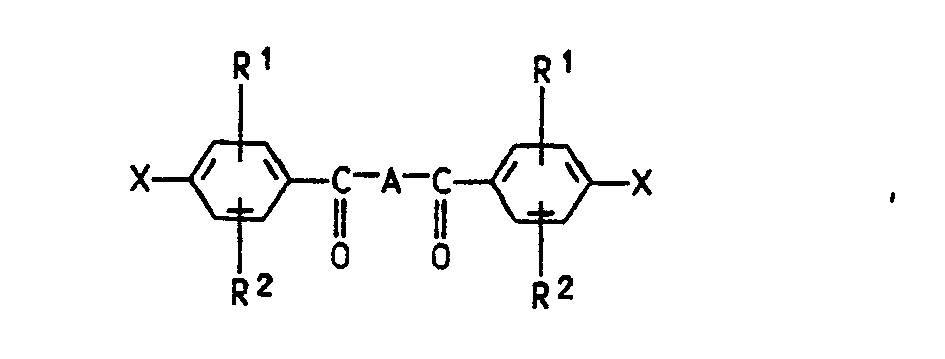
in der X für ein Brom- oder vorzugsweise CHloratom steht, und R¹, R² und A die oben genannte Bedeutung haben, mit einem anorganischen Salz der Fluorwasserstoffsäure bei Temperaturen von 100 bis 500°C versetzt.
R¹ und R², die gleich oder verschieden sein können, sind Wasserstoff, Methyl, Ethyl, Methoxy oder Ethoxy
A ist ein ein- oder mehrkerniger carbocyclischer oder heterocyclischer aromatischer Rest oder ein Rest der Formel
2. Verfahren nach Anspruch 1, dadurch gekennzeichnet, daß man 1,4-Bis-(chlorbenzoyl)benzol mit Kaliumfluorid umsetzt.
Applications Claiming Priority (2)
| Application Number | Priority Date | Filing Date | Title |
|---|---|---|---|
| DE3531838 | 1985-09-06 | ||
| DE19853531838 DE3531838A1 (de) | 1985-09-06 | 1985-09-06 | Verfahren zur herstellung von bis-(fluorbenzoyl)-verbindungen |
Publications (1)
| Publication Number | Publication Date |
|---|---|
| EP0214565A1 true EP0214565A1 (de) | 1987-03-18 |
Family
ID=6280279
Family Applications (1)
| Application Number | Title | Priority Date | Filing Date |
|---|---|---|---|
| EP86111947A Withdrawn EP0214565A1 (de) | 1985-09-06 | 1986-08-29 | Verfahren zur Herstellung von Bis-(fluorbenzoyl)-Verbindungen |
Country Status (2)
| Country | Link |
|---|---|
| EP (1) | EP0214565A1 (de) |
| DE (1) | DE3531838A1 (de) |
Cited By (2)
| Publication number | Priority date | Publication date | Assignee | Title |
|---|---|---|---|---|
| EP0495350A1 (de) * | 1991-01-18 | 1992-07-22 | Kureha Kagaku Kogyo Kabushiki Kaisha | Verfahren zur Herstellung von 4,4'-Bis(4-chlorobenzoyl)benzophenon |
| EP0596395A1 (de) * | 1992-11-04 | 1994-05-11 | Hoechst Aktiengesellschaft | Fluorierte Benzile und Verfahren zu ihrer Herstellung |
Citations (3)
| Publication number | Priority date | Publication date | Assignee | Title |
|---|---|---|---|---|
| DE2425199A1 (de) * | 1973-05-25 | 1974-12-12 | Ici Ltd | Aromatische ketone |
| DE2810794A1 (de) * | 1977-03-14 | 1978-09-21 | Ici Ltd | Verfahren zur herstellung von aromatischen polyaethern |
| EP0101760A1 (de) * | 1982-07-08 | 1984-03-07 | MITSUI TOATSU CHEMICALS, Inc. | Verfahren zur Herstellung von Derivaten von Fluorbenzophenon |
-
1985
- 1985-09-06 DE DE19853531838 patent/DE3531838A1/de not_active Withdrawn
-
1986
- 1986-08-29 EP EP86111947A patent/EP0214565A1/de not_active Withdrawn
Patent Citations (3)
| Publication number | Priority date | Publication date | Assignee | Title |
|---|---|---|---|---|
| DE2425199A1 (de) * | 1973-05-25 | 1974-12-12 | Ici Ltd | Aromatische ketone |
| DE2810794A1 (de) * | 1977-03-14 | 1978-09-21 | Ici Ltd | Verfahren zur herstellung von aromatischen polyaethern |
| EP0101760A1 (de) * | 1982-07-08 | 1984-03-07 | MITSUI TOATSU CHEMICALS, Inc. | Verfahren zur Herstellung von Derivaten von Fluorbenzophenon |
Cited By (3)
| Publication number | Priority date | Publication date | Assignee | Title |
|---|---|---|---|---|
| EP0495350A1 (de) * | 1991-01-18 | 1992-07-22 | Kureha Kagaku Kogyo Kabushiki Kaisha | Verfahren zur Herstellung von 4,4'-Bis(4-chlorobenzoyl)benzophenon |
| EP0596395A1 (de) * | 1992-11-04 | 1994-05-11 | Hoechst Aktiengesellschaft | Fluorierte Benzile und Verfahren zu ihrer Herstellung |
| US5463135A (en) * | 1992-11-04 | 1995-10-31 | Hoechst Aktiengesellschaft | Fluorinated benzils and a process for their preparation |
Also Published As
| Publication number | Publication date |
|---|---|
| DE3531838A1 (de) | 1987-03-19 |
Similar Documents
| Publication | Publication Date | Title |
|---|---|---|
| EP0737705A2 (de) | Verfahren zur Herstellung von aromatischen schwefelhaltigen Polymeren | |
| EP1031566B1 (de) | Verfahren zur Herstellung von 2-Chlor-5-chlormethylthiazol | |
| EP0187349A2 (de) | Verfahren zur Herstellung von 1,2-Benzisothiazolonen | |
| DE3531838A1 (de) | Verfahren zur herstellung von bis-(fluorbenzoyl)-verbindungen | |
| DE3125329A1 (de) | Verfahren zur herstellung von derivaten der vinylphosphon- oder vinylpyrophosphonsaeure | |
| EP0195744B1 (de) | Verfahren zur Herstellung von Trifluordichlorethyl substituierten Säuren und Zinkverbindungen | |
| EP0299329B1 (de) | Verfahren zur Herstellung von 2-Arylthiobenzoesäuren | |
| EP0573459A1 (de) | Verfahren zur herstellung von 3'-aminopropyl-2-sulfatoethylsulfon. | |
| DE69811358T2 (de) | Verfahren zur herstellung von 1-chlorocarbonyl-4-piperidinopiperidin oder dem hydrochlorid davon | |
| JP3220508B2 (ja) | 2,3,4,5−テトラフルオロ安息香酸の製造方法 | |
| DE4102337C2 (de) | Verfahren zur Herstellung von Zink-bis-(dibenzyldithiocarbamat) und dessen Derivate | |
| EP0134753B1 (de) | Verfahren zur Herstellung von Benzanthron | |
| EP0212607B1 (de) | Verfahren zur Herstellung von Halogenphenyl-oxethylsulfiden und deren Oxidationsprodukten | |
| AT338279B (de) | Verfahren zur herstellung von 1-alkyl-4-phenyl- bzw. -4-(2'-thienyl)-2(1h)-chinazolinonen | |
| DE3429903C2 (de) | ||
| EP0249024B1 (de) | Aromatische, Keton- oder Aldehydgruppen enthaltende (Poly)Sulfone und Verfahren zu ihrer Herstellung | |
| DE3200431A1 (de) | Verfahren zur herstellung von 4-fluor-3-phenoxytoluol | |
| DE3324879A1 (de) | Verfahren zur herstellung eines pigments auf basis 4,4',7,7'-tetrachlorthioindigo | |
| CA1111043A (en) | N,n' dichlorobicyclo¬2.2.2| oct-7-ene-2,3,5,6- tetracarboxylic-2,3,5,6-diimide | |
| EP0212608A1 (de) | Verfahren zur Herstellung von Halogenphenyl-oxethylsulfiden und deren Oxidationsprodukten | |
| DE1468782C (de) | Verfahren zur Herstellung von monome ren oder polymeren Sulfiden | |
| EP0102055A2 (de) | Verfahren zur Herstellung halogensubstituierter 2-Aminobenzthiazole | |
| DE3537401A1 (de) | Verfahren zur herstellung von triarylsulfoniumsalzen | |
| JPH0211585B2 (de) | ||
| KR930009039B1 (ko) | 방향족 우레아 화합물의 제조방법 |
Legal Events
| Date | Code | Title | Description |
|---|---|---|---|
| PUAI | Public reference made under article 153(3) epc to a published international application that has entered the european phase |
Free format text: ORIGINAL CODE: 0009012 |
|
| AK | Designated contracting states |
Kind code of ref document: A1 Designated state(s): CH DE FR GB IT LI |
|
| STAA | Information on the status of an ep patent application or granted ep patent |
Free format text: STATUS: THE APPLICATION HAS BEEN WITHDRAWN |
|
| 18W | Application withdrawn |
Withdrawal date: 19870602 |
|
| RIN1 | Information on inventor provided before grant (corrected) |
Inventor name: SCHAEFER, GERHARD, DR. Inventor name: NEUMANN, PETER, DR. |