EP0214664A2 - Verfahren zur Herstellung von Organopolysilanen und Verwendung der so hergestellten Organopolysilane - Google Patents
Verfahren zur Herstellung von Organopolysilanen und Verwendung der so hergestellten Organopolysilane Download PDFInfo
- Publication number
- EP0214664A2 EP0214664A2 EP86112560A EP86112560A EP0214664A2 EP 0214664 A2 EP0214664 A2 EP 0214664A2 EP 86112560 A EP86112560 A EP 86112560A EP 86112560 A EP86112560 A EP 86112560A EP 0214664 A2 EP0214664 A2 EP 0214664A2
- Authority
- EP
- European Patent Office
- Prior art keywords
- organopolysilanes
- formula
- compound
- given above
- meaning given
- Prior art date
- Legal status (The legal status is an assumption and is not a legal conclusion. Google has not performed a legal analysis and makes no representation as to the accuracy of the status listed.)
- Granted
Links
Classifications
-
- G—PHYSICS
- G03—PHOTOGRAPHY; CINEMATOGRAPHY; ANALOGOUS TECHNIQUES USING WAVES OTHER THAN OPTICAL WAVES; ELECTROGRAPHY; HOLOGRAPHY
- G03F—PHOTOMECHANICAL PRODUCTION OF TEXTURED OR PATTERNED SURFACES, e.g. FOR PRINTING, FOR PROCESSING OF SEMICONDUCTOR DEVICES; MATERIALS THEREFOR; ORIGINALS THEREFOR; APPARATUS SPECIALLY ADAPTED THEREFOR
- G03F7/00—Photomechanical, e.g. photolithographic, production of textured or patterned surfaces, e.g. printing surfaces; Materials therefor, e.g. comprising photoresists; Apparatus specially adapted therefor
- G03F7/004—Photosensitive materials
- G03F7/075—Silicon-containing compounds
- G03F7/0754—Non-macromolecular compounds containing silicon-to-silicon bonds
-
- C—CHEMISTRY; METALLURGY
- C01—INORGANIC CHEMISTRY
- C01B—NON-METALLIC ELEMENTS; COMPOUNDS THEREOF; METALLOIDS OR COMPOUNDS THEREOF NOT COVERED BY SUBCLASS C01C
- C01B32/00—Carbon; Compounds thereof
- C01B32/90—Carbides
- C01B32/914—Carbides of single elements
- C01B32/956—Silicon carbide
- C01B32/963—Preparation from compounds containing silicon
- C01B32/977—Preparation from organic compounds containing silicon
-
- C—CHEMISTRY; METALLURGY
- C04—CEMENTS; CONCRETE; ARTIFICIAL STONE; CERAMICS; REFRACTORIES
- C04B—LIME, MAGNESIA; SLAG; CEMENTS; COMPOSITIONS THEREOF, e.g. MORTARS, CONCRETE OR LIKE BUILDING MATERIALS; ARTIFICIAL STONE; CERAMICS; REFRACTORIES; TREATMENT OF NATURAL STONE
- C04B35/00—Shaped ceramic products characterised by their composition; Ceramics compositions; Processing powders of inorganic compounds preparatory to the manufacturing of ceramic products
- C04B35/515—Shaped ceramic products characterised by their composition; Ceramics compositions; Processing powders of inorganic compounds preparatory to the manufacturing of ceramic products based on non-oxide ceramics
- C04B35/56—Shaped ceramic products characterised by their composition; Ceramics compositions; Processing powders of inorganic compounds preparatory to the manufacturing of ceramic products based on non-oxide ceramics based on carbides or oxycarbides
- C04B35/565—Shaped ceramic products characterised by their composition; Ceramics compositions; Processing powders of inorganic compounds preparatory to the manufacturing of ceramic products based on non-oxide ceramics based on carbides or oxycarbides based on silicon carbide
- C04B35/571—Shaped ceramic products characterised by their composition; Ceramics compositions; Processing powders of inorganic compounds preparatory to the manufacturing of ceramic products based on non-oxide ceramics based on carbides or oxycarbides based on silicon carbide obtained from Si-containing polymer precursors or organosilicon monomers
-
- C—CHEMISTRY; METALLURGY
- C08—ORGANIC MACROMOLECULAR COMPOUNDS; THEIR PREPARATION OR CHEMICAL WORKING-UP; COMPOSITIONS BASED THEREON
- C08G—MACROMOLECULAR COMPOUNDS OBTAINED OTHERWISE THAN BY REACTIONS ONLY INVOLVING UNSATURATED CARBON-TO-CARBON BONDS
- C08G77/00—Macromolecular compounds obtained by reactions forming a linkage containing silicon with or without sulfur, nitrogen, oxygen or carbon in the main chain of the macromolecule
- C08G77/60—Macromolecular compounds obtained by reactions forming a linkage containing silicon with or without sulfur, nitrogen, oxygen or carbon in the main chain of the macromolecule in which all the silicon atoms are connected by linkages other than oxygen atoms
-
- C—CHEMISTRY; METALLURGY
- C01—INORGANIC CHEMISTRY
- C01P—INDEXING SCHEME RELATING TO STRUCTURAL AND PHYSICAL ASPECTS OF SOLID INORGANIC COMPOUNDS
- C01P2002/00—Crystal-structural characteristics
- C01P2002/80—Crystal-structural characteristics defined by measured data other than those specified in group C01P2002/70
- C01P2002/82—Crystal-structural characteristics defined by measured data other than those specified in group C01P2002/70 by IR- or Raman-data
-
- C—CHEMISTRY; METALLURGY
- C01—INORGANIC CHEMISTRY
- C01P—INDEXING SCHEME RELATING TO STRUCTURAL AND PHYSICAL ASPECTS OF SOLID INORGANIC COMPOUNDS
- C01P2002/00—Crystal-structural characteristics
- C01P2002/80—Crystal-structural characteristics defined by measured data other than those specified in group C01P2002/70
- C01P2002/84—Crystal-structural characteristics defined by measured data other than those specified in group C01P2002/70 by UV- or VIS- data
-
- C—CHEMISTRY; METALLURGY
- C01—INORGANIC CHEMISTRY
- C01P—INDEXING SCHEME RELATING TO STRUCTURAL AND PHYSICAL ASPECTS OF SOLID INORGANIC COMPOUNDS
- C01P2004/00—Particle morphology
- C01P2004/50—Agglomerated particles
-
- C—CHEMISTRY; METALLURGY
- C01—INORGANIC CHEMISTRY
- C01P—INDEXING SCHEME RELATING TO STRUCTURAL AND PHYSICAL ASPECTS OF SOLID INORGANIC COMPOUNDS
- C01P2006/00—Physical properties of inorganic compounds
- C01P2006/60—Optical properties, e.g. expressed in CIELAB-values
Definitions
- This object is achieved by the invention.
- the invention relates to a process for the preparation of organopolysilanes, characterized in that at least one disilane of the formula wherein R represents identical or different, monovalent alkyl, alkenyl or aryl groups and R represents identical or different, monovalent alkyl groups, optionally in a mixture with a compound of the formula wherein R has the meaning given above, with at least one compound of the formula wherein R has the meaning given above and R represents the methoxy group or has the same meaning as R, in the presence of at least one compound of the formula where R has the meaning given above and M is an alkali metal.
- Alkyl groups R, R and R preferably each contain 1 to 12 carbon atoms per radical, such as the methyl, ethyl, n-propyl, isopropyl, n-butyl, sec-butyl and 2-ethylhexyl radical, 2 and dodecyl radicals .
- aryl radicals R and R are the phenyl radical and xenyl radicals.
- R, R 1 and R methyl groups are preferred as alkyl groups.
- the most important example of an alkenyl group R is the vinyl group.
- the alkali metal can be lithium, sodium, potassium, rubidium or cesium. Preferred as an alkali metal in the compound of the formula are sodium and potassium.
- disilanes which are preferably used in the process according to the invention are 1,1,2-trimethyl-1,2,2-trimethoxydisilane, 1-phenyl-1,2-dimethyl-1,2,2-trimethoxydisilane and 1- Vinyl 1,2-dimethyl-1,2,2-trimethoxydisilane.
- the main example of a compound of the formula is 1,2-dimethyl-1,1,2,2-tetramethoxydisilane.
- Examples of compounds of the formula which are preferably used in the process according to the invention are dimethylmethoxysilane and diphenylmethylsilane.
- compound of formula in amounts of 0.5 to 5 percent by weight, in particular 2 to 4 percent by weight, based in each case on the weight of the amount of disilane used in each case.
- Compound of formula serves as a catalyst in the process according to the invention. It is preferably used in amounts of 0.2 to 0.5 percent by weight, based on the weight of the amount of disilane used in each case.
- the reaction takes place after mixing the reactants and catalyst at temperatures from 25 ° C to 220 ° C and is complete when no more monomeric organomethoxysilane is distilled off.
- the reaction is preferably carried out at the pressure of the surrounding atmosphere, that is at 1020 hPa (abs.) Or about 1020 hPa (abs.). However, higher or lower pressures can be used if desired.
- the Si-bonded hydrogen in the compounds prepared according to the invention can be reacted by reacting these compounds, for example with methanol in the presence of a catalyst which does not attack the silicon-silicon bond, such as H i PtCl 6 . 6H 2 0, can be converted into alkoxy groups.
- a catalyst which does not attack the silicon-silicon bond such as H i PtCl 6 . 6H 2 0, can be converted into alkoxy groups.
- organopolysilanes produced according to the invention can be used for all purposes for which organopoly has also been used up to now silanes could be used, in particular for the production of silicon carbide by heating the organopolysilanes to temperatures above 700 ° C.
- organopolysilane according to the invention or produced according to the invention is applied to a suitable, smooth or flat base such as a semiconductor wafer, exposed through a mask, after which the unexposed parts of the organopolysilane coating are separated from the exposed, crosslinked areas of the coating with a solvent such as toluene .
- a by mixing 1000 g of 1,1,2-trimethyl-1,2,2-trimethoxydisilane with 30 g (3%, based on the weight of disilane used) of diphenylmethylsilane and 3 g (0.3% based on the total weight of the mixture of disilane) sodium methylate used warms up quickly to about 90 ° C. after reaching a temperature of 25 ° C. without external heat supply.
- the mixture is then heated to 200 ° C., 700 g of a mixture of methyltrimethoxysilane and dimethyldimethoxysilane distilling off. 330 g of residue are obtained, which is dissolved in 250 ml of toluene to remove sodium methylate and undesirably low oligomers.
- Sodium methylate mixture quickly warms up to about 90 ° C. after reaching a temperature of 25 ° C. without external heat supply.
- the mixture is then heated to 200 ° C., 700 g of a mixture of methyltrimethoxysilane and dimethyldimethoxysilane distilling off.
- 330 g of residue are obtained, which is dissolved in 250 ml of tetrahydrofuran to remove sodium methylate and undesirably low oligomers.
- a solution of 2 g of the organopolysilane prepared according to Example 1 in 40 ml of toluene is applied to a round silicon wafer (wafer) with a diameter of 4 inches (10 cm) by spin coating. After 15 minutes of pre-baking at 100 ° C., the organopolysilane film thus obtained is placed on the silicon wafer for 2 seconds using a low-pressure mercury ultraviolet lamp with an output of 450 watts and a maximum output at 253.7 nanometers by means of a square chrome-on-quartz test -Mask exposed with an edge length of 5 inches (12.5 cm). Then the disk is dipped in toluene for removal because unexposed polysilane. A sharply resolved pattern with a minimum line width of 0.75 microns is obtained.
Landscapes
- Chemical & Material Sciences (AREA)
- Organic Chemistry (AREA)
- Engineering & Computer Science (AREA)
- Physics & Mathematics (AREA)
- Ceramic Engineering (AREA)
- Health & Medical Sciences (AREA)
- Polymers & Plastics (AREA)
- Manufacturing & Machinery (AREA)
- Medicinal Chemistry (AREA)
- Materials Engineering (AREA)
- Structural Engineering (AREA)
- General Health & Medical Sciences (AREA)
- Inorganic Chemistry (AREA)
- Chemical Kinetics & Catalysis (AREA)
- Spectroscopy & Molecular Physics (AREA)
- General Physics & Mathematics (AREA)
- Silicon Polymers (AREA)
Abstract



Description
- Aus US Re. 31 447 (ausgegeben: 22. November 1983, Baney et al., Dow Corning Corporation) ist ein zweistufiges Verfahren zur Herstellung von Organopolysilanen mit SiOC-gebundenen Methoxygruppen bekannt.
- Es ist nun Aufgabe der Erfindung, ein einfaches, einstufiges Verfahren zur Herstellung von Organopolysilanen, die schmelzbar und in organischem Lösungsmittel löslich sind, mehr als 7 Siliciumatome je Molekül aufweisen, monomodale und symmetrische Molekulargewichtsverteilung haben, frei von Si-gebundenem Halogen und an der Luft nicht selbstentzündlich sind sowie Ultraviolettlicht mit Wellenlängen unterhalb 360 nanometer absorbieren und durch derartiges Licht vernetzt werden, mit verhältnismäßig guten Ausbeuten bereitzustellen. Diese Aufgabe wird durch die Erfindung gelöst.
- Gegenstand der Erfindung ist ein Verfahren zur Herstellung von Organopolysilanen, dadurch gekennzeichnet, daß mindestens ein Disilan der Formel
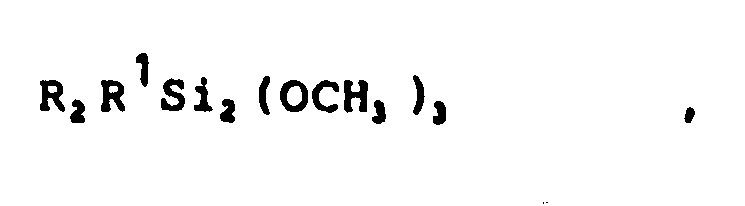


- Vorzugsweise enthalten Alkylgruppen R, R und R jeweils 1 bis 12 Kohlenstoffatome je Rest, wie der Methyl-, Ethyl-, n-Propyl-, Isopropyl-, n-Butyl-, sec.-Butyl- und 2-Ethylhexylrest, 2 sowie Dodecylreste. Beispiele für Arylreste R und R sind der Phenylrest und Xenylreste. Insbesondere wegen der leichteren 1 Zugänglichkeit sind als Alkylgruppen R, R1 und R Methylgruppen bevorzugt. Das wichtigste Beispiel für eine Alkenylgruppe R ist die Vinylgruppe.
- Als weiteres Beispiel für einen Rest R in der Verbindung der Formel

- Das Alkalimetall kann Lithium, Natrium, Kalium, Rubidium oder Cäsium sein. Bevorzugt als Alkalimetall in der Verbindung der Formel

- Beispiele für Disilane, die bei dem erfindungsgemäßen Verfahren bevorzugt eingesetzt werden, sind 1,1,2-Trimethyl-1,2,2-trimethoxydisilan, 1-Phenyl-1,2-dimethyl-1,2,2 -trimethoxydisilan und 1-Vinyl-1,2-dimethyl-1,2,2-trimethoxydisilan. Das wichtigste Beispiel für eine Verbindung der Formel

- Die Herstellung derartiger Silane ist bekannt, z.B. durch E. Hengge et al. in "Monatshefte für Chemie" Band 105, (1974), Seite 671 bis 683, W.H. Atwell et al. in "Journal of Organometallic Chemistry", Band 7, (1967), Seite 71 bis 78, E. Hengge et al. in "Monatshefte für Chemie", Band 99, (1968), Seite 340 bis 346, und H. Watanabe et al. in "Journal of Organometallic Chemistry", Band 128 (1977), Seite 173 bis 175. Werden Disilane der Formel


- Beispiele für Verbindungen der Formel

- Vorzugsweise wird Verbindung der Formel

- Wichtige Beispiele für Verbindungen der Formel

- Verbindung der Formel

- Die Umsetzung erfolgt nach Vermischen der Reaktionsteilnehmer und Katalysator bei Temperaturen von 25°C bis 220°C und ist beendet, wenn kein monomeres Organomethoxysilan mehr abdestilliert.
- Die Umsetzung wird vorzugsweise beim Druck der umgebenden Atmosphäre, also bei 1020 hPa (abs.) oder etwa 1020 hPa (abs.), durchgeführt. Falls erwünscht, können jedoch auch höhere oder niedrigere Drücke angewendet werden.
- Der Si-gebundene Wasserstoff in den erfindungsgemäß hergestellten Verbindungen kann durch Umsetzung dieser Verbindungen, z.B. mit Methanol in Gegenwart eines die Silicium-Silicium-Bindung nicht angreifenden Katalysators, wie HiPtCl6. 6H20, in Alkoxygruppen umgewandelt werden.
- Die erfindungsgemäß hergestellten Organopolysilane können für alle Zwecke eingesetzt werden, für die auch bisher Organopolysilane eingesetzt werden konnten, insbesondere zur Herstellung von Siliciumcarbid durch Erwärmen der Organopolysilane auf Temperaturen über 700°C in inerter Atmosphäre und zur Herstellung von negativen Photoresistbeschichtungen z.B. bei der Erzeugung von Leiterplatten und Halbleiterbauteilen in für die Herstellung von negativen Photoresistbeschichtungen aus Organopolysilanen an sich bekannter Weise, wobei erfindungsgemäßes oder erfindungsgemäß hergestelltes Organopolysilan auf eine geeignete, glatte oder ebene Unterlage wie ein Halbleiterplättchen aufgebracht, durch eine Maske hindurch belichtet wird, wonach die unbelichteten Teile des Organopolysilanüberzugs mit einem Lösungsmittel, wie Toluol, von den belichteten, vernetzten Stellen des Überzugs getrennt werden.
- In den folgenden Beispielen beziehen sich alle Angaben von Prozentsätzen auf das Gewicht.
- Ein durch Vermischen von 1000 g 1,1,2-Trimethyl-1,2,2-tri- methoxydisilan mit 30 g (3 %, bezogen auf das Gewicht von eingesetztem Disilan) Diphenylmethylsilan und 3 g (0,3 %, bezogen auf das Gesamtgewicht von eingesetztem Disilan) Natriummethylat bereitetes Gemisch erwärmt sich nach Erreichen einer Temperatur von 25 °C ohne äußere Wärmezufuhr rasch auf etwa 90°C. Dann wird das Gemisch auf 200°C erwärmt, wobei 700 g eines Gemisches aus Methyltrimethoxysilan und Dimethyldimethoxysilan abdestillieren. Es werden 330 g Rückstand erhalten, der zur Abtrennung von Natriummethylat und unerwünscht niedrigen Oligomeren in 250 ml Toluol gelöst wird. Die so erhaltene Lösung wird ebenfalls zu dem vorstehend angegebenen Zweck auf 0°C gekühlt und mit 750 ml bei 0°C gehaltenen Acetons vermischt, wobei ein weißer Nieder schlag ausfällt, der abfiltriert und bei 16 hPa (abs.) getrocknet wird. Es werden so 264 g des Organopolysilans der Formel

- Das gleiche Ergebnis wird bei Verwendung von Kaliumtert.- butylat anstelle von Natriummethylat erhalten.
- Ein durch Vermischen von 1000 g 1,1,2-Trimethyl-1,2,2-tri- methoxydisilan mit 30 g (3 %, bezogen auf das Gewicht des Disilans) Dimethylmethoxysilan und 4 g (0,4 %, bezogen auf das Gewicht des Disilans) Natriummethylat bereitetes Gemisch erwärmt sich nach Erreichen einer Temperatur von 25°C ohne äußere Wärmezufuhr rasch auf etwa 90°C. Dann wird das Gemisch auf 200°C erwärmt, wobei 700 g eines Gemisches aus Methyltrimethoxysilan und Dimethyldimethoxysilan abdestillieren. Es werden 330 g Rückstand erhalten, der zur Abtrennung von Natriummethylat und unerwünscht niedrigen Oligomeren in 250 ml Tetrahydrofuran gelöst wird. Die so erhaltene Lösung wird ebenfalls zu dem vorstehend angegebenen Zweck auf 0°C gekühlt und mit 750 ml bei 0°C gehaltenen Methanols vermischt, wobei ein weißer Niederschlag ausfällt, der abfiltriert und bei 16 hPa (abs.) getrocknet wird. Es werden so 270 g des Organopolysilans der Formel

- Das gleiche Ergebnis wird bei verwendung von Kaliumtert.- butylat anstelle von Natriummethylat erhalten.
- Eine Lösung von 2 g des gemäß Beispiel 1 hergestellten Organopolysilans in 40 ml Toluol wird durch Aufschleudern (spin coating) auf eine runde Siliciumscheibe (wafer) mit einem Durchmesser von 4 Zoll (10 cm) aufgetragen. Nach 15 Minuten Vorbacken bei 100°C wird der so erhaltene auf der Siliciumscheibe befindliche Organopolysilanfilm 2 Sekunden mit einer Quecksilberniederdruck-Ultraviolettlampe mit einer Leistung von 450 Watt und einem Maximum der Leistung bei 253,7 Nanometer durch eine quadratische Chrom-auf-Quarz-Test-Maske mit einer Kantenlänge von 5 Zoll (12,5 cm) belichtet. Dann wird die Scheibe zur Entfernung, weil unbelichtetem, Polysilan in Toluol getaucht. Es wird ein scharf aufgelöstes Muster mit einer minimalen Linienbreite von 0,75 Mikrometer erhalten.
- Ein durch Vermischen von 213 q (1,09 Moll 1,1,2-Trimethyl-1,2,2-trimethoxy- disilan mit 142 g (0,68 Mol) 1,2-Dimethyl-1,1,2,2-tetramethoxvdi- silan, 10,7 g (3 %,bezogen auf das Gesamtgewicht von eingesetzten Disilanen) Diphenylmethylsilan und 1,1 g (0,3 %, bezogen auf das Gesamtgewicht von eingesetzten Disilanen) Natriummethylat bereitetes Gemisch erwärmt sich nach Erreichen einer Temperatur von 25.C ohne äußere Wärmezufuhr rasch auf etwa 90'C. Dann wird das Gemisch auf 200°C erwärmt, wobei 277 g eines Gemisches aus Dimethyldimethoxysilan und Methyltrimethoxysilan ahdestillieren. Es werden 90 g Rückstand erhalten, der zur Abtrennung von Natriummethylat und unerwünscht niedrigen Oligomeren in 80 ml Toluol gelöst wird. Die so erhaltene Lösung wird ebenfalls zu dem vorstehend angegebenen Zweck auf 0°C gekühlt und mit 250 ml bei 0°C gehaltenen Acetons vermischt, wobei ein weißer Niederschlag ausfällt, der abfiltriert und bei 16 hPa (abs.) getrocknet wird. Es werden so 78 g eines Organopolysilans mit durchschnittlich 39 Si-Atomen je Molekül erhalten. Das durchschnittliche Molekulargewicht dieses Organopolysilans beträgt etwa 2400. Es har eine symmetrische, monomodale Molekulargewichtsverteilung und erweicht bei 100°C bis 150°C zu einer Schmelze. Es absorbiert Ultraviolett-Licht zwischen 200 und 350 nanometer. Im Infrarot-Spektrum hat es eine starke Absorptionsbande bei 2070 cm-1.
- Das gleiche Ergebnis wird bei Verwendung von Kaliumtert.- butylat anstelle von Natriummethylat erhalten,
- Ein durch Vermischen von 120 g (0,57 Mol) 1,2-Dimethvl-1,1,2,2-tetramethoxy- disilan mit 180 g (0,98 Mol) 1,1,2-Trimethyl-1,2,2-trimethoxvdisilan, 8,1 g (2,7 %, bezogen auf das Gesamtgewicht der Disilane) Dimethylmethoxysilan und 1,2 g (0,4 %, bezogen auf das Gesamtgewicht der Disilane) Natriummethylat bereitetes Gemisch erwärmt sich nach Erreichen einer Temperatur von 25°C ohne äußere Wärmezufuhr rasch auf etwa 90.C. Dann wird das Gemisch auf 200°C erwärmt, wobei 223 g eines Gemisches aus Dimethyldimethoxysilan und Methyltrimethoxysilan abdestillieren. Es werden 86 g Rückstand erhalten, der zur Abtrennung von Natriummethylat und unerwünscht niedrigen Oligomeren in 80 ml Tetrahydrofuran gelöst wird. Die so erhaltene Lösung wird ebenfalls zu dem vorstehend angegebenen Zweck auf 0°C gekühlt und mit 250 ml bei 0°C gehaltenen Methanols vermischt, wobei ein weißer Niederschlag ausfällt, der abfiltriert und bei 16 hPa (abs.) getrocknet wird. Es werden so 58 g eines Organopolysilans mit durchschnittlich 31 Siliciumdtomen je Molekül erhalten. Das durchschnittliche Molekulargewicht dieses Organopolysilans beträgt etwa 1800. Es hat eine symmetrische, monomodale Molekulargewichtsverteilung und erweicht bei 80°C bis 150°C zu einer Schmelze. Es absorbiert Ultraviolett-Licht zwischen 200 und 350 nanometer. Im Infrarot-Spektrum hat es eine starke Absorptionsbande bei 2070 cm-1.
- Das gleiche Ergebnis wird bei Verwendung von Kaliumtert.- butylat anstelle von Natriummethylat erhalten.
- In einem Rohrofen werden 50 g des gemäß Beispiel 2 hergestellten Organopolysilans unter Argon mit einer Aufheizgeschwindigkeit von 200°C je Stunde auf 1300°C erhitzt. Nach dem Abkühlen auf Raumtemperatur werden 22,5 g schwarzer Siliciumcarbid-Körner erhalten.
Claims (3)


Priority Applications (1)
| Application Number | Priority Date | Filing Date | Title |
|---|---|---|---|
| AT86112560T ATE72571T1 (de) | 1985-09-10 | 1986-09-10 | Verfahren zur herstellung von organopolysilanen und verwendung der so hergestellten organopolysilane. |
Applications Claiming Priority (2)
| Application Number | Priority Date | Filing Date | Title |
|---|---|---|---|
| DE19853532128 DE3532128A1 (de) | 1985-09-10 | 1985-09-10 | Organopolysilane, verfahren zu ihrer herstellung und verwendung dieser organopolysilane |
| DE3532128 | 1985-09-10 |
Publications (3)
| Publication Number | Publication Date |
|---|---|
| EP0214664A2 true EP0214664A2 (de) | 1987-03-18 |
| EP0214664A3 EP0214664A3 (en) | 1988-05-04 |
| EP0214664B1 EP0214664B1 (de) | 1992-02-12 |
Family
ID=6280477
Family Applications (1)
| Application Number | Title | Priority Date | Filing Date |
|---|---|---|---|
| EP86112560A Expired - Lifetime EP0214664B1 (de) | 1985-09-10 | 1986-09-10 | Verfahren zur Herstellung von Organopolysilanen und Verwendung der so hergestellten Organopolysilane |
Country Status (6)
| Country | Link |
|---|---|
| US (1) | US4667046A (de) |
| EP (1) | EP0214664B1 (de) |
| JP (1) | JPS6262821A (de) |
| AT (1) | ATE72571T1 (de) |
| CA (1) | CA1265314A (de) |
| DE (2) | DE3532128A1 (de) |
Cited By (5)
| Publication number | Priority date | Publication date | Assignee | Title |
|---|---|---|---|---|
| FR2634488A1 (fr) * | 1988-07-22 | 1990-01-26 | Dow Corning | Procedes pour la preparation de methylpolysilanes a teneurs reglees en carbone, produits ainsi obtenus et produits ceramiques qui en derivent |
| EP0303908A3 (en) * | 1987-08-05 | 1990-10-24 | Wacker-Chemie Gmbh | Thermosetting organopolyiloxane composition |
| GB2234254A (en) * | 1988-07-22 | 1991-01-30 | Dow Corning Coporation | Methylpolysilanes having controllable rheology and method for their preparation |
| GB2234255A (en) * | 1988-07-22 | 1991-01-30 | Dow Corning Coporation | Methylpolysilanes and method for their preparation. |
| EP0463624A3 (en) * | 1990-06-29 | 1992-03-04 | Wacker-Chemie Gmbh | Process for preparing organopolysilanes |
Families Citing this family (13)
| Publication number | Priority date | Publication date | Assignee | Title |
|---|---|---|---|---|
| US4716240A (en) * | 1986-02-19 | 1987-12-29 | Yuki Gosei Kogyo Co., Ltd. | 1,2-dichloro-1,2,2-trimethyl-1-phenyldisilane and method for producing the same |
| DE3811567A1 (de) * | 1988-04-07 | 1989-10-19 | Wacker Chemie Gmbh | Verfahren zur herstellung von organopolysilanen |
| JPH06103092B2 (ja) * | 1988-08-04 | 1994-12-14 | 松下電器産業株式会社 | 触媒燃焼装置 |
| US5173452A (en) * | 1989-02-15 | 1992-12-22 | Dobuzinsky David M | Process for the vapor deposition of polysilanes photoresists |
| JP2758106B2 (ja) * | 1992-08-11 | 1998-05-28 | 東芝シリコーン株式会社 | ポリオルガノシランの製造方法 |
| EP0669363B1 (de) * | 1994-02-28 | 1999-08-18 | Toshiba Silicone Co., Ltd. | Verfahren zur Herstellung von Polyorganosilan |
| US7022864B2 (en) * | 2003-07-15 | 2006-04-04 | Advanced Technology Materials, Inc. | Ethyleneoxide-silane and bridged silane precursors for forming low k films |
| US20080207005A1 (en) * | 2005-02-15 | 2008-08-28 | Freescale Semiconductor, Inc. | Wafer Cleaning After Via-Etching |
| WO2007025565A1 (en) * | 2005-09-01 | 2007-03-08 | Freescale Semiconductor, Inc. | Semiconductor device including a coupled dielectric layer and metal layer, method of fabrication thereof, and material for coupling a dielectric layer and a metal layer in a semiconductor device |
| US7678529B2 (en) * | 2005-11-21 | 2010-03-16 | Shin-Etsu Chemical Co., Ltd. | Silicon-containing film forming composition, silicon-containing film serving as etching mask, substrate processing intermediate, and substrate processing method |
| US20090045164A1 (en) * | 2006-02-03 | 2009-02-19 | Freescale Semiconductor, Inc. | "universal" barrier cmp slurry for use with low dielectric constant interlayer dielectrics |
| US20090301867A1 (en) * | 2006-02-24 | 2009-12-10 | Citibank N.A. | Integrated system for semiconductor substrate processing using liquid phase metal deposition |
| US7803719B2 (en) * | 2006-02-24 | 2010-09-28 | Freescale Semiconductor, Inc. | Semiconductor device including a coupled dielectric layer and metal layer, method of fabrication thereof, and passivating coupling material comprising multiple organic components for use in a semiconductor device |
Family Cites Families (6)
| Publication number | Priority date | Publication date | Assignee | Title |
|---|---|---|---|---|
| GB828843A (en) * | 1955-12-03 | 1960-02-24 | Kali Chemie Ag | Method of producing silicones |
| US3146248A (en) * | 1960-10-25 | 1964-08-25 | Dow Corning | Endblocked polysilanes |
| US4298558A (en) * | 1980-07-23 | 1981-11-03 | Dow Corning Corporation | High yield silicon carbide pre-ceramic polymers |
| USRE31447E (en) * | 1980-07-23 | 1983-11-22 | Dow Corning Corporation | High yield silicon carbide pre-ceramic polymers |
| FR2565231B1 (fr) * | 1984-05-30 | 1987-09-18 | Rhone Poulenc Spec Chim | Procede de preparation d'organosilanes et d'organopolysilanes a partir d'organodisilanes |
| FR2565234B1 (fr) * | 1984-06-01 | 1986-09-19 | Centre Nat Rech Scient | Nouveaux polysilanes non ramifies, leur preparation et leur application |
-
1985
- 1985-09-10 DE DE19853532128 patent/DE3532128A1/de not_active Withdrawn
-
1986
- 1986-09-02 US US06/902,540 patent/US4667046A/en not_active Expired - Fee Related
- 1986-09-03 CA CA000517382A patent/CA1265314A/en not_active Expired - Lifetime
- 1986-09-10 JP JP61211827A patent/JPS6262821A/ja active Granted
- 1986-09-10 AT AT86112560T patent/ATE72571T1/de not_active IP Right Cessation
- 1986-09-10 EP EP86112560A patent/EP0214664B1/de not_active Expired - Lifetime
- 1986-09-10 DE DE8686112560T patent/DE3683883D1/de not_active Expired - Lifetime
Cited By (11)
| Publication number | Priority date | Publication date | Assignee | Title |
|---|---|---|---|---|
| EP0303908A3 (en) * | 1987-08-05 | 1990-10-24 | Wacker-Chemie Gmbh | Thermosetting organopolyiloxane composition |
| FR2634488A1 (fr) * | 1988-07-22 | 1990-01-26 | Dow Corning | Procedes pour la preparation de methylpolysilanes a teneurs reglees en carbone, produits ainsi obtenus et produits ceramiques qui en derivent |
| GB2223231A (en) * | 1988-07-22 | 1990-04-04 | Dow Corning | Composition control of ceramic chars derived from methylpolysilanes |
| GB2234254A (en) * | 1988-07-22 | 1991-01-30 | Dow Corning Coporation | Methylpolysilanes having controllable rheology and method for their preparation |
| GB2234255A (en) * | 1988-07-22 | 1991-01-30 | Dow Corning Coporation | Methylpolysilanes and method for their preparation. |
| FR2654734A1 (fr) * | 1988-07-22 | 1991-05-24 | Dow Corning | Procede de preparation d'un methylpolysilane a rheologie reglable, et produit obtenu par ce procede. |
| FR2656869A1 (fr) * | 1988-07-22 | 1991-07-12 | Dow Corning | Procede de production de methylpolysilanes et methylpolysilanes obtenus par ce procede. |
| GB2234255B (en) * | 1988-07-22 | 1992-09-30 | Dow Corning | Methylpolysilanes and method for their preparation |
| GB2223231B (en) * | 1988-07-22 | 1992-09-30 | Dow Corning | Composition control of ceramic chars derived from methylpolysilanes |
| GB2234254B (en) * | 1988-07-22 | 1992-12-02 | Dow Corning | Methylpolysilanes having controllable rheology and method for their preparation |
| EP0463624A3 (en) * | 1990-06-29 | 1992-03-04 | Wacker-Chemie Gmbh | Process for preparing organopolysilanes |
Also Published As
| Publication number | Publication date |
|---|---|
| DE3683883D1 (de) | 1992-03-26 |
| DE3532128A1 (de) | 1987-03-12 |
| ATE72571T1 (de) | 1992-02-15 |
| CA1265314A (en) | 1990-02-06 |
| JPS6310170B2 (de) | 1988-03-04 |
| JPS6262821A (ja) | 1987-03-19 |
| US4667046A (en) | 1987-05-19 |
| EP0214664B1 (de) | 1992-02-12 |
| EP0214664A3 (en) | 1988-05-04 |
Similar Documents
| Publication | Publication Date | Title |
|---|---|---|
| EP0214664B1 (de) | Verfahren zur Herstellung von Organopolysilanen und Verwendung der so hergestellten Organopolysilane | |
| DE3041758C2 (de) | Verfahren zur Herstellung eines Polysilans und dessen Verwendung zur Herstellung eines siliciumcarbidhaltigen keramischen Materials | |
| DE69428043T2 (de) | Pre-keramische silikon-polymere | |
| DE4423195A1 (de) | Triazenoxid-Übergangsmetall-Komplexe als Hydrosilylierungskatalysatoren | |
| DE2901514A1 (de) | Kristalline organopolysiloxancopolymere mit einer vielzahl von sequenzen und verfahren zu deren herstellung | |
| DE3041760C2 (de) | Verfahren zur Herstellung eines Polysilans und dessen Verwendung zur Herstellung eines siliciumcarbidhaltigen keramischen Materials | |
| DE102008000156A1 (de) | Durch Bestrahlung aktivierte Hydrosilylierungsreaktionen | |
| DE1221222B (de) | Verfahren zur Herstellung von stabilen alkylenphenol-substituierten Organosiloxanen und/oder -silanolen | |
| CH651310A5 (de) | Verfahren zur herstellung eines polysilanes. | |
| DE3444306C2 (de) | Borsiliciumorganisches Polymeres und Herstellungsverfahren dafür | |
| DE3716372A1 (de) | Verfahren zur herstellung von organopolysiloxanen und ein neues organopolysiloxan | |
| EP0463624A2 (de) | Verfahren zur Herstellung von Organopolysilanen | |
| EP0636642B1 (de) | Organosiloxangebundene Übergangsmetallkomplexe | |
| DE4317978A1 (de) | Organosiliciumreste aufweisende Phosphazene, Verfahren zu deren Herstellung und deren Verwendung | |
| DE3020446A1 (de) | Hydrogenalkenyloxysilane, verfahren zu deren herstellung und deren verwendung | |
| DE1668159C2 (de) | Platinsiloxan-Komplexe und ihre Verwendung | |
| DE69529909T2 (de) | Verfahren zur herstellung einer elektronischen schaltung | |
| EP0690062B1 (de) | Furanylgruppen aufweisende Organosiliciumverbindungen | |
| DE69107554T2 (de) | Herstellung von Poly(silylen)vinylenen ausgehend von Ethinyl- hydridosilanen und ihre Verwendung. | |
| DE3308377A1 (de) | Verfahren zur herstellung von 4-hydroxy-2-methyl-2h-1,2-benzothiazin-3-carboxamind-1,1-dioxiden | |
| DE102016117519A1 (de) | Verfahren zur Herstellung eines Siloxans, Verfahren zur Herstellung eines Polysiloxans, Verfahren zum Vergießen von optoelektronischen Bauelementen | |
| DE1229528B (de) | Verfahren zur Herstellung von fluessigen Organodisiloxanen | |
| EP0511567A1 (de) | Organische Silazanpolymere, Verfahren zu ihrer Herstellung, sowie ein Verfahren zur Herstellung von Keramikmaterialien daraus | |
| DE4110793C1 (en) | Organo:polysiloxane - used as photoinitiator in cationically curable organo:polysiloxane compsn. esp. contg. epoxy¨ or vinyl¨ gps. | |
| JP2650524B2 (ja) | ポリシラン類及びその製造方法 |
Legal Events
| Date | Code | Title | Description |
|---|---|---|---|
| PUAI | Public reference made under article 153(3) epc to a published international application that has entered the european phase |
Free format text: ORIGINAL CODE: 0009012 |
|
| 17P | Request for examination filed |
Effective date: 19860910 |
|
| AK | Designated contracting states |
Kind code of ref document: A2 Designated state(s): AT BE CH DE FR GB IT LI NL |
|
| PUAL | Search report despatched |
Free format text: ORIGINAL CODE: 0009013 |
|
| AK | Designated contracting states |
Kind code of ref document: A3 Designated state(s): AT BE CH DE FR GB IT LI NL |
|
| 17Q | First examination report despatched |
Effective date: 19900409 |
|
| ITF | It: translation for a ep patent filed | ||
| ITTA | It: last paid annual fee | ||
| GRAA | (expected) grant |
Free format text: ORIGINAL CODE: 0009210 |
|
| RAP1 | Party data changed (applicant data changed or rights of an application transferred) |
Owner name: WACKER-CHEMIE GMBH |
|
| AK | Designated contracting states |
Kind code of ref document: B1 Designated state(s): AT BE CH DE FR GB IT LI NL |
|
| REF | Corresponds to: |
Ref document number: 72571 Country of ref document: AT Date of ref document: 19920215 Kind code of ref document: T |
|
| REF | Corresponds to: |
Ref document number: 3683883 Country of ref document: DE Date of ref document: 19920326 |
|
| GBT | Gb: translation of ep patent filed (gb section 77(6)(a)/1977) | ||
| ET | Fr: translation filed | ||
| PGFP | Annual fee paid to national office [announced via postgrant information from national office to epo] |
Ref country code: FR Payment date: 19920812 Year of fee payment: 7 |
|
| PGFP | Annual fee paid to national office [announced via postgrant information from national office to epo] |
Ref country code: CH Payment date: 19920814 Year of fee payment: 7 Ref country code: AT Payment date: 19920814 Year of fee payment: 7 |
|
| PGFP | Annual fee paid to national office [announced via postgrant information from national office to epo] |
Ref country code: BE Payment date: 19920825 Year of fee payment: 7 |
|
| PGFP | Annual fee paid to national office [announced via postgrant information from national office to epo] |
Ref country code: GB Payment date: 19920826 Year of fee payment: 7 |
|
| PGFP | Annual fee paid to national office [announced via postgrant information from national office to epo] |
Ref country code: DE Payment date: 19920928 Year of fee payment: 7 |
|
| PGFP | Annual fee paid to national office [announced via postgrant information from national office to epo] |
Ref country code: NL Payment date: 19920930 Year of fee payment: 7 |
|
| PLBE | No opposition filed within time limit |
Free format text: ORIGINAL CODE: 0009261 |
|
| STAA | Information on the status of an ep patent application or granted ep patent |
Free format text: STATUS: NO OPPOSITION FILED WITHIN TIME LIMIT |
|
| 26N | No opposition filed | ||
| PG25 | Lapsed in a contracting state [announced via postgrant information from national office to epo] |
Ref country code: GB Effective date: 19930910 Ref country code: AT Effective date: 19930910 |
|
| PG25 | Lapsed in a contracting state [announced via postgrant information from national office to epo] |
Ref country code: LI Effective date: 19930930 Ref country code: CH Effective date: 19930930 Ref country code: BE Effective date: 19930930 |
|
| BERE | Be: lapsed |
Owner name: WACKER-CHEMIE G.M.B.H. Effective date: 19930930 |
|
| PG25 | Lapsed in a contracting state [announced via postgrant information from national office to epo] |
Ref country code: NL Effective date: 19940401 |
|
| GBPC | Gb: european patent ceased through non-payment of renewal fee |
Effective date: 19930910 |
|
| NLV4 | Nl: lapsed or anulled due to non-payment of the annual fee | ||
| PG25 | Lapsed in a contracting state [announced via postgrant information from national office to epo] |
Ref country code: FR Free format text: LAPSE BECAUSE OF NON-PAYMENT OF DUE FEES Effective date: 19940531 |
|
| REG | Reference to a national code |
Ref country code: CH Ref legal event code: PL |
|
| PG25 | Lapsed in a contracting state [announced via postgrant information from national office to epo] |
Ref country code: DE Effective date: 19940601 |
|
| REG | Reference to a national code |
Ref country code: FR Ref legal event code: ST |
|
| PG25 | Lapsed in a contracting state [announced via postgrant information from national office to epo] |
Ref country code: IT Free format text: LAPSE BECAUSE OF NON-PAYMENT OF DUE FEES;WARNING: LAPSES OF ITALIAN PATENTS WITH EFFECTIVE DATE BEFORE 2007 MAY HAVE OCCURRED AT ANY TIME BEFORE 2007. THE CORRECT EFFECTIVE DATE MAY BE DIFFERENT FROM THE ONE RECORDED. Effective date: 20050910 |