EP0214716A2 - Wiegeinstrument mit austauschbaren Skaleneinteilungen versehenen Blättern - Google Patents
Wiegeinstrument mit austauschbaren Skaleneinteilungen versehenen Blättern Download PDFInfo
- Publication number
- EP0214716A2 EP0214716A2 EP86304475A EP86304475A EP0214716A2 EP 0214716 A2 EP0214716 A2 EP 0214716A2 EP 86304475 A EP86304475 A EP 86304475A EP 86304475 A EP86304475 A EP 86304475A EP 0214716 A2 EP0214716 A2 EP 0214716A2
- Authority
- EP
- European Patent Office
- Prior art keywords
- slide
- slides
- pointer
- scales
- weighing instrument
- Prior art date
- Legal status (The legal status is an assumption and is not a legal conclusion. Google has not performed a legal analysis and makes no representation as to the accuracy of the status listed.)
- Withdrawn
Links
- 238000005303 weighing Methods 0.000 title claims abstract description 60
- 235000013305 food Nutrition 0.000 claims abstract description 71
- 239000000463 material Substances 0.000 claims abstract description 31
- 230000004044 response Effects 0.000 claims abstract description 7
- 230000007246 mechanism Effects 0.000 claims description 15
- XEEYBQQBJWHFJM-UHFFFAOYSA-N Iron Chemical compound [Fe] XEEYBQQBJWHFJM-UHFFFAOYSA-N 0.000 claims description 6
- 150000001720 carbohydrates Chemical class 0.000 claims description 5
- 235000014633 carbohydrates Nutrition 0.000 claims description 5
- 239000003086 colorant Substances 0.000 claims description 4
- OYPRJOBELJOOCE-UHFFFAOYSA-N Calcium Chemical compound [Ca] OYPRJOBELJOOCE-UHFFFAOYSA-N 0.000 claims description 3
- DGAQECJNVWCQMB-PUAWFVPOSA-M Ilexoside XXIX Chemical compound C[C@@H]1CC[C@@]2(CC[C@@]3(C(=CC[C@H]4[C@]3(CC[C@@H]5[C@@]4(CC[C@@H](C5(C)C)OS(=O)(=O)[O-])C)C)[C@@H]2[C@]1(C)O)C)C(=O)O[C@H]6[C@@H]([C@H]([C@@H]([C@H](O6)CO)O)O)O.[Na+] DGAQECJNVWCQMB-PUAWFVPOSA-M 0.000 claims description 3
- 239000011575 calcium Substances 0.000 claims description 3
- 229910052791 calcium Inorganic materials 0.000 claims description 3
- 239000003925 fat Substances 0.000 claims description 3
- BHEPBYXIRTUNPN-UHFFFAOYSA-N hydridophosphorus(.) (triplet) Chemical compound [PH] BHEPBYXIRTUNPN-UHFFFAOYSA-N 0.000 claims description 3
- 238000007373 indentation Methods 0.000 claims description 3
- 229910052742 iron Inorganic materials 0.000 claims description 3
- 102000004169 proteins and genes Human genes 0.000 claims description 3
- 108090000623 proteins and genes Proteins 0.000 claims description 3
- 239000011734 sodium Substances 0.000 claims description 3
- 229910052708 sodium Inorganic materials 0.000 claims description 3
- 235000005911 diet Nutrition 0.000 abstract description 7
- 230000037213 diet Effects 0.000 abstract description 7
- 235000013351 cheese Nutrition 0.000 description 8
- 240000002129 Malva sylvestris Species 0.000 description 4
- 235000006770 Malva sylvestris Nutrition 0.000 description 4
- 238000006073 displacement reaction Methods 0.000 description 4
- 229920003023 plastic Polymers 0.000 description 4
- 230000005484 gravity Effects 0.000 description 3
- 238000000034 method Methods 0.000 description 3
- 241001379910 Ephemera danica Species 0.000 description 2
- 235000019577 caloric intake Nutrition 0.000 description 2
- 230000000295 complement effect Effects 0.000 description 2
- 238000010586 diagram Methods 0.000 description 2
- 238000011156 evaluation Methods 0.000 description 2
- 239000004615 ingredient Substances 0.000 description 2
- 238000002347 injection Methods 0.000 description 2
- 239000007924 injection Substances 0.000 description 2
- 239000007788 liquid Substances 0.000 description 2
- 239000000203 mixture Substances 0.000 description 2
- 235000016709 nutrition Nutrition 0.000 description 2
- 230000035764 nutrition Effects 0.000 description 2
- 239000004033 plastic Substances 0.000 description 2
- 244000144977 poultry Species 0.000 description 2
- 241000669069 Chrysomphalus aonidum Species 0.000 description 1
- 238000005452 bending Methods 0.000 description 1
- 239000011449 brick Substances 0.000 description 1
- 230000008859 change Effects 0.000 description 1
- 238000004140 cleaning Methods 0.000 description 1
- 238000010276 construction Methods 0.000 description 1
- 235000013365 dairy product Nutrition 0.000 description 1
- 230000003247 decreasing effect Effects 0.000 description 1
- 230000007812 deficiency Effects 0.000 description 1
- 235000001916 dieting Nutrition 0.000 description 1
- 230000037228 dieting effect Effects 0.000 description 1
- 235000013399 edible fruits Nutrition 0.000 description 1
- 235000015219 food category Nutrition 0.000 description 1
- 230000036449 good health Effects 0.000 description 1
- 229910052500 inorganic mineral Inorganic materials 0.000 description 1
- 238000003780 insertion Methods 0.000 description 1
- 230000037431 insertion Effects 0.000 description 1
- 239000004973 liquid crystal related substance Substances 0.000 description 1
- 235000013372 meat Nutrition 0.000 description 1
- 239000011707 mineral Substances 0.000 description 1
- NJPPVKZQTLUDBO-UHFFFAOYSA-N novaluron Chemical compound C1=C(Cl)C(OC(F)(F)C(OC(F)(F)F)F)=CC=C1NC(=O)NC(=O)C1=C(F)C=CC=C1F NJPPVKZQTLUDBO-UHFFFAOYSA-N 0.000 description 1
- 235000021116 parmesan Nutrition 0.000 description 1
- 230000003014 reinforcing effect Effects 0.000 description 1
- 230000000284 resting effect Effects 0.000 description 1
- 230000035939 shock Effects 0.000 description 1
- 239000002689 soil Substances 0.000 description 1
- 239000012815 thermoplastic material Substances 0.000 description 1
- 235000013311 vegetables Nutrition 0.000 description 1
Images


Classifications
-
- G—PHYSICS
- G01—MEASURING; TESTING
- G01G—WEIGHING
- G01G23/00—Auxiliary devices for weighing apparatus
- G01G23/18—Indicating devices, e.g. for remote indication; Recording devices; Scales, e.g. graduated
- G01G23/20—Indicating weight by mechanical means
-
- G—PHYSICS
- G01—MEASURING; TESTING
- G01G—WEIGHING
- G01G23/00—Auxiliary devices for weighing apparatus
- G01G23/18—Indicating devices, e.g. for remote indication; Recording devices; Scales, e.g. graduated
- G01G23/20—Indicating weight by mechanical means
- G01G23/206—Indicating weight by mechanical means special graduated scales therefor
Definitions
- This invention relates to weighing instruments of the kind having graduated scales for indicating weight related characteristics of selected materials such as the caloric content of selected food items.
- the basic method of determining a weight related characteristic of an unknown quantity of food item is to weigh the food item, refer to a table or listing of foods to obtain the characteristic for a unit weight of the particular kind of food item, and multiply the unit weight characteristic by the weight of the food item.
- the unit weight characteristics of food items have been determined by the U.S.A. Department of Agriculture, and compilations have been published by numerous authors, including C.F. Adams, Encyclopaedia of Food and Nutrition, Drake Publishers, Inc., New York, N.Y. (1977), and B.L. Gelb, The Dictionary of Food, Paddington Press Ltd., New York, N.Y. (1978).
- Another known method of reducing the number of graduated scales is to provide a single respective scale for each of a plurality of food groups. This method assumes, however, that the unit weight characteristics of the foods in each group are not substantially different, which is not always true.
- German utility model No. 73 42204 there is described a weighing instrument with a double pointer which is moved in front of a fixed scale expressed in weight and behind a flexible transparent card slideable in horizontal slideways which give it the shape of a cylindrical sector.
- This card carries successive graduated scales which relate to different categories of foods and which are expressed in calories.
- Such a card is vulnerable since it slips out of the slide at its two ends and it is thus exposed to shocks, which risk damaging it and/or causing it to pass inadvertently from one category of foods to another, as well as to splashes of materials which are liable to soil it.
- the horizontal dimensions of the card are necessarily restricted, which limits the maximum number of categories of foods to a low figure.
- the primary object of the present invention is to provide a weighing instrument having a large number of graduated scales corresponding to various materials or weight-related characteristics, but which does not require a good deal of time and effort for selecting the scales for a desired material or weight related characteristic.
- Another object of the invention is to provide a weighing instrument for the evaluation of selected weight-related characteristics of various foodstuffs wherein graduated scales are arranged in food categories, but without limiting the accuracy of the result.
- Yet another object of the invention is to provide a weighing instrument having a large number of graduated scales for the evaluation of selected weight-related characteristics of various foodstuffs wherein it is difficult for the user to inadvertently read an incorrect scale for a selected food item and characteristic.
- a specific object of the present invention is to provide an improved diet control system for enabling a person to limit more effectively his or her total daily intake of calories or carbohydrates to a specific amount.
- a large number of graduated scales are provided on a set of interchangeable slides.
- the weighing instrument has means for receiving and holding a selected slide in a predetermined position and orientation with respect to a weight-responsive pointer so that the pointer and graduated scale are both visible.
- the weighing instrument is of the kind having a pointer rotated about an axis in response to weight and the slide is flat when it is received and held for viewing in relation to the pointer.
- the slide is rigid, transparent, rectangular, and includes a number of concentric arcuate or circular scales.
- the pointer it is preferably mounted on a circular disc concentric with the pivot axis of the pointer, and the selected slide is inserted from above and held by the force of gravity between the circular disc and a transparent planar window.
- the slides include scales corresponding to related groups of materials or characteristics.
- the graduated scales on each card are preferably colour coded along with a description of the material or weight-related characteristic to prevent confusion among the scales.
- more than one scale may be provided at the same circumference.
- a diet control system further includes an index file of slides arranged by food groups.
- the slides preferably do not have a corresponding scale graduated in weight so as to prevent cheating.
- a special slide could be provided with a scale graduated in weight or weight-related units that are not associated with food, such as postage rates).
- the weighing instrument has a wide-range zero-adjusting knob so that the pointer may be zeroed to a different graduated scale prior to the successive addition of a different ingredient to a mixing bowl placed on the weighing instrument.
- a diet control system which includes a weighing instrument 10, an index file 11 of slides arranged according to food groups, and a conventional liquid crystal display (LCD) pocket calculator 12.
- LCD liquid crystal display
- the weighing instrument 10 includes a base 13, and a weighing platform 14 which is vertically movable with respect to the base 13. Material such as food items to be weighed (not shown) are placed on the platform 14. To facilitate the weighing of liquid or powdered items, a mixing bowl 15 having a pour spout 16 is adapted to be placed on the weighing platform 14. For weighing somewhat smaller quantities of material, a graduated cup 17 is also provided and can be alternatively placed on the weighing platform 14.
- the weight placed on the platform 14 is indicated by the movement of a pointer 18.
- a mechanism shown and further described below by reference to Fig. 4, is enclosed in a housing 19 and displaces the pointer 18 in proportion to the weight placed on the weighing platform 14.
- the pointer 18 co-operates with an interchangeable slide 20 carrying one or more graduated scales 21 calibrated in weight-related units such as calories.
- the weighing instrument 10 has means 22 for receiving and holding a selected slide in a predetermined position and orientation with respect to the pointer 18 and so that the pointer 18 and graduated scales 21 are visible at the same time.
- the weighing instrument 10 is of the kind having the pointer 18 rotated about an axis in response to the weight placed on the platform 14, and the slide 20 is flat when it is received and held for viewing in relation to the pointer 18.
- the graduated scales 21 are a series of concentric circles of arcs about the pivot axis of the pointer.
- the pointer 18 therefore moves in a first plane perpendicular to the pivot axis and the graduates scales 21 lie in a second plane parallel to and closely spaced from the first plane.
- the slide 20 is fairly rigid, transparent and rectangular.
- the pointer is mounted on a circular disc 23 (more clearly shown in Fig. 2) concentric with the pivot axis of the pointer 18, and the selected slide is inserted from above and held by the force of gravity between the circular disc 23 and a transparent planar window 24.
- the slide 20 is inserted into a rectangular slot defined by the window 24, a back plate 25, and side planes 26 and 27 defined by the housing 19.
- the inserted slide 20 is held by the force of gravity on a bottom ledge 28 which is integral with the base 13.
- the housing 19 has a spherical depression 2 8 aligned with semi-circular indentations 29 and 30 in the back plate 26 and the transparent window 24, respectively.
- the depression 28 and indentations 29 and 30 guide the operator's fingers to an upper edge portion of the slide 20 held in the means for holding and receiving.
- the weighing instrument 10 has a wide-ranged zero-adjusting knob 31 so that the pointer 18 may be zeroed to a different graduated scale 21 prior to the successive addition of a different ingredient to a mixing bowl 15 placed on the weighing platform 14.
- the zero-adjusting knob 31 preferably can cause at least a full 360° rotation of the pointer 18, so that the pointer 18 can be moved from any angular position on the graduated scale 21 to the zero position.
- the individual weighing and analysis of different food items added to the bowl 15 is performed by successively (1) inserting in the weighing instrument a slide corresponding to the material to be analyzed (2) adjusting the zeroing knob 31 to register the pointer 18 with the zero indication for a scale carried by the inserted slide, and (3) placing the material to be analyzed (not shown) in the mixing bowl 15, so that the pointer 18 - indicates the calories or other weight-related units of the added material.
- the index file 11 preferably includes a large number of slides 20 arranged by food groups behind labelled dividers 11.
- the food groups include dairy products, fruits, meats (exclusive of poultry), vegetables, poultry, grains, liquids, and various other items.
- the slides preferably do not have a corresponding scale graduated in weight so as to prevent cheating.
- a special slide could have a scale graduated in weight or weight-related units which are not associated with food (such as postage rates).
- a conventional LCD pocket calculator 12 keeps a running total of the calories indicated by the weighing instrument 10 over the course of the day.
- Fig. 2 there are shown in the assembly diagram the various parts of the weighing instrument 10.
- the mixing bowl 15, which is moulded from transparent plastic, has a pedestal 31 which rests upon and slightly covers the top portion of the weighing platform 14.
- the measuring cup 17 is moulded from transparent plastics material and rests in a complementary depression 32 formed in the top left portion of the housing 19.
- the weighing platform 14 is injection moulded from opaque plastics material and is received through a circular aperture 33 in the top right portion of the housing 19.
- the weighing platform 14 has a set of reinforcing ribs such as ribs 34, 35 and 36 which form a C-shaped channel 37 shown in Fig. 3.
- the channel 37 snugly receives the end portion of a complementary rail 3 8 (Fig. 2) which forms part of the vertically moving portion of a mechanical spring-balance mechanism 39.
- the spring balance mechanism includes four parallel leaf springs 41, 42, 43, and 44 which bridge the vertically moving rail 38 to a stationary rail 45.
- the stationary rail 45 is snugly received between two supports 46 and 47 which are integral with the base 13.
- the housing 19 is placed over the mechanical mechanism 39 and the lower portion of the housing 19 is engaged with a rim 48 formed on the upper periphery of the base 13.
- the rim 48 is ultra-sonically welded to the bottom portion of the housing 19, it being understood that both the housing and base are injection moulded from thermoplastic material.
- the weighing platform 14 is merely press fitted onto the upper portion of the rail 38.
- the side planes 26 and 27 of the housing 19 include sets of depressions 49. 50 which mate with corresponding protrusions 51, 52 formed on the left and right sides of the back plate 25 and transparent window 24. It should be evident that once the housing 19 is mounted on the base 13, the back plate 25 is inserted between the side planes 26 and 27 so that the disc 23 carrying the pointer 18 is received within a corresponding circular aperture 53 formed in the back plate 25. The transparent window 24 is then inserted so as to cover the disc 23 and back plate 25. By applying a moderate level of force so as to bow the transparent window 24, the window can be removed and reassembled for cleaning purposes.
- the zero-adjusting knob 31 is inserted through a circular hole 54 in the lower left of the housing 19.
- the adjusting knob 31 includes a threaded shaft 55 which engages with a hole 56 leading to the mechanical mechanism 39.
- a number of retaining tabs 57 are provided on the outer circumference of the knob 31 proximate to the threaded shaft 54.
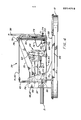
- Fig. 4 there is shown in elevation the mechanical weighing mechanism 39.
- This conventional weighing mechanism is manufactured by Terraillon, BP 501 Annemasse, Cedex, France 74013, and has been successfully used for a number of years in the Terraillon two kilogram scale model number BA22.
- the parallel leaf springs 42, 42, 43, 44 form a parallelogram in conjunction with the moving rail 38 and fixed rail 45 which insures that the moving rail 38 moves in a vertical direction. Due to the resiliency of the parallel leaf springs, the vertical deflection of the rail 38 is proportional to the weight applied to the rail 38.
- the rail 38 is connected by a pivoting lower arm 60 which is in turn pivoted to a linear rack 61 which includes gear teeth 62 meshing with a pinion 63.
- the pinion 63 is journalled in a box 64 which is supported by a horizontal beam 65 secured by a screw 66 to the stationary rail 45. Therefore, the pinion 63 is angularly displaced by an amount proportional to the vertical displacement of the rail 38 and thus the applied weight.
- a long screw 67 is received in the rack 61 to apply gravitational force to engage the rack and pinion.
- the vertical displacement of the rail is limited by a stop 68 integral with the base 13.
- the lower arm 60 is pivoted to the rail 38 at two points 69, 70 formed on a resilient plastic bracket 71.
- the lower arm 60 is held on the bracket 71 by the force of a spring 72 which is clamped between the bracket 71 and the vertically moving rail 38 by a screw 73.
- the lower arm 60 is slotted so as to disengage the pivots 69, 70 near the respective lower and upper limits of vertical travel of the rail 38.
- a screw 74 abuts the lower portion of the bracket 71 and could possibly function as a full scale adjustment by bending the bracket 71 to slightly change the angle of the rack 62 with respect to the vertical direction.
- an upper arm 75 includes a pivot connection 76 to the stationary rail 45. To raise and lower the arm 75, the arm has a lower abutment 77 resting upon the end face of the threaded shaft 55 of a knob 31.
- the upper end portion of the arm 75 includes a mount 78 for a connector 79 to an extension spring 80 having its other end secured to the lower end of a mounting bracket 100 secured to the vertically moving rail 38 and leaf springs 41, 42, 43, 44.
- the spring 80 is selected to obtain up to about a 60° adjustment in terms of rotation of the pinion 63 which is intended to rotate a circular disc carrying a graduated scale.
- a pointer rather than a graduated scale is carried by a disc.
- the zeroing knob 31 it is desirable for the zeroing knob 31 to permit a full 360° rotation of the pointer. Therefore, the stiffness of the spring 80 should be increased and also the diameter of the pinion 63 could be decreased, to obtain a wider range of zero adjustment.
- Fig. 5 there is shown a detailed view of the graduated scales 21 on the slide 20. These scales are in the form of concentric arcs extending over 270° so as to leave open 90° for annotating the scales with the names of food items. Specifically, the food items include eight different cheeses.
- the cheeses listed on the slide 20 should be generally arranged in terms of increasing caloric content but consideration may also be given to the fact that a number of cheeses have the same caloric content, to a high degree of precision.
- Cottage cheese for example, is listed first corresponding to the graduated scale having the least circumference. Cheddar and Parmesan cheese are listed together since their caloric contents differ by only one per cent. Similarly Swiss, American and Brick are listed together because they have almost identical caloric contents.
- the scales are preferably imprinted in different colours and the names of the food items have the same colours as their associated scales.
- a slide 90 may have scales 91 for a number of characteristics 92 (such as calories, carbohydrates, fats, proteins, calcium, phosphorous, iron and sodium) for each food item.
- a slide 93 includes a first set of food items and associated scales on the upper half and a second set of food items and associated scales on the lower half. In this case, confusion between the upper and lower scales is prevented because the numbers and letters for the lower scales are upside-down.
- the slide 93 is turned so that the desired food item is right-side up and the slide 30 is then inserted into the receiving and guiding means 22 of the weighing instrument 10. Therefore, the centre of the scales is located at the centre of the slide.
- the slide 93 also has the name of the corresponding food group printed at both the top and bottom of the slide so that the slide is never upside-down in the index file 11 (see Fig. 1).
- the slides may also have the name 94 of the food group on the top faces of the slides, as shown in Fig. 5.
- the "double-density" slides 93 should have the food group printed on both of the top and bottom sides, so that the top and bottom sides will be indistinguishable.
- the slides 20, for example, are preferably 1/10 of an inch thick. If this printing 94 is too small for a particular user, the user can flip through the index file 11 (see Fig. 1) and read the names of the food groups printed on the faces of the slides.
- a weighing instrument having a large number of graduated scales which does not require a great deal of time and effort for selecting the scales and does not cause confusion when referring to a particular scale corresponding to a desired material or weight-related characteristic.
- the scales are colour coded and arranged in a convenient fashion on easily handled rigid rectangular slides. These slides are arranged in an index file and labelled according to subject matter for quick reference.
Landscapes
- Physics & Mathematics (AREA)
- General Physics & Mathematics (AREA)
- Food-Manufacturing Devices (AREA)
- Length-Measuring Instruments Using Mechanical Means (AREA)
- Table Devices Or Equipment (AREA)
Applications Claiming Priority (2)
| Application Number | Priority Date | Filing Date | Title |
|---|---|---|---|
| US76985685A | 1985-08-26 | 1985-08-26 | |
| US769856 | 1985-08-26 |
Publications (2)
| Publication Number | Publication Date |
|---|---|
| EP0214716A2 true EP0214716A2 (de) | 1987-03-18 |
| EP0214716A3 EP0214716A3 (de) | 1988-06-08 |
Family
ID=25086711
Family Applications (1)
| Application Number | Title | Priority Date | Filing Date |
|---|---|---|---|
| EP86304475A Withdrawn EP0214716A3 (de) | 1985-08-26 | 1986-06-11 | Wiegeinstrument mit austauschbaren Skaleneinteilungen versehenen Blättern |
Country Status (3)
| Country | Link |
|---|---|
| EP (1) | EP0214716A3 (de) |
| AU (1) | AU5797786A (de) |
| GB (1) | GB2179742A (de) |
Family Cites Families (10)
| Publication number | Priority date | Publication date | Assignee | Title |
|---|---|---|---|---|
| GB592105A (en) * | 1945-05-17 | 1947-09-08 | Coventry Engineering Company L | Improvements in adjustable slip gauges |
| DE395424C (de) * | 1921-03-20 | 1924-05-08 | Alfred Frenzel | Zifferblatt fuer Waagen, das mit einer Anzahl konzentrischer Skalen ausgestattet ist |
| GB308234A (en) * | 1927-12-20 | 1929-03-20 | David Frederick Lucking | Improvements in adjustable raising blocks and the like for setting-up machine parts,jigs, or other members |
| GB564065A (en) * | 1943-02-08 | 1944-09-12 | Dudley Ernest Stainton | Adjustable measuring and/or gauge blocks and adjustable parallels and/or adjustable laps |
| GB1231220A (de) * | 1968-06-22 | 1971-05-12 | ||
| BE794396A (fr) * | 1972-01-23 | 1973-05-16 | Salter Housewares Ltd | Balance en particulier pour cuisine |
| DE2540931A1 (de) * | 1975-09-13 | 1977-03-24 | Soehnle Murrhardter Waagen | Waage, insbesondere wandwaage |
| US4055141A (en) * | 1976-02-27 | 1977-10-25 | Homs Douglas M | Transparent dial and outer transparent cover for scale with zero-setting adjustment |
| GB1564110A (en) * | 1976-12-16 | 1980-04-02 | Salter Housewares Ltd | Kitchen or household weighing appartus |
| CH623929A5 (de) * | 1978-11-09 | 1981-06-30 | Paul Terraillon |
-
1986
- 1986-05-27 AU AU57977/86A patent/AU5797786A/en not_active Abandoned
- 1986-06-02 GB GB08613277A patent/GB2179742A/en not_active Withdrawn
- 1986-06-11 EP EP86304475A patent/EP0214716A3/de not_active Withdrawn
Also Published As
| Publication number | Publication date |
|---|---|
| AU5797786A (en) | 1987-03-05 |
| GB2179742A (en) | 1987-03-11 |
| GB8613277D0 (en) | 1986-07-09 |
| EP0214716A3 (de) | 1988-06-08 |
Similar Documents
| Publication | Publication Date | Title |
|---|---|---|
| US5044453A (en) | Weighing instrument having interchangeable slides carrying graduated scales | |
| US4387777A (en) | Calorie counting method and apparatus | |
| US4462473A (en) | Apparatus for electronically determining postage in response to weight | |
| US4840239A (en) | Volumetric-to-gravimetric-to-volumetric converter scale | |
| US4599508A (en) | Calorie counter | |
| US4625675A (en) | Diet management device | |
| US4893685A (en) | Scale | |
| GB2179752A (en) | Weighing instrument with interchangeable indicating scales | |
| EP0214716A2 (de) | Wiegeinstrument mit austauschbaren Skaleneinteilungen versehenen Blättern | |
| US4280574A (en) | Balance with selectable multiple reading scales | |
| US4744428A (en) | Scale | |
| US4223750A (en) | Weighting instrument for dietetic use | |
| US4454409A (en) | Bra-size calculator | |
| GB2317961A (en) | Food weighing scale with nutritional calculation | |
| US3481413A (en) | Scale with index means for determining changes in volume of a material | |
| GB2094000A (en) | A caloric content measuring kitchen balance | |
| EP0257613A2 (de) | Apparat für chemische Instrumentierung | |
| US3413952A (en) | Scale with adjustable cover-dial combination | |
| JPH0334665Y2 (de) | ||
| JPS6139302Y2 (de) | ||
| US4090301A (en) | Graphic recording system | |
| US4213089A (en) | Variable scale readout for multi-meter use | |
| EP1947589A1 (de) | Altersabhängige relative Gewichtsangaben | |
| US575143A (en) | Scale | |
| US581172A (en) | Computing-scale |
Legal Events
| Date | Code | Title | Description |
|---|---|---|---|
| PUAI | Public reference made under article 153(3) epc to a published international application that has entered the european phase |
Free format text: ORIGINAL CODE: 0009012 |
|
| AK | Designated contracting states |
Kind code of ref document: A2 Designated state(s): AT BE CH DE FR IT LI LU NL SE |
|
| PUAL | Search report despatched |
Free format text: ORIGINAL CODE: 0009013 |
|
| AK | Designated contracting states |
Kind code of ref document: A3 Designated state(s): AT BE CH DE FR IT LI LU NL SE |
|
| STAA | Information on the status of an ep patent application or granted ep patent |
Free format text: STATUS: THE APPLICATION IS DEEMED TO BE WITHDRAWN |
|
| 18D | Application deemed to be withdrawn |
Effective date: 19881231 |
|
| RIN1 | Information on inventor provided before grant (corrected) |
Inventor name: FINKLE, GERALD |