EP0215773B1 - Verfahren zur herstellung von elektronischen komponenten unter verwendung eines weichlötflussmittels auf carbonsäurebasis - Google Patents
Verfahren zur herstellung von elektronischen komponenten unter verwendung eines weichlötflussmittels auf carbonsäurebasis Download PDFInfo
- Publication number
- EP0215773B1 EP0215773B1 EP84901992A EP84901992A EP0215773B1 EP 0215773 B1 EP0215773 B1 EP 0215773B1 EP 84901992 A EP84901992 A EP 84901992A EP 84901992 A EP84901992 A EP 84901992A EP 0215773 B1 EP0215773 B1 EP 0215773B1
- Authority
- EP
- European Patent Office
- Prior art keywords
- flux
- soft soldering
- fact
- compliance
- soldering flux
- Prior art date
- Legal status (The legal status is an assumption and is not a legal conclusion. Google has not performed a legal analysis and makes no representation as to the accuracy of the status listed.)
- Expired
Links
Classifications
-
- B—PERFORMING OPERATIONS; TRANSPORTING
- B23—MACHINE TOOLS; METAL-WORKING NOT OTHERWISE PROVIDED FOR
- B23K—SOLDERING OR UNSOLDERING; WELDING; CLADDING OR PLATING BY SOLDERING OR WELDING; CUTTING BY APPLYING HEAT LOCALLY, e.g. FLAME CUTTING; WORKING BY LASER BEAM
- B23K35/00—Rods, electrodes, materials, or media, for use in soldering, welding, or cutting
- B23K35/22—Rods, electrodes, materials, or media, for use in soldering, welding, or cutting characterised by the composition or nature of the material
- B23K35/36—Selection of non-metallic compositions, e.g. coatings or fluxes; Selection of soldering or welding materials, conjoint with selection of non-metallic compositions, both selections being of interest
- B23K35/3612—Selection of non-metallic compositions, e.g. coatings or fluxes; Selection of soldering or welding materials, conjoint with selection of non-metallic compositions, both selections being of interest with organic compounds as principal constituents
-
- B—PERFORMING OPERATIONS; TRANSPORTING
- B23—MACHINE TOOLS; METAL-WORKING NOT OTHERWISE PROVIDED FOR
- B23K—SOLDERING OR UNSOLDERING; WELDING; CLADDING OR PLATING BY SOLDERING OR WELDING; CUTTING BY APPLYING HEAT LOCALLY, e.g. FLAME CUTTING; WORKING BY LASER BEAM
- B23K35/00—Rods, electrodes, materials, or media, for use in soldering, welding, or cutting
- B23K35/22—Rods, electrodes, materials, or media, for use in soldering, welding, or cutting characterised by the composition or nature of the material
- B23K35/36—Selection of non-metallic compositions, e.g. coatings or fluxes; Selection of soldering or welding materials, conjoint with selection of non-metallic compositions, both selections being of interest
- B23K35/3612—Selection of non-metallic compositions, e.g. coatings or fluxes; Selection of soldering or welding materials, conjoint with selection of non-metallic compositions, both selections being of interest with organic compounds as principal constituents
- B23K35/3613—Polymers, e.g. resins
-
- B—PERFORMING OPERATIONS; TRANSPORTING
- B23—MACHINE TOOLS; METAL-WORKING NOT OTHERWISE PROVIDED FOR
- B23K—SOLDERING OR UNSOLDERING; WELDING; CLADDING OR PLATING BY SOLDERING OR WELDING; CUTTING BY APPLYING HEAT LOCALLY, e.g. FLAME CUTTING; WORKING BY LASER BEAM
- B23K35/00—Rods, electrodes, materials, or media, for use in soldering, welding, or cutting
- B23K35/22—Rods, electrodes, materials, or media, for use in soldering, welding, or cutting characterised by the composition or nature of the material
- B23K35/36—Selection of non-metallic compositions, e.g. coatings or fluxes; Selection of soldering or welding materials, conjoint with selection of non-metallic compositions, both selections being of interest
- B23K35/3612—Selection of non-metallic compositions, e.g. coatings or fluxes; Selection of soldering or welding materials, conjoint with selection of non-metallic compositions, both selections being of interest with organic compounds as principal constituents
- B23K35/3618—Carboxylic acids or salts
Definitions
- the invention relates to a method for producing electrical and electronic components, in particular printed circuit boards equipped with components, by soft soldering by means of soldering machines using a soft soldering flux based on carboxylic acid, which is used in the electronics and electronics industry.
- Soft solder fluxes based on organic carboxylic acids are known. They are basically described by C.L. Barber, “Soft Solder Fluxes in“ Industrial Engineering Chemistry ”, Vol. 29, No. 10 (1937), in DE PS 841 097, DIN 8511, type F-SW 32 or DIN 8516 and DIN 8527, as well as in DE PS 2725 701 and PE PS 292 1827. Furthermore in US PS 2740193 and US PS 41 65244 and GB PS 557816.
- soft soldering fluxes based on organic carboxylic acids can generally be described as follows: They consist of a carrier, activator and solvent system. Resins or polyhydric modified alcohols or their derivatives are used as carriers, organic acids as activators and alkanols, ketones, water etc. as solvents or individually or in mixtures.
- reaction products which are insoluble in the fire-retardant fillers of the printed circuits, polymerisation products, crystalline anhydrides or esters of the activator components.
- reaction products of this type can originate from aliphatic unsaturated and saturated mono-, di-, polycarboxylic or keto acids, as well as from their amine, amide or ureide components or from halogen compounds.
- DE-A-2921 827 indicates the property of the removability of the flux residues.
- the application shows a limited suitability due to a time limit of the cleanability (max. 2 hours after the soldering process) or the use is only possible at soldering temperatures> 300 ° C.
- soldering temperatures > 300 ° C.
- the soldering temperature of 250 ° C which is common in electronics production, there is no correspondence with the requirements of DIN 8527.
- PS DE 2725 701 it is also known that when using aromatic acids or aromatic compounds based on mono-, di-, policarboxylic acids and their Derivatives a flawless cleaning process can be carried out (PS DE 2725 701). However, such compounds have no stability against autoxidation in resin fluxes.
- the flux composition mentioned in PS GB-A-1448 351 is used for the process of soldering tin cans on body-maker machines.
- This PS does not say anything about the special requirements placed on fluxes for the manufacture of electronic products (e.g. printed circuits) (such as surface resistance).
- the alicyclic carboxylic acids (similar to the aromatic ones) have significantly lower pKa values than the aliphatic carboxylic acids. This is expressed in a soldering ability of the fluxes according to the invention which is significantly improved compared to fluxes activated with purely aliphatic carboxylic acids.
- the flux residues can optionally remain on the printed circuits after the soldering process.
- the resin (claim 4a) is contained in an amount of ' 0.01-35%.
- the suitable types of resin are described above.
- the polyhydric, modified alcohols with 2-16 C atoms (claim 4b), their isomers and derivatives, in particular their ester, ether and oxo compounds, are contained in 0.01-90%.
- Examples include glycols, glycerol, pentaerythritol, dodecanol, tridecanol and tetradecanol, also in combination with ethylene and propylene oxide polymerization adducts.
- the following components of the activator system (claim 3) are contained either with 0.01-25% or with 0%.
- Alicyclic mono-, di- or policarboxylic acids with at least one carbon ring (claim 3a) or their derivatives.
- Alicyclic ring systems based on cyclopentane, hexane and heptane are suitable. Of these, the cyclohexane series has proven to be particularly suitable. This is also reflected in the fact that the stress energy for the deformation of the carbon rings in cyclohexane has a minimum.
- Alicyclic carboxylic acids which cannot be split into optically active antipodes have been found to be particularly suitable.
- An example of a suitable alicyclic carboxylic acid is trans-cyclo-hexane-1,4-dicarboxylic acid.
- Saturated aliphatic monocarboxylic acids with 14-22 carbon atoms (claim 3b).
- suitable acids are palmitic, stearic and lauric acid, with stearic acid being particularly preferred.
- Saturated aliphatic dicarboxylic acids with 2-10 C atoms and policarboxylic acids (claim 3c).
- suitable acids are malonic, succinic, glutaric, adipic, pimelic, cork, azelaic and sebacic acid, with succinic, adipic and glutaric acid or mixtures being particularly preferred.
- Aliphatic ketocarboxylic acids with 3-5 carbon atoms (claim 3d).
- suitable acids are pyruvic, acetoacetic and levulinic acid, with levulinic acid being particularly preferred.
- Quaternary ammonium salts with 4-19 C atoms (claim 3e).
- An example of a suitable salt is the tetramethylammonium salt.
- the halogen salts are particularly suitable, in particular the bromides of the quaternary ammonium salts are preferred.
- the water is contained with 0.01-25% (claim 5a).
- the water-miscible alkanols or their isomers with 2-5 C atoms (claim 5b) are contained as the remainder in each case 100% of the respective flux mixture.
- suitable alkanols are ethanol, propanol, butanol, pentanol or their isomers, isopropanol being particularly preferred.
- solder paste With the dispersion of finely divided solder in the liquid flux, a solder paste can also be obtained (claim 6).
- Such a product can be used to coat soldering parts or to fill solder wires (claim 7).
- the components according to claim 5 are omitted for these applications.
- Liquid flux for automatic flow soldering which is particularly suitable for applications in the consumer electronics sector
- Liquid flux for automatic flow soldering the residues of which can be removed with water after the soldering process.
Landscapes
- Engineering & Computer Science (AREA)
- Mechanical Engineering (AREA)
- Electric Connection Of Electric Components To Printed Circuits (AREA)
- Organic Low-Molecular-Weight Compounds And Preparation Thereof (AREA)
Description
- Die Erfindung betrifft ein Verfahren zur Herstellung von elektrischen und elektronischen Komponenten, insbesondere von mit Bauelementen bestückten gedruckten Schaltungen durch Weichlöten mittels Lötmaschinen unter Verwendung eines Weichlötflussmittels auf Carbonsäurebasis, das in der Elektronik- und Elektroindustrie eingesetzt wird.
- Weichlötflussmittel auf der Basis von organischen Carbonsäuren sind bekannt. Sie werden grunglegend beschrieben von C.L. Barber, « Soft Solder Fluxes in « Industrial Engineering Chemistry », Vol. 29, No. 10 (1937), in der DE PS 841 097, der DIN 8511, Typ F-SW 32 bzw. DIN 8516 und DIN 8527, sowie in der DE PS 2725 701 und der PE PS 292 1827. Ferner in den US PS 2740193 und US PS 41 65244 sowie GB PS 557816.
- Weichlötflussmittel auf der Basis von organischen Carbonsäuren können in ihrem Aufbau allgemein wie folgt beschrieben werden : Sie bestehen aus einem Träger-, Aktivator- und Lösemittelsystem. Hierbei werden als Träger Harze oder mehrwertige modifizierte Alkohole oder deren Derivate, als Aktivatoren organische Säuren und als Lösemittel Alkanole, Ketone, Wasser etc. einzeln oder in Mischungen verwendet.
- Als Harze können im weichlöttechnischen Sinne definiert werden :
- a) natürliche Baumharze (Kolophonium)
- b) veresterte Baumharze
- c) Kunstharze auf der Basis von gesättigten und ungesättigten aliphatischen Mono-, Di-, Polisowie aromatischen Carbonsäuren bzw. Phenolen.
- Die Produkte gemäss a) und b) sind in ihrer Natur vorbeschrieben, z. B. in der DE PS 2820 656 bzw. DE PS 2921 827. Die bisher bekannten Aktivator- und Lösemittelsysteme sind in der eingangs angeführten Grundlagenliteratur umfassend vorbeschrieben.
- Durch die Einführung von Bauelementen auf Basis der LSI- bzw. VLSI-Technologien kann eine mit Bauelementen bestückte greduckte Schaltung nur mehr mittels Automatischen Testsystemen (ATE) wirtschaftlich auf Funktion geprüft werden. Es werden mit steigender Tendenz bereits bis zu mehrere tausend Prüfnadeln zur Kontaktierung mit Prüfadaptern pro gedruckte Schaltung benötigt. Bei Verwendung von herkömmlichen Harzflussmitteln, deren Rückstände nach dem Löten der gedruckten Schaltungen auf diesen verbleiben, verursachen diese Harzflussmittelrückstände aufgrund ihrer klebrigen Konsistenz innerhalb weniger Prüfzyklen durch Bildung von Aufbauschichten auf den Prüfspitzen erhebliche Kontaktprobleme. Auch die Schichtdicke der Flussmittelrückstände an sich, die ja beim Aufsetzen der Prüfspitzen von diesen durchstossen werden muss, kann hierbei Anpresskräfte erfordern, bei denen sich die Prüfspitzen verbiegen. Sehr häufig ist auch, da&s die Rückstandsschicht der Harzflussmittel überhaupt nicht durchdrungen wird. Alle diese Vorgänge führen zur Anzeige von scheinbaren Funktionsfehlern der Elektronik im Prüfprotokoll der ATE. Durch hohen Prüfaufwand zur Auffindung der Scheinfehlerquellen kann die Wirtschaftlichkeit der ATE in Frage gestellt sein.
- Die vorbeschriebenen Scheinfehlerquellen lassen sich bekannterweise durch die Entfernung der Harzflussmittelrückstände auf den gedruckten Schaltungen in einem der Testroutine vorgeschalteten Reinigungsprozess vermeiden. Jedoch weisen bisher verfügbare Harzflussmittel in ihrer Geeignetheit zur Entfernungihrer Rückstände nach dem Lötprozess erhebliche Nachteile auf. Gewöhnlich werden als Reinigungsmedien Chlor-, Fluorchlorkohlenwasserstoffe (FKW), Alkanole atc. oder auch Mischungen davon verwendet. Mit derartigen nonpolaren Reinigungsmedien lassen sich bisher zwar die Harzanteile der Flussmittelrückstände, aber nicht die Reaktionsprodukte der Aktivatorkomponenten entfernen. Es treten nach einem Reinigungsvorgang die bekannten « weissen Schleier auf. Diese unerwünschten Rüchstände können je nach Zusammensetzung des Harzflussmittels in den Reinigungsmedien unlösliche Reaktionsprodukte mit den feuerhemmenden Füllstoffen der gedruckten Schaltungen, Polimerisationsprodukte, kristalline Anhydride oder Ester der Aktivatorkomponenten sein. Insbesondere können derartige Reaktionsprodukte von aliphatischen ungesättigten und gesättigten Mono-, Di-, Policarbon- bzw. Ketosäuren, sowie von deren Amin-, Amid- bzw. Ureidkomponenten oder auch von Halogenverbindungen stammen.
- Die DE- A-2921 827 deutet zwar die Eigenschaft der Entfernbarkeit der Flussmittelrückstände an. Doch zeigt sich in der Anwendung eine begrenzte Geeignetheit durch eine zeitliche Limitierung der Reinigbarkeit (max. 2 Stunden nach dem Lötprozess) bzw. der Einsatz ist nur bei Löttemperaturen > 300 °C möglich. Bei der in der Elektronikproduktion üblichen Löttemperatur von 250 °C besteht keine Entsprechung mit den Forderungen der DIN 8527. Es ist auch bekannt, dass bei Verwendung von aromatischen Säuren, bzw. aromatischen Verbindungen auf der Basis von Mono-, Di-, Policarbonsäuren und deren Derivaten ein einwandfreier Reinigungsprozess durchgeführt werden kann (PS DE 2725 701). Doch weisen derartige Verbindungen in Harzflussmitteln keine Stabilität gegen Autoxidation auf.
- Ferner ist es für die Erfordernisse der Elektronikproduktion wünschenswert, die Möglichkeiten des wahlweisen Verbleibens der Flussmittelrückstände auf den gedruckten Schaltungen gemäss den Forderungen der DIN 8511, Typ F-SW 32 bzw. DIN 8527 zu haben. Aufgrund der heute üblichen Microminiaturisierung ist das Problem der Lotbrückenbildung besonders dominierend. Dies kann nur mit einer starken Reduzierung der Lotoberflächenspannung während des Weichlötvorgangs gelöst werden. Harzflussmittel auf der Basis von gesättigten und ungesättigten aliphatischen Mono-, Di- und Policarbonsäuren besitzen zwar die Aktivität wie sie die heutige Elektronikproduktion fordert. Sie weisen jedoch die vorbeschriebenen Reinigungsprobleme auf. Flussmittel auf der Basis von aromatischen Carbonsäuren haben nur eine geringe Aktivität und weisen Instabilität gegen Autoxidation als gravierende Nachteile auf (insbesondere ist ein Absinken des Oberflächenwiderstands feststellbar).
- Die in der PS GB-A-1448 351 erwähnte Flussmittelzusammensetzung wird für das Verfahren Löten von Blechdosen auf body-maker-Maschinen angewandt. Über die speziellen Anforderungen, die an Flussmittel zur Herstellung von elektronischen Produkten (z. B. gedruckten Schaltungen) gestellt werden (wie z. B. Oberflächenwiderstand) wird in dieser PS nichts ausgesagt.
- Die Erfindung ist in den Ansprüchen wiedergegeben. Aus der Grundrezeptur nach den Ansprüchen 1 und 2 lassen sich Flussmittel für die verschiedensten Weichlötverfahren und Anwendungen aufbauen. Hierbei ist die besondere Eigenschaft der vollständigen Wiederentfernbarkeit der Flussmittelrückstände nach dem Weichlötprozess mit jedem bekannten und geeigneten Reinigungsverfahren (z. B. Sprüh-, Bürsten-, Ultraschall- oder Dampfentfettungsreinigung) and Rei- nigungsmedium (z. B. Chlor-, Fluorchlorkohlenwasserstoffen, Alkoholen, Ketonen, Wasser) ohne zeitliche Begrenzung und ohne Hinterlassung irgendwelcher Rückstände möglich. Die erfindungsgemässen Flussmittel sind stabil und unterliegen keinerlei Autoxidation oder sonstigen Abbauprozessen. Andererseits weisen die alicyclischen Carbonsäuren (ähnlich den aromatischen) erheblich niedrigere pKa- Werte als die aliphatischen Carbonsäuren auf. Dies drückt sich in einer gegenüber mit rein aliphatischen Carbonsäuren aktivierten Flussmitteln deutlich verbesserten Lötfähigkeit der erfindungsgemässen Flussmittel aus. Zudem können die Flussmittelrückstände nach dem Lötprozess wahlweise auf den gedruckten Schaltungen verbleiben.
- Mit der Erfindung können Flussmittel für verschiedene Applikationsverfahren aufgebaut werden. Alle nachfolgenden Prozentangaben beziehen sich (soweit nicht anders angegeben) als Gewichtsprozente auf die Gesamtzusammensetzung.
- Die Anwendung erfolgt vorzugsweise bei automatischen Fliesslötverfahren, wobei die Applikation auf die gedruckten Schaltungen mittels Schaum, Sprayen oder ähnlichem geschieht.
- Hierbei ist das Harz (Anspruch 4a) in einer Menge von '0,01-35 % enthalten. Die geigneten Harzsorten sind eingangs vorbeschrieben.
- Die mehrwertigen, modifizierten Alkohole mit 2-16 C-Atomen (Anspruch 4b), deren Isomeren und Derivate, insbesondere deren Ester-, Ether-und Oxoverbindungen sind mit 0,01-90 % enthalten. Als Beispiele sind angeführt Glycole, Glycerin, Pentaerythrit, Dodecanol, Tridecanol und Tetradecanol, auch in Verbindung mit Ethylen- und Propylenoxidpolimerisationsaddukten.
- Die nachfolgenden Bestandteile des Aktivatorsystems (Anspruch3) sind entweder mit 0,01-25 % oder mit 0 % enthalten.
- Alicyclische Mono-, Di- bzw. Policarbonsäuren mit mindestens einem Kohlenstoffring (Anspruch 3a) oder deren Derivate. Geeignet sind alicyclische Ringsysteme auf der Basis von Cyclopentan, -hexan und -heptan. Hiervon hat sich als besonders geeignet die Cyclohexan-Reihe gezeigt. Dies drückt sich auch darin aus, dass die Spannungsenergie zur Deformation der Kohlenstoffringe beim Cyclohexan ein Minimum hat. Als bevorzugt geeignet haben sich alicyclische Carbonsäuren gezeigt, die sich nicht in optisch aktive Antipoden spalten lassen. Beispiel für eine geeignete alicyclische Carbonsäure ist die trans-Cyclo-hexan- 1,4 Dicarbonsäure.
- Gesättigte aliphatische Monocarbonsäuren mit 14-22 C-Atomen (Anspruch 3b). Beispiele für geeignete Saüren sind Palmitin-, Stearin- und Laurinsäure, wobei die Stearinsäure besonders bevorzugt ist.
- Gesättigte aliphatische Dicarbonsäuren mit 2-10 C-Atomen und Policarbonsäuren (Anspruch 3c). Beispiele für geeignete Säuren sind Malon-, Bernstein-, Glutar-, Adipin-, Pimelin-, Kork-, Azelain- und Sebazinsäure, wobei die Bernstein-, Adipin- und Glutarsäure oder Mischungen besonders bevorzugt sind.
- Aliphatische Ketocarbonsäuren mit 3-5 C-Atomen (Anspruch 3d). Beispiele für geeignete Säuren sind Brenztrauben-, Acetessig- und Lävulinsäure, wobei die Lävulinsäure besonders bevorzugt ist.
- Quartäre Ammoniumsalze mit 4-19 C-Atomen (Anspruch 3e). Beispiel für ein geeignetes Salz ist das Tetramethyammoniumsalz. Bevorzugt geeignet sind die Halogensalze, insbesondere sind die Bromide der quartären Ammoniumsalze bevorzugt.
- Das Wasser ist mit 0,01-25 % enthalten (Anspruch 5a). Die mit Wasser mischbaren Alkanole oder deren Isomeren mit 2-5 C-Atomen (Anspruch 5b) sind als Rest zu jeweils 100 % der jeweiligen Flussmittelmischung enthalten. Beispiele für geeignete Alkanole sind Äthanol, Propanol, Butanol, Pentanol oder deren Isomere, wobei Isopropanol besonders bevorzugt ist.
- Mit der Dispergierung von feinteiligem Lot in das Flüssigflussmittel kann auch eine Lotpaste erhalten werden (Anspruch 6).
- Ein derartiges Produkt kann zur Umhüllung von Lottormteilen oder als Füllung von Lotdrähten verwendet werden (Anspruch 7). Für diese Anwendungen entfallen die Komponenten gemäss Anspruch 5.
- Die nachfolgenden Beispiele erläutern die Erfindung.
- Flüssigflussmittel für automatisches Fließlötverfahren

- Flüssigflussmittel für automatische Fließlötverfahren, das besonders geeignet ist für Anwendungen im Konsumelektronikbereich
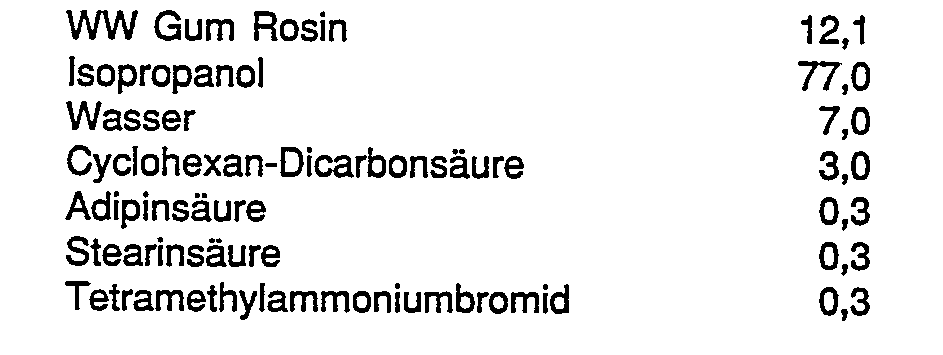
- Flüssigflussmittel für automatisches Fliesslötverfahren, dessen Rückstände mit Wasser nach dem Lötprozess wieder entfernt werden können.
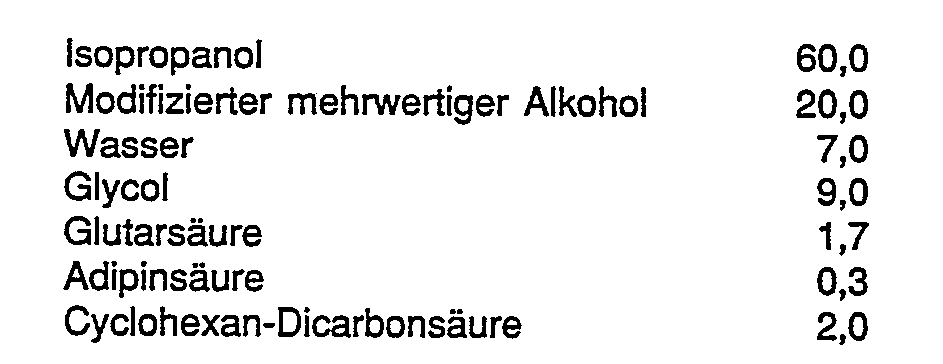
- Festflussmittel zur Umhüllung eines Lotformteiles oder als Füllung für Lotdrähte.

- Sämtliche Flussmittelmischungen entsprechen in Bezug auf Korrosion und Oberflächenwiderstand gemäss DIN 8516 und DIN 8527 allen Tests für halogenfreie Flussmittel.
Claims (7)
Applications Claiming Priority (1)
| Application Number | Priority Date | Filing Date | Title |
|---|---|---|---|
| PCT/EP1984/000143 WO1985005307A1 (fr) | 1984-05-14 | 1984-05-14 | Flux decapant pouvant se nettoyer a base d'acides carboxyles pour la soudure tendre |
Publications (3)
| Publication Number | Publication Date |
|---|---|
| EP0215773A1 EP0215773A1 (de) | 1987-04-01 |
| EP0215773B1 true EP0215773B1 (de) | 1989-07-19 |
| EP0215773B2 EP0215773B2 (de) | 1997-01-22 |
Family
ID=8164941
Family Applications (1)
| Application Number | Title | Priority Date | Filing Date |
|---|---|---|---|
| EP84901992A Expired - Lifetime EP0215773B2 (de) | 1984-05-14 | 1984-05-14 | Verfahren zur herstellung von elektronischen komponenten unter verwendung eines weichlötflussmittels auf carbonsäurebasis |
Country Status (4)
| Country | Link |
|---|---|
| EP (1) | EP0215773B2 (de) |
| AT (1) | ATE44671T1 (de) |
| DE (1) | DE3478999D1 (de) |
| WO (1) | WO1985005307A1 (de) |
Cited By (3)
| Publication number | Priority date | Publication date | Assignee | Title |
|---|---|---|---|---|
| DE4235575A1 (de) * | 1992-10-22 | 1994-04-28 | Degussa | Weichlotpaste zum Löten von elektronischen Schaltungen |
| DE19711350B4 (de) * | 1996-03-19 | 2011-08-11 | Harima Chemicals, Inc., Hyogo | Lötflussmittel |
| CN103264240A (zh) * | 2012-12-31 | 2013-08-28 | 广东普赛特电子科技股份有限公司 | 一种无卤免清洗助焊剂及其制备方法 |
Families Citing this family (4)
| Publication number | Priority date | Publication date | Assignee | Title |
|---|---|---|---|---|
| DE3713553C1 (de) * | 1987-04-23 | 1988-09-15 | Alpha Grillo Lotsysteme Gmbh | Halogenfreies Flussmittelgemisch und seine Verwendung |
| ES2047019T3 (es) * | 1988-01-12 | 1994-02-16 | Rudolf A Kerner | Procedimiento para la fabricacion de componentes electricos y electronicos. |
| BE1002430A3 (nl) * | 1988-02-16 | 1991-02-05 | Interflux Electronics Bv Met B | Soldeervloeimiddel |
| TW206936B (de) * | 1990-10-31 | 1993-06-01 | Hughes Aircraft Co |
Family Cites Families (6)
| Publication number | Priority date | Publication date | Assignee | Title |
|---|---|---|---|---|
| GB557816A (en) * | 1942-05-30 | 1943-12-07 | Lucas Ltd Joseph | Improvements relating to soldering fluxes |
| US2740193A (en) * | 1953-07-01 | 1956-04-03 | Rca Corp | Method of soldering printed circuits |
| GB1458351A (en) * | 1972-12-06 | 1976-12-15 | Jacobs N L | Fluxes |
| US4168996A (en) * | 1977-05-16 | 1979-09-25 | Western Electric Company, Inc. | Soldering flux |
| US4165244A (en) * | 1977-10-21 | 1979-08-21 | Jacobs Norman L | Soldering flux and method of using same |
| DE2921827B2 (de) * | 1979-05-29 | 1981-06-04 | Winchester Electronics Gmbh, 7100 Heilbronn | Halogenfreies Flußmittel für die Weichlötung auf Kolophoniumbasis |
-
1984
- 1984-05-14 AT AT84901992T patent/ATE44671T1/de not_active IP Right Cessation
- 1984-05-14 EP EP84901992A patent/EP0215773B2/de not_active Expired - Lifetime
- 1984-05-14 WO PCT/EP1984/000143 patent/WO1985005307A1/de not_active Ceased
- 1984-05-14 DE DE8484901992T patent/DE3478999D1/de not_active Expired
Cited By (3)
| Publication number | Priority date | Publication date | Assignee | Title |
|---|---|---|---|---|
| DE4235575A1 (de) * | 1992-10-22 | 1994-04-28 | Degussa | Weichlotpaste zum Löten von elektronischen Schaltungen |
| DE19711350B4 (de) * | 1996-03-19 | 2011-08-11 | Harima Chemicals, Inc., Hyogo | Lötflussmittel |
| CN103264240A (zh) * | 2012-12-31 | 2013-08-28 | 广东普赛特电子科技股份有限公司 | 一种无卤免清洗助焊剂及其制备方法 |
Also Published As
| Publication number | Publication date |
|---|---|
| ATE44671T1 (de) | 1989-08-15 |
| EP0215773B2 (de) | 1997-01-22 |
| WO1985005307A1 (fr) | 1985-12-05 |
| EP0215773A1 (de) | 1987-04-01 |
| DE3478999D1 (en) | 1989-08-24 |
Similar Documents
| Publication | Publication Date | Title |
|---|---|---|
| DE1520933B2 (de) | Verfahren zur Herstellung von Copolyamiden und deren Verwendung als Schmelzkleber | |
| EP0215773B1 (de) | Verfahren zur herstellung von elektronischen komponenten unter verwendung eines weichlötflussmittels auf carbonsäurebasis | |
| EP0002725B1 (de) | Filmbildende Zusammensetzung zur Beschichtung von Kontaktstiften eines Moduls | |
| EP0398871B1 (de) | Verfahren zur herstellung von elektronischen komponenten unter verwendung eines weichlötflussmittels auf carbonsäurebasis | |
| DE1570235A1 (de) | Verfahren zur Herstellung von Alkydharzen durch in situ-Alkoholyse | |
| DE2921827B2 (de) | Halogenfreies Flußmittel für die Weichlötung auf Kolophoniumbasis | |
| DE578707C (de) | Verfahren zur Herstellung von Kunstharzen | |
| EP0254722B1 (de) | Härtbare zusammensetzung | |
| DE1251450B (de) | Flammschutzmittel fur Epoxyharzlacke | |
| EP0101964B1 (de) | Verfahren zum Verbinden von Karosserieblechen unter Verwendung von pastösen, vorgelierbaren, wärmehärtbaren Epoxidharz-Klebstoffen | |
| DE954738C (de) | Verfahren zur Herstellung gelierter, insbesondere bei der Linoleum-Produktion zu verwendender Massen | |
| DE2929440C2 (de) | ||
| CH372166A (de) | Verfahren zur Herstellung von löslichen ungesättigten Polyesterharzen | |
| EP0288828B1 (de) | Halogenfreies Flussmittelgemisch und seine Verwendung | |
| DE1669858A1 (de) | Haertung von lufttrocknenden Polyesterform- oder -ueberzugsmassen | |
| DE2702986A1 (de) | Vernetzende waessrige ueberzugsmittel | |
| DE2853578C2 (de) | ||
| EP0056155A1 (de) | Wässrige Dispersionen auf Basis von Cellulosenitraten, Polyestern bzw. Alkydharzen und Aminoplastharzen, Verfahren zu ihrer Herstellung und ihre Verwendung zur Herstellung von Überzügen | |
| DE1920972A1 (de) | Haertbare Beschichtungsmassen auf der Grundlage von Gemischen aus sauren Polyestern und Epoxyverbindungen | |
| DE1287309B (de) | Herstellen von Polyesterpressmassen | |
| DE68920849T2 (de) | Bindemittel für schwerentflammbare lignozellulosehaltige Verbundstoffe und Verfahren zu ihrer Herstellung. | |
| EP0381973B1 (de) | Verfahren zur Herstellung von Nitrilgruppen enthaltenden Copolymerisaten auf Basis von Ethylen | |
| DE3338274C1 (de) | Wäßrige Cellulosenitrat-Dispersionen | |
| AT225423B (de) | Ungesättigte Polyesterharze | |
| EP0158238A2 (de) | Ungesättigte Polyesterharze |
Legal Events
| Date | Code | Title | Description |
|---|---|---|---|
| PUAI | Public reference made under article 153(3) epc to a published international application that has entered the european phase |
Free format text: ORIGINAL CODE: 0009012 |
|
| 17P | Request for examination filed |
Effective date: 19861103 |
|
| AK | Designated contracting states |
Kind code of ref document: A1 Designated state(s): AT BE CH DE FR GB LI LU NL SE |
|
| 17Q | First examination report despatched |
Effective date: 19880823 |
|
| GRAA | (expected) grant |
Free format text: ORIGINAL CODE: 0009210 |
|
| AK | Designated contracting states |
Kind code of ref document: B1 Designated state(s): AT BE CH DE FR GB LI LU NL SE |
|
| REF | Corresponds to: |
Ref document number: 44671 Country of ref document: AT Date of ref document: 19890815 Kind code of ref document: T |
|
| REF | Corresponds to: |
Ref document number: 3478999 Country of ref document: DE Date of ref document: 19890824 |
|
| ET | Fr: translation filed | ||
| GBT | Gb: translation of ep patent filed (gb section 77(6)(a)/1977) | ||
| PLBI | Opposition filed |
Free format text: ORIGINAL CODE: 0009260 |
|
| PG25 | Lapsed in a contracting state [announced via postgrant information from national office to epo] |
Ref country code: GB Effective date: 19900514 Ref country code: AT Effective date: 19900514 |
|
| PG25 | Lapsed in a contracting state [announced via postgrant information from national office to epo] |
Ref country code: SE Effective date: 19900515 |
|
| PG25 | Lapsed in a contracting state [announced via postgrant information from national office to epo] |
Ref country code: LU Free format text: LAPSE BECAUSE OF NON-PAYMENT OF DUE FEES Effective date: 19900531 Ref country code: LI Effective date: 19900531 Ref country code: CH Effective date: 19900531 Ref country code: BE Effective date: 19900531 |
|
| 26 | Opposition filed |
Opponent name: LITTON KESTER Effective date: 19900409 |
|
| NLR1 | Nl: opposition has been filed with the epo |
Opponent name: LITTON KESTER |
|
| BERE | Be: lapsed |
Owner name: KERNER RUDOLF A. Effective date: 19900531 |
|
| PG25 | Lapsed in a contracting state [announced via postgrant information from national office to epo] |
Ref country code: NL Effective date: 19901201 |
|
| GBPC | Gb: european patent ceased through non-payment of renewal fee | ||
| NLV4 | Nl: lapsed or anulled due to non-payment of the annual fee | ||
| PG25 | Lapsed in a contracting state [announced via postgrant information from national office to epo] |
Ref country code: FR Effective date: 19910131 |
|
| REG | Reference to a national code |
Ref country code: CH Ref legal event code: PL |
|
| REG | Reference to a national code |
Ref country code: FR Ref legal event code: ST |
|
| PLAB | Opposition data, opponent's data or that of the opponent's representative modified |
Free format text: ORIGINAL CODE: 0009299OPPO |
|
| R26 | Opposition filed (corrected) |
Opponent name: LITTON PRECISION PRODUCTS INTERNATIONAL, INC. ZWEI Effective date: 19900409 |
|
| EUG | Se: european patent has lapsed |
Ref document number: 84901992.2 Effective date: 19910115 |
|
| PLAW | Interlocutory decision in opposition |
Free format text: ORIGINAL CODE: EPIDOS IDOP |
|
| PLAW | Interlocutory decision in opposition |
Free format text: ORIGINAL CODE: EPIDOS IDOP |
|
| APAC | Appeal dossier modified |
Free format text: ORIGINAL CODE: EPIDOS NOAPO |
|
| PUAH | Patent maintained in amended form |
Free format text: ORIGINAL CODE: 0009272 |
|
| STAA | Information on the status of an ep patent application or granted ep patent |
Free format text: STATUS: PATENT MAINTAINED AS AMENDED |
|
| APAC | Appeal dossier modified |
Free format text: ORIGINAL CODE: EPIDOS NOAPO |
|
| 27A | Patent maintained in amended form |
Effective date: 19970122 |
|
| AK | Designated contracting states |
Kind code of ref document: B2 Designated state(s): AT BE CH DE FR GB LI LU NL SE |
|
| REG | Reference to a national code |
Ref country code: CH Ref legal event code: AEN Free format text: AUFRECHTERHALTUNG DES PATENTES IN GEAENDERTER FORM |
|
| EN | Fr: translation not filed | ||
| PGFP | Annual fee paid to national office [announced via postgrant information from national office to epo] |
Ref country code: DE Payment date: 20030627 Year of fee payment: 20 |
|
| APAH | Appeal reference modified |
Free format text: ORIGINAL CODE: EPIDOSCREFNO |