EP0216392A2 - Procédé et installation pour le traitement de produits divers - Google Patents
Procédé et installation pour le traitement de produits divers Download PDFInfo
- Publication number
- EP0216392A2 EP0216392A2 EP86113286A EP86113286A EP0216392A2 EP 0216392 A2 EP0216392 A2 EP 0216392A2 EP 86113286 A EP86113286 A EP 86113286A EP 86113286 A EP86113286 A EP 86113286A EP 0216392 A2 EP0216392 A2 EP 0216392A2
- Authority
- EP
- European Patent Office
- Prior art keywords
- devices
- product unit
- zone
- product
- treatment
- Prior art date
- Legal status (The legal status is an assumption and is not a legal conclusion. Google has not performed a legal analysis and makes no representation as to the accuracy of the status listed.)
- Granted
Links
Images

Classifications
-
- A—HUMAN NECESSITIES
- A21—BAKING; EDIBLE DOUGHS
- A21B—BAKERS' OVENS; MACHINES OR EQUIPMENT FOR BAKING
- A21B1/00—Bakers' ovens
- A21B1/42—Bakers' ovens characterised by the baking surfaces moving during the baking
-
- A—HUMAN NECESSITIES
- A21—BAKING; EDIBLE DOUGHS
- A21C—MACHINES OR EQUIPMENT FOR MAKING OR PROCESSING DOUGHS; HANDLING BAKED ARTICLES MADE FROM DOUGH
- A21C15/00—Apparatus for handling baked articles
-
- A—HUMAN NECESSITIES
- A21—BAKING; EDIBLE DOUGHS
- A21C—MACHINES OR EQUIPMENT FOR MAKING OR PROCESSING DOUGHS; HANDLING BAKED ARTICLES MADE FROM DOUGH
- A21C9/00—Other apparatus for handling dough or dough pieces
-
- A—HUMAN NECESSITIES
- A23—FOODS OR FOODSTUFFS; TREATMENT THEREOF, NOT COVERED BY OTHER CLASSES
- A23B—PRESERVATION OF FOODS, FOODSTUFFS OR NON-ALCOHOLIC BEVERAGES; CHEMICAL RIPENING OF FRUIT OR VEGETABLES
- A23B2/00—Preservation of foods or foodstuffs, in general
-
- A—HUMAN NECESSITIES
- A23—FOODS OR FOODSTUFFS; TREATMENT THEREOF, NOT COVERED BY OTHER CLASSES
- A23L—FOODS, FOODSTUFFS OR NON-ALCOHOLIC BEVERAGES, NOT OTHERWISE PROVIDED FOR; PREPARATION OR TREATMENT THEREOF
- A23L5/00—Preparation or treatment of foods or foodstuffs, in general; Food or foodstuffs obtained thereby; Materials therefor
- A23L5/10—General methods of cooking foods, e.g. by roasting or frying
- A23L5/13—General methods of cooking foods, e.g. by roasting or frying using water or steam
-
- A—HUMAN NECESSITIES
- A47—FURNITURE; DOMESTIC ARTICLES OR APPLIANCES; COFFEE MILLS; SPICE MILLS; SUCTION CLEANERS IN GENERAL
- A47J—KITCHEN EQUIPMENT; COFFEE MILLS; SPICE MILLS; APPARATUS FOR MAKING BEVERAGES
- A47J37/00—Baking; Roasting; Grilling; Frying
-
- B—PERFORMING OPERATIONS; TRANSPORTING
- B65—CONVEYING; PACKING; STORING; HANDLING THIN OR FILAMENTARY MATERIAL
- B65G—TRANSPORT OR STORAGE DEVICES, e.g. CONVEYORS FOR LOADING OR TIPPING, SHOP CONVEYOR SYSTEMS OR PNEUMATIC TUBE CONVEYORS
- B65G25/00—Conveyors comprising a cyclically-moving, e.g. reciprocating, carrier or impeller which is disengaged from the load during the return part of its movement
- B65G25/04—Conveyors comprising a cyclically-moving, e.g. reciprocating, carrier or impeller which is disengaged from the load during the return part of its movement the carrier or impeller having identical forward and return paths of movement, e.g. reciprocating conveyors
- B65G25/08—Conveyors comprising a cyclically-moving, e.g. reciprocating, carrier or impeller which is disengaged from the load during the return part of its movement the carrier or impeller having identical forward and return paths of movement, e.g. reciprocating conveyors having impellers, e.g. pushers
-
- F—MECHANICAL ENGINEERING; LIGHTING; HEATING; WEAPONS; BLASTING
- F26—DRYING
- F26B—DRYING SOLID MATERIALS OR OBJECTS BY REMOVING LIQUID THEREFROM
- F26B25/00—Details of general application not covered by group F26B21/00 or F26B23/00
- F26B25/001—Handling, e.g. loading or unloading arrangements
-
- B—PERFORMING OPERATIONS; TRANSPORTING
- B65—CONVEYING; PACKING; STORING; HANDLING THIN OR FILAMENTARY MATERIAL
- B65G—TRANSPORT OR STORAGE DEVICES, e.g. CONVEYORS FOR LOADING OR TIPPING, SHOP CONVEYOR SYSTEMS OR PNEUMATIC TUBE CONVEYORS
- B65G2201/00—Indexing codes relating to handling devices, e.g. conveyors, characterised by the type of product or load being conveyed or handled
- B65G2201/02—Articles
- B65G2201/0202—Agricultural and processed food products
- B65G2201/0211—Fruits and vegetables
-
- Y—GENERAL TAGGING OF NEW TECHNOLOGICAL DEVELOPMENTS; GENERAL TAGGING OF CROSS-SECTIONAL TECHNOLOGIES SPANNING OVER SEVERAL SECTIONS OF THE IPC; TECHNICAL SUBJECTS COVERED BY FORMER USPC CROSS-REFERENCE ART COLLECTIONS [XRACs] AND DIGESTS
- Y02—TECHNOLOGIES OR APPLICATIONS FOR MITIGATION OR ADAPTATION AGAINST CLIMATE CHANGE
- Y02A—TECHNOLOGIES FOR ADAPTATION TO CLIMATE CHANGE
- Y02A40/00—Adaptation technologies in agriculture, forestry, livestock or agroalimentary production
- Y02A40/90—Adaptation technologies in agriculture, forestry, livestock or agroalimentary production in food processing or handling, e.g. food conservation
Definitions
- the invention relates to a treatment method for treating different products in a common chamber and to a treatment device with a treatment chamber in which different batches of products are treated over different treatment times or under different conditions.
- Treatment chambers for processing food products, pottery, metal products and the like under conditions formed in such a chamber are known. Conveyors are used to convey these products either continuously or in batches through such chambers. In many cases it is desirable to create a chamber with a number of different zones in which different conditions and conditions exist.
- air circulation, water rinsing or water spray treatment can be provided in the different zones or areas.
- the air can either be humidified or dehumidified or heated, or contain smoke or other constituents, or can be at a reduced temperature for cooling purposes.
- the water rinse or the spray jet can be heated for cooking purposes or cooled for cooling purposes.
- One way to do this is to create a treatment chamber in which the conveyor moves step by step, whereby separate items or units of products are progressively moved through the chamber.
- the chamber can be made much shorter.
- the chamber can always cannot be switched from treating one type of product to treating another type of product until the first type of product has been completely moved through the chamber.
- the invention has for its object to provide a treatment method or a treatment device of the type mentioned, in which or in the delays in the change from one product to another are largely avoided and in which the individual items of products in any way can be treated.
- a treatment chamber which has two separate conveyor systems operated step by step.
- a first batch or a unit of a product can be conveyed using a conveyor are moved at a first speed and as soon as the first zone of the chamber is free of this first item of a product, a second item of another product can be moved into the first zone by means of the second conveyor, this second item moving step by step in a different sequence becomes.
- the treatment device comprises devices which form a continuous chamber for processing a product, the chamber having a number of different chamber zones or regions. Means are provided to form different treatment conditions in the various chamber zones and a single continuous conveyor extends from end to end through the chamber.
- Product unit support means are provided which are mountable on the conveyor to move the product from end to end in lots or units.
- a first product unit drive unit operable with a predetermined first timing is provided for moving the product units through the chamber with the predetermined first timing
- a separate second product unit drive device operable with a second predetermined timing controlled by the deviates from the first time control, is provided for moving product units through the chamber with the second predetermined time control.
- coupling devices are provided which can be selectively engaged between the product unit holding devices and the first or the second drive devices, so that the product unit holding devices can be brought into engagement with either the first or the second drive devices.
- control devices are provided, which are the first and Control second drive devices for a selective time-controlled mode of operation.
- the treatment chamber according to the invention has at least two zones or areas and devices for forming predetermined, different treatment conditions in each of these zones.
- the first and second drive means have respective tie rods arranged side by side, power operated devices for selective actuation of the tie rods, stop devices on the tie rods and movable locking devices on the product unit holders, which are movable between two positions, whereby they in one position can be brought into engagement with the stop devices of the one pull rod, while in the other position they can be brought into engagement with the stop devices of the other pull rod.
- At least one zone of the zones of the treatment chamber has a water treatment system which includes a circulation pump, heating or cooling devices for regulating the temperature of the water, an overhead liquid container which is fed with water by the pump and has openings through which water can flow down through the entire area of the zone of the chamber, so that Product units can be treated in these zones during their residence time.
- a circulation pump heating or cooling devices for regulating the temperature of the water
- an overhead liquid container which is fed with water by the pump and has openings through which water can flow down through the entire area of the zone of the chamber, so that Product units can be treated in these zones during their residence time.
- the treatment method according to the invention and the treatment chamber thus enable the treatment of separate items from different products in a common chamber without significant downtimes when changing from one product to another.
- the treatment chamber embodiments described below can be used to process and treat a variety of different products and goods. For example, many different food products are treated in such chambers, and other products such as e.g. Metal products, pottery and the like can also be treated in the chamber embodiment.
- the treatment conditions in the various zones of the chamber are determined by the type of goods to be treated. These goods can be baked, hardened, dried, tempered, smoked and refrigerated to give just a few examples of the different types of treatment conditions that can be used for different types of goods.
- the chamber is intended for the treatment of meat and poultry products for the meat products market.
- Fruit products can also be treated by simply drying them without cooking or cooling.
- the foodstuffs are processed in batches in the method according to the invention and in the treatment chamber.
- Such a unit can be mounted on rollers on an overhead conveyor rail.
- such a unit or lot can stand on a set of wheels that run to the ground on rails.
- unit is used to refer to a single product or a number of products assembled on a suitable bracket of any desired type, which unit moves through the chamber as a single unit becomes.
- This type of treatment has several significant advantages over previous forms of treatment chambers.
- an elongated or tunnel-like structure was built through which a conveyor system runs that moves continuously.
- the funding system was provided with spaced hooks and individual products or product quantities were hung on each hook and moved continuously through the chamber.
- the user of the treatment device wishes to treat one type of product, for example, during a first shift of the day and then wants to switch to a second type of product during a second shift.
- These two products may require different treatment conditions or different residence times, or both.
- a lot of a product can be introduced into a zone and then simply kept stationary in this zone during its treatment time. Once that time is up the item can be moved to the next zone and then simply stopped in that zone, etc.
- zones are more compact, treatment conditions can be maintained with more precise tolerances and the design of the equipment in each zone can be significantly more effective.
- each product item is removed as a single unit from one zone and transferred to another zone and because the holding devices for the individual items are separated from one another and not connected to one another, this means that it is much easier to change from one product type to another while the first type of product is still in the chamber.
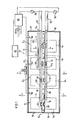
- FIG. 1 an embodiment of the whomskam- m e r is schematically indicated at 10.
- the chamber has three zones, labeled Z1, Z2 and Z3, and the product moves from left to right from entrance E1 to exit E2.
- the chamber 10 is formed with continuous side walls 12, a bottom 14, entrance doors 16 and exit doors 18.
- the walls 12 are insulated and doors 16 and 18 would normally be insulated and the doors are of course movable so that they can be opened and closed appropriately, for example by being hinged or slidable.
- a continuous roof 20 is shown and beneath the roof 20 are arranged devices for achieving suitable treatment conditions, these devices changing from zone to zone and from treatment to treatment.
- the treatment condition devices in the zone ZI have a fan 22 which is driven by a motor 24 and which is adjacent to a baffle or a suspended ceiling 25 works.
- the suspended ceiling 25 has a central opening 26 and delimits side openings 28-28, which can be provided with suitable air guide vanes or the like of a known type.
- Air driven by the fan 22 exits through outlet openings 29 and flows down through the zone, whereupon it returns up through the central opening 26 in a continuous orbit.
- the air in this zone is treated or tempered in some way, for example by tempering units 30.
- the tempering units 30 can heat, cool, or control the humidity by either increasing or decreasing it, or they can be of various types Introduce artificial smoke to flavor the product.
- tempering or tempering units are well known in the art and require no further description.
- the temperature control and treatment units 30 could also be of such a type that they create other atmospheres in the zone Z1, and are therefore intended here only as a schematic explanation without any restriction.
- zone Z2 is shown, which zone is shown, for purposes of illustration and without limitation, to include a hot water treatment system having an overhead liquid tank 32 disposed below roof 20 and having a plurality of outlet openings 34 is provided.
- Zone Z2 has a base designated F, which is designed with an incline so that it forms a collecting container 36.
- a circulation pump 38 is connected to the collecting tank 36 via pipes 40.
- the outlet of the pump 38 feeds a main pipe 42 and a branch pipe 44.
- the main pipe 42 leads back to the roof 20 in order to feed water into the liquid container 32 located above.
- the branch line 44 conducts a portion of the water through a heat exchanger 46. In this way, a constant flow of hot water at an elevated temperature (or chilled water) is supplied to the liquid container 32, which water then flows downstream pours through the plurality of openings 34 over the area of zone 22 and collects again in the collecting container 36.
- This so-called water treatment system therefore enables the treatment device to subject the products in zones Z2 to heating or cooling, depending on the type of treatment and the type of product.
- a heating medium for food products such as treated meat
- a liquid medium such as Water particularly beneficial.
- the use of a massive recirculation system such as this with a relatively low pressure but high volume pump 38 provides a very effective method of processing food products.
- the very high volume of water flowing continuously through Zone Z2 ensures that all products are brought to the same temperature almost simultaneously, with a very high degree of temperature control over all products within Zone Z2.
- Zone Z2 has been described as a "hot water” zone for cooking, this zone might as well chilled water would be used and zone Z2 would then cool the product in a very effective manner.
- Zone Z3 which is not shown in detail in section, can be provided with either an air circulation system according to FIG. 2 or a water circulation system according to FIG. 3, typically for the purpose of cooling the products. However, if any other form of treatment is required in zone Z3, this can be provided with a completely different system for forming a predetermined condition in this zone.
- a step-by-step or post-conveyor system is provided to move the lots or units of products through the zones.
- a conveyor system comprises a single continuous rail 50 arranged at the top, which in a suitable manner the middle is suspended in the upper areas of the chamber 10, for example with a post 52.
- the product holders are only shown as cubes 54. In practice, however, these brackets are typically formed by a system of hooks or shelves or carriers or the like on which the products prepared for treatment are held.
- the brackets are in the form of a cage made of bars or beams or the like, and in many cases the products can first be arranged in groups or lengths on other brackets which are then attached or hung on the bracket 54.
- Various different forms of holder devices can be used to hold products.
- a typical mounting device is shown in U.S. Patent No. 3,594,858.
- suspension or support devices for the products enables the products, such as sausages, to be arranged by a sausage tamping machine in loops which have a weight which is expedient to handle, and any suspension device with sausage arranged thereon. would then grind in suitable hooks are hooked onto the mounting device 54.
- the product holder 54 has a trolley 56 which can be pushed over the rail 50.
- Friction reducing devices such as Wheels or the like (not shown) can be used to improve sliding along the rail.
- the two drive systems include air cylinders 60 and 62, which are attached side by side to the downstream or outlet end E2 of chamber 10.
- Each cylinder 60 and 62 has an elongated tie rod 64, 66.
- the pull rod 64 of the cylinder 60 is connected to a piston (not shown) in the cylinder 60 so that actuation of the cylinder 60 causes the pull rod 64 to reciprocate in one direction or the other, and the same applies to the pull rod 66 and cylinder 62.
- the tie rods 64 and 66 extend almost the entire length of the chamber 10 and are arranged parallel and side by side on opposite sides of the conveyor rail 50. Each of the tie rods 64 and 66 is provided with selectively operable engagement means for engagement with the trolleys 56 or the brackets 54. In the illustrated embodiment, these engagement devices are shown as a series of stop blocks 68, 70. They are generally wedge-shaped (FIG. 5) in this embodiment to form a ramp surface and are spaced along the length of each of the tie rods 64 and 66.
- Each of the trolleys 56 of the mounting units 54 is provided with movable locking parts 72 and 74 which are pivotably attached to the trolleys 56 and which can be pivoted from left to right (FIG. 4).
- the locking parts can be connected to each other with the help of devices, not shown, so that they are pivoted together.
- the pivoting movement of the locking parts 72 and 74 is such that they rest either on the pull rod 64 or on the pull rod 66 in a slightly upwardly inclined position.
- Other forms of engagement or coupling devices could also be provided and these may or may not have a movable type of engagement.
- the trolleys 56 could be formed in two different designs, one of which can be engaged on one side and the other on the other side.
- Brackets may be provided for the tie rods 64, 66 to hold them in place.
- the cylinders 60 and 62 are controlled by valves 76, 78 and a control device 80. Controller 80 is also typically connected to zone sensors 82, 84 and 86 to measure conditions in these zones.
- Controller 80 is also typically connected to the units for establishing suitable conditions in the zones via lines 88. Initial information is supplied to control unit 80 from an input console 90.
- controller 80 and zone sensors, treatment condition controls, and console are omitted for clarity and may vary widely from one unit to another. In any case, such devices and equipment are well known to those skilled in the art.
- tie rod 92 and a cylinder may be provided for engagement with brackets 54 in the downstream zones Z2, Z3, etc. This enables the operator to make a change faster in some cases.
- the engaging means and the cylinder are omitted for clarity.
- the necessary program information for the first product is entered into the control unit 80 on the console 90 and the zone conditions in the zones Z1, Z2 and Z3 are developed and stabilized.
- the corresponding sausage product is then loaded onto a product unit holder 54, which is then placed on the guide rail 50 at the zone entrance E1.
- the loaded holder 54 is then pushed into the zone Z1 or it can be easily pulled in by the actuation of the cylinder 60 in the manner described below.
- the doors 16 are closed and the operator issues a signal to the control device that has started the treatment of the first item.
- the controller 80 then operates the valve 78 such that the cylinder 62 performs a certain number of operating periods per hour. This can be, for example, 1 or 2 operating periods per hour.
- the cylinder 62 executes an actuation period. This results in the pull rod 66 being extended and then retracted.
- the stop 70 moves under the locking part 74.
- the locking part 74 simply slides up over the ramp of the stop 70 and then falls down again.
- the pull rod 66 is then retracted and this results in the first lot holder 54 moving the length of a period of the pull rod 66.
- zone Z1 it may also be desirable to fully move the lot holder 54 out of zone Z1 at this point and insert it into zone Z2. This may require, for example, two operating periods or movement steps of the pull rod 66 and the associated cylinder 62 before the lot holder 54 has moved from the zone Z1 to the zone Z2.
- the program may be such that a longer dwell time in zone Zl is required, and in this case the program issues a command for a single actuation period of pull rod 66, which then only causes item holder 54 to move from the first position moved to a second position within zone Z1.
- the second lot holder can be loaded with a product and then inserted into the treatment device, and simply by opening the doors 16 and placing the trolley 56 of the second item holder on the rail 50.
- the next lot holder 54 loaded with the second type of product is raised and attached to the rail 50, however in this case the locking parts 72, 74 are pivoted to the left.
- control unit 80 controls the cylinder 60 via the valve 76 so that it performs operating periods at appropriate times.
- the conditions in one or more of the zones must be changed. This means that all parts of the first product have to be moved out of the zone to be changed.
- the new treatment conditions can then be entered into the control unit. This results in a certain delay during which the new conditions stabilize.
- the items or units of the second product can then be imported and treated under the new conditions.
- zone Z1 has been described in connection with an air circulation system, while zone Z2 has a water circulation system, the device described is not limited to these systems or to this configuration of the systems.
- any zone can be designed to have both air and water systems that can be selectively used for greater flexibility.
- the locking parts 72 and 74 can be provided with some form of electrical or mechanical actuation or control device.
- one of the cylinders 60 or 62 and the associated tie rod could be completely omitted.
- one or the other locking part 72, 74 could also be omitted.
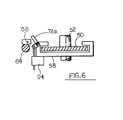
- FIG. 6 A general arrangement of such a system is shown in FIG. 6.
- the locking part 72a is actuated by a remote-controlled electrical actuation box 94, which can be actuated under the control of the control unit 80 so that it pivots the locking part 72a back and forth and thus into and out of engagement with the ramp 68 on the pull rod 64.
- the actuation box 94 can be actuated by air pressure or by magnetic pulses.
Landscapes
- Engineering & Computer Science (AREA)
- Food Science & Technology (AREA)
- Life Sciences & Earth Sciences (AREA)
- Chemical & Material Sciences (AREA)
- Mechanical Engineering (AREA)
- Polymers & Plastics (AREA)
- Zoology (AREA)
- Nutrition Science (AREA)
- Health & Medical Sciences (AREA)
- Wood Science & Technology (AREA)
- General Engineering & Computer Science (AREA)
- Treatment Of Fiber Materials (AREA)
- Food Preservation Except Freezing, Refrigeration, And Drying (AREA)
- General Preparation And Processing Of Foods (AREA)
- Processing Of Meat And Fish (AREA)
- Chemical Treatment Of Metals (AREA)
- Container, Conveyance, Adherence, Positioning, Of Wafer (AREA)
- Control And Other Processes For Unpacking Of Materials (AREA)
- Superconductors And Manufacturing Methods Therefor (AREA)
- Processing Of Solid Wastes (AREA)
Priority Applications (1)
| Application Number | Priority Date | Filing Date | Title |
|---|---|---|---|
| AT86113286T ATE55351T1 (de) | 1985-09-27 | 1986-09-26 | Behandlungsverfahren fuer verschiedene produkte sowie behandlungsvorrichtung zur durchfuehrung des verfahrens. |
Applications Claiming Priority (2)
| Application Number | Priority Date | Filing Date | Title |
|---|---|---|---|
| US06/780,835 US4644857A (en) | 1985-09-27 | 1985-09-27 | Food processing chamber |
| US780835 | 1985-09-27 |
Publications (3)
| Publication Number | Publication Date |
|---|---|
| EP0216392A2 true EP0216392A2 (fr) | 1987-04-01 |
| EP0216392A3 EP0216392A3 (en) | 1988-07-27 |
| EP0216392B1 EP0216392B1 (fr) | 1990-08-08 |
Family
ID=25120852
Family Applications (1)
| Application Number | Title | Priority Date | Filing Date |
|---|---|---|---|
| EP86113286A Expired - Lifetime EP0216392B1 (fr) | 1985-09-27 | 1986-09-26 | Procédé et installation pour le traitement de produits divers |
Country Status (5)
| Country | Link |
|---|---|
| US (1) | US4644857A (fr) |
| EP (1) | EP0216392B1 (fr) |
| AT (1) | ATE55351T1 (fr) |
| CA (1) | CA1264460A (fr) |
| DE (1) | DE3673297D1 (fr) |
Families Citing this family (16)
| Publication number | Priority date | Publication date | Assignee | Title |
|---|---|---|---|---|
| DE3610124C1 (de) * | 1986-03-26 | 1987-07-30 | Nordischer Maschinenbau | Einrichtung zur kontinuierlichen Waermebehandlung von Nahrungsmitteln |
| US4887524A (en) * | 1988-04-11 | 1989-12-19 | International Seafood Engineering, Inc. | Shrimp cooking apparatus |
| US4966072A (en) * | 1988-04-11 | 1990-10-30 | International Seafood Engineering, Inc. | Shrimp cooking apparatus |
| CA2011344A1 (fr) * | 1989-10-10 | 1991-04-10 | Louis D. Dunckel | Appareil et procede de cuisson et d'emballage des oeufs |
| US5072663A (en) * | 1991-04-26 | 1991-12-17 | Seafood Equipment Development Corporation | Shrimp cooking apparatus |
| US5197375A (en) * | 1991-08-30 | 1993-03-30 | The Middleby Corporation | Conveyor oven control |
| DE4128890C2 (de) * | 1991-08-30 | 1995-02-23 | Germos Fessmann Gmbh & Co Kg | Anlage zum Behandeln von Produkten |
| US5253564A (en) * | 1991-08-30 | 1993-10-19 | The Middleby Corporation | Conveyor oven control |
| US5398600A (en) * | 1993-02-09 | 1995-03-21 | Madsen; Torben | Batch conveyor for processing chamber |
| US5431936A (en) * | 1994-02-18 | 1995-07-11 | Leger; Pierre-Paul | System and tower for the continuous processing of proteinaceous products |
| US5906485A (en) * | 1998-02-27 | 1999-05-25 | Reading Pretzel Machinery Corporation | Tunnel-type conveyor oven having two types of heat sources |
| US6526877B2 (en) | 1998-06-05 | 2003-03-04 | Mcconnell James W. | Staged rotisserie |
| US5974956A (en) | 1998-06-05 | 1999-11-02 | Mcconnell; James W. | Staged rotisserie |
| US7337707B2 (en) * | 2004-08-27 | 2008-03-04 | Jesus Antonio Silvestrini | Thermal conditioning system having continuous conveyor |
| FR2933594B1 (fr) * | 2008-07-09 | 2013-04-12 | Armor Inox Sa | Cuve de traitement thermique |
| US8261658B1 (en) * | 2009-05-12 | 2012-09-11 | Ross A Rouse | Portable outdoor cleaner and steamer |
Family Cites Families (20)
| Publication number | Priority date | Publication date | Assignee | Title |
|---|---|---|---|---|
| US1581519A (en) * | 1923-09-25 | 1926-04-20 | Harry M Robertson | Apparatus for and process of treating food products |
| US1960516A (en) * | 1928-07-27 | 1934-05-29 | Atlantic Coast Fisheries Co | Method of smoking comestibles |
| US3062353A (en) * | 1961-03-09 | 1962-11-06 | Lamb Co F Jos | Work transfer mechanism |
| US3276352A (en) * | 1963-05-27 | 1966-10-04 | Hoover Ball & Bearing Co | Apparatus for continuously processing frankfurters |
| GB1055545A (en) * | 1964-09-30 | 1967-01-18 | Martin Rudolf Ekstam | An apparatus for heat treatment of goods |
| US3301374A (en) * | 1965-05-05 | 1967-01-31 | Cross Co | Dual rate indexing system for machine tools |
| US3518934A (en) * | 1968-10-22 | 1970-07-07 | Ranger Tool Co | Continuous processing apparatus for linked sausages |
| US3702583A (en) * | 1970-04-06 | 1972-11-14 | George B Rullman | Apparatus for processing food |
| US3718082A (en) * | 1971-04-20 | 1973-02-27 | S Lipoma | Apparatus for continuous electromagnetic sterilization |
| US3792508A (en) * | 1972-01-24 | 1974-02-19 | Simon K Ind Ltd | Sausage-supporting apparatus for use in smoke houses and the like |
| US4081564A (en) * | 1975-03-11 | 1978-03-28 | Oscar Mayer & Co. Inc. | Method and apparatus for continuously making loaf meat |
| US3948158A (en) * | 1975-03-11 | 1976-04-06 | Oscar Mayer & Co. Inc. | Multiple-stage gang-type plug pushing assembly |
| US3982300A (en) * | 1975-03-18 | 1976-09-28 | Anthony Joseph Soikie | Hanger for smoke house |
| US4136608A (en) * | 1976-02-17 | 1979-01-30 | Gladd Industries, Inc. | System for processing meat |
| SE409164B (sv) * | 1978-06-19 | 1979-08-06 | Tipe Revent Ab | Bakugn |
| US4250917A (en) * | 1978-11-13 | 1981-02-17 | Knud Simonsen Industries Limited | Air flow reverser system |
| US4310020A (en) * | 1978-11-13 | 1982-01-12 | Knud Simonsen Industries Limited | Processing chamber with an air flow reverser |
| US4271957A (en) * | 1979-09-12 | 1981-06-09 | Lasalle Machine Tool, Inc. | Mechanical transfer bar drive assembly |
| US4366177A (en) * | 1981-01-26 | 1982-12-28 | Pet Incorporated | Method of flameless broiling or baking greasy meat products |
| DD156518A1 (de) * | 1981-05-18 | 1982-09-01 | Guenter Huebsch | Vorrichtung zum transport gleichartiger stueckiger gueter,vorzugsweise giessereiformkaesten |
-
1985
- 1985-09-27 US US06/780,835 patent/US4644857A/en not_active Expired - Fee Related
-
1986
- 1986-09-18 CA CA000518562A patent/CA1264460A/fr not_active Expired - Lifetime
- 1986-09-26 AT AT86113286T patent/ATE55351T1/de not_active IP Right Cessation
- 1986-09-26 DE DE8686113286T patent/DE3673297D1/de not_active Expired - Lifetime
- 1986-09-26 EP EP86113286A patent/EP0216392B1/fr not_active Expired - Lifetime
Also Published As
| Publication number | Publication date |
|---|---|
| DE3673297D1 (de) | 1990-09-13 |
| EP0216392B1 (fr) | 1990-08-08 |
| US4644857A (en) | 1987-02-24 |
| EP0216392A3 (en) | 1988-07-27 |
| CA1264460A (fr) | 1990-01-16 |
| ATE55351T1 (de) | 1990-08-15 |
Similar Documents
| Publication | Publication Date | Title |
|---|---|---|
| EP0216392B1 (fr) | Procédé et installation pour le traitement de produits divers | |
| DE69112035T2 (de) | Backofen und verfahren zum garen von nahrungsmitteln. | |
| DE69405069T2 (de) | Gerät zum kontinuierlichen Dampf-Kochen von grossen Mengen | |
| DE2100818A1 (de) | Vorrichtung zum Erwärmen, Garen, Braten und Auftauen von Speisen | |
| DE60216350T2 (de) | Ofen mit Tropfenauffang | |
| DE69207510T2 (de) | Linie zur Herstellung hüllenloser Würste | |
| DE69714642T2 (de) | Gerät und Verfahren zur oberflächlichen in-Line Abkühlung von Produkten | |
| DE3604808C1 (de) | Vorrichtung zur kontinuierlichen Garung und/oder Entwaesserung von Nahrungsmitteln | |
| DE1601938A1 (de) | Waermeaustauschbehaelter | |
| DE2555144A1 (de) | Vorrichtung zum auftragen von zutaten | |
| DE60019787T2 (de) | Verfahren zum herstellen von würsten und behälter enthaltend zu verarbeitende würsten | |
| DE2827257C2 (de) | Vorrichtung zum Herstellen von Cottage- od.dgl. Frischkäse | |
| DE2454973C3 (de) | Vorrichtung zum Temperatur-Konditionieren von Verformungen aus thermoplastischem Kunststoff | |
| DE60218563T2 (de) | Vorrichtung zur Behandlung von Nahrungsmitteln mit einem Zirkulationsystem; Verfahren | |
| DE2515067C3 (de) | Verfahren zum Herstellen einer hautlosen Dauerwurst in Form von Knabberstäbchen | |
| DE1959439A1 (de) | Verfahren und Vorrichtung zum Behandeln von Lebensmitteln in einem klimatisierten Raum unter Luftumwaelzung | |
| DE4211682C2 (de) | Verfahren und Vorrichtung zum Zwischenlagern von Förderobjekten, insbesondere Schlachttierkörpern oder Schlachttierkörperteilen, in einer Stapelgleisanordnung | |
| EP0814673B1 (fr) | Procede et dispositif de maturation de lots de denrees alimentaires | |
| AT391402B (de) | Anlage zum vorgaeren, formen und nachgaeren portionierter teigstuecke | |
| DE3712372A1 (de) | Anlage zum vorgaeren, formen und nachgaeren portionierter teigstuecke | |
| DE60105755T2 (de) | Kontinuierliche Vorrichtung zum Einspritzen von Pökel | |
| DE60003401T2 (de) | Produktionseinheit zum bereiten von nahrungsmitteln | |
| DE69109093T2 (de) | Verfahren und anlage zur verbesserten qualitätserhaltung von nahrungsmitteln. | |
| DE3225813A1 (de) | Backofen | |
| WO2000047052A1 (fr) | Procede et dispositif de production de saucisses, et produit de patisserie prepare en utilisant de telles saucisses |
Legal Events
| Date | Code | Title | Description |
|---|---|---|---|
| PUAI | Public reference made under article 153(3) epc to a published international application that has entered the european phase |
Free format text: ORIGINAL CODE: 0009012 |
|
| AK | Designated contracting states |
Kind code of ref document: A2 Designated state(s): AT BE CH DE FR GB IT LI LU NL SE |
|
| PUAL | Search report despatched |
Free format text: ORIGINAL CODE: 0009013 |
|
| AK | Designated contracting states |
Kind code of ref document: A3 Designated state(s): AT BE CH DE FR GB IT LI LU NL SE |
|
| 17P | Request for examination filed |
Effective date: 19890120 |
|
| 17Q | First examination report despatched |
Effective date: 19890529 |
|
| GRAA | (expected) grant |
Free format text: ORIGINAL CODE: 0009210 |
|
| AK | Designated contracting states |
Kind code of ref document: B1 Designated state(s): AT BE CH DE FR GB IT LI LU NL SE |
|
| PG25 | Lapsed in a contracting state [announced via postgrant information from national office to epo] |
Ref country code: IT Free format text: LAPSE BECAUSE OF FAILURE TO SUBMIT A TRANSLATION OF THE DESCRIPTION OR TO PAY THE FEE WITHIN THE PRE;WARNING: LAPSES OF ITALIAN PATENTS WITH EFFECTIVE DATE BEFORE 2007 MAY HAVE OCCURRED AT ANY TIME BEFORE 2007. THE CORRECT EFFECTIVE DATE MAY BE DIFFERENT FROM THE ONE RECORDED.SCRIBED TIME-LIMIT Effective date: 19900808 Ref country code: SE Free format text: THE PATENT HAS BEEN ANNULLED BY A DECISION OF A NATIONAL AUTHORITY Effective date: 19900808 Ref country code: BE Effective date: 19900808 |
|
| REF | Corresponds to: |
Ref document number: 55351 Country of ref document: AT Date of ref document: 19900815 Kind code of ref document: T |
|
| GBT | Gb: translation of ep patent filed (gb section 77(6)(a)/1977) | ||
| REF | Corresponds to: |
Ref document number: 3673297 Country of ref document: DE Date of ref document: 19900913 |
|
| PG25 | Lapsed in a contracting state [announced via postgrant information from national office to epo] |
Ref country code: AT Effective date: 19900926 |
|
| PG25 | Lapsed in a contracting state [announced via postgrant information from national office to epo] |
Ref country code: LU Free format text: LAPSE BECAUSE OF NON-PAYMENT OF DUE FEES Effective date: 19900930 |
|
| ET | Fr: translation filed | ||
| PLBI | Opposition filed |
Free format text: ORIGINAL CODE: 0009260 |
|
| 26 | Opposition filed |
Opponent name: VEMAG ANLAGENBAU GMBH, Effective date: 19910506 |
|
| NLR1 | Nl: opposition has been filed with the epo |
Opponent name: VEMAG ANLAGENBAU GMBH |
|
| PGFP | Annual fee paid to national office [announced via postgrant information from national office to epo] |
Ref country code: FR Payment date: 19920909 Year of fee payment: 7 |
|
| PGFP | Annual fee paid to national office [announced via postgrant information from national office to epo] |
Ref country code: GB Payment date: 19920917 Year of fee payment: 7 |
|
| PGFP | Annual fee paid to national office [announced via postgrant information from national office to epo] |
Ref country code: CH Payment date: 19920928 Year of fee payment: 7 |
|
| PGFP | Annual fee paid to national office [announced via postgrant information from national office to epo] |
Ref country code: NL Payment date: 19920930 Year of fee payment: 7 |
|
| PGFP | Annual fee paid to national office [announced via postgrant information from national office to epo] |
Ref country code: DE Payment date: 19921005 Year of fee payment: 7 |
|
| PG25 | Lapsed in a contracting state [announced via postgrant information from national office to epo] |
Ref country code: GB Effective date: 19930926 |
|
| PG25 | Lapsed in a contracting state [announced via postgrant information from national office to epo] |
Ref country code: CH Free format text: LAPSE BECAUSE OF NON-PAYMENT OF DUE FEES Effective date: 19930930 Ref country code: LI Free format text: LAPSE BECAUSE OF NON-PAYMENT OF DUE FEES Effective date: 19930930 |
|
| PG25 | Lapsed in a contracting state [announced via postgrant information from national office to epo] |
Ref country code: NL Effective date: 19940401 |
|
| NLV4 | Nl: lapsed or anulled due to non-payment of the annual fee | ||
| GBPC | Gb: european patent ceased through non-payment of renewal fee |
Effective date: 19930926 |
|
| REG | Reference to a national code |
Ref country code: CH Ref legal event code: PL |
|
| PG25 | Lapsed in a contracting state [announced via postgrant information from national office to epo] |
Ref country code: DE Effective date: 19940601 |
|
| REG | Reference to a national code |
Ref country code: FR Ref legal event code: ST |
|
| RDAG | Patent revoked |
Free format text: ORIGINAL CODE: 0009271 |
|
| STAA | Information on the status of an ep patent application or granted ep patent |
Free format text: STATUS: PATENT REVOKED |
|
| 27W | Patent revoked |
Effective date: 19940808 |
|
| PG25 | Lapsed in a contracting state [announced via postgrant information from national office to epo] |
Ref country code: FR Free format text: LAPSE BECAUSE OF NON-PAYMENT OF DUE FEES Effective date: 19930930 |