EP0216433A2 - Verfahren für die Abwasserreinigung - Google Patents
Verfahren für die Abwasserreinigung Download PDFInfo
- Publication number
- EP0216433A2 EP0216433A2 EP19860201636 EP86201636A EP0216433A2 EP 0216433 A2 EP0216433 A2 EP 0216433A2 EP 19860201636 EP19860201636 EP 19860201636 EP 86201636 A EP86201636 A EP 86201636A EP 0216433 A2 EP0216433 A2 EP 0216433A2
- Authority
- EP
- European Patent Office
- Prior art keywords
- depuration
- treatment
- water
- filtering
- filter
- Prior art date
- Legal status (The legal status is an assumption and is not a legal conclusion. Google has not performed a legal analysis and makes no representation as to the accuracy of the status listed.)
- Granted
Links
- 238000011282 treatment Methods 0.000 title claims description 31
- 238000000034 method Methods 0.000 title claims description 29
- 230000008569 process Effects 0.000 title claims description 29
- 239000003643 water by type Substances 0.000 title description 6
- 238000001914 filtration Methods 0.000 claims abstract description 30
- 239000010865 sewage Substances 0.000 claims abstract description 23
- 239000000463 material Substances 0.000 claims abstract description 13
- XLYOFNOQVPJJNP-UHFFFAOYSA-N water Substances O XLYOFNOQVPJJNP-UHFFFAOYSA-N 0.000 claims description 28
- QVGXLLKOCUKJST-UHFFFAOYSA-N atomic oxygen Chemical compound [O] QVGXLLKOCUKJST-UHFFFAOYSA-N 0.000 claims description 14
- 239000001301 oxygen Substances 0.000 claims description 14
- 229910052760 oxygen Inorganic materials 0.000 claims description 14
- 239000002344 surface layer Substances 0.000 claims description 2
- 239000007900 aqueous suspension Substances 0.000 claims 1
- 239000003295 industrial effluent Substances 0.000 claims 1
- 238000011144 upstream manufacturing Methods 0.000 claims 1
- 239000010802 sludge Substances 0.000 abstract description 11
- 238000004519 manufacturing process Methods 0.000 abstract description 3
- 239000003575 carbonaceous material Substances 0.000 abstract 1
- 239000000126 substance Substances 0.000 description 9
- 238000005273 aeration Methods 0.000 description 6
- 238000010908 decantation Methods 0.000 description 4
- 230000009471 action Effects 0.000 description 3
- 230000008901 benefit Effects 0.000 description 3
- 230000031018 biological processes and functions Effects 0.000 description 2
- 238000001035 drying Methods 0.000 description 2
- 230000008030 elimination Effects 0.000 description 2
- 238000003379 elimination reaction Methods 0.000 description 2
- 230000001788 irregular Effects 0.000 description 2
- 239000010410 layer Substances 0.000 description 2
- VNWKTOKETHGBQD-UHFFFAOYSA-N methane Chemical compound C VNWKTOKETHGBQD-UHFFFAOYSA-N 0.000 description 2
- 244000005700 microbiome Species 0.000 description 2
- 230000009467 reduction Effects 0.000 description 2
- 238000003756 stirring Methods 0.000 description 2
- 238000005406 washing Methods 0.000 description 2
- 238000004438 BET method Methods 0.000 description 1
- 239000004215 Carbon black (E152) Substances 0.000 description 1
- 239000000654 additive Substances 0.000 description 1
- 230000001580 bacterial effect Effects 0.000 description 1
- 230000004071 biological effect Effects 0.000 description 1
- 230000015572 biosynthetic process Effects 0.000 description 1
- 239000004568 cement Substances 0.000 description 1
- 230000006378 damage Effects 0.000 description 1
- 239000003599 detergent Substances 0.000 description 1
- 238000011161 development Methods 0.000 description 1
- 230000029087 digestion Effects 0.000 description 1
- 239000000975 dye Substances 0.000 description 1
- 238000002474 experimental method Methods 0.000 description 1
- 239000007789 gas Substances 0.000 description 1
- 229930195733 hydrocarbon Natural products 0.000 description 1
- 150000002430 hydrocarbons Chemical class 0.000 description 1
- 229920000126 latex Polymers 0.000 description 1
- 230000036284 oxygen consumption Effects 0.000 description 1
- 239000002245 particle Substances 0.000 description 1
- 230000037361 pathway Effects 0.000 description 1
- 238000002203 pretreatment Methods 0.000 description 1
- 238000012545 processing Methods 0.000 description 1
- 239000002904 solvent Substances 0.000 description 1
- 238000011272 standard treatment Methods 0.000 description 1
- 239000002352 surface water Substances 0.000 description 1
- 239000000725 suspension Substances 0.000 description 1
- 238000012546 transfer Methods 0.000 description 1
Images
Classifications
-
- C—CHEMISTRY; METALLURGY
- C02—TREATMENT OF WATER, WASTE WATER, SEWAGE, OR SLUDGE
- C02F—TREATMENT OF WATER, WASTE WATER, SEWAGE, OR SLUDGE
- C02F3/00—Biological treatment of water, waste water, or sewage
- C02F3/30—Aerobic and anaerobic processes
-
- C—CHEMISTRY; METALLURGY
- C02—TREATMENT OF WATER, WASTE WATER, SEWAGE, OR SLUDGE
- C02F—TREATMENT OF WATER, WASTE WATER, SEWAGE, OR SLUDGE
- C02F3/00—Biological treatment of water, waste water, or sewage
- C02F3/02—Aerobic processes
- C02F3/10—Packings; Fillings; Grids
-
- C—CHEMISTRY; METALLURGY
- C02—TREATMENT OF WATER, WASTE WATER, SEWAGE, OR SLUDGE
- C02F—TREATMENT OF WATER, WASTE WATER, SEWAGE, OR SLUDGE
- C02F3/00—Biological treatment of water, waste water, or sewage
- C02F3/28—Anaerobic digestion processes
- C02F3/2806—Anaerobic processes using solid supports for microorganisms
-
- Y—GENERAL TAGGING OF NEW TECHNOLOGICAL DEVELOPMENTS; GENERAL TAGGING OF CROSS-SECTIONAL TECHNOLOGIES SPANNING OVER SEVERAL SECTIONS OF THE IPC; TECHNICAL SUBJECTS COVERED BY FORMER USPC CROSS-REFERENCE ART COLLECTIONS [XRACs] AND DIGESTS
- Y02—TECHNOLOGIES OR APPLICATIONS FOR MITIGATION OR ADAPTATION AGAINST CLIMATE CHANGE
- Y02W—CLIMATE CHANGE MITIGATION TECHNOLOGIES RELATED TO WASTEWATER TREATMENT OR WASTE MANAGEMENT
- Y02W10/00—Technologies for wastewater treatment
- Y02W10/10—Biological treatment of water, waste water, or sewage
Definitions
- the present invention relates to a process and plant for the depuration treatment of effluent waters, both domestic and industrial and more specifically to the treatment for the depuration of the said waters from organic polluting substances, without residual active sludges being formed.
- the most widespread process for the depuration treatment of effluent waters, both civil and industrial, and especially of the effluent waters polluted from substances of organic nature is the so-called biological or active sludge process, essentially consisting in causing a bacterial flora to be formed in the sewage water to be treated; the action of said flora, thanks to the concomitant feeding of oxygen, normally atmospherical oxygen, reduces the contents of polluting substances present in the sewage water, until values are achieved which are acceptable for the discharge in surface waters (rivers, lakes, etc.).
- This depuration treatment is so known and widespread that no more detailed description is needed.
- a problem always accompanying the biological depuration treatment is that of the active sludges or secondary sludges which result in a great excess with respect to the amount necessary for the prosecution of the process on further sewage water; since the true depuration treatment is normally followed by a decantation step, the latter gives place to a definitely relevant amount of sludges which in some way must be destroyed.
- the afore said carbonaceous and macroporous mass is used to form a filtering layer, through which the sewage to be depurated is passed, after having undergone the preliminary standard treatments (such as for instance that of primary decantation to remove coarse and suspended materials), the sewage being either simultaneously or previously aerated.
- the advantage of the above particular process and of the carbonaceous mass therein used is that of providing excellent depuration results, namely that of lowering the content of polluting organic substances, in combination with a simultaneous filtration of the water, whereby the secondary decantation is no longer necessary, and in combination with a reduced oxygen consumption, the quantitative depuration results being the same.
- the main purpose of the present invention is that of providing a biological treatment of effluent waters containing polluting organic substances, wherein the no active sludges remain at the end of the treatment . It has now been suprisingly found and is the subject of the present invention that the sewage depuration treatment under anaerobic conditions if carried out in a filter consisting of a layer of macroporous material, particularly the macroporous carbonaceous mass of the USP 3,575,884, permits.from one side to shorten the duration of the complete treatment of depuration under anaerobic conditions to very short times and, on the other side and at same time, to totally eliminate the sludge formation, sludges of organic nature possibly already present in the sewage undergoing the treatment being also destroyed.
- the sewage to be treated is firstly fed with oxygen, preferably atmospherical oxygen, in an amount sufficient to establish a phase of biological treatment with active sludges, of aerobical type, and before this phase of aerobical depuration is completed, the sewage is passed to the aforesaid filter under conditions such that in most of the filtering mass a state of anaerobicity is set up.
- oxygen preferably atmospherical oxygen
- a sewage is taken and subjected to a normal biological treatment with active sludge, but, before this step of treatment is completed, the sewage is passed with its residual content of oxygen and with its content of active sludge thus formed, through a filtering bed of macroporous material, having low specific surface (not greater than about 400 s q. m .
- the essentiall condition of the process of the- present invention is that the content of oxygen,if any of the water fed to the filtering bed and possibly coming from the partial treatment of standard biological depuration is not sufficient to support the setting up or the prosecuting of the aerobical biological action, but on the contrary in most of the filtering mass and more preferably throughout the whole height of the filtering mass an anaerobic condition is established whereby a biological action of anaerobic type occurs.
- An equally important condition is that the passage of the water through the filtering bed takes place slowly and that the height or thickness of the same filtering bed is such that a condition of anaerobicity is necessarily established in the pathway of the water through most or preferably all the filtering mass.
- an anaerobic treatment is provded, by which not only the depuration degree is excellent, and anyhow equal to the desired values, but no residual active sludge is formed and the step of secondary decantation is no longer necessary.
- Another feature important as well of the process of the present invention is that the residual sludges of standard biological treatments, preferably suitably diluted, can be fed to the filter of macroporous material and are thus destroyed.
- the plant according to the present invention in its essential feature is characterized by the fact that the sewage is fed to a filtering bed consisting of macroporous material having low specific surface and height such that the passage of the sewage through the same bed takes place under non aerobic conditions.
- the plant according to the present invention in the most general embodiment, is characterized by comprising a filtering bed of macroporous material having low specifc surface and height such that in the sewage to be treated the oxygen content, if any is exhausted in the initial portion of the whole bed, the flow rate of the water through the bed being selected to fulfill the aforesaid condition of exhausting the oxygen content, whereby most of the path of the water through the filtering bed is in anaerobic conditions.
- the filtering bed consists of the filtering carbonaceous mass disclosed in the U.S. Patent No. 3,575,884 and both the height or thickness of the filtering bed and the flow rate of the water are selected so that the residual oxygen content if any of the water is exhausted in the surface layer of the filtering mass.
- two treatment steps of the sewage are provided, the first one being a step of standard biological treatment with aeration of the water to be treated, said step being carried out so that the water coming out therefrom has a low oxygen content, and a second step consisting of the above defined filtering bed operating under the above indicate conditions.
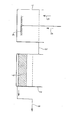
- two treatment tanks are shown, respectively indicated by the references 1 and 2, and connected by a pipe 3 for the transfer from the tank 1 to the tank 2.
- a standard device 4 is provided for the aeration and the stirring of the water contained in the tank, the arrows 5 and 6 indicating the feed of the sewage to be depurated and of the aeration atmospherical air.
- a filtering bed is provided, preferably consisting of the filtering carbonaceous mass of the already cited US Patent, the water coming from the tank 1 slowly flowing through this bed.
- the water treated and depurated is takn from the bottom of the tank 2 and passed to the discharge (8).
- the plant does consist only of the tank 2, whereby no particular showing is necessary.
- the process of the present invention has been industrially applied in a plant for the treatment of the effluent water of a printing and paper processing shop.
- the daily volume of the treated effluent water, limitedly to the working days, is of about 4 cubic meters, distributed in 8 to 9 daily hours.
- the feeding to the treatment plant takes place at irregular time intervals and irregular as well is the polluting load, both as regards the concentration and as regards the quality.
- This lead mainly consists of several dyestuff, solvents, even of hydrocarbon type, detergents, cements, suspensions of rubber latex, several additives, always in the presence of paper particles.
- the water At the outlet of the tank 2 the water has on the average a COD value less than 100 and, after more than 2 year of continuationed operation of the plant in the above indicated conditions, no presence of sludge has been detected.
Landscapes
- Life Sciences & Earth Sciences (AREA)
- Microbiology (AREA)
- Water Supply & Treatment (AREA)
- Hydrology & Water Resources (AREA)
- Engineering & Computer Science (AREA)
- Environmental & Geological Engineering (AREA)
- Biodiversity & Conservation Biology (AREA)
- Chemical & Material Sciences (AREA)
- Organic Chemistry (AREA)
- Purification Treatments By Anaerobic Or Anaerobic And Aerobic Bacteria Or Animals (AREA)
- Biological Treatment Of Waste Water (AREA)
- Organic Low-Molecular-Weight Compounds And Preparation Thereof (AREA)
- Compounds Of Unknown Constitution (AREA)
- Physical Water Treatments (AREA)
- Removal Of Specific Substances (AREA)
Priority Applications (1)
| Application Number | Priority Date | Filing Date | Title |
|---|---|---|---|
| AT86201636T ATE84770T1 (de) | 1985-09-25 | 1986-09-22 | Verfahren fuer die abwasserreinigung. |
Applications Claiming Priority (2)
| Application Number | Priority Date | Filing Date | Title |
|---|---|---|---|
| IT2227285 | 1985-06-26 | ||
| IT2227285A IT1185384B (it) | 1985-09-25 | 1985-09-25 | Procedimento ed impianto per il trattamento di depurazione di acque reflue |
Publications (3)
| Publication Number | Publication Date |
|---|---|
| EP0216433A2 true EP0216433A2 (de) | 1987-04-01 |
| EP0216433A3 EP0216433A3 (en) | 1988-07-20 |
| EP0216433B1 EP0216433B1 (de) | 1993-01-20 |
Family
ID=11193974
Family Applications (1)
| Application Number | Title | Priority Date | Filing Date |
|---|---|---|---|
| EP19860201636 Expired - Lifetime EP0216433B1 (de) | 1985-09-25 | 1986-09-22 | Verfahren für die Abwasserreinigung |
Country Status (7)
| Country | Link |
|---|---|
| EP (1) | EP0216433B1 (de) |
| JP (1) | JPS6274497A (de) |
| AT (1) | ATE84770T1 (de) |
| BR (1) | BR8604627A (de) |
| DE (1) | DE3687558T2 (de) |
| ES (1) | ES2001802A6 (de) |
| IT (1) | IT1185384B (de) |
Families Citing this family (1)
| Publication number | Priority date | Publication date | Assignee | Title |
|---|---|---|---|---|
| JPS62102894A (ja) * | 1985-10-28 | 1987-05-13 | Hitachi Zosen Corp | 中濃度有機廃水の処理方法 |
Family Cites Families (3)
| Publication number | Priority date | Publication date | Assignee | Title |
|---|---|---|---|---|
| DE1584958A1 (de) * | 1965-12-20 | 1970-02-05 | Heinrich Onnen | Verfahren und Vorrichtung zum Reinigen von Abwaessern |
| SE342804B (de) * | 1967-01-27 | 1972-02-21 | Squindo W | |
| DE3032869A1 (de) * | 1980-09-01 | 1982-04-15 | Linde Ag, 6200 Wiesbaden | Verfahren und vorrichtung zur anaeroben biologischen reinigung von abwasser |
-
1985
- 1985-09-25 IT IT2227285A patent/IT1185384B/it active
-
1986
- 1986-09-22 DE DE8686201636T patent/DE3687558T2/de not_active Expired - Fee Related
- 1986-09-22 EP EP19860201636 patent/EP0216433B1/de not_active Expired - Lifetime
- 1986-09-22 AT AT86201636T patent/ATE84770T1/de not_active IP Right Cessation
- 1986-09-25 ES ES8602190A patent/ES2001802A6/es not_active Expired
- 1986-09-25 BR BR8604627A patent/BR8604627A/pt unknown
- 1986-09-25 JP JP61225042A patent/JPS6274497A/ja active Pending
Also Published As
| Publication number | Publication date |
|---|---|
| IT8522272A0 (it) | 1985-09-25 |
| EP0216433B1 (de) | 1993-01-20 |
| ATE84770T1 (de) | 1993-02-15 |
| DE3687558D1 (de) | 1993-03-04 |
| EP0216433A3 (en) | 1988-07-20 |
| IT1185384B (it) | 1987-11-12 |
| JPS6274497A (ja) | 1987-04-06 |
| BR8604627A (pt) | 1987-05-26 |
| ES2001802A6 (es) | 1988-06-16 |
| DE3687558T2 (de) | 1993-07-01 |
Similar Documents
| Publication | Publication Date | Title |
|---|---|---|
| US3709364A (en) | Method and apparatus for denitrification of treated sewage | |
| EP0543457B1 (de) | Verfahren für Abwasserbehandlung | |
| Jhung et al. | A comparative study of UASB and anaerobic fixed film reactors with development of sludge granulation | |
| Ghyoot et al. | Coupling membrane filtration to anaerobic primary sludge digestion | |
| KR100906395B1 (ko) | 축산폐수처리를 위한 고효율 축산 폐수 처리장치 및 이를 이용한 방법 | |
| EP1012121A1 (de) | Verfahren zur nitrifikation von abwasser unter verwendung von aus ammoniumhaltigen wasser isolierten und angereicherten mikro-organismen | |
| US4253966A (en) | Process for biological denitrification of waters | |
| US3928190A (en) | Method of biological purification of sewage | |
| Lovett et al. | Effect of sludge age and substrate composition on the settling and dewatering characteristics of activated sludge | |
| CN101781056B (zh) | 造纸废水的处理方法 | |
| WO2020152707A1 (en) | Heavy metal removal from industrial effluents by combination of aerobic and anaerobic treatment | |
| Guyot et al. | Anaerobic digestion of a petrochemical wastewater using the UASB process | |
| Kraus | The use of digested sludge and digester overflow to control bulking activated sludge | |
| EP0216433B1 (de) | Verfahren für die Abwasserreinigung | |
| Rockey et al. | The use of aim anaerobic expanded bed reactor for the treatment of domestic sewage | |
| Inamori et al. | Domestic sewage treatment using an anaerobic biofilter with an aerobic biofilter | |
| JP3370355B2 (ja) | 焼酎蒸留廃液の処理方法 | |
| JP3843540B2 (ja) | 有機性固形分を含む排液の生物処理方法 | |
| Austermann-Haun et al. | Experiences gained in the operation of anaerobic treatment plants in Germany | |
| JP4142410B2 (ja) | 排水処理方法 | |
| Muhamad et al. | Efficiency of attached-growth sequencing batch reactor in the treatment of recycled paper mill wastewater | |
| JP2834765B2 (ja) | 排水処理方法 | |
| JPH07204678A (ja) | 排水の高度処理方法及び処理装置 | |
| Richter et al. | Elimination of nitrogen in two flooded and statically packed bed biofilters with aerobic and anaerobic microsites | |
| Webb | An investigation into the occurrence of sewage fungus in rivers containing papermill effluents—III. Removal of sewage fungus nutrients |
Legal Events
| Date | Code | Title | Description |
|---|---|---|---|
| PUAI | Public reference made under article 153(3) epc to a published international application that has entered the european phase |
Free format text: ORIGINAL CODE: 0009012 |
|
| AK | Designated contracting states |
Kind code of ref document: A2 Designated state(s): AT BE CH DE FR GB IT LI LU NL SE |
|
| PUAL | Search report despatched |
Free format text: ORIGINAL CODE: 0009013 |
|
| AK | Designated contracting states |
Kind code of ref document: A3 Designated state(s): AT BE CH DE FR GB IT LI LU NL SE |
|
| 17P | Request for examination filed |
Effective date: 19890119 |
|
| 17Q | First examination report despatched |
Effective date: 19900206 |
|
| GRAA | (expected) grant |
Free format text: ORIGINAL CODE: 0009210 |
|
| RAP1 | Party data changed (applicant data changed or rights of an application transferred) |
Owner name: FAIETA, MARCELLO |
|
| RIN1 | Information on inventor provided before grant (corrected) |
Inventor name: ALLAVENA, RICCARDO Inventor name: FAIETA, MARCELLO |
|
| AK | Designated contracting states |
Kind code of ref document: B1 Designated state(s): AT BE CH DE FR GB IT LI LU NL SE |
|
| PG25 | Lapsed in a contracting state [announced via postgrant information from national office to epo] |
Ref country code: SE Effective date: 19930120 Ref country code: LI Effective date: 19930120 Ref country code: CH Effective date: 19930120 Ref country code: AT Effective date: 19930120 |
|
| REF | Corresponds to: |
Ref document number: 84770 Country of ref document: AT Date of ref document: 19930215 Kind code of ref document: T |
|
| REF | Corresponds to: |
Ref document number: 3687558 Country of ref document: DE Date of ref document: 19930304 |
|
| ET | Fr: translation filed | ||
| ITF | It: translation for a ep patent filed | ||
| REG | Reference to a national code |
Ref country code: CH Ref legal event code: PL |
|
| PG25 | Lapsed in a contracting state [announced via postgrant information from national office to epo] |
Ref country code: LU Free format text: LAPSE BECAUSE OF NON-PAYMENT OF DUE FEES Effective date: 19930930 |
|
| PLBE | No opposition filed within time limit |
Free format text: ORIGINAL CODE: 0009261 |
|
| STAA | Information on the status of an ep patent application or granted ep patent |
Free format text: STATUS: NO OPPOSITION FILED WITHIN TIME LIMIT |
|
| 26N | No opposition filed | ||
| GBPC | Gb: european patent ceased through non-payment of renewal fee |
Effective date: 19930922 |
|
| REG | Reference to a national code |
Ref country code: GB Ref legal event code: 728C |
|
| REG | Reference to a national code |
Ref country code: GB Ref legal event code: 728A |
|
| PGFP | Annual fee paid to national office [announced via postgrant information from national office to epo] |
Ref country code: FR Payment date: 19950821 Year of fee payment: 10 |
|
| PGFP | Annual fee paid to national office [announced via postgrant information from national office to epo] |
Ref country code: BE Payment date: 19950829 Year of fee payment: 10 |
|
| PGFP | Annual fee paid to national office [announced via postgrant information from national office to epo] |
Ref country code: NL Payment date: 19950929 Year of fee payment: 10 |
|
| PGFP | Annual fee paid to national office [announced via postgrant information from national office to epo] |
Ref country code: DE Payment date: 19951005 Year of fee payment: 10 |
|
| PG25 | Lapsed in a contracting state [announced via postgrant information from national office to epo] |
Ref country code: FR Effective date: 19960930 Ref country code: BE Effective date: 19960930 |
|
| PGFP | Annual fee paid to national office [announced via postgrant information from national office to epo] |
Ref country code: GB Payment date: 19970324 Year of fee payment: 11 |
|
| BERE | Be: lapsed |
Owner name: FAIETA MARCELLO Effective date: 19960930 |
|
| PG25 | Lapsed in a contracting state [announced via postgrant information from national office to epo] |
Ref country code: NL Effective date: 19970401 |
|
| NLV4 | Nl: lapsed or anulled due to non-payment of the annual fee |
Effective date: 19970401 |
|
| PG25 | Lapsed in a contracting state [announced via postgrant information from national office to epo] |
Ref country code: DE Effective date: 19970603 |
|
| REG | Reference to a national code |
Ref country code: FR Ref legal event code: ST |
|
| REG | Reference to a national code |
Ref country code: FR Ref legal event code: ST |
|
| PG25 | Lapsed in a contracting state [announced via postgrant information from national office to epo] |
Ref country code: GB Free format text: LAPSE BECAUSE OF NON-PAYMENT OF DUE FEES Effective date: 19970922 |
|
| GBPC | Gb: european patent ceased through non-payment of renewal fee |
Effective date: 19970922 |
|
| PG25 | Lapsed in a contracting state [announced via postgrant information from national office to epo] |
Ref country code: IT Free format text: LAPSE BECAUSE OF NON-PAYMENT OF DUE FEES;WARNING: LAPSES OF ITALIAN PATENTS WITH EFFECTIVE DATE BEFORE 2007 MAY HAVE OCCURRED AT ANY TIME BEFORE 2007. THE CORRECT EFFECTIVE DATE MAY BE DIFFERENT FROM THE ONE RECORDED. Effective date: 20050922 |