EP0216467A2 - Glukosesubstratempfindliche zweidimensionale Diffusionselektrode - Google Patents
Glukosesubstratempfindliche zweidimensionale Diffusionselektrode Download PDFInfo
- Publication number
- EP0216467A2 EP0216467A2 EP86305743A EP86305743A EP0216467A2 EP 0216467 A2 EP0216467 A2 EP 0216467A2 EP 86305743 A EP86305743 A EP 86305743A EP 86305743 A EP86305743 A EP 86305743A EP 0216467 A2 EP0216467 A2 EP 0216467A2
- Authority
- EP
- European Patent Office
- Prior art keywords
- layer
- oxygen
- permeable
- glucose
- enzyme
- Prior art date
- Legal status (The legal status is an assumption and is not a legal conclusion. Google has not performed a legal analysis and makes no representation as to the accuracy of the status listed.)
- Ceased
Links
Images
Classifications
-
- C—CHEMISTRY; METALLURGY
- C12—BIOCHEMISTRY; BEER; SPIRITS; WINE; VINEGAR; MICROBIOLOGY; ENZYMOLOGY; MUTATION OR GENETIC ENGINEERING
- C12Q—MEASURING OR TESTING PROCESSES INVOLVING ENZYMES, NUCLEIC ACIDS OR MICROORGANISMS; COMPOSITIONS OR TEST PAPERS THEREFOR; PROCESSES OF PREPARING SUCH COMPOSITIONS; CONDITION-RESPONSIVE CONTROL IN MICROBIOLOGICAL OR ENZYMOLOGICAL PROCESSES
- C12Q1/00—Measuring or testing processes involving enzymes, nucleic acids or microorganisms; Compositions therefor; Processes of preparing such compositions
- C12Q1/001—Enzyme electrodes
- C12Q1/005—Enzyme electrodes involving specific analytes or enzymes
-
- C—CHEMISTRY; METALLURGY
- C12—BIOCHEMISTRY; BEER; SPIRITS; WINE; VINEGAR; MICROBIOLOGY; ENZYMOLOGY; MUTATION OR GENETIC ENGINEERING
- C12Q—MEASURING OR TESTING PROCESSES INVOLVING ENZYMES, NUCLEIC ACIDS OR MICROORGANISMS; COMPOSITIONS OR TEST PAPERS THEREFOR; PROCESSES OF PREPARING SUCH COMPOSITIONS; CONDITION-RESPONSIVE CONTROL IN MICROBIOLOGICAL OR ENZYMOLOGICAL PROCESSES
- C12Q1/00—Measuring or testing processes involving enzymes, nucleic acids or microorganisms; Compositions therefor; Processes of preparing such compositions
- C12Q1/001—Enzyme electrodes
- C12Q1/005—Enzyme electrodes involving specific analytes or enzymes
- C12Q1/006—Enzyme electrodes involving specific analytes or enzymes for glucose
Definitions
- This invention relates to a two-dimensional diffusion glucose substrate sensing electrode.
- an implantable sensor is the so-called enzyme electrode in which an immobilized enzyme catalyzes a chemical reaction between glucose and another molecule such as oxygen that can be detected by an electrode.
- the enzymatic reaction is one in which glucose is catalytically converted to gluconic acid with the simultaneous consumption of oxygen promoted by the enzyme glucose oxidase, with the resulting decrease in oxygen determined by an amperometric oxygen electrode and thereby related to glucose levels.
- a key problem in developing this sensor is that the glucose concentration in the body is normally higher than the oxygen concentration by a factor of 50 - 1000 times. Thus, since the enzymatic reaction is limited by oxygen, the least abundant reactant, glucose measurements in the body are often inaccurate. Most previous investigators have not recognized or gone beyond this problem.
- Hicks et al. in U.S. Patent No. 3,542,662 describe an electrolytic glucose sensor capable of assaying glucose in fluid removed from the body, but not usable for measuring glucose directly in vivo .
- Hicks et al. describe an enzyme-containing membrane disposed between a fluid being assayed and first oxygen sensor electrode and a similar membrane not containing enzymes disposed between a fluid and second reference oxygen electrode. Oxygen diffuses through the enzyme-containing membrane and is consumed in an equal molar reaction with glucose catalyzed by the enzyme glucose oxidase; consequently, oxygen is unavailable for detection by the oxygen sensor electrode.
- the second oxygen sensor electrode measures the concentration of oxygen existing absent any enzyme-catalyzed reaction. The difference in oxygen levels detected by the two electrodes is proportional to the glucose concentration within certain limits.
- the glucose sensor described by Hicks et al. performs satisfactorily when assaying for glucose in vitro .
- its performance is unreliable. In part, this appears to be due to the inability of the dual-sensor design to function adequately in low-oxygen environments.
- the hydrophobic layer was selected to be permeable predominantly to oxygen; consequently, oxygen diffuses into the enzyme layer at all points across the surface of the hydrophobic layer whereas glucose diffuses in only at the region of the hole. In this manner, a stoichiometric excess of oxygen over glucose was provided to the enzyme layer.
- this oxygen electrode sensor apparatus is limited as to the range of concentrations of glucose detectable.
- the enzyme situated near the opening in the hydrophobic membrane is constantly exposed to incoming glucose, it tends to become inactivated, which in turn requires that for the sensor to continue functioning that glucose diffuse further into the membrane, which additionally limits the use of the sensor in that it increases its response time.
- An oxygen electrode sensor that can be implanted in the body, and which is suitable for detecting glucose in regions of the body where oxygen concentrations are stoichiometrically less than glucose concentrations.
- the sensor consists of a hydrophilic layer containing enzyme in communication with the sensor and a hydrophobic layer in communication with the hydrophilic layer.
- the hydrophilic and hydrophobic layers are positioned so that the enzyme substrates, glucose and oxygen diffuse predominantly in a two-directional manner such that the substrates enter the hydrophilic layer at right angles to each other.
- a second oxygen sensor electrode capable of acting as a reference electrode to measure the level of ambient oxygen present in the absence of enzymatic catalysis of glucose is described.
- the invention will be described as applied to determining concentrations of glucose in bodily fluids containing a large stoichiometric excess of glucose over oxygen. It will be understood, however, by those skilled in the arts that the electrode assembly of the present invention is not limited to assay solely glucose, and that it may be used to assay other molecules such as amino acids, lactates, ammonia, or similar molecules commonly found in bodily fluids that are substrates for oxidase enzymes that require the presence of a gaseous species to undergo enzymatic conversion.
- An electrode assembly suitable for detecting concentrations of glucose in bodily fluids where the electrode assembly detects a change in oxygen due to the conversion of glucose to gluconic acid is constructed of three parts an electrochemical oxygen sensor having the appropriate geometry, a gelatinous layer made of hydrophilic material, and a hydrophobic layer.
- the gelatinous hydrophilic material contracts the sensor part of the assembly.
- Contained within, or associated with, the gelatinous material is a enzyme, glucose oxidase, and optionally a second enzyme, catalase.
- the oxidase enzyme promotes the following reaction: glucose + oxygen + water ⁇ gluconic acid + hydrogen peroxide
- Hydrogen peroxide can be decomposed by incorporating catalase in the gelatinous material should it be desirable to do so.
- Catalase catalyzes the following reaction: H2O2 ⁇ 1 ⁇ 2O2 + H2O
- Materials useful for preparing the gelatinous layer include polyacrylamide gels, glutaraldehyde - cross-linked collagen or albumin, polyhdroxyethylmethacrylate, and its derivatives and other hydrophilic polymers and copolymers.
- the layer can similarly be constructed by cross-linking glucose oxidase or other enzymes with chemical cross-linking reagents.
- a second layer made of hydrophobic material.
- Materials suitable for constructing the second layer are polydimethylsiloxane, polymers of tetrafluoroethylene, or its fluorocarbon analogs alone or as copolymers with ethylene or propylene, polyethylene, polypropylene, cellulose acetate, and other oxygen-imbibing polymeric materials. Generally, these materials will account for about 2% - 40% of the combined weight of the hydrophilic and hydrophobic layers.
- the hydrophilic gel layer containing the enzyme will most often be disposed between a thin layer of the hydrophobic material covering a portion or all of the face of the hydrophilic layer and the oxygen sensor but leaving the edge surfaces, due to the thickness of that layer, accessible to the solution to be analyzed.
- the hydrophilic gelatinous layer is permeable to both glucose and gaseous molecules, such as oxygen. Glucose oxidase impregnated in the hydrophilic layer acts on glucose and oxygen as they diffuse through it.
- the hydrophobic material of the second layer is relatively impermeable to glucose but permeable to oxygen. Since the conversion of glucose to gluconic acid is limited stoichiometrically by whichever component is present at the oxygen-sensitive electrode in lowest concentration, in order to make the electrode assembly sensitive to glucose concentrations oxygen within the enzyme region must be at least stoichiometrically equal to glucose. This requirement is met by covering they hydrophilic gel layer with the hydrophobic layer, which hinders the rate of entry of glucose but provides access of oxygen to the gel layer.
- hydrophobic layer in a body or bodies that limits the surface area of the hydrophilic gel layer exposed for accepting glucose from bodily fluids causes a reduced rate of entry of glucose into the hydrophilic gel layer, which decreases the concentration of glucose inside the hydrophilic gelatinous layer to a concentration that allows for stoichiometric reaction with oxygen.
- the first and second layers of the electrode assembly, hydrophilic and hydrophobic layers, respectively, can be positioned relative to each other in several ways.
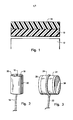
- glucose enters the membrane only through the edge surfaces of the gelatinous hydrophilic layer 10 and diffuses toward the centre portion of the layer substantially parallel to the face of the surface of the layer and the surface of the planar sensor 12.
- the gaseous species, oxygen enters the hydrophobic membrane 14 through the entire exposed surface of the hydrophobic layer and subsequently penetrates into the gelatinous hydrophilic layer to insure that there is an excess of oxygen over glucose.
- FIG. 2 An additional configuration of the hydrophilic and hydrophobic layer is shown in Figure 2.
- the oxygen sensor portion 16 of the assembly exhibits a cylindrical shape with its active surface being the curve of cylindrical face rather than the flat end.
- a concentric hydrophilic layer 18 contains the enzymes that contacts the oxygen sensor portion along the curved surface and a concentric hydrophobic layer 20 contacts the curved face but not the flat face of the hydrophilic layer.
- the glucose enters only through the flat hydrophilic exposed edge and oxygen enters predominantly through the curved sides of the hydrophobic layer.
- a third arrangement shown in Figure 3 is a combination of a circular-plate oxygen sensor 22 sensitive to oxygen on one or both of its flat surfaces but not at the curved edges with a hydrophilic enzyme-containing layer 24 contacting the oxygen sensor on each side and with a hydrophobic layer 26 contacting the outer surface of each hydrophilic layer but not the circular edge.
- oxygen predominantly enters from both sides through the two hydrophilic layers in a direction perpendicular to the plane while glucose enters only through the hydrophilic circumferential edge.
- the hydrophilic layer containing glucose oxidase is designed to so that oxygen passes readily into it through the exposed edge and through the contacting hydrophobic layer whereas glucose, diffuses into it only through the exposed edge and not through the hydrophobic layer.
- the ratio of oxygen to glucose is thus controlled by (1) the external concentrations, (2) the entry and/or transport properties of the combination of hydrophilic and hydrophobic layers, and (3) the aspect ratio, or area of the exposed hydrophilic surface available for glucose transport to the area of the hydrophobic surface available to only oxygen transport.
- the relative proportions of glucose and oxygen are thus changed from a concentration ratio in the body between approximately 50 - 1000 parts of glucose to 1 part of oxygen to a new ratio in which a slight stoichiometric excess of oxygen exists in the hydrophilic layer. Consequently, the electrode assembly is not stoichiometrically limited by the concentration of oxygen in bodily fluids, and the system operates in a manner that is sensitive to the glucose concentration being measured.
- a membrane-covered cylindrical oxygen sensor was fashioned from two platinum wires and a silver wire cemented into a glass bead and coated with a hydrophobic polymer. The opposite wire ends protruding through the glass bead were connected to the electrochemical analysis instrumentation. The exposed flat end of the oxygen sensor was rendered electro-chemically inactive by the application of a thin impermeable coating. a segment of silicone rubber tubing, 0.07ins. I.D. x 0.11 ins. O.D., (Dow Corning Corporation) was fitted over the sensor and cemented to the glass bead at the closed end leaving a concentric cavity. The enzymes were immobilized in a gel formed in the cylindrical cavity between the sensor and the tube.
- the gel contained 20gm% denatured bovine achilles tendon collagen, 6gm% glucose oxidase from A. niger (Sigma Chemical Company, type VII), and catalase. These gel components were dissolved in 0.1M phosphate buffer, pH 7.3, and cross-linked with glutaraldehyde (25% solution).
- the resulting glucose sensor was placed in a sealed, thermostated (37°C) vessel containing 0.1M phosphate buffer, pH 7.3, and equilibrated with the gas mixture containing 1.8% oxygen (0.02mM).
Landscapes
- Chemical & Material Sciences (AREA)
- Life Sciences & Earth Sciences (AREA)
- Organic Chemistry (AREA)
- Health & Medical Sciences (AREA)
- Engineering & Computer Science (AREA)
- Zoology (AREA)
- Wood Science & Technology (AREA)
- Proteomics, Peptides & Aminoacids (AREA)
- Molecular Biology (AREA)
- Bioinformatics & Cheminformatics (AREA)
- Immunology (AREA)
- Microbiology (AREA)
- Biophysics (AREA)
- Analytical Chemistry (AREA)
- Physics & Mathematics (AREA)
- Genetics & Genomics (AREA)
- Biochemistry (AREA)
- Biotechnology (AREA)
- General Engineering & Computer Science (AREA)
- General Health & Medical Sciences (AREA)
- Emergency Medicine (AREA)
- Measurement Of The Respiration, Hearing Ability, Form, And Blood Characteristics Of Living Organisms (AREA)
- Measuring Or Testing Involving Enzymes Or Micro-Organisms (AREA)
- Apparatus Associated With Microorganisms And Enzymes (AREA)
- Immobilizing And Processing Of Enzymes And Microorganisms (AREA)
- Investigating Or Analysing Biological Materials (AREA)
Applications Claiming Priority (2)
| Application Number | Priority Date | Filing Date | Title |
|---|---|---|---|
| US77806185A | 1985-09-20 | 1985-09-20 | |
| US778061 | 1985-09-20 |
Publications (2)
| Publication Number | Publication Date |
|---|---|
| EP0216467A2 true EP0216467A2 (de) | 1987-04-01 |
| EP0216467A3 EP0216467A3 (de) | 1988-09-28 |
Family
ID=25112193
Family Applications (1)
| Application Number | Title | Priority Date | Filing Date |
|---|---|---|---|
| EP86305743A Ceased EP0216467A3 (de) | 1985-09-20 | 1986-07-25 | Glukosesubstratempfindliche zweidimensionale Diffusionselektrode |
Country Status (5)
| Country | Link |
|---|---|
| EP (1) | EP0216467A3 (de) |
| JP (1) | JP2528102B2 (de) |
| AU (1) | AU591150B2 (de) |
| CA (1) | CA1247700A (de) |
| ZA (1) | ZA864927B (de) |
Cited By (2)
| Publication number | Priority date | Publication date | Assignee | Title |
|---|---|---|---|---|
| GB2230865A (en) * | 1989-04-27 | 1990-10-31 | Nat Res Dev | Glucose-sensing electrode |
| WO1999017107A3 (de) * | 1997-09-26 | 1999-05-20 | Siemens Ag | Mikrostrukturierter biosensor, verwendung des biosensors und verfahren zur immobilisierung von biokatalysatoren |
Families Citing this family (4)
| Publication number | Priority date | Publication date | Assignee | Title |
|---|---|---|---|---|
| GB8522834D0 (en) * | 1985-09-16 | 1985-10-23 | Ici Plc | Sensor |
| GB8612861D0 (en) * | 1986-05-27 | 1986-07-02 | Cambridge Life Sciences | Immobilised enzyme biosensors |
| WO2000078992A2 (en) * | 1999-06-18 | 2000-12-28 | Therasense, Inc. | Mass transport limited in vivo analyte sensor |
| US20050272989A1 (en) * | 2004-06-04 | 2005-12-08 | Medtronic Minimed, Inc. | Analyte sensors and methods for making and using them |
Family Cites Families (6)
| Publication number | Priority date | Publication date | Assignee | Title |
|---|---|---|---|---|
| JPS51112395A (en) * | 1975-03-27 | 1976-10-04 | Nikkiso Co Ltd | Apparatus for measurement of sugar concentration |
| JPS55162051A (en) * | 1979-06-04 | 1980-12-17 | Sakurai Koichi | Method and device for direct and continuous measurement of blood sugar level or the like |
| US4484987A (en) * | 1983-05-19 | 1984-11-27 | The Regents Of The University Of California | Method and membrane applicable to implantable sensor |
| IL70707A (en) * | 1984-01-17 | 1987-09-16 | Omikron Scient Ltd | Hydrogel-coated polymers and methods of making same |
| IL70706A (en) * | 1984-01-17 | 1987-08-31 | Omikron Scient Ltd | Composite enzyme-containing membranes,methods of making same and electrochemical sensors constructed therewith |
| GB8522834D0 (en) * | 1985-09-16 | 1985-10-23 | Ici Plc | Sensor |
-
1986
- 1986-06-30 CA CA000512751A patent/CA1247700A/en not_active Expired
- 1986-07-02 ZA ZA864927A patent/ZA864927B/xx unknown
- 1986-07-21 AU AU60386/86A patent/AU591150B2/en not_active Ceased
- 1986-07-25 EP EP86305743A patent/EP0216467A3/de not_active Ceased
- 1986-09-19 JP JP61219875A patent/JP2528102B2/ja not_active Expired - Fee Related
Cited By (4)
| Publication number | Priority date | Publication date | Assignee | Title |
|---|---|---|---|---|
| GB2230865A (en) * | 1989-04-27 | 1990-10-31 | Nat Res Dev | Glucose-sensing electrode |
| WO1990013021A1 (en) * | 1989-04-27 | 1990-11-01 | National Research Development Corporation | Glucose-sensing electrode |
| WO1999017107A3 (de) * | 1997-09-26 | 1999-05-20 | Siemens Ag | Mikrostrukturierter biosensor, verwendung des biosensors und verfahren zur immobilisierung von biokatalysatoren |
| US6440296B1 (en) | 1997-09-26 | 2002-08-27 | Siemens Aktiengesselschaft | Microstructured biosensor, use of the biosensor and process for the immobilization of biocatalysts |
Also Published As
| Publication number | Publication date |
|---|---|
| CA1247700A (en) | 1988-12-28 |
| JPS6273150A (ja) | 1987-04-03 |
| AU591150B2 (en) | 1989-11-30 |
| JP2528102B2 (ja) | 1996-08-28 |
| EP0216467A3 (de) | 1988-09-28 |
| AU6038686A (en) | 1987-03-26 |
| ZA864927B (en) | 1987-02-25 |
Similar Documents
| Publication | Publication Date | Title |
|---|---|---|
| US4890620A (en) | Two-dimensional diffusion glucose substrate sensing electrode | |
| CA1244085A (en) | Enzyme electrode type sensor for analyte determination | |
| US4650547A (en) | Method and membrane applicable to implantable sensor | |
| Vadgama | Enzyme electrodes as practical biosensors | |
| Mullen et al. | Glucose enzyme electrode with extended linearity: application to undiluted blood measurements | |
| US4484987A (en) | Method and membrane applicable to implantable sensor | |
| US6379883B2 (en) | Microfabricated aperture-based sensor | |
| Updike et al. | Implanting the glucose enzyme electrode: problems, progress, and alternative solutions | |
| AU608875B2 (en) | Sensor of the enzyme electrode type for the determination of an analyte | |
| CA1171768A (en) | Cutaneous methods of measuring body substances | |
| US4886740A (en) | Enzyme-electrode sensor with organosilane treated membrane | |
| US3979274A (en) | Membrane for enzyme electrodes | |
| Mascini et al. | Glucose electrochemical probe with extended linearity for whole blood | |
| Palleschi et al. | Ideal hydrogen peroxide-based glucose sensor | |
| CA1109374A (en) | Stabilization of activated galactose oxidase enzyme | |
| CA1247700A (en) | Two-dimensional diffusion glucose substrate sensing electrode | |
| Yang et al. | An Integrated Needle‐Type Biosensor for Intravascular Glucose and Lactate Monitoring | |
| Compagnone et al. | Amperometric glutathione electrodes | |
| Keyes et al. | Glucose analysis utilizing immobilized enzymes | |
| GB2197486A (en) | Enzyme electrode sensor | |
| JPH01152357A (ja) | バイオセンサ | |
| JPH0643130A (ja) | 複合型固定化酵素膜 | |
| WO1989004967A1 (en) | Method and apparatus for chemical analysis | |
| JPH04136749A (ja) | コレステロールセンサ | |
| Vadgama | Department of Clinical Biochemistry |
Legal Events
| Date | Code | Title | Description |
|---|---|---|---|
| PUAI | Public reference made under article 153(3) epc to a published international application that has entered the european phase |
Free format text: ORIGINAL CODE: 0009012 |
|
| AK | Designated contracting states |
Kind code of ref document: A2 Designated state(s): AT BE CH DE FR GB IT LI LU NL SE |
|
| PUAL | Search report despatched |
Free format text: ORIGINAL CODE: 0009013 |
|
| AK | Designated contracting states |
Kind code of ref document: A3 Designated state(s): AT BE CH DE FR GB IT LI LU NL SE |
|
| 17P | Request for examination filed |
Effective date: 19890119 |
|
| 17Q | First examination report despatched |
Effective date: 19900716 |
|
| STAA | Information on the status of an ep patent application or granted ep patent |
Free format text: STATUS: THE APPLICATION HAS BEEN REFUSED |
|
| 18R | Application refused |
Effective date: 19930409 |
|
| RIN1 | Information on inventor provided before grant (corrected) |
Inventor name: GOUGH, DAVID A. |