EP0216497A2 - Utilisation de plaques de plâtre revêtues d'une natte fibreuse dans des murs de cage et plaque améliorée résistant au feu - Google Patents
Utilisation de plaques de plâtre revêtues d'une natte fibreuse dans des murs de cage et plaque améliorée résistant au feu Download PDFInfo
- Publication number
- EP0216497A2 EP0216497A2 EP86306391A EP86306391A EP0216497A2 EP 0216497 A2 EP0216497 A2 EP 0216497A2 EP 86306391 A EP86306391 A EP 86306391A EP 86306391 A EP86306391 A EP 86306391A EP 0216497 A2 EP0216497 A2 EP 0216497A2
- Authority
- EP
- European Patent Office
- Prior art keywords
- board
- core
- gypsum
- mat
- faced
- Prior art date
- Legal status (The legal status is an assumption and is not a legal conclusion. Google has not performed a legal analysis and makes no representation as to the accuracy of the status listed.)
- Withdrawn
Links
- 229910052602 gypsum Inorganic materials 0.000 title claims abstract description 212
- 239000010440 gypsum Substances 0.000 title claims abstract description 210
- 230000009970 fire resistant effect Effects 0.000 title claims abstract description 48
- 230000000712 assembly Effects 0.000 title abstract description 38
- 238000000429 assembly Methods 0.000 title abstract description 38
- 239000003365 glass fiber Substances 0.000 claims description 63
- 239000000203 mixture Substances 0.000 claims description 43
- XLYOFNOQVPJJNP-UHFFFAOYSA-N water Substances O XLYOFNOQVPJJNP-UHFFFAOYSA-N 0.000 claims description 43
- 238000012360 testing method Methods 0.000 claims description 33
- 239000011521 glass Substances 0.000 claims description 26
- 239000000463 material Substances 0.000 claims description 24
- 229910052751 metal Inorganic materials 0.000 claims description 22
- 239000002184 metal Substances 0.000 claims description 22
- 239000010426 asphalt Substances 0.000 claims description 21
- -1 poly(vinyl alcohol) Polymers 0.000 claims description 21
- 239000000839 emulsion Substances 0.000 claims description 20
- 239000000654 additive Substances 0.000 claims description 18
- OSGAYBCDTDRGGQ-UHFFFAOYSA-L calcium sulfate Chemical compound [Ca+2].[O-]S([O-])(=O)=O OSGAYBCDTDRGGQ-UHFFFAOYSA-L 0.000 claims description 14
- 229920002451 polyvinyl alcohol Polymers 0.000 claims description 14
- 239000004615 ingredient Substances 0.000 claims description 13
- 238000000034 method Methods 0.000 claims description 12
- 239000000853 adhesive Substances 0.000 claims description 6
- 230000001070 adhesive effect Effects 0.000 claims description 6
- 239000002557 mineral fiber Substances 0.000 claims description 5
- 239000005373 porous glass Substances 0.000 claims description 3
- 230000000996 additive effect Effects 0.000 claims description 2
- 230000000149 penetrating effect Effects 0.000 claims 1
- 229910052500 inorganic mineral Inorganic materials 0.000 abstract 1
- 239000011707 mineral Substances 0.000 abstract 1
- 239000002002 slurry Substances 0.000 description 41
- 239000010410 layer Substances 0.000 description 28
- 238000004519 manufacturing process Methods 0.000 description 19
- 239000000047 product Substances 0.000 description 16
- 239000001993 wax Substances 0.000 description 9
- 239000000835 fiber Substances 0.000 description 8
- 239000003795 chemical substances by application Substances 0.000 description 7
- 239000011152 fibreglass Substances 0.000 description 5
- IMROMDMJAWUWLK-UHFFFAOYSA-N Ethenol Chemical compound OC=C IMROMDMJAWUWLK-UHFFFAOYSA-N 0.000 description 4
- 229940095672 calcium sulfate Drugs 0.000 description 4
- 238000000576 coating method Methods 0.000 description 4
- 238000011161 development Methods 0.000 description 4
- 230000018109 developmental process Effects 0.000 description 4
- 238000011156 evaluation Methods 0.000 description 4
- 239000010409 thin film Substances 0.000 description 4
- ZOMBKNNSYQHRCA-UHFFFAOYSA-J calcium sulfate hemihydrate Chemical compound O.[Ca+2].[Ca+2].[O-]S([O-])(=O)=O.[O-]S([O-])(=O)=O ZOMBKNNSYQHRCA-UHFFFAOYSA-J 0.000 description 3
- 239000011248 coating agent Substances 0.000 description 3
- 239000000470 constituent Substances 0.000 description 3
- 238000009472 formulation Methods 0.000 description 3
- 239000010763 heavy fuel oil Substances 0.000 description 3
- 238000009434 installation Methods 0.000 description 3
- 229920002689 polyvinyl acetate Polymers 0.000 description 3
- 239000011118 polyvinyl acetate Substances 0.000 description 3
- 239000000779 smoke Substances 0.000 description 3
- 239000002344 surface layer Substances 0.000 description 3
- RSWGJHLUYNHPMX-UHFFFAOYSA-N Abietic-Saeure Natural products C12CCC(C(C)C)=CC2=CCC2C1(C)CCCC2(C)C(O)=O RSWGJHLUYNHPMX-UHFFFAOYSA-N 0.000 description 2
- KHPCPRHQVVSZAH-HUOMCSJISA-N Rosin Natural products O(C/C=C/c1ccccc1)[C@H]1[C@H](O)[C@@H](O)[C@@H](O)[C@@H](CO)O1 KHPCPRHQVVSZAH-HUOMCSJISA-N 0.000 description 2
- 229920002472 Starch Polymers 0.000 description 2
- XTXRWKRVRITETP-UHFFFAOYSA-N Vinyl acetate Chemical compound CC(=O)OC=C XTXRWKRVRITETP-UHFFFAOYSA-N 0.000 description 2
- 239000003513 alkali Substances 0.000 description 2
- 239000011230 binding agent Substances 0.000 description 2
- 230000005540 biological transmission Effects 0.000 description 2
- 238000009529 body temperature measurement Methods 0.000 description 2
- 239000011280 coal tar Substances 0.000 description 2
- 239000002131 composite material Substances 0.000 description 2
- 238000013461 design Methods 0.000 description 2
- 239000002270 dispersing agent Substances 0.000 description 2
- 238000001035 drying Methods 0.000 description 2
- 239000006260 foam Substances 0.000 description 2
- 238000010438 heat treatment Methods 0.000 description 2
- 230000036571 hydration Effects 0.000 description 2
- 238000006703 hydration reaction Methods 0.000 description 2
- 239000000543 intermediate Substances 0.000 description 2
- 238000005192 partition Methods 0.000 description 2
- 229920005989 resin Polymers 0.000 description 2
- 239000011347 resin Substances 0.000 description 2
- 238000007493 shaping process Methods 0.000 description 2
- 235000019698 starch Nutrition 0.000 description 2
- 229920003002 synthetic resin Polymers 0.000 description 2
- 239000000057 synthetic resin Substances 0.000 description 2
- 239000004753 textile Substances 0.000 description 2
- 229920001169 thermoplastic Polymers 0.000 description 2
- 239000004416 thermosoftening plastic Substances 0.000 description 2
- KHPCPRHQVVSZAH-UHFFFAOYSA-N trans-cinnamyl beta-D-glucopyranoside Natural products OC1C(O)C(O)C(CO)OC1OCC=CC1=CC=CC=C1 KHPCPRHQVVSZAH-UHFFFAOYSA-N 0.000 description 2
- 239000004925 Acrylic resin Substances 0.000 description 1
- 229920000178 Acrylic resin Polymers 0.000 description 1
- 229910000809 Alumel Inorganic materials 0.000 description 1
- 235000005940 Centaurea cyanus Nutrition 0.000 description 1
- 240000004385 Centaurea cyanus Species 0.000 description 1
- 229910001335 Galvanized steel Inorganic materials 0.000 description 1
- 239000011398 Portland cement Substances 0.000 description 1
- 241000220317 Rosa Species 0.000 description 1
- VYPSYNLAJGMNEJ-UHFFFAOYSA-N Silicium dioxide Chemical compound O=[Si]=O VYPSYNLAJGMNEJ-UHFFFAOYSA-N 0.000 description 1
- BZHJMEDXRYGGRV-UHFFFAOYSA-N Vinyl chloride Chemical compound ClC=C BZHJMEDXRYGGRV-UHFFFAOYSA-N 0.000 description 1
- GZCGUPFRVQAUEE-SLPGGIOYSA-N aldehydo-D-glucose Chemical class OC[C@@H](O)[C@@H](O)[C@H](O)[C@@H](O)C=O GZCGUPFRVQAUEE-SLPGGIOYSA-N 0.000 description 1
- 229910052784 alkaline earth metal Inorganic materials 0.000 description 1
- 150000004645 aluminates Chemical class 0.000 description 1
- PNEYBMLMFCGWSK-UHFFFAOYSA-N aluminium oxide Inorganic materials [O-2].[O-2].[O-2].[Al+3].[Al+3] PNEYBMLMFCGWSK-UHFFFAOYSA-N 0.000 description 1
- 229910052925 anhydrite Inorganic materials 0.000 description 1
- 229940095564 anhydrous calcium sulfate Drugs 0.000 description 1
- 239000010425 asbestos Substances 0.000 description 1
- 230000001174 ascending effect Effects 0.000 description 1
- 239000002585 base Substances 0.000 description 1
- 239000000440 bentonite Substances 0.000 description 1
- 229910000278 bentonite Inorganic materials 0.000 description 1
- SVPXDRXYRYOSEX-UHFFFAOYSA-N bentoquatam Chemical compound O.O=[Si]=O.O=[Al]O[Al]=O SVPXDRXYRYOSEX-UHFFFAOYSA-N 0.000 description 1
- 230000015572 biosynthetic process Effects 0.000 description 1
- 239000004566 building material Substances 0.000 description 1
- 239000005018 casein Substances 0.000 description 1
- BECPQYXYKAMYBN-UHFFFAOYSA-N casein, tech. Chemical compound NCCCCC(C(O)=O)N=C(O)C(CC(O)=O)N=C(O)C(CCC(O)=N)N=C(O)C(CC(C)C)N=C(O)C(CCC(O)=O)N=C(O)C(CC(O)=O)N=C(O)C(CCC(O)=O)N=C(O)C(C(C)O)N=C(O)C(CCC(O)=N)N=C(O)C(CCC(O)=N)N=C(O)C(CCC(O)=N)N=C(O)C(CCC(O)=O)N=C(O)C(CCC(O)=O)N=C(O)C(COP(O)(O)=O)N=C(O)C(CCC(O)=N)N=C(O)C(N)CC1=CC=CC=C1 BECPQYXYKAMYBN-UHFFFAOYSA-N 0.000 description 1
- 235000021240 caseins Nutrition 0.000 description 1
- 239000004927 clay Substances 0.000 description 1
- 238000004140 cleaning Methods 0.000 description 1
- 239000008119 colloidal silica Substances 0.000 description 1
- 230000000052 comparative effect Effects 0.000 description 1
- 239000007859 condensation product Substances 0.000 description 1
- 238000010276 construction Methods 0.000 description 1
- 229920001577 copolymer Polymers 0.000 description 1
- 238000005336 cracking Methods 0.000 description 1
- 230000008021 deposition Effects 0.000 description 1
- 230000006866 deterioration Effects 0.000 description 1
- 125000005442 diisocyanate group Chemical group 0.000 description 1
- 238000004090 dissolution Methods 0.000 description 1
- 230000000694 effects Effects 0.000 description 1
- 239000003995 emulsifying agent Substances 0.000 description 1
- 238000001704 evaporation Methods 0.000 description 1
- 230000008020 evaporation Effects 0.000 description 1
- 239000002657 fibrous material Substances 0.000 description 1
- 239000010408 film Substances 0.000 description 1
- 238000009432 framing Methods 0.000 description 1
- 239000008397 galvanized steel Substances 0.000 description 1
- XLYOFNOQVPJJNP-ZSJDYOACSA-N heavy water Substances [2H]O[2H] XLYOFNOQVPJJNP-ZSJDYOACSA-N 0.000 description 1
- 239000012948 isocyanate Substances 0.000 description 1
- 239000007788 liquid Substances 0.000 description 1
- 239000004200 microcrystalline wax Substances 0.000 description 1
- 235000019808 microcrystalline wax Nutrition 0.000 description 1
- 238000002156 mixing Methods 0.000 description 1
- 239000011368 organic material Substances 0.000 description 1
- 229920006136 organohydrogenpolysiloxane Polymers 0.000 description 1
- 239000012188 paraffin wax Substances 0.000 description 1
- 230000035515 penetration Effects 0.000 description 1
- 230000035699 permeability Effects 0.000 description 1
- 239000003208 petroleum Substances 0.000 description 1
- 239000012169 petroleum derived wax Substances 0.000 description 1
- 235000019381 petroleum wax Nutrition 0.000 description 1
- 239000011297 pine tar Substances 0.000 description 1
- 229940068124 pine tar Drugs 0.000 description 1
- 229920003023 plastic Polymers 0.000 description 1
- 239000004033 plastic Substances 0.000 description 1
- 229920000915 polyvinyl chloride Polymers 0.000 description 1
- 239000004800 polyvinyl chloride Substances 0.000 description 1
- 239000012286 potassium permanganate Substances 0.000 description 1
- OTYBMLCTZGSZBG-UHFFFAOYSA-L potassium sulfate Chemical compound [K+].[K+].[O-]S([O-])(=O)=O OTYBMLCTZGSZBG-UHFFFAOYSA-L 0.000 description 1
- 229910052939 potassium sulfate Inorganic materials 0.000 description 1
- 235000011151 potassium sulphates Nutrition 0.000 description 1
- 230000000750 progressive effect Effects 0.000 description 1
- 229910052895 riebeckite Inorganic materials 0.000 description 1
- 239000000344 soap Substances 0.000 description 1
- 241000894007 species Species 0.000 description 1
- 239000008107 starch Substances 0.000 description 1
- 239000000758 substrate Substances 0.000 description 1
- BDHFUVZGWQCTTF-UHFFFAOYSA-M sulfonate Chemical compound [O-]S(=O)=O BDHFUVZGWQCTTF-UHFFFAOYSA-M 0.000 description 1
- 238000010998 test method Methods 0.000 description 1
- 239000002562 thickening agent Substances 0.000 description 1
- 239000010455 vermiculite Substances 0.000 description 1
- 229910052902 vermiculite Inorganic materials 0.000 description 1
- 235000019354 vermiculite Nutrition 0.000 description 1
Images
Classifications
-
- E—FIXED CONSTRUCTIONS
- E04—BUILDING
- E04F—FINISHING WORK ON BUILDINGS, e.g. STAIRS, FLOORS
- E04F17/00—Vertical ducts; Channels, e.g. for drainage
- E04F17/005—Lift shafts
-
- B—PERFORMING OPERATIONS; TRANSPORTING
- B28—WORKING CEMENT, CLAY, OR STONE
- B28B—SHAPING CLAY OR OTHER CERAMIC COMPOSITIONS; SHAPING SLAG; SHAPING MIXTURES CONTAINING CEMENTITIOUS MATERIAL, e.g. PLASTER
- B28B11/00—Apparatus or processes for treating or working the shaped or preshaped articles
- B28B11/04—Apparatus or processes for treating or working the shaped or preshaped articles for coating or applying engobing layers
-
- E—FIXED CONSTRUCTIONS
- E04—BUILDING
- E04C—STRUCTURAL ELEMENTS; BUILDING MATERIALS
- E04C2/00—Building elements of relatively thin form for the construction of parts of buildings, e.g. sheet materials, slabs, or panels
- E04C2/02—Building elements of relatively thin form for the construction of parts of buildings, e.g. sheet materials, slabs, or panels characterised by specified materials
- E04C2/04—Building elements of relatively thin form for the construction of parts of buildings, e.g. sheet materials, slabs, or panels characterised by specified materials of concrete or other stone-like material; of asbestos cement; of cement and other mineral fibres
- E04C2/043—Building elements of relatively thin form for the construction of parts of buildings, e.g. sheet materials, slabs, or panels characterised by specified materials of concrete or other stone-like material; of asbestos cement; of cement and other mineral fibres of plaster
Definitions
- This invention relates to an improved structural component for use in fire-resistant applications, for example, in hollow shaft wall assemblies of the type used in constructing elevator shafts and stairwells in buildings. More particularly, this invention relates to fibrous mat-faced gypsum board having improved fire-resistant properties and to its use in various structural applications.
- a shaft wall assembly is used typically to line shafts which commonly extend through a plurality of floors in a building. Examples of such shafts are elevator shafts, air shafts, and stairwells.
- a popularly used shaft wall assembly is constructed from panels of paper-faced gypsum board which are supported in place by metal framework. The design of the assembly is such that the gypsum board panels, including the panels which line and face the shaft, can be installed from one side, that is, away from the shaft being enclosed.
- Such assemblies are constructed in place by workmen who are supported by the floor through which the shaft extends. This eliminates the necessity for construction of internal scaffolding or other supports for workmen within the shaft.
- shaft wall assemblies possess certain characteristics for commercial acceptability. For example, it is particularly important that gypsum board used in the shaft wall assemblies possess fire-resistant qualities that enable the assemblies utilizing them to meet the strict fire regulations of most municiple codes. Still further, it should be kept in mind that in an elevator, the gypsum board panels used in lining an elevator shaft must be able to withstand significant forces that are imposed on them by compressed air which is generated by ascending and descending elevator cars. Such forces can involve air pressure loads as high as 15 pounds per square foot. Acoustical insulating characteristics are also desirable in shaft walls.
- the present invention relates to improved shaft wall assemblies and also improved fire-resistant fibrous mat-faced gypsum board which can be used in such assemblies, as well as other types of structural applications.
- a shaft wall assembly that is used widely at the present time consists of a metal framework which supports a plurality of plies of panels of gypsum board. Such assemblies are described in detail hereinbelow.
- one wall of the assembly which itself surrounds the open shaft, comprises a pair of horizontally disposed metal J-tracks (one of the pair of tracks being fastened to the ceiling and the other of the pair being fastened to the floor) and a plurality of spaced vertically disposed metal "I-studs" which are frictionally held within the J-tracks.
- Panels of gypsum board which line the shaft being enclosed are supported by the J-tracks and the I-studs.
- One or more facing layers of gypsum board panels are fastened to the J-tracks and I-studs on the side of the metal assembly opposite the shaft being enclosed.
- the core of gypsum board used in such commercial shaft wall assemblies usually contain chopped glass fibers as an additive to improve the fire-resistant properties of the board.
- chopped glass fibers to improve the fire-resistant properties of the board.
- such boards have a relatively high density. This adds to shipping costs and makes installation more difficult.
- the amount of chopped glass fibers added to the core is not insignificant and adds to the boards' cost.
- the paper facing sheets smoke when exposed to the heat of fire and eventually burn.
- Gypsum boards suggested for use in shaft wall assemblies in which the flammable paper facing sheets have been eliminated in favor of glass fibert mat or chopped glass fibers embedded in and covered by set gypsum of the surface layers of the gypsum board are described in U.S. Patent Nos. 4,195,110 and 4,265,979. It is believed that the boards described in these patents have never been commercially used for a variety of reasons.
- the '110 patent discloses a gypsum board formed from the set product of a gypsum slurry sandwiched between two surface layers of glass fiber-containing set gypsum composition.
- the glass fibers may be in the form of rovings, continuous strand mat or chopped glass.
- the single example of gypsum board which is the subject of the patent shows a board of relatively high density, namely, about 52 lbs/cu. ft. This is about 1 to 2 pounds higher than the conventional paper-faced boards which are referred to in the '110 patent.
- the patent discloses also that the board which is the subject of the patent has improved flexural strength and does not smoke when exposed to the heat of fire.
- the '979 patent discloses a gypsum board that has chopped glass fibers concentrated in the surface portions of the core of the board.
- a mixture of chopped glass fibers and gypsum is hydrated and formed into sheets.
- a "conventional" gypsum slurry is sandwiched between the unset sheets, and the resulting three layered composite is compressed and allowed to dry.
- the patent also discloses that such boards, in addition to being “highly fire resistant and smoke resistant" and "relatively light”, have improved flexural strength over conventional paper faced boards. It is apparent from the disclosure that the patentees contemplate a relatively dense gypsum board, the density of the surface sheet being reported as 81 lbs/cu.ft.
- an improved shaft wall assembly including a gypsum-based structural component and also gypsum board having improved fire-resistant properties.
- a shaft wall assembly comprising fire-resistant framework and, supported by said framework, fibrous mat-faced gypsum board.
- the assembly comprises glass mat-faced gypsum board supported by metal framework.
- said glass mat-faced gypsum board comprises a set gypsum core which includes one or more fire-resistant additives, most preferably glass fibers.
- Another aspect of the invention described and claimed herein encompasses fibrous mat-faced gypsum board having a core which includes one or more additives which are effective in improving the fire-resistant characteristics of the board.
- the invention includes glass mat-faced gypsum board having a core which includes glass fibers in a fire-resistant improving amount, for example, about 0.07 to about 0.2 wt.%, based on the dry mixture from which the core is made.
- a further aspect of the present invention includes the provision of a glass mat-faced gypsum board which has significantly improved fire-resistant properties notwithstanding the presence in the board core of a relatively small amount of fire-resistant additives such as glass fibers and the use of a core which has a relatively low density.
- the improved fire-resistant board of the present invention can be used to excellent advantage in shaft wall assemblies, as mentioned above, and, in addition, the board can be used to excellent advantage in the numerous and varied applications in which conventional paper-faced gypsum board is used.
- Such applications include, for example, the use of the board as structural components of walls, ceilings, partitions, and the like.
- the invention affords the manufacture of a gypsum-based product which has fire-resistant properties not heretofore available in gypsum board of popularly used thicknesses and having a relatively low weight. Furthermore, such advantages can be achieved by manufacturing the board of the present invention by the use of existing gypsum-manufacturing equipment.
- the improved gypsum board that can be used in improved shaft wall assemblies of the present invention, it comprises a set gypsum core faced with a fibrous mat.
- the gypsum core is basically of the type used in those gypsum structural products which are known as gypsum wallboard, dry wall, gypsum board and gypsum sheathing.
- the core of such a product is formed by mixing water with powdered anhydrous calcium sulfate or calcium sulfate hemihydrate (CaSO4 ⁇ 1/2H2O), also known as calcined gypsum; and thereafter allowing the mixture to hydrate or set into calcium sulfate dihydrate (CaSO4 ⁇ 2H2O), a relatively hard material.
- the core of the product will in general comprise at least about 85 wt.% of set gypsum.
- composition from which the set gypsum core is made can include optional constituents, including, for example, those included conventionally in gypsum sheathing.
- optional constituents include set accelerators, retarders, forming agents, and dispersing agents.
- the set gypsum core is faced with a fibrous mat.
- the fibrous mat should be sufficiently porous to permit water in the aqueous gypsum slurry from which the gypsum core is made to evaporate therethrough.
- the fibrous mat-faced gypsum board can be made efficiently by forming an aqueous gypsum slurry which contains excess water and placing thereon the fibrous mat. Aided by heating, excess water evaporates through the porous mat after the calcined gypsum sets.
- the fibrous mat comprises material which is capable of forming a strong bond with the set gypsum comprising the core of the gypsum board.
- materials include a mineral-type material such as glass fibers and synthetic resin fibers.
- the mat can comprise continuous or discrete strands or fibers and be woven or nonwoven in form. Nonwoven mats such as chopped strand mat and continuous strand mat can be used satisfactorily and are less costly than woven materials.
- the strands of such mats are bonded together by suitable adhesive.
- the mat can range in thickness, for example, from about 15 to about 40 mils, with a thickness of about 25 to about 35 mils being preferred.
- the aforementioned fibrous mats are known and are commercially available in many forms.
- the preferred fibrous mat is a fiber glass mat comprising fiber glass filaments oriented in random pattern and bound together with a resin binder.
- Fiber glass mats of this type are commercially available, for example, those sold under the trademark DURA-GLASS by Manville Building Materials Corporation and those sold by Elk Corporation as BUR or shingle mat.
- gypsum core which has but one of its surfaces faced with fibrous mat as described herein, it is preferred that both surfaces of the core be faced with substantially the same fibrous material. If the surfaces of the core are faced with materials that have different coefficients of expansion, the core tends to warp. Fibrous mat-faced gypsum board and methods for making the same are known, for example, as described in Canadian Patent No. 993,779 and U.S. Patent No. 3,993,822.
- gypsum board comprising a set gypsum core faced with a fibrous mat, as described hereinabove, and preferably gypsum board comprising a set gypsum core sandwiched between two sheets of porous glass mat, is used as a component of a shaft wall assembly or similar assembly in the interior of a building.
- the fibrous mat-faced board can be used to particular advantage in place of conventional paper-faced gypsum core board or shaft liner panels, the core of which generally includes fire-resistant additives.
- Shaft wall assemblies including the fibrous mat-faced board have improved fire endurance relative to assemblies which include paper-faced gypsum core board.
- assemblies of this type generally comprise metal framework or studs for support of the gypsum panels which form the walls of the shafts of elevators, stairwells, air shafts and the like. Examples of such assemblies are shown in U.S. Patent Nos. 4,047,355; 4,324,082; and 4,364,212. Fibrous mat-faced board, as described herein, can be used, for example, in the assemblies described in the aforementioned patents and the shaft liner panels and/or as facing panels.
- the core of the fibrous mat-faced gypsum board includes one or more additives which improve the ability of the set gypsum composition to maintain its integrity when subjected to the heat of fire.
- materials which have been reported as being effective for improving the fire-resistant properties of gypsum products include mineral fibers such as, for example, glass fibers, asbestos fibers, and calcium sulfate whisker fibers. A mixture of one or more of such fibers can be used.
- Other exemplary materials which are known for use in conventional fire-resistant gypsum board are unexpanded vermiculite, clay, colloidal silica and colloidal alumina.
- mineral fibers and particularly glass fibers, are used in admixture with one or more of the aforementioned exemplary materials.
- U.S. Patent No. 3,616,173 assigned to the same assignees as the present invention.
- a preferred material for use in improving the fire-resistant properties of the fibrous mat-faced gypsum board comprises chopped glass fibers, for example, as described in aforementioned U.S. Patent No. 3,616,173, the disclosure of which, as it relates to glass fibers, is incorporated herein by reference. Briefly described, said glass fibers are of the drawn textile glass fiber type, produced as continuous individual filaments and having a diameter of from about 0.0002 to about 0.001".
- the individual filaments are usually grouped into strands, the filaments having coated thereon a relatively weak, bonding type material, such as, for example, starch or other water softenable or soluble coating material. The bonding material helps to prevent abraiding between the several grouped filaments of each strand.
- the strands Prior to the addition of the loosely bonded textile glass fibers to the core composition, the strands are cut into short lengths such as, for example, 1/8" to 1".
- the bonding or coating material dissolves, and the strands separate into individual fibers which become uniformly distributed throughout the slurry as the slurry is mixed.
- the presence of mineral fibers in the core of fibrous mat-faced gypsum board in accordance with the present invention results in a product which has unusually high fire-resistant characteristics.
- the presence of a predetermined amount of chopped glass fibers in the core of glass mat-faced gypsum board of predetermined thickness provides a product which has fire-resistant characteristics that are significantly better than those of conventional paper-faced gypsum board that has a like amount of glass fibers in its core and a like thickness.
- the effects which flow from this development are significantly important and can desirably be taken advantage of in several different ways.
- the development can be used to produce a glass mat-faced gypsum board which has a lower density than that of conventional paper-faced, glass fiber-containing gypsum board without sacrificing fire-resistant properties.
- significantly lower amounts of glass fibers can be used in the glass mat-faced board without sacrificing fire-resistant properties.
- the amount of glass fibers in the core should be at least about 0.03 wt.% and can vary over a wide range, for example, from about 0.03 to about 0.3wt.% based on the total weight of the dry ingredients comprising the core, that is, the total weight of the ingredients before they are combined with water to make the aqueous slurry from which the core is formed.
- the amount of glass fibers comprises about 0.07 to about 0.2 wt.%.
- the core of the fibrous mat-faced board for use in fire-resistant applications can be fabricated according to available techniques into a density of desired value.
- the density of the core can be as low as about 35 lb/cu.ft.
- the bond between the gypsum core and paper facings is generally unsatisfactory due to the low density of the core.
- the density of the core should not exceed about 47 lbs/cu.ft. It is believed that a density within the range of about 40 to about 47 lbs/cu. ft. will be used most widely.
- Board having a core density of about 41 to about 45 lbs/cu. ft. has a particularly good combination of properties, including good fire- resistant characteristics and relatively low weight.
- Another aspect of the present invention comprises a glass mat-faced gypsum board having a core comprising the set product of calcium sulfate and at least about 0.03 wt.% of glass fibers, said core having a density ranging from about 41 to about 47 lbs./cu.ft., and the amounts and proportions of ingredients comprising the core being such that when said board has a thickness of about 1 inch, a shaft wall test section including said one-inch board has a fire endurance rating of at least about three hours.
- the method for evaluating said fire endurance rating is described in detail hereinbelow in the Example section.
- glass mat-faced gypsum board which has a thickness less than or greater than one inch, so long as the core density falls within the above range, so long as the core includes the ingredients as set forth above, and so long as the particular core formulation involved, when part of a one-inch board having said density yields a board which reults in said rating.
- a board having a thickness less than one inch generally will not have as good fire-resistant properties as a one-inch board even if the densities of the cores and the ingredients, and the amounts thereof, from which the cores are formed are the same.
- a board having a thickness greater than one inch will generally have better fire-resistant properties than a one-inch core, even though the core densities and the ingredients, and amounts thereof, from which the cores are formed are the same.
- glass mat-faced gypsum board having a thickness of about 1", and core density of about 41 to about 47 lbs./cu.ft., preferably no greater than about 45 lbs/cu. ft., and prepared from a formulation containing about 0.03 to about 0.3 wt.% of glass fibers.
- the glass mat surface of the gypsum board assists in conducting heat away from the framework which supports the board, thus leading to improvements in the fire endurance of the assembly.
- Glass mat-faced gypsum board as described herein, and including also such board having a glass fiber-containing core, can be used also as board panels in one or more of the plies of facing layers which comprise shaft wall assemblies.
- the board can be used to advantage in any application of the type in which conventional fire-resistant gypsum board is generally used.
- the board can be fabricated into thicknesses which are popularly used, for example 1/2". 5/8", 3/4" and 1".
- both fire-resistant and water-resistant additives can be included in the core.
- the preferred means for imparting water-resistant properties to the gypsum core is to include in the gypsum composition from which the core is made one or more additives which improve the ability of the set gypsum composition to resist being degraded by water, for example, to resist dissolution.
- the water resistance of the core is such that it absorbs less than about 10%, preferably less than about 7.5% and most preferably less than about 5% water when tested in accordance with ASTM method C-473 with only the edges exposed.
- the fibrous mat for use in structural systems described herein has substantially better water-resistant properties than the conventional paper facing of gypsum wallboard or sheathing. Nevertheless, evaluations have shown that the bond between the fibrous mat and gypsum core can deteriorate relatively quickly under the influence of water. For example, samples exposed to the weather showed loosening at the glass fiber facing within one to two months. In contrast, evaluations of water-resistant gypsum core faced with fibrous mat, as described herein, have shown the bond between the mat and core resists being degraded by water for indefinite periods of time.
- Examples of materials which have been reported as being effective for improving the water-resistant properties of gypsum products are the following: poly(vinyl alcohol), with or without a minor amount of poly(vinyl acetate); metallic resinates; wax or asphalt or mixtures thereof; a mixture of wax/or asphalt and also cornflower and potassium permanganate; water insoluble thermoplastic organic materials such as petroleum and natural asphalt, coal tar, and thermoplastic synthetic resins such as poly(vinyl acetate), poly(vinyl chloride) and a copolymer of vinyl acetate and vinyl chloride and acrylic resins; a mixture of rosin soap, a water soluble alkaline earth metal salt, and residual fuel oil; a mixture of petroleum wax in the form of an emulsion and either residual fuel oil, pine tar or coal tar; a mixture comprising residual fuel oil and rosin; aromatic isocyanates and diisocyanates; organohydrogenpolysiloxanes; a wax-asphalt e
- a preferred material for use in improving the water-resistant properties of the gypsum core comprises wax-asphalt emulsion, species of which are available commercially.
- the wax portion of the emulsion is preferably a paraffin or microcrystalline wax, but other waxes can be used also.
- the asphalt in general should have a softening point of about 115°F, as determined by the ring and ball method.
- the total amount of wax and asphalt in the aqueous emulsion will generally comprise about 50 to 60 wt.% of the aqueous emulsion, with the weight ratio of asphalt to wax varying from about 1 to 1 to about 10 to 1.
- Various methods are known for preparing the wax-asphalt emulsion, as reported in U.S. Patent No.
- wax asphalt emulsions that can be used in the composition described herein are sold by United States Gypsum Co. (Wax Emulsion), Monsey Products (No. 52 Emulsion) and Douglas Oil Co. (Docal No. 1034).
- the amount of wax-asphalt emulsion used can be within the range of about 3 to about 10 wt.%, preferably about 5 to about 7 wt.%, based on the total weight of the ingredients of the composition from which the set gypsum core is made, said ingredients including the water of the wax-asphalt emulsion, but not including additional amounts of water that are added to the gypsum composition for forming an aqueous slurry thereof.
- a particularly preferred material for use in improving the water-resistant properties of the gypsum core comprises a mixture of materials, namely, poly(vinyl alcohol) and wax-asphalt emulsion of the aforementioned type.
- the use of such additives to improve the water resistance of gypsum products is described in aforementioned U.S. Patent No. 3,935,021.
- the source of the poly(vinyl alcohol) is preferably a substantially completely hydrolyzed form of poly(vinyl acetate), that is, about 97 to 100% hydrolyzed poly(vinyl acetate.
- the poly(vinyl alcohol) should be cold-water insoluble and soluble in water at elevated temperatures, for example, at temperatures of about 140 to about 205°F. In general, a 4 wt.% water solution of poly(vinyl alcohol) at 20°C will have a viscosity of about 25 to 70 cp as determined by means of the Hoeppler falling ball method.
- Commercially available poly(vinyl alcohols) for use in the composition of the present invention are available from E. I.
- the amounts of poly(vinyl alcohol) and wax-asphalt emulsion used should be at least about 0.05 wt.% and about 2 wt.% respectively.
- the preferred amounts of poly(vinyl alcohol) and wax-asphalt emulsion are about 0.15 to about 0.4 wt.% and about 3.0 to about 5.0 wt.% respectively.
- wt. % when used herein and in the claims means weight percent based on the total weight of the ingredients of the composition from which the set gypsum core is made, said ingredients including the water of the wax-asphalt emulsion or the water associated with other additives, but not including additional amounts of water that are added to the gypsum composition for forming an aqueous slurry thereof.
- the fibrous mat of the gypsum board described herein is also a significant factor in reducing transmission of sound, a desirable characteristic, which can be taken advantage of in elevator shaft wall assemblies, as well as other structural assemblies where reduced sound transmission is desired.
- a fibrous mat-faced board provides a support surface for a facing layer of material adhesively fastened thereto
- the adhesive interface between the board and facing layer provides a resilient connection which tends to dissipate sound energy, thereby providing a sound resistant assembly.
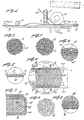
- the fibrous mat-faced gypsum board can be made utilizing existing wallboard manufacturing lines, for example, as shown somewhat diagramatically in Figure 1.
- dry ingredients (not shown) from which the gypsum core is formed are pre-mixed and then fed to a mixer of the type commonly referred to as a pin mixer 2.
- Water and other liquid constituents (not shown) used in making the core are metered into the pin mixer 2 where they are combined with the dry ingredients to form an aqueous gypsum slurry.
- Foam is generally added to the slurry in the pin mixer to control the density of the resulting core.
- the slurry 4 is dispersed through one or more outlets at the bottom of the mixer 2 onto a moving sheet of fibrous mat 6.
- the sheet of fibrous mat 6 is indefinite in length and is fed from a roll (not shown) of the mat.
- the two opposite edge portions of the fibrous mat 6 are progressively flexed upwardly from the mean plane of the mat 6 and then turned inwardly at the margins so as to provide coverings for the edges of the resulting board 40.
- this progressive flexing and shaping of the edges of the mat 6 are shown for only one side edge of the mat and the conventional guiding devices which are ordinarily employed for this purpose are omitted from the figure for the sake of clarity.
- Figure 7 shows also score marks 10 and 10A of the mat 6, the score marks permitting the formation of good edges and flat surfaces.
- the score marks 10 and 10A are made by a conventional scoring wheel 12.
- Another sheet of fibrous mat 16 is fed from a roll (not shown) onto the top of slurry 4, thereby sandwiching the slurry between the two moving fibrous mats which form the slurry.
- the mats 6 and 16 with the slurry 4 sandwiched therebetween enter the nip between the upper and lower forming or shaping rolls 18 and 20, and are thereafter received on a conveyor belt 22.
- Conventional edge guiding devices, such as indicated at 24 shape and maintain the edges of the composite until the gypsum has set sufficiently to retain its shape. In due course, sequential lengths of the board are cut and further processed by exposure to heat which accelerates the drying of the board by increasing the rate of evaporation of excess water in the gypsum slurry.
- the preferred form of mats 6 and 16, as shown in Figures 2 and 3, comprise glass fiber filaments 30 oriented in random pattern and bound together with a resin binder (not shown).
- a preferred form of glass fiber mat-faced gypsum board 40 is shown in Figures 4 and 7. It comprises one in which the set gypsum of the core 42 penetrates substantially through the thickness of the mat 6 over substantial area portions thereof and in which the set gypsum of the core 42 penetrates the mat 16 partially, with the surface being thus substantially free of set gypsum.
- the gypsum-free surface of mat 16, as seen in Figure 8, is highly textured, and provides an excellent substrate for adhering thereto an overlying component inasmuch as it comprises many interstices into which an adhesive composition can flow and bond.
- substantially penetrated by set gypsum means that the set gypsum of the core, extends from the mat surface which is contiguous to the core to the outer mat surface and coats glass fibers on the outer surface with a thin film of set gypsum to the extent that the outline of glass fibers can be seen through the thin film of set gypsum.
- over substantial area portions of the outer surface means that about 30 to 75% of the outer surface area of the mat is substantially penetrated by set gypsum. Preferably, about 45 to about 55% of the outer surface area of the mat is substantially penetrated by set gypsum.
- the gypsum-coated surface of this preferred embodiment of the board comprises a surface that has a roughened or patterned appearance; it does not comprise a smooth continuous coating of set gypsum.
- This preferred form of board can be formed with relatively small amounts of gypsum slurry being deposited on the underlying support surface, thus minimizing the need to clean the surface of the board-forming equipment.
- this preferred form of board has two gypsum-free fiber-faced surfaces.
- the manufacture of the aforementioned preferred forms of board can be accomplished by controlling the viscosity of the aqueous slurry of the calcined gypsum in a manner such that the slurry penetrates the underlying and overlying mats to the desired degree.
- the viscosity of the slurry should be such that it penetrates about 10 to 50% of the thickness of the overlying mat over the entire surface area thereof.
- the recommended means for controlling the viscosity of the slurry is to add thereto a viscosity-control agent .
- a viscosity-control agent are known in the field of gypsum board manufacture.
- a preferred viscosity-control agent is paper fiber. Examples of other agents that can be used are cellulosic thickeners, bentonite clays, starches, and gypsum whisker fibers.
- the particular viscosity values that are used in the manufacturing operation can vary from one application to the next, depending on the porosity of the mat, the hydration rate of the calcined gypsum and the desired penetration of the slurry. Accordingly, for any particular application, the viscosity value is best determined empirically.
- the viscosity value refers to Brookfield viscosity measured at a temperature of 70°F at 10 rpm utilizing paddle No. 3. It should be appreciated that the amount of viscosity-control agent added to the slurry to give the desired viscosity will vary depending on the particular agent used and the specific viscosity desired.
- the manufacture of cores of predetermined densities can be effected by using known techniques, for example, by introducing an appropriate amount of foam into the aqueous gypsum slurry from which the core is formed.
- the weight of a widely used paper facing in the manufacture of conventional gypsum sheathing is in the range of about 120 lbs/1000 sq.ft. of board, whereas the weight of a preferred form of glass fiber mat for use in the present invention is about 40 lbs/1000 sq.ft. of board.
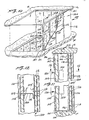
- Shaft wall assembly 100 comprises metal framework consisting of ceiling- and floor-mounted J-tracks 101 and I-studs 103 for supporting gypsum board panels 110 and 112.
- J-tracks 101 are fastened by bolts 104 to the ceiling C and to the floor F adjacent to the shaft S to be enclosed.
- Each J-track has a short leg 106 and a long leg 107, the long leg 107 lying in substantially the same plane as the shaft side 120 of shaft wall assembly 100.
- I-studs 103 are positioned vertically between the ceiling and floor J-tracks 101.
- I-studs 103 are friction-fit between the legs 106 and 107 of the ceiling and floor J-tracks.
- I-studs 103 comprise flanges 109 and 109' extending perpendicularly from an intermediate body portion 114.
- Tabs T are cut and folded out of the metal sheet from which I-studs 103 are made. The forming of such tabs results in forming holes 140 in body portion 114 of the I-studs.
- Gypsum board panels 110 comprising the shaft liner panels of the assembly, are positioned between legs 106 and 107 of J-tracks 101, with the vertical edges of said panels being friction-fit between the I-stud tabs T and flanges 109. Facing layers of gypsum board panels 112 are fastened by screw fasteners 113 to the face side 130 of shaft wall assembly 130. Two facing layers or plies of gypsum board panels 112 are illustrated, although it should be understood that additional face layers of gypsum board may be applied, as desired. Facing layers of gypsum board may also be applied to the shaft side of the assembly in stairwell applications where a finished wall surface is desired.
- gypsum board panels 110 shaft liner panels of the assembly
- gypsum board panels 112 the facing layers of the assembly
- Exemplary alternative embodiments include the use of panels comprising a gypsum core having but one side faced with a fibrous mat and oriented in the assembly with the "mat" facing the shaft and the use of fibrous mat-faced gypsum board in one or more plies of the facing layers.
- glass fiber mat-faced gypsum boards falling within the scope of the present invention were installed and evaluated for fire endurance in test sections of conventional shaft wall assemblies of the general type shown in the drawings.
- the metal components of the shaft wall metal framework were supplied by Georgia Pacific Corporation and were manufactured from 25 gauge hot dipped galvanized steel.
- the components consisted of four J-tracks having a 2 1/2" wide base portion from which 2 1/4" and 1" legs extended and a single I-stud which was 1 1/2" wide and 2 1/2" deep.
- the J-tracks were fastened by bolts to horizontal and vertical edges of a masonry framing structure.
- the ends of the I-stud were friction-fit between the legs of the upper and lower horizontally positioned J-tracks.
- the side of the assembly defined by the mean plane of the long legs of the J-tracks is referred to hereafter as the "shaft side”; the side of the assembly defined by mean plane of the short legs of the J-tracks is hereafter referred to as the "face side.”
- Each of the glass fiber mat-faced gypsum boards that were tested had a substantially gypsum-free face and a face having gypsum over substantial area portions thereof.
- Each of the boards was installed in its test assembly so that its gypsum-free face was exposed to the shaft side of the assembly.
- facing layers of paper-faced gypsum board were fastened to the face side of the metal framework. These facing layers are described in more detail hereinbelow.
- the furnace was fired with multiple gas burners positioned such that the yellow luminous flame from each burner impinged on the face of the specimen thereby maintaining a uniform temperature thereover.
- Furnace temperature was gradually increased according to the standard time temperature curve of ASTM E-119, as shown below.
- Temperature measurements of the test assembly were made by eight Chromel-Alumel (Type K) thermocouples, four of which were positioned on the furnace exposed side and the remaining four of which were positioned on the unexposed side of the assembly.
- Fire endurance of each assembly tested was measured as time taken for either (1) the average temperature of the unexposed side, as measured by the four thermocouples, to reach 250°F above ambient temperature or (2) any individual thermocouple temperature measurement to reach 325°F above ambient temperature. Once either of these two temperatures was reached, the test was concluded and the time measured from the start of the test was recorded. During each test, observations were made of each assembly respecting board deterioration, cracking, distortion and metal component failure.
- the evaluations involved two-hour fire endurance tests and three-hour fire endurance tests, as described below.
- gypsum board In each shaft wall assembly tested, two facing layers (an inner layer and an outer layer) of gypsum board were fastened to the face of the metal framework. These two layers consisted of 1/2" fire-resistant gypsym boards, the core composition of which is set forth below. Two such boards, each having dimensions of 33" x 39", their longest dimensions oriented horizontally, were fastened to the face side of the framework using 1" Type S screws, 24" O.C. to form an inner facing layer. The joint formed between the edges of these two boards extended horizontally and was not finished.
- the outer facing layer consisted of a single gypsum board having dimensions of 39" x 66", the longest board dimension being vertically oriented. The board was fastened over the boards of the inner facing layer using 1 5/8" Type S screws, 16" O.C.
- the glass fiber mat-faced gypsum boards referred to in Table 1 below that is, those boards falling within the scope of the present invention, were made utilizing nonwoven mat composed of glass fiber filaments oriented in a random pattern bonded together by an adhesive referred to by the manufacturer as a "modified urea-formaldehyde resin".
- the mat had a thickness of 33 mils, and was more porous than paper of the type used as the cover sheet of gypsum wallboard.
- the air permeability of the mat was 700 CFM/sq.ft. (test method FG 436-910).
- the mat is available commercially as DURA-GLASS 7502-2 lbs and is an example of a preferred fibrous mat for use in the practice of the present invention.
- Continuous length board was made from an aqueous slurry of the gypsum formulations described in Table 1 below on a conventional wallboard machine.
- the slurry was fed onto a moving sheet of the mat as it was unrolled from a roll onto a moving support surface.
- the mat had a width of about 51 inches and was scored continuously by conventional scoring blades prior to the deposition of the slurry thereon.
- Each edge of the mat was scored with two score marks, with each of the outer scores being about 1 inch from its respective edge of the mat and each of the inner scores being about 1 1/2" from its respective edge. After the slurry was deposited on the mat, the edges were folded at the score marks and overlapped on top of the slurry.
- the gypsum core formed from this operation had a width of 47 7/8" and a thickness of 1/2".
- Mat from another roll thereof and having a width of 47 1/2" was fed onto the top of the gypsum slurry and the overlapped edge portions of the underlying mat.
- the gypsum slurry penetrated the overlapped edge portions and served to bond the edge portions of the overlying mat to the overlapped edge portions of the underlying mat.
- the viscosity of the gypsum slurry was about 5900 cp at 70°F. At this viscosity, the slurry penetrated substantially through some portions of the underlying mat to form a thin film thereof on about 40 to 50% of the area of the outer surface of the mat.
- a three-hour fire endurance test was conducted as described below.
- a 1" thick glass fiber mat-faced board having a density of 42 lbs/ft.3 was installed in a test section of a conventional shaft wall assembly as described earlier.
- the core composition of the board, referred to herein as G-4, is set forth below.
- the face side of the assembly which was tested included three facing layers of conventional gypsum board having a thick ness of 5/8" and a core composition as set forth below.
- the innermost facing layer was formed from two such boards having respective dimensions of 15" x 66" and 24" x 66", their longest dimensions oriented vertically. These boards were fastened to the short legs of the J-tracks and I-stud flanges using 1" Type S screws, 24" O.C. The joint formed between the edges of these boards was centered over the I-stud. The joint was not finished.
- the boards forming th eintermediate and outer facing layers had the same length and width dimensions and were positioned in the same orientation as the inner and outer facing layers of the assembly described above for the two-hour tests.
- the outermost facing layer was fastened in place using 2 1/4" Type S screws.
- the face side of the test assembly was exposed to the gas flames of the furnace, the shaft side remaining unexposed to flames.
- the paper-faced gypsum boards were Type "X” board sold by Georgia-Pacific Corporation under the trademark FIRESTOP. These facing boards have an average weight of 2350 lbs/1000 ft.2 and a core composition as set forth below.
- the temperature of the flame-exposed face of the assembly rose at a rate of approximately 88°F/minute in the first 15 minutes of the test, 9°F/minute in the second 15 minutes, and 1.8°F/minute for the remaining two hours and forty-five minutes of the test, and reached an average temperature after three hours and fifteen minutes of about 1,910°F.
- the average temperature measured on the unexposed face side of the assembly rose from approximately 77°F (ambient temperature) to 327°F over a period of time of three hours, thirteen minutes.
- the maximum temperature measured on the unexposed face side was 402°F. It was reached in three hours and twelve minutes. Thus, a fire endurance of 3.2 hours was achieved by the test assembly.
- glass fiber mat-faced gypsum boards as described herein when tested in shaft wall assemblies, show significant improvements in fire endurance over their conventional paper-faced counterparts despite the fact that their cores are significantly less dense and contain a significantly smaller quantity of fire-resistant additives, namely glass fibers.
- the next example involves the evaluation in a fire test of a 5/8" thick glass fiber mat-faced gypsum board having a core composition as set forth below and prepared according to the techniques described for glass fiber mat-faced gypsum boards of the earlier examples herein.
- the density of the core of the board was 53 lbs/cu.ft.
- a fire rating of 1 hour and 30 seconds was achieved when the board was evaluated for fire resistance and hose stream resistance according to ASTM E-119. It is noted that the board has excellent water-resistant properties due to the use of water-resistant additives in its core, those additives being wax-asphalt emulsion and poly(vinyl alcohol).
- the present invention provides ina practical way important functional improvements in structural assemblies which are intended to have fire-resistant properties designed to ensure the safety of life and property.
Landscapes
- Engineering & Computer Science (AREA)
- Architecture (AREA)
- Structural Engineering (AREA)
- Civil Engineering (AREA)
- Chemical & Material Sciences (AREA)
- Ceramic Engineering (AREA)
- Mechanical Engineering (AREA)
- Building Environments (AREA)
- Laminated Bodies (AREA)
- Panels For Use In Building Construction (AREA)
- Load-Bearing And Curtain Walls (AREA)
Applications Claiming Priority (2)
| Application Number | Priority Date | Filing Date | Title |
|---|---|---|---|
| US76958385A | 1985-08-26 | 1985-08-26 | |
| US769583 | 1985-08-26 |
Publications (2)
| Publication Number | Publication Date |
|---|---|
| EP0216497A2 true EP0216497A2 (fr) | 1987-04-01 |
| EP0216497A3 EP0216497A3 (fr) | 1987-12-02 |
Family
ID=25085893
Family Applications (1)
| Application Number | Title | Priority Date | Filing Date |
|---|---|---|---|
| EP86306391A Withdrawn EP0216497A3 (fr) | 1985-08-26 | 1986-08-19 | Utilisation de plaques de plâtre revêtues d'une natte fibreuse dans des murs de cage et plaque améliorée résistant au feu |
Country Status (4)
| Country | Link |
|---|---|
| EP (1) | EP0216497A3 (fr) |
| JP (1) | JP2523523B2 (fr) |
| CA (1) | CA1309828C (fr) |
| MX (1) | MX171714B (fr) |
Cited By (11)
| Publication number | Priority date | Publication date | Assignee | Title |
|---|---|---|---|---|
| EP1291475A1 (fr) * | 2001-09-06 | 2003-03-12 | Gebr. Knauf Westdeutsche Gipswerke | Panneau à base de plâtre et méthode de fabrication |
| NL1038299C2 (nl) * | 2010-10-08 | 2012-04-11 | Jongenelen Las En Constructiewerken B V M | Werkwijze voor het verschaffen van een brandwerende scheidingswand. |
| US8197952B2 (en) | 2005-06-09 | 2012-06-12 | United States Gypsum Company | High starch light weight gypsum wallboard |
| USRE44070E1 (en) | 2005-06-09 | 2013-03-12 | United States Gypsum Company | Composite light weight gypsum wallboard |
| FR3011862A1 (fr) * | 2013-10-16 | 2015-04-17 | Machome | Module de construction |
| CN106975184A (zh) * | 2017-05-18 | 2017-07-25 | 盐城欧润石化设备制造有限公司 | 一种管道阻火器 |
| US9802866B2 (en) | 2005-06-09 | 2017-10-31 | United States Gypsum Company | Light weight gypsum board |
| US9840066B2 (en) | 2005-06-09 | 2017-12-12 | United States Gypsum Company | Light weight gypsum board |
| US11306028B2 (en) | 2005-06-09 | 2022-04-19 | United States Gypsum Company | Light weight gypsum board |
| US11338548B2 (en) | 2005-06-09 | 2022-05-24 | United States Gypsum Company | Light weight gypsum board |
| CN117733986A (zh) * | 2023-12-06 | 2024-03-22 | 泰山石膏(南通)有限公司 | 一种环保多功能纸面石膏板生产装置 |
Families Citing this family (1)
| Publication number | Priority date | Publication date | Assignee | Title |
|---|---|---|---|---|
| WO2023014771A1 (fr) | 2021-08-06 | 2023-02-09 | Owens Corning Intellectual Capital, Llc | Parement composite renforcé et revêtu et ensemble d'isolation le comprenant |
Family Cites Families (6)
| Publication number | Priority date | Publication date | Assignee | Title |
|---|---|---|---|---|
| US3616173A (en) * | 1967-08-29 | 1971-10-26 | Georgia Pacific Corp | Fire resistant wallboard |
| US3993822A (en) * | 1970-02-25 | 1976-11-23 | Gebr. Knauf Westdeutsche Gipswerke | Multi-layer plasterboard |
| JPS49116446U (fr) * | 1973-02-05 | 1974-10-04 | ||
| US3935021A (en) * | 1973-11-05 | 1976-01-27 | Georgia-Pacific Corporation | Water-resistant gypsum products |
| GB1532095A (en) * | 1975-05-27 | 1978-11-15 | United States Gypsum Co | Stud for forming fire-rated wall and structure formed therewith |
| US4047355A (en) * | 1976-05-03 | 1977-09-13 | Studco, Inc. | Shaftwall |
-
1986
- 1986-08-19 EP EP86306391A patent/EP0216497A3/fr not_active Withdrawn
- 1986-08-22 CA CA000516602A patent/CA1309828C/fr not_active Expired - Lifetime
- 1986-08-25 JP JP61197460A patent/JP2523523B2/ja not_active Expired - Lifetime
- 1986-08-26 MX MX354786A patent/MX171714B/es unknown
Cited By (16)
| Publication number | Priority date | Publication date | Assignee | Title |
|---|---|---|---|---|
| EP1291475A1 (fr) * | 2001-09-06 | 2003-03-12 | Gebr. Knauf Westdeutsche Gipswerke | Panneau à base de plâtre et méthode de fabrication |
| US9802866B2 (en) | 2005-06-09 | 2017-10-31 | United States Gypsum Company | Light weight gypsum board |
| US9840066B2 (en) | 2005-06-09 | 2017-12-12 | United States Gypsum Company | Light weight gypsum board |
| US8257489B2 (en) | 2005-06-09 | 2012-09-04 | United States Gypsum Company | Slurries and methods of making light weight gypsum board |
| USRE44070E1 (en) | 2005-06-09 | 2013-03-12 | United States Gypsum Company | Composite light weight gypsum wallboard |
| US11884040B2 (en) | 2005-06-09 | 2024-01-30 | United States Gypsum Company | Light weight gypsum board |
| US11338548B2 (en) | 2005-06-09 | 2022-05-24 | United States Gypsum Company | Light weight gypsum board |
| US8197952B2 (en) | 2005-06-09 | 2012-06-12 | United States Gypsum Company | High starch light weight gypsum wallboard |
| US10407345B2 (en) | 2005-06-09 | 2019-09-10 | United States Gypsum Company | Light weight gypsum board |
| US11306028B2 (en) | 2005-06-09 | 2022-04-19 | United States Gypsum Company | Light weight gypsum board |
| US10406779B2 (en) | 2005-06-09 | 2019-09-10 | United States Gypsum Company | Light weight gypsum board |
| NL1038299C2 (nl) * | 2010-10-08 | 2012-04-11 | Jongenelen Las En Constructiewerken B V M | Werkwijze voor het verschaffen van een brandwerende scheidingswand. |
| WO2015056083A3 (fr) * | 2013-10-16 | 2015-08-13 | Bat'ipac | Module de construction a base de carton et methode de fabrication dudit module |
| FR3011862A1 (fr) * | 2013-10-16 | 2015-04-17 | Machome | Module de construction |
| CN106975184A (zh) * | 2017-05-18 | 2017-07-25 | 盐城欧润石化设备制造有限公司 | 一种管道阻火器 |
| CN117733986A (zh) * | 2023-12-06 | 2024-03-22 | 泰山石膏(南通)有限公司 | 一种环保多功能纸面石膏板生产装置 |
Also Published As
| Publication number | Publication date |
|---|---|
| JPS6290460A (ja) | 1987-04-24 |
| CA1309828C (fr) | 1992-11-10 |
| JP2523523B2 (ja) | 1996-08-14 |
| MX171714B (es) | 1993-11-11 |
| EP0216497A3 (fr) | 1987-12-02 |
Similar Documents
| Publication | Publication Date | Title |
|---|---|---|
| US5148645A (en) | Use of fibrous mat-faced gypsum board in shaft wall assemblies and improved fire resistant board | |
| EP0154094B1 (fr) | Planche de plâtre couverte de tissu en fibre et son utilisation pour isolation extérieure, dans systèmes de finition extérieure de bâtiments et dans le montage d'un mur de puit | |
| CA2495551C (fr) | Plaques de platre a couche interface d'alcool de polyvinyle, et leur procede de fabrication | |
| US4810569A (en) | Fibrous mat-faced gypsum board | |
| US5552187A (en) | Coated fibrous mat-faced gypsum board | |
| US5791109A (en) | Gypsum board and finishing system containing same | |
| JP4323754B2 (ja) | 改良されたマットを備えた石膏板 | |
| US6737156B2 (en) | Interior wallboard and method of making same | |
| US5220762A (en) | Fibrous mat-faced gypsum board in exterior and interior finishing systems for buildings | |
| US5883024A (en) | Fibrous mat and mat-faced gypsum board | |
| AU2005279310B2 (en) | New gypsum board and systems comprising it | |
| CA2663998A1 (fr) | Panneau de gypse resistant au feu | |
| CA1309828C (fr) | Utilisation, dans des gaines techniques, de panneaux de gype revetus de matelas fibreux et de panneaux ignifuges ameliores | |
| JP2014510854A (ja) | 軽量かつ低密度の耐火性石膏パネル | |
| CA1326625C (fr) | Panneau de gypse a face revetue d'un materiau fibreux, a caracteristiques ameliorees de resistance au feu | |
| JP2523523C (fr) | ||
| HK1050230A (en) | Improved mat-faced gypsum board |
Legal Events
| Date | Code | Title | Description |
|---|---|---|---|
| PUAI | Public reference made under article 153(3) epc to a published international application that has entered the european phase |
Free format text: ORIGINAL CODE: 0009012 |
|
| AK | Designated contracting states |
Kind code of ref document: A2 Designated state(s): AT CH DE FR GB LI |
|
| PUAL | Search report despatched |
Free format text: ORIGINAL CODE: 0009013 |
|
| AK | Designated contracting states |
Kind code of ref document: A3 Designated state(s): AT CH DE FR GB LI |
|
| 17P | Request for examination filed |
Effective date: 19880514 |
|
| STAA | Information on the status of an ep patent application or granted ep patent |
Free format text: STATUS: THE APPLICATION HAS BEEN WITHDRAWN |
|
| 18W | Application withdrawn |
Withdrawal date: 19881222 |
|
| RIN1 | Information on inventor provided before grant (corrected) |
Inventor name: LEHNERT, CHARLES W. Inventor name: FOWLER, GEORGE F., JR. Inventor name: HINKEL, RAY W. Inventor name: RANDALL, BRIAN G. |