EP0217025A2 - Rotors à vis pour compresseurs ou similaires - Google Patents
Rotors à vis pour compresseurs ou similaires Download PDFInfo
- Publication number
- EP0217025A2 EP0217025A2 EP86109975A EP86109975A EP0217025A2 EP 0217025 A2 EP0217025 A2 EP 0217025A2 EP 86109975 A EP86109975 A EP 86109975A EP 86109975 A EP86109975 A EP 86109975A EP 0217025 A2 EP0217025 A2 EP 0217025A2
- Authority
- EP
- European Patent Office
- Prior art keywords
- rotor
- female
- male
- rotors
- point
- Prior art date
- Legal status (The legal status is an assumption and is not a legal conclusion. Google has not performed a legal analysis and makes no representation as to the accuracy of the status listed.)
- Withdrawn
Links
Images


Classifications
-
- F—MECHANICAL ENGINEERING; LIGHTING; HEATING; WEAPONS; BLASTING
- F04—POSITIVE - DISPLACEMENT MACHINES FOR LIQUIDS; PUMPS FOR LIQUIDS OR ELASTIC FLUIDS
- F04C—ROTARY-PISTON, OR OSCILLATING-PISTON, POSITIVE-DISPLACEMENT MACHINES FOR LIQUIDS; ROTARY-PISTON, OR OSCILLATING-PISTON, POSITIVE-DISPLACEMENT PUMPS
- F04C18/00—Rotary-piston pumps specially adapted for elastic fluids
- F04C18/08—Rotary-piston pumps specially adapted for elastic fluids of intermeshing-engagement type, i.e. with engagement of co-operating members similar to that of toothed gearing
- F04C18/082—Details specially related to intermeshing engagement type pumps
- F04C18/084—Toothed wheels
Definitions
- This invention relates to a pair of male and female screw rotors for use in screw compressors or the like, and more particularly to improvements in screw rotors of the type which consist of a female rotor with an addendum on each tooth outside its pitch circle and a male rotor having corresponding deddenda inside its pitch circle correspondingly to the addenda of the female rotor.
- the present invention contemplates an improvement in the volumetric efficiency in screw rotors of this sort (which is about 83.99% in the particular example given above). It has been known in the art that the volumetric efficiency is largely influenced by the following three factors: the theoretical volume; the seal line length per unit theoretical volume; and the blow hole area per unit theoretical volume.
- the present invention provides a pair of male and female screw rotors for use in compressors or the like, in which; the female rotor is formed with an addendum on each tooth beyond its pitch circle and the male rotor is formed with a deddendum at each root within its pitch circle complementarily to said addendum of the female rotor: and each follower side tooth rofile of said male rotor includes a curve generated by a point on said female rotor, when a point is located on the pitch circle of said female rotor said point is located on the pitch circle of said male rotor, and said point is located on the root circle of said male rotor characterised in that each trailing side tooth profile of said female rotor includes a curve generated by the point on said male rotor.
- FIGURE 2 there are shown more particularly the tooth shapes of a female rotor F and a male rotor M in one preferred embodiment of the invention.
- the female and male rotors F and M are provided with teeth of the shapes as follows.
- the female rotor F is provided with an addendum Af on the outer side of a pitch circle Pf of each tooth and with a deddendum Df on the inner side of the pitch circle Pf at each root.
- the tooth shapes on the propelling and follower sides of the female rotor F are as follows.
- the profile d2-e2 is an arc having its center at the intersection of the pitch circle Pf and a straight line drawn between the centers Of and Om of the two rotors, and the angle d2me2 is about 40 degrees. Point d2 is located on line Of-Om.
- the profile e2-f2 is a tangential line passing through point e2, and point f2 is located on the pitch circle Pf.
- the profile f 2-g2 is constituted by an arc passing through point f2 and having its center at point S on a line drawn at right angles with line e2-f2.
- Point g2 is located on an arc having its center at Of.
- the profile d2-c2 is constituted by a generated curve which is determined by point dl.
- the profile c2-b2 is constituted by an arc having its center at point t on a line tangential to the pitch circle Pf and passing through point b2 (on the pitch circle Pf).
- the profile b2-a2 is constituted by an arc having its center at point q on the pitch circle Pf. Point a2 is located on an arc having its center at Of. (Tooth Shape of Male Rotor]
- the male rotor M is provided with a deddemdum Dm at each root correspondingly to the addendum Af of the female rotor F
- the tooth shapes on the propelling and follower sides of the male rotor M are as follows.
- the profile dl-el is an arc having its center at the intersection point m of the pitch circle Pm and a straight line drawn between the centers Of and Om of the female and male rotors, and corresponding to the arc d2-e2 of the female rotor F. Accordingly, the angle dlmel is same as the angle ⁇ d2me2. Point dl is located on the line through the rotor centers Of and Om.
- the profile el-(fl)-gl is a generating curve which is determined by the line e2-(f2)-g2 of the female rotor F.
- Point fl is located on the pitch circle Pm, and point gl is located on the tooth root circle of the male rotor M.
- the profile dl-bl is a generating curve which is determined by the arc c2-b2 of the female rotor F. Point bl is located on the pitch circle Pm.
- the profile bl-al is an arc corresponding to the arc b2-a2 of the female rotor F. Point al is located on the tooth root circle of the male rotor M.
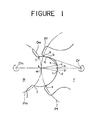
- the female and male rotors F and M are formed to have the above-defined tooth shapes which permit to secure a greater tooth width for the female rotor as compared with the conventional tooth shapes (FIGURE 1), as clear from FIGURE 3.
- Denoted at F and M in FIGURE 3 are female and male rotors according to the present invention (indicated by solid line) and at F' and M' are conventional female and male rotors, which have the same outer diameters (Tm, Tf').
- the reference characters w and w' indicate the minimum tooth width of the female rotor of the invention and the conventional female rotor, respectively.
- the tooth width w' is about 62% of the tooth thickness w.
- the above-mentioned difference in tooth width is attributable to the difference in shape between the generating curves d2-c2 and c-b of the female rotors F and F'. More particularly, the generating curve c-b of the female rotor F' which is determined by point h of the male rotor M' is scooped in a greater degree as long as the tooth width is concerned. On the other hand, the generating curve d2-c2 of the female rotor F is determined by point dl of the male rotor M (which is located on the inter-axis line Om-Of), so that its degree of recession which causes the reduction in tooth width is relatively small.
- the female rotor F of the present embodiment with the profile e2-f2 of a straight line has an advantage in a case where the female rotor F is fabricated by a hobbing operation since it is possible to shape the profile successively by individual hob blades without overlapped cutting.
- the conventional female rotor F' with an arcuate profile at d-e, which has to be cut simultaneously by a plural number of hob blades for overlapped cutting is disadvantageous from the standpoint of machining condition.
- the tooth width or thickness of the female rotor is determined depending upon the minimum allowable mechanical strength and from the standpoint of machinability in the manufacturing process and durability of the rotor in service. According to the experiments conducted by the present inventors, it has been found that, in a case where the inter-axis distance CD of the rotors is 100 mm, the minimum allowable value for the tooth thickness of the female rotor is about 8 mm.
- the above-defined outer diameter (1.37 x CD) for the male rotor M has been determined on the basis of the minimum allowable value (8mm) of the female rotor tooth thickness.
- FIGURE 6 comparatively shows the outer diameters of the male and female rotors in the embodiment of the invention and the conventional example.
- the outer diameter of a female rotor is determined by the sum of the dimensions of its pitch circle and addemdum.
- the dimension of the pitch circle is automatically determined by the inter-axis distance CD of the male and female rotors and their tooth ratio. Therefore, the outer diameter of the female rotor is determined by the dimension or dimensional ratio of the addendum.
- FIGURE 5 shows the results of experiments conducted by the present inventors, studying variations in the volume efficiency in relation with the seal line length and blow hole area by changing the dimensional rate of addendum on the female rotor. More specifically, the results show that the volume efficiency curve reaches the maximum when the addendum rate is 2%. As mentioned hereinbefore, the addendum rate in the conventional example is 2.79 at which the volume efficiency is about 0.84 (indicated by a mark "" in FIGURE 5).
- the embodiment of the present invention fa excels the volumetric efficiency of the conventional example at any addendum rate in the range of 0% - 3% according to the invention, and marks an especially high volumetric efficiency of 85.7 at an addendum rate in the vicinity of 2%, namely, in the range of 1.7% to 2.3%.
- the rotors according to the present invention realizes a significant increase in the theoretical volume along with reductions in the seal line length and blow hole area per unit theoretical volume as compared with the conventional rotors. As a result, the volumetric efficiency can be improved drastically from the value of the conventional rotors.
- the volume efficiency is also largely influenced by the blow hole area which appears, as shown particularly in FIGURE 7, between a point when the cusp S of a screw compressor casing disengages from a tooth of the male rotor M and a time when it comes into engagement with a tooth of the female rotor F, forming a blow hole of compressed air.
- the area of the blow hole is generally expressed by way of the area of a substantially triangular shape which is defined by a tooth surface of the male rotor M, a surface of the addendum Af of the female rotor F and an extension line V of the cusp wall at a time point when a tooth point h on the male rotor M comes into contact with a tooth point b on the female rotor F.
- the conventional rotors of FIGURE 1 have a blow hole area as. indicated by dotted region B in FIGURE 7.
- the volumetric efficiency of the rotors is further enhanced by improving the shape of addendum Af of the female rotor F in such a manner as to reduce the blow hole area.
- the profile a-l' on the follower side of the female rotor tooth is formed by a curved generating line which is determined by point f on the male rotor, while the profile f-q' on the follower side of the male rotor tooth is formed by a generating curve which is determined by point I' on the female rotor.
- point a is a point on the pitch circle of the female rotor
- point f is a point located on the pitch circle of the male rotor
- point q' is a point located on the root circle of the male rotor.
- FIGURES 8 and 9 in which the female and male. rotors are formed in the same tooth shapes as in the conventional rotors of FIGURE 1 for the convenience of explanation, except for the feature points which will be discussed in greater detail hereinlater. Those parts which are common to the foregoing embodiment are designated by common reference characters and their description is omitted to avoid unnecessary repetitions.
- the rotors in the embodiment of FIGURES 8 and 9 differs from the first embodiment in the profile a-t' on the follower side of the female rotor tooth shape and in the profile f-q' on the follower side of the male rotor tooth shape. More specifically, the profile a-2' is formed by a generating curve which is defined by point f on the male rotor M, while the profile f-q' is formed by a generating curve which is determined by point t' on the female rotor F, provided that point f is located on the pitch circle Pm of the male rotor M, and point q' is located on the root circle of the male rotor M.
- the shape of the addendum Af on the female rotor F is shown on an enlarged scale in FIGURE 9. As clear therefrom, the addendum Af is more bulged out in a direction of reducing the blow hole area, as compared with the conventional addendum.
- the blow hole area in this embodiment is indicated by a dotted region B', which is equal to the conventional blow hole area B minus the bulged area B" (the hatched area) of the addendum Af.
- the volumetric efficiency can be improved to an extent corresponding to the reduction in the blow hole area.
- the profile b-a of the female rotor is formed by a straight line in the embodiment of FIGURES 8 and 9, it may be formed by an arc passing through point a (a point on the pitch circle Pf) and having its center on a line tangential to the pitch circle Pf, while profiling h-f of the male rotor M by a curve which is generated by the arc b-a of the female rotor F if desired.
- the profile d2-c2 on the follower side of the tooth shape of the female rotor is formed by a curve which is generated by point dl of the male rotor M located on an inter-axis line of the rotors thereby securing a maximum tooth width for the female rotor thereby securing a maximum tooth width for the female rotor while permitting to increase the theoretical volume by enlargement of the outer diameter of the male rotor.
- the theoretical volume can be increased to maximum by holding the outer diameter of the male rotor in the dimension of about 1.37 x CD.
- seal line length and blow hole area per unit theoretical volume can be,reduced by holding the addendum rate of the female rotor in the range of about 1.7% to 2.3%.
- the invention makes it possible to attain a drastically improved volumetric efficiency of 85.7% or higher in contrast to the conventional volumetric efficiency of 83.99%, even without additionally employing the improved addendum shape of the second embodiment.
Landscapes
- Engineering & Computer Science (AREA)
- Mechanical Engineering (AREA)
- General Engineering & Computer Science (AREA)
- Rotary Pumps (AREA)
- Applications Or Details Of Rotary Compressors (AREA)
Applications Claiming Priority (4)
| Application Number | Priority Date | Filing Date | Title |
|---|---|---|---|
| JP3862283U JPS59144185U (ja) | 1983-03-16 | 1983-03-16 | スクリユ−圧縮機等のスクリユ−ロ−タ |
| JP4468283A JPS59196988A (ja) | 1983-03-16 | 1983-03-16 | スクリユ−圧縮機等のスクリユ−ロ−タ |
| JP44682/83 | 1983-03-16 | ||
| JP38622/83 | 1983-03-16 |
Related Parent Applications (2)
| Application Number | Title | Priority Date | Filing Date |
|---|---|---|---|
| EP84301801.1 Division | 1984-03-16 | ||
| EP84301801A Division EP0122725B1 (fr) | 1983-03-16 | 1984-03-16 | Rotors à vis pour compresseurs ou similaires |
Publications (2)
| Publication Number | Publication Date |
|---|---|
| EP0217025A2 true EP0217025A2 (fr) | 1987-04-08 |
| EP0217025A3 EP0217025A3 (fr) | 1987-11-19 |
Family
ID=26377891
Family Applications (2)
| Application Number | Title | Priority Date | Filing Date |
|---|---|---|---|
| EP84301801A Expired EP0122725B1 (fr) | 1983-03-16 | 1984-03-16 | Rotors à vis pour compresseurs ou similaires |
| EP86109975A Withdrawn EP0217025A3 (fr) | 1983-03-16 | 1984-03-16 | Rotors à vis pour compresseurs ou similaires |
Family Applications Before (1)
| Application Number | Title | Priority Date | Filing Date |
|---|---|---|---|
| EP84301801A Expired EP0122725B1 (fr) | 1983-03-16 | 1984-03-16 | Rotors à vis pour compresseurs ou similaires |
Country Status (3)
| Country | Link |
|---|---|
| US (1) | US4583927A (fr) |
| EP (2) | EP0122725B1 (fr) |
| DE (1) | DE3471348D1 (fr) |
Cited By (1)
| Publication number | Priority date | Publication date | Assignee | Title |
|---|---|---|---|---|
| DE19502323A1 (de) * | 1995-01-26 | 1996-08-01 | Guenter Kirsten | Verfahren zur Herstellung von Rotoren von Schraubenverdichtern |
Families Citing this family (10)
| Publication number | Priority date | Publication date | Assignee | Title |
|---|---|---|---|---|
| JPH0320481Y2 (fr) * | 1985-06-29 | 1991-05-02 | ||
| US4673344A (en) * | 1985-12-16 | 1987-06-16 | Ingalls Robert A | Screw rotor machine with specific lobe profiles |
| US4671750A (en) * | 1986-07-10 | 1987-06-09 | Kabushiki Kaisha Kobe Seiko Sho | Screw rotor mechanism with specific tooth profile |
| JP3823573B2 (ja) * | 1998-11-19 | 2006-09-20 | 株式会社日立製作所 | スクリュー流体機械 |
| GB2418455B (en) * | 2004-09-25 | 2009-12-09 | Fu Sheng Ind Co Ltd | A mechanism of the screw rotor |
| US20060078453A1 (en) * | 2004-10-12 | 2006-04-13 | Fu Sheng Industrial Co. , Ltd. | Mechanism of the screw rotor |
| JP5695995B2 (ja) * | 2011-07-25 | 2015-04-08 | 株式会社神戸製鋼所 | ギアポンプ |
| CN102828954B (zh) * | 2012-09-14 | 2015-06-17 | 上海齐耀螺杆机械有限公司 | 一种新型双螺杆压缩机转子齿型 |
| DE102014105882A1 (de) | 2014-04-25 | 2015-11-12 | Kaeser Kompressoren Se | Rotorpaar für einen Verdichterblock einer Schraubenmaschine |
| CN115711231A (zh) * | 2022-11-22 | 2023-02-24 | 上海齐耀螺杆机械有限公司 | 双螺杆转子端面型线 |
Family Cites Families (9)
| Publication number | Priority date | Publication date | Assignee | Title |
|---|---|---|---|---|
| GB1197432A (en) * | 1966-07-29 | 1970-07-01 | Svenska Rotor Maskiner Ab | Improvements in and relating to Rotary Positive Displacement Machines of the Intermeshing Screw Type and Rotors therefor |
| BE792576A (fr) * | 1972-05-24 | 1973-03-30 | Gardner Denver Co | Rotor helicoidal de compresseur a vis |
| US3773444A (en) * | 1972-06-19 | 1973-11-20 | Fuller Co | Screw rotor machine and rotors therefor |
| US4028026A (en) * | 1972-07-14 | 1977-06-07 | Linde Aktiengesellschaft | Screw compressor with involute profiled teeth |
| US4140445A (en) * | 1974-03-06 | 1979-02-20 | Svenka Rotor Haskiner Aktiebolag | Screw-rotor machine with straight flank sections |
| US4088427A (en) * | 1974-06-24 | 1978-05-09 | Atlas Copco Aktiebolag | Rotors for a screw rotor machine |
| DE2911415C2 (de) * | 1979-03-23 | 1982-04-15 | Karl Prof.Dr.-Ing. 3000 Hannover Bammert | Parallel- und außenachsige Rotationskolbenmaschine mit Kämmeingriff |
| JPS5793602A (en) * | 1980-12-03 | 1982-06-10 | Hitachi Ltd | Screw rotor |
| IN157732B (fr) * | 1981-02-06 | 1986-05-24 | Svenska Rotor Maskiner Ab |
-
1984
- 1984-03-15 US US06/589,684 patent/US4583927A/en not_active Expired - Lifetime
- 1984-03-16 EP EP84301801A patent/EP0122725B1/fr not_active Expired
- 1984-03-16 EP EP86109975A patent/EP0217025A3/fr not_active Withdrawn
- 1984-03-16 DE DE8484301801T patent/DE3471348D1/de not_active Expired
Cited By (1)
| Publication number | Priority date | Publication date | Assignee | Title |
|---|---|---|---|---|
| DE19502323A1 (de) * | 1995-01-26 | 1996-08-01 | Guenter Kirsten | Verfahren zur Herstellung von Rotoren von Schraubenverdichtern |
Also Published As
| Publication number | Publication date |
|---|---|
| US4583927A (en) | 1986-04-22 |
| EP0217025A3 (fr) | 1987-11-19 |
| DE3471348D1 (en) | 1988-06-23 |
| EP0122725A1 (fr) | 1984-10-24 |
| EP0122725B1 (fr) | 1988-05-18 |
Similar Documents
| Publication | Publication Date | Title |
|---|---|---|
| EP0217025A2 (fr) | Rotors à vis pour compresseurs ou similaires | |
| EP0372480B1 (fr) | Compresseur à vis | |
| US6296461B1 (en) | Plural screw positive displacement machines | |
| US4643654A (en) | Screw rotor profile and method for generating | |
| CA1215956A (fr) | Configuration de rotors-vis sans fin | |
| EP0158514B1 (fr) | Rotors hélicoidaux | |
| US8096795B2 (en) | Oil pump rotor | |
| US6779993B2 (en) | Rotor profile for screw compressors | |
| JP2761233B2 (ja) | ルーツ型ブロワ | |
| US4028026A (en) | Screw compressor with involute profiled teeth | |
| CN106536933A (zh) | 用于螺杆机的压缩机组的转子对 | |
| US4401420A (en) | Male and female screw rotor assembly with specific tooth flanks | |
| AU720108B2 (en) | Twin feed screw | |
| EP0961009B1 (fr) | Profil de rotor à vis conjugué | |
| EP0308055B1 (fr) | Assemblage de rotors pour compresseur à vis | |
| EP0591979B2 (fr) | Profil des dents pour rotor à vis | |
| EP2852763B1 (fr) | Machines à vis à bruit réduit | |
| US4636156A (en) | Screw rotor machines with specific tooth profiles | |
| US5624250A (en) | Tooth profile for compressor screw rotors | |
| US6257855B1 (en) | Screw fluid machine | |
| HU177663B (en) | Screw rotor pair | |
| US4671750A (en) | Screw rotor mechanism with specific tooth profile | |
| GB2299135A (en) | Screw compressor rotor profiles | |
| AU2003257923B2 (en) | Conjugate screw rotor profile | |
| US20040228753A1 (en) | Meshing helical rotors |
Legal Events
| Date | Code | Title | Description |
|---|---|---|---|
| PUAI | Public reference made under article 153(3) epc to a published international application that has entered the european phase |
Free format text: ORIGINAL CODE: 0009012 |
|
| 17P | Request for examination filed |
Effective date: 19860721 |
|
| AC | Divisional application: reference to earlier application |
Ref document number: 122725 Country of ref document: EP |
|
| AK | Designated contracting states |
Kind code of ref document: A2 Designated state(s): DE FR GB SE |
|
| PUAL | Search report despatched |
Free format text: ORIGINAL CODE: 0009013 |
|
| AK | Designated contracting states |
Kind code of ref document: A3 Designated state(s): DE FR GB SE |
|
| 17Q | First examination report despatched |
Effective date: 19880505 |
|
| STAA | Information on the status of an ep patent application or granted ep patent |
Free format text: STATUS: THE APPLICATION HAS BEEN WITHDRAWN |
|
| 18W | Application withdrawn |
Withdrawal date: 19890706 |
|
| R18W | Application withdrawn (corrected) |
Effective date: 19890706 |
|
| RIN1 | Information on inventor provided before grant (corrected) |
Inventor name: SHIGEKAWA, KAZUO |