EP0217196A2 - Apparat und Verfahren zur anfänglichen Erfassung der niedrigeren, meist bedeutsamen, räumlichen Frequenzdaten bei der Bilderzeugung mittels magnetischer Kernresonanz - Google Patents
Apparat und Verfahren zur anfänglichen Erfassung der niedrigeren, meist bedeutsamen, räumlichen Frequenzdaten bei der Bilderzeugung mittels magnetischer Kernresonanz Download PDFInfo
- Publication number
- EP0217196A2 EP0217196A2 EP86112618A EP86112618A EP0217196A2 EP 0217196 A2 EP0217196 A2 EP 0217196A2 EP 86112618 A EP86112618 A EP 86112618A EP 86112618 A EP86112618 A EP 86112618A EP 0217196 A2 EP0217196 A2 EP 0217196A2
- Authority
- EP
- European Patent Office
- Prior art keywords
- nmr
- responses
- data acquisition
- image
- successive
- Prior art date
- Legal status (The legal status is an assumption and is not a legal conclusion. Google has not performed a legal analysis and makes no representation as to the accuracy of the status listed.)
- Granted
Links
- 238000000034 method Methods 0.000 title claims abstract description 61
- 238000003384 imaging method Methods 0.000 title claims abstract description 40
- 230000004044 response Effects 0.000 claims abstract description 34
- 230000005284 excitation Effects 0.000 claims description 14
- 238000012545 processing Methods 0.000 claims description 14
- 230000008859 change Effects 0.000 claims description 3
- 238000001514 detection method Methods 0.000 claims 1
- 230000033001 locomotion Effects 0.000 abstract description 18
- 230000008569 process Effects 0.000 abstract description 14
- 238000012544 monitoring process Methods 0.000 abstract description 4
- 238000005481 NMR spectroscopy Methods 0.000 description 86
- 238000005259 measurement Methods 0.000 description 17
- 238000012360 testing method Methods 0.000 description 11
- 230000009466 transformation Effects 0.000 description 8
- 230000000694 effects Effects 0.000 description 5
- 238000002591 computed tomography Methods 0.000 description 4
- 230000003247 decreasing effect Effects 0.000 description 3
- 238000012986 modification Methods 0.000 description 3
- 230000004048 modification Effects 0.000 description 3
- 230000003068 static effect Effects 0.000 description 3
- 206010006322 Breath holding Diseases 0.000 description 2
- 230000008901 benefit Effects 0.000 description 2
- 230000000052 comparative effect Effects 0.000 description 2
- 238000004590 computer program Methods 0.000 description 2
- 238000012937 correction Methods 0.000 description 2
- 238000010586 diagram Methods 0.000 description 2
- 230000001360 synchronised effect Effects 0.000 description 2
- 238000003325 tomography Methods 0.000 description 2
- 230000000007 visual effect Effects 0.000 description 2
- 238000012935 Averaging Methods 0.000 description 1
- 230000005540 biological transmission Effects 0.000 description 1
- 230000001427 coherent effect Effects 0.000 description 1
- 229940079593 drug Drugs 0.000 description 1
- 239000003814 drug Substances 0.000 description 1
- 238000001493 electron microscopy Methods 0.000 description 1
- 230000009191 jumping Effects 0.000 description 1
- 230000003094 perturbing effect Effects 0.000 description 1
- 238000000926 separation method Methods 0.000 description 1
Images




Classifications
-
- G—PHYSICS
- G01—MEASURING; TESTING
- G01R—MEASURING ELECTRIC VARIABLES; MEASURING MAGNETIC VARIABLES
- G01R33/00—Arrangements or instruments for measuring magnetic variables
- G01R33/20—Arrangements or instruments for measuring magnetic variables involving magnetic resonance
- G01R33/44—Arrangements or instruments for measuring magnetic variables involving magnetic resonance using nuclear magnetic resonance [NMR]
- G01R33/48—NMR imaging systems
- G01R33/4818—MR characterised by data acquisition along a specific k-space trajectory or by the temporal order of k-space coverage, e.g. centric or segmented coverage of k-space
- G01R33/482—MR characterised by data acquisition along a specific k-space trajectory or by the temporal order of k-space coverage, e.g. centric or segmented coverage of k-space using a Cartesian trajectory
-
- G—PHYSICS
- G01—MEASURING; TESTING
- G01R—MEASURING ELECTRIC VARIABLES; MEASURING MAGNETIC VARIABLES
- G01R33/00—Arrangements or instruments for measuring magnetic variables
- G01R33/20—Arrangements or instruments for measuring magnetic variables involving magnetic resonance
- G01R33/44—Arrangements or instruments for measuring magnetic variables involving magnetic resonance using nuclear magnetic resonance [NMR]
- G01R33/48—NMR imaging systems
- G01R33/54—Signal processing systems, e.g. using pulse sequences ; Generation or control of pulse sequences; Operator console
- G01R33/56—Image enhancement or correction, e.g. subtraction or averaging techniques, e.g. improvement of signal-to-noise ratio and resolution
- G01R33/561—Image enhancement or correction, e.g. subtraction or averaging techniques, e.g. improvement of signal-to-noise ratio and resolution by reduction of the scanning time, i.e. fast acquiring systems, e.g. using echo-planar pulse sequences
-
- G—PHYSICS
- G01—MEASURING; TESTING
- G01R—MEASURING ELECTRIC VARIABLES; MEASURING MAGNETIC VARIABLES
- G01R33/00—Arrangements or instruments for measuring magnetic variables
- G01R33/20—Arrangements or instruments for measuring magnetic variables involving magnetic resonance
- G01R33/44—Arrangements or instruments for measuring magnetic variables involving magnetic resonance using nuclear magnetic resonance [NMR]
- G01R33/48—NMR imaging systems
- G01R33/4818—MR characterised by data acquisition along a specific k-space trajectory or by the temporal order of k-space coverage, e.g. centric or segmented coverage of k-space
- G01R33/4824—MR characterised by data acquisition along a specific k-space trajectory or by the temporal order of k-space coverage, e.g. centric or segmented coverage of k-space using a non-Cartesian trajectory
-
- G—PHYSICS
- G01—MEASURING; TESTING
- G01R—MEASURING ELECTRIC VARIABLES; MEASURING MAGNETIC VARIABLES
- G01R33/00—Arrangements or instruments for measuring magnetic variables
- G01R33/20—Arrangements or instruments for measuring magnetic variables involving magnetic resonance
- G01R33/44—Arrangements or instruments for measuring magnetic variables involving magnetic resonance using nuclear magnetic resonance [NMR]
- G01R33/48—NMR imaging systems
- G01R33/54—Signal processing systems, e.g. using pulse sequences ; Generation or control of pulse sequences; Operator console
- G01R33/56—Image enhancement or correction, e.g. subtraction or averaging techniques, e.g. improvement of signal-to-noise ratio and resolution
- G01R33/565—Correction of image distortions, e.g. due to magnetic field inhomogeneities
- G01R33/56509—Correction of image distortions, e.g. due to magnetic field inhomogeneities due to motion, displacement or flow, e.g. gradient moment nulling
Definitions
- This invention relates to apparatus and method for NMR (nuclear magnetic resonance) imaging wherein data representing the internal distribution of selected molecular structures within an object under test is obtained using nuclear magnetic resonance phenomena.
- radio frequency spin echo NMR responses can be elicited from selected internal regions of an object under test by transmitting an initial NMR r.f. perturbation pulse into the object followed by at least one subsequent 180° NMR r.f. nutation pulse (sometimes called a "flipping" pulse).
- Selected (typically planar) regions of the object under test are selectively activated at the appropriate NMRLamor radio frequency by employing magnetic gradients oriented along x, y or z axes (or any other desired axis) and superimposed upon a static magnetic field during the transmitted r.f. perturbation and flipping pulses. Additional magnetic gradients are typically employed to correct for undesirable de-phasing effects during measurement cycles and/or to purposefully phase encode some NMR responses.
- a spin echo NMR response occurs in accordance with the "rule of equal times" after each 180° flipping pulse.
- Synchronous r.f. modulation/ demodulation techniques are preferably employed and a rapid succession of individual NMR measurement cycles are typically repeated at the same or different repetition rates (e.g., 0.5 second and 1.0 second per cycle) during an overall or complete NMR image data acquisition cycle (e.g., typically in excess of 1 minute) from which sufficient NMR spin echo response data is collected so as to permit the generation of an NMR image of the selected internal region of an object under test.
- the NMR image data may be stored, displayed or otherwise used as desired and as will be appreciated.
- NMR Imaging The principles and techniques of NMR imaging are also discussed in detail at Chapters 2, 3 and 4 of "NMR Imaging In Medicine” edited by L. Kaufman, L. Crooks and A.R. Margulis (Igaku-Shoin, New York, New York).
- PR projection reconstruction
- FT two-dimensional Fourier transform
- a linear magnetic gradient is established (e.g. during NMR excitation/response times) along an axis that is sequentially rotated by an increment angle so as to collect NMR image data representing projection views from correspondingly sequentially incremented angles which may then be filtered (e.g. with a digital convolution algorithm) and back-projected or otherwise processed into the picture elements (pixels) of an image plane using techniques similar to those used in computed x-ray tomography.
- filtered e.g. with a digital convolution algorithm
- FIGURES 2 and 3A Such prior art back-projection image reconstruction algorithms are generally depicted at FIGURES 2 and 3A. As there shown, it is customary to obtain approximately N equally spaced projection views over a total 180° angular interval with the raw data being successively gathered over monotonically increasing angles relative to some initial view angle.
- a magnetic gradient i.e. Gy along a Y axis
- the measurement sequence may involve a 90° NMR excitation pulse followed by a 180° NMR excitation pulse so as to produce (in accordance with the rule of equal times), an NMR spin echo SE response signal.
- phase encoding magnetic gradient is schematically depicted in FIGURE 5, it should be appreciated that other axes could also be utilized and that the phase encoding gradient could be applied at different portions of a given measurement sequence.
- Such phase encoding gradient is changed during successive NMR data measurement sequences so as to obtain a family of NMR image data responses which, when properly Fourier transformed, give rise to pixel values for an NMR image for the planar or other volume of nuclei from which NMR responses have been elicited.
- the first measurement sequence typically has heretofore utilized a maximum phase encoding in one direction followed by successively less phase encoding in the following measurement sequences until a zero phase encoding measurement sequence. occurs.
- the prior data acquisition sequences have involved successive procedures which only change by a small incremental amount (related to the desired resulting image resolution).
- some overlapped scanning may be performed with averaging techniques utilized in an attempt to ensure that only a relatively continuous set of raw data is input to the imaging algorithm. If the object under test moves between the start and finish times of a complete image data gathering procedure, the resulting image will include motion artifacts resulting from an attempt to reconstruct a somewhat inconsistent noncontinuous set of input data.
- N M R image data may be obtained during these early stages of a longer NMR imaging procedure.
- the overall degree of motion artifact apparent in the complete reconstructed NMR image may be reduced.
- a recognizable NMR image may be obtained at an earlier stage in a complete data gathering cycle thus permitting an approximately "real time" image display to the operator for better monitoring and/or control of the overall procedure.
- projection views furtherest apart from one another are capable of generating more significant overall image information than are a similar number of more closely spaced projections taken over a smaller total angle.
- projection views taken at progressively finer angular steps are important in providing increasing image detail (e.g. at higher and higher spatial frequencies).
- the projection views should be taken at angles which are initially spaced quite far from one another and then progressively closer to one another.
- the exemplary embodiment takes projection views over a total 180° angular segment with successive projections being taken at angles which successively bisect the included angle between previous projection views.
- one such sequence of angular projections_might start with a projection at 0° followed by projections at relative angles of 90°, 135°, 45°, 157°, 111°, 22°, etc. -rather than the more traditional 0°, 1°, 2°, 3°, ... 180° projection angles).
- the projection angle is determined merely by the waveforms of electrical currents applied to magnetic gradient coils. Accordingly, the data-taking order for projection angles can be arbitrarily shifted from one data measurement subsequence to the next so as to capture the more significant lower spatial frequency image data at earlier times in the overall data gathering procedure.
- a special data acquisition sequence can be used in NMR Fourier transform imaging techniques so as to initially capture the lower spatial frequency image data.
- a rearranged data acquisition sequence can be used wherein the first measuring sequence employs zero phase encoding followed by successive pairs of measurement sub-sequences wherein ever greater alternating positive and negative phase-encoding is employed.
- a pair of sequences using the smallest increments of positive and negative phase encoding may be effected, followed by a pair of sequences wherein twice as much positive and negative encoding are employed and so on until a final pair of data acquisition sequences is used wherein the maximum positive and negative phase encoding is employed.
- phase encoding is purely a function of the electrical waveform sequence applied to static magnetic gradient coils
- arbitrary ordering can be conveniently effected by merely changing the programmed control of the apparatus which generates the magnetic gradient pulse currents.
- the same general type of reordered data acquisition sequences can be used for three-dimensional projection reconstruction and Fourier transform NMR imaging as should be apparent to those in the art.
- the NMR image data is in the process of being accumulated in this new sequence which provides the most significant low spatial freguency image data at an earlier time, then it is also possible to begin the image reconstruction process at an earlier time (i.e. a recognizable image will be produced at an earlier time in such reconstruction processes) after only a few basic measurement sub-sequences have been effected.
- the initial images thus produced after only some of the earlier data has become available, can then be updated as ever more projections (adding ever finer degrees of higher spatial frequency detail) are obtained thus increasing the visible detail to an operator or the like.
- Such a reordering of the data acquisition sequences thus permits reasonable images to be reconstructed and presented to an NMR imaging operator even while the overall data acquisition for the final image is continuing thus generating an approximately "live" display for use by the operator in monitoring/controlling the procedure in a more timely manner. For example, if there is some severe anomaly in the data-taking procedure (e.g. severe motion artifact) that becomes apparent during an early stage in the data gathering procedure, then the operator would be thus enabled to detect this fact and to abort such procedure and begin again thus minimizing the wasted utilization of an expensive NMR imaging facility.
- severe anomaly in the data-taking procedure e.g. severe motion artifact
- FIGURE 1 The details of a complete imaging NMR scanner as depicted in FIGURE 1 are supplied more completely in the above-referenced related patents/applications.
- the patient or other object under examination 10 is placed within a large cryogenic electromagnetic assembly 12 which includes a static magnetic field coil 14 and, typically, x, y and z magnetic gradient coils 16.
- Radio frequency transmit/receive coils 18 are also included in the assembly to permit NMR excitation r.f. signals to be transmitted into the object under test 10 and NMR response r.f. signals to be received therefrom.
- the x, y, z gradient coils 16 are typically driven over lines 20 with pulsed drive currents having selected amplitude, duration and timing within a given measurement cycle so as to cause only selected regions of the object under test 10 to be responsive to transmitted NMR signals and/or to provide various corrections (e.g., "phasing" corrections) and/or to encode an NMR spin echo response as it is being read out during a given NMR measurement cycle.
- pulsed drive currents having selected amplitude, duration and timing within a given measurement cycle so as to cause only selected regions of the object under test 10 to be responsive to transmitted NMR signals and/or to provide various corrections (e.g., "phasing" corrections) and/or to encode an NMR spin echo response as it is being read out during a given NMR measurement cycle.
- Receiver 24 and transmitter 22 are given controlled sequential access to the common r.f. coils 18 via a transmit/receive switch 26 (which might comprise a "magic T” or non-reciprocal r.f. "circulator” as will be appreciated).
- a transmit/receive switch 26 which might comprise a "magic T” or non-reciprocal r.f. "circulator” as will be appreciated.
- the output of the r.f. receiver is digitized in an analog-to-digital converter 28 before or as it is being input to the data acquisition and display computer 30.
- the overall sequence of NMR excitation transmissions and magnetic gradient coil drivers, etc. may typically be carried out in a separate control computer system 32 which communicates, for example, over a serial line interface 34 with the. data acquisition and display computer 30.
- a CRT display/keyboard terminal 36 is employed control of the imaging NMR scanner and monitor 37 for actual display of images derived thereby.
- the imaging NMR scanner of FIGURE 1 is further modified (typically by suitable modification of the controlling programs utilized in the data acquisition and display computer 30 and/or in the control computer 32 as depicted in block 38) so as to be capable of selectively ordered taking of NMR responses to insure prompt initial capture (and, if desired, image processing) of lower spatial frequency image data prior to relatively higher spatial frequencies. In this manner, later occurring movement artifacts may be minimized and/or more rapid meaningful image displays may be obtained.
- the modified program represented by block 38 would be embodied in a modified physical structure of digital memory devices such as RAM, ROM, magnetic disks, etc., so as to implement the modified NMR test data acquisition/processing sequences to be further described with respect to subsequent flow charts in FIGURES 4 and/or 7.
- NMR image data may result from a 1, 2 or 3 dimensional Fourier transformation of collected NMR spin echo signals elicited during successive individual measurement cycles.
- a measurement cycle includes an initial perturbing NMR nutation pulse (e.g., 90°) followed by one or more 180° r.f. NMR pulses which, in accordance with the "rule of equal times" elicits one or more corresponding NMR spin echo signals.
- Such spin echo signals may then be coherently detected, sampled, digitized and stored prior to subsequent digital processing steps.
- spin echo NMR signal responses from sets of plural measurement cycles may be algebraically combined prior to such Fourier transformation.
- a one-dimensional Fourier transformation provides corresponding signal intensity values (e.g., the values of the Fourier coefficients for a sequence of different sinusoidal frequency components) .for NMR spin echo responses at different component signal frequencies corresponding to different elemental volume or voxel locations along that line.
- a two-dimensional Fourier transformation process may be required to resolve the raw data from the entire plane into data representative of individual incremental voxels within that plane.
- a series of one-dimensional Fourier transforms may give rise to data representing one-dimensional projections through that planar volume at different radial angles (assuming that corresponding different radially- directed magnetic gradients were utilized during the spin echo readouts) followed by conventional reconstruction signal processing using, for example, the well known filtered back projection or convolution/back projection reconstruction processes for reconstructing a multi-dimensional function from a large number of its one-dimensional projections (already well known in the art of X-ray computed tomography and electron microscopy).
- successive projections views Pl, P2, P3, etc. may be "back projected” in accordance with known techniques so as to provide a reconstructed "image" of a cross section through an object under test.
- FIGURE 3A it is conventional practice to successively take such projections at monotonically increasing angles relative to an initial view angle.
- FIGURE 3 only depicts eight projections but those in the art will understand that there are typically on the order of 180 or so such projections distributed at one degree increments.
- the data acquisition sequences are altered so as to "jump around" and initially obtain ,NMR projection views from widely separated angles thus achieving an initial capturing sequence which is richer with low spatial frequency content than would otherwise be the case.
- a second projection P2 may be taken at a relative angle of 90°.
- the thus defined 90° sectors are bisected so as to next take data defining projections P3 and P4.
- the thus defined 45° angular segments are further bisected so as to next take data defining projections P5, P6, P7 and P8.
- the process of subdividing the included angle between adjacent projections is continued until a desired minimum separation angle between projection.views has been obtained.
- the desired resequencing of FIGURE 3B can be obtained by merely changing the stored program for a projection reconstruction data capturing routine.
- a PR data acquisition routine is entered at 400.
- data defining a projection at some initial view angle of 0° is effected at 402 and for 90° at 404.
- Image reconstruction could actually start at any time after two or more sets of projection view data are available. For example, as depicted in FIGURE 4, such image reconstruction and display can optionally be started as the last portion of step 404 -- even before additional sets of projection data for relative angles of 90° plus and minus 45° are taken.
- the image reconstruction process itself would be controlled by a separate computer processor which continues the reconstruction process based upon raw projection view data fed to it from the output of the data capturing routine depicted in FIGURE 4.
- the order of taking projection views at 45° and 135° is not significant.
- each time the angles between previous projections are bisected the exact order in which the bisecting projection views are taken is not significant.
- FIGURE 5 a typical prior art overall data acquisition cycle for an NMR FT image is depicted at FIGURE 5.
- the above-referenced related patents and patent applications depict such data acquisition cycles in considerably more detail.
- the abbreviated depiction of FIGURE 5 is sufficient to illustrate that a succession of measurement sequences (from top to bottom in FIGURE 5) is utilized with a maximum degree of phase encoding used in the initial measurement sequence, followed by successively lesser degrees of phase encoding all the way down to a zero phase encoding sequence followed by successively increasing degrees of phase encoding in the opposite sense.
- the resulting spin echo rf NMR responses are typically captured (in digitized sampled form) and processed (e.g. by Fourier transformation) so as to provide pixel values for a resulting NMR image.
- FIGURE 6A Such a prior art phase encoding sequence is depicted at FIGURE 6A in tabular form and compared to FIGURE 6B which shows a modified phase encoding sequence which starts at 0 and then progressively increases the magnitude of phase encoding (alternately in both senses) so as to capture the lower spatial frequency NMR image data during an earlier portion of the overall data acquisition cycle.
- FIGURE 5 shows a modified phase encoding sequence which starts at 0 and then progressively increases the magnitude of phase encoding (alternately in both senses) so as to capture the lower spatial frequency NMR image data during an earlier portion of the overall data acquisition cycle.
- the new data acquisition cycle essentially starts in the middle of the old data acquisition cycle and then progresses outward therefrom in alternative fashion (i.e. both upward and downward in FIGURE 5).
- the desired new order of data acquisition can be achieved by altering the program which controls data acquisition.
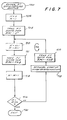
- One exemplary embodiment for the altered FT data capturing routine can be entered at box 700 in FIGURE 7. Thereafter, counters M and N are initialized at 702 before Fourier transformed data is taken at 704 for 0 phase encoding. Thereafter, a loop 706 is entered where counters N and M are incremented at 708 and Fourier transform image data is then taken for positive phase encoding of one increment at block 710. Thereafter, counter M is incremented at 712.
- a test for a maximum number of M data sets is made at 716 and, unless the maximum number of desired data sets has yet been reached, another set of Fourier transform image data is taken at 717 for a negative one increment of phase encoding.
- positive N increments and negative N increments of phase encoding will be effected at blocks 710 and 717 respectively.
- Control is returned to the top of loop 706 at box 708.
- image reconstruction and display can actually be started after only a few Fourier transform data set views are at hand thus providing an early recognizable "live" image depiction for the operator.
- the loop 706 will be completed at box 716 and an exit from the routine of FIGURE 7 will be taken normally at 720.
- a phantom object of 64 x 64 pixels has been computer generated with an identical second phantom object displaced along the X and/or Y axis.
- both PR and FT data sets can be simulated and the displaced phantom object may be used to simulate motion apparently occurring at any desired point in time during the imaging procedure.
- a complete data set may thus be constructed so as to consist of projection data obtained both before and after the motion has occurred. In this manner, one may simulate the effect of changing the data acquisition order.
- FIGURES 8 and 9 are photographs which compare reconstructed images obtained using conventional sequential sets of projections as compared to images obtained from simulated data reordered in accordance with this invention. As shown in the figures, comparisons are made for simulated motions occurring at different times during a data gathering procedure. The reordered data acquisitions clearly produce decreased motion artifact effects in the visual images.
- FIGURE 8 a simulated phantom has moved in the vertical direction during an NMR FT data gathering procedure after only approximately 10% of the procedure has been completed (in a 64 second procedure, the motion is thus at the sixth second point), and then continues to move regularly thereafterwards.
- the bottom row of images shown in FIGURE 8 represents-the images obtained from a reordered sequence where a zero phase encoding projection is first obtained.
- Each vertical column shows a somewhat different simulated movement sequence, but all show decreased artifacts in the bottom row of images.
- FIGURE 9 is essentially the same as FIGURE 8 except that the object has been displaced in X and Y coordinates by a relatively larger amount (e.g. 5 pixels each). In both cases, the simulated motion does to some extent blur the object, but in the bottom.row (representing images obtained using reordered data acquisition sequences in accordance with this invention) such motion artifacts are less evident.
- FIGURE 10 depicts the NMR image that is obtained by reconstructing different numbers (e.g. 4 to 64) of sequential NMR/FT data sets (i.e. using a conventional FT data acquisition sequence). Note that approximately 32 projections are necessary before any reasonable likeness of the image is apparent.
- FIGURE 11 similarly shows a series of reconstructed NMR images of the phantom obtained using different numbers (e.g. 4 to 64) of FTNMR data sets but with data sets that have been obtained in a reordered data acquisition sequence in accordance with this invention. It should be noted that the basic outline of the phantom is recognizable after only four data sets have been acquired and that as few as sixteen data sets produce a somewhat blurry but nevertheless recognizable likeness of an object therewithin.
- the reordered data acquisition sequence of this invention will permit more timely reconstructed recognizable NMR images to be made available to the operator of such an apparatus thus permitting-much more effective monitoring and control of the NMR data acquisition procedure.
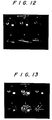
- FIGURES 12 and 13 are similar to FIGURES 10 and 11 respectively but illustrate the use of projection reconstruction NMR imaging procedures. As will be observed, the same improved timeliness is apparent using a reordered data gathering sequence as in FIGURE 13 as compared to the more conventional sequential data acquisition procedures used in FIGURE 12.
Landscapes
- Physics & Mathematics (AREA)
- High Energy & Nuclear Physics (AREA)
- Condensed Matter Physics & Semiconductors (AREA)
- General Physics & Mathematics (AREA)
- Health & Medical Sciences (AREA)
- General Health & Medical Sciences (AREA)
- Nuclear Medicine, Radiotherapy & Molecular Imaging (AREA)
- Radiology & Medical Imaging (AREA)
- Engineering & Computer Science (AREA)
- Signal Processing (AREA)
- Magnetic Resonance Imaging Apparatus (AREA)
- Apparatus For Radiation Diagnosis (AREA)
Priority Applications (1)
| Application Number | Priority Date | Filing Date | Title |
|---|---|---|---|
| AT86112618T ATE67863T1 (de) | 1985-09-30 | 1986-09-12 | Apparat und verfahren zur anfaenglichen erfassung der niedrigeren, meist bedeutsamen, raeumlichen frequenzdaten bei der bilderzeugung mittels magnetischer kernresonanz. |
Applications Claiming Priority (2)
| Application Number | Priority Date | Filing Date | Title |
|---|---|---|---|
| US781735 | 1985-09-30 | ||
| US06/781,735 US4721912A (en) | 1985-09-30 | 1985-09-30 | Apparatus and method for initially capturing most significant low spatial frequency NMR imaging data |
Publications (3)
| Publication Number | Publication Date |
|---|---|
| EP0217196A2 true EP0217196A2 (de) | 1987-04-08 |
| EP0217196A3 EP0217196A3 (en) | 1989-01-18 |
| EP0217196B1 EP0217196B1 (de) | 1991-09-25 |
Family
ID=25123742
Family Applications (1)
| Application Number | Title | Priority Date | Filing Date |
|---|---|---|---|
| EP86112618A Expired EP0217196B1 (de) | 1985-09-30 | 1986-09-12 | Apparat und Verfahren zur anfänglichen Erfassung der niedrigeren, meist bedeutsamen, räumlichen Frequenzdaten bei der Bilderzeugung mittels magnetischer Kernresonanz |
Country Status (5)
| Country | Link |
|---|---|
| US (1) | US4721912A (de) |
| EP (1) | EP0217196B1 (de) |
| JP (1) | JPS62129040A (de) |
| AT (1) | ATE67863T1 (de) |
| DE (1) | DE3681673D1 (de) |
Cited By (3)
| Publication number | Priority date | Publication date | Assignee | Title |
|---|---|---|---|---|
| FR2616936A1 (fr) * | 1987-06-19 | 1988-12-23 | Thomson Cgr | Procede de prise en compte, dans une image, des mouvements d'un objet |
| EP0265955A3 (en) * | 1986-10-29 | 1989-01-18 | Hitachi Medical Corporation | Nuclear magnetic resonance imaging method and apparatus nuclear magnetic resonance imaging method and apparatus for realizing same for realizing same |
| EP0453102A3 (en) * | 1990-04-19 | 1992-08-26 | Picker International, Inc. | Magnetic resonance imaging methods and apparatus |
Families Citing this family (12)
| Publication number | Priority date | Publication date | Assignee | Title |
|---|---|---|---|---|
| DE3701849A1 (de) * | 1987-01-23 | 1988-08-04 | Philips Patentverwaltung | Verfahren und vorrichtung fuer die kernspintomographie |
| US4800494A (en) * | 1987-03-23 | 1989-01-24 | Varian Associates, Inc. | Method and apparatus for execution of multislice imaging experiments |
| US4830012A (en) * | 1987-08-14 | 1989-05-16 | Duke University | High speed NMR imaging method and apparatus |
| JP2960419B2 (ja) * | 1988-08-10 | 1999-10-06 | 株式会社日立製作所 | 磁気共鳴イメージング方法 |
| GB9025344D0 (en) * | 1990-11-21 | 1991-01-02 | Marconi Gec Ltd | Nuclear magnetic resonance methods and apparatus |
| DE4142726C2 (de) * | 1991-12-21 | 1993-10-07 | Bruker Medizintech | Verfahren zur Beobachtung von zeitlichen Veränderungen der Signalintensitäten eines Kernspintomographie-Bildes |
| IL100530A (en) * | 1991-12-26 | 1996-05-14 | Elscint Ltd | Evolving image |
| JPH0661734U (ja) * | 1991-12-27 | 1994-08-30 | 達明 大西 | ガス缶 |
| US6025714A (en) * | 1997-04-25 | 2000-02-15 | Toshiba America Mri, Inc. | Magnetic resonance imaging (MRI) using fast spin echo (FSE) imaging process |
| WO2005093451A1 (en) * | 2004-03-26 | 2005-10-06 | Koninklijke Philips Electronics N.V. | Non-expert control of an mr system |
| US8655348B2 (en) * | 2011-02-18 | 2014-02-18 | Pctel, Inc. | System and method for acquiring network data |
| DE102014220328B3 (de) * | 2014-10-07 | 2015-08-27 | Sirona Dental Systems Gmbh | Erstellung einer MRT-Aufnahme |
Family Cites Families (13)
| Publication number | Priority date | Publication date | Assignee | Title |
|---|---|---|---|---|
| US4297637A (en) * | 1978-07-20 | 1981-10-27 | The Regents Of The University Of California | Method and apparatus for mapping lines of nuclear density within an object using nuclear magnetic resonance |
| US4318043A (en) * | 1978-07-20 | 1982-03-02 | The Regents Of The University Of California | Method and apparatus for rapid NMR imaging of nuclear densities within an object |
| US4471305A (en) * | 1978-07-20 | 1984-09-11 | The Regents Of The University Of Calif. | Method and apparatus for rapid NMR imaging of nuclear parameters with an object |
| JPS5838539A (ja) * | 1981-08-31 | 1983-03-07 | 株式会社東芝 | 診断用核磁気共鳴装置 |
| JPS59177028A (ja) * | 1983-03-29 | 1984-10-06 | 株式会社島津製作所 | Nmr断層像撮影方法 |
| US4549140A (en) * | 1983-06-03 | 1985-10-22 | General Electric Company | Method utilizing combined, interleaved pulse sequences for reducing motion artifacts in computed T1,T2 and M0 NMR imaging |
| US4581581A (en) * | 1983-06-30 | 1986-04-08 | General Electric Company | Method of projection reconstruction imaging with reduced sensitivity to motion-related artifacts |
| GB8320653D0 (en) * | 1983-08-01 | 1983-09-01 | Eastwood L M | Producing images by nmr techniques |
| JPS6099240A (ja) * | 1983-11-04 | 1985-06-03 | 横河メディカルシステム株式会社 | 計算機トモグラフイ装置 |
| US4614195A (en) * | 1984-12-18 | 1986-09-30 | General Electric Company | Method for reduction of motion artifacts in Fourier transform NMR imaging techniques |
| US4684891A (en) * | 1985-07-31 | 1987-08-04 | The Regents Of The University Of California | Rapid magnetic resonance imaging using multiple phase encoded spin echoes in each of plural measurement cycles |
| US4663591A (en) * | 1985-08-16 | 1987-05-05 | General Electric Company | Method for reducing image artifacts due to periodic signal variations in NMR imaging |
| US4706026A (en) * | 1985-08-16 | 1987-11-10 | General Electric Company | Method for reducing image artifacts due to periodic signal variations in NMR imaging |
-
1985
- 1985-09-30 US US06/781,735 patent/US4721912A/en not_active Expired - Lifetime
-
1986
- 1986-09-12 DE DE8686112618T patent/DE3681673D1/de not_active Expired - Lifetime
- 1986-09-12 AT AT86112618T patent/ATE67863T1/de not_active IP Right Cessation
- 1986-09-12 EP EP86112618A patent/EP0217196B1/de not_active Expired
- 1986-09-30 JP JP61230208A patent/JPS62129040A/ja active Granted
Cited By (4)
| Publication number | Priority date | Publication date | Assignee | Title |
|---|---|---|---|---|
| EP0265955A3 (en) * | 1986-10-29 | 1989-01-18 | Hitachi Medical Corporation | Nuclear magnetic resonance imaging method and apparatus nuclear magnetic resonance imaging method and apparatus for realizing same for realizing same |
| FR2616936A1 (fr) * | 1987-06-19 | 1988-12-23 | Thomson Cgr | Procede de prise en compte, dans une image, des mouvements d'un objet |
| EP0297935A1 (de) * | 1987-06-19 | 1989-01-04 | General Electric Cgr S.A. | Verfahren zur Berücksichtigung von Objektbewegung in einem Bild |
| EP0453102A3 (en) * | 1990-04-19 | 1992-08-26 | Picker International, Inc. | Magnetic resonance imaging methods and apparatus |
Also Published As
| Publication number | Publication date |
|---|---|
| US4721912A (en) | 1988-01-26 |
| ATE67863T1 (de) | 1991-10-15 |
| JPS62129040A (ja) | 1987-06-11 |
| DE3681673D1 (de) | 1991-10-31 |
| EP0217196B1 (de) | 1991-09-25 |
| EP0217196A3 (en) | 1989-01-18 |
| JPH0457339B2 (de) | 1992-09-11 |
Similar Documents
| Publication | Publication Date | Title |
|---|---|---|
| US4599565A (en) | Method and apparatus for rapid NMR imaging using multi-dimensional reconstruction techniques | |
| US4721912A (en) | Apparatus and method for initially capturing most significant low spatial frequency NMR imaging data | |
| US4710717A (en) | Method for fast scan cine NMR imaging | |
| US4830012A (en) | High speed NMR imaging method and apparatus | |
| US4614195A (en) | Method for reduction of motion artifacts in Fourier transform NMR imaging techniques | |
| US4901019A (en) | Three-dimensional imaging | |
| US9018951B2 (en) | Accelerated multispectral data magnetic resonance imaging system and method | |
| EP0490528A1 (de) | Korrektur der magnetischen Kernresonanz-Messwerte ermittelt durch Echoplanar-Technik | |
| EP3100067B1 (de) | Simultane mehrschicht-mrt mit zufälliger gradientenkodierung | |
| JP5854575B2 (ja) | 磁気共鳴イメージング装置 | |
| EP0212526A2 (de) | Verfahren zur Verminderung von Bildartefakten infolge von periodischen Signalschwankungen in der KMR-Bildgebung | |
| JP2003135429A (ja) | z方向の周波数エンコードを伴うテーブル移動式MRI | |
| US5923789A (en) | Band limited interpolation and projection of spatial 3-D images | |
| US5912557A (en) | Centric phase encoding order for 3D NMR data acquisition | |
| US5754046A (en) | Method for the acquisition and evaluation of data in a nuclear magnetic resonance tomography apparatus via updating K-space data in a constant subregion thereof | |
| EP1148343B1 (de) | Selbstkorrektur von Bewegungsartefakten in MR-Projektionsbildern | |
| US6404196B1 (en) | Method for correction of MRI motion artifacts and main field fluctuation | |
| US11131733B2 (en) | System and method for magnetic resonance fingerprinting with non-locally sequential sampling of k-space | |
| US4994743A (en) | Method for monitoring respiration with acquired NMR data | |
| JPH07265281A (ja) | Mrイメージング装置 | |
| US9366740B2 (en) | System and method for vastly undersampled isotropic projection reconstruction with inversion recovery | |
| US20180100908A1 (en) | Systems and methods for slice dithered enhanced resolution simultaneous multislice magnetic resonance imaging | |
| US20230061571A1 (en) | Continuous Three-Dimensional Imaging for Magnetic Resonance Elastography | |
| US4966149A (en) | Reducing the effects of coherence in magnetic resonance imaging | |
| JPH01218436A (ja) | Mrダイナミツクイメージング方法 |
Legal Events
| Date | Code | Title | Description |
|---|---|---|---|
| PUAI | Public reference made under article 153(3) epc to a published international application that has entered the european phase |
Free format text: ORIGINAL CODE: 0009012 |
|
| AK | Designated contracting states |
Kind code of ref document: A2 Designated state(s): AT BE CH DE FR GB IT LI LU NL SE |
|
| PUAL | Search report despatched |
Free format text: ORIGINAL CODE: 0009013 |
|
| AK | Designated contracting states |
Kind code of ref document: A3 Designated state(s): AT BE CH DE FR GB IT LI LU NL SE |
|
| 17P | Request for examination filed |
Effective date: 19890228 |
|
| 17Q | First examination report despatched |
Effective date: 19900723 |
|
| GRAA | (expected) grant |
Free format text: ORIGINAL CODE: 0009210 |
|
| AK | Designated contracting states |
Kind code of ref document: B1 Designated state(s): AT BE CH DE FR GB IT LI LU NL SE |
|
| PG25 | Lapsed in a contracting state [announced via postgrant information from national office to epo] |
Ref country code: LI Effective date: 19910925 Ref country code: AT Effective date: 19910925 Ref country code: CH Effective date: 19910925 Ref country code: NL Effective date: 19910925 Ref country code: SE Effective date: 19910925 Ref country code: BE Effective date: 19910925 Ref country code: IT Free format text: LAPSE BECAUSE OF FAILURE TO SUBMIT A TRANSLATION OF THE DESCRIPTION OR TO PAY THE FEE WITHIN THE PRE;WARNING: LAPSES OF ITALIAN PATENTS WITH EFFECTIVE DATE BEFORE 2007 MAY HAVE OCCURRED AT ANY TIME BEFORE 2007. THE CORRECT EFFECTIVE DATE MAY BE DIFFERENT FROM THE ONE RECORDED.SCRIBED TIME-LIMIT Effective date: 19910925 |
|
| REF | Corresponds to: |
Ref document number: 67863 Country of ref document: AT Date of ref document: 19911015 Kind code of ref document: T |
|
| REF | Corresponds to: |
Ref document number: 3681673 Country of ref document: DE Date of ref document: 19911031 |
|
| ET | Fr: translation filed | ||
| REG | Reference to a national code |
Ref country code: CH Ref legal event code: PL |
|
| NLV1 | Nl: lapsed or annulled due to failure to fulfill the requirements of art. 29p and 29m of the patents act | ||
| PLBE | No opposition filed within time limit |
Free format text: ORIGINAL CODE: 0009261 |
|
| STAA | Information on the status of an ep patent application or granted ep patent |
Free format text: STATUS: NO OPPOSITION FILED WITHIN TIME LIMIT |
|
| 26N | No opposition filed | ||
| PG25 | Lapsed in a contracting state [announced via postgrant information from national office to epo] |
Ref country code: LU Free format text: LAPSE BECAUSE OF NON-PAYMENT OF DUE FEES Effective date: 19920930 |
|
| REG | Reference to a national code |
Ref country code: GB Ref legal event code: IF02 |
|
| PGFP | Annual fee paid to national office [announced via postgrant information from national office to epo] |
Ref country code: GB Payment date: 20050908 Year of fee payment: 20 |
|
| PGFP | Annual fee paid to national office [announced via postgrant information from national office to epo] |
Ref country code: FR Payment date: 20050919 Year of fee payment: 20 |
|
| PGFP | Annual fee paid to national office [announced via postgrant information from national office to epo] |
Ref country code: DE Payment date: 20051031 Year of fee payment: 20 |
|
| PG25 | Lapsed in a contracting state [announced via postgrant information from national office to epo] |
Ref country code: GB Free format text: LAPSE BECAUSE OF EXPIRATION OF PROTECTION Effective date: 20060911 |
|
| REG | Reference to a national code |
Ref country code: GB Ref legal event code: PE20 |