EP0218085A1 - 3-Halogen-acetonsulfonamide und Verfahren zu deren Herstellung sowie ihre Verwendung - Google Patents
3-Halogen-acetonsulfonamide und Verfahren zu deren Herstellung sowie ihre Verwendung Download PDFInfo
- Publication number
- EP0218085A1 EP0218085A1 EP86111971A EP86111971A EP0218085A1 EP 0218085 A1 EP0218085 A1 EP 0218085A1 EP 86111971 A EP86111971 A EP 86111971A EP 86111971 A EP86111971 A EP 86111971A EP 0218085 A1 EP0218085 A1 EP 0218085A1
- Authority
- EP
- European Patent Office
- Prior art keywords
- sulfonamide
- bromine
- preparation
- acetone
- formula
- Prior art date
- Legal status (The legal status is an assumption and is not a legal conclusion. Google has not performed a legal analysis and makes no representation as to the accuracy of the status listed.)
- Withdrawn
Links
- 238000002360 preparation method Methods 0.000 title claims abstract description 7
- 238000000034 method Methods 0.000 title claims description 5
- 150000001408 amides Chemical class 0.000 title 1
- 229910052794 bromium Inorganic materials 0.000 claims abstract description 16
- GDTBXPJZTBHREO-UHFFFAOYSA-N bromine Substances BrBr GDTBXPJZTBHREO-UHFFFAOYSA-N 0.000 claims abstract description 14
- -1 bromine compound Chemical class 0.000 claims abstract description 13
- WKBOTKDWSSQWDR-UHFFFAOYSA-N Bromine atom Chemical compound [Br] WKBOTKDWSSQWDR-UHFFFAOYSA-N 0.000 claims abstract description 9
- 150000001875 compounds Chemical class 0.000 claims abstract description 9
- 229910052801 chlorine Inorganic materials 0.000 claims abstract description 8
- 239000000460 chlorine Substances 0.000 claims abstract description 8
- 229910052731 fluorine Inorganic materials 0.000 claims abstract description 8
- GTOXRTMBLGPMLH-UHFFFAOYSA-N 2-oxopropane-1-sulfonamide Chemical compound CC(=O)CS(N)(=O)=O GTOXRTMBLGPMLH-UHFFFAOYSA-N 0.000 claims abstract description 6
- 239000000987 azo dye Substances 0.000 claims abstract description 5
- 238000004519 manufacturing process Methods 0.000 claims abstract description 5
- ZAMOUSCENKQFHK-UHFFFAOYSA-N Chlorine atom Chemical compound [Cl] ZAMOUSCENKQFHK-UHFFFAOYSA-N 0.000 claims abstract description 4
- 239000000010 aprotic solvent Substances 0.000 claims abstract description 4
- 239000007864 aqueous solution Substances 0.000 claims abstract description 4
- 239000003814 drug Substances 0.000 claims abstract description 4
- 239000011737 fluorine Substances 0.000 claims abstract description 4
- 239000011814 protection agent Substances 0.000 claims abstract description 4
- 239000004753 textile Substances 0.000 claims abstract description 4
- VEXZGXHMUGYJMC-UHFFFAOYSA-M Chloride anion Chemical compound [Cl-] VEXZGXHMUGYJMC-UHFFFAOYSA-M 0.000 claims abstract description 3
- KRHYYFGTRYWZRS-UHFFFAOYSA-M Fluoride anion Chemical compound [F-] KRHYYFGTRYWZRS-UHFFFAOYSA-M 0.000 claims abstract description 3
- XMBWDFGMSWQBCA-UHFFFAOYSA-N hydrogen iodide Chemical compound I XMBWDFGMSWQBCA-UHFFFAOYSA-N 0.000 claims abstract description 3
- 229940124530 sulfonamide Drugs 0.000 claims description 12
- 239000000049 pigment Substances 0.000 claims description 6
- VQFAIAKCILWQPZ-UHFFFAOYSA-N bromoacetone Chemical compound CC(=O)CBr VQFAIAKCILWQPZ-UHFFFAOYSA-N 0.000 claims description 4
- ZCYVEMRRCGMTRW-UHFFFAOYSA-N 7553-56-2 Chemical group [I] ZCYVEMRRCGMTRW-UHFFFAOYSA-N 0.000 claims 1
- 125000001153 fluoro group Chemical group F* 0.000 claims 1
- 229910052740 iodine Chemical group 0.000 claims 1
- 239000011630 iodine Chemical group 0.000 claims 1
- PXGOKWXKJXAPGV-UHFFFAOYSA-N Fluorine Chemical compound FF PXGOKWXKJXAPGV-UHFFFAOYSA-N 0.000 abstract description 3
- 150000002497 iodine compounds Chemical class 0.000 abstract description 3
- 229910006074 SO2NH2 Inorganic materials 0.000 abstract 1
- CSCPPACGZOOCGX-UHFFFAOYSA-N Acetone Chemical compound CC(C)=O CSCPPACGZOOCGX-UHFFFAOYSA-N 0.000 description 10
- XLYOFNOQVPJJNP-UHFFFAOYSA-N water Substances O XLYOFNOQVPJJNP-UHFFFAOYSA-N 0.000 description 6
- 238000002844 melting Methods 0.000 description 5
- 230000008018 melting Effects 0.000 description 5
- 239000000203 mixture Substances 0.000 description 4
- LPXPTNMVRIOKMN-UHFFFAOYSA-M sodium nitrite Chemical compound [Na+].[O-]N=O LPXPTNMVRIOKMN-UHFFFAOYSA-M 0.000 description 4
- ZMXDDKWLCZADIW-UHFFFAOYSA-N N,N-Dimethylformamide Chemical compound CN(C)C=O ZMXDDKWLCZADIW-UHFFFAOYSA-N 0.000 description 3
- 238000000655 nuclear magnetic resonance spectrum Methods 0.000 description 3
- 230000000269 nucleophilic effect Effects 0.000 description 3
- NLKNQRATVPKPDG-UHFFFAOYSA-M potassium iodide Chemical compound [K+].[I-] NLKNQRATVPKPDG-UHFFFAOYSA-M 0.000 description 3
- BDERNNFJNOPAEC-UHFFFAOYSA-N propan-1-ol Chemical compound CCCO BDERNNFJNOPAEC-UHFFFAOYSA-N 0.000 description 3
- 239000000243 solution Substances 0.000 description 3
- ICSNLGPSRYBMBD-UHFFFAOYSA-N 2-aminopyridine Chemical compound NC1=CC=CC=N1 ICSNLGPSRYBMBD-UHFFFAOYSA-N 0.000 description 2
- IAZDPXIOMUYVGZ-UHFFFAOYSA-N Dimethylsulphoxide Chemical compound CS(C)=O IAZDPXIOMUYVGZ-UHFFFAOYSA-N 0.000 description 2
- LFQSCWFLJHTTHZ-UHFFFAOYSA-N Ethanol Chemical compound CCO LFQSCWFLJHTTHZ-UHFFFAOYSA-N 0.000 description 2
- VEXZGXHMUGYJMC-UHFFFAOYSA-N Hydrochloric acid Chemical compound Cl VEXZGXHMUGYJMC-UHFFFAOYSA-N 0.000 description 2
- XEEYBQQBJWHFJM-UHFFFAOYSA-N Iron Chemical compound [Fe] XEEYBQQBJWHFJM-UHFFFAOYSA-N 0.000 description 2
- KFZMGEQAYNKOFK-UHFFFAOYSA-N Isopropanol Chemical compound CC(C)O KFZMGEQAYNKOFK-UHFFFAOYSA-N 0.000 description 2
- WCUXLLCKKVVCTQ-UHFFFAOYSA-M Potassium chloride Chemical compound [Cl-].[K+] WCUXLLCKKVVCTQ-UHFFFAOYSA-M 0.000 description 2
- 229910052784 alkaline earth metal Inorganic materials 0.000 description 2
- 229910052782 aluminium Inorganic materials 0.000 description 2
- XAGFODPZIPBFFR-UHFFFAOYSA-N aluminium Chemical compound [Al] XAGFODPZIPBFFR-UHFFFAOYSA-N 0.000 description 2
- 238000006243 chemical reaction Methods 0.000 description 2
- 150000001805 chlorine compounds Chemical class 0.000 description 2
- 239000000975 dye Substances 0.000 description 2
- 238000000921 elemental analysis Methods 0.000 description 2
- 150000002222 fluorine compounds Chemical class 0.000 description 2
- 125000005843 halogen group Chemical group 0.000 description 2
- 239000000543 intermediate Substances 0.000 description 2
- 150000004694 iodide salts Chemical class 0.000 description 2
- 239000012452 mother liquor Substances 0.000 description 2
- 235000010288 sodium nitrite Nutrition 0.000 description 2
- 125000000565 sulfonamide group Chemical group 0.000 description 2
- TYMLOMAKGOJONV-UHFFFAOYSA-N 4-nitroaniline Chemical compound NC1=CC=C([N+]([O-])=O)C=C1 TYMLOMAKGOJONV-UHFFFAOYSA-N 0.000 description 1
- OYPRJOBELJOOCE-UHFFFAOYSA-N Calcium Chemical compound [Ca] OYPRJOBELJOOCE-UHFFFAOYSA-N 0.000 description 1
- OKTJSMMVPCPJKN-UHFFFAOYSA-N Carbon Chemical group [C] OKTJSMMVPCPJKN-UHFFFAOYSA-N 0.000 description 1
- SECXISVLQFMRJM-UHFFFAOYSA-N N-Methylpyrrolidone Chemical compound CN1CCCC1=O SECXISVLQFMRJM-UHFFFAOYSA-N 0.000 description 1
- HCHKCACWOHOZIP-UHFFFAOYSA-N Zinc Chemical compound [Zn] HCHKCACWOHOZIP-UHFFFAOYSA-N 0.000 description 1
- GCPWJFKTWGFEHH-UHFFFAOYSA-N acetoacetamide Chemical class CC(=O)CC(N)=O GCPWJFKTWGFEHH-UHFFFAOYSA-N 0.000 description 1
- 230000002378 acidificating effect Effects 0.000 description 1
- 239000003513 alkali Substances 0.000 description 1
- 150000001342 alkaline earth metals Chemical class 0.000 description 1
- 229910052788 barium Inorganic materials 0.000 description 1
- DSAJWYNOEDNPEQ-UHFFFAOYSA-N barium atom Chemical compound [Ba] DSAJWYNOEDNPEQ-UHFFFAOYSA-N 0.000 description 1
- 230000015572 biosynthetic process Effects 0.000 description 1
- 229910052791 calcium Inorganic materials 0.000 description 1
- 239000011575 calcium Substances 0.000 description 1
- 238000001816 cooling Methods 0.000 description 1
- 230000008878 coupling Effects 0.000 description 1
- 238000010168 coupling process Methods 0.000 description 1
- 238000005859 coupling reaction Methods 0.000 description 1
- 238000004042 decolorization Methods 0.000 description 1
- 239000012954 diazonium Substances 0.000 description 1
- 150000001989 diazonium salts Chemical class 0.000 description 1
- 239000006185 dispersion Substances 0.000 description 1
- 150000004820 halides Chemical class 0.000 description 1
- 150000002366 halogen compounds Chemical class 0.000 description 1
- UTCSSFWDNNEEBH-UHFFFAOYSA-N imidazo[1,2-a]pyridine Chemical compound C1=CC=CC2=NC=CN21 UTCSSFWDNNEEBH-UHFFFAOYSA-N 0.000 description 1
- 229910052742 iron Inorganic materials 0.000 description 1
- LNOPIUAQISRISI-UHFFFAOYSA-N n'-hydroxy-2-propan-2-ylsulfonylethanimidamide Chemical compound CC(C)S(=O)(=O)CC(N)=NO LNOPIUAQISRISI-UHFFFAOYSA-N 0.000 description 1
- AJDUTMFFZHIJEM-UHFFFAOYSA-N n-(9,10-dioxoanthracen-1-yl)-4-[4-[[4-[4-[(9,10-dioxoanthracen-1-yl)carbamoyl]phenyl]phenyl]diazenyl]phenyl]benzamide Chemical compound O=C1C2=CC=CC=C2C(=O)C2=C1C=CC=C2NC(=O)C(C=C1)=CC=C1C(C=C1)=CC=C1N=NC(C=C1)=CC=C1C(C=C1)=CC=C1C(=O)NC1=CC=CC2=C1C(=O)C1=CC=CC=C1C2=O AJDUTMFFZHIJEM-UHFFFAOYSA-N 0.000 description 1
- 239000012038 nucleophile Substances 0.000 description 1
- 230000000144 pharmacologic effect Effects 0.000 description 1
- 239000001103 potassium chloride Substances 0.000 description 1
- 235000011164 potassium chloride Nutrition 0.000 description 1
- 239000011541 reaction mixture Substances 0.000 description 1
- 230000035484 reaction time Effects 0.000 description 1
- 230000009257 reactivity Effects 0.000 description 1
- 150000003839 salts Chemical class 0.000 description 1
- 239000002904 solvent Substances 0.000 description 1
- 239000007858 starting material Substances 0.000 description 1
- 238000003756 stirring Methods 0.000 description 1
- 239000000126 substance Substances 0.000 description 1
- 150000003456 sulfonamides Chemical class 0.000 description 1
- 238000003786 synthesis reaction Methods 0.000 description 1
- 239000001043 yellow dye Substances 0.000 description 1
- 229910052725 zinc Inorganic materials 0.000 description 1
- 239000011701 zinc Substances 0.000 description 1
Classifications
-
- C—CHEMISTRY; METALLURGY
- C07—ORGANIC CHEMISTRY
- C07C—ACYCLIC OR CARBOCYCLIC COMPOUNDS
- C07C311/00—Amides of sulfonic acids, i.e. compounds having singly-bound oxygen atoms of sulfo groups replaced by nitrogen atoms, not being part of nitro or nitroso groups
- C07C311/01—Sulfonamides having sulfur atoms of sulfonamide groups bound to acyclic carbon atoms
- C07C311/02—Sulfonamides having sulfur atoms of sulfonamide groups bound to acyclic carbon atoms of an acyclic saturated carbon skeleton
- C07C311/03—Sulfonamides having sulfur atoms of sulfonamide groups bound to acyclic carbon atoms of an acyclic saturated carbon skeleton having the nitrogen atoms of the sulfonamide groups bound to hydrogen atoms or to acyclic carbon atoms
Definitions
- the present invention relates to new 3-haloacetonesulfonamides of the general formula I where X stands for F, Cl, Br or J.
- the compounds according to the invention represent interesting intermediates e.g. for the production of azo dyes or pigments, crop protection agents, pharmaceuticals or textile auxiliaries.
- the bromine compound of the formula I is obtained in a very simple manner by brominating acetonsulfonamide in aqueous solution. Surprisingly, the bromine does not occur, as expected, on the activated carbon atom in the 2-position of the starting product, and there are also no N-bromine derivatives.
- the fluorine, chlorine or iodine compound of the formula I is prepared by nucleophilic exchange from the bromine compound in aprotic dipolar media.
- the production of 3-bromo-acetone sulfonamide according to the invention is generally carried out at temperatures from 0 ° to 100 ° C with molar amounts of bromine. However, a temperature in the range from 20 ° to 50 ° C. is preferably chosen.
- the reaction time depends on the temperature used and can be recognized by the complete decolorization of the reaction mixture.
- the acetone sulfonamide used as the starting material can be obtained according to DE-OS 3 323 510 or US Pat. No. 4,448,988.
- the nucleophilic exchange of the bromine in 3-bromoacetone sulfonamide to produce the three other halogenoacetone sulfonamides of the formula I is generally carried out at temperatures between 20 and 100 ° C. with fluorides, chlorides or iodides in aprotic solvents such as acetone, dimethylformamide, N-methyl-pyrrolidone or carried out dimethyl sulfoxide. Fluorides, chlorides or iodides of alkali or alkaline earth metals or of iron, aluminum or zinc are preferably used. In general, about 1 to 5 moles of halide are used per mole of 3-bromoacetone sulfonamide.
- halogen compounds according to the invention are new reactive substances which are suitable as intermediates for crop protection agents, pharmaceuticals or textile auxiliaries and are accessible to numerous other reactions.
- their reaction with 2-amino-N-heterocycles, such as 2-amino-pyridine provides access to bicycles substituted with sulfonamide groups, such as imidazo [1,2-a] pyridine.
- sulfonamide groups such as imidazo [1,2-a] pyridine.
- derivatives of such imidazo [1,2-ajpyridines have pharmacological effects (J.Med.Chem. (1969), 122-26; Eur.J.Med.-Chim. Therapeut. 13, 271-76 (1978)).
- the compounds of the formula I according to the invention also represent analogues of acetoacetic acid amides, they can be used - for example after nucleophilic exchange of the halogen atom - as coupling components for the production of azo dyes or pigments.
- the following test report shows the synthesis of such an azo pigment:
- this azo dye is that the activated halogen atom can be exchanged for nucleophiles and thus the properties of the dye can be changed as desired, and that the acidic sulfonamide group with salts, e.g. of barium, calcium or aluminum can be lacquered, whereby the solubility of the dyes is greatly reduced, which is very desirable for use as pigments.
- the fluorine, chlorine or iodine compound according to formula I can be converted into an azo pigment analogously to the bromine compound.
Landscapes
- Chemical & Material Sciences (AREA)
- Organic Chemistry (AREA)
- Organic Low-Molecular-Weight Compounds And Preparation Thereof (AREA)
- Treatments For Attaching Organic Compounds To Fibrous Goods (AREA)
- Nitrogen Condensed Heterocyclic Rings (AREA)
Abstract
Die Erfindung betrifft neue 3-Halogen-acetonsulfonamide der Formel X-CH2-CO-CH2-SO2NH2 mit X = F, Cl, Br oder J, sowie deren Herstellung und Verwendung. Die Herstellung der erfindungsgemäßen Bromverbindung erfolgt durch Umsetzung von Acetonsulfonamid mit Brom in wäßriger Lösung. Die Fluor-, Chlor- bzw. Jodverbindung wird durch Umsetzung der Bromverbindung mit einem Fluorid, Chlorid bzw. Jodid in einem aprotischen Lösungsmittel hergestellt. Die erfindungsgemäßen Verbindungen können bei der Herstellung von Azofarbstoffen, Pflanzenschutzmitteln, Pharmazeutika und Textilhilfsmitteln verwendet werden.
Description
- Ein Gegenstand der vorliegenden Erfindung sind neue 3-Halogen-acetonsulfonamide der allgemeinen Formel I


- Die erfindungsgemäßen Verbindungen stellen infolge ihrer Reaktivität interessante Zwischenprodukte z.B. zur Herstellung von Azofarbstoffen oder -pigmenten, Pflanzenschutzmitteln, Pharmazeutika oder Textilhilfsmitteln dar.
- Man erhält die Bromverbindung der Formel I, wie gesagt, auf sehr einfache Weise, indem man Acetonsulfonamid in wäßriger Lösung bromiert. Überraschenderweise tritt das Brom nicht, wie erwartet, an das aktivierte Kohlenstoffatom in 2-Stellung des Ausgangsprodukts und es entstehen auch keine N-Brom-Derivate.
- Die Fluor-, Chlor- bzw. Jodverbindung der Formel I stellt man durch nukleophilen Austausch aus der Bromverbindung in aprotischen dipolaren Medien her.
- Die erfindungsgemäße Herstellung von 3-Brom-acetonsulfonamid wird im allgemeinen bei Temperaturen von 0° bis 100°C mit molaren Mengen Brom durchgeführt. Vorzugsweise wählt man jedoch eine Temperatur im Bereich von 20° bis 50°C.
- Die Reaktionszeit richtet sich dabei nach der angewendeten Temperatur und ist an der vollständigen Entfärbung des Reaktionsansatzes zu erkennen.
- Das als Ausgangsmaterial eingesetzte Acetonsulfonamid kann nach DE-OS 3 323 510 oder US-PS 4 448 988 erhalten werden. Der nukleophile Austausch des Broms im 3-Bromacetonsulfonamid zur Herstellung der drei anderen Halogenacetonsulfonamide der Formel I wird im allgemeinen bei Temperaturen zwischen 20 und 100°C mit Fluoriden, Chloriden bzw. Jodiden in aprotischen Lösungsmitteln, wie Aceton, Dimethylformamid, N-Methyl-pyrrolidon oder Dimethylsulfoxid durchgeführt. Dabei setzt man vorzugsweise Fluoride, Chloride bzw. Jodide von Alkali- oder Erdalkalimetallen oder von Eisen, Aluminium oder Zink ein. Im allgemeinen verwendet man etwa 1 bis 5 Mol Halogenid pro Mol 3-Bromacetonsulfonamid.
- Die erfindungsgemäßen Halogenverbindungen sind neue reaktive Substanzen, die als Zwischenprodukte für Pflanzenschutzmittel, Pharmazeutika oder Textilhilfsmittel geeignet und zahlreichen weiteren Umsetzungen zugänglich sind. Zum Beispiel eröffnet ihre Reaktion mit 2-Amino-N-heterocyclen, wie beispielsweise 2-Amino-pyridin, einen Zugang zu mit Sulfonamidgruppen substituierten Bicyclen wie Imidazo[1,2-a]pyridin. Es ist bekannt, daß Derivate solcher Imidazo[1,2-ajpy- ridine pharmakologische Wirkungen besitzen (J.Med.Chem. (1969), 122-26; Eur.J.Med.-Chim. Therapeut. 13, 271-76 (1978)).
- Da die erfindungsgemäßen Verbindungen der Formel I aber auch Analoga der Acetessigsäureamide darstellen, können sie - beispielsweise nach nukleophilem Austausch des Halogenatoms - als Kupplungskomponenten zur Herstellung von Azofarbstoffen bzw. -pigmenten eingesetzt werden. Der folgende Versuchsbericht zeigt die Synthese eines solchen Azopigments:
- 6,9 g (50 mMol) 4-Nitranilin wurden in einer Mischung von 12 ml konz. Salzsäure und 12 ml Wasser gelöst und auf 0°C abgekühlt. Die Lösung wurde mit 14 ml (53.3 mMol) einer 20 gew.-%igen Natriumnitritlösung versetzt und 15 Minuten bei 0°C nachgerührt. Danach wurde das überschüssige Natriumnitrit mit Amidosulfonsäure zerstört. Die Diazoniumsalzlösung wurde bei 5°C in eine Dispersion von 11.6 g (50 mMol) Bromacetonsulfonamid in 50 ml Wasser getropft und dabei wurde der pH-Wert unter 6 gehalten. Nach 6 Stunden wurde das ausgefallene Produkt abgesaugt und getrocknet. Man erhielt 8 g eines gelben Farbstoffes der Formel

- Der Vorteil dieses Azofarbstoffs liegt darin, daß man das aktivierte Halogenatom gegen Nukleophile austauschen und somit die Eigenschaften des Farbstoffs in gewünschter Weise verändern kann, und daß die saure Sulfonamidgruppe mit Salzen, z.B. des Bariums, Calciums oder Aluminiums verlackt werden kann, wodurch die Löslichkeit der Farbstoffe stark herabgesetzt wird, was für den Einsatz als Pigmente sehr erwünscht ist.
- Die Fluor-, Chlor- bzw. Jodverbindung gemäß Formel I kann analog zur Bromverbindung zu einem Azopigment umgesetzt werden.
- Die nachfolgenden Beispiele erläutern die Herstellung der erfindungsgemäßen Verbindungen:
- 137,2 g (1 Mol) Acetonsulfonamid wurden in 200 ml Wasser suspendiert und bei 20°C wurden unter Kühlung 160 g (1 Mol = 52 ml) Brom zugetropft (Zeitdauer ca. 30 Min.). Es wurde noch 1 Stunde bei Raumtemperatur nachgerührt. Das Lösungsmittel wurde am Rotationsverdampfer im Wasserstrahlvakuum abdestilliert. Der angefallene Rückstand wurde dann aus 1,5 1 i-Propanol umkristallisiert. Man erhielt 186 g (86 % d.Th.) 3-Bromacetonsulfonamid vom Schmelzpunkt 119 - 120°C. Elementaranalyse: C3H6BrN03S (Molekulargewicht 216.05) Berechnet: C: 16,7; H: 2,8; Br: 37,0; N: 6,5; S: 14,8 Gefunden: C: 17,0; H: 2,7; Br: 37,4; N: 6,5; S: 15,2 NMR-Spektrum: 100 MHz - 1HNMR (DMSO-d6) (ppm): 4,4 (2H,s,CH2), 4,5(2H,s,CH2), 7,2(2H,s,NH2).
- 137,2g(1 Mol) Acetonsulfonamid wurden mit 200 ml Wasser auf 40°C erhitzt und bei dieser Temperatur innerhalb von 2 Stunden mit 1 Mol Brom versetzt. Es wurde noch 0,5 Stunden nachgerührt und wie in Beispiel 1 aufgearbeitet. Ausbeute: 181,6 g (84 % d.Th.), Schmelzpunkt: 117-119°C.
- 43,2 g (0,2 Mol) 3-Bromacetonsulfonamid wurden in 300 ml Aceton gelöst und mit 33,2 g (0,2 Mol) Kaliumjodid versetzt. Nach 5-stündigem Rühren bei Raumtemperatur wurde abgesaugt und mit Aceton nachgewaschen. Die Mutterlauge wurde im Wasserstrahlvakuum eingedampft und der Rückstand aus 500 ml i-Propanol umkristallisiert. Man erhielt 45 g (85 % d.Th.) 3-Jodacetonsulfonamid vom Schmelzpunkt 125-127°C.
- Elementaranalyse: C3H6JN03S (Molekulargewicht 263.05) Berechnet: C: 13,7; H: 2,3; J: 48,2; N: 5,3; S: 12,2 Gefunden: C: 13,7; H: 2,2; J: 48,0; N: 5,6; S: 12,4 NMR-Spektrum: 100 MHz - 1HNMR (DMSO-d6) (ppm): 4,2(2H,s,CH2), 4,4(2H,s,CH2), 7,2(2H,s,NH2).
- 4,3 g (20 mMol) 3-Bromacetonsulfonamid wurden in 30 ml Aceton gelöst und mit 3 g (40 mMol) Kaliumchlorid versetzt. Es wurde 1,5 Stunden bei Raumtemperatur gerührt, filtriert und mit Aceton gewaschen. Die Mutterlauge wurde am Rotationsverdampfer eingedampft. Der Rückstand, aus 30 ml 1-Propanol umkristallisiert, ergab 3 g Produkt vom Schmelzpunkt 110-112°C. Es wurde nochmals aus 30 ml Ethanol umkristallisiert, wobei man 2,0 g 3-Chloracetonsulfonamid vom Schmelzpunkt 114-115°C erhielt.
- NMR-Spektrum: 100 MHz - 1HNMR (DMSO-d6) (ppm): 4,3(2H,s,CH2), 4,7(2H,s,CH2), 7,2(2H,s,NH2).
Claims (4)
1. Verbindungen der Formel
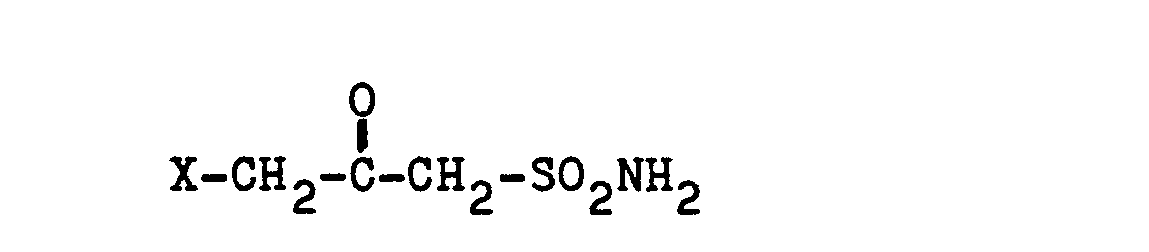
worin X = Fluor, Chlor, Brom oder Jod sein kann.
2. Verfahren zur Herstellung von 3-Bromacetonsulfonamid

dadurch gekennzeichnet, daß man Acetonsulfonamid in wäßriger Lösung mit Brom umsetzt.
3. Verfahren zur Herstellung von Verbindungen der Formel

mit X = F, Cl oder J, dadurch gekennzeichnet, daß man 3-Brom-acetonsulfonamid in einem aprotischen Lösungsmittel mit einem Fluorid, Chlorid oder Jodid umsetzt.
4. Verwendung von Verbindungen gemäß Anspruch 1 zur Herstellung von Azofarbstoffen oder -pigmenten, Pflanzenschutzmitteln, Pharmazeutika und Textilhilfsmitteln.
Applications Claiming Priority (2)
| Application Number | Priority Date | Filing Date | Title |
|---|---|---|---|
| DE3531788 | 1985-09-06 | ||
| DE19853531788 DE3531788A1 (de) | 1985-09-06 | 1985-09-06 | 3-halogen-acetonsulfonamide und verfahren zu deren herstellung sowie ihre verwendung |
Publications (1)
| Publication Number | Publication Date |
|---|---|
| EP0218085A1 true EP0218085A1 (de) | 1987-04-15 |
Family
ID=6280245
Family Applications (1)
| Application Number | Title | Priority Date | Filing Date |
|---|---|---|---|
| EP86111971A Withdrawn EP0218085A1 (de) | 1985-09-06 | 1986-08-29 | 3-Halogen-acetonsulfonamide und Verfahren zu deren Herstellung sowie ihre Verwendung |
Country Status (4)
| Country | Link |
|---|---|
| US (1) | US4691056A (de) |
| EP (1) | EP0218085A1 (de) |
| JP (1) | JPS6256462A (de) |
| DE (1) | DE3531788A1 (de) |
Cited By (1)
| Publication number | Priority date | Publication date | Assignee | Title |
|---|---|---|---|---|
| EP0252640A1 (de) * | 1986-06-30 | 1988-01-13 | Merck & Co. Inc. | Alkansulfonamide als Antiglaucoma-Mittel |
Families Citing this family (1)
| Publication number | Priority date | Publication date | Assignee | Title |
|---|---|---|---|---|
| US4812463A (en) * | 1986-06-30 | 1989-03-14 | Merck & Co., Inc. | Alkanesulfonamides as antiglaucoma agents |
Citations (1)
| Publication number | Priority date | Publication date | Assignee | Title |
|---|---|---|---|---|
| EP0063767A1 (de) * | 1981-04-23 | 1982-11-03 | Hoechst Aktiengesellschaft | 2-Ketosulfonamide und Verfahren zu ihrer Herstellung |
-
1985
- 1985-09-06 DE DE19853531788 patent/DE3531788A1/de not_active Withdrawn
-
1986
- 1986-08-29 EP EP86111971A patent/EP0218085A1/de not_active Withdrawn
- 1986-09-04 JP JP61206941A patent/JPS6256462A/ja active Pending
- 1986-09-04 US US06/904,049 patent/US4691056A/en not_active Expired - Fee Related
Patent Citations (1)
| Publication number | Priority date | Publication date | Assignee | Title |
|---|---|---|---|---|
| EP0063767A1 (de) * | 1981-04-23 | 1982-11-03 | Hoechst Aktiengesellschaft | 2-Ketosulfonamide und Verfahren zu ihrer Herstellung |
Non-Patent Citations (1)
| Title |
|---|
| CHEMICAL ABSTRACTS, Band 103, Nr. 21, 25. November 1985, Seite 680, Zusammenfassung no. 178236q, Columbus, Ohio, US; C. CARPANELLI et al.: "[4+2]-Cycloaddition reactions of N-sulfinylcarboxamides. III. Reactions of N-sulfinyl-p-toluamide with alkynes", & GAZZ. CHIM. ITAL. 1985, 115(5), 265-8 * |
Cited By (1)
| Publication number | Priority date | Publication date | Assignee | Title |
|---|---|---|---|---|
| EP0252640A1 (de) * | 1986-06-30 | 1988-01-13 | Merck & Co. Inc. | Alkansulfonamide als Antiglaucoma-Mittel |
Also Published As
| Publication number | Publication date |
|---|---|
| JPS6256462A (ja) | 1987-03-12 |
| DE3531788A1 (de) | 1987-03-12 |
| US4691056A (en) | 1987-09-01 |
Similar Documents
| Publication | Publication Date | Title |
|---|---|---|
| DE19532052C2 (de) | Verfahren zur Herstellung von Chinazolinderivaten | |
| EP0172515B1 (de) | Alpha-(o-chlorphenyl)-aminomethylen-beta-formylaminopropionitril, Verfahren zu seiner Herstellung sowie Verwendung zur Herstellung von 2-Methyl-4-amino-5-formylaminomethylpyrimidin | |
| DE2614240C3 (de) | Verfahren zur Herstellung von Acylcyaniden | |
| DE3531788A1 (de) | 3-halogen-acetonsulfonamide und verfahren zu deren herstellung sowie ihre verwendung | |
| DE4335497A1 (de) | Verfahren zur Herstellung unsymmetrisch substituierter Triazine | |
| EP0067352B2 (de) | Verfahren zur Herstellung von S-Aryl-thioglycolsäuren | |
| EP0057889A1 (de) | Verfahren zur Herstellung von 1-Alkyl-2-chlor-5-nitro-4-benzol-sulfonsäuren | |
| EP0031473B1 (de) | Verfahren zur Herstellung von 2-((Alkoxycarbonyl)-amino)-5-(alkylthio)-1H-benzimidazolen | |
| EP0134934B1 (de) | 2-Ketosulfonamide und Verfahren zu deren Herstellung | |
| EP0693466A1 (de) | Verfahren zur Herstellung von aromatischen fluorierten Verbindungen und neue Diamide | |
| EP0022959B1 (de) | Verfahren zur Herstellung von Diazoniumtetrafluoroboraten in verdünnter wässriger Lösung | |
| EP0694534A1 (de) | 3-Substituierte Chinolin-5-carbonsäurederivate und Verfahren zu ihrer Herstellung | |
| DE2433176C3 (de) | N-Cyano-cyano-acetimidate und Verfahren zur Herstellung von 2-Halopyrinüdinderivaten | |
| EP0590361A1 (de) | Verfahren zur Herstellung von 2-Amino-6-halogenpurinen | |
| EP0013007A1 (de) | Verfahren zur Herstellung von 4-Methyl-2-aminobenzthiazol | |
| EP0387531B1 (de) | Verfahren zur Herstellung von beta-Chloräthylsulfonyl-arylisocyanaten | |
| CH638499A5 (de) | Derivate von 5-alkylsulfonyl- und 5-alkenylsulfonylbarbitursaeuren. | |
| DE69203856T2 (de) | Verfahren zur Herstellung von 1,3A,8-Trimethyl-1,2,3,3A,8,8A-HEXAHYDROPYROLO(2,3-B)INDOL-5(3AS,8AR)-HEPTYLCARBAMAT. | |
| DE2614825A1 (de) | Verfahren zur herstellung von aminonitrophenolen | |
| CH620197A5 (de) | ||
| DE1915799C (de) | Verfahren zur Herstellung von 2,4,6 Tnhalogen 1,3,5 benzotrinitnlen | |
| EP0973745A1 (de) | Verfahren zur herstellung von 2,6-dichlor-5-fluornicotinonitril und die chemische verbindung 3-cyano-2-hydroxy-5-fluorpyrid-6-on-mononatriumsalz sowie dessen tautomere | |
| CH648833A5 (de) | Verfahren zur herstellung von 2-amino-4-hydroxy-5-halogen-pyrimidinen. | |
| DE3431009A1 (de) | Verfahren zur herstellung von 6-demethyl-6-desoxy-6-methylen-5-oxytetracyclin und dessen 11a-chlorderivat | |
| EP0153908A1 (de) | Verfahren zur Herstellung von Pyridin-2,3-dicarbonsäure |
Legal Events
| Date | Code | Title | Description |
|---|---|---|---|
| PUAI | Public reference made under article 153(3) epc to a published international application that has entered the european phase |
Free format text: ORIGINAL CODE: 0009012 |
|
| AK | Designated contracting states |
Kind code of ref document: A1 Designated state(s): BE CH DE FR GB IT LI NL |
|
| 17P | Request for examination filed |
Effective date: 19870716 |
|
| 17Q | First examination report despatched |
Effective date: 19880427 |
|
| STAA | Information on the status of an ep patent application or granted ep patent |
Free format text: STATUS: THE APPLICATION HAS BEEN WITHDRAWN |
|
| 18W | Application withdrawn |
Withdrawal date: 19880712 |
|
| RIN1 | Information on inventor provided before grant (corrected) |
Inventor name: GUENTHER, DIETER, DR. |