EP0218154B1 - Zusammensetzungen aus Tri-Nickel-Aluminid, die duktil sind bei Heissbrüchigkeitstemperaturen - Google Patents
Zusammensetzungen aus Tri-Nickel-Aluminid, die duktil sind bei Heissbrüchigkeitstemperaturen Download PDFInfo
- Publication number
- EP0218154B1 EP0218154B1 EP86113265A EP86113265A EP0218154B1 EP 0218154 B1 EP0218154 B1 EP 0218154B1 EP 86113265 A EP86113265 A EP 86113265A EP 86113265 A EP86113265 A EP 86113265A EP 0218154 B1 EP0218154 B1 EP 0218154B1
- Authority
- EP
- European Patent Office
- Prior art keywords
- alloy
- melt
- tri
- nickel aluminide
- aluminide
- Prior art date
- Legal status (The legal status is an assumption and is not a legal conclusion. Google has not performed a legal analysis and makes no representation as to the accuracy of the status listed.)
- Expired
Links
Images


Classifications
-
- C—CHEMISTRY; METALLURGY
- C22—METALLURGY; FERROUS OR NON-FERROUS ALLOYS; TREATMENT OF ALLOYS OR NON-FERROUS METALS
- C22C—ALLOYS
- C22C19/00—Alloys based on nickel or cobalt
- C22C19/03—Alloys based on nickel or cobalt based on nickel
-
- B—PERFORMING OPERATIONS; TRANSPORTING
- B22—CASTING; POWDER METALLURGY
- B22F—WORKING METALLIC POWDER; MANUFACTURE OF ARTICLES FROM METALLIC POWDER; MAKING METALLIC POWDER; APPARATUS OR DEVICES SPECIALLY ADAPTED FOR METALLIC POWDER
- B22F3/00—Manufacture of workpieces or articles from metallic powder characterised by the manner of compacting or sintering; Apparatus specially adapted therefor ; Presses and furnaces
- B22F3/12—Both compacting and sintering
- B22F3/16—Both compacting and sintering in successive or repeated steps
-
- C—CHEMISTRY; METALLURGY
- C22—METALLURGY; FERROUS OR NON-FERROUS ALLOYS; TREATMENT OF ALLOYS OR NON-FERROUS METALS
- C22C—ALLOYS
- C22C1/00—Making non-ferrous alloys
- C22C1/04—Making non-ferrous alloys by powder metallurgy
- C22C1/0433—Nickel- or cobalt-based alloys
Definitions
- the present invention relates generally to compositions having a nickel aluminide base and their processing to improve their properties. More specifically, it relates to tri-nickel aluminide base materials which may be processed into useful articles which have overcome a hot-short problem of such materials.
- the single crystal tri-nickel aluminide in certain orientations does display a favorable combination of properties at room temperature including significant ductility.
- the polycrystalline material which is conventionally formed by known processes does not display the desirable properties of the single crystal material and, although potentially useful as a high temperature structural material, has not found extensive use in this application because of the poor properties of the material at room temperature.
- nickel aluminide has good physical properties at temperatures of up to 1100°F (600°C) and could be employed, for example, in jet engines as component parts at operating or higher temperatures. However, if the material does not have favorable properties at lower temperature, including room temperature, the aluminide may break when subjected to stress at such lower temperatures at which the part would be maintained prior to starting the engine or prior to operating the engine at the higher temperatures above 1000°C.
- Alloys having a tri-nickel aluminide base are among the group of alloys known as heat-resisting alloys or superalloys. These alloys are intended for very high temperature service where relatively high stresses such as tensile, thermal, vibratory and shock are encountered and where oxidation resistance is frequently required.
- U.S-A-4,478,791 teaches a method by which a significant measure of ductility can be imparted to a tri-nickel aluminide base metal at room temperature to overcome the brittleness of this material.
- EP-A-85 110016.4; 85 110 021.4 and 85 110014.9 teach methods by which the composition and methods of U.S-A-4,478,791 may be further improved.
- These and similar inventions have essentially solved the basic problem of according, a tri-nickel aluminide a moderate degree of strength and ductility at lower temperatures such as room temperature.
- the subject application presents a further improvement in the nickel aluminide to which significant increased ductilization has been imparted and particularly improvements in the strength and ductility of tri-nickel aluminide base compositions in the temperature range above about 600°C where the hot-short condition has been found to occur.
- Ni3Al compositions also display low ductility or a hot-short in a temperature over 600°C and particularly from 600°C to 800°C.
- Another object is to provide an article suitable for withstanding significant degrees of stress and for providing appreciable ductility at room temperature as well as at elevated temperatures of up to about (1100°F) 600°C.
- Another object is to provide a consolidated material which can be formed into useful parts having the combination of properties of significant strength and ductility at room temperature and at elevated temperatures of up to about 1100°F (600°C).
- Another object is to provide a consolidated tri-nickel aluminide material which has a combination of strength and ductility which was heretofore unattainable in the hot-short temperature range.
- Another object is to provide parts consolidated from powder which have a set of properties useful in applications such as jet engines and which may be subjected to a variety of forms of stress in the hot-short temperature range.
- An object of the present invention may be achieved with the methods according to claims 1, 8, 10, 12 by providing a melt having a tri-nickel aluminide base and containing a relatively small percentage of boron and which contains cobalt.
- the melt is then atomized by inert gas atomization.
- the melt is rapidly solidified to powder during the atomization.
- the material may then be consolidated by hot isostatic pressing at a temperature of about 1150°C and at about 103.4 MPa (15 ksi) for about two hours.
- the isostatically pressed sample is cold rolled and annealed to impart a set of significantly improved properties to the sample.
- the molten metal stream being atomized may be intercepted as part of a plasma spray forming process to form a consolidated body.
- melt referred to above should ideally consist only of the atoms of the intermetallic phase and cobalt as well as atoms of boron, it is recognized that occasionally and inevitably other atoms of one or more incidental impurity atoms may be present in the melt.
- tri-nickel aluminide base composition refers to a tri-nickel aluminide which contains impurities which are conventionally found in nickel aluminide compositions.
- Nickel aluminide is found in the nickel-aluminum binary system and as the gamma prime phase of conventional gamma/gamma prime nickel-base superalloys. Nickel aluminide has high hardness and is stable and resistant to oxidation and corrosion at elevated temperatures which makes it attractive as a potential structural material.
- FCC face centered cubic
- tri-nickel aluminide is an intermetallic phase and not a compound as it exists over a range of compositions as a function of temperature, e.g., about 72.5 to 77 at.% Ni (85.1 to 87.8 wt.%) at 600°C.
- Polycrystalline Ni3Al by itself is quite brittle and shatters under stress as applied in efforts to form the material into useful objects or to use such an article.
- This substituted metal is designated and known herein as a substituent metal, i.e. as a nickel substituent in the Ni3Al structure or an aluminum substituent.
- a substituent metal is meant a metal which takes the place of and in this way is substituted for another and different ingredient metal, where the other ingredient metal is part of a desirable combination of ingredient metals which ingredient metals form the essential constituent of an alloy system.
- the ingredient or constituent metals are nickel and aluminum.
- the metals are present in the stoichiometric atomic ratio of 3 nickel atoms for each aluminum atom in this system.
- the alloy compositions of the prior and also of the present invention must also contain boron as a tertiary ingredient as taught herein and as taught in U.S-A-4,478,791.
- a preferred range for the boron tertiary additive is between 0.25 and 1.50%.
- composition which is formed must have a preselected intermetallic phase having a crystal structure of the L12 type and must have been formed by cooling a melt at a cooling rate of at least 103°C per second to form a solid body the principal phase of which is of the L12 type crystal structure in either its ordered or disordered state.
- the alloys prepared according to the teaching of U.S-A-4,478,791 as rapidly solidified cast ribbons have been found to have a highly desirable combination of strength and ductility at room temperature.
- the ductility achieved is particularly significant in comparison to the zero level of ductility of previous samples.
- Such annealing embrittlement leads to a low temperature brittleness.
- a significant advance in overcoming the annealing embrittlement is achieved by preparing a specimen of tri-nickel aluminide base alloy through a combination of atomization and consolidation techniques. This is also described in EP-A-217 303.
- tri-nickel aluminide base compositions are also subject to an intermediate temperature ductility minimum. This minimum has been found to occur in the intermediate temperature range of 600°C to 800°C.
- a set of tri-nickel aluminide base alloys were each individually vacuum induction melted to form a 4.5 kg (ten pound) heat.
- the compositions of the alloys in atomic percent are listed in Table I below.
- the ingots formed from the vacuum melting were re-melted and were then atomized in argon.
- the atomization was carried out in accordance with one or more of the methods taught in FR-A-85 02915, FR-A-85 02916 and FR-A-85 02161.
- Other and conventional atomization processes may be employed to form rapidly solidified powder to be consolidated.
- the powder produced was screened and the fraction having particle sizes of -150 ⁇ m (-100 mesh) or smaller were selected.
- the selected powder was sealed into a metal container and HIPped.
- the HIP process is a hot-isostatic-pressing process known in the art.
- the selected powder specimens were HIPped at about 1150°C and at about 103.4 MPa (15 ksi) pressure for a period of about 2 hours.
- Y.S. is yield strength in MPa (ksi); ksi is thousand pounds per square inch; T.S. is tensile strength in MPa (ksi); U.L. is uniform elongation in percent; uniform elongation is the elongation as measured at the point of maximum strength of a test sample; E.L. is total elongation in percent; total elongation is the amount of elongation of a test specimen at the point of failure. Where E.L. is greater than U.L., this is an indication that necking has occurred.
- Each of these samples has a desirable combination of strength and ductility properties at room temperature or at about 20°C.
- each sample displays a substantial loss of ductility at elevated temperature as is made evident from tests of the properties of samples of the same alloys at elevated temperatures as set out in Table IIB for alloy T-18; Table IIC for alloy T-19 and Table IID for alloy T-56 below.
- Table IIIA lists HIPping and annealing temperatures for the specimens of Example 1 and Table IIIB, Table IIIC and Table IIID list room temperature mechanical properties for the as-HIPped samples and also for the as-HIPped and annealed samples.
- thermo-mechanical processing i.e., cold rolling followed by annealing.
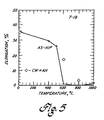
- the yield strength is plotted as ordinate against the temperature of the test sample as abscissa.
- the values of yield strength found for the as-HIPped composition is plotted as a solid line connecting the plus, +, signs.
- the values found for the cold worked and annealed specimens are plotted as diamonds.
- the cold working and annealing of the T-19 tri-nickel aluminum base composition did not result in any loss of yield strength. Rather at each temperature where a measurement was made, the value for the cold worked and annealed specimens was higher. In the case of the measurements made at 800°C, the value found for the thermomechanically treated specimen was approximately 40% higher.
- the intermediate temperature ductility of a cobalt-containing boron doped tri-nickel aluminide may be improved by preparing a melt of the cobalt containing tri-nickel aluminide to contain 0.2 to 1.5 atomic percent boron, rapidly solidifying the melt to a powder by gas atomization, consolidating the powder to a solid body by high temperature isostatic pressing, and cold working and annealing the consolidated body.
- a boron doped tri-nickel aluminide alloy was prepared by conventional casting techniques and mechanically worked.
- the alloy had the composition as set forth in Table VIA. The ingredients are given in atomic percent. TABLE VIA Alloy Nickel Cobalt Aluminum Boron T-5 Balance 14.85 23.76 1.0
- the ingredients were formed into a melt by induction melting, introduced into a copper chill mold and then allowed to cool to form an ingot.
- the ingot was processed through a series of cold rolls and anneals with each cold roll being followed by an anneal for two hours at 1100°C.
- the rolling schedule was as follows: 5% reduction and anneal at 1100°C 5% reduction and anneal at 1100°C 10% reduction and anneal at 1100°C 15% reduction and anneal at 1100°C.
- the alloy T-5 as set forth in Example 5 above was formed into a second ingot by the method-described in Example 5.
- the second ingot was thermo-mechanically processed by a more severe set of rollings and a set of anneals at lower temperature and specifically at 1000°C rather than the 1100°C temperature employed in Example 5.
- the initial reduction was 12% followed by a 1000°C anneal for two hours.
- the next two reductions were at higher percentages and each was followed by a two hour anneal at 1000°C.
- the fourth and final rolling reduction was about a 30% reduction and was followed by a two hour anneal at 1000°C.
- Test specimens were prepared from the rolled ingot and mechanical properties were measured. The mechanical properties determined from these tests are listed in Table VII below. TABLE VII Test Temp (°C) Y.S. (ksi) MPa T.S. (ksi) MPa U.L. (%) E.L. (%) 24 (89) 613.6 (189) 1303.1 45 48 600 (116) 799.8 (123) 848.0 0.7 0.7 700 (90) 620.5 (94) 648.1 0.6 0.6
- the melt was atomized and collected as a dense body on a cold collecting surface according to a spray forming process.
- a spray forming process is disclosed in U.S-A-3,826,301 and 3,909,921. Other processes may also be employed.
- the deposit formed was removed and subjected to a series of treatments including thermal and thermo-mechanical processing.
Landscapes
- Chemical & Material Sciences (AREA)
- Engineering & Computer Science (AREA)
- Mechanical Engineering (AREA)
- Materials Engineering (AREA)
- Metallurgy (AREA)
- Organic Chemistry (AREA)
- Manufacturing & Machinery (AREA)
- Powder Metallurgy (AREA)
- Manufacture Of Metal Powder And Suspensions Thereof (AREA)
Claims (13)
- Verfahren zum Verbessern der Eigenschaften einer bordotierten Tri-Nickel-Aluminid-Zusammensetzung bei mittlerer Temperatur, umfassend:
Bilden einer Kobaltlegierung des Aluminids gemäß dem folgenden Ausdruck:
(Ni1-x-zCoxAlz)100-yBy
worinx zwischen 0,05 und 0,30,z zwischen 0,23 und 0,25 sowiey zwischen 0,2 und 1,50 liegt undBilden einer Schmelze der Legierung,
rasches Erstarrenlassen der Legierung aus der Schmelze durch Abkühlen der Schmelze mit einer Kühlgeschwindigkeit von mindestens 10³°C pro Sekunde zur Bildung eines Festkörpers, dessen Hauptphase die L1₂-artige Kristallstruktur aufweist,
heißisostatisches Pressen der Legierung und
Kaltverformen und Glühen der heißisostatisch gepreßten Legierung. - Verfahren nach Anspruch 1, worin das Kobaltverhältnis x zwischen 0,05 und 0,20 liegt.
- Verfahren nach Anspruch 1, worin das Kobaltverhältnis x etwa 0,10 beträgt.
- Verfahren nach Anspruch 1, worin das Aluminiumverhältnis z zwischen 0,23 und 0,245 liegt.
- Verfahren nach Anspruch 1, worin das Aluminiumverhältnis z etwa 0,24 beträgt.
- Verfahren nach Anspruch 1, worin die Borkonzentration y zwischen 0,2 und 1,0 liegt.
- Verfahren nach Anspruch 1, worin die Borkonzentration zwischen 0,5 und 1,0 liegt.
- Verfahren zum Verbessern der Eigenschaften eines bordotierten Tri-Nickel-Aluminids bei mittlerer Temperatur, umfassend:
Bilden einer Kobaltlegierung des Aluminids gemäß dem folgenden Ausdruck
(Ni1-x-zCoxAlz)100-yBy
worinx zwischen 0.5 und 0.30,z zwischen 0.23 und 0,25 sowiey zwischen 0,2 und 1,50 liegen,Bilden einer Schmelze aus der Legierung,
Abkühlen der Schmelze mit einer Kühlgeschwindigkeit von mindestens 10³°C pro Sekunde zur Bildung eines Festkörpers, dessen Hauptphase die L1₂-artige Kristallstruktur aufweist, durch Zerstäuben der Schmelze auf eine geformte gekühlte Sammeloberfläche zur Bildung eines Körpers und
Kaltverformen und Glühen des Körpers aus Tri-Nickel-Aluminid. - Verfahren nach Anspruch 8, bei dem der kaltverformte Körper für etwa 2 Stunden bei etwa 1000°C geglüht wird.
- Verfahren zum Verbessern der Eigenschaften eines bordotierten Tri-Nickel-Aluminids bei mittlerer Temperatur, umfassend:
Bilden einer Kobaltlegierung des Aluminids gemäß dem folgenden Ausdruck:
(Ni1-x-zCoxAlz)100-yBy
worinx zwischen 0,05 und 0,30,z zwischen 0,23 und 0,25 sowiey zwischen 0,2 und 1,50 liegen,Bilden einer Schmelze aus der Legierung,
Abkühlen der Schmelze mit einer Kühlgeschwindigkeit von mindestens 10³°C pro Sekunde zur Bildung eines Festkörpers, dessen Hauptphase von der L1₂-artigen Kristallstruktur ist durch Zerstäuben der Schmelze zu einem Pulver, Sammeln des Pulvers und heißisostatischem Pressen des gesammelten Pulvers zur Bildung eines Körpers und
Kaltverformen und Glühen des Körpers aus dem Tri-Nickel-Aluminid. - Verfahren nach Anspruch 10, bei dem der kaltverformte Körper für etwa 2 Stunden bei etwa 1000°C geglüht wird.
- Verfahren zum Verbessern der Eigenschaften eines bordotierten Tri-Nickel-Aluminids bei mittlerer Temperatur umfassend:
Bilden einer Kobaltlegierung des Aluminids gemäß dem folgenden Ausdruck:
(Ni1-x-zCoxAlz)100-yBy
worinx zwischen 0,05 und 0,30z zwischen 0,23 und 0,25 sowiey zwischen 0,2 und 1,50 liegen,Bilden einer Schmelze aus der Legierung,
Abkühlen der Schmelze mit einer Kühlgeschwindigkeit von mindestens 10³°C pro Sekunde zur Bildung eines Festkörpers, dessen Hauptphase von der L1₂-artigen Kristallstruktur ist durch Zerstäuben der Schmelze zu einem Pulver, Plasmaspritzen des Pulvers zur Bildung eines Körpers und Kaltverformen und Glühen des Körpers aus dem Tri-Nickel-Aluminid. - Verfahren nach Anspruch 12, bei dem der kaltverformte Körper für etwa 2 Stunden bei etwa 1000°C geglüht wird.
Applications Claiming Priority (2)
| Application Number | Priority Date | Filing Date | Title |
|---|---|---|---|
| US06/783,582 US4609528A (en) | 1985-10-03 | 1985-10-03 | Tri-nickel aluminide compositions ductile at hot-short temperatures |
| US783582 | 1985-10-03 |
Publications (3)
| Publication Number | Publication Date |
|---|---|
| EP0218154A2 EP0218154A2 (de) | 1987-04-15 |
| EP0218154A3 EP0218154A3 (en) | 1988-08-24 |
| EP0218154B1 true EP0218154B1 (de) | 1992-03-18 |
Family
ID=25129730
Family Applications (1)
| Application Number | Title | Priority Date | Filing Date |
|---|---|---|---|
| EP86113265A Expired EP0218154B1 (de) | 1985-10-03 | 1986-09-26 | Zusammensetzungen aus Tri-Nickel-Aluminid, die duktil sind bei Heissbrüchigkeitstemperaturen |
Country Status (5)
| Country | Link |
|---|---|
| US (1) | US4609528A (de) |
| EP (1) | EP0218154B1 (de) |
| JP (1) | JPH0778265B2 (de) |
| DE (1) | DE3684397D1 (de) |
| IL (1) | IL79827A0 (de) |
Families Citing this family (12)
| Publication number | Priority date | Publication date | Assignee | Title |
|---|---|---|---|---|
| US4762558A (en) * | 1987-05-15 | 1988-08-09 | Rensselaer Polytechnic Institute | Production of reactive sintered nickel aluminide material |
| US4908069A (en) * | 1987-10-19 | 1990-03-13 | Sps Technologies, Inc. | Alloys containing gamma prime phase and process for forming same |
| US5169463A (en) * | 1987-10-19 | 1992-12-08 | Sps Technologies, Inc. | Alloys containing gamma prime phase and particles and process for forming same |
| US5015290A (en) * | 1988-01-22 | 1991-05-14 | The Dow Chemical Company | Ductile Ni3 Al alloys as bonding agents for ceramic materials in cutting tools |
| US4919718A (en) * | 1988-01-22 | 1990-04-24 | The Dow Chemical Company | Ductile Ni3 Al alloys as bonding agents for ceramic materials |
| US4941928A (en) * | 1988-12-30 | 1990-07-17 | Westinghouse Electric Corp. | Method of fabricating shaped brittle intermetallic compounds |
| US5116438A (en) * | 1991-03-04 | 1992-05-26 | General Electric Company | Ductility NiAl intermetallic compounds microalloyed with gallium |
| US5116691A (en) * | 1991-03-04 | 1992-05-26 | General Electric Company | Ductility microalloyed NiAl intermetallic compounds |
| US5215831A (en) * | 1991-03-04 | 1993-06-01 | General Electric Company | Ductility ni-al intermetallic compounds microalloyed with iron |
| US5455001A (en) * | 1993-09-22 | 1995-10-03 | National Science Council | Method for manufacturing intermetallic compound |
| US6759005B2 (en) * | 2002-07-23 | 2004-07-06 | Heraeus, Inc. | Fabrication of B/C/N/O/Si doped sputtering targets |
| US20070189916A1 (en) * | 2002-07-23 | 2007-08-16 | Heraeus Incorporated | Sputtering targets and methods for fabricating sputtering targets having multiple materials |
Family Cites Families (8)
| Publication number | Priority date | Publication date | Assignee | Title |
|---|---|---|---|---|
| US2755184A (en) * | 1952-05-06 | 1956-07-17 | Thompson Prod Inc | Method of making ni3al |
| US3653976A (en) * | 1967-05-05 | 1972-04-04 | Gen Motors Corp | Thermocouple probe assembly with nickel aluminide tip |
| US3922168A (en) * | 1971-05-26 | 1975-11-25 | Nat Res Dev | Intermetallic compound materials |
| GB1381859A (en) * | 1971-05-26 | 1975-01-29 | Nat Res Dev | Trinickel aluminide base alloys |
| BE790453A (fr) * | 1971-10-26 | 1973-02-15 | Brooks Reginald G | Fabrication d'articles en metal |
| US4379720A (en) * | 1982-03-15 | 1983-04-12 | Marko Materials, Inc. | Nickel-aluminum-boron powders prepared by a rapid solidification process |
| US4478791A (en) * | 1982-11-29 | 1984-10-23 | General Electric Company | Method for imparting strength and ductility to intermetallic phases |
| US4537742A (en) * | 1983-10-28 | 1985-08-27 | General Electric Company | Method for controlling dimensions of RSPD articles |
-
1985
- 1985-10-03 US US06/783,582 patent/US4609528A/en not_active Expired - Fee Related
-
1986
- 1986-08-25 IL IL79827A patent/IL79827A0/xx not_active IP Right Cessation
- 1986-09-26 EP EP86113265A patent/EP0218154B1/de not_active Expired
- 1986-09-26 DE DE8686113265T patent/DE3684397D1/de not_active Expired - Lifetime
- 1986-10-03 JP JP61234748A patent/JPH0778265B2/ja not_active Expired - Lifetime
Also Published As
| Publication number | Publication date |
|---|---|
| EP0218154A3 (en) | 1988-08-24 |
| US4609528A (en) | 1986-09-02 |
| IL79827A0 (en) | 1986-11-30 |
| EP0218154A2 (de) | 1987-04-15 |
| JPS62142732A (ja) | 1987-06-26 |
| JPH0778265B2 (ja) | 1995-08-23 |
| DE3684397D1 (de) | 1992-04-23 |
Similar Documents
| Publication | Publication Date | Title |
|---|---|---|
| EP0217305B1 (de) | Kaltbearbeitete Zusammensetzungen aus Tri-Nickel-Aluminidlegierungen | |
| US5286443A (en) | High temperature alloy for machine components based on boron doped TiAl | |
| EP0217299B1 (de) | Tri-Nickel-Aluminid-Zusammensetzung, legiert um die Probleme der Heissbrüchigkeit zu überwinden | |
| US3767385A (en) | Cobalt-base alloys | |
| US4359352A (en) | Nickel base superalloys which contain boron and have been processed by a rapid solidification process | |
| Sampath | Studies on the effect of grain refinement and thermal processing on shape memory characteristics of Cu–Al–Ni alloys | |
| EP0218154B1 (de) | Zusammensetzungen aus Tri-Nickel-Aluminid, die duktil sind bei Heissbrüchigkeitstemperaturen | |
| US4613480A (en) | Tri-nickel aluminide composition processing to increase strength | |
| WO1988009825A1 (en) | Rapidly solidified aluminum iron silicon vanadium alloys | |
| US4650519A (en) | Nickel aluminide compositions | |
| US3698962A (en) | Method for producing superalloy articles by hot isostatic pressing | |
| EP0533780B1 (de) | Verfahren zum schmieden von einem körper aus schnell erstarrter magnesiumlegierung | |
| EP0668806B1 (de) | Siliziumlegierung, verfahren zu deren herstellung und verfahren zur herstellung konsolidierter produkte aus dieser legierung | |
| US4923534A (en) | Tungsten-modified titanium aluminum alloys and method of preparation | |
| EP0217303B1 (de) | Aus Pulver hergestellte Zusammensetzung auf Tri-Nickel-Aluminid-Basis | |
| US4710247A (en) | Rapidly solidified tri-nickel aluminide base alloy | |
| EP0217300B1 (de) | Kohlenstoff enthaltendes, mit Bor dotiertes Tri-Nickel-Aluminid | |
| Suryanarayana et al. | Light metals synthesis by mechanical alloying | |
| US4743316A (en) | Rapidly solidified zirconium modified nickel aluminide of improved strength | |
| US4606888A (en) | Inhibition of grain growth in Ni3 Al base alloys | |
| US4764226A (en) | Ni3 A1 alloy of improved ductility based on iron and niobium substituent | |
| US4481034A (en) | Process for producing high hafnium carbide containing alloys | |
| US4743315A (en) | Ni3 Al alloy of improved ductility based on iron substituent | |
| EP0175899B1 (de) | Verfahren zur Erteilung von Festigkeit und Duktilität zu intermetallische Phasen | |
| Chang et al. | Property Comparison of Melt-Spun Ribbons and Consolidated Powders of Ni3Al-B |
Legal Events
| Date | Code | Title | Description |
|---|---|---|---|
| PUAI | Public reference made under article 153(3) epc to a published international application that has entered the european phase |
Free format text: ORIGINAL CODE: 0009012 |
|
| AK | Designated contracting states |
Kind code of ref document: A2 Designated state(s): DE FR GB IT SE |
|
| PUAL | Search report despatched |
Free format text: ORIGINAL CODE: 0009013 |
|
| AK | Designated contracting states |
Kind code of ref document: A3 Designated state(s): DE FR GB IT SE |
|
| 17P | Request for examination filed |
Effective date: 19890120 |
|
| 17Q | First examination report despatched |
Effective date: 19900810 |
|
| ITTA | It: last paid annual fee | ||
| GRAA | (expected) grant |
Free format text: ORIGINAL CODE: 0009210 |
|
| AK | Designated contracting states |
Kind code of ref document: B1 Designated state(s): DE FR GB IT SE |
|
| ET | Fr: translation filed | ||
| REF | Corresponds to: |
Ref document number: 3684397 Country of ref document: DE Date of ref document: 19920423 |
|
| ITF | It: translation for a ep patent filed | ||
| PGFP | Annual fee paid to national office [announced via postgrant information from national office to epo] |
Ref country code: FR Payment date: 19920812 Year of fee payment: 7 |
|
| PGFP | Annual fee paid to national office [announced via postgrant information from national office to epo] |
Ref country code: SE Payment date: 19920814 Year of fee payment: 7 |
|
| PLBE | No opposition filed within time limit |
Free format text: ORIGINAL CODE: 0009261 |
|
| STAA | Information on the status of an ep patent application or granted ep patent |
Free format text: STATUS: NO OPPOSITION FILED WITHIN TIME LIMIT |
|
| 26N | No opposition filed | ||
| PG25 | Lapsed in a contracting state [announced via postgrant information from national office to epo] |
Ref country code: SE Effective date: 19930927 |
|
| PG25 | Lapsed in a contracting state [announced via postgrant information from national office to epo] |
Ref country code: FR Free format text: LAPSE BECAUSE OF NON-PAYMENT OF DUE FEES Effective date: 19940531 |
|
| REG | Reference to a national code |
Ref country code: FR Ref legal event code: ST |
|
| EUG | Se: european patent has lapsed |
Ref document number: 86113265.2 Effective date: 19940410 |
|
| PGFP | Annual fee paid to national office [announced via postgrant information from national office to epo] |
Ref country code: DE Payment date: 19950818 Year of fee payment: 10 |
|
| PGFP | Annual fee paid to national office [announced via postgrant information from national office to epo] |
Ref country code: GB Payment date: 19950825 Year of fee payment: 10 |
|
| PG25 | Lapsed in a contracting state [announced via postgrant information from national office to epo] |
Ref country code: GB Effective date: 19960926 |
|
| GBPC | Gb: european patent ceased through non-payment of renewal fee |
Effective date: 19960926 |
|
| PG25 | Lapsed in a contracting state [announced via postgrant information from national office to epo] |
Ref country code: DE Effective date: 19970603 |
|
| PG25 | Lapsed in a contracting state [announced via postgrant information from national office to epo] |
Ref country code: IT Free format text: LAPSE BECAUSE OF NON-PAYMENT OF DUE FEES;WARNING: LAPSES OF ITALIAN PATENTS WITH EFFECTIVE DATE BEFORE 2007 MAY HAVE OCCURRED AT ANY TIME BEFORE 2007. THE CORRECT EFFECTIVE DATE MAY BE DIFFERENT FROM THE ONE RECORDED. Effective date: 20050926 |