EP0218207A2 - Verwendung von Komplexestern in synthetischen Schmiermitteln und diese enthaltende Schmiermitteln - Google Patents
Verwendung von Komplexestern in synthetischen Schmiermitteln und diese enthaltende Schmiermitteln Download PDFInfo
- Publication number
- EP0218207A2 EP0218207A2 EP86113639A EP86113639A EP0218207A2 EP 0218207 A2 EP0218207 A2 EP 0218207A2 EP 86113639 A EP86113639 A EP 86113639A EP 86113639 A EP86113639 A EP 86113639A EP 0218207 A2 EP0218207 A2 EP 0218207A2
- Authority
- EP
- European Patent Office
- Prior art keywords
- lubricants
- complex esters
- ester
- synthetic
- general formula
- Prior art date
- Legal status (The legal status is an assumption and is not a legal conclusion. Google has not performed a legal analysis and makes no representation as to the accuracy of the status listed.)
- Granted
Links
- 150000002148 esters Chemical class 0.000 title claims abstract description 25
- 239000000314 lubricant Substances 0.000 title claims abstract description 23
- -1 isooctyl Chemical group 0.000 claims abstract description 32
- 239000000203 mixture Substances 0.000 claims abstract description 12
- 239000002253 acid Substances 0.000 claims abstract description 11
- SLCVBVWXLSEKPL-UHFFFAOYSA-N neopentyl glycol Chemical group OCC(C)(C)CO SLCVBVWXLSEKPL-UHFFFAOYSA-N 0.000 claims abstract description 5
- 239000010689 synthetic lubricating oil Substances 0.000 claims description 3
- 150000001875 compounds Chemical group 0.000 claims description 2
- WNLRTRBMVRJNCN-UHFFFAOYSA-N adipic acid Chemical compound OC(=O)CCCCC(O)=O WNLRTRBMVRJNCN-UHFFFAOYSA-N 0.000 description 18
- 235000011037 adipic acid Nutrition 0.000 description 10
- 239000001361 adipic acid Substances 0.000 description 10
- 229940117969 neopentyl glycol Drugs 0.000 description 8
- XLYOFNOQVPJJNP-UHFFFAOYSA-N water Substances O XLYOFNOQVPJJNP-UHFFFAOYSA-N 0.000 description 8
- 239000003921 oil Substances 0.000 description 7
- XFRVVPUIAFSTFO-UHFFFAOYSA-N 1-Tridecanol Chemical compound CCCCCCCCCCCCCO XFRVVPUIAFSTFO-UHFFFAOYSA-N 0.000 description 4
- ALKCLFLTXBBMMP-UHFFFAOYSA-N 3,7-dimethylocta-1,6-dien-3-yl hexanoate Chemical compound CCCCCC(=O)OC(C)(C=C)CCC=C(C)C ALKCLFLTXBBMMP-UHFFFAOYSA-N 0.000 description 4
- LFQSCWFLJHTTHZ-UHFFFAOYSA-N Ethanol Chemical compound CCO LFQSCWFLJHTTHZ-UHFFFAOYSA-N 0.000 description 4
- OFOBLEOULBTSOW-UHFFFAOYSA-N Malonic acid Chemical compound OC(=O)CC(O)=O OFOBLEOULBTSOW-UHFFFAOYSA-N 0.000 description 4
- 238000001816 cooling Methods 0.000 description 4
- 230000032050 esterification Effects 0.000 description 4
- 238000005886 esterification reaction Methods 0.000 description 4
- 238000005461 lubrication Methods 0.000 description 4
- 238000003756 stirring Methods 0.000 description 4
- JOXIMZWYDAKGHI-UHFFFAOYSA-N toluene-4-sulfonic acid Chemical compound CC1=CC=C(S(O)(=O)=O)C=C1 JOXIMZWYDAKGHI-UHFFFAOYSA-N 0.000 description 4
- 239000012530 fluid Substances 0.000 description 3
- 238000010438 heat treatment Methods 0.000 description 3
- 239000010687 lubricating oil Substances 0.000 description 3
- PLLBRTOLHQQAQQ-UHFFFAOYSA-N 8-methylnonan-1-ol Chemical compound CC(C)CCCCCCCO PLLBRTOLHQQAQQ-UHFFFAOYSA-N 0.000 description 2
- 239000000654 additive Substances 0.000 description 2
- FPCJKVGGYOAWIZ-UHFFFAOYSA-N butan-1-ol;titanium Chemical compound [Ti].CCCCO.CCCCO.CCCCO.CCCCO FPCJKVGGYOAWIZ-UHFFFAOYSA-N 0.000 description 2
- 238000001704 evaporation Methods 0.000 description 2
- 230000008020 evaporation Effects 0.000 description 2
- 238000001914 filtration Methods 0.000 description 2
- 230000001050 lubricating effect Effects 0.000 description 2
- 238000005809 transesterification reaction Methods 0.000 description 2
- CKPKHTKLLYPGFM-UHFFFAOYSA-N 6,6-dimethylheptane-1,1-diol Chemical compound CC(CCCCC(O)O)(C)C CKPKHTKLLYPGFM-UHFFFAOYSA-N 0.000 description 1
- CFJJETGTKOFIQF-UHFFFAOYSA-N N[N](N)(N)[NH+]([O-])ON Chemical compound N[N](N)(N)[NH+]([O-])ON CFJJETGTKOFIQF-UHFFFAOYSA-N 0.000 description 1
- 229910019142 PO4 Inorganic materials 0.000 description 1
- 230000032683 aging Effects 0.000 description 1
- 150000001298 alcohols Chemical class 0.000 description 1
- 125000001931 aliphatic group Chemical group 0.000 description 1
- 230000015572 biosynthetic process Effects 0.000 description 1
- WPUKZOKYKHYASK-UHFFFAOYSA-N bis(11-methyldodecyl) hexanedioate Chemical compound CC(C)CCCCCCCCCCOC(=O)CCCCC(=O)OCCCCCCCCCCC(C)C WPUKZOKYKHYASK-UHFFFAOYSA-N 0.000 description 1
- YKGYQYOQRGPFTO-UHFFFAOYSA-N bis(8-methylnonyl) hexanedioate Chemical group CC(C)CCCCCCCOC(=O)CCCCC(=O)OCCCCCCCC(C)C YKGYQYOQRGPFTO-UHFFFAOYSA-N 0.000 description 1
- 239000000969 carrier Substances 0.000 description 1
- 238000006243 chemical reaction Methods 0.000 description 1
- 238000004140 cleaning Methods 0.000 description 1
- 239000010725 compressor oil Substances 0.000 description 1
- 238000010276 construction Methods 0.000 description 1
- 230000007797 corrosion Effects 0.000 description 1
- 238000005260 corrosion Methods 0.000 description 1
- 150000002009 diols Chemical class 0.000 description 1
- 239000000446 fuel Substances 0.000 description 1
- ACCCMOQWYVYDOT-UHFFFAOYSA-N hexane-1,1-diol Chemical compound CCCCCC(O)O ACCCMOQWYVYDOT-UHFFFAOYSA-N 0.000 description 1
- JEIPFZHSYJVQDO-UHFFFAOYSA-N iron(III) oxide Inorganic materials O=[Fe]O[Fe]=O JEIPFZHSYJVQDO-UHFFFAOYSA-N 0.000 description 1
- 239000002480 mineral oil Substances 0.000 description 1
- 235000010446 mineral oil Nutrition 0.000 description 1
- 150000002763 monocarboxylic acids Chemical class 0.000 description 1
- 239000010705 motor oil Substances 0.000 description 1
- 230000003647 oxidation Effects 0.000 description 1
- 238000007254 oxidation reaction Methods 0.000 description 1
- 239000010452 phosphate Substances 0.000 description 1
- 150000003014 phosphoric acid esters Chemical class 0.000 description 1
- 238000002360 preparation method Methods 0.000 description 1
- 239000010731 rolling oil Substances 0.000 description 1
- 238000003786 synthesis reaction Methods 0.000 description 1
- 239000012209 synthetic fiber Substances 0.000 description 1
- 229920002994 synthetic fiber Polymers 0.000 description 1
- STCOOQWBFONSKY-UHFFFAOYSA-N tributyl phosphate Chemical compound CCCCOP(=O)(OCCCC)OCCCC STCOOQWBFONSKY-UHFFFAOYSA-N 0.000 description 1
Classifications
-
- C—CHEMISTRY; METALLURGY
- C10—PETROLEUM, GAS OR COKE INDUSTRIES; TECHNICAL GASES CONTAINING CARBON MONOXIDE; FUELS; LUBRICANTS; PEAT
- C10M—LUBRICATING COMPOSITIONS; USE OF CHEMICAL SUBSTANCES EITHER ALONE OR AS LUBRICATING INGREDIENTS IN A LUBRICATING COMPOSITION
- C10M129/00—Lubricating compositions characterised by the additive being an organic non-macromolecular compound containing oxygen
- C10M129/02—Lubricating compositions characterised by the additive being an organic non-macromolecular compound containing oxygen having a carbon chain of less than 30 atoms
- C10M129/68—Esters
- C10M129/78—Complex esters, i.e. compounds containing at least three esterified carboxyl groups and derived from the combination of at least three different types of the following five types of compound: monohydroxy compounds, polyhydroxy compounds, monocarboxylic acids, polycarboxylic acids, hydroxy carboxylic acids
- C10M129/82—Complex esters, i.e. compounds containing at least three esterified carboxyl groups and derived from the combination of at least three different types of the following five types of compound: monohydroxy compounds, polyhydroxy compounds, monocarboxylic acids, polycarboxylic acids, hydroxy carboxylic acids derived from the combination of monohydroxy compounds, dihydroxy compounds and dicarboxylic acids only and having no free hydroxy or carboxyl groups
-
- C—CHEMISTRY; METALLURGY
- C10—PETROLEUM, GAS OR COKE INDUSTRIES; TECHNICAL GASES CONTAINING CARBON MONOXIDE; FUELS; LUBRICANTS; PEAT
- C10M—LUBRICATING COMPOSITIONS; USE OF CHEMICAL SUBSTANCES EITHER ALONE OR AS LUBRICATING INGREDIENTS IN A LUBRICATING COMPOSITION
- C10M105/00—Lubricating compositions characterised by the base-material being a non-macromolecular organic compound
- C10M105/08—Lubricating compositions characterised by the base-material being a non-macromolecular organic compound containing oxygen
- C10M105/32—Esters
- C10M105/42—Complex esters, i.e. compounds containing at least three esterified carboxyl groups and derived from the combination of at least three different types of the following five types of compound: monohydroxy compounds, polyhydroxy compounds, monocarboxylic acids, polycarboxylic acids and hydroxy carboxylic acids
-
- C—CHEMISTRY; METALLURGY
- C10—PETROLEUM, GAS OR COKE INDUSTRIES; TECHNICAL GASES CONTAINING CARBON MONOXIDE; FUELS; LUBRICANTS; PEAT
- C10M—LUBRICATING COMPOSITIONS; USE OF CHEMICAL SUBSTANCES EITHER ALONE OR AS LUBRICATING INGREDIENTS IN A LUBRICATING COMPOSITION
- C10M105/00—Lubricating compositions characterised by the base-material being a non-macromolecular organic compound
- C10M105/08—Lubricating compositions characterised by the base-material being a non-macromolecular organic compound containing oxygen
- C10M105/32—Esters
- C10M105/42—Complex esters, i.e. compounds containing at least three esterified carboxyl groups and derived from the combination of at least three different types of the following five types of compound: monohydroxy compounds, polyhydroxy compounds, monocarboxylic acids, polycarboxylic acids and hydroxy carboxylic acids
- C10M105/46—Complex esters, i.e. compounds containing at least three esterified carboxyl groups and derived from the combination of at least three different types of the following five types of compound: monohydroxy compounds, polyhydroxy compounds, monocarboxylic acids, polycarboxylic acids and hydroxy carboxylic acids derived from the combination of monohydroxy compounds, dihydroxy compounds and dicarboxylic acids only and having no free hydroxy or carboxyl groups
-
- C—CHEMISTRY; METALLURGY
- C10—PETROLEUM, GAS OR COKE INDUSTRIES; TECHNICAL GASES CONTAINING CARBON MONOXIDE; FUELS; LUBRICANTS; PEAT
- C10M—LUBRICATING COMPOSITIONS; USE OF CHEMICAL SUBSTANCES EITHER ALONE OR AS LUBRICATING INGREDIENTS IN A LUBRICATING COMPOSITION
- C10M129/00—Lubricating compositions characterised by the additive being an organic non-macromolecular compound containing oxygen
- C10M129/02—Lubricating compositions characterised by the additive being an organic non-macromolecular compound containing oxygen having a carbon chain of less than 30 atoms
- C10M129/68—Esters
- C10M129/78—Complex esters, i.e. compounds containing at least three esterified carboxyl groups and derived from the combination of at least three different types of the following five types of compound: monohydroxy compounds, polyhydroxy compounds, monocarboxylic acids, polycarboxylic acids, hydroxy carboxylic acids
-
- C—CHEMISTRY; METALLURGY
- C10—PETROLEUM, GAS OR COKE INDUSTRIES; TECHNICAL GASES CONTAINING CARBON MONOXIDE; FUELS; LUBRICANTS; PEAT
- C10M—LUBRICATING COMPOSITIONS; USE OF CHEMICAL SUBSTANCES EITHER ALONE OR AS LUBRICATING INGREDIENTS IN A LUBRICATING COMPOSITION
- C10M2209/00—Organic macromolecular compounds containing oxygen as ingredients in lubricant compositions
- C10M2209/10—Macromolecular compoundss obtained otherwise than by reactions only involving carbon-to-carbon unsaturated bonds
- C10M2209/11—Complex polyesters
Definitions
- the invention relates to the use of complex esters in synthetic lubricants. It also relates to a lubricant that contains at least one complex ester.
- the HD oils (heavy duty) - to which additives were added for their additional tasks, such as aging and corrosion protection, high-pressure resistance, and as "dirt carriers" - were followed by the multigrade oils with flat viscosity curves and suitability for summer and winter operation, for longer oil change intervals and also already reduced fuel consumption, especially in winter and short-haul operations.
- a flat viscosity curve means a reduced temperature dependence of the lubricating oil.
- the viscosity index (VI) is a measure of the temperature dependence.
- Complex esters are particularly suitable as synthesis components due to their low basic and low viscosity, their low volatility and high viscosity indices.
- US-A-4 130 494 relates to the use of amine salts of phosphate esters as additives to synthetic lubricating oil compositions. These are intended to reduce unwanted deposits in the engines, especially in turbine engines.
- US-A-4 155 861 relates to a lubricant which comprises a mixture of a monomeric ester of a branched dicarboxylic acid and an aliphatic primary monoalcohol and a complex ester of a dicarboxylic acid and hexanediol or trimethylhexanediol.
- the lubricant should be characterized by universal applicability.
- FR-A-1 508 458 describes the preparation of complex esters with a phosphate ester component.
- adipic acid, neopentyl glycol and C6-C10 monocarboxylic acids are reacted with tributyl phosphate, and a complex ester is thus obtained, for which it is claimed that it has an increased resistance to oxidation.
- a lubricant base composition which is essentially a mixture of a pentaerythrolester and a neopentyl glycol ester, the neopentyl glycol ester by reaction of neopentyl glycol with a C4-C12-alkanedicarboxylic acid and a C4-C12 -Alkanol was obtained.
- the invention has for its object to provide complex esters for use in synthetic lubricants, and corresponding lubricants, which have good temperature-viscosity behavior, expressed by a high viscosity index and a low pour point, and a low evaporation loss.
- the dicarboxylic acid component is preferably adipic acid.
- the invention also relates to a lubricant which contains at least one compound of the general formula I according to one of claims 1 or 2.
- the lubricant is preferably in the form of a synthetic lubricating oil.
- the complex esters of the general formula I can be used either individually or in a mixture.
- the term mixture here means a mixture of complex esters of the general formula I in which the index n and / or the index m can have all the values mentioned.
- the measured values n and m represent mean values.
- the mean value of the index n can be e.g. represent any value between 1 and 3. The same applies to the index m.
- the complex ester of the general formula I has the isooctyl, isodecanyl or isotridecanyl radical as the monoalcohol component.
- the isodecanyl or isotridecanyl radical are particularly preferred.
- the alcohols R-OH used in the esterification are commercially available isomer mixtures, such as those e.g. incurred during oxosynthesis.
- R can, for example, have the following structures 2-ethyl-4-methylpentyl, 3,3-dimethylhexyl, 3,5-dimethylhexyl, 4,5-dimethylhexyl, 2-ethylhexyl, 3-methylheptyl, 5-methylheptyl -, 3,5,5-Trimethylheptyl-, 3,5-dimethyloctyl-, 4,7-dimethyloctyl-, 3,5,5,7-tetramethylnonyl- and their isomers.
- lubricants for engines or automotive engines, compressor oils, hydraulic fluids, insulating fluids for electrical devices, electrical contact oils, lubricating greases, chain lubricants, heat transfer fluids, vacuum pump oils, synthetic fiber lubricants, instrument oils, rust protection oils and rolling oils . All applications in lubricants that have a lubricating function are included.
- the complex esters intended for use in accordance with the invention have a very good temperature-viscosity behavior, expressed by a high viscosity index and a low pour point, and a low evaporation loss according to Noack.
- the lubrication data are listed in the table below.
- the lubrication data are listed in the table below.
- the lubrication data are listed in the table below.
Landscapes
- Chemical & Material Sciences (AREA)
- Chemical Kinetics & Catalysis (AREA)
- General Chemical & Material Sciences (AREA)
- Oil, Petroleum & Natural Gas (AREA)
- Organic Chemistry (AREA)
- Health & Medical Sciences (AREA)
- Emergency Medicine (AREA)
- Organic Low-Molecular-Weight Compounds And Preparation Thereof (AREA)
- Lubricants (AREA)
Abstract

R für einen Isooctyl-, Isodecanyl- oder Isotridecanylrest steht,
m für 4 oder 6 steht,
n die Bedeutungen 1, 2 oder 3 besitzt, und
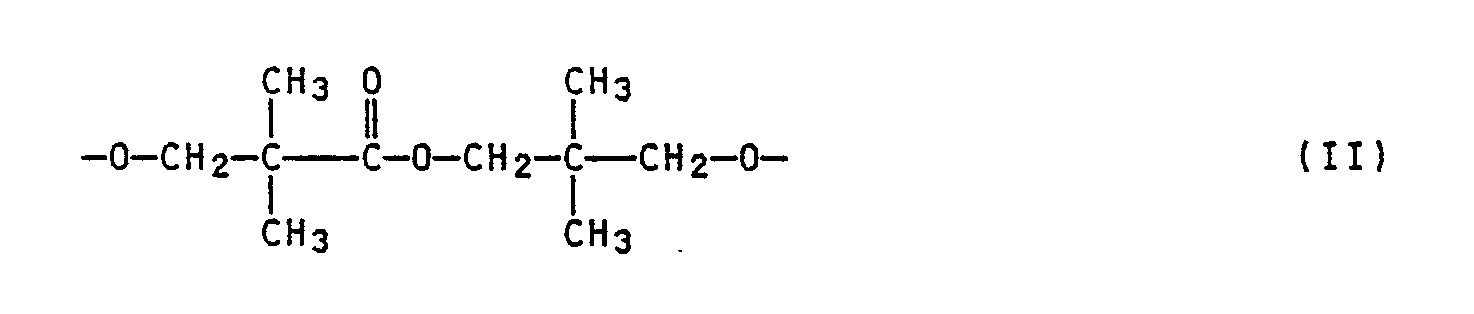
X den Hydroxipivalinsäureneopentylglykolrest der Formel II
einzeln oder in Mischung in synthetischen Schmiermitteln.
Description
- Die Erfindung betrifft die Verwendung von Komplexestern in synthetischen Schmiermitteln. Sie betrifft auch ein Schmiermittel, welches mindestens einen Komplexester enthält.
- Moderne Schmiermittel, insbesondere Leichtlauf-Motorenöle, sind nicht mehr allein durch Mineralölkomponenten herstellbar, die Zumischung von Synthesekomponenten ist erforderlich. Insbesondere bei Schmierölen für Kraftfahrzeugmotoren werden ständig steigende Anforderungen gestellt, da Drehzahlen, Arbeitsdrücke und Leistungen bei gleichzeitiger Forderung nach hoher Lebensdauer und Zuverlässigkeit im Motorenbau ständig ansteigen.
- Den HD-Ölen (Heavy Duty) - denen für ihre zusätzlichen Aufgaben, wie Alterungs- und Korrosionsschutz, Hochdruckbeständigkeit, sowie als "Schmutzträger" Additive zugesetzt wurden - folgten die Mehrbereichsöle mit flachen Viskositätskurven und einer Eignung für Sommer- und Winterbetrieb, für längere Ölwechselintervalle und auch bereits verminderten Kraftstoffverbrauch, insbesondere im Winter- und Kurzstreckenbetrieb. Eine flache Viskositätskurve bedeutet eine verminderte Temperaturabhängigkeit des Schmieröls. Ein Maß für die Temperaturabhängigkeit ist der Viskositätsindex (VI).
- Komplexester sind aufgrund ihrer niedrigen Grund- und Kälteviskosität, ihrer geringen Flüchtigkeit und hohen Viskositätsindices als Synthesekomponenten besonders geeignet.
- Nach dem Stand der Technik ist die Verwendung einer Vielzahl unterschiedlichster Komplexester in synthetischen Schmiermittelzusammensetzungen bekannt. So betrifft die US-A-4 130 494 die Verwendung von Aminsalzen von Phosphatestern als Additive zu synthetischen Schmierölzusammensetzungen. Diese sollen unerwünschte Ablagerungen in den Motoren, insbesondere in Turbinenmotoren, verringern.
- Die US-A-4 155 861 betrifft ein Schmiermittel, welches eine Mischung aus einem monomeren Ester einer verzweigten Dicarbonsäure und einem aliphatischen primären Monoalkohol und einem Komplexester einer Dicarbonsäure und Hexandiol oder Trimethylhexandiol, umfaßt. Das Schmiermittel soll sich durch universelle Anwendbarkeit auszeichnen.
- In der FR-A-1 508 458 ist die Herstellung von Komplexestern mit einer Phosphatesterkomponente beschrieben. Hierbei setzt man beispielsweise Adipinsäure, Neopentylglykol und C₆-C₁₀-Monocarbonsäuren mit Tributylphosphat um und erhält so einen Komplexester, für den geltend gemacht wird, daß er eine erhöhte Oxidationsbeständigkeit aufweist.
- In der US-A-4 064 058 ist eine Schmiermittelgrundzusammensetzung beschrieben, bei der es sich im wesentlichen um eine Abmischung aus einem Pentaerythrolester und einem Neopentylglykolester handelt, wobei der Neopentylglykolester durch Reaktion von Neopentylglykol mit einer C₄-C₁₂-Alkandicarbonsäure und einem C₄-C₁₂-Alkanol erhalten wurde.
- Der Erfindung liegt die Aufgabe zugrunde, Komplexester zur Verwendung in synthetischen Schmiermitteln, sowie entsprechende Schmiermittel zur Verfügung zu stellen, welche ein gutes Temperatur-Viskositätsverhalten, ausgedrückt durch einen hohen Viskositätsindex und einen tiefen Stockpunkt, sowie einen niedrigen Verdampfungsverlust aufweisen.
- Diese Aufgabe wird gelöst durch Verwendung von Komplexestern der allgemeinen Formel (I)

R für einen Isooctyl-, Isodecanyl- oder Isotridecanylrest steht,
m für 4 oder 6 steht,
n die Bedeutungen 1, 2 oder 3 besitzt, und
X den Hydroxipivalinsäureneopentylglykolrest der Formel II
einzeln oder in Mischung in synthetischen Schmiermitteln. - Nach einer bevorzugten Ausführungsform steht in der allgemeinen Formel I m für 4, d.h. bei der Dicarbonsäurekomponente handelt es sich bevorzugt um Adipinsäure.
- Die Erfindung betrifft auch ein Schmiermittel, welches mindestens eine Verbindung der allgemeinen Formel I nach einem der Ansprüche 1 oder 2 enthält. Vorzugsweise liegt das Schmiermittel in Form eines synthetischen Schmieröls vor.
- Die Komplexester der allgemeinen Formel I können entweder einzeln oder in Mischung eingesetzt werden. Unter dem Begriff Mischung wird hier ein Gemisch von Komplexestern der allgemeinen Formel I verstanden, bei dem der Index n und/oder der Index m sämtliche genannten Werte aufweisen können. Mit anderen Worten stellen dann die gemessenen Werte n und m Mittelwerte dar. So kann der Mittelwert des Indexes n z.B. irgendeinen Wert zwischen 1 und 3 darstellen. Sinngemäßes gilt für den Index m.
- Als Monoalkoholkomponente weist der Komplexester der allgemeinen Formel I den Isooctyl-, Isodecanyl- oder Isotridecanylrest auf. Besonders bevorzugt sind der Isodecanyl- bzw. Isotridecanylrest.
- Die bei der Veresterung benutzten Alkohole R-OH (Isooctyl-, Isodecanyl-, Isotridecanylalkohole) sind handelsübliche Isomerengemische, wie sie z.B. bei der Oxosynthese anfallen.
- Dabei kann R beispielsweise die folgenden Strukturen 2-Ethyl-4-methylpentyl-, 3,3-Dimethylhexyl-, 3,5-Dimethylhexyl-, 4,5-Dimethylhexyl-, 2-Ethylhexyl-, 3-Methylheptyl-, 5-Methylheptyl-, 3,5,5-Trimethylheptyl-, 3,5-Dimethyloctyl-, 4,7-Dimethyloctyl-, 3,5,5,7-Tetramethylnonyl-, und deren Isomere, bedeuten.
- Die Verwendung der Komplexester der allgemeinen Formel I ist vorgesehen in Schmiermitteln. Hierbei kann es sich beispielsweise um Schmierstoffe (Schmieröle) für Triebwerke oder Kfz-Motoren, um Kompressorenöle, hydraulische Flüssigkeiten, Isolierflüssigkeiten für elektrische Geräte, elektrische Kontaktöle, Schmierfette, Kettenschmierstoffe, Wärmeübertragungs-Flüssigkeiten, Vakuumpumpenöle, synthetische Faserschmierstoffe, Instrumentenöle, Rostschutzöle und Walzöle handeln. Sämtliche Anwendungen in Schmiermitteln, welche eine Schmierfunktion haben, sind umfaßt.
- Die zur erfindungsgemäßen Verwendung vorgesehenen Komplexester weisen ein sehr gutes Temperatur-Viskositätsverhalten, ausgedrückt durch einen hohen Viskositätsindex und einen tiefen Stockpunkt, sowie einen niedrigen Verdampfungsverlust nach Noack auf.
- Zur Herstellung der Komplexester kann man entweder Di-Isooctyl-, Di-Isodecyl- bzw. Di-Isotridecyl-Adipat mit Hydroxipivalinsäureneopentylgly kolester (HPN) umestern oder eine Direktveresterung des Monoalkohols, der Dicarbonsäure und des Diols durchführen.
- Die Erfindung wird durch die nachstehenden Beispiele näher erläutert.
- 853,4 g (2 Mol) Adipinsäurediisodecylester, 204,0 g (1 Mol) HPN und 0,85 g Tetrabutylorthotitanat werden gemischt und langsam auf 100°C erhitzt. Man legt Wasserstrahlvakuum an und erhitzt langsam weiter auf 250°C. Während 2 Stunden bei 250°C sammelt man 310 g Isodecanol. Nach Abkühlen und Filtration erhält man 747 g des schwach gelb gefärbten Komplexesters der folgenden Struktur:

- Die schmiertechnischen Daten sind in der nachstehenden Tabelle 1 aufgeführt.
- 896,1 g (2,1 Mol) Adipinsäurediisodecylester, 285,6 g (1,4 Mol) HPN und 0,90 g Tetrabutylorthotitanat werden gemischt und langsam auf 100°C erhitzt. Man legt Wasserstrahlvakuum an und erhitzt langsam weiter auf 250°C. Während 2stündigem Erhitzen auf 250°C hat man 420 g Isodecanol gesammelt. Nach Abkühlen und Filtration erhält man 760 g des schwach gelb gefärbten Komplexesters der folgenden Struktur:

- Die schmiertechnischen Daten sind der nachstehenden Tabelle aufgeführt.
- 292 g (2 Mol) Adipinsäre , 420,7 g (2,1 Mol) Tridecanol, 204,3 g (1 Mol) HPN und 1,46 g p-Toluolsulfonsäure werden gemischt und langsam auf 200°C erhitzt. Ab ca. 120°C beginnt die Abspaltung von wasser. Nach 2stündigem Rühren bei 200°C legt man langsam Wasserstrahlvakuum an und rührt noch 1 Stunde nach (abgespaltene Wassermenge: 71 ml). Nach Abkühlen und Reinigen des Esters (Entfernung von Säreresten, Entfernung des Restalkohols) erhält man ca. 810 g des schwach gelb gefärbten Komplexesters der folgenden Struktur:

- Die schmiertechnischen Daten sind in der nachstehenden Tabelle aufgeführt.
- 292 g (2 Mol) Adipinsäure, 360 g (1,8 Mol) Tridecanol, 245,1 g (1,2 Mol) HPN und 1,5 g p-Toluolsulfonsäure werden gemischt und langsam auf 200°C erhitzt. Ab ca. 120°C beginnt die Abspaltung von Wasser. Nach 2stündigem Rühren bei 200°C legt man langsam Wasserstrahlvakuum an und rührt noch 1 Stunde nach (abgespaltene Wassermenge: 70 ml). Nach Abkühlen und Reinigen des Esters (Entfernung von Säureresten, Entfernung des Restalkohols) erhält man ca. 820 g des schwach gelb gefärbten Komplexesters der folgenden Struktur:

- Die schmiertechnischen Daten sind in der nachstehenden Tabelle aufgeführt.

Claims (4)

R für einen Isooctyl-, Isodecanyl- oder Isotridecanylrest steht,
m für 4 oder 6 steht,
n die Bedeutungen 1, 2 oder 3 besitzt, und
X den Hydroxipivalinsäureneopentylglykolrest der Formel II

einzeln oder in Mischung in synthetischen Schmiermitteln.
Applications Claiming Priority (2)
| Application Number | Priority Date | Filing Date | Title |
|---|---|---|---|
| DE3536197 | 1985-10-10 | ||
| DE19853536197 DE3536197A1 (de) | 1985-10-10 | 1985-10-10 | Verwendung von komplexestern in synthetischen schmiermitteln und diese enthaltende schmiermittel |
Publications (3)
| Publication Number | Publication Date |
|---|---|
| EP0218207A2 true EP0218207A2 (de) | 1987-04-15 |
| EP0218207A3 EP0218207A3 (en) | 1988-01-27 |
| EP0218207B1 EP0218207B1 (de) | 1990-01-10 |
Family
ID=6283283
Family Applications (1)
| Application Number | Title | Priority Date | Filing Date |
|---|---|---|---|
| EP86113639A Expired - Lifetime EP0218207B1 (de) | 1985-10-10 | 1986-10-02 | Verwendung von Komplexestern in synthetischen Schmiermitteln und diese enthaltende Schmiermitteln |
Country Status (2)
| Country | Link |
|---|---|
| EP (1) | EP0218207B1 (de) |
| DE (2) | DE3536197A1 (de) |
Cited By (7)
| Publication number | Priority date | Publication date | Assignee | Title |
|---|---|---|---|---|
| EP0440069A1 (de) * | 1990-01-22 | 1991-08-07 | Kao Corporation | Gefrierölzusammensetzung |
| EP0445610A1 (de) * | 1990-03-05 | 1991-09-11 | Hoechst Aktiengesellschaft | Verwendung von komplexen Esterölen als Schmiermittel für Kältemittelverdichter |
| EP0632124A1 (de) * | 1993-06-30 | 1995-01-04 | Nof Corporation | Synthetisches Schmieröl und Arbeitsmittelzusammensetzung für Kältemaschinen |
| US5391312A (en) * | 1993-08-02 | 1995-02-21 | Albemarle Corportion | Lubricant additives |
| WO1997021782A1 (de) * | 1995-12-11 | 1997-06-19 | Henkel Kommanditgesellschaft Auf Aktien | Nichttoxische wärmeträgeröle |
| WO1998010041A1 (en) * | 1996-09-06 | 1998-03-12 | Exxon Chemical Patents Inc. | Engine oil lubricants formed from complex alcohol esters |
| KR100690351B1 (ko) | 2005-07-15 | 2007-03-12 | 주식회사 엘지화학 | 하이드록시 피발일 하이드록시 피발레이트 에스테르 가소제조성물 및 이의 제조방법 |
Family Cites Families (3)
| Publication number | Priority date | Publication date | Assignee | Title |
|---|---|---|---|---|
| GB768119A (en) * | 1954-03-17 | 1957-02-13 | Exxon Research Engineering Co | Improvements in or relating to complex ester synthetic lubricants |
| BE586528A (de) * | 1959-01-14 | |||
| US4064058A (en) * | 1972-03-01 | 1977-12-20 | Hercules Incorporated | Mixed synthetic ester grease base stock |
-
1985
- 1985-10-10 DE DE19853536197 patent/DE3536197A1/de not_active Withdrawn
-
1986
- 1986-10-02 EP EP86113639A patent/EP0218207B1/de not_active Expired - Lifetime
- 1986-10-02 DE DE8686113639T patent/DE3668184D1/de not_active Expired - Lifetime
Cited By (7)
| Publication number | Priority date | Publication date | Assignee | Title |
|---|---|---|---|---|
| EP0440069A1 (de) * | 1990-01-22 | 1991-08-07 | Kao Corporation | Gefrierölzusammensetzung |
| EP0445610A1 (de) * | 1990-03-05 | 1991-09-11 | Hoechst Aktiengesellschaft | Verwendung von komplexen Esterölen als Schmiermittel für Kältemittelverdichter |
| EP0632124A1 (de) * | 1993-06-30 | 1995-01-04 | Nof Corporation | Synthetisches Schmieröl und Arbeitsmittelzusammensetzung für Kältemaschinen |
| US5391312A (en) * | 1993-08-02 | 1995-02-21 | Albemarle Corportion | Lubricant additives |
| WO1997021782A1 (de) * | 1995-12-11 | 1997-06-19 | Henkel Kommanditgesellschaft Auf Aktien | Nichttoxische wärmeträgeröle |
| WO1998010041A1 (en) * | 1996-09-06 | 1998-03-12 | Exxon Chemical Patents Inc. | Engine oil lubricants formed from complex alcohol esters |
| KR100690351B1 (ko) | 2005-07-15 | 2007-03-12 | 주식회사 엘지화학 | 하이드록시 피발일 하이드록시 피발레이트 에스테르 가소제조성물 및 이의 제조방법 |
Also Published As
| Publication number | Publication date |
|---|---|
| DE3668184D1 (de) | 1990-02-15 |
| EP0218207B1 (de) | 1990-01-10 |
| DE3536197A1 (de) | 1987-04-16 |
| EP0218207A3 (en) | 1988-01-27 |
Similar Documents
| Publication | Publication Date | Title |
|---|---|---|
| DE3643935C2 (de) | Synthetische Polyolester | |
| DE68914448T3 (de) | Kältemaschinenschmiermittel. | |
| DE69524686T2 (de) | Technische Pentaerythritolester als synthetische Grundschmieröle | |
| DE60130083T2 (de) | Herstellung von Estern für die Verwendung als Basisschmieröl | |
| DE69634330T2 (de) | VERWENDUNG VON EINEM POLYOLESTERZUSAMMENSETZUNGEN MIT NICHT-UMGEZETZTEN HYDROXYLGRUPPEN ENTHALTENDEN SCHMIERMITTEL ALS kURBELGEHÄUSESCHMIERMITTEL | |
| EP0009746A1 (de) | Lactonmodifizierte Esteröle und diese enthaltende Schmiermittel-Zusammensetzung | |
| EP0489809B1 (de) | Neues basisöl für die schmierstoffindustrie | |
| EP0264842A2 (de) | Verwendung von Carbonsäureestern in voll- oder teilsynthetischen Schmiermitteln und Schmiermittel, die diese Ester enthalten | |
| DE1618912A1 (de) | Verfahren zur Herstellung normalerweise fluessiger Ester | |
| DE3737782C2 (de) | Verwendung einer synthetischen Schmierölmischung | |
| DE1281422B (de) | Verfahren zur Herstellung von als Hochleistungsschmiermittel dienenden Veresterungsprodukten des Pentaerythrits mit Gemischen gesaettigter Fettsaeuren | |
| DE2159511A1 (de) | Neue Schmiermittel-Kompositionen | |
| DE3788570T2 (de) | Traktionsflüssigkeit. | |
| EP0218207B1 (de) | Verwendung von Komplexestern in synthetischen Schmiermitteln und diese enthaltende Schmiermitteln | |
| DE3524188A1 (de) | Synthetische schmieroele | |
| DE3400769C2 (de) | Schmiermittel, geeignet zur Verwendung bei hoher Temperatur | |
| DE1057272B (de) | Schmieroel auf der Basis fluessiger Ester | |
| DE3534442A1 (de) | Schmieroelzusammensetzung | |
| DE1197869B (de) | Verfahren zur Herstellung von als Schmiermittel dienenden Estern der Pivalinsaeure | |
| DE69414185T2 (de) | Synthetisches Schmieröl und Arbeitsmittelzusammensetzung für Kältemaschinen | |
| DE2225758C3 (de) | Schmieröl | |
| DE69626049T2 (de) | Grundschmieröl für flugzeugturbine mit vermindertem geruch und hoher stabilität | |
| DE2339065A1 (de) | Synthetisches esterschmiermittel | |
| DE1444852A1 (de) | Schmiermittelzusammensetzung | |
| DE2228351A1 (de) | Stabilisierte Schmiermittel |
Legal Events
| Date | Code | Title | Description |
|---|---|---|---|
| PUAI | Public reference made under article 153(3) epc to a published international application that has entered the european phase |
Free format text: ORIGINAL CODE: 0009012 |
|
| AK | Designated contracting states |
Kind code of ref document: A2 Designated state(s): BE DE FR GB IT NL |
|
| PUAL | Search report despatched |
Free format text: ORIGINAL CODE: 0009013 |
|
| AK | Designated contracting states |
Kind code of ref document: A3 Designated state(s): BE DE FR GB IT NL |
|
| 17P | Request for examination filed |
Effective date: 19880105 |
|
| 17Q | First examination report despatched |
Effective date: 19890309 |
|
| GRAA | (expected) grant |
Free format text: ORIGINAL CODE: 0009210 |
|
| AK | Designated contracting states |
Kind code of ref document: B1 Designated state(s): BE DE FR GB IT NL |
|
| ITF | It: translation for a ep patent filed | ||
| REF | Corresponds to: |
Ref document number: 3668184 Country of ref document: DE Date of ref document: 19900215 |
|
| GBT | Gb: translation of ep patent filed (gb section 77(6)(a)/1977) | ||
| ET | Fr: translation filed | ||
| PLBE | No opposition filed within time limit |
Free format text: ORIGINAL CODE: 0009261 |
|
| STAA | Information on the status of an ep patent application or granted ep patent |
Free format text: STATUS: NO OPPOSITION FILED WITHIN TIME LIMIT |
|
| 26N | No opposition filed | ||
| PGFP | Annual fee paid to national office [announced via postgrant information from national office to epo] |
Ref country code: GB Payment date: 19910806 Year of fee payment: 6 |
|
| PGFP | Annual fee paid to national office [announced via postgrant information from national office to epo] |
Ref country code: FR Payment date: 19910918 Year of fee payment: 6 |
|
| PGFP | Annual fee paid to national office [announced via postgrant information from national office to epo] |
Ref country code: DE Payment date: 19911018 Year of fee payment: 6 |
|
| PGFP | Annual fee paid to national office [announced via postgrant information from national office to epo] |
Ref country code: BE Payment date: 19911022 Year of fee payment: 6 |
|
| ITTA | It: last paid annual fee | ||
| PGFP | Annual fee paid to national office [announced via postgrant information from national office to epo] |
Ref country code: NL Payment date: 19911031 Year of fee payment: 6 |
|
| PG25 | Lapsed in a contracting state [announced via postgrant information from national office to epo] |
Ref country code: GB Effective date: 19921002 |
|
| PG25 | Lapsed in a contracting state [announced via postgrant information from national office to epo] |
Ref country code: DE Effective date: 19921021 |
|
| PG25 | Lapsed in a contracting state [announced via postgrant information from national office to epo] |
Ref country code: BE Effective date: 19921031 |
|
| BERE | Be: lapsed |
Owner name: BASF A.G. Effective date: 19921031 |
|
| PG25 | Lapsed in a contracting state [announced via postgrant information from national office to epo] |
Ref country code: NL Effective date: 19930501 |
|
| GBPC | Gb: european patent ceased through non-payment of renewal fee |
Effective date: 19921002 |
|
| NLV4 | Nl: lapsed or anulled due to non-payment of the annual fee | ||
| PG25 | Lapsed in a contracting state [announced via postgrant information from national office to epo] |
Ref country code: FR Effective date: 19930630 |
|
| REG | Reference to a national code |
Ref country code: FR Ref legal event code: ST |
|
| PG25 | Lapsed in a contracting state [announced via postgrant information from national office to epo] |
Ref country code: IT Free format text: LAPSE BECAUSE OF NON-PAYMENT OF DUE FEES;WARNING: LAPSES OF ITALIAN PATENTS WITH EFFECTIVE DATE BEFORE 2007 MAY HAVE OCCURRED AT ANY TIME BEFORE 2007. THE CORRECT EFFECTIVE DATE MAY BE DIFFERENT FROM THE ONE RECORDED. Effective date: 20051002 |