EP0218263A2 - Laserinformationsaufzeichnungsmedium mit Aufzeichnungsschicht - Google Patents
Laserinformationsaufzeichnungsmedium mit Aufzeichnungsschicht Download PDFInfo
- Publication number
- EP0218263A2 EP0218263A2 EP86114086A EP86114086A EP0218263A2 EP 0218263 A2 EP0218263 A2 EP 0218263A2 EP 86114086 A EP86114086 A EP 86114086A EP 86114086 A EP86114086 A EP 86114086A EP 0218263 A2 EP0218263 A2 EP 0218263A2
- Authority
- EP
- European Patent Office
- Prior art keywords
- recording medium
- information recording
- dye
- forming material
- laser information
- Prior art date
- Legal status (The legal status is an assumption and is not a legal conclusion. Google has not performed a legal analysis and makes no representation as to the accuracy of the status listed.)
- Granted
Links
Images


Classifications
-
- G—PHYSICS
- G11—INFORMATION STORAGE
- G11B—INFORMATION STORAGE BASED ON RELATIVE MOVEMENT BETWEEN RECORD CARRIER AND TRANSDUCER
- G11B7/00—Recording or reproducing by optical means, e.g. recording using a thermal beam of optical radiation by modifying optical properties or the physical structure, reproducing using an optical beam at lower power by sensing optical properties; Record carriers therefor
- G11B7/24—Record carriers characterised by shape, structure or physical properties, or by the selection of the material
- G11B7/241—Record carriers characterised by shape, structure or physical properties, or by the selection of the material characterised by the selection of the material
- G11B7/242—Record carriers characterised by shape, structure or physical properties, or by the selection of the material characterised by the selection of the material of recording layers
- G11B7/244—Record carriers characterised by shape, structure or physical properties, or by the selection of the material characterised by the selection of the material of recording layers comprising organic materials only
-
- G—PHYSICS
- G11—INFORMATION STORAGE
- G11B—INFORMATION STORAGE BASED ON RELATIVE MOVEMENT BETWEEN RECORD CARRIER AND TRANSDUCER
- G11B7/00—Recording or reproducing by optical means, e.g. recording using a thermal beam of optical radiation by modifying optical properties or the physical structure, reproducing using an optical beam at lower power by sensing optical properties; Record carriers therefor
- G11B7/24—Record carriers characterised by shape, structure or physical properties, or by the selection of the material
- G11B7/241—Record carriers characterised by shape, structure or physical properties, or by the selection of the material characterised by the selection of the material
- G11B7/242—Record carriers characterised by shape, structure or physical properties, or by the selection of the material characterised by the selection of the material of recording layers
- G11B7/244—Record carriers characterised by shape, structure or physical properties, or by the selection of the material characterised by the selection of the material of recording layers comprising organic materials only
- G11B7/246—Record carriers characterised by shape, structure or physical properties, or by the selection of the material characterised by the selection of the material of recording layers comprising organic materials only containing dyes
- G11B7/247—Record carriers characterised by shape, structure or physical properties, or by the selection of the material characterised by the selection of the material of recording layers comprising organic materials only containing dyes methine or polymethine dyes
- G11B7/2472—Record carriers characterised by shape, structure or physical properties, or by the selection of the material characterised by the selection of the material of recording layers comprising organic materials only containing dyes methine or polymethine dyes cyanine
-
- G—PHYSICS
- G11—INFORMATION STORAGE
- G11B—INFORMATION STORAGE BASED ON RELATIVE MOVEMENT BETWEEN RECORD CARRIER AND TRANSDUCER
- G11B7/00—Recording or reproducing by optical means, e.g. recording using a thermal beam of optical radiation by modifying optical properties or the physical structure, reproducing using an optical beam at lower power by sensing optical properties; Record carriers therefor
- G11B7/24—Record carriers characterised by shape, structure or physical properties, or by the selection of the material
- G11B7/241—Record carriers characterised by shape, structure or physical properties, or by the selection of the material characterised by the selection of the material
- G11B7/252—Record carriers characterised by shape, structure or physical properties, or by the selection of the material characterised by the selection of the material of layers other than recording layers
- G11B7/253—Record carriers characterised by shape, structure or physical properties, or by the selection of the material characterised by the selection of the material of layers other than recording layers of substrates
- G11B7/2531—Record carriers characterised by shape, structure or physical properties, or by the selection of the material characterised by the selection of the material of layers other than recording layers of substrates comprising glass
-
- G—PHYSICS
- G11—INFORMATION STORAGE
- G11B—INFORMATION STORAGE BASED ON RELATIVE MOVEMENT BETWEEN RECORD CARRIER AND TRANSDUCER
- G11B7/00—Recording or reproducing by optical means, e.g. recording using a thermal beam of optical radiation by modifying optical properties or the physical structure, reproducing using an optical beam at lower power by sensing optical properties; Record carriers therefor
- G11B7/24—Record carriers characterised by shape, structure or physical properties, or by the selection of the material
- G11B7/241—Record carriers characterised by shape, structure or physical properties, or by the selection of the material characterised by the selection of the material
- G11B7/252—Record carriers characterised by shape, structure or physical properties, or by the selection of the material characterised by the selection of the material of layers other than recording layers
- G11B7/258—Record carriers characterised by shape, structure or physical properties, or by the selection of the material characterised by the selection of the material of layers other than recording layers of reflective layers
- G11B7/2585—Record carriers characterised by shape, structure or physical properties, or by the selection of the material characterised by the selection of the material of layers other than recording layers of reflective layers based on aluminium
-
- Y—GENERAL TAGGING OF NEW TECHNOLOGICAL DEVELOPMENTS; GENERAL TAGGING OF CROSS-SECTIONAL TECHNOLOGIES SPANNING OVER SEVERAL SECTIONS OF THE IPC; TECHNICAL SUBJECTS COVERED BY FORMER USPC CROSS-REFERENCE ART COLLECTIONS [XRACs] AND DIGESTS
- Y10—TECHNICAL SUBJECTS COVERED BY FORMER USPC
- Y10S—TECHNICAL SUBJECTS COVERED BY FORMER USPC CROSS-REFERENCE ART COLLECTIONS [XRACs] AND DIGESTS
- Y10S430/00—Radiation imagery chemistry: process, composition, or product thereof
- Y10S430/145—Infrared
-
- Y—GENERAL TAGGING OF NEW TECHNOLOGICAL DEVELOPMENTS; GENERAL TAGGING OF CROSS-SECTIONAL TECHNOLOGIES SPANNING OVER SEVERAL SECTIONS OF THE IPC; TECHNICAL SUBJECTS COVERED BY FORMER USPC CROSS-REFERENCE ART COLLECTIONS [XRACs] AND DIGESTS
- Y10—TECHNICAL SUBJECTS COVERED BY FORMER USPC
- Y10S—TECHNICAL SUBJECTS COVERED BY FORMER USPC CROSS-REFERENCE ART COLLECTIONS [XRACs] AND DIGESTS
- Y10S430/00—Radiation imagery chemistry: process, composition, or product thereof
- Y10S430/146—Laser beam
Definitions
- the present invention relates to the art of laser information recording and more particularly to a laser information recording medium with an improved recording layer of organic dyes.
- J-aggregate dissociates by application of heat and the absorption spectra before and after dissociation vary significantly from each other.
- a laser information recording medium which comprises a recording layer made of a cumulative film of J-aggregates which are obtained from a cyanine dye of the following formula (I) and arachic (arachidic) acid used as a film-forming material.
- a cyanine dye of the following formula (I) and arachic (arachidic) acid used as a film-forming material.
- the yield of the J-aggregates in this system was not necessarily satisfactory.
- the present invention provides a laser information recording medium which overcomes the above problems of the prior art and has good characteristics such as high sensitivity, high bit density and reversibility.
- the laser information medium of the present invention there is a recording layer made of cumulative sub-layers of a specific type of organic dye and a specific type of film-forming material whereby the yield of cumulative sub-layers is improved to almost 100% while having the characteristics mentioned above.
- One of the features of the present invention resides in providing a laser information recording medium in which at least two organic dyes having different absorption peaks are used to form a plurality of recording layers of the medium in order to improve the bit density further.
- a laser information recording medium which comprises a substrate, a reflective layer and a recording layer formed on the substrate in the order stated or in reverse order.
- the recording layer is made of cumulative sub-layers of J-aggregates of an organic dye having an absorption peak of wavelength in the laser beam oscillation band along with a cationic film-forming material, the sub-layers being formed by the Langmuir-Blodgett (LB) thin film method.
- LB Langmuir-Blodgett
- the organic dyes useful in accordance with the present invention may be any of the dyes which are capable of forming J-aggregates and have an absorption peak of wavelength in the laser beam oscillation band.
- the cationic film-forming materials used in combination with the above-described organic dyes are mixtures of at least two materials of the group consisting of dioctadecyldimethylammonium chloride (hereinafter referred to as DODAC), stearylamine and methyl stearate. These mixtures may be any combination of the three materials such as stearylamine plus methyl stearate, DODAC and stearylamine, DODAC and methyl stearate, and DODAC, stearylamine, and methyl stearate.
- arachic acid may be used singly as an anionic film-forming material.
- the organic dye is of formula (II) and the film-forming material is a mixture of stearylamine and methyl stearate.
- the cyanine dye and the film-forming material are preferably used at molar ratios of 0.5 to 2 mols of dye to 4 mols of film-forming material.
- the substrate, reflective layer, and the recording layer should be superposed in the order of either substrate-reflective layer-recording layer or substrate-recording layer-reflective layer.
- the reflective layer is generally made of Al, Ag, Ni, Cr, W, Ta or similar metal.
- An organic dye and a film-forming material are first dissolved in an organic solvent such as chloroform and/or methanol, and the mixture is dropped and developed over a water surface in a vessel to form a monomolecular film.
- an organic solvent such as chloroform and/or methanol
- the substrate is moved vertically a desired number of times with respect to the water surface, thereby transferring the film onto the substrate.
- the above procedure is followed to cumulate a desired number of monomolecular films on the substrate to form a recording layer. In this manner, J-aggregates of a specific aggregation state in which dye molecules are oriented and arranged specifically are formed.
- the laser information recording medium of the present invention utilizes a principle of information recording in which the aggregation state of the dye molecules undergoes a fine variation by application of a laser beam.
- the recoraing layer of the laser information recording medium of the invention does not involve release of the dye from the recording pits, so that the recording can be essentially reversible and is thus erasable.
- the unit of an information-bearing medium becomes very small, so that recording spots having a uniform shape and a fine size can be obtained with the possibility of high density recording. Since a great geometric variation is not involved in the recording medium, the recording layer can be protected from opposite sides. In practice, the construction of the recording medium can be simplified. Since the recording principle according to the invention is based on a variation of an absorption spectrum according to a fine variation in aggregation state of dye molecules, the energy required for recording becomes small. Thus, high recording sensitivity is provided.
- organic dyes having different absorption peaks can be combined in at least two recording layers.
- the organic dyes of the aforementioned formulae (II) and (III) may be separately contained in two recording layers.
- the film-forming material set forth above may also be used in this case, that is, mixtures of at least two of the substances DODAC, methyl stearate and stearylamine.
- arachic acid may also be used.
- the recording layers containing the respective dyes may be formed similarly to the first embodiment. The excellent performance of the double-layered recording layer will become apparent z:rom the succeeding examples.
- a cyanine dye having the formula (II), stearylamine and methyl stearate were dissolved at molar ratios of 1:1:3 in a mixed solvent of chloroform/methanol at a mixing ratio of 4:1 to make a total concentration of stearylamine and methyl stearate of 1 mg/ml.
- the solution was dropped over a surface of distilled water at 16°C to develop a monomolecular film, after which a partition plate over the water surface was moved so that the surface pressure was 35 dyne/cm.
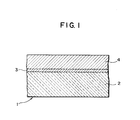
- This monomolecular film was cumulated in 25 layers on a glass substrate 2 having an aluminum reflective layer 3 of about 2000 angstroms in thickness as shown in FIG.
- the sample was irradiated for writing with a semiconductor laser beam having a wavelength of 780 nm in the form of spots with a diameter of 1.25 microns at a power of 6 mW.
- the variation in reflectivity is shown in FIG. 3. This variation in reflectivity was determined by measuring the intensities of reflected light before and after the pulse irradiation while decreasing the output power of the laser. As will be apparent from FIG. 3, the variation of the reflectivity at a pulse width of 0.1 microsecond was about 0.2, making it possible to read.
- the information recording medium obtained in this example has recording characteristics of high sensitivity.
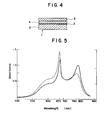
- an approximately 2000 angstrom thick aluminum reflective layer 3 was vacuum deposited on a glass substrate 2, followed by forming a first recording layer 4 and a second recording layer 5 according to the LB method, thereby obtaining a high density information medium.
- the recording layer 4 was formed as follows. A cyanine dye of the aforementioned formula (II) DODAC and methyl stearate at molar ratios of 1:1:2 were dissolved in a chloroform/methanol mixture (4:1) in such a way that the total concentration of DODAC and methyl stearate was 1 mg/ml. The resultant solution was dropped over distilled water at 20°C to develop a monomolecular layer. Then, partition plates were moved for compression so that the surface pressure was 35 dynes/cm. The monomolecular layer was cumulated in 25 sub-layers according to the LB method to form a first recording layer 4 having a thickness of about 800 angstroms. The first recording layer 4 contained the J-aggregates of the dye of formula (II) and had an absorption peak at about 780 nm.
- the second recording layer 5 was formed as follows. A cyanine dye of the formula (III) and arachic acid at a molar mixing ratio of 1:2 were dissolved so that the concentration of the arachic acid was 1 mg/ml. This solution was dropped over distilled water at 16°C to permit a monomolecular layer to develop over the water. Thereafter, partition plates were moved for compression to such an extent that the surface pressure was 30 dynes/cm. The monomolecular layer was cumulated in 6 layers according to the LB method to form a second recording layer 5 having a thickness of about 200 angstroms. The second recording layer 5 had an absorption peak at about 670 nm because of the presence of the J-aggregates of the dye of formula (III).
- the reflection spectrum of the thus obtained sample prior to irradiation of a laser beam is shown in FIG. 5 as a solid line.
- the absorption peaks at about 780 nm and 670 nm were based on the first recording layer 4 and the second recording layer 5, ⁇ respectively.
- the recording medium sample obtained in this Example was placed on a disk and written spirally by irradiation with a laser beam which was in the form of a laser spot having a diameter of about 1.6 microns and a wavelength of 780 nm at a laser output of 3.5 mW and a track pitch of 1 micron.
- the reflection spectrum after writing is shown in FIG. 5 as a broken line.
- multiple recording can be made on the same portion cf the substrate by utilizing the difference in absorbance between the recording layers.
Landscapes
- Optical Record Carriers And Manufacture Thereof (AREA)
- Thermal Transfer Or Thermal Recording In General (AREA)
Applications Claiming Priority (4)
| Application Number | Priority Date | Filing Date | Title |
|---|---|---|---|
| JP60226403A JPH0729487B2 (ja) | 1985-10-11 | 1985-10-11 | レ−ザ記録媒体 |
| JP226403/85 | 1985-10-11 | ||
| JP61009460A JPH0720728B2 (ja) | 1986-01-20 | 1986-01-20 | 高密度レ−ザ記録媒体 |
| JP9460/86 | 1986-01-20 |
Publications (3)
| Publication Number | Publication Date |
|---|---|
| EP0218263A2 true EP0218263A2 (de) | 1987-04-15 |
| EP0218263A3 EP0218263A3 (en) | 1988-07-13 |
| EP0218263B1 EP0218263B1 (de) | 1992-05-27 |
Family
ID=26344197
Family Applications (1)
| Application Number | Title | Priority Date | Filing Date |
|---|---|---|---|
| EP86114086A Expired - Lifetime EP0218263B1 (de) | 1985-10-11 | 1986-10-10 | Laserinformationsaufzeichnungsmedium mit Aufzeichnungsschicht |
Country Status (3)
| Country | Link |
|---|---|
| US (1) | US4767696A (de) |
| EP (1) | EP0218263B1 (de) |
| DE (1) | DE3685470D1 (de) |
Cited By (7)
| Publication number | Priority date | Publication date | Assignee | Title |
|---|---|---|---|---|
| EP0251117A1 (de) * | 1986-07-02 | 1988-01-07 | BASF Aktiengesellschaft | Optische Aufzeichnungsmedien |
| EP0304050A1 (de) * | 1987-08-20 | 1989-02-22 | Fuji Photo Film Co., Ltd. | Optischer Informationsaufzeichnungsträger |
| EP0278356A3 (en) * | 1987-02-04 | 1990-12-19 | Hitachi, Ltd. | Optical recording method |
| EP0324621A3 (de) * | 1988-01-12 | 1991-02-06 | Olympus Optical Co., Ltd. | Herstellen von optischen Karten |
| EP0420659A3 (en) * | 1989-09-29 | 1991-06-05 | Matsushita Electric Industrial Co., Ltd. | Optical information storage mediums |
| FR2656722A1 (fr) * | 1989-12-29 | 1991-07-05 | Thomson Csf | Milieu d'enregistrement optique inscriptible thermo-optiquement, procede de realisation d'un tel milieu et support d'informations utilisant ledit milieu. |
| EP0978392A4 (de) * | 1997-04-23 | 2000-05-10 | Sony Corp | Optisches aufzeichnungsmedium |
Families Citing this family (10)
| Publication number | Priority date | Publication date | Assignee | Title |
|---|---|---|---|---|
| US4935288A (en) * | 1987-12-07 | 1990-06-19 | American Label Systems, Inc. | Coated laser printed labels |
| US6090508A (en) * | 1988-06-07 | 2000-07-18 | Ricoh Company, Ltd. | Optically anisotropic recording medium and method of recording and erasing information using the same |
| US5215800A (en) * | 1989-01-17 | 1993-06-01 | Teijin Limited | Erasable optical recording medium and method for writing, reading and/or erasing thereof |
| JP2801739B2 (ja) * | 1990-05-15 | 1998-09-21 | パイオニア株式会社 | 多層記録膜の記録再生方法 |
| JP2842939B2 (ja) * | 1990-10-15 | 1999-01-06 | パイオニア株式会社 | 光記録媒体 |
| US5776656A (en) * | 1995-07-28 | 1998-07-07 | Tdk Corporation | Optical recording medium |
| US6013430A (en) * | 1998-03-10 | 2000-01-11 | Eastman Kodak Company | Thermal recording element |
| US5965333A (en) * | 1998-03-10 | 1999-10-12 | Eastman Kodak Company | Thermal recording element |
| JP2003059107A (ja) * | 2001-08-08 | 2003-02-28 | Nec Corp | 多層記録層を有する光ディスク、光ディスク製造方法、光ディスク装置ならびに光ディスク記録再生方法 |
| JP2007307814A (ja) * | 2006-05-19 | 2007-11-29 | Taiyo Yuden Co Ltd | 光情報記録媒体およびその製造方法 |
Family Cites Families (5)
| Publication number | Priority date | Publication date | Assignee | Title |
|---|---|---|---|---|
| US4460665A (en) * | 1981-12-28 | 1984-07-17 | Ricoh Co., Ltd. | Optical information recording medium |
| JPS5978341A (ja) * | 1982-10-28 | 1984-05-07 | Ricoh Co Ltd | 光学的情報記録媒体 |
| JPS60121442A (ja) * | 1983-12-06 | 1985-06-28 | Canon Inc | 感光性記録メモリ−媒体および記録再生方法 |
| EP0179436B1 (de) * | 1984-10-25 | 1991-05-08 | Matsushita Electric Industrial Co., Ltd. | Optisches Aufzeichnungsmedium |
| DE3689891T2 (de) * | 1985-03-06 | 1994-10-20 | Matsushita Electric Ind Co Ltd | Optische Aufzeichnungsmedien mit hoher Dichte, Verfahren zu deren Herstellung und Verfahren um optische Informationen in diesem Medium aufzuzeichnen. |
-
1986
- 1986-10-10 DE DE8686114086T patent/DE3685470D1/de not_active Expired - Lifetime
- 1986-10-10 EP EP86114086A patent/EP0218263B1/de not_active Expired - Lifetime
- 1986-10-14 US US06/918,152 patent/US4767696A/en not_active Expired - Fee Related
Cited By (10)
| Publication number | Priority date | Publication date | Assignee | Title |
|---|---|---|---|---|
| EP0251117A1 (de) * | 1986-07-02 | 1988-01-07 | BASF Aktiengesellschaft | Optische Aufzeichnungsmedien |
| EP0278356A3 (en) * | 1987-02-04 | 1990-12-19 | Hitachi, Ltd. | Optical recording method |
| EP0304050A1 (de) * | 1987-08-20 | 1989-02-22 | Fuji Photo Film Co., Ltd. | Optischer Informationsaufzeichnungsträger |
| EP0324621A3 (de) * | 1988-01-12 | 1991-02-06 | Olympus Optical Co., Ltd. | Herstellen von optischen Karten |
| EP0420659A3 (en) * | 1989-09-29 | 1991-06-05 | Matsushita Electric Industrial Co., Ltd. | Optical information storage mediums |
| FR2656722A1 (fr) * | 1989-12-29 | 1991-07-05 | Thomson Csf | Milieu d'enregistrement optique inscriptible thermo-optiquement, procede de realisation d'un tel milieu et support d'informations utilisant ledit milieu. |
| EP0437135A1 (de) * | 1989-12-29 | 1991-07-17 | Thomson-Csf | Thermooptisch beschreibbares optisches Aufzeichnungsmedium, Verfahren zur Herstellung desgleichen und Aufzeichnungsträger der das Gleiche gebraucht |
| EP0978392A4 (de) * | 1997-04-23 | 2000-05-10 | Sony Corp | Optisches aufzeichnungsmedium |
| US6727041B1 (en) | 1997-04-23 | 2004-04-27 | Sony Corporation | Optical recording media |
| US7008753B2 (en) | 1997-04-23 | 2006-03-07 | Sony Corporation | Optical recording medium |
Also Published As
| Publication number | Publication date |
|---|---|
| EP0218263A3 (en) | 1988-07-13 |
| DE3685470D1 (de) | 1992-07-02 |
| EP0218263B1 (de) | 1992-05-27 |
| US4767696A (en) | 1988-08-30 |
Similar Documents
| Publication | Publication Date | Title |
|---|---|---|
| EP0218263B1 (de) | Laserinformationsaufzeichnungsmedium mit Aufzeichnungsschicht | |
| EP0193931B1 (de) | Optische Aufzeichnungsmedien mit hoher Dichte, Verfahren zu deren Herstellung und Verfahren um optische Informationen in diesem Medium aufzuzeichnen | |
| US4819210A (en) | Optical information writing method | |
| Ishimoto et al. | Multiple wavelength optical recording using cyanine dye J aggregates in Langmuir–Blodgett films | |
| CA2271079A1 (en) | Complex polymethine dyes and their use | |
| EP0820057B1 (de) | Datenaufzeichnungsmedium | |
| JPH02155689A (ja) | 光記録方式 | |
| JPH07182693A (ja) | 光記録媒体及びその製造方法 | |
| US5316899A (en) | Optical recording medium | |
| US5117416A (en) | Recording method for multi-layer recording film | |
| US5252371A (en) | Rewritable photochromic optical disk | |
| KR920006313B1 (ko) | 광정보기록매체 및 광기록방법 | |
| JP2890760B2 (ja) | 光学記録媒体 | |
| JPS6285991A (ja) | レ−ザ記録媒体 | |
| JPS62167088A (ja) | 高密度レ−ザ記録媒体 | |
| Zhang et al. | Diarylethene materials for photon-mode optical storage | |
| JPH0558913B2 (de) | ||
| JPH0720729B2 (ja) | レ−ザ記録媒体 | |
| EP0420659B1 (de) | Methode zur Aufzeichnung und Wiedergabe von Informationen mittels eines Mediums für optische Datenspeicherung | |
| JPS63296986A (ja) | 光記録媒体及び記録方法 | |
| Pu et al. | Synthesis and multiwavelength optical recording properties of two new photochromic diarylethenes | |
| JP2518225B2 (ja) | 波長多重レ−ザ記録媒体 | |
| JP2617231B2 (ja) | 光記録及び読み出し方法 | |
| JP2695264B2 (ja) | 光記録及び読み出し方法 | |
| JPH0443572B2 (de) |
Legal Events
| Date | Code | Title | Description |
|---|---|---|---|
| PUAI | Public reference made under article 153(3) epc to a published international application that has entered the european phase |
Free format text: ORIGINAL CODE: 0009012 |
|
| AK | Designated contracting states |
Kind code of ref document: A2 Designated state(s): DE FR GB NL |
|
| PUAL | Search report despatched |
Free format text: ORIGINAL CODE: 0009013 |
|
| AK | Designated contracting states |
Kind code of ref document: A3 Designated state(s): DE FR GB NL |
|
| 17P | Request for examination filed |
Effective date: 19890112 |
|
| 17Q | First examination report despatched |
Effective date: 19900625 |
|
| GRAA | (expected) grant |
Free format text: ORIGINAL CODE: 0009210 |
|
| AK | Designated contracting states |
Kind code of ref document: B1 Designated state(s): DE FR GB NL |
|
| REF | Corresponds to: |
Ref document number: 3685470 Country of ref document: DE Date of ref document: 19920702 |
|
| ET | Fr: translation filed | ||
| PLBE | No opposition filed within time limit |
Free format text: ORIGINAL CODE: 0009261 |
|
| STAA | Information on the status of an ep patent application or granted ep patent |
Free format text: STATUS: NO OPPOSITION FILED WITHIN TIME LIMIT |
|
| 26N | No opposition filed | ||
| PGFP | Annual fee paid to national office [announced via postgrant information from national office to epo] |
Ref country code: GB Payment date: 19961001 Year of fee payment: 11 |
|
| PGFP | Annual fee paid to national office [announced via postgrant information from national office to epo] |
Ref country code: FR Payment date: 19961009 Year of fee payment: 11 |
|
| PG25 | Lapsed in a contracting state [announced via postgrant information from national office to epo] |
Ref country code: GB Free format text: LAPSE BECAUSE OF NON-PAYMENT OF DUE FEES Effective date: 19971010 |
|
| PG25 | Lapsed in a contracting state [announced via postgrant information from national office to epo] |
Ref country code: FR Free format text: THE PATENT HAS BEEN ANNULLED BY A DECISION OF A NATIONAL AUTHORITY Effective date: 19971031 |
|
| GBPC | Gb: european patent ceased through non-payment of renewal fee |
Effective date: 19971010 |
|
| REG | Reference to a national code |
Ref country code: FR Ref legal event code: ST |
|
| PGFP | Annual fee paid to national office [announced via postgrant information from national office to epo] |
Ref country code: DE Payment date: 20011022 Year of fee payment: 16 |
|
| PGFP | Annual fee paid to national office [announced via postgrant information from national office to epo] |
Ref country code: NL Payment date: 20011031 Year of fee payment: 16 |
|
| PG25 | Lapsed in a contracting state [announced via postgrant information from national office to epo] |
Ref country code: NL Free format text: LAPSE BECAUSE OF NON-PAYMENT OF DUE FEES Effective date: 20030501 Ref country code: DE Free format text: LAPSE BECAUSE OF NON-PAYMENT OF DUE FEES Effective date: 20030501 |
|
| NLV4 | Nl: lapsed or anulled due to non-payment of the annual fee |
Effective date: 20030501 |