EP0218937A2 - Führungsbuchse - Google Patents
Führungsbuchse Download PDFInfo
- Publication number
- EP0218937A2 EP0218937A2 EP86112788A EP86112788A EP0218937A2 EP 0218937 A2 EP0218937 A2 EP 0218937A2 EP 86112788 A EP86112788 A EP 86112788A EP 86112788 A EP86112788 A EP 86112788A EP 0218937 A2 EP0218937 A2 EP 0218937A2
- Authority
- EP
- European Patent Office
- Prior art keywords
- socket according
- rod
- hollow ring
- tube
- section
- Prior art date
- Legal status (The legal status is an assumption and is not a legal conclusion. Google has not performed a legal analysis and makes no representation as to the accuracy of the status listed.)
- Granted
Links
- 239000012530 fluid Substances 0.000 claims abstract description 22
- 238000013016 damping Methods 0.000 claims description 9
- 239000007788 liquid Substances 0.000 claims description 4
- 230000007423 decrease Effects 0.000 claims 1
- 239000011796 hollow space material Substances 0.000 claims 1
- 230000013011 mating Effects 0.000 claims 1
- 230000000694 effects Effects 0.000 description 3
- 230000006835 compression Effects 0.000 description 2
- 238000007906 compression Methods 0.000 description 2
- 239000000725 suspension Substances 0.000 description 2
- 238000011161 development Methods 0.000 description 1
- 230000018109 developmental process Effects 0.000 description 1
- 239000000314 lubricant Substances 0.000 description 1
- 238000004519 manufacturing process Methods 0.000 description 1
- 239000000463 material Substances 0.000 description 1
- 238000009423 ventilation Methods 0.000 description 1
Images


Classifications
-
- F—MECHANICAL ENGINEERING; LIGHTING; HEATING; WEAPONS; BLASTING
- F16—ENGINEERING ELEMENTS AND UNITS; GENERAL MEASURES FOR PRODUCING AND MAINTAINING EFFECTIVE FUNCTIONING OF MACHINES OR INSTALLATIONS; THERMAL INSULATION IN GENERAL
- F16C—SHAFTS; FLEXIBLE SHAFTS; ELEMENTS OR CRANKSHAFT MECHANISMS; ROTARY BODIES OTHER THAN GEARING ELEMENTS; BEARINGS
- F16C29/00—Bearings for parts moving only linearly
- F16C29/002—Elastic or yielding linear bearings or bearing supports
-
- F—MECHANICAL ENGINEERING; LIGHTING; HEATING; WEAPONS; BLASTING
- F16—ENGINEERING ELEMENTS AND UNITS; GENERAL MEASURES FOR PRODUCING AND MAINTAINING EFFECTIVE FUNCTIONING OF MACHINES OR INSTALLATIONS; THERMAL INSULATION IN GENERAL
- F16C—SHAFTS; FLEXIBLE SHAFTS; ELEMENTS OR CRANKSHAFT MECHANISMS; ROTARY BODIES OTHER THAN GEARING ELEMENTS; BEARINGS
- F16C29/00—Bearings for parts moving only linearly
-
- F—MECHANICAL ENGINEERING; LIGHTING; HEATING; WEAPONS; BLASTING
- F16—ENGINEERING ELEMENTS AND UNITS; GENERAL MEASURES FOR PRODUCING AND MAINTAINING EFFECTIVE FUNCTIONING OF MACHINES OR INSTALLATIONS; THERMAL INSULATION IN GENERAL
- F16F—SPRINGS; SHOCK-ABSORBERS; MEANS FOR DAMPING VIBRATION
- F16F9/00—Springs, vibration-dampers, shock-absorbers, or similarly-constructed movement-dampers using a fluid or the equivalent as damping medium
- F16F9/02—Springs, vibration-dampers, shock-absorbers, or similarly-constructed movement-dampers using a fluid or the equivalent as damping medium using gas only or vacuum
- F16F9/04—Springs, vibration-dampers, shock-absorbers, or similarly-constructed movement-dampers using a fluid or the equivalent as damping medium using gas only or vacuum in a chamber with a flexible wall
- F16F9/0418—Springs, vibration-dampers, shock-absorbers, or similarly-constructed movement-dampers using a fluid or the equivalent as damping medium using gas only or vacuum in a chamber with a flexible wall having a particular shape, e.g. annular, spherical, tube-like
-
- F—MECHANICAL ENGINEERING; LIGHTING; HEATING; WEAPONS; BLASTING
- F16—ENGINEERING ELEMENTS AND UNITS; GENERAL MEASURES FOR PRODUCING AND MAINTAINING EFFECTIVE FUNCTIONING OF MACHINES OR INSTALLATIONS; THERMAL INSULATION IN GENERAL
- F16F—SPRINGS; SHOCK-ABSORBERS; MEANS FOR DAMPING VIBRATION
- F16F9/00—Springs, vibration-dampers, shock-absorbers, or similarly-constructed movement-dampers using a fluid or the equivalent as damping medium
- F16F9/10—Springs, vibration-dampers, shock-absorbers, or similarly-constructed movement-dampers using a fluid or the equivalent as damping medium using liquid only; using a fluid of which the nature is immaterial
- F16F9/14—Devices with one or more members, e.g. pistons, vanes, moving to and fro in chambers and using throttling effect
- F16F9/16—Devices with one or more members, e.g. pistons, vanes, moving to and fro in chambers and using throttling effect involving only straight-line movement of the effective parts
-
- F—MECHANICAL ENGINEERING; LIGHTING; HEATING; WEAPONS; BLASTING
- F16—ENGINEERING ELEMENTS AND UNITS; GENERAL MEASURES FOR PRODUCING AND MAINTAINING EFFECTIVE FUNCTIONING OF MACHINES OR INSTALLATIONS; THERMAL INSULATION IN GENERAL
- F16F—SPRINGS; SHOCK-ABSORBERS; MEANS FOR DAMPING VIBRATION
- F16F9/00—Springs, vibration-dampers, shock-absorbers, or similarly-constructed movement-dampers using a fluid or the equivalent as damping medium
- F16F9/32—Details
- F16F9/36—Special sealings, including sealings or guides for piston-rods
- F16F9/361—Sealings of the bellows-type
-
- F—MECHANICAL ENGINEERING; LIGHTING; HEATING; WEAPONS; BLASTING
- F16—ENGINEERING ELEMENTS AND UNITS; GENERAL MEASURES FOR PRODUCING AND MAINTAINING EFFECTIVE FUNCTIONING OF MACHINES OR INSTALLATIONS; THERMAL INSULATION IN GENERAL
- F16F—SPRINGS; SHOCK-ABSORBERS; MEANS FOR DAMPING VIBRATION
- F16F2230/00—Purpose; Design features
- F16F2230/10—Enclosure elements, e.g. for protection
- F16F2230/105—Flexible, e.g. bellows or bladder
Definitions
- the invention relates to a liquid damper in the form of a toroidal, flexible hollow ring according to the preamble of the main claim.
- a joint is also known (CH-PS 463 885), in which hollow rings can be designed as open or closed hoses and have a liquid or gaseous fluid as a lubricant in the interior, the two (outer and inner) parts of the hollow ring being in contact with one another issue. Finally, the hollow ring is fixed to the two parts to be fixed to one another at least at one point.
- the invention has for its object to develop a guide bush according to the preamble of the main claim so that it can spring and dampen in addition to the leadership function.
- a guiding function in the alignment of the rod or of the tube arranged concentrically thereto is effected.
- the guidance can therefore also take place along an arbitrarily curved space curve by
- the rod is rigidly attached to a machine part and another is guided along the same, which is attached to the rod.
- Torsional vibrations between the rod and the tube are also largely damped, the hollow ring abutting the inner wall of the tube on the one hand and the outer wall of the rod on the other in a firm frictional engagement.
- the guiding properties along a degree of freedom with the guide bushing designed according to the invention are practically frictionless.
- an elastic hollow ring with an incompressible fluid or an elastic hollow ring with a compressible fluid is used and, moreover, the hollow ring is arranged in its working position sc such that it is not yet completely encompassed by the tube and rather is immersed in the tube during compression, then inherit If the hollow ring is correctly dimensioned when the hollow ring is pulled into the tube, the volume of the fluid contained therein or a hollow ring made of elastic plastic or compressions of the compressible fluid in the case of a hollow ring made of inelastic plastic. In any case, this causes a resilient spring force.
- a two-part design with the invention is also known, wherein the hollow ring is designed to be open and slotted all around on the outside transversely to the axis of the rod and each partial tube has a flange. Each edge formed by the open hollow tube is fixed between the flange of each partial tube and a separate central ring by clamping, for example by screwing the parts together.
- the same spring and damping characteristics can be achieved as in the closed torus, but at each part-tube, a flange and the M ittelring required. It is also possible to use only one partial tube and to form the other part of the hollow ring freely on the outside or in any case above a partial tube.
- the initially empty toroidal hollow ring is mounted and then the fluid is supplied via the central ring or bores or the like made there, which can also serve as ventilation openings.
- the pressure of the fluid is adjustable.
- the guide bush drawn in cross section in FIG. 1 has a flexible hollow ring 5 with a fluid 6 located therein.
- the hollow ring 5 extends more in the axial direction 7 than in the radial direction 8 of the overall toroidal hollow ring 5.
- a rod 10 Arranged in the opening 9 of the hollow ring 5 is a rod 10 which takes up at least the free cross section of the opening 9 and is inserted through the opening 9. Parallel to its extension and concentrically to it, a tube 11 is provided, the free cross section of which, schematically designated by 12, corresponds at most to the area enclosed by the rod 10 inserted through the center of the hollow ring 5.
- projections 13 and ribs 14, which limit the free cross section of the hollow ring 5, are provided in the cavity 13 of the hollow ring 5, so that the flow cross section 15 for the fluid 6 when the guide bush is in operation, i. when deflection according to direction arrow 16 is reduced while increasing the flow resistance for the fluid 6.
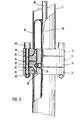
- Figure 3 shows a hollow ring 20 which is divided transversely to the axis of the rod 10 on its outer side 21, wherein the tube 11 is also divided into two and each partial tube is provided with a circumferential flange 23, between which a central ring, generally designated 24, is arranged.
- the central ring has two wedge-shaped inclined surfaces 25 arranged symmetrically to one another and tapering in a wedge shape on each flange 23.
- the counter surfaces 26 on the flasnch 23 are designed accordingly.
- the edges 27 of the hollow ring 21 are clamped between them.
- the flange 23 and the middle piece 24 outside the clear cross-section of each partial tube 11, however, have bores 28 extending parallel to the rod 10, through which the clamping screws 29 are inserted and secured by nuts 30.
- the center ring 24 has a cylindrical inner wall 31 inside, in which a circumferential groove 32, preferably semicircular in cross section, is formed as a damping body for an O-ring designated as 33, which has a narrow one between it and the inner wall of the hollow ring 20 Has slot for the fluid that can be filled through a fill opening 34 in the center ring 24.
Landscapes
- Engineering & Computer Science (AREA)
- General Engineering & Computer Science (AREA)
- Mechanical Engineering (AREA)
- Fluid-Damping Devices (AREA)
- Endoscopes (AREA)
- Pens And Brushes (AREA)
- Turning (AREA)
- Valve-Gear Or Valve Arrangements (AREA)
- Mechanical Coupling Of Light Guides (AREA)
Abstract
Description
- Die Erfindung betrifft einen Flüssigkeitsdämpfer in Form eines torusförmigen, flexiblen Hohlrings gemäß dem Oberbegriff des Hauptanspruchs.
- Es ist eine Lagerung für Schaltwellen bekannt (DE-AS 10 63 863), bei der ein schlauchförmiger Hohlkörper in eine Anzahl von einzelnen, an den Enden offenen bihlauch- stücken unterteilt ist, die an Linien in Umfangsrichtung der Schaltwelle an dieser und am Lagerkörper befestigt sind. Der Hohlkörper ist hierbei aus einem verformbaren Werkstoff hergestellt.
- Es ist weiterhin ein Gelenk bekannt (CH-PS 463 885), bei der.Hohlringe als offene oder geschlossene Schläuche ausgebildet sein können und im Innenbereich ein flüssiges oder gasförmiges Fluid als Schmierstoff aufweisen, wobei die beiden (äußeren und inneren) Teile des Hohlrings aneinander anliegen. Schließlich ist der Hohlring jeweils an den beiden aneinander festzulegenden Teilen zumindest an einer Stelle festgelegt.
- Beide bekannten Lagerungen sollen höchst reibungsarm funktionieren.
- Demgegenüber liegt der Erfindung die Aufgabe zugrunde, eine Führungsbuchse gemäß dem Oberbegriff des Hauptanspruches so weiterzubilden, daß sie neben der Führungsfunktion zugleich federn und dämpfen kann.
- Diese Aufgabe wird gemäß dem kennzeichnenden Teil des neu vorgelegten Hauptanspruchs gelöst.
- Mit der Erfindung wird also eine Führungsfunktion in Ausrichtung des Stabes bzw. des konzentrisch dazu angeordneten Rohres bewirkt. Die Führung kann daher auch längs einer willkürlich gekrümmten Raumkurve erfolgen, indem beispielsweise der Stab starr an einem Maschinenteil angebracht wird und längs desselben ein anderes geführt wird, welches an der Stange befestigt ist. Auch werden Drehschwingungen zwischen Stab und Rohr weitestgehend gedämpft, wobei der Hohlring in festem Reibungsschluß an der Innenwandung des Rohres einerseits sowie der Aussenwandung des Stabes andererseits anliegt. Die Führungseigenschaften längs eines Freiheitsgrades mit der erfindungsgemäß ausgebildeten Führungsbuchse erfolgt dabei praktisch reibungsfrei.
- Wird darüber hinaus ein elastischer Hohlring mit einem inkompressiblen Fluid oder ein elastischer Hohlring mit einem kompressiblen Fluid benutzt und darüber hinaus der Hohlring in seiner Arbeitsstellung sc angeordnet, daß er noch nicht vollständig von dem Rohr umfaßt ist und beim Einfedern vielmehr in dieses eintaucht, so erben sich bei richtiger Dimensionierung beim Einziehen des Hohlrings in das Rohr Verdrändungen an Volumen des darin befindlichen Fluids bzw. einen aus elastischem Kunststoff bestehenden Hohlring bzw. Kompressionen des kompressiblen Fluids bei einem Hohlring aus unelastischem Kunststoff. In jedem Fall wird dadurch eine rücktreibende Federungskraft bewirkt.
- Derselbe Federungseffekt ergibt sich bei vollständig von dem Rohr umschlossenen Hohlring dann wenn der Querschnitt des Ringspaltes über die Führungshohe der Führungsbuchse verändertbeispielweise nach unten hin verengt wird, was durch Vergrößerung des Querschnitts des Stabes und/oder Verkleinerung d Innenquerschnitts des Rohres geschehen kann.

- Wenn des weiteren im Inneren des Hohlrings dessen freien Querschnitt begrenzende Vorsprünge, Noppen oder dergleichen Hindernisse angeordnet werden, so wird der Strömungsquerschnitt im Bereich der Führungsbuchse verringert und damit der strömungswiderstand erhöht, so daß sich außerdem eine Dämpfungswirkung ergibt. Diese kann alleine oder zusammen mit den vorstehend beschriebenen Federungsmöglichkeiten auftreten, und zwar entweder gleichzeitig oder erst nacheinander. In jedem Falle bleibt aber die Führungsfunktion bestehen.
- Es ist ferner eine zweigeteilte Ausbildung mit der Erfindung bekannt, wobei der Hohlring quer zur Achse des Stabes auf seiner Außenseite umlaufend geschlitzt offen ausgebildet ist und jedes Teilrohr einen Flansch aufweist. Jeder von dem offenen Hohlrohr gebildete Rand wird zwischen dem Flansch jedes Teilrohrs und einem gesonderten Mittelring durch Klemmen festgelegt, indem beispielsweise die Teile miteinander fest verschraubt sind. Bei dieser Ausführungsform, die einfach herzustellen ist, können dieselben Federungs- und Dämpfungseigenschaften wie bei dem geschlossenen Torus erzielt werden, allerdings ist an jedem Teilrohr ein Flansch und der Mittelring erforderlich. Es ist auch möglich, nur ein Teilrohr zu verwenden und den anderen Teil des Hohlringes frei außen oder jedenfalls über ein Teilrohr vorstehend auszubilden. Bei dieser Ausführungsform wird der zunächst leere torusförmige Hohlring montiert und danach das Fluid über den Mittelring bzw. dort angebrachte Bohrungen oder dergleichen zugeführt, die zugleich als Entlüftungsöffnungen dienen können. Bei dieser Ausführungsform ist es von Vorteil, daß der Druck des Fluids einstellbar ist.
- Zweckmäßige Ausgestaltungen und Weiterbildungen der Erfindung sind in den Unteransprüchen gekennzeichnet.
- Drei bevorzugte Ausführungsbeispiele der Erfindung werden nachfolgend unter Bezugnahme auf die Zeichnungen näher erläutert.
- In diesen zeigen:
- Figur 1 eine erste FUhrungsbuchse mit sowohl federnden als auch dämpfenden Eigenschaften;
- Figur 2 eine zweite Führungsbuchse mit dämpfenden Eigenschaften, jeweils in schematischem Querschnitt;
- Figur 3 eine dritte Ausführungsform mit einem außen geteilten Hohlring.
- Die in Figur 1 im Querschnitt gezeichnete FUhrungsbuchse weist einen flexiblen Hohlring 5 mit einem darin befindlichen Fluid 6 auf. Der Hohlring 5 erstreckt sich mehr in axialer Richtung 7 als in radialer Richtung 8 des insgesamt torusförmigen Hohlringes 5.
- In der Öffnung 9 des Hohlringes 5 ist ein zumindest den freien Querschnitt der Öffnung 9 einnehmender und durch die Öffnung 9 hindurchgesteckter Stab 10 angeordnet. Parallel zu dessen Erstreckung sowie konzentrisch zu diesem ist ein Rohr 11 vorgesehen, dessen schematisch mit 12 bezeichneter freier Querschnitt höchstens der von der Kontur des Hohlringes 5 mitten hindurchgestecktem Stab 10 umschlossenen Fläche entspricht.
- Desweiteren sind im Hohlraum 13 des Hohlringes 5 dessen freien Querschnitt begrenzende VorsprUnge 13 sowie Rippen 14 vorgesehen, so daß der Strömungsquerschnitt 15 für das Fluid 6 in Betrieb der FUhrungsbuchse, d.h. beim Einfedern gemäß Richtungspfeil 16 unter gleichzeitiger Vergrößerung des Strömungswiderstandes für das Fluid 6 verringert wird.
- Aufgrund dieser Ausbildung ist beim Bewegen des Stabes 10 gemäß Richtungspfeil 16 zunächst mit einer Federungswirkung, d. h. mit einer entgegen Richtungspfeil 16 wirkenden rücktreibenden Kraft solange zu rechnen, bis der Hohlring 5 vollständig, wie in Figur 2 gezeigt, von dem Rohr 11 umgriffen ist. Zugleich ist ersichtlich, daß das beim Einziehen des Hohlringes 5 in das Rohr 11 verdrängte Fluid als Druckkraft auf den Hohlring 5 aus elastischem Kunststoff wirkt, der sich infolgedessen solange dehnt, bis er die in Figur 2 gezeigte Lage erreicht hat. In dieser Stellung - gleicher Ringspaltquerschnitt zwischen dem Stab 10 und dem Rohr 11 Überall vorausgesetzt - besitzt der Hohlring 5 keine Federungseigenschaften mehr. Es folgt lediglich eine Dämpfung infolge des verringerten Strömungsquerschnittes 15. Diese Dämpfung war auch wirksam bei der Stellung gemäß Figur 1, d. h. zugleich mit der Federwirkung.
- Figur 3 zeigt einen Hohlring 20, der zur Achse des Stabes 10 quer auf seiner Außenseite 21 geteilt ist, wobei auch das Rohr 11 zweigeteilt ist und jedes Teilrohr mit einem umlaufenden Flansch 23 versehen ist, zwischen denen ein insgesamt mit 24 bezeichneter Mittelring angeordnet ist. Der Mittelring weist zwei symmetrisch zueinander angeordnete, sich keilförmig auf jeden Flansch 23 hin verjüngende, keilförmige Schrägflächen 25 auf. Die Gegenflächen 26 am Flasnch 23 sind entsprechend ausgebildet. Zwischen ihnen sind die Ränder 27 des Hohlrings 21 festgeklemmt. Zu diesem Zwecke weisen der Flansch 23 und das Mittelstück 24 außerhalb des lichten Querschnitts jedes Teilrohres 11 sich jedoch parallel zur Stange 10 erstreckende Bohrungen 28 auf, durch die Klemmschrauben 29 hindurchgesteckt und mittels Muttern 30 gesichert sind.
- Der Mittelring 24 weist im Inneren eine zylindrische Innenwand 31 auf, in der eine umlaufende Nut 32, vorzugsweise im Querschnitt halbkreisförmig, fUr einen mit insgesamt 33 bezeichneten O-Ring als Dämpfungskörper ausgebildet ist, der zwischen sich und der inneren Wand des Hohlrings 20 einen schmalen Schlitz für das Fluid aufweist, das über eine Einfüllöffnung 34 in dem Mittelring 24 eingefüllt werden kann.
Claims (26)
Priority Applications (1)
| Application Number | Priority Date | Filing Date | Title |
|---|---|---|---|
| AT86112788T ATE62980T1 (de) | 1985-09-16 | 1986-09-16 | Fuehrungsbuchse. |
Applications Claiming Priority (2)
| Application Number | Priority Date | Filing Date | Title |
|---|---|---|---|
| DE8526480U | 1985-09-16 | ||
| DE8526480U DE8526480U1 (de) | 1985-09-16 | 1985-09-16 | Führungsbuchse |
Publications (3)
| Publication Number | Publication Date |
|---|---|
| EP0218937A2 true EP0218937A2 (de) | 1987-04-22 |
| EP0218937A3 EP0218937A3 (en) | 1987-05-27 |
| EP0218937B1 EP0218937B1 (de) | 1991-04-24 |
Family
ID=6785317
Family Applications (1)
| Application Number | Title | Priority Date | Filing Date |
|---|---|---|---|
| EP86112788A Expired - Lifetime EP0218937B1 (de) | 1985-09-16 | 1986-09-16 | Führungsbuchse |
Country Status (3)
| Country | Link |
|---|---|
| EP (1) | EP0218937B1 (de) |
| AT (1) | ATE62980T1 (de) |
| DE (2) | DE8526480U1 (de) |
Cited By (4)
| Publication number | Priority date | Publication date | Assignee | Title |
|---|---|---|---|---|
| WO1998035165A1 (en) * | 1997-02-11 | 1998-08-13 | 1... Ipr Limited | Motors, and bearings therefor |
| GB2354046A (en) * | 1997-02-11 | 2001-03-14 | 1 Ipr Ltd | Linear bearing |
| JP2017093505A (ja) * | 2015-11-18 | 2017-06-01 | 株式会社イノフィス | 引張バネ及び人体サポート装置 |
| JP2020157099A (ja) * | 2015-11-18 | 2020-10-01 | 株式会社イノフィス | 引張バネ及び人体サポート装置 |
Families Citing this family (2)
| Publication number | Priority date | Publication date | Assignee | Title |
|---|---|---|---|---|
| DE19741266A1 (de) * | 1997-08-05 | 1999-02-11 | Marker Deutschland Gmbh | Stoßdämpfer |
| DE202017003374U1 (de) * | 2017-06-27 | 2017-11-29 | Berthold van Schoor | Führung, insbesondere Linearführung, zugleich Schlitten aus einem in sich geschlossenen, quer zur Längsrichtung gewölbten Band. Insbesondere für LED- und Niedervoltleuchten, elektronisches Spielzeug Mikrofone und andere Sensoren |
Family Cites Families (6)
| Publication number | Priority date | Publication date | Assignee | Title |
|---|---|---|---|---|
| DE1063863B (de) * | 1957-03-28 | 1959-08-20 | Maschf Augsburg Nuernberg Ag | Lagerung der Schaltwellen von Getrieben oder aehnlichen in Richtung ihrer Laengsachse verschieblichen Bauteilen |
| FR1499340A (fr) * | 1966-09-09 | 1967-10-27 | Salomon & Fils F | Palier antifriction pour mouvements alternatifs |
| LU72099A1 (de) * | 1974-05-10 | 1975-08-20 | ||
| DE2609911A1 (de) * | 1976-03-10 | 1977-09-15 | Balkau Rolf | Elastische winkelbewegliche wellenkupplung mit hydraulischer balgabstuetzung |
| FR2554531B1 (fr) * | 1983-11-08 | 1988-11-10 | Glaenzer Spicer Sa | Accouplement universel destine a transmettre un mouvement de rotation et un couple entre deux arbres sous forte angularite |
| DE3343340C1 (de) * | 1983-11-30 | 1985-06-13 | Max Planck Gesellschaft | Linearverstellvorrichtung |
-
1985
- 1985-09-16 DE DE8526480U patent/DE8526480U1/de not_active Expired
-
1986
- 1986-09-16 DE DE8686112788T patent/DE3678892D1/de not_active Expired - Fee Related
- 1986-09-16 AT AT86112788T patent/ATE62980T1/de active
- 1986-09-16 EP EP86112788A patent/EP0218937B1/de not_active Expired - Lifetime
Cited By (7)
| Publication number | Priority date | Publication date | Assignee | Title |
|---|---|---|---|---|
| WO1998035165A1 (en) * | 1997-02-11 | 1998-08-13 | 1... Ipr Limited | Motors, and bearings therefor |
| GB2354046A (en) * | 1997-02-11 | 2001-03-14 | 1 Ipr Ltd | Linear bearing |
| GB2354046B (en) * | 1997-02-11 | 2001-06-06 | 1 Ipr Ltd | Bearing |
| US6309106B1 (en) | 1997-02-11 | 2001-10-30 | 1... Limited | Motors, and bearings therefor |
| US6483208B2 (en) | 1997-02-11 | 2002-11-19 | 1 . . . Limited | Linear motor |
| JP2017093505A (ja) * | 2015-11-18 | 2017-06-01 | 株式会社イノフィス | 引張バネ及び人体サポート装置 |
| JP2020157099A (ja) * | 2015-11-18 | 2020-10-01 | 株式会社イノフィス | 引張バネ及び人体サポート装置 |
Also Published As
| Publication number | Publication date |
|---|---|
| ATE62980T1 (de) | 1991-05-15 |
| EP0218937A3 (en) | 1987-05-27 |
| DE8526480U1 (de) | 1987-01-22 |
| EP0218937B1 (de) | 1991-04-24 |
| DE3678892D1 (de) | 1991-05-29 |
Similar Documents
| Publication | Publication Date | Title |
|---|---|---|
| DE3617787C2 (de) | ||
| EP0806514B1 (de) | Reibungsdämpfer, insbesondere für Waschmaschinen mit Schleudergang | |
| DE4104717A1 (de) | Schwingungsgedaempfte geradefuehrungseinheit | |
| DE2217309C3 (de) | Vorrichtung zur Übertragung einer Drehbewegung | |
| DE4003245C2 (de) | Führung für teleskopartig ineinander verschiebbare zylindrische Teile | |
| DE3222885C2 (de) | Hydraulikdämpfer | |
| EP0089311A2 (de) | Schwingungstilger und Verwendung desselben | |
| DE2246454C3 (de) | Anschlag zur Begrenzung der axialen Relativbewegung zwischen zwei mechanischen Teilen | |
| DE2942716A1 (de) | Reibungsdaempfer | |
| EP0177693A2 (de) | Potentiometer | |
| DE3025601C2 (de) | Anordnung zum geräuscharmen Aufhängen von langgestreckten Bauteilen, wie Rohren oder Schläuchen | |
| DE69104549T2 (de) | Verbesserungen hydraulischer Antischwingungsvorrichtungen. | |
| EP0218937A2 (de) | Führungsbuchse | |
| DE2633014A1 (de) | Einstellbarer hydraulischer stossdaempfer | |
| DE3017321A1 (de) | Daempfungsvorrichtung fuer mess- und regelgeraete o.dgl. | |
| EP0543183B1 (de) | Schreibgerät | |
| DE2239555C3 (de) | Vorrichtung zur fuehrung von schlitten, traversen oder anderen verstellbaren maschinenteilen an fuehrungssaeulen | |
| DE4444272C2 (de) | Tragsystem | |
| WO2001090587A1 (de) | Längenverstellbares rohr | |
| EP0837241B1 (de) | Axialkolbenmaschine mit variabler Fixierung der Steuerscheibe | |
| DE2002996C3 (de) | Lagerung, insbesondere für Verstellringe photographischer Kameras | |
| DE3209620A1 (de) | Doppelkardangelenk | |
| DE2950119C2 (de) | Vorrichtung zum stufenlosen Verstellen und Feststellen der Höhe von Zuggabeln an Anhängern | |
| DE2554178C3 (de) | Lager für Meßinstrumente | |
| EP0949434B1 (de) | Schraubgetriebe |
Legal Events
| Date | Code | Title | Description |
|---|---|---|---|
| PUAI | Public reference made under article 153(3) epc to a published international application that has entered the european phase |
Free format text: ORIGINAL CODE: 0009012 |
|
| PUAL | Search report despatched |
Free format text: ORIGINAL CODE: 0009013 |
|
| AK | Designated contracting states |
Kind code of ref document: A2 Designated state(s): AT BE CH DE FR GB IT LI LU NL SE |
|
| AK | Designated contracting states |
Kind code of ref document: A3 Designated state(s): AT BE CH DE FR GB IT LI LU NL SE |
|
| 17P | Request for examination filed |
Effective date: 19870603 |
|
| 17Q | First examination report despatched |
Effective date: 19880811 |
|
| GRAA | (expected) grant |
Free format text: ORIGINAL CODE: 0009210 |
|
| AK | Designated contracting states |
Kind code of ref document: B1 Designated state(s): AT BE CH DE FR GB IT LI LU NL SE |
|
| PG25 | Lapsed in a contracting state [announced via postgrant information from national office to epo] |
Ref country code: IT Free format text: LAPSE BECAUSE OF FAILURE TO SUBMIT A TRANSLATION OF THE DESCRIPTION OR TO PAY THE FEE WITHIN THE PRE;WARNING: LAPSES OF ITALIAN PATENTS WITH EFFECTIVE DATE BEFORE 2007 MAY HAVE OCCURRED AT ANY TIME BEFORE 2007. THE CORRECT EFFECTIVE DATE MAY BE DIFFERENT FROM THE ONE RECORDED.SCRIBED TIME-LIMIT Effective date: 19910424 Ref country code: NL Effective date: 19910424 Ref country code: SE Effective date: 19910424 Ref country code: BE Effective date: 19910424 Ref country code: GB Effective date: 19910424 |
|
| REF | Corresponds to: |
Ref document number: 62980 Country of ref document: AT Date of ref document: 19910515 Kind code of ref document: T |
|
| REF | Corresponds to: |
Ref document number: 3678892 Country of ref document: DE Date of ref document: 19910529 |
|
| ET | Fr: translation filed | ||
| NLV1 | Nl: lapsed or annulled due to failure to fulfill the requirements of art. 29p and 29m of the patents act | ||
| PG25 | Lapsed in a contracting state [announced via postgrant information from national office to epo] |
Ref country code: LU Free format text: LAPSE BECAUSE OF NON-PAYMENT OF DUE FEES Effective date: 19910930 |
|
| GBV | Gb: ep patent (uk) treated as always having been void in accordance with gb section 77(7)/1977 [no translation filed] | ||
| PLBE | No opposition filed within time limit |
Free format text: ORIGINAL CODE: 0009261 |
|
| STAA | Information on the status of an ep patent application or granted ep patent |
Free format text: STATUS: NO OPPOSITION FILED WITHIN TIME LIMIT |
|
| 26N | No opposition filed | ||
| PGFP | Annual fee paid to national office [announced via postgrant information from national office to epo] |
Ref country code: DE Payment date: 19971128 Year of fee payment: 12 |
|
| PGFP | Annual fee paid to national office [announced via postgrant information from national office to epo] |
Ref country code: CH Payment date: 19980908 Year of fee payment: 13 |
|
| PGFP | Annual fee paid to national office [announced via postgrant information from national office to epo] |
Ref country code: AT Payment date: 19980914 Year of fee payment: 13 |
|
| PGFP | Annual fee paid to national office [announced via postgrant information from national office to epo] |
Ref country code: FR Payment date: 19980930 Year of fee payment: 13 |
|
| PG25 | Lapsed in a contracting state [announced via postgrant information from national office to epo] |
Ref country code: DE Free format text: LAPSE BECAUSE OF NON-PAYMENT OF DUE FEES Effective date: 19990701 |
|
| PG25 | Lapsed in a contracting state [announced via postgrant information from national office to epo] |
Ref country code: AT Free format text: LAPSE BECAUSE OF NON-PAYMENT OF DUE FEES Effective date: 19990916 |
|
| PG25 | Lapsed in a contracting state [announced via postgrant information from national office to epo] |
Ref country code: LI Free format text: LAPSE BECAUSE OF NON-PAYMENT OF DUE FEES Effective date: 19990930 Ref country code: CH Free format text: LAPSE BECAUSE OF NON-PAYMENT OF DUE FEES Effective date: 19990930 |
|
| REG | Reference to a national code |
Ref country code: CH Ref legal event code: PL |
|
| PG25 | Lapsed in a contracting state [announced via postgrant information from national office to epo] |
Ref country code: FR Free format text: LAPSE BECAUSE OF NON-PAYMENT OF DUE FEES Effective date: 20000531 |
|
| REG | Reference to a national code |
Ref country code: FR Ref legal event code: ST |