EP0218976A2 - Verfahren zur Herstellung von 1-substituierten Azacycloalkan-2-onen - Google Patents
Verfahren zur Herstellung von 1-substituierten Azacycloalkan-2-onen Download PDFInfo
- Publication number
- EP0218976A2 EP0218976A2 EP86113358A EP86113358A EP0218976A2 EP 0218976 A2 EP0218976 A2 EP 0218976A2 EP 86113358 A EP86113358 A EP 86113358A EP 86113358 A EP86113358 A EP 86113358A EP 0218976 A2 EP0218976 A2 EP 0218976A2
- Authority
- EP
- European Patent Office
- Prior art keywords
- alkali metal
- azacycloalkan
- ones
- sodium
- general formula
- Prior art date
- Legal status (The legal status is an assumption and is not a legal conclusion. Google has not performed a legal analysis and makes no representation as to the accuracy of the status listed.)
- Withdrawn
Links
- 238000000034 method Methods 0.000 title claims abstract description 12
- 238000002360 preparation method Methods 0.000 title claims abstract description 5
- 229910052783 alkali metal Inorganic materials 0.000 claims abstract description 15
- WQDUMFSSJAZKTM-UHFFFAOYSA-N Sodium methoxide Chemical compound [Na+].[O-]C WQDUMFSSJAZKTM-UHFFFAOYSA-N 0.000 claims abstract description 12
- -1 alkali metal salt Chemical class 0.000 claims abstract description 10
- 229910000272 alkali metal oxide Inorganic materials 0.000 claims abstract description 8
- 150000001340 alkali metals Chemical class 0.000 claims abstract description 8
- KKCBUQHMOMHUOY-UHFFFAOYSA-N sodium oxide Chemical compound [O-2].[Na+].[Na+] KKCBUQHMOMHUOY-UHFFFAOYSA-N 0.000 claims abstract description 4
- 229910001948 sodium oxide Inorganic materials 0.000 claims abstract description 4
- 125000000217 alkyl group Chemical group 0.000 claims abstract description 3
- 125000004432 carbon atom Chemical group C* 0.000 claims abstract description 3
- 229910052739 hydrogen Inorganic materials 0.000 claims abstract description 3
- 239000001257 hydrogen Substances 0.000 claims abstract description 3
- 125000004435 hydrogen atom Chemical group [H]* 0.000 claims abstract description 3
- QDRKDTQENPPHOJ-UHFFFAOYSA-N sodium ethoxide Chemical compound [Na+].CC[O-] QDRKDTQENPPHOJ-UHFFFAOYSA-N 0.000 claims abstract description 3
- 239000002168 alkylating agent Substances 0.000 abstract description 3
- 229940100198 alkylating agent Drugs 0.000 abstract description 3
- 230000029936 alkylation Effects 0.000 abstract description 2
- 238000005804 alkylation reaction Methods 0.000 abstract description 2
- YXFVVABEGXRONW-UHFFFAOYSA-N Toluene Chemical compound CC1=CC=CC=C1 YXFVVABEGXRONW-UHFFFAOYSA-N 0.000 description 12
- XTHFKEDIFFGKHM-UHFFFAOYSA-N Dimethoxyethane Chemical compound COCCOC XTHFKEDIFFGKHM-UHFFFAOYSA-N 0.000 description 10
- 238000006243 chemical reaction Methods 0.000 description 8
- RTZKZFJDLAIYFH-UHFFFAOYSA-N Diethyl ether Chemical compound CCOCC RTZKZFJDLAIYFH-UHFFFAOYSA-N 0.000 description 7
- 239000011541 reaction mixture Substances 0.000 description 6
- 239000002904 solvent Substances 0.000 description 6
- 239000000203 mixture Substances 0.000 description 4
- 239000003921 oil Substances 0.000 description 4
- AXTGDCSMTYGJND-UHFFFAOYSA-N 1-dodecylazepan-2-one Chemical compound CCCCCCCCCCCCN1CCCCCC1=O AXTGDCSMTYGJND-UHFFFAOYSA-N 0.000 description 3
- RPVBFFYNFVTCBX-UHFFFAOYSA-N 1-trimethylsilylazepan-2-one Chemical compound C[Si](C)(C)N1CCCCCC1=O RPVBFFYNFVTCBX-UHFFFAOYSA-N 0.000 description 3
- UHOVQNZJYSORNB-UHFFFAOYSA-N Benzene Chemical compound C1=CC=CC=C1 UHOVQNZJYSORNB-UHFFFAOYSA-N 0.000 description 3
- ZMANZCXQSJIPKH-UHFFFAOYSA-N Triethylamine Chemical compound CCN(CC)CC ZMANZCXQSJIPKH-UHFFFAOYSA-N 0.000 description 3
- 150000001875 compounds Chemical class 0.000 description 3
- 238000010992 reflux Methods 0.000 description 3
- 239000000725 suspension Substances 0.000 description 3
- XLYOFNOQVPJJNP-UHFFFAOYSA-N water Substances O XLYOFNOQVPJJNP-UHFFFAOYSA-N 0.000 description 3
- PBLNBZIONSLZBU-UHFFFAOYSA-N 1-bromododecane Chemical compound CCCCCCCCCCCCBr PBLNBZIONSLZBU-UHFFFAOYSA-N 0.000 description 2
- KEAYESYHFKHZAL-UHFFFAOYSA-N Sodium Chemical compound [Na] KEAYESYHFKHZAL-UHFFFAOYSA-N 0.000 description 2
- QAOWNCQODCNURD-UHFFFAOYSA-N Sulfuric acid Chemical compound OS(O)(=O)=O QAOWNCQODCNURD-UHFFFAOYSA-N 0.000 description 2
- NTSNXSJENBZFSF-UHFFFAOYSA-N [Na+].[SiH3][O-] Chemical compound [Na+].[SiH3][O-] NTSNXSJENBZFSF-UHFFFAOYSA-N 0.000 description 2
- 125000001931 aliphatic group Chemical group 0.000 description 2
- 150000001350 alkyl halides Chemical class 0.000 description 2
- RDOXTESZEPMUJZ-UHFFFAOYSA-N anisole Chemical compound COC1=CC=CC=C1 RDOXTESZEPMUJZ-UHFFFAOYSA-N 0.000 description 2
- 230000015572 biosynthetic process Effects 0.000 description 2
- 239000003153 chemical reaction reagent Substances 0.000 description 2
- IJOOHPMOJXWVHK-UHFFFAOYSA-N chlorotrimethylsilane Chemical compound C[Si](C)(C)Cl IJOOHPMOJXWVHK-UHFFFAOYSA-N 0.000 description 2
- 238000004821 distillation Methods 0.000 description 2
- 239000000706 filtrate Substances 0.000 description 2
- FFUAGWLWBBFQJT-UHFFFAOYSA-N hexamethyldisilazane Chemical compound C[Si](C)(C)N[Si](C)(C)C FFUAGWLWBBFQJT-UHFFFAOYSA-N 0.000 description 2
- 239000012442 inert solvent Substances 0.000 description 2
- 239000011734 sodium Substances 0.000 description 2
- JHJLBTNAGRQEKS-UHFFFAOYSA-M sodium bromide Chemical compound [Na+].[Br-] JHJLBTNAGRQEKS-UHFFFAOYSA-M 0.000 description 2
- 159000000000 sodium salts Chemical class 0.000 description 2
- MOMGDEWWZBKDDR-UHFFFAOYSA-M sodium;3,4,5,6-tetrahydro-2h-azepin-7-olate Chemical compound [Na+].O=C1CCCCC[N-]1 MOMGDEWWZBKDDR-UHFFFAOYSA-M 0.000 description 2
- MNDIARAMWBIKFW-UHFFFAOYSA-N 1-bromohexane Chemical compound CCCCCCBr MNDIARAMWBIKFW-UHFFFAOYSA-N 0.000 description 1
- BAWUFGWWCWMUNU-UHFFFAOYSA-N 1-hexylpyrrolidin-2-one Chemical compound CCCCCCN1CCCC1=O BAWUFGWWCWMUNU-UHFFFAOYSA-N 0.000 description 1
- LUBVCBITQHEVCJ-UHFFFAOYSA-N 1-trimethylsilylpyrrolidin-2-one Chemical compound C[Si](C)(C)N1CCCC1=O LUBVCBITQHEVCJ-UHFFFAOYSA-N 0.000 description 1
- DGAQECJNVWCQMB-PUAWFVPOSA-M Ilexoside XXIX Chemical compound C[C@@H]1CC[C@@]2(CC[C@@]3(C(=CC[C@H]4[C@]3(CC[C@@H]5[C@@]4(CC[C@@H](C5(C)C)OS(=O)(=O)[O-])C)C)[C@@H]2[C@]1(C)O)C)C(=O)O[C@H]6[C@@H]([C@H]([C@@H]([C@H](O6)CO)O)O)O.[Na+] DGAQECJNVWCQMB-PUAWFVPOSA-M 0.000 description 1
- WHXSMMKQMYFTQS-UHFFFAOYSA-N Lithium Chemical compound [Li] WHXSMMKQMYFTQS-UHFFFAOYSA-N 0.000 description 1
- ZWXPDGCFMMFNRW-UHFFFAOYSA-N N-methylcaprolactam Chemical compound CN1CCCCCC1=O ZWXPDGCFMMFNRW-UHFFFAOYSA-N 0.000 description 1
- ZLMJMSJWJFRBEC-UHFFFAOYSA-N Potassium Chemical compound [K] ZLMJMSJWJFRBEC-UHFFFAOYSA-N 0.000 description 1
- PMZURENOXWZQFD-UHFFFAOYSA-L Sodium Sulfate Chemical compound [Na+].[Na+].[O-]S([O-])(=O)=O PMZURENOXWZQFD-UHFFFAOYSA-L 0.000 description 1
- 239000008186 active pharmaceutical agent Substances 0.000 description 1
- 150000001298 alcohols Chemical class 0.000 description 1
- 150000001339 alkali metal compounds Chemical class 0.000 description 1
- 229910001508 alkali metal halide Inorganic materials 0.000 description 1
- 150000008045 alkali metal halides Chemical class 0.000 description 1
- 150000008052 alkyl sulfonates Chemical class 0.000 description 1
- 230000002152 alkylating effect Effects 0.000 description 1
- 150000001450 anions Chemical class 0.000 description 1
- 150000004945 aromatic hydrocarbons Chemical class 0.000 description 1
- 150000008378 aryl ethers Chemical class 0.000 description 1
- 238000009835 boiling Methods 0.000 description 1
- 150000003857 carboxamides Chemical class 0.000 description 1
- 238000001816 cooling Methods 0.000 description 1
- 239000003814 drug Substances 0.000 description 1
- 239000000975 dye Substances 0.000 description 1
- 238000004043 dyeing Methods 0.000 description 1
- 150000002148 esters Chemical class 0.000 description 1
- 239000000835 fiber Substances 0.000 description 1
- UQEAIHBTYFGYIE-UHFFFAOYSA-N hexamethyldisiloxane Chemical compound C[Si](C)(C)O[Si](C)(C)C UQEAIHBTYFGYIE-UHFFFAOYSA-N 0.000 description 1
- 210000000548 hind-foot Anatomy 0.000 description 1
- 229910052744 lithium Inorganic materials 0.000 description 1
- UZKWTJUDCOPSNM-UHFFFAOYSA-N methoxybenzene Substances CCCCOC=C UZKWTJUDCOPSNM-UHFFFAOYSA-N 0.000 description 1
- MBABOKRGFJTBAE-UHFFFAOYSA-N methyl methanesulfonate Chemical compound COS(C)(=O)=O MBABOKRGFJTBAE-UHFFFAOYSA-N 0.000 description 1
- 230000035515 penetration Effects 0.000 description 1
- 230000007903 penetration ability Effects 0.000 description 1
- 239000000825 pharmaceutical preparation Substances 0.000 description 1
- 229910052700 potassium Inorganic materials 0.000 description 1
- 239000011591 potassium Substances 0.000 description 1
- 239000002244 precipitate Substances 0.000 description 1
- 230000001681 protective effect Effects 0.000 description 1
- 230000009257 reactivity Effects 0.000 description 1
- 229910052708 sodium Inorganic materials 0.000 description 1
- ODZPKZBBUMBTMG-UHFFFAOYSA-N sodium amide Chemical compound [NH2-].[Na+] ODZPKZBBUMBTMG-UHFFFAOYSA-N 0.000 description 1
- 229910000104 sodium hydride Inorganic materials 0.000 description 1
- 239000012312 sodium hydride Substances 0.000 description 1
- 229910052938 sodium sulfate Inorganic materials 0.000 description 1
- 235000011152 sodium sulphate Nutrition 0.000 description 1
- KKVTYAVXTDIPAP-UHFFFAOYSA-M sodium;methanesulfonate Chemical compound [Na+].CS([O-])(=O)=O KKVTYAVXTDIPAP-UHFFFAOYSA-M 0.000 description 1
- 239000007858 starting material Substances 0.000 description 1
- 238000003756 stirring Methods 0.000 description 1
- BDHFUVZGWQCTTF-UHFFFAOYSA-M sulfonate Chemical compound [O-]S(=O)=O BDHFUVZGWQCTTF-UHFFFAOYSA-M 0.000 description 1
- 239000004753 textile Substances 0.000 description 1
- 239000005051 trimethylchlorosilane Substances 0.000 description 1
Classifications
-
- C—CHEMISTRY; METALLURGY
- C07—ORGANIC CHEMISTRY
- C07D—HETEROCYCLIC COMPOUNDS
- C07D207/00—Heterocyclic compounds containing five-membered rings not condensed with other rings, with one nitrogen atom as the only ring hetero atom
- C07D207/02—Heterocyclic compounds containing five-membered rings not condensed with other rings, with one nitrogen atom as the only ring hetero atom with only hydrogen or carbon atoms directly attached to the ring nitrogen atom
- C07D207/18—Heterocyclic compounds containing five-membered rings not condensed with other rings, with one nitrogen atom as the only ring hetero atom with only hydrogen or carbon atoms directly attached to the ring nitrogen atom having one double bond between ring members or between a ring member and a non-ring member
- C07D207/22—Heterocyclic compounds containing five-membered rings not condensed with other rings, with one nitrogen atom as the only ring hetero atom with only hydrogen or carbon atoms directly attached to the ring nitrogen atom having one double bond between ring members or between a ring member and a non-ring member with hetero atoms or with carbon atoms having three bonds to hetero atoms with at the most one bond to halogen, e.g. ester or nitrile radicals, directly attached to ring carbon atoms
- C07D207/24—Oxygen or sulfur atoms
- C07D207/26—2-Pyrrolidones
- C07D207/263—2-Pyrrolidones with only hydrogen atoms or radicals containing only hydrogen and carbon atoms directly attached to other ring carbon atoms
- C07D207/267—2-Pyrrolidones with only hydrogen atoms or radicals containing only hydrogen and carbon atoms directly attached to other ring carbon atoms with only hydrogen atoms or radicals containing only hydrogen and carbon atoms directly attached to the ring nitrogen atom
-
- C—CHEMISTRY; METALLURGY
- C07—ORGANIC CHEMISTRY
- C07D—HETEROCYCLIC COMPOUNDS
- C07D211/00—Heterocyclic compounds containing hydrogenated pyridine rings, not condensed with other rings
- C07D211/04—Heterocyclic compounds containing hydrogenated pyridine rings, not condensed with other rings with only hydrogen or carbon atoms directly attached to the ring nitrogen atom
- C07D211/68—Heterocyclic compounds containing hydrogenated pyridine rings, not condensed with other rings with only hydrogen or carbon atoms directly attached to the ring nitrogen atom having one double bond between ring members or between a ring member and a non-ring member
- C07D211/72—Heterocyclic compounds containing hydrogenated pyridine rings, not condensed with other rings with only hydrogen or carbon atoms directly attached to the ring nitrogen atom having one double bond between ring members or between a ring member and a non-ring member with hetero atoms or with carbon atoms having three bonds to hetero atoms, with at the most one bond to halogen, directly attached to ring carbon atoms
- C07D211/74—Oxygen atoms
- C07D211/76—Oxygen atoms attached in position 2 or 6
-
- C—CHEMISTRY; METALLURGY
- C07—ORGANIC CHEMISTRY
- C07D—HETEROCYCLIC COMPOUNDS
- C07D223/00—Heterocyclic compounds containing seven-membered rings having one nitrogen atom as the only ring hetero atom
- C07D223/02—Heterocyclic compounds containing seven-membered rings having one nitrogen atom as the only ring hetero atom not condensed with other rings
- C07D223/06—Heterocyclic compounds containing seven-membered rings having one nitrogen atom as the only ring hetero atom not condensed with other rings with hetero atoms or with carbon atoms having three bonds to hetero atoms with at the most one bond to halogen, e.g. ester or nitrile radicals, directly attached to ring carbon atoms
- C07D223/08—Oxygen atoms
- C07D223/10—Oxygen atoms attached in position 2
Definitions
- the compounds of the general formula I are generally prepared by alkylation of 1-unsubstituted azacycloalkan-2-ones of the general formula II, in which R and m have the meaning given above, by the action of an alkylating agent, such as, for example, an alkyl halide or an alkyl sulfonate. It is him required to convert the azacycloalkan-2-one into its anion beforehand. This is achieved by reaction with sodium metal [Helv.Chim.Acta 4 (1921), 480] or sodium hydride or sodium amide (US Pat. No. 4,316,893). The handling of these reagents requires special precautionary and protective measures because of their great reactivity, especially against moisture, which is why working, preferably on an industrial scale, is difficult and complex.
- an alkylating agent such as, for example, an alkyl halide or an alkyl sulfonate. It is him required to convert the azacycloalkan-2-one into its anion beforehand. This
- 1-substituted azacycloalkan-2-ones of the general formula I can be prepared in a simple manner by reacting the corresponding 1-trimethylsilyl compounds with alkali metal alcoholate or alkali metal oxide and then alkylating them.
- the invention therefore relates to a process for the preparation of the compounds of the formula I. in which R, m and n have the meanings given, which is characterized in that 1-trimethylsilyl-azacycloalkan-2-one of the general formula III, in which R and m have the meanings given above, reacted with an alkali metal alcoholate or an alkali metal oxide and, in order to introduce the alkyl radical (CH 2 ) n CH 3, can act on the alkali metal salt of azacycloalkan-2-one formed in a manner known per se . It is not necessary to isolate the alkali metal salt so that the reaction can be carried out continuously in a vessel.
- N-trimethylsilylaza-cycloalkan-2-ones used as starting material can be obtained in a simple and inexpensive manner from the unsubstituted azacycloalkan-2-ones of the general formula II by reaction with trimethylchlorosilane in the presence of triethylamine [Chem. Ber. 99, 3820 (1966)] or with hexamethyldisilazane (EP-A-00 43 630).
- Alkali metal alcoholates or alkali metal oxides which are used in the first step are preferably the alcoholates or oxides of lithium, sodium or potassium.
- Sodium methylate, sodium ethylate or sodium oxide are used particularly advantageously.
- the reactions are advantageously carried out in the presence of an inert solvent.
- aromatic hydrocarbons such as benzene or toluene, or aliphatic or aromatic ethers, such as 1,2-dimethoxyethane or anisole.
- the reaction is advantageously carried out by first suspending the alkali metal alcoholate or oxide in the inert solvent and then adding the 1-trimethylsilyl-azacycloalkan-2-one, optionally dissolved in the same solvent.
- the formation of the alkali metal salt of azacycloalkan-2-one already takes place at room temperature. However, to accelerate and complete the implementation, it is often advantageous to increase the temperature, e.g. heat to the boiling point of the solvent used.
- reaction mixture is then mixed with the alkylating agent, if appropriate after prior cooling.
- Alkyl halides or esters of alcohols with sulfuric acid or aliphatic or aromatic sulfonic acids are suitable as such.
- the reaction with the sodium salt can take place at room temperature. In general, however, it is advantageous to work at an elevated temperature, preferably between 50 and 150 ° C.
- the alkali metal compound such as alkali metal halide or sulfonate
- the solvent is removed by distillation.
- the 1-substituted azacycloalkan-2-ones generally remain as oils and can be obtained in pure form by distillation in vacuo.
- the reaction mixture can also be worked up in such a way that the solvent i.V. distilled off, the residue treated with water and a water-immiscible solvent, the latter is separated off, dried and evaporated. The remaining oil is then i.V. distilled.
Landscapes
- Chemical & Material Sciences (AREA)
- Organic Chemistry (AREA)
Abstract
Verfahren zur Hestellung von 1-substituierten Azacycloalkan-2-onen der allgemeinen Formel I, <IMAGE> in der R Wasserstoff oder niedriges Alkyl mit 1-4 Kohlenstoffatomen, m 3-7 und n 0-17 bedeuten, dadurch gekennzeichnet, daß man ein 1-Trimethylsilyl-azacycloalkan-2-on der allgemeinen Formel III <IMAGE> in der R und m die angegebene Bedeutung besitzen, mit einem Alkalimetallalkoholat oder einem Alkalimentalloxid umsetzt und zur Einführung des Alkylrestes-(CH2)n-CH3 auf das gebildete Alkalimetallsalz des Azacycloalkan-2-ons in an sich bekannter Weise ein Alkylierungsmittel einwirken läßt. Verfahren nach Anspruch 1, dadurch gekennzeichnet, daß man als Alkalimetallalkoholat Natriummethylat oder Natriumäthylat verwendet. Verfahren nach Anspruch 1, dadurch gekennzeichnet, daß man als Alkalimetalloxid Natriumoxid verwendet. Verfahren zur Herstellung von 1-Substituierten Azacycloalkan-2-onen der Formel I <IMAGE> worin R, m und n die angegebenen Bedeutungen haben durch Umsetzung von entsprechenden 1-Trimethylsilylazacycloalkan-2-onen mit Alkalimetallalkoholat oder Alkalimetalloxid und anschließende Alkylierung der gebildeten Alkalimetallsalze.
Description
- Es ist bekannt, daß 1-substituierte Azacycloalkan-2-one der allgemeinen Formel I,

- Die Herstellung der Verbindungen der allgemeinen Formel I erfolgt im allgemeinen durch Alkylierung von 1-unsubstituierten Azacycloalkan-2-onen der allgemeinen Formel II,

- In Chem.Ber. 102, (1969), 3094, wird beschrieben, daß sich Natriumsalze von Carbonsäureamiden dadurch gewinnen lassen, daß man auf die entsprechenden N-Trimethylsilylderivate Natriumsilanolat einwirken läßt. Die besonders hohe Bindungsenergie der Silizium-Sauerstoff-Bindung in Disiloxanen führt zur Bildung von Hexamethyldisiloxan, wobei gleichzeitig das Amid-Natriumsalz entsteht. Dieses einfache Verfahren ist jedoch auf die Anwendung im Labormaßstab beschränkt. Die schwere Zugänglichkeit und der damit verbundene hohe Preis des Natriumsilanolats verbietet seinen Einsatz in großtechnischen Prozessen.
- Es wurde nun überraschenderweise gefunden, daß man 1-substituierte Azacycloalkan-2-one der allgemeinen Formel I in einfacher Weise herstellen kann, indem man die entsprechenden 1-Trimethylsilylverbindungen mit Alkalimetallalkoholat oder Alkalimetalloxid umsetzt und anschließend alkyliert.
- Die Erfindung betrifft daher ein Verfahren zur Herstellung der Verbindungen der Formel I


- Die als Ausgangsmaterial eingesetzten N-Trimethylsilylaza- cycloalkan-2-one können in einfacher und billiger Weise aus den unsubstituierten Azacycloalkan-2-onen der allgemeinen Formel II durch Reaktion mit Trimethylchlorsilan in Gegenwart von Triäthylamin [Chem.Ber. 99, 3820 (1966)] oder mit Hexamethyldisilazan (EP-A-00 43 630) hergestellt werden.
- Als Alkalimetallalkoholate oder Alkalimetalloxide, die im ersten Schritt eingesetzt werden, kommen vorzugsweise die Alkoholate oder Oxide von Lithium, Natrium oder Kalium in Betracht. Besonders vorteilhaft verwendet man Natriummethylat, Natriumäthylat oder Natriumoxid. Diese leicht zugänglichen und wohlfeilen Reagenzien lassen sich auch im großtechnischen Maßstab gefahrlos und ohne zusätzlichen Aufwand und besondere Vorsichtsmaßnahmen handhaben.
- Die Umsetzungen werden vorteilhaft in Gegenwart eines inerten Lösungsmittels durchgeführt. Besonders geeignet sind aromatische Kohlenwasserstoffe, wie z.B. Benzol oder Toluol, oder aliphatische oder aromatische Äther, wie z.B. 1,2-Dimethoxyäthan oder Anisol.
- Die Durchführung der Reaktion erfolgt zweckmäßig in der Weise, daß man zunächst das Alkalimetallalkoholat oder -oxid in dem inerten Lösungsmittel suspendiert und dann das 1-Trimethylsilyl-azacycloalkan-2-on, gegebenenfalls gelöst in dem gleichen Lösungsmittel, zufügt. Die Bildung des Alkalimetallsalzes des Azacycloalkan-2-ons findet bereits bei Raumtemperatur statt. Zur Beschleunigung und Vervollständigung der Umsetzung ist es jedoch oft vorteilhaft, auf höhere Temperaturen, z.B. bis zur Siedetemperatur des verwendeten Lösungsmittels, zu erhitzen.
- Das Reaktionsgemisch wird anschließend, gegebenenfalls nach vorhergehendem Abkühlen, mit dem Alkylierungsmittel versezt. Als solche kommen Alkylhalogenide oder Ester von Akoholen mit Schwefelsäure oder aliphatischen oder aromatischen Sulfonsäuren in Betracht. Die Umsetzung mit dem Natriumsalz kann schon bei Raumtemperatur stattfinden. Im allgemeinen ist es jedoch vorteilhaft, bei erhöhter Temperatur, vorzugsweise zwischen 50 und 150°C, zu arbeiten.
- Nach Beendigung der Reaktion filtriert man von der gebildeten Alkalimetallverbindung,wie Alkalimetallhalogenid bzw. -sulfonat,ab und entfernt das Lösungsmittel durch Abdestillieren. Die 1-substituierten Azacycloalkan-2-one bleiben im allgemeinen als öle zurück und können durch Destillation im Vakuum in reiner Form erhalten werden.
- Die Aufarbeitung des Reaktionsgemischs kann aber auch in der Weise erfolgen, daß man zunächst das Lösungsmittel i.V. abdestilliert, den Rückstand mit Wasser und einem mit Wasser nicht mischbaren Lösungsmittel behandelt, letzteres abtrennt, trocknet und abdampft. Das zurückbleibende Öl wird dann i.V. destilliert.
- Zu einer Suspension von 10,8 g (0,2 M) Natriummethylat in 300 ml Toluol werden bei Raumtemperatur 37 g (0,2 M) N-Trimethylsilylcaprolactam getropft und weitere 30 Minuten gerührt. Dabei bildet sich eine dicke Suspension des Caprolactam-natriumsalzes. Nach Zugabe von 49,8 g (0,2 M) n-Dodecylbromid wird das Reaktionsgemisch 20 Stunden unter Rückfluß erhitzt und gerührt. Anschließend wird das Toluol i.V. abdestilliert, der Rückstand mit Diäthyläther und Wasser aufgenommen, die Ätherphase abgetrennt, viermal mit Wasser gewaschen und über Natriumsulfat getrocknet. Nach dem Abdestillieren des Äthers bleibt ein Öl zurück, das im Vakuum destilliert wird. Kp0,17 mm 182-184°C; Ausbeute 39,7 g
- Umsetzung analog Beispiel 1; anstelle von 300 ml Toluol werden 300 ml 1,2-Dimethoxyäthan als Lösungsmittel eingsetzt. Kp0,15 mm 175-176°C; Ausbeute 39,5 g
- 3,1 g (0,05 M) Natriumoxid (Na20) werden in 150 ml 1,2-Dimethoxyäthan suspendiert und dann 18,5 g (0,1 m) N-Trimethylsilylcaprolactam zugesetzt. Das Reaktionsgemisch wird 2 Stunden bei 50°C gerührt, wobei sich der voluminöse Niederschlag des Caprolactam-natriumsalzes bildet. Anschließend werden 24,9 g (0,1 M) n-Dodecylbromid zugefügt und 20 Stunden unter Rückfluß erhitzt und gerührt. Die Aufarbeitung erfolgt wie in Beispiel 1 angegeben. Kp0,15 mm 175-176°C; Ausbeute 20,8 g
- In 150 ml 1,2-Dimethoxyäthan werden nacheinander 5,4 g (0,1 M) Natriummethylat und 18,5 g (0,1 M) N-Trimethylsilylcaprolactam eingetragen und 30 Minuten bei Raumtemperatur gerührt. Anschließend werden 11 g (0,1 M) Methansulfonsäuremethylester zugetropft. Nachdem man noch 1 Stunde bei 50°C gerührt hat, wird das Reaktionsgemisch abgekühlt, von Natriummesylat abgesaugt und das Filtrat eingedampft. Der ölige Riickstand wird im Vakuum destilliert. KP6 mm 100-102°C; Ausbeute 8,9 g
- Zu einer Suspension von 10,8 g (0,2 M) Natriummethylat in 200 ml 1,2-Dimethoxyäthan werden rasch 31,4 g (0,2 M) 1-Trimethylsilylpyrrolidin-2-on gegeben. Zur Vervollständigung der Umsetzung erhitzt man noch 2 Stunden unter Rückfluß, kühlt das Reaktionsgemisch dann ab und tropft 31 g (0,2 M) n-Hexylbromid zu. Anschließend wird 8 Stunden unter Rückfuß erhitzt, abgekühlt und von entstehendem Natriumbromid abgesaugt. Nach dem Eindampfen des Filtrats bleibt ein Öl zurück, das i.V. destilliert wird. Kp0,35 mm 91-93°C; Ausbeute 26 g
Claims (3)
1) Verfahren zur Herstellung von 1-substituierten Azacycloalkan-2-onen der allgemeinen Formel I,
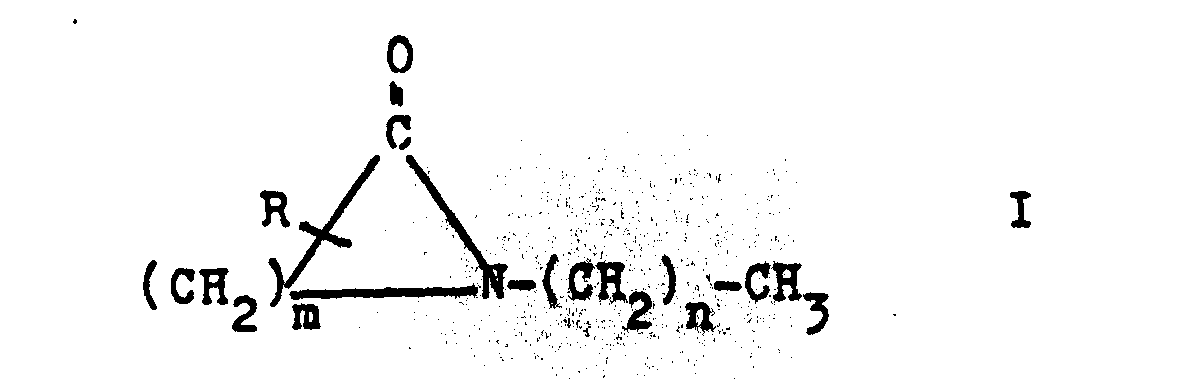
in der R Wasserstoff oder niedriges Alkyl mit 1-4 Kohlenstoffatomen, m 3-7 und n 0-17 bedeuten, dadurch gekennzeichnet, daß man ein 1-Trimethylsilyl-azacycloalkan-2-on der allgemeinen Formel III,

in der R und m die angegebene Bedeutung besitzen, mit einem Alkalimetallalkoholat oder einem Alkalimetalloxid umsetzt und zur Einführung des Alkylrestes-(CH2)n-CH3 auf das gebildete Alkalimetallsalz des Azacycloalkan-2-ons in an sich bekannter Weise ein Alkylierungsmittel einwirken läßt.
2) Verfahren nach Anspruch 1, dadurch gekennzeichnet, daß man als Alkalimetallalkoholat Natriummethylat oder Natriumäthylat verwendet.
3) Verfahren nach Anspruch 1, dadurch gekennzeichnet, daß man als Alkalimetalloxid Natriumoxid verwendet.
Applications Claiming Priority (2)
| Application Number | Priority Date | Filing Date | Title |
|---|---|---|---|
| DE19853536028 DE3536028A1 (de) | 1985-10-09 | 1985-10-09 | Verfahren zur herstellung von 1-substituierten azacycloalkan-2-onen |
| DE3536028 | 1985-10-09 |
Publications (1)
| Publication Number | Publication Date |
|---|---|
| EP0218976A2 true EP0218976A2 (de) | 1987-04-22 |
Family
ID=6283162
Family Applications (1)
| Application Number | Title | Priority Date | Filing Date |
|---|---|---|---|
| EP86113358A Withdrawn EP0218976A2 (de) | 1985-10-09 | 1986-09-29 | Verfahren zur Herstellung von 1-substituierten Azacycloalkan-2-onen |
Country Status (3)
| Country | Link |
|---|---|
| US (1) | US4692523A (de) |
| EP (1) | EP0218976A2 (de) |
| DE (1) | DE3536028A1 (de) |
Cited By (1)
| Publication number | Priority date | Publication date | Assignee | Title |
|---|---|---|---|---|
| EP0822184A1 (de) * | 1996-07-31 | 1998-02-04 | Societe Nationale Des Poudres Et Explosifs | Verfahren zur Herstellung von N-substituierten Laktamen |
Families Citing this family (3)
| Publication number | Priority date | Publication date | Assignee | Title |
|---|---|---|---|---|
| US4873336A (en) * | 1988-03-28 | 1989-10-10 | Gaf Corporation | Process for the preparation of N-vinyl lactams |
| CN1046736A (zh) * | 1989-04-24 | 1990-11-07 | 北京师范大学 | 生产1-正十二烷基氮杂环庚-2-酮的改进方法 |
| US4939273A (en) * | 1989-08-24 | 1990-07-03 | Gaf Chemicals Corporation | Method for conversion of ethylidene N,N'-bis-pyrrolidone into 2-pyrrolidone |
Family Cites Families (2)
| Publication number | Priority date | Publication date | Assignee | Title |
|---|---|---|---|---|
| US3332938A (en) * | 1965-05-11 | 1967-07-25 | Gen Aniline & Film Corp | Alkylated lactams and process of preparation |
| CH573404A5 (de) * | 1972-07-28 | 1976-03-15 | Inventa Ag |
-
1985
- 1985-10-09 DE DE19853536028 patent/DE3536028A1/de not_active Withdrawn
-
1986
- 1986-09-29 EP EP86113358A patent/EP0218976A2/de not_active Withdrawn
- 1986-10-07 US US06/916,373 patent/US4692523A/en not_active Expired - Fee Related
Cited By (3)
| Publication number | Priority date | Publication date | Assignee | Title |
|---|---|---|---|---|
| EP0822184A1 (de) * | 1996-07-31 | 1998-02-04 | Societe Nationale Des Poudres Et Explosifs | Verfahren zur Herstellung von N-substituierten Laktamen |
| FR2751963A1 (fr) * | 1996-07-31 | 1998-02-06 | Poudres & Explosifs Ste Nale | Procede de preparation de lactames n-substitues |
| US5986092A (en) * | 1996-07-31 | 1999-11-16 | Snpe | Process for the preparation of N-substituted lactams |
Also Published As
| Publication number | Publication date |
|---|---|
| DE3536028A1 (de) | 1987-04-09 |
| US4692523A (en) | 1987-09-08 |
Similar Documents
| Publication | Publication Date | Title |
|---|---|---|
| EP0893426B1 (de) | 2-Phasen-Herstellung von Carbonsäureestern | |
| DE2001431A1 (de) | Verfahren zur Herstellung neuer,therapeutisch wertvoller Derivate des 2'-Hydroxy-3-phenylpropionphenons und deren Salze | |
| DE2202689A1 (de) | Neue Zwischenprodukte der Vitamin-A-Synthese | |
| DE3536028A1 (de) | Verfahren zur herstellung von 1-substituierten azacycloalkan-2-onen | |
| DE1301312B (de) | Verfahren zur Herstellung von Pyrryl-(2)-acetonitrilen | |
| EP0087585A1 (de) | Verfahren zur Herstellung von 3-Alkoxi-acrylnitrilen | |
| DE2642608C2 (de) | Verfahren zur Herstellung eines 4-Hydroxymethyl-2-pyrrolidinons | |
| DE68914500T2 (de) | Alkylarylsulfone und Verfahren zu ihrer Herstellung. | |
| DE2166997C3 (de) | Verfahren zur Herstellung von 4,4-Diphenyl-piperidinen | |
| EP0069754B1 (de) | Verfahren zur herstellung von imidazolylvinylethern | |
| DE3621835A1 (de) | Verfahren zur racemisierung optisch aktiver (alpha)-phenoxypropionsaeure und deren derivate | |
| EP0773213A2 (de) | Verfahren zur Herstellung von (2RS,3RS)-3-(2'-Aminophenylthio)-2-hydroxy-3-(4"-methoxyphenyl)-propionsäuremethylester | |
| DE1128424B (de) | Verfahren zur Herstellung von 7-Alkylthio- und 7-Alkenylthio-4-androsten-3-onen | |
| DE2820687C2 (de) | Substituierte Chinolizidinderivate, Verfahren zu deren Herstellung und diese enthaltende Mittel | |
| DE3429667C2 (de) | ||
| DE2224240A1 (de) | Verfahren zur Herstellung von 1- eckige Klammer auf p-(beta-Diäthylaminoäthoxy)-phenyl eckige Klammer zu -l^-diphenyl^-chloräthylen beziehungsweise therapeutisch brauchbaren Salzen desselben | |
| DE898897C (de) | Verfahren zur Herstellung von primaeren und sekundaeren ?-Alkenylmalonsaeureestern oder -cyanessigsaeureestern | |
| AT330751B (de) | Verfahren zur herstellung neuer 3- (p-alkylthioalkoxy-phenoxy) -2-hydroxy-aminopropane und deren saureadditionssalze | |
| DE1593782C3 (de) | 1-Nitrilophenoxy- 2- hydroxy -3- tertbutylaminopropane, Verfahren zu ihrer Herstellung und diese enthaltende pharmazeutische Präparate | |
| AT213884B (de) | Verfahren zur Herstellung von neuen 3-Phenyl-3-pyrrolidinol-Verbindungen | |
| EP0157225A1 (de) | Verfahren zur Herstellung von Benzimidazolyl,-Benzoxazolyl- und Benzthiazolyloxyphenoxypropionsäurederivaten | |
| AT329540B (de) | Verfahren zur herstellung neuer 3-(p-alkylthioalkoxy-phenoxy)-2-hydroxy-aminopropane und deren saureadditionssalze | |
| DE3409201A1 (de) | Verfahren zur herstellung von benzoxazolyl- und benzthiazolyloxyphenoxypropionsaeurederivaten | |
| DE3534613A1 (de) | Verfahren zur herstellung von cycloalkancarbonsaeuren | |
| DE1081471B (de) | Verfahren zur Herstellung von N-[4, 5, 6, 7, 10, 10-Hexachlor-4, 7-endomethylen-4, 7, 8, 9-tetrahydro-phthalanyl-(1)]-ª‡-aminocarbonsaeureestern |
Legal Events
| Date | Code | Title | Description |
|---|---|---|---|
| PUAI | Public reference made under article 153(3) epc to a published international application that has entered the european phase |
Free format text: ORIGINAL CODE: 0009012 |
|
| AK | Designated contracting states |
Kind code of ref document: A2 Designated state(s): CH DE FR GB LI |
|
| STAA | Information on the status of an ep patent application or granted ep patent |
Free format text: STATUS: THE APPLICATION HAS BEEN WITHDRAWN |
|
| 18W | Application withdrawn |
Withdrawal date: 19880420 |
|
| RIN1 | Information on inventor provided before grant (corrected) |
Inventor name: SCHMITT, WILFRIED Inventor name: SCHORR, MANFRED, DR. |