EP0219121B1 - Méthode et système pour commander des procédés discontinus - Google Patents
Méthode et système pour commander des procédés discontinus Download PDFInfo
- Publication number
- EP0219121B1 EP0219121B1 EP86114279A EP86114279A EP0219121B1 EP 0219121 B1 EP0219121 B1 EP 0219121B1 EP 86114279 A EP86114279 A EP 86114279A EP 86114279 A EP86114279 A EP 86114279A EP 0219121 B1 EP0219121 B1 EP 0219121B1
- Authority
- EP
- European Patent Office
- Prior art keywords
- internal
- master unit
- control
- bus system
- information
- Prior art date
- Legal status (The legal status is an assumption and is not a legal conclusion. Google has not performed a legal analysis and makes no representation as to the accuracy of the status listed.)
- Expired - Lifetime
Links
Images


Classifications
-
- G—PHYSICS
- G05—CONTROLLING; REGULATING
- G05B—CONTROL OR REGULATING SYSTEMS IN GENERAL; FUNCTIONAL ELEMENTS OF SUCH SYSTEMS; MONITORING OR TESTING ARRANGEMENTS FOR SUCH SYSTEMS OR ELEMENTS
- G05B19/00—Program-control systems
- G05B19/02—Program-control systems electric
- G05B19/18—Numerical control [NC], i.e. automatically operating machines, in particular machine tools, e.g. in a manufacturing environment, so as to execute positioning, movement or co-ordinated operations by means of program data in numerical form
- G05B19/414—Structure of the control system, e.g. common controller or multiprocessor systems, interface to servo, programmable interface controller
-
- G—PHYSICS
- G05—CONTROLLING; REGULATING
- G05B—CONTROL OR REGULATING SYSTEMS IN GENERAL; FUNCTIONAL ELEMENTS OF SUCH SYSTEMS; MONITORING OR TESTING ARRANGEMENTS FOR SUCH SYSTEMS OR ELEMENTS
- G05B2219/00—Program-control systems
- G05B2219/30—Nc systems
- G05B2219/31—From computer integrated manufacturing till monitoring
- G05B2219/31229—Supervisor, leader, workstation controller, automation, machine control
-
- G—PHYSICS
- G05—CONTROLLING; REGULATING
- G05B—CONTROL OR REGULATING SYSTEMS IN GENERAL; FUNCTIONAL ELEMENTS OF SUCH SYSTEMS; MONITORING OR TESTING ARRANGEMENTS FOR SUCH SYSTEMS OR ELEMENTS
- G05B2219/00—Program-control systems
- G05B2219/30—Nc systems
- G05B2219/32—Operator till task planning
- G05B2219/32061—Central controls modules grouped according to function
-
- G—PHYSICS
- G05—CONTROLLING; REGULATING
- G05B—CONTROL OR REGULATING SYSTEMS IN GENERAL; FUNCTIONAL ELEMENTS OF SUCH SYSTEMS; MONITORING OR TESTING ARRANGEMENTS FOR SUCH SYSTEMS OR ELEMENTS
- G05B2219/00—Program-control systems
- G05B2219/30—Nc systems
- G05B2219/33—Director till display
- G05B2219/33125—System configuration, reconfiguration, customization, automatic
-
- Y—GENERAL TAGGING OF NEW TECHNOLOGICAL DEVELOPMENTS; GENERAL TAGGING OF CROSS-SECTIONAL TECHNOLOGIES SPANNING OVER SEVERAL SECTIONS OF THE IPC; TECHNICAL SUBJECTS COVERED BY FORMER USPC CROSS-REFERENCE ART COLLECTIONS [XRACs] AND DIGESTS
- Y02—TECHNOLOGIES OR APPLICATIONS FOR MITIGATION OR ADAPTATION AGAINST CLIMATE CHANGE
- Y02P—CLIMATE CHANGE MITIGATION TECHNOLOGIES IN THE PRODUCTION OR PROCESSING OF GOODS
- Y02P90/00—Enabling technologies with a potential contribution to greenhouse gas [GHG] emissions mitigation
- Y02P90/02—Total factory control, e.g. smart factories, flexible manufacturing systems [FMS] or integrated manufacturing systems [IMS]
Definitions
- the invention relates to a method and to a control system constructed from subsystems and arranged in hierarchical levels or to a corresponding circuit arrangement for controlling discontinuous processes for continuously adapting the internal information processing to changing process conditions.
- the subsystems arranged in hierarchy levels consist of problem-solving master units operating as control modules and process control slave units arranged downstream of these and acting as processing modules.
- Such control systems are used in automated machining and processing processes, which are divided into a large number of processes to be treated simultaneously, which in turn consist of individual tasks and process parts. In addition to the effect on the execution of the individual tasks, the internal information processing for the overall operation must be continuously coordinated and adapted to the changed conditions.
- a circuit arrangement for a hierarchical control system is already known (DD-PS 219 978), the one Has master unit, which consists of a generator unit, a coordinator unit and a variable memory, which are interconnected via a bus system. Connected to the bus system are a first interface coupling peripheral input units, a second interface connected to process signal outputs, and slave units controlling process parts or individual processes.
- the coordinator unit consists of a coordinator control unit which is connected to the bus system via a coordinator interface. The functioning of the slave units is controlled by the coordinator unit on the basis of the processing rules stored in the variable memory.
- the generator unit issues processing rules from process signals and information input from the peripheral input units and stores them in the variable memory, as a result of which the operation of the overall system is constantly updated in accordance with the process feedback signals and inputs from the peripheral devices.
- the master unit With frequent entries, the master unit must constantly reorganize itself in order to then determine specifications for the slave units with the result obtained. The master unit is thus heavily burdened with internal tasks. Both the master unit for its specifications to the slave units and the slave units in processing their tasks are bound to a sequential mode of operation. In addition, the internal process is complicated by the two-phase operation of generation and coordination in the overall system.
- Each module contains a processor and memory on a local bus.
- the computer modules are able to process user and service programs by interpreting program languages, and the peripheral modules execute input / output commands. All computer modules are connected to a main memory via a higher-level bus system and are interconnected.
- Each module is capable of processing tasks intended for it. Other tasks that a module cannot process are transferred to a suitable module in an order language via the higher-level bus system. Due to the modular ability to be upgraded and dismantled, a structure based on the tasks to be processed is possible (DE-OS 31 12 693).
- the inventive method for hierarchical control discontinuous processes for the continuous adaptation of the internal information processing to changing process conditions is based on the use of subsystems arranged in hierarchy levels from control modules and in the subordinate hierarchy level as functional modules and assigned input interfaces, and is characterized in that in each control module the lowest hierarchy level consists of program specifications and Process information control variables, conditions and structural information are determined and stored in a memory and, on the basis of this information, processing instructions are provided for the processing modules downstream of the control module, selected and activated by the control module of the next higher hierarchical level, and problem-related information entered in a programming language via a instruction interface from the control module the highest hierarchical level and the control modules de r subordinate hierarchy levels are specified as processing rules.
- the device represents a circuit arrangement of a hierarchical control system for discontinuous processes for the continuous adaptation of the internal information processing to changing process conditions, which has hierarchical levels subsystems consisting of control modules and processing modules and input interfaces assigned in each hierarchical level; it is characterized in that a problem management master unit, as a further hierarchical level, is superior to the systems consisting of problem solving master unit and slave units on a common bus system.
- a problem processing master unit and a teaching interface intended for entering a programming language are connected to the common bus system in a further higher hierarchical level.
- This solution creates a variable control system for the simultaneous processing of parallel processes or process parts, which is optimally modification-oriented in its internal processing sequence and adaptable to changing conditions.
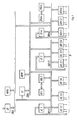
- bus systems SB 1.1 to SB 1.m with processing units SE 1.1 to SE nk connected to them in the lowest hierarchical level for controlling individual or sub-processes.
- These processing units SE 1.1 to SE nk are control units ME 1 to ME m, each with a variable memory VS 1 to VS m for Processing rules on the relevant bus systems SB 1.1 to SB 1.m overriding.
- the processing units SE 2.1 to SE 2.k on the second bus system SB 1.2 are designed as independent, active units operating according to their own processing rules for parallel processes with a limited scope of processing that have the same rights.
- Input interfaces IE 1 to IE m are connected to these bus systems SB 1.1 to SB 1.m for the coupling of process feedback and output information of the processing units SE 1.1 to SE nk connected to the respective bus system SB 1.1 to SB 1.m.
- the bus systems SB 1.1 to SB 1.m are connected to a higher-level bus system SB 2.
- This bus system SB 2 and all subordinate bus systems SB 1.1 to SB 1.m, which are equipped with their own control unit ME 1 to ME m, are connected to a further bus system SB 3, which is superior to this.
- the bus system SB 2 of the second hierarchy level is managed by a problem management master unit MPV.
- An interface IC for external inputs is connected to this bus system SB 2.
- a problem processing master unit MPA and an instruction interface IB are connected to the bus system SB 3 of the highest hierarchical level.
- the processing units SE 1.1 to SE nk use control instructions and process feedback information to determine and output control information for the process P, for example a process for machining a workpiece on a machine tool.
- Information necessary for the program sequence is compiled for the processing units SE 1.1 to SE nk by the directly higher-level control units ME 1 to ME m.
- control units ME 1 to ME m determine this information from program information, the process feedback information that is coupled in via the input interface IE 1 to IE m connected to the respective bus system SB 1.1 to SB 1.m in this hierarchy level, and the output from the processing units SE 1.1 to SE nk and also via the respective one Input interface IE 1 to IE m control information coupled to the relevant bus system SB 1 to SB m on the basis of the processing rules stored in the variable memory VS 1 to VS m.
- Processing units SE 2.1 to SE 2.k which are connected to a bus system SB 1.2, on which no control unit ME 1 to ME m is arranged, solve tasks after selection and activation by the problem management master unit MPV in the higher hierarchical level based on their saved machining program. This allows certain tasks to be processed that do not require control variables, conditions and structural information to be updated.
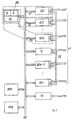
- a problem-solving master unit ME is connected to a common bus system SB.
- the problem-solving master unit ME consists of a coordinator unit K, a generator unit G and a variable memory VS. Control variables, conditions and structural information for controlling systems S 1 to S m are stored in the variable memory VS.
- the coordinator unit K controls the routine process, while the generator unit G obtains new information from process feedback signals and the information stored in the variable memory VS and stores this again in the variable memory VS as control variable, conditions and structural information for further processing.
- the controlling systems S 1 to S m are each formed from a slave unit SE 1 to SE m connected to the common bus system SB in connection with the problem-solving master unit ME.
- the problem-solving master unit ME is the control unit and the slave units SE 1 to SE n are the processing units in this hierarchical level.
- Each of these systems S 1 to S m controls an individual process or a part of an extensive process.
- the outputs of the slave units SE 1 to SE m are connected to process control means P.
- process control means P For the feedback of the output information of the slave units SE 1 to SE m, feedback lines are led to an input interface IE.
- Feedback information lines from the process control means P are also routed to this input interface IE.
- input information such as manual input keyboards, is processed, for example route control and position control processes are created, and switching command information is processed and output.
- the operating unit of a numerical control is connected to one of the slave units SE 1 to SE m, or parts of the operating unit are connected to different slave units SE 1 to SE m.
- Other slave units SE 1 to SE m form the path control / position control part of the numerical control and are connected in the direction of the process to the drives, path measuring systems and speed devices of the machine tool to be controlled. If there is a high demand for information, it is advantageous to carry out the input and output of the slave units SE 1 to SE n via an input / output port of an interface and the feedback information of the slave units SE 1 to SE n via an output port and an external bus system EB to lead an output port and an external bus system EB to the input interface IE.
- further autonomous slave units SE m + 1 to SE n are connected to the common bus system SB, which are independent of the problem-solving master unit ME. From these autonomous slave units SE m + 1 to SE n, switching information to be treated according to fixed processing rules, such as the switching off of the drives when a machine table is opened onto a limit switch, the control of the coolant supply or events that require an emergency shutdown are processed.
- a problem management master unit MPV as a further hierarchy level to the problem solving master unit ME a problem preparation master unit MPA and for inputting information necessary for the operation of the overall system in a program language an instruction interface IB.
- the slave units SE 1 to SE n constantly process the input and output information of a sub-process or a process part.
- the slave units SE 1 to SE n correspond to the process control means P via input and output lines. Via the feedback lines led to the input interface IE, an image of the output information of the slave units SE 1 to SE n is sent to the common bus system SB and thus to the problem-solving system -Master unit ME or to the problem management master unit MPV.
- the problem-solving master unit ME determines new instructions for the slave units SE 1 to SE m on the basis of program information in the variable memory VS. derive data and commands for the process control means P therefrom.
- the problem-solving master unit ME determines specifications for the movement curves of the machining tools on the machine.
- the problem management master unit MPV assigns them tasks or diagnostic routines to be processed for the current processing process in accordance with their functional scope.
- the process control means P can be freely assigned in the broadest sense by the problem management master unit MPV to the slave units SE 1 to SE n.
- Dynamic for example changes determined by sensors provided for this purpose and other changeable correction values are processed by the problem-solving master unit ME in generation cycles for the running program. This means that the machining program is constantly updated.
- the problem-solving master unit ME interprets the program information specified by the keyboard of the operating unit in generation cycles and processes it as processing information and then outputs it to the relevant slave units SE 1 to SE m as program instructions or as input requests.
- the feedback information of the autonomous slave units SE m + 1 to SE n and the processing status and the information requirement of the problem-solving master unit ME are monitored by the problem-management master unit MPV, which issues program instructions to these units based on their stored processing rules, with tasks being distributed.
- control variables, processing rules, conditions and structural information can be entered in the form of a program language, which are provided by the problem preparation master unit MPA as instructions for the problem management master unit MPV, the problem solving master unit ME and the autonomous slave units SE m + 1 to SE n be processed. This makes it possible to adapt the control system to changing conditions or to enable it to process different programs and tasks.
- FIG. 3 shows the block diagram of a problem management master unit MPV.
- An internal function memory IFS, an internal system memory ISS, an internal problem management operator unit IOPV and an internal interface IMPVI for connection to the common bus system SB are connected to an internal bus system IBMPV.
- the internal function memory IFS stores universal coordination options for all control units connected to the common bus system SB in the form of the problem-solving master unit ME and its subordinate slave units SE 1 to SE m and the autonomous slave units SE m + 1 to SE n. With these static conditions, the internal problem management operator unit IOPV is able to issue instructions for processing tasks via the internal interface IMPVI to them according to the program stipulated thereby and based on requirements of the control units. An optimal distribution of tasks is therefore possible within the program stored in the internal function memory IFS. In the internal system memory ISS can be entered from the common bus system SB via the internal interface IMPVI further coordination options for other control units that are not considered in the internal function memory IFS.
- the information of the expanding coordination options is arranged by the internal storage manager ISV and the storage and query are controlled.
- the coordination options are expanded with the help of the internal system memory ISS, any expansion of the entire control system is possible, which is only limited by the processing speed of the problem management master unit MPV.
- a generator unit IGMPA as the active unit, an internal memory ISPMPA, an internal filter unit IFMPA and an internal interface IMPAI for connection to the common bus system SB are connected to an internal bus system IBMPA.
- the problem preparation master unit MPA is connected to the instruction interface IB via the common bus system SB.
- the information entered by the instruction interface IB on the common bus system SB in the form of a program language is received by the internal interface IMPAI and passed on to the internal bus system IBMPA.
- the internal generator unit IGMPA separates this information into coordinating and action-executing elements and then stores it as control variable, conditions and structural information in the internal memory ISPMPA.
- new instructions for the problem management master unit MPV and the problem solving master unit ME are obtained, which are linked by these in a separate processing routine in which the problem preparation master unit MPA is coupled to the problem management master unit MPV or the problem solving master unit ME. taken over and stored in their internal system memory or in the variable memory VS.
- FIG. 5 shows a coupling arrangement for a plurality of control systems, each of which has its own, common bus system SB 1 to SB k.
- common bus system SB 1 to SB k For all these common bus systems SB 1 to SB k, only one problem management master unit MPV and also only one problem preparation master unit MPA are provided.
- a problem-solving master unit ME 1 to ME k which forms together with subordinate slave units SE 1.1 to SE mk systems, as well as further autonomous slave units SE (M + 1) .1 to SE nk, can be connected to each common bus system SB 1 to SB k be.
- the problem management master unit MPV controls and monitors the processing of the tasks by the units connected to the common bus systems SB 1 to SB k.
- changing instructions are processed by the problem preparation master unit MPA and made available to the problem management master unit MPA.
- Any tax system can used to control and monitor a process running parallel to other processes, which can be independent individual processes or sub-processes of a complex process.
- the concept of the invention is essentially based on the fact that the hierarchy falls towards the process.
- the processing modules operating as slaves are superordinated to control modules operating as masters.
- the processing units SE 1 to SE m are slaves of the problem-solving master unit ME.
- the systems S 1 to S m formed by the problem solving master unit ME with the processing units SE 1 to SE m are in turn slaves of the problem management master unit MPV. With new instruction, all of these units are SE 1 to SE m, ME (S 1 to S m) and MPV slaves of the problem preparation master unit MPA and process their newly specified processing rules.
Landscapes
- Engineering & Computer Science (AREA)
- Human Computer Interaction (AREA)
- Manufacturing & Machinery (AREA)
- Physics & Mathematics (AREA)
- General Physics & Mathematics (AREA)
- Automation & Control Theory (AREA)
- Selective Calling Equipment (AREA)
- Feedback Control In General (AREA)
- Multi Processors (AREA)
- Control By Computers (AREA)
- Crystals, And After-Treatments Of Crystals (AREA)
- Programmable Controllers (AREA)
- Multi-Process Working Machines And Systems (AREA)
Claims (10)
- Procédé de commande hiérarchisée de processus discontinus (P) pour l'adaptation permanente du traitement interne d'informations à des conditions variables de processus, moyennant l'utilisation de systèmes partiels, disposés dans des plans hiérarchiques et constitués par des modules de commande (ME1 à MEm) et d'unités fonctionnelles, agissant en tant que modules de traitement (SE1.1 à SEn.k) dans le plan hiérarchique aval, et d'interfaces d'entrée (IE1 à IEM) associées, caractérisé par le fait que dans chaque module de commande (ME1 à MEm) du plan hiérarchique le plus bas, des variables de commande, des conditions et des informations de structure sont déterminées à partir de prescriptions de programme et d'informations de processus et sont mémorisées dans une mémoire (VS1 à VSm), et des instructions de traitement sont préparées, à partir de ces informations, pour les modules de traitement (SE1.1 à SEn.k), qui sont disposés en aval du module de commande (ME1 à MEm), et sont sélectionnés et activés par le module de commande du plan hiérarchique immédiatement supérieur, et que des informations liées au problème et introduites dans un langage de programmation par l'intermédiaire d'une interface donneur d'instructions (IB), sont préparées par le module de commande du plan hiérarchique le plus élevé et sont prédéterminées en tant que règles de traitement pour les modules de commande des plans hiérarchiques situés au-dessous du plan hiérarchique le plus élevé.
- Procédé suivant la revendication 1, caractérisé par le fait que pour des parties de programme qui se déroulent selon des règles inchangées, des modules de traitement, dans lesquels sont mémorisés des programmes de traitement et qui sont situés dans le plan hiérarchique le plus bas, sont sélectionnés et activés au moyen des modules du plan hiérarchique de rang le plus élevé.
- Système de commande hiérarchique pour des processus discontinus, pour l'adaptation continue du traitement interne de l'information à des conditions variables d'un processus, notamment pour la mise en oeuvre du procédé suivant la revendication 1 ou 2, comportant des systèmes partiels associés à des plans hiérarchiques et constitués par des modules de commande (ME 1 à ME m) et des modules de traitement (SE 1.1 à SE n.k) et des interfaces d'entrée associées dans chaque plan hiérarchique, caractérisé par le fait qu'une unité maître (MPV) de gestion des problèmes est superposée, en tant qu'autre plan hiérarchique, aux systèmes (S 1 à S m), qui sont constitués par l'unité maître (ME) de résolution des problèmes et des unités (SE 1 à SE m), dans un système de bus commun (SB).
- Système de commande suivant la revendication 3, caractérisé par le fait que l'unité maître (MPV) de gestion des problèmes comporte un système de bus interne (IBMPV), au moyen duquel une mémoire système interne (ISS), dans laquelle sont mémorisées des règles internes de traitement, une mémoire interne de fonctions (IFS) pour la réception d'informations actuelles du processus, une unité interne (ISB) de gestion de mémoires et une unité opérationnelle interne (IOPV) de gestion des problèmes sont reliées entre elles et auxquelles est raccordée une interface (IMPVI) prévue pour la liaison avec le système de bus commun.
- Système de commande suivant la revendication 3 ou 4, caractérisé par le fait que les sorties des unités esclaves (SE 1 à SE m) sont reliées, pour la communication d'informations de signalisation en retour, à une interface d'entrée (IE) raccordée à un système de bus commun (SB).
- Système de commande suivant l'une des revendications 3 à 5, caractérisé par le fait que des unités esclaves (SE m+1 à SE n), qui travaillent de façon autonome indépendamment de l'unité maître (ME) de résolution des problèmes et qui sont reliées par leurs sorties aux moyens de commande de processus (P) pour la communication et à l'interface d'entrée (IE), pour les informations de signalisation en retour, sont raccordées au système de bus commun (SB) pour la sélection et l'activation par l'unité maître (MPV) de gestion des problèmes.
- Système de commande suivant la revendication 6, caractérisé par le fait que les unités esclaves (SE 1 à SE m, SE m+1 à SE n) sont reliées par des interfaces (IS 1 à IS m, IS m+1 à IS n) respectivement par une porte d'entrée/sortie aux moyens de commande de processus (P) et par une porte de sortie, par l'intermédiaire d'un système de bus externe (EB), à l'interface d'entrée (IB).
- Système de commande suivant l'une des revendications 3 à 7, caractérisé par le fait qu'en outre une unité maître (MPA) de préparation des problèmes et une interface d'apprentissage (IB), utilisée pour introduire un langage de programmation, sont raccordées en supplément au système de bus commun (SB).
- Système de commande suivant la revendication 8, caractérisé par le fait que dans l'unité maître (MPA) de préparation des problèmes, une mémoire interne d'enregistrement-lecture (ISPMPA), une interface interne (IMPAJ) pour le raccordement au système de bus commun (SB), une unité de filtre (IFMPA) pour la détermination d'éléments, qui assurent une coordination et exécutent des actions, de la grammaire du langage de programmation pouvant être introduit par l'intermédiaire de l'interface interne (IMPAI) et de l'interface donner d'instructions (IB), et une unité formant générateur interne (IGMPA) pour déterminer des indications de traitement, liées au problème, pour les autres unités du système de commande, sont raccordées à un système de bus interne (IBMPA), dans l'unité maître (MPA) de préparation des problèmes.
- Système de commande suivant la revendication 4 ou 9, caractérisé par le fait que l'unité maître (MPV) de gestion des problèmes et l'unité maître (MPA) de préparation des problèmes sont reliées, en étant réciproquement découplées, respectivement aux systèmes de bus commun (SB 1 à SB n) de plusieurs systèmes de commande (IMPAJ).
Applications Claiming Priority (4)
| Application Number | Priority Date | Filing Date | Title |
|---|---|---|---|
| DD28172085A DD241797A1 (de) | 1985-10-15 | 1985-10-15 | Steuerungsverfahren fuer diskontinuierliche prozesse |
| DD281721 | 1985-10-15 | ||
| DD281720 | 1985-10-15 | ||
| DD28172185A DD241798A1 (de) | 1985-10-15 | 1985-10-15 | Schaltungsanordnung fuer ein hierarchisches steuersystem |
Publications (3)
| Publication Number | Publication Date |
|---|---|
| EP0219121A2 EP0219121A2 (fr) | 1987-04-22 |
| EP0219121A3 EP0219121A3 (en) | 1989-08-16 |
| EP0219121B1 true EP0219121B1 (fr) | 1993-12-29 |
Family
ID=25748005
Family Applications (1)
| Application Number | Title | Priority Date | Filing Date |
|---|---|---|---|
| EP86114279A Expired - Lifetime EP0219121B1 (fr) | 1985-10-15 | 1986-10-15 | Méthode et système pour commander des procédés discontinus |
Country Status (4)
| Country | Link |
|---|---|
| EP (1) | EP0219121B1 (fr) |
| AT (1) | ATE99437T1 (fr) |
| DE (1) | DE3689460D1 (fr) |
| HU (1) | HU198345B (fr) |
Families Citing this family (1)
| Publication number | Priority date | Publication date | Assignee | Title |
|---|---|---|---|---|
| US5591299A (en) * | 1995-04-28 | 1997-01-07 | Advanced Micro Devices, Inc. | System for providing integrated monitoring, control and diagnostics functions for semiconductor spray process tools |
Family Cites Families (5)
| Publication number | Priority date | Publication date | Assignee | Title |
|---|---|---|---|---|
| IT1062827B (it) * | 1976-03-29 | 1985-02-11 | Olivetti Controllo Numerico | Sistema di controllo numerico per macchine utensili |
| DE3136390A1 (de) * | 1981-09-14 | 1983-05-11 | Liebherr-Verzahntechnik Gmbh, 8960 Kempten | Zahnradbearbeitungsmaschine |
| AU2016283A (en) * | 1982-10-15 | 1984-04-19 | General Electric Company, Plc, The | Plural data processing units |
| EP0125776A2 (fr) * | 1983-04-13 | 1984-11-21 | Nordson Corporation | Système de commande pour un robot |
| EP0132069A3 (fr) * | 1983-06-29 | 1987-11-11 | Westinghouse Electric Corporation | Système de commande distribuée de processus avec des moyens et une méthode pour la gestion automatique de base de données pour des informations à diffuser |
-
1986
- 1986-09-29 HU HU864132A patent/HU198345B/hu not_active IP Right Cessation
- 1986-10-15 EP EP86114279A patent/EP0219121B1/fr not_active Expired - Lifetime
- 1986-10-15 AT AT86114279T patent/ATE99437T1/de not_active IP Right Cessation
- 1986-10-15 DE DE86114279T patent/DE3689460D1/de not_active Expired - Fee Related
Also Published As
| Publication number | Publication date |
|---|---|
| DE3689460D1 (de) | 1994-02-10 |
| EP0219121A3 (en) | 1989-08-16 |
| HU198345B (en) | 1989-09-28 |
| EP0219121A2 (fr) | 1987-04-22 |
| HUT45160A (en) | 1988-05-30 |
| ATE99437T1 (de) | 1994-01-15 |
Similar Documents
| Publication | Publication Date | Title |
|---|---|---|
| EP0906596B1 (fr) | Systeme d'automatisation de processus industriels | |
| EP0577919B1 (fr) | Contrôle d'accès pour couplage de microcontrôleurs programmés par masque | |
| DE102011108282A1 (de) | Numerische Steuerung für eine Mehrachsenmaschine zum Bearbeiten einer geneigten Bearbeitungsebene | |
| DE3040008A1 (de) | Numerische werkzeugmaschinensteuerung | |
| EP0782722B1 (fr) | Procede et dispositif permettant de commander et d'activer des detecteurs et/ou des organes d'actionnement relies par un systeme de bus | |
| DE4005042C2 (de) | Mehrrechnersystem zur Durchführung von Bewegungssteuerungen | |
| DE68924109T2 (de) | Verfahren und System für die Überwachung der Anzahl von freien Puffern. | |
| EP2422248B1 (fr) | Système et procédé de répartition de données de projets d'un controlleur de sécurité d'une installation automatisée aux composants de commande | |
| EP0071703B1 (fr) | Système à microprocesseur pour la commande d'un procédé | |
| EP0705456B1 (fr) | Procede de gestion de processus industriels, notamment pour grandes installations industrielles | |
| EP0113379B1 (fr) | Coupleur pour processeurs | |
| EP1025469B1 (fr) | Procede de commande d'une machine-outil a commande numerique par calculateur | |
| DE4408603A1 (de) | Verfahren zur Erhöhung der Sicherheit in hierarchisch strukturierten Automatisierungssystemen | |
| DE69910375T2 (de) | Verfahren und vorrichtung zur sequenzen-erstellung für numerisch gesteuerte maschinenwerkzeuge | |
| EP0219121A2 (fr) | Méthode et système pour commander des procédés discontinus | |
| DE3621863C2 (fr) | ||
| DE3603142C2 (fr) | ||
| DE2845218B1 (de) | Mikroprogrammgesteuerte Ein-/Ausgabeeinrichtung und Verfahren zum Durchfuehren von Ein-/Ausgabeoperationen | |
| DE69028811T2 (de) | Extern erweiterbare speicherprogrammierbare steuerung | |
| EP1386200B1 (fr) | Procede permettant de faire fonctionner un systeme de commande modulaire et systeme de commande fonctionnant selon ce procede | |
| DE2607687C2 (de) | Verfahren zum Steuern von Gruppen von Geräten in einer mit elektronischer Datenverarbeitung arbeitenden Fernsprechvermittlungsanlage und deren Ausbildung | |
| DE3545957A1 (de) | Verfahren und schaltungsanordnung zur automatischen abarbeitung von einrichtefunktionen in numerischen steuerungen | |
| DE4126434A1 (de) | Numerische steuereinrichtung | |
| DE3534465A1 (de) | Verbundsystem speicherprogrammierbarer steuerungen | |
| DE4008559C2 (de) | Numerische Werkzeugmaschinensteuerung |
Legal Events
| Date | Code | Title | Description |
|---|---|---|---|
| PUAI | Public reference made under article 153(3) epc to a published international application that has entered the european phase |
Free format text: ORIGINAL CODE: 0009012 |
|
| AK | Designated contracting states |
Kind code of ref document: A2 Designated state(s): AT BE CH DE FR GB IT LI LU NL SE |
|
| PUAL | Search report despatched |
Free format text: ORIGINAL CODE: 0009013 |
|
| RHK1 | Main classification (correction) |
Ipc: G06F 15/16 |
|
| AK | Designated contracting states |
Kind code of ref document: A3 Designated state(s): AT BE CH DE FR GB IT LI LU NL SE |
|
| 17P | Request for examination filed |
Effective date: 19900208 |
|
| RAP1 | Party data changed (applicant data changed or rights of an application transferred) |
Owner name: SIEMENS AKTIENGESELLSCHAFT |
|
| 17Q | First examination report despatched |
Effective date: 19920917 |
|
| GRAA | (expected) grant |
Free format text: ORIGINAL CODE: 0009210 |
|
| AK | Designated contracting states |
Kind code of ref document: B1 Designated state(s): AT BE CH DE FR GB IT LI LU NL SE |
|
| PG25 | Lapsed in a contracting state [announced via postgrant information from national office to epo] |
Ref country code: SE Effective date: 19931229 Ref country code: GB Effective date: 19931229 Ref country code: BE Effective date: 19931229 |
|
| REF | Corresponds to: |
Ref document number: 99437 Country of ref document: AT Date of ref document: 19940115 Kind code of ref document: T |
|
| REF | Corresponds to: |
Ref document number: 3689460 Country of ref document: DE Date of ref document: 19940210 |
|
| ITF | It: translation for a ep patent filed | ||
| ET | Fr: translation filed | ||
| GBV | Gb: ep patent (uk) treated as always having been void in accordance with gb section 77(7)/1977 [no translation filed] |
Effective date: 19931229 |
|
| PG25 | Lapsed in a contracting state [announced via postgrant information from national office to epo] |
Ref country code: AT Effective date: 19941015 |
|
| PGFP | Annual fee paid to national office [announced via postgrant information from national office to epo] |
Ref country code: FR Payment date: 19941024 Year of fee payment: 9 |
|
| PG25 | Lapsed in a contracting state [announced via postgrant information from national office to epo] |
Ref country code: LU Free format text: LAPSE BECAUSE OF NON-PAYMENT OF DUE FEES Effective date: 19941031 Ref country code: LI Effective date: 19941031 Ref country code: CH Effective date: 19941031 |
|
| PGFP | Annual fee paid to national office [announced via postgrant information from national office to epo] |
Ref country code: NL Payment date: 19941031 Year of fee payment: 9 |
|
| PLBE | No opposition filed within time limit |
Free format text: ORIGINAL CODE: 0009261 |
|
| STAA | Information on the status of an ep patent application or granted ep patent |
Free format text: STATUS: NO OPPOSITION FILED WITHIN TIME LIMIT |
|
| PGFP | Annual fee paid to national office [announced via postgrant information from national office to epo] |
Ref country code: DE Payment date: 19941216 Year of fee payment: 9 |
|
| 26N | No opposition filed | ||
| REG | Reference to a national code |
Ref country code: CH Ref legal event code: PL |
|
| PG25 | Lapsed in a contracting state [announced via postgrant information from national office to epo] |
Ref country code: NL Effective date: 19960501 |
|
| PG25 | Lapsed in a contracting state [announced via postgrant information from national office to epo] |
Ref country code: FR Effective date: 19960628 |
|
| PG25 | Lapsed in a contracting state [announced via postgrant information from national office to epo] |
Ref country code: DE Effective date: 19960702 |
|
| NLV4 | Nl: lapsed or anulled due to non-payment of the annual fee |
Effective date: 19960501 |
|
| REG | Reference to a national code |
Ref country code: FR Ref legal event code: ST |
|
| PG25 | Lapsed in a contracting state [announced via postgrant information from national office to epo] |
Ref country code: IT Free format text: LAPSE BECAUSE OF NON-PAYMENT OF DUE FEES;WARNING: LAPSES OF ITALIAN PATENTS WITH EFFECTIVE DATE BEFORE 2007 MAY HAVE OCCURRED AT ANY TIME BEFORE 2007. THE CORRECT EFFECTIVE DATE MAY BE DIFFERENT FROM THE ONE RECORDED. Effective date: 20051015 |