EP0219242A2 - Epoxidklebstoff aus sphärischen Teilchen und Verfahren zu dessen Herstellung - Google Patents
Epoxidklebstoff aus sphärischen Teilchen und Verfahren zu dessen Herstellung Download PDFInfo
- Publication number
- EP0219242A2 EP0219242A2 EP86307297A EP86307297A EP0219242A2 EP 0219242 A2 EP0219242 A2 EP 0219242A2 EP 86307297 A EP86307297 A EP 86307297A EP 86307297 A EP86307297 A EP 86307297A EP 0219242 A2 EP0219242 A2 EP 0219242A2
- Authority
- EP
- European Patent Office
- Prior art keywords
- curing agent
- particles
- type spherical
- epoxy type
- epoxy
- Prior art date
- Legal status (The legal status is an assumption and is not a legal conclusion. Google has not performed a legal analysis and makes no representation as to the accuracy of the status listed.)
- Granted
Links
Images
Classifications
-
- C—CHEMISTRY; METALLURGY
- C08—ORGANIC MACROMOLECULAR COMPOUNDS; THEIR PREPARATION OR CHEMICAL WORKING-UP; COMPOSITIONS BASED THEREON
- C08J—WORKING-UP; GENERAL PROCESSES OF COMPOUNDING; AFTER-TREATMENT NOT COVERED BY SUBCLASSES C08B, C08C, C08F, C08G or C08H
- C08J3/00—Processes of treating or compounding macromolecular substances
- C08J3/12—Powdering or granulating
- C08J3/16—Powdering or granulating by coagulating dispersions
-
- C—CHEMISTRY; METALLURGY
- C08—ORGANIC MACROMOLECULAR COMPOUNDS; THEIR PREPARATION OR CHEMICAL WORKING-UP; COMPOSITIONS BASED THEREON
- C08G—MACROMOLECULAR COMPOUNDS OBTAINED OTHERWISE THAN BY REACTIONS ONLY INVOLVING UNSATURATED CARBON-TO-CARBON BONDS
- C08G59/00—Polycondensates containing more than one epoxy group per molecule; Macromolecules obtained by polymerising compounds containing more than one epoxy group per molecule using curing agents or catalysts which react with the epoxy groups
- C08G59/18—Macromolecules obtained by polymerising compounds containing more than one epoxy group per molecule using curing agents or catalysts which react with the epoxy groups ; e.g. general methods of curing
- C08G59/188—Macromolecules obtained by polymerising compounds containing more than one epoxy group per molecule using curing agents or catalysts which react with the epoxy groups ; e.g. general methods of curing using encapsulated compounds
-
- C—CHEMISTRY; METALLURGY
- C09—DYES; PAINTS; POLISHES; NATURAL RESINS; ADHESIVES; COMPOSITIONS NOT OTHERWISE PROVIDED FOR; APPLICATIONS OF MATERIALS NOT OTHERWISE PROVIDED FOR
- C09J—ADHESIVES; NON-MECHANICAL ASPECTS OF ADHESIVE PROCESSES IN GENERAL; ADHESIVE PROCESSES NOT PROVIDED FOR ELSEWHERE; USE OF MATERIALS AS ADHESIVES
- C09J163/00—Adhesives based on epoxy resins; Adhesives based on derivatives of epoxy resins
-
- G—PHYSICS
- G02—OPTICS
- G02F—OPTICAL DEVICES OR ARRANGEMENTS FOR THE CONTROL OF LIGHT BY MODIFICATION OF THE OPTICAL PROPERTIES OF THE MEDIA OF THE ELEMENTS INVOLVED THEREIN; NON-LINEAR OPTICS; FREQUENCY-CHANGING OF LIGHT; OPTICAL LOGIC ELEMENTS; OPTICAL ANALOGUE/DIGITAL CONVERTERS
- G02F1/00—Devices or arrangements for the control of the intensity, colour, phase, polarisation or direction of light arriving from an independent light source, e.g. switching, gating or modulating; Non-linear optics
- G02F1/01—Devices or arrangements for the control of the intensity, colour, phase, polarisation or direction of light arriving from an independent light source, e.g. switching, gating or modulating; Non-linear optics for the control of the intensity, phase, polarisation or colour
- G02F1/13—Devices or arrangements for the control of the intensity, colour, phase, polarisation or direction of light arriving from an independent light source, e.g. switching, gating or modulating; Non-linear optics for the control of the intensity, phase, polarisation or colour based on liquid crystals, e.g. single liquid crystal display cells
- G02F1/133—Constructional arrangements; Operation of liquid crystal cells; Circuit arrangements
- G02F1/1333—Constructional arrangements; Manufacturing methods
- G02F1/1339—Gaskets; Spacers; Sealing of cells
- G02F1/13392—Gaskets; Spacers; Sealing of cells spacers dispersed on the cell substrate, e.g. spherical particles, microfibres
-
- C—CHEMISTRY; METALLURGY
- C08—ORGANIC MACROMOLECULAR COMPOUNDS; THEIR PREPARATION OR CHEMICAL WORKING-UP; COMPOSITIONS BASED THEREON
- C08J—WORKING-UP; GENERAL PROCESSES OF COMPOUNDING; AFTER-TREATMENT NOT COVERED BY SUBCLASSES C08B, C08C, C08F, C08G or C08H
- C08J2363/00—Characterised by the use of epoxy resins; Derivatives of epoxy resins
Definitions
- the present invention relates to an epoxy type particulate adhesive which contains a latent curing agent in the interior of particles and is in the so-called B stage and which is cured by heating and functions as an adhesive, and a process for the preparation of this adhesive. More particularly, the present invention relates to a particulate adhesive which is substantially free of a solvent, contains a latent curing agent homogeneously in the interior of particles and is spherical and therefore, which can be used especially advantageously for bonding electronic materials which are apt to be degraded by impurities and for which high-precision bonding is required, such as liquid crystal display plates.
- Conventional epoxy type powdery adhesives are powdery mixtures of an epoxy resin powder formed by pulverizing an uncured or partially cured epoxy resin and classifying the pulverized resin if necessary and a separately formed latent curing agent powder, or powdery products obtained by pulverizing an uncured or partially cured epoxy resin, with which a latent curing agent has been kneaded in advance, and classifying the pulverized resin if necessary.
- the conventional technique utilizing the pulverizing method is disadvantageous in that since respective particles are indeterminate in the shape, the mobility of the powder is bad and the coating property is insufficient.
- the distance between which is kept uniform by a spacer or the like, even if classified particles are used, since particles formed by pulverization are indeterminate in the shape, all the particles do not completely fill the space between the plates but there are present many particles making no contribution to bonding.
- a technique of spherodizing particles formed by pulverization by passing them through a high-temperature atmosphere is known, but in case of particles containing a latent curing agent in the interior thereof, if this technique is adopted, curing reaction is advanced and therefore it often happens that the adhesiveness is drastically degraded in the spheroidized particles.
- U.S. Patent 4,588,6l7 discloses a technique of forming cured particles having an average diameter smaller than 50 ⁇ m by adding an amine type compound to an uncured epoxy compound emulsion prepared in advance. However, particles prepared according to this technique have no adhesiveness.
- the main object of the present invention is to provide an improved epoxy type particulate adhesive. Further objects achieved at least by some embodiments of the invention are -
- a further object of the present invention is to provide a process in which an adhesive having excellent functions as described above can be prepared efficiently.
- an epoxy type spherical particulate adhesive comprising at least an epoxy resi n as the main component, wherein the epoxy resin contains a latent curing agent in the interior of particles and the average particle diameter is 0.3 to 500 ⁇ m
- a process for the preparation of an epoxy type spherical particulate adhesive comprising at least an epoxy resin as the main component which comprises emulsifying or suspending an epoxy compound having a latent curing agent incorporated therein into a liquid composed mainly of water to form spherical particles
- a process for the preparation of an epoxy type spherical particulate adhesive comprising at least an epoxy resin as the main component which comprises mixing an aqueous slurry obtained by emulsifying or suspending an epoxy compound containing a latent curing agent compatibly therein into a liquid composed mainly of water to form spherical particles, with a slurry of fine particles of an inorganic oxide having
- An epoxy compound containing at least two epoxy groups in the molecule is preferred as the epoxy compound used in the present invention.
- bisphenol A or condensed bisphenol A diglycidyl ether polyethylene glycol diglycidyl ether, a polyglycidyl ether of a phenoi-novoiak compound and N,N,N',N'-tetraglycidyl-m-exylene-diamine.
- These compounds may be used singly or in the form of a mixture of two or more of them.
- a compound having one epoxy group in the molecule for example, 2-ethylhexyl glycidyl ether, can be used according to need.
- a latent curing agent is added to the epoxy compound.
- the latent curing agent is a curing agent such that the pot life of an optimum mixing ratio composition (composition showing a highest curing speed) of the curing agent and bisphenol A diglycidyl ether is longer than l day at normal temperature.
- the curing agent satisfying this requirement there can be mentioned dicyandiamide, imidazoles, Lewis acid complexes, phenos, bisphenols, phenol-novolaks, polyvinyl phenols, carboxylic acids, acid anhydrides, acidic polyesters, carboxyl group-containing polymers such as styrene-maleic acid copolymers, polyamines and modified polyamines.
- Condensation or addition type compounds are preferred as the latent curing agent in the present invention, and phenolic curing agents such as phenol-novolaks, polyvinyl phenols and adducts formed by biphenol diglycidyl ethers or condensates thereof and polyhydric phenols, especially bisphenols, are particularly preferred because the bonding force is high and the storage stability at normal temperature is good.
- phenolic curing agents such as phenol-novolaks, polyvinyl phenols and adducts formed by biphenol diglycidyl ethers or condensates thereof and polyhydric phenols, especially bisphenols
- the epoxy compound and latent curing agent which are at least partially compatible, preferably completely compatible, with each other are advantageously used in the present invention.
- Compatibilization of the epoxy compound and latent curing agent is accomplished by heat-mixing them within a range not inhibiting attainment of the objects of the present invention or by dissolving them in a common solvent and then removing the solvent by drying under reduced pressure according to need.
- the amount of the latent curing agent be 0.05 to l equivalent per equivalent of the epoxy group of the epoxy compound.
- the amount of the curing agent is generally smaller than 20% by weight based on the epoxy compound.
- the latent curing agent When the epoxy compound is partially cured in the particulate state by an amine type compound, the latent curing agent is separated in the island-like form from the epoxy compound with increase of the polymerization degree of the epoxy compound. However, since the separation state is very fine, the curing action of the latent curing agent is not substantially influenced by this separation. Accordingly, in the present invention, the "compatible" state is defined to include even such a separation state.
- first method a method in which mechanically pulverized particles are floated or dropped by gravity in a heating cylinder to spheroidize the particles.
- second method a method in which the mixture of the epoxy compound and latent curing agent is emulsified or suspended in a liquid composed mainly of water to spheroidize the mixture (hereinafter referred to as "second method").
- the second method is especially preferred.
- a method in which the mixture is emulsified or suspended by using a surface active agent or the like is particularly preferred.
- the methods (3) through (5) are preferably used in the present invention from the viewpoint of productivity, but a combination of the methods (l) through (5) is preferably used in the present invention.
- the mixture of the epoxy compound and latent curing agent is liquid at normal temperature and the product is used in the form of a dry powder, the mixture should be in the state of spherical particles which are solid at least at normal temperature by partially curing the epoxy compound.
- a curing agent other than the latent curing agent is sometimes used.
- the curing agent and curing method for this purpose are not particularly critical. However, there are preferably adopted the following methods.
- a surface active agent having an HLB value of at least l0 is preferably used in the present invention. If the HLB value is smaller than l0, the stability of the emulsion or suspension is degraded and a good particulate cured product is hardly obtained.
- ether type non-ionic surface active agents such as polyoxyethylene phenol substituted ether type surface active agents and polyoxyethylene/polypropylene block polyether type surface active agents
- ester type non-ionic surface active agents such as polyethylene glycol esters of higher fatty acids and polyhydric alcohol esters of fatty acids
- alkoxylated rosins examples of the surface active agent preferably used in the present invention.
- the amount used of the surface active agent is important in the present invention. It is preferred that the surface active agent be added in an amount of at least 2% by weight based on the mixture of the epoxy compound and latent curing agent. If the amount of the surface active agent is smaller than 2% by weight, the stability of the emulsion or suspension is degraded and a good particulate product is hardly obtained.
- the upper limit of the amount used of the surface active agent is not particularly critical, but in order to prevent reduction of the physical properties of the particles, it is ordinarily preferred that the surface active agent be used in an amount of up to 30% by weight based on the mixture.
- emulsification or suspension of a compound is easy or difficult ordinarily depends on the viscosity.
- the viscosity of the mixture is high or the mixture is solid at normal temperature, it is difficult to attain sufficient emulsification or suspension only by a mechanical force.
- a diluent for the epoxy compound is used together with the surface active agent or the mixture is liquefied by heating.
- ketones there can be mentioned ketones, alcohols, cellosolves, dioxane, aromatic hydrocarbons and esters such as ethyl acetate.
- the mixture containing a surface active agent is heated at normal temperatu re to 95°C and water maintained at this temperature is gradually added to the heated mixture with stirring at a high speed.
- a typical additive is an organic or inorganic pigment or a dye, which is used, for coloration. Ordinarily, this colorant is added before the mixture is emulsified or suspended in an aqueous liquid. However, spherical particles may be dyed or colored.
- the curing agent be added to the mixture before conversion to emulsified particles or to the emulsion to effect partial curing and form suspended particles.
- amines that can be used in the present invention are not limited to those exemplified above.
- the amine type curing agent satisfying the re quirement of the Shore A hardness be added to the emulsion or suspension.
- a monovalent amine such as diethylamine may be used for reducing the polymerization degree, and especially good results can be obtained when a piperazine or hydrazine compound is used in combination with it.
- the amount used of the curing agent is changed according to the intended particle size of the particles, the time of addition of the curing agent and the concentration of the emulsion or suspension, but if the amount used of the curing agent is too small, particles which are solid at normal temperature cannot be obtained, and if the amount used of the curing agent is too large, the melting point (softening point) becomes too high and the bonding force is readily degraded. It is generally preferred that the curing agent be used in an amount of 0.l to 0.6 equivalent based on the epoxy compound.
- the amine type curing agent is added to the emulsion or suspension, there is ordinarily adopted a method in which the curing agent is added directly or in the form of an aqueous solution.
- curing reaction be carried out under standing or gentle stirring (l) after formation of the emulsion or suspension in the case where the curing agent is added to the mixture of the epoxy compound and latent curing agent and the mixture is emulsified or suspended or (2) after addition of the curing agent in the case where the mixture of the epoxy compound and latent curing agent is emulsified or suspended and the curing agent is added to the emulsion or suspension.
- the suspension after solidifica tion is neutralized with a mineral acid or the like according to need and particles are separated from the aqueous liquid by filtration or the like, washed and air-dried or dried at a low temperature, whereby dry particles can be withdrawn without reduction of the bonding force.
- a good adhesive is often obtained in the present invention when the average diameter of particles is 0.3 to 500 ⁇ m, preferably 0.5 to 300 ⁇ m. If the particle size is too small and below the above-mentioned range, the bonding force is reduced, and if the particle size is too large and exceeds the above-mentioned range, the scattering and coating property is likely degraded.
- the epoxy type spherical particulate adhesive of the present invention is preferably used as a spot adhesive for a liquid crystal electric optical element.
- a powder having an average particle size of l to 20 ⁇ m, especially a powder having such a particle size distribution that particles having a size of from 0.5 ⁇ (average particle size) to l.5 ⁇ (average particle size) occupy at least 90% by weight of total particles is preferred.
- the gap between glass sheets or films in which a liquid crystal is sealed cannot be sufficiently filled and bonding becomes insufficient.
- boning can be accomplished but the presence of the particles on the display surface of the liquid crystal is observed and the appearance characteristic is degraded.
- the suspension filtration method Various means such as the suspension filtration method, the elutriation method utilizing centrifugal separation or natural sedimention, the air elutriation method and the gas cyclone method can be adopted for sharpening the particle size distribution.
- the elutriation method is excellent in classifying capacity and precision.
- the amount of the inorganic oxide particles is too small and below the above-mentioned range, the effect of preventing blocking or charging is low, and if the amount is too large and exceeds the above-mentioned range, reduction of the bonding force is caused.
- a method in which a suspension of the fine inorganic oxide particles and a suspension of the epoxy type spherical particles are mixed together is most preferred for adsorbing and covering the fine inorganic oxide particles on the epoxy type spherical particles.
- both the suspensions are in the state where respective particles are independently dispersed without agglomeration, the surfaces of the epoxy spherical particles are most uniformly covered with the inorganic oxide particles. Accordingly, a method in which a suspension of the epoxy type spherical particles and a suspension of the inorganic oxide particles, which are not dried at all, are used is most preferred.
- a combination of these suspensions there can be mentioned a combination of suspension of a product formed by partially curing epoxy type spherical particles according to the second method, especially by an amine type curing agent, and silica sol.
- this covering treatment with inorganic oxi de particles be carried out after the epoxy type spherical particles have been classified.
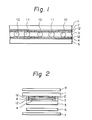
- Fig. l is a diagram illustrating a main part of one embodiment of the present invention.
- An electroconductive coat layer 2 is formed on the surface of a glass or plastic sheet or monoaxially oriented film l as a top plate, and a transparent electrode 4 is formed on the surface of a glass or plastic sheet or film 5 as a lower plate.
- Particles l0 as a spacer keep a distance between the top and lower plates, and adhesive particles ll of the present invention bond the top and lower plates in the state where the upper and lower contact portions of the particles ll are somewhat crushed.
- Reference numeral 3 represents a liquid crystal.
- Fig. 2 shows the entire structure of the embodiment of the present invention. Explanation of the members shown in Fig. l is omitted.
- Reference numerals 6, 7, 8, 9 and l2 represent a polarizing plate, a reflecting plate, a sealing material, a polarizing plate and alignmental film, respectively.
- the adhesive particles of the present invention are crushed and act as a cushioning member for preventing the spacer particles from being destroyed by convexities of the substrate.
- the adhesive particles also serve to attract the concavities of the substrate toward the confronting substrate by bonding, whereby a uniform space is realized.
- Adhesive particles comprising a phenolic curing agent, especially an adduct of a condensed or uncondensed bisphenol glycidyl ether and a bisphenol, is particularly effective for preventing contamination or breaking of the orientation coat layer.
- the adhesive particles ll of the present invention are crushed and are cured in the state fusion-bonded to the two substrates l and 5.
- the two substrates l and 5 are secured while they reeive a force of attracting them to each other by the sealing material 8 and the adhesive particles ll but the inward movement is regulated by the spacer particles l0, whereby a cell is formed.
- the adhesive particles ll exert a cushioning action at the press-bonding step and prevent the spacer particles l0 from being crushed and broken by convexities of the undulated substrates.
- the adhesive particles ll comprise a phenolic curing agent
- a contaminant reaction gas is not generated at the curing reaction and hence the alignmental film is not deteriorated. Accordingly, an electric optical element having a good contrast ratio can be obtained. Furthermore, since the adhesive particles ll are chemically stable, the liquid crystal is not modified or deteriorated even if the liquid crystal is used for a long time, and the durability characteristic is highly improved.
- the amount used of the adhesive particles is about 0.l to about 50 mg per l00 cm2 of the panel. Since the diameter of the particles is much smaller than the size of the image elements, even if the adhesive particles are used in such an amount as described above, no substantial disturbance is caused in a displayed image and no bad influences are imposed on the human eyes.
- a polyethylene cup having a capacity of l00 cc was charged with 5 g of Epikote 828 and 5 g of Epikote l00l, each being a commercially available bisphenol A diglycidyl ether type epoxy resin supplied by Yuka-Shell Epoxy, and l g of Noigen EA-l37 (supplied by Daiichi Kogyo Seiyaku), which is a commercially available polyoxyethylene phenol substituted ether type surface active agent having an HLB value of l3, was added.
- a curing liquid formed by diluting 0.44 equivalent of piperazine with 8 cc of water was added to the emulsion and the mixture was gently stirred to uniformalize the emulsion.
- the emulsion was allowed to stand still at 25°C for 6 days to obtain spherical particles having an average particle size of about 4.9 ⁇ m.
- the particles were recovered by filtration and dried, and they were placed on a slide glass and treated at l40°C, whereby the particles were rendered transparent and integrated. Separately, l0 mg of the particles were uniformly scattered on a slide glass [75 mm ⁇ 25 mm ⁇ l mm (thickness)] in a region of 30 mm from one end, and the particle-scattered area was covered by another slide glass and both the slide glasses were fixed by an adhesive cellophane tape. The assembly was heat-treated for 8 hours by a hot air drier maintained at l40°C. Then, the bonded structure was taken out and bent by the hands. The bonded portion was not broken but the slide glasses were broken in other portions.
- a polyethylene cup having a capacity of 300 cc was charged with 40 g of Epikote 828 used in Example l, and 4 g of Emulgit 9 (supplied by Daiichi Kogyo Seiyaku), which is a polyoxyethylene nonylphenyl ether having an HLB value of l6.2, and l2 g (about 0.26 equivalent) of Epicure l7lN, which is the same latent curing agent as used in Example l, were added, and the mixture was heated at 90°C to form a transparent compatible liquid. The mixture was cooled to normal temperature and an emulsion was prepared in the same manner as described in Example l by using 24 cc of water as a whole.
- the curing liquid-containing slurry of epoxy type spherical particles obtained in Example l was diluted to form a suspension having a solid content of 5% by weight. Then, silica sol (Snowtex N supplied by Nissan Kagaku) was added to the suspension, and the mixture was stirred tration, washed and dried at normal temperature under reduces pressure.
- silica sol Snowtex N supplied by Nissan Kagaku
- a polyethylene cup having a capacity of l00 cc was charged with 5 g of Epikote 828, 5 g of Epikote l00l and l g of Emulsit 9 as a surface active agent, and they were melt-mixed at 95°C.
- the molten mixture was cooled to 50°C and 0.5 g of Curesol 2E4MZ-CN (imidazole type latent curing agent supplied by Shikoku Kasei) was added, and they were melt-mixed to obtain a transparent mixture.
- a curing liquid formed by diluting 0.3 equivalent of piperazine with 8 cc of water was added to the emulsion, and partial curing was effected with gentle stirring at 20°C for 4 days to obtain spherical particles having an average particle size of 4.5 ⁇ m.
- the particles were dried at normal temperature under reduced pressure, and when the tear bonding strength was measured in the same manner as described in Example 3, it was found that the tear bonding strength was 23 Kg/l5 mm.
- An epoxy resin adhesive liquid was coated in a thickness of about 7 ⁇ m on the surface of the peripheral. region of a glass substrate having a transparent electrode coat layer and a rubbed or unrubbed polyimide alignment film as an orientation coat to form a sealing portion.
- An epoxy type spherical particulate adhesive having a composition described below
- fine particles of alumina having a diameter of 2 ⁇ m were scattered at predetermined densities (for example, 200 particles per mm2) on the inner region surrounded by the sealing portion.
- Another glass substrate was piled on the glass substrate, and the assembly was heated at an elevated temperature (for example, 80 to 200°C) under a pressure (for example, 0.3 to 5 Kg/cm2). A cell structure comprising the glass substrates secured in parallel with a space of 2 ⁇ m was thus obtained.
- a ferroelectric chiral smectic liquid crystal (for example, p-desiloxybenzylidene-p'-amino-2-methylbutyl cinnamate) was injected into the formed cell, and the cell was driven and the ratio of the contrast at the time of transmission of light to the contrast at the time of interception of light was measured.
- the contrast ratio was 5.5 to 6.5. Accordingly, it was confirmed that the contrast ratio was sufficiently high and the orientation state of the liquid crystal was not disturbed.
- a polyethylene cup having a capacity of 300 cc was charged with 20 g of Epikote 828 and 20 g of Epikote l00l as the epoxy resin, and 4 g of Emulsit 9 as the surface active agent was added and 4 g (about 0.l2 equivalent) of Epicure l7lN as the latent curing agent was added. The entire mixture was heated at 95°C and promptly stirred to form a transparent compatible liquid.
- a stirrer having a Teflon plate vane attached to the top end thereof was set in the cup, and the liquid was stirred at 800 rpm at a temperature maintained at 50°C. Then, 6 cc of water contained in a syringe and maintained at 50°C was added and the mixture was stirred for 40 seconds. This operation was repeated 4 times. Thus, the mixture of the epoxy resin and Epicure l7lN was emulsified by 24 cc of water as a whole.
- a curing liquid formed by diluting 0.44 equivalent of p iperazine with 32 cc of water was added to the emulsion and the mixture was gently stirred to uniformalize the emulsion.
- the emulsion was allowed to stand still at 25°C for 6 days to obtain spherical particles having an average particle size of about 6 ⁇ m.
- Water classification was carried out to obtain such a particle size distribution that particles having a size of 5.5 ⁇ 2 ⁇ m occupied 95% by weight of total particles.
- Silica sol (Snowtex N, solid content of 40% of by weight) was added in an amount of 2.5% by weight based on the particles to the classified particle suspension, and the mixture was stirred for 30 minutes to make silica adsorbed on the particles.
- the particles were recovered by suction filtration and dried at normal temperature under reduced pressure.
- the tear bonding strength was measured in the same manner as described in Example 3. It was found that the tear bonding strength was 40 Kg/l5 mm.
- a polyethylene cup having a capacity of 300 cc was charged with 40 g of Epikote 828, l2 g (about 0.26 equivalent) of Epicure l7lN as the latent curing agent and 4 g of Noigen EAl37 as the surface active agent, and they were heat-mixed at 95°C to obtain a transparent compatible liquid.
- the liquid was emulsified in the same manner as described in Adhesive l except that the emulsifying temperature was normal temperature.
- a curing liquid formed by diluting 0.3 equivalent of piperazine with 32 cc of water was added to the emulsion and the mixture was gently stirred to uniformalize the emulsion.
- the emulsion was allowed to stand still at 25°C with gentle stirring at about l to about 3 rpm for 4 days to obtain spherical particles having an average particle size of 6.5 ⁇ m.
- the particles After drying under reduced pressure, the particles had a tear bonding strength of 35 Kg/l5 mm.
- the following curing agents were used as the phenolic curing agent to be contained in the epoxy type spherical particulate adhesive. In each case, a good contrast ratio was obtained.
- a polyethylene cup having a capacity of 300 cc was charged with 40 g of the resulting transparent mixture comprising Epikote 828 and Sumilite Resin at a ratio of 9/l.
- a solution of 6 g of polyvinyl alcohol (Gosenol GL-05 supplied by Nippon Gosei Kagaku) in 34 g of water was used for emulsifying the above mixture. Namely, the aqueous solution of polyvinyl alcohol was added at intervals of l minute l0 g by l0 g to the mixture stirred at 800 rpm.
- a curing liquid formed by diluting 0.26 equivalent of piperazine with 32 cc of water was added to the emulsion and the mixture was gently stirred at 25°C for 4 days to effect partial curing and obtain spherical particles having an average particle size of l0 ⁇ m.
- Classification was carried out by elutriation so that particles having a size of l2 ⁇ 3 ⁇ m occupied 95% by weight of total particles, and silica sol Snowtex N (solid content of 40% by weight) was added in an amount of l.25% by weight based on the particles and the mixture was stirred for 30 minutes and dried at normal temperature under reduced pressure.
- the tear bonding strength measured in the same manner as described in Example 3 was l5 Kg/l5 mm.
Landscapes
- Chemical & Material Sciences (AREA)
- Physics & Mathematics (AREA)
- Organic Chemistry (AREA)
- Nonlinear Science (AREA)
- Health & Medical Sciences (AREA)
- Polymers & Plastics (AREA)
- Medicinal Chemistry (AREA)
- Chemical Kinetics & Catalysis (AREA)
- Dispersion Chemistry (AREA)
- Crystallography & Structural Chemistry (AREA)
- Optics & Photonics (AREA)
- General Physics & Mathematics (AREA)
- Mathematical Physics (AREA)
- Adhesives Or Adhesive Processes (AREA)
- Processes Of Treating Macromolecular Substances (AREA)
- Epoxy Resins (AREA)
- Liquid Crystal (AREA)
Priority Applications (1)
| Application Number | Priority Date | Filing Date | Title |
|---|---|---|---|
| AT86307297T ATE53857T1 (de) | 1985-09-25 | 1986-09-23 | Epoxidklebstoff aus sphaerischen teilchen und verfahren zu dessen herstellung. |
Applications Claiming Priority (2)
| Application Number | Priority Date | Filing Date | Title |
|---|---|---|---|
| JP21140085 | 1985-09-25 | ||
| JP211400/85 | 1985-09-25 |
Publications (3)
| Publication Number | Publication Date |
|---|---|
| EP0219242A2 true EP0219242A2 (de) | 1987-04-22 |
| EP0219242A3 EP0219242A3 (en) | 1988-03-23 |
| EP0219242B1 EP0219242B1 (de) | 1990-05-02 |
Family
ID=16605339
Family Applications (1)
| Application Number | Title | Priority Date | Filing Date |
|---|---|---|---|
| EP86307297A Expired - Lifetime EP0219242B1 (de) | 1985-09-25 | 1986-09-23 | Epoxidklebstoff aus sphärischen Teilchen und Verfahren zu dessen Herstellung |
Country Status (8)
| Country | Link |
|---|---|
| US (1) | US4732961A (de) |
| EP (1) | EP0219242B1 (de) |
| JP (1) | JPS62174726A (de) |
| KR (1) | KR940003072B1 (de) |
| AT (1) | ATE53857T1 (de) |
| AU (1) | AU580513B2 (de) |
| CA (1) | CA1287427C (de) |
| DE (1) | DE3670861D1 (de) |
Cited By (4)
| Publication number | Priority date | Publication date | Assignee | Title |
|---|---|---|---|---|
| EP0314048A3 (en) * | 1987-10-27 | 1990-06-13 | Semiconductor Energy Laboratory Co., Ltd. | Liquid crystal device and manufacturing method for the same |
| US5204766A (en) * | 1991-03-28 | 1993-04-20 | Canon Kabushiki Kaisha | Ferroelectric liquid crystal cell with particulate adhesive density higher near side |
| WO1996031572A1 (de) * | 1995-04-03 | 1996-10-10 | Institut für Neue Materialien Gemeinnützige GmbH | Kompositklebstoff für optische und optoelektronische anwendungen |
| EP2045839A4 (de) * | 2006-07-20 | 2009-08-05 | Sekisui Chemical Co Ltd | Kleber für elektronische komponenten, verfahren zum herstellen eines halbleiterchip-laminats und halbleiteranordnung |
Families Citing this family (19)
| Publication number | Priority date | Publication date | Assignee | Title |
|---|---|---|---|---|
| JP2796558B2 (ja) * | 1986-04-01 | 1998-09-10 | セイコーインスツルメンツ株式会社 | 液晶電気光学素子 |
| JP2703217B2 (ja) * | 1986-09-25 | 1998-01-26 | 株式会社東芝 | 液晶素子 |
| IT1203925B (it) * | 1987-04-17 | 1989-02-23 | Ausimont Spa | Procedimento per vulcanizzare resine termoindurenti mediante l'uso di un trasferitore liquido di calore |
| DE68928293T2 (de) | 1988-06-23 | 1998-02-12 | Canon Kk | Vorrichtung mit einem Flüssigkristall |
| JP2756978B2 (ja) * | 1988-08-04 | 1998-05-25 | キヤノン株式会社 | 液晶セル |
| US4959398A (en) * | 1989-02-13 | 1990-09-25 | Toray Industries, Inc. | Powdery adhesive and process for preparation thereof |
| JPH03160071A (ja) * | 1989-11-18 | 1991-07-10 | Somar Corp | 光硬化性無電解メッキレジストインキ組成物 |
| US5150239A (en) * | 1990-02-09 | 1992-09-22 | Canon Kabushiki Kaisha | One-pack type epoxy sealant with amine-type curing agent, for liquid crystal cell, display apparatus and recording apparatus |
| US5480957A (en) * | 1991-05-28 | 1996-01-02 | W. R. Grace & Co.-Conn. | Spherical curing agent for epoxy resin, curing agent masterbatch for epoxy resin and their preparation |
| JP2603747B2 (ja) * | 1990-07-24 | 1997-04-23 | シャープ株式会社 | 液晶表示装置の製造方法 |
| JP3562467B2 (ja) * | 1991-08-01 | 2004-09-08 | セイコーエプソン株式会社 | 液晶表示素子及び電子機器 |
| US5357008A (en) * | 1992-01-22 | 1994-10-18 | W. R. Grace & Co.-Conn. | Latent curing agent for epoxy resin and its preparation |
| JPH0843835A (ja) * | 1995-08-04 | 1996-02-16 | Canon Inc | 液晶セルの製造方法 |
| US6492437B1 (en) | 2001-06-21 | 2002-12-10 | National Starch And Chemical Investment Holding Corporation | Solvent-based process for manufacturing latent curing catalysts |
| FR2858818B1 (fr) * | 2003-08-14 | 2008-04-18 | Snf Sas | Nouveaux polymeres sous forme solide et leurs applications |
| WO2006128091A2 (en) * | 2005-05-26 | 2006-11-30 | E. I. Du Pont De Nemours And Company | Multilayer laminates comprising twisted nematic liquid crystals |
| US7993732B2 (en) * | 2006-07-28 | 2011-08-09 | Ricoh Company, Ltd. | Heat-sensitive pressure-sensitive adhesive and heat-sensitive adhesive material |
| US20090098396A1 (en) * | 2007-10-10 | 2009-04-16 | Ppg Industries Ohio, Inc. | Powder coating compositions, methods for their preparation and related coated substrates |
| CN116042131B (zh) * | 2023-01-31 | 2024-07-23 | 哈尔滨工业大学 | 一种纳米导电粘接剂的制备方法 |
Family Cites Families (11)
| Publication number | Priority date | Publication date | Assignee | Title |
|---|---|---|---|---|
| US3102043A (en) * | 1958-01-30 | 1963-08-27 | Fluidized bed coating method | |
| US3342775A (en) * | 1964-04-16 | 1967-09-19 | Gen Mills Inc | Process of coprecipitation of epoxies with crosslinking agents |
| NL6610758A (de) * | 1965-08-09 | 1967-02-10 | ||
| JPS54145157A (en) * | 1978-05-02 | 1979-11-13 | Hitachi Ltd | Production of liquid crystal display element |
| US4243794A (en) * | 1978-10-10 | 1981-01-06 | Minnesota Mining And Manufacturing Company | Mixture of rough and spheroidized resin particles |
| US4269760A (en) * | 1978-11-09 | 1981-05-26 | Sinloihi Company Limited | Fine spherical polymer particles containing inorganic pigment and/or coloring agent and process for the preparation thereof |
| US4251426A (en) * | 1979-02-06 | 1981-02-17 | E. I. Du Pont De Nemours And Company | Epoxy resin powder primer compositions |
| JPS5729031A (en) * | 1980-07-28 | 1982-02-16 | Nissan Motor Co Ltd | Liquid crystal display panel |
| DE3308622C2 (de) * | 1983-03-11 | 1994-02-03 | Syntec Ges Fuer Chemieprodukte | Verfahren zur Herstellung einer lagerfähigen, einsatzbereiten Reaktionsharz-Härter-Zubereitung und nach diesem Verfahren hergestellte Zubereitung |
| US4588617A (en) * | 1984-09-17 | 1986-05-13 | Toray Industries, Inc. | Process for producing cured epoxy resin spherical particles |
| JPS61166827A (ja) * | 1985-01-17 | 1986-07-28 | Toray Ind Inc | 変性エポキシ系微粒子 |
-
1986
- 1986-09-16 CA CA000518324A patent/CA1287427C/en not_active Expired - Lifetime
- 1986-09-18 US US06/909,058 patent/US4732961A/en not_active Expired - Fee Related
- 1986-09-19 JP JP61219273A patent/JPS62174726A/ja active Pending
- 1986-09-23 EP EP86307297A patent/EP0219242B1/de not_active Expired - Lifetime
- 1986-09-23 AT AT86307297T patent/ATE53857T1/de not_active IP Right Cessation
- 1986-09-23 DE DE8686307297T patent/DE3670861D1/de not_active Expired - Fee Related
- 1986-09-23 AU AU63062/86A patent/AU580513B2/en not_active Ceased
- 1986-09-25 KR KR1019860008037A patent/KR940003072B1/ko not_active Expired - Fee Related
Cited By (7)
| Publication number | Priority date | Publication date | Assignee | Title |
|---|---|---|---|---|
| EP0314048A3 (en) * | 1987-10-27 | 1990-06-13 | Semiconductor Energy Laboratory Co., Ltd. | Liquid crystal device and manufacturing method for the same |
| US4973138A (en) * | 1987-10-27 | 1990-11-27 | Semiconductor Energy Laboratory Co., Ltd. | Liquid crystal device and manufacturing method for the same |
| US5204766A (en) * | 1991-03-28 | 1993-04-20 | Canon Kabushiki Kaisha | Ferroelectric liquid crystal cell with particulate adhesive density higher near side |
| WO1996031572A1 (de) * | 1995-04-03 | 1996-10-10 | Institut für Neue Materialien Gemeinnützige GmbH | Kompositklebstoff für optische und optoelektronische anwendungen |
| US5910522A (en) * | 1995-04-03 | 1999-06-08 | Institut Fur Neue Materialien Gemeinnutzige Gmbh | Composite adhesive for optical and opto-electronic applications |
| EP2045839A4 (de) * | 2006-07-20 | 2009-08-05 | Sekisui Chemical Co Ltd | Kleber für elektronische komponenten, verfahren zum herstellen eines halbleiterchip-laminats und halbleiteranordnung |
| US7915743B2 (en) | 2006-07-20 | 2011-03-29 | Sekisui Chemical Co., Ltd. | Adhesive for electronic components, method for manufacturing semiconductor chip laminate, and semiconductor device |
Also Published As
| Publication number | Publication date |
|---|---|
| ATE53857T1 (de) | 1990-06-15 |
| CA1287427C (en) | 1991-08-06 |
| EP0219242A3 (en) | 1988-03-23 |
| AU6306286A (en) | 1987-03-26 |
| JPS62174726A (ja) | 1987-07-31 |
| AU580513B2 (en) | 1989-01-12 |
| EP0219242B1 (de) | 1990-05-02 |
| US4732961A (en) | 1988-03-22 |
| KR870003176A (ko) | 1987-04-15 |
| DE3670861D1 (de) | 1990-06-07 |
| KR940003072B1 (ko) | 1994-04-13 |
Similar Documents
| Publication | Publication Date | Title |
|---|---|---|
| EP0219242B1 (de) | Epoxidklebstoff aus sphärischen Teilchen und Verfahren zu dessen Herstellung | |
| EP0216632A2 (de) | Elektrooptisches Flüssigkristallelement und sein Herstellungsverfahren | |
| JP6484446B2 (ja) | エポキシ樹脂用硬化剤、エポキシ樹脂組成物及びこれを含有する材料 | |
| KR100961417B1 (ko) | 고-안정성 마이크로캡슐화 에폭시 수지용 경화제 및 에폭시수지 조성물 | |
| JP5148292B2 (ja) | マイクロカプセル型エポキシ樹脂用硬化剤、マスタ−バッチ型エポキシ樹脂用硬化剤組成物、一液性エポキシ樹脂組成物、および加工品 | |
| JP6619628B2 (ja) | 接着フィルム用エポキシ樹脂組成物。 | |
| WO2010122995A1 (ja) | イミダゾール化合物含有マイクロカプセル化組成物、それを用いた硬化性組成物及びマスターバッチ型硬化剤 | |
| JP2007091899A (ja) | 高安定性エポキシ樹脂用硬化剤およびエポキシ樹脂組成物 | |
| JP4911981B2 (ja) | 高含水含溶剤エポキシ樹脂用硬化剤およびエポキシ樹脂組成物 | |
| KR20150027013A (ko) | 사전적용된 언더필 | |
| US4959398A (en) | Powdery adhesive and process for preparation thereof | |
| JPH039154B2 (de) | ||
| JPH1054990A (ja) | エポキシ樹脂被覆熱接着性粒子およびその製造方法 | |
| JP4877717B2 (ja) | 緩反応性エポキシ樹脂用硬化剤およびエポキシ樹脂組成物 | |
| WO2005038519A1 (ja) | 液晶シール剤、それを用いた液晶表示装置および該装置の製造方法 | |
| JPH042637B2 (de) | ||
| CN112708384A (zh) | 一种柔性增韧组合物、增韧型环氧树脂胶黏剂及其制备方法 | |
| JPH01197721A (ja) | 複合粒子 | |
| JP2005171209A (ja) | フィラー含有樹脂組成物及びその製造方法 | |
| JP3753470B2 (ja) | 異方性導電接着剤 | |
| KR930008756B1 (ko) | 분말접착제 및 그의 제조방법 | |
| JPH0678511B2 (ja) | 液晶素子基板間用接着剤 | |
| JP4096136B2 (ja) | 粉末状接着剤 | |
| JPH06908B2 (ja) | 球状粉末接着剤およびその製造方法 | |
| JPS63218780A (ja) | 粉末接着剤およびこれを利用した液晶素子用粉末接着剤 |
Legal Events
| Date | Code | Title | Description |
|---|---|---|---|
| PUAI | Public reference made under article 153(3) epc to a published international application that has entered the european phase |
Free format text: ORIGINAL CODE: 0009012 |
|
| AK | Designated contracting states |
Kind code of ref document: A2 Designated state(s): AT BE CH DE FR GB IT LI LU NL SE |
|
| PUAL | Search report despatched |
Free format text: ORIGINAL CODE: 0009013 |
|
| AK | Designated contracting states |
Kind code of ref document: A3 Designated state(s): AT BE CH DE FR GB IT LI LU NL SE |
|
| 17P | Request for examination filed |
Effective date: 19880423 |
|
| 17Q | First examination report despatched |
Effective date: 19890306 |
|
| GRAA | (expected) grant |
Free format text: ORIGINAL CODE: 0009210 |
|
| AK | Designated contracting states |
Kind code of ref document: B1 Designated state(s): AT BE CH DE FR GB IT LI LU NL SE |
|
| REF | Corresponds to: |
Ref document number: 53857 Country of ref document: AT Date of ref document: 19900615 Kind code of ref document: T |
|
| ITF | It: translation for a ep patent filed | ||
| REF | Corresponds to: |
Ref document number: 3670861 Country of ref document: DE Date of ref document: 19900607 |
|
| ET | Fr: translation filed | ||
| PLBE | No opposition filed within time limit |
Free format text: ORIGINAL CODE: 0009261 |
|
| STAA | Information on the status of an ep patent application or granted ep patent |
Free format text: STATUS: NO OPPOSITION FILED WITHIN TIME LIMIT |
|
| 26N | No opposition filed | ||
| ITTA | It: last paid annual fee | ||
| EPTA | Lu: last paid annual fee | ||
| PGFP | Annual fee paid to national office [announced via postgrant information from national office to epo] |
Ref country code: AT Payment date: 19940913 Year of fee payment: 9 |
|
| PGFP | Annual fee paid to national office [announced via postgrant information from national office to epo] |
Ref country code: SE Payment date: 19940915 Year of fee payment: 9 |
|
| PGFP | Annual fee paid to national office [announced via postgrant information from national office to epo] |
Ref country code: CH Payment date: 19940923 Year of fee payment: 9 |
|
| PGFP | Annual fee paid to national office [announced via postgrant information from national office to epo] |
Ref country code: LU Payment date: 19941001 Year of fee payment: 9 |
|
| PGFP | Annual fee paid to national office [announced via postgrant information from national office to epo] |
Ref country code: BE Payment date: 19941104 Year of fee payment: 9 |
|
| EAL | Se: european patent in force in sweden |
Ref document number: 86307297.1 |
|
| PG25 | Lapsed in a contracting state [announced via postgrant information from national office to epo] |
Ref country code: LU Free format text: LAPSE BECAUSE OF NON-PAYMENT OF DUE FEES Effective date: 19950923 Ref country code: AT Effective date: 19950923 |
|
| PG25 | Lapsed in a contracting state [announced via postgrant information from national office to epo] |
Ref country code: SE Effective date: 19950924 |
|
| PG25 | Lapsed in a contracting state [announced via postgrant information from national office to epo] |
Ref country code: LI Effective date: 19950930 Ref country code: CH Effective date: 19950930 Ref country code: BE Effective date: 19950930 |
|
| BERE | Be: lapsed |
Owner name: TORAY INDUSTRIES INC. Effective date: 19950930 |
|
| REG | Reference to a national code |
Ref country code: CH Ref legal event code: PL |
|
| EUG | Se: european patent has lapsed |
Ref document number: 86307297.1 |
|
| PGFP | Annual fee paid to national office [announced via postgrant information from national office to epo] |
Ref country code: NL Payment date: 19960930 Year of fee payment: 11 |
|
| PG25 | Lapsed in a contracting state [announced via postgrant information from national office to epo] |
Ref country code: NL Free format text: LAPSE BECAUSE OF NON-PAYMENT OF DUE FEES Effective date: 19980401 |
|
| NLV4 | Nl: lapsed or anulled due to non-payment of the annual fee |
Effective date: 19980401 |
|
| PGFP | Annual fee paid to national office [announced via postgrant information from national office to epo] |
Ref country code: FR Payment date: 19980909 Year of fee payment: 13 |
|
| PGFP | Annual fee paid to national office [announced via postgrant information from national office to epo] |
Ref country code: GB Payment date: 19980916 Year of fee payment: 13 |
|
| PGFP | Annual fee paid to national office [announced via postgrant information from national office to epo] |
Ref country code: DE Payment date: 19981005 Year of fee payment: 13 |
|
| PG25 | Lapsed in a contracting state [announced via postgrant information from national office to epo] |
Ref country code: GB Free format text: LAPSE BECAUSE OF NON-PAYMENT OF DUE FEES Effective date: 19990923 |
|
| GBPC | Gb: european patent ceased through non-payment of renewal fee |
Effective date: 19990923 |
|
| PG25 | Lapsed in a contracting state [announced via postgrant information from national office to epo] |
Ref country code: FR Free format text: LAPSE BECAUSE OF NON-PAYMENT OF DUE FEES Effective date: 20000531 |
|
| PG25 | Lapsed in a contracting state [announced via postgrant information from national office to epo] |
Ref country code: DE Free format text: LAPSE BECAUSE OF NON-PAYMENT OF DUE FEES Effective date: 20000701 |
|
| REG | Reference to a national code |
Ref country code: FR Ref legal event code: ST |
|
| PG25 | Lapsed in a contracting state [announced via postgrant information from national office to epo] |
Ref country code: IT Free format text: LAPSE BECAUSE OF NON-PAYMENT OF DUE FEES;WARNING: LAPSES OF ITALIAN PATENTS WITH EFFECTIVE DATE BEFORE 2007 MAY HAVE OCCURRED AT ANY TIME BEFORE 2007. THE CORRECT EFFECTIVE DATE MAY BE DIFFERENT FROM THE ONE RECORDED. Effective date: 20050923 |