EP0219414A1 - Regeneration eines Ionenaustauscherharzes zur Entfernung von Nitraten aus Wasser - Google Patents
Regeneration eines Ionenaustauscherharzes zur Entfernung von Nitraten aus Wasser Download PDFInfo
- Publication number
- EP0219414A1 EP0219414A1 EP86402163A EP86402163A EP0219414A1 EP 0219414 A1 EP0219414 A1 EP 0219414A1 EP 86402163 A EP86402163 A EP 86402163A EP 86402163 A EP86402163 A EP 86402163A EP 0219414 A1 EP0219414 A1 EP 0219414A1
- Authority
- EP
- European Patent Office
- Prior art keywords
- resin
- water
- bed
- regeneration
- nitrates
- Prior art date
- Legal status (The legal status is an assumption and is not a legal conclusion. Google has not performed a legal analysis and makes no representation as to the accuracy of the status listed.)
- Granted
Links
- XLYOFNOQVPJJNP-UHFFFAOYSA-N water Substances O XLYOFNOQVPJJNP-UHFFFAOYSA-N 0.000 title claims abstract description 32
- 150000002823 nitrates Chemical class 0.000 title claims abstract description 21
- 230000008929 regeneration Effects 0.000 title description 32
- 238000011069 regeneration method Methods 0.000 title description 32
- 239000003456 ion exchange resin Substances 0.000 title description 2
- 229920003303 ion-exchange polymer Polymers 0.000 title description 2
- NWUYHJFMYQTDRP-UHFFFAOYSA-N 1,2-bis(ethenyl)benzene;1-ethenyl-2-ethylbenzene;styrene Chemical compound C=CC1=CC=CC=C1.CCC1=CC=CC=C1C=C.C=CC1=CC=CC=C1C=C NWUYHJFMYQTDRP-UHFFFAOYSA-N 0.000 title 1
- 239000011347 resin Substances 0.000 claims abstract description 47
- 229920005989 resin Polymers 0.000 claims abstract description 47
- 238000000034 method Methods 0.000 claims abstract description 33
- 238000002156 mixing Methods 0.000 claims abstract description 14
- 239000012267 brine Substances 0.000 claims abstract description 11
- HPALAKNZSZLMCH-UHFFFAOYSA-M sodium;chloride;hydrate Chemical compound O.[Na+].[Cl-] HPALAKNZSZLMCH-UHFFFAOYSA-M 0.000 claims abstract description 11
- 238000005342 ion exchange Methods 0.000 claims abstract description 8
- 238000003756 stirring Methods 0.000 claims abstract description 8
- 239000012492 regenerant Substances 0.000 claims abstract description 6
- 238000011049 filling Methods 0.000 claims abstract description 3
- 238000000265 homogenisation Methods 0.000 claims abstract description 3
- 238000002347 injection Methods 0.000 claims abstract description 3
- 239000007924 injection Substances 0.000 claims abstract description 3
- 238000005325 percolation Methods 0.000 claims abstract description 3
- 239000003651 drinking water Substances 0.000 claims abstract 2
- 235000020188 drinking water Nutrition 0.000 claims abstract 2
- 125000000129 anionic group Chemical group 0.000 claims description 5
- 239000000203 mixture Substances 0.000 claims description 5
- 230000004907 flux Effects 0.000 claims 1
- 238000010907 mechanical stirring Methods 0.000 claims 1
- 239000002245 particle Substances 0.000 abstract description 3
- FAPWRFPIFSIZLT-UHFFFAOYSA-M Sodium chloride Chemical compound [Na+].[Cl-] FAPWRFPIFSIZLT-UHFFFAOYSA-M 0.000 description 35
- 239000011780 sodium chloride Substances 0.000 description 18
- 238000009434 installation Methods 0.000 description 8
- -1 nitrate ions Chemical class 0.000 description 8
- 229910002651 NO3 Inorganic materials 0.000 description 7
- 150000001450 anions Chemical class 0.000 description 6
- 150000003839 salts Chemical class 0.000 description 6
- 230000001172 regenerating effect Effects 0.000 description 5
- BVKZGUZCCUSVTD-UHFFFAOYSA-M Bicarbonate Chemical class OC([O-])=O BVKZGUZCCUSVTD-UHFFFAOYSA-M 0.000 description 3
- 238000006073 displacement reaction Methods 0.000 description 3
- LFQSCWFLJHTTHZ-UHFFFAOYSA-N Ethanol Chemical compound CCO LFQSCWFLJHTTHZ-UHFFFAOYSA-N 0.000 description 2
- NHNBFGGVMKEFGY-UHFFFAOYSA-N Nitrate Chemical compound [O-][N+]([O-])=O NHNBFGGVMKEFGY-UHFFFAOYSA-N 0.000 description 2
- 230000000052 comparative effect Effects 0.000 description 2
- 230000008030 elimination Effects 0.000 description 2
- 238000003379 elimination reaction Methods 0.000 description 2
- 238000010828 elution Methods 0.000 description 2
- 230000005484 gravity Effects 0.000 description 2
- 239000000758 substrate Substances 0.000 description 2
- 150000003467 sulfuric acid derivatives Chemical class 0.000 description 2
- IJGRMHOSHXDMSA-UHFFFAOYSA-N Atomic nitrogen Chemical compound N#N IJGRMHOSHXDMSA-UHFFFAOYSA-N 0.000 description 1
- 241000894006 Bacteria Species 0.000 description 1
- VEXZGXHMUGYJMC-UHFFFAOYSA-M Chloride anion Chemical compound [Cl-] VEXZGXHMUGYJMC-UHFFFAOYSA-M 0.000 description 1
- 206010028980 Neoplasm Diseases 0.000 description 1
- QAOWNCQODCNURD-UHFFFAOYSA-L Sulfate Chemical compound [O-]S([O-])(=O)=O QAOWNCQODCNURD-UHFFFAOYSA-L 0.000 description 1
- 230000001174 ascending effect Effects 0.000 description 1
- QVGXLLKOCUKJST-UHFFFAOYSA-N atomic oxygen Chemical compound [O] QVGXLLKOCUKJST-UHFFFAOYSA-N 0.000 description 1
- 230000031018 biological processes and functions Effects 0.000 description 1
- 230000015572 biosynthetic process Effects 0.000 description 1
- 244000309464 bull Species 0.000 description 1
- KRALOLGXHLZTCW-UHFFFAOYSA-L calcium;2-acetyloxybenzoate Chemical compound [Ca+2].CC(=O)OC1=CC=CC=C1C([O-])=O.CC(=O)OC1=CC=CC=C1C([O-])=O KRALOLGXHLZTCW-UHFFFAOYSA-L 0.000 description 1
- 150000003841 chloride salts Chemical class 0.000 description 1
- 229910001873 dinitrogen Inorganic materials 0.000 description 1
- 238000005516 engineering process Methods 0.000 description 1
- 238000000605 extraction Methods 0.000 description 1
- 239000010419 fine particle Substances 0.000 description 1
- 230000014759 maintenance of location Effects 0.000 description 1
- 239000000463 material Substances 0.000 description 1
- 208000005135 methemoglobinemia Diseases 0.000 description 1
- 230000003647 oxidation Effects 0.000 description 1
- 238000007254 oxidation reaction Methods 0.000 description 1
- 239000001301 oxygen Substances 0.000 description 1
- 229910052760 oxygen Inorganic materials 0.000 description 1
- 238000009304 pastoral farming Methods 0.000 description 1
- 230000000737 periodic effect Effects 0.000 description 1
- 238000005086 pumping Methods 0.000 description 1
- 238000004064 recycling Methods 0.000 description 1
- 230000000717 retained effect Effects 0.000 description 1
- 238000004904 shortening Methods 0.000 description 1
- 238000013517 stratification Methods 0.000 description 1
- 229910021653 sulphate ion Inorganic materials 0.000 description 1
- 239000000725 suspension Substances 0.000 description 1
- 238000003786 synthesis reaction Methods 0.000 description 1
- 239000000057 synthetic resin Substances 0.000 description 1
- 229920003002 synthetic resin Polymers 0.000 description 1
- 238000003911 water pollution Methods 0.000 description 1
Images
Classifications
-
- C—CHEMISTRY; METALLURGY
- C02—TREATMENT OF WATER, WASTE WATER, SEWAGE, OR SLUDGE
- C02F—TREATMENT OF WATER, WASTE WATER, SEWAGE, OR SLUDGE
- C02F1/00—Treatment of water, waste water, or sewage
- C02F1/42—Treatment of water, waste water, or sewage by ion-exchange
-
- B—PERFORMING OPERATIONS; TRANSPORTING
- B01—PHYSICAL OR CHEMICAL PROCESSES OR APPARATUS IN GENERAL
- B01J—CHEMICAL OR PHYSICAL PROCESSES, e.g. CATALYSIS OR COLLOID CHEMISTRY; THEIR RELEVANT APPARATUS
- B01J41/00—Anion exchange; Use of material as anion exchangers; Treatment of material for improving the anion exchange properties
- B01J41/04—Processes using organic exchangers
-
- B—PERFORMING OPERATIONS; TRANSPORTING
- B01—PHYSICAL OR CHEMICAL PROCESSES OR APPARATUS IN GENERAL
- B01J—CHEMICAL OR PHYSICAL PROCESSES, e.g. CATALYSIS OR COLLOID CHEMISTRY; THEIR RELEVANT APPARATUS
- B01J49/00—Regeneration or reactivation of ion-exchangers; Apparatus therefor
- B01J49/05—Regeneration or reactivation of ion-exchangers; Apparatus therefor of fixed beds
- B01J49/07—Regeneration or reactivation of ion-exchangers; Apparatus therefor of fixed beds containing anionic exchangers
-
- B—PERFORMING OPERATIONS; TRANSPORTING
- B01—PHYSICAL OR CHEMICAL PROCESSES OR APPARATUS IN GENERAL
- B01J—CHEMICAL OR PHYSICAL PROCESSES, e.g. CATALYSIS OR COLLOID CHEMISTRY; THEIR RELEVANT APPARATUS
- B01J49/00—Regeneration or reactivation of ion-exchangers; Apparatus therefor
- B01J49/60—Cleaning or rinsing ion-exchange beds
Definitions
- the present invention relates to the field of water treatment and specifically the removal of nitrate ions from ea ll. It relates more particularly, during the use of ion exchange resins to promote this elimination, a process making it possible to reduce the rate of regeneration of anion resins and to significantly reduce the amount of sodium chloride, or product equivalent, used for regeneration.
- nitrates Two main types of treatment for water pollution by nitrates have been developed to date.
- biological process where nitrates are used to oxidize a carbonaceous substrate, such as for example ethanol in the BIODENIT process (registered trademark) of the Applicant, while the nitrogen gas is eliminated, the denitrification is carried out by heterotrophic bacteria which, in an anoxic medium, use the oxygen of nitrates to oxidize a carbonaceous substrate and draw from this oxidation the energy necessary for the synthesis of new cells.
- the elimination of nitrates is done by ion exchange and an anionic synthetic resin is then used where the nitrates ions, as well as sulphate ions , bicarbonates or other anions, are exchanged against the anions of the regenerant (chloride or other) according to the conventional sequence of an exhaustion phase where the nitrates are fixed on the resin grains and a regeneration phase where the nitrates are displaced by the anions of the regenerant, such as for example the chlorides of a concentrated brine of NaCl or other anion of an appropriate regenerant.
- counter-current regeneration a periodic extraction of a fraction of the volume of resin is carried out to remove fine particles in an annex installation; counter-current regeneration of exhaustion with concentrated brine; then a counter-current movement of the brine and a counter-current rinsing, these last two phases must necessarily be carried out with treated water, which generally implies the need for an additional installation for storing treated water .
- Such a process generally gives good results in denitrification and makes it possible to achieve the abovementioned objective of reducing the amount of regenerating salt used.
- it requires two works annexed to the ion exchange installation, which significantly increases investment and operating costs and makes implementation difficult for modest rural treatment installations.
- superimposed tanks or other arrangements are used which always make the installation complicated and difficult to operate.
- the treatment phases consist of: an expansion of the resin (from 50 to 100%) to loosen the bed which tends to compact during exhaustion and to remove the particles retained on the surface, from materials in suspension of the water to be treated or formed by attrition and wear of the resin; then a percolation of brine concentrated to co- gravity flow of exhaustion; displacement of the co-current brine and co-current rinsing; the different phases can be done either with treated water or with untreated water without appreciable repercussions on the quality of the treated water when the exhaustion cycle is restarted.
- the installation to be implemented is much simpler and easier to operate, the consumption in brine is on the other hand very important and reaches rates, during regeneration, which often are not not bearable for the environment and make operation expensive.
- an anion retention gradient is created inside the resin bed, the more marked the lower the regeneration rate: due to the fact that the anions nitrates are more difficult to elute than sulfates and bicarbonates, they remain fixed at the base of the resin bed and, during the re-start in the exhaustion phase, these nitrates are displaced by the sulfates, which results in a significant leak in nitrates. Consequently, the regeneration rate cannot be reduced to a value less than 400% of the stoeohiometric quantity normally required, ie, for example about 240 g of NaCl per liter of resin.
- One of the essential aims of the invention is precisely to considerably reduce the amount of salt to be used during regeneration, while using the advantages of the simplicity of the abovementioned co-current technique.
- the final rinsing phase in the regeneration process is followed by homogenization by mixing the grains of anionic resin. It has in fact been found that careful mixing of the resin bed makes it possible to bring back into the lower layers thereof perfectly regenerated grains which then play a finishing role in the regeneration of the bed by allowing the stratification of the bed to be eliminated. and to reduce the leakage of nitrate ions, to a value below the standard, when restarting the exhaustion cycle.
- the mixing of the resin grains can be carried out in various ways.
- the bed is vigorously stirred with pressurized air, for example at 0.04 - 0.6 megaPascal.
- pressurized air for example at 0.04 - 0.6 megaPascal.
- stirring can be carried out by recycling by means of pumping water, or by mechanical stirrer or hydro-ejector, and, in general, by any known stirring system.
- the other phases of the regeneration process are the same as those mentioned above in the co-current technique, so that the sequential sequence is analyzed as follows: expansion of the bed, sending to co-current depletion of concentrated brine, displacement of the co-current brine, co-current rinsing then, according to the invention, mixing of the resin bed.
- the use of untreated water for the rinsing and brine displacement phases does not affect the quality of the treatment.
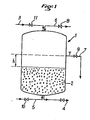
- FIG. 1 A processing device according to the invention is shown schematically by way of nonlimiting example in attached FIG. 1 where it can be seen that the reactor 1, provided with its anionic resin 2, is equipped for the above-mentioned purpose with mixing here to the air: from the inlet 3 of water to be treated, from the outlet 4 from treated water, from the line 5 for the arrival of the mixing air, from the outlet 6 for this air and from the line 7 partial emptying of the device.
- the height h as well as the stirring air flow and the duration of the mixing constitute parameters which vary, and can be determined by a person skilled in the art, depending on the size and the geometry of the devices. ion exchange treatment.
- the water was treated at a flow rate of 200 m3 / h over twenty hours of operation and contained: 60 ppm (parts per million) of nitrate ions, 40 ppm of sulfate ions and 260 ppm of bicarbonate ions.
- the final content desired for the nitrates was set at 15 ppm.
- the leakage of nitrates being substantially zero, it was sufficient to treat 75% of the water flow, which could therefore be mixed with 25% of raw water.
- the regeneration rate was 1.5 equivalent of NaCl per liter of resin (50% more than stoichiometry) and the capacity of the resin for nitrates was of the order of 250 milliequivalents / l of resin.
- the weight of NaCl to be used was 1,188 kg per 24 hours.
- the regeneration rate was 4 equivalents of NaCl / liter of resin (4 times the stoichiometry) for a volume of resin, calculated as said above, of 10, 5 m3.
- a weight of NaCl to be used from 2,520 Kg / 24 h. Because the quarter could be recycled, we had to base our on a daily consumption of 1,890 Kg.
- the regeneration rate was 1.5 equivalent of NaCl / 1 of resin and the capacity of the resin for nitrates of 250 milliequivalents / 1 of resin.
- the volume of resin to be used was of the order of 13 m3 in this exemplary embodiment. We then arrived at a weight of sodium chloride to use of 1170 kg / 24 hours. The volume of resin could be reduced to 10 m3 on condition of shortening the cycles between two regenerations (for example 6.30 pm instead of 24 hours) without spending more regenerating salt.
- the implementation of the method according to the invention has made it possible to reduce the amount of NaCl by almost 40% compared to the conventional co-current technique.
- the final quantity was of the same order as that used in the counter-current process, but with the advantage of simplicity of apparatus and much lower operating cost.
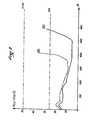
- the exhaustion curves during the implementation of the method of the invention are plotted in FIG. 2 appended, this for a regeneration rate of 1.5 equivalent / 1 of resin.
- the curves indicate the concentration of No3 (mg / 1) relative to the ratio R of volume of water treated per volume of resin.
- Curve A corresponds to the treatment of raw water containing 50 mg / l starting from nitrate ions whereas curve B reflects the case of a water which contained 100 mg / 1 of nitrate ions.
- the horizontal line CMA corresponds to the "maximum admissible concentration" and the line NG to the "guide level” according to the recommendations cited at the beginning of the description (Directive EEC / 80/778 of 07/15/1980).
- the nitrate removal rate according to the process of the invention was lower than the NG during the exhaustion cycle.
- the level of nitrates leaks represented by the vertical ascents of curves A and B is a function of the regeneration rate applied.
Landscapes
- Chemical & Material Sciences (AREA)
- Organic Chemistry (AREA)
- Chemical Kinetics & Catalysis (AREA)
- Life Sciences & Earth Sciences (AREA)
- Hydrology & Water Resources (AREA)
- Engineering & Computer Science (AREA)
- Environmental & Geological Engineering (AREA)
- Water Supply & Treatment (AREA)
- Treatment Of Water By Ion Exchange (AREA)
- Treatment Of Water By Oxidation Or Reduction (AREA)
Priority Applications (1)
| Application Number | Priority Date | Filing Date | Title |
|---|---|---|---|
| AT86402163T ATE59007T1 (de) | 1985-10-15 | 1986-10-02 | Regeneration eines ionenaustauscherharzes zur entfernung von nitraten aus wasser. |
Applications Claiming Priority (2)
| Application Number | Priority Date | Filing Date | Title |
|---|---|---|---|
| FR8515246 | 1985-10-15 | ||
| FR8515246A FR2588486B1 (fr) | 1985-10-15 | 1985-10-15 | Perfectionnement a la regeneration d'un lit de resine echangeuse d'ions pour l'elimination des nitrates de l'eau |
Publications (2)
| Publication Number | Publication Date |
|---|---|
| EP0219414A1 true EP0219414A1 (de) | 1987-04-22 |
| EP0219414B1 EP0219414B1 (de) | 1990-12-12 |
Family
ID=9323825
Family Applications (1)
| Application Number | Title | Priority Date | Filing Date |
|---|---|---|---|
| EP86402163A Expired - Lifetime EP0219414B1 (de) | 1985-10-15 | 1986-10-02 | Regeneration eines Ionenaustauscherharzes zur Entfernung von Nitraten aus Wasser |
Country Status (4)
| Country | Link |
|---|---|
| EP (1) | EP0219414B1 (de) |
| AT (1) | ATE59007T1 (de) |
| DE (1) | DE3676157D1 (de) |
| FR (1) | FR2588486B1 (de) |
Cited By (1)
| Publication number | Priority date | Publication date | Assignee | Title |
|---|---|---|---|---|
| EP0442849A1 (de) * | 1990-01-24 | 1991-08-21 | Valerio Mancini | Methode zur Verwendung und Regeneration von anionischen Harzen in Rückflusswassersystemen von Farblösungen und ähnlichen |
Citations (5)
| Publication number | Priority date | Publication date | Assignee | Title |
|---|---|---|---|---|
| US3313726A (en) * | 1963-06-24 | 1967-04-11 | Monsanto Co | Process for regenerating ion exchange resins |
| FR1512912A (fr) * | 1966-03-09 | 1968-02-09 | Rohm & Haas | Procédé d'amélioration de la capacité des résines échangeuses d'anions |
| FR2005248A1 (de) * | 1968-04-01 | 1969-12-12 | Crane Co | |
| DE3301054A1 (de) * | 1983-01-14 | 1984-07-19 | hydrogel-Chemie Korrosionsschutzgesellschaft mbH, 4760 Werl | Verfahren und nitratanlage zum entfernen von nitraten aus trinkwasser |
| US4479877A (en) * | 1983-07-28 | 1984-10-30 | The United States Of America As Represented By The Administrator Environmental Protection Agency | Removal of nitrate from water supplies using a tributyl amine strong base anion exchange resin |
-
1985
- 1985-10-15 FR FR8515246A patent/FR2588486B1/fr not_active Expired - Lifetime
-
1986
- 1986-10-02 DE DE8686402163T patent/DE3676157D1/de not_active Expired - Lifetime
- 1986-10-02 EP EP86402163A patent/EP0219414B1/de not_active Expired - Lifetime
- 1986-10-02 AT AT86402163T patent/ATE59007T1/de not_active IP Right Cessation
Patent Citations (5)
| Publication number | Priority date | Publication date | Assignee | Title |
|---|---|---|---|---|
| US3313726A (en) * | 1963-06-24 | 1967-04-11 | Monsanto Co | Process for regenerating ion exchange resins |
| FR1512912A (fr) * | 1966-03-09 | 1968-02-09 | Rohm & Haas | Procédé d'amélioration de la capacité des résines échangeuses d'anions |
| FR2005248A1 (de) * | 1968-04-01 | 1969-12-12 | Crane Co | |
| DE3301054A1 (de) * | 1983-01-14 | 1984-07-19 | hydrogel-Chemie Korrosionsschutzgesellschaft mbH, 4760 Werl | Verfahren und nitratanlage zum entfernen von nitraten aus trinkwasser |
| US4479877A (en) * | 1983-07-28 | 1984-10-30 | The United States Of America As Represented By The Administrator Environmental Protection Agency | Removal of nitrate from water supplies using a tributyl amine strong base anion exchange resin |
Cited By (1)
| Publication number | Priority date | Publication date | Assignee | Title |
|---|---|---|---|---|
| EP0442849A1 (de) * | 1990-01-24 | 1991-08-21 | Valerio Mancini | Methode zur Verwendung und Regeneration von anionischen Harzen in Rückflusswassersystemen von Farblösungen und ähnlichen |
Also Published As
| Publication number | Publication date |
|---|---|
| DE3676157D1 (de) | 1991-01-24 |
| ATE59007T1 (de) | 1990-12-15 |
| FR2588486A1 (fr) | 1987-04-17 |
| EP0219414B1 (de) | 1990-12-12 |
| FR2588486B1 (fr) | 1991-05-17 |
Similar Documents
| Publication | Publication Date | Title |
|---|---|---|
| EP0863793B1 (de) | Reinigungsverfahren für eine unterwassermembranfitteranlage | |
| FR2833939A1 (fr) | Procede de traitement d'eau par floculation lestee et decantation | |
| CH444063A (fr) | Nouveau procédé de désionisation | |
| EP0071553A1 (de) | Verfahren und Vorrichtung zur Reinigung von Helium in einer Gasmischung | |
| EP2511239A1 (de) | Aufbereitungsverfahren von durch Klärung behandeltem Wasser, das eine Absorption eines geklärten Wasseranteils und eine Klärung eines Wassergemischs aus geklärtem, absorbiertem Wasser und aufzubereitendem Wasser umfasst | |
| EP0219414B1 (de) | Regeneration eines Ionenaustauscherharzes zur Entfernung von Nitraten aus Wasser | |
| BE1005513A5 (fr) | Adoucisseur d'eau. | |
| EP0697999B1 (de) | Verfahren zur weitergehenden katalytischen desoxydierung von meerwasser | |
| EP3558874B1 (de) | Anlage und verfahren zur behandlung von wasser | |
| BE1027370B1 (fr) | Méthode et appareil domestique de production d'eau minérale à partir d'une eau de ville | |
| FR2522987A1 (fr) | Procede et dispositif pour la regeneration periodique d'une colonne d'adsorption | |
| EP0694027B1 (de) | Anlage und verfahren zur kontinuierlichen entkarbonisierung und enthärtung von rohwasser unter neutralen ph-bedingungen | |
| EP0991786A1 (de) | Abtrennung von auf harz absorbierten metallionen und anlage mit ionenaustauscher und elektrolysezelle zur regenerierenden aufarbeitung fotografischer bäder | |
| EP0280620B1 (de) | Vorrichtung zum Filtrieren und Reinigungsverfahren der Vorrichtung | |
| FR2990212A1 (fr) | Procede de recuperation d'hydrocarbures a partir d'une boue et dispositif mettant en oeuvre un tel procede | |
| FR2792307A1 (fr) | Procede et dispositif de traitement d'effluents industriels en vue de l'elimination de la pollution organique et/ou minerale | |
| WO2014091141A1 (fr) | Procede d'oxydation d'eaux de production | |
| FR2562060A1 (fr) | Epurateur d'eau et procede de production d'eau potable epuree | |
| BE791559Q (fr) | Procede pour le traitement (preparation, adoucissement et/ou dessalement) de solutions aqueuses au moyen d'echangeurs d'ions ainsique dispositif pour la mise en oeuvre du procede | |
| FR2904622A1 (fr) | Procede de traitement de lixiviat. | |
| CA1101567A (fr) | Procede pour l'epuration biologique des eaux | |
| BE476999A (de) | ||
| FR2742359A1 (fr) | Procede et dispositif d'epuration du charbon actif utilise dans le traitement des condensats | |
| CN101600656A (zh) | 从水溶液中除去氟化物离子 | |
| EP2082799A1 (de) | Verfahren und Vorrichtung zur Regenerierung eines absorbierenden Gels für Kohlendioxid, das in einem Gas enthalten ist |
Legal Events
| Date | Code | Title | Description |
|---|---|---|---|
| PUAI | Public reference made under article 153(3) epc to a published international application that has entered the european phase |
Free format text: ORIGINAL CODE: 0009012 |
|
| AK | Designated contracting states |
Kind code of ref document: A1 Designated state(s): AT BE CH DE GB IT LI NL |
|
| 17P | Request for examination filed |
Effective date: 19870402 |
|
| 17Q | First examination report despatched |
Effective date: 19881020 |
|
| GRAA | (expected) grant |
Free format text: ORIGINAL CODE: 0009210 |
|
| AK | Designated contracting states |
Kind code of ref document: B1 Designated state(s): AT BE CH DE GB IT LI NL |
|
| PG25 | Lapsed in a contracting state [announced via postgrant information from national office to epo] |
Ref country code: NL Effective date: 19901212 Ref country code: AT Effective date: 19901212 |
|
| REF | Corresponds to: |
Ref document number: 59007 Country of ref document: AT Date of ref document: 19901215 Kind code of ref document: T |
|
| ITF | It: translation for a ep patent filed | ||
| GBT | Gb: translation of ep patent filed (gb section 77(6)(a)/1977) | ||
| REF | Corresponds to: |
Ref document number: 3676157 Country of ref document: DE Date of ref document: 19910124 |
|
| NLV1 | Nl: lapsed or annulled due to failure to fulfill the requirements of art. 29p and 29m of the patents act | ||
| PLBE | No opposition filed within time limit |
Free format text: ORIGINAL CODE: 0009261 |
|
| STAA | Information on the status of an ep patent application or granted ep patent |
Free format text: STATUS: NO OPPOSITION FILED WITHIN TIME LIMIT |
|
| ITTA | It: last paid annual fee | ||
| PG25 | Lapsed in a contracting state [announced via postgrant information from national office to epo] |
Ref country code: BE Effective date: 19911031 |
|
| 26N | No opposition filed | ||
| BERE | Be: lapsed |
Owner name: OTV OMNIUM DE TRAITEMENTS ET DE VALORISATION Effective date: 19911031 |
|
| PGFP | Annual fee paid to national office [announced via postgrant information from national office to epo] |
Ref country code: DE Payment date: 19930924 Year of fee payment: 8 |
|
| PGFP | Annual fee paid to national office [announced via postgrant information from national office to epo] |
Ref country code: CH Payment date: 19931101 Year of fee payment: 8 |
|
| PGFP | Annual fee paid to national office [announced via postgrant information from national office to epo] |
Ref country code: GB Payment date: 19931102 Year of fee payment: 8 |
|
| PG25 | Lapsed in a contracting state [announced via postgrant information from national office to epo] |
Ref country code: GB Effective date: 19941002 |
|
| PG25 | Lapsed in a contracting state [announced via postgrant information from national office to epo] |
Ref country code: LI Effective date: 19941031 Ref country code: CH Effective date: 19941031 |
|
| GBPC | Gb: european patent ceased through non-payment of renewal fee |
Effective date: 19941002 |
|
| REG | Reference to a national code |
Ref country code: CH Ref legal event code: PL |
|
| PG25 | Lapsed in a contracting state [announced via postgrant information from national office to epo] |
Ref country code: DE Effective date: 19950701 |
|
| PG25 | Lapsed in a contracting state [announced via postgrant information from national office to epo] |
Ref country code: IT Free format text: LAPSE BECAUSE OF NON-PAYMENT OF DUE FEES;WARNING: LAPSES OF ITALIAN PATENTS WITH EFFECTIVE DATE BEFORE 2007 MAY HAVE OCCURRED AT ANY TIME BEFORE 2007. THE CORRECT EFFECTIVE DATE MAY BE DIFFERENT FROM THE ONE RECORDED. Effective date: 20051002 |