EP0219440A1 - Verfahren zur Dekontamination eines sandigen oder steinigen Strands - Google Patents
Verfahren zur Dekontamination eines sandigen oder steinigen Strands Download PDFInfo
- Publication number
- EP0219440A1 EP0219440A1 EP86420246A EP86420246A EP0219440A1 EP 0219440 A1 EP0219440 A1 EP 0219440A1 EP 86420246 A EP86420246 A EP 86420246A EP 86420246 A EP86420246 A EP 86420246A EP 0219440 A1 EP0219440 A1 EP 0219440A1
- Authority
- EP
- European Patent Office
- Prior art keywords
- electrolyzate
- sand
- spraying
- seawater
- installation
- Prior art date
- Legal status (The legal status is an assumption and is not a legal conclusion. Google has not performed a legal analysis and makes no representation as to the accuracy of the status listed.)
- Granted
Links
Images

Classifications
-
- E—FIXED CONSTRUCTIONS
- E01—CONSTRUCTION OF ROADS, RAILWAYS, OR BRIDGES
- E01H—STREET CLEANING; CLEANING OF PERMANENT WAYS; CLEANING BEACHES; DISPERSING OR PREVENTING FOG IN GENERAL CLEANING STREET OR RAILWAY FURNITURE OR TUNNEL WALLS
- E01H12/00—Cleaning beaches or sandboxes
- E01H12/002—Treatment in situ
-
- A—HUMAN NECESSITIES
- A61—MEDICAL OR VETERINARY SCIENCE; HYGIENE
- A61L—METHODS OR APPARATUS FOR STERILISING MATERIALS OR OBJECTS IN GENERAL; DISINFECTION, STERILISATION OR DEODORISATION OF AIR; CHEMICAL ASPECTS OF BANDAGES, DRESSINGS, ABSORBENT PADS OR SURGICAL ARTICLES; MATERIALS FOR BANDAGES, DRESSINGS, ABSORBENT PADS OR SURGICAL ARTICLES
- A61L2/00—Disinfection or sterilisation of materials or objects, in general; Accessories therefor
- A61L2/02—Disinfection or sterilisation of materials or objects, in general; Accessories therefor using physical processes
- A61L2/03—Electric current
- A61L2/035—Electrolysis
-
- C—CHEMISTRY; METALLURGY
- C02—TREATMENT OF WATER, WASTE WATER, SEWAGE, OR SLUDGE
- C02F—TREATMENT OF WATER, WASTE WATER, SEWAGE, OR SLUDGE
- C02F1/00—Treatment of water, waste water, or sewage
- C02F1/46—Treatment of water, waste water, or sewage by electrochemical methods
- C02F1/461—Treatment of water, waste water, or sewage by electrochemical methods by electrolysis
- C02F1/467—Treatment of water, waste water, or sewage by electrochemical methods by electrolysis by electrochemical disinfection; by electrooxydation or by electroreduction
- C02F1/4672—Treatment of water, waste water, or sewage by electrochemical methods by electrolysis by electrochemical disinfection; by electrooxydation or by electroreduction by electrooxydation
- C02F1/4674—Treatment of water, waste water, or sewage by electrochemical methods by electrolysis by electrochemical disinfection; by electrooxydation or by electroreduction by electrooxydation with halogen or compound of halogens, e.g. chlorine, bromine
Definitions
- the present invention relates to a method for disinfecting marine coastal environments, for example sandy and pebble beaches.
- the invention also relates to installations for implementing the method according to the invention.
- the sand the surface of which is contaminated by the large tourist frequentation retains humidity and heat thanks to its thin and dense layers and thus creates the conditions favorable to the proliferation of microbial germs.
- the invention aims at the same concern for disinfection, but by biological means, without any danger for humans and the environment.
- This treatment can moreover be associated with conventional cleaning, by mechanical means consisting for example of turning the sand and removing all the stains.
- the invention relates to a process for disinfecting marine coastal environments, consisting in treating the surface of the contaminated environment using an active solution against microorganisms, the active solution being an electrolyzate of sea water.
- seawater from the shore is sucked into a tank where it undergoes electrolysis and it is sprayed directly on the beach to be disinfected.
- Seawater pumped beforehand filtered is sent at constant flow rate to the electrolysis cell equipped with a set of metal electrodes covered with an electrocatalytic layer.
- the electrodes are supplied with direct current, current delivered for example by a rechargeable battery.
- the current density is adjusted so that the concentration of active species corresponds to the demand.
- the electrolyser comprises two compartments in which two sets of electrodes, anodes and cathodes are not separated, the sets being associated in electrical series. Seawater enters the first compartment and then passes into the second; half of the amp hours are consumed in each of them. Good agitation in each of the compartments allows a homogeneous mixture of the species in solution.
- the active species produced by electrolysis are essentially hypochlorite and hypobromite ions, according to a reaction scheme which, in the case of seawater, is as follows: either in total after mixing
- hypobromite formation can be carried out according to the scheme rapid reaction to pH values below 8, which is the case with seawater.
- the pH of the electrolyzate remains substantially that of seawater.
- hypobromite formed remains low compared to the total since there is only about 68 ppm of bromide in seawater. It was noted however that the presence of hypobromite was very favorable to the disinfectant quality of the electrolyzate, hypobromite seems to lead to a synergistic effect with hypochlorite.
- the active species, hypochlorites and hypobromites, alone or in a mixture (see above), are powerful disinfectants and their effectiveness is limited in time by the action of UV rays (sun). They become chlorides and bromides again and the natural cycle is thus completed.
- the spray treatment of the electrolyzate can be combined with mechanical means for turning and sieving the sand, so as to thoroughly disinfect it.
- mechanical means for turning and sieving the sand so as to thoroughly disinfect it.
- the sand is brewed, users and the germs responsible for infections can be found several centimeters or tens of centimeters below the surface.
- sea electrolyzate can be stored, in carboys for example, and be transported for remote treatments.
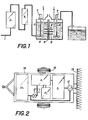
- the seawater to be electrolyzed arrives through an inlet 1 and passes through an activated carbon filter 2, to retain plankton, suspended substances and organic matter. Of there, the sea water passes through a flow meter 3 and is then sent to the electrolyser. At the outlet of the electrolyser 4, the sea water containing the active species is directly used for spraying or sent to a storage tank 5.
- the electrolyser can advantageously be of the type sold under the brand Lectraqua h1, M2 or M5 by the company F-TEC and which is well suited for the implementation of the process.
- this electrolyser 4 is provided with agitators 6, with a motor 7 and comprises watertight walls 8 separating the compartments.
- the electrodes 9 are of the DSA type, which are dimensionally stable electrodes of titanium covered with a catalyst.
- the electrolyser is powered by a 12 V battery.
- a voltage adjustment allows electrolysis at 7.2 V with an intensity of 7.5 A, which corresponds to a current density of 4.4 A / dm 2 and an energy consumption of 3.25 kwh / kg of chlorine equivalent produced. If we add the electrical consumption of the agitators, the total consumption is 5 kWh / kg of chlorine equivalent produced.
- the dosage by iodine of the total amount of active species produced shows that for an average seawater flow rate of 33.3 1 / h at the outlet of the device, it is produced on average 16.66 g chlorine equivalent per hour. This allows, by redilution with sea water to prepare solutions of different concentrations, 10 ppm, 50 ppm, 200 ppm or 400 ppm for example.
- the invention can be implemented using a mobile installation of the trolley type, which can be dragged along the beach by a tractor, of the type used to transport mechanical devices intended to turn the sand and remove the defilements. In this way, the two treatments can be combined.
- the treatments can be combined on a single trolley combining the mechanical treatment and the disinfection treatment.
- the carriage comprises a tank 10 filled with seawater and of sufficient capacity to treat large areas of sand.
- the tank 5 can be replaced by a long flexible pipe drawing water directly from the sea, corresponding to the inlet 1 in FIG. 1.
- the electrolyzate is sent to the storage tank 5 from which we can prepare the solutions to be sprayed at the desired concentrations.
- the concentrate coming from the tank 5 can be rediluted with sea water coming from the tank 10 or from the direct inlet 1 and a control block 12 controls the dilution rate.
- the electrolyzate is sprayed towards the ground using a sprayer 13.
- the circuit taken by the electrolyzate is 10-3-4-5-12, while the untreated seawater follows the circuit 10-12.
- All the aforementioned elements are firmly anchored on a plate 14 provided with wheels 15 in order to constitute a carriage which can be coupled to a tractor.
- the invention can also be implemented using a fixed station installation supplying one or more mobile units, as seen in FIG. 3.
- the room 30 is installed on a beach or near a beach and is supplied with sea water by a conduit 1 opening out to sea.
- the sea water is pumped to the room by a pump 20 through an activated carbon filter 2 intended to retain the sand and the gravel.
- This filter also serves to retain suspended plant matter, plankton, as well as organic materials such as hydrocarbons.
- a control block 22 allows the control of the assembly, including the redilution of the electrolyzate.
- This control unit 22 is therefore connected to the electrolyser 4 and to the storage tank 5.
- the sea water sent to the electrolyser 4 undergoes electrolysis, it emerges at a concentration of "active species" controlled both by the flow rate and the intensity of the current applied to the electrolyser.
- This electrolyser 4 is electrically supplied with 24 V DC by a transformer-rectifier 25.
- a general table 23 allows the monitoring and control of the assembly.
- the electrolyzed seawater, as well as the raw seawater, is found in a mixture in the storage tank 5, from which they supply the mobile units.
- These mobile units each include a spreading tank 24 mounted on a plate 14 on which is fixed a sprayer 13.
- the electrolyzate stored in the tank 24 is sprayed on the surface to be treated by means of this sprayer 13.
- Wheels 15 allow to transport the unit, for example by means of a tractor as above.
- Two sandy beaches of the Mediterranean coast are treated, one in the middle of August, by spraying an electrolyzate of sea water, at a rate of 2 m 3 / ha, the electrolyzate having a concentration of active species of 200 ppm, respectively 400 ppm.
- the amount of electrolyzate sprayed would correspond to a thickness, on a smooth surface, equivalent to 200 ⁇ m of liquid.
- the sand being a finely divided material, the liquid is distributed over a larger surface, therefore over a smaller thickness.
- dosages are carried out by collecting the sand over a thickness of 1 to 2 cm, which makes it possible to fully appreciate the effectiveness of the treatment, if we refer to the thickness of the film d electrolyzate indicated above.
- a sample of control sand taken just before treatment serves as a comparison.
- the treated sand it is analyzed 24 hours after the application of the treatment.
- FIG. 3 Another beach on the Mediterranean coast is treated using a stationary installation, such as that shown in FIG. 3.
- Spraying on the beach is carried out by mobile units at a speed of 10 km / h over 5 meters wide, a treatment of 5 ha / h.
- the spreading tank and the mobile unit contain a 3 m 3 of electrolyzate.
- the treatment is carried out at the rate of 2 m 3 per ha of beach to be decontaminated.
- an average of 3.35 tanks will be required, which, taking into account the back and forth and the filling times of the mobile elements, corresponds to approximately 3 hours.
- the treatment is carried out early in the morning, before the arrival of the bathers, between 5 and 8 hours.
- the electrolyser operates at 24 V and 100 A with an incoming flow of 6.3 l / min. We therefore obtain a Cl equivalent concentration of 1.787 g / 1.
- non-electrolyzed seawater supplies the storage tank at the rate of 50 l / min. Thus, after mixing, a concentration of 200 ppm of active species will be obtained.
- the fixed station includes, in its general table, a timer starting the installation at 3 am to stop it at 6 am.
- a contact float in the tank of 10m 3 for example, stops the electrolysis pumping when the tank contains for example 9 m 3 of solution, or if it happens that the flow rates are adjusted, or even if the withdrawals are not done between 5 and 6 a.m.
- Another safety device placed in the electrolyser stops the circulation of electrolysis water if the electrolyser is not completely filled with water due to a failure in pumping, a leak, or the development of a gas pocket. .
- Sand wetting tests over a thickness of 25 cm were carried out in the laboratory by spreading 1.5 cm 3 of colored seawater electrolyzate, 2 cm 3 , 2.5 cm 3 , 3 cm 3 over the surface. , 4 cm 3 per liter of sand, corresponding respectively to 0.375 1 / m 2 of sand surface, 0.5 1 / m 2 , 0.625 1 / m 2 , 0.750 11m 2 , 11 / m 2 .
- This sand treated with dyes was then vigorously brewed and we could see the presence of sand wetted by the dyes on the 25 cm thick.
- Spray bars have been installed on a machine that turns the sand twenty to thirty centimeters thick, and that screens and sieves the returned sand to remove solid detritus such as dog excrement, sticks, paper, pebbles, etc. ...
Landscapes
- Health & Medical Sciences (AREA)
- Chemical & Material Sciences (AREA)
- Engineering & Computer Science (AREA)
- Life Sciences & Earth Sciences (AREA)
- Veterinary Medicine (AREA)
- Electrochemistry (AREA)
- Structural Engineering (AREA)
- Animal Behavior & Ethology (AREA)
- General Health & Medical Sciences (AREA)
- Public Health (AREA)
- Civil Engineering (AREA)
- Architecture (AREA)
- Chemical Kinetics & Catalysis (AREA)
- Epidemiology (AREA)
- General Chemical & Material Sciences (AREA)
- Hydrology & Water Resources (AREA)
- Environmental & Geological Engineering (AREA)
- Water Supply & Treatment (AREA)
- Organic Chemistry (AREA)
- Water Treatment By Electricity Or Magnetism (AREA)
- Processing Of Solid Wastes (AREA)
- Catching Or Destruction (AREA)
Applications Claiming Priority (2)
| Application Number | Priority Date | Filing Date | Title |
|---|---|---|---|
| FR8515284 | 1985-10-08 | ||
| FR8515284A FR2588190B1 (fr) | 1985-10-08 | 1985-10-08 | Procede de desinfection de milieux interstitiels charges en germes pathogenes |
Publications (2)
| Publication Number | Publication Date |
|---|---|
| EP0219440A1 true EP0219440A1 (de) | 1987-04-22 |
| EP0219440B1 EP0219440B1 (de) | 1991-12-27 |
Family
ID=9323842
Family Applications (1)
| Application Number | Title | Priority Date | Filing Date |
|---|---|---|---|
| EP86420246A Expired - Lifetime EP0219440B1 (de) | 1985-10-08 | 1986-10-06 | Verfahren zur Dekontamination eines sandigen oder steinigen Strands |
Country Status (5)
| Country | Link |
|---|---|
| EP (1) | EP0219440B1 (de) |
| DE (1) | DE3683122D1 (de) |
| ES (1) | ES2039359T3 (de) |
| FR (1) | FR2588190B1 (de) |
| GR (1) | GR3003453T3 (de) |
Cited By (5)
| Publication number | Priority date | Publication date | Assignee | Title |
|---|---|---|---|---|
| FR2612965A1 (fr) * | 1986-11-17 | 1988-09-30 | F Tec Sarl | Materiel de nettoyage de terrain de sable ou de galet |
| WO2000024432A1 (en) * | 1998-10-23 | 2000-05-04 | Radical Waters Ip (Pty) Limited | Treatment of biofilm on marine seismographic equipment |
| WO2000024431A1 (en) * | 1998-10-23 | 2000-05-04 | Radical Waters Ip (Pty) Limited | Method for applying bactericidal solutions |
| EP1032281A4 (de) * | 1997-10-23 | 2001-04-25 | Radical Waters Ip Pty Ltd | Waessrige loesung zum desinfizieren eines tierischen produkts, ein verfahren sowie eine anlage fuer eine solche desinfizierung |
| FR2916638A1 (fr) * | 2007-05-29 | 2008-12-05 | Jean Jacques Lasvaladas | Procede de preparation d'une solution de nettoyage de sable par electrolyse d'eau de mer et intallation pour la mise en oeuvre d'un tel procede |
Families Citing this family (1)
| Publication number | Priority date | Publication date | Assignee | Title |
|---|---|---|---|---|
| CN112554124B (zh) * | 2020-12-22 | 2022-12-13 | 江苏鸿源石化机械有限公司 | 一种溢油海岸处理装置 |
Citations (2)
| Publication number | Priority date | Publication date | Assignee | Title |
|---|---|---|---|---|
| US3819329A (en) * | 1971-05-11 | 1974-06-25 | Morton Norwich Products Inc | Spray sanitizing system with electrolytic generator |
| EP0115893A1 (de) * | 1983-02-03 | 1984-08-15 | Battelle Memorial Institute | Vorrichtung zum Sterilisieren von Erzeugnissen mit Hilfe einer wässrigen Hypochloritlösung |
Family Cites Families (1)
| Publication number | Priority date | Publication date | Assignee | Title |
|---|---|---|---|---|
| GB2021947A (en) * | 1978-05-26 | 1979-12-12 | Dhp Corp | Hypochlorite-Containing Antiseptic and Disinfectant |
-
1985
- 1985-10-08 FR FR8515284A patent/FR2588190B1/fr not_active Expired
-
1986
- 1986-10-06 EP EP86420246A patent/EP0219440B1/de not_active Expired - Lifetime
- 1986-10-06 ES ES198686420246T patent/ES2039359T3/es not_active Expired - Lifetime
- 1986-10-06 DE DE8686420246T patent/DE3683122D1/de not_active Expired - Fee Related
-
1991
- 1991-12-30 GR GR91402064T patent/GR3003453T3/el unknown
Patent Citations (2)
| Publication number | Priority date | Publication date | Assignee | Title |
|---|---|---|---|---|
| US3819329A (en) * | 1971-05-11 | 1974-06-25 | Morton Norwich Products Inc | Spray sanitizing system with electrolytic generator |
| EP0115893A1 (de) * | 1983-02-03 | 1984-08-15 | Battelle Memorial Institute | Vorrichtung zum Sterilisieren von Erzeugnissen mit Hilfe einer wässrigen Hypochloritlösung |
Non-Patent Citations (1)
| Title |
|---|
| CHEMICAL ABSTRACTS, vol. 100, no. 23, 4 juin 1984, page 313, résumé no. 188657e, Columbus, Ohio, US; Yu.I. GRIGOR'EV et al.: "Effectiveness of using chlorine produced by electrolysis of sea water as a bactericide", & GIG. SANIT. 1984, (3), 84-6 * |
Cited By (7)
| Publication number | Priority date | Publication date | Assignee | Title |
|---|---|---|---|---|
| FR2612965A1 (fr) * | 1986-11-17 | 1988-09-30 | F Tec Sarl | Materiel de nettoyage de terrain de sable ou de galet |
| US4993498A (en) * | 1986-11-17 | 1991-02-19 | Fresnel Jean Marie | Apparatus for cleaning sandy or pebble-covered sites |
| EP1032281A4 (de) * | 1997-10-23 | 2001-04-25 | Radical Waters Ip Pty Ltd | Waessrige loesung zum desinfizieren eines tierischen produkts, ein verfahren sowie eine anlage fuer eine solche desinfizierung |
| WO2000024432A1 (en) * | 1998-10-23 | 2000-05-04 | Radical Waters Ip (Pty) Limited | Treatment of biofilm on marine seismographic equipment |
| WO2000024431A1 (en) * | 1998-10-23 | 2000-05-04 | Radical Waters Ip (Pty) Limited | Method for applying bactericidal solutions |
| FR2916638A1 (fr) * | 2007-05-29 | 2008-12-05 | Jean Jacques Lasvaladas | Procede de preparation d'une solution de nettoyage de sable par electrolyse d'eau de mer et intallation pour la mise en oeuvre d'un tel procede |
| EP2014311A2 (de) | 2007-05-29 | 2009-01-14 | Jean-Jacques Lasvaladas | Verfahren zur Herstellung einer Lösung zur Reinigung von Sand durch Meerwasserelektrolyse und Anlage zur Anwendung dieses Verfahrens |
Also Published As
| Publication number | Publication date |
|---|---|
| DE3683122D1 (de) | 1992-02-06 |
| FR2588190B1 (fr) | 1989-03-03 |
| ES2039359T3 (es) | 1993-10-01 |
| GR3003453T3 (en) | 1993-02-17 |
| FR2588190A1 (fr) | 1987-04-10 |
| EP0219440B1 (de) | 1991-12-27 |
Similar Documents
| Publication | Publication Date | Title |
|---|---|---|
| Bakheet et al. | Effective treatment of greywater via green wall biofiltration and electrochemical disinfection | |
| Norra et al. | Chlorine-free electrochemical disinfection using graphene sponge electrodes | |
| Ghernaout et al. | From chemical disinfection to electrodisinfection: The obligatory itinerary? | |
| EP3426608B1 (de) | Desinfektion und entfernung von stickstoffspezies aus salzhaltigen aquakultursystemen | |
| EP2406187B1 (de) | Anlage und Verfahren zur Vorbehandlung von Rohwasser | |
| JP5127983B2 (ja) | 一種の微電流電気分解滅菌滅藻装置と方法 | |
| US11019823B2 (en) | Method of controlling water surface inhabiting pests | |
| Nanayakkara et al. | A low-energy intensive electrochemical system for the eradication of Escherichia coli from ballast water: process development, disinfection chemistry, and kinetics modeling | |
| Pal et al. | Nanobubble ozonation for waterbody rejuvenation at different locations in India: A holistic and sustainable approach | |
| AU2004299043B2 (en) | Composition and method for cleaning contained bodies of water | |
| EP0219440B1 (de) | Verfahren zur Dekontamination eines sandigen oder steinigen Strands | |
| Kone et al. | Caractérisation des boues de vidange dépotées sur les lits de séchage de zagtouli (Ouagadougou) | |
| KR20140147623A (ko) | 농작물 절임수 및 세척수의 정수시스템 | |
| FR2994174A1 (fr) | Procede et installation de traitement d'eaux de ballast de navires | |
| EP0343092B1 (de) | Verfahren und Anlage für die Entkeimung von Badewasser durch elektrochemisch in situ-erzeugtes Natriumhypochlorit | |
| US20220356090A1 (en) | Facility-based wastewater treatment, reuse,waste disposal process. | |
| EP1167297B1 (de) | Verfahren zur physikalisch-chemischen Behandlung von Wasser eines Schwimmbeckens | |
| WO2010120198A1 (en) | Electrodes for electrolysis of water | |
| JPH0889969A (ja) | 用水の浄化方法及び浄化装置 | |
| US11919786B2 (en) | Bias enhanced electrolytic photocatalysis (BEEP) cleaning system | |
| US20210347662A1 (en) | Methods and apparatus for controlling or destroying red tide | |
| RU2182125C1 (ru) | Комбинированный способ обеззараживания воды | |
| FR2915988A1 (fr) | Procede et dispositif de potabilisation de l'eau. | |
| Isaeva et al. | Water treatment for the removal of iron and manganese | |
| Taparhudee et al. | Application of an electrolytic water treatment technique in a Litopenaeus vannamei (Boone, 1931) closed-hatchery system |
Legal Events
| Date | Code | Title | Description |
|---|---|---|---|
| PUAI | Public reference made under article 153(3) epc to a published international application that has entered the european phase |
Free format text: ORIGINAL CODE: 0009012 |
|
| AK | Designated contracting states |
Kind code of ref document: A1 Designated state(s): BE DE ES GB GR IT NL |
|
| 17P | Request for examination filed |
Effective date: 19871218 |
|
| RIN1 | Information on inventor provided before grant (corrected) |
Inventor name: BANNOCHIE, JOHN GREIG Inventor name: FRESNEL, JEAN-MARIE |
|
| 17Q | First examination report despatched |
Effective date: 19890126 |
|
| RAP1 | Party data changed (applicant data changed or rights of an application transferred) |
Owner name: F-TEC S.A.R.L. |
|
| RAP1 | Party data changed (applicant data changed or rights of an application transferred) |
Owner name: F-TEC S.A. |
|
| GRAA | (expected) grant |
Free format text: ORIGINAL CODE: 0009210 |
|
| AK | Designated contracting states |
Kind code of ref document: B1 Designated state(s): BE DE ES GB GR IT NL |
|
| GBT | Gb: translation of ep patent filed (gb section 77(6)(a)/1977) | ||
| REF | Corresponds to: |
Ref document number: 3683122 Country of ref document: DE Date of ref document: 19920206 |
|
| ITF | It: translation for a ep patent filed | ||
| PLBE | No opposition filed within time limit |
Free format text: ORIGINAL CODE: 0009261 |
|
| STAA | Information on the status of an ep patent application or granted ep patent |
Free format text: STATUS: NO OPPOSITION FILED WITHIN TIME LIMIT |
|
| REG | Reference to a national code |
Ref country code: GR Ref legal event code: FG4A Free format text: 3003453 |
|
| 26N | No opposition filed | ||
| PGFP | Annual fee paid to national office [announced via postgrant information from national office to epo] |
Ref country code: GB Payment date: 19940929 Year of fee payment: 9 |
|
| PGFP | Annual fee paid to national office [announced via postgrant information from national office to epo] |
Ref country code: BE Payment date: 19941003 Year of fee payment: 9 |
|
| PGFP | Annual fee paid to national office [announced via postgrant information from national office to epo] |
Ref country code: DE Payment date: 19941027 Year of fee payment: 9 |
|
| PGFP | Annual fee paid to national office [announced via postgrant information from national office to epo] |
Ref country code: NL Payment date: 19941031 Year of fee payment: 9 |
|
| ITPR | It: changes in ownership of a european patent |
Owner name: CESSIONE;KURT BOSCH |
|
| REG | Reference to a national code |
Ref country code: ES Ref legal event code: PC2A Owner name: KURT BOSCH |
|
| REG | Reference to a national code |
Ref country code: GB Ref legal event code: 732E |
|
| PG25 | Lapsed in a contracting state [announced via postgrant information from national office to epo] |
Ref country code: GB Effective date: 19951006 |
|
| PGFP | Annual fee paid to national office [announced via postgrant information from national office to epo] |
Ref country code: GR Payment date: 19951025 Year of fee payment: 10 |
|
| PG25 | Lapsed in a contracting state [announced via postgrant information from national office to epo] |
Ref country code: BE Effective date: 19951031 |
|
| NLS | Nl: assignments of ep-patents |
Owner name: KURT BOESCH |
|
| BERE | Be: lapsed |
Owner name: BOSCH KURT Effective date: 19951031 |
|
| PG25 | Lapsed in a contracting state [announced via postgrant information from national office to epo] |
Ref country code: NL Effective date: 19960501 |
|
| GBPC | Gb: european patent ceased through non-payment of renewal fee |
Effective date: 19951006 |
|
| PG25 | Lapsed in a contracting state [announced via postgrant information from national office to epo] |
Ref country code: DE Effective date: 19960702 |
|
| NLV4 | Nl: lapsed or anulled due to non-payment of the annual fee |
Effective date: 19960501 |
|
| PG25 | Lapsed in a contracting state [announced via postgrant information from national office to epo] |
Ref country code: GR Free format text: THE PATENT HAS BEEN ANNULLED BY A DECISION OF A NATIONAL AUTHORITY Effective date: 19970430 |
|
| REG | Reference to a national code |
Ref country code: GR Ref legal event code: MM2A Free format text: 3003453 |
|
| PGFP | Annual fee paid to national office [announced via postgrant information from national office to epo] |
Ref country code: ES Payment date: 20011022 Year of fee payment: 16 |
|
| PG25 | Lapsed in a contracting state [announced via postgrant information from national office to epo] |
Ref country code: ES Free format text: LAPSE BECAUSE OF NON-PAYMENT OF DUE FEES Effective date: 20021007 |
|
| REG | Reference to a national code |
Ref country code: ES Ref legal event code: FD2A Effective date: 20031112 |
|
| PG25 | Lapsed in a contracting state [announced via postgrant information from national office to epo] |
Ref country code: IT Free format text: LAPSE BECAUSE OF NON-PAYMENT OF DUE FEES;WARNING: LAPSES OF ITALIAN PATENTS WITH EFFECTIVE DATE BEFORE 2007 MAY HAVE OCCURRED AT ANY TIME BEFORE 2007. THE CORRECT EFFECTIVE DATE MAY BE DIFFERENT FROM THE ONE RECORDED. Effective date: 20051006 |