EP0219488A1 - Utilisation d'un genre nouveau de bactéries de Streptococcus faecium pour l'abaissement du pH dans le tract gastro-intestinal des animaux ainsi que le genre même - Google Patents
Utilisation d'un genre nouveau de bactéries de Streptococcus faecium pour l'abaissement du pH dans le tract gastro-intestinal des animaux ainsi que le genre même Download PDFInfo
- Publication number
- EP0219488A1 EP0219488A1 EP86890277A EP86890277A EP0219488A1 EP 0219488 A1 EP0219488 A1 EP 0219488A1 EP 86890277 A EP86890277 A EP 86890277A EP 86890277 A EP86890277 A EP 86890277A EP 0219488 A1 EP0219488 A1 EP 0219488A1
- Authority
- EP
- European Patent Office
- Prior art keywords
- strain
- bacteria
- faecium
- animals
- imb
- Prior art date
- Legal status (The legal status is an assumption and is not a legal conclusion. Google has not performed a legal analysis and makes no representation as to the accuracy of the status listed.)
- Granted
Links
Images




Classifications
-
- A—HUMAN NECESSITIES
- A61—MEDICAL OR VETERINARY SCIENCE; HYGIENE
- A61K—PREPARATIONS FOR MEDICAL, DENTAL OR TOILETRY PURPOSES
- A61K35/00—Medicinal preparations containing materials or reaction products thereof with undetermined constitution
- A61K35/66—Microorganisms or materials therefrom
- A61K35/74—Bacteria
- A61K35/741—Probiotics
- A61K35/744—Lactic acid bacteria, e.g. enterococci, pediococci, lactococci, streptococci or leuconostocs
-
- A—HUMAN NECESSITIES
- A23—FOODS OR FOODSTUFFS; TREATMENT THEREOF, NOT COVERED BY OTHER CLASSES
- A23K—FODDER
- A23K10/00—Animal feeding-stuffs
- A23K10/10—Animal feeding-stuffs obtained by microbiological or biochemical processes
- A23K10/16—Addition of microorganisms or extracts thereof, e.g. single-cell proteins, to feeding-stuff compositions
- A23K10/18—Addition of microorganisms or extracts thereof, e.g. single-cell proteins, to feeding-stuff compositions of live microorganisms
-
- A—HUMAN NECESSITIES
- A23—FOODS OR FOODSTUFFS; TREATMENT THEREOF, NOT COVERED BY OTHER CLASSES
- A23K—FODDER
- A23K30/00—Processes specially adapted for preservation of materials in order to produce animal feeding-stuffs
- A23K30/10—Processes specially adapted for preservation of materials in order to produce animal feeding-stuffs of green fodder
- A23K30/15—Processes specially adapted for preservation of materials in order to produce animal feeding-stuffs of green fodder using chemicals or microorganisms for ensilaging
- A23K30/18—Processes specially adapted for preservation of materials in order to produce animal feeding-stuffs of green fodder using chemicals or microorganisms for ensilaging using microorganisms or enzymes
-
- C—CHEMISTRY; METALLURGY
- C12—BIOCHEMISTRY; BEER; SPIRITS; WINE; VINEGAR; MICROBIOLOGY; ENZYMOLOGY; MUTATION OR GENETIC ENGINEERING
- C12N—MICROORGANISMS OR ENZYMES; COMPOSITIONS THEREOF; PROPAGATING, PRESERVING, OR MAINTAINING MICROORGANISMS; MUTATION OR GENETIC ENGINEERING; CULTURE MEDIA
- C12N1/00—Microorganisms; Compositions thereof; Processes of propagating, maintaining or preserving microorganisms or compositions thereof; Processes of preparing or isolating a composition containing a microorganism; Culture media therefor
- C12N1/20—Bacteria; Culture media therefor
- C12N1/205—Bacterial isolates
-
- C—CHEMISTRY; METALLURGY
- C12—BIOCHEMISTRY; BEER; SPIRITS; WINE; VINEGAR; MICROBIOLOGY; ENZYMOLOGY; MUTATION OR GENETIC ENGINEERING
- C12R—INDEXING SCHEME ASSOCIATED WITH SUBCLASSES C12C - C12Q, RELATING TO MICROORGANISMS
- C12R2001/00—Microorganisms ; Processes using microorganisms
- C12R2001/01—Bacteria or Actinomycetales ; using bacteria or Actinomycetales
- C12R2001/46—Streptococcus ; Enterococcus; Lactococcus
Definitions
- the invention relates to the use of a new strain of Streptococcus faecium bacteria for lowering the pH in the gastrointestinal tract of animals, and to the new strain itself.
- the bacteria should have a short generation time, a high acidification activity, a relatively high heat resistance and a high stability with low water activity.
- bacteria with the identifying characteristics of the strain Sc.faecium IMB 52 are used to achieve the desired physiological effects.
- This strain brings about a very rapid lowering of the pH, which results in a very rapid protein breakdown, which improves digestion and thus increases the general well-being of the animals.
- acidification to a pH value which is about 0.5 lower than that of known control strains is achieved.
- the strain mentioned causes the intestinal flora to rebuild rapidly, e.g. with higher antibiotics, so that it is advisable to administer Sc.faecium IMB 52 during the treatment with antibiotics in the appropriate number of germs.
- the bacteria can advantageously be added to the feed with pre-acidification of the feed, whereby the bacteria are already fully activated when they enter the body.
- the bacteria can be added to the feed to produce silage feed with a high degree of acidification.
- bacteria with the identifying characteristics of the strain Sc. faecium IMB 5c can be used as a microbial performance enhancer. Performance enhancers are feed additives which result in a higher meat performance of the slaughter animals in relation to the amount of feed used and the feeding time. Furthermore, the bacteria with the identifying characteristics of the strain Sc. faecium IMB 52 can be used to alleviate diarrhea in animals, especially since they have a very short generation time and thus rapid accumulation of the Cause intestinal flora. In the case of calf diarrhea in calves, about five billion germs are administered per animal and meal over three to four days, after which time the animals are usually already free from diarrhea.
- the microorganism according to the invention which by the identifying characteristics of the strain Sc. faecium IMB 52, is therefore particularly suitable for regenerating the intestinal flora of animals, or for lowering the pH in the gastrointestinal tract of animals, or for acidifying plant-based food and feed.
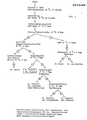
- Fig. 1 is a schematic representation of the identification process for Sc. faecium / durans.
- 2 shows the electrophoretic separation image of intracellular proteins from Sc.faecium isolates and reference strains.
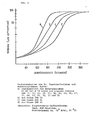
- Figure 3 illustrates the growth curves of Sc.faecium isolates and reference strains.
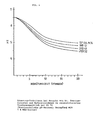
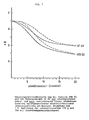
- Fig. 4 shows the acidification capacity when Sc.faeciun isolates and reference strains are grown in reconstituted dry skimmed milk at 35 ° C.
- FIG. 5 is a graphical representation of the change in the number of live germs (CFU) during the storage of spray-dried skimmed milk cultures of Sc.faecium isolates and reference strains at room temperature.
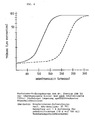
- Figure 6 shows growth-turbidity curves of Sc. faecium 1MB 52.
- Figure 7 illustrates the acidification activity curve of Sc.faecium 1MB and a reference strain.
- Sc. Faecium / durans The identification of Sc. Faecium / durans is carried out in accordance with the scheme shown in FIG. 1, the most important criterion for the limitation of Sc.faecium strains after selective enrichment of the enterococci on liquid and solid nutrient media being the fermentation capacity of sorbitol, arabinose and mannitol is pulled.
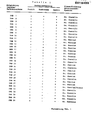
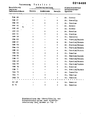
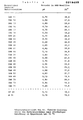
- Table 1 20 Sc. faecalis strains, 20 sc. faecium strains, 12 sc. faecium / durans strains and 3 sc. durans strains identified.
- the isolates are further characterized by means of a sugar utilization spectrum, the so-called "colorful series", electrophoretic separation of intracellular proteins, resistance behavior to selected antibiotics, growth rate tests and finally heat stability tests.
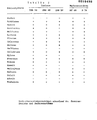
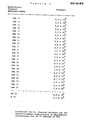
- Table 2 compares the sugar utilization capacity of the strains mentioned with the two reference strains Sf 68 and M 74. While the strains IMB 12 and IMB 49 behave identically to the mutually identical reference strains, the strain Sc. faecium IMB 52 due to the lack of sucrose and melibiose fermentation.
- the IMB 12 strain is also very similar to the two strains mentioned above, whereas the IMB 49 strain is more evident in the E f 0.5 range and the IMB 52 strain in both the E f 0.1 and E f 0.5 ranges different from the reference strains.
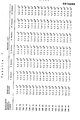
- Table 3 shows the resistance or the sensitivity of selected strains and the reference strains to some antibiotics.
- concentration of P e nicillin, flavomycin, avoparcin, bacitracin and Virginiamycin are chosen arbitrarily so that positive and negative results are obtained in the test arrangement in the serial dilution test with decimal dilution gradation.
- the growth rate i.e. the generation time
- the increase in turbidity as a function of the incubation time is continuously recorded in a biophotometer and logarithmic from the log calibrated using Koch's plate method Phase calculated the average generation time of the strains under optimal conditions (see Fig. 3).
- the best strains namely SF 68, M 74, IMB 12, IMB 49 and IMB 52, have generation times of 18 to 20 minutes.
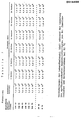
- Table 4 shows the results of the acidification activity determination. Starting from a uniform starting pH of 6.52 in MRS broth and an equalized form of inoculation and incubation, the strains examined and the reference strains deliver different final pH values in the range from 5.2 to 4.5 after 24 hours .
- the strain IMB 52 lies at 4.55 at the bottom of the scale and can therefore be described as relatively strongly acid-active.
- Fig. 4 shows a graphical representation of the pH functions of some selected strains.
- the results of the heat resistance test are shown in Table 5. Arbitrarily 15 minutes at 75 ° C. are chosen as test conditions. The number of live germs, expressed as colony-forming units (CFU) according to Koch's plate method, is checked immediately before and after the heating without specific cultural revitalization steps on MRS agar and the germ reduction is calculated as a comparative measure. The least reduction, ie the highest relative heat resistance, shows the strain IMB 23 with a decrease in the number of bacteria among the defined conditions of only 3.4 x 10 4 , the highest heating-related reduction in the strain IMB 31 with 3.5 x 10 6 . The strain IMB 52 ranks third in this test criterion after the reference strains.
- CFU colony-forming units
- the strains are incubated in skim milk concentrate with 30% dry matter at 35 ° C. for 20 to 24 hours.
- the pH is between 4.5 and 5.2, depending on the strain type.
- the bacterial counts that can be achieved before spray drying range from 2.5 x 10 5 to 2.7 x 10 9 (see Table 6).
- the strain IMB 52 with 2.5 x 10 9 is the second best place in the present test series with regard to the bacterial count, although the pH value in the concentrate with pH 4.7 is relatively low.
- the strain IMB 52 has a change in the bacterial count during drying from 7.5 ⁇ 10 9 to 5.5 ⁇ 10 9 .
- the bacterial strain is grown in skimmed milk, which is heated to 90 ° C. before inoculation and then cooled to the incubation temperature of 36 ° C. Then the skimmed milk is inoculated with a 2% inoculation with the cultivated culture and incubated for about 22 to 24 hours until a pH of 4.6 is reached. Then the bacterial growth and thus the acidification is interrupted by cooling. This culture is then inoculated into skimmed milk concentrated to about 30% dry matter, etc. again with a vaccination rate of 2%. The inoculated substrate is then incubated at 36 ° C. for about 22 to 24 hours until the pH has dropped again to 4.6, after which the acidification is then interrupted by cooling.
- the substrate is continuously stirred during this cooling.
- the skimmed milk-bacteria concentrate thus obtained is then dried in a conventional drying tower, the supply air temperature being approximately 150 ° C. and the exhaust air temperature being approximately 79 ° C.
- the product thus dried then has a minimum germ content of 2.5 x 10 9 germs per gram.
- the shelf life of the product without changing the germination capacity is at least six months.
Landscapes
- Life Sciences & Earth Sciences (AREA)
- Chemical & Material Sciences (AREA)
- Microbiology (AREA)
- Health & Medical Sciences (AREA)
- Engineering & Computer Science (AREA)
- Zoology (AREA)
- Polymers & Plastics (AREA)
- Biotechnology (AREA)
- General Health & Medical Sciences (AREA)
- Food Science & Technology (AREA)
- Wood Science & Technology (AREA)
- Animal Husbandry (AREA)
- Organic Chemistry (AREA)
- Medicinal Chemistry (AREA)
- Molecular Biology (AREA)
- Biochemistry (AREA)
- Mycology (AREA)
- Bioinformatics & Cheminformatics (AREA)
- Biomedical Technology (AREA)
- Genetics & Genomics (AREA)
- Epidemiology (AREA)
- Virology (AREA)
- Tropical Medicine & Parasitology (AREA)
- General Engineering & Computer Science (AREA)
- Veterinary Medicine (AREA)
- Chemical Kinetics & Catalysis (AREA)
- General Chemical & Material Sciences (AREA)
- Public Health (AREA)
- Animal Behavior & Ethology (AREA)
- Pharmacology & Pharmacy (AREA)
- Physiology (AREA)
- Medicines Containing Material From Animals Or Micro-Organisms (AREA)
- Micro-Organisms Or Cultivation Processes Thereof (AREA)
- Fodder In General (AREA)
Applications Claiming Priority (2)
| Application Number | Priority Date | Filing Date | Title |
|---|---|---|---|
| AT0294285A AT383956B (de) | 1985-10-11 | 1985-10-11 | Verwendung eines neuen stammes von streptococcus faecium bakterien zur absenkung des ph-wertes im magen-darm-trakt von tieren, sowie der neue stamm selbst |
| AT2942/85 | 1985-10-11 |
Publications (2)
| Publication Number | Publication Date |
|---|---|
| EP0219488A1 true EP0219488A1 (fr) | 1987-04-22 |
| EP0219488B1 EP0219488B1 (fr) | 1990-01-03 |
Family
ID=3542774
Family Applications (1)
| Application Number | Title | Priority Date | Filing Date |
|---|---|---|---|
| EP86890277A Expired - Lifetime EP0219488B1 (fr) | 1985-10-11 | 1986-10-09 | Utilisation d'un genre nouveau de bactéries de Streptococcus faecium pour l'abaissement du pH dans le tract gastro-intestinal des animaux ainsi que le genre même |
Country Status (3)
| Country | Link |
|---|---|
| EP (1) | EP0219488B1 (fr) |
| AT (2) | AT383956B (fr) |
| DE (1) | DE3667901D1 (fr) |
Cited By (3)
| Publication number | Priority date | Publication date | Assignee | Title |
|---|---|---|---|---|
| EP0271364A3 (en) * | 1986-12-12 | 1988-10-26 | Biorem C.C. | Preparation suitable for treating enteric disorders |
| WO1997045530A1 (fr) * | 1996-05-27 | 1997-12-04 | UZILOVA, Irina Semenovna, Heiress of UZILOV | Utilisation de souches de streptococcus faecium et composition a base de ces souches |
| WO2004032645A1 (fr) * | 2002-10-11 | 2004-04-22 | Erber Aktiengesellschaft | Additif alimentaire et/ou d'eau potable destine a des animaux utiles |
Families Citing this family (1)
| Publication number | Priority date | Publication date | Assignee | Title |
|---|---|---|---|---|
| RU2152433C1 (ru) * | 1993-03-30 | 2000-07-10 | Товарищество с ограниченной ответственностью "Алэф" | Штамм бактерий streptococcus faecium, используемый для борьбы с дисбактериозами сельскохозяйственных животных |
Citations (2)
| Publication number | Priority date | Publication date | Assignee | Title |
|---|---|---|---|---|
| LU60508A1 (fr) * | 1969-10-13 | 1970-05-11 | ||
| DE2803794A1 (de) * | 1977-02-16 | 1978-08-17 | Medipharm Ab | Verfahren zum behandeln von gruenfutter |
Family Cites Families (1)
| Publication number | Priority date | Publication date | Assignee | Title |
|---|---|---|---|---|
| GB2077101B (en) * | 1980-05-12 | 1984-08-08 | Kyokuto Fatty Acid Corp | Antiallergic composition containing streptococci |
-
1985
- 1985-10-11 AT AT0294285A patent/AT383956B/de not_active IP Right Cessation
-
1986
- 1986-10-09 AT AT86890277T patent/ATE49105T1/de not_active IP Right Cessation
- 1986-10-09 EP EP86890277A patent/EP0219488B1/fr not_active Expired - Lifetime
- 1986-10-09 DE DE8686890277T patent/DE3667901D1/de not_active Expired - Fee Related
Patent Citations (3)
| Publication number | Priority date | Publication date | Assignee | Title |
|---|---|---|---|---|
| LU60508A1 (fr) * | 1969-10-13 | 1970-05-11 | ||
| DE2010654A1 (de) * | 1969-10-13 | 1971-05-06 | Aktiebolaget Cernelle, Vegeholm (Schweden) | Substanz zur Regulierung der mensch liehen und/oder tierischen Darmflora sowie Verfahren zu ihrer Herstellung |
| DE2803794A1 (de) * | 1977-02-16 | 1978-08-17 | Medipharm Ab | Verfahren zum behandeln von gruenfutter |
Cited By (3)
| Publication number | Priority date | Publication date | Assignee | Title |
|---|---|---|---|---|
| EP0271364A3 (en) * | 1986-12-12 | 1988-10-26 | Biorem C.C. | Preparation suitable for treating enteric disorders |
| WO1997045530A1 (fr) * | 1996-05-27 | 1997-12-04 | UZILOVA, Irina Semenovna, Heiress of UZILOV | Utilisation de souches de streptococcus faecium et composition a base de ces souches |
| WO2004032645A1 (fr) * | 2002-10-11 | 2004-04-22 | Erber Aktiengesellschaft | Additif alimentaire et/ou d'eau potable destine a des animaux utiles |
Also Published As
| Publication number | Publication date |
|---|---|
| EP0219488B1 (fr) | 1990-01-03 |
| ATA294285A (de) | 1987-02-15 |
| DE3667901D1 (de) | 1990-02-08 |
| ATE49105T1 (de) | 1990-01-15 |
| AT383956B (de) | 1987-09-10 |
Similar Documents
| Publication | Publication Date | Title |
|---|---|---|
| DE2922284A1 (de) | Verfahren zur verminderung des nitratgehalts von tabak | |
| DE2010654B2 (de) | Normalisierung der Darmflora von Mensch und Haustier | |
| EP0372502A2 (fr) | Utilisation d'un produit enzymatique bactériolytique et protéase comme additif destiné à modifier l'exploitation du fourrage dans la production animale | |
| DE2208451A1 (de) | Verfahren zum Zuchten von Sauerteig bakterien | |
| WO1999035240A1 (fr) | Micro-organisme, procede permettant de le preparer et additif pour substances fourrageres | |
| DE3503742A1 (de) | Verfahren zur herstellung von milchsauren fruchtsaftprodukten | |
| DE3781652T2 (de) | Zubereitung, geeignet fuer die behandlung von darmstoerungen. | |
| DE60124071T2 (de) | Porphyrin enthaltende milchsäurebakterien und deren verwendung | |
| DE69111676T2 (de) | Selektives Mittel für die Kultur von Propionibacterium. | |
| EP0219488B1 (fr) | Utilisation d'un genre nouveau de bactéries de Streptococcus faecium pour l'abaissement du pH dans le tract gastro-intestinal des animaux ainsi que le genre même | |
| DE69122186T2 (de) | Laktobazillus acidophilus-f-133, herstellung von davon ausgehenden milchsäurebakterien und verfahren zu deren herstellung | |
| EP0290716A2 (fr) | Procédé de conservation de produits à base de volaille et de viande fraîche à l'aide d'enzymes bactériolytiques de streptomyces | |
| SU1398796A1 (ru) | Способ кормлени цыпл т | |
| EP0250786B1 (fr) | Procédé d'ensilage de fourrage vert | |
| DE2015334A1 (de) | Zusammensetzung zur Behandlung von Acidose bei Wiederkäuern | |
| DE69218837T2 (de) | Bakterienwachstumsförderndes Material | |
| DE3608423A1 (de) | Verfahren zur steuerung stabiler mikrobieller mischbiozoenosen | |
| DE3015030C2 (fr) | ||
| DE2554407A1 (de) | Herstellung thermostabiler lactase | |
| DE1767183B2 (de) | Verfahren zur herstellung von mikrobiellem labferment | |
| DE1492907C (de) | Verfahren zur Herstellung von Beifuttermittel | |
| DE698833C (de) | Schonbuchse fuer umlaufende Wellen | |
| DE19943488B4 (de) | Mittel zur Behandlung von Tauben | |
| DE2011935B2 (de) | Enzym mit der Fähigkeit zur Lyse der Zellen von Zahnkaries erzeugenden Mikroorganismen, Verfahren zur Herstellung dieses Enzyms sowie ein Präparat zur Verhütung und Behandlung von Zahnkaries | |
| DE2140322A1 (de) | Neues Antibiotikum |
Legal Events
| Date | Code | Title | Description |
|---|---|---|---|
| PUAI | Public reference made under article 153(3) epc to a published international application that has entered the european phase |
Free format text: ORIGINAL CODE: 0009012 |
|
| AK | Designated contracting states |
Kind code of ref document: A1 Designated state(s): AT BE CH DE FR GB IT LI LU NL SE |
|
| 17P | Request for examination filed |
Effective date: 19870619 |
|
| 17Q | First examination report despatched |
Effective date: 19880812 |
|
| GRAA | (expected) grant |
Free format text: ORIGINAL CODE: 0009210 |
|
| AK | Designated contracting states |
Kind code of ref document: B1 Designated state(s): AT BE CH DE FR GB IT LI LU NL SE |
|
| PG25 | Lapsed in a contracting state [announced via postgrant information from national office to epo] |
Ref country code: NL Effective date: 19900103 Ref country code: GB Effective date: 19900103 Ref country code: FR Free format text: THE PATENT HAS BEEN ANNULLED BY A DECISION OF A NATIONAL AUTHORITY Effective date: 19900103 Ref country code: BE Effective date: 19900103 Ref country code: IT Free format text: LAPSE BECAUSE OF FAILURE TO SUBMIT A TRANSLATION OF THE DESCRIPTION OR TO PAY THE FEE WITHIN THE PRESCRIBED TIME-LIMIT;WARNING: LAPSES OF ITALIAN PATENTS WITH EFFECTIVE DATE BEFORE 2007 MAY HAVE OCCURRED AT ANY TIME BEFORE 2007. THE CORRECT EFFECTIVE DATE MAY BE DIFFERENT FROM THE ONE RECORDED. Effective date: 19900103 Ref country code: SE Effective date: 19900103 |
|
| REF | Corresponds to: |
Ref document number: 49105 Country of ref document: AT Date of ref document: 19900115 Kind code of ref document: T |
|
| REF | Corresponds to: |
Ref document number: 3667901 Country of ref document: DE Date of ref document: 19900208 |
|
| EN | Fr: translation not filed | ||
| NLV1 | Nl: lapsed or annulled due to failure to fulfill the requirements of art. 29p and 29m of the patents act | ||
| GBV | Gb: ep patent (uk) treated as always having been void in accordance with gb section 77(7)/1977 [no translation filed] | ||
| PG25 | Lapsed in a contracting state [announced via postgrant information from national office to epo] |
Ref country code: AT Effective date: 19901009 |
|
| PLBE | No opposition filed within time limit |
Free format text: ORIGINAL CODE: 0009261 |
|
| STAA | Information on the status of an ep patent application or granted ep patent |
Free format text: STATUS: NO OPPOSITION FILED WITHIN TIME LIMIT |
|
| 26N | No opposition filed | ||
| EPTA | Lu: last paid annual fee | ||
| PGFP | Annual fee paid to national office [announced via postgrant information from national office to epo] |
Ref country code: LU Payment date: 19941001 Year of fee payment: 9 |
|
| PGFP | Annual fee paid to national office [announced via postgrant information from national office to epo] |
Ref country code: CH Payment date: 19950918 Year of fee payment: 10 |
|
| PGFP | Annual fee paid to national office [announced via postgrant information from national office to epo] |
Ref country code: DE Payment date: 19950919 Year of fee payment: 10 |
|
| PG25 | Lapsed in a contracting state [announced via postgrant information from national office to epo] |
Ref country code: LU Free format text: LAPSE BECAUSE OF NON-PAYMENT OF DUE FEES Effective date: 19951009 |
|
| PG25 | Lapsed in a contracting state [announced via postgrant information from national office to epo] |
Ref country code: CH Effective date: 19961031 Ref country code: LI Effective date: 19961031 |
|
| REG | Reference to a national code |
Ref country code: CH Ref legal event code: PL |
|
| PG25 | Lapsed in a contracting state [announced via postgrant information from national office to epo] |
Ref country code: DE Effective date: 19970701 |