EP0219584A1 - Verfahren zur Gewinnung von alkylaromatischen Kohlenwasserstoffen aus dem Umsatz eines Kohlenwasserstoff-Konvertierungsbereiches - Google Patents
Verfahren zur Gewinnung von alkylaromatischen Kohlenwasserstoffen aus dem Umsatz eines Kohlenwasserstoff-Konvertierungsbereiches Download PDFInfo
- Publication number
- EP0219584A1 EP0219584A1 EP85307476A EP85307476A EP0219584A1 EP 0219584 A1 EP0219584 A1 EP 0219584A1 EP 85307476 A EP85307476 A EP 85307476A EP 85307476 A EP85307476 A EP 85307476A EP 0219584 A1 EP0219584 A1 EP 0219584A1
- Authority
- EP
- European Patent Office
- Prior art keywords
- column
- stream
- product
- hydrocarbon
- fractionation column
- Prior art date
- Legal status (The legal status is an assumption and is not a legal conclusion. Google has not performed a legal analysis and makes no representation as to the accuracy of the status listed.)
- Granted
Links
- 229930195733 hydrocarbon Natural products 0.000 title claims abstract description 59
- 150000002430 hydrocarbons Chemical class 0.000 title claims abstract description 59
- 239000004215 Carbon black (E152) Substances 0.000 title claims abstract description 44
- 238000000034 method Methods 0.000 title claims description 39
- 230000008569 process Effects 0.000 title claims description 33
- 238000006243 chemical reaction Methods 0.000 title abstract description 23
- 238000011084 recovery Methods 0.000 title description 4
- UHOVQNZJYSORNB-UHFFFAOYSA-N Benzene Chemical compound C1=CC=CC=C1 UHOVQNZJYSORNB-UHFFFAOYSA-N 0.000 claims description 69
- 238000005194 fractionation Methods 0.000 claims description 60
- 238000005804 alkylation reaction Methods 0.000 claims description 52
- 239000000047 product Substances 0.000 claims description 44
- 230000029936 alkylation Effects 0.000 claims description 43
- RWGFKTVRMDUZSP-UHFFFAOYSA-N cumene Chemical compound CC(C)C1=CC=CC=C1 RWGFKTVRMDUZSP-UHFFFAOYSA-N 0.000 claims description 34
- 150000004945 aromatic hydrocarbons Chemical class 0.000 claims description 21
- 239000007788 liquid Substances 0.000 claims description 15
- 239000006227 byproduct Substances 0.000 claims description 12
- 238000009835 boiling Methods 0.000 claims description 11
- YXFVVABEGXRONW-UHFFFAOYSA-N Toluene Chemical compound CC1=CC=CC=C1 YXFVVABEGXRONW-UHFFFAOYSA-N 0.000 claims description 9
- 239000003054 catalyst Substances 0.000 description 22
- 238000004519 manufacturing process Methods 0.000 description 10
- XLYOFNOQVPJJNP-UHFFFAOYSA-N water Substances O XLYOFNOQVPJJNP-UHFFFAOYSA-N 0.000 description 10
- 150000001875 compounds Chemical class 0.000 description 8
- QQONPFPTGQHPMA-UHFFFAOYSA-N propylene Natural products CC=C QQONPFPTGQHPMA-UHFFFAOYSA-N 0.000 description 8
- 125000004805 propylene group Chemical group [H]C([H])([H])C([H])([*:1])C([H])([H])[*:2] 0.000 description 8
- 238000000926 separation method Methods 0.000 description 8
- NBIIXXVUZAFLBC-UHFFFAOYSA-N Phosphoric acid Chemical compound OP(O)(O)=O NBIIXXVUZAFLBC-UHFFFAOYSA-N 0.000 description 7
- 150000001336 alkenes Chemical class 0.000 description 7
- 239000000543 intermediate Substances 0.000 description 7
- 239000000463 material Substances 0.000 description 7
- 239000000203 mixture Substances 0.000 description 7
- ATUOYWHBWRKTHZ-UHFFFAOYSA-N Propane Chemical compound CCC ATUOYWHBWRKTHZ-UHFFFAOYSA-N 0.000 description 6
- JRZJOMJEPLMPRA-UHFFFAOYSA-N olefin Natural products CCCCCCCC=C JRZJOMJEPLMPRA-UHFFFAOYSA-N 0.000 description 6
- VYPSYNLAJGMNEJ-UHFFFAOYSA-N Silicium dioxide Chemical compound O=[Si]=O VYPSYNLAJGMNEJ-UHFFFAOYSA-N 0.000 description 5
- 125000003118 aryl group Chemical group 0.000 description 5
- 125000004432 carbon atom Chemical group C* 0.000 description 5
- YNQLUTRBYVCPMQ-UHFFFAOYSA-N Ethylbenzene Chemical compound CCC1=CC=CC=C1 YNQLUTRBYVCPMQ-UHFFFAOYSA-N 0.000 description 4
- 239000000654 additive Substances 0.000 description 3
- 229910000147 aluminium phosphate Inorganic materials 0.000 description 3
- 239000003599 detergent Substances 0.000 description 3
- 239000012530 fluid Substances 0.000 description 3
- 238000004508 fractional distillation Methods 0.000 description 3
- 239000007789 gas Substances 0.000 description 3
- 230000036571 hydration Effects 0.000 description 3
- 238000006703 hydration reaction Methods 0.000 description 3
- 238000002347 injection Methods 0.000 description 3
- 239000007924 injection Substances 0.000 description 3
- 239000012071 phase Substances 0.000 description 3
- 239000001294 propane Substances 0.000 description 3
- 238000010992 reflux Methods 0.000 description 3
- VXNZUUAINFGPBY-UHFFFAOYSA-N 1-Butene Chemical compound CCC=C VXNZUUAINFGPBY-UHFFFAOYSA-N 0.000 description 2
- CSCPPACGZOOCGX-UHFFFAOYSA-N Acetone Chemical compound CC(C)=O CSCPPACGZOOCGX-UHFFFAOYSA-N 0.000 description 2
- RTZKZFJDLAIYFH-UHFFFAOYSA-N Diethyl ether Chemical compound CCOCC RTZKZFJDLAIYFH-UHFFFAOYSA-N 0.000 description 2
- UQSXHKLRYXJYBZ-UHFFFAOYSA-N Iron oxide Chemical compound [Fe]=O UQSXHKLRYXJYBZ-UHFFFAOYSA-N 0.000 description 2
- 239000002253 acid Substances 0.000 description 2
- 229940100198 alkylating agent Drugs 0.000 description 2
- 239000002168 alkylating agent Substances 0.000 description 2
- 238000005899 aromatization reaction Methods 0.000 description 2
- WTEOIRVLGSZEPR-UHFFFAOYSA-N boron trifluoride Chemical compound FB(F)F WTEOIRVLGSZEPR-UHFFFAOYSA-N 0.000 description 2
- 238000009833 condensation Methods 0.000 description 2
- 230000005494 condensation Effects 0.000 description 2
- 238000010438 heat treatment Methods 0.000 description 2
- 239000007791 liquid phase Substances 0.000 description 2
- 150000005673 monoalkenes Chemical group 0.000 description 2
- HFPZCAJZSCWRBC-UHFFFAOYSA-N p-cymene Chemical compound CC(C)C1=CC=C(C)C=C1 HFPZCAJZSCWRBC-UHFFFAOYSA-N 0.000 description 2
- 239000002245 particle Substances 0.000 description 2
- 239000000376 reactant Substances 0.000 description 2
- 238000004064 recycling Methods 0.000 description 2
- 239000007787 solid Substances 0.000 description 2
- 238000009834 vaporization Methods 0.000 description 2
- 230000008016 vaporization Effects 0.000 description 2
- 239000008096 xylene Substances 0.000 description 2
- 239000005995 Aluminium silicate Substances 0.000 description 1
- 229910015900 BF3 Inorganic materials 0.000 description 1
- LFQSCWFLJHTTHZ-UHFFFAOYSA-N Ethanol Chemical compound CCO LFQSCWFLJHTTHZ-UHFFFAOYSA-N 0.000 description 1
- KRHYYFGTRYWZRS-UHFFFAOYSA-N Fluorane Chemical compound F KRHYYFGTRYWZRS-UHFFFAOYSA-N 0.000 description 1
- VQTUBCCKSQIDNK-UHFFFAOYSA-N Isobutene Chemical group CC(C)=C VQTUBCCKSQIDNK-UHFFFAOYSA-N 0.000 description 1
- 239000005909 Kieselgur Substances 0.000 description 1
- CTQNGGLPUBDAKN-UHFFFAOYSA-N O-Xylene Chemical compound CC1=CC=CC=C1C CTQNGGLPUBDAKN-UHFFFAOYSA-N 0.000 description 1
- ISWSIDIOOBJBQZ-UHFFFAOYSA-N Phenol Chemical compound OC1=CC=CC=C1 ISWSIDIOOBJBQZ-UHFFFAOYSA-N 0.000 description 1
- OAICVXFJPJFONN-UHFFFAOYSA-N Phosphorus Chemical compound [P] OAICVXFJPJFONN-UHFFFAOYSA-N 0.000 description 1
- YDHWWBZFRZWVHO-UHFFFAOYSA-N [hydroxy(phosphonooxy)phosphoryl] phosphono hydrogen phosphate Chemical compound OP(O)(=O)OP(O)(=O)OP(O)(=O)OP(O)(O)=O YDHWWBZFRZWVHO-UHFFFAOYSA-N 0.000 description 1
- 239000006096 absorbing agent Substances 0.000 description 1
- 230000000996 additive effect Effects 0.000 description 1
- 150000001350 alkyl halides Chemical class 0.000 description 1
- 150000008051 alkyl sulfates Chemical class 0.000 description 1
- 235000012211 aluminium silicate Nutrition 0.000 description 1
- IAQRGUVFOMOMEM-UHFFFAOYSA-N butene Natural products CC=CC IAQRGUVFOMOMEM-UHFFFAOYSA-N 0.000 description 1
- 238000001354 calcination Methods 0.000 description 1
- 239000012876 carrier material Substances 0.000 description 1
- 239000007795 chemical reaction product Substances 0.000 description 1
- 238000010960 commercial process Methods 0.000 description 1
- 238000010276 construction Methods 0.000 description 1
- 239000000498 cooling water Substances 0.000 description 1
- 229930007927 cymene Natural products 0.000 description 1
- 230000018044 dehydration Effects 0.000 description 1
- 238000006297 dehydration reaction Methods 0.000 description 1
- 238000010586 diagram Methods 0.000 description 1
- 150000001993 dienes Chemical class 0.000 description 1
- XPPKVPWEQAFLFU-UHFFFAOYSA-N diphosphoric acid Chemical compound OP(O)(=O)OP(O)(O)=O XPPKVPWEQAFLFU-UHFFFAOYSA-N 0.000 description 1
- 150000002148 esters Chemical class 0.000 description 1
- -1 ethylene, propylene Chemical group 0.000 description 1
- 229910000286 fullers earth Inorganic materials 0.000 description 1
- 238000000227 grinding Methods 0.000 description 1
- 229910000040 hydrogen fluoride Inorganic materials 0.000 description 1
- 239000004615 ingredient Substances 0.000 description 1
- 229910052500 inorganic mineral Inorganic materials 0.000 description 1
- 238000009434 installation Methods 0.000 description 1
- 239000013067 intermediate product Substances 0.000 description 1
- 150000002506 iron compounds Chemical class 0.000 description 1
- 238000006317 isomerization reaction Methods 0.000 description 1
- NLYAJNPCOHFWQQ-UHFFFAOYSA-N kaolin Chemical compound O.O.O=[Al]O[Si](=O)O[Si](=O)O[Al]=O NLYAJNPCOHFWQQ-UHFFFAOYSA-N 0.000 description 1
- 239000011707 mineral Substances 0.000 description 1
- 238000002156 mixing Methods 0.000 description 1
- 230000004048 modification Effects 0.000 description 1
- 238000012986 modification Methods 0.000 description 1
- 239000012188 paraffin wax Substances 0.000 description 1
- 229910052698 phosphorus Inorganic materials 0.000 description 1
- 239000011574 phosphorus Substances 0.000 description 1
- 229920000136 polysorbate Polymers 0.000 description 1
- 239000000377 silicon dioxide Substances 0.000 description 1
- 239000010802 sludge Substances 0.000 description 1
- 239000011949 solid catalyst Substances 0.000 description 1
- 239000000454 talc Substances 0.000 description 1
- 229910052623 talc Inorganic materials 0.000 description 1
- IAQRGUVFOMOMEM-ONEGZZNKSA-N trans-but-2-ene Chemical compound C\C=C\C IAQRGUVFOMOMEM-ONEGZZNKSA-N 0.000 description 1
- 238000010555 transalkylation reaction Methods 0.000 description 1
- 239000012808 vapor phase Substances 0.000 description 1
- 150000003738 xylenes Chemical class 0.000 description 1
Images
Classifications
-
- C—CHEMISTRY; METALLURGY
- C07—ORGANIC CHEMISTRY
- C07C—ACYCLIC OR CARBOCYCLIC COMPOUNDS
- C07C15/00—Cyclic hydrocarbons containing only six-membered aromatic rings as cyclic parts
- C07C15/02—Monocyclic hydrocarbons
- C07C15/085—Isopropylbenzene
-
- B—PERFORMING OPERATIONS; TRANSPORTING
- B01—PHYSICAL OR CHEMICAL PROCESSES OR APPARATUS IN GENERAL
- B01D—SEPARATION
- B01D3/00—Distillation or related exchange processes in which liquids are contacted with gaseous media, e.g. stripping
- B01D3/14—Fractional distillation or use of a fractionation or rectification column
- B01D3/143—Fractional distillation or use of a fractionation or rectification column by two or more of a fractionation, separation or rectification step
-
- B—PERFORMING OPERATIONS; TRANSPORTING
- B01—PHYSICAL OR CHEMICAL PROCESSES OR APPARATUS IN GENERAL
- B01D—SEPARATION
- B01D3/00—Distillation or related exchange processes in which liquids are contacted with gaseous media, e.g. stripping
- B01D3/14—Fractional distillation or use of a fractionation or rectification column
- B01D3/32—Other features of fractionating columns ; Constructional details of fractionating columns not provided for in groups B01D3/16 - B01D3/30
- B01D3/322—Reboiler specifications
-
- C—CHEMISTRY; METALLURGY
- C07—ORGANIC CHEMISTRY
- C07C—ACYCLIC OR CARBOCYCLIC COMPOUNDS
- C07C7/00—Purification; Separation; Use of additives
- C07C7/04—Purification; Separation; Use of additives by distillation
Definitions
- the invention in general relates to the energy efficient processing of hydrocarbons and to the recovery of specific hydrocarbons from the effluent of a hydrocarbon conversion process.
- the invention is directly concerned with the efficient recovery of a product alkylaromatic hydrocarbon from the effluent of an alkylation zone.
- the invention directly concerns a unique integrated fractional distillation method employed in the separation of an alkylaromatic hydrocarbon from an alkylation zone effluent stream.
- the alkylation of aromatic hydrocarbons is a widely practiced commercial process. It may be performed for the production of an end product or an intermediate product which is the feedstock for a subsequent process or processing step. For instance, benzene may be reacted with a linear olefin for the production of linear akylbenzenes suitable for conversion into soft detergent.
- the subject invention is, however, more directly concerned with the alkylation processes in which a feed aromatic hydrocarbon is reacted with another hydrocarbon having from two to about four carbon atoms per molecule.
- This reference illustrates the passage of a net liquid phase alkylation zone effluent stream into a first fractionation column labeled as the recycle column. Unreacted benzene is recovered as a net overhead product of the recycle column and returned to the alkylation zone. A bottoms product is removed from the recycle column and passed into a second fractionation column in which the product cumene is separated into a net overhead product.
- This two column arrangement is similar to that used in the subject invention.
- the overhead vapor stream of a column 12 is used as the heat source employed in the reboiler 16 of a second column.
- the overhead vapor stream is then condensed and collected in an overhead receiver.
- a first portion of the collected condensate is returned to the column 12 as reflux and a second portion is passed into the second column.
- the subject invention provides an improved process which reduces the utility cost of recovering a product alkylaromatic hydrocarbon from an admixture comprising both lower boiling and higher boiling aromatic hydrocarbons.
- the subject process utilizes energy available in the overhead stream of a second fractionation column in a side reboiler located between the feed tray and the bottom of a preceding fractionation column. This significantly reduces the amount of energy required in the reboiler located at the bottom of the first fractionation column.
- the subject process may be characterized as comprising the steps of passing the reaction zone effluent stream which comprises a C6-plus aromatic first hydrocarbon, an aromatic second alkylaromatic hydrocarbon and a heavy by-product alkylaromatic third hydrocarbon into a first fractionation column at a first point, with the first fractionation column being maintained at fractionation conditions in part through the use of a first reboiler means located at the bottom of the first fractionation column; removing an overhead stream, which is rich in the first hydrocarbon, from the first fractionation column; removing a first net bottoms stream, which is rich in the alkylaromatic second hydrocarbon, from the first fractionation column and passing the first net bottoms stream into a second fractionation column; removing a second net bottoms stream, which is rich in the by-product alkylaromatic third hydrocarbon, from the second fractionation column; and condensing at least a portion of an overhead vapor stream which is withdrawn from the second fractionation column by indirect heat exchange as the heat source employed in a
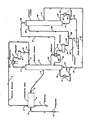
- the drawing is a simplified flow diagram of an alkylation process for producing cumene and which utilizes a preferred embodiment of the invention.
- a feed stream of relatively high purity benzene carried by line 1 together with a propylene-containing feed stream carried by line 2 and the benzene-rich recycle stream of line 3 are passed into the alkylation zone 4.
- these three streams are brought into contact with an alkylation catalyst at alkylation-promoting conditions which result in the reaction of a portion of the benzene with the available propylene.
- the material being withdrawn from the reaction zone is separated within the alkylation zone as required by the specific alkylation zone and propylene feed streams which are being employed.
- the alkylation zone effluent stream comprises an admixture of benzene, cumene, and various higher boiling by-product hydrocarbons produced by reactions other than the intended monoalkylation of the benzene.
- the alkylation zone effluent stream is passed into a first fractionation column 6 referred to as a recycle column.
- a first fractionation column 6 referred to as a recycle column.
- Substantially all of the benzene and any lighter hydrocarbons is concentrated into a net overhead vapor stream removed through line 7 and passed through the overhead condenser 8.
- the resultant condensate is collected in the overhead receiver 9. Uncondensed gases which may be present and condensed water may be removed through means not shown.
- the hydrocarbon condensate is withdrawn from the overhead receiver through line 10 and divided into a first portion which is returned to the recycle column through line 11 as reflux and a second portion which is recycled to the alkylation zone as the benzene recycle stream carried by line 3.
- Substantially all of the hydrocarbons entering the fractionation column which are less volatile than benzene are concentrated into a bottoms liquid stream withdrawn from the recycle column in line 12.
- a first portion of the bottoms liquid is diverted through an external reboiler means 14 via line 13.
- the fluids discharged from the bottom reboiler 14 are passed into a bottom portion of the recycle column.
- the remaining portion of the bottoms stream of line 12 becomes the feed stream charged to the product column 16 through line 15.
- the relatively small amount of high boiling by-products which enters the product column becomes concentrated into a bottoms stream withdrawn in line 17.
- This bottoms liquid is divided into a portion which is passed through a reboiler means 20 via line 19 and a second portion with drawn as a by-products stream through line 18.
- the very great majority of the material which enters the product column 16 is concentrated into the overhead vapor stream removed from the products column in line 21.
- the overhead vapor stream passes through a side reboiler means 22 wherein it is condensed to form an overhead condensate which is passed into the overhead receiver 25.
- the condensate is withdrawn through line 26 and divided into a first portion returned to the products column via line 28 as reflux and a second portion which is withdrawn as the cumene product stream through line 27.
- the substantial amount of heat of vaporization given up by the overhead vapor stream of the products column is received by a liquid stream withdrawn from an intermediate point in the lower half of the recycle column in line 23. This liquid is preferably partially vaporized in the side reboiler 22 to thereby produce a mixed phase stream which is charged to the recycle column 6 through line 24.
- Line 24 communicates with the recycle column at a point which is at least several trays above the point at which vapors produced by the bottom reboiler means 14 enter the recycle column.
- the alkylation of aromatic hydrocarbons is practiced commercially on a large scale.
- One particular example is the alkylation of benzene with propylene to form cumene, which is then used to produce phenol and acetone.
- These alkylation processes are normally performed with the intent of producing a single alkylaromatic product rather than an admixture of alkylaromatics.
- the products of the commercial alkylation reactor will normally contain an admixture which contains small amounts of by-products which must be separated from the reaction zone product.
- Further, in an effort to promote monoalkylation there is normally provided an excess of the feed aromatic hydrocarbon which is to be alkylated.
- the effluent of the alkylation reaction zone therefore normally contains an admixture of the feed hydrocarbon, the product hydrocarbon, and one or more higher boiling side products.
- the separation of these materials is normally performed commercially by fractional distillation.
- the separation of these sometimes close-boiling hydrocarbons in large quantities and to high purities requires sizable fractionation facilities and consumes a large amount of energy.
- the utilities cost of the fractionation includes both the cost of heat supplied to the reboiler of the fractionation column and the cost in terms of cooling water and wasted low level heat which is associated with the condensation of overhead vapors.
- the utilities cost of separating the effluent stream of the alkylation zone is therefore a significant part of the total cost of operating such an aromatic hydrocarbon alkylation process. It is therefore an objective of the subject process to provide a method of reducing the utilities cost of operating the fractionation section of a process for the alkylation of aromatic hydrocarbons.
- the subject process may be used to separate the effluent of reaction zones used for transalkylation, alkylaromatic hydrocarbon isomerization, aromatization, etc.
- the preferred reaction is alkylation and the process will be described mainly in terms of this one limited embodiment.
- the preferred feed hydrocarbon for alkylation is benzene.
- the preferred hydrocarbon feed material may be more generally characterized as an aromatic C6-plus hydrocarbon such as benzene, toluene, a xylene, or ethylbenzene. Higher molecular weight hydrocarbons could also be consumed as the feed hyhrocarbon.
- the alkylating agent which is reacted with the feed hydrocarbon to produce the product alkylaromatic hydrocarbon may be an olefin-acting compound such as an alcohol, ether or ester including alkylhalides, alkylsulfates and alkylphosphates.
- the alkylating agent is a mono- or diolefin having from two to five carbon atoms per molecule.
- the preferred monoolefins include ethylene, propylene, butene-1, butene-2 and isobutylene. These olefins may be used as relatively pure streams containing a single hydrocarbon species.
- a mixture of a single olefin and a corresponding paraffin may be used or a mixture of two or more olefinic hydrocarbons may be employed as the olefin-containing material charged to the alkylation zone.
- Typical product hydrocarbons include cumene, ethylbenzene, and cymene (isopropyltoluene).
- the hydrocarbon stream charged to the fractionation zone is the effluent stream of a hydrocarbon conversion zone.
- This effluent stream is preferably the result of a partial separation performed within the conversion zone which results in a reaction zone effluent stream being converted into a conversion zone effluent stream containing less than 10 mole percent of any hydrocarbon having fewer carbon atoms per molecule than the hydrocarbon which is recovered as the overhead product of the first fractionation column.
- this is achieved through a partial condensation of the admixture of compounds actually exiting from the reactor to produce a liquid hydrocarbon phase and a vapor phase containing a very great percentage of any hydrogen and normally gaseous hydrocarbons which exit the catalyst bed.
- the liquid phase produced in this manner may be stripped of dissolved light gases if desired prior to being passed into the fractionation zone of the subject invention.
- the subject improved separation method could be applied in general to the separation of any reaction zone effluent stream comprising an admixture of hydrocarbons having the appropriate boiling point characteristics including those processes described above.
- the reaction zone is intended to operate as an alkylation zone in which the feed hydrocarbon is consumed in the production of a product hydrocarbon of higher molecular weight.
- This alkylation may be promoted through the use of a wide variety of suitable catalysts such as boron trifluoride, various zeolitic compounds, hydrogen fluoride, etc.
- the preferred catalyst for use in the alkylation zone is referred to as a solid phosphoric acid or SPA catalyst.
- SPA catalyst Suitable SPA catalysts are available commercially.
- the term "SPA catalyst” or its equivalent is intended to refer generically to a solid catalyst which contains as one of its principal raw ingredients an acid of phosphorus such as ortho-, pyro- or tetraphosphoric acid.
- These catalysts are normally formed by mixing the acid with a siliceous solid carrier to form a wet paste. This paste may be calcined and then crushed to yield catalyst particles, or the paste may be extruded or pelleted prior to calcining to produce more uniform catalyst particles.
- the carrier is preferably a naturally-occurring porous silica-containing material such as kieselguhr, kaolin, infusorial earth and diatomaceous earth.
- a minor amount of various additives such as mineral talc, fullers earth and iron compounds including iron oxide have been added to the carrier to increase its strength and hardness.
- the combination of the carrier and the additives normally comprises about 15-30 wt. % of the catalyst, with the remainder being the phosphoric acid.
- the amount of phosphoric acid used in the manufacture of the catalyst may vary from about 8-80 wt. % of the catalyst as described in U.S. Patent 3,402,130.
- the amount of the additive may be equal to about 3-20 wt. % of the total carrier material.
- Further details as to the composition and production of typical SPA catalysts may be obtained from U.S. Patents 3,050,472, 3,050,473 and 3,132,109 and from other references.
- the rate of this injection is used to control the catalyst hydration level, and the feed streams are therefore maintained as dry as practical prior to the water injection point. This results in the total water content of the feed being essentially the same as the amount injected.
- Typical water injection rates are from about 100 to 2000 wt. ppm in aromatic hydrocarbon alkylation operations.
- a preferred water addition rate during the production of cumene is from about 200 to 300 wt. ppm of the combined feed to the reaction zone.
- the feed hydrocarbon, any recycle streams and the feed olefin-acting compound are preferably admixed and then passed into a reaction zone.
- the reaction zone is maintained at alkylation-promoting conditions which include a pressure of about 300 to 1000 psig (2068 to 6895 kPag) and a temperature of about 300° to 600°F (149 to 316°C).
- the liquid hourly space velocity of reactants may range from about 0.5 to 2.5 hr. ⁇ 1. It is preferred that an excess of the aromatic hydrocarbon be present in the reaction zone.
- the mole ratio of the aromatic hydrocarbon to the olefin should be within the broad range of 3:1 to 20:1. A ratio of about 8:1 is preferred for the production of cumene.
- the reactant stream be mixed phase through the reactor.
- the feed stream therefore preferably contains some unreactive light paraffins having the same number of carbon atoms per molecule as the olefin.
- the amount of propane in the reaction zone feed stream be at least equal to the amount of propylene in this stream. This may be accomplished by using a dilute propylene feed stream or by recycling propane.
- the effluent of the alkylation reactor is passed into a first rectifier column located within the complex referred to herein as the alkylation zone.
- This column is normally used in conjunction with either a second rectifier, an absorber or a depropanizer (for alkylation using propylene).
- the exact form of this system does not influence the subject process.
- the function of this portion of the alkylation zone is to recover any olefin-acting compound which may be available for recycling to the reactor and to remove any light hydrocarbons such as propane which enter the alkylation zone.
- the preferred form of this portion of the alkylation zone is described in previously referred to U.S. Patent 4,051,191 and in U.S. Patent 3,510,534.
- the alkylation zone effluent will normally contain most of the excess benzene charged to the alkylation reactor to promote mono-alkylation. It is common and preferred practice to first separate the feed benzene and other hydrocarbons boiling below the cumene (or other product) in a first fractionation column referred to as a benzene column or recycle column. The cumene or other product alkylaromatic is then recovered as the overhead of a second column referred to as the cumene column or product column. Further information on the preferred alkylation process and possible variations in process flows and operations may be obtained by reference to U.S. Patents 3,437,706; 3,437,707; 3,437,708; 3,520,944 and 3,542,892.
- a broad range of conditions for use in the first fractionation column includes a top pressure of about 5 to about 150 psig (34 to 1034 kPag) and a bottoms temperature of about 270° to about 400°F (132 to 204°C).
- a broad range of conditions for use in the second fractionation column includes a top pressure of about 15 to about 240 psig (103 to 1655 kPag) and a bottoms temperature of about 320° to about 470°F (160 to 243°C).
- the subject process requires a side reboiler to be installed in the first of the two columns.
- This reboiler is separate and distinct from the reboiler(s) employed at the bottom of the column.
- This reboiler is used to vaporize liquid withdrawn from an intermediate point in the column.
- intermediate point is intended to indicate a point which is separated from each extremity of the column by vapor-liquid contacting material equal to at least two and preferably three theoretical contacting stages (trays).
- the side reboiler therefore acts upon liquid which has a lower average boiling point then the bottoms liquid entering the bottom reboiler.
- the side reboiler preferably is located about midway between the bottom of the first column and the feed point to the column.
- the location of the feed point may be varied depending on the composition of the entering alkylation zone feed stream, and the feed may enter at such a level that the side reboiler is optimally placed much closer to the bottom reboiler than to the feed point.
- the subject process recovers at least a major portion of the heat which must be removed in condensing the overhead stream of the second fractionation column. This heat is transferred into the first column. The amount of heat which must be applied to the customary bot tom reboiler of the first column is thereby reduced and the utility cost of operating the column is lowered.
- the required temperature of the cumene (second) column overhead vapor stream is lower than if it was attempted to use this overhead vapor as the heat source in the bottom reboiler. This assumes the pressure in the first column is the same during this comparison.
- the ability to recover heat from the overhead vapor at this lower temperature can be advantageous. For instance, the ability to apply modern heat recovery techniques to an existing pair of fractionation columns may be limited due to the maximum pressures at which the columns can be operated.
- the subject process may be characterized as a process for recovering an alkylaromatic hydrocarbon from the effluent stream of an aromatic hydrocarbon alkylation zone which comprises the steps of passing an alkylation zone effluent stream which comprises a feed aromatic hydrocarbon, a product alkylaromatic hydrocarbon, and a by-product alkylaromatic having a higher boiling point than the product alkylaromatic hydrocarbon into a first fractionation column at a first intermediate point, with a first reboiler being located at the bottom of the first fractionation column; recovering a first net overhead product stream, which is rich in the feed hydrocarbon, from the first fractionation column; removing a first net bottoms stream, which is rich in the product alkylaromatic hydrocarbon, from the first fractionation column and passing the first net bottoms stream into a second fractionation column; removing a second net bottoms stream, which is rich in the by-product alkylaromatic hydrocarbon, from the second fractionation column; and conden
- the term "rich” is intended to indicate that the stream or fluid being described contains over 60 mole percent of the specified compound or class of compounds.
- the separations may be different from those described above.
- aromatics are produced from C3 and/or C4 hydrocarbons
- benzene could be the top product of the first column
- a mixture of toluene and xylenes may be removed as the top product of the second column and a mixture of C9-plus aromatics withdrawn as the net bottoms product of the second column.
Landscapes
- Chemical & Material Sciences (AREA)
- Organic Chemistry (AREA)
- Chemical Kinetics & Catalysis (AREA)
- Engineering & Computer Science (AREA)
- Analytical Chemistry (AREA)
- Oil, Petroleum & Natural Gas (AREA)
- Water Supply & Treatment (AREA)
- Organic Low-Molecular-Weight Compounds And Preparation Thereof (AREA)
Priority Applications (2)
| Application Number | Priority Date | Filing Date | Title |
|---|---|---|---|
| DE8585307476T DE3565395D1 (en) | 1985-10-17 | 1985-10-17 | Process for the recovery of alkylaromatic hydrocarbons from the effluent stream of a hydrocarbon conversion zone |
| AT85307476T ATE37707T1 (de) | 1985-10-17 | 1985-10-17 | Verfahren zur gewinnung von alkylaromatischen kohlenwasserstoffen aus dem umsatz eines kohlenwasserstoff-konvertierungsbereiches. |
Applications Claiming Priority (2)
| Application Number | Priority Date | Filing Date | Title |
|---|---|---|---|
| US06/553,343 US4555311A (en) | 1983-11-18 | 1983-11-18 | Integrated fractionation in the recovery of alkylaromatic hydrocarbons |
| CN85109128.8A CN1003999B (zh) | 1983-11-18 | 1985-11-14 | 联合分馏回收烷基芳烃 |
Publications (2)
| Publication Number | Publication Date |
|---|---|
| EP0219584A1 true EP0219584A1 (de) | 1987-04-29 |
| EP0219584B1 EP0219584B1 (de) | 1988-10-05 |
Family
ID=25742142
Family Applications (1)
| Application Number | Title | Priority Date | Filing Date |
|---|---|---|---|
| EP85307476A Expired EP0219584B1 (de) | 1983-11-18 | 1985-10-17 | Verfahren zur Gewinnung von alkylaromatischen Kohlenwasserstoffen aus dem Umsatz eines Kohlenwasserstoff-Konvertierungsbereiches |
Country Status (6)
| Country | Link |
|---|---|
| US (1) | US4555311A (de) |
| EP (1) | EP0219584B1 (de) |
| JP (1) | JPS62103030A (de) |
| CN (1) | CN1003999B (de) |
| AU (1) | AU580639B2 (de) |
| IN (1) | IN165757B (de) |
Families Citing this family (27)
| Publication number | Priority date | Publication date | Assignee | Title |
|---|---|---|---|---|
| DE3519161A1 (de) * | 1985-05-29 | 1986-12-04 | Hoechst Ag, 6230 Frankfurt | Verfahren zur reinigung von 1,2-dichlorethan |
| US4695665A (en) * | 1986-07-02 | 1987-09-22 | Uop Inc. | Process for alkylation of hydrocarbons |
| US4897098A (en) * | 1986-10-16 | 1990-01-30 | Enterprise Products Company | Fractionation system for stabilizing natural gasoline |
| DE69026613T2 (de) * | 1990-07-18 | 1996-10-24 | Fina Technology | Transalkylierungsverfahren |
| DE69033689T2 (de) * | 1990-11-13 | 2001-05-17 | Fina Technology, Inc. | Herstellung alkylierter Aromaten |
| US5600048A (en) * | 1994-12-27 | 1997-02-04 | Mobil Oil Corporation | Continuous process for preparing ethylbenzene using liquid phase alkylation and vapor phase transalkylation |
| US5600049A (en) * | 1995-06-01 | 1997-02-04 | Chemical Research & Licensing Company | Process for depropanizing benzene |
| US5573645A (en) * | 1995-06-29 | 1996-11-12 | Mobil Oil Corporation | Process and apparatus for the separation of aromatic hydrocarbons |
| KR100546892B1 (ko) * | 2004-06-18 | 2006-01-31 | 최병국 | 감자박피기 |
| CN101918343B (zh) * | 2008-01-09 | 2014-05-21 | 环球油品公司 | 从包括dipb、tipb、和多烷基化物重化合物的进料中分离二异丙苯(dipb)和三异丙苯(tipb)的方法 |
| TWI367878B (en) * | 2008-01-09 | 2012-07-11 | Uop Llc | Process for separating diisopropylbenzene (dipb) and triisopropylbenzene (tipb) from a feed comprising dipb, tipb, and polyalkylate heavies |
| US8894820B2 (en) * | 2010-02-05 | 2014-11-25 | Uop Llc | Alkylation apparatus, fractionation zone, and method relating thereto |
| US8993825B2 (en) * | 2010-08-25 | 2015-03-31 | Uop Llc | Energy conservation in heavy-hydrocarbon distillation |
| US8916740B2 (en) * | 2010-08-25 | 2014-12-23 | Uop Llc | Energy conservation in heavy-hydrocarbon distillation |
| US8754281B2 (en) * | 2010-08-25 | 2014-06-17 | Uop Llc | Energy conservation in heavy-hydrocarbon distillation |
| JP2013536225A (ja) * | 2010-08-25 | 2013-09-19 | ユーオーピー エルエルシー | 重質炭化水素の蒸留におけるエネルギー節減 |
| US8609922B2 (en) * | 2010-08-25 | 2013-12-17 | Uop Llc | Energy conservation in heavy-hydrocarbon distillation |
| US8840762B2 (en) * | 2010-08-25 | 2014-09-23 | Uop Llc | Energy conservation in heavy-hydrocarbon distillation |
| US20120330076A1 (en) | 2011-06-27 | 2012-12-27 | Uop, Llc | Exchanger and a process relating thereto |
| US8716545B1 (en) * | 2012-12-12 | 2014-05-06 | Uop Llc | Methods and apparatuses for separating toluene from multiple hydrocarbon streams |
| CN106794385B (zh) * | 2014-10-31 | 2019-08-09 | 株式会社Lg化学 | 蒸馏装置 |
| CN104531203B (zh) * | 2014-11-29 | 2016-04-20 | 惠州宇新化工有限责任公司 | 一种乙酸仲丁酯副产重烃的精制方法 |
| CN107523323A (zh) * | 2017-08-16 | 2017-12-29 | 中石化广州工程有限公司 | 一种烷基化分馏工艺 |
| CN107603659A (zh) * | 2017-08-16 | 2018-01-19 | 中石化广州工程有限公司 | 一种烷基化分馏方法 |
| US10927307B2 (en) * | 2018-03-30 | 2021-02-23 | Gas Liquids Engineering Ltd. | Contaminant removal method for fractionating columns |
| CN114478171B (zh) * | 2020-10-26 | 2024-06-28 | 中国石油化工股份有限公司 | 一种异丙苯的精制方法和系统 |
| JP2024544250A (ja) * | 2021-12-10 | 2024-11-28 | ケロッグ ブラウン アンド ルート エルエルシー | クメン精製のための熱連結した蒸留方式 |
Citations (4)
| Publication number | Priority date | Publication date | Assignee | Title |
|---|---|---|---|---|
| US3520944A (en) * | 1968-07-01 | 1970-07-21 | Universal Oil Prod Co | Separation process for aromatic alkylation and olefinic oligomerization |
| DE1593652A1 (de) * | 1965-08-26 | 1972-04-20 | Universal Oil Prod Co | Verfahren zur Trennung eines Kohlenwasserstoffgemisches |
| DE2800118A1 (de) * | 1977-01-03 | 1978-07-13 | Uop Inc | Verfahren zur herstellung von alkylaromatischen kohlenwasserstoffen |
| DE3447807A1 (de) * | 1984-12-29 | 1985-05-23 | Günther 4250 Bottrop Richter | Verfahren zur aufarbeitung eines alkylierten reaktionsgemisches |
Family Cites Families (13)
| Publication number | Priority date | Publication date | Assignee | Title |
|---|---|---|---|---|
| US3254024A (en) * | 1965-03-03 | 1966-05-31 | Halcon International Inc | Process for separating c8-aromatic hydrocarbons by series column distillation |
| US3414484A (en) * | 1966-06-20 | 1968-12-03 | Universal Oil Prod Co | Process for separating ethylbenzene from c8 aromatic hydrocarbons by super-distillation with vapor compression-reboiler heat exchange |
| US3518165A (en) * | 1968-03-29 | 1970-06-30 | Universal Oil Prod Co | Process for separating alkylation effluent by plural stage distillation with benzene recycle |
| US3499826A (en) * | 1968-04-15 | 1970-03-10 | Thomas L Sulzbach | Separation process for aromatic alkylation effluent by flash distillation and partial condensation |
| US3639497A (en) * | 1968-08-22 | 1972-02-01 | Badger Co | Extraction and multi-stage fractional distillation with indirect heat exchange of liquid and vapor process and system for recovering aromatic products |
| US3763022A (en) * | 1971-07-09 | 1973-10-02 | Phillips Petroleum Co | Condensing fractionator sidestream vapor as reboiler heat source |
| TR19348A (tr) * | 1976-11-18 | 1979-01-04 | Standard Oil Co | Islah edilmis katalitik alkillendirme usulue |
| US4170548A (en) * | 1977-11-04 | 1979-10-09 | Dresser Engineering Company | Energy efficient distillation process |
| US4144281A (en) * | 1978-04-27 | 1979-03-13 | Phillips Petroleum Company | HF Alkylation process utilizing compressed isoparaffin vapor in indirect heat exchanges |
| US4182924A (en) * | 1978-06-12 | 1980-01-08 | Phillips Petroleum Company | HF alkylation process utilizing fractionation zones at different pressures and including indirect heat exchange |
| US4225741A (en) * | 1979-08-01 | 1980-09-30 | Phillips Petroleum Company | Parallel alkylation reactions utilizing pressured vaporous isoparaffin for indirect heat exchange with fractionators and/or HF strippers |
| US4311866A (en) * | 1979-09-07 | 1982-01-19 | Phillips Petroleum Company | Separation of products of HF alkylation |
| US4587370A (en) * | 1985-06-05 | 1986-05-06 | Uop Inc. | Aromatic hydrocarbon alkylation process product recovery method |
-
1983
- 1983-11-18 US US06/553,343 patent/US4555311A/en not_active Expired - Lifetime
-
1985
- 1985-10-17 EP EP85307476A patent/EP0219584B1/de not_active Expired
- 1985-10-18 IN IN874/DEL/85A patent/IN165757B/en unknown
- 1985-10-25 JP JP60237778A patent/JPS62103030A/ja active Granted
- 1985-11-07 AU AU49454/85A patent/AU580639B2/en not_active Ceased
- 1985-11-14 CN CN85109128.8A patent/CN1003999B/zh not_active Expired
Patent Citations (4)
| Publication number | Priority date | Publication date | Assignee | Title |
|---|---|---|---|---|
| DE1593652A1 (de) * | 1965-08-26 | 1972-04-20 | Universal Oil Prod Co | Verfahren zur Trennung eines Kohlenwasserstoffgemisches |
| US3520944A (en) * | 1968-07-01 | 1970-07-21 | Universal Oil Prod Co | Separation process for aromatic alkylation and olefinic oligomerization |
| DE2800118A1 (de) * | 1977-01-03 | 1978-07-13 | Uop Inc | Verfahren zur herstellung von alkylaromatischen kohlenwasserstoffen |
| DE3447807A1 (de) * | 1984-12-29 | 1985-05-23 | Günther 4250 Bottrop Richter | Verfahren zur aufarbeitung eines alkylierten reaktionsgemisches |
Also Published As
| Publication number | Publication date |
|---|---|
| CN85109128A (zh) | 1987-06-03 |
| JPS62103030A (ja) | 1987-05-13 |
| US4555311A (en) | 1985-11-26 |
| AU4945485A (en) | 1987-05-14 |
| EP0219584B1 (de) | 1988-10-05 |
| IN165757B (de) | 1990-01-06 |
| JPH0336812B2 (de) | 1991-06-03 |
| CN1003999B (zh) | 1989-04-26 |
| AU580639B2 (en) | 1989-01-19 |
Similar Documents
| Publication | Publication Date | Title |
|---|---|---|
| EP0219584B1 (de) | Verfahren zur Gewinnung von alkylaromatischen Kohlenwasserstoffen aus dem Umsatz eines Kohlenwasserstoff-Konvertierungsbereiches | |
| EP0205003B1 (de) | Verfahren zur Gewinnung des Produktes eines Verfahrens zur Alkylierung eines aromatischen Kohlenwasserstoffs | |
| CA1075269A (en) | Solid phosphoric acid catalyzed alkylation of aromatic hydrocarbons | |
| US7608745B2 (en) | Process for production of propylene and ethylbenzene from dilute ethylene streams | |
| US4642402A (en) | Process for conversion of light aliphatic hydrocarbons to aromatics | |
| US4695665A (en) | Process for alkylation of hydrocarbons | |
| EP0179456B1 (de) | Kombiniertes Alkylierungsveretherungsverfahren | |
| US4108914A (en) | Aromatic hydrocarbon alkylation process | |
| US3200164A (en) | Alkylation-transalkylation process | |
| US4079093A (en) | Aromatic hydrocarbon alkylation process | |
| US3499826A (en) | Separation process for aromatic alkylation effluent by flash distillation and partial condensation | |
| US4237328A (en) | Process for HF-catalyzed alkylation of aromatic hydrocarbons | |
| US4182924A (en) | HF alkylation process utilizing fractionation zones at different pressures and including indirect heat exchange | |
| US3437707A (en) | Process for aromatic alkylation and olefinic oligomerization | |
| US3437708A (en) | Separation process for alkylated aromatic compounds and olefinic oligomerizaton products | |
| US4885424A (en) | Effluent separation method for aromatic hydrocarbon alkylation process | |
| US4237327A (en) | Process for HF-catalyzed alkylation of aromatic hydrocarbons | |
| US3370003A (en) | Method for separating light hydrocarbon components | |
| CA1226552A (en) | Integrated fractionation in the recovery of alkylaromatic hydrocarbons | |
| US3437706A (en) | Process for aromatic alkylation and olefinic oligomerization | |
| US3520944A (en) | Separation process for aromatic alkylation and olefinic oligomerization | |
| KR890003656B1 (ko) | 알킬방향족 탄화 수소의 회수공정 | |
| US5105041A (en) | Effluent separation method for aromatic hydrocarbon alkylation process | |
| US4112010A (en) | Parallel alkylation zones with alkylate product and propane removal from a flash zone and a fractionation zone | |
| FI80012C (fi) | Foerfarande foer aotervinning av alkylaromatiska kolvaeten fraon effluent av kolvaetekonversionsprocess. |
Legal Events
| Date | Code | Title | Description |
|---|---|---|---|
| PUAI | Public reference made under article 153(3) epc to a published international application that has entered the european phase |
Free format text: ORIGINAL CODE: 0009012 |
|
| AK | Designated contracting states |
Kind code of ref document: A1 Designated state(s): AT BE DE FR GB IT NL SE |
|
| 17P | Request for examination filed |
Effective date: 19870619 |
|
| 17Q | First examination report despatched |
Effective date: 19880307 |
|
| GRAA | (expected) grant |
Free format text: ORIGINAL CODE: 0009210 |
|
| AK | Designated contracting states |
Kind code of ref document: B1 Designated state(s): AT BE DE FR GB IT NL SE |
|
| PG25 | Lapsed in a contracting state [announced via postgrant information from national office to epo] |
Ref country code: SE Effective date: 19881005 Ref country code: AT Effective date: 19881005 |
|
| REF | Corresponds to: |
Ref document number: 37707 Country of ref document: AT Date of ref document: 19881015 Kind code of ref document: T |
|
| REF | Corresponds to: |
Ref document number: 3565395 Country of ref document: DE Date of ref document: 19881110 |
|
| ET | Fr: translation filed | ||
| ITF | It: translation for a ep patent filed | ||
| PLBE | No opposition filed within time limit |
Free format text: ORIGINAL CODE: 0009261 |
|
| STAA | Information on the status of an ep patent application or granted ep patent |
Free format text: STATUS: NO OPPOSITION FILED WITHIN TIME LIMIT |
|
| 26N | No opposition filed | ||
| ITTA | It: last paid annual fee | ||
| PGFP | Annual fee paid to national office [announced via postgrant information from national office to epo] |
Ref country code: GB Payment date: 19961008 Year of fee payment: 12 |
|
| PGFP | Annual fee paid to national office [announced via postgrant information from national office to epo] |
Ref country code: FR Payment date: 19961009 Year of fee payment: 12 |
|
| PGFP | Annual fee paid to national office [announced via postgrant information from national office to epo] |
Ref country code: DE Payment date: 19961025 Year of fee payment: 12 |
|
| PGFP | Annual fee paid to national office [announced via postgrant information from national office to epo] |
Ref country code: NL Payment date: 19961029 Year of fee payment: 12 |
|
| PGFP | Annual fee paid to national office [announced via postgrant information from national office to epo] |
Ref country code: BE Payment date: 19961212 Year of fee payment: 12 |
|
| PG25 | Lapsed in a contracting state [announced via postgrant information from national office to epo] |
Ref country code: GB Free format text: LAPSE BECAUSE OF NON-PAYMENT OF DUE FEES Effective date: 19971017 |
|
| PG25 | Lapsed in a contracting state [announced via postgrant information from national office to epo] |
Ref country code: FR Free format text: THE PATENT HAS BEEN ANNULLED BY A DECISION OF A NATIONAL AUTHORITY Effective date: 19971031 Ref country code: BE Free format text: LAPSE BECAUSE OF NON-PAYMENT OF DUE FEES Effective date: 19971031 |
|
| BERE | Be: lapsed |
Owner name: UOP INC. Effective date: 19971031 |
|
| PG25 | Lapsed in a contracting state [announced via postgrant information from national office to epo] |
Ref country code: NL Free format text: LAPSE BECAUSE OF NON-PAYMENT OF DUE FEES Effective date: 19980501 |
|
| GBPC | Gb: european patent ceased through non-payment of renewal fee |
Effective date: 19971017 |
|
| NLV4 | Nl: lapsed or anulled due to non-payment of the annual fee |
Effective date: 19980501 |
|
| PG25 | Lapsed in a contracting state [announced via postgrant information from national office to epo] |
Ref country code: DE Free format text: LAPSE BECAUSE OF NON-PAYMENT OF DUE FEES Effective date: 19980701 |
|
| REG | Reference to a national code |
Ref country code: FR Ref legal event code: ST |