EP0219666A2 - Cyclopentanderivate - Google Patents
Cyclopentanderivate Download PDFInfo
- Publication number
- EP0219666A2 EP0219666A2 EP86112318A EP86112318A EP0219666A2 EP 0219666 A2 EP0219666 A2 EP 0219666A2 EP 86112318 A EP86112318 A EP 86112318A EP 86112318 A EP86112318 A EP 86112318A EP 0219666 A2 EP0219666 A2 EP 0219666A2
- Authority
- EP
- European Patent Office
- Prior art keywords
- formula
- und
- derivatives
- hydroxy
- compound
- Prior art date
- Legal status (The legal status is an assumption and is not a legal conclusion. Google has not performed a legal analysis and makes no representation as to the accuracy of the status listed.)
- Granted
Links
Classifications
-
- C—CHEMISTRY; METALLURGY
- C07—ORGANIC CHEMISTRY
- C07C—ACYCLIC OR CARBOCYCLIC COMPOUNDS
- C07C35/00—Compounds having at least one hydroxy or O-metal group bound to a carbon atom of a ring other than a six-membered aromatic ring
- C07C35/02—Compounds having at least one hydroxy or O-metal group bound to a carbon atom of a ring other than a six-membered aromatic ring monocyclic
- C07C35/06—Compounds having at least one hydroxy or O-metal group bound to a carbon atom of a ring other than a six-membered aromatic ring monocyclic containing a five-membered rings
-
- C—CHEMISTRY; METALLURGY
- C07—ORGANIC CHEMISTRY
- C07F—ACYCLIC, CARBOCYCLIC OR HETEROCYCLIC COMPOUNDS CONTAINING ELEMENTS OTHER THAN CARBON, HYDROGEN, HALOGEN, OXYGEN, NITROGEN, SULFUR, SELENIUM OR TELLURIUM
- C07F7/00—Compounds containing elements of Groups 4 or 14 of the Periodic Table
- C07F7/02—Silicon compounds
- C07F7/08—Compounds having one or more C—Si linkages
- C07F7/18—Compounds having one or more C—Si linkages as well as one or more C—O—Si linkages
- C07F7/1804—Compounds having Si-O-C linkages
-
- Y—GENERAL TAGGING OF NEW TECHNOLOGICAL DEVELOPMENTS; GENERAL TAGGING OF CROSS-SECTIONAL TECHNOLOGIES SPANNING OVER SEVERAL SECTIONS OF THE IPC; TECHNICAL SUBJECTS COVERED BY FORMER USPC CROSS-REFERENCE ART COLLECTIONS [XRACs] AND DIGESTS
- Y02—TECHNOLOGIES OR APPLICATIONS FOR MITIGATION OR ADAPTATION AGAINST CLIMATE CHANGE
- Y02P—CLIMATE CHANGE MITIGATION TECHNOLOGIES IN THE PRODUCTION OR PROCESSING OF GOODS
- Y02P20/00—Technologies relating to chemical industry
- Y02P20/50—Improvements relating to the production of bulk chemicals
- Y02P20/55—Design of synthesis routes, e.g. reducing the use of auxiliary or protecting groups
Definitions
- the compounds of formula I can be used as intermediates in the preparation of prostaglandin derivatives.
- the invention had for its object to find a new process (and new intermediates) for the preparation of "A" and related compounds and thus for the production of prostaglandin derivatives which does not have the disadvantages of the known process or only to a lesser extent, provides high yields and is suitable for the industrial scale.
- the radical R 1 can denote a hydroxy protective group.
- hydroxyl protecting group is generally known and refers to a group which is suitable for protecting (blocking) the hydroxyl group from chemical reactions, but which is easily removable after the desired chemical reaction has been carried out at other locations in the molecule.
- the nature and size of the hydroxyl protective groups is not critical since they are removed again after the desired chemical reaction or reaction sequence.
- hydroxyl protective groups are unsubstituted or substituted acyl groups, ether groups or silyl ether groups.
- Preferred hydroxy protecting groups are trialkylsilyl with a total of 3-12 C atoms, preferably trimethylsilyl, triethylsilyl, triisopropylsilyl, tert-butyldimethylsilyl, di-tert-butyl-methylsilyl;
- the lactols of formula II obtainable by reduction of the corresponding lactones with diisobutylaluminum hydride, include the preferred 2-oxa-1ßH, 5 ⁇ H-bicyclo [3,3,0] oct-5-en-3-ol (IIa) and the two stereoisomers 2-oxa-6,7-epoxy-bicylo [3,3,0] octan-3-ole.
- the organometallic compounds of the formula III are obtainable from 5-hal-pentanols, which can first be converted into compounds of the formula Hal- (CH 2 ) 5 -OR 1 by protecting the OH group; these can then be implemented with Li or Mg.
- the reaction of the compounds of formula II and III is conveniently carried out in the presence of an inert solvent, e.g. an ether such as tetrahydrofuran (THF), diethyl ether, diisopropyl ether, methyl tert-butyl ether, at temperatures between about 0 and 100 °, preferably between 15 and 30 °.
- an inert solvent e.g. an ether such as tetrahydrofuran (THF), diethyl ether, diisopropyl ether, methyl tert-butyl ether
- Peroxides and hydroperoxides such as m-chloroperbenzoic acid or tert-butyl hydroperoxide are particularly suitable as oxidizing agents.
- Hydroperoxides are advantageously used in the presence of a catalyst, for example a heavy metal catalyst such as molybdenum hexacarbonyl, vanadium (IV) oxide or one of its derivatives, for example vanadium (IV) oxide acetylacetonate.
- the oxidation is advantageously carried out in the presence of an inert solvent, for example a halogenated hydrocarbon such as dichloromethane, chloroform, carbon tetrachloride, trichlorethylene, or an aromatic hydrocarbon such as benzene or toluene, at temperatures between about 0 and about 40 °, preferably between 15 and 30 °.
- an inert solvent for example a halogenated hydrocarbon such as dichloromethane, chloroform, carbon tetrachloride, trichlorethylene, or an aromatic hydrocarbon such as benzene or toluene
- Conventional work-up means: the mixture is extracted with ethyl acetate or dichloromethane, washed with water, the organic phase is dried and evaporated.
Landscapes
- Chemical & Material Sciences (AREA)
- Organic Chemistry (AREA)
- Organic Low-Molecular-Weight Compounds And Preparation Thereof (AREA)
- Epoxy Compounds (AREA)
- Pharmaceuticals Containing Other Organic And Inorganic Compounds (AREA)
Abstract
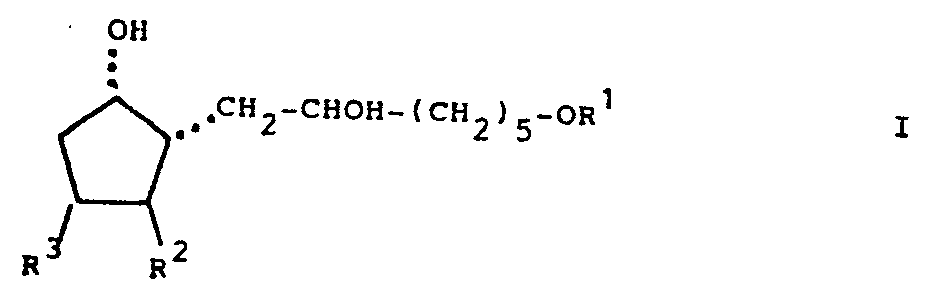
- R1 H oder eine Hydroxyschutzgruppe und
- R2 und R3 zusammen ein O-Atom oder auch zusammen eine Bindung
bedeuten,
können als Zwischenprodukte bei der Synthese von Prostaglandinderivaten verwendet werden.
Description
- Die Erfindung betrifft neue Cyclopentanderivate der Formel I worin

- R1 H oder eine Hydroxyschutzgruppe und
- R 2 und R 3 zusammen ein O-Atom oder auch zusammen eine Bindung
- R 2 und R 3 die angegebene Bedeutung haben
- mit einer Verbindung der Formel III

- M MgHal oder Li und
- Hal Cl, Br oder J bedeuten und
- R 1 die angegebene Bedeutung hat,
- Die Verbindungen der Formel I können als Zwischenprodukte bei der Herstellung von Prostaglandinderivaten verwendet werden. Insbesondere ist aus I (R2 + R3 = 0) die 6-Oxo-7-(2a,3a-epoxy-5-oxo-la-cyclopentyl)-heptansäure ("A") erhältlich, aus der z.B. 6,9-Diketo-13-thiaprosta- glandine hergestellt werden können (vgl. DE-OS 34 01 542).
- Für die Herstellung der Säure "A" ist l.c. eine dreistufige Synthese angegeben, bei der man von 2a-(6-Carboxy-2-cis-hexenyl)-3a,4a-epoxy-cyclopentan-la-ol ausgeht. Jedoch lassen die Ausbeuten bei dieser Synthese zu wünschen übrig, insbesondere bei Versuchen, sie in den großtechnischen Maßstab zu übertragen.
- Der Erfindung lag die Aufgabe zugrunde, ein neues Verfahren (und neue Zwischenprodukte) zur Herstellung von "A" und verwandten Verbindungen und damit zur Herstellung von Prostaglandinderivaten aufzufinden, das die Nachteile des bekannten Verfahrens nicht oder nur in geringerem Maße aufweist, hohe Ausbeuten liefert und für den großtechnischen Maßstab geeignet ist.
- Diese Aufgabe wurde durch die Bereitstellung des neuen Verfahrens und der neuen Zwischenprodukte der Formel I gelöst.
- Es wurde gefunden, daß das neue Verfahren, das von leicht zugänglichen Verbindungen (II) ausgeht, bessere Ausbeuten als das bekannte liefert und sich ohne Schwierigkeiten in den großtechnischen Maßstab übertragen läßt.
- In den Verbindungen der Formeln I und III kann der Rest R 1 eine Hydroxyschutzgruppe bedeuten. Der Ausdruck "Hydroxyschutzgruppe" ist allgemein bekannt und bezeichnet eine Gruppe, die geeignet ist, die Hydroxygruppe vor chemischen Umsetzungen zu schützen (zu blockieren), die aber leicht entfernbar ist, nachdem die gewünschte chemische Reaktion an anderen Stellen des Moleküls durchgeführt worden ist. Natur und Größe der Hydroxyschutzgruppen ist nicht kritisch, da sie nach der gewünschten chemischen Reaktion oder Reaktionsfolge wieder entfernt werden.
- Als Hydroxyschutzgruppen eignen sich z.B. unsubstituierte oder substituierte Acylgruppen, Ethergruppen oder Silylethergruppen. Bevorzugte Hydroxyschutzgruppen sind Trialkylsilyl mit insgesamt 3-12 C-Atomen, vorzugsweise Trimethylsilyl, Triethylsilyl, Triisopropylsilyl, tert.-Butyl-dimethylsilyl, Di-tert.-butyl-methylsilyl; Aryldialkylsilyl mit insgesamt 8-18 C-Atomen, vorzugsweise Phenyldimethylsilyl; Tetrahydro-2-pyranyl; Alkoxymethyl mit 2-5 C-Atomen wie Methoxymethyl, Ethoxymethyl oder tert.-Butoxymethyl; Alkylthiomethyl mit 2-5 C-Atomen wie Methylthiomethyl, Ethylthiomethyl oder tert.-Butyl- thiomethyl; Aryloxymethyl mit 7-11 C-Atomen wie Phenoxymethyl; ferner auch Alkyl mit 1-7 C-Atomen, vorzugsweise tert.-Butyl, Methyl, Ethyl oder Propyl, ferner Isopropyl, Butyl, Isobutyl, sek.-Butyl, Pentyl, Hexyl oder Heptyl; Acyl mit 1-10 C-Atomen, insbesondere Alkanoyl mit 1-6 C-Atomen wie Formyl, Acetyl, Trimethylacetyl, tert.-Butylacetyl; Aroyl mit 7-10 C-Atomen wie Benzoyl; weiterhin Kohlensäureestergruppen wie tert.-Butoxycarbonyl oder Benzoxycarbonyl. Besonders bevorzugt steht R 1 für eine Trimethylsilylgruppe.
- Die Lactole der Formel II, erhältlich durch Reduktion der entsprechenden Lactone mit Diisobutylaluminiumhydrid, umschließen das bevorzugte 2-Oxa-lßH,5ßH- bicyclo[3,3,0]oct-5-en-3-ol (IIa) und die beiden stereoisomeren 2-Oxa-6,7-epoxy-bicylo[3,3,0]octan-3-ole. Die metallorganischen Verbindungen der Formel III sind aus 5-Hal-pentanolen, erhältlich, die zunächst durch Schutz der OH-Gruppe in Verbindungen der Formel Hal-(CH2)5-ORl übergeführt werden können; diese kann man anschließend mit Li oder Mg umsetzen.
- Die Umsetzung der Verbindungen der Formel II and III gelingt zweckmäßig in Gegenwart eines inerten Lösungsmittels, z.B. eines Ethers wie Tetrahydrofuran (THF), Diethylether, Diisopropylether, Methyl-tert.-butylether, bei Temperaturen zwischen etwa 0 und 100°, vorzugsweise zwischen 15 und 30°. Zweckmäßig wird die metallorganische Verbindung III in situ hergestellt; anschließend versetzt man mit dem Lactol II oder einer Lösung desselben.
- Ein so erhaltenes Cyclopentenderivat 1 (R2 + R3 = Bindung) kann, falls erwünscht, zum entsprechenden Epoxid I (R 2 + R 3 = 0) oxydiert werden. Als Oxydationsmittel eignen sich insbesondere Peroxide und Hydroperoxide wie m-Chlorperbenzoesäure oder tert.-Butylhydroperoxid. Hydroperoxide werden zweckmäßig in Gegenwart eines Katalysators verwendet, z.B. eines Schwermetallkatalysators wie Molybdänhexacarbonyl, Vanadin(IV)oxid oder einem ihrer Derivate, z.B. Vanadin(IV)oxid-acetylacetonat. Die Oxydation erfolgt zweckmäßig in Gegenwart eines inerten Lösungsmittels, z.B. eines halogenierten Kohlenwasserstoffs wie Dichlormethan, Chloroform, Tetrachlorkohlenstoff, Trichlorethylen, oder eines aromatischen Kohlenwasserstoffs wie Benzol oder Toluol, bei Temperaturen zwischen etwa 0 und etwa 40°, vorzugsweise zwischen 15 und 30°.
- Es ist auch möglich, mehrstufig zu oxydieren, z.B. durch Anlagerung von HOBr zum Bromhydrin und anschließende Dehydrobromierung zum Epoxid.
- Die erfindungsgemäß erhältlichen Diole der Formel I können zu entsprechenden Diketoverbindungen oxydiert werden. Oxydation von I (R1 = Trimethylsilyl, R 2 + R3 = O) mit "Jones-Reagenz" (Cr03 in wässeriger Schwefelsäure) führt z.B. zu der bekannten Säure "A" (l.c.).
- "Übliche Aufarbeitung" bedeutet: man extrahiert mit Ethylacetat oder Dichlormethan, wäscht mit Wasser, trocknet die organische Phase und dampft sie ein.
- Beispiel
- a) Zu einem siedenden Gemisch von 243 g Mg-Spänen, 200 mg Jod und 1 1 THF tropft man unter Stickstoff innerhalb 2 Std. eine Lösung von 1795 g 5-Trimethylsilyloxy-pentylbromid (erhältlich aus 5-Brompentanol und Chlortrimethylsilan) in 1,6 1 THF und läßt abkühlen. Bei 20-22° wird anschließend eine Lösung von 315 g IIa in 1 1 THF innerhalb 2 Std. zugetropft. Man rührt noch 1 Std., gießt in gesättigte NH4Cl-Lösung, arbeitet wie üblich auf (Ethylacetat) und erhält 811 g rohes 2a-(2-Hydroxy-7-trimethyl- silyloxy-heptyl)-3-cyclopenten-la-ol.
- b) Eine Lösung von 650 g dieser Verbindung in 3,25 1 Dichlormethan wird mit 200 g CaCO3 sowie 3 g Vanadin(IV)oxid-acetylacetonat ("VA") versetzt. Bei 20° werden unter Rühren innerhalb 45 Min. 628 ml 70 %iges wässeriges tert.-Butylhydroperoxid zugetropft; gleichzeitig wird portionsweise weiteres VA zugegeben, insgesamt 45 g. Man rührt noch 5 Std., gießt in gesättigte Na2S2O3-Lösung, filtriert, arbeitet wie üblich auf (Dichlormethan) und erhält 685 g rohes 2a-(2-Hydroxy-7-trimethylsilyloxy- heptyl)-3a,4a-epoxy-cyclopentan-la-ol.
- Verwendungsbeispiel
- Eine Lösung von 665 g der vorstehenden Verbindung in einem Gemisch von je 5,32 1 Aceton und THF wird bei -2° innerhalb 3,5 Std. tropfenweise mit 2,7 1 Jones-Reagenz (erhalten durch Einrühren von 721 g CrO3 in 621 ml konz. H2S04 und Auffüllen mit Wasser) versetzt. Man rührt noch 1 Std. bei 0°, gibt dann unter Kühlung 800 ml Isopropanol hinzu, rührt weitere 30 Min., fügt 1 1 Wasser hinzu, trennt ab und extrahiert mit Dichlormethan. Die vereinten organischen Phasen werden mit gesättigter NaCl-Lösung gewaschen, getrocknet und eingedampft. Der Rückstand wird chromatographisch gereinigt. Man erhält 6-Oxo-7-(2a,3a-epoxy-5-oxo-la-cyclopentyl)-heptansäure ("A"), F. 93-94°.
bedeuten,
sowie ein Verfahren zu ihrer Herstellung, dadurch gekennzeichnet, daß man ein Lactol der Formel II

umsetzt
und daß man gegebenenfalls eine erhaltene Verbindung der Formel I (R2 + R3 = Bindung) durch Behandeln mit einem Oxydationsmittel in eine Verbindung der Formel I (R2 + R3 = O) umwandelt.
Claims (4)


umsetzt
und daß man gegebenenfalls eine erhaltene Verbindung der Formel I (R 2 + R 3 = Bindung) durch Behandeln mit einem Oxydationsmittel in eine Verbindung der Formel I (R2 + R3 = O) umwandelt.
Priority Applications (1)
| Application Number | Priority Date | Filing Date | Title |
|---|---|---|---|
| AT86112318T ATE63558T1 (de) | 1985-09-20 | 1986-09-05 | Cyclopentanderivate. |
Applications Claiming Priority (2)
| Application Number | Priority Date | Filing Date | Title |
|---|---|---|---|
| DE19853533576 DE3533576A1 (de) | 1985-09-20 | 1985-09-20 | Cyclopentanderivate |
| DE3533576 | 1985-09-20 |
Publications (3)
| Publication Number | Publication Date |
|---|---|
| EP0219666A2 true EP0219666A2 (de) | 1987-04-29 |
| EP0219666A3 EP0219666A3 (en) | 1989-05-31 |
| EP0219666B1 EP0219666B1 (de) | 1991-05-15 |
Family
ID=6281486
Family Applications (1)
| Application Number | Title | Priority Date | Filing Date |
|---|---|---|---|
| EP86112318A Expired - Lifetime EP0219666B1 (de) | 1985-09-20 | 1986-09-05 | Cyclopentanderivate |
Country Status (10)
| Country | Link |
|---|---|
| US (1) | US4885372A (de) |
| EP (1) | EP0219666B1 (de) |
| JP (1) | JPS6272638A (de) |
| AT (1) | ATE63558T1 (de) |
| AU (1) | AU584741B2 (de) |
| CA (1) | CA1285278C (de) |
| DE (2) | DE3533576A1 (de) |
| ES (1) | ES2001793A6 (de) |
| HU (1) | HUT44997A (de) |
| ZA (1) | ZA867155B (de) |
Families Citing this family (2)
| Publication number | Priority date | Publication date | Assignee | Title |
|---|---|---|---|---|
| US5166124A (en) * | 1991-04-30 | 1992-11-24 | Eastman Kodak Company | Mixture of yellow and magenta dyes to form a red hue for color filter array element |
| WO1999041296A1 (en) * | 1998-02-11 | 1999-08-19 | Rensselaer Polytechnic Institute | Photopolymerizable compositions containing cycloaliphatic epoxyalcohol monomers |
Family Cites Families (5)
| Publication number | Priority date | Publication date | Assignee | Title |
|---|---|---|---|---|
| GB1525282A (en) * | 1975-08-08 | 1978-09-20 | Ono Pharmaceutical Co | 16-chloroprostaglandin analogues |
| US4115452A (en) * | 1975-10-16 | 1978-09-19 | Hoffmann-La Roche Inc. | 4,5, Substituted cyclopentane-1,3-diols |
| US4111959A (en) * | 1976-03-03 | 1978-09-05 | American Cyanamid Company | 15,16-Dioxy prostenoic acids and esters and intermediates in their preparation |
| US4085272A (en) * | 1977-03-30 | 1978-04-18 | American Cyanamid Company | 11-(2-Hydroxyethylthio)prostenoic acid E2 series derivatives |
| DE3401542A1 (de) * | 1984-01-18 | 1985-08-01 | Merck Patent Gmbh, 6100 Darmstadt | Schwefelhaltige 6-ketoprostaglandine |
-
1985
- 1985-09-20 DE DE19853533576 patent/DE3533576A1/de not_active Withdrawn
-
1986
- 1986-09-05 EP EP86112318A patent/EP0219666B1/de not_active Expired - Lifetime
- 1986-09-05 DE DE8686112318T patent/DE3679274D1/de not_active Expired - Fee Related
- 1986-09-05 AT AT86112318T patent/ATE63558T1/de not_active IP Right Cessation
- 1986-09-09 AU AU62468/86A patent/AU584741B2/en not_active Ceased
- 1986-09-18 CA CA000518457A patent/CA1285278C/en not_active Expired - Fee Related
- 1986-09-19 US US06/909,745 patent/US4885372A/en not_active Expired - Fee Related
- 1986-09-19 ZA ZA867155A patent/ZA867155B/xx unknown
- 1986-09-19 HU HU864002A patent/HUT44997A/hu unknown
- 1986-09-19 ES ES8602034A patent/ES2001793A6/es not_active Expired
- 1986-09-19 JP JP61219864A patent/JPS6272638A/ja active Pending
Also Published As
| Publication number | Publication date |
|---|---|
| ZA867155B (en) | 1987-05-27 |
| HUT44997A (en) | 1988-05-30 |
| EP0219666B1 (de) | 1991-05-15 |
| DE3679274D1 (de) | 1991-06-20 |
| JPS6272638A (ja) | 1987-04-03 |
| EP0219666A3 (en) | 1989-05-31 |
| ES2001793A6 (es) | 1988-06-16 |
| CA1285278C (en) | 1991-06-25 |
| AU584741B2 (en) | 1989-06-01 |
| US4885372A (en) | 1989-12-05 |
| AU6246886A (en) | 1988-03-17 |
| DE3533576A1 (de) | 1987-03-26 |
| ATE63558T1 (de) | 1991-06-15 |
Similar Documents
| Publication | Publication Date | Title |
|---|---|---|
| EP0219666B1 (de) | Cyclopentanderivate | |
| DE2608932C2 (de) | Verfahren zur Herstellung von 3-Oxy-4H-pyran-4-on-Derivaten | |
| DE2423485A1 (de) | Bicyclooctan-derivate | |
| DE2130053B2 (de) | Verfahren zur Herstellung von Cyclopenta-[f][l]-benzopyran-derivaten | |
| DE69219217T2 (de) | Neue 16-Methyl substituierte Steroidderivate von Pregna-1,4-dien-3,20-dion, ihre Herstellung, ihre Verwendung zur Herstellung von 16-Methylene-substituierte Steroide und neue Zwischenprodukten dafür | |
| DE2319017B2 (de) | Verfahren zur Herstellung von Prostaglandinen der Eins-Reihe | |
| EP0285548B1 (de) | Verfahren zur Herstellung von 17alpha-Ethinyl-17beta-hydroxy-18-methyl-4,15-estradien-3-on und die neuen Zwischenprodukte für dieses Verfahren | |
| DE68910774T2 (de) | Cyclopentanheptencarbonsäurederivate und Verfahren zu ihrer Herstellung. | |
| DE69001266T2 (de) | Cyclische triketonverbindungen und trimethylsilylbutadienverbindungen und ihre verwendung zur herstellung von daunomycinon-derivaten. | |
| EP0766660A1 (de) | Cyclohexanon-derivate, verfahren zu deren herstellung und zwischenprodukte des verfahrens | |
| Herlem et al. | Studies toward the total synthesis of diterpenes in the labdane series. III. Synthesis of two epimeric 6, 7, 8-trihydroxylabdadienes | |
| DE2847049A1 (de) | 13,14-didehydro-prostaglandine, verfahren zu ihrer herstellung und sie enthaltendes pharmazeutisches oder veterinaermedizinisches mittel | |
| CH628639A5 (en) | Process for the preparation of furanose derivatives | |
| DE2626288A1 (de) | Verfahren zur stereoselektiven reduktion von prostaglandinzwischenprodukten | |
| EP0008077B1 (de) | Neue Prostaglandinderivate in der Delta-2-PGF2 und Delta-2-PGE2-Reihe, Verfahren zu deren Herstellung und ihre Verwendung als Arzneimittel | |
| DE2654668A1 (de) | Verfahren zur herstellung von verbindungen des prostaglandintyps und nach diesem verfahren erhaltene produkte | |
| EP0366216A1 (de) | (1S,2S,3R,5R)-2-[(3S)-2-Halogen-3-hydroxy-1-alken(inyl)]3-trialkyl-silyloxy-7,7-(2,2-dimethyl-trimethyl-enoxy)-bicyclo[3.3.0]octan-Verbindungen und Verfahren zu deren Herstellung | |
| DE2731459A1 (de) | Cyclohexan-analoge vom prostaglandin-typ, verfahren zu deren herstellung und diese enthaltende zusammensetzungen | |
| DD262027A5 (de) | 13 alpha-alkylgonan - delta hoch 9 hoch (11)-5,10 -epoxide | |
| DE68906821T2 (de) | Verfahren zur Herstellung von Prolinolamid-Derivaten. | |
| DE19735574A1 (de) | Neue [C1(Carboxa)-C6]-Fragmente, Verfahren zu ihrer Herstellung und ihre Verwendung zur Synthese von Epothilon und Epothilonderivaten | |
| EP0335827B1 (de) | Neues Verfahren zur Herstellung von Bicyclo(3.3.0)octan-3-on-derivaten | |
| US4204001A (en) | Prostane derivatives | |
| EP0249844A1 (de) | Ketolactone | |
| EP0044495A1 (de) | 16-Beta-Ethylsteroide, diese enthaltende Präparate und Verfahren zu ihrer Herstellung |
Legal Events
| Date | Code | Title | Description |
|---|---|---|---|
| PUAI | Public reference made under article 153(3) epc to a published international application that has entered the european phase |
Free format text: ORIGINAL CODE: 0009012 |
|
| AK | Designated contracting states |
Kind code of ref document: A2 Designated state(s): AT BE CH DE FR GB IT LI NL SE |
|
| PUAL | Search report despatched |
Free format text: ORIGINAL CODE: 0009013 |
|
| AK | Designated contracting states |
Kind code of ref document: A3 Designated state(s): AT BE CH DE FR GB IT LI NL SE |
|
| 17P | Request for examination filed |
Effective date: 19891004 |
|
| 17Q | First examination report despatched |
Effective date: 19901016 |
|
| ITF | It: translation for a ep patent filed | ||
| GRAA | (expected) grant |
Free format text: ORIGINAL CODE: 0009210 |
|
| AK | Designated contracting states |
Kind code of ref document: B1 Designated state(s): AT BE CH DE FR GB IT LI NL SE |
|
| REF | Corresponds to: |
Ref document number: 63558 Country of ref document: AT Date of ref document: 19910615 Kind code of ref document: T |
|
| GBT | Gb: translation of ep patent filed (gb section 77(6)(a)/1977) | ||
| REF | Corresponds to: |
Ref document number: 3679274 Country of ref document: DE Date of ref document: 19910620 |
|
| ET | Fr: translation filed | ||
| PGFP | Annual fee paid to national office [announced via postgrant information from national office to epo] |
Ref country code: GB Payment date: 19910805 Year of fee payment: 6 |
|
| PGFP | Annual fee paid to national office [announced via postgrant information from national office to epo] |
Ref country code: SE Payment date: 19910820 Year of fee payment: 6 |
|
| PGFP | Annual fee paid to national office [announced via postgrant information from national office to epo] |
Ref country code: FR Payment date: 19910906 Year of fee payment: 6 |
|
| PGFP | Annual fee paid to national office [announced via postgrant information from national office to epo] |
Ref country code: AT Payment date: 19910909 Year of fee payment: 6 |
|
| PGFP | Annual fee paid to national office [announced via postgrant information from national office to epo] |
Ref country code: CH Payment date: 19910923 Year of fee payment: 6 |
|
| PGFP | Annual fee paid to national office [announced via postgrant information from national office to epo] |
Ref country code: NL Payment date: 19910930 Year of fee payment: 6 |
|
| PGFP | Annual fee paid to national office [announced via postgrant information from national office to epo] |
Ref country code: DE Payment date: 19911001 Year of fee payment: 6 |
|
| PGFP | Annual fee paid to national office [announced via postgrant information from national office to epo] |
Ref country code: BE Payment date: 19911104 Year of fee payment: 6 |
|
| PLBE | No opposition filed within time limit |
Free format text: ORIGINAL CODE: 0009261 |
|
| STAA | Information on the status of an ep patent application or granted ep patent |
Free format text: STATUS: NO OPPOSITION FILED WITHIN TIME LIMIT |
|
| 26N | No opposition filed | ||
| PG25 | Lapsed in a contracting state [announced via postgrant information from national office to epo] |
Ref country code: GB Effective date: 19920905 Ref country code: AT Effective date: 19920905 |
|
| PG25 | Lapsed in a contracting state [announced via postgrant information from national office to epo] |
Ref country code: SE Effective date: 19920906 |
|
| PG25 | Lapsed in a contracting state [announced via postgrant information from national office to epo] |
Ref country code: LI Effective date: 19920930 Ref country code: CH Effective date: 19920930 Ref country code: BE Effective date: 19920930 |
|
| BERE | Be: lapsed |
Owner name: MERCK PATENT G.M.B.H. Effective date: 19920930 |
|
| PG25 | Lapsed in a contracting state [announced via postgrant information from national office to epo] |
Ref country code: NL Effective date: 19930401 |
|
| GBPC | Gb: european patent ceased through non-payment of renewal fee |
Effective date: 19920905 |
|
| NLV4 | Nl: lapsed or anulled due to non-payment of the annual fee | ||
| PG25 | Lapsed in a contracting state [announced via postgrant information from national office to epo] |
Ref country code: FR Effective date: 19930528 |
|
| REG | Reference to a national code |
Ref country code: CH Ref legal event code: PL |
|
| PG25 | Lapsed in a contracting state [announced via postgrant information from national office to epo] |
Ref country code: DE Effective date: 19930602 |
|
| REG | Reference to a national code |
Ref country code: FR Ref legal event code: ST |
|
| EUG | Se: european patent has lapsed |
Ref document number: 86112318.0 Effective date: 19930406 |
|
| PG25 | Lapsed in a contracting state [announced via postgrant information from national office to epo] |
Ref country code: IT Free format text: LAPSE BECAUSE OF NON-PAYMENT OF DUE FEES;WARNING: LAPSES OF ITALIAN PATENTS WITH EFFECTIVE DATE BEFORE 2007 MAY HAVE OCCURRED AT ANY TIME BEFORE 2007. THE CORRECT EFFECTIVE DATE MAY BE DIFFERENT FROM THE ONE RECORDED. Effective date: 20050905 |