EP0220265B1 - Beschichtungsverfahren - Google Patents
Beschichtungsverfahren Download PDFInfo
- Publication number
- EP0220265B1 EP0220265B1 EP86902920A EP86902920A EP0220265B1 EP 0220265 B1 EP0220265 B1 EP 0220265B1 EP 86902920 A EP86902920 A EP 86902920A EP 86902920 A EP86902920 A EP 86902920A EP 0220265 B1 EP0220265 B1 EP 0220265B1
- Authority
- EP
- European Patent Office
- Prior art keywords
- tip
- allergen
- skin
- pickling
- steel
- Prior art date
- Legal status (The legal status is an assumption and is not a legal conclusion. Google has not performed a legal analysis and makes no representation as to the accuracy of the status listed.)
- Expired
Links
- 238000000576 coating method Methods 0.000 title claims abstract description 13
- 239000013566 allergen Substances 0.000 claims abstract description 43
- 239000011248 coating agent Substances 0.000 claims abstract description 11
- 206010020751 Hypersensitivity Diseases 0.000 claims abstract description 10
- 238000000034 method Methods 0.000 claims abstract description 10
- 208000026935 allergic disease Diseases 0.000 claims abstract description 6
- 230000007815 allergy Effects 0.000 claims abstract description 6
- 230000037368 penetrate the skin Effects 0.000 claims abstract description 5
- 238000001727 in vivo Methods 0.000 claims abstract description 4
- 229910001220 stainless steel Inorganic materials 0.000 claims description 5
- 239000010935 stainless steel Substances 0.000 claims description 5
- 229910000831 Steel Inorganic materials 0.000 abstract description 16
- 239000010959 steel Substances 0.000 abstract description 16
- 238000005554 pickling Methods 0.000 description 21
- 210000003491 skin Anatomy 0.000 description 17
- 238000012360 testing method Methods 0.000 description 17
- 230000002009 allergenic effect Effects 0.000 description 11
- 239000002253 acid Substances 0.000 description 10
- 238000002360 preparation method Methods 0.000 description 10
- 239000000126 substance Substances 0.000 description 10
- 239000000463 material Substances 0.000 description 8
- VEXZGXHMUGYJMC-UHFFFAOYSA-N Hydrochloric acid Chemical compound Cl VEXZGXHMUGYJMC-UHFFFAOYSA-N 0.000 description 6
- 230000000694 effects Effects 0.000 description 6
- 150000007513 acids Chemical class 0.000 description 4
- 208000030961 allergic reaction Diseases 0.000 description 4
- 229910052751 metal Inorganic materials 0.000 description 4
- 239000002184 metal Substances 0.000 description 4
- GRYLNZFGIOXLOG-UHFFFAOYSA-N Nitric acid Chemical compound O[N+]([O-])=O GRYLNZFGIOXLOG-UHFFFAOYSA-N 0.000 description 3
- 229960004784 allergens Drugs 0.000 description 3
- 239000012535 impurity Substances 0.000 description 3
- 229910052500 inorganic mineral Inorganic materials 0.000 description 3
- -1 mammalian epithelia Chemical class 0.000 description 3
- 239000011707 mineral Substances 0.000 description 3
- 239000000203 mixture Substances 0.000 description 3
- 229910017604 nitric acid Inorganic materials 0.000 description 3
- 230000001590 oxidative effect Effects 0.000 description 3
- 239000000243 solution Substances 0.000 description 3
- UOCLXMDMGBRAIB-UHFFFAOYSA-N 1,1,1-trichloroethane Chemical compound CC(Cl)(Cl)Cl UOCLXMDMGBRAIB-UHFFFAOYSA-N 0.000 description 2
- 206010070834 Sensitisation Diseases 0.000 description 2
- FAPWRFPIFSIZLT-UHFFFAOYSA-M Sodium chloride Chemical compound [Na+].[Cl-] FAPWRFPIFSIZLT-UHFFFAOYSA-M 0.000 description 2
- QAOWNCQODCNURD-UHFFFAOYSA-N Sulfuric acid Chemical compound OS(O)(=O)=O QAOWNCQODCNURD-UHFFFAOYSA-N 0.000 description 2
- 208000024780 Urticaria Diseases 0.000 description 2
- 238000007792 addition Methods 0.000 description 2
- 230000000172 allergic effect Effects 0.000 description 2
- 208000010668 atopic eczema Diseases 0.000 description 2
- 238000003745 diagnosis Methods 0.000 description 2
- 150000004676 glycans Chemical class 0.000 description 2
- 229920001282 polysaccharide Polymers 0.000 description 2
- 239000005017 polysaccharide Substances 0.000 description 2
- 102000004169 proteins and genes Human genes 0.000 description 2
- 108090000623 proteins and genes Proteins 0.000 description 2
- 150000003839 salts Chemical class 0.000 description 2
- 230000008313 sensitization Effects 0.000 description 2
- XLYOFNOQVPJJNP-UHFFFAOYSA-N water Substances O XLYOFNOQVPJJNP-UHFFFAOYSA-N 0.000 description 2
- 241000196324 Embryophyta Species 0.000 description 1
- 206010015150 Erythema Diseases 0.000 description 1
- 240000004296 Lolium perenne Species 0.000 description 1
- 241000237503 Pectinidae Species 0.000 description 1
- 206010040914 Skin reaction Diseases 0.000 description 1
- 229940074608 allergen extract Drugs 0.000 description 1
- 239000007864 aqueous solution Substances 0.000 description 1
- 238000005452 bending Methods 0.000 description 1
- 230000000052 comparative effect Effects 0.000 description 1
- 238000013461 design Methods 0.000 description 1
- 230000006866 deterioration Effects 0.000 description 1
- 238000004090 dissolution Methods 0.000 description 1
- 239000012153 distilled water Substances 0.000 description 1
- 229940079593 drug Drugs 0.000 description 1
- 239000003814 drug Substances 0.000 description 1
- 231100000321 erythema Toxicity 0.000 description 1
- 230000007717 exclusion Effects 0.000 description 1
- 238000002474 experimental method Methods 0.000 description 1
- 210000000245 forearm Anatomy 0.000 description 1
- 210000003630 histaminocyte Anatomy 0.000 description 1
- 238000000760 immunoelectrophoresis Methods 0.000 description 1
- 230000002757 inflammatory effect Effects 0.000 description 1
- 239000007788 liquid Substances 0.000 description 1
- 239000002932 luster Substances 0.000 description 1
- 238000004519 manufacturing process Methods 0.000 description 1
- 229910044991 metal oxide Inorganic materials 0.000 description 1
- 150000004706 metal oxides Chemical class 0.000 description 1
- 230000003389 potentiating effect Effects 0.000 description 1
- 230000009257 reactivity Effects 0.000 description 1
- 238000012552 review Methods 0.000 description 1
- 235000020637 scallop Nutrition 0.000 description 1
- 230000035483 skin reaction Effects 0.000 description 1
- 231100000430 skin reaction Toxicity 0.000 description 1
- 239000011780 sodium chloride Substances 0.000 description 1
- 239000002195 soluble material Substances 0.000 description 1
- 241000894007 species Species 0.000 description 1
- 239000010421 standard material Substances 0.000 description 1
- 239000008174 sterile solution Substances 0.000 description 1
- 230000000007 visual effect Effects 0.000 description 1
Images
Classifications
-
- A—HUMAN NECESSITIES
- A61—MEDICAL OR VETERINARY SCIENCE; HYGIENE
- A61B—DIAGNOSIS; SURGERY; IDENTIFICATION
- A61B17/00—Surgical instruments, devices or methods
- A61B17/20—Surgical instruments, devices or methods for vaccinating or cleaning the skin previous to the vaccination
- A61B17/205—Vaccinating by means of needles or other puncturing devices
Definitions
- the invention relates to a method for applying a coating of allergen on the tip of an instrument, which is to be employed for in vivo allergy diagnosis, so-called prick tests on skin.
- allergen refers to a substance capable of causing an allergic reaction, unless stated otherwise.
- In vivo allergy diagnosis is a means of identifying the specific allergen(s) to which a patient is allergic, the technique of this diagnostication involving the following procedure: A drop of allergen extract or of allergen in some other suitable form is deposited on the skin. Thereafter, the skin is punctured by means of the tip of a cannula, or with a needle, lancet or other pointed tool, to thus cause the allergen to penetrate into the skin where the allergen then may give rise to an allergic reaction; for instance, the allergen may react with IgE antibodies bound to mast cells which release inflammatory mediators.
- the technique as such is well known and is described in numerous textbooks and review articles (see for example Allergy and Clinical Immunology, Grune & Stratton Inc., 1976, p. 164-170).
- the instruments employed for puncturing may take various forms and shapes.
- special needles have been employed, which are made of steel and have a tip configuration optimized for skin testing (Malling, J-J et al., Allergy 37 (1982), p. 563-67).
- an excess of allergenic material is deposited on the skin, whereupon puncturing is effected by means of the needle, and the residual excess of allergen is then wiped off.
- Needles that have been coated with allergenic substances prior to their use in prick testing have also been proposed as suitable tools. For instance in DE-A-2 940 342, a lancet is described, onto the tip of which a drop of an allergenic preparation is deposited, freezed and lacquered prior to use. Neither pickling in general nor acid pickling as a pretreatment step is discussed.
- the object of this invention is to minimize these disadvantages, i.e. to increase the reproducibility of test results obtained variously at different times and with different allergen preparations of either the same or different allergens.
- the invention moreover, is aimed at reducing sensitization hazards for patients and for personnel carrying out the tests.
- a factor affecting the adhesiveness of the allergen preparation is its origin and composition.
- allergen preparations rich in polysaccharides e.g. from molds and plants, have a relatively high degree of adhesiveness to steel surfaces; whereas others which are poor in polysaccharides, e.g. mammalian epithelia, possess only little adhesiveness to steel surfaces.
- the allergenic component is always a protein and the degree of its adhesiveness is determined by the other components present in the preparation.
- a second factor is the luster of the steel, i.e its surface depth. As a rule an increased surface depth is conducive to improved adhesion.
- a third factor may be impurities, if present, such as e.g. fat and metal oxides. Impurities may involve a substantial deterioration of adhesiveness. It will thus be appreciated that there are a number of factors which are decisive for the allergenic activity of an allergen preparation when that preparation adheres to a steel tip.
- the invention provides a method by which due consideration is given to these factors so that the entire tip of the puncturing instrument can be coated with a reproducible and standardized active amount of allergenic substance. This is achieved by acid pickling of the tip prior to the coating thereof.
- Pickling according to the invention has the effect that the steel surface of a tip is cleansed from oxides and other impurities, and presumably also has the further effect that the microstructure of the steel surface is affected favourably for coating with an active amount of an allergenic substance.
- Fat-soluble materials are removed from the steel prior to pickling, in that the surface to be pickled is treated with a fat-dissolving substance such as, for instance, trichloroethane.
- an active amount of material is to be present on the tip means that a local allergic reaction will result upon puncturing of the skin of an allergic individual with the tip.
- the active amount expressed in grams varies among different allergen preparations of the same allergen as well as among different types of allergens. Normally the tip is covered with an amount of allergen (protein) within the range of 0,1 - 10000 ng, in particular 8-1000 ng.
- the activity may be expressed as biological units, B.U. (Nordic Guidelines, Publ. No.
- the lancet tip is coated with an amount of allergen such that the reaction in the skin when the allergen is used will correspond to 10 4 - 10 6 B.U., as e.g. 10 5 B.U.
- the wide range of variations in specific activity liable to occur with different types of allergen is exemplified in Table 1.
- the instrument may be embodied in various different forms, the most critical feature being the shape of the tip.
- tip means that portion of the instrument which will penetrate into the skin upon puncturing thereof.
- the tip is given a shape such that puncturing of the skin is effected reproducibly to a suitable depth; for in this context it should be noted that the local allergic reaction obtained will depend on i.a. the depth of the puncture and the angle at which puncturing is effected.
- the instrument may take the form of a lancet, the tip of which has shoulders, and the handle of which has been given a shape such that the test operator will always prefer to puncture the skin at the same angle, for example 45° or 90° (measured between the skin and the instrument).
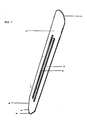
- a puncturing instrument which has the shape of a lancet. It consists of a plate (1) which is substantially rectangular and oblong. On one of its short sides it has a tip (2), preferably triangular, the base of the tip attaching to the short side in a manner such that the tip at right angles in the plane of the plate projects therefrom. It is recommendable that the plate and tip are punched from the same sheet of metal (stainless steel). The portion of the short side surrounding the tip base forms two means (3) which can be made to penetrate the skin with only the greatest difficulty.
- shoulder or “stop means” and are directed substantially at right angles outward from the longitudinal axis of the instrument.
- the corners (4 and 5) of the plate may be beveled for the sake of optimum grip and esthetic appeal.
- longitudinally extending ridges or recesses - grooves (6) may be embossed/impressed in the plate. These will thwart accidental folding or bending of the instiument.
- the exact dimensions of the instrument are determined by practical considerations. For example, the length of the instrument is chosen such that the tip can easily be handled to penetrate the skin at a given angle, for instance at 90°. The length may be in the range of 25 - 45 mm, and the width in the range of 3 - 6 mm.
- the ratio of the depth of the tip to the width of one stop means may vary from e.g. 0.1 to 1.
- the visual appearance of the tip this may vary within wide limits.
- Examples of different embodiments are plainly neddle-shaped and triangular tips, hollow tips, and tips formed with a surface- increasing scallops configuration. If the surface is increased, this means that a larger area is at one's disposal for coating, i.e. the tip can be coated with a larger amount of allergen. If the tip is formed with surface- increasing features, these must be chosen such that they will not negatively affect the possibilities of performing reproducible and painless punctures of the skin.
- a triangular tip is a preferred embodiment.
- the surface which is to be coated with the allergen should be made of stainless steel, an important proviso being that the steel should be of a quality such as to minimize the risk of the test person's becoming sensitized to metal.
- the other, non-coated portions of the instrument may preferably be of the same material although they may also be made of other material.
- the invention utilizes acid pickling with the aid of a mineral acid such as, for instance, hydrochloric acid, sulfuric acid or mixtures thereof.
- a mineral acid such as, for instance, hydrochloric acid, sulfuric acid or mixtures thereof.
- the degree of efficiency of the pickling will depend on the concentration of the acids and on the time during which the steel is exposed to the treatment. An average expert will easily find out suitable conditions. Treating periods that are too long or concentrations that are too high will tend to bring about dissolution of the steel. If, on the other hand, the treating periods are too short or the concentrations are too low, the thus resultant pickling will be of an inferior quality, so that the allergen will exhibit poor adhesiveness.
- salts such as sodium chloride, may increase the pickling capacity of a pickling bath. Oxidizing acids in a concentrated form, such as e.g.
- nitric acid are conducive to poor pickling, whereas additions of soluble salts of non-oxidizing mineral acids may increase the pickling capacity of nitric acid (oxidizing acid).
- oxidizing acid oxidizing acid
- the tip is rinsed, whereupon the rinsed surface before being recontaminated is coated with allergenic material.
- This may be done by contacting the tip with a preparation of standardized allergen, preferably an aqueous solution thereof, the concentration of this standard material being for example 0.004 - 0.4 mg/ml.
- the tip is dried (optionally freeze-dried)
- the instrument thus dressed and ready may advantageously be stored in a vacuum, with the exclusion of air and moisture. Coating is performed aseptically to make sure that a sterile product is obtained.
- care is to be taken that the portions of the stop means lying in the immediate proximity of the tip of the instrument are pickled and coated with allergen. In this manner a reproducible coating of the tip is ensured.
- a number of lancets (Swedish high-grade steel, Sandvik AB, Sweden) are introduced into a system of hangers from which each lancet hangs down freely. From these lancets any rests of fat are washed off by means of trichloroethane. The hanger system is then suspended in a rack over a bath containing HC1 5M so that each lancet tip plus a few millimeters up the shoulder will come into contact with the liquid. After seven minutes, pickling is discontinued and the lancets are washed carefully in distilled water until all of the residual hydrochloric acid has been removed. Then the lancets are dried and sterilized in a hot cabinet.
- the pickling according to the invention should give lancets free of miscolouring.
- lancets 40 sterilized lancets (pickled as according to 1 A) are suspended on hangers so that they are all on the same level.
- the lancets are then transported laterally so as to pass over the solution, each lancet being allowed to contact with this allergen solution for 0.5 minute; in this manner allergenic material is caused to adhere to the lancet.
- the lancets are dried in LAF (Laminal Air Flow) for about 5 minutes, whereupon they are packed aseptically in moisture-proof casings. With the aid of immunoelectrophoresis it is possible to evaluate the amount of allergen attaching to the lancet semiquantatively.
- LAF Laminal Air Flow
- the lancet casing is opened.
- the lancet is seized by the upper part of the handle and is directed at right angles to the skin (forearm underside, or back) whereupon the skin is pierced by means of a light pressure on the lancet which is then immediately retracted and discarded. If several tests are carried out simultaneously there should be a distance of at least 2 cm between punctures. After 15 minutes the skin reaction is read off. An erythema and a wheal can be seen if the patient has reacted positively. The size of the wheal is proportional to the reactivity of the patient.
Landscapes
- Health & Medical Sciences (AREA)
- Life Sciences & Earth Sciences (AREA)
- Surgery (AREA)
- Molecular Biology (AREA)
- General Health & Medical Sciences (AREA)
- Biomedical Technology (AREA)
- Heart & Thoracic Surgery (AREA)
- Medical Informatics (AREA)
- Nuclear Medicine, Radiotherapy & Molecular Imaging (AREA)
- Animal Behavior & Ethology (AREA)
- Engineering & Computer Science (AREA)
- Public Health (AREA)
- Veterinary Medicine (AREA)
- Medicines Containing Antibodies Or Antigens For Use As Internal Diagnostic Agents (AREA)
- Measurement Of The Respiration, Hearing Ability, Form, And Blood Characteristics Of Living Organisms (AREA)
- Acyclic And Carbocyclic Compounds In Medicinal Compositions (AREA)
- General Preparation And Processing Of Foods (AREA)
- Application Of Or Painting With Fluid Materials (AREA)
Claims (1)
- Verfahren zum Anbringen eines Allergenbelags auf der aus nichtrostendem Stahl gefertigten Spitze eines Punktiergeräts, das für die Allergiediagnose in vivo verwendet werden soll und das neben der aus nichtrostendem Stahl gefertigten Spitze mit Stopporganen versehen ist, sodass nur die Spitze selber die Haut zu durchdringen vermag, dadurch gekennzeichnet, dass die aus nichtrostendem Stahl gefertigte Spitze sowie auch diejenigen Stopporganpartien, die sich in unmittelbarer Nähe der Spitze befinden, mit Säure geheizt und dann mit Allergen beschichtet worden sind, um so das Anhaften einer aktiven Menge Allergen an der Spitze zustande zu bringen.
Priority Applications (1)
| Application Number | Priority Date | Filing Date | Title |
|---|---|---|---|
| AT86902920T ATE38765T1 (de) | 1985-04-24 | 1986-04-08 | Beschichtungsverfahren. |
Applications Claiming Priority (2)
| Application Number | Priority Date | Filing Date | Title |
|---|---|---|---|
| SE8501990A SE8501990D0 (sv) | 1985-04-24 | 1985-04-24 | Beleggningsforfarande |
| SE8501990 | 1985-04-24 |
Publications (2)
| Publication Number | Publication Date |
|---|---|
| EP0220265A1 EP0220265A1 (de) | 1987-05-06 |
| EP0220265B1 true EP0220265B1 (de) | 1988-11-23 |
Family
ID=20359960
Family Applications (1)
| Application Number | Title | Priority Date | Filing Date |
|---|---|---|---|
| EP86902920A Expired EP0220265B1 (de) | 1985-04-24 | 1986-04-08 | Beschichtungsverfahren |
Country Status (11)
| Country | Link |
|---|---|
| US (1) | US4714621A (de) |
| EP (1) | EP0220265B1 (de) |
| JP (1) | JPS62502516A (de) |
| AU (1) | AU577699B2 (de) |
| BR (1) | BR8601805A (de) |
| CA (1) | CA1272951A (de) |
| DE (1) | DE3661238D1 (de) |
| ES (1) | ES8801107A1 (de) |
| PT (1) | PT82449B (de) |
| SE (1) | SE8501990D0 (de) |
| WO (1) | WO1986006268A1 (de) |
Families Citing this family (24)
| Publication number | Priority date | Publication date | Assignee | Title |
|---|---|---|---|---|
| DE19609315C2 (de) * | 1996-03-09 | 1998-11-05 | Univ Dresden Tech | Nasaler Probennehmer |
| US5931794A (en) * | 1997-10-21 | 1999-08-03 | Pitesky; Isadore | Allergy testing apparatus |
| US6077229A (en) * | 1997-10-21 | 2000-06-20 | Pitesky; Isadore | Allergy testing apparatus |
| US6918901B1 (en) * | 1997-12-10 | 2005-07-19 | Felix Theeuwes | Device and method for enhancing transdermal agent flux |
| BR0114909A (pt) * | 2000-10-26 | 2004-02-03 | Alza Corp | Dispositivos de distribuição de drogas transdérmicas possuindo microprotuberâncias revestidas |
| US20020193729A1 (en) * | 2001-04-20 | 2002-12-19 | Cormier Michel J.N. | Microprojection array immunization patch and method |
| US6890345B2 (en) * | 2001-09-27 | 2005-05-10 | Tyco Healthcare Group Lp | Pretreatment for lubricated surgical needles |
| AU2002352978A1 (en) * | 2001-11-30 | 2003-06-17 | Alza Corporation | Methods and apparatuses for forming microprojection arrays |
| AU2002357372B2 (en) * | 2001-12-20 | 2008-11-20 | Alza Corporation | Skin-piercing microprojections having piercing depth control |
| US7470250B2 (en) * | 2002-03-22 | 2008-12-30 | Novo Nordisk A/S | Apparatus for automatic insertion of a solid medicine |
| WO2004002566A1 (en) * | 2002-06-28 | 2004-01-08 | Alza Corporation | Transdermal drug delivery devices having coated microprotrusions |
| TW200409657A (en) * | 2002-08-08 | 2004-06-16 | Alza Corp | Transdermal vaccine delivery device having coated microprotrusions |
| MXPA06000281A (es) | 2003-06-30 | 2006-07-03 | Johnson & Johnson | Formulaciones para microproyecciones revestidas que contienen contraiones no volatiles. |
| BRPI0413360A (pt) * | 2003-08-04 | 2006-10-10 | Alza Corp | método e dispositivo para aumentar o fluxo de agentes transdérmicos |
| CA2536443A1 (en) * | 2003-08-26 | 2005-03-03 | Alza Corporation | Device and method for intradermal cell implantation |
| KR20070001886A (ko) * | 2003-10-28 | 2007-01-04 | 알자 코포레이션 | 치료용 펩타이드 및 단백질의 폴리머 컨쥬게이트의 피복된미세돌출부를 통한 전달 |
| MXPA06013168A (es) | 2004-05-13 | 2007-05-15 | Johnson & Johnson | Aparato y metodo para el suministro transdermico de agentes de la hormona paratiroidea. |
| US20060030811A1 (en) * | 2004-08-03 | 2006-02-09 | Wong Patrick S | Method and device for enhancing transdermal agent flux |
| KR20070099540A (ko) * | 2004-09-08 | 2007-10-09 | 알자 코포레이션 | 향상된 피부 점착성 및 순응도를 갖는 미세돌출부 어레이 |
| US20060084887A1 (en) * | 2004-10-18 | 2006-04-20 | Golde William T | Rapid, simple and humane method of bleeding mice |
| US20080214952A1 (en) * | 2005-07-11 | 2008-09-04 | Jose Mir | Replaceable Cartridge for Allergy Testing System |
| ES2551305T3 (es) * | 2005-12-28 | 2015-11-17 | Alza Corporation | Formulaciones terapéuticas estables |
| US20100100005A1 (en) * | 2006-07-11 | 2010-04-22 | Infotonics Technology Center, Inc. | Minimally invasive allergy testing system with coated allergens |
| ES2806177B2 (es) * | 2020-06-01 | 2021-07-05 | Borque Ricardo Moreno | Dispositivo de lanceta para pruebas de alergia |
Family Cites Families (3)
| Publication number | Priority date | Publication date | Assignee | Title |
|---|---|---|---|---|
| GB1121809A (en) * | 1966-02-26 | 1968-07-31 | K S F Chemical Processes Ltd | Process for pickling iron and steel and regenerating pickle liquor |
| DE2940342A1 (de) | 1979-10-04 | 1981-04-16 | Erich Rudolf Dipl.-Kfm. Baumgartner | Aus einer lanzette und einem damit verbundenen fluessigkeitsbehaelter gebildete lanzettenanordnung und verfahren zu ihrer herstellung |
| US4483348A (en) * | 1982-03-25 | 1984-11-20 | Nathan Sher | Skin testing device |
-
1985
- 1985-04-24 SE SE8501990A patent/SE8501990D0/xx unknown
-
1986
- 1986-04-08 US US06/946,512 patent/US4714621A/en not_active Expired - Fee Related
- 1986-04-08 JP JP61502500A patent/JPS62502516A/ja active Pending
- 1986-04-08 EP EP86902920A patent/EP0220265B1/de not_active Expired
- 1986-04-08 AU AU58101/86A patent/AU577699B2/en not_active Ceased
- 1986-04-08 WO PCT/SE1986/000157 patent/WO1986006268A1/en not_active Ceased
- 1986-04-08 DE DE8686902920T patent/DE3661238D1/de not_active Expired
- 1986-04-23 PT PT82449A patent/PT82449B/pt not_active IP Right Cessation
- 1986-04-23 CA CA000507314A patent/CA1272951A/en not_active Expired - Fee Related
- 1986-04-23 BR BR8601805A patent/BR8601805A/pt unknown
- 1986-04-24 ES ES554352A patent/ES8801107A1/es not_active Expired
Also Published As
| Publication number | Publication date |
|---|---|
| BR8601805A (pt) | 1986-12-23 |
| WO1986006268A1 (en) | 1986-11-06 |
| PT82449B (pt) | 1992-07-31 |
| JPS62502516A (ja) | 1987-10-01 |
| US4714621A (en) | 1987-12-22 |
| EP0220265A1 (de) | 1987-05-06 |
| SE8501990D0 (sv) | 1985-04-24 |
| ES8801107A1 (es) | 1988-01-01 |
| AU577699B2 (en) | 1988-09-29 |
| AU5810186A (en) | 1986-11-18 |
| ES554352A0 (es) | 1988-01-01 |
| DE3661238D1 (en) | 1988-12-29 |
| CA1272951A (en) | 1990-08-21 |
| PT82449A (en) | 1986-05-01 |
Similar Documents
| Publication | Publication Date | Title |
|---|---|---|
| EP0220265B1 (de) | Beschichtungsverfahren | |
| Baumberger et al. | Methods for the separation of epidermis from dermis and some physiologic and chemical properties of isolated epidermis | |
| Marzulli | Barriers to skin penetration | |
| US5647371A (en) | Skin testing device loading method | |
| CA2049123A1 (en) | Apparatus and method for subcuticular stapling of body tissue | |
| Sevilla et al. | Invalidation of the resting electrocardiogram obtained via exercise electrode sites as a standard 12-lead recording | |
| DE3782825D1 (de) | Vorrichtung zur mechanischen fuehrung von kathetern waehrend der untersuchung von herz- und blutgefaessen. | |
| DE69232711D1 (de) | Vorrichtung und verfahren zur nichtinvasiven mengenbestimmung von im blut oder gewebe vorliegenden bestandteilen | |
| Jui-Chen et al. | Properties of adhesive tapes used for stratum corneum stripping | |
| US4270548A (en) | Allergy testing method | |
| DE69016428D1 (de) | Vorrichtung und verfahren zur bestimmung eines bestandteiles in einer flüssigkeitsprobe. | |
| US4483348A (en) | Skin testing device | |
| US4473083A (en) | Device and method for allergy testing | |
| AT387858B (de) | Anwendung und vorrichtung zur durchfuehrung eines polarimetrischen verfahrens zur quantitativen bestimmung der glucosekonzentration in blut | |
| Goldenberg et al. | Animal/vegetal differences in cortical granule exocytosis during activation of the frog egg | |
| US4205689A (en) | Allergy testing system | |
| Almér et al. | The plasminogen activator activity of arteries and veins in diabetes mellitus | |
| de Jong et al. | Investigative studies of the dermatitis caused by the larva of the brown-tail moth (Euproctis chrysorrhoea Linn.) I. Clinical and experimental findings | |
| EP0081975A2 (de) | Vorrichtung und Verfahren zum Durchführen eines Allergietests | |
| BRUNNER et al. | A laboratory method for evaluation of topical anti-inflammatory agents | |
| El Sayed et al. | Responses of dermal mast cells to injury | |
| EP2194992B1 (de) | Epidermale stimulation zur verstärkung der haarfollikelbildung | |
| NO864919L (no) | Beleggingsmetode. | |
| DE3038010C2 (de) | Verfahren zur Inhibierung der Blutplättchen-Release-Reaktion und Blutsammelvorrichtung zur Durchführung des Verfahrens | |
| ATE28384T1 (de) | Medizinisches verfahren und zubereitung. |
Legal Events
| Date | Code | Title | Description |
|---|---|---|---|
| PUAI | Public reference made under article 153(3) epc to a published international application that has entered the european phase |
Free format text: ORIGINAL CODE: 0009012 |
|
| 17P | Request for examination filed |
Effective date: 19861204 |
|
| AK | Designated contracting states |
Kind code of ref document: A1 Designated state(s): AT BE CH DE FR GB IT LI LU NL SE |
|
| 17Q | First examination report despatched |
Effective date: 19880427 |
|
| GRAA | (expected) grant |
Free format text: ORIGINAL CODE: 0009210 |
|
| AK | Designated contracting states |
Kind code of ref document: B1 Designated state(s): AT BE CH DE FR GB IT LI LU NL SE |
|
| REF | Corresponds to: |
Ref document number: 38765 Country of ref document: AT Date of ref document: 19881215 Kind code of ref document: T |
|
| REF | Corresponds to: |
Ref document number: 3661238 Country of ref document: DE Date of ref document: 19881229 |
|
| ITF | It: translation for a ep patent filed | ||
| ET | Fr: translation filed | ||
| PG25 | Lapsed in a contracting state [announced via postgrant information from national office to epo] |
Ref country code: LU Free format text: LAPSE BECAUSE OF NON-PAYMENT OF DUE FEES Effective date: 19890430 |
|
| PLBE | No opposition filed within time limit |
Free format text: ORIGINAL CODE: 0009261 |
|
| STAA | Information on the status of an ep patent application or granted ep patent |
Free format text: STATUS: NO OPPOSITION FILED WITHIN TIME LIMIT |
|
| 26N | No opposition filed | ||
| PGFP | Annual fee paid to national office [announced via postgrant information from national office to epo] |
Ref country code: GB Payment date: 19900331 Year of fee payment: 5 |
|
| PGFP | Annual fee paid to national office [announced via postgrant information from national office to epo] |
Ref country code: AT Payment date: 19900411 Year of fee payment: 5 |
|
| PGFP | Annual fee paid to national office [announced via postgrant information from national office to epo] |
Ref country code: CH Payment date: 19900412 Year of fee payment: 5 |
|
| PGFP | Annual fee paid to national office [announced via postgrant information from national office to epo] |
Ref country code: FR Payment date: 19900415 Year of fee payment: 5 |
|
| PGFP | Annual fee paid to national office [announced via postgrant information from national office to epo] |
Ref country code: BE Payment date: 19900417 Year of fee payment: 5 |
|
| PGFP | Annual fee paid to national office [announced via postgrant information from national office to epo] |
Ref country code: SE Payment date: 19900418 Year of fee payment: 5 |
|
| ITTA | It: last paid annual fee | ||
| PGFP | Annual fee paid to national office [announced via postgrant information from national office to epo] |
Ref country code: NL Payment date: 19900430 Year of fee payment: 5 |
|
| PGFP | Annual fee paid to national office [announced via postgrant information from national office to epo] |
Ref country code: LU Payment date: 19900509 Year of fee payment: 5 |
|
| PGFP | Annual fee paid to national office [announced via postgrant information from national office to epo] |
Ref country code: DE Payment date: 19900531 Year of fee payment: 5 |
|
| PG25 | Lapsed in a contracting state [announced via postgrant information from national office to epo] |
Ref country code: GB Effective date: 19910408 Ref country code: AT Effective date: 19910408 |
|
| PG25 | Lapsed in a contracting state [announced via postgrant information from national office to epo] |
Ref country code: SE Effective date: 19910409 |
|
| PG25 | Lapsed in a contracting state [announced via postgrant information from national office to epo] |
Ref country code: LI Effective date: 19910430 Ref country code: CH Effective date: 19910430 Ref country code: BE Effective date: 19910430 |
|
| BERE | Be: lapsed |
Owner name: PHARMACIA A.B. Effective date: 19910430 |
|
| PG25 | Lapsed in a contracting state [announced via postgrant information from national office to epo] |
Ref country code: NL Effective date: 19911101 |
|
| GBPC | Gb: european patent ceased through non-payment of renewal fee | ||
| NLV4 | Nl: lapsed or anulled due to non-payment of the annual fee | ||
| PG25 | Lapsed in a contracting state [announced via postgrant information from national office to epo] |
Ref country code: FR Effective date: 19911230 |
|
| REG | Reference to a national code |
Ref country code: CH Ref legal event code: PL |
|
| PG25 | Lapsed in a contracting state [announced via postgrant information from national office to epo] |
Ref country code: DE Effective date: 19920201 |
|
| REG | Reference to a national code |
Ref country code: FR Ref legal event code: ST |
|
| EUG | Se: european patent has lapsed |
Ref document number: 86902920.7 Effective date: 19911108 |
|
| PG25 | Lapsed in a contracting state [announced via postgrant information from national office to epo] |
Ref country code: IT Free format text: LAPSE BECAUSE OF NON-PAYMENT OF DUE FEES;WARNING: LAPSES OF ITALIAN PATENTS WITH EFFECTIVE DATE BEFORE 2007 MAY HAVE OCCURRED AT ANY TIME BEFORE 2007. THE CORRECT EFFECTIVE DATE MAY BE DIFFERENT FROM THE ONE RECORDED. Effective date: 20050408 |