EP0220437B1 - Générateur produisant des séquences de chiffrage binaires - Google Patents
Générateur produisant des séquences de chiffrage binaires Download PDFInfo
- Publication number
- EP0220437B1 EP0220437B1 EP86112345A EP86112345A EP0220437B1 EP 0220437 B1 EP0220437 B1 EP 0220437B1 EP 86112345 A EP86112345 A EP 86112345A EP 86112345 A EP86112345 A EP 86112345A EP 0220437 B1 EP0220437 B1 EP 0220437B1
- Authority
- EP
- European Patent Office
- Prior art keywords
- generator
- generators
- sequences
- sequence
- period
- Prior art date
- Legal status (The legal status is an assumption and is not a legal conclusion. Google has not performed a legal analysis and makes no representation as to the accuracy of the status listed.)
- Expired - Lifetime
Links
- 230000000295 complement effect Effects 0.000 claims description 2
- 230000002123 temporal effect Effects 0.000 description 7
- 241001136792 Alle Species 0.000 description 2
- 239000002131 composite material Substances 0.000 description 2
- 230000000875 corresponding effect Effects 0.000 description 2
- 230000015572 biosynthetic process Effects 0.000 description 1
- 125000004122 cyclic group Chemical group 0.000 description 1
- 238000000034 method Methods 0.000 description 1
- 210000000056 organ Anatomy 0.000 description 1
- 230000000737 periodic effect Effects 0.000 description 1
- 238000007619 statistical method Methods 0.000 description 1
Images
Classifications
-
- H—ELECTRICITY
- H03—ELECTRONIC CIRCUITRY
- H03K—PULSE TECHNIQUE
- H03K3/00—Circuits for generating electric pulses; Monostable, bistable or multistable circuits
- H03K3/84—Generating pulses having a predetermined statistical distribution of a parameter, e.g. random pulse generators
-
- H—ELECTRICITY
- H04—ELECTRIC COMMUNICATION TECHNIQUE
- H04L—TRANSMISSION OF DIGITAL INFORMATION, e.g. TELEGRAPHIC COMMUNICATION
- H04L9/00—Cryptographic mechanisms or cryptographic arrangements for secret or secure communications; Network security protocols
- H04L9/06—Cryptographic mechanisms or cryptographic arrangements for secret or secure communications; Network security protocols the encryption apparatus using shift registers or memories for block-wise or stream coding, e.g. DES systems or RC4; Hash functions; Pseudorandom sequence generators
- H04L9/065—Encryption by serially and continuously modifying data stream elements, e.g. stream cipher systems, RC4, SEAL or A5/3
- H04L9/0656—Pseudorandom key sequence combined element-for-element with data sequence, e.g. one-time-pad [OTP] or Vernam's cipher
- H04L9/0662—Pseudorandom key sequence combined element-for-element with data sequence, e.g. one-time-pad [OTP] or Vernam's cipher with particular pseudorandom sequence generator
Definitions
- the invention relates to a generator for generating binary encryption sequences according to the preamble of patent claim 1.
- Such generators are used in particular for the encryption of binary coded speech, as well as binary messages and data.
- Binary sequences are often encrypted by mixing them with a "pseudo-random" cipher sequence.
- these are generated by finite deterministic generators and are therefore necessarily periodic.
- the generators themselves are designed so that some settings can be freely selected and used as a key. It is now assumed that this key is the only secret element on such a generator. Accordingly, it is desirable that different keys lead to very different encryption sequences.
- stream ciphering a corresponding element of a binary cipher sequence modulo 2 is added to each element of a binary sequence.
- the encryption sequence generated with a given key is accessible to everyone. It is therefore essential that the law of formation of the sequence is not easy to guess. If the cipher sequence is unbalanced, statistical analysis can also be used to reconstruct part of the sequence that carries the message. Therefore, the encryption sequence statistics must be balanced, i.e. The cipher sequence must not differ significantly in terms of its statistics from a sequence that is created by ideally tossing an ideal coin.
- a cipher generator with several subgenerators is also known from document DE-A-24 51711. These are located on different hierarchical levels, with several subgenerators running in parallel at a certain level. The data outputs of a stage are linked together and passed on as input data to the subsequent generators.
- the shift registers, which act as partial generators, are all controlled by an external clock generator.
- the invention solves the problem of specifying a generator of the type mentioned, for which not only the quantities defined under 1) to 5) can be calculated, but also their associated conditions are all met.
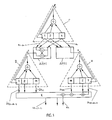
- ⁇ , ⁇ and ⁇ 1 three partial generators, shown schematically as dashed triangles, are designated, which binary sequences K , ⁇ and ⁇ with a period of K, M and M.
- K 2 k-1
- M 2 m-1
- M 2 m -1
- the length k, m and m can be implemented.
- part or all of the bits of the shift register, added to one another, for example, modulo-2, are fed back to its input.
- the subgenerators ⁇ , ⁇ and ⁇ must be clocked and each have clock inputs c.
- the partial generator r receives its clock from an external clock generator (not shown in FIG. 1).
- the clocks of the two other subgenerators ⁇ and ⁇ are derived from outputs of the partial generator r via function transmitters ⁇ f (t) and ⁇ f (t).
- the sequence K should be able to be tapped at each of these outputs, specifically at a different time position (phase) at each output. With a length K of the period of the sequence K , K such different temporal positions Kt ... K t- (K-1) are possible in principle.
- the sequences ⁇ and ⁇ can of the partial generators ⁇ and ⁇ are generated in different temporal positions.
- the M or m different temporal positions can in turn be realized by suitable linear combinations of only m or m successive outputs of the shift register. Therefore, only m or M of such outputs are shown in FIG. 1.
- the at the outputs of the subgenerators ⁇ and ⁇ Available sequences are, not necessarily all, linked via at least one linking unit X to the cipher sequence w t , which may also be available in different temporal positions w t , ..., ⁇ t- (T-1) .
- the elements described are the three subgenerators ⁇ , ⁇ and ⁇ , the two function transmitters ⁇ f (t) and ⁇ f (t) and the combination unit X in their combination form a generator according to the invention.
- the function generator ⁇ f (t) can, for example, forward the sequence K alone in the time position t to the clock input c of the subgenerator ⁇ , while by the function generator ⁇ f (t) for example, the complement of the sequence K in the time position t and modulo-2 added to the product of the sequence K in all time positions, that is modulo-2 to K t- (k-1) ... K t-1 K t adds to the clock input c of the sub-generator ⁇ can be led.
- the linking unit X allows certain temporal positions of the subgenerators ⁇ and ⁇ generated sequences ⁇ and ⁇ be modulo-2 added, which for the ⁇ f (t) , ... ⁇ f (t) - (m-1 ) in FIG. 1 is also shown, for example, within the rectangle forming the linking unit X.
- the generator according to the invention has the properties explained below with regard to the sizes and conditions defined at 1) to 5):
- the subgenerators ⁇ , ⁇ and ⁇ 1 need not necessarily be implemented by linear feedback shift registers. Any other implementations are also possible.
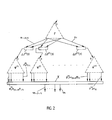
- a generator of the type described can also be used as a partial generator in the sense of cascading.
- K, ⁇ (1) , ..., ⁇ (n) are sequences of the periods K, M (1) , ..., M (n) which are generated by n + 1 arbitrary subgenerators r, ⁇ (1), ⁇ (n) are generated and if ⁇ f (1) , ..., ⁇ f (n) are arbitrary K-periodic functions of K and t, the sequence generated by the composite generator is complete given, where f (i) (t) by was defined.
Landscapes
- Engineering & Computer Science (AREA)
- Computer Security & Cryptography (AREA)
- Computer Networks & Wireless Communication (AREA)
- Signal Processing (AREA)
- Storage Device Security (AREA)
- Complex Calculations (AREA)
- Mobile Radio Communication Systems (AREA)
Claims (8)
Applications Claiming Priority (2)
| Application Number | Priority Date | Filing Date | Title |
|---|---|---|---|
| CH4482/85A CH668340A5 (de) | 1985-10-17 | 1985-10-17 | Generator zur erzeugung binaerer chiffriersequenzen. |
| CH4482/85 | 1985-10-17 |
Publications (2)
| Publication Number | Publication Date |
|---|---|
| EP0220437A1 EP0220437A1 (fr) | 1987-05-06 |
| EP0220437B1 true EP0220437B1 (fr) | 1990-06-06 |
Family
ID=4276924
Family Applications (1)
| Application Number | Title | Priority Date | Filing Date |
|---|---|---|---|
| EP86112345A Expired - Lifetime EP0220437B1 (fr) | 1985-10-17 | 1986-09-06 | Générateur produisant des séquences de chiffrage binaires |
Country Status (4)
| Country | Link |
|---|---|
| US (1) | US4817145A (fr) |
| EP (1) | EP0220437B1 (fr) |
| CH (1) | CH668340A5 (fr) |
| DE (1) | DE3671817D1 (fr) |
Families Citing this family (8)
| Publication number | Priority date | Publication date | Assignee | Title |
|---|---|---|---|---|
| US5363448A (en) * | 1993-06-30 | 1994-11-08 | United Technologies Automotive, Inc. | Pseudorandom number generation and cryptographic authentication |
| US5608801A (en) * | 1995-11-16 | 1997-03-04 | Bell Communications Research, Inc. | Efficient cryptographic hash functions and methods for amplifying the security of hash functions and pseudo-random functions |
| US6009135A (en) * | 1997-10-10 | 1999-12-28 | Interdigtal Technology Corporation | Method and apparatus for generating a stream cipher |
| DE19757370C2 (de) * | 1997-12-22 | 2000-03-23 | Siemens Ag | Verfahren zur taktilen Erzeugung pseudo-zufälliger Datenworte |
| EP1111785A1 (fr) * | 1999-12-22 | 2001-06-27 | TELEFONAKTIEBOLAGET L M ERICSSON (publ) | Procédé et dispositif pour générer des séquences de bruit pseudo-aléatoires commandé par une horloge autogénérée |
| US6522210B1 (en) | 2000-02-16 | 2003-02-18 | Honeywell International Inc. | Random pulse generator |
| GB0123302D0 (en) * | 2001-09-28 | 2001-11-21 | Hw Comm Ltd | Cipher apparatus |
| US8121292B2 (en) * | 2002-02-26 | 2012-02-21 | Qualcomm Incorporated | Method and apparatus for scrambling information bits on a channel in a communications system |
Family Cites Families (10)
| Publication number | Priority date | Publication date | Assignee | Title |
|---|---|---|---|---|
| DE977715C (de) * | 1962-05-18 | 1968-08-29 | Philips Usfa Nv | Verschluesselungseinrichtung |
| US3548174A (en) * | 1966-08-10 | 1970-12-15 | Burroughs Corp | Random number generator |
| US3728529A (en) * | 1969-10-08 | 1973-04-17 | Sperry Rand Corp | Two-way communication system employing two-clock frequency pseudo-noise signal modulation |
| US3986168A (en) * | 1975-06-02 | 1976-10-12 | Ncr Corporation | Multichannel error signal generator |
| US4115657A (en) * | 1976-11-11 | 1978-09-19 | Datotek, Inc. | Random digital code generator |
| US4202051A (en) * | 1977-10-03 | 1980-05-06 | Wisconsin Alumni Research Foundation | Digital data enciphering and deciphering circuit and method |
| US4161041A (en) * | 1978-10-06 | 1979-07-10 | The United States Of America As Represented By The Secretary Of The Air Force | Pseudo random number generator apparatus |
| US4375620A (en) * | 1980-12-15 | 1983-03-01 | The United States Of America As Represented By The Secretary Of The Navy | Pseudo-atmospheric noise generator with control of temporal characteristics |
| JPS57194621A (en) * | 1981-05-26 | 1982-11-30 | Nec Corp | Random number generator |
| GB2178535B (en) * | 1985-07-27 | 1988-11-09 | Rolls Royce | Digital noise generator |
-
1985
- 1985-10-17 CH CH4482/85A patent/CH668340A5/de not_active IP Right Cessation
-
1986
- 1986-09-06 EP EP86112345A patent/EP0220437B1/fr not_active Expired - Lifetime
- 1986-09-06 DE DE8686112345T patent/DE3671817D1/de not_active Expired - Lifetime
- 1986-10-15 US US06/918,884 patent/US4817145A/en not_active Expired - Fee Related
Also Published As
| Publication number | Publication date |
|---|---|
| EP0220437A1 (fr) | 1987-05-06 |
| DE3671817D1 (de) | 1990-07-12 |
| US4817145A (en) | 1989-03-28 |
| CH668340A5 (de) | 1988-12-15 |
Similar Documents
| Publication | Publication Date | Title |
|---|---|---|
| DE69118977T2 (de) | Verschlüsselungssystem auf Grundlage der Chaostheorie | |
| DE3884048T2 (de) | Nichtlinearer Zufallsfolgegenerator. | |
| DE19744961B4 (de) | Erzeugen eindeutiger und unvorhersagbarer Werte | |
| DE1537062C3 (de) | Schlüsselgenerator | |
| DE69929251T2 (de) | Verschlüsselungssystem mit einem schlüssel veränderlicher länge | |
| DE19827904C2 (de) | Blockchiffrier- oder -dechiffrierverfahren und Blockchiffrier- oder -dechiffriervorrichtung | |
| DE69031736T2 (de) | Verschlüsselungsmethode | |
| DE68914322T2 (de) | Dynamische Rückkopplungsvorrichtung für einen Verschleierungsschlüsselgenerator. | |
| EP0012974B1 (fr) | Procédé de chiffrage de blocs de données ayant une longueur prédéterminée | |
| DE3689377T2 (de) | Zufallsfolgengeneratoren. | |
| EP0482154A1 (fr) | Dispositif de conversion de blocs numeriques et son utilisation. | |
| DE112011106024B4 (de) | Erzeugungsvorrichtung für vorrichtungsspezifische Informationen und Erzeugungsverfahren für vorrichtungsspezifische Informationen | |
| DE10347455B4 (de) | Pseudozufallszahlengenerator für einen Stream Cipher | |
| DE1512617B1 (de) | Schaltungsanordnung zur Erzeugung eines Impulscodes aus einem eintreffenden Impulszug | |
| EP0220437B1 (fr) | Générateur produisant des séquences de chiffrage binaires | |
| DE2245360A1 (de) | Pseudo-zufallszahlengenerator fuer datenverarbeitung | |
| DE69503308T2 (de) | Codesequenzgenerator | |
| EP0189734A1 (fr) | Procédé et dispositif pour convertir une séquence de données numériques dans une forme chiffrée | |
| EP0002478B1 (fr) | Appareil cryptographique | |
| DE60004409T2 (de) | Schaltung und Verfahren zur Zufallszahlerzeugung | |
| DE19757370C2 (de) | Verfahren zur taktilen Erzeugung pseudo-zufälliger Datenworte | |
| EP1159782A1 (fr) | Generateur de signaux aleatoires et procede pour produire des signaux aleatoires | |
| WO2001013218A1 (fr) | Procede destine a generer des nombres pseudo-aleatoires et procede de signature electronique | |
| EP0146865B1 (fr) | Procédé pour la génération de suites de signaux binaires pseudo-aléatoires | |
| DE1188123B (de) | Elektronischer Verschluessler mit einer Anordnung, welche jeden zu verschluesselnden Klartextbuchstaben in Form einer Gruppe von binaeren Signalen liefert |
Legal Events
| Date | Code | Title | Description |
|---|---|---|---|
| PUAI | Public reference made under article 153(3) epc to a published international application that has entered the european phase |
Free format text: ORIGINAL CODE: 0009012 |
|
| AK | Designated contracting states |
Kind code of ref document: A1 Designated state(s): CH DE GB LI SE |
|
| RAP1 | Party data changed (applicant data changed or rights of an application transferred) |
Owner name: BBC BROWN BOVERI AG |
|
| 17P | Request for examination filed |
Effective date: 19870917 |
|
| 17Q | First examination report despatched |
Effective date: 19890406 |
|
| GRAA | (expected) grant |
Free format text: ORIGINAL CODE: 0009210 |
|
| AK | Designated contracting states |
Kind code of ref document: B1 Designated state(s): CH DE GB LI SE |
|
| REF | Corresponds to: |
Ref document number: 3671817 Country of ref document: DE Date of ref document: 19900712 |
|
| GBT | Gb: translation of ep patent filed (gb section 77(6)(a)/1977) | ||
| PLBE | No opposition filed within time limit |
Free format text: ORIGINAL CODE: 0009261 |
|
| STAA | Information on the status of an ep patent application or granted ep patent |
Free format text: STATUS: NO OPPOSITION FILED WITHIN TIME LIMIT |
|
| 26N | No opposition filed | ||
| EAL | Se: european patent in force in sweden |
Ref document number: 86112345.3 |
|
| PGFP | Annual fee paid to national office [announced via postgrant information from national office to epo] |
Ref country code: CH Payment date: 19990813 Year of fee payment: 14 |
|
| PGFP | Annual fee paid to national office [announced via postgrant information from national office to epo] |
Ref country code: SE Payment date: 19990816 Year of fee payment: 14 |
|
| PGFP | Annual fee paid to national office [announced via postgrant information from national office to epo] |
Ref country code: GB Payment date: 19990818 Year of fee payment: 14 |
|
| PGFP | Annual fee paid to national office [announced via postgrant information from national office to epo] |
Ref country code: DE Payment date: 19990825 Year of fee payment: 14 |
|
| PG25 | Lapsed in a contracting state [announced via postgrant information from national office to epo] |
Ref country code: GB Free format text: LAPSE BECAUSE OF NON-PAYMENT OF DUE FEES Effective date: 20000906 |
|
| PG25 | Lapsed in a contracting state [announced via postgrant information from national office to epo] |
Ref country code: SE Free format text: THE PATENT HAS BEEN ANNULLED BY A DECISION OF A NATIONAL AUTHORITY Effective date: 20000929 |
|
| PG25 | Lapsed in a contracting state [announced via postgrant information from national office to epo] |
Ref country code: LI Free format text: LAPSE BECAUSE OF NON-PAYMENT OF DUE FEES Effective date: 20000930 Ref country code: CH Free format text: LAPSE BECAUSE OF NON-PAYMENT OF DUE FEES Effective date: 20000930 |
|
| GBPC | Gb: european patent ceased through non-payment of renewal fee |
Effective date: 20000906 |
|
| REG | Reference to a national code |
Ref country code: CH Ref legal event code: PL |
|
| EUG | Se: european patent has lapsed |
Ref document number: 86112345.3 |
|
| PG25 | Lapsed in a contracting state [announced via postgrant information from national office to epo] |
Ref country code: DE Free format text: LAPSE BECAUSE OF NON-PAYMENT OF DUE FEES Effective date: 20010601 |