EP0220563B1 - Adaptive noise suppressor - Google Patents
Adaptive noise suppressor Download PDFInfo
- Publication number
- EP0220563B1 EP0220563B1 EP86113983A EP86113983A EP0220563B1 EP 0220563 B1 EP0220563 B1 EP 0220563B1 EP 86113983 A EP86113983 A EP 86113983A EP 86113983 A EP86113983 A EP 86113983A EP 0220563 B1 EP0220563 B1 EP 0220563B1
- Authority
- EP
- European Patent Office
- Prior art keywords
- noise
- signal
- transforming
- signals
- frequency
- Prior art date
- Legal status (The legal status is an assumption and is not a legal conclusion. Google has not performed a legal analysis and makes no representation as to the accuracy of the status listed.)
- Expired
Links
Images

Classifications
-
- G—PHYSICS
- G10—MUSICAL INSTRUMENTS; ACOUSTICS
- G10L—SPEECH ANALYSIS TECHNIQUES OR SPEECH SYNTHESIS; SPEECH RECOGNITION; SPEECH OR VOICE PROCESSING TECHNIQUES; SPEECH OR AUDIO CODING OR DECODING
- G10L21/00—Speech or voice signal processing techniques to produce another audible or non-audible signal, e.g. visual or tactile, in order to modify its quality or its intelligibility
- G10L21/02—Speech enhancement, e.g. noise reduction or echo cancellation
- G10L21/0208—Noise filtering
-
- H—ELECTRICITY
- H03—ELECTRONIC CIRCUITRY
- H03H—IMPEDANCE NETWORKS, e.g. RESONANT CIRCUITS; RESONATORS
- H03H21/00—Adaptive networks
- H03H21/0012—Digital adaptive filters
- H03H21/0025—Particular filtering methods
- H03H21/0027—Particular filtering methods filtering in the frequency domain
-
- H—ELECTRICITY
- H04—ELECTRIC COMMUNICATION TECHNIQUE
- H04R—LOUDSPEAKERS, MICROPHONES, GRAMOPHONE PICK-UPS OR LIKE ACOUSTIC ELECTROMECHANICAL TRANSDUCERS; ELECTRIC HEARING AIDS; PUBLIC ADDRESS SYSTEMS
- H04R25/00—Electric hearing aids
- H04R25/45—Prevention of acoustic reaction, i.e. acoustic oscillatory feedback
- H04R25/453—Prevention of acoustic reaction, i.e. acoustic oscillatory feedback electronically
-
- H—ELECTRICITY
- H04—ELECTRIC COMMUNICATION TECHNIQUE
- H04R—LOUDSPEAKERS, MICROPHONES, GRAMOPHONE PICK-UPS OR LIKE ACOUSTIC ELECTROMECHANICAL TRANSDUCERS; ELECTRIC HEARING AIDS; PUBLIC ADDRESS SYSTEMS
- H04R2225/00—Details of deaf aids covered by H04R25/00, not provided for in any of its subgroups
- H04R2225/43—Signal processing in hearing aids to enhance the speech intelligibility
-
- H—ELECTRICITY
- H04—ELECTRIC COMMUNICATION TECHNIQUE
- H04R—LOUDSPEAKERS, MICROPHONES, GRAMOPHONE PICK-UPS OR LIKE ACOUSTIC ELECTROMECHANICAL TRANSDUCERS; ELECTRIC HEARING AIDS; PUBLIC ADDRESS SYSTEMS
- H04R3/00—Circuits for transducers
- H04R3/02—Circuits for transducers for preventing acoustic reaction, i.e. acoustic oscillatory feedback
Definitions
- the invention is in the field of adaptive noise suppression. More particularly, the invention is directed to a microprocessing controlled digital noise suppression device employing adaptive digital filtering techniques.
- Noise suppression devices have significant applications in the enhancement of narrowband spectral lines in a broadband noise field when there is a poor signal-to-noise ratio at the input where there is insufficient a priori information on which to design appropriate filters.
- the device automatically filters out the components of the signal which are uncorrelated in time and passes the correlated portions. Since the properties of the device are determined solely by the input signal statistics, the properties of the filter automatically adjust to variations in the input signal statistics to obtain the least means square (LMS) approximation to a Wiener-Hopf filter. The device will thus track slowly varying spectral lines in broadband noise.
- LMS least means square
- noise suppression devices may be found, for example, in hearing aids for the hearing impaired.
- Present day digital filtering techniques are not effective for providing truly high fidelity frequency compensation in hearing aids and often suffer from muffled sound outputs, and intolerable noise and ringing problems.
- a further problem in the conventional design of hearing aids is the inadequate treatment of background noise. Since the vowels have the greatest energy content they are typically louder than the consonants, and a related problem with conventional hearing aid design is that the user will normally reduce the volume control to moderate the higher intensity vowel energy but, at the same time sacrifice intelligence by simultaneously reducing the intensity of the lower energy consonants. Further, hearing aids which employ automatic gain control (decreasing gain as input levels increases) have the disadvantage of decreasing the gain as a function not only of the lower frequency stronger vowel sounds contained in speech but also by the large energy, low frequency background noises. The fact that the background noise as well as vowels can have the same effect on the gain control introduces an abnormal relationship between speech sounds.
- Consonants are not amplified sufficiently in the present of background noises resulting in greatly reduced speech intelligence.
- Conventional systems may be compared with a public address system in which all sounds are amplified. To persons with normal hearing one may generally say that the louder the sound the more easily it is heard. However, in the presence of background noises, the adverse amplification of these background noises greatly mask speech intelligence.
- a particular troublesome area for the hearing impaired occurs during normal conversation in a background environment of a conference or large office. Persons with normal hearing are able to selectively listen to conversations from just one other person.
- the hearing impaired person has no such ability and experiences a phenomenon known as "speech babble" in which all sounds are woven into an undecipherable fabric of noise and distortion.
- speech babble a phenomenon known as "speech babble" in which all sounds are woven into an undecipherable fabric of noise and distortion.
- Yet another object of the invention is to provide a microprocessor controlled noise and feedback suppression device employing digital filtering techniques.
- a noise suppression device according to the present invention is as defined in claim 1 and a method for noise suppression is as defined in claim 8, respectively.
- Adaptive filters are filters that adjust themselves automatically based on a given performance criteria. The most common such filter is the LMS adaptive filter.
- Figure 1 is a block diagram of a prior art adaptive canceller 50 which has an adaptive filter 52 which adjusts itself so as to minimize the means square error between the desired input and the filter output.
- This filter was first proposed by Widrow et al reference (9). By analyzing the expectation of signals at various points in the structure, it can be easily shown that components of the desired input that are correlated with components of the reference input will be cancelled from the error output leaving only uncorrelated components.
- This structure is commonly employed in the filtering of narrow band speech corrupted by noise.
- Figure 1 illustrates a two microphone configuration wherein speech and noise signals are presented to the desired input 54, while a sample of the noise alone is presented to the reference input 56. Ideally the two noise inputs are correlated with each other while the speech and noise are uncorrelated. Thus, the noise component is removed from the signal in adder 58, leaving speech in error output 60. Any speech signal present at the reference input 56 limits the maximum possible signal to noise gain to the inverse of the speech to noise ratio at the reference input.
- a one microphone configuration is employed as shown by the adaptive enhancer 70 of Figure 2.
- an adaptive filter 72 is fed a combined speech and noise signal applied from the input 74 through a delay 76.
- the delayed speech and noise signals thus serve as a reference input to the adaptive filter 72 and are fed thereto along line 78.
- the delay 76 is chosen such that the noise components of the desired and reference inputs are uncorrelated with each other while the signal components remain correlated.
- the correlated components in this case the speech, are cancelled in adder 80 leaving noise in the error output 82, and speech in the filter output 84.
- the structure of the adaptive filters 52 and 72 may comprise a standard tapped delay line filter where the error output is multiplied by a gains ⁇ and used to modify the filter weights W O , W1...W N .
- Such a filter structure for adaptive filter 72 (Fig. 2) is shown in Figure 3 and is per se well known as shown, for example in references (10) and (11).
- the relationship between the mean square error and the weight values is quadratic.
- a plot of the mean square error against a single weight yields a parabola.
- Plotting the mean square error against N weights in N dimensions yields a concave hyperparaboloidal surface.
- the weight update consists of computing an estimate of the gradient; scaling it by a scaler adaptive learning constant, ⁇ ; and subtracting this from the previous weight value.
- Time-domain and frequency-domain adaptive filtering techniques have been utilized with varying degrees of success to filter background noise from speech. e.g., see references 1-12.
- Prior filtering algorithms have, however, failed to provide the desired results producing speech that sounds muffled or has a large reverberation component.
- These undesirable effects result from the non-periodic nature of the input signal and the utilization of the discrete FFT to perform the digital filtering.
- the FFT is derived from the Fourier series expansion of the signal which assumes that the input function is periodic. With this assumption, the input signal is sampled to obtain a discrete Fourier transform, the transform coefficients are then processed and the inverse discrete Fourier transform is taken on the manipulated coefficients.
- Dentino discusses adaptive filtering in the frequency-domain but fails to adequately take into effect the circular convolution introduced by the FFT.
- These circular or wrap-around effects may be seen, for example, in the time-domain by considering a circular convolution of an input signal which is L samples long and utilizing a filter which is M samples long. The output of the filter is the convolution sum of L + M samples. If one does a circular convolution without adding zeros prior to taking the convolution one will obtain circular or wrap-around effects which introduce harmonics of the noise which is sought to be cancelled.
- the wrap-around effects are not limited solely to harmonics but may introduce sub-harmonics of the wrap-around frequency resulting from alising.
- Ferrara (reference 2) employed the FFT to obtain high speed convolution with the overlap and save technique for a block updated version of the time-domain LMS algorithm.
- This fast LMS algorithm required five FFT's but provided a computational savings over the time-domain implementation for moderate to very large filter lengths.
- the time-domain technique of Ferrara suffers from a common deficiency of all time-domain approaches in that they are too slow.
- Such techniques typically attempt to minimize mean-square error by taking the frequency component that has the most error and work to minimize that error first, then take the next highest error, minimizing it and so forth. When such techniques are applied to speech, the lower frequency components which have the most energy are first minimized, then the intermediate frequency components, having the intermediate energy, and finally the higher frequency components which have the least energy.
- time-domain filters have a response time on the order of 200-300 ms which is quite long as compared to the dynamics of speech which is in the range of 20-40 ms.
- time-domain filtering the background noises which appear in the higher frequency components are not effectively filtered, a result which subjectively "muffles" the speech.
- ⁇ determines how fast the filter learns, the larger ⁇ corresponding to the shorter learning time.
- ⁇ determines how fast the filter learns, the larger ⁇ corresponding to the shorter learning time.
- ⁇ is selected to be inversely proportional to the power in each frequency bin.
- Utilizing a vector ⁇ selected specifically for each bin has the advantage of enabling separate and simultaneous mean square fits for each frequency bin wherein the computations may be performed in a parallel mode.
- Transforms may be obtained using the matrix FFT L as.
- the weight update equation using the method of steepest descents becomes where the symbol * denotes conjugation, ⁇ specifies the rate of leakage, and the quantity ⁇ is The fact that the weights have been obtained by circular convolution is denoted by .
- the frequency-domain weight vector is obtained as where is the L m xl m identity matrix.
- the truncation of the weight vector in equation (12) insures that the last half of a time-domain representation of the weights is identically zero.
- Clark et al have already noted the similarity between the Dentino and UFLMS algorithms and the unified block LMS algorithm.
- the derivation showing the equivalence of the Dentino (or frequency-domain adaptive filter, FDAF) and the block LMS is incorrect in that the error used in equation (39) for the FDAF is not the same as the error used in equation (32) for the time-domain block adaptive filter in that paper.
- circular convolution results are introduced into the gradient estimate.
- the UFLMS (reference 3) and the general algorithm may be related by insuring that the input signal meets certain requirements. Specifically, by applying the constraint that the system to be modelled is an FIR filter of order less than or equal to the order of the adaptive filter, the projection operation in equation (12) may be eliminated and the two algorithms become equivalent.
- the transform domain algorithm proposed by Narayan blocks the data so that only one output point is obtained with each filter operation.
- the inverse transform is then imbedded in the filter coefficients and circular convolution effects are avoided; however, an increased computational burden is imposed.
- a similar result may be obtained by the present frequency-domain algorithm if one eliminates the zero-padding in equations (9) and (12) and only a single output point is extracted from each block computation and each block of length 2L m overlaps the previous block by all but one sample.
- Equation (1)-(14) allows an ALE to be implemented which incorporates a vector ⁇ and preserves the constraint intended by the delay in the reference channel. Additionally, the value of ⁇ may be allowed to vary in the case of non-stationary inputs. Such a feature becomes important in speech modelling, for example, where the speech spectrum is not white and inputs are non-stationary.
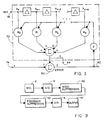
- FIG. 5 is a block diagram for an adaptive noise suppresser showing data flow in accordance with equations (1)-(14).
- the adaptive noise suppresser may be utilized for example as an adaptive line enhancer (ALE).
- ALE adaptive line enhancer
- FIG. 5 includes input 74, error output 82, filter output 84 and adder 80.
- the adaptive noise suppresser of Figure 5 is also seen to comprise a delay 102, FFT 104 and 105, IFFT 108, window 110 vector ⁇ calculating device 112, summer 114, vector multipliers 116, 118 and 120 and a projection operator 122.
- Window 110 serves to zero the first L terms of the error output as per equation (9).
- the vector ⁇ calculating device 112 determines the value of the vector ⁇ (k) in accordance with equation (14) utilizing stored values for ⁇ min and ⁇ .
- Vector multipliers 116, 118 and 120 perform the element by element, outer product vector multiplication.
- Multiplier 120 forms the weighted means for multiplying the frequency coefficients of FFT 104 by the vector weights to permit adaptive filtering using a mean square algorithm.
- the projection operator 122 serves to remove the effects of circular convolution to provide an output which corresponds to a linear convolution.
- the projection operator is defined by equation (12) and is seen to comprise IFFT 124, window 126 and FFT 128. Window 126 operates to zero the last L terms of data and is effective for removing circular convolution effects.
- the loop identified by Z ⁇ 1 in Figure 5 represents the feedback of the previous weight as called for in equation (10).
- the noise suppressed signal is taken at filter output 84.
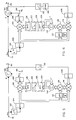
- FIG. 6 An alternate embodiment of the invention is illustrated in Figure 6 which is identical to Figure 5 with the exception of a stack 130 positioned after window 110.
- the stack is a memory store which serves to store the windowed data and to combine it with a second group of windowed stored data so that a full block of data may be fed to the FFT 106.
- the groups In combining the two groups of data, the groups are simply placed adjacent one another to produce a full block of data without the added zeros.
- equation (9) is replaced by: Stacking has been found to introduce negligible effects due to alisning. Data stacking is not necessary but will allow a more efficient operation in performing the FFT 106, thus reducing power consumption.
- Figure 7 Yet another embodiment of the invention is illustrated in Figure 7. This embodiment is similar to Figure 6 but the delayed weight sample is now taken after the projection operator 122.
- equation (10) is replaced by:
- the stack 130 is optional and may be removed to achieve a similar embodiment as in Figure 5 using equation (9).
- the delay and adaptive filters for speech processing be chosen to be equal to a pitch period which is approximately 8 ms, e.g., reference 12.
- a pitch period which is approximately 8 ms, e.g., reference 12.
- the delay of a pitch period while suitable for vowels is not suitable for fricatives or plosive sounds. Such sounds are destroyed by the large delay making it difficult to distinguish, for example, "tired” from "dired.”
- the s, sh, d, t may be largely confused and non-distinguishable.
- speech intelligibility is greatly improved by selecting the delay to be on the order of 1-3 ms and most preferably to be about 1 ms. Such selection will preserve speech intelligibility for all sounds, especially for plosive and fricative sounds.
- Another important aspect of the invention is to utilize a leak factor ⁇ as per equation (10) so as to make the filter forgetting time the same as the filter learning time. It has been noted that absent a leak factor, noise reverberation builds up at the output of the filter especially at the end of a word. This reverberation has much the same effect as a jet aircraft passing overhead, i.e., it produces a shshsh sound at the end of every word. The reverberation takes place because at the end of a word there is zero or very little energy entering a particular frequency bin. If there is no forgetting time, the filter weights are maintained and subsequent residual noise coming through the filter is amplified with the existing weights resulting in the reverberation.
- a "leak" constant ⁇ representation of the weight forgetting time is utilized as a multiplier of the weights in computing the updated weights.
- a minimum ⁇ is selected such that the updated ⁇ will be equal to the minimum ⁇ plus a calculated value of ⁇ .
- This minimum ⁇ is important to prevent an over compensation of the filter weights which would result with a zero or very little energy content within a particular frequency bin. For example, since ⁇ is selected to be inversely proportional to the power within a particular frequency bin and a zero power within a particular bin will result in an infinite choice ford ⁇ . On the next sample, however, a relatively small amplitude signal will be multiplied by the infinite (very large) ⁇ resulting in over compensation and undesirable noise.
- the frequency spectrum in these bins tends to become very noisy.
- Introduction of a minimum ⁇ however eliminates this noise background and eliminates the over compensation.
- the minimum value of ⁇ may be selected to be different for each frequency bin and may be chosen to be inversely proportional to the power spectrum of speech.
- a feedback suppression device is illustrated by the block diagram of Figure 8. It is noted that Figure 8 is similar to Figure 5 and the corresponding elements have been identified corresponding primed numbers. The formula in equations (1)-(14) also apply; however, for the frequency suppression device the output is taken from the error output 82' rather than the filter output 84'. Furthermore, delay 102' now replaces delay 102. Delay 102' is selected to filter out feedback squeal and is selected to be relatively large, as for example, on the order of 100 ms. With these modifications, the details of the filter algorithm utilized to implement Figure 8 are the same as those shown in Figure 5 with regard to noise suppression.
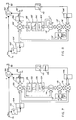
- the embodiment of the invention shown in Figure 9 incorporates a noise suppression device 40 and a feedback suppression device 42 into a hearing aid having a microphone 200, A/D converter 400, D/A converter 600 and output device 800.
- the hearing aid device may typically be designed utilizing a mircoprocessor or range scale integrated circuits such that the entire device may be small enough to be fitted into the ear as in present day hearing aids.
- the output device 800 may be a speaker or earphone for transmitting the final analog output of the hearing aid to the eardrum of the hearing aid user.
- the adaptive speech enhancer 100 of Figure 5 and the feedback suppression device of Figure 8 may be utilized to form the respective noise suppression device 40 and feedback suppression device 42 of Figure 10.
- noise suppression device 40 as well as feedback suppression device 42 may be implemented in the form of a program algorithm, either software or firmware stored in the memory of a microprocessor.
- the microprocessor may be a conventional single chip microprocessor or a specially designed LSI or VLSI circuit operable to perform the noise and feedback suppression as set forth herein.
- Reference to individual "devices" in reference to the functions of the noise and feedback elements is simply a term to facilitate the explanation of the individual components and does not necessarily imply that these components must appear on separate and distinct integrated circuits.
- the noise suppression device 40 and feedback suppression device 42 are arranged in series as shown in Figure 9, it is only necessary to take the output 84 of Figure 5 (the noise suppressed output) and feed it as an input signal into the input 74' of Figure 8.
- the error output 82' will then represent not only the noise suppressed output but also the feedback suppressed output as desired.
- the order of noise and feedback suppression may be reversed such that frequency suppression is performed first. In the latter case, the output 82' of Figure 8 is fed as to input 74 of Figure 5 with the output taken at output 84.
- Time-domain feedback suppression may utilize the techniques exemplified in reference 11 with the delay 102' selected as indicated above and with the output taken from the error output 82'.
- the adaptive filter would essentially be represented by the embodiment of Figure 3 utilizing tapped delay lines.
- the delay 102' in Figure 8 is important to select the delay 102' in Figure 8 to be at least greater than one phonem.
- the length is selected to be 50-150 ms so that the delay 102' should be on the order of 50 ms or greater.
- the delay should be in the range of 50-500 ms with the more preferred range of 75-125 ms.
- Most preferably the delay should be selected at approximately 100 ms.
- Typical speech phonems are stationary on the order of about 20-40 ms so that the selection of 100 ms typically ensures that the phonem (or word) in the delayed and undelayed channels are completely uncorrelated by the time they are summed in adder 80'. Feedback squeal on the other hand will still be present in both the delayed and undelayed channels so that they will be correlated and summed to zero in the adder 80' providing a feedback free signal at output 82'.
- Another important aspect of the instant invention pertaining to feedback suppression is to select the number of weights in the adaptive filter to be relatively small, namely between 16 and 32 weights and most preferably at approximately 22 weights. Such a relatively small number of weights is desirable because of the nature of the feedback tone which may center around a band of frequencies. For example, assuming that the initial frequency squeal occurs at f0, the adaptive filter basically serves as a notch filter at frequency f0 to eliminate the squeal. If the frequency contains a lot of weights and has a great deal of resolution it will specifically remove the frequency f0.
- the filter is so finely tuned that a small change in the frequency feedback typically puts the squeal outside of the filter notch and the squeal begins to appear even though at a slightly different frequency.
- a high resolution filter will then have to relearn and readjust the notch to the new feedback frequency.
- This relearning takes time, and the higher the filter resolution the longer time it takes. It is thus desirable, in accordance with the invention, to produce a broad notch filter with a relatively small number of weights. Such a design will not distinguish between small changes in the feedback frequency and will thus eliminate a broader range of feedback signals without having to readjust the filter weights for each change in environment.
- the utilization of a vector ⁇ in Figure 8 is quite important in controlling the fidelity of the frequency spectrum just as in the case of the noise suppression device of Figure 5.
- the utilization of a vector ⁇ in accordance with equations 1-14 above does not represent a LMS algorithm but is rather a mean-square algorithm in the frequency-domain. Effectively, the algorithm minimizes mean-square error concurrently within each frequency bin. The result is not necessarily the same as a minimization of the total mean-square error.
- the utilization of the vector ⁇ enables the filter to response very quickly to the feedback squeal before it in fact develops into a large enough amplitude to be notices.
- the feedback suppression device of Figure 8 may be modified in a similar manner as set forth above in connection with the noise suppression device of Figures 6 and 7.
- the invention has many applications and is not limited to a hearing aid device as described in relation to Figure 9.
- the noise suppression network set forth in Figures 4 and 8 may, for example, be utilized in all types of telecommunications systems in which it is desired to eliminate background or channel noise.
- the feedback suppression network may be utilized in loud speaker systems and all sorts of audio amplification networks.
Landscapes
- Engineering & Computer Science (AREA)
- Acoustics & Sound (AREA)
- Physics & Mathematics (AREA)
- Signal Processing (AREA)
- Health & Medical Sciences (AREA)
- General Health & Medical Sciences (AREA)
- Human Computer Interaction (AREA)
- Audiology, Speech & Language Pathology (AREA)
- Computational Linguistics (AREA)
- Quality & Reliability (AREA)
- Neurosurgery (AREA)
- Multimedia (AREA)
- Otolaryngology (AREA)
- Filters That Use Time-Delay Elements (AREA)
- Soundproofing, Sound Blocking, And Sound Damping (AREA)
- Inorganic Insulating Materials (AREA)
- Noise Elimination (AREA)
- Cable Transmission Systems, Equalization Of Radio And Reduction Of Echo (AREA)
Applications Claiming Priority (2)
| Application Number | Priority Date | Filing Date | Title |
|---|---|---|---|
| US785999 | 1985-10-10 | ||
| US06/785,999 US4658426A (en) | 1985-10-10 | 1985-10-10 | Adaptive noise suppressor |
Publications (2)
| Publication Number | Publication Date |
|---|---|
| EP0220563A1 EP0220563A1 (en) | 1987-05-06 |
| EP0220563B1 true EP0220563B1 (en) | 1992-05-27 |
Family
ID=25137296
Family Applications (1)
| Application Number | Title | Priority Date | Filing Date |
|---|---|---|---|
| EP86113983A Expired EP0220563B1 (en) | 1985-10-10 | 1986-10-09 | Adaptive noise suppressor |
Country Status (7)
| Country | Link |
|---|---|
| US (1) | US4658426A (da) |
| EP (1) | EP0220563B1 (da) |
| JP (1) | JPS62155606A (da) |
| AU (1) | AU582018B2 (da) |
| CA (1) | CA1250348A (da) |
| DE (1) | DE3685474D1 (da) |
| DK (1) | DK485986A (da) |
Families Citing this family (144)
| Publication number | Priority date | Publication date | Assignee | Title |
|---|---|---|---|---|
| JPS62135020A (ja) * | 1985-12-06 | 1987-06-18 | Nec Corp | 雑音消去装置 |
| US5029217A (en) * | 1986-01-21 | 1991-07-02 | Harold Antin | Digital hearing enhancement apparatus |
| US4939685A (en) * | 1986-06-05 | 1990-07-03 | Hughes Aircraft Company | Normalized frequency domain LMS adaptive filter |
| US4926488A (en) * | 1987-07-09 | 1990-05-15 | International Business Machines Corporation | Normalization of speech by adaptive labelling |
| US5157596A (en) * | 1987-07-17 | 1992-10-20 | Hughes Aircraft Company | Adaptive noise cancellation in a closed loop control system |
| GB8801014D0 (en) * | 1988-01-18 | 1988-02-17 | British Telecomm | Noise reduction |
| US5225836A (en) * | 1988-03-23 | 1993-07-06 | Central Institute For The Deaf | Electronic filters, repeated signal charge conversion apparatus, hearing aids and methods |
| US5016280A (en) * | 1988-03-23 | 1991-05-14 | Central Institute For The Deaf | Electronic filters, hearing aids and methods |
| US5111419A (en) * | 1988-03-23 | 1992-05-05 | Central Institute For The Deaf | Electronic filters, signal conversion apparatus, hearing aids and methods |
| US5046103A (en) * | 1988-06-07 | 1991-09-03 | Applied Acoustic Research, Inc. | Noise reducing system for voice microphones |
| US5091952A (en) * | 1988-11-10 | 1992-02-25 | Wisconsin Alumni Research Foundation | Feedback suppression in digital signal processing hearing aids |
| US4893082A (en) * | 1989-02-13 | 1990-01-09 | Letcher Iii John H | Noise suppression in magnetic resonance imaging |
| CA2015253A1 (en) * | 1989-05-25 | 1990-11-25 | Robert T. Beierle | Adaptive analysis apparatus |
| US5126681A (en) * | 1989-10-16 | 1992-06-30 | Noise Cancellation Technologies, Inc. | In-wire selective active cancellation system |
| US5097510A (en) * | 1989-11-07 | 1992-03-17 | Gs Systems, Inc. | Artificial intelligence pattern-recognition-based noise reduction system for speech processing |
| US5243661A (en) * | 1990-04-09 | 1993-09-07 | Sony Corporation | Microphone apparatus |
| EP0486679B1 (en) * | 1990-06-13 | 1996-04-03 | Sabine Musical Manufacturing Company, Inc. | Method and apparatus for adaptive audio resonant frequency filtering |
| EP0483845B1 (en) * | 1990-11-01 | 1999-07-14 | Nec Corporation | Interference canceller with tap weight adaptation control using stepsize inversely proportional to the signal power level |
| US5263019A (en) * | 1991-01-04 | 1993-11-16 | Picturetel Corporation | Method and apparatus for estimating the level of acoustic feedback between a loudspeaker and microphone |
| US5305307A (en) * | 1991-01-04 | 1994-04-19 | Picturetel Corporation | Adaptive acoustic echo canceller having means for reducing or eliminating echo in a plurality of signal bandwidths |
| US5309378A (en) * | 1991-11-18 | 1994-05-03 | Hughes Aircraft Company | Multi-channel adaptive canceler |
| US5412735A (en) * | 1992-02-27 | 1995-05-02 | Central Institute For The Deaf | Adaptive noise reduction circuit for a sound reproduction system |
| US5402496A (en) * | 1992-07-13 | 1995-03-28 | Minnesota Mining And Manufacturing Company | Auditory prosthesis, noise suppression apparatus and feedback suppression apparatus having focused adaptive filtering |
| US6563931B1 (en) * | 1992-07-29 | 2003-05-13 | K/S Himpp | Auditory prosthesis for adaptively filtering selected auditory component by user activation and method for doing same |
| US5396414A (en) * | 1992-09-25 | 1995-03-07 | Hughes Aircraft Company | Adaptive noise cancellation |
| US5355418A (en) * | 1992-10-07 | 1994-10-11 | Westinghouse Electric Corporation | Frequency selective sound blocking system for hearing protection |
| US5416847A (en) * | 1993-02-12 | 1995-05-16 | The Walt Disney Company | Multi-band, digital audio noise filter |
| US5353348A (en) * | 1993-05-14 | 1994-10-04 | Jrc International, Inc. | Double echo cancelling system |
| DE69428119T2 (de) * | 1993-07-07 | 2002-03-21 | Picturetel Corp., Peabody | Verringerung des hintergrundrauschens zur sprachverbesserung |
| DE4330243A1 (de) * | 1993-09-07 | 1995-03-09 | Philips Patentverwaltung | Sprachverarbeitungseinrichtung |
| EP0585976A3 (en) * | 1993-11-10 | 1994-06-01 | Phonak Ag | Hearing aid with cancellation of acoustic feedback |
| JP3235925B2 (ja) * | 1993-11-19 | 2001-12-04 | 松下電器産業株式会社 | ハウリング抑制装置 |
| US5581620A (en) * | 1994-04-21 | 1996-12-03 | Brown University Research Foundation | Methods and apparatus for adaptive beamforming |
| US6020782A (en) * | 1994-05-25 | 2000-02-01 | The United States Of America As Represented By The Secretary Of The Navy | Noise assisted signal processor with nonlinearly coupled arrays of nonlinear dynamic elements |
| DE4420894C2 (de) * | 1994-06-15 | 1997-01-23 | Daimler Benz Ag | Verfahren zur Verringerung von Störungen eines Sprachsignals |
| US5500902A (en) * | 1994-07-08 | 1996-03-19 | Stockham, Jr.; Thomas G. | Hearing aid device incorporating signal processing techniques |
| US8085959B2 (en) * | 1994-07-08 | 2011-12-27 | Brigham Young University | Hearing compensation system incorporating signal processing techniques |
| US6072885A (en) * | 1994-07-08 | 2000-06-06 | Sonic Innovations, Inc. | Hearing aid device incorporating signal processing techniques |
| US5577116A (en) * | 1994-09-16 | 1996-11-19 | North Carolina State University | Apparatus and method for echo characterization of a communication channel |
| US5526426A (en) * | 1994-11-08 | 1996-06-11 | Signalworks | System and method for an efficiently constrained frequency-domain adaptive filter |
| US5978783A (en) * | 1995-01-10 | 1999-11-02 | Lucent Technologies Inc. | Feedback control system for telecommunications systems |
| JP2760373B2 (ja) * | 1995-03-03 | 1998-05-28 | 日本電気株式会社 | 雑音消去装置 |
| US5612978A (en) * | 1995-05-30 | 1997-03-18 | Motorola, Inc. | Method and apparatus for real-time adaptive interference cancellation in dynamic environments |
| JP2685031B2 (ja) * | 1995-06-30 | 1997-12-03 | 日本電気株式会社 | 雑音消去方法及び雑音消去装置 |
| FR2738692B1 (fr) * | 1995-09-08 | 1997-10-31 | France Telecom | Procede de filtrage numerique adaptatif dans le domaine frequentiel |
| US5737433A (en) * | 1996-01-16 | 1998-04-07 | Gardner; William A. | Sound environment control apparatus |
| US5848163A (en) * | 1996-02-02 | 1998-12-08 | International Business Machines Corporation | Method and apparatus for suppressing background music or noise from the speech input of a speech recognizer |
| JP2882364B2 (ja) * | 1996-06-14 | 1999-04-12 | 日本電気株式会社 | 雑音消去方法及び雑音消去装置 |
| US5825898A (en) * | 1996-06-27 | 1998-10-20 | Lamar Signal Processing Ltd. | System and method for adaptive interference cancelling |
| US5742694A (en) * | 1996-07-12 | 1998-04-21 | Eatwell; Graham P. | Noise reduction filter |
| US5963899A (en) * | 1996-08-07 | 1999-10-05 | U S West, Inc. | Method and system for region based filtering of speech |
| US6098038A (en) * | 1996-09-27 | 2000-08-01 | Oregon Graduate Institute Of Science & Technology | Method and system for adaptive speech enhancement using frequency specific signal-to-noise ratio estimates |
| JP3556419B2 (ja) * | 1996-12-09 | 2004-08-18 | 株式会社東芝 | 携帯無線電話機 |
| US6178248B1 (en) | 1997-04-14 | 2001-01-23 | Andrea Electronics Corporation | Dual-processing interference cancelling system and method |
| AU764316C (en) * | 1997-04-16 | 2004-06-24 | Emma Mixed Signal C.V. | Apparatus for noise reduction, particulary in hearing aids |
| US7016507B1 (en) * | 1997-04-16 | 2006-03-21 | Ami Semiconductor Inc. | Method and apparatus for noise reduction particularly in hearing aids |
| US5978489A (en) * | 1997-05-05 | 1999-11-02 | Oregon Graduate Institute Of Science And Technology | Multi-actuator system for active sound and vibration cancellation |
| US6122610A (en) * | 1998-09-23 | 2000-09-19 | Verance Corporation | Noise suppression for low bitrate speech coder |
| WO2000041169A1 (en) | 1999-01-07 | 2000-07-13 | Tellabs Operations, Inc. | Method and apparatus for adaptively suppressing noise |
| US6363345B1 (en) | 1999-02-18 | 2002-03-26 | Andrea Electronics Corporation | System, method and apparatus for cancelling noise |
| US6408318B1 (en) | 1999-04-05 | 2002-06-18 | Xiaoling Fang | Multiple stage decimation filter |
| US6507623B1 (en) * | 1999-04-12 | 2003-01-14 | Telefonaktiebolaget Lm Ericsson (Publ) | Signal noise reduction by time-domain spectral subtraction |
| US7146013B1 (en) * | 1999-04-28 | 2006-12-05 | Alpine Electronics, Inc. | Microphone system |
| AU5806400A (en) | 1999-07-19 | 2001-02-05 | Oticon A/S | Feedback cancellation with low frequency input |
| EP1081985A3 (en) * | 1999-09-01 | 2006-03-22 | Northrop Grumman Corporation | Microphone array processing system for noisy multipath environments |
| SE514875C2 (sv) | 1999-09-07 | 2001-05-07 | Ericsson Telefon Ab L M | Förfarande och anordning för konstruktion av digitala filter |
| US6480610B1 (en) | 1999-09-21 | 2002-11-12 | Sonic Innovations, Inc. | Subband acoustic feedback cancellation in hearing aids |
| US6594367B1 (en) | 1999-10-25 | 2003-07-15 | Andrea Electronics Corporation | Super directional beamforming design and implementation |
| US6757395B1 (en) | 2000-01-12 | 2004-06-29 | Sonic Innovations, Inc. | Noise reduction apparatus and method |
| US6766292B1 (en) * | 2000-03-28 | 2004-07-20 | Tellabs Operations, Inc. | Relative noise ratio weighting techniques for adaptive noise cancellation |
| WO2001086639A1 (en) | 2000-05-06 | 2001-11-15 | Nanyang Technological University | System for noise suppression, transceiver and method for noise suppression |
| WO2002017487A1 (en) * | 2000-08-21 | 2002-02-28 | Koninklijke Philips Electronics N.V. | Partioned block frequency domain adaptive filter |
| EP1314247B1 (en) * | 2000-08-21 | 2007-01-17 | Koninklijke Philips Electronics N.V. | Partitioned block frequency domain adaptive filter |
| US7613529B1 (en) * | 2000-09-09 | 2009-11-03 | Harman International Industries, Limited | System for eliminating acoustic feedback |
| US6963649B2 (en) * | 2000-10-24 | 2005-11-08 | Adaptive Technologies, Inc. | Noise cancelling microphone |
| EP1211671A3 (en) * | 2000-11-16 | 2003-09-10 | Alst Innovation Technologies | Automatic gain control with noise suppression |
| US6664460B1 (en) | 2001-01-05 | 2003-12-16 | Harman International Industries, Incorporated | System for customizing musical effects using digital signal processing techniques |
| DE10110258C1 (de) * | 2001-03-02 | 2002-08-29 | Siemens Audiologische Technik | Verfahren zum Betrieb eines Hörhilfegerätes oder Hörgerätesystems sowie Hörhilfegerät oder Hörgerätesystem |
| GB0116493D0 (en) | 2001-07-06 | 2001-08-29 | Koninkl Philips Electronics Nv | Receiver having an adaptive filter and method of optimising the filter |
| CA2357200C (en) * | 2001-09-07 | 2010-05-04 | Dspfactory Ltd. | Listening device |
| US6694029B2 (en) * | 2001-09-14 | 2004-02-17 | Fender Musical Instruments Corporation | Unobtrusive removal of periodic noise |
| AU2002364264A1 (en) * | 2002-01-02 | 2003-07-24 | Enuvis, Inc. | Rejection of narrowband frequency components in wideband positioning signals |
| US7203324B2 (en) * | 2002-03-13 | 2007-04-10 | Harman International Industries, Incorporated | Audio feedback processing system |
| JP2004061617A (ja) * | 2002-07-25 | 2004-02-26 | Fujitsu Ltd | 受話音声処理装置 |
| US7725314B2 (en) * | 2004-02-16 | 2010-05-25 | Microsoft Corporation | Method and apparatus for constructing a speech filter using estimates of clean speech and noise |
| US7386142B2 (en) | 2004-05-27 | 2008-06-10 | Starkey Laboratories, Inc. | Method and apparatus for a hearing assistance system with adaptive bulk delay |
| US7660340B2 (en) * | 2004-06-22 | 2010-02-09 | Alcatel-Lucent Usa Inc. | Method of receiver processing of CDMA signals in a CDMA system |
| US20060133621A1 (en) * | 2004-12-22 | 2006-06-22 | Broadcom Corporation | Wireless telephone having multiple microphones |
| US20070116300A1 (en) * | 2004-12-22 | 2007-05-24 | Broadcom Corporation | Channel decoding for wireless telephones with multiple microphones and multiple description transmission |
| US20060147063A1 (en) * | 2004-12-22 | 2006-07-06 | Broadcom Corporation | Echo cancellation in telephones with multiple microphones |
| US7983720B2 (en) * | 2004-12-22 | 2011-07-19 | Broadcom Corporation | Wireless telephone with adaptive microphone array |
| US8509703B2 (en) * | 2004-12-22 | 2013-08-13 | Broadcom Corporation | Wireless telephone with multiple microphones and multiple description transmission |
| DE102005039621A1 (de) * | 2005-08-19 | 2007-03-01 | Micronas Gmbh | Verfahren und Vorrichtung zur adaptiven Reduktion von Rausch- und Hintergrundsignalen in einem sprachverarbeitenden System |
| CA2624629A1 (en) * | 2005-10-31 | 2007-05-10 | Telefonaktiebolaget L M Ericsson (Publ) | Reduction of digital filter delay |
| US8345890B2 (en) * | 2006-01-05 | 2013-01-01 | Audience, Inc. | System and method for utilizing inter-microphone level differences for speech enhancement |
| US8744844B2 (en) * | 2007-07-06 | 2014-06-03 | Audience, Inc. | System and method for adaptive intelligent noise suppression |
| US8204252B1 (en) | 2006-10-10 | 2012-06-19 | Audience, Inc. | System and method for providing close microphone adaptive array processing |
| US9185487B2 (en) * | 2006-01-30 | 2015-11-10 | Audience, Inc. | System and method for providing noise suppression utilizing null processing noise subtraction |
| US8194880B2 (en) * | 2006-01-30 | 2012-06-05 | Audience, Inc. | System and method for utilizing omni-directional microphones for speech enhancement |
| FR2898209B1 (fr) * | 2006-03-01 | 2008-12-12 | Parrot Sa | Procede de debruitage d'un signal audio |
| CN101385386B (zh) * | 2006-03-03 | 2012-05-09 | 日本电信电话株式会社 | 混响除去装置和混响除去方法 |
| US8849231B1 (en) | 2007-08-08 | 2014-09-30 | Audience, Inc. | System and method for adaptive power control |
| US8150065B2 (en) * | 2006-05-25 | 2012-04-03 | Audience, Inc. | System and method for processing an audio signal |
| US8204253B1 (en) | 2008-06-30 | 2012-06-19 | Audience, Inc. | Self calibration of audio device |
| US8934641B2 (en) * | 2006-05-25 | 2015-01-13 | Audience, Inc. | Systems and methods for reconstructing decomposed audio signals |
| US8949120B1 (en) | 2006-05-25 | 2015-02-03 | Audience, Inc. | Adaptive noise cancelation |
| DK2080408T3 (da) * | 2006-10-23 | 2012-11-19 | Starkey Lab Inc | Undgåelse af medrivning med et auto-regressivt filter |
| US20080187147A1 (en) * | 2007-02-05 | 2008-08-07 | Berner Miranda S | Noise reduction systems and methods |
| US8259926B1 (en) | 2007-02-23 | 2012-09-04 | Audience, Inc. | System and method for 2-channel and 3-channel acoustic echo cancellation |
| US8189766B1 (en) | 2007-07-26 | 2012-05-29 | Audience, Inc. | System and method for blind subband acoustic echo cancellation postfiltering |
| US20090103744A1 (en) * | 2007-10-23 | 2009-04-23 | Gunnar Klinghult | Noise cancellation circuit for electronic device |
| US8428661B2 (en) * | 2007-10-30 | 2013-04-23 | Broadcom Corporation | Speech intelligibility in telephones with multiple microphones |
| US8180064B1 (en) | 2007-12-21 | 2012-05-15 | Audience, Inc. | System and method for providing voice equalization |
| US8143620B1 (en) | 2007-12-21 | 2012-03-27 | Audience, Inc. | System and method for adaptive classification of audio sources |
| US8194882B2 (en) | 2008-02-29 | 2012-06-05 | Audience, Inc. | System and method for providing single microphone noise suppression fallback |
| US8355511B2 (en) | 2008-03-18 | 2013-01-15 | Audience, Inc. | System and method for envelope-based acoustic echo cancellation |
| US8571244B2 (en) | 2008-03-25 | 2013-10-29 | Starkey Laboratories, Inc. | Apparatus and method for dynamic detection and attenuation of periodic acoustic feedback |
| US8774423B1 (en) | 2008-06-30 | 2014-07-08 | Audience, Inc. | System and method for controlling adaptivity of signal modification using a phantom coefficient |
| US8521530B1 (en) | 2008-06-30 | 2013-08-27 | Audience, Inc. | System and method for enhancing a monaural audio signal |
| CN102422346B (zh) * | 2009-05-11 | 2014-09-10 | 皇家飞利浦电子股份有限公司 | 音频噪声消除 |
| US8737636B2 (en) | 2009-07-10 | 2014-05-27 | Qualcomm Incorporated | Systems, methods, apparatus, and computer-readable media for adaptive active noise cancellation |
| JP5787126B2 (ja) * | 2009-11-06 | 2015-09-30 | 日本電気株式会社 | 信号処理方法、情報処理装置、及び信号処理プログラム |
| US8219394B2 (en) * | 2010-01-20 | 2012-07-10 | Microsoft Corporation | Adaptive ambient sound suppression and speech tracking |
| US9008329B1 (en) | 2010-01-26 | 2015-04-14 | Audience, Inc. | Noise reduction using multi-feature cluster tracker |
| US8630437B2 (en) * | 2010-02-23 | 2014-01-14 | University Of Utah Research Foundation | Offending frequency suppression in hearing aids |
| JP5156043B2 (ja) * | 2010-03-26 | 2013-03-06 | 株式会社東芝 | 音声判別装置 |
| US8917891B2 (en) | 2010-04-13 | 2014-12-23 | Starkey Laboratories, Inc. | Methods and apparatus for allocating feedback cancellation resources for hearing assistance devices |
| US8942398B2 (en) | 2010-04-13 | 2015-01-27 | Starkey Laboratories, Inc. | Methods and apparatus for early audio feedback cancellation for hearing assistance devices |
| US9654885B2 (en) | 2010-04-13 | 2017-05-16 | Starkey Laboratories, Inc. | Methods and apparatus for allocating feedback cancellation resources for hearing assistance devices |
| US8798290B1 (en) | 2010-04-21 | 2014-08-05 | Audience, Inc. | Systems and methods for adaptive signal equalization |
| US8611570B2 (en) | 2010-05-25 | 2013-12-17 | Audiotoniq, Inc. | Data storage system, hearing aid, and method of selectively applying sound filters |
| CA2782228A1 (en) | 2011-07-06 | 2013-01-06 | University Of New Brunswick | Method and apparatus for noise cancellation in signals |
| US9286907B2 (en) * | 2011-11-23 | 2016-03-15 | Creative Technology Ltd | Smart rejecter for keyboard click noise |
| US9640194B1 (en) | 2012-10-04 | 2017-05-02 | Knowles Electronics, Llc | Noise suppression for speech processing based on machine-learning mask estimation |
| US9536540B2 (en) | 2013-07-19 | 2017-01-03 | Knowles Electronics, Llc | Speech signal separation and synthesis based on auditory scene analysis and speech modeling |
| US10149047B2 (en) * | 2014-06-18 | 2018-12-04 | Cirrus Logic Inc. | Multi-aural MMSE analysis techniques for clarifying audio signals |
| US9613634B2 (en) * | 2014-06-19 | 2017-04-04 | Yang Gao | Control of acoustic echo canceller adaptive filter for speech enhancement |
| CN106797512B (zh) | 2014-08-28 | 2019-10-25 | 美商楼氏电子有限公司 | 多源噪声抑制的方法、系统和非瞬时计算机可读存储介质 |
| WO2016112968A1 (en) * | 2015-01-14 | 2016-07-21 | Widex A/S | Method of operating a hearing aid system and a hearing aid system |
| DE102015207706B3 (de) * | 2015-04-27 | 2016-08-18 | Sivantos Pte. Ltd. | Verfahren zur frequenzabhängigen Rauschunterdrückung eines Eingangssignals |
| US9691378B1 (en) * | 2015-11-05 | 2017-06-27 | Amazon Technologies, Inc. | Methods and devices for selectively ignoring captured audio data |
| US10079015B1 (en) | 2016-12-06 | 2018-09-18 | Amazon Technologies, Inc. | Multi-layer keyword detection |
| CN111870223A (zh) * | 2020-07-13 | 2020-11-03 | 上海电机学院 | 一种基于变化域lms算法的自适应降噪方法 |
| CN114757242B (zh) * | 2022-06-16 | 2022-09-23 | 中国空气动力研究与发展中心低速空气动力研究所 | 基于循环维纳滤波的直升机噪声增强方法以及检测方法 |
Family Cites Families (9)
| Publication number | Priority date | Publication date | Assignee | Title |
|---|---|---|---|---|
| US4025721A (en) * | 1976-05-04 | 1977-05-24 | Biocommunications Research Corporation | Method of and means for adaptively filtering near-stationary noise from speech |
| US4185168A (en) * | 1976-05-04 | 1980-01-22 | Causey G Donald | Method and means for adaptively filtering near-stationary noise from an information bearing signal |
| US4135590A (en) * | 1976-07-26 | 1979-01-23 | Gaulder Clifford F | Noise suppressor system |
| JPS53105303A (en) * | 1977-02-25 | 1978-09-13 | Hitachi Ltd | Preprocessing system for audio recognition |
| US4321686A (en) * | 1980-01-24 | 1982-03-23 | Communications Satellite Corporation | Correction processor of self-adaptive filters |
| JPS5864895A (ja) * | 1981-10-14 | 1983-04-18 | Shigetaro Muraoka | ハウリング防止方法 |
| WO1983001525A1 (en) * | 1981-10-21 | 1983-04-28 | Chaplin, George, Brian, Barrie | Improved method and apparatus for cancelling vibrations |
| US4468804A (en) * | 1982-02-26 | 1984-08-28 | Signatron, Inc. | Speech enhancement techniques |
| JPS6021612A (ja) * | 1983-07-15 | 1985-02-04 | Matsushita Electric Ind Co Ltd | グラフイツク・イコライザ |
-
1985
- 1985-10-10 US US06/785,999 patent/US4658426A/en not_active Expired - Fee Related
-
1986
- 1986-10-08 CA CA000520142A patent/CA1250348A/en not_active Expired
- 1986-10-09 EP EP86113983A patent/EP0220563B1/en not_active Expired
- 1986-10-09 AU AU63653/86A patent/AU582018B2/en not_active Ceased
- 1986-10-09 DE DE8686113983T patent/DE3685474D1/de not_active Expired - Lifetime
- 1986-10-09 JP JP61241197A patent/JPS62155606A/ja active Pending
- 1986-10-10 DK DK485986A patent/DK485986A/da not_active Application Discontinuation
Also Published As
| Publication number | Publication date |
|---|---|
| DE3685474D1 (de) | 1992-07-02 |
| EP0220563A1 (en) | 1987-05-06 |
| DK485986D0 (da) | 1986-10-10 |
| AU582018B2 (en) | 1989-03-09 |
| US4658426A (en) | 1987-04-14 |
| JPS62155606A (ja) | 1987-07-10 |
| CA1250348A (en) | 1989-02-21 |
| DK485986A (da) | 1987-04-11 |
| AU6365386A (en) | 1987-04-16 |
Similar Documents
| Publication | Publication Date | Title |
|---|---|---|
| EP0220563A1 (en) | Adaptive noise suppressor | |
| EP1417756B1 (en) | Sub-band adaptive signal processing in an oversampled filterbank | |
| US5553014A (en) | Adaptive finite impulse response filtering method and apparatus | |
| US6505057B1 (en) | Integrated vehicle voice enhancement system and hands-free cellular telephone system | |
| US9456275B2 (en) | Cardioid beam with a desired null based acoustic devices, systems, and methods | |
| US6246760B1 (en) | Subband echo cancellation method for multichannel audio teleconference and echo canceller using the same | |
| US6549586B2 (en) | System and method for dual microphone signal noise reduction using spectral subtraction | |
| US5590241A (en) | Speech processing system and method for enhancing a speech signal in a noisy environment | |
| US20020015500A1 (en) | Method and device for acoustic echo cancellation combined with adaptive beamforming | |
| EP1090382A1 (en) | A noise suppressor having weighted gain smoothing | |
| JP6351538B2 (ja) | ディジタル音響信号用の多帯域信号プロセッサ | |
| US20080112574A1 (en) | Directional audio signal processing using an oversampled filterbank | |
| US20060069556A1 (en) | Method and system for active noise cancellation | |
| EP1638079B1 (en) | Method and system for active noise cancellation | |
| US20060147032A1 (en) | Acoustic echo devices and methods | |
| Bitzer et al. | Multi-microphone noise reduction by post-filter and superdirective beamformer | |
| Chabries et al. | Application of adaptive digital signal processing to speech enhancement for the hearing impaired | |
| WO2003058607A2 (en) | Audio enhancement system having a spectral power ratio dependent processor | |
| CN117241200A (zh) | 一种低延时自适应声反馈消除方法及装置 | |
| CA2397080C (en) | Sub-band adaptive signal processing in an oversampled filterbank | |
| Masuyama et al. | Causal distortionless response beamforming by alternating direction method of multipliers | |
| JP2004349796A (ja) | 音響エコー消去方法、その装置、プログラム及びその記録媒体 | |
| Benesty et al. | Adaptive algorithms for MIMO acoustic echo cancellation | |
| EP4471765A1 (en) | Beamforming-dependent adaptation of frequency equalization | |
| Gustafsson | Dual-Microphone Spectral Subtraction |
Legal Events
| Date | Code | Title | Description |
|---|---|---|---|
| PUAI | Public reference made under article 153(3) epc to a published international application that has entered the european phase |
Free format text: ORIGINAL CODE: 0009012 |
|
| AK | Designated contracting states |
Kind code of ref document: A1 Designated state(s): CH DE FR GB LI SE |
|
| RIN1 | Information on inventor provided before grant (corrected) |
Inventor name: LYNN, DOUGLAS Inventor name: CHRISTIANSEN, RICHARD W. Inventor name: KENWORTHY, GARY R. Inventor name: CHABRIES, DOUGLAS |
|
| 17P | Request for examination filed |
Effective date: 19871106 |
|
| 17Q | First examination report despatched |
Effective date: 19891127 |
|
| GRAA | (expected) grant |
Free format text: ORIGINAL CODE: 0009210 |
|
| AK | Designated contracting states |
Kind code of ref document: B1 Designated state(s): CH DE FR GB LI SE |
|
| PG25 | Lapsed in a contracting state [announced via postgrant information from national office to epo] |
Ref country code: SE Effective date: 19920527 |
|
| REF | Corresponds to: |
Ref document number: 3685474 Country of ref document: DE Date of ref document: 19920702 |
|
| ET | Fr: translation filed | ||
| PLBE | No opposition filed within time limit |
Free format text: ORIGINAL CODE: 0009261 |
|
| STAA | Information on the status of an ep patent application or granted ep patent |
Free format text: STATUS: NO OPPOSITION FILED WITHIN TIME LIMIT |
|
| 26N | No opposition filed | ||
| PGFP | Annual fee paid to national office [announced via postgrant information from national office to epo] |
Ref country code: GB Payment date: 19931006 Year of fee payment: 8 |
|
| PGFP | Annual fee paid to national office [announced via postgrant information from national office to epo] |
Ref country code: FR Payment date: 19931011 Year of fee payment: 8 |
|
| PGFP | Annual fee paid to national office [announced via postgrant information from national office to epo] |
Ref country code: CH Payment date: 19931013 Year of fee payment: 8 |
|
| PGFP | Annual fee paid to national office [announced via postgrant information from national office to epo] |
Ref country code: DE Payment date: 19931026 Year of fee payment: 8 |
|
| PG25 | Lapsed in a contracting state [announced via postgrant information from national office to epo] |
Ref country code: GB Effective date: 19941009 |
|
| PG25 | Lapsed in a contracting state [announced via postgrant information from national office to epo] |
Ref country code: LI Effective date: 19941031 Ref country code: CH Effective date: 19941031 |
|
| GBPC | Gb: european patent ceased through non-payment of renewal fee |
Effective date: 19941009 |
|
| PG25 | Lapsed in a contracting state [announced via postgrant information from national office to epo] |
Ref country code: FR Effective date: 19950630 |
|
| REG | Reference to a national code |
Ref country code: CH Ref legal event code: PL |
|
| PG25 | Lapsed in a contracting state [announced via postgrant information from national office to epo] |
Ref country code: DE Effective date: 19950701 |
|
| REG | Reference to a national code |
Ref country code: FR Ref legal event code: ST |