EP0220678A1 - Matériaux pour le stockage d'hydrogène utilisables dans des pompes à chaleur - Google Patents
Matériaux pour le stockage d'hydrogène utilisables dans des pompes à chaleur Download PDFInfo
- Publication number
- EP0220678A1 EP0220678A1 EP86114698A EP86114698A EP0220678A1 EP 0220678 A1 EP0220678 A1 EP 0220678A1 EP 86114698 A EP86114698 A EP 86114698A EP 86114698 A EP86114698 A EP 86114698A EP 0220678 A1 EP0220678 A1 EP 0220678A1
- Authority
- EP
- European Patent Office
- Prior art keywords
- hydrogen storage
- hydrogen
- phase
- materials
- theta
- Prior art date
- Legal status (The legal status is an assumption and is not a legal conclusion. Google has not performed a legal analysis and makes no representation as to the accuracy of the status listed.)
- Withdrawn
Links
Images

Classifications
-
- C—CHEMISTRY; METALLURGY
- C01—INORGANIC CHEMISTRY
- C01B—NON-METALLIC ELEMENTS; COMPOUNDS THEREOF; METALLOIDS OR COMPOUNDS THEREOF NOT COVERED BY SUBCLASS C01C
- C01B3/00—Hydrogen; Gaseous mixtures containing hydrogen; Separation of hydrogen from mixtures containing it; Purification of hydrogen; Reversible storage of hydrogen
- C01B3/0005—Reversible storage of hydrogen, e.g. by hydrogen getters or electrodes
- C01B3/001—Reversible storage of hydrogen, e.g. by hydrogen getters or electrodes characterised by the uptaking media; Treatment thereof
- C01B3/0078—Composite solid storage media, e.g. mixtures of polymers and metal hydrides, coated solid compounds or structurally heterogeneous solid compounds
-
- C—CHEMISTRY; METALLURGY
- C01—INORGANIC CHEMISTRY
- C01B—NON-METALLIC ELEMENTS; COMPOUNDS THEREOF; METALLOIDS OR COMPOUNDS THEREOF NOT COVERED BY SUBCLASS C01C
- C01B3/00—Hydrogen; Gaseous mixtures containing hydrogen; Separation of hydrogen from mixtures containing it; Purification of hydrogen; Reversible storage of hydrogen
- C01B3/0005—Reversible storage of hydrogen, e.g. by hydrogen getters or electrodes
-
- Y—GENERAL TAGGING OF NEW TECHNOLOGICAL DEVELOPMENTS; GENERAL TAGGING OF CROSS-SECTIONAL TECHNOLOGIES SPANNING OVER SEVERAL SECTIONS OF THE IPC; TECHNICAL SUBJECTS COVERED BY FORMER USPC CROSS-REFERENCE ART COLLECTIONS [XRACs] AND DIGESTS
- Y02—TECHNOLOGIES OR APPLICATIONS FOR MITIGATION OR ADAPTATION AGAINST CLIMATE CHANGE
- Y02E—REDUCTION OF GREENHOUSE GAS [GHG] EMISSIONS, RELATED TO ENERGY GENERATION, TRANSMISSION OR DISTRIBUTION
- Y02E60/00—Enabling technologies; Technologies with a potential or indirect contribution to GHG emissions mitigation
- Y02E60/30—Hydrogen technology
- Y02E60/32—Hydrogen storage
-
- Y—GENERAL TAGGING OF NEW TECHNOLOGICAL DEVELOPMENTS; GENERAL TAGGING OF CROSS-SECTIONAL TECHNOLOGIES SPANNING OVER SEVERAL SECTIONS OF THE IPC; TECHNICAL SUBJECTS COVERED BY FORMER USPC CROSS-REFERENCE ART COLLECTIONS [XRACs] AND DIGESTS
- Y02—TECHNOLOGIES OR APPLICATIONS FOR MITIGATION OR ADAPTATION AGAINST CLIMATE CHANGE
- Y02P—CLIMATE CHANGE MITIGATION TECHNOLOGIES IN THE PRODUCTION OR PROCESSING OF GOODS
- Y02P20/00—Technologies relating to chemical industry
- Y02P20/10—Process efficiency
- Y02P20/129—Energy recovery, e.g. by cogeneration, H2recovery or pressure recovery turbines
Definitions
- the present invention relates to hydrides useful as, e.g., a heat pump material for transferring thermal energy from a low temperature heat source to a high temperature heat sink to provide heating or cooling.
- a solution to the energy crisis lies in harvesting energy from heretofore underutilized energy sources and in more effective use of energy from existing energy sources.
- the present invention deals with energy harvesting, as well as with energy conservation, pollution control, and economic growth. It does this by the development of new hydrogen storage materials particularly suited for use in heat pumps.
- hydride heat pumps operate on the principle of reversible storage of hydrogen. This is explained as shown below: where M is a hydride former. M reacts with hydrogen to form a hydride MH. This process is exothermic and it releases a quantity of heat, Q, which can be usefully utilized.
- the reverse reaction involves supplying a quantity of heat, Q, to the hydride, MH, to regenerate the original hydride former M, releasing hydrogen and producing a cooling effect.
- This process of producing heating and/or cooling effect involves only the transfer of hydrogen, thus eliminating the need for a compressor. As a result the problems of the compressor type heat pump, i.e., the noise, vibration, and other problems are reduced or eliminated.
- hydride A is substantially hydrided and hydride B is substantially unhydrided.
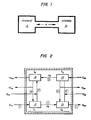
- a typical heat pump cooling cycle consists of four steps, which are illustrated in Figure 2. As shown in the Figure:
- each hydride will have a characteristic pressure at which it will begin to absorb significant amounts of hydrogen. The pressure will remain relatively constant until a characteristic quantity of hydrogen is absorbed. At that point, exposing the hydride to more hydrogen will not cause a significant composition change.
- the hydride pair In order for hydrogen to flow from the bed containing hydride A to the bed containing hydride B during Step 1, the hydride pair must display properties such that there is an appropriate pressure differential between A and B at temperatures T C and T M , as shown above.
- the pair of hydrides must have properties such that there is a sufficient pressure differential between B and A at temperatures T H and T H respectively.
- thermodynamic Analysis of a Metal Hydride Heat Pump See “A Thermodynamic Analysis of a Metal Hydride Heat Pump", A. Abelson and J.S. Horowitz, Argonne National Laboratory, No. 809427, for a fuller discussion of the thermodynamic considerations.
- the hydride heat pump can use any source of heat; i.e., gas, electricity, solar, waste heat, ground water, etc, thus providing for more efficient and flexible energy utilization. Due to the modular, solid state nature of the hydride system and because hydrogen gas is the only working medium, these systems also allow packaging flexibility.
- Solid hydrides suitable for the reversible storage of hydrogen in heat pump applications must have several characteristics, such as: the useful capacity must be large at a given operating temperature; they must have the ability to operate over a broad range of temperatures; they must have good hydrogen absorption/desorption kinetics; the materials must be structurally stable to ensure long cycle life; the hysterisis between hydrogen absorption and desorption pressures of the materials should be small; the thermal conductivity of the materials should be reasonably high; and the cost should be reasonably low. If the materials fail to possess any one of these characteristics, they will not find acceptance for wide scale commercial utilization.
- a relatively low desorption temperature is necessary for efficient utilization of the available exhaust heat from vehicles, machinery, or other similar equipment.
- Reversibility is needed to enable the hydrogen storage material to be capable of repeated absorption-desorption cycles without significant loss of its hydrogen storage capabilities.
- Favorable kinetics are necessary to enable hydrogen to be absorbed or desorbed in a relatively short period of time.
- the density of hydrogen storage sites or interstitial sites is also limited due to specific stoichiometries in the single phase crystalline host structures.
- the catalytically active sites are relatively limited in number and result from accidentally occurring surface irregularities which interrupt the periodicity of the single phase crystalline structure.
- a few examples of such surface irregularities are dislocation sites, crystal steps, surface impurities and foreign absorbates. These irregularities typically occur only in relatively few numbers on the surface of a single phase crystalline material and not throughout its bulk.
- the density of catalytically active sites can be increased to a limited extent by mechanical cracking of the single phase crystalline structure or by forming a powder therefrom to increase the surface area.
- the powders can present a utilization problem, because when the stored hydrogen is later released from the hydride, the powder particles or fractioned segments thereof may be in and carried off by the hydrogen gas as the gas is pumped to its point of utilization as a fuel.
- the prior art metallic host single phase crystalline hydrogen storage materials include magnesium, magnesium-nickel, vanadium, iron-titanium, lanthanum pentanickel and others. No such prior art material, however, has all of the required properties i.e., useful storage capacity at operational temperatures, acceptable absorption/desorption kinetics, etc. required for a hydride heat pump medium with widespread commercial utilizability.
- magnesium's other hydrogen storage characteristics make it commercially unacceptable for widespread use as a heat pump material.
- One alloy system that has been utilized as a hydrogen storer is that containing various combinations of titanium, vanadium, manganese and iron. See, for example, U.S. Reissued Patent No. 30,083 in the name of Reilly et al, which is a reissue of U.S. Patent No. 3,922,872, U.S. Patent No. 4,358,316 in the name of Liu et al, U.S. Patent No. 4,457,891 in the name of Bernauer et al, and U.S. Patent No. 4,488,906 in the name of Gondo et al. All of these references teach the use of an alloy with a major phase of either titanium or manganese, and little or no vanadium.
- U.S. Patent No. 4,446,101 in the name of Bernauer et al does disclose a material with a higher fraction of vanadium. However, no disclosure is made as to the material's structure or pressure versus (H/M) behavior.
- Laid-open Japanese Patent Application No. 55-167401 "Hydrogen Storage Material,” in the name of Matsumato et al, discloses bi or tri element hydrogen storage materials of at least 50 volume percent amorphous structure.
- the first element is chosen from the group Ca, Mg, Ti, Zr, Hf, V, Nb, Ta, Y and lanthanides, and the second from the group Al, Cr, Fe, Co, Ni, Cu, Mn and Si.
- a third element from the grouo B, C, P and Ge can optionally be present.
- the amorphous structure is needed to overcome the problem of the unfavorably high desorption temperature characteristic of most crystalline systems.
- a high desorption temperature (above, for example, 150°C) severely limits the uses to which the system may be put.
- a heat pump used as an air conditioner would have to perform at ambient temperatures.
- the materials suggested by Matsumoto et al do not have suitable matching pairs with appropriate pressure versus composition curves.
- the material of at least 50% amorphous structure will be able to desorb at least some hydrogen at relatively low temperatures because the bonding energies of the individual atoms are not uniform, as is the case with crystalline material, but are distributed over a wide range.
- Such an amorphous material will not have the flat hysteresis curve (pressure isotherm) characteristic of crystalline materials. Hence, at least some hydrogen will be desorbed at a relatively low temperature.
- Matsumoto et al claims a material of at least 50% amorphous structure. While Matsumoto et al does not provide any further teaching about the meaning of the term "amorphous,” the scientifically accepted definition of the term encompasses a maximum short range order of about 20 Angstroms or less.
- disordered metastable hydrogen storage materials characterized by a chemically modified, thermodynamically metastable structure, can be tailor-made to possess all the hydrogen storage characteristics desirable for a wide range of commercial applications.
- the modified hydrogen storage materials can be made to have greater hydrogen storage capacity than do the single phase crystalline host materials.
- the bonding strengths between the hydrogen and the storage sites in these modified materials can be tailored to provide a spectrum of bonding possibilities thereby to obtain desired absorption and desorption characteristics.
- Disordered hydrogen storage materials having a chemically modified, thermodynamically metastable structure also have a greatly increased density of catalytically active sites for improved hydrogen storage kinetics and increased resistance to poisoning.
- the synergistic combination of selected modifiers incorporated in a selected host matrix provides a degree and quality of structural and chemical modification that stabilizes chemical, physical, and electronic structures and conformations amenable to hydrogen storage.
- the framework for the modified hydrogen storage materials is a lightweight host matrix.
- the host matrix is structurally modified with selected modifier elements to provide a disordered material with local chemical environments which result in the required hydrogen storage properties.
- Another advantage of the host matrix described by Ovshinsky, et al. is that it can be modified in a substantially continuous range of varying percentages of modifier elements. This ability allows the host matrix to be manipulated by modifiers to tailor-make or engineer hydrogen storage materials with characteristics suitable for particular applications. This is in contrast to multicomponent single phase host crystalline materials which generally have a very limited range of stoichiometry available. A continuous range of control of chemical and structural modification of the thermodynamics and kinetics of such crystalline materials therefore is not possible.
- a still further advantage of these disordered hydrogen storage materials is that they are much more resistant to poisoning. As stated before, these materials have a much greater density of catalytically active sites. Thus, a certain number of such sites can be sacrificed to the effects of poisonous species, while the large number of unpoisoned active sites still remain to continue to provide the desired hydrogen storage kinetics.
- disordered materials can be designed to be mechanically more flexible than single phase crystalline materials.
- the disordered materials are thus capable of more distortion during expansion and contraction allowing for greater mechanical stability during the absorption and desorption cycles.
- a novel class of disordered, multicomponent, multiphase, polycrystalline hydrogen storage materials have a plurality of phases, with compositional and structural order within each phase and compositional and structural disorder between phases.
- the resulting disordered, multicomponent, multiphase, polycrystalline materials have a high hydrogen storage capacity and high reversibility.
- the material comprises at least two phases: a major crystalline phase in which V strongly predominates and an intergranular phase in which T, V and Fe predominate.
- other inclusion phases may be present in which Ti may strongly predominate.
- the multicomponent, multiphase, polycrystalline material has a nominal composition of Ti a V b Mn c Fe d , where 0.5 ⁇ a ⁇ 0.75, 1.15 ⁇ b ⁇ 1.65, 0.9 ⁇ a + c ⁇ 1.31, and 1.6 ⁇ b + d ⁇ 2.0.
- the major crystalline phase is represented by the stochiometric formula Ti a V b Mn c Fe d , where 12 ⁇ a ⁇ 18, 53 ⁇ b ⁇ 59, 9 ⁇ c ⁇ 11, and 17 ⁇ d ⁇ 21, and the continuous intergranular phase has the stochiometry Ti a V b Mn c Fe d , where 31 ⁇ a ⁇ 36, 23 ⁇ b ⁇ 26, 10 ⁇ c ⁇ 12, and 29 ⁇ d ⁇ 34.
- These materials are capable of reversibly storing relatively large amounts of hydrogen, e.g., above about 1.45 weight percent hydrogen.
- the materials are further characterized by favorable pressure-temperature-rate hydriding and dehydriding kinetics.
- the materials of the present invention are of a disordered, polycrystalline structure.
- thermochemical heat pump utilizing the class of hydride materials of the present invention is also claimed herein.
- the heat pump contains at least one pair of hydride beds with a connector between them to allow hydrogen to pass between the beds.
- At least one bed is comprised of a hydride of the class of multicomponent, multiphase, polycrytalline material of the present invention.
- the class of materials of the present invention is a disordered, multicomponent, multiphase, polycrystalline hydrogen storage class.
- disordered is meant that the material is characterized by the absence of compositional and structural order between phases, and by the presence of such order within a phase.
- the material can be amorphous, polycrystalline (but lacking long range compositional order), or microcrystalline in structure or an intimate mixture of any combination of those phases.
- the novel class of hydrogen storage materials herein disclosed is multiphase, with predominantly a polycrystalline structure.
- disordered is meant the absence of long range structural and compositional order between phases.
- polycrystalline is meant that the material's local structural order and, crystallite size of the major phase is of the range of at least 300 Angstroms. In a preferred exemplification, the local structural order and crystallite size are between 5 and 100 microns. In a particularly preferred exemplification, the crystallite size is between 10 and 15 microns.
- the material of the present invention is multiphase, comprising at least a major crystalline phase which is substantially surrounded by an intergranular phase.
- one or more inclusion phases may also be present. While not wishing to be bound by the following explanation, the inventors believe that the intergranular phase which substantially surrounds the crystallite may serve as a hydrogen conduit for carrying hydrogen to and from the crystallites during the absorption and desorption processes. It is also believed that the one or more inclusion phases may catalytically aid the absorption and desorption of hydrogen into and out of the hydride.
- the predominant crytalline phase is surrounded by the intergranular phase.
- Two seperate inclusion phases also occur sporadically throughout the material.
- the samples described herein were prepared by induction melting.
- the nominal composition of the samples are given in Table I below.
- the constituent elements, titanium, vanadium, manganese and iron, which were powdered and of laboratory grade, were thoroughly mixed together, heated in a rf induction furnace until melting was completed, and then cooled to form a solidified ingot.
- the ingot was then reduced in size by conventional methods to form the material of the present invention.
- the powdered material may then be activated by subjecting it to hydrogen under pressure.
- ambient temperature activation is performed under a hydrogen atmosphere at a pressure of at least 450 psi for at least 30 minutes.
- the activation is performed at a temperature of at least 200°C, with the pressure of the hydrogen atmosphere being at least 200 psi. This elevated temperature activation method takes at least 10 minutes.
- the multicomponent, multiphase, polycrystalline material has a nominal composition of Ti a V b Mn c Fe d , where 0.5 ⁇ a ⁇ 0.75, 1.15 ⁇ b ⁇ 1.65, 0.9 ⁇ a + c ⁇ 1.31, and 1.6 ⁇ b + d ⁇ 2.0.
- the major crystalline phase is represented by the stochiometric formula Ti a V b Mn c Fe d , where 12 ⁇ a ⁇ 18, 53 ⁇ b ⁇ 59, 9 ⁇ c ⁇ 11, and 17 ⁇ d ⁇ 21, and the continuous intergranular phase has the stochiometry Ti a V b Mn c Fe d , where 31 ⁇ a ⁇ 36, 23 ⁇ b ⁇ 26, 10 ⁇ c ⁇ 12, and 29 ⁇ d ⁇ 34.
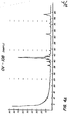
- Figures 4a and 4b represent Bragg x-ray diffraction patterns exhibited by two samples of the material of the present invention.
- the major peak occurs at 43 degrees 2 theta.
- the narrowness of the peaks at half maximum intensity clearly show that the samples have a high degree of crystallinity.
- Figures 4a and 4b also show minor peaks which are characteristic of the material of the present invention. These peaks occur at 37 degrees 2 theta, at 40 degrees 2 theta at 42 degrees 2 theta, at 45 degrees 2 theta, at 62 degrees 2 theta and at 78.5 degrees, 2 theta.
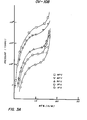
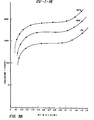
- Figures 3a and 3b are P-C-T curves showing the absorption-desorption characteristics of two samples of the materials of the present invention. These curves indicate how much hydrogen is present in the material as a function of pressure at a constant temperature. Increasing the temperature shifts the curve upward. Thus, these curves are pressure versus weight percent of stored hydrogen isotherms.
- the P-C-T curves are characterized by a slight shift upward of pressure for weight percents of hydrogen in the range of approximately 0.4 to 1.4 weight percent. Increasing the weight percent of hydrogen absorbed tends to shift the pressure slightly upward, until a point is reached where hydrogen absorption virtually ceases and the pressure rapidly increases.
- a similarly shaped P-C-T curve is also characteristic of a truly amorphous material, as in Matsumoto et al referenced above.
- the gradually rising P-C-T curve of the amorphous material of Matsumoto et al corresponds to a different phenomenon than the slightly sloped curves of the material of the present invention.
- the disordered material of the present invention which has a much larger range of local order than prior art amorphous material, is multiphase and polycrystalline.
- Such a material has complex P-C-T characteristics with desorption and absorption occurring at many phase boundaries and following a number of thermodynamic pathways.
- the gradually inclined P-C-T curves are the result of the superposition of many different pressure plateaus of various phases and combinations of phases. When these plateaus are superimposed and smoothed out, the curves illustrated result.
- polycrystalline, multiphase, thermodynamically metastable materials exhibit such thermodynamically complicated behavior, it is possible for them to display combinations of properties not obtainable with either single crystal or amorphous materials.
- polycrystalline materials have a menu of properties, such as absorption and desorption pressures, hydrogen storage capacity, reversibility, kinetics, and resistance to poisioning, from which may be selected those properties desired for a particular application.
- the elements have been selected so as to optimize the properties particularly suitable for a hydrogen storage material useful in heat pump applications.
- the materials have high, useful hydrogen storage capacity, rapid absorption and desorption kinetics, resistance to poisioning, and ready desorption and absorption of hydrogen at ambient or below ambient temperatures.
- the melting may be done by triarc melting.
- the cooling may be by rapid quench techniques, including melt spinning on a chill surface, physical and chemical vacuum deposition methods, plasma spraying, sputtering, and other such techniques well known in the art.
Landscapes
- Chemical & Material Sciences (AREA)
- Organic Chemistry (AREA)
- Chemical Kinetics & Catalysis (AREA)
- Engineering & Computer Science (AREA)
- Combustion & Propulsion (AREA)
- Inorganic Chemistry (AREA)
- Hydrogen, Water And Hydrids (AREA)
- Filling Or Discharging Of Gas Storage Vessels (AREA)
Applications Claiming Priority (6)
| Application Number | Priority Date | Filing Date | Title |
|---|---|---|---|
| US79182285A | 1985-10-28 | 1985-10-28 | |
| US791822 | 1985-10-28 | ||
| US80501685A | 1985-12-05 | 1985-12-05 | |
| US805016 | 1985-12-05 | ||
| US86600186A | 1986-08-27 | 1986-08-27 | |
| US866001 | 1997-05-30 |
Publications (1)
| Publication Number | Publication Date |
|---|---|
| EP0220678A1 true EP0220678A1 (fr) | 1987-05-06 |
Family
ID=27419890
Family Applications (1)
| Application Number | Title | Priority Date | Filing Date |
|---|---|---|---|
| EP86114698A Withdrawn EP0220678A1 (fr) | 1985-10-28 | 1986-10-23 | Matériaux pour le stockage d'hydrogène utilisables dans des pompes à chaleur |
Country Status (2)
| Country | Link |
|---|---|
| EP (1) | EP0220678A1 (fr) |
| CA (1) | CA1286489C (fr) |
Cited By (3)
| Publication number | Priority date | Publication date | Assignee | Title |
|---|---|---|---|---|
| DE102005004589A1 (de) * | 2005-02-01 | 2006-08-10 | Bayerische Motoren Werke Ag | Druckerhöhungseinrichtung für Wasserstoff |
| WO2014134186A1 (fr) * | 2013-02-26 | 2014-09-04 | Battelle Memorial Institute | Systèmes et dispositifs de stockage réversible d'énergie thermique à base d'un hydrure métallique, et procédé pour des applications haute température |
| US20230272981A1 (en) * | 2020-07-16 | 2023-08-31 | Texel Energy Storage Ab | Thermochemical energy storage device |
Citations (1)
| Publication number | Priority date | Publication date | Assignee | Title |
|---|---|---|---|---|
| EP0011602A1 (fr) * | 1978-11-14 | 1980-05-28 | Battelle Memorial Institute | Composition d'alliage à base de titane et de fer pour le stockage de l'hydrogène |
-
1986
- 1986-10-23 EP EP86114698A patent/EP0220678A1/fr not_active Withdrawn
- 1986-10-28 CA CA000521594A patent/CA1286489C/fr not_active Expired - Fee Related
Patent Citations (1)
| Publication number | Priority date | Publication date | Assignee | Title |
|---|---|---|---|---|
| EP0011602A1 (fr) * | 1978-11-14 | 1980-05-28 | Battelle Memorial Institute | Composition d'alliage à base de titane et de fer pour le stockage de l'hydrogène |
Cited By (5)
| Publication number | Priority date | Publication date | Assignee | Title |
|---|---|---|---|---|
| DE102005004589A1 (de) * | 2005-02-01 | 2006-08-10 | Bayerische Motoren Werke Ag | Druckerhöhungseinrichtung für Wasserstoff |
| DE102005004589B4 (de) * | 2005-02-01 | 2013-10-10 | Bayerische Motoren Werke Aktiengesellschaft | Druckerhöhungseinrichtung für Wasserstoff |
| WO2014134186A1 (fr) * | 2013-02-26 | 2014-09-04 | Battelle Memorial Institute | Systèmes et dispositifs de stockage réversible d'énergie thermique à base d'un hydrure métallique, et procédé pour des applications haute température |
| US20230272981A1 (en) * | 2020-07-16 | 2023-08-31 | Texel Energy Storage Ab | Thermochemical energy storage device |
| US12480718B2 (en) * | 2020-07-16 | 2025-11-25 | Texel Energy Storage Ab | Thermochemical energy storage device |
Also Published As
| Publication number | Publication date |
|---|---|
| CA1286489C (fr) | 1991-07-23 |
Similar Documents
| Publication | Publication Date | Title |
|---|---|---|
| US4431561A (en) | Hydrogen storage materials and method of making same | |
| US6328821B1 (en) | Modified magnesium based hydrogen storage alloys | |
| US7211541B2 (en) | Mg—Ni hydrogen storage composite having high storage capacity and excellent room temperature kinetics | |
| US5916381A (en) | Magnesium mechanical alloys for thermal hydrogen storage | |
| EP1082469B1 (fr) | Alliages de magnesium obtenus par procede mecanique et destines a un stockage thermique d'hydrogene | |
| JPH11510133A (ja) | 可逆的な水素貯蔵のための方法 | |
| US4832913A (en) | Hydrogen storage materials useful for heat pump applications | |
| US6491866B1 (en) | High storage capacity, fast kinetics, long cycle-life, hydrogen storage alloys | |
| US20030103861A1 (en) | Hydrogen storage material including a modified Ti-Mn2 alloy | |
| WO2001092592A1 (fr) | Alliages de stockage d'hydrogene a longue duree de vie | |
| CA1286489C (fr) | Materiaux de stockage d'hydrogene pour installations a thermopompe | |
| WO2003064320A1 (fr) | Materiau de stockage d'hydrogene de capacite elevee a base de calcium lithium et procede de fabrication associe | |
| WO2004027102A1 (fr) | Materiaux de stockage d'hydrogene a base de metaux de transition haute capacite utilises dans le stockage reversible d'hydrogene | |
| JPS626739B2 (fr) | ||
| JP3350445B2 (ja) | ヒートポンプ用水素吸蔵合金ユニット | |
| JPS62136547A (ja) | 水素貯蔵材料及びその製造方法 | |
| VN | USE OF METAL HYDRIDES AS SOURCES OF HYDROGEN FOR VARIOUS PRACTICAL APPLICATIONS | |
| Ramakrishna | rare earth pentanickelide (RNi5) type solid state materials for hydrogen | |
| MXPA00010011A (en) | Magnesium mechanical alloys for thermal hydrogen storage |
Legal Events
| Date | Code | Title | Description |
|---|---|---|---|
| PUAI | Public reference made under article 153(3) epc to a published international application that has entered the european phase |
Free format text: ORIGINAL CODE: 0009012 |
|
| AK | Designated contracting states |
Kind code of ref document: A1 Designated state(s): AT BE CH DE ES FR GB GR IT LI LU NL SE |
|
| STAA | Information on the status of an ep patent application or granted ep patent |
Free format text: STATUS: THE APPLICATION IS DEEMED TO BE WITHDRAWN |
|
| 18D | Application deemed to be withdrawn |
Effective date: 19871109 |
|
| RIN1 | Information on inventor provided before grant (corrected) |
Inventor name: HONG, KUOCHIH Inventor name: SAPRU, KRISHNA |