EP0220866A2 - Sprachverschleierer - Google Patents
Sprachverschleierer Download PDFInfo
- Publication number
- EP0220866A2 EP0220866A2 EP86307855A EP86307855A EP0220866A2 EP 0220866 A2 EP0220866 A2 EP 0220866A2 EP 86307855 A EP86307855 A EP 86307855A EP 86307855 A EP86307855 A EP 86307855A EP 0220866 A2 EP0220866 A2 EP 0220866A2
- Authority
- EP
- European Patent Office
- Prior art keywords
- scrambler
- samples
- signal
- analogue
- series
- Prior art date
- Legal status (The legal status is an assumption and is not a legal conclusion. Google has not performed a legal analysis and makes no representation as to the accuracy of the status listed.)
- Withdrawn
Links
Images

Classifications
-
- H—ELECTRICITY
- H04—ELECTRIC COMMUNICATION TECHNIQUE
- H04K—SECRET COMMUNICATION; JAMMING OF COMMUNICATION
- H04K1/00—Secret communication
- H04K1/04—Secret communication by frequency scrambling, i.e. by transposing or inverting parts of the frequency band or by inverting the whole band
Definitions
- the present invention relates to speech scramblers.
- Various types of speech scrambling systems are known. For example, many systems use digital processing by sampling the input speech signal at fixed time intervals to produce a block of time samples. In one system the blocks of time samples are simply rearranged and converted back into an analogue signal for transmission. Such a system is a time domain scrambler. This system requires synchronisation between the transmitting scrambler and the receiving de-scrambler in order to achieve an acceptable speech quality at the output of the de-scrambler.
- the block of time samples is converted by a fast Fourier transform to produce a series of Fourier coefficients representing the frequency spectrum of the input speech signal. If these Fourier coefficients are permuted before being subjected to an inverse fast Fourier transform, a new block of time samples is produced which can be converted into a scrambled analogue signal for transmission.
- the input signal is again sampled and these samples subjected to a fast Fourier transform.
- the resulting coefficients are permuted in the inverse manner to the permutation applied by the scrambler and subjected to a Fourier transform and this produces a sequence of time samples which should convert to the original input speech signal.
- Such a basic frequency-domain scrambler also requires synchronisation between the scrambling systems employed at each end of the link. This has been overcome in recent designs by the use of short time Fourier transforms (STFT).
- STFT short time Fourier transforms
- the latter system may basically be regarded as continuously passing the input signal through a bank of frequency shifters, the output of each frequency shifter being passed to an ideal low pass filter. The outputs of the filters are then permuted. The scrambled frequency spectrum is then reconverted into an analogue signal for transmission.
- Such a scrambler may be used in conjunction with a de-scrambler constructed as the scrambler defined above operating on said scrambled analogue signal instead of an input speech signal, and in which the selecting means uses a down-sampling function which has the inverse effect to the down-sampling function used by the scrambler.
- the scrambler to be described processes only time-domain samples, it nevertheless functions as a band scrambler in the frequency-domain. That is, it takes an input speech signal and filters the signal into a series of sub-bands. The filter outputs are scrambled by shifting their centre frequencies, and the resulting spectrum produced is that of a scrambled signal for transmission over the telephone line.
- h(n') is a windowing function.
- a suitable windowing function is as follows:
- N and L are constants of the scrambling system and N is typically chosen to be a prime number in the region of 200 and L an integer, for example, 2.
- N defines the number of sub-bands into which the frequency spectrum of the input speech signal is divided when the effect of the scrambler in the frequency-domain is considered.
- the function s(n) is a down-sampling function which is defined as:
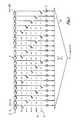
- Figure 1 illustrates a block diagram of the scrambler for producing the required y(n).
- N has been chosen to be 5 in this Example rather than a more typical value of 199.
- the input speech signal to be scrambled is fed via an analogue-to-digital converter which samples it at the Nyquist rate.
- the samples are produced they are fed via an input 2 to a delay line 4 which is made up of a series of time delay blocks 6 which each produce a delay equivalent to the sampling interval. Therefore, the delay line is capable of storing 2LN samples, in this case 20.
- the sample available downstream of the first delay block 6 on the delay line is x(n-1).
- the sample available at the end of the delay line is x(n-20).
- Each intermediate point of the delay line is connected via a switch to a respective multiplier 8.
- Each of the multipliers 8 contains a predetermined constant factor. These factors are determined by the window function h(n') where n' is the number of time delay blocks 6 between the input 2 and the connection to the respective multiplier.
- the switches connected to the delay line are ganged together in N series where each of the switches of each series is separated by N delay line blocks 6. At each time n a particular series of ganged switches is closed.
- k may be 2, 3 or 4.
- the values of the x(n) available at each point on the delay line move along one.
- the y(n) are obtained by summing the outputs of the multipliers 8 to which the input switches are closed in an adder 10.
- the signals x(n) and y(n) have a wide dynamic range, it is desirable to provide a large number of bits for their storage, for example 12.
- the values of the windowing function h(n) may be expressed to fewer bits, for example 4, since the exact form of this function has not been found to be critical.
- a logarithmic analogue-to-digital converter may be provided for producing the samples x(n).
- the multipliers 8 are then replaced by adders in which the logarithmic value of the window function is stored.
- the outputs from these adders are then converted to analogue form using an anti-logarithmic digital to analogue converter, and the adder 10 implemented by analogue means.
- the de-scrambler for use with the scrambler of Figure 1 is identical in form to the scrambler except that it utilizes a different key k * .
- the input signal y(n) is sampled and fed to the input 2 of the delay line.
- the outputs from the adder 10 are then the de-scrambled samples.
- synchronisation between the sampling of the scrambler and de-scrambler is not necessary. Any misalignment between the sampling of the signals introduces a phase error which varies with frequency. As the human ear is relatively insensitive to phase errors, the absence of synchronisation does not adversely affect the speech.
- the value of k * for de-scrambling can be calculated from equation (4) in a known manner or obtained by a trial and error process.
- the required values may be stored in a look-up table within the de-scrambler.
- the down-sampling function (3) can be expressed as follows:
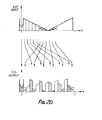
- Figure 2A illustrates a diagrammatic Fourier transform of an input speech signal.
- the form of this spectrum represents a spectrum of a typical speech signal, time-averaged over a period of at least 500 ms, and with frequency subsequently normalised to the range 1/2 ⁇ f ⁇ 1/2.
- X(f-(kr-r)/N) is the input spectrum shifted by (kr-r)/N, as illustrated in Figure 2B.
- H(f) as illustrated in Figure 2C is an approximation of a rectangular filter with bandwidth 1/N.
- Figure 2D illustrates how the frequency bands of the original input spectrum X(f) are mapped onto the output spectrum Y(f).
- this band scrambler enables particularly simple implementation to be used.
- the requirement already set out that k and N should be coprime is to ensure that no two sub-bands in the input speech spectrum are mapped onto the same sub- band in the output spectrum.
- the transform H(f) of the windowing function h(n) will not have the precisely rectangular form illustrated in Figure 2.
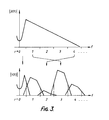
- Figure 3 The effect of variations in the shape of H(f) on the efficiency of the scrambler are illustrated in Figure 3.
- the power is concentrated at low frequency.
- the higher frequencies represent important information, partly because the human ear is more sensitive to them.
- the window function will not be ideal and this effectively means that the sub-bands will extend beyond their allotted bandwidth.
- the amount of energy in this band may be modified by the relatively large leakage from the adjacent bands.
- the upper plot in Figure 3 shows the idealised frequency spectrum of a speech signal averaged over a long period of time.
- Provision of a pre-emphasis filter prior to sampling augments the higher frequencies.
- the output of the de-scrambler is restored to the original spectrum by a de-emphasis filter following its output.
- Another advantage of the inclusion of the pre-emphasis and de-emphasis filters is to reduce the risk of the key being decoded by a listener who can, over a period of time, estimate the original positions of the sub-bands by their power levels. Thus, a sub-band which is consistently of higher average power level would normally be a sub-band of low frequency. However, the presence of the pre-emphasis filter reduces this consistent variation in the power of the sub-bands and thus reduces the risk of this type of crypt-analysis.
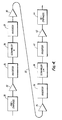
- An input speech signal is fed via a pre-emphasis filter 20 to an analogue-to-digital converter 22 (including an anti-aliasing filter) which may, as previously discussed, be a logarithmic converter.
- the converter 22 may be made operable at different sampling rates to further increase possible system codes. For example, five sampling rates selected between 6.5 and 8KHz may be selectively chosen.
- the output of the inverter 24 is fed to the scrambler 26 with key k.
- the scrambler 26 is as described with reference to Figure 1.
- the y(n) output from the scrambler 26 are fed to a further inverter 28 which is identical to inverter 24.
- This inverter can be switched in or out to further increase the number of system codes. With two inverters. four distinct scrambling codes are available for each value of k. assuming that the sampling rate is maintained constant.
- the output of the inverter 28 is fed to a digital-to-analogue converter 30 (including an interpolation filter) operable at the same rate as converter 22. Instead of varying the sampling rate, the value of N used by the scrambler may be varied.
- the output of the ditigal to analogue converter 30 is fed along the telephone line 32.
- the scrambling and de-scrambling systems may be set so that during a single telephone conversation, the code represented by the states of the inverter, key k and sampling rate or value of N are maintained constant.
- the code may be chanted periodically. This may be done by varying the setting of the inverters, the sampling rate or the key k independently or varying some or all of these factors. If such a rolling code is used then it is necessary for there to be some form of synchronisation between the scrambling and de-scrambling systems. However, since a code need only be changed relatively infrequently the requirement for synchronisation is much less rigorous than for prior art time-domain block scramblers which must be precisely synchronised. A brief resynchronisation period of the scrambler will not unduly adversely affect the transmitted signal since a voice signal is generally intelligible even if it is corrupted for short periods.
- a cyclic shifting process may be made on frequency components in the range 0 ⁇ f ⁇ 1/2.
- the frequency components in the range -1/2 ⁇ f ⁇ 0 are similarly shifted such that the time domain samples remain real.
- a frequency shift which operates on an analogue signal is described in an article entitled "MISTIC, an analogue speech scrambler" by R. Nettleship published in Phillip Telecom Review, vol.41, No.1, April 1983.
- the modified sequence of ssb samples is fed to the scrambler which is identical to that described with reference to Figure 1.
- the main scrambling is unchanged except that it is performed with even samples only since the remaining samples are zero
- Cyclic frequency shifting performed by either of the above defined processes may be used both before and after the scrambling. This may give a useful improvement in security, possibly subject to some constraints.
Landscapes
- Engineering & Computer Science (AREA)
- Computer Networks & Wireless Communication (AREA)
- Signal Processing (AREA)
- Transmission Systems Not Characterized By The Medium Used For Transmission (AREA)
- Complex Calculations (AREA)
Applications Claiming Priority (2)
| Application Number | Priority Date | Filing Date | Title |
|---|---|---|---|
| GB8526409A GB2182229B (en) | 1985-10-25 | 1985-10-25 | Speech scramblers |
| GB8526409 | 1985-10-25 |
Publications (2)
| Publication Number | Publication Date |
|---|---|
| EP0220866A2 true EP0220866A2 (de) | 1987-05-06 |
| EP0220866A3 EP0220866A3 (de) | 1988-03-23 |
Family
ID=10587280
Family Applications (1)
| Application Number | Title | Priority Date | Filing Date |
|---|---|---|---|
| EP86307855A Withdrawn EP0220866A3 (de) | 1985-10-25 | 1986-10-10 | Sprachverschleierer |
Country Status (3)
| Country | Link |
|---|---|
| US (1) | US4773092A (de) |
| EP (1) | EP0220866A3 (de) |
| GB (1) | GB2182229B (de) |
Cited By (2)
| Publication number | Priority date | Publication date | Assignee | Title |
|---|---|---|---|---|
| EP0422955A3 (en) * | 1989-10-12 | 1992-04-15 | Matsushita Electric Industrial Co., Ltd. | Sound field control system |
| RU2152690C1 (ru) * | 1999-06-10 | 2000-07-10 | Общество с ограниченной ответственностью "Центр речевых технологий" | Способ защиты информации в проводных каналах связи и устройство для его осуществления |
Families Citing this family (7)
| Publication number | Priority date | Publication date | Assignee | Title |
|---|---|---|---|---|
| US4888799A (en) * | 1986-01-03 | 1989-12-19 | Scientific Atlanta, Inc. | Scrambling of signals by inversion |
| US4827507A (en) * | 1987-06-19 | 1989-05-02 | Motorola, Inc. | Duplex analog scrambler |
| JPS6424648A (en) * | 1987-07-21 | 1989-01-26 | Fujitsu Ltd | Privacy call equipment |
| KR0154793B1 (ko) * | 1995-10-19 | 1998-11-16 | 김광호 | 무선전화기의 비화회로 및 역비화회로 |
| US7051203B1 (en) | 1999-11-08 | 2006-05-23 | International Business Machines Corporation | Data watermarks created by using an uneven sampling period |
| DE10138650A1 (de) * | 2001-08-07 | 2003-02-27 | Fraunhofer Ges Forschung | Verfahren und Vorrichtung zum Verschlüsseln eines diskreten Signals sowie Verfahren und Vorrichtung zur Entschlüsselung |
| US8848913B2 (en) * | 2007-10-04 | 2014-09-30 | Qualcomm Incorporated | Scrambling sequence generation in a communication system |
Family Cites Families (13)
| Publication number | Priority date | Publication date | Assignee | Title |
|---|---|---|---|---|
| GB1157870A (en) * | 1967-04-21 | 1969-07-09 | Standard Telephones Cables Ltd | A Speech Scrambling Device |
| CH607506A5 (de) * | 1976-06-01 | 1978-12-29 | Europ Handelsges Anst | |
| US4100374A (en) * | 1977-04-11 | 1978-07-11 | Bell Telephone Laboratories, Incorporated | Uniform permutation privacy system |
| US4221931A (en) * | 1977-10-17 | 1980-09-09 | Harris Corporation | Time division multiplied speech scrambler |
| JPS54129901A (en) * | 1978-03-31 | 1979-10-08 | Toshiba Corp | Secret communication system |
| US4295223A (en) * | 1979-04-25 | 1981-10-13 | Westinghouse Electric Corp. | Digital signal/noise ratio amplifier apparatus for a communication system |
| US4365110A (en) * | 1979-06-05 | 1982-12-21 | Communications Satellite Corporation | Multiple-destinational cryptosystem for broadcast networks |
| DE3120357A1 (de) * | 1981-05-22 | 1982-12-09 | Licentia Patent-Verwaltungs-Gmbh, 6000 Frankfurt | Verfahren zur vertauschung von n teilbaendern |
| US4433211A (en) * | 1981-11-04 | 1984-02-21 | Technical Communications Corporation | Privacy communication system employing time/frequency transformation |
| US4591673A (en) * | 1982-05-10 | 1986-05-27 | Lee Lin Shan | Frequency or time domain speech scrambling technique and system which does not require any frame synchronization |
| SE431385B (sv) * | 1982-06-11 | 1984-01-30 | Ericsson Telefon Ab L M | Sett att forvrenga en talsignal, sett att aterstella den forvrengda talsignalen, samt anordning for att forvrenga respektive aterstella talsignalen |
| US4551580A (en) * | 1982-11-22 | 1985-11-05 | At&T Bell Laboratories | Time-frequency scrambler |
| JPS6055750A (ja) * | 1983-09-07 | 1985-04-01 | Nippon Telegr & Teleph Corp <Ntt> | 反転秘話無線通信方式 |
-
1985
- 1985-10-25 GB GB8526409A patent/GB2182229B/en not_active Expired
-
1986
- 1986-10-10 EP EP86307855A patent/EP0220866A3/de not_active Withdrawn
- 1986-10-24 US US06/923,035 patent/US4773092A/en not_active Expired - Fee Related
Cited By (2)
| Publication number | Priority date | Publication date | Assignee | Title |
|---|---|---|---|---|
| EP0422955A3 (en) * | 1989-10-12 | 1992-04-15 | Matsushita Electric Industrial Co., Ltd. | Sound field control system |
| RU2152690C1 (ru) * | 1999-06-10 | 2000-07-10 | Общество с ограниченной ответственностью "Центр речевых технологий" | Способ защиты информации в проводных каналах связи и устройство для его осуществления |
Also Published As
| Publication number | Publication date |
|---|---|
| GB2182229A (en) | 1987-05-07 |
| GB2182229B (en) | 1989-10-04 |
| EP0220866A3 (de) | 1988-03-23 |
| US4773092A (en) | 1988-09-20 |
Similar Documents
| Publication | Publication Date | Title |
|---|---|---|
| US5497398A (en) | Multi-carrier transceiver | |
| Vaidyanathan | Multirate digital filters, filter banks, polyphase networks, and applications: a tutorial | |
| Bellanger et al. | TDM-FDM transmultiplexer: Digital polyphase and FFT | |
| US4691292A (en) | System for digital multiband filtering | |
| US4393276A (en) | Fourier masking analog signal secure communication system | |
| Coulson | A generalization of nonuniform bandpass sampling | |
| US4270026A (en) | Interpolator apparatus for increasing the word rate of a digital signal of the type employed in digital telephone systems | |
| CA1288182C (en) | Secret speech equipment | |
| EP0190796A1 (de) | Filtersatz für Signalanalyse und Synthese | |
| CA2458650A1 (en) | Compensation for non-linear distortion in a modem receiver | |
| US4443660A (en) | System and method for encrypting a voice signal | |
| EP1095463A1 (de) | Unterdrückung von funkfrequenzinterferenz und impulsrauschen in kommunikationskanälen | |
| US4773092A (en) | Speech scramblers | |
| US4188506A (en) | Method and installation for masked speech transmission over a telephone channel | |
| EP1098468B1 (de) | Verfahren un Vorrichtung für Mehrfachzugriff in einem Kommunikationssystem | |
| GB2304504A (en) | OFDM receiver includes digital filter | |
| EP0667687B1 (de) | Echo-Löscher | |
| US5226083A (en) | Communication apparatus for speech signal | |
| EP0277392B1 (de) | Datenübertragungssystem mit Entfaltungsfiltern | |
| US3751596A (en) | Data transmission system using complementary coding sequences | |
| Del Re et al. | A new speech signal scrambling method for secure communications: theory, implementation, and security evaluation | |
| Huang et al. | Time sample speech scrambler which does not require synchronization | |
| US4020288A (en) | System for data transmission through the channels of a frequency division multiplex system | |
| Cheung et al. | High quality 16 kb/s voice transmission: The subband coder approach | |
| Lim et al. | Quality analog scramblers using frequency-response masking filter banks |
Legal Events
| Date | Code | Title | Description |
|---|---|---|---|
| PUAI | Public reference made under article 153(3) epc to a published international application that has entered the european phase |
Free format text: ORIGINAL CODE: 0009012 |
|
| AK | Designated contracting states |
Kind code of ref document: A2 Designated state(s): DE FR GB IT NL SE |
|
| PUAL | Search report despatched |
Free format text: ORIGINAL CODE: 0009013 |
|
| AK | Designated contracting states |
Kind code of ref document: A3 Designated state(s): DE FR GB IT NL SE |
|
| 17P | Request for examination filed |
Effective date: 19880505 |
|
| 17Q | First examination report despatched |
Effective date: 19900621 |
|
| STAA | Information on the status of an ep patent application or granted ep patent |
Free format text: STATUS: THE APPLICATION IS DEEMED TO BE WITHDRAWN |
|
| 18D | Application deemed to be withdrawn |
Effective date: 19910501 |
|
| RIN1 | Information on inventor provided before grant (corrected) |
Inventor name: HUANG, FREDERICK |