EP0221472A2 - An apparatus and a method for measuring registration errors of a print - Google Patents
An apparatus and a method for measuring registration errors of a print Download PDFInfo
- Publication number
- EP0221472A2 EP0221472A2 EP86114790A EP86114790A EP0221472A2 EP 0221472 A2 EP0221472 A2 EP 0221472A2 EP 86114790 A EP86114790 A EP 86114790A EP 86114790 A EP86114790 A EP 86114790A EP 0221472 A2 EP0221472 A2 EP 0221472A2
- Authority
- EP
- European Patent Office
- Prior art keywords
- registration
- image
- marks
- inputting
- Prior art date
- Legal status (The legal status is an assumption and is not a legal conclusion. Google has not performed a legal analysis and makes no representation as to the accuracy of the status listed.)
- Withdrawn
Links
Images



Classifications
-
- B—PERFORMING OPERATIONS; TRANSPORTING
- B41—PRINTING; LINING MACHINES; TYPEWRITERS; STAMPS
- B41F—PRINTING MACHINES OR PRESSES
- B41F33/00—Indicating, counting, warning, control or safety devices
- B41F33/0081—Devices for scanning register marks
Definitions
- This invention relates to an apparatus for measuring registration errors by utilizing registration marks printed at predetermined positions on a multicolor print to be inspected, and more particularly to an apparatus for the same by utilizing a handy type image inputting device for inputting images of the registration marks.
- a plate with a pattern is wrapped around a plate cylinder and an ink which is stored in an ink fountain is applied to the plate through a group of inking rollers.
- the ink applied to the plate is pressed against the plate cylinder and transferred to a blanket (rubber) cylinder which is rotating.
- a web or sheet of paper is made to pass between the blanket cylinder and an impression cylinder, whereby a pattern is printed on the web or sheet of paper.
- a unit comprising a plate cylinder, a blanket cylinder and an impression cylinder is provided for each color.
- the web or sheet of paper printed with a first color is made to pass the printing unit of a second color and then the printing unit for a third color, whereby multicolor printing is accomplished.
- a printed medium has registration errors in the circumferential direction (in the direction in which the web or sheet of paper is transported), the lateral direction and/or in the twisted direction.
- An object of the present invention is to provide a device for correctly measuring registration errors of a printed medium by a simple operation.
- a second object of the present invention is to provide a device capable of measuring a registration error of a printed medium in terms of a numerical value by a simple operation.
- the present invention provides a device of handy type for inputting a pattern of a printed medium on printing press, displaying the pattern on enlarged scale on the screen of a display device, inputting the coordinates of the positions of each color pattern for a predetermined element within the magnified and displayed image by a coordinate input means, determining registration errors between respective colors from the coordinates of the positions of each color and the magnification of the image, calculating a quantity required for the adjustment of the position of plate cylinders based on said registration errors and automatically effecting the registering of the printing press in response to the results of this calculation.
- the registration can be achieved only by one trial printing so that the operation time and paper can be considerably reduced.
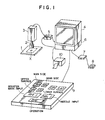
- FIG. l shows an embodiment of the present invention which is applied to an offset press.
- a printed medium to be measured X is placed on a table l and a suitable portion of the printed medium X is magnified and focused through a magnifying lens 2 with an extension tube.
- the magnified light image thus formed is converted by a color video camera 3 into electrical signals which in turn are applied through a superimposer 5 to a color cathode-ray tube 4 which displays an image magnified by tens of times.
- a pattern of the printed medium X to be displayed on the color cathode-ray tube 4 include a pattern which can distinctly indicate the misregistration. For example, it includes registration marks or patterns whose misregistration can be easily recognized.
- the coordinate inputs obtained by the operation of the operation panel 9 in response to the shift of the cursor by the joy stick 8 to the pattern picked up by the camera 3 and displayed on the color cathode-ray tube 4 is calculated by the personal computer 6 and the calculation results; that is, the registration errors are converted into data for correcting the positions of a plate cylinder.
- a flat scanner may be used as input means.
- the register mark on a printed medium may be directly made into contact with an image pickup tube or an image pickup element.
- the register mark is photographed by use of a Polaroid camera and a hard copy thus obtained is placed upon a digitizer to enter the position of the register mark.
- a display device such as a liquid crystal display device or a plasma display device may be used.
- Fig. 2(b), (c) do not have such drawbacks hereinabove.
- Fig. 2(b) shows a status in which registration is incompleted
- Fig. 2(c) shows another status in which the registration is completed, the registration marks being aligned with spacings of 3 millimeters along the circumferential direction. Since deviation of marks in circumferential direction seldom exceeds ⁇ l millimeter, if it is predetermined to align these marks from the above to the below in the order of B, C, M and Y, there should be no change in the order.
- FIGS. 2(a) ⁇ (e) show the images displayed on the screen of the color cathode-ray tube 4 (see FIG. l).
- FIG. 2(a), (b) and (e) show misregistration display marks called register marks and cyan, magenta, yellow and black marks are marked on the gear side and on the operating side of the plate cylinder.
- FIG. 2(d) shows a cross-shaped cursor ll which is superimposed on the patterns or marks shown in FIG. 2(a), (b), (c) or (e). This cursor can be shifted to any position on the screen of the color cathode-ray tube 4 in response to the operation of the joy stick 8.
- FIG. 2(d) shows the point of the patterns upon which the cursor must be registered and there are two kinds of inputs.
- a first kind of input is used to correct in the vertical and horizontal directions of the screen of the color cathode-ray tube 4.
- an operator sets the printed medium on the table l so that the circumferential and lateral directions of the printed medium will not coincide with the coordinates on the screen of the color cathode-ray tube 4.
- a reference line representative of the vertical direction and a reference line representative of the horizontal or lateral direction are marked on the color cathode-ray tube 4 and if the operator sets the printed medium in such a way that one of the color register marks coincides with these reference lines, then the circumferential and lateral directions of the printed medium coincide with the coordinates on the screen of the color cathode-ray tube 4.
- the coordinates are corrected by means of the personal computer. For instance, two points ll3 and ll4 on the vertical or horizontal line of one of the color register marks displayed on the screen of the color cathode-ray tube are entered. If the two points are vertically spaced apart from each other, the "CIR.” button is depressed. On the other hand, when the two points are spaced apart from each other in the horizontal direction, the "LAT.” button is depressed. Then, the vertical and horizontal directions can be automatically corrected.
- a second kind of input is used to designate the coordinates of each of the color register marks.
- the register mark is in the form of a cross so that when the point of intersection between the vertical and horizontal lines is entered as an input, both the vertical and horizontal coordinates are also entered simultaneously.
- register marks with only a vertical or horizontal line.
- the coordinates representative of the direction of a vertical or horizontal line are entered as an input.
- the coordinates of a position are determined in a coordinate system which in turn is determined in response to the corrections in the circumferential and lateral directions.
- only the circumferential or lateral operation is carried out so that the operation panel is provided with a button for operation only in the circumferential direction and a button for operation only in the lateral direction.
- the vertically upward direction of a register mark is always displayed in the vertically upward direction on the screen of the color cathode-ray tube.
- an angle between the vertical of the screen of the color display cathode-ray tube and a line interconnecting between two points selected on the screen of the color cathode-ray tube is less than 45°, it is recognized that the vertical or circumferential input is made and on the other hand, when the angle is greater than 45°, it is recognized that the horizontal or lateral input is made. Therefore one button on the operation panel 9 can have a dual function of the "CIR.” and "LAT.” buttons.
- the register marks are placed substantially at the same position on the upper and lower surfaces of the printing press and must be aligned with each other. Therefore a needle hole is formed adjacent to the register marks and is used to make the inputs of the misregistrations on the upper and lower surface. This can be done by manipulating "NDL" button on the operation panel 9 as in the case of inputting the register mark position coordinate system.
- the upper and lower surfaces can be registered with each other based on the position of the needle hole as a reference.
- the joy stick 8 is operated in such a way that the cursor on the screen of the color cathode-ray tube 4 is sequentially registered with two points on the horizontal or vertical line of a register mark. Thereafter the "CIR.” or "LAT.” button on the operation panel 9 is depressed.
- the joy stick 8 is so operated that the cursor is registered with each of the color registration patterns and then the "MAN” or "GR” button, and the "UP” or “LO” buttons are depressed.
- the joy stick 8 is so operated that the cursor on the display screen of the color cathode-ray tube 4 is aligned with the needle hole formed adjacent to the register marks and then the "NDL" button on the operation panel 9 is depressed.
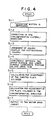
- FIGS. 4 and 5 show the arithmetic operations carried by the personal computer 6 as shown in FIG. l.
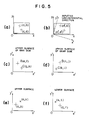
- FIG. 4 shows the steps and FIGS. 5(a) ⁇ (f) show the contents of the arithmetic operations.
- the registration error is not computed, but the plate cylinder corrections are directly computed.
- the arithmetic operation steps comprise the depression of the operation button (S-l), the circumferential (lateral) direction correction (S-2), the .display for distinguishing colors (S-3), the coincidence of the coordiantes on the upper and lower surfaces (s-4), the arithmetic operation for obtaining the corrections of the twisted plate cylinder (S-5), and the arithmetic operation for obtaining the correction of the plate cylinder in the circumferential and lateral directions (S-6), and may comprise the application of signals to the motor drive circuit in the registration device of the printing press (S-7).
- the arithmetic operations are carried out by the five steps S-2 -- S-6 so that these steps will be described in detail hereinafter.
- FIG. 5(a) First the coordinates of the position of the register marks which are based on the X- and Y-axes (FIG. 5(a)) are converted into the coordinates based upon the circumferential and lateral direction in response to the circumferential and lateral direction information previously entered (FIG. 5(b)).
- (a, b) and (c, d) are coordinates of the position of the register mark based on the X- and Y-axes on the screen of the color cathode-ray tube and the coordinates (a′, b′) and (c′, d′) shown in FIG. 5(b) are those based on the X′- and Y′-axes with reference to the circumferential direction entered as an input.
- This operation is repeated four times for the gear side, the operation side and their upper and lower surfaces of one printed medium.
- Register marks are displayed on the display 4 according to the converted coordinates along Y axis and are distinguished each other as B (black), C (cyan), M (magenta) and Y (yellow), when the marks of Fig. 2(c) are utilized.
- FIGS. 5(e) and (f) show the conditions of the upper and lower surfaces when the circumferential directions are transformed so as to coincide with the Y′-axis.
- ( , p) and (q, r) are coordinates and * represents a needle hole.
- the origin 0 is shifted to the pin hole (u, v) as shown in FIG. 5(e) and then shifted to the pin hole (s, t) as shown in FIG. 5(f) so that only the X′-axis sign of the register mark is changed.
- ( , p) ⁇ ( -u, p-v) (q, r) ⁇ (s-q, r-t) Then, the register marks on the upper and lower surfaces can be placed on the same coordinates.
- FIGS. 5(c) and (d) show examples of the registration marks on the man and gear sides.
- BL black
- C blue
- [(j-l) ⁇ (f-h)] ⁇ m when the marks of Fig. 2(a) are utilized where m is a constant inherent to a printing press.
- a twist for each color is obtained based on the reference C (blue) and a twisted shift is defined by a value obtained when an average twist is subtracted from the twist of each color.
- the corrections of the plate cylinders in the twisted direction can be obtained from the twisted shift and the magnification.
- the twist varies depending upon the width of a web of paper. Therefore, when the above-stated calculations are made on a web of paper having a standard width in order to obtain a correct twist, an error occurs when the width of a web of paper varies. Therefore, the width can be entered by using ten keys or one of the paper width selection keys is depressed depending on the width of a web of paper used so that the constant m may be varied. A plurality of paper width selection keys are previously provided depending upon the widths of webs of paper to be used.
- the positions of the register marks are represented in the same coordinate system on the upper and lower surfaces of the gear and man sides so that the shifts in the circumferential and lateral directions of the register marks so that they coincide with each other can be obtained by a simple arithmetic operation.
- the shifts are obtained by coinciding all the register marks with an average position in the circumferential, lateral and twist directions, but except the register marks which are extremely deviated, it suffices to obtain an average position. From these shifts and the magnifying power, the corrections of the positions of the plate cylinders in the circumferential and lateral directions can be obtained.
- a mouse instead of the joy stick, a mouse, a track ball, a light pen or digitizer may be used and a menu patch may be marked on the operation panel or a display device.
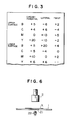
- FIG. 3 shows one output example derived from the printer l2; that is, the results of the arithmetic operations carried out by the personal computer 6.
- the personal computer 6 calculates based upon the magnification of the color pattern, information concerning the positions of the color pattern on the screen of the display device 4 and the information concerning the circumferential (lateral) direction on the screen of the display device 4 so that the registration errors between the respective color patterns can be obtained. It is more preferable that the personal computer is so designed and constructed that it can calculate optimum corrections of the positions of a plate cylinders.
- the printout example as shown in FIG. 3 will be described. This is an example of a printout of an optimum correction of the positions of plate cylinders.
- + represents the operation side in the lateral direction, the forward direction when twisted and the operation side in the circumferential direction while - represents the rearward direction in the circumferential direction and when twisted and the man side in the lateral direction.
- the unit of the numerical values shown is l/l00 mm. Therefore, for instance, BL (black) on the upper surface should be displaced by 5/l00 mm in the forward direction in the circumferential direction, should be displaced by l/l00 mm toward the gear side in the lateral direction and should be twisted by 2/l00 mm in the forward direction.
- References are upper side M (magenta) in the circumferential direction, lower side M (magenta) in the lateral direction and lower side C (cyan) in the twisted direction, which are all determined by the calculations.
- FIG. 6 shows a sheet-fed press to which is applied the present invention.
- the sheet-fed press prints the upper and lower surfaces of a sheet of paper separately so that when the lower surface is to be printed after the upper surface has been printed, it is preferable to utilize the patterns on the upper surface which have been already registered with each other.
- a glass plate 2l is embedded into the table l and a lamp 22 is disposed below the glass plate 2l.
- the light emitted from the lamp 22 is transmitted through a printed medium X and is focused by a lens system 2. Therefore, it becomes possible to observe from the lower surface side the register marks which are registered with each other on the upper surface. As a result, when viewed from the lower surface side, not only the register marks marked on the lower surface but also the register marks marked on the upper surface can be observed. Then it becomes possible to observe how much the deviation of the register marks printed on the lower surface from the register marks on the upper surface is.
- the operation panel ll is provided with an input button for entering the position of the register mark printed on the upper surface of the sheet so that the position of the register mark printed on the upper surface when viewed through the printed medium X is entered and the register mark on the lower surface is aligned with the register mark on the upper surface.
- the input of the coordinate positions of the register marks on the lower surface as well as the input of the circumferential (lateral) direction are substantially similar to that described above with reference to the rotary press. Otherwise a pinhole is provided at the centers of register marks so that the registration is rendered depending upon this pinhole. In this case the optical system shown in FIG. 6 is not needed.
- a combination of a focusing glass and a lens system is used.
- a printed medium X placed on the table l is magnified by an objective lens 33 and a magnifying lens 34, redirected by a mirror 35 and focused on the focusing glass 56.
- the printed medium X is sufficiently illuminated by the light emitted from a lamp 3l and redirected by a half mirror 35.
- the coordinates of the position of each color register mark is entered as an input through a transparent digitizer 37 bonded over the focusing glass 36 and is processed by a special microcomputer (not shown).
- a transparent digitizer 37 bonded over the focusing glass 36 and is processed by a special microcomputer (not shown).
- a conventional digitizer may be used and the digitizer used may be of an optical type, an ultrasonic type or a transparent electrode type.
- FIG. 8 shows a view for explaining a way of setting a camera 3 on a print X to be inspected.
- the print X is set on an inspecting table l00 on which the camera 3 is positioned over a predetermined portion of the print X.
- the camera 3 inputs the image of the registration mark (not shown) printed at the predetermined portion of the print X.
- FIGS. 9A and 9B show views for explaining detailed structure of the camera and its attachments in FIG. 8.
- the camera 3 is supported by a spacer 200 made of a transparent material so that the camera 3 is set on a print X.
- the spacer 200 is transparent, the operator who handles the camera 3 can easily observe whether the registration mark is just under the lense 2 of the camera 3.
- a light emitting end of an optical fiber 40 the other end of which is connected to a light source consisting of a lamp 38, a reflecting mirror 39 and a cooling fan 4l so that the portion under the camera 3 is illuminated by light emitted from one end of the optical fiber 40.
- FIG. 9B shows a view for explaining another way of setting the camera 3 on the print X.
- the camera 3 is supported by a moving mechanism 42 including a pair of side rails and a cross rail which is provided across the side rails.
- the cross rail is movable along a pair of side rails and is immovable when a stopper 43 is locked to fix the cross rail to the side rails.
- the spacer 200 is not needed because the camera 3 is supported by the moving mechanism.
Landscapes
- Inking, Control Or Cleaning Of Printing Machines (AREA)
- Accessory Devices And Overall Control Thereof (AREA)
Abstract
Description
- This invention relates to an apparatus for measuring registration errors by utilizing registration marks printed at predetermined positions on a multicolor print to be inspected, and more particularly to an apparatus for the same by utilizing a handy type image inputting device for inputting images of the registration marks.
- For instance, in the case of an offset press, a plate with a pattern is wrapped around a plate cylinder and an ink which is stored in an ink fountain is applied to the plate through a group of inking rollers. The ink applied to the plate is pressed against the plate cylinder and transferred to a blanket (rubber) cylinder which is rotating. A web or sheet of paper is made to pass between the blanket cylinder and an impression cylinder, whereby a pattern is printed on the web or sheet of paper. In the case of the multicolor printing, a unit comprising a plate cylinder, a blanket cylinder and an impression cylinder is provided for each color. The web or sheet of paper printed with a first color is made to pass the printing unit of a second color and then the printing unit for a third color, whereby multicolor printing is accomplished.
- Meanwhile in the multicolor offset printing process, when a plate wrapped around a plate cylinder is deviated from a predetermined position, a printed medium has registration errors in the circumferential direction (in the direction in which the web or sheet of paper is transported), the lateral direction and/or in the twisted direction.
- Therefore after a trial printing, an operator visually observes the print by means of a magnifier or the like to determine a registration error and in response to the registration error thus found, the operator adjusts the positions of the plates. These steps are repeated until the registration errors are completely eliminated.
- However, in order to visually measure registration errors and adjust the positions of plate cylinders in response to the registration error thus found, an operator must have great skill and long experience. Furthermore, the above-described steps must be repeated many times in a trial-and-error manner until all registration errors are eliminated so that much time is required and much printing paper is wasted.
- An object of the present invention is to provide a device for correctly measuring registration errors of a printed medium by a simple operation.
- A second object of the present invention is to provide a device capable of measuring a registration error of a printed medium in terms of a numerical value by a simple operation.
- To the above and other ends, the present invention provides a device of handy type for inputting a pattern of a printed medium on printing press, displaying the pattern on enlarged scale on the screen of a display device, inputting the coordinates of the positions of each color pattern for a predetermined element within the magnified and displayed image by a coordinate input means, determining registration errors between respective colors from the coordinates of the positions of each color and the magnification of the image, calculating a quantity required for the adjustment of the position of plate cylinders based on said registration errors and automatically effecting the registering of the printing press in response to the results of this calculation.
- Therefore, according to the present invention, the registration can be achieved only by one trial printing so that the operation time and paper can be considerably reduced.
-
- FIG. l is a perspective view used to explain an embodiment of the present invention;
- FIGS. 2(a) ∼ 2(e) show images displayed on a color cathode-ray tube shown in FIG. l;
- FIG. 3 is a view used to explain a printout obtained from the embodiment as shown in FIG. l;
- FIG. 4. is a flowchart showing the steps of arithmetic operation carried out by a computer shown in FIG. l;
- FIGS. 5(a) ∼ 5(f) are views used to explain the contents of arithmetic operations corresponding to the steps shown in FIG. 4;
- FIG. 6 is a view used to explain the present invention applied to a sheet-fed printing press;
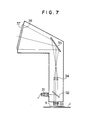
- FIG. 7 is a view used to explain a pure optical system for displaying on enlarged scale a pattern on a display screen;
- FIG. 8 is a view used to explain a way of setting a camera on a print to be inspected;
- FIGS. 9A and 9B are views used to explain detailed structure of the camera and its attachments in FIG. 8; and
- FIG. l0 is a view used to explain another way of setting a camera on a print to be inspected.
- The preferred embodiments of the present invention will be described with reference to the accompanying drawings.
- FIG. l shows an embodiment of the present invention which is applied to an offset press. A printed medium to be measured X is placed on a table l and a suitable portion of the printed medium X is magnified and focused through a
magnifying lens 2 with an extension tube. The magnified light image thus formed is converted by acolor video camera 3 into electrical signals which in turn are applied through asuperimposer 5 to a color cathode-ray tube 4 which displays an image magnified by tens of times. It is preferable that a pattern of the printed medium X to be displayed on the color cathode-ray tube 4 include a pattern which can distinctly indicate the misregistration. For example, it includes registration marks or patterns whose misregistration can be easily recognized. An image such as a cross-shaped cursor which is generated by apersonal computer 6 is superimposed through thesuperimposer 5 on the image displayed on the color cathode-ray tube 4. This cross-shaped cursor can be displaced in response to the operation of ajoy stick 8 connected through aninterface 7 to the personal computer. After the cursor is displaced in response to the operation of thejoy stick 8, an input instruction is applied by means of anoperation panel 9 whose input instruction buttons include "CIR.(circumferential)", "LAT.(lateral)", "UP(upper surface)", "LO(lower surface)", "OPE.(operation)", "MAN(man side)", "GR(gear side)", "RM I.(register mark input)" and "NDL(needle input)". - The coordinate inputs obtained by the operation of the
operation panel 9 in response to the shift of the cursor by thejoy stick 8 to the pattern picked up by thecamera 3 and displayed on the color cathode-ray tube 4 is calculated by thepersonal computer 6 and the calculation results; that is, the registration errors are converted into data for correcting the positions of a plate cylinder. - In addition to the
camera 3, as input means, a flat scanner may be used. Alternatively, the register mark on a printed medium may be directly made into contact with an image pickup tube or an image pickup element. Furthermore, the register mark is photographed by use of a Polaroid camera and a hard copy thus obtained is placed upon a digitizer to enter the position of the register mark. Instead of the color cathode-ray tube 4, a display device such as a liquid crystal display device or a plasma display device may be used. - Marks called registration marks and having shape of cross have long been utilized. These marks, consisting of four color marks, namely cyan, magenta, yellow and black, are printed on the gear side and the man side of a print respectively. The deviation between these marks is null when the registration is completed, so that good prints are produced. However, there are some problems to be solved when inputting respective positions of marks. Namely,
- l It is necessary to distinguish the colors of respective marks before inputting so that an expensive and large-sized color display and a corresponding color camera are required to display color image for the operator.
- 2 The operator tends to misunderstand colors when the registration is almost completed because the registration marks are overlapped each other at that time.
- The marks shown in Fig. 2(b), (c) do not have such drawbacks hereinabove. Fig. 2(b) shows a status in which registration is incompleted, and Fig. 2(c) shows another status in which the registration is completed, the registration marks being aligned with spacings of 3 millimeters along the circumferential direction. Since deviation of marks in circumferential direction seldom exceeds ±l millimeter, if it is predetermined to align these marks from the above to the below in the order of B, C, M and Y, there should be no change in the order.
- Accordingly,it is easily judged as to the relationship between marks and colors according to positional relationship of marks. As a result, there is no need to utilize a color display and camera at all. And it is predetermined when inputting images by camera that one of the circumferential directions is for example below, color judgement can be easily made by software in a personal computer so that it is unnecessary to input the colors of marks. Further it is easy to accomplish accurate position inputting because the marks never overlaps actually.
- FIGS. 2(a) ∼ (e) show the images displayed on the screen of the color cathode-ray tube 4 (see FIG. l). FIG. 2(a), (b) and (e) show misregistration display marks called register marks and cyan, magenta, yellow and black marks are marked on the gear side and on the operating side of the plate cylinder.
- FIG. 2(d) shows a cross-shaped cursor ll which is superimposed on the patterns or marks shown in FIG. 2(a), (b), (c) or (e). This cursor can be shifted to any position on the screen of the color cathode-
ray tube 4 in response to the operation of thejoy stick 8. FIG. 2(d) shows the point of the patterns upon which the cursor must be registered and there are two kinds of inputs. - A first kind of input is used to correct in the vertical and horizontal directions of the screen of the color cathode-
ray tube 4. When patterns on a printed medium are inputted by means of a camera, an operator sets the printed medium on the table l so that the circumferential and lateral directions of the printed medium will not coincide with the coordinates on the screen of the color cathode-ray tube 4. When a reference line representative of the vertical direction and a reference line representative of the horizontal or lateral direction are marked on the color cathode-ray tube 4 and if the operator sets the printed medium in such a way that one of the color register marks coincides with these reference lines, then the circumferential and lateral directions of the printed medium coincide with the coordinates on the screen of the color cathode-ray tube 4. However, this step is cumbersome in practice. Therefore, according to the present invention, even when the printed medium is arbitrarily set on the table, the coordinates are corrected by means of the personal computer. For instance, two points ll3 and ll4 on the vertical or horizontal line of one of the color register marks displayed on the screen of the color cathode-ray tube are entered. If the two points are vertically spaced apart from each other, the "CIR." button is depressed. On the other hand, when the two points are spaced apart from each other in the horizontal direction, the "LAT." button is depressed. Then, the vertical and horizontal directions can be automatically corrected. A second kind of input is used to designate the coordinates of each of the color register marks. In general, the register mark is in the form of a cross so that when the point of intersection between the vertical and horizontal lines is entered as an input, both the vertical and horizontal coordinates are also entered simultaneously. - In addition to the cross-shaped register mark, there are register marks with only a vertical or horizontal line. In the latter case, the coordinates representative of the direction of a vertical or horizontal line are entered as an input. In order to input, it suffices to input only one arbitrary point on the horizontal or vertical line. The coordinates of a position are determined in a coordinate system which in turn is determined in response to the corrections in the circumferential and lateral directions. However, in this case, only the circumferential or lateral operation is carried out so that the operation panel is provided with a button for operation only in the circumferential direction and a button for operation only in the lateral direction.
- And there is another example of inputting the circumferential or lateral direction. According to this method, the vertically upward direction of a register mark is always displayed in the vertically upward direction on the screen of the color cathode-ray tube. When an angle between the vertical of the screen of the color display cathode-ray tube and a line interconnecting between two points selected on the screen of the color cathode-ray tube is less than 45°, it is recognized that the vertical or circumferential input is made and on the other hand, when the angle is greater than 45°, it is recognized that the horizontal or lateral input is made. Therefore one button on the
operation panel 9 can have a dual function of the "CIR." and "LAT." buttons. - In the case of the offset press, the register marks are placed substantially at the same position on the upper and lower surfaces of the printing press and must be aligned with each other. Therefore a needle hole is formed adjacent to the register marks and is used to make the inputs of the misregistrations on the upper and lower surface. This can be done by manipulating "NDL" button on the
operation panel 9 as in the case of inputting the register mark position coordinate system. The upper and lower surfaces can be registered with each other based on the position of the needle hole as a reference. - The above-described input operations may be summarized as follows:
- The
joy stick 8 is operated in such a way that the cursor on the screen of the color cathode-ray tube 4 is sequentially registered with two points on the horizontal or vertical line of a register mark. Thereafter the "CIR." or "LAT." button on theoperation panel 9 is depressed. - The
joy stick 8 is so operated that the cursor is registered with each of the color registration patterns and then the "MAN" or "GR" button, and the "UP" or "LO" buttons are depressed. - The
joy stick 8 is so operated that the cursor on the display screen of the color cathode-ray tube 4 is aligned with the needle hole formed adjacent to the register marks and then the "NDL" button on theoperation panel 9 is depressed. - The operation is started according to the contents of the computation to be described below. FIGS. 4 and 5 show the arithmetic operations carried by the
personal computer 6 as shown in FIG. l. FIG. 4 shows the steps and FIGS. 5(a) ∼ (f) show the contents of the arithmetic operations. According to the first embodiment, the registration error is not computed, but the plate cylinder corrections are directly computed. The arithmetic operation steps comprise the depression of the operation button (S-l), the circumferential (lateral) direction correction (S-2), the .display for distinguishing colors (S-3), the coincidence of the coordiantes on the upper and lower surfaces (s-4), the arithmetic operation for obtaining the corrections of the twisted plate cylinder (S-5), and the arithmetic operation for obtaining the correction of the plate cylinder in the circumferential and lateral directions (S-6), and may comprise the application of signals to the motor drive circuit in the registration device of the printing press (S-7). The arithmetic operations are carried out by the five steps S-2 -- S-6 so that these steps will be described in detail hereinafter. - First the coordinates of the position of the register marks which are based on the X- and Y-axes (FIG. 5(a)) are converted into the coordinates based upon the circumferential and lateral direction in response to the circumferential and lateral direction information previously entered (FIG. 5(b)). In FIG. 5(a), (a, b) and (c, d) are coordinates of the position of the register mark based on the X- and Y-axes on the screen of the color cathode-ray tube and the coordinates (a′, b′) and (c′, d′) shown in FIG. 5(b) are those based on the X′- and Y′-axes with reference to the circumferential direction entered as an input. This operation is repeated four times for the gear side, the operation side and their upper and lower surfaces of one printed medium.
- Register marks are displayed on the
display 4 according to the converted coordinates along Y axis and are distinguished each other as B (black), C (cyan), M (magenta) and Y (yellow), when the marks of Fig. 2(c) are utilized. - In order to register all the register marks on the upper and lower surfaces, the coordinate transformation is carried out so that the upper surface and lower surface coordinate systems coincide with each other. For instance, FIGS. 5(e) and (f) show the conditions of the upper and lower surfaces when the circumferential directions are transformed so as to coincide with the Y′-axis. In these figures, (, p) and (q, r) are coordinates and * represents a needle hole.

- In the case of the coincidence operation, the
origin 0 is shifted to the pin hole (u, v) as shown in FIG. 5(e) and then shifted to the pin hole (s, t) as shown in FIG. 5(f) so that only the X′-axis sign of the register mark is changed.
(, p) → ( -u, p-v)
(q, r) → (s-q, r-t)
Then, the register marks on the upper and lower surfaces can be placed on the same coordinates. - A twist is calculated by using the coordinates in which the circumferential direction (lateral direction) is corrected and which is converted into the coordinates in common both on the upper and lower surfaces by the above-described steps l) and 2). FIGS. 5(c) and (d) show examples of the registration marks on the man and gear sides. In this case, BL (black) is twisted relative to C (blue) by
(to circumferential direction) {(j-3-l)-(f-3-h)} × m when the marks of Fig. 2(c) are utilized, [(j-l)∼(f-h)] × m when the marks of Fig. 2(a) are utilized where m is a constant inherent to a printing press. - As described above, a twist for each coloris obtained based on the reference C (blue) and a twisted shift is defined by a value obtained when an average twist is subtracted from the twist of each color. The corrections of the plate cylinders in the twisted direction can be obtained from the twisted shift and the magnification.
- The twist varies depending upon the width of a web of paper. Therefore, when the above-stated calculations are made on a web of paper having a standard width in order to obtain a correct twist, an error occurs when the width of a web of paper varies. Therefore, the width can be entered by using ten keys or one of the paper width selection keys is depressed depending on the width of a web of paper used so that the constant m may be varied. A plurality of paper width selection keys are previously provided depending upon the widths of webs of paper to be used.
- As the results of the above-described operations l) and 2), the positions of the register marks are represented in the same coordinate system on the upper and lower surfaces of the gear and man sides so that the shifts in the circumferential and lateral directions of the register marks so that they coincide with each other can be obtained by a simple arithmetic operation.
- For instance, the shifts are obtained by coinciding all the register marks with an average position in the circumferential, lateral and twist directions, but except the register marks which are extremely deviated, it suffices to obtain an average position. From these shifts and the magnifying power, the corrections of the positions of the plate cylinders in the circumferential and lateral directions can be obtained.
- Furthermore, instead of the joy stick, a mouse, a track ball, a light pen or digitizer may be used and a menu patch may be marked on the operation panel or a display device.
- FIG. 3 shows one output example derived from the printer l2; that is, the results of the arithmetic operations carried out by the
personal computer 6. - After the input operations i) ∼ iv) described above, upon depression of the "OPE" button on the
operation panel 9, the personal computer 6 (See FIG. 6) calculates based upon the magnification of the color pattern, information concerning the positions of the color pattern on the screen of thedisplay device 4 and the information concerning the circumferential (lateral) direction on the screen of thedisplay device 4 so that the registration errors between the respective color patterns can be obtained. It is more preferable that the personal computer is so designed and constructed that it can calculate optimum corrections of the positions of a plate cylinders. - The printout example as shown in FIG. 3 will be described. This is an example of a printout of an optimum correction of the positions of plate cylinders. + represents the operation side in the lateral direction, the forward direction when twisted and the operation side in the circumferential direction while - represents the rearward direction in the circumferential direction and when twisted and the man side in the lateral direction. The unit of the numerical values shown is l/l00 mm. Therefore, for instance, BL (black) on the upper surface should be displaced by 5/l00 mm in the forward direction in the circumferential direction, should be displaced by l/l00 mm toward the gear side in the lateral direction and should be twisted by 2/l00 mm in the forward direction. References are upper side M (magenta) in the circumferential direction, lower side M (magenta) in the lateral direction and lower side C (cyan) in the twisted direction, which are all determined by the calculations.
- Therefore when the position adjusting device of the printing press is activated in response to the printed out numerical values, the registration can be achieved for one time.
- FIG. 6 shows a sheet-fed press to which is applied the present invention. The sheet-fed press prints the upper and lower surfaces of a sheet of paper separately so that when the lower surface is to be printed after the upper surface has been printed, it is preferable to utilize the patterns on the upper surface which have been already registered with each other.
- In view of the above, as shown in FIG. 6, a glass plate 2l is embedded into the table l and a
lamp 22 is disposed below the glass plate 2l. The light emitted from thelamp 22 is transmitted through a printed medium X and is focused by alens system 2. Therefore, it becomes possible to observe from the lower surface side the register marks which are registered with each other on the upper surface. As a result, when viewed from the lower surface side, not only the register marks marked on the lower surface but also the register marks marked on the upper surface can be observed. Then it becomes possible to observe how much the deviation of the register marks printed on the lower surface from the register marks on the upper surface is. - In this case, instead of the "needle" button, the operation panel ll is provided with an input button for entering the position of the register mark printed on the upper surface of the sheet so that the position of the register mark printed on the upper surface when viewed through the printed medium X is entered and the register mark on the lower surface is aligned with the register mark on the upper surface. The input of the coordinate positions of the register marks on the lower surface as well as the input of the circumferential (lateral) direction are substantially similar to that described above with reference to the rotary press. Otherwise a pinhole is provided at the centers of register marks so that the registration is rendered depending upon this pinhole. In this case the optical system shown in FIG. 6 is not needed.
- In the embodiment shown in FIG. 7, a combination of a focusing glass and a lens system is used. A printed medium X placed on the table l is magnified by an
objective lens 33 and a magnifyinglens 34, redirected by amirror 35 and focused on the focusing glass 56. The printed medium X is sufficiently illuminated by the light emitted from a lamp 3l and redirected by ahalf mirror 35. - In this embodiment, the coordinates of the position of each color register mark is entered as an input through a
transparent digitizer 37 bonded over the focusingglass 36 and is processed by a special microcomputer (not shown). Instead of the transparent digitizer, a conventional digitizer may be used and the digitizer used may be of an optical type, an ultrasonic type or a transparent electrode type. - FIG. 8 shows a view for explaining a way of setting a
camera 3 on a print X to be inspected. The print X is set on an inspecting table l00 on which thecamera 3 is positioned over a predetermined portion of the print X. Thecamera 3 inputs the image of the registration mark (not shown) printed at the predetermined portion of the print X. - FIGS. 9A and 9B show views for explaining detailed structure of the camera and its attachments in FIG. 8. As shown in FIG. 9A the
camera 3 is supported by aspacer 200 made of a transparent material so that thecamera 3 is set on a print X. As thespacer 200 is transparent, the operator who handles thecamera 3 can easily observe whether the registration mark is just under thelense 2 of thecamera 3. - In the
spacer 200 is provided a light emitting end of anoptical fiber 40 the other end of which is connected to a light source consisting of alamp 38, a reflectingmirror 39 and a cooling fan 4l so that the portion under thecamera 3 is illuminated by light emitted from one end of theoptical fiber 40. - In the case of FIG. 9B, the
camera body 3A is separated from thespacer 200 which supports only thelens 2 which is connected to thecamera body 3A by a image guiding optical fiber. The other structures are similar to those in FIG. 9A. FIG. l0 shows a view for explaining another way of setting thecamera 3 on the print X. In this case, thecamera 3 is supported by a movingmechanism 42 including a pair of side rails and a cross rail which is provided across the side rails. The cross rail is movable along a pair of side rails and is immovable when astopper 43 is locked to fix the cross rail to the side rails. According to the structure for supporting the camera, thespacer 200 is not needed because thecamera 3 is supported by the moving mechanism.
Claims (7)
means for inputting an image of registration marks printed at a predetermined portion of a multicolor print to be inspected; and
a display for displaying said registration marks inputted by said image inputting means so as to measure said registration errors according to the image displayed,
characterized in that said image inputting means is a handy type device so as to be set over the registration mark on the print for inputting the image of said registration mark.
inputting images of registration marks printed at a predetermined portion of a multicolor print; and displaying enlarged image of the registration marks on a display for measurement of registration errors according to the displayed image,
characterized by comprising the steps of:
printing registration marks, regularly aligned with predetermined spaces therebetween, printed at a predetermined portion of a print to be inspected when the registration is completed; and
displaying enlarged image of said marks on a display,
thereby measuring the amount of registration error according to the positions of the registration marks of the respective color and its percentage of enlargement.
Applications Claiming Priority (2)
| Application Number | Priority Date | Filing Date | Title |
|---|---|---|---|
| JP60237515A JPS6297846A (en) | 1985-10-25 | 1985-10-25 | Method for measuring the amount of registration error in printed matter |
| JP237515/85 | 1985-10-25 |
Publications (2)
| Publication Number | Publication Date |
|---|---|
| EP0221472A2 true EP0221472A2 (en) | 1987-05-13 |
| EP0221472A3 EP0221472A3 (en) | 1988-08-10 |
Family
ID=17016463
Family Applications (1)
| Application Number | Title | Priority Date | Filing Date |
|---|---|---|---|
| EP86114790A Withdrawn EP0221472A3 (en) | 1985-10-25 | 1986-10-24 | An apparatus and a method for measuring registration errors of a print |
Country Status (2)
| Country | Link |
|---|---|
| EP (1) | EP0221472A3 (en) |
| JP (1) | JPS6297846A (en) |
Cited By (7)
| Publication number | Priority date | Publication date | Assignee | Title |
|---|---|---|---|---|
| DE3915587C1 (en) * | 1989-05-16 | 1990-11-08 | Man Roland Druckmaschinen Ag, 6050 Offenbach, De | Measurement element for multiple colour offset printing - determines match difference between two partial images independently of quality of image signal |
| WO1991001847A1 (en) * | 1989-07-26 | 1991-02-21 | Tecflex Limited | Optical alignment means |
| EP0401691A3 (en) * | 1989-06-08 | 1991-07-24 | Bobst S.A. | Method and device for detecting registration marks in a multicolour printing press |
| DE4012608A1 (en) * | 1990-04-20 | 1991-10-24 | Roland Man Druckmasch | METHOD AND DEVICE FOR DETERMINING PASSAGE DIFFERENCES AT PRINT IMAGE SITES OF A MULTICOLOR OFFSET PRINT |
| DE4335351A1 (en) * | 1993-10-16 | 1995-04-20 | Heidelberger Druckmasch Ag | Device for compensating register deviations in printed products |
| DE4335350A1 (en) * | 1993-10-16 | 1995-04-20 | Heidelberger Druckmasch Ag | Process and device for determining register deviations in multicolour printed products produced in a printing machine |
| DE102007031058A1 (en) | 2007-07-04 | 2009-01-08 | Manroland Ag | Method and device for the application of functional elements |
Families Citing this family (3)
| Publication number | Priority date | Publication date | Assignee | Title |
|---|---|---|---|---|
| US7193640B2 (en) | 2003-10-31 | 2007-03-20 | Polaroid Corporation | Printer color registration correction |
| JP2011110886A (en) * | 2009-11-30 | 2011-06-09 | Komori Corp | Registering device of printer and method for registering printer |
| DE102016204540A1 (en) * | 2016-03-18 | 2017-09-21 | Koenig & Bauer Ag | Inspection system with a screen for visual display of a photographic image |
Family Cites Families (5)
| Publication number | Priority date | Publication date | Assignee | Title |
|---|---|---|---|---|
| DE2731842C3 (en) * | 1977-07-14 | 1983-12-22 | Heidelberger Druckmaschinen Ag, 6900 Heidelberg | Method for determining changes in the halftone value of a color of printed sheets or webs caused by shifting and / or doubling |
| DD134743A1 (en) * | 1978-02-13 | 1979-03-21 | Arndt Jentzsch | PASSMARK EVALUATION UNIT ON MULTICOLOR PRINTING MACHINES |
| DE3136701C1 (en) * | 1981-09-16 | 1983-04-07 | M.A.N.- Roland Druckmaschinen AG, 6050 Offenbach | Device for scanning registration marks which are printed on printed matter and characterize the positional accuracy of the printing ink application |
| DE3136705C1 (en) * | 1981-09-16 | 1982-10-28 | M.A.N.- Roland Druckmaschinen AG, 6050 Offenbach | Process for the production of precise prints in printing machines |
| EP0177885A3 (en) * | 1984-10-03 | 1988-02-24 | Dai Nippon Insatsu Kabushiki Kaisha | Method and device for registering printing press |
-
1985
- 1985-10-25 JP JP60237515A patent/JPS6297846A/en active Pending
-
1986
- 1986-10-24 EP EP86114790A patent/EP0221472A3/en not_active Withdrawn
Cited By (14)
| Publication number | Priority date | Publication date | Assignee | Title |
|---|---|---|---|---|
| DE3915587C1 (en) * | 1989-05-16 | 1990-11-08 | Man Roland Druckmaschinen Ag, 6050 Offenbach, De | Measurement element for multiple colour offset printing - determines match difference between two partial images independently of quality of image signal |
| AU634241B2 (en) * | 1989-06-08 | 1993-02-18 | Bobst Sa | Procedure and device for detecting printing registration marks in a multi-colour printing press |
| EP0401691A3 (en) * | 1989-06-08 | 1991-07-24 | Bobst S.A. | Method and device for detecting registration marks in a multicolour printing press |
| US5138667A (en) * | 1989-06-08 | 1992-08-11 | Bobst Sa | Process and device for detecting print registration marks on a web from a multi-color printing press |
| WO1991001847A1 (en) * | 1989-07-26 | 1991-02-21 | Tecflex Limited | Optical alignment means |
| DE4012608A1 (en) * | 1990-04-20 | 1991-10-24 | Roland Man Druckmasch | METHOD AND DEVICE FOR DETERMINING PASSAGE DIFFERENCES AT PRINT IMAGE SITES OF A MULTICOLOR OFFSET PRINT |
| US5181257A (en) * | 1990-04-20 | 1993-01-19 | Man Roland Druckmaschinen Ag | Method and apparatus for determining register differences from a multi-color printed image |
| DE4335351A1 (en) * | 1993-10-16 | 1995-04-20 | Heidelberger Druckmasch Ag | Device for compensating register deviations in printed products |
| DE4335350A1 (en) * | 1993-10-16 | 1995-04-20 | Heidelberger Druckmasch Ag | Process and device for determining register deviations in multicolour printed products produced in a printing machine |
| US5500801A (en) * | 1993-10-16 | 1996-03-19 | Heidelberger Druckmaschinen Ag | Device for compensating for deviations in register in printed products |
| US5696890A (en) * | 1993-10-16 | 1997-12-09 | Heidelberger Druckmaschinen Ag | Method of register regulation and printing control element for determining register deviations in multicolor printing |
| DE4335351C2 (en) * | 1993-10-16 | 2003-04-30 | Heidelberger Druckmasch Ag | Method and device for compensating register deviations in an offset rotary printing machine |
| DE102007031058A1 (en) | 2007-07-04 | 2009-01-08 | Manroland Ag | Method and device for the application of functional elements |
| EP2025514A2 (en) | 2007-07-04 | 2009-02-18 | manroland AG | Method and device for applying functional elements |
Also Published As
| Publication number | Publication date |
|---|---|
| EP0221472A3 (en) | 1988-08-10 |
| JPS6297846A (en) | 1987-05-07 |
Similar Documents
| Publication | Publication Date | Title |
|---|---|---|
| JP2587053B2 (en) | Method and apparatus for correcting registration error in a multicolor printing press | |
| US5056430A (en) | Method of positioning plate cylinders in a multi-color rotary printing machine | |
| JP3053893B2 (en) | Register deviation detecting method and device | |
| DE3924989C2 (en) | ||
| US4963029A (en) | Register-measuring system | |
| EP0177885A2 (en) | Method and device for registering printing press | |
| EP0893254B1 (en) | Method and apparatus for registration mounting printing plates | |
| EP0221472A2 (en) | An apparatus and a method for measuring registration errors of a print | |
| EP0277329B1 (en) | A method of adjusting density measurement position | |
| JPS6391254A (en) | Method and device for correcting registration | |
| CN87103417A (en) | Overprint error determines in the colour printing | |
| CN101161457B (en) | Positioning device for a color measuring head | |
| US5649484A (en) | Electronic apparatus and computer-controlled method for alignment correction | |
| JPS6299149A (en) | Automatic registration device for printing presses | |
| JP3735251B2 (en) | Registration mark for printing and registration deviation measuring device | |
| JPH03175304A (en) | Measuring apparatus of positional shifting amount of recording paper | |
| JPS6184249A (en) | Registration error measuring device for printed matter | |
| JPH0315553A (en) | Plate registration detector of printing machine | |
| JP2002192701A (en) | Double detecting method, mark for detecting double, and double measuring apparatus | |
| JPH1034893A (en) | Method for deciding regulating amount for register regulator of sheet-feed printer | |
| JPH0519479B2 (en) | ||
| JP2006345367A (en) | Image measuring device and image measuring method | |
| JPS6184250A (en) | How to register a multicolor printing machine | |
| JP3356331B2 (en) | Color matching device | |
| JP2001018365A (en) | Color matching device |
Legal Events
| Date | Code | Title | Description |
|---|---|---|---|
| PUAI | Public reference made under article 153(3) epc to a published international application that has entered the european phase |
Free format text: ORIGINAL CODE: 0009012 |
|
| AK | Designated contracting states |
Kind code of ref document: A2 Designated state(s): CH DE FR GB IT LI SE |
|
| PUAL | Search report despatched |
Free format text: ORIGINAL CODE: 0009013 |
|
| AK | Designated contracting states |
Kind code of ref document: A3 Designated state(s): CH DE FR GB IT LI SE |
|
| 17P | Request for examination filed |
Effective date: 19881015 |
|
| STAA | Information on the status of an ep patent application or granted ep patent |
Free format text: STATUS: THE APPLICATION IS DEEMED TO BE WITHDRAWN |
|
| 18D | Application deemed to be withdrawn |
Effective date: 19900401 |
|
| RIN1 | Information on inventor provided before grant (corrected) |
Inventor name: YAMADA, KENJI Inventor name: SUZUKI, DAIJI Inventor name: KOBAYASHA, MICHIAKI |