EP0222117A2 - Verfahren zur Herstellung von ungesättigten cyclischen Alkoholen - Google Patents
Verfahren zur Herstellung von ungesättigten cyclischen Alkoholen Download PDFInfo
- Publication number
- EP0222117A2 EP0222117A2 EP86113117A EP86113117A EP0222117A2 EP 0222117 A2 EP0222117 A2 EP 0222117A2 EP 86113117 A EP86113117 A EP 86113117A EP 86113117 A EP86113117 A EP 86113117A EP 0222117 A2 EP0222117 A2 EP 0222117A2
- Authority
- EP
- European Patent Office
- Prior art keywords
- propanol
- column
- aldehyde
- aluminum
- alcoholate
- Prior art date
- Legal status (The legal status is an assumption and is not a legal conclusion. Google has not performed a legal analysis and makes no representation as to the accuracy of the status listed.)
- Granted
Links
- 238000000034 method Methods 0.000 title claims abstract description 16
- -1 unsaturated cyclic alcohols Chemical class 0.000 title claims abstract description 9
- 238000004519 manufacturing process Methods 0.000 title description 4
- KFZMGEQAYNKOFK-UHFFFAOYSA-N Isopropanol Chemical compound CC(C)O KFZMGEQAYNKOFK-UHFFFAOYSA-N 0.000 claims abstract description 79
- XAGFODPZIPBFFR-UHFFFAOYSA-N aluminium Chemical compound [Al] XAGFODPZIPBFFR-UHFFFAOYSA-N 0.000 claims abstract description 13
- 229910052782 aluminium Inorganic materials 0.000 claims abstract description 13
- 238000002360 preparation method Methods 0.000 claims abstract description 3
- CSCPPACGZOOCGX-UHFFFAOYSA-N Acetone Chemical compound CC(C)=O CSCPPACGZOOCGX-UHFFFAOYSA-N 0.000 claims description 12
- ACIAHEMYLLBZOI-ZZXKWVIFSA-N Unsaturated alcohol Chemical compound CC\C(CO)=C/C ACIAHEMYLLBZOI-ZZXKWVIFSA-N 0.000 claims description 9
- BTANRVKWQNVYAZ-UHFFFAOYSA-N butan-2-ol Chemical compound CCC(C)O BTANRVKWQNVYAZ-UHFFFAOYSA-N 0.000 claims description 7
- 238000004821 distillation Methods 0.000 claims description 4
- QVGXLLKOCUKJST-UHFFFAOYSA-N atomic oxygen Chemical compound [O] QVGXLLKOCUKJST-UHFFFAOYSA-N 0.000 claims description 2
- 229910052799 carbon Inorganic materials 0.000 claims description 2
- 229910052739 hydrogen Inorganic materials 0.000 claims description 2
- 239000001257 hydrogen Substances 0.000 claims description 2
- 239000007788 liquid Substances 0.000 claims description 2
- 229910052760 oxygen Inorganic materials 0.000 claims description 2
- 239000001301 oxygen Substances 0.000 claims description 2
- 125000002485 formyl group Chemical class [H]C(*)=O 0.000 claims 4
- UFHFLCQGNIYNRP-UHFFFAOYSA-N Hydrogen Chemical compound [H][H] UFHFLCQGNIYNRP-UHFFFAOYSA-N 0.000 claims 1
- 150000001299 aldehydes Chemical class 0.000 abstract description 24
- 238000006722 reduction reaction Methods 0.000 description 8
- 239000003054 catalyst Substances 0.000 description 5
- 238000006243 chemical reaction Methods 0.000 description 5
- 239000000203 mixture Substances 0.000 description 5
- 239000000047 product Substances 0.000 description 4
- MQBIZQLCHSZBOI-UHFFFAOYSA-N 4-(4-Methyl-3-pentenyl)-3-cyclohexene-1-carboxaldehyde Chemical compound CC(C)=CCCC1=CCC(C=O)CC1 MQBIZQLCHSZBOI-UHFFFAOYSA-N 0.000 description 3
- DCFDVJPDXYGCOK-UHFFFAOYSA-N cyclohex-3-ene-1-carbaldehyde Chemical compound O=CC1CCC=CC1 DCFDVJPDXYGCOK-UHFFFAOYSA-N 0.000 description 3
- MBVFRSJFKMJRHA-UHFFFAOYSA-N 4-fluoro-1-benzofuran-7-carbaldehyde Chemical group FC1=CC=C(C=O)C2=C1C=CO2 MBVFRSJFKMJRHA-UHFFFAOYSA-N 0.000 description 2
- YPHGCKOZJCGDTF-UHFFFAOYSA-N 4-methylcyclohex-3-ene-1-carbaldehyde Chemical compound CC1=CCC(C=O)CC1 YPHGCKOZJCGDTF-UHFFFAOYSA-N 0.000 description 2
- HGINCPLSRVDWNT-UHFFFAOYSA-N Acrolein Chemical compound C=CC=O HGINCPLSRVDWNT-UHFFFAOYSA-N 0.000 description 2
- RTZKZFJDLAIYFH-UHFFFAOYSA-N Diethyl ether Chemical compound CCOCC RTZKZFJDLAIYFH-UHFFFAOYSA-N 0.000 description 2
- WYURNTSHIVDZCO-UHFFFAOYSA-N Tetrahydrofuran Chemical compound C1CCOC1 WYURNTSHIVDZCO-UHFFFAOYSA-N 0.000 description 2
- 238000006423 Tishchenko reaction Methods 0.000 description 2
- 238000009835 boiling Methods 0.000 description 2
- 239000006227 byproduct Substances 0.000 description 2
- 150000002148 esters Chemical class 0.000 description 2
- JFNLZVQOOSMTJK-KNVOCYPGSA-N norbornene Chemical compound C1[C@@H]2CC[C@H]1C=C2 JFNLZVQOOSMTJK-KNVOCYPGSA-N 0.000 description 2
- LMHHRCOWPQNFTF-UHFFFAOYSA-N s-propan-2-yl azepane-1-carbothioate Chemical compound CC(C)SC(=O)N1CCCCCC1 LMHHRCOWPQNFTF-UHFFFAOYSA-N 0.000 description 2
- 239000002904 solvent Substances 0.000 description 2
- NPWYTMFWRRIFLK-UHFFFAOYSA-N 3,4-dihydro-2h-pyran-2-carbaldehyde Chemical compound O=CC1CCC=CO1 NPWYTMFWRRIFLK-UHFFFAOYSA-N 0.000 description 1
- 125000003119 4-methyl-3-pentenyl group Chemical group [H]\C(=C(/C([H])([H])[H])C([H])([H])[H])C([H])([H])C([H])([H])* 0.000 description 1
- LFQSCWFLJHTTHZ-UHFFFAOYSA-N Ethanol Chemical compound CCO LFQSCWFLJHTTHZ-UHFFFAOYSA-N 0.000 description 1
- 238000003612 Meerwein-Ponndorf-Verley reduction reaction Methods 0.000 description 1
- 239000002253 acid Substances 0.000 description 1
- 150000001298 alcohols Chemical class 0.000 description 1
- SMZOGRDCAXLAAR-UHFFFAOYSA-N aluminium isopropoxide Chemical compound [Al+3].CC(C)[O-].CC(C)[O-].CC(C)[O-] SMZOGRDCAXLAAR-UHFFFAOYSA-N 0.000 description 1
- 150000001732 carboxylic acid derivatives Chemical class 0.000 description 1
- 150000001735 carboxylic acids Chemical class 0.000 description 1
- 239000003638 chemical reducing agent Substances 0.000 description 1
- 238000004140 cleaning Methods 0.000 description 1
- JGDFBJMWFLXCLJ-UHFFFAOYSA-N copper chromite Chemical compound [Cu]=O.[Cu]=O.O=[Cr]O[Cr]=O JGDFBJMWFLXCLJ-UHFFFAOYSA-N 0.000 description 1
- 239000012043 crude product Substances 0.000 description 1
- 239000003822 epoxy resin Substances 0.000 description 1
- 238000002474 experimental method Methods 0.000 description 1
- 238000000605 extraction Methods 0.000 description 1
- 239000003205 fragrance Substances 0.000 description 1
- LNEPOXFFQSENCJ-UHFFFAOYSA-N haloperidol Chemical compound C1CC(O)(C=2C=CC(Cl)=CC=2)CCN1CCCC(=O)C1=CC=C(F)C=C1 LNEPOXFFQSENCJ-UHFFFAOYSA-N 0.000 description 1
- 150000004678 hydrides Chemical class 0.000 description 1
- 125000004435 hydrogen atom Chemical class [H]* 0.000 description 1
- 238000005984 hydrogenation reaction Methods 0.000 description 1
- 125000001449 isopropyl group Chemical group [H]C([H])([H])C([H])(*)C([H])([H])[H] 0.000 description 1
- JZKXXTVDUIVFJU-UHFFFAOYSA-N lead;propan-2-ol Chemical compound [Pb].CC(C)O JZKXXTVDUIVFJU-UHFFFAOYSA-N 0.000 description 1
- 239000012280 lithium aluminium hydride Substances 0.000 description 1
- 125000002496 methyl group Chemical group [H]C([H])([H])* 0.000 description 1
- 238000006053 organic reaction Methods 0.000 description 1
- 239000000825 pharmaceutical preparation Substances 0.000 description 1
- 229940127557 pharmaceutical product Drugs 0.000 description 1
- 229920000647 polyepoxide Polymers 0.000 description 1
- 229920000642 polymer Polymers 0.000 description 1
- 239000002243 precursor Substances 0.000 description 1
- 239000011814 protection agent Substances 0.000 description 1
- 238000000197 pyrolysis Methods 0.000 description 1
- 239000000376 reactant Substances 0.000 description 1
- 239000011541 reaction mixture Substances 0.000 description 1
- 150000003839 salts Chemical class 0.000 description 1
- 125000002914 sec-butyl group Chemical group [H]C([H])([H])C([H])([H])C([H])(*)C([H])([H])[H] 0.000 description 1
- 239000012279 sodium borohydride Substances 0.000 description 1
- 229910000033 sodium borohydride Inorganic materials 0.000 description 1
- 239000007787 solid Substances 0.000 description 1
- 125000001424 substituent group Chemical group 0.000 description 1
- YLQBMQCUIZJEEH-UHFFFAOYSA-N tetrahydrofuran Natural products C=1C=COC=1 YLQBMQCUIZJEEH-UHFFFAOYSA-N 0.000 description 1
- 238000011144 upstream manufacturing Methods 0.000 description 1
- XLYOFNOQVPJJNP-UHFFFAOYSA-N water Substances O XLYOFNOQVPJJNP-UHFFFAOYSA-N 0.000 description 1
- 238000010626 work up procedure Methods 0.000 description 1
Classifications
-
- C—CHEMISTRY; METALLURGY
- C07—ORGANIC CHEMISTRY
- C07C—ACYCLIC OR CARBOCYCLIC COMPOUNDS
- C07C33/00—Unsaturated compounds having hydroxy or O-metal groups bound to acyclic carbon atoms
- C07C33/05—Alcohols containing rings other than six-membered aromatic rings
- C07C33/14—Alcohols containing rings other than six-membered aromatic rings containing six-membered rings
-
- C—CHEMISTRY; METALLURGY
- C07—ORGANIC CHEMISTRY
- C07C—ACYCLIC OR CARBOCYCLIC COMPOUNDS
- C07C29/00—Preparation of compounds having hydroxy or O-metal groups bound to a carbon atom not belonging to a six-membered aromatic ring
- C07C29/132—Preparation of compounds having hydroxy or O-metal groups bound to a carbon atom not belonging to a six-membered aromatic ring by reduction of an oxygen containing functional group
- C07C29/136—Preparation of compounds having hydroxy or O-metal groups bound to a carbon atom not belonging to a six-membered aromatic ring by reduction of an oxygen containing functional group of >C=O containing groups, e.g. —COOH
- C07C29/14—Preparation of compounds having hydroxy or O-metal groups bound to a carbon atom not belonging to a six-membered aromatic ring by reduction of an oxygen containing functional group of >C=O containing groups, e.g. —COOH of a —CHO group
-
- C—CHEMISTRY; METALLURGY
- C07—ORGANIC CHEMISTRY
- C07D—HETEROCYCLIC COMPOUNDS
- C07D309/00—Heterocyclic compounds containing six-membered rings having one oxygen atom as the only ring hetero atom, not condensed with other rings
- C07D309/16—Heterocyclic compounds containing six-membered rings having one oxygen atom as the only ring hetero atom, not condensed with other rings having one double bond between ring members or between a ring member and a non-ring member
- C07D309/20—Heterocyclic compounds containing six-membered rings having one oxygen atom as the only ring hetero atom, not condensed with other rings having one double bond between ring members or between a ring member and a non-ring member with hydrogen atoms and substituted hydrocarbon radicals directly attached to ring carbon atoms
- C07D309/22—Radicals substituted by oxygen atoms
- C07D309/24—Methylol radicals
-
- C—CHEMISTRY; METALLURGY
- C07—ORGANIC CHEMISTRY
- C07C—ACYCLIC OR CARBOCYCLIC COMPOUNDS
- C07C2601/00—Systems containing only non-condensed rings
- C07C2601/12—Systems containing only non-condensed rings with a six-membered ring
- C07C2601/16—Systems containing only non-condensed rings with a six-membered ring the ring being unsaturated
-
- C—CHEMISTRY; METALLURGY
- C07—ORGANIC CHEMISTRY
- C07C—ACYCLIC OR CARBOCYCLIC COMPOUNDS
- C07C2602/00—Systems containing two condensed rings
- C07C2602/36—Systems containing two condensed rings the rings having more than two atoms in common
- C07C2602/42—Systems containing two condensed rings the rings having more than two atoms in common the bicyclo ring system containing seven carbon atoms
Definitions
- the invention relates to a process for the production of unsaturated cyclic alcohols by reduction of the corresponding aldehydes in the presence of aluminum alcoholate and 2-propanol.
- Various methods are known for obtaining unsaturated cyclic alcohols by reduction.
- DE-PS 1 101 409 relates to the hydrogenation of unsaturated aldehydes in the presence of copper chromite. Because of the high necessary pressures of 100 to 200 bar, a considerable amount of equipment is necessary, which, particularly in the case of continuous driving, entails considerable costs.
- Another alternative is to esterify the unsaturated aldehyde in the sense of a Tishchenko reaction and then hydrolytically esterify the ester to split (CWSmith, Acrolein, Wegig, Heidelberg, 1975, p. 176).
- This process is particularly uneconomical because, on the one hand, an additional reaction step is upstream and, on the other hand, because half of the aldehyde used is obtained as a carboxylic acid or its salt.
- solvent (2-propanol) is also used in large quantities, based on the aldehyde.
- the object of the invention is a process for the production of unsaturated cyclic alcohols in an economical way by reducing the corresponding aldehydes.
- Aldehydes of the formula (II) are used in which R1, R2, R3 and X have the meaning given above.
- the carboxaldehyde group is located either in the ⁇ or in the ⁇ position, preferably in the ⁇ position, based on X.
- the ring is preferably only monosubstituted, but advantageously not adjacent to this group. An exception is the bridging between R1 and X.
- the methyl group and 4-methyl-3-pentenyl group are particularly suitable as substituents.
- the reaction is carried out batchwise, for example in a dry distillation apparatus, in which the reaction mixture is heated and the acetone formed is optionally continuously drawn off together with small amounts of 2-propanol.
- the reaction temperature is between 80 and 120 ° C under normal pressure.
- One variant is that the mixture is not initially introduced, but the aldehyde is metered into the boiling solution of the alcoholate in 2-propanol either alone or in 2-propanol.
- the excess 2-propanol for example, since no water and no acid has to be used to destroy the alcoholate, can be removed in a simple manner and fed back to the reduction.
- the procedure is such that 2-propanol, aluminum alcoholate and aldehyde are fed into the column above the bottom and the acetone obtained as a by-product, which may contain traces of 2-propanol, is drawn off overhead.
- the sump which consists mainly of 2-propanol, alcoholate and the unsaturated alcohol in addition to small amounts of aldehyde and high boilers, is introduced into a second column in which 2-propanol is removed as the top product.
- a mixture of the desired alcohol, high boilers and the aluminum alcoholate is then obtained as the crude product in the bottom of the second column.
- the unsaturated alcohol is separated from this mixture in a third column.
- the 2-propanol obtained overhead in the 2nd column is recycled to the reduction column after addition in accordance with the amount of acetone formed.
- the workup can advantageously be designed by removing the unsaturated alcohol in vapor form in column 2 in a side stream above the bottom or above the first trays, thereby saving the third column.
- Column 2 and column 3 are operated at normal pressure; it is also possible to work under vacuum, for example 100-500 mbar.
- the columns can be tray columns, but columns with other internals or packed columns, as are known to the person skilled in the art, can be used.
- the reactants are fed in individually or in a mixture with one another (except for alcoholate and aldehyde) and are controlled in such a way that the highest possible conversion is achieved.
- the aldehyde is mixed with 2-propanol at the feed point, optionally preheated to 30 to 70 ° C.
- the bottom temperatures in the second and third columns are determined by the boiling temperatures of the 2-propanol or the desired unsaturated alcohol (depending on the pressure used).
- Solid alcoholates are expediently dissolved in 2-propanol. It is particularly preferred to use a so-called mixed alcoholate of 2-propanol and 2-butanol which is liquid at room temperature, as is commercially available, for example, from Texaco.
- the high boilers contained in this sump consist predominantly of the esters formed by the Tishchenko reaction and of 2-propyl and 2-butyl esters of the carboxylic acids corresponding to the aldehyde.
- the proportion of these by-products is very small in the process according to the invention, it is approximately 0.8 to 3.0% by weight, based on the aldehyde used.
- the unsaturated alcohols obtained by the process according to the invention are obtained in high purity; they are valuable precursors for the production of epoxy resins, polymers, fragrances, pharmaceutical products and crop protection agents.
- Aluminum mixed alcoholate served as the catalyst. It was also fed in above the swamp.
Landscapes
- Chemical & Material Sciences (AREA)
- Organic Chemistry (AREA)
- Organic Low-Molecular-Weight Compounds And Preparation Thereof (AREA)
- Pyrane Compounds (AREA)
Abstract
Description
- Die Erfindung betrifft ein Verfahren zur Herstellung ungesättigter cyclischer Alkohole durch Reduktion der entsprechenden Aldehyde in Gegenwart von Aluminiumalkoholat und 2-Propanol. Es sind verschiedene Methoden bekannt, ungesättigte cyclische Alkohole durch Reduktion zu gewinnen.
- So betrifft die DE-PS 1 101 409 die Hydrierung ungesättigter Aldehyde in Gegenwart von Kupferchromit. Wegen der hohen notwendigen Drücke von 100 bis 200 bar ist eine erhebliche apparative Ausrüstung notwendig, welche gerade bei kontinuierlicher Fahrweise erhebliche Kosten mit sich bringt.
- Weiterhin ist bekannt, obenstehende Aldehyde mit komplexen Hydriden, z.B. Natriumborhydrid oder Lithium-Aluminiumhydrid zu reduzieren (US-PS 4 287 100 und J.Org.Chem. 23, 184 (1958)).
- Neben den kostspieligen Reduktionsmitteln verhindern die verwendeten Lösungsmitteln wie Ether, Tetrahydrofuran wegen ihrer leichten Entzündbarkeit eine technische Verwertung dieses Verfahrens.
- Eine weitere Alternative besteht darin, den ungesättigten Aldehyd im Sinne einer Tischtschenko-Reaktion zu verestern und den Ester anschließend hydrolytisch zu spalten (C.W.Smith, Acrolein, Hüthig, Heidelberg, 1975, S. 176).
- Dieses Verfahren ist besonders unwirtschaftlich, da zum einen ein zusätzlicher Reaktionsschritt vorgelagert ist, und zum anderen, weil die Hälfte des eingesetzten Aldehyds als Carbonsäure bzw. deren Salz anfällt.
- Es ist auch bekannt Aldehyde nach Meerwein-Ponndorf Verley mit Aluminiumisopropylat zu reduzieren. Man setzt dabei einen großen Überschuß an Isopropylat ein, wie man den folgenden Handbüchern entnehmen kann:
- Vogel's Textbook of Practical Organic Chemistry, Longman, London, New York, 1978, 4. Auflage, S. 454;
Organic Reactions, Volume II, John Wiley & Sons, 4. Auflage 1947, S. 195. - Auch die Reduktion von Δ 3-Tetrahydrobenzaldehyd erfolgt unter Anwendung eines Überschusses an Isopropylat (Ber. Dtsch.Chem. Ges. 75, (1942) 890, 891).
- Gleichzeitig ist darauf zu verweisen, daß ebenfalls Lösungsmittel (2-Propanol) in großen Mengen, bezogen auf den Aldehyd, verwendet wird.
- Aufgabe der Erfindung ist ein Verfahren zur Herstellung von ungesättigten cyclischen Alkoholen auf einem wirtschaftlichen Weg durch Reduktion der entsprechenden Aldehyde.
- Gegenstand der Erfindung ist ein Verfahren zur Herstellung von ungesättigten cyclischen Alkoholen der Formel (I)

R₁, R₂, R₃, gleich oder verschieden: Wasserstoff, ein C₁ - C₁₀Alkylrest, geradkettig oder verzweigt ein C₂ - C₆ Akylenrest, geradkettig oder verzweigt, X: Sauerstoff oderCHR₄, wobei R₄ die gleiche Bedeutung wie R₁, R₂, R₃ hat, oder -CH , wenn über R₁ = CH₂- eine Kohlenstoffbrücke zu X besteht,

durch Reduktion der entsprechenden Aldehyde unter Verwendung von Aluminiumalkoholaten und 2-Propanol, dadurch gekennzeichnet, daß man den Aldehyd bei erhöhter Temperatur mit der 1,5 bis 5-fachen, bevorzugt 1,5 bis 3-fachen molaren Menge 2-Propanol in Gegenwart von 0,1 bis 5 Gew.-% Aluminiumalkoholat, beides bezogen auf den Aldehyd, reduziert, das bei der Reduktion entstehende Aceton gleichzeitig abdestilliert und anschließend den ungesättigten Alkohol destillativ reinigt. - Geringere Mengen 2-Propanol führen zu schlechten Ausbeuten, größere zu einem erhöhten Destillationsaufwand.
- Eingesetzt werden Aldehyde der Formel (II)
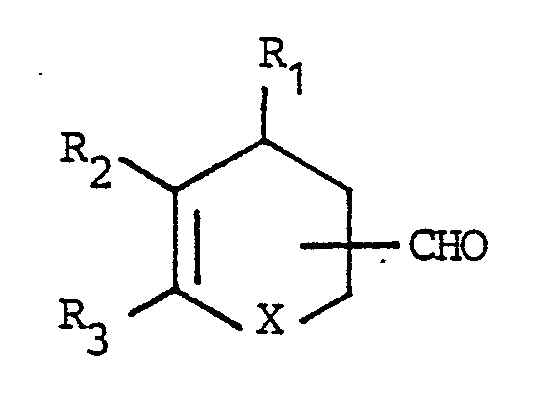
Die Carboxaldehydgruppe befindet sich entweder in α- oder in β-Stellung, bevorzugt in α-Stellung, bezogen auf X.
Der Ring ist zusätzlich zur Carboxaldehydgruppe bevorzugt nur einfach substituiert, vorteilhaft aber nicht dieser Gruppe benachbart.
Eine Ausnahme stellt die Brückenbildung zwischen R₁ und X dar. - Besonders sind als Substituenten die Methylgruppe und 4-Methyl-3-pentenylgruppe geeignet.
- Als vorteilhaft erweist sich insbesondere die Verwendung von
Norbonen-(2)-aldehyd,
2,3-Dihydro-4H-pyran-2-carboxaldehyd
(Formyldihydropyran)
3-Cyclohexen-1-carboxaldehyd
3- bzw. 4-(4-Methyl-3-pentenyl)-3-cyclohexen
-1-carboxaldehyd(Myracaldehyd)
3-bzw. 4-Methyl-3-cyclohexen-1-carboxaldehyd. - Man führt die Reaktion diskontinuierlich beispielsweise in einer trockenen Destillationsapparatur durch, in der man das Reaktionsgemisch erhitzt und das entstandene Aceton gegebenenfalls zusammen mit geringen Mengen 2-Propanol laufend abzieht.
- Dabei liegt die Umsetzungstemperatur zwischen 80 und 120°C unter Normaldruck.
- Dabei ist natürlich zu berücksichtigen, daß bei erhöhten Drücken höhere Temperaturen und bei Drücken unterhalb des Normaldrucks tiefere Temperaturen vorteilhaft sind.
- Eine Variante besteht darin, daß man das Gemisch nicht vorlegt, sondern den Aldehyd entweder allein oder in 2-Propanol gelöst in die siedende Lösung des Alkoholats in 2-Propanol eindosiert.
- Nach Abschluß der Reaktion zieht man das restliche 2-Propanol unter Vakuum ab und gewinnt anschließend destillativ oder durch Extraktion den gewünschten ungesättigten Alkohol.
- Seine besonderen Vorteile entfaltet das erfindungsgemäße Verfahren bei kontinuierlicher Durchführung.
- Das überschüssige 2-Propanol kann zum Beispiel, da kein Wasser und keine Säure zur Zerstörung des Alkoholats eingesetzt werden muß, in einfacher Weise abgezogen und der Reduktion wieder zugeführt werden.
- Man geht so vor, daß man oberhalb des Sumpfes 2-Propanol, Aluminiumalkoholat und Aldehyd in die Kolonne einspeist und über Kopf das als Nebenprodukt anfallende Aceton, das ggf. Spuren an 2-Propanol enthalten kann, abzieht. Der Sumpf, der vorwiegend aus 2-Propanol, Alkoholat und dem ungesättigten Alkohol neben geringen Mengen Aldehyd und Hochsiedern besteht, wird in eine zweite Kolonne eingeleitet, in der man als Kopfprodukt 2-Propanol entfernt. Im Sumpf der zweiten Kolonne fällt dann als Rohprodukt ein Gemisch aus gewünschtem Alkohol, Hochsiedern und dem Aluminiumalkoholat an.
- Aus diesem Gemisch trennt man in einer dritten Kolonne den ungesättigten Alkohol ab.
- Das in der 2. Kolonne über Kopf anfallende 2-Propanol wird nach Ergänzung gemäß der gebildeten Acetonmenge in die Reduktionskolonne zurückgeführt. Besonders vorteilhaft kann die Aufarbeitung dadurch gestaltet werden, indem man in Kolonne 2 den ungesättigten Alkohol dampfförmig im Seitenstrom über dem Sumpf oder oberhalb der ersten Böden entnimmt und damit die 3. Kolonne einspart.
- Kolonne 2 und Kolonne 3 werden bei Normaldruck betrieben; ebenso gut kann aber auch unter Vakuum, zum Beispiel 100-500 mbar gearbeitet werden. Die Kolonnen können Bodenkolonnen sein, es können aber Kolonnen mit anderen Einbauten oder Füllkörperkolonnen, wie sie dem Fachmann bekannt sind, eingesetzt werden.
- Die Einspeisung der Reaktionsteilnehmer erfolgt einzeln oder im Gemisch miteinander (außer Alkoholat und Aldehyd) und wird so gesteuert, daß ein möglichst hoher Umsatz erreicht wird.
- Vorteilhafterweise führt man den Aldehyd im Gemisch mit 2-Propanol an der Einspeisungsstelle, gegebenenfalls auf 30 bis 70°C vorgeheizt zu.
- Die Reduktion findet dann in der Kolonne innerhalb eines Temperaturbereichs statt, der bei Normaldruck von ca. 56°C am Kopf der Kolonne bis zu 80 bis 120°C im Sumpf reicht.
- Die Sumpftemperaturen in der zweiten und dritten Kolonne werden durch die Siedetemperaturen des 2-Propanols beziehungsweise des gewünschten ungesättigten Alkohols bestimmt (in Abhängigkeit vom angewandten Druck).
- Als Katalysator verwendet man dem Fachmann bekannte Aluminiumalkoholate, z.B. 2-Propanolat oder 2-Butanolat.
- Feste Alkoholate löst man zweckmäßigerweise in 2-Propanol. Besonders bevorzugt ist der Einsatz eines bei Raumtemperatur flüssigen sog. Mischalkoholats des 2-Propanol und 2-Butanol, wie es zum Beispiel von Texaco kommerziell angeboten wird.
- Es ist besonders günstig, einen Teil des Sumpfes der letzten Stufe, der vorwiegend Katalysator neben Hochsiedern enthält, in die Reduktionskolonne(erste Kolonne), zurückzuführen, um den Verbrauch an frischem Katalysator weiter zu verringern.
- Die in diesem Sumpf enthaltenen Hochsieder bestehen vorwiegend aus den durch Tischtschenko-Reaktion gebildeten Estern sowie aus 2-Propyl und 2-Butyl-Estern der dem Aldehyd entsprechenden Carbonsäuren. Der Anteil an diesen Nebenprodukten ist nach dem erfindungsgemäßen Verfahren sehr gering, er liegt bei ca. 0,8 bis 3,0 Gew.-%, bezogen auf eingesetzten Aldehyd. Die nach dem erfindungsgemäßen Verfahren erhaltenen ungesättigten Alkohole fallen in hoher Reinheit an; sie sind wertvolle Vorstufen zur Herstellung von Epoxidharzen, Polymeren, Riechstoffen, pharmazeutischen Produkten und Pflanzenschutzmitteln.
- In eine Glockenbodenkolonne (20 Böden) speist man Katalysator, Aldehyd und 2-Propanol ein (siehe Tabelle). Der Sumpf wurde kontinuierlich über einen Zwischenkühler abgezogen und in eine zweite Kolonne (Einlauf 10./11. Boden, p=300 mbar) eingespeist. Die Produktabnahme erfolgte dampfförmig im Seitenstrom zwischen dem 2./3. Boden. Das Destillat von Kolonne 2 (Kopfprodukt) wurde vollständig in die Beschickungsvorlage von Kolonne 1, der Sumpf zu bis 70 % in die Mischalkoholatvorlage rückgeführt.
- Es wurden sowohl Gemische von Aldehyd und 2-Propanol (gleiche Bödenzahl) als auch die Komponenten einzeln zugeführt (ungleiche Bodenzahl).
- Als Katalysator diente Aluminium-Mischalkoholat. Er wurde ebenfalls oberhalb des Sumpfes eingespeist.
- Die Sumpftemperatur in der 1. Kolonne lag zwischen 85 und 110°C.
Das im Seitenstrom abgezogene Produkt bedurfte keiner weiteren Reinigung.
Es wurden eingesetzt:
- A: 3-Cyclohexen-1-carboxaldehyd
- B: Norbonen-2-aldehyd
- C: Formyldihydropyran
- D: Myracaldehyd
- Die in der Tabelle angegebenen Verweilzeiten gelten für Kolonne 1 incl. Sumpf.
Umsatz und Ausbeute beziehen sich auf die Menge des eingesetzten Aldehyds.
Claims (4)

R₁, R₂, R₃, gleich oder verschieden: Wasserstoff ein C₁-C₁₀ Alkylrest, geradkettig oder verzweigt ein C₂-C₆ Alkylenrest, geradkettig oder verzweigt, X: Sauerstoff oder


durch Reduktion der entsprechenden Aldehyde unter Verwendung von Aluminiumalkoholaten und 2-Propanol, dadurch gekennzeichnet, daß man den Aldehyd bei erhöhter Temperatur mit der 1,5 bis 5-fachen molaren Menge 2-Propanol in Gegenwart von 0,1 bis 6 Gew.-% Aluminiumalkoholat, beides bezogen auf den Aldehyd, reduziert, das bei der Reduktion entstehende Aceton gleichzeitig abdestilliert und anschließend den ungesättigten Alkohol destillativ reinigt.
Priority Applications (1)
| Application Number | Priority Date | Filing Date | Title |
|---|---|---|---|
| AT86113117T ATE49398T1 (de) | 1985-11-11 | 1986-09-24 | Verfahren zur herstellung von ungesaettigten cyclischen alkoholen. |
Applications Claiming Priority (2)
| Application Number | Priority Date | Filing Date | Title |
|---|---|---|---|
| DE3539872 | 1985-11-11 | ||
| DE19853539872 DE3539872A1 (de) | 1985-11-11 | 1985-11-11 | Verfahren zur herstellung von ungesaettigten cyclischen alkoholen |
Publications (3)
| Publication Number | Publication Date |
|---|---|
| EP0222117A2 true EP0222117A2 (de) | 1987-05-20 |
| EP0222117A3 EP0222117A3 (en) | 1987-12-16 |
| EP0222117B1 EP0222117B1 (de) | 1990-01-10 |
Family
ID=6285622
Family Applications (1)
| Application Number | Title | Priority Date | Filing Date |
|---|---|---|---|
| EP86113117A Expired - Lifetime EP0222117B1 (de) | 1985-11-11 | 1986-09-24 | Verfahren zur Herstellung von ungesättigten cyclischen Alkoholen |
Country Status (5)
| Country | Link |
|---|---|
| EP (1) | EP0222117B1 (de) |
| JP (1) | JPS62114924A (de) |
| AT (1) | ATE49398T1 (de) |
| BE (1) | BE905699A (de) |
| DE (2) | DE3539872A1 (de) |
Cited By (1)
| Publication number | Priority date | Publication date | Assignee | Title |
|---|---|---|---|---|
| WO2006079819A3 (en) * | 2005-01-27 | 2007-05-10 | Univ Nottingham | Improved method for the preparation of enantiomerically enriched secondary alcohols by the addition of organoaluminium reagents to carbonyl compounds |
Families Citing this family (1)
| Publication number | Priority date | Publication date | Assignee | Title |
|---|---|---|---|---|
| JPS63275538A (ja) * | 1987-05-06 | 1988-11-14 | Daicel Chem Ind Ltd | テトラヒドロベンジルアルコ−ルの製造方法 |
Family Cites Families (1)
| Publication number | Priority date | Publication date | Assignee | Title |
|---|---|---|---|---|
| DE3224380A1 (de) * | 1982-06-30 | 1984-01-12 | Hoechst Ag, 6230 Frankfurt | Verfahren zur herstellung araliphatischer alkohole |
-
1985
- 1985-11-11 DE DE19853539872 patent/DE3539872A1/de not_active Withdrawn
-
1986
- 1986-09-24 DE DE8686113117T patent/DE3668165D1/de not_active Expired - Lifetime
- 1986-09-24 EP EP86113117A patent/EP0222117B1/de not_active Expired - Lifetime
- 1986-09-24 AT AT86113117T patent/ATE49398T1/de not_active IP Right Cessation
- 1986-11-05 BE BE0/217367A patent/BE905699A/fr not_active IP Right Cessation
- 1986-11-10 JP JP61265743A patent/JPS62114924A/ja active Pending
Cited By (1)
| Publication number | Priority date | Publication date | Assignee | Title |
|---|---|---|---|---|
| WO2006079819A3 (en) * | 2005-01-27 | 2007-05-10 | Univ Nottingham | Improved method for the preparation of enantiomerically enriched secondary alcohols by the addition of organoaluminium reagents to carbonyl compounds |
Also Published As
| Publication number | Publication date |
|---|---|
| DE3539872A1 (de) | 1987-05-14 |
| BE905699A (fr) | 1987-05-05 |
| EP0222117A3 (en) | 1987-12-16 |
| ATE49398T1 (de) | 1990-01-15 |
| JPS62114924A (ja) | 1987-05-26 |
| DE3668165D1 (de) | 1990-02-15 |
| EP0222117B1 (de) | 1990-01-10 |
Similar Documents
| Publication | Publication Date | Title |
|---|---|---|
| EP1230206B1 (de) | Verfahren zur herstellung von ameisensäure | |
| DD147664A5 (de) | Verfahren zur gleichzeitigen herstellung von reinem methyl-tert.-butylether | |
| EP0008654A1 (de) | Verfahren zur Gewinnung von reinen 2-(Perfluoralkyl)-äthanolen aus ihren Gemischen mit 2-(Perfluoralkyl)-äthylenen und gegebenenfalls 2-(Perfluoralkyl)-äthylestern | |
| EP0992477B1 (de) | Verfahren zur Herstellung von Citral | |
| EP0897380A1 (de) | VERFAHREN ZUR HERSTELLUNG $g(g), $g(d)-UNGESÄTTIGTER KETONE DURCH UMSETZUNG TERTIÄRER ALLYLALKOHOLE MIT ALKENYLALKYLETHERN | |
| DE3719790A1 (de) | Herstellung von langkettigen polyolen aus nachwachsenden rohstoffen | |
| DE69214026T2 (de) | Herstellung von Neopentylglykol (III) | |
| DE2538532C2 (de) | Verfahren zur Abtrennung von stereospezifischer Farnesylessigsäure oder deren Ester aus stereoisomeren Mischungen | |
| EP0847976B1 (de) | Verfahren zur Herstellung von Glyoxalmonoacetalen | |
| EP0000140B1 (de) | Verfahren zur Herstellung von wässrigen Lösungen bzw. feinteiligen wässrigen Dispersionen von Polyenyltriarylphosphoniumsalzen | |
| EP0222117B1 (de) | Verfahren zur Herstellung von ungesättigten cyclischen Alkoholen | |
| DE3442937A1 (de) | Kontinuierliches verfahren zur herstellung von 1,2-pentandiol | |
| CH631147A5 (de) | Verfahren zur herstellung von acetalen. | |
| DE1200281B (de) | Verfahren zur Herstellung von Acetessigsaeureestern | |
| DE3938121A1 (de) | Verfahren zur abtrennung von (alpha)-butyrolacton aus gemischen, die bernsteinsaeurediethylester enthalten | |
| EP1300387A1 (de) | Verfahren zum Herstellen von Estern einer Hydroxysäure | |
| EP1216979A1 (de) | Verfahren zur Herstellung von Trimethylolverbindungen und Ameisensäure | |
| EP0080118B1 (de) | Verfahren zur Herstellung von Malondialdehydtetraalkylacetalen | |
| EP0080023B1 (de) | Verfahren zum kontinuierlichen Verestern von Methacrylsäure | |
| EP0230951A2 (de) | Halbacetale von Glyoxylsäureestern sowie Verfahren zur Isolierung von Glyoxylsäureestern | |
| EP0182168B1 (de) | Verfahren zur Herstellung von Hydroxymethylen-alkoxyessigsäureestern | |
| EP0222988B1 (de) | Verfahren zur Herstellung von Hydroxymethylcyclopropan (Cyclopropylmethanol) | |
| DE2729974B2 (de) | Verfahren zur Herstellung von wäßrigen Lösungen bzw. feinteiligen wäßrigen Dispersionen von Polyenyltriarylphosphoniumsalzen | |
| DE4241448C2 (de) | Verfahren zur Herstellung von schwefelfreien Dicarbonsäuredimethylestern | |
| DE2111669A1 (de) | Herstellung von Alkoholen |
Legal Events
| Date | Code | Title | Description |
|---|---|---|---|
| PUAI | Public reference made under article 153(3) epc to a published international application that has entered the european phase |
Free format text: ORIGINAL CODE: 0009012 |
|
| 17P | Request for examination filed |
Effective date: 19860924 |
|
| AK | Designated contracting states |
Kind code of ref document: A2 Designated state(s): AT CH DE FR GB IT LI NL SE |
|
| PUAL | Search report despatched |
Free format text: ORIGINAL CODE: 0009013 |
|
| AK | Designated contracting states |
Kind code of ref document: A3 Designated state(s): AT CH DE FR GB IT LI NL SE |
|
| 17Q | First examination report despatched |
Effective date: 19890217 |
|
| GRAA | (expected) grant |
Free format text: ORIGINAL CODE: 0009210 |
|
| ITF | It: translation for a ep patent filed | ||
| AK | Designated contracting states |
Kind code of ref document: B1 Designated state(s): AT CH DE FR GB IT LI NL SE |
|
| REF | Corresponds to: |
Ref document number: 49398 Country of ref document: AT Date of ref document: 19900115 Kind code of ref document: T |
|
| GBT | Gb: translation of ep patent filed (gb section 77(6)(a)/1977) | ||
| ET | Fr: translation filed | ||
| REF | Corresponds to: |
Ref document number: 3668165 Country of ref document: DE Date of ref document: 19900215 |
|
| PGFP | Annual fee paid to national office [announced via postgrant information from national office to epo] |
Ref country code: CH Payment date: 19900905 Year of fee payment: 5 |
|
| PGFP | Annual fee paid to national office [announced via postgrant information from national office to epo] |
Ref country code: SE Payment date: 19900918 Year of fee payment: 5 |
|
| PGFP | Annual fee paid to national office [announced via postgrant information from national office to epo] |
Ref country code: NL Payment date: 19900930 Year of fee payment: 5 |
|
| PLBE | No opposition filed within time limit |
Free format text: ORIGINAL CODE: 0009261 |
|
| STAA | Information on the status of an ep patent application or granted ep patent |
Free format text: STATUS: NO OPPOSITION FILED WITHIN TIME LIMIT |
|
| 26N | No opposition filed | ||
| PGFP | Annual fee paid to national office [announced via postgrant information from national office to epo] |
Ref country code: DE Payment date: 19910816 Year of fee payment: 6 |
|
| PGFP | Annual fee paid to national office [announced via postgrant information from national office to epo] |
Ref country code: AT Payment date: 19910910 Year of fee payment: 6 |
|
| PGFP | Annual fee paid to national office [announced via postgrant information from national office to epo] |
Ref country code: GB Payment date: 19910913 Year of fee payment: 6 |
|
| PG25 | Lapsed in a contracting state [announced via postgrant information from national office to epo] |
Ref country code: SE Effective date: 19910925 |
|
| PGFP | Annual fee paid to national office [announced via postgrant information from national office to epo] |
Ref country code: FR Payment date: 19910927 Year of fee payment: 6 |
|
| PG25 | Lapsed in a contracting state [announced via postgrant information from national office to epo] |
Ref country code: LI Effective date: 19910930 Ref country code: CH Effective date: 19910930 |
|
| PG25 | Lapsed in a contracting state [announced via postgrant information from national office to epo] |
Ref country code: NL Effective date: 19920401 |
|
| NLV4 | Nl: lapsed or anulled due to non-payment of the annual fee | ||
| REG | Reference to a national code |
Ref country code: CH Ref legal event code: PL |
|
| PG25 | Lapsed in a contracting state [announced via postgrant information from national office to epo] |
Ref country code: GB Effective date: 19920924 Ref country code: AT Effective date: 19920924 |
|
| GBPC | Gb: european patent ceased through non-payment of renewal fee |
Effective date: 19920924 |
|
| PG25 | Lapsed in a contracting state [announced via postgrant information from national office to epo] |
Ref country code: FR Effective date: 19930528 |
|
| PG25 | Lapsed in a contracting state [announced via postgrant information from national office to epo] |
Ref country code: DE Effective date: 19930602 |
|
| REG | Reference to a national code |
Ref country code: FR Ref legal event code: ST |
|
| EUG | Se: european patent has lapsed |
Ref document number: 86113117.5 Effective date: 19920408 |
|
| PG25 | Lapsed in a contracting state [announced via postgrant information from national office to epo] |
Ref country code: IT Free format text: LAPSE BECAUSE OF NON-PAYMENT OF DUE FEES;WARNING: LAPSES OF ITALIAN PATENTS WITH EFFECTIVE DATE BEFORE 2007 MAY HAVE OCCURRED AT ANY TIME BEFORE 2007. THE CORRECT EFFECTIVE DATE MAY BE DIFFERENT FROM THE ONE RECORDED. Effective date: 20050924 |