EP0222308A2 - Funkkommunikationssystem mit Mitteln zum Vermeiden einer Signalkollision - Google Patents
Funkkommunikationssystem mit Mitteln zum Vermeiden einer Signalkollision Download PDFInfo
- Publication number
- EP0222308A2 EP0222308A2 EP86115292A EP86115292A EP0222308A2 EP 0222308 A2 EP0222308 A2 EP 0222308A2 EP 86115292 A EP86115292 A EP 86115292A EP 86115292 A EP86115292 A EP 86115292A EP 0222308 A2 EP0222308 A2 EP 0222308A2
- Authority
- EP
- European Patent Office
- Prior art keywords
- data
- slave station
- master station
- station
- time period
- Prior art date
- Legal status (The legal status is an assumption and is not a legal conclusion. Google has not performed a legal analysis and makes no representation as to the accuracy of the status listed.)
- Withdrawn
Links
- 238000000034 method Methods 0.000 claims 4
- 238000012544 monitoring process Methods 0.000 claims 2
- 230000005540 biological transmission Effects 0.000 description 11
- 230000006870 function Effects 0.000 description 6
- 238000010586 diagram Methods 0.000 description 3
- 238000010276 construction Methods 0.000 description 1
- 238000001514 detection method Methods 0.000 description 1
- 239000004973 liquid crystal related substance Substances 0.000 description 1
- 230000010355 oscillation Effects 0.000 description 1
- 239000010453 quartz Substances 0.000 description 1
- VYPSYNLAJGMNEJ-UHFFFAOYSA-N silicon dioxide Inorganic materials O=[Si]=O VYPSYNLAJGMNEJ-UHFFFAOYSA-N 0.000 description 1
Images


Classifications
-
- H—ELECTRICITY
- H04—ELECTRIC COMMUNICATION TECHNIQUE
- H04W—WIRELESS COMMUNICATION NETWORKS
- H04W16/00—Network planning, e.g. coverage or traffic planning tools; Network deployment, e.g. resource partitioning or cells structures
- H04W16/14—Spectrum sharing arrangements between different networks
-
- H—ELECTRICITY
- H04—ELECTRIC COMMUNICATION TECHNIQUE
- H04W—WIRELESS COMMUNICATION NETWORKS
- H04W84/00—Network topologies
- H04W84/18—Self-organising networks, e.g. ad-hoc networks or sensor networks
Definitions
- the present invention relates to a radio communication system and, particularly, a radio communication system in which a plurality of communication groups each having a master station and at least one slave station use a single common carrier frequency.
- the signal collision may include a collision between signals from the different master stations and a collision between signals from a slave station of one group and a master station of another group, etc.
- one station detects a carrier frequency from another station and transmits a signal during a time in which the carrier frequency is not used by the another station.
- both of the master station and the slave station must have carrier sense functions, respectively.
- an object of the present invention is to provide a radio communication system in which master stations have carrier sensing functions, respectively, to thereby avoid the signal collision problem.
- Another object of the present invention is to provide a radio communication system in which a plurality of communication groups each including a master station and at least one slave station can use a single common carrier frequency, while avoiding the signal collision problem.
- a radio communication system comprising a plurality of communication groups each including a master station and at least a slave station, said communication groups being adapted to use a single common frequency, wherein the master station has means for sensing a carrier wave of the common frequency, wherein the master station transmits a data when the master station does not detect the carrier wave for a first predetermined time period, and wherein the slave station transmits an acknowledging signal, upon a reception of the data, within a second predetermined time period shorter than the first predetermined time period.
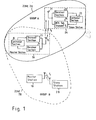
- a radio communication system includes a pair of communication groups A and B which use a carrier frequency f 1 commonly. It may be possible to include three or more communication groups in this system.
- the communication group A includes a master station 1A and a slave station 2A and the group B includes a master station 1B and a slave station 2B.
- the number of slave stations in each communication group may be any.
- a service zone of the group A is shown by a solid line ZA and that of the group B is shown by a dotted line ZB.
- the service zones of the groups A and B overlaps each other and thus an interference in communication may occur in the overlapped zone.
- the master station lA is composed of a transmitter section 13 for sending a data from a controller section 12 to the slave station 2A over the carrier frequency fl, a receiver section 14 for receiving an acknowledging signal which is sent by the slave station 2A, upon a reception of the data, over the same frequency.
- the receiver section 14 of the master station 1A has a carrier sense function to decide whether or not the carrier is being used by the slave station 2A and/or the communication group B.
- the slave station 2A is composed of a receiver section 22 tuned to the carrier frequency f 1 , a controller section 23 for controlling an operation of the slave station 2A and a transmitter section 24 for sending an acknowledging signal ACK to the master station lA. Since the master station 1B and the slave station 2B are constituted with identical components to those of the master station and the slave station of the group A and operate in the same way as those of the group A, an operation of only the communication group A will be described with reference to Fig. 2.
- the controller section 12 of the master station lA determines, at step 10S, whether or not a data transmission is requested and to set a carrier sense timer having a time T, at step 11S, every time when a data transmission request occurs. Then, the controller section 12 monitors whether or not the carrier frequency f I is being used by any other station before the time period T of the timer expires, at steps 12S and 13S, respectively. When the carrier frequency f 1 is not sensed within the time period T, the operation is shifted to a data transmission phase in step 14S. On the other hand, when the carrier being used is sensed in the step 12S, the operation is returned to the step 11S in which the timer is set again. The operations in the steps 11S, 12S and 13S are repeated until the carrier disappears in the time period T.
- step 15S After the data transmission completed at step 14S, it is determined, at step 15S, whether or not the acknowledging signal ACK from the slave station 2A is received by the master station lA within a subsequent time period t R .
- the time period t R is set as being shorter than the time T to prevent a signal collision between the acknowledging signal ACK and a data signal of the other group B from occuring.
- the initializing operation such as resetting of the-timer is performed at step 16S and the operation is returned to the step 10S to wait for a next data transmission request.
- the acknowledging signal is not received by the master station lA within the time period t R , the operation is returned from step 15S to step 11S to send the data again.
- Fig. 3 which is a flow chart of operation of the slave station 2A
- the controller section 23 of the slave station 2A checks at step 20S, whether or not the data is received thereby.
- the acknowledging signal ACK is sent within the time t R subsequent to the data reception, at step 21S.
- the timer is initialized at step 22S and the operation is returned to step 20S.
- the master station lA which is located in the overlapped area, i.e., the interference zone, as shown in Fig. 1 starts to sense the carrier when the data transmission request occurs at a time t 1 and monitors it for the time period T. When there is no carrier detected in that time T, the data is transmitted thereby. When the slave station 2A receives the data transmitted, it transmits the acknowledging signal within the time tR after a time t 3 at which the data reception is over.
- the master station lB starts to transmit the data after the time T from a time at which the carrier from the master station lA disappears.
- the slave station 2B transmit an acknowledging signal back to the master station 1B within the time period t R from the data reception thereby. Since the slave station 2A of the group A is outside the interference zone (see Fig. 1), the master station lB does not detect the carrier after the master station lA completes the data transmission. If the master station lB starts to send the data without setting the time T, the transmitted data from the master station 1B might collide with the acknowledging signal ACK from the slave station 2A in the interference zone, causing the ACK signal to not be received by the master station lA. On the contrary, in the present invention, the time T is set as being T > t R . Therefore, the data transmission from the master station lB is started after the master station lA acknowledges a reception of the ACK signal from the slave station 2A and thus such collision of the signals is avoided.
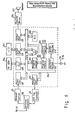
- the controller section 12 of the master station lA includes a central processing unit (CPU) 121 and a main portion of the task thereof is performed by CPU 121.
- a control program of the CPU 121 is stored in a read-only memory (ROM) 122 and various control data are stored temporarily in a random access memory (RAM) 123.
- An input/output (I/O) port 124 functions as an interface to an external data input device, through which the data transmission request etc. are input thereto.
- the I/O port 124 is usually constructed with a device of RS-232-C type.
- the data to be transmitted in the interrogation input device of the paging system includes an identification (ID) number of the slave station designated.
- ID identification
- An input port 125 functions to read-in the reception data, i.e., the ACK signal and the carrier detection information from the receiver section 14 in CPU 121.
- An output port 126 is to transmit the data to the transmitter section 13 and to supply an on-off control signal thereto.
- a reference numeral 127 designates a data bus.
- the receiver section 14 includes a receiver 141 and a carrier squelch circuit 142.
- the receiver 141 is usually an FM receiver tuned to the frequency f 1 .
- the squelch circuit 142 may be any which responds to an IF signal of the receiver 141 to detect the presence of the carrier.
- the transmitter section 13 may be an FM transmitter capable of transmitting the data at the frequency f l'
- a reference numeral 133 denotes an antenna duplexer.
- the slave station lB is a paging transmitter/receiver which includes a one chip CPU 200.
- the CPU 200 includes elements 201 to 213.
- a program for controlling the receiving and transmitting of signals in the slave station is stored in a memory 201.
- a program counter 202 counts every time when a command is read out from the program memory 201.
- a control section 203 responds to the command from the memory 201 to supply control signals to the various portions of CPU 200.
- Reference numerals 204, 205, 206 and 207 denote an arithmetic and logic circuit (ALC), an accumulater (AC C ), an internal bus and an input port for reading in data from the receiver section 22, respectively.
- ALC arithmetic and logic circuit
- AC C accumulater
- An I/O port 208 is used to read out an ID nunber from an ROM 214 storing the ID number of the slave station.
- An output port 209 is used to output a transmission data to the transmitter section 24.
- a display data is supplied through an output port 210 to an external liquid crystal device (LCD) 215.
- a drive signal for driving a loudspeaker 217 is supplied through an output port 211 to a driver 216.
- An oscillation output of an oscillator circuit composed of a quartz oscillator 219 and an internal oscillator 212 is supplied to a system clock generator 213 from which clock signals having predetermined periods are supplied to various portions of CPU 200.
- a reference numeral 218 designates an antenna duplexer.
- the slave station constructed as above transmits the ACK signal in the steps shown in Fig. 3 only when the ID number contained in the received data coincides with the ID number contained in its own ROM 214.
Landscapes
- Engineering & Computer Science (AREA)
- Computer Networks & Wireless Communication (AREA)
- Signal Processing (AREA)
- Mobile Radio Communication Systems (AREA)
- Small-Scale Networks (AREA)
Applications Claiming Priority (2)
| Application Number | Priority Date | Filing Date | Title |
|---|---|---|---|
| JP248500/85 | 1985-11-05 | ||
| JP60248500A JPS62107542A (ja) | 1985-11-05 | 1985-11-05 | 無線通信方式 |
Publications (2)
| Publication Number | Publication Date |
|---|---|
| EP0222308A2 true EP0222308A2 (de) | 1987-05-20 |
| EP0222308A3 EP0222308A3 (de) | 1989-03-15 |
Family
ID=17179093
Family Applications (1)
| Application Number | Title | Priority Date | Filing Date |
|---|---|---|---|
| EP86115292A Withdrawn EP0222308A3 (de) | 1985-11-05 | 1986-11-04 | Funkkommunikationssystem mit Mitteln zum Vermeiden einer Signalkollision |
Country Status (5)
| Country | Link |
|---|---|
| US (1) | US5042083A (de) |
| EP (1) | EP0222308A3 (de) |
| JP (1) | JPS62107542A (de) |
| AU (1) | AU594094B2 (de) |
| CA (1) | CA1290402C (de) |
Cited By (5)
| Publication number | Priority date | Publication date | Assignee | Title |
|---|---|---|---|---|
| EP0549235A1 (de) * | 1991-12-24 | 1993-06-30 | NCR International, Inc. | Lokales Netzwerksystem |
| WO1994017616A1 (fr) * | 1993-01-26 | 1994-08-04 | Inria Institut National De Recherche En Informatique Et En Automatique | Installation de transmission de donnees, du type reseau radio, et procede correspondant |
| US5398248A (en) * | 1992-07-02 | 1995-03-14 | U.S. Philips Corporation | Resolving conflicts between communication systems |
| WO1996008901A1 (en) * | 1994-09-12 | 1996-03-21 | Telefonaktiebolaget Lm Ericsson | A method to adapt synchronous transmission |
| GB2328837A (en) * | 1997-08-29 | 1999-03-03 | Motorola Ltd | Avoiding midamble collisions in a TDMA communication system |
Families Citing this family (43)
| Publication number | Priority date | Publication date | Assignee | Title |
|---|---|---|---|---|
| US5673031A (en) * | 1988-08-04 | 1997-09-30 | Norand Corporation | Redundant radio frequency network having a roaming terminal communication protocol |
| US5090024A (en) * | 1989-08-23 | 1992-02-18 | Intellon Corporation | Spread spectrum communications system for networks |
| US5646607A (en) * | 1990-06-15 | 1997-07-08 | Texas Instruments Incorporated | Transponder/interrogator protocol in a multi-interrogator field |
| US5420572A (en) * | 1990-12-03 | 1995-05-30 | Echelon Corporation | Configuration device for use in a networked communication system |
| US5319641A (en) * | 1990-12-03 | 1994-06-07 | Echelon Systems Corp. | Multiaccess carrier sensing network communication protocol with priority messages |
| US5297143A (en) * | 1990-12-03 | 1994-03-22 | Echelon Systems, Corp. | Network communication protocol including a reliable multicasting technique |
| US5265150A (en) * | 1991-01-30 | 1993-11-23 | At&T Bell Laboratories | Automatically configuring wireless PBX system |
| US6714559B1 (en) * | 1991-12-04 | 2004-03-30 | Broadcom Corporation | Redundant radio frequency network having a roaming terminal communication protocol |
| US6407991B1 (en) * | 1993-05-06 | 2002-06-18 | Intermec Ip Corp. | Communication network providing wireless and hard-wired dynamic routing |
| US5357559A (en) * | 1991-12-12 | 1994-10-18 | Telefonaktiebolaget L M Ericsson | Listening control channel in a cellular mobile radiotelephone system |
| US5896561A (en) * | 1992-04-06 | 1999-04-20 | Intermec Ip Corp. | Communication network having a dormant polling protocol |
| US5546443A (en) * | 1992-10-26 | 1996-08-13 | Ericsson Ge Mobile Communications, Inc. | Communication management technique for a radiotelephone system including microcells |
| GB9223890D0 (en) * | 1992-11-13 | 1993-01-06 | Ncr Int Inc | Wireless local area network system |
| US5493722A (en) * | 1994-01-24 | 1996-02-20 | Ingersoll-Rand Company | Method for controlling data transmissions on a single channel radio frequency network |
| JP3262966B2 (ja) * | 1994-06-20 | 2002-03-04 | キヤノン株式会社 | 通信装置及びその制御方法 |
| JPH0816739A (ja) * | 1994-06-24 | 1996-01-19 | Tokimec Inc | リーダライタとデータキャリアを用いたデータ処理装置 |
| JP3041200B2 (ja) * | 1994-07-21 | 2000-05-15 | シャープ株式会社 | データ通信装置およびその方法 |
| US5485463A (en) * | 1994-09-09 | 1996-01-16 | Glenayre Electronics, Inc. | System for transmitting paging signals using time-division-multiplexing |
| FI97503C (fi) * | 1995-01-12 | 1996-12-27 | Nokia Telecommunications Oy | Matkaviestinjärjestelmän toistin |
| FI98579C (fi) * | 1995-01-20 | 2004-11-11 | Eads Secure Networks Oy | Suorakanavalla liikennöiminen |
| US5634190A (en) * | 1995-06-06 | 1997-05-27 | Globalstar L.P. | Low earth orbit communication satellite gateway-to-gateway relay system |
| US5706274A (en) * | 1995-09-07 | 1998-01-06 | Tetherless Access Ltd. (Tal) | CSMA with dynamic persistence |
| US5784375A (en) * | 1996-06-12 | 1998-07-21 | Advanced Micro Devices, Inc. | Rotating priority arrangement in an ethernet network |
| US5732358A (en) * | 1996-07-08 | 1998-03-24 | Motorola, Inc. | Method for selecting an optimal base transmitter in a radio communication system |
| DE19735527C2 (de) * | 1997-08-16 | 2003-02-06 | Philips Corp Intellectual Pty | Kommunikationssystem mit mehreren Funksystemen |
| JP3572933B2 (ja) * | 1998-03-31 | 2004-10-06 | Kddi株式会社 | 移動通信システム |
| US6157818A (en) * | 1998-04-03 | 2000-12-05 | Trimble Navigation Limited | Communication system having automatic addressing |
| EP1531383A3 (de) | 1999-07-30 | 2005-07-27 | Intertrust Technologies Corp. | Verfahren und Systeme zur Transaktionsaufzeichnungsübertragung unter Anwendung von Schwellen und eines mehrstufigen Protokolls |
| CA2439697C (en) * | 2001-03-02 | 2007-11-13 | At&T Corp. | Interference suppression methods for 802.11 |
| US7167484B2 (en) * | 2001-03-22 | 2007-01-23 | Oxford Semiconductor, Inc. | Centralized coordination point for wireless communication devices using multiple protocols |
| US7233602B2 (en) * | 2001-03-22 | 2007-06-19 | Oxford Semiconductor, Inc. | Coordination architecture for wireless communication devices using multiple protocols |
| US6954616B2 (en) * | 2001-03-22 | 2005-10-11 | Transdimension, Inc. | Top-level controller for wireless communication devices and protocols |
| US7177294B2 (en) * | 2001-03-22 | 2007-02-13 | Oxford Semiconductor, Inc. | Collision rectification in wireless communication devices |
| US7277451B1 (en) | 2001-10-11 | 2007-10-02 | Oxford Semiconductor, Inc. | Recognition scheme for moderating wireless protocols |
| US7215659B1 (en) * | 2001-10-18 | 2007-05-08 | Oxford Semiconductor, Inc. | Remotely-cooperative scheduling solution for moderating wireless protocols |
| US7694005B2 (en) | 2005-11-04 | 2010-04-06 | Intermatic Incorporated | Remote device management in a home automation data transfer system |
| US7640351B2 (en) | 2005-11-04 | 2009-12-29 | Intermatic Incorporated | Application updating in a home automation data transfer system |
| US7870232B2 (en) | 2005-11-04 | 2011-01-11 | Intermatic Incorporated | Messaging in a home automation data transfer system |
| US7698448B2 (en) | 2005-11-04 | 2010-04-13 | Intermatic Incorporated | Proxy commands and devices for a home automation data transfer system |
| US7716536B2 (en) * | 2006-06-29 | 2010-05-11 | Intel Corporation | Techniques for entering a low-power link state |
| US9287944B2 (en) * | 2010-12-20 | 2016-03-15 | Celeno Communications Ltd. | System and method for allowing multiple stations in a network to use MU-MIMO transmit beamforming |
| JP5798383B2 (ja) | 2011-06-07 | 2015-10-21 | ラピスセミコンダクタ株式会社 | 無線通信方法及び装置 |
| US9370023B2 (en) * | 2013-03-11 | 2016-06-14 | Motorola Solutions, Inc. | Method and apparatus for resolving call collisions in a digital conventional direct mode |
Family Cites Families (14)
| Publication number | Priority date | Publication date | Assignee | Title |
|---|---|---|---|---|
| DE1273627B (de) * | 1966-02-04 | 1968-07-25 | Siemens Ag | Schaltungsanordnung zur Unterdrueckung der Kennungssignale in den Empfaengern der einem Wechselsprechfunknetz zugehoerigen Teilnehmerstellen |
| DE2856019A1 (de) * | 1978-12-23 | 1980-07-10 | Bosch Gmbh Robert | Sprechfunknetz mit einer hauptstation, mindestens zwei auf demselben funkkanal arbeitenden relaisstationen und mit mehreren unterstationen |
| US4342995A (en) * | 1980-09-15 | 1982-08-03 | Burroughs Corporation | Data network employing a single transmission bus for overlapping data transmission and acknowledgment signals |
| US4414661A (en) * | 1981-07-02 | 1983-11-08 | Trancom Ab | Apparatus for communicating with a fleet of vehicles |
| US4412326A (en) * | 1981-10-23 | 1983-10-25 | Bell Telephone Laboratories, Inc. | Collision avoiding system, apparatus and protocol for a multiple access digital communications system including variable length packets |
| US4532626A (en) * | 1982-07-19 | 1985-07-30 | At&T Bell Laboratories | Collision avoiding system and protocol for a two path multiple access digital communications system |
| US4608559A (en) * | 1982-08-19 | 1986-08-26 | Computer Automation, Inc. | Local modulated carrier data network with a collision avoidance protocol |
| US4501017A (en) * | 1983-01-31 | 1985-02-19 | Motorola, Inc. | Switch controller for obtaining a plurality of functions from a single switch in a two-way transceiver and method therefor |
| JPS6094544A (ja) * | 1983-10-28 | 1985-05-27 | Nec Corp | 移動無線通信方式 |
| US4644351A (en) * | 1984-05-08 | 1987-02-17 | Motorola, Inc. | Two way personal message system with extended coverage |
| US4689785A (en) * | 1984-09-14 | 1987-08-25 | Sanyo Electric Co., Ltd. | Data transmission system |
| US4644105A (en) * | 1985-03-25 | 1987-02-17 | P.T.I., Inc. | Mobile telephone controller switch |
| US4757460A (en) * | 1985-06-14 | 1988-07-12 | Zenith Electronics Corporation | Communications network with individualized access delays |
| JPH0624337B2 (ja) * | 1985-09-30 | 1994-03-30 | 日本電信電話株式会社 | 無線電話装置の着呼信号送出方式 |
-
1985
- 1985-11-05 JP JP60248500A patent/JPS62107542A/ja not_active Withdrawn
-
1986
- 1986-11-04 EP EP86115292A patent/EP0222308A3/de not_active Withdrawn
- 1986-11-05 US US06/927,037 patent/US5042083A/en not_active Expired - Lifetime
- 1986-11-05 CA CA000522195A patent/CA1290402C/en not_active Expired - Lifetime
- 1986-11-05 AU AU64829/86A patent/AU594094B2/en not_active Ceased
Non-Patent Citations (3)
| Title |
|---|
| COMPUTER NETWORKS, vol. 7, no. 1, February 1983, pages 1-8, North-Holland, Amsterdam, NL; M.A. MALCOLM et al.: "An acknowledging contention algorithm suitable for local radio networks" * |
| IEEE COMPUTER SOCIETY INTERNATIONAL CONFERENCE, New York, 6th-9th September 1977, pages 320-325; M. TOKORO et al.: "Acknowledging ethernet" * |
| IEEE TRANSACTIONS ON COMMUNICATIONS, vol. COM-26, no. 6, June 1978, pages 815-826, IEEE, New York, US; F.A. TOBAGI et al.: "The effect of acknowledgment traffic on the capacity of packet-switched radio channels" * |
Cited By (8)
| Publication number | Priority date | Publication date | Assignee | Title |
|---|---|---|---|---|
| US5519834A (en) * | 1991-12-12 | 1996-05-21 | Ncr Corporation | Method of transmitting selected message frames without individual destination address in non-overlapping sequential time intervals from host computer to terminals via bridges and retransmitting thereafter |
| EP0549235A1 (de) * | 1991-12-24 | 1993-06-30 | NCR International, Inc. | Lokales Netzwerksystem |
| US5398248A (en) * | 1992-07-02 | 1995-03-14 | U.S. Philips Corporation | Resolving conflicts between communication systems |
| WO1994017616A1 (fr) * | 1993-01-26 | 1994-08-04 | Inria Institut National De Recherche En Informatique Et En Automatique | Installation de transmission de donnees, du type reseau radio, et procede correspondant |
| US5638449A (en) * | 1993-01-26 | 1997-06-10 | Inria Institut National De Recherche En Informatique Et En Automatique | Data transmission installation of the radio network type, and corresponding process |
| WO1996008901A1 (en) * | 1994-09-12 | 1996-03-21 | Telefonaktiebolaget Lm Ericsson | A method to adapt synchronous transmission |
| GB2328837A (en) * | 1997-08-29 | 1999-03-03 | Motorola Ltd | Avoiding midamble collisions in a TDMA communication system |
| GB2328837B (en) * | 1997-08-29 | 2002-12-18 | Motorola Ltd | Synchronisation apparatus and method therefor |
Also Published As
| Publication number | Publication date |
|---|---|
| AU6482986A (en) | 1987-05-07 |
| EP0222308A3 (de) | 1989-03-15 |
| AU594094B2 (en) | 1990-03-01 |
| US5042083A (en) | 1991-08-20 |
| JPS62107542A (ja) | 1987-05-18 |
| CA1290402C (en) | 1991-10-08 |
Similar Documents
| Publication | Publication Date | Title |
|---|---|---|
| US5042083A (en) | Radio communication system having means for avoiding signal collision | |
| US4887266A (en) | Communication system | |
| US5194860A (en) | Radio telemetry systems with channel selection | |
| EP0596521B1 (de) | Anordnung für Multi-Abfrage, Datenkommunikation und Antwort | |
| CA1161136A (en) | Communication link contention resolution system | |
| EP0300200A2 (de) | Verfahren zur Identifizierung von Fahrzeugen für ein über Funk arbeitendes Fahrzeugüberwachungssystem | |
| EP0344624A2 (de) | Überwachungssystem für Funkkommunikationsapparate | |
| JPH05506970A (ja) | 通信システム | |
| US4670872A (en) | Communication link contention resolution system | |
| US6067626A (en) | Method of processing externally supplied data by CPU in non-operating state and portable terminal device for the same | |
| US6163703A (en) | Method for registering portable unit in cordless telephone system by using both wire and wireless links | |
| JPH0834627B2 (ja) | チャネル選択方式 | |
| JP3293943B2 (ja) | プログラマブルコントローラ | |
| US6328218B1 (en) | Electronic card identification methods | |
| JP2603672B2 (ja) | 移動体識別システムのデータ通信方式 | |
| JP2655660B2 (ja) | 移動体識別システムの交信方式 | |
| JP2569827B2 (ja) | 親局と複数の子局との交信方法 | |
| JP2653269B2 (ja) | マルチアクセス通信装置 | |
| JP2840792B2 (ja) | 混信防止機能を有したワイヤレス送信器およびこれを用いたワイヤレス伝送制御システム | |
| JP3024624B2 (ja) | 通信制御プログラムのダウンラインロード方法 | |
| KR100243897B1 (ko) | 차량운행기록용 무선리모콘 | |
| JPH02303226A (ja) | 無線通信装置 | |
| JPH02116779A (ja) | 移動体識別装置 | |
| JPH08123918A (ja) | 非接触式媒体のアクセス方式 | |
| JP2000261446A (ja) | 無線通信装置 |
Legal Events
| Date | Code | Title | Description |
|---|---|---|---|
| PUAI | Public reference made under article 153(3) epc to a published international application that has entered the european phase |
Free format text: ORIGINAL CODE: 0009012 |
|
| 17P | Request for examination filed |
Effective date: 19861104 |
|
| AK | Designated contracting states |
Kind code of ref document: A2 Designated state(s): DE GB NL SE |
|
| PUAL | Search report despatched |
Free format text: ORIGINAL CODE: 0009013 |
|
| AK | Designated contracting states |
Kind code of ref document: A3 Designated state(s): DE GB NL SE |
|
| 17Q | First examination report despatched |
Effective date: 19910424 |
|
| STAA | Information on the status of an ep patent application or granted ep patent |
Free format text: STATUS: THE APPLICATION IS DEEMED TO BE WITHDRAWN |
|
| 18D | Application deemed to be withdrawn |
Effective date: 19911105 |
|
| RIN1 | Information on inventor provided before grant (corrected) |
Inventor name: ICHIKAWA, YOSHIO |