EP0222401B1 - Presse pour découper des bandes de circuits intégrés - Google Patents
Presse pour découper des bandes de circuits intégrés Download PDFInfo
- Publication number
- EP0222401B1 EP0222401B1 EP19860115753 EP86115753A EP0222401B1 EP 0222401 B1 EP0222401 B1 EP 0222401B1 EP 19860115753 EP19860115753 EP 19860115753 EP 86115753 A EP86115753 A EP 86115753A EP 0222401 B1 EP0222401 B1 EP 0222401B1
- Authority
- EP
- European Patent Office
- Prior art keywords
- sheet
- press
- cutting
- feed
- mold
- Prior art date
- Legal status (The legal status is an assumption and is not a legal conclusion. Google has not performed a legal analysis and makes no representation as to the accuracy of the status listed.)
- Expired - Lifetime
Links
Images






Classifications
-
- H—ELECTRICITY
- H10—SEMICONDUCTOR DEVICES; ELECTRIC SOLID-STATE DEVICES NOT OTHERWISE PROVIDED FOR
- H10P—GENERIC PROCESSES OR APPARATUS FOR THE MANUFACTURE OR TREATMENT OF DEVICES COVERED BY CLASS H10
- H10P72/00—Handling or holding of wafers, substrates or devices during manufacture or treatment thereof
- H10P72/04—Apparatus for manufacture or treatment
- H10P72/0438—Apparatus for making assemblies not otherwise provided for, e.g. package constructions
-
- H—ELECTRICITY
- H10—SEMICONDUCTOR DEVICES; ELECTRIC SOLID-STATE DEVICES NOT OTHERWISE PROVIDED FOR
- H10P—GENERIC PROCESSES OR APPARATUS FOR THE MANUFACTURE OR TREATMENT OF DEVICES COVERED BY CLASS H10
- H10P72/00—Handling or holding of wafers, substrates or devices during manufacture or treatment thereof
- H10P72/04—Apparatus for manufacture or treatment
- H10P72/0428—Apparatus for mechanical treatment or grinding or cutting
-
- H—ELECTRICITY
- H05—ELECTRIC TECHNIQUES NOT OTHERWISE PROVIDED FOR
- H05K—PRINTED CIRCUITS; CASINGS OR CONSTRUCTIONAL DETAILS OF ELECTRIC APPARATUS; MANUFACTURE OF ASSEMBLAGES OF ELECTRICAL COMPONENTS
- H05K13/00—Apparatus or processes specially adapted for manufacturing or adjusting assemblages of electric components
- H05K13/0092—Treatment of the terminal leads as a separate operation
-
- Y—GENERAL TAGGING OF NEW TECHNOLOGICAL DEVELOPMENTS; GENERAL TAGGING OF CROSS-SECTIONAL TECHNOLOGIES SPANNING OVER SEVERAL SECTIONS OF THE IPC; TECHNICAL SUBJECTS COVERED BY FORMER USPC CROSS-REFERENCE ART COLLECTIONS [XRACs] AND DIGESTS
- Y10—TECHNICAL SUBJECTS COVERED BY FORMER USPC
- Y10T—TECHNICAL SUBJECTS COVERED BY FORMER US CLASSIFICATION
- Y10T29/00—Metal working
- Y10T29/51—Plural diverse manufacturing apparatus including means for metal shaping or assembling
- Y10T29/5136—Separate tool stations for selective or successive operation on work
- Y10T29/5137—Separate tool stations for selective or successive operation on work including assembling or disassembling station
- Y10T29/5139—Separate tool stations for selective or successive operation on work including assembling or disassembling station and means to sever work prior to disassembling
-
- Y—GENERAL TAGGING OF NEW TECHNOLOGICAL DEVELOPMENTS; GENERAL TAGGING OF CROSS-SECTIONAL TECHNOLOGIES SPANNING OVER SEVERAL SECTIONS OF THE IPC; TECHNICAL SUBJECTS COVERED BY FORMER USPC CROSS-REFERENCE ART COLLECTIONS [XRACs] AND DIGESTS
- Y10—TECHNICAL SUBJECTS COVERED BY FORMER USPC
- Y10T—TECHNICAL SUBJECTS COVERED BY FORMER US CLASSIFICATION
- Y10T29/00—Metal working
- Y10T29/51—Plural diverse manufacturing apparatus including means for metal shaping or assembling
- Y10T29/5147—Plural diverse manufacturing apparatus including means for metal shaping or assembling including composite tool
- Y10T29/5148—Plural diverse manufacturing apparatus including means for metal shaping or assembling including composite tool including severing means
- Y10T29/5149—Plural diverse manufacturing apparatus including means for metal shaping or assembling including composite tool including severing means to sever electric terminal from supply strip
-
- Y—GENERAL TAGGING OF NEW TECHNOLOGICAL DEVELOPMENTS; GENERAL TAGGING OF CROSS-SECTIONAL TECHNOLOGIES SPANNING OVER SEVERAL SECTIONS OF THE IPC; TECHNICAL SUBJECTS COVERED BY FORMER USPC CROSS-REFERENCE ART COLLECTIONS [XRACs] AND DIGESTS
- Y10—TECHNICAL SUBJECTS COVERED BY FORMER USPC
- Y10T—TECHNICAL SUBJECTS COVERED BY FORMER US CLASSIFICATION
- Y10T83/00—Cutting
- Y10T83/444—Tool engages work during dwell of intermittent workfeed
- Y10T83/463—Work-feed element contacts and moves with work
- Y10T83/4635—Comprises element entering aperture in, or engaging abutment surface on, work
Definitions
- the present invention relates to an IC (Integrated Circuit) sheet cutting press for performing a series of press cutting operations while feeding an IC sheet stepwise in which IC sheet a plurality of IC's are coupled through a lead frame.
- IC Integrated Circuit
- An IC sheet cutting press of this type is known from the document US-A-3 722 060.
- the press described therein is provided for cutting IC sheets each comprising a plurality of ICs coupled through a lead frame, and includes an IC sheet feed mechanism for feeding the respective IC sheet stepwise, as well as a plurality of press molds for performing the series of the press cutting operations, wherein said sheet feed mechanism and said plurality of press molds are provided on a common die set to constitute a single mold unit.
- this object is solved by providing an IC sheet cutting press having the features of claim 1.
- a plurality of types of press molds for performing a series of press cutting machining and an IC sheet feed mechanism for feeding IC sheets stepwise are separately detachably mounted on a common die set to constitute a single press mold unit.
- the press mold unit performs a series of press cutting machining while IC sheets are fed stepwise, thus cutting IC's from a lead frame.
- the press mold unit can be entirely exchanged with another press mold unit. Since the press molds and the IC sheet feed mechanism need not be positioned separately, replacement can be performed easily within a short period of time. In this case, if different press mold units have common fixing portions to a press table and coupling portions to a press ram, the exchange operation can be standardized and can be easily carried out by unskilled workers. As a result, the stop time of the IC cutting press can be shortened, thus minimizing reduction of the operation efficiency and realizing a high productivity.
- the IC sheet cutting press can be easily converted for machining another type of IC sheet, resulting in high compatibility.
- the press molds and the IC sheet feed mechanism are detachably mounted on the die set and can be individually exchanged. Therefore, if a plurality of types of die sets, press molds, and IC sheet feed mechanisms are prepared and are selectively combined, various press mold units can be assembled. Therefore, different press units need not be prepared for each different type of IC sheet, resulting in a low mold manufacturing cost.
- an IC processing apparatus capable of automatically performing IC sheet processing including cutting of IC's from an IC sheet for a long period of time can be realized.
- Preferred embodiments of the present invention will be described with reference to an IC sheet processing apparatus which automatically performs cutting of IC's from an IC sheet and bending of lead terminals of the cut IC's for a long period of time.
- Figures 1 to 4 show an IC sheet processing apparatus, which basically comprises an IC sheet loader A, an IC sheet cutting press B, an IC sheet bending press C, and an IC unloader D.
- IC sheet loader A a large number of magazines M each storing a large number of IC sheets S shown in Fig. 5 are stocked in a magazine stock section A1, and the IC sheets S are picked up from each magazine M one by one and fed to the IC sheet cutting press B by an IC sheet feeding section A2.
- the IC sheet cutting press B performs a series of press machining operations with respect to the IC sheet S to separate IC's therefrom, as shown in Fig. 6.
- the IC lead bending press C bends lead terminals L of the IC's separated from the IC sheet shown in Fig. 7, as shown in Fig. 8.
- the IC unloader D stores and stocks a large number of IC's after the lead bending process shown in Fig. 8 in a container CN.
- reference symbol E in Figs. 2 and 4 denotes a dust collector for collecting a punched refuse or cutting dust produced during IC sheet cutting of the cutting press B.
- a plurality of DIP (Dual-Inline-Package) type IC's are coupled to each other through a lead frame F.
- the lead frame F is formed integrally with the lead terminals L, cross bars F1, dam bars F2, and tie bars F3.
- the dam bar F2 presents flowing of resin leaked from a mold during resin molding to the distal end portions of the lead terminals.
- the tie bar F3 directly couples the IC package to the lead frame F, and serves to hold the IC's until the last step of the IC sheet cutting process, as will be described later.
- a large number of holes having different shapes and sizes are formed in the lead frame F to be used for feeding the IC sheet or for position detection.
- the IC's are cut from the IC sheet S in such a manner that the IC sheet S is fed stepwise along an IC sheet feed path T at a distance equal to an arrangement interval p of the IC's (Fig. 5) to be subjected to a series of press machining steps, i.e., resin punching, dam bar cutting, lead cutting, tie bar pinch forming, and punching steps.
- a series of press machining steps i.e., resin punching, dam bar cutting, lead cutting, tie bar pinch forming, and punching steps.
- the IC sheet loader A basically has a magazine stock section (to be referred to simply as a "stock section” hereinafter) A1 for storing the magazines M, the IC sheet feeding section A2 for picking up the IC sheets S one by one from a magazine MA located at an IC sheet pickup position TP on one end side of the stock section A1 and feeding it to the cutting press B, and a magazine returning section A3 for returning an empty magazine, from which the IC sheets S have been picked up, to the end position of the magazine array on the other end side of the stock section A1.
- reference numeral A4 denotes an operation panel.
- the IC sheet cutting press B has a press mold unit B1, as shown in Fig. 23.
- the press mold unit B1 is mounted on a table B3 of a press frame, and is driven by a press ram B2 (Fig. 4) mounted in a ram housing B4.
- the press mold unit B1 comprises a lower mold B10, an upper mold B20, and an IC sheet feed mechanism B30, and performs a series of press machining operations to cut IC's from the IC sheet S (Fig. 5) by the upper and lower molds B10 and B20 while feeding the IC sheets S stepwise by the IC sheet feed mechanism B30.
- the arrangement and operation of the respective sections of the press mold unit B1 will be described hereinafter in detail.
- the lower mold B10 is arranged in such a manner that respective dies DE1 to DE5 for press molds for performing above-mentioned series of press machining operations (i.e., resin punching, dam bar cutting, lead cutting, tie bar pinch forming, and punching) are detachably mounted on a single common die holder 110.
- press molds for performing above-mentioned series of press machining operations (i.e., resin punching, dam bar cutting, lead cutting, tie bar pinch forming, and punching) are detachably mounted on a single common die holder 110.
- the resin punching die DE1 at the first stage will be exemplified below.
- the die DE1 is mounted on a die plate 111.
- the die plate 111 is positioned by a key groove 113 in its bottom surface, a guide key 113 of the die holder 110 (Fig. 25), and a tapered metal member 114 and a fastening metal member 115 on one side of the die plate 111, and is fixed to the die holder 110 by a bolt 116 at its opposite end portion.
- the fastening metal member 115 is common to the die plates of the dies DE1 to DE3, as can be seen from Fig. 24.
- a pair of dust-sealed guide bushings 117 are arranged on the die plate 111, and are engaged with pilot pins 147 (to be described later; Figs. 30 and 32) of the upper mold B20.
- the two dies DE4 and DE5 at the latter stage are mounted on a common die plate 118, as shown in Figs. 24 and 25.
- the die plate 118 is positioned by a key groove 119, a guide key 120 (Fig. 25), and a tapered metal member 121 and a fastening metal member 122 (Figs. 24, 26, and 27) as in the die plate 111, and is fixed to the die holder 110 by a bolt.
- the die plate 118 has a pair of dust-sealed bushings 123 (Fig. 24) at its two end portions, which are engaged with pilot pins 158 of the upper mold B20 (to be described later; Figs. 30 and 31).
- an air cylinder 124 and a guide rail 125 for feeding IC's cut from the IC sheet by the punching press mold (i.e., the die DE5 of the upper mold B10 and a punch PH5 of the upper mold B20) to the bending press C are arranged on the die plate 118 to be perpendicular to the IC sheet feed path T. Since the tie bar pinch forming die DE4 and the punching die DE5 are always used in this combination, they are mounted on the common die plate 118, thus allowing easy mounting and removal of these dies.
- the dies DE1 to DE5 are arranged along the IC sheet feed path T at given intervals, i.e., 1.5p or 2p shown in Fig. 6.
- each guide post 130 is fitted in a hole of the die plate 110 and is fixed by a flange 131, a retainer plate 132, and a bolt 133.
- Stopper pins 135 are provided adjacent to the three guide posts 130. These pins 135 abut against stopper pins 160 (to be described later; Figs. 30 and 31) of the upper mold B20 to define the lower dead point of the upper mold B20.
- Other stopper pins 136 are arranged adjacent to the guide posts 130. These pins 136 abut against spring-biased stopper pins 161 (to be described later; Figs. 30 and 31) of the upper mold B20.
- An air joint block 137 for supplying a vacuum pressure for drawing an IC cut by the punching die DE5 and compressed air to the air cylinder 124 for feeding IC's is arranged on one side (the left side in Fig. 24) of the die holder 110. Although a number of photosensors for detecting an IC sheet feed position are arranged on the die holder 110, a detailed description thereof will be omitted.
- FIGs 24 to 27 illustrate a state wherein a sheet guide assembly B31 of the IC sheet feed mechanism B30 (Fig. 23) is mounted on the die holder 110.
- the sheet guide assembly B31 will be described later.
- the lower mold B10 is detachably mounted on the table B3 of the cutting press B. More specifically, as shown in Figs. 24, 25, and 27, a key groove 138 is formed in the bottom surface of the die holder 110, and a pair of tapered metal members 139 are arranged on its one end side. As shown in Fig. 23, a guide key B3a and a fastening metal member B3b are fixed to the table B3 of the cutting press B to be perpendicular to each other.
- the lower mold B10 When the key groove 138 of the die holder 110 is engaged with the guide key B3a and the tapered metal member 139 is engaged with the fastening metal member B3b, the lower mold B10 can be positioned, and is fixed, such that a bolt (not shown) is screwed in a tap hole B3c of the table B3 from a bolt hole 110a (in the upper left corner in Fig. 24) of the die holder 110. Note that since the common fixing structure of the lower mold B10 with respect to the press table B3 is adopted, a compatibility with different press mold units B1 can be provided.
- a hole B3d formed in the press table B3 is a dust collecting port corresponding to the dies DE1 to DE3 of the lower mold B10.
- the dust collecting port B3d communicates with a dust collector E through a hose or tube E1, as shown in Fig. 4, so that a punched refuse or cutting dust produced by the dies DE1 to DE3 is collected through the dust collecting port B3d.
- the press B has a transparent safe cover B5.
- the cover B5 When the cover B5 is opened, not only the IC sheet cutting press B but also the entire IC sheet processing apparatus is automatically stopped.
- the upper mold B20 is arranged so that punches PH1 to PH5 for the respective press molds for performing the above-mentioned series of press machining operations are detachably mounted on a single common punch holder 140.
- the resin punch PH1 at the first stage will be exemplified below.
- the punch PH1 is mounted on a punch plate 141, which is detachably mounted on the punch holder 140 by a bolt 144 through an intermediate plate 142 and a base plate 143.
- a sheet pressing plate (or a stripper plate) 145 is mounted on the punch plate 141 by a pair of spring-biased slide pins 146 to be vertically movable, and a pair of pilot pins 147 are fixed thereto.
- the pilot pins 147 are engaged with the guide bushings 117 of the die holder 111 for the dies DE1 to DE3 of the lower mold B10 described above (Figs. 24 and 27).
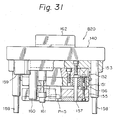
- the punches PH4 and PH5 at the latter stage are mounted on a punch plate 151, as shown in Fig. 31, and the punch plate 151 is detachably mounted on the punch holder 140 by a bolt 154 (Fig. 29) through an intermediate plate 152 and a base plate 153.
- the base plate 153 is common to the punches PH4 and PH5, as shown in Fig. 30. This arrangement corresponds to that wherein the die plate 118 commonly used for the dies DE4 and DE5 of the lower mold B10.
- a sheet pressing plate (or a stripper plate) 155 is mounted on the punch plate 151 by a pair of spring-biased slide pins 156 and a pair of guide pins 157 to be vertically movable.
- a pair of pilot pins 158 are fixed to the common base plate 153, and are engaged with the guide bushings 123 of the lower mold B10 described above.
- guide bushings 159 Four guide bushings 159, three stopper pins 160, and four spring-biased stopper pins 161 are arranged on the punch holder 140. As described above, the guide bushings 159 are engaged with the guide posts 130 of the lower mold B10, and the stopper pins 160 and 161 abut against the stopper pins 135 and 136 of the lower mold B10, respectively.
- the punch holder 140 has a ram coupling member 162, which is engaged with the flange B2a (Figs. 30 and 32) at the distal end portion of the piston rod of the press ram B2 (Fig. 4) of the cutting press B.
- the upper mold B20 is vertically moved by the press ram B2, and a sheet cutting operation is performed by the dies DE1 to DE5 and the punches PH1 to PH5.
- An L-shaped lever 163 is fixed to one end portion of the punch holder 140.
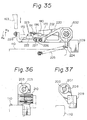
- the lever 163 pushes down a sheet feed lever 220 (see Fig. 35) of the IC sheet feed mechanism B30 by utilizing downward movement of the upper mold B20, and will be described later.
- the upper mold B10 also has a large number of photosensors for position detection during IC sheet feed, a detailed description thereof will be omitted.
- the IC sheet feed mechanism B30 comprises the sheet guide assembly B31 (illustrated in a stage wherein it is mounted on the lower mold B10), a feed rod assembly B32 for feeding the IC sheet along the sheet guide assembly, and an ejector B33 for ejecting a waste sheet after IC cutting, as shown in Fig. 23.
- the sheet guide assembly B31 has a pair of guide rails 170 arranged on two sides of the IC sheet feed path T (Fig. 24), as shown in Figs. 24 to 28.
- Each guide rail 170 has a supporting rail 171 having a rectangular section, and a cover plate 172 fixed to the upper surface of the rail 171 by a screw.
- the CI sheet S is fed, with the right and left side edges of the lead frame F (Fig. 5) engaged with the guide grooves between the supporting rails 171 and the cover plates 172.
- the end portions on one side of the supporting rails 171 of the guide rails 170 extend from the lower-mold die holder 110, and constitute a sheet feed portion on which the IC sheet fed by the IC sheet feeding section A2 of the IC sheet loader A is placed.
- guide blocks 173 are mounted on the extending end portions of the supporting rails 171, and the IC sheet S is inserted from the above between the guide blocks 173 to be placed on the supporting rails 171 by the lead frame side edge portion.
- Two sheet pressing plates 174 (only one is shown) are arranged on each guide block 173.
- the sheet pressing plates 174 normally extend inwardly, and when the IC sheet S is inserted from the above, they are extended outwardly to allow insertion of the IC sheet S. After insertion of the IC sheet, the plates 174 again extend inwardly to prevent the IC sheet S from being ejected outside. Note that the IC sheet S is often bent during its manufacture. However, the sheet pressing plates 174 suppress the bending of the IC sheet to hold it flat. The bending of the IC sheet is suppressed by the guide grooves of the guide rails 170 during the subsequent stepwise feed, thus allowing satisfactory press cutting.
- the guide rails 170 are mounted on the lower-mold die holder 110 by lifters 180 at positions adjacent to their ends to be vertically movable.
- each lifter 180 has a body 181 fixed to the die holder 110, and a lift pin 182 is mounted in the body 181 by a linear ball baring 183 to be vertically movable.
- the upper end portion of the lift pin 182 is inserted in the hole of the corresponding supporting rail 171 of the guide rail 170, and the lower end portion thereof is inserted in the hole of the die holder 110, so that the guide rails 170 are biased upward by the action of a compression coil spring 184.
- a stopper plate 185 is fixed to the upper surface of the lifter body 181, and a pawl 186 fixed to the lower surface of the corresponding guide rail 170 is engaged with the lower surface of the stopper plate 185, thus defining the upper limit lift position (upper dead point) of the guide rail 170.
- the guide rails 170 are held at a level higher than that of the upper surface of the dies DE1 to DE5 in a non-press state wherein the upper mold B20 is located at its upper position.
- the guide rails 170 are pushed downward by the upper mold B20 to the level of the dies DE1 to DE5, thus performing IC sheet cutting.
- the lift operation of the guide rails 170 is associated with the IC sheet feed operation by the feed rod assembly B32.
- a large number of sensor light transmission holes for detecting the IC sheet position are formed in the supporting rails 171 and the cover plates 172 of the guide plates 170.
- a large number of elongated holes are formed in the cover plates 172 so as to allow engagement of feed pins 196 (Fig. 33) of the feed rod assembly B32 with the feed holds of the IC sheets.
- the feed rod assembly B32 has a feed rod 190 extending parallel to the guide rails 170 (indicated by imaginary lines), and feed arms 191 to 195 are mounted on the feed rod 190 to be perpendicular thereto.
- feed pins 196 extending downward are arranged on the lower surface of each feed arm. These feed pins 196 are engaged with the holes of the lead frame F of the IC sheet S (see Fig. 5) to perform the sheet feed operation.
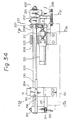
- the two end portions of the feed rod 190 are respectively fixed so free end portions of a double-arm lever 201 and a single-arm lever 202. These levers 201 and 202 are swingable about a supporting shaft 203 but not movable in its axial direction. More specifically, the feed rod 190, the levers 201 and 202, and the supporting shaft 203 constitute a rectangular frame (to be referred to as "feed rod frame” hereinafter), in which the feed rod 190 is swingable about the supporting shaft 203.
- the feed rod frame is mounted on the lower-mold die holder 110 by a pair of bearings 204 and 205. These bearings 204 and 205 are fixed by their lower portions to the die holder 110, as shown in Figs. 34 and 36, and support the supporting shaft 203 of the feed rod frame by the linear ball bearings 206 at their upper portions to be reciprocal in its axial direction.
- a driving rod 207 (see Fig. 37) is mounted on the supporting shaft 203 adjacent to the single-arm lever 202 by a pair of collar bearings 208 to be pivotal thereabout but not to be movable in the axial direction of the supporting shaft 203.
- a direct-mount type air cylinder 210 is mounted on the bearing 205 of the supporting shaft 203 (see Fig.
- a tension coil spring 213 is extended between the horizontal arm of the double-arm lever 201 of the feed rod frame and a bracket 212 fixed to the lower-mold die holder 110, so that the feed rod frame is always subjected to a force for the rotation about the supporting shaft 203 thereof in the direction indicated by arrow R1 (Fig. 38).
- a roller 214 is pivoted to the lower end of the vertical arm of the double-arm lever 201 and abuts against the front surface of a horizontal stopper rail 215 (see Figs.
- an insulating bushing 216 made of electrical insulator is studded in the stopper rail 215, and a screw-like contact terminal 217 formed of a conductor is screwed therein to extend to the roller abutting surface of the rail 215.
- a touch limit TL is fixed to the back surface of the bearing 204, and a terminal TLa thereof is connected to the terminal 217 through a lead wire (not shown).
- the roller 214 is formed of a conductor, and can be electrically connected to the touch limit TL through the lever 201, the supporting shaft 203, and the bearing 204.
- the supporting shaft 203 of the feed rod frame extends outwardly from the single-arm lever 202, and a sheet feed lever 220 is mounted on the extending portion of the feed rod frame by a pair of collar bearings 221 (see Fig. 33) to be pivotal but not to be movable in the axial direction of the supporting shaft 203.
- a bracket 222 is fixed near the distal end portion of the lever 220 to coincide with the IC sheet feed path T, and two sheet feed plates 223 are arranged on the upper surface of the bracket 222 to be parallel to each other.
- the sheet feed plates 223 are in frictional contact with the lower surface of an IC resin mold of the IC sheet S (Fig. 33) placed on the sheet feed portions of the guide rails 170.
- a tension coil spring 225 is extended between a bracket 224 fixed to the proximal end portion of the lever 220 and the lower-mold die holder 110, thereby applying to the lever 220 an upward force for the rotation in the direction indicated by arrow R3.
- a roller 227 is rotatably arranged on a bracket 226 fixed to the central portion of the lever 220, and abuts against the lower surfaces of the guide rails 170 to define a pivotal upper limit position of the lever 220.
- a roller 228 is rotatably arranged on the distal bent portion of the lever 220. The roller 228 is provided in correspondence with the lever 163 of the upper mold B20.
- the ejector B33 has an eject roller 230 and a pair of pressing roller 231, which are vertically aligned.
- the eject roller 230 has a structure shown in Fig.
- a sleeve 230b is mounted on a spindle 230a supported, through a cantilever bearing, by a bracket 232 fixed to the lower-mold die holder 110, a drum 230d is arranged on the sleeve 230b through two one-way clutches (shell-type roller clutches) 230c, a friction roller 230e and a guide flange 230f are respectively arranged at two end portions of the drum 230d, and a portion opposite to the spindle 230a is fixed by a pressing plate 230g and a screw 230h.
- shell-type roller clutches shell-type roller clutches
- the drum 230d When the spindle 230a is rotated at high speed by an electrical motor 233 with reduction gears, the drum 230d is rotated at high speed.
- the one-way clutches 230c allow the drum 230d to be rotated in a forward direction (in the IC sheet eject direction) but not to be rotated in the reverse direction.
- the pressing rollers 231 are rotatably mounted, via shafts 231a and bearings 231b, on the distal end portions of a pair of swing arms 235 mounted on a supporting shaft 234 which is supported by the bracket 232 in a cantilever manner. As shown in Fig.
- the pressing rollers 231 are urged against the friction rollers 230e of the eject roller 230 by a biasing force of a spring 236 fixed to the bracket 232.
- the lead frame F left after the IC punching operation is clamped between the friction rollers 230e and the pressing rollers 231 and is quickly ejected to a waste sheet chute B6 (Figs. 2 and 3).
- the IC sheet cutting operation by the IC sheet cutting press B described above is performed as follows.
- the IC sheet cutting press according to the present invention has the following advantages.
- the exchange operation of the press mold units in a short period of time allows a stop time of the press to be shortened, i.e., improves an operating efficiency, thus realizing a high producibility.
- the high producibility allows easy conversion of the cutting press for machining another type of IC sheet, thus keeping high compatibility of the press.
- the press mold unit since the press molds and the IC sheet feed mechanism are individually and detachably mounted on the die set, if only minimum number of necessary types of the press molds, the IC sheet feed mechanism, and the die set are prepared and they are combined appropriately, a desired press mold unit can be assembled. Therefore, a complete press mold unit need not be prepared for each type of IC sheet, resulting in great advantage in terms of manufacturing cost.
- the press mold unit performs the tie bar pinch forming operation before the punching operation during the IC sheet cutting process, the tie bar cutting operation during punching is made easier, so that a cutting burr of the tie bar will not be formed, and damage of IC packages can be prevented.
- a press force is applied to an IC to cut its tie bar F3 by a shearing force.
- the tie bar F3 has the same thickness as that of the lead frame and has a relatively large mechanical strength. Therefore, a considerably large press force is required.
- a burr may be formed on the cutting surface of the tie bar or an IC mold package may crack.
- the tie bar pinch forming press mold (DE4 an PH4) is arranged between the lead cut press mold (DE3 and PH3) and the punching press mold (DE5 and PH5), so that pinches are formed in tie bar cutting portions before the tie bar cutting operation by punching.
- Figs. 42 and 43 illustrate the main part of the punch PH4 for the tie bar pinch forming press mold.
- the punch PH4 has a pair of punched PU1 and PU2, and these punches are inserted in a central hole of th sheet pressing plate (stripper plate) 156, and are pivotally supported by pins 551 mounted on the plate 155.
- a cover plate 552 is fixed to the upper side of the central hole of the sheet pressing plate 155.
- a stop pin 553 arranged on the cover plate 552 restricts pivotal movement of the punches PU1 and PU2 during the pinch forming operation.
- a compression coil spring 554 is interposed between the punches PU1 and PU2 and the cover plate 552, so as not to move the punches PU1 and PU2 in the non-press state.
- reference numeral 157 denotes guide pins for mounting the plate 155 to the punch plate 151 or the intermediate plate 152 to be vertically movable.
- the die DE4 of the lower mold B10 facing the punch PH4 also has a pair of similar punches to those of the punch PH4.
- the tie bar F3 of the IC sheet S is pressed vertically by the distal end tips of the punches of the punch PH4 and the die DE4, thus forming a pinch PN, as shown in Fig. 44B.
- the pinch amount (pressed amount) of the pinch PN is defined by an adjusting plate 555 fixed to the lower surface of the plate 155.
- the tie bar F3 has a thickness of 0.43 mm
- the portion having such a thickness can be cut by a very small press force.
- the tie bar F3 can be easily cut by a small press force PF during the punching operation. Therefore, the cutting surface of the tie bar will not be burred or the resin mold package of the IC will be crack, thus improving the quality of IC's and manufacturing yield.
- the feed rod assembly is simply reciprocated along the IC sheet feed path, and the guide rails of the sheet guide assembly are moved vertically to engage or disengage the IC sheet with or from the feed pins. More specifically, since the IC sheet feed holes are simply moved with respect to the feed pins in their axial directions, engagement and disengagement therebetween can be smoothly performed. Therefore, an engagement error will rarely occur, and a highly reliable IC sheet feed operation can be realized. Smooth engagement or disengagement allows a high engagement precision between the feed holes and the feed pins. Therefore, the sheet feed operation can be performed with higher precision than in a conventional apparatus. Further, even if an engagement error occurs between the feed pins and the feed holes, the feed rod frame is moved upward, thus detecting the error by the touch limit.
- the guide rails of the sheet feed mechanism and the sheet feed lever are driven by downward movement of the upper mold and the action by the spring. Therefore, a special driving mechanism is not required, and complete synchronization with the press machining operation can be obtained.
- the sheet feed mechanism When an IC sheet is mounted on the press mold unit, in particular, the sheet feed mechanism, the bending of the IC sheet can be automatically removed, and the IC sheet can be maintained not to be bent during the IC sheet cutting operation, thus allowing a satisfactory IC sheet cutting operation.
- a waste sheet (lead frame) from which IC's are separated is clamped between the eject roller and the pressing rollers of the ejector to be quickly ejected. Therefore, even if the feed pins of the IC sheet feed mechanism are drifted from the feed holes of the waste sheet, waste sheet ejection can be reliably performed. Thus, the press operation can be prevented from being stopped due to waste sheet jam, thus realizing a smooth and efficient IC cutting operation.
- the IC sheet processing apparatus described above is constituted by combining the IC sheet cutting press B with other devices A, C, and D.
- the IC sheet cutting press can be independently used as a matter of course.
Landscapes
- Engineering & Computer Science (AREA)
- Manufacturing & Machinery (AREA)
- Microelectronics & Electronic Packaging (AREA)
- Lead Frames For Integrated Circuits (AREA)
- Sheets, Magazines, And Separation Thereof (AREA)
Claims (5)
- Presse (B) pour découper des feuilles de circuits intégrés afin d'exécuter une série d'opérations de découpe à la presse tout en introduisant pas à pas une feuille (S) de circuits intégrés, feuille dans laquelle une multitude de circuits intégrés sont accouplés par l'intermédiaire d'un cadre (F) à conducteurs, où chacun d'une multitude de types de matrices de compression (DE1 à DE5, PH1 à PH5) pour l'exécution de la série d'opérations de découpe à la presse et un mécanisme (B30) d'introduction de feuille de circuits intégrés pour introduire pas à pas la feuille de circuits intégrés sont montés de façon séparée et amovible sur un jeu commun d'étampes (110, 140) pour constituer un ensemble unique à matrices de compression (B1) destiné à être assemblé dans un état ajusté en correspondance avec la feuille de circuits intégrés pour être découpé avant montage sur une table de presse (B3) d'un châssis de la presse.
- Presse pour découper des feuilles de circuits intégrés selon la revendication 1, dans laquelle ledit ensemble à matrices de compression (B1) comprend une matrice inférieure (B10) dans laquelle les étampes desdites matrices de compression sont montées de façon séparée et détachée sur un seul support commun d'étampe et qui est fixé de manière amovible à ladite table (B3) de la presse, et une matrice supérieure (B20) dans laquelle les poinçons desdites matrices de compression sont montés de manière séparée et détachée sur un seul support commun de poinçon et qui est accouplé de manière désengageable à un piston de presse (B2) de ladite presse de découpe, et ledit mécanisme (B30) d'introduction de feuille de circuits intégrés est monté de manière amovible sur ladite matrice inférieure (B10).
- Presse pour découper des feuilles de circuits intégrés selon la revendication 2, dans laquelle une partie de ladite matrice inférieure (B10) fixée à ladite table (B3) de la presse et une partie de ladite matrice supérieure (B20) accouplée audit piston (B2) de la presse sont communes à des types différents d'ensembles à matrices de compression (B1).
- Presse pour découper des feuilles de circuits intégrés selon l'une quelconque des revendications précédentes, dans laquelle ledit mécanisme (B30) d'introduction de feuilles de circuits intégrés comprend un éjecteur de feuilles de rebut (B33) pour éjecter une feuille de rebut dont ont été séparés des circuits intégrés, ledit éjecteur de feuilles de rebut comportant:(a) un rouleau d'éjection (230) en contact avec une surface de la feuille de rebut;(b) un rouleau de compression (231) qui est en contact avec l'autre surface de la feuille de rebut pour entraîner cette feuille de rebut contre le rouleau d'éjection (230; et(c) un moteur (233) pour mettre en rotation à haute vitesse ledit rouleau d'éjection (230).
- Presse pour découper des feuilles de circuits intégrés selon l'une quelconque des revendications précédentes, pour découper des feuilles de circuits intégrés (S) comprenant une multitude de circuits intégrés accouplées par l'intermédiaire dudit cadre (F) à conducteurs dans lequel au moins des bornes (L) et des barres de raccordement (F3) sont formées, où ladite multitude de matrices de compression (DE1 à DE5, PH1 à PH5) comprend au moins une matrice de compression pour couper finalement les barres de raccordement (F3) par poinçonnage de manière à séparer les circuits intégrés dudit cadre (F) de conducteurs et une matrice de compression disposée devant la matrice de compression de découpage des barres de raccordement pour former des poinçons aux parties de coupe correspondantes des barres de raccordement (F3).
Applications Claiming Priority (18)
| Application Number | Priority Date | Filing Date | Title |
|---|---|---|---|
| JP252645/85 | 1985-11-13 | ||
| JP60252644A JPS62116434A (ja) | 1985-11-13 | 1985-11-13 | Icシ−ト給排装置 |
| JP60252645A JPS62116435A (ja) | 1985-11-13 | 1985-11-13 | Icシ−ト給排装置 |
| JP252644/85 | 1985-11-13 | ||
| JP60253815A JPS62114732A (ja) | 1985-11-14 | 1985-11-14 | Ic切断プレス |
| JP253815/85 | 1985-11-14 | ||
| JP61000182A JPS62158350A (ja) | 1986-01-07 | 1986-01-07 | Ic切断方法 |
| JP182/86 | 1986-01-07 | ||
| JP61007949A JPS62166551A (ja) | 1986-01-20 | 1986-01-20 | Icリ−ド曲げプレス |
| JP7944/86 | 1986-01-20 | ||
| JP61007944A JPS62168621A (ja) | 1986-01-20 | 1986-01-20 | Ic切断プレス |
| JP7947/86 | 1986-01-20 | ||
| JP794586A JPS62168620A (ja) | 1986-01-20 | 1986-01-20 | Ic切断プレス |
| JP61007947A JPS62166550A (ja) | 1986-01-20 | 1986-01-20 | Icリ−ド曲げプレス |
| JP7949/86 | 1986-01-20 | ||
| JP7945/86 | 1986-01-20 | ||
| JP61058210A JPS62235104A (ja) | 1986-03-18 | 1986-03-18 | Ic収納装置 |
| JP58210/86 | 1986-03-18 |
Publications (3)
| Publication Number | Publication Date |
|---|---|
| EP0222401A2 EP0222401A2 (fr) | 1987-05-20 |
| EP0222401A3 EP0222401A3 (en) | 1990-09-05 |
| EP0222401B1 true EP0222401B1 (fr) | 1994-02-16 |
Family
ID=27576398
Family Applications (1)
| Application Number | Title | Priority Date | Filing Date |
|---|---|---|---|
| EP19860115753 Expired - Lifetime EP0222401B1 (fr) | 1985-11-13 | 1986-11-13 | Presse pour découper des bandes de circuits intégrés |
Country Status (3)
| Country | Link |
|---|---|
| US (1) | US4972572A (fr) |
| EP (1) | EP0222401B1 (fr) |
| KR (1) | KR910001118B1 (fr) |
Families Citing this family (22)
| Publication number | Priority date | Publication date | Assignee | Title |
|---|---|---|---|---|
| DE8901638U1 (de) * | 1989-01-31 | 1989-06-22 | Frost, Günther, 8400 Regensburg | Vorrichtung zum Zertrennen eines mehrere gedruckte Schaltkreise aufweisenden plattenförmigen Nutzens |
| JP2596217Y2 (ja) * | 1991-06-21 | 1999-06-07 | 山形日本電気株式会社 | 切断成形装置 |
| JPH07148535A (ja) * | 1993-11-30 | 1995-06-13 | Apic Yamada Kk | 吸着搬送金型 |
| JP3542365B2 (ja) * | 1993-11-30 | 2004-07-14 | アピックヤマダ株式会社 | 汎用リード加工機 |
| WO1999003128A2 (fr) * | 1997-07-09 | 1999-01-21 | Systemation Engineered Products, Inc. | Systeme de separation pour boitiers grandeur puce |
| SG82620A1 (en) * | 1998-07-17 | 2001-08-21 | Towa Corp | Method and apparatus for processing resin sealed lead frame |
| JP3741995B2 (ja) * | 2001-10-31 | 2006-02-01 | 株式会社ルネサステクノロジ | 半導体装置の樹脂封止後におけるタイバーの除去装置及び方法、並びに半導体装置の製造方法 |
| EP1321965A1 (fr) * | 2001-12-07 | 2003-06-25 | O.LA.ME.F. di FAUSONE RENZO e C. S.n.c. | Machine de préformage de transistors |
| CN102328004B (zh) * | 2011-10-12 | 2013-04-24 | 西安建筑科技大学 | 一种小直径丝材弯折机 |
| JP2015184162A (ja) * | 2014-03-25 | 2015-10-22 | セイコーエプソン株式会社 | 電子部品搬送装置および電子部品検査装置 |
| CN105035709A (zh) * | 2015-08-05 | 2015-11-11 | 海宁联丰磁业股份有限公司 | 一种磁芯的多功能落料装置 |
| CN105965684A (zh) * | 2016-04-18 | 2016-09-28 | 重庆卓工科技有限公司 | 砖坯辅助推送机构 |
| CN107826712B (zh) * | 2017-11-01 | 2020-04-10 | 池杭杭 | 一种集成电路元件包装管切断下料整理装置 |
| CN108847397B (zh) * | 2018-04-20 | 2020-05-05 | 四川旭茂微科技有限公司 | 一种整流桥弯脚装置及其使用方法 |
| CN110211901B (zh) * | 2019-06-11 | 2021-07-13 | 凌顶世纪科技成都有限公司 | 一种新型全自动成型机 |
| CN110369608B (zh) * | 2019-06-28 | 2024-05-28 | 无锡红光微电子股份有限公司 | 半导体器件的切筋成型装置 |
| CN111070294B (zh) * | 2019-12-25 | 2021-04-20 | 芜湖恒丰彩印包装股份有限公司 | 一种自动模切机的安全保护机构 |
| CN111646162B (zh) * | 2020-05-09 | 2021-06-04 | 温岭市光明电器有限公司 | 一种用于钢片粘贴的钢片定向机构及直流电机的铁芯装配机 |
| CN111842681B (zh) * | 2020-07-09 | 2022-07-22 | 瑞茂金泰(山东)智能设备制造有限责任公司 | 一种钢板压圈上料装置 |
| CN112193810B (zh) * | 2020-12-09 | 2021-03-23 | 爱汽科技(佛山)有限公司 | 一种棒料自动输送装置及应用该装置的齿轮生产线 |
| CN112547978A (zh) * | 2020-12-29 | 2021-03-26 | 福建汇达建筑工程有限公司 | 一种建筑工程用钢筋折弯机 |
| CN118751747B (zh) * | 2024-06-18 | 2025-01-28 | 山东鑫达盛新材料科技有限公司 | 一种金属制品自动压型设备 |
Family Cites Families (11)
| Publication number | Priority date | Publication date | Assignee | Title |
|---|---|---|---|---|
| US764851A (en) * | 1902-02-21 | 1904-07-12 | Crompton & Knowles Loom Works | Automatic feed mechanism. |
| US3469754A (en) * | 1966-06-07 | 1969-09-30 | Litton Business Systems Inc | Tag feed device |
| FR1488830A (fr) * | 1966-08-08 | 1967-07-13 | Nat Dairy Prod Corp | Procédé et appareil pour le façonnage de flans |
| US3745808A (en) * | 1969-06-18 | 1973-07-17 | Y Hosaka | Die set having automatic feed between successive stages |
| US3650232A (en) * | 1970-09-08 | 1972-03-21 | Amp Inc | Method and apparatus for manufacturing lead frames |
| US3722060A (en) * | 1971-07-27 | 1973-03-27 | F Gaiser | Machine |
| US3866471A (en) * | 1973-12-03 | 1975-02-18 | Kaller Die & Tool Company | Progressive die |
| US4064917A (en) * | 1976-10-18 | 1977-12-27 | Honeywell Information Systems Inc. | Apparatus for cutting and forming flexible beam leads of an integrated circuit chip |
| FR2379909A1 (fr) * | 1977-02-04 | 1978-09-01 | Cii Honeywell Bull | Procede et appareil de montage de dispositifs sur un substrat |
| US4099322A (en) * | 1977-02-07 | 1978-07-11 | Littelfuse, Inc. | Method for making plug-in fuse assemblies |
| US4619028A (en) * | 1983-03-25 | 1986-10-28 | L H Carbide Corporation | Apparatus for manufacture of laminated parts |
-
1986
- 1986-11-13 KR KR1019860009593A patent/KR910001118B1/ko not_active Expired
- 1986-11-13 US US06/929,781 patent/US4972572A/en not_active Expired - Fee Related
- 1986-11-13 EP EP19860115753 patent/EP0222401B1/fr not_active Expired - Lifetime
Also Published As
| Publication number | Publication date |
|---|---|
| KR870005451A (ko) | 1987-06-09 |
| KR910001118B1 (ko) | 1991-02-23 |
| EP0222401A3 (en) | 1990-09-05 |
| EP0222401A2 (fr) | 1987-05-20 |
| US4972572A (en) | 1990-11-27 |
Similar Documents
| Publication | Publication Date | Title |
|---|---|---|
| CN113878021A (zh) | 具有钣金冲切与模内铆合的自动化生产设备 | |
| US4972572A (en) | IC sheet cutting press and IC sheet processing apparatus using the same | |
| CN112845963B (zh) | 一种元件整形及切断装置 | |
| WO2021103965A1 (fr) | Mécanisme de détachement de pin synchrone | |
| CN113857415B (zh) | 电流起动器自动装配机的装铆钉装置 | |
| CN219585082U (zh) | 具有自动上料功能的磁芯成型机 | |
| CN117359257A (zh) | 一种双联齿轮的自动装配检测设备及其自动化装配方法 | |
| CN113690102A (zh) | 端子自动插接设备 | |
| CN113437605A (zh) | 一种电子连接器组装方法 | |
| CN112017860A (zh) | 一种电磁铁线圈机的插件装置 | |
| CN116834203A (zh) | 一种自动化注塑成型设备 | |
| CN115519361A (zh) | 一种小型电机自动组装焊接生产线 | |
| CN213503301U (zh) | 一种全自动电芯贴标装置 | |
| CN111672974A (zh) | 一种利用iso代码控制旋转台的精密冲床 | |
| CN111564744B (zh) | 连接器装配测试机用通讯连接器装配设备 | |
| CN106451023B (zh) | 接插件全自动化冲压生产线 | |
| CN215967346U (zh) | 端子上料机构 | |
| JPS62114732A (ja) | Ic切断プレス | |
| CN115084972B (zh) | 一种连接器端子的通用折弯成型装置 | |
| JP2001076835A (ja) | 圧接コネクタ用端子実装機 | |
| KR100283781B1 (ko) | 아이씨리드 프레임 가공시스템 | |
| CN210499108U (zh) | 斜压式插件机构及应用其的动组件铆接装置 | |
| CN210476082U (zh) | 高速90度旋转取料组装机械手 | |
| CN211248010U (zh) | 自动化钢珠铆装设备 | |
| CN210358642U (zh) | 一种钣金自动化折弯设备 |
Legal Events
| Date | Code | Title | Description |
|---|---|---|---|
| PUAI | Public reference made under article 153(3) epc to a published international application that has entered the european phase |
Free format text: ORIGINAL CODE: 0009012 |
|
| AK | Designated contracting states |
Kind code of ref document: A2 Designated state(s): DE FR GB |
|
| PUAL | Search report despatched |
Free format text: ORIGINAL CODE: 0009013 |
|
| AK | Designated contracting states |
Kind code of ref document: A3 Designated state(s): DE FR GB |
|
| 17P | Request for examination filed |
Effective date: 19910304 |
|
| 17Q | First examination report despatched |
Effective date: 19911113 |
|
| RBV | Designated contracting states (corrected) |
Designated state(s): GB |
|
| GRAA | (expected) grant |
Free format text: ORIGINAL CODE: 0009210 |
|
| REG | Reference to a national code |
Ref country code: DE Ref legal event code: 8566 |
|
| AK | Designated contracting states |
Kind code of ref document: B1 Designated state(s): GB |
|
| PLBE | No opposition filed within time limit |
Free format text: ORIGINAL CODE: 0009261 |
|
| 26N | No opposition filed | ||
| PGFP | Annual fee paid to national office [announced via postgrant information from national office to epo] |
Ref country code: GB Payment date: 19981113 Year of fee payment: 13 |
|
| PG25 | Lapsed in a contracting state [announced via postgrant information from national office to epo] |
Ref country code: GB Free format text: LAPSE BECAUSE OF NON-PAYMENT OF DUE FEES Effective date: 19991113 |
|
| GBPC | Gb: european patent ceased through non-payment of renewal fee |
Effective date: 19991113 |