EP0223340B2 - Electrode pour corps vivant - Google Patents
Electrode pour corps vivant Download PDFInfo
- Publication number
- EP0223340B2 EP0223340B2 EP86306507A EP86306507A EP0223340B2 EP 0223340 B2 EP0223340 B2 EP 0223340B2 EP 86306507 A EP86306507 A EP 86306507A EP 86306507 A EP86306507 A EP 86306507A EP 0223340 B2 EP0223340 B2 EP 0223340B2
- Authority
- EP
- European Patent Office
- Prior art keywords
- electrode
- lead
- living body
- main body
- defibrillator
- Prior art date
- Legal status (The legal status is an assumption and is not a legal conclusion. Google has not performed a legal analysis and makes no representation as to the accuracy of the status listed.)
- Expired - Lifetime
Links
- 0 C(*1)C2C1CCC2 Chemical compound C(*1)C2C1CCC2 0.000 description 1
- GDOPTJXRTPNYNR-UHFFFAOYSA-N CC1CCCC1 Chemical compound CC1CCCC1 GDOPTJXRTPNYNR-UHFFFAOYSA-N 0.000 description 1
Images


Classifications
-
- A—HUMAN NECESSITIES
- A61—MEDICAL OR VETERINARY SCIENCE; HYGIENE
- A61N—ELECTROTHERAPY; MAGNETOTHERAPY; RADIATION THERAPY; ULTRASOUND THERAPY
- A61N1/00—Electrotherapy; Circuits therefor
- A61N1/02—Details
- A61N1/04—Electrodes
- A61N1/0404—Electrodes for external use
- A61N1/0408—Use-related aspects
- A61N1/046—Specially adapted for shock therapy, e.g. defibrillation
-
- A—HUMAN NECESSITIES
- A61—MEDICAL OR VETERINARY SCIENCE; HYGIENE
- A61N—ELECTROTHERAPY; MAGNETOTHERAPY; RADIATION THERAPY; ULTRASOUND THERAPY
- A61N1/00—Electrotherapy; Circuits therefor
- A61N1/02—Details
- A61N1/04—Electrodes
- A61N1/0404—Electrodes for external use
- A61N1/0472—Structure-related aspects
- A61N1/0492—Patch electrodes
-
- A—HUMAN NECESSITIES
- A61—MEDICAL OR VETERINARY SCIENCE; HYGIENE
- A61N—ELECTROTHERAPY; MAGNETOTHERAPY; RADIATION THERAPY; ULTRASOUND THERAPY
- A61N1/00—Electrotherapy; Circuits therefor
- A61N1/02—Details
- A61N1/04—Electrodes
- A61N1/0404—Electrodes for external use
- A61N1/0408—Use-related aspects
Definitions
- This invention relates to an electrode for a living body which is suitable for a defibrillator, an electrocardiograph, or the like.
- a catheter In the process of a cardiac catheterization, a catheter is inserted into a blood vessel of a patient to inject a contrast media for X-ray inspection. There is, however, the case that the patient's heart is convulsed for more than 15 to 30 seconds due to an excitation in the middle of the inspection. If the convulsion of the heart continues for a long time, it causes damage to brain cells through interruptions of blood flow. Accordingly, when such a convulsion of the heart arises, in general, a high-voltage shock of 3000 to 5000 volts is given to the heart with a defibrillator.
- Such a conventional defibrillator has generally a box-shaped body provided with a handle at the upper surface of the body.
- the defibrillator is provided with electrodes at the lower surface of the body. The electrodes are to be brought into contact with a patient's body at the portion over his heart to give an electric shock to the heart.
- Such a conventional defibrillator is, however, very troublesome because it must be brought out to be used whenever the patient's heart is convulsed. Especially, there is the possibility that it is not in time for the case of emergency.
- the electrodes of an electrocardiograph must be attached to the surface of a patient's body for getting electrocardiograms at the time of an X-ray inspection.
- the electrodes of such an electrocardiograph are conventionally made of metal and they are not transparent in regard to X rays, they are hindrances to X-ray photographing.
- X-ray transparent electrodes are known from US-A-4 442 315, these being in laminate form.
- an object of the present invention to provide an electrode for a living body which is substantially transparent to X rays so as not to hinder any X-ray inspection.
- the eletrode can serve both as electrodes of an electrocardiograph and a defibrillator.
- an electrode for a living body comprising a main body which consists of a flexible sheet of graphite having a thickness in the range of 0.1 to 2.0 mm and a minimum permissible radius of curvature less than 50 mm, and a lead attached thereto, the electrode body being flexible and the whole of the electrode being substantially transparent to X-rays.
- a defibrillator comprises a high-voltage source 1, a pair of electrode body (hereinafter, each merely called “electrode") 2, and leads 3 for connecting the electrodes to the high-voltage source.
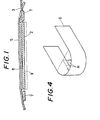
- Each electrode 2 consists of a disk-like flexible sheet (see Figs. 2A and 2B) having area of about 50 cm 2 and the thickness of about 0.1 to 2 mm.
- the electrodes 2 are attached to a patient's body 4 from both of the breast side and the back side of his heart, respectively.
- each electrode 2 is directly attached to the patient's skin with a proper adhesive and fixed with adhesive tapes or bands 5.
- the electrodes serve as that of a defibrillator, they must be fixed in an especially firm manner because they are apt to come off from the patient's body due to a high-voltage shock.
- a ring-shaped sponge 7 is arranged around the electrode 2.
- a protective layer 8 is disposed on the upper surface of the electrode 2.
- a buffer 9 such as a sponge containting physiological sodium chloride solution may be interposed between the electrode 2 and a living body in order to improve the affinity with and the followability to the living body and the absorbability of a high-voltage shock.
- Each electrode 2 is made of a crystalline flexible sheet of graphite obtained by treating natural graphite particles with concentrated sulfuric acid of 98%.
- it can be made of Grafoil (Registered trade name) available by Union Carbide Corp.
- the thickness t of the electrode 2 preferably falls within the range of 0.1 of 2 mm more preferably within the range of 0.2 to 1 mm. If the thickness t is less than 0.1 mm, the mechanical strength of the electrode decreases, while, if the thickness t is more than 2 mm, the flexibility of the electrode decreases.
- the flexibility of a graphite sheet 6 to be used as an electrode can be represented by the permissible minimum radius R of curvature when the sheet is bent.
- the radius R is preferably less than 100 mm, more preferably less than 50 mm. If the radius R is more than 100 mm, the flexibility required can not be obtained so the followability to a living body lowers and the manner of contact with the living body becomes bad. As the result, the electrode become easy to come off from the living body by a high-voltage shock or the like.
- the electrical resistance of each electrode is preferably less than 1.0 ohm. If the resistance is too large, the electrode may cause a burn on a living body due to the generation of heat.
- Each lead 3 of the defibrillator may be made of a graphite sheet such as Grafoil, similarly to the electrode 2.
- Figs. 2A and 2B show examples that the lead 3 is made of Grafoil.
- the electrode 2 and lead 3 are integral, that is they are formed from a single sheet of graphite.
- Grafoil can be easily formed into any shape by punching or the like so it is superior in mass productivity. In addition, Grafoil can make the contact resistance between the lead and the electrode decrease to a value which may be disregarded.
- the electrode 2 and the lead 3 can be bonded to each other with an electroconductive adhesive that powder of carbon black is mixed in a thermosetting resin.
- the thermosetting resin usable is, for example, phenolic resin, epoxy resin, etc.
- the content of carbon black is preferably 30 to 90wt. %. If the content of carbon black is too little, the electrical conductivity required can not be obtained, while, if the content is too much, the adhesive strength decreases.
- Agso an electroconductive adhesive that powder of carbon black is mixed in a rubber adhesive can be used.
- a natural rubber adhesive or a synthetic rubber adhesive can be used.
- the content of carbon black is preferably 30 to 90 wt.% from the same reason as described above.
- An electroconductive adhesive of this type can make the connecting portion between the electrode and the lead flexible though the adhesive strength may decrease.
- the following method can be employed for connecting the electrode 2 and the lead 3 to each other. That is, after the electrode 2 and the lead 3 are connected to each other with an adhesive that powder of carbon black is mixed in a thermosetting resin, the connecting portion is calcined and carbonized under a reduced pressure or in an inert atmosphere at a temperature not less than 1000 ° C. By this method, the electrical resistance of the connecting portion decreases to a value which may be disregarded.
- the thermosetting resin usable for this method is, for example, phenolic resin, epoxy resin, etc.
- the content of carbon black is preferably less than 90 wt. %. If the content of carbon black is too much, the adhesive strength decreases.
- both of the electrodes 2 and the leads 3 are substantially transparent in regard to X rays. Therefore, they are not hindrances to X-ray photographing. As the result, the electrode can be attached to a patient's body through an X-ray inspection.
- the present invention is applied to the electrodes of a defibrillator.
- the present invention can be applied also to the electrodes of an electrocardiograph.
- an electrode of the present invention can serve both as electrode of a defibrillator and an electrocardiograph.
- the present invention can be applied to various electrodes such as that of a electroencephalograph and so on.
- the main body of an electrode consists of a flexible sheet of graphite and the whole of the electrode is substantially transparent in regard to X rays. Therefore, the electrode is not a hindrance to X-ray photographing. As the result, it can be applied to the electrodes of an electrocardiograph or a defibrillator attached to a living body through an X-ray inspection.
- the surface of an electrode to contact with a living body is made flexible, the followability to the living body is superior so the electrode is hard to come off from the living body even when it is used as an electrode of a defibrillator.
Landscapes
- Health & Medical Sciences (AREA)
- Engineering & Computer Science (AREA)
- Biomedical Technology (AREA)
- Nuclear Medicine, Radiotherapy & Molecular Imaging (AREA)
- Radiology & Medical Imaging (AREA)
- Life Sciences & Earth Sciences (AREA)
- Animal Behavior & Ethology (AREA)
- General Health & Medical Sciences (AREA)
- Public Health (AREA)
- Veterinary Medicine (AREA)
- Measurement And Recording Of Electrical Phenomena And Electrical Characteristics Of The Living Body (AREA)
- Electrotherapy Devices (AREA)
Claims (5)
Applications Claiming Priority (2)
| Application Number | Priority Date | Filing Date | Title |
|---|---|---|---|
| JP60187596A JPS6247373A (ja) | 1985-08-27 | 1985-08-27 | X線透過型生体電極 |
| JP187596/85 | 1985-08-27 |
Publications (3)
| Publication Number | Publication Date |
|---|---|
| EP0223340A1 EP0223340A1 (fr) | 1987-05-27 |
| EP0223340B1 EP0223340B1 (fr) | 1990-11-22 |
| EP0223340B2 true EP0223340B2 (fr) | 1994-10-19 |
Family
ID=16208874
Family Applications (1)
| Application Number | Title | Priority Date | Filing Date |
|---|---|---|---|
| EP86306507A Expired - Lifetime EP0223340B2 (fr) | 1985-08-27 | 1986-08-21 | Electrode pour corps vivant |
Country Status (5)
| Country | Link |
|---|---|
| US (1) | US4800887A (fr) |
| EP (1) | EP0223340B2 (fr) |
| JP (1) | JPS6247373A (fr) |
| CA (1) | CA1287664C (fr) |
| DE (1) | DE3675738D1 (fr) |
Families Citing this family (9)
| Publication number | Priority date | Publication date | Assignee | Title |
|---|---|---|---|---|
| DK283789A (da) * | 1988-10-05 | 1990-04-06 | Niels Kornerup | Elektrisk generator, kompres og kompreskombination og system til behandling af saar ved elektrisk stimulering samt fremgangsmaade til behandling af saar |
| US5366497A (en) * | 1992-03-31 | 1994-11-22 | Cardiotronics, Inc. | Non-invasive, radiolucent cardiac electrode |
| US5356428A (en) * | 1992-03-31 | 1994-10-18 | Cardiotronics, Inc. | Non-invasive, radiolucent electrode |
| DE4232255C1 (de) * | 1992-09-25 | 1994-02-17 | Siemens Ag | Neutralelektrode und Verfahren zu deren Wiederverwendung für ein Hochfrequenz-Chirurgiegerät mit Applikationsüberwachungseinrichtung |
| US5733324A (en) * | 1995-12-08 | 1998-03-31 | Ferrari; R. Keith | X-ray transmissive transcutaneous stimulating electrode |
| US5571165A (en) * | 1995-12-08 | 1996-11-05 | Ferrari; R. Keith | X-ray transmissive transcutaneous stimulating electrode |
| US7774070B2 (en) * | 2008-01-10 | 2010-08-10 | Hill Laboratories Company | Medical electrode assembly for electrotherapy and phototherapy treatment |
| US9226680B1 (en) | 2013-02-12 | 2016-01-05 | David Kendricks | Patient electrode connectors for electrocardiograph monitoring system |
| CN107049302A (zh) * | 2017-06-26 | 2017-08-18 | 美合实业(苏州)有限公司 | 心电导联线 |
Family Cites Families (14)
| Publication number | Priority date | Publication date | Assignee | Title |
|---|---|---|---|---|
| AU1388870A (en) * | 1969-05-02 | 1971-10-21 | Sybron Corporation | Inactive electrode |
| GB1298010A (fr) * | 1970-11-19 | 1972-11-29 | ||
| JPS528633B2 (fr) * | 1971-12-13 | 1977-03-10 | ||
| GB1542859A (en) * | 1975-12-18 | 1979-03-28 | Nat Res Dev | Electrode assemblies |
| US4102331A (en) * | 1976-09-21 | 1978-07-25 | Datascope Corporation | Device for transmitting electrical energy |
| CA1111503A (fr) * | 1977-04-02 | 1981-10-27 | Isoji Sakurada | Electrode biomedicale |
| US4248237A (en) * | 1978-03-07 | 1981-02-03 | Needle Industries Limited | Cardiac pacemakers |
| US4198991A (en) * | 1978-05-17 | 1980-04-22 | Cordis Corporation | Cardiac pacer lead |
| DE2842318C2 (de) * | 1978-09-28 | 1985-05-23 | Siemens AG, 1000 Berlin und 8000 München | Implantierbare Kohlenstoffelektrode |
| US4370984A (en) * | 1979-04-30 | 1983-02-01 | Ndm Corporation | X-Ray transparent medical electrode |
| US4257424A (en) * | 1979-04-30 | 1981-03-24 | Ndm Corporation | X-ray transparent medical electrode |
| US4417581A (en) * | 1979-05-23 | 1983-11-29 | The University Of Florida | Corneal electrode for electroretinography |
| US4442315A (en) * | 1980-11-17 | 1984-04-10 | Fukuda Denshi Kabushiki Kaisha | X-Ray transmissive electrode-shielded wire assembly and manufacture thereof |
| FR2548028B1 (fr) * | 1983-06-15 | 1986-09-19 | Hovelian Krikor | Electrode medicale de surface, jetable |
-
1985
- 1985-08-27 JP JP60187596A patent/JPS6247373A/ja active Pending
-
1986
- 1986-08-21 EP EP86306507A patent/EP0223340B2/fr not_active Expired - Lifetime
- 1986-08-21 DE DE8686306507T patent/DE3675738D1/de not_active Expired - Fee Related
- 1986-08-26 US US06/900,661 patent/US4800887A/en not_active Expired - Fee Related
- 1986-08-26 CA CA000516803A patent/CA1287664C/fr not_active Expired - Fee Related
Also Published As
| Publication number | Publication date |
|---|---|
| CA1287664C (fr) | 1991-08-13 |
| EP0223340B1 (fr) | 1990-11-22 |
| DE3675738D1 (de) | 1991-01-03 |
| EP0223340A1 (fr) | 1987-05-27 |
| JPS6247373A (ja) | 1987-03-02 |
| US4800887A (en) | 1989-01-31 |
Similar Documents
| Publication | Publication Date | Title |
|---|---|---|
| US4748983A (en) | X-ray transmissive electrode for a living body | |
| US4715382A (en) | Flat biomedical electrode with reuseable lead wire | |
| US4852571A (en) | Disposable biopotential electrode | |
| US4570637A (en) | Electrode | |
| JP5430832B2 (ja) | 医療用電極 | |
| US5456710A (en) | Vented electrode | |
| US5337748A (en) | Biosignal electrode | |
| US5356428A (en) | Non-invasive, radiolucent electrode | |
| US5405273A (en) | Medical electrode assembly | |
| US5824033A (en) | Multifunction electrode | |
| ES2370475T3 (es) | Electrodo estimulador transcutáneo transmisor de rayos x. | |
| EP1424094B1 (fr) | Electrode de stimulation transparente aux rayons X | |
| US5366497A (en) | Non-invasive, radiolucent cardiac electrode | |
| JP2001506154A (ja) | 使い捨て電極及び標準のリード線コネクタとインターフェイス接続する再使用可能なリード線アダプタを有する生医学電極 | |
| EP0223340B2 (fr) | Electrode pour corps vivant | |
| EP0222473A1 (fr) | Electrode pour un corps vivant | |
| US6477430B1 (en) | Hands-free paddles using single-use adhesive pads | |
| EP0269200A1 (fr) | Electrode biomédicale plane | |
| CN211962036U (zh) | 电极结构以及生物信息监测系统 | |
| JPS6247375A (ja) | X線透過型生体電極 | |
| JPS62122677A (ja) | X線透過型生体電極 | |
| EP0375440B1 (fr) | Electrode destinée à l'usage sur tissu vivant | |
| JPH1147105A (ja) | 生体用電極 |
Legal Events
| Date | Code | Title | Description |
|---|---|---|---|
| PUAI | Public reference made under article 153(3) epc to a published international application that has entered the european phase |
Free format text: ORIGINAL CODE: 0009012 |
|
| AK | Designated contracting states |
Kind code of ref document: A1 Designated state(s): DE FR GB |
|
| 17P | Request for examination filed |
Effective date: 19871112 |
|
| 17Q | First examination report despatched |
Effective date: 19891010 |
|
| GRAA | (expected) grant |
Free format text: ORIGINAL CODE: 0009210 |
|
| AK | Designated contracting states |
Kind code of ref document: B1 Designated state(s): DE FR GB |
|
| REF | Corresponds to: |
Ref document number: 3675738 Country of ref document: DE Date of ref document: 19910103 |
|
| ET | Fr: translation filed | ||
| PLBI | Opposition filed |
Free format text: ORIGINAL CODE: 0009260 |
|
| 26 | Opposition filed |
Opponent name: SIEMENS AKTIENGESELLSCHAFT, BERLIN UND MUENCHEN Effective date: 19910528 |
|
| PLBI | Opposition filed |
Free format text: ORIGINAL CODE: 0009260 |
|
| 26 | Opposition filed |
Opponent name: HORN GMBH & CO. KG Effective date: 19910822 Opponent name: SIEMENS AKTIENGESELLSCHAFT, BERLIN UND MUENCHEN Effective date: 19910528 |
|
| PUAH | Patent maintained in amended form |
Free format text: ORIGINAL CODE: 0009272 |
|
| STAA | Information on the status of an ep patent application or granted ep patent |
Free format text: STATUS: PATENT MAINTAINED AS AMENDED |
|
| 27A | Patent maintained in amended form |
Effective date: 19941019 |
|
| AK | Designated contracting states |
Kind code of ref document: B2 Designated state(s): DE FR GB |
|
| ET3 | Fr: translation filed ** decision concerning opposition | ||
| PGFP | Annual fee paid to national office [announced via postgrant information from national office to epo] |
Ref country code: FR Payment date: 19960809 Year of fee payment: 11 |
|
| PGFP | Annual fee paid to national office [announced via postgrant information from national office to epo] |
Ref country code: GB Payment date: 19960812 Year of fee payment: 11 |
|
| PGFP | Annual fee paid to national office [announced via postgrant information from national office to epo] |
Ref country code: DE Payment date: 19960830 Year of fee payment: 11 |
|
| PG25 | Lapsed in a contracting state [announced via postgrant information from national office to epo] |
Ref country code: GB Free format text: LAPSE BECAUSE OF NON-PAYMENT OF DUE FEES Effective date: 19970821 |
|
| GBPC | Gb: european patent ceased through non-payment of renewal fee |
Effective date: 19970821 |
|
| PG25 | Lapsed in a contracting state [announced via postgrant information from national office to epo] |
Ref country code: FR Free format text: LAPSE BECAUSE OF NON-PAYMENT OF DUE FEES Effective date: 19980430 |
|
| PG25 | Lapsed in a contracting state [announced via postgrant information from national office to epo] |
Ref country code: DE Free format text: LAPSE BECAUSE OF NON-PAYMENT OF DUE FEES Effective date: 19980501 |
|
| REG | Reference to a national code |
Ref country code: FR Ref legal event code: ST |
|
| PLAB | Opposition data, opponent's data or that of the opponent's representative modified |
Free format text: ORIGINAL CODE: 0009299OPPO |