EP0223343A2 - Zeit-Integral-Indikator eines überwachten Parameters - Google Patents
Zeit-Integral-Indikator eines überwachten Parameters Download PDFInfo
- Publication number
- EP0223343A2 EP0223343A2 EP86306699A EP86306699A EP0223343A2 EP 0223343 A2 EP0223343 A2 EP 0223343A2 EP 86306699 A EP86306699 A EP 86306699A EP 86306699 A EP86306699 A EP 86306699A EP 0223343 A2 EP0223343 A2 EP 0223343A2
- Authority
- EP
- European Patent Office
- Prior art keywords
- electrode
- electrochromic material
- layer
- electrons
- electrolyte
- Prior art date
- Legal status (The legal status is an assumption and is not a legal conclusion. Google has not performed a legal analysis and makes no representation as to the accuracy of the status listed.)
- Withdrawn
Links
- 239000000463 material Substances 0.000 claims abstract description 97
- 239000003792 electrolyte Substances 0.000 claims abstract description 43
- ZNOKGRXACCSDPY-UHFFFAOYSA-N tungsten trioxide Chemical compound O=[W](=O)=O ZNOKGRXACCSDPY-UHFFFAOYSA-N 0.000 claims abstract description 37
- 230000004913 activation Effects 0.000 claims abstract description 18
- 238000004090 dissolution Methods 0.000 claims description 17
- 239000000758 substrate Substances 0.000 claims description 16
- 238000000034 method Methods 0.000 claims description 15
- PXHVJJICTQNCMI-UHFFFAOYSA-N Nickel Chemical compound [Ni] PXHVJJICTQNCMI-UHFFFAOYSA-N 0.000 claims description 13
- 229920000642 polymer Polymers 0.000 claims description 13
- 230000000007 visual effect Effects 0.000 claims description 12
- 230000001419 dependent effect Effects 0.000 claims description 10
- 238000012546 transfer Methods 0.000 claims description 10
- 238000004891 communication Methods 0.000 claims description 7
- 238000007650 screen-printing Methods 0.000 claims description 7
- 229910052759 nickel Inorganic materials 0.000 claims description 6
- 238000007789 sealing Methods 0.000 claims description 6
- 238000010521 absorption reaction Methods 0.000 claims description 5
- XEEYBQQBJWHFJM-UHFFFAOYSA-N Iron Chemical compound [Fe] XEEYBQQBJWHFJM-UHFFFAOYSA-N 0.000 claims description 4
- 238000000151 deposition Methods 0.000 claims description 4
- 238000004519 manufacturing process Methods 0.000 claims description 4
- 230000001186 cumulative effect Effects 0.000 claims description 3
- 229910052742 iron Inorganic materials 0.000 claims description 2
- 238000007599 discharging Methods 0.000 abstract description 2
- 239000010410 layer Substances 0.000 description 40
- 229910052739 hydrogen Inorganic materials 0.000 description 16
- 239000001257 hydrogen Substances 0.000 description 16
- 238000012505 colouration Methods 0.000 description 15
- 230000001276 controlling effect Effects 0.000 description 13
- 238000009792 diffusion process Methods 0.000 description 13
- BDAGIHXWWSANSR-UHFFFAOYSA-N methanoic acid Natural products OC=O BDAGIHXWWSANSR-UHFFFAOYSA-N 0.000 description 12
- 229910000906 Bronze Inorganic materials 0.000 description 7
- 239000002253 acid Substances 0.000 description 7
- 239000010974 bronze Substances 0.000 description 7
- KUNSUQLRTQLHQQ-UHFFFAOYSA-N copper tin Chemical compound [Cu].[Sn] KUNSUQLRTQLHQQ-UHFFFAOYSA-N 0.000 description 7
- 235000013305 food Nutrition 0.000 description 7
- 150000002431 hydrogen Chemical class 0.000 description 7
- -1 hydrogen ions Chemical class 0.000 description 7
- 230000035945 sensitivity Effects 0.000 description 7
- 238000012360 testing method Methods 0.000 description 7
- WFKWXMTUELFFGS-UHFFFAOYSA-N tungsten Chemical compound [W] WFKWXMTUELFFGS-UHFFFAOYSA-N 0.000 description 7
- 229910052721 tungsten Inorganic materials 0.000 description 7
- 239000010937 tungsten Substances 0.000 description 7
- OSWFIVFLDKOXQC-UHFFFAOYSA-N 4-(3-methoxyphenyl)aniline Chemical compound COC1=CC=CC(C=2C=CC(N)=CC=2)=C1 OSWFIVFLDKOXQC-UHFFFAOYSA-N 0.000 description 6
- VEXZGXHMUGYJMC-UHFFFAOYSA-N Hydrochloric acid Chemical compound Cl VEXZGXHMUGYJMC-UHFFFAOYSA-N 0.000 description 6
- 235000019253 formic acid Nutrition 0.000 description 6
- 238000002347 injection Methods 0.000 description 6
- 239000007924 injection Substances 0.000 description 6
- 239000000945 filler Substances 0.000 description 4
- QTBSBXVTEAMEQO-UHFFFAOYSA-N Acetic acid Chemical compound CC(O)=O QTBSBXVTEAMEQO-UHFFFAOYSA-N 0.000 description 3
- HEMHJVSKTPXQMS-UHFFFAOYSA-M Sodium hydroxide Chemical compound [OH-].[Na+] HEMHJVSKTPXQMS-UHFFFAOYSA-M 0.000 description 3
- 230000002378 acidificating effect Effects 0.000 description 3
- 230000000694 effects Effects 0.000 description 3
- 239000007772 electrode material Substances 0.000 description 3
- 239000010408 film Substances 0.000 description 3
- 238000004806 packaging method and process Methods 0.000 description 3
- UFHFLCQGNIYNRP-UHFFFAOYSA-N Hydrogen Chemical compound [H][H] UFHFLCQGNIYNRP-UHFFFAOYSA-N 0.000 description 2
- QAOWNCQODCNURD-UHFFFAOYSA-N Sulfuric acid Chemical compound OS(O)(=O)=O QAOWNCQODCNURD-UHFFFAOYSA-N 0.000 description 2
- 150000007513 acids Chemical class 0.000 description 2
- 230000003213 activating effect Effects 0.000 description 2
- CJOBVZJTOIVNNF-UHFFFAOYSA-N cadmium sulfide Chemical compound [Cd]=S CJOBVZJTOIVNNF-UHFFFAOYSA-N 0.000 description 2
- 238000010276 construction Methods 0.000 description 2
- 239000011521 glass Substances 0.000 description 2
- 229910052738 indium Inorganic materials 0.000 description 2
- APFVFJFRJDLVQX-UHFFFAOYSA-N indium atom Chemical compound [In] APFVFJFRJDLVQX-UHFFFAOYSA-N 0.000 description 2
- 150000002500 ions Chemical class 0.000 description 2
- 239000000843 powder Substances 0.000 description 2
- 239000004065 semiconductor Substances 0.000 description 2
- 239000001117 sulphuric acid Substances 0.000 description 2
- 235000011149 sulphuric acid Nutrition 0.000 description 2
- 239000010409 thin film Substances 0.000 description 2
- 229920000219 Ethylene vinyl alcohol Polymers 0.000 description 1
- FYYHWMGAXLPEAU-UHFFFAOYSA-N Magnesium Chemical compound [Mg] FYYHWMGAXLPEAU-UHFFFAOYSA-N 0.000 description 1
- 235000011054 acetic acid Nutrition 0.000 description 1
- 239000012790 adhesive layer Substances 0.000 description 1
- 239000003513 alkali Substances 0.000 description 1
- 230000001580 bacterial effect Effects 0.000 description 1
- 230000015572 biosynthetic process Effects 0.000 description 1
- 229910052980 cadmium sulfide Inorganic materials 0.000 description 1
- 238000006243 chemical reaction Methods 0.000 description 1
- 239000011248 coating agent Substances 0.000 description 1
- 238000000576 coating method Methods 0.000 description 1
- 239000002131 composite material Substances 0.000 description 1
- 238000002425 crystallisation Methods 0.000 description 1
- 238000013461 design Methods 0.000 description 1
- 230000006866 deterioration Effects 0.000 description 1
- 238000009826 distribution Methods 0.000 description 1
- 230000005684 electric field Effects 0.000 description 1
- 230000005670 electromagnetic radiation Effects 0.000 description 1
- 239000004715 ethylene vinyl alcohol Substances 0.000 description 1
- 238000009472 formulation Methods 0.000 description 1
- PCHJSUWPFVWCPO-UHFFFAOYSA-N gold Chemical compound [Au] PCHJSUWPFVWCPO-UHFFFAOYSA-N 0.000 description 1
- 229910052737 gold Inorganic materials 0.000 description 1
- 239000010931 gold Substances 0.000 description 1
- RZXDTJIXPSCHCI-UHFFFAOYSA-N hexa-1,5-diene-2,5-diol Chemical compound OC(=C)CCC(O)=C RZXDTJIXPSCHCI-UHFFFAOYSA-N 0.000 description 1
- 235000011167 hydrochloric acid Nutrition 0.000 description 1
- 235000015243 ice cream Nutrition 0.000 description 1
- 230000001771 impaired effect Effects 0.000 description 1
- 238000011534 incubation Methods 0.000 description 1
- 229910052500 inorganic mineral Inorganic materials 0.000 description 1
- 239000012212 insulator Substances 0.000 description 1
- 230000010354 integration Effects 0.000 description 1
- 229920000092 linear low density polyethylene Polymers 0.000 description 1
- 239000004707 linear low-density polyethylene Substances 0.000 description 1
- 239000007788 liquid Substances 0.000 description 1
- 239000011244 liquid electrolyte Substances 0.000 description 1
- 239000011777 magnesium Substances 0.000 description 1
- 229910052749 magnesium Inorganic materials 0.000 description 1
- 238000002844 melting Methods 0.000 description 1
- 230000008018 melting Effects 0.000 description 1
- 229910052751 metal Inorganic materials 0.000 description 1
- 239000002184 metal Substances 0.000 description 1
- 239000011707 mineral Substances 0.000 description 1
- 239000000203 mixture Substances 0.000 description 1
- 238000012544 monitoring process Methods 0.000 description 1
- 231100000252 nontoxic Toxicity 0.000 description 1
- 230000003000 nontoxic effect Effects 0.000 description 1
- 239000002245 particle Substances 0.000 description 1
- 230000002085 persistent effect Effects 0.000 description 1
- 239000011148 porous material Substances 0.000 description 1
- 238000012545 processing Methods 0.000 description 1
- 238000009790 rate-determining step (RDS) Methods 0.000 description 1
- 230000001105 regulatory effect Effects 0.000 description 1
- 239000007787 solid Substances 0.000 description 1
- 239000007784 solid electrolyte Substances 0.000 description 1
- 239000000243 solution Substances 0.000 description 1
- 238000001228 spectrum Methods 0.000 description 1
- 238000003860 storage Methods 0.000 description 1
- 239000000126 substance Substances 0.000 description 1
- 231100000419 toxicity Toxicity 0.000 description 1
- 230000001988 toxicity Effects 0.000 description 1
Images


Classifications
-
- G—PHYSICS
- G04—HOROLOGY
- G04F—TIME-INTERVAL MEASURING
- G04F13/00—Apparatus for measuring unknown time intervals by means not provided for in groups G04F5/00 - G04F10/00
- G04F13/04—Apparatus for measuring unknown time intervals by means not provided for in groups G04F5/00 - G04F10/00 using electrochemical means
-
- G—PHYSICS
- G01—MEASURING; TESTING
- G01K—MEASURING TEMPERATURE; MEASURING QUANTITY OF HEAT; THERMALLY-SENSITIVE ELEMENTS NOT OTHERWISE PROVIDED FOR
- G01K3/00—Thermometers giving results other than momentary value of temperature
- G01K3/02—Thermometers giving results other than momentary value of temperature giving means values; giving integrated values
- G01K3/04—Thermometers giving results other than momentary value of temperature giving means values; giving integrated values in respect of time
Definitions
- This invention relates to indicator devices for indicating the time integral of a monitored parameter.
- One particular application of the device is for indicating the time temperature integral of degradable or perishable commodities.
- Such devices may be placed on wrappings or containers of perishable commodities to give a visual indication of the integral of time and temperature to which the commodity has been subjected since packaging, that is, since the fresh condition, in particular for indicating when the commodity has been subject to conditions of time and temperature such that it will have suffered deterioration or spoilage.
- Such devices are generally known as "time temperature indicators”.
- time temperature indicator In general, the common requirements of a time temperature indicator are that it should exhibit properties which are readily changed by time and/or temperature, give a visual indication of time and temperature integration, and should be activatable when the commodity is fresh or has been recently packaged.
- Devices which fulfil these requirements are already known and are based on processes such as chemical diffusion, physical diffusion, thermochromic effects, biological reactions, polymer crystallisation and electrochemical effects.
- an indicator device for indicating the time integral of a monitored parameter comprising: a substrate carrying a layer of electrochromic material; an electrode; and an electrolyte for contacting both the layer of electrochromic material and the electrode, the device being arranged so that, upon activation, electrons pass from the electrode to the layer of electrochromic material by means of a localised area of communication therebetween causing the electromagnetic absorption characteristic, and hence colour, of the electrochromic material to change so that a colour change boundary advances across the layer of electrochromic material away from the said area of communication, and being arranged so that the rate of advancement of the colour change boundary is substantially determined by the supply of electrons from the electrode to the unchanged electrochromic material at the colour change boundary, the said supply of electrons being responsive to changes in the monitored parameter, whereby the position of the colour change boundary provides a visual indication of the time integral of the monitored parameter since activation of the device.
- an electrochromic device may be adapted to function as a time integrator of a monitored parameter.
- One particular form of the invention is an electrochromic device adapted to function as a time-temperature indicator.
- a method of making devices comprising the steps of: depositing a layer of electrochromic material in a plurality of areas onto a sheet of substrate; depositing an electrode on or adjacent the layer of electrochromic layer in each of the said areas; providing a quantity of electrolyte in each of the said areas; and sealing the sheet of substrate with electrochromic material, electrode and electrolyte thereon between two polymer sheets; and sealing each of the said areas from each other to define individual devices.
- an electrochromic device as an indicator device for indicating the time integral of a monitored parameter, the device comprising: a substrate carrying a layer of electrochromic material; an electrode; and an electrolyte in contact with the layer of electrochromic material and the electrode, the arrangement being such that a passage of electrons from the electrode to the layer of electrochromic material causes the elecromagnetic absorption characteristic, and hence colour, of the electrochromic material to change so that a colour change boundary advances along the layer of electrochromic material to provide a visual indication of the time integral of the monitored parameter since activation of the device.
- Figures 1 and 2 show a time temperature indicator device comprising a porous substrate 1, a layer or strip of electrochromic material 2 such as tungsten trioxide (W0 3 ), which is colourless or pale yellow, applied thereto and an electrode 3 in contact with one end of the strip of electrochromic material 2 so that there is a localised area of communication between the electrode 3 and the strip of electrochromic material 2.
- An electrolyte 4 contacts both the layer of electrochromic material 2 and the electrode 3 and the whole device is encapsulated within a transparent polymer sheath 5.
- the electrode 3 is formed of a material such as nickel which dissolves in an acidic electrolyte, eg 2M formic acid. As positive ions of the electrode 3 go into solution, the electrons remaining in the electrode 3 are injected into the layer of tungsten trioxide 2. The resultant negative charge in the layer 2 is then believed to attract hydrogen ions from the electrolyte 4 to react with the electrochromic material under the electrode 3 to convert it (in the case of tungsten trioxide) into hydrogen tungsten bronze (H x W0 3 ) 6 which absorbs light at the red end of the spectrum and therefore appears blue. The region of the layer of electrochromic material 2 under the electrode 3 therefore becomes coloured.
- an acidic electrolyte eg 2M formic acid.
- the hydrogen tungsten bronze 6 is a semiconductor whereas the tungsten trioxide is an insulator, so as further electrons are injected into the electrochromic layer 2 they are conducted through the coloured hydrogen tungsten bronze 6 to an interface 7 between the converted (and hence coloured) and unconverted (and hence uncoloured) tungsten trioxide so that the formation of hydrogen tungsten bronze continues. It is believed that hydrogen ions are attracted into the layer of electrochromic material along the whole length of the coloured portion thereof during this process and diffuse down the concentration gradient between the oldest coloured portion thereof and the most recently coloured portion.
- the interface 7 is clearly shown by a colour change boundary between the coloured and uncoloured material, and as the tungsten trioxide is progressively converted to hydrogen tungsten bronze the interface 7 advances along the strip.
- the position of the colour change boundary is thus dependent on the time and temperature since activation of the device and so provides a visual indication of the cumulative time-temperature history of the device.
- the device is effectively acting as a coulombmeter.
- the strip of electrochromic material may be between 2mm and 4mm wide, between 20mm and 40mm long and about 10ii to 30 thick.
- the device may be applied very much like a label to the wrapping or container of a product and may be provided with a calibration scale to indicate the state of the product as a result of its time-temperature history.
- One convenient way of doing this is to mark the device with green, amber and red areas as shown in Figure 2 such that when the colour change boundary is within the green area this indicates that the product should be fresh, when in the amber area this indicates that the product should be used in the near future, and when in the red area this indicates that the product may have passed its "sell-by" date and may be unsatisfactory.
- the arrangement described above effectively comprises an internal electrochemical cell and so requires no external power source.
- the cell can be designed to have a high internal resistance so that it discharges slowly and produces a slow moving colour change boundary 7.
- the rate at which the colour change boundary 7 advances along the strip is dependent on a number of factors and if the device is to be used as a time temperature indicator it must be designed so that the rate controlling step is temperature sensitive.
- the rate controlling step either involves the supply of electrons, ie the initial injection of electrons or their subsequent movement to the unconverted tungsten trioxide at the colour change boundary, or the movement of a larger species, eg the diffusion of hydrogen ions from the electrolyte into the layer of electrochromic material.
- the supply of electrons can generally be made much more temperature sensitive than the diffusion of a species such as hydrogen ions so if the device is to be used as a time-temperature indicator it should be arranged so that the supply of electrons controls the rate of the colouration process.
- the device can be arranged so that any of these processes is the rate controlling step but the examples described herein will mostly relate to process (a).
- process (a) In order to make a device in which the rate of dissolution of the electrode is the rate controlling step, it is necessary to consider three criteria:
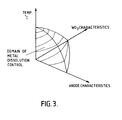
- a three-dimensional model can therefore be constructed which defines a domain within which electrode dissolution controls the colouration rate and outside which diffusion processes dominate (see Fig 3).
- the rate at which the colour change boundary moves is dependent on several factors.
- devices can be designed to operate in the temperature range -40°C to 100°C and which monitor the time-temperature history of a commodity for periods in the range 10 minutes to 10 months.
- Preferred ranges for instance for perishable food products, are a temperature range of 0°C to 4CPC and time periods in the range of a few days to a few weeks.
- the temperature sensitivity of the devices may be such that the rate of boundary movement increases 1.5 to 4.5 times for a 10°C temperature rise.
- Devices for use with food products may, for instance, produce 30mm of colouration in 2 weeks at 5°C and 30mm of colouration in 5.6 days at 15°C. That is a rate of movement between 0.09 and 0.22mm/hour and an increase in the rate of movement of 2.4 times for a 10°C temperature rise.
- the substrate 1 is preferably made of a porous material such as paper when a liquid electrolyte 4 is used to facilitate even distribution of the electrolyte in contact with the electrochromic material 2.
- the electrolyte could alternatively be in the form of a gel which would permit the use of a non-porous substrate.
- the substrate is flexible to enable the device to be easily attached to packaging and is opaque or semi-opaque to help show up the position of the colour change boundary.
- the electrochromic material 2 is preferably tungsten trioxide, although other oxides such as Mo03 and V 2 0 5 may be used. It is preferably applied as a powder, which may be mixed with an inert filler and dispersed in an organic vehicle, by a thick film technique such as screen printing to produce a layer between 5 ⁇ and 8@ thick, the thicker films giving slower colouration rates.
- the amount of inert filler, such as glass, which is used affects the conductance of the material.
- inert filler it may be desirable to include a relatively large proportion of inert filler to reduce the conductance of the material to such an extent that the rate of transfer of electrons along the layer of electrochromic material becomes the rate controlling step for the movement of the colour change boundary 7 as mentioned in relation to process (c) above.
- the electrode preferably comprises nickel although other electropositive materials, such as iron, which have a tendency to dissolve in an acidic electrolyte (ie are electronegative with respect to hydrogen) may be used.
- electropositive materials such as iron
- the nature of the perishable commodity to which it is intended to apply the device may be a major factor governing choice of electrode material in view of the toxicity of some materials.
- the electrode is also preferably applied by screen printing and may be 60 to 100 ⁇ on thickness and cover a localised area of around 4 to 16mm of the strip of electrochromic material.
- the electrolyte is preferably acidic and may comprise non-mineral acids such as formic acid, acetic acid, sulphuric and hydrochloric acid.
- Weaker acids ie those having a higher pH, tend to be used with the more electropositive electrode materials in order to limit the dissolution rate.
- Acid concentrations may lie in the range 0.25M to 4M.
- alkali electrolytes for instance sodium hydroxide with a magnesium electrode.
- the electrolyte may be a liquid or a gel. It is also possible to use a solid electrolyte such as phosphonomolybdic acid which has a high proton conductance.
- the device is sealed from contact with the ambient atmosphere by being contained in a transparent polymer sheath 5 for example co-extruded ethylene vinyl alcohol polymer and a linear low-density polyethylene.
- a transparent polymer sheath 5 for example co-extruded ethylene vinyl alcohol polymer and a linear low-density polyethylene.
- the device may, as mentioned above, comprise a layer of intermediate material between the electrode and the layer of electrochromic material.
- the intermediate layer may have a predetermined or variable conductance and the transfer of electrons therethrough may be the rate determining step in the colouration process.
- the intermediate layer may, for example, be a thermistor which controls the injection of electrons into the layer of electrochromic material in dependence upon temperature or may be a photoconductor which controls the injection of electrons in dependence upon the intensity of light incident thereupon.
- the device comprises a porous, paper susbstrate 140 P thick with a strip of tungsten trioxide powder applied thereto by screen printing using an organic medium called Seristar SX (Trade Mark) produced by Sericol Ltd.
- the strip is formed with a thickness of between 10 and 3011 and dried at room temperature or slightly elevated temperature, eg 50°C.
- the strip is about 30mm long and 2mm wide.
- An electrode 4mm by 4mm is formed on one end of the strip by screen printing nickel powder dispersed in a Seristar SX (Trade Mark) carrier to a thickness of 20 to 80 ⁇ .
- the electrolyte used is 2M formic acid which is substantially absorbed by the porous substrate.
- the entire device is sealed in a transparent polymer sheath by ultrasonic sealing or infra-red sealing.
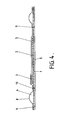
- Figures 4 and 5 illustrate a convenient construction for the mass production of devices.
- the devices are formed by placing a sheet of a highly porous paper substrate 1 onto a polymer sheet 5 . Strips of electrochromic material 2 , together with their associated electrodes 3 , are then printed onto the substrate 1 , for instance in rows of 20 with 20 rows per sheet.
- the electrolyte 4 is then deposited at appropriate positions onto the polymer sheet 5 and a further polymer sheet 5 is then laid over the top to cover each device and form blisterpacks 8 for the electrolyte 4 .
- Seals 9 are formed through both polymer sheets 5 and the intervening porous paper substrate 1 to define individual devices and to provide a rupturable seal 10 in each device between the blisterpack 8 and the electrode 3 and strip of electrochromic material 2 .
- An adhesive layer together with a removable cover sheet may be applied to the underside of the first polymer sheet 5 to enable the device to be affixed easily to an article. The composite sheet thus formed is then cut into individual devices along the seals 9 .
- tine temperature indicator devices are suitable for use on perishable products such as food particularly as they can be produced inexpensively and are generally non-toxic.
- Q 10 is defined as
- Perishable foodstuffs generally have a Q 10 factor in the range from about 1.1 to 10 with the range 2 to 5 covering most products. Therefore, for a product with a Q 10 factor of say 2.5, a time temperature indicator should be provided in which the colour change boundary moves at a rate such that within limits laid down by the food or other relevant industry.
- Time temperature indicator devices can also be made to conform with other spoilage models used in the food industry, eg the Ratkowski formula.
- a refined form of the device suitable for use in the food industry is provided with means to inhibit dissolution of the electrode in the early stages to allow for the initial incubation period for bacterial growth in a perishable product. This may, for instance, be achieved by coating the electrode with a suitable polymer which has to be broken down by the electrolyte before dissolution of the electrode can occur.
- devices can thus be made having a predetermined temperature sensitivity and a predetermined rate of movement of the colour change boundary.
- a wide range of characteristics can be achieved, eg Q lo factors in the range 1.5 to 4.5.
- the dissolution rate is temperature sensitive care should be taken to ensure that the device has the required characteristics in the temperature range in which it is intended to be used.
- the colour change boundaries on each side of the centrally positioned electrode advance at approximately half the normal rate so that after a given time approximately the same total length of strip is coloured as compared to a normal device with the electrode positioned at the end of the strip.
- the devices so far described have all operated as self-discharging internal cells requiring no external power source as electrons are injected into the electrochromic material as the electrode dissolves. It is also possible to inject electrons from some other source, eg by using a photodiode as the electrode in place of or in conjunction with a dissolving metal electrode. In many applications the ability to function without an external power source is an advantage but in some cases it may be desirable to apply an external current source to the device as a further means of controlling the supply of electrons between the electrode and the colour change boundary.
- the external current source can be used to increase or decrease the supply of electrons and can itself be made dependent on a parameter monitored by an appropriate transducer.
- the colouration rate of the layer of electrochromic material can thus be made dependent on parameters other than time and temperature so the device can be used as a coulombmeter in a wide variety of applications.
- a current input to the device may be arranged to vary in dependence upon the output of a pressure transducer so that the position of the colour change boundary provides a visual indication of the pressure-time integral. This may be done by connecting the output voltage of the pressure transducer across two gold electrodes deposited on the device, one electrode being connected to the layer of electrochromic material and the other being in contact with the electrolyte.
- Two or more transducers may also be used either in series or parallel with each other depending on the quantity to be monitored and, again, may be used in place of or in conjunction with a source of injected electrons such as a dissolving electrode.
Landscapes
- Physics & Mathematics (AREA)
- General Physics & Mathematics (AREA)
- Chemical & Material Sciences (AREA)
- Chemical Kinetics & Catalysis (AREA)
- Electrochemistry (AREA)
- General Chemical & Material Sciences (AREA)
- Electrochromic Elements, Electrophoresis, Or Variable Reflection Or Absorption Elements (AREA)
- Measurement Of Unknown Time Intervals (AREA)
- Audible And Visible Signals (AREA)
Applications Claiming Priority (2)
| Application Number | Priority Date | Filing Date | Title |
|---|---|---|---|
| GB8521488 | 1985-08-29 | ||
| GB08521488A GB2180964A (en) | 1985-08-29 | 1985-08-29 | Indicator element |
Publications (2)
| Publication Number | Publication Date |
|---|---|
| EP0223343A2 true EP0223343A2 (de) | 1987-05-27 |
| EP0223343A3 EP0223343A3 (de) | 1989-02-08 |
Family
ID=10584424
Family Applications (1)
| Application Number | Title | Priority Date | Filing Date |
|---|---|---|---|
| EP86306699A Withdrawn EP0223343A3 (de) | 1985-08-29 | 1986-08-29 | Zeit-Integral-Indikator eines überwachten Parameters |
Country Status (4)
| Country | Link |
|---|---|
| US (1) | US4804275A (de) |
| EP (1) | EP0223343A3 (de) |
| JP (1) | JPS62111284A (de) |
| GB (1) | GB2180964A (de) |
Families Citing this family (38)
| Publication number | Priority date | Publication date | Assignee | Title |
|---|---|---|---|---|
| US4929090A (en) * | 1988-10-24 | 1990-05-29 | Isabelle Grahm | Temperature history indicatiang label |
| DE3907683A1 (de) * | 1989-03-09 | 1990-09-20 | Badische Tabakmanufaktur | Indikator, verfahren zu seiner herstellung sowie seine verwendung |
| DE9001322U1 (de) * | 1990-02-06 | 1990-04-12 | Klocke Verpackungs-Service GmbH, 7504 Weingarten | Entmischungsuhr |
| US5138481A (en) * | 1991-07-23 | 1992-08-11 | Ford Motor Company | Electrochromic device with color gradient and method of making the device |
| US6243192B1 (en) | 1997-04-28 | 2001-06-05 | Timer Technologies, Llc | Electrochemical display and timing mechanism with migrating electrolyte |
| GB2324884A (en) * | 1997-04-28 | 1998-11-04 | Wisconsin Label Corp | Electrochemical display and timing mechanism with migrating electrolyte |
| US6285492B1 (en) | 1998-07-02 | 2001-09-04 | Timer Technologies, Llc | Interactive electrochemical displays |
| US6136468A (en) * | 1998-08-25 | 2000-10-24 | Timer Technologies, Llc | Electrochemical cell with deferred assembly |
| US6198701B1 (en) | 1998-09-03 | 2001-03-06 | Polyplus Battery Company, Inc. | Electrochemical timer |
| US6395043B1 (en) | 1998-11-25 | 2002-05-28 | Timer Technologies, Llc | Printing electrochemical cells with in-line cured electrolyte |
| JP3394202B2 (ja) * | 1999-01-13 | 2003-04-07 | 太陽誘電株式会社 | 電磁界強度の測定方法及び装置並びに電流電圧分布の測定方法及び装置 |
| US6737274B1 (en) | 1999-02-04 | 2004-05-18 | United States Of America As Represented By The Secretary Of The Army | Comparator for time-temperature indicator |
| DE19912307A1 (de) * | 1999-03-19 | 2000-09-28 | Michael Baumgaertner | Aus Papier oder Gewebe (Textil) aufgebauter Bildschirm |
| US6270122B1 (en) * | 1999-10-22 | 2001-08-07 | Timer Technologies, Llc | Irreversible thin film display with clearing agent |
| US6318760B1 (en) * | 2000-06-06 | 2001-11-20 | Timer Technologies, Llc | Irreversible display with temporary imaging stage |
| US20030080191A1 (en) | 2001-10-26 | 2003-05-01 | Allen Lubow | Method and apparatus for applying bar code information to products during production |
| US6822931B2 (en) * | 2001-12-13 | 2004-11-23 | Vision Works, Llc | Timing system and device and method for making the same |
| US7813226B2 (en) * | 2002-12-13 | 2010-10-12 | Vision Works Ip Corporation | Timing system and device and method for making the same |
| US7372780B1 (en) * | 2002-12-13 | 2008-05-13 | Vision Works Ip Corporation | Timing system and device and method for making the same |
| WO2003052681A1 (en) | 2001-12-17 | 2003-06-26 | International Barcode Corporation | Double-sided bar code doubling as a single bar code |
| BR0308300A (pt) * | 2002-03-07 | 2005-04-05 | Avery Dennison Corp | Rótulo indicador de tempo e temperatura, método para determinar o histórico de tempo e temperatura de um artigo, cartão de identificação de nome e método para proporcionar cartões de identificação de nome com um limite de tempo |
| US7254095B1 (en) * | 2002-12-13 | 2007-08-07 | Vision Works, Llc | Timing system and device and method for making the same |
| US8717854B2 (en) | 2002-12-13 | 2014-05-06 | Vision Works Ip Corporation | Environment dependent—temperature independent color changing label |
| US7377690B1 (en) * | 2004-05-13 | 2008-05-27 | The United States Of America As Represented By The Secretary Of The Navy | High trigger temperature lithium intermetallic thermal sensors |
| US7821794B2 (en) * | 2005-04-11 | 2010-10-26 | Aveso, Inc. | Layered label structure with timer |
| US7362663B2 (en) * | 2005-09-21 | 2008-04-22 | Timestrip Uk Limited | Elapsed time indicator device |
| US7528737B2 (en) * | 2006-04-10 | 2009-05-05 | Rosemount Inc. | Temperature responsive indicators for process control instruments |
| EP1862786B1 (de) * | 2006-05-30 | 2011-10-05 | Acreo AB | Vorrichtung, Kit und Verfahren zur Überwachung einer Parameterhistorie |
| ATE527527T1 (de) | 2006-05-30 | 2011-10-15 | Acreo Ab | Vorrichtung, kit und verfahren zur überwachung einer parameterhistorie |
| US7604398B1 (en) | 2007-03-26 | 2009-10-20 | Akers Jeffrey W | Remote indicating cumulative thermal exposure monitor and system for reading same |
| GB2454203A (en) | 2007-10-30 | 2009-05-06 | Univ Muenster Wilhelms | Time controlled activation of elements |
| EP2401659B1 (de) * | 2009-02-26 | 2016-12-14 | Vision Works Ip Corporation | Zeitabhängiges-temperaturunabhängiges etikett mit farbveränderung |
| US8599018B2 (en) | 2010-11-18 | 2013-12-03 | Yael Debra Kellen | Alarm system having an indicator light that is external to an enclosed space for indicating the time elapsed since an intrusion into the enclosed space and method for installing the alarm system |
| US8624735B2 (en) | 2010-11-18 | 2014-01-07 | Yael Debra Kellen | Alarm system having an indicator light that is external to an enclosed space for indicating the specific location of an intrusion into the enclosed space and a method for installing the alarm system |
| US9188962B2 (en) | 2011-11-01 | 2015-11-17 | Vision Works Ip Corporation | Timing system and device and method for making the same |
| US9298167B2 (en) | 2011-12-23 | 2016-03-29 | Vision Works Ip Corporation | Timing system and device and method for making the same |
| US10338537B2 (en) | 2014-09-08 | 2019-07-02 | Vision Works Ip Corporation | Indicators for external variables consisting of singular and multiple depletion cells |
| US10318604B2 (en) | 2017-02-13 | 2019-06-11 | Vision Works Ip Corporation | Electronically readable system and device with changing codes |
Family Cites Families (14)
| Publication number | Priority date | Publication date | Assignee | Title |
|---|---|---|---|---|
| GB903967A (en) * | 1961-03-17 | 1962-08-22 | Honeywell Regulator Co | A visual temperature-history indicator |
| US3090915A (en) * | 1961-01-03 | 1963-05-21 | American Mach & Foundry | Elapsed time indicator |
| DE1473295A1 (de) * | 1961-12-15 | 1969-04-17 | Honeywell Inc | Temperaturlebenslauf-Anzeigegeraet |
| US3380072A (en) * | 1966-03-21 | 1968-04-23 | Union Carbide Corp | Recording coulometer |
| US3521941A (en) * | 1967-02-07 | 1970-07-28 | American Cyanamid Co | Electro-optical device having variable optical density |
| US3602813A (en) * | 1967-03-02 | 1971-08-31 | Roy Fergus Benseman | Device including an electrolytic bath for ascertaining the average temperature of a body or space and particularly foodstuffs over a period of time |
| US3578843A (en) * | 1968-09-25 | 1971-05-18 | American Cyanamid Co | Control of light reflected from a mirror |
| US3665308A (en) * | 1970-05-28 | 1972-05-23 | Curtis Instr | Package for an electrochemical elapsed time meter |
| US4001688A (en) * | 1974-05-28 | 1977-01-04 | Curtis Instruments, Inc. | Coulometer with end of integration color change indicator |
| US4021100A (en) * | 1974-09-03 | 1977-05-03 | American Cyanamid Company | Electrochromic device having an electrolyte contained in a solid porous insulating layer |
| US3940205A (en) * | 1974-09-09 | 1976-02-24 | Rca Corporation | Electrochromic device having an indium electrode |
| US4009935A (en) * | 1975-07-11 | 1977-03-01 | Rca Corporation | Electrochromic device having a dopant therein to improve its color center absorption characteristics |
| GB2107894A (en) * | 1981-10-19 | 1983-05-05 | Glaverbel | Electrochromic display devices |
| US4488780A (en) * | 1981-12-07 | 1984-12-18 | Rockwell International Corporation | Method of producing a color change in a chemically coupled color-changing display |
-
1985
- 1985-08-29 GB GB08521488A patent/GB2180964A/en not_active Withdrawn
-
1986
- 1986-08-29 EP EP86306699A patent/EP0223343A3/de not_active Withdrawn
- 1986-08-29 US US06/901,645 patent/US4804275A/en not_active Expired - Fee Related
- 1986-08-29 JP JP61201910A patent/JPS62111284A/ja active Pending
Also Published As
| Publication number | Publication date |
|---|---|
| EP0223343A3 (de) | 1989-02-08 |
| US4804275A (en) | 1989-02-14 |
| GB8521488D0 (en) | 1985-10-02 |
| GB2180964A (en) | 1987-04-08 |
| JPS62111284A (ja) | 1987-05-22 |
Similar Documents
| Publication | Publication Date | Title |
|---|---|---|
| US4804275A (en) | Indicator device for indicating the time integral of a monitored parameter | |
| US6198701B1 (en) | Electrochemical timer | |
| EP1952110B1 (de) | Kombinations-frostindikatoren | |
| US7891310B2 (en) | Freeze indicators, flexible freeze indicators, combination indicators and manufacturing methods | |
| US10274900B2 (en) | Timing system and device and method for making the same | |
| US8824246B2 (en) | Timing system and device and method for making the same | |
| US9164493B2 (en) | Time dependent-temperature independent color changing label | |
| US7343872B2 (en) | Freeze indicators suitable for mass production | |
| US7290925B1 (en) | Full history time-temperature indicator system | |
| US8717854B2 (en) | Environment dependent—temperature independent color changing label | |
| US4182666A (en) | Oxygen sensors | |
| JPS5917812B2 (ja) | 画像表示装置 | |
| US5672440A (en) | Cell tester device employing a cathodically depositable metal ion electrolyte solution | |
| US3170860A (en) | Condition responsive devices | |
| JPH08159880A (ja) | 温度計および温度履歴計 | |
| GB2464867A (en) | Freeze indicators suitable for mass production | |
| WO2014035750A1 (en) | Timing system and method for making the same |
Legal Events
| Date | Code | Title | Description |
|---|---|---|---|
| PUAI | Public reference made under article 153(3) epc to a published international application that has entered the european phase |
Free format text: ORIGINAL CODE: 0009012 |
|
| AK | Designated contracting states |
Kind code of ref document: A2 Designated state(s): AT BE CH DE FR GB IT LI LU NL SE |
|
| PUAL | Search report despatched |
Free format text: ORIGINAL CODE: 0009013 |
|
| AK | Designated contracting states |
Kind code of ref document: A3 Designated state(s): AT BE CH DE FR GB IT LI LU NL SE |
|
| 17P | Request for examination filed |
Effective date: 19890311 |
|
| RAP3 | Party data changed (applicant data changed or rights of an application transferred) |
Owner name: JOHNSON MATTHEY PUBLIC LIMITED COMPANY |
|
| 17Q | First examination report despatched |
Effective date: 19910226 |
|
| STAA | Information on the status of an ep patent application or granted ep patent |
Free format text: STATUS: THE APPLICATION IS DEEMED TO BE WITHDRAWN |
|
| 18D | Application deemed to be withdrawn |
Effective date: 19911105 |
|
| RIN1 | Information on inventor provided before grant (corrected) |
Inventor name: MAHER, EAMONN FRANCIS Inventor name: ROBINSON, JUDITH Inventor name: KANG, KAREM SINGH Inventor name: MUNN, STEPHEN |