EP0223445A2 - Articles formés en oxydes réfractaires - Google Patents
Articles formés en oxydes réfractaires Download PDFInfo
- Publication number
- EP0223445A2 EP0223445A2 EP86308349A EP86308349A EP0223445A2 EP 0223445 A2 EP0223445 A2 EP 0223445A2 EP 86308349 A EP86308349 A EP 86308349A EP 86308349 A EP86308349 A EP 86308349A EP 0223445 A2 EP0223445 A2 EP 0223445A2
- Authority
- EP
- European Patent Office
- Prior art keywords
- extrudate
- cutting
- transport device
- green
- rate
- Prior art date
- Legal status (The legal status is an assumption and is not a legal conclusion. Google has not performed a legal analysis and makes no representation as to the accuracy of the status listed.)
- Granted
Links
Images
Classifications
-
- B—PERFORMING OPERATIONS; TRANSPORTING
- B01—PHYSICAL OR CHEMICAL PROCESSES OR APPARATUS IN GENERAL
- B01J—CHEMICAL OR PHYSICAL PROCESSES, e.g. CATALYSIS OR COLLOID CHEMISTRY; THEIR RELEVANT APPARATUS
- B01J2/00—Processes or devices for granulating materials, e.g. fertilisers in general; Rendering particulate materials free flowing in general, e.g. making them hydrophobic
- B01J2/20—Processes or devices for granulating materials, e.g. fertilisers in general; Rendering particulate materials free flowing in general, e.g. making them hydrophobic by expressing the material, e.g. through sieves and fragmenting the extruded length
-
- B—PERFORMING OPERATIONS; TRANSPORTING
- B23—MACHINE TOOLS; METAL-WORKING NOT OTHERWISE PROVIDED FOR
- B23P—METAL-WORKING NOT OTHERWISE PROVIDED FOR; COMBINED OPERATIONS; UNIVERSAL MACHINE TOOLS
- B23P13/00—Making metal objects by operations essentially involving machining but not covered by a single other subclass
- B23P13/04—Making metal objects by operations essentially involving machining but not covered by a single other subclass involving slicing of profiled material
-
- B—PERFORMING OPERATIONS; TRANSPORTING
- B26—HAND CUTTING TOOLS; CUTTING; SEVERING
- B26F—PERFORATING; PUNCHING; CUTTING-OUT; STAMPING-OUT; SEVERING BY MEANS OTHER THAN CUTTING
- B26F3/00—Severing by means other than cutting; Apparatus therefor
- B26F3/004—Severing by means other than cutting; Apparatus therefor by means of a fluid jet
-
- B—PERFORMING OPERATIONS; TRANSPORTING
- B28—WORKING CEMENT, CLAY, OR STONE
- B28B—SHAPING CLAY OR OTHER CERAMIC COMPOSITIONS; SHAPING SLAG; SHAPING MIXTURES CONTAINING CEMENTITIOUS MATERIAL, e.g. PLASTER
- B28B11/00—Apparatus or processes for treating or working the shaped or preshaped articles
- B28B11/14—Apparatus or processes for treating or working the shaped or preshaped articles for dividing shaped articles by cutting
- B28B11/16—Apparatus or processes for treating or working the shaped or preshaped articles for dividing shaped articles by cutting for extrusion or for materials supplied in long webs
- B28B11/163—Apparatus or processes for treating or working the shaped or preshaped articles for dividing shaped articles by cutting for extrusion or for materials supplied in long webs in which the cutting device is moved longitudinally with the moving strand
-
- B—PERFORMING OPERATIONS; TRANSPORTING
- B28—WORKING CEMENT, CLAY, OR STONE
- B28B—SHAPING CLAY OR OTHER CERAMIC COMPOSITIONS; SHAPING SLAG; SHAPING MIXTURES CONTAINING CEMENTITIOUS MATERIAL, e.g. PLASTER
- B28B11/00—Apparatus or processes for treating or working the shaped or preshaped articles
- B28B11/14—Apparatus or processes for treating or working the shaped or preshaped articles for dividing shaped articles by cutting
- B28B11/16—Apparatus or processes for treating or working the shaped or preshaped articles for dividing shaped articles by cutting for extrusion or for materials supplied in long webs
- B28B11/166—Apparatus or processes for treating or working the shaped or preshaped articles for dividing shaped articles by cutting for extrusion or for materials supplied in long webs with devices for determining the correct cutting moment, e.g. measuring rollers or the like
-
- B—PERFORMING OPERATIONS; TRANSPORTING
- B30—PRESSES
- B30B—PRESSES IN GENERAL
- B30B11/00—Presses specially adapted for forming shaped articles from material in particulate or plastic state, e.g. briquetting presses, tabletting presses
- B30B11/22—Extrusion presses; Dies therefor
- B30B11/227—Means for dividing the extruded material into briquets
Definitions
- This invention relates to refractory shaped articles suitable for use as catalyst supports, catalyst precursors, absorbents or adsorbents and in particular to their production by an extrusion process.
- Refractory articles are widely used as adsorbents, absorbents or as supports for catalytically active materials for use in various catalytic processes.
- Other refractory compositions e.g. iron oxide compositions are themselves useful as catalyst precursors; the active catalyst can be produced from such precursors by reduction.
- One known method for the production of refractory shaped articles involves extruding a composition containing a particulate material through a die to give a green extrudate of the requisite cross-section and the calcining the green extrudate to remove volatiles and to bond the particles together.
- the articles are often required in discrete pieces and so the extrudate has to be cut to the appropriate length, which may be as little as 2 mm or may be up to 50 mm or more. While it would be convenient to cut the green extrudate to the requisite length, because the composition necessarily has to be deformable in order to effect extrusion, conventional cutting techniques, e.g. employing wires or guillotines, tend to cause significant distortion and deformation of the green extrudate pieces.
- refractory shaped articles can be made by other techniques, such as pelletting, such techniques are less versatile in the shapes that can be produced.
- the present invention provides a method of making refractory shaped articles comprising
- the water jet cutting technique involves directing at the extrudate a jet of water of thickness suitably in the range 0.05 to 0.3 mm at a high velocity, normally exceeding the speed of sound, and suitably in the range 300 to 1000 m.s ⁇ 1.
- a hydrophilic polymer such as a polyacrylamide
- the high velocity water jet is conveniently produced by forcing the water under high pressure, typically in the range 1000 to 4000 bar abs., through a fine orifice.
- the high pressure is suitably attained in a two stage system comprising a booster pump to raise the pressure to 3 to 6.5 bar abs. and an intensifier pump, such as a hydraulically driven reciprocating plunger pump, to raise the pressure to the requisite high pressure.
- the particulate material of the extrudable composition should include those ingredients necessary to provide the mechanical form and strength of the support and/or the precursor to the catalytically active material, absorbent, or adsorbent.
- Particularly suitable materials include alumina, silica, titania, zinc oxide, zirconia, magnesia, chromia, yttria, rare earth oxides, actinide oxides; solid solutions thereof (e.g. stabilised zirconia); multiphase combinations of oxides (e.g.
- oxidic and non-oxidic materials such as carbon, e.g. activated carbon, silicon carbide, sialon, silicon nitride, and multiphase combinations, or the precursors thereof. In some cases combinations of oxidic and non-oxidic materials may be employed, e.g. silica and carbon to produce silicon carbide after sintering, or mixtures of activated carbon and bentonite.
- Oxidic material that are of use as catalyst precursors or as catalysts per se include magnetite, haematite, nickel oxide, copper oxide, cobalt oxide, and cobalt molybdate.
- the extrudable composition will often contain one or more other oxidic materials, such as the above mentioned support or a rare earth, to act as a stabiliser to minimise sintering of the catalytic material during use.
- the composition usually contains a liquid and a viscosity-modifying polymer soluble or swellable in the liquid.
- the liquid is water
- the polymer can comprise for example, a soluble carbohydrate such as starch, alginate or xanthan gum; a cellulose ether; a protein; a polyvinyl alcohol, ester, acetal, or ether or mixed derivative e.g. a partially hydrolysed polyvinyl acetate; a polyalkylene oxide; a polyacrylate or methacrylate; or polyacrylamide or polymethacrylamide.
- Polymer mixtures may be employed.
- the liquid is organic, for example a polyol such as glycol or glycerol
- a polyol such as glycol or glycerol
- numerous organic polymers are suitable, for example polyolefins of high molecular weight (over 150000) with a plasticiser such as polyol or high boiling ester as the liquid.
- compositions are disclosed in EP-A-134138.
- the extrudable consistency can be due to a water-swellable inorganic compound oxide, for example a clay mineral such as bentonite or colloidal magnesium aluminium silicate sold under the trade name Vee Gum T.
- a clay mineral such as bentonite or colloidal magnesium aluminium silicate sold under the trade name Vee Gum T.
- the oxidic material is a hydraulic cement.
- Suitable extrudable hydraulic cement compositions are described in EP-A-55035.
- the extrusion die typically provides an extrudate having one of the following cross-sectional shapes: circles or ovals; re-entrant figures such as lobed figures, typically having 2 - 4 lobes, eg a "clover-leaf configuration, triangles projecting from a circle or "cog wheels”; concentric circles, thus producing a single hole cylindrical product; circles with a plurality of inscribed small circles, thus producing a cylindrical product with a plurality of longitudinal bores there-through; circles with a plurality of radii, typically 2 -8, especially 3, 5 or 7 radii, thus producing products of the type commonly termed "waggon-wheels; circles with at least 3 symmetrically disposed intersecting non-diametral chords, thus producing a "partitioned ring” product; and a honeycomb, preferably with at least 9 openings per cm2, each opening being of triangular, square, or hexagonal configuration.
- the process is of particular utility in the production of of cylindrical products having a plurality , e.g. 10 or more, of fine through passages, particularly passages of diameter below 1.5, more particularly below 1, mm.
- the dimensions of the shaped article will depend on the intended use of the product: for use in randomly packed beds, the maximum overall dimension, ie the length, diameter etc., will generally be below 50 mm while the minimum overall dimension will generally be above 1.5 mm.
- honeycombs of cross-sectional dimensions at least 25 mm and preferably at least 50 mm.
- honeycomb may have a maximum cross-sectional dimension of up to about 300 mm or more.
- Dies suitable for the production of extrudates having through passages will usually have a spider supporting cores, or more conveniently, a single block construction with primary and secondary channels, eg as described in our US-A-3824196, or a plate-bundle construction.
- the extrudate is cut as aforesaid to the desired lengths and is calcined to remove any volatile or combustible material and to bond the particles of the refractory material together.
- a calcining step may be performed in stages.
- the extrudable composition contains a volatile liquid, eg water
- the extrudate pieces may first be dried, typically at under 200°C, especially at under 100°C, with care to avoid non-uniformity of heating and consequent strains. If desired over-rapid drying can be avoided by controlling the relative humidity of the drying atmosphere at a high level, for example at over 50%, especially over 70%. This applies especially where the extrudable composition contains water and a polymer in an amount of less than 10% by weight of the oxidic material, but analogous treatment is possible when the extrudable composition contains an organic liquid.
- Drying by the use of a dielectric or microwave heater is also effective.
- refractory material is a hydraulic cement
- curing of the latter may take place prior to, or during such a drying step, eg by heating the extrudate under conditions of controlled relative humidity prior to volatilising residual water.
- the calcination step usually includes treatment at 200 to 700°C in air to decompose and/or burn out any organic components, eg polymeric material added to aid extrusion. Where the binder is not harmful in the final product, it is not necessary to remove it by calcination.
- calcination typically at temperatures up to 1600°C may be employed as necessary, as is known in the art, to effect bonding of the particles.
- calcination at temperatures typically in the range 1000-1600°C may be carried out.
- the calcination cycle should contain dwell times in the temperature regions appropriate to the desired phase change. It may also be desirable to effect changes in the surrounding atmosphere, e.g. from oxidising, i.e. air, to an inert or in some cases, reducing atmosphere or to include steam, in order to effect desired mineralogical changes in the product.
- the support may be impregnated or coated with the active material or with a material that is convertible thereto, e.g. by heating and/or chemical reaction e.g. reduction.
- the active material, or material convertible thereto will of course depend on the nature of the process for which the shaped articles are to be used.
- Examples of catalytically active materials, or materials convertible thereto include iron, nickel, copper, silver, rare earth, and precious metal compounds.
- the green extrudate is cut, as mentioned above, by the use of a high velocity water jet as a knife to slice through the extrudate. It has been found that the best results are obtained if the extrudate is suspended vertically and is cut horizontally with the jet. This enables the cut extrudate pieces to fall away from the end of the continuous extrudate. Removal of the cut pieces from the cutting zone is usefully assisted by an air jet. If the extrudate is horizontal and cut vertically with the water jet, there may be a tendency for the cut pieces to adhere together giving rise to the possibility of distortion when the pieces are subsequently separated from one another.
- the extrudate is extruded horizontally and then, while supported on a transport device, turned through 90° to the vertical position prior to the cutting position.
- the extrusion may be directed vertically downwards and a transport device, eg a pair of endless belts, provided to lightly grip opposed portions of the extrudate to prevent draw-down from the die.
- a transport device eg a pair of endless belts
- a transport device may be usefully employed between the die and the cutting station where the extrudate is extruded horizontally and cut with a vertical cut into the required lengths.
- the cut lengths of the extrudate have ends substantially perpendicular to the length of the extrudate. To achieve this it may be desirable to move the water jet in unison with the extrudate as the cut is being made.
- the uniformity of the lengths of the cut extrudate pieces may be important. Since the extrusion rate may be subject to significant variation, either of a periodic or random nature, merely making cuts at uniform times may not give adequate uniformity of the cut lengths.
- the degree of sag is monitored by sensors which control the drive to the transport device.
- sensors which control the drive to the transport device.
- two sensors displaced vertically with respect to one another may be provided.
- the transport device movement rate is increased.
- the extrusion rate is reduced, the extrudate between the die and the transport device will sage to a lesser extent until the upper sensor is actuated whereupon the transport device movement rate is reduced.
- the transport device movement may be arranged to be intermittent so that the cut can be made on a stationary part of the extrudate. In this way movement of the cutting device in the direction of travel of the extrudate in order to obtain perpendicular ends to the cut extrudate is not necessary.
- the transport advances a predetermined length past the cutting station with each movement of the transport device: the frequency of the transport device movements and of the operation of the cutting device are determined by the rate of extrusion as monitored by the sensors.
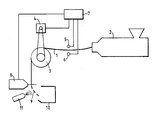
- an extrudate 1 is extruded horizontally from an extruder 2 and is received by a transport device in the form of a wheel 3 driven by a motor 4.
- Two optical sensors 5,6 are positioned one above the other with one sensors, 5, above the extrudate 1 and one sensor, 6, below the extrudate 1 in the space between the extruder 2 and wheel 3.
- Signals from sensors 5 and 6 are fed to a control unit 7 which controls motor 4.
- the extrudate 1 is turned through 90° by wheel 3 so that it travels vertically downwards where it is cut into discrete lengths by a water jet cutter 8 which is arranged to move, by means not shown, in a figure of eight pattern.
- the movement of cutter 8 is also controlled by control unit 7 so that the cutter moves, during the cutting operation, in unison with the extrudate 1.
- the cut pieces 9 of the extrudate are directed from the cutting zone to a receiver 10 by a jet of compressed air from a supply 11.
- Extrusion rates were in the range 3-6 gm. sec. ⁇ 1 depending upon the auger speed.
- the extrusion was horizontal and the green extrudate was received by a driven wheel approximately 400 mm dia with a vee-groove around its circumference.
- the wheel was so positioned to support the extrudate and turn it through 90° into the vertically downwards direction and through the cutting zone.
- the vertical centre-line of the wheel was spaced 150 mm from the die-face so that the extrudate was able to sag into the space between the die and the wheel.
- the degree of sag was monitored by optical sensors vertically displaced relative to one another by approximately 20 mm. The sensors thus actuated the drive to the wheel to maintain the degree of sag in the range approximately 4 - 16 mm.
- the extrudate was cut by a jet of water directed horizontally at the extrudate.
- the jet was produced from a sapphire nozzle having a bore of 0.13 mm using a water pressure of 2800 bar.
- An air jet was used to direct the cut pellets away from the cutting zone.
- the nozzle was mounted in a reciprocating mechanism which moved it in a shallow figure of eight path across the extrudate and back at intervals: the reciprocating movement was in unison with the rate of movement of the extrudate so that a perpendicular cut was made.
- the frequency of operation of the reciprocating mechanism was determined by the rate of rotation of the wheel.
- the cut pieces of extrudate had a length of 8 mm with a uniformity of ⁇ 3%. the cut pieces of extrudate were free of flashes and distortion and there was no blockage in any of the longitudinal through holes despite their small diameter.
- the resulting catalyst support units can be converted to catalyst pieces by application of an active compound such as copper chloride or silver nitrate or by application of a precursor compound such as copper oxide, nickel oxide, or palladium nitrate followed by reduction to give catalytically active material.
- an active compound such as copper chloride or silver nitrate
- a precursor compound such as copper oxide, nickel oxide, or palladium nitrate followed by reduction to give catalytically active material.
- a particulate composition was made by mixing about 95% by weight of haematite powder, about 3% by weight of alumina trihydrate powder, about 1% by weight of calcium carbonate, and about 1% by weight of magnesium aluminate spinel. Each of the ingredients had been ground to a fine particle size, median particle size about 3 ⁇ m and essentially all the particles below 10 ⁇ m. To the particulate mixture there was added about 1% by weight of potassium carbonate, about 1% by weight of a high molecular weight polysaccharide, and about 4% by weight of corn starch, all based on the weight of the particulate mixture. To the particulate mixture was then added about 11-12% by weight, based on the weight of the particulate mixture of water. The resultant composition was mixed to give a homogeneous paste.
- the resultant paste was extruded at room temperature using a die of circular cross section about 9 mm having 50 suspended wire cores arranged in three concentric rings of 29, 14, and 6 cores, around a central core; the wires were about 0.5 mm diameter.
- the extrusion and cutting of the extrudate was effected as described in Example 1.
- the extrudates, of length about 8.5 mm, were free of flashes, showed no distortion, and exhibited no blocking of any of the 50 through passages.
- the extruded pieces were dried, calcined, and sintered by the procedure of Example 1 using a sintering temperature of 1300°C.
- the resultant sintered units which had a diameter of about 8.5 mm and 50 through passages of diameter about 0.48 mm, were suitable for use as ammonia synthesis catalyst precursors.
Landscapes
- Engineering & Computer Science (AREA)
- Mechanical Engineering (AREA)
- Chemical & Material Sciences (AREA)
- Structural Engineering (AREA)
- Ceramic Engineering (AREA)
- Forests & Forestry (AREA)
- Life Sciences & Earth Sciences (AREA)
- Organic Chemistry (AREA)
- Chemical Kinetics & Catalysis (AREA)
- Catalysts (AREA)
- Devices For Post-Treatments, Processing, Supply, Discharge, And Other Processes (AREA)
- Press-Shaping Or Shaping Using Conveyers (AREA)
- Glass Compositions (AREA)
Priority Applications (2)
| Application Number | Priority Date | Filing Date | Title |
|---|---|---|---|
| AT86308349T ATE58652T1 (de) | 1985-11-08 | 1986-10-27 | Geformte gegenstaende aus feuerfesten oxiden. |
| EP86308349A EP0223445B1 (fr) | 1985-11-08 | 1986-10-27 | Articles formés en oxydes réfractaires |
Applications Claiming Priority (3)
| Application Number | Priority Date | Filing Date | Title |
|---|---|---|---|
| GB858527661A GB8527661D0 (en) | 1985-11-08 | 1985-11-08 | Catalyst supports & precursors |
| GB8527661 | 1985-11-08 | ||
| EP86308349A EP0223445B1 (fr) | 1985-11-08 | 1986-10-27 | Articles formés en oxydes réfractaires |
Publications (3)
| Publication Number | Publication Date |
|---|---|
| EP0223445A2 true EP0223445A2 (fr) | 1987-05-27 |
| EP0223445A3 EP0223445A3 (en) | 1988-11-17 |
| EP0223445B1 EP0223445B1 (fr) | 1990-11-28 |
Family
ID=26105051
Family Applications (1)
| Application Number | Title | Priority Date | Filing Date |
|---|---|---|---|
| EP86308349A Expired EP0223445B1 (fr) | 1985-11-08 | 1986-10-27 | Articles formés en oxydes réfractaires |
Country Status (2)
| Country | Link |
|---|---|
| EP (1) | EP0223445B1 (fr) |
| AT (1) | ATE58652T1 (fr) |
Cited By (6)
| Publication number | Priority date | Publication date | Assignee | Title |
|---|---|---|---|---|
| US4758253A (en) * | 1986-02-24 | 1988-07-19 | Imperial Chemical Industries Plc | Adsorption process |
| EP0467845A3 (en) * | 1990-07-17 | 1992-05-20 | Gurit-Essex Ag | Process for cutting a adhesive plastic material, particularly an adhesive strip, and process for automatically depositing an adhesive shaped strip along the edge of a glass sheet |
| WO1994002294A1 (fr) * | 1992-07-15 | 1994-02-03 | Hoechst Ceramtec Aktiengesellschaft | Procede de fabrication de corps crus structures en ceramique |
| WO1994002293A1 (fr) * | 1992-07-15 | 1994-02-03 | Hoechst Ceramtec Aktiengesellschaft | Procede pour structurer des corps crus en ceramique |
| EP0862944A1 (fr) * | 1997-03-07 | 1998-09-09 | Ciba SC Holding AG | Procédé et dispositif de fabrication de granulats de produits de joncs |
| WO2006024415A1 (fr) * | 2004-09-02 | 2006-03-09 | Henkel Kommanditgesellschaft Auf Aktien | Liquides fabriques sous forme solide, pour une utilisation dans des detergents et des nettoyants particulaires |
Family Cites Families (8)
| Publication number | Priority date | Publication date | Assignee | Title |
|---|---|---|---|---|
| US2934987A (en) * | 1953-11-12 | 1960-05-03 | Rauline Maurice | Loop control fluid operated means for regulating the speed of a cutting means to cut uniform lengths |
| US2881503A (en) * | 1955-03-16 | 1959-04-14 | Durox Internat S A | Method for cutting up plastic and semi-plastic masses |
| GB1133983A (en) * | 1964-11-24 | 1968-11-20 | South Birmingham Engineering C | Improvements relating to the control of the tension of moving strip material |
| DE1301539B (de) * | 1966-07-29 | 1969-08-21 | Bayer Ag | Verfahren zur Herstellung von verseiften AEthylen-Vinylacetat-Copolymerisaten |
| US4097566A (en) * | 1977-06-01 | 1978-06-27 | Nucleonics Data Systems | Extrusion line control system |
| US4250130A (en) * | 1978-09-12 | 1981-02-10 | Phillips Petroleum Company | Control of pipe tension between extruder die and take-up coiler |
| DD146804A1 (de) * | 1979-12-05 | 1981-03-04 | Friedrich Paape | Vorrichtung zur aufteilung eines endlosen oxidkeramischen massestranges |
| US4443558A (en) * | 1982-04-08 | 1984-04-17 | Chevron Research Company | Highly stable hydroprocessing catalyst |
-
1986
- 1986-10-27 AT AT86308349T patent/ATE58652T1/de not_active IP Right Cessation
- 1986-10-27 EP EP86308349A patent/EP0223445B1/fr not_active Expired
Cited By (7)
| Publication number | Priority date | Publication date | Assignee | Title |
|---|---|---|---|---|
| US4758253A (en) * | 1986-02-24 | 1988-07-19 | Imperial Chemical Industries Plc | Adsorption process |
| EP0467845A3 (en) * | 1990-07-17 | 1992-05-20 | Gurit-Essex Ag | Process for cutting a adhesive plastic material, particularly an adhesive strip, and process for automatically depositing an adhesive shaped strip along the edge of a glass sheet |
| WO1994002294A1 (fr) * | 1992-07-15 | 1994-02-03 | Hoechst Ceramtec Aktiengesellschaft | Procede de fabrication de corps crus structures en ceramique |
| WO1994002293A1 (fr) * | 1992-07-15 | 1994-02-03 | Hoechst Ceramtec Aktiengesellschaft | Procede pour structurer des corps crus en ceramique |
| EP0862944A1 (fr) * | 1997-03-07 | 1998-09-09 | Ciba SC Holding AG | Procédé et dispositif de fabrication de granulats de produits de joncs |
| FR2760384A1 (fr) * | 1997-03-07 | 1998-09-11 | Ciba Geigy Ag | Procede et appareil pour la production de granules |
| WO2006024415A1 (fr) * | 2004-09-02 | 2006-03-09 | Henkel Kommanditgesellschaft Auf Aktien | Liquides fabriques sous forme solide, pour une utilisation dans des detergents et des nettoyants particulaires |
Also Published As
| Publication number | Publication date |
|---|---|
| ATE58652T1 (de) | 1990-12-15 |
| EP0223445B1 (fr) | 1990-11-28 |
| EP0223445A3 (en) | 1988-11-17 |
Similar Documents
| Publication | Publication Date | Title |
|---|---|---|
| US4776998A (en) | Method of making refractory shaped articles by cutting vertically hanging extrudates | |
| US3824196A (en) | Catalyst support | |
| JP3995060B2 (ja) | 単一モード又は多モードの触媒担体又は触媒、その製造方法及び塩素の製造方法 | |
| EP1844912B1 (fr) | Appareil de découpe d'élément moulé, procédé de découpe d'éléments moulés en céramique et procédé de fabrication d'un élément structuré en nid d'abeille | |
| US5188779A (en) | Production of ceramic honeycomb structural bodies | |
| Forzatti et al. | Preparation and characterization of extruded monolithic ceramic catalysts | |
| CN86101117A (zh) | 具有整体化的高表面积相的整体催化剂载体结构的制造方法 | |
| EP0223445B1 (fr) | Articles formés en oxydes réfractaires | |
| JP2002535229A (ja) | 高強度かつ高表面積のアルミナセラミック | |
| EP0562567A1 (fr) | Catalyseur pour l'oxidation d'ammoniac | |
| JP2002535229A5 (fr) | ||
| US3930522A (en) | Structural ceramic article and method of making same | |
| CN112165985A (zh) | 生产过渡型氧化铝催化剂整料的方法 | |
| US3679605A (en) | Extruded alumina catalyst support and the preparation thereof | |
| EP1140731B1 (fr) | Procede de production de matrices ceramiques poreuses pour catalyseurs | |
| NO167789B (no) | Katalysator-forloeper, f.eks. for ammoniakksyntese-katalysatorer. | |
| US4729982A (en) | Bed packing material | |
| US4996015A (en) | Methods of producing ceramic honeycomb structures | |
| RU2756660C1 (ru) | Каталитический элемент регулярной сотовой структуры для гетерогенных реакций | |
| US6790806B2 (en) | Core/jacket catalyst molding | |
| Kraushaar-Czarnetzki et al. | Shaping of solid catalysts | |
| CN113546614A (zh) | 一种具有梯度微观形貌结构的催化剂氧化铝载体材料及其制备方法 | |
| EP0019674B1 (fr) | Procédé de fabrication d'un support de catalyseur creux en alumine de transition | |
| JPS6071568A (ja) | 造形耐火物ユニツトの製造方法 | |
| CN103521271B (zh) | 一种长度规整的条形催化剂载体及制备方法 |
Legal Events
| Date | Code | Title | Description |
|---|---|---|---|
| PUAI | Public reference made under article 153(3) epc to a published international application that has entered the european phase |
Free format text: ORIGINAL CODE: 0009012 |
|
| AK | Designated contracting states |
Kind code of ref document: A2 Designated state(s): AT BE CH DE ES FR GB GR IT LI LU NL SE |
|
| PUAL | Search report despatched |
Free format text: ORIGINAL CODE: 0009013 |
|
| AK | Designated contracting states |
Kind code of ref document: A3 Designated state(s): AT BE CH DE ES FR GB GR IT LI LU NL SE |
|
| 17P | Request for examination filed |
Effective date: 19881104 |
|
| RIN1 | Information on inventor provided before grant (corrected) |
Inventor name: RALPH, DONALD LESLIE Inventor name: KIRK, FRANK ALFRED Inventor name: DAVIDSON, JOHN FRANK Inventor name: DAVIDSON, PETER JOHN |
|
| 17Q | First examination report despatched |
Effective date: 19890614 |
|
| GRAA | (expected) grant |
Free format text: ORIGINAL CODE: 0009210 |
|
| AK | Designated contracting states |
Kind code of ref document: B1 Designated state(s): AT BE CH DE ES FR GB GR IT LI LU NL SE |
|
| PG25 | Lapsed in a contracting state [announced via postgrant information from national office to epo] |
Ref country code: GR Free format text: LAPSE BECAUSE OF FAILURE TO SUBMIT A TRANSLATION OF THE DESCRIPTION OR TO PAY THE FEE WITHIN THE PRESCRIBED TIME-LIMIT Effective date: 19901128 |
|
| REF | Corresponds to: |
Ref document number: 58652 Country of ref document: AT Date of ref document: 19901215 Kind code of ref document: T |
|
| ITF | It: translation for a ep patent filed | ||
| REF | Corresponds to: |
Ref document number: 3675895 Country of ref document: DE Date of ref document: 19910110 |
|
| ET | Fr: translation filed | ||
| PG25 | Lapsed in a contracting state [announced via postgrant information from national office to epo] |
Ref country code: ES Free format text: LAPSE BECAUSE OF FAILURE TO SUBMIT A TRANSLATION OF THE DESCRIPTION OR TO PAY THE FEE WITHIN THE PRESCRIBED TIME-LIMIT Effective date: 19910311 |
|
| PGFP | Annual fee paid to national office [announced via postgrant information from national office to epo] |
Ref country code: FR Payment date: 19910911 Year of fee payment: 6 |
|
| PGFP | Annual fee paid to national office [announced via postgrant information from national office to epo] |
Ref country code: AT Payment date: 19910912 Year of fee payment: 6 |
|
| PGFP | Annual fee paid to national office [announced via postgrant information from national office to epo] |
Ref country code: SE Payment date: 19910917 Year of fee payment: 6 Ref country code: CH Payment date: 19910917 Year of fee payment: 6 |
|
| PGFP | Annual fee paid to national office [announced via postgrant information from national office to epo] |
Ref country code: GB Payment date: 19910923 Year of fee payment: 6 Ref country code: BE Payment date: 19910923 Year of fee payment: 6 |
|
| PGFP | Annual fee paid to national office [announced via postgrant information from national office to epo] |
Ref country code: LU Payment date: 19910927 Year of fee payment: 6 |
|
| PLBE | No opposition filed within time limit |
Free format text: ORIGINAL CODE: 0009261 |
|
| STAA | Information on the status of an ep patent application or granted ep patent |
Free format text: STATUS: NO OPPOSITION FILED WITHIN TIME LIMIT |
|
| PGFP | Annual fee paid to national office [announced via postgrant information from national office to epo] |
Ref country code: DE Payment date: 19910930 Year of fee payment: 6 |
|
| ITTA | It: last paid annual fee | ||
| PGFP | Annual fee paid to national office [announced via postgrant information from national office to epo] |
Ref country code: NL Payment date: 19911031 Year of fee payment: 6 |
|
| 26N | No opposition filed | ||
| EPTA | Lu: last paid annual fee | ||
| PG25 | Lapsed in a contracting state [announced via postgrant information from national office to epo] |
Ref country code: LU Free format text: LAPSE BECAUSE OF NON-PAYMENT OF DUE FEES Effective date: 19921027 Ref country code: GB Effective date: 19921027 Ref country code: AT Effective date: 19921027 |
|
| PG25 | Lapsed in a contracting state [announced via postgrant information from national office to epo] |
Ref country code: SE Effective date: 19921028 |
|
| PG25 | Lapsed in a contracting state [announced via postgrant information from national office to epo] |
Ref country code: LI Effective date: 19921031 Ref country code: CH Effective date: 19921031 Ref country code: BE Effective date: 19921031 |
|
| BERE | Be: lapsed |
Owner name: IMPERIAL CHEMICAL INDUSTRIES P.L.C. Effective date: 19921031 |
|
| PG25 | Lapsed in a contracting state [announced via postgrant information from national office to epo] |
Ref country code: NL Effective date: 19930501 |
|
| NLV4 | Nl: lapsed or anulled due to non-payment of the annual fee | ||
| GBPC | Gb: european patent ceased through non-payment of renewal fee |
Effective date: 19921027 |
|
| PG25 | Lapsed in a contracting state [announced via postgrant information from national office to epo] |
Ref country code: FR Effective date: 19930630 |
|
| REG | Reference to a national code |
Ref country code: CH Ref legal event code: PL |
|
| PG25 | Lapsed in a contracting state [announced via postgrant information from national office to epo] |
Ref country code: DE Effective date: 19930701 |
|
| REG | Reference to a national code |
Ref country code: FR Ref legal event code: ST |
|
| EUG | Se: european patent has lapsed |
Ref document number: 86308349.9 Effective date: 19930510 |
|
| PG25 | Lapsed in a contracting state [announced via postgrant information from national office to epo] |
Ref country code: IT Free format text: LAPSE BECAUSE OF NON-PAYMENT OF DUE FEES Effective date: 20051027 |