EP0223601B1 - Bildverarbeitungsverfahren - Google Patents
Bildverarbeitungsverfahren Download PDFInfo
- Publication number
- EP0223601B1 EP0223601B1 EP86309024A EP86309024A EP0223601B1 EP 0223601 B1 EP0223601 B1 EP 0223601B1 EP 86309024 A EP86309024 A EP 86309024A EP 86309024 A EP86309024 A EP 86309024A EP 0223601 B1 EP0223601 B1 EP 0223601B1
- Authority
- EP
- European Patent Office
- Prior art keywords
- image
- picture elements
- line
- value
- average density
- Prior art date
- Legal status (The legal status is an assumption and is not a legal conclusion. Google has not performed a legal analysis and makes no representation as to the accuracy of the status listed.)
- Expired
Links
Images

Classifications
-
- G—PHYSICS
- G06—COMPUTING OR CALCULATING; COUNTING
- G06T—IMAGE DATA PROCESSING OR GENERATION, IN GENERAL
- G06T5/00—Image enhancement or restoration
- G06T5/20—Image enhancement or restoration using local operators
-
- H—ELECTRICITY
- H04—ELECTRIC COMMUNICATION TECHNIQUE
- H04N—PICTORIAL COMMUNICATION, e.g. TELEVISION
- H04N1/00—Scanning, transmission or reproduction of documents or the like, e.g. facsimile transmission; Details thereof
- H04N1/40—Picture signal circuits
- H04N1/403—Discrimination between the two tones in the picture signal of a two-tone original
-
- H—ELECTRICITY
- H04—ELECTRIC COMMUNICATION TECHNIQUE
- H04N—PICTORIAL COMMUNICATION, e.g. TELEVISION
- H04N1/00—Scanning, transmission or reproduction of documents or the like, e.g. facsimile transmission; Details thereof
- H04N1/40—Picture signal circuits
- H04N1/409—Edge or detail enhancement; Noise or error suppression
Definitions
- the present invention relates to a gradation image processing apparatus and a method for expressing a halftone-including image in a facsimile or the like with binary black-and-white pixels.
- an apparatus such as a facsimile machine for scanning and sampling an original to read out its image per pixel unit and copy the image thus read out is not to achieve faithful reproduction of the image, but to attempt to improve the image. This is attempted by processing the image signal to emphasise, or extract, specific data from the original image to eliminate the noise component included in the original image or restore the sharpness of the image.
- the noise is smoothed by first detecting the densities of specific pixels adjacent to a subject pixel, then taking the accumulated density frequency distribution per sampling level, and processing its average value as the density level of the subject pixel.
- the minimum level of specific pixels adjacent to a subject pixel is subtracted from the density level of the subject pixel, and the value thus obtained is regarded as the true density level of the latter pixel.
- the density-level variation range is reduced to consequently bring about lower contrast in the image as a whole.
- Another unavoidable drawback is that the granular noise cannot substantially be eliminated.
- the present invention has been accomplished in view of the above-mentioned problems known heretofore. And its principal object resides in providing an image processing method which eliminates both granular noise and noise derived from the soiled surface of an original, and corrects the gradation in a wide density variation range to reproduce a high-contrast image without causing a reduction in sharpness.
- Another object of the invention is to provide an image processing apparatus capable of eliminating both granular noise and noise derived from a soiled surface of an original and correct the gradation in a wide density variation range to reproduce a high-contrast image without a deterioration in sharpness.
- an image processing method for digitising an original image comprising the steps: splitting the original image into a two-dimensional matrix of picture elements, producing an initial image value for each picture element, and averaging the initial values of picture elements in a pair of mutually orthogonal directions around each picture element to produce an average density value; and comparing the initial image value for each picture element with the average density value and determining a density level to be output in accordance with the value of the initial image value relative to the average density value, characterised in that the step of splitting the original image, producing an inital image value and averaging comprises the steps of: scanning and sampling the original image in a line-by-line manner and developing a digital image signal thereform, corresponding to a present line of picture elements; calculating, for each of a set of picture elements extending in opposing directions along the line of picture elements from a subject picture element, a first average density value of the picture element and the adjacent picture element of the preceding line; and
- an image processing system for digitizing an original image comprising: means for splitting the original image into a two-dimensional matrix of picture elements, producing an initial image value for each picture element, and averaging the initial values of picture elements in a pair of mutually orthogonal directions around each picture element to produce an average density value; and means for providing a density level output in accordance with the level of the initial image value relative to the average value, characterised in that the means for splitting the original image, producing an inital image value and averaging comprises: means for scanning and sampling the original image in a line-by-line manner and developing a digital image signal thereform, corresponding to a present line of picture elements; means for calculating, for each of a set of picture elements extending in opposing directions along the line of picture elements from a subject picture element, a first average density value of the picture element and the adjacent picture element of the preceding line; and means for calculating an average density value by averaging the first average density values for the set of picture elements.
- Fig. 1 (a) shows a 16 x 1 pixel region composed of pixels x n-7 to x n+8 inclusive of a subject pixel x n obtained by the present scanning, and another 16 x 1 pixel region composed of pixels y n-7 to y n+8 obtained by the preceding scanning.
- the density gradation of the subject pixel x n is corrected in accordance with individual input data in such 2 x 16 pixel regions.
- x n+6 , x n+7 and x n+8 inclusive of the subject pixel x n and the preceding-line pixels y n-7 , y n-6 , y n-5 , .... y n , ... y n+6 , y n+7 and y n+8 corresponding positionally to the present-line ones are defined as a specific reference image region with respect to the subject pixel, then the average density level of the pixels constituting such specific reference cage region is detected, and subsequently such detected average density level of the specific reference pixel region is compared with the image input data of the subject pixel H, whereby the density gradation of the subject pixel x n is corrected.
- the average density D'n in such specific reference pixel region can be computed from the following equation with respect to the subject pixel x n .
- the result thus obtained from Eq. (1) represents the average density of merely the present-line pixels in the specific reference pixel region. Therefore, in order to compute the average density relative to the preceding-line region as well, this invention is so contrived as to first compute the average image input data of the present-line pixels and that of the preceding-line pixels positionally corresponding thereto, and then to take the average value of the respective input data to obtain the average density of the specific reference pixel region.
- the average value X n ⁇ m (0 ⁇ m ⁇ 8) of the pixels in the preceding line and the present line positionally corresponding to each other is expressed as where y n ⁇ m (0 ⁇ m ⁇ 8) represents the image input data of the preceding-line pixels, and x n ⁇ m (0 ⁇ m ⁇ 8) represents the image input data of the present line pixels.
- y n ⁇ m (0 ⁇ m ⁇ 8) represents the image input data of the preceding-line pixels
- x n ⁇ m (0 ⁇ m ⁇ 8) represents the image input data of the present line pixels.
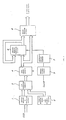
- Fig. 2 shows an exemplary constitution of an image processing apparatus designed to carry out the method of this invention, wherein the analog image signal obtained by scanning an original image through the use of an image reader such as charge-coupled device (CCD) is sampled and amplified by a sample holding and amplifying circuit 1 and then is inputted to an analog-digital converter circuit 3.
- a shading waveform memory and peak holding circuit 2 is connected to the other input terminal of the analog-digital converter circuit 3 and performs a peak holding operation within the effective range of the image signal to produce a shading waveform output proportional to the peak value.
- the analog -digital converter circuit 3 corrects the shading of the input analog image signal from the sample holding and amplifying circuit 1 in accordance with the shading waveform received from the shading waveform memory and peak holding circuit 2 to produce a digital image data, which is then fed to a data memory circuit 4 and is stored at a predetermined address in accordance with a memory address instruction signal inputted from an address control circuit 5.
- an average density computing circuit 6 executes addition and subtraction of the digital image data inputted sequentially from the data memory circuit 4.
- the digital image data of the specific reference pixel region composed of the present-line pixels including the subject pixel and the preceding-line pixels positionally corresponding to the present-line pixels as shown in Fig. 1 are read out from the data memory circuit 4, and the average value of the specific reference pixel region is calculated from Eq. (2). And the value obtained as a result of such calculation is added to the 16-pixel component according to Eq. (3) to produce an average density output.
- a binary decision circuit 8 the average density in the specific reference pixel region calculated by the average density computing circuit 6 is compared with the subject pixel data fed from the data memory circuit 4, and a decision as whether the subject pixel is to be reproduced in black or white is made on the basis of whether the calculated average density is less than or greater than the actual density value represented by the pixel data from the memory circuit 4. The result of such decision is outputted in the form of a binary signal.
- the average density of the subject pixel x n is computed and coded into a binary form.
- the present invention is so contrived as to effectively utilizing the average density D n already computed relative to the first subject pixel x n , and the average density D n+1 of the second subject pixel x n+1 next to the first subject pixel x n is obtained from the following equation. That is, an accumulated value of the 2nd through 17th pixels is obtained by substracting the data of the 1st pixel from the accumulated data of the 1st through 16th pixels and then adding the data of the 17th pixel thereto. And subsequently such procedure is repeated to encode the present-line pixels into a binary value.
- the image processing apparatus and method of the present invention are so constituted that, relative to each of the pixel units obtained by scanning and sampling the original image, a first average density level is detected to represent the average density level of the pixel unit within a first specific reference pixel region composed of pixel unit groups adjacent to the subject pixel unit leftward and rightward, and a second average density level is detected to represent the average density level of the pixel unit within a second specific reference pixel region composed of a pixel unit group adjacent to the first specific reference pixel region upward; and the density level of the subject pixel unit is determined in accordance with the first and second average density levels, so that the gradation is rendered correctable.
Landscapes
- Engineering & Computer Science (AREA)
- Multimedia (AREA)
- Signal Processing (AREA)
- Physics & Mathematics (AREA)
- General Physics & Mathematics (AREA)
- Theoretical Computer Science (AREA)
- Facsimile Image Signal Circuits (AREA)
- Image Processing (AREA)
Claims (6)
- Bildverarbeitungsverfahren zur Digitalisierung eines Originalbilds mit folgenden Verfahrensschritten:
Aufspalten des Originalbilds in eine zweidimensionale Matrix von Bildelementen, Erzeugen eines anfänglichen Bildwerts für jedes Bildelement und Mitteln der Anfangswerte von Bildelementen in einem Paar von gegenseitig orthogonalen Richtungen um jedes Bildelement um einen gemittelten Dichtewert zu erzeugen; und
Vergleichen des anfänglichen Bildwerts jedes Bildelements mit dem gemittelten Dichtewert und Bestimmen eines auszugebenden Dichtepegels in Übereinstimmung mit dem Wert des anfänglichen Bildwerts relativ zum gemittelten Dichtewert, dadurch gekennzeichnet, daß der Verfahrensschritt des Aufspaltens des Originalbilds, des Erzeugens eines anfänglichen Bildwerts und der Mittelung folgende Schritte umfaßt:
Zeilenweises Abtasten und Sampeln des Originalbilds mit daraus folgendem Erzeugen eines digitalen Bildsignals, das einer momentanen Zeile von Bildelementen entspricht;
Errechnen eines ersten gemittelten Dichtewerts der Bildelemente und der angrenzenden Bildelemente der vorhergehenden Zeile für jedes eines Satzes von Bildelementen, die sich in entgegengesetzten Richtungen entlang der Zeile von Bildelementen von einem betreffenden Bildelement aus erstrecken; und
Errechnen eines gemittelten Dichtewerts durch Mittelwertbildung bezüglich der ersten gemittelten Dichtewerte für den Satz von Bildelementen. - Verfahren nach Anspruch 1, bei welchem die Bildverarbeitung gemäß einem Verfahren erfolgt, bei dem ein Original-Schwarz-Weiß-Bild einschließlich Graustufen erfaßt und das Originalbild in Form von binär-kodierten Ausgangssignalen reproduziert wird.
- Verfahren nach Anspruch 1 oder 2, bei welchem der Satz von Bildelementen sieben benachbarte Bildelemente in der einen Richtung entlang der Zeile und acht benachbarte Bildelemente in der entgegengesetzten Richtung entlang der Zeile umfaßt.
- Bildverarbeitungseinrichtung zur Digitalisierung eines Originalbilds mit
Mitteln zum Aufspalten des Originalbilds in eine zweidimensionale Matrix von Bildelementen, zum Erzeugen eines anfänglichen Bildwerts für jedes Bildelement und zum Mitteln der Anfangswerte der Bildelemente hinsichtlich eines Paars von zueinander orthogonalen Richtungen um jedes Bildelement um einen gemittelten Dichtewert zu erzeugen, und mit Mitteln zum Bereitstellen eines Dichtepegelausgangs entsprechend dem Pegel des anfänglichen Bildwerts relativ zu dem gemittelten Wert, dadurch gekennzeichnet, daß die Mittel zum Aufspalten des Originalbilds, zum Erzeugen des anfänglichen Bildwerts und zur Mittelwertbildung folgende Baugruppen umfassen:
Mittel zum zeilenweisen Abtasten und Sampeln des Originalbilds, um daraus ein digitales Bildsignal zu erzeugen, das einer bestimmten momentanen Zeile von Bildelementen entspricht;
Mittel zum Berechnen eines ersten gemittelten Dichtewerts der Bildelemente und der benachbarten Bildelemente der vorhergehenden Zeile für jede eines Satzes von Bildelementen, die sich in entgegengesetzte Richtungen entlang der Zeile von Bildelementen von einem betreffenden Bildelement aus erstrecken; und
Mittel zum Berechnen eines gemittelten Dichtewerts durch Mittelwertbildung bezüglich der ersten gemittelten Dichtewerte für den Satz von Bildelementen. - Einrichtung nach Anspruch 4, bei welcher ein Original-Schwarz-Weiß-Bild einschließlich von Grautönen erfaßt und das Originalbild in Form von binär-kodierten Ausgangssignalen reproduziert wird.
- Bildverarbeitungseinrichtung nach Anspruch 4 oder 5, bei welcher der Satz von Bildelementen sieben benachbarte Bildelemente in einer Richtung entlang der betreffenden Zeile und acht benachbarte Bildelemente in der entgegengesetzten Zeilenrichtung umfaßt.
Applications Claiming Priority (2)
| Application Number | Priority Date | Filing Date | Title |
|---|---|---|---|
| JP259473/85 | 1985-11-18 | ||
| JP60259473A JPS62118676A (ja) | 1985-11-18 | 1985-11-18 | 画像処理方式 |
Publications (3)
| Publication Number | Publication Date |
|---|---|
| EP0223601A2 EP0223601A2 (de) | 1987-05-27 |
| EP0223601A3 EP0223601A3 (en) | 1988-10-05 |
| EP0223601B1 true EP0223601B1 (de) | 1992-09-30 |
Family
ID=17334563
Family Applications (1)
| Application Number | Title | Priority Date | Filing Date |
|---|---|---|---|
| EP86309024A Expired EP0223601B1 (de) | 1985-11-18 | 1986-11-18 | Bildverarbeitungsverfahren |
Country Status (4)
| Country | Link |
|---|---|
| US (1) | US4841374A (de) |
| EP (1) | EP0223601B1 (de) |
| JP (1) | JPS62118676A (de) |
| DE (1) | DE3686862T2 (de) |
Families Citing this family (25)
| Publication number | Priority date | Publication date | Assignee | Title |
|---|---|---|---|---|
| US4797943A (en) * | 1985-11-29 | 1989-01-10 | Ricoh Company, Ltd. | Gradation data processing apparatus |
| US4894727A (en) * | 1987-10-20 | 1990-01-16 | Ricoh Company, Ltd. | Image processing system and method |
| DE3838730C2 (de) * | 1987-11-16 | 1994-07-28 | Canon Kk | Verfahren und Vorrichtung zur Bildverarbeitung |
| US5151794A (en) * | 1989-01-30 | 1992-09-29 | Ezel Inc. | Image processing method |
| JP2817932B2 (ja) * | 1989-02-10 | 1998-10-30 | キヤノン株式会社 | 画像読取装置 |
| US6134355A (en) * | 1989-02-10 | 2000-10-17 | Canon Kabushiki Kaisha | Binarization using a local average, and using error diffusion |
| US5182657A (en) * | 1989-04-27 | 1993-01-26 | Casio Computer Co., Ltd. | Image processing apparatus including binary data producing unit |
| NL8901555A (nl) * | 1989-06-21 | 1991-01-16 | Oce Nederland Bv | Werkwijze en inrichting voor beeldsegmentatie. |
| JP2856806B2 (ja) * | 1990-01-08 | 1999-02-10 | 株式会社リコー | ピークホールド回路 |
| US5055942A (en) * | 1990-02-06 | 1991-10-08 | Levien Raphael L | Photographic image reproduction device using digital halftoning to screen images allowing adjustable coarseness |
| JPH0834544B2 (ja) * | 1990-08-14 | 1996-03-29 | 株式会社東芝 | 画像の復元処理方法 |
| JPH04100378A (ja) * | 1990-08-20 | 1992-04-02 | Toshiba Corp | 信号処理装置 |
| US5170261A (en) * | 1990-11-21 | 1992-12-08 | Polaroid Corporation | Printing method |
| DK0514504T3 (da) * | 1990-11-21 | 1997-06-23 | Polaroid Corp | Fremgangsmåde til printning |
| US5235434A (en) * | 1991-06-27 | 1993-08-10 | Polaroid Corporation | Method and apparatus for selectively adjusting the brightness of large regions of an image |
| JP3222183B2 (ja) * | 1992-02-19 | 2001-10-22 | 株式会社リコー | 画像処理装置 |
| US5243444A (en) * | 1992-03-25 | 1993-09-07 | Xerox Corporation | Image processing system and method with improved reconstruction of continuous tone images from halftone images including those without a screen structure |
| AU1294095A (en) * | 1993-12-08 | 1995-06-27 | Minnesota Mining And Manufacturing Company | Method and apparatus for background determination and subtraction for a monocular vision system |
| US5870505A (en) * | 1996-03-14 | 1999-02-09 | Polaroid Corporation | Method and apparatus for pixel level luminance adjustment |
| JP3472479B2 (ja) * | 1998-05-22 | 2003-12-02 | シャープ株式会社 | 画像処理装置 |
| US7440612B2 (en) * | 1998-11-13 | 2008-10-21 | Sony Corporation | Image processing apparatus and method capable of correcting gradation of image data |
| JP3594831B2 (ja) * | 1999-02-26 | 2004-12-02 | シャープ株式会社 | 画像補正装置および方法、画像補正制御プログラムを記憶した媒体 |
| US6195467B1 (en) * | 1999-03-25 | 2001-02-27 | Image Processing Technologies, Inc. | Method and apparatus for sharpening a grayscale image |
| JP3426189B2 (ja) * | 2000-04-26 | 2003-07-14 | インターナショナル・ビジネス・マシーンズ・コーポレーション | 画像処理方法、相対濃度の検出方法、および画像処理装置 |
| JP5137602B2 (ja) * | 2008-01-31 | 2013-02-06 | 株式会社ユニバーサルエンターテインメント | 紙葉類識別装置、及び紙葉類識別方法 |
Family Cites Families (5)
| Publication number | Priority date | Publication date | Assignee | Title |
|---|---|---|---|---|
| US4150401A (en) * | 1975-10-03 | 1979-04-17 | Kokusai Denshin Denwa Kabushiki Kaisha | Facsimile signal converter |
| JPS56109069A (en) | 1980-02-04 | 1981-08-29 | Nec Corp | Binary circuit |
| EP0055965B1 (de) * | 1981-01-05 | 1989-03-29 | Image Processing Technologies Inc. | Verfahren und Gerät zur Umwandlung eines Musters in eine binäre Form |
| US4450483A (en) * | 1981-09-02 | 1984-05-22 | Westinghouse Electric Corp. | Circuit for improving the quality of digitized line images |
| JPS59221074A (ja) * | 1983-05-30 | 1984-12-12 | Hitachi Ltd | パタ−ン信号2値化装置 |
-
1985
- 1985-11-18 JP JP60259473A patent/JPS62118676A/ja active Pending
-
1986
- 1986-11-18 US US06/931,843 patent/US4841374A/en not_active Expired - Lifetime
- 1986-11-18 DE DE8686309024T patent/DE3686862T2/de not_active Expired - Lifetime
- 1986-11-18 EP EP86309024A patent/EP0223601B1/de not_active Expired
Also Published As
| Publication number | Publication date |
|---|---|
| JPS62118676A (ja) | 1987-05-30 |
| EP0223601A3 (en) | 1988-10-05 |
| US4841374A (en) | 1989-06-20 |
| DE3686862T2 (de) | 1993-05-06 |
| DE3686862D1 (de) | 1992-11-05 |
| EP0223601A2 (de) | 1987-05-27 |
Similar Documents
| Publication | Publication Date | Title |
|---|---|---|
| EP0223601A2 (de) | Bildverarbeitungsverfahren | |
| US5408338A (en) | Image processing unit processing pixel data according to scan line density | |
| US5649031A (en) | Image information processor for producing high-quality output image | |
| US5243445A (en) | Picture processing apparatus | |
| EP0828375B1 (de) | Bildbereichs-Erkennungsverfahren und Bildverarbeitungsvorrichtung | |
| US5805738A (en) | Image processing apparatus and method | |
| JPH06276392A (ja) | 画像処理装置 | |
| US6961151B1 (en) | Image reading-out apparatus, copying machine and facsimile device utilizing the same, and method of reading out image | |
| JPH07212592A (ja) | 画像処理方法 | |
| JP2521745B2 (ja) | 画像処理装置 | |
| JP3245600B2 (ja) | 画像処理装置 | |
| JPH0213510B2 (de) | ||
| JPH0457274B2 (de) | ||
| JPS60136478A (ja) | 画調識別方法 | |
| JPH02186876A (ja) | 画像処理装置 | |
| JP3006460B2 (ja) | 2値化画像処理装置 | |
| JPS6250013B2 (de) | ||
| JPH0546749B2 (de) | ||
| JPS6180964A (ja) | 画信号処理方法 | |
| JP2867487B2 (ja) | 画像処理方法 | |
| JP3032238B2 (ja) | 画像処理装置 | |
| JP2857906B2 (ja) | 中間調の2値化処理装置 | |
| JP3049262B2 (ja) | 画像補正装置 | |
| JPS632517B2 (de) | ||
| JP2553799B2 (ja) | 画像処理装置 |
Legal Events
| Date | Code | Title | Description |
|---|---|---|---|
| PUAI | Public reference made under article 153(3) epc to a published international application that has entered the european phase |
Free format text: ORIGINAL CODE: 0009012 |
|
| AK | Designated contracting states |
Kind code of ref document: A2 Designated state(s): DE GB IT |
|
| PUAL | Search report despatched |
Free format text: ORIGINAL CODE: 0009013 |
|
| AK | Designated contracting states |
Kind code of ref document: A3 Designated state(s): DE GB IT |
|
| 17P | Request for examination filed |
Effective date: 19881031 |
|
| 17Q | First examination report despatched |
Effective date: 19901112 |
|
| GRAA | (expected) grant |
Free format text: ORIGINAL CODE: 0009210 |
|
| AK | Designated contracting states |
Kind code of ref document: B1 Designated state(s): DE GB IT |
|
| REF | Corresponds to: |
Ref document number: 3686862 Country of ref document: DE Date of ref document: 19921105 |
|
| ITF | It: translation for a ep patent filed | ||
| PLBE | No opposition filed within time limit |
Free format text: ORIGINAL CODE: 0009261 |
|
| STAA | Information on the status of an ep patent application or granted ep patent |
Free format text: STATUS: NO OPPOSITION FILED WITHIN TIME LIMIT |
|
| 26N | No opposition filed | ||
| REG | Reference to a national code |
Ref country code: GB Ref legal event code: IF02 |
|
| PGFP | Annual fee paid to national office [announced via postgrant information from national office to epo] |
Ref country code: DE Payment date: 20051110 Year of fee payment: 20 |
|
| PGFP | Annual fee paid to national office [announced via postgrant information from national office to epo] |
Ref country code: GB Payment date: 20051116 Year of fee payment: 20 |
|
| PGFP | Annual fee paid to national office [announced via postgrant information from national office to epo] |
Ref country code: IT Payment date: 20051125 Year of fee payment: 20 |
|
| PG25 | Lapsed in a contracting state [announced via postgrant information from national office to epo] |
Ref country code: GB Free format text: LAPSE BECAUSE OF EXPIRATION OF PROTECTION Effective date: 20061117 |
|
| REG | Reference to a national code |
Ref country code: GB Ref legal event code: PE20 |