EP0223708A2 - Polyesters poreux bioabsorbables - Google Patents
Polyesters poreux bioabsorbables Download PDFInfo
- Publication number
- EP0223708A2 EP0223708A2 EP86402527A EP86402527A EP0223708A2 EP 0223708 A2 EP0223708 A2 EP 0223708A2 EP 86402527 A EP86402527 A EP 86402527A EP 86402527 A EP86402527 A EP 86402527A EP 0223708 A2 EP0223708 A2 EP 0223708A2
- Authority
- EP
- European Patent Office
- Prior art keywords
- polyether
- article
- polylactone
- porous
- shaped
- Prior art date
- Legal status (The legal status is an assumption and is not a legal conclusion. Google has not performed a legal analysis and makes no representation as to the accuracy of the status listed.)
- Granted
Links
Images
Classifications
-
- A—HUMAN NECESSITIES
- A61—MEDICAL OR VETERINARY SCIENCE; HYGIENE
- A61J—CONTAINERS SPECIALLY ADAPTED FOR MEDICAL OR PHARMACEUTICAL PURPOSES; DEVICES OR METHODS SPECIALLY ADAPTED FOR BRINGING PHARMACEUTICAL PRODUCTS INTO PARTICULAR PHYSICAL OR ADMINISTERING FORMS; DEVICES FOR ADMINISTERING FOOD OR MEDICINES ORALLY; BABY COMFORTERS; DEVICES FOR RECEIVING SPITTLE
- A61J3/00—Devices or methods specially adapted for bringing pharmaceutical products into particular physical or administering forms
-
- A—HUMAN NECESSITIES
- A61—MEDICAL OR VETERINARY SCIENCE; HYGIENE
- A61K—PREPARATIONS FOR MEDICAL, DENTAL OR TOILETRY PURPOSES
- A61K9/00—Medicinal preparations characterised by special physical form
- A61K9/0087—Galenical forms not covered by A61K9/02 - A61K9/7023
- A61K9/0092—Hollow drug-filled fibres, tubes of the core-shell type, coated fibres, coated rods, microtubules or nanotubes
-
- A—HUMAN NECESSITIES
- A61—MEDICAL OR VETERINARY SCIENCE; HYGIENE
- A61K—PREPARATIONS FOR MEDICAL, DENTAL OR TOILETRY PURPOSES
- A61K9/00—Medicinal preparations characterised by special physical form
- A61K9/70—Web, sheet or filament bases ; Films; Fibres of the matrix type containing drug
- A61K9/7007—Drug-containing films, membranes or sheets
-
- Y—GENERAL TAGGING OF NEW TECHNOLOGICAL DEVELOPMENTS; GENERAL TAGGING OF CROSS-SECTIONAL TECHNOLOGIES SPANNING OVER SEVERAL SECTIONS OF THE IPC; TECHNICAL SUBJECTS COVERED BY FORMER USPC CROSS-REFERENCE ART COLLECTIONS [XRACs] AND DIGESTS
- Y10—TECHNICAL SUBJECTS COVERED BY FORMER USPC
- Y10T—TECHNICAL SUBJECTS COVERED BY FORMER US CLASSIFICATION
- Y10T428/00—Stock material or miscellaneous articles
- Y10T428/13—Hollow or container type article [e.g., tube, vase, etc.]
Definitions
- the present invention relates to bioabsorbable polyesters possessing porous structures and their use in novel polymer-drug formulations. More specifically, this invention relates to the fabrication of tubular drug delivery devices from polycaprolactone or its copolymers with other lactones, said devices possessing walls of defined porosities which can be adjusted by proper selection of the production parameters to yield formulations exhibiting the desired rates of drug release.
- U.S. Patent No. 3,887,699 to Yolles discloses a device for dispersing drugs from a biodegradable polymeric material which is shown to be polylactate.
- U.S. Pat. No. 4,l48,87l to Pitt, et al discloses the use of biodegradable homopolymers and copolymers of ⁇ -caprolactone for formulating devices to accomplish the sustained subdermal delivery of drugs. Neither of these references, however, discloses the use or the fabrication of bioabsorbable devices, exhibiting a porous polymer structure.
- the application of these devices is limited to drugs of low molecular weight (less than 500 dalton) which in addition must be sufficiently soluble in the encapsulating polymer.
- the novel polymer-drug formulations of the present invention utilize porous polymers and, consequently, the applications of these novel devices are not restricted by the molecular weight of the dispensed drug or its solubility in the polymer.
- the Netherlands Patent Application Nos. 8202893 and 8202894 to Gogolewski and Pennings disclose the fabrication of porous polylactate and porous polylactate-polyurethane blends and the use of these materials for biodegradable prosthetic devices.
- the fabrication and the application of porous prosthetic devices derived from polylactate and its blends with polyurethane have been disclosed also in several scientific publications. See for example S. Gogolewski and A.J. Pennings, Makromol. Chem., Rapid. Comm., 3 , 839 (l982), 4 , 2l3 (l983); Coll. Polym. Sci., 26l , 477 (l983).
- the disclosures by Gogolewski and Pennings do not include the concept of the controlled release of high molecular weight drugs which is germane to the present invention and are restricted to polylactate and its blends with polyurethanes.
- the controlled release of high molecular weight drugs from polymeric reservoir devices requires porous reservoir walls, especially for drugs which are hydrophilic and practically insoluble in the hydrophobic polymer.
- the pores in the reservoir walls have to be interconnected to provide a continuous path for the migrating drug which then diffuses from the reservoir at a rate governed by the tortuosity of the diffusion path.
- tubular devices possessing porous tube walls can be fabricated from polycaprolactone or its copolymers, as well as polyvalerolactone and its copolymers (e.g. with lactic acid) containing an additive which is selectively removed by treatment with appropriate solvents.
- Suitable polymers or copolymers have an average molecular weight ranging from about 40,000 to about 250,000 or higher. If the molecular weight is too low, the structure of the device may be too weak and tend to degrade. A preferred average molecular weight is about l00,000.
- Pore forming additives of interest are low molecular weight aliphatic polyethers which are commercially available (Pluronics, BASF Wyandotte) so that neither the compounds per se nor the method by which they are obtained constitutes any portion of this invention.
- Pluronic F-68 is of particular interest because it has found FDA approval for medical applications. Residues of this polyether remaining in the porous tube walls after the pore-forming process can be tolerated and, indeed, are beneficial for the release performance of the devices by increasing the wettability of the pore surfaces.
- Appropriate solvents for selectively removing the incorporated polyether from polycaprolactone or its copolymers during the pore-forming process are aqueous solutions of organic solvents at concentrations at which dissolution of the polycaprolactone or its copolymers does not take place.
- Useful solvents for the selective elution of the polyether are among others aqueous solutions of methanol, ethanol, or acetone.
- the formation of interconnected pores is demonstrated by the water uptake of the porous polymers.
- a sample of the porous polymer of known weight is kept submerged in water and the vessel containing the submerged sample is evacuated until gas evolution ceases. Then air is admitted and the sample is weighed after removal of adherent water droplets.
- the void content increases with the content of the organic component in the aqueous eluant.
- a critical concentration for the organic component below which the void content remains low despite all of the added polyether being eluted.
- this critical concentration is around 45 vol-% acetone at 40°C elution temperature and decreases to about 25 vol-% acetone at 45°C.
- partial melting and recrystallization of the polycaprolactone takes place during the leaching process which results in a pore structure composed of interconnected pores. Below the critical concentration the porous structure of the leached polycaprolactone changes to one of low void content and being composed of closed cells.
- the present invention provides an article suitable for use as a controlled release reservoir for high molecular weight drugs, comprising a porous polymer formed by:
- the invention additionally provides methods for making such an article.
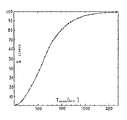
- the FIGURE is a graph which illustrates the cumulative release of decapeptide described in Example l.
- the preparation of formulations in which the drug is contained within the cavity of the polymeric device of the present invention is a three step process.
- the first step involves the preparation of the tubular, non-porous, and drug-free polymeric device suitable for the subsequent pore-forming process. This is accomplished by conventional methods such as extrusion, injection molding, dip casting, or annealing of rolled films utilizing intimate blends composed of polycaprolactone or a suitable copolymer of caprolactone and proper amounts of a polyether such as Pluronic F-68.
- Intimate blends of polycaprolactone or its copolymers with the pore-forming polyether can also be prepared in situ by polymerizing the corresponding lactones in the presence of the polyether which has to be endcapped by acetyl groups.
- the amount of polyether such as Pluronic F-68 or its endcapped modification can be in the range of 5-50% (w/w) but is preferentially between l0-25% (w/w).
- the tube walls are made porous by selectively removing the pore-forming additive in a leaching process utilizing aqueous solutions of an organic solvent such as methanol, ethanol, or acetone.
- concentration of the organic component of the leaching bath can be in the range of l0-l00% (v/v). The proper selection of the concentration to be utilized depends on the kind of the organic component in the leaching solution, the temperature of the leaching path, the initial polyether content of the polylactone, and the desired porosity to be obtained in the final product.
- the leaching process must be performed at an elevated temperature between about 40 and 55°C in order to obtain porous tube walls with interconnected pores.
- the polymer tubes are supported by inserted stainless steel rods and the bath is mildly agitated. Selective elution of the pore-forming additive is generally complete after 2-3 hours when the porous tubes are cooled with ice water to facilitate crystallization.
- the tubes are then washed with deionized water at ambient temperature, and dried under vacuum at ambient temperature.
- a desired drug is introduced into the cavity of such devices in a suitable form, e.g. as micronized powder or in form of a mixture with a suitable solvent, diluent, or dispersing agent.
- a suitable form e.g. as micronized powder or in form of a mixture with a suitable solvent, diluent, or dispersing agent.
- the amount of drug, the dimensions of the polymeric device, and the amount of solvent, diluent or dispersing agent may be varied such that the rate of drug delivery and the time over which the drug is delivered are considered optimum for the particular therapeutic application.
- the device of the present invention is in the form of a cylindrical tube with the drug contained within the interior cavity formed by the porous walls and both ends of the tubular device being closed by heat sealing.
- the rate at which the polymeric device is degraded within the body is determined by the chemical structure and the molecular weight selected for the fabrication of the device as well as the mode of administration to the patient.
- Polycaprolactone with an intrinsic viscosity in toluene of greater than one dl/g does not begin to lose significant mechanical strength or weight for at least l2 months.
- a copolymer of caprolactone and dilactide with the same intrinsic viscosity is degraded within two to three months.
- a polymer tube of 60 mm length, 2.0 mm inner diameter, and 0.l5 mm wall thickness was prepared from a blend composed of 70 parts per weight of polycaprolactone with an intrinsic viscosity of l.9 dl/g in toluene and 30 parts per weight of Pluronic F-68.
- the Pluronic F-68 was selectively eluted by submerging the tube in a mixture composed of one part ethanol and two parts water at 50°C for 8 hours.
- the tube was chilled with ice water, washed, and then dried under vacuum at ambient temperature. From tube weight and geometric dimensions a void content of 59% was calculated.
- Micrographs obtained by scanning electron microscopy revealed a very open cell structure with interconnected holes in the cell walls of about 6-8 ⁇ m in diameter. The pores of the wall surfaces were about 20 ⁇ m in diameter and represented about l0% of the tube surface.
- a 30 mm length of the prepared porous tube was heat sealed at one end by pressing it under rotation into a fitting conical indentation of a small Teflon block thermostated at 72°C.
- the tube was then filled with 5.8 mg of a synthetic decapeptide followed by 60 mg of water. After heat sealing the tube was immersed in deionized water at 38° (and the release of the decapeptide was monitored by its absorbance at 220 nm.
- the decapeptide was released with a nearly constant rate of l40 ⁇ g/day for a time period of 33 days when the device was depleted to about 20% of its initial drug content.
- the release rate of the decapeptide is graphically depicted in the FIGURE.
- the procedure of example l was repeated with incorporation of the following changes.
- the polymer tube was prepared from a blend composed of 60 parts per weight of the polycaprolactone of example l and 40 parts per weight of Pluronic F-68. Selective elution of the Pluronic F-68 content was performed with a mixture of two volumes methanol and three volumes water at 50°C for l6 hours. The void content of the porous tube walls was found to be 65%.
- a porous polymer-drug formulation was prepared by filling a 30 mm length of the prepared porous tube with 4.6 mg of the decapeptide of example l and 50 mg of water. The release of the decapeptide into deionized water was monitored as in example l for 66 days when the drug content was completely exhausted. The maximum release rate during this time period was found to be l58 ⁇ g/day.
- a porous polymer tube was prepared according to the procedure of example l but utilizing a methanol-water mixture with a volume ratio of l:2 for the elution of the Pluronic F-68 content at 50°C for l0 hours.
- a 27 mm length of the resulting porous tube was used for the preparation of a polymer-drug formulaton composed of l3.4 mg of an oligopeptide with a molecular weight of 5000 and 68 mg of water.
- the release rate of the oligopeptide into deionized water at 38°C was monitored for 50 days by its absorbance at 2l5 nm and was found to be in the range of 20-60 ⁇ g/cm/day.
- a porous tube was prepared according to the procedure of example l but utilizing a polymer blend composed of 80 parts per weight of polycaprolactone and parts per weight of Pluronic F-68.
- the Pluronic F-68 content was eluted with a methanol-water mixture of a volume ratio of 2:l at 50°C for l.3 hours.
- a porous capsule of 27 mm length was prepared which contained 20 mg of riboflavin dispersed in 60 ⁇ l of water.
- the release of the riboflavin into deionized water at 38°C was monitored by its absorbance at 444 nm.
- a release rate of 48 ⁇ g/cm/day was observed.
- the total release of riboflavin from a non-porous polycaprolactone capsule of identical dimensions amounted to less than 5 ⁇ g.
- the procedure of example l was repeated with incorporation of the following changes.
- the polymer tube was prepared from a blend composed of 23 parts by weight of Pluronic F-68 and 77 parts per weight of a random copolymer of ⁇ -caprolactone and ⁇ -valerolactone containing 20 mol-% of ester groups derived from the latter lactone. Selective elution of the Pluronic F-68 content was performed at 48°C in a mixture of equal volumes of methanol and water for 8 hours. The void content of the porous tube wall was found to be 62%.
- a 25 mm length of the prepared porous tube was loaded with 5.3 mg of the decapeptide of example l and 49 mg of water.
- the release rate of the decapeptide into deionized water was monitored as in example l for 40 days and was found to remain nearly constant at l80 ⁇ g/day.
- a porous tube was prepared according to the procedure of example l by utilizing a polymer blend composed of 20 parts per weight of Pluronic F-68 and 80 parts per weight of a random copolymer of ⁇ -caprolactone and L-dilactide containing l5 mol-% of ester groups derived from the dilactide. Selective elution of the Pluronic F-68 content at 52°C in a methanol-water mixture of ratio 3:2 for 6 hours yielded a tube with porous walls with a void content of 78%.
- a 30 mm length of the prepared porous tube was loaded with 6.2 mg of the decapeptide of example l followed by 70 mg of water.
- the monitored release rate of the decapeptide into deionized water was found to be 230 ⁇ g/day.
- Pluronic F-68 was endcapped with acetyl groups by dissolving l00 g F-68 in l00 ml freshly distilled pyridine and adding 50 ml freshly distilled acetic anhydride. After refluxing the solution for 6 hours the solvents were removed on a rotary evaporator until solidification. The solid was Soxhlet extracted with pentane for 24 hours and then vacuum dried at 40°C for 24 hours.
- a porous film was prepared by placing the film into an aqueous solution containing 45 vol-% acetone at 45°C for l2 hours.
- the void content of the film as determined by its water uptake was 78%.
- a crosslinked polycaprolactone film was prepared by polymerizing between Teflon plates a solution composed of 85 parts per weight of caprolactone, l5 parts per weight of acetyl endcapped Pluronic F-68 of example 7, l part per weight of 2,2-bis(6-hexanolacton-4-yl)propane, and 200 ppm stannous octoate. The polymerization was performed at l20°C for l8 hours.
- the film was made porous by placing it into an aqueous solution containing 70 vol-% acetone at 40°C for l2 hours.
- the void content of the crosslinked film as determined by its water uptake was 88%.
Landscapes
- Health & Medical Sciences (AREA)
- Chemical & Material Sciences (AREA)
- Engineering & Computer Science (AREA)
- Bioinformatics & Cheminformatics (AREA)
- Life Sciences & Earth Sciences (AREA)
- Medicinal Chemistry (AREA)
- Pharmacology & Pharmacy (AREA)
- Animal Behavior & Ethology (AREA)
- General Health & Medical Sciences (AREA)
- Public Health (AREA)
- Veterinary Medicine (AREA)
- Epidemiology (AREA)
- Nanotechnology (AREA)
- Materials For Medical Uses (AREA)
- Medicinal Preparation (AREA)
- Manufacture Of Porous Articles, And Recovery And Treatment Of Waste Products (AREA)
- Polyesters Or Polycarbonates (AREA)
Priority Applications (1)
| Application Number | Priority Date | Filing Date | Title |
|---|---|---|---|
| AT86402527T ATE65911T1 (de) | 1985-11-18 | 1986-11-13 | Poroese biologisch absorbierbare polyester. |
Applications Claiming Priority (2)
| Application Number | Priority Date | Filing Date | Title |
|---|---|---|---|
| US06/798,883 US4702917A (en) | 1985-11-18 | 1985-11-18 | Porous bioabsorbable polyesters |
| US798883 | 1985-11-18 |
Publications (3)
| Publication Number | Publication Date |
|---|---|
| EP0223708A2 true EP0223708A2 (fr) | 1987-05-27 |
| EP0223708A3 EP0223708A3 (en) | 1988-01-13 |
| EP0223708B1 EP0223708B1 (fr) | 1991-08-07 |
Family
ID=25174507
Family Applications (1)
| Application Number | Title | Priority Date | Filing Date |
|---|---|---|---|
| EP86402527A Expired - Lifetime EP0223708B1 (fr) | 1985-11-18 | 1986-11-13 | Polyesters poreux bioabsorbables |
Country Status (10)
| Country | Link |
|---|---|
| US (1) | US4702917A (fr) |
| EP (1) | EP0223708B1 (fr) |
| JP (1) | JPS62164743A (fr) |
| KR (1) | KR870004698A (fr) |
| AT (1) | ATE65911T1 (fr) |
| AU (1) | AU599612B2 (fr) |
| CA (1) | CA1283051C (fr) |
| DE (1) | DE3680754D1 (fr) |
| DK (1) | DK549486A (fr) |
| NO (1) | NO864507L (fr) |
Cited By (3)
| Publication number | Priority date | Publication date | Assignee | Title |
|---|---|---|---|---|
| WO1992020325A1 (fr) * | 1991-05-14 | 1992-11-26 | Endocon, Inc. | Procede d'ingenierie biomedicale s'appliquant a la reponse inflammatoire locale, servant a reguler la liberation d'un apport de medicament |
| FR2687588A1 (fr) * | 1992-02-25 | 1993-08-27 | Weidmann H Ag | Corps de dimensions stables a pores ouverts, et application pour la fabrication des filtres, substance de depart et procede pour fabriquer un tel corps. |
| GB2386847A (en) * | 2002-03-30 | 2003-10-01 | Visteon Global Tech Inc | Water vapour plasma method of increasing the surface energy of a surface |
Families Citing this family (60)
| Publication number | Priority date | Publication date | Assignee | Title |
|---|---|---|---|---|
| DE3564078D1 (en) * | 1984-11-09 | 1988-09-08 | Terumo Corp | Flat permeable membrane and method for manufacture thereof |
| CA1312429C (fr) * | 1985-08-29 | 1993-01-12 | Yukio Seita | Membrane poreuse servant a separer les composants du sang et methode de fabrication |
| SE8802414D0 (sv) * | 1988-06-27 | 1988-06-28 | Astra Meditec Ab | Nytt kirurgiskt material |
| US4961707A (en) * | 1987-12-22 | 1990-10-09 | University Of Florida | Guided periodontal tissue regeneration |
| US5641505A (en) * | 1988-06-27 | 1997-06-24 | Astra Tech Aktiebolag | Porous flexible sheet for tissue separation |
| US5843156A (en) * | 1988-08-24 | 1998-12-01 | Endoluminal Therapeutics, Inc. | Local polymeric gel cellular therapy |
| US5213580A (en) * | 1988-08-24 | 1993-05-25 | Endoluminal Therapeutics, Inc. | Biodegradable polymeric endoluminal sealing process |
| US5328471A (en) | 1990-02-26 | 1994-07-12 | Endoluminal Therapeutics, Inc. | Method and apparatus for treatment of focal disease in hollow tubular organs and other tissue lumens |
| US5575815A (en) * | 1988-08-24 | 1996-11-19 | Endoluminal Therapeutics, Inc. | Local polymeric gel therapy |
| WO1990001969A1 (fr) * | 1988-08-24 | 1990-03-08 | Slepian Marvin J | Etancheification a l'aide d'un polymere biodegradable de la surface interieure d'une lumiere d'un organe |
| US5634946A (en) * | 1988-08-24 | 1997-06-03 | Focal, Inc. | Polymeric endoluminal paving process |
| US4938763B1 (en) * | 1988-10-03 | 1995-07-04 | Atrix Lab Inc | Biodegradable in-situ forming implants and method of producing the same |
| US5700479A (en) * | 1988-12-23 | 1997-12-23 | Guidor Ab | Surgical element and method for selective tissue regeneration |
| US5610214A (en) * | 1988-12-29 | 1997-03-11 | Deknatel Technology Corporation, Inc. | Method for increasing the rate of absorption of polycaprolactone |
| US5487897A (en) | 1989-07-24 | 1996-01-30 | Atrix Laboratories, Inc. | Biodegradable implant precursor |
| USRE37950E1 (en) | 1990-04-24 | 2002-12-31 | Atrix Laboratories | Biogradable in-situ forming implants and methods of producing the same |
| DK0527891T3 (da) * | 1990-05-01 | 1995-11-27 | Res Triangle Inst | Bionedbrydelige polyestere til forsinket frigivelse af lægemidler |
| CA2064410A1 (fr) * | 1991-04-01 | 1992-10-02 | Masanobu Ajioka | Mousse degradable et utilisation de ladite mousse |
| US5223546A (en) * | 1991-04-24 | 1993-06-29 | Mitsui Toatsu Chemicals, Inc. | High polymer network |
| US5238968A (en) * | 1991-04-24 | 1993-08-24 | Mitsui Toatsu Chemicals, Inc. | Process for preparing a degradable high polymer network |
| US5271736A (en) * | 1991-05-13 | 1993-12-21 | Applied Medical Research | Collagen disruptive morphology for implants |
| US5330768A (en) * | 1991-07-05 | 1994-07-19 | Massachusetts Institute Of Technology | Controlled drug delivery using polymer/pluronic blends |
| WO1993022987A2 (fr) * | 1992-05-20 | 1993-11-25 | Cytrx Corporation | Composition de gel pour protheses et son procede d'utilisation |
| DE4239781A1 (de) * | 1992-11-26 | 1994-06-01 | Basf Ag | Formkörper aus geschäumten Polylactiden und Verfahren zu ihrer Herstellung |
| EP0690736B1 (fr) * | 1993-03-23 | 1998-11-11 | Focal, Inc. | Appareil et procede d'application locale d'un materiau polymere sur des tissus |
| US6004547A (en) | 1997-09-29 | 1999-12-21 | Focal, Inc. | Apparatus and method for local application of polymeric material to tissue |
| ATE169483T1 (de) * | 1993-04-28 | 1998-08-15 | Focal Inc | Vorrichtung, produkt und verwendung betreffend die intraluminale photothermoformgebung |
| US5542594A (en) * | 1993-10-06 | 1996-08-06 | United States Surgical Corporation | Surgical stapling apparatus with biocompatible surgical fabric |
| US5502092A (en) * | 1994-02-18 | 1996-03-26 | Minnesota Mining And Manufacturing Company | Biocompatible porous matrix of bioabsorbable material |
| US5607686A (en) * | 1994-11-22 | 1997-03-04 | United States Surgical Corporation | Polymeric composition |
| US5641502A (en) * | 1995-06-07 | 1997-06-24 | United States Surgical Corporation | Biodegradable moldable surgical material |
| US5736152A (en) * | 1995-10-27 | 1998-04-07 | Atrix Laboratories, Inc. | Non-polymeric sustained release delivery system |
| US5861174A (en) * | 1996-07-12 | 1999-01-19 | University Technology Corporation | Temperature sensitive gel for sustained delivery of protein drugs |
| CA2274004A1 (fr) * | 1996-12-03 | 1998-06-11 | Osteobiologics, Inc. | Couche polymere biodegradable |
| US6186985B1 (en) | 1997-10-03 | 2001-02-13 | Boston Scientific Corporation | Gastro-intestinal tube with dissolvable support bolster |
| US7128927B1 (en) | 1998-04-14 | 2006-10-31 | Qlt Usa, Inc. | Emulsions for in-situ delivery systems |
| US6261583B1 (en) * | 1998-07-28 | 2001-07-17 | Atrix Laboratories, Inc. | Moldable solid delivery system |
| US6143314A (en) * | 1998-10-28 | 2000-11-07 | Atrix Laboratories, Inc. | Controlled release liquid delivery compositions with low initial drug burst |
| US6110484A (en) | 1998-11-24 | 2000-08-29 | Cohesion Technologies, Inc. | Collagen-polymer matrices with differential biodegradability |
| US6325810B1 (en) | 1999-06-30 | 2001-12-04 | Ethicon, Inc. | Foam buttress for stapling apparatus |
| US8226598B2 (en) | 1999-09-24 | 2012-07-24 | Tolmar Therapeutics, Inc. | Coupling syringe system and methods for obtaining a mixed composition |
| US6273897B1 (en) | 2000-02-29 | 2001-08-14 | Ethicon, Inc. | Surgical bettress and surgical stapling apparatus |
| JP2004529676A (ja) | 2000-11-13 | 2004-09-30 | ダブリュ アイ ティー アイ ピー コーポレーション | 断熱領域を有する治療カテーテル |
| US7393339B2 (en) | 2003-02-21 | 2008-07-01 | C. R. Bard, Inc. | Multi-lumen catheter with separate distal tips |
| WO2004087797A1 (fr) * | 2003-04-03 | 2004-10-14 | Corporation De L'ecole Polytechnique De Montreal | Articles microporeux comportant des polymeres medicaux biodegradables, leur procede de preparation et leur procede d'utilisation |
| US20040243095A1 (en) | 2003-05-27 | 2004-12-02 | Shekhar Nimkar | Methods and apparatus for inserting multi-lumen spit-tip catheters into a blood vessel |
| US20050266043A1 (en) * | 2004-05-27 | 2005-12-01 | Medtronic Vascular, Inc. | Methods and compounds for treatment of aneurysmal tissue |
| US8992454B2 (en) | 2004-06-09 | 2015-03-31 | Bard Access Systems, Inc. | Splitable tip catheter with bioresorbable adhesive |
| US20050283111A1 (en) * | 2004-06-22 | 2005-12-22 | Dan Maurice | Catheter assembly with degradable material |
| JP5098443B2 (ja) * | 2007-05-31 | 2012-12-12 | 東レ株式会社 | ポリ乳酸分離膜およびその製造方法 |
| EP2214765A4 (fr) | 2007-10-17 | 2011-08-10 | Bard Access Systems Inc | Fabrication de cathéters à pointe divisée |
| US8066660B2 (en) | 2007-10-26 | 2011-11-29 | C. R. Bard, Inc. | Split-tip catheter including lateral distal openings |
| US8292841B2 (en) | 2007-10-26 | 2012-10-23 | C. R. Bard, Inc. | Solid-body catheter including lateral distal openings |
| JP5452498B2 (ja) | 2007-11-01 | 2014-03-26 | シー・アール・バード・インコーポレーテッド | 三重管腔端を含むカテーテル組立体 |
| US9579485B2 (en) | 2007-11-01 | 2017-02-28 | C. R. Bard, Inc. | Catheter assembly including a multi-lumen configuration |
| EP2265126A4 (fr) * | 2008-03-10 | 2011-06-29 | Univ Louisville Res Found | Méthodes et compositions pour l administration contrôlée d agents phytochimiques |
| US8858995B2 (en) | 2008-03-10 | 2014-10-14 | University Of Louisville Research Foundation, Inc. | Methods and compositions for controlled delivery of phytochemical agents |
| USD748252S1 (en) | 2013-02-08 | 2016-01-26 | C. R. Bard, Inc. | Multi-lumen catheter tip |
| WO2016011091A1 (fr) | 2014-07-14 | 2016-01-21 | C. R. Bard, Inc. | Appareils, systèmes et procédés pour introduction de cathéters à pointe divisée ayant des propriétés de raidissement et de guidage améliorées |
| CN118852599A (zh) * | 2023-04-28 | 2024-10-29 | 中国石油化工股份有限公司 | 一种提高聚己内酯产品品质的方法 |
Family Cites Families (5)
| Publication number | Priority date | Publication date | Assignee | Title |
|---|---|---|---|---|
| US2894289A (en) * | 1956-03-01 | 1959-07-14 | Dow Chemical Co | Method of making permeselective membranes |
| US3423491A (en) * | 1964-09-02 | 1969-01-21 | Dow Chemical Co | Permselective hollow fibers and method of making |
| US3887699A (en) * | 1969-03-24 | 1975-06-03 | Seymour Yolles | Biodegradable polymeric article for dispensing drugs |
| GB1412983A (en) * | 1971-11-30 | 1975-11-05 | Debell & Richardson | Method of producing porous plastic materials |
| US4148871A (en) * | 1977-10-11 | 1979-04-10 | Pitt Colin G | Sustained subdermal delivery ofdrugs using poly(ε-caprolactone) and its copolymers |
-
1985
- 1985-11-18 US US06/798,883 patent/US4702917A/en not_active Expired - Fee Related
-
1986
- 1986-11-12 NO NO864507A patent/NO864507L/no unknown
- 1986-11-13 AT AT86402527T patent/ATE65911T1/de not_active IP Right Cessation
- 1986-11-13 EP EP86402527A patent/EP0223708B1/fr not_active Expired - Lifetime
- 1986-11-13 JP JP61270834A patent/JPS62164743A/ja active Pending
- 1986-11-13 DE DE8686402527T patent/DE3680754D1/de not_active Expired - Lifetime
- 1986-11-14 AU AU65159/86A patent/AU599612B2/en not_active Ceased
- 1986-11-17 KR KR860009685A patent/KR870004698A/ko not_active Withdrawn
- 1986-11-17 DK DK549486A patent/DK549486A/da not_active Application Discontinuation
- 1986-11-17 CA CA000523151A patent/CA1283051C/fr not_active Expired - Lifetime
Cited By (5)
| Publication number | Priority date | Publication date | Assignee | Title |
|---|---|---|---|---|
| WO1992020325A1 (fr) * | 1991-05-14 | 1992-11-26 | Endocon, Inc. | Procede d'ingenierie biomedicale s'appliquant a la reponse inflammatoire locale, servant a reguler la liberation d'un apport de medicament |
| FR2687588A1 (fr) * | 1992-02-25 | 1993-08-27 | Weidmann H Ag | Corps de dimensions stables a pores ouverts, et application pour la fabrication des filtres, substance de depart et procede pour fabriquer un tel corps. |
| CH684273A5 (de) * | 1992-02-25 | 1994-08-15 | Weidmann H Ag | Offenporiger dimensionsstabiler Körper. |
| GB2386847A (en) * | 2002-03-30 | 2003-10-01 | Visteon Global Tech Inc | Water vapour plasma method of increasing the surface energy of a surface |
| GB2386847B (en) * | 2002-03-30 | 2004-06-16 | Visteon Global Tech Inc | Water vapor plasma method of increasing the surface energy of a surface |
Also Published As
| Publication number | Publication date |
|---|---|
| CA1283051C (fr) | 1991-04-16 |
| EP0223708B1 (fr) | 1991-08-07 |
| NO864507L (no) | 1987-05-19 |
| DK549486D0 (da) | 1986-11-17 |
| KR870004698A (ko) | 1987-06-01 |
| ATE65911T1 (de) | 1991-08-15 |
| DK549486A (da) | 1987-05-19 |
| AU6515986A (en) | 1987-05-21 |
| DE3680754D1 (de) | 1991-09-12 |
| JPS62164743A (ja) | 1987-07-21 |
| EP0223708A3 (en) | 1988-01-13 |
| AU599612B2 (en) | 1990-07-26 |
| NO864507D0 (no) | 1986-11-12 |
| US4702917A (en) | 1987-10-27 |
Similar Documents
| Publication | Publication Date | Title |
|---|---|---|
| EP0223708B1 (fr) | Polyesters poreux bioabsorbables | |
| Schindler et al. | Biodegradable polymers for sustained drug delivery | |
| Mathiowitz et al. | Polyanhydride microspheres as drug carriers I. Hot-melt microencapsulation | |
| Hsu et al. | Effect of polymer foam morphology and density on kinetics of in vitro controlled release of isoniazid from compressed foam matrices | |
| Bodmeier et al. | The preparation and evaluation of drug-containing poly (dl-lactide) microspheres formed by the solvent evaporation method | |
| US5102983A (en) | Process for preparing foamed, bioabsorbable polymer particles | |
| US4882168A (en) | Polyesters containing alkylene oxide blocks as drug delivery systems | |
| EP0258780B1 (fr) | Polyesters contenant des séquences d'oxyde d'alkylène et leur utilisation comme systèmes de libération de médicaments | |
| JP4612419B2 (ja) | 水膨潤性ポリマー | |
| AT395584B (de) | Verfahren zur herstellung neuer ester | |
| Masaharu et al. | In vivo characteristics of low molecular weight copoly (L-lactic acid/glycolic acid) formulations with controlled release of luteinizing hormone-releasing hormone agonist | |
| JPS6351324A (ja) | 中空細管状薬剤デリバリ−システムの製造方法 | |
| EP0200224A2 (fr) | Compositions pharmaceutiques contenant des systèmes à base de tubes fins et creux pour la libération des médicaments | |
| Heller et al. | In vitro and in vivo release of levonorgestrel from poly (ortho esters): II. Crosslinked polymers | |
| Domb et al. | Preparation and characterization of carmustine loaded polyanhydride wafers for treating brain tumors | |
| US4186189A (en) | Absorbable pharmaceutical compositions based on poly(alkylene oxalates) | |
| Bain et al. | Solvent influence on spray-dried biodegradable microspheres | |
| AU2020401182A1 (en) | Cariprazine release formulations | |
| Asikainen et al. | Hydrolysis and drug release from poly (ethylene glycol)-modified lactone polymers with open porosity | |
| US4645664A (en) | Microporous powder form polylactides | |
| Shieh et al. | Drug release from a new family of biodegradable polyanhydrides | |
| Vert et al. | Recent advances in the field of lactic acid/glycolic acid polymer‐based therapeutic systems | |
| WO1989005138A1 (fr) | Procede de production d'implants bioerodables pour l'amelioration de la liberation controlee de medicaments | |
| Kishida et al. | Some determinants of morphology and release rate from poly (L) lactic acid microspheres | |
| Khamlao et al. | Preparation of self-solidifying polymeric depots from PLEC-PEG-PLEC triblock copolymers as an injectable drug delivery system |
Legal Events
| Date | Code | Title | Description |
|---|---|---|---|
| PUAI | Public reference made under article 153(3) epc to a published international application that has entered the european phase |
Free format text: ORIGINAL CODE: 0009012 |
|
| AK | Designated contracting states |
Kind code of ref document: A2 Designated state(s): AT BE CH DE ES FR GB GR IT LI LU NL SE |
|
| PUAL | Search report despatched |
Free format text: ORIGINAL CODE: 0009013 |
|
| AK | Designated contracting states |
Kind code of ref document: A3 Designated state(s): AT BE CH DE ES FR GB GR IT LI LU NL SE |
|
| 17P | Request for examination filed |
Effective date: 19880516 |
|
| 17Q | First examination report despatched |
Effective date: 19891218 |
|
| GRAA | (expected) grant |
Free format text: ORIGINAL CODE: 0009210 |
|
| AK | Designated contracting states |
Kind code of ref document: B1 Designated state(s): AT BE CH DE ES FR GB GR IT LI LU NL SE |
|
| PG25 | Lapsed in a contracting state [announced via postgrant information from national office to epo] |
Ref country code: NL Effective date: 19910807 Ref country code: GR Free format text: LAPSE BECAUSE OF FAILURE TO SUBMIT A TRANSLATION OF THE DESCRIPTION OR TO PAY THE FEE WITHIN THE PRESCRIBED TIME-LIMIT Effective date: 19910807 |
|
| REF | Corresponds to: |
Ref document number: 65911 Country of ref document: AT Date of ref document: 19910815 Kind code of ref document: T |
|
| ITF | It: translation for a ep patent filed | ||
| REF | Corresponds to: |
Ref document number: 3680754 Country of ref document: DE Date of ref document: 19910912 |
|
| ET | Fr: translation filed | ||
| PG25 | Lapsed in a contracting state [announced via postgrant information from national office to epo] |
Ref country code: GB Effective date: 19911113 Ref country code: AT Effective date: 19911113 |
|
| PG25 | Lapsed in a contracting state [announced via postgrant information from national office to epo] |
Ref country code: SE Effective date: 19911114 |
|
| PG25 | Lapsed in a contracting state [announced via postgrant information from national office to epo] |
Ref country code: LU Free format text: LAPSE BECAUSE OF NON-PAYMENT OF DUE FEES Effective date: 19911130 Ref country code: LI Effective date: 19911130 Ref country code: CH Effective date: 19911130 Ref country code: BE Effective date: 19911130 |
|
| NLV1 | Nl: lapsed or annulled due to failure to fulfill the requirements of art. 29p and 29m of the patents act | ||
| PG25 | Lapsed in a contracting state [announced via postgrant information from national office to epo] |
Ref country code: ES Free format text: LAPSE BECAUSE OF THE APPLICANT RENOUNCES Effective date: 19920129 |
|
| BERE | Be: lapsed |
Owner name: RESEARCH TRIANGLE INSTITUTE Effective date: 19911130 |
|
| PLBE | No opposition filed within time limit |
Free format text: ORIGINAL CODE: 0009261 |
|
| GBPC | Gb: european patent ceased through non-payment of renewal fee | ||
| 26N | No opposition filed | ||
| PG25 | Lapsed in a contracting state [announced via postgrant information from national office to epo] |
Ref country code: FR Effective date: 19920731 |
|
| REG | Reference to a national code |
Ref country code: CH Ref legal event code: PL |
|
| PG25 | Lapsed in a contracting state [announced via postgrant information from national office to epo] |
Ref country code: DE Effective date: 19920801 |
|
| REG | Reference to a national code |
Ref country code: FR Ref legal event code: ST |
|
| EUG | Se: european patent has lapsed |
Ref document number: 86402527.5 Effective date: 19920604 |
|
| PG25 | Lapsed in a contracting state [announced via postgrant information from national office to epo] |
Ref country code: IT Free format text: LAPSE BECAUSE OF NON-PAYMENT OF DUE FEES;WARNING: LAPSES OF ITALIAN PATENTS WITH EFFECTIVE DATE BEFORE 2007 MAY HAVE OCCURRED AT ANY TIME BEFORE 2007. THE CORRECT EFFECTIVE DATE MAY BE DIFFERENT FROM THE ONE RECORDED. Effective date: 20051113 |