EP0223965B1 - Leichter verwickelter nichtgewobener Vliesstoff mit guter Reissfestigkeit in der Maschinen- und Querrichtung und Verfahren zur Herstellung desselben - Google Patents
Leichter verwickelter nichtgewobener Vliesstoff mit guter Reissfestigkeit in der Maschinen- und Querrichtung und Verfahren zur Herstellung desselben Download PDFInfo
- Publication number
- EP0223965B1 EP0223965B1 EP19860113207 EP86113207A EP0223965B1 EP 0223965 B1 EP0223965 B1 EP 0223965B1 EP 19860113207 EP19860113207 EP 19860113207 EP 86113207 A EP86113207 A EP 86113207A EP 0223965 B1 EP0223965 B1 EP 0223965B1
- Authority
- EP
- European Patent Office
- Prior art keywords
- entangled
- fibers
- fiber
- fabric
- lines
- Prior art date
- Legal status (The legal status is an assumption and is not a legal conclusion. Google has not performed a legal analysis and makes no representation as to the accuracy of the status listed.)
- Expired - Lifetime
Links
- 239000004745 nonwoven fabric Substances 0.000 title claims description 14
- 238000000034 method Methods 0.000 title claims description 9
- 230000008569 process Effects 0.000 title claims description 9
- 239000000835 fiber Substances 0.000 claims description 95
- 239000004744 fabric Substances 0.000 claims description 90
- 229920000297 Rayon Polymers 0.000 claims description 25
- 239000002964 rayon Substances 0.000 claims description 25
- 229920000728 polyester Polymers 0.000 claims description 23
- 239000007788 liquid Substances 0.000 claims description 19
- 238000003491 array Methods 0.000 claims description 6
- 230000000694 effects Effects 0.000 claims description 2
- 230000004044 response Effects 0.000 claims description 2
- 239000012530 fluid Substances 0.000 description 8
- 230000008707 rearrangement Effects 0.000 description 6
- XLYOFNOQVPJJNP-UHFFFAOYSA-N water Substances O XLYOFNOQVPJJNP-UHFFFAOYSA-N 0.000 description 6
- 239000000203 mixture Substances 0.000 description 2
- 230000004048 modification Effects 0.000 description 2
- 238000012986 modification Methods 0.000 description 2
- 229920013683 Celanese Polymers 0.000 description 1
- 230000009471 action Effects 0.000 description 1
- 238000010276 construction Methods 0.000 description 1
- 238000001035 drying Methods 0.000 description 1
- 238000005516 engineering process Methods 0.000 description 1
- 238000004519 manufacturing process Methods 0.000 description 1
- 238000012876 topography Methods 0.000 description 1
Images



Classifications
-
- D—TEXTILES; PAPER
- D04—BRAIDING; LACE-MAKING; KNITTING; TRIMMINGS; NON-WOVEN FABRICS
- D04H—MAKING TEXTILE FABRICS, e.g. FROM FIBRES OR FILAMENTARY MATERIAL; FABRICS MADE BY SUCH PROCESSES OR APPARATUS, e.g. FELTS, NON-WOVEN FABRICS; COTTON-WOOL; WADDING ; NON-WOVEN FABRICS FROM STAPLE FIBRES, FILAMENTS OR YARNS, BONDED WITH AT LEAST ONE WEB-LIKE MATERIAL DURING THEIR CONSOLIDATION
- D04H1/00—Non-woven fabrics formed wholly or mainly of staple fibres or like relatively short fibres
- D04H1/40—Non-woven fabrics formed wholly or mainly of staple fibres or like relatively short fibres from fleeces or layers composed of fibres without existing or potential cohesive properties
- D04H1/44—Non-woven fabrics formed wholly or mainly of staple fibres or like relatively short fibres from fleeces or layers composed of fibres without existing or potential cohesive properties the fleeces or layers being consolidated by mechanical means, e.g. by rolling
- D04H1/46—Non-woven fabrics formed wholly or mainly of staple fibres or like relatively short fibres from fleeces or layers composed of fibres without existing or potential cohesive properties the fleeces or layers being consolidated by mechanical means, e.g. by rolling by needling or like operations to cause entanglement of fibres
- D04H1/492—Non-woven fabrics formed wholly or mainly of staple fibres or like relatively short fibres from fleeces or layers composed of fibres without existing or potential cohesive properties the fleeces or layers being consolidated by mechanical means, e.g. by rolling by needling or like operations to cause entanglement of fibres by fluid jet
- D04H1/495—Non-woven fabrics formed wholly or mainly of staple fibres or like relatively short fibres from fleeces or layers composed of fibres without existing or potential cohesive properties the fleeces or layers being consolidated by mechanical means, e.g. by rolling by needling or like operations to cause entanglement of fibres by fluid jet for formation of patterns, e.g. drilling or rearrangement
-
- D—TEXTILES; PAPER
- D04—BRAIDING; LACE-MAKING; KNITTING; TRIMMINGS; NON-WOVEN FABRICS
- D04H—MAKING TEXTILE FABRICS, e.g. FROM FIBRES OR FILAMENTARY MATERIAL; FABRICS MADE BY SUCH PROCESSES OR APPARATUS, e.g. FELTS, NON-WOVEN FABRICS; COTTON-WOOL; WADDING ; NON-WOVEN FABRICS FROM STAPLE FIBRES, FILAMENTS OR YARNS, BONDED WITH AT LEAST ONE WEB-LIKE MATERIAL DURING THEIR CONSOLIDATION
- D04H1/00—Non-woven fabrics formed wholly or mainly of staple fibres or like relatively short fibres
- D04H1/70—Non-woven fabrics formed wholly or mainly of staple fibres or like relatively short fibres characterised by the method of forming fleeces or layers, e.g. reorientation of fibres
- D04H1/74—Non-woven fabrics formed wholly or mainly of staple fibres or like relatively short fibres characterised by the method of forming fleeces or layers, e.g. reorientation of fibres the fibres being orientated, e.g. in parallel (anisotropic fleeces)
-
- D—TEXTILES; PAPER
- D04—BRAIDING; LACE-MAKING; KNITTING; TRIMMINGS; NON-WOVEN FABRICS
- D04H—MAKING TEXTILE FABRICS, e.g. FROM FIBRES OR FILAMENTARY MATERIAL; FABRICS MADE BY SUCH PROCESSES OR APPARATUS, e.g. FELTS, NON-WOVEN FABRICS; COTTON-WOOL; WADDING ; NON-WOVEN FABRICS FROM STAPLE FIBRES, FILAMENTS OR YARNS, BONDED WITH AT LEAST ONE WEB-LIKE MATERIAL DURING THEIR CONSOLIDATION
- D04H5/00—Non woven fabrics formed of mixtures of relatively short fibres and yarns or like filamentary material of substantial length
- D04H5/02—Non woven fabrics formed of mixtures of relatively short fibres and yarns or like filamentary material of substantial length strengthened or consolidated by mechanical methods, e.g. needling
- D04H5/03—Non woven fabrics formed of mixtures of relatively short fibres and yarns or like filamentary material of substantial length strengthened or consolidated by mechanical methods, e.g. needling by fluid jet
-
- Y—GENERAL TAGGING OF NEW TECHNOLOGICAL DEVELOPMENTS; GENERAL TAGGING OF CROSS-SECTIONAL TECHNOLOGIES SPANNING OVER SEVERAL SECTIONS OF THE IPC; TECHNICAL SUBJECTS COVERED BY FORMER USPC CROSS-REFERENCE ART COLLECTIONS [XRACs] AND DIGESTS
- Y10—TECHNICAL SUBJECTS COVERED BY FORMER USPC
- Y10T—TECHNICAL SUBJECTS COVERED BY FORMER US CLASSIFICATION
- Y10T428/00—Stock material or miscellaneous articles
- Y10T428/24—Structurally defined web or sheet [e.g., overall dimension, etc.]
- Y10T428/24273—Structurally defined web or sheet [e.g., overall dimension, etc.] including aperture
- Y10T428/24298—Noncircular aperture [e.g., slit, diamond, rectangular, etc.]
-
- Y—GENERAL TAGGING OF NEW TECHNOLOGICAL DEVELOPMENTS; GENERAL TAGGING OF CROSS-SECTIONAL TECHNOLOGIES SPANNING OVER SEVERAL SECTIONS OF THE IPC; TECHNICAL SUBJECTS COVERED BY FORMER USPC CROSS-REFERENCE ART COLLECTIONS [XRACs] AND DIGESTS
- Y10—TECHNICAL SUBJECTS COVERED BY FORMER USPC
- Y10T—TECHNICAL SUBJECTS COVERED BY FORMER US CLASSIFICATION
- Y10T428/00—Stock material or miscellaneous articles
- Y10T428/24—Structurally defined web or sheet [e.g., overall dimension, etc.]
- Y10T428/24628—Nonplanar uniform thickness material
- Y10T428/24669—Aligned or parallel nonplanarities
-
- Y—GENERAL TAGGING OF NEW TECHNOLOGICAL DEVELOPMENTS; GENERAL TAGGING OF CROSS-SECTIONAL TECHNOLOGIES SPANNING OVER SEVERAL SECTIONS OF THE IPC; TECHNICAL SUBJECTS COVERED BY FORMER USPC CROSS-REFERENCE ART COLLECTIONS [XRACs] AND DIGESTS
- Y10—TECHNICAL SUBJECTS COVERED BY FORMER USPC
- Y10T—TECHNICAL SUBJECTS COVERED BY FORMER US CLASSIFICATION
- Y10T428/00—Stock material or miscellaneous articles
- Y10T428/24—Structurally defined web or sheet [e.g., overall dimension, etc.]
- Y10T428/24628—Nonplanar uniform thickness material
- Y10T428/24736—Ornamental design or indicia
-
- Y—GENERAL TAGGING OF NEW TECHNOLOGICAL DEVELOPMENTS; GENERAL TAGGING OF CROSS-SECTIONAL TECHNOLOGIES SPANNING OVER SEVERAL SECTIONS OF THE IPC; TECHNICAL SUBJECTS COVERED BY FORMER USPC CROSS-REFERENCE ART COLLECTIONS [XRACs] AND DIGESTS
- Y10—TECHNICAL SUBJECTS COVERED BY FORMER USPC
- Y10T—TECHNICAL SUBJECTS COVERED BY FORMER US CLASSIFICATION
- Y10T428/00—Stock material or miscellaneous articles
- Y10T428/24—Structurally defined web or sheet [e.g., overall dimension, etc.]
- Y10T428/24802—Discontinuous or differential coating, impregnation or bond [e.g., artwork, printing, retouched photograph, etc.]
-
- Y—GENERAL TAGGING OF NEW TECHNOLOGICAL DEVELOPMENTS; GENERAL TAGGING OF CROSS-SECTIONAL TECHNOLOGIES SPANNING OVER SEVERAL SECTIONS OF THE IPC; TECHNICAL SUBJECTS COVERED BY FORMER USPC CROSS-REFERENCE ART COLLECTIONS [XRACs] AND DIGESTS
- Y10—TECHNICAL SUBJECTS COVERED BY FORMER USPC
- Y10T—TECHNICAL SUBJECTS COVERED BY FORMER US CLASSIFICATION
- Y10T442/00—Fabric [woven, knitted, or nonwoven textile or cloth, etc.]
- Y10T442/60—Nonwoven fabric [i.e., nonwoven strand or fiber material]
- Y10T442/689—Hydroentangled nonwoven fabric
-
- Y—GENERAL TAGGING OF NEW TECHNOLOGICAL DEVELOPMENTS; GENERAL TAGGING OF CROSS-SECTIONAL TECHNOLOGIES SPANNING OVER SEVERAL SECTIONS OF THE IPC; TECHNICAL SUBJECTS COVERED BY FORMER USPC CROSS-REFERENCE ART COLLECTIONS [XRACs] AND DIGESTS
- Y10—TECHNICAL SUBJECTS COVERED BY FORMER USPC
- Y10T—TECHNICAL SUBJECTS COVERED BY FORMER US CLASSIFICATION
- Y10T442/00—Fabric [woven, knitted, or nonwoven textile or cloth, etc.]
- Y10T442/60—Nonwoven fabric [i.e., nonwoven strand or fiber material]
- Y10T442/697—Containing at least two chemically different strand or fiber materials
Definitions
- the invention relates to a light weight entangled non-woven fabric that has excellent strength in both the machine and cross direction and to a process for producing it.
- U.S. Patent 3,486,168 discloses an unapertured ribbed entangled non-woven fabric.
- the fibers are supported on a "grill" during entangling.
- the fabric comprises parallel entangled ribs with a substantially continuous array of fibers extending between the ribs.
- U.S. Patent 3,498,874 discloses an apertured ribbed entangled non-woven fabric.
- the fibers are supported on a plain weave carrier belt having heavier wires or filaments in one direction and three to five times as many finer wires or filaments extending in the other direction.
- the fabric formed thereon displays zig-zag entangled ribs extending in said one direction.
- Co-pending application SN602877 filed April 23, 1984 discloses an apertured entangled non-woven fabric comprising two series of fibrous bands that are substantially perpendicular to each other. Each band contains segments in which the individual fibers are substantially parallel to each other, these segments alternate with regions of entangled fibers which occur when the band of one series intersects a band of the other series.
- the fabric is entangled on a plain weave belt.
- U.S. Patent No. 4,379,799 to Holmes et al. utilizes fluid rearrangement and entanglement to provide a non-woven fabric having the appearance of ribbed terry cloth, by carrying out the fluid rearrangement/entanglement on a woven belt having fine threads or filaments extending in one direction and fine threads or filaments and heavier threads extending in the other direction.
- the non-woven fabric provided therein is characterized by a repeating pattern of spaced, paralleled, raised ribs which extend continuously in one fabric direction, with the ribs being interconnected by spaced bundles of straight, substantially parallel fiber segments, said bundles being substantially parallel to one another and substantially perpendicular to said ribs.
- the fibers in the ribs are almost wholly entangled throughout. On a macroscopic scale when viewing the fabric as a whole, the ribs are uniform and substantially non-patterned.
- the fabric of Holmes et al. are described as having typical basis weights of 50.869 to 203.46 g/m2 (1.5 oz. to 6 oz. per square yard).
- the fabric of the present invention is made on the particular type of carrier belt described in Holmes et al.
- the fabrics of the present invention have a basis weight of from 10.172 to 50.869 g/m2 (0.03 to 1.5 oz/yd2). They are made from a starting web of carded fibers comprising at least 75% polyester staple fibers. While the fabrics of the present invention do not display ribs which are almost wholly entangled throughout, they exhibit excellent strength in both the machine and cross direction.
- the fabric of the present invention comprises a light weight entangled non-woven fabric having an excellent combination of machine direction and cross direction strength.
- the fabric comprises at least 75% polyester staple fibers.
- the fabric is characterized by a repeating pattern of spaced, parallel, lines of raised regions of entangled fibers interconnected by an array of partially entangled fibers, said lines extending substantially transversly of said fabric.
- the raised regions of entangled fiber of one line are interconnected to raised regions of entangled fiber in an adjacent line, by spaced bundles of straight substantially paralleled fiber segments, said bundles being substantially parallel to one another and substantially perpendicular to said lines. Adjacent bundles, and the lines of raised entangled fiber regions and partially entangled fiber arrays they interconnect form aperatures.
- the fabric of the invention is produced by a process which comprises:
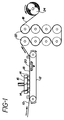
- Fig. 1 is a schematic side elevation of an apparatus that can be used to manufacture the fabrics of the present invention.
- Figs. 2 and 3 are schematic cross-sections through four successive warps of forming belts which may be used to make the fabrics of the present invention.
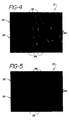
- Figs. 4 and 5 are photomacrographs of the fabric of the present invention taken at 10X, showing the top side and the belt side, respectively, illuminated from above.
- Fig. 6 is a photomacrograph of the fabric of Figs 4 and 5, taken at 10X, showing the top side of the fabric, illuminated from below.
- Figs. 7 and 8 are photomacrographs of the prior art fabrics taken at 10X, showing the top side and the belt side respectively, illuminate from above.
- Figs 9 and 10 are photomacrographs of the fabric of the present invention taken at 10X, showing the top side and the belt side, respectively, illuminated from above.
- Figs. 11 and 12 are photomacrographs of prior art fabrics taken at 10X, showing the top side and the belt side respectively, illuminated from above.
- Figs. 13 and 14 are photomacrographs of prior art fabrics taken at 10X, showing the topside and the belt side respectively, illuminated from above.
- Figs. 15 and 16 are photomacrographs of prior art fabrics taken at 10X, showing the top side and the belt side respectively, illuminated from above.
- the non-woven fabric of this invention is produced by the fluid rearrangement/entanglement of a layer of fibers on a liquid pervious woven forming belt of special construction which is described more fully below.
- a fibrous layer 10 of stable fibers can be passed onto an endless belt 12 which is the said woven forming belt.
- the belt 12 carries the layer of fibers 10 under a series of high-pressure fine, essentially columnar jets of water 14.
- the high-pressure water is supplied from a manifold 16.
- the jets 14 are arranged in rows disposed transversely across the path of travel of the forming belt 12.
- a vacuum slot (not shown) pulling a vacuum of e.g., 5.080 to 38.100 cm (2 to 15 inches)of water, beneath the forming belt 12, directly under each row of jets 14 in order to optimize durability of the fabric product.
- the fibers in the layer 10 are rearranged and entangled by the jets 14 as the liquid from the jets 14 passes through the fiberous layer 10 and then passes through or rebounds from the belt 12, to form the fabric 18 of the present invention.
- the fabric 18 is carried by the belt 12 over a vacuum dewatering station 20, and then proceeds to a series of drying cans 22 and from there to a windup 24.
- Evans in U.S. Patent 3,485,706 describes a process an apparatus for rearranging/entangling fiberous webs by carrying fibrous layers on a woven belt under a series of high pressure, fine, columnar jets of liquid.
- the disclosure of Evans is incorporated herein by reference.
- staple fibers are used, that is fibers having length of from about 1.27 to about 7.62 cm (1/2 up to about 3 inches).
- the belt speeds, water jet pressures, and number of rows of jets have not been found to be narrowly critical. Representative conditions are the following: Belt speed: About 0.914 to 91.44 m/min. (3 to 300 ft. per minute) Jet pressurer: About 13.78 to 137.8 bar (200 to 2000 psi) Rows of jets: About 2 to 50
- the forming belt used to make the fabrics of the present invention is woven from fine warp monofilaments which extend in the direction of travel of the belt, or the machine direction, and fill monofilaments of 2 different sizes; a heavier fill monofilament and a finer fill monofilament.
- the belt is woven in such a manner that the topography of the top surface of the belt, that is, the surface which the fibers will contact, has raised parallel ridges alternating with the depressions. The raised ridges are formed by the heavier fill monofilaments. At spaced intervals along said heavier fill monofilaments, fine warp monofilaments pass over the heavier fill monofilaments.
- the weave of the forming belt is such that at least 2, and up to 4, of the warp monofilaments pass under each heavier fill monofilament between each warp monofilament that passes over the heavier fill monofilament. Therefore, the intervals between said fine warp monofilaments that pass over the heavier fill monofilaments will usually vary from about 2 to about 4 diameters of the fine warp monofilaments. In said depressions, warp filaments are interlaced with fine fill monofilaments to provide a relatively tightly closed, but still water pervious zone.
- the forming belts used in the present invention are disclosed in U.S. Patent 4,379,799.
- FIG. 3 Schematic cross-sections through 4 successive warps 52a, 52b, 52c, and 52d are shown in Fig. 3.
- fabrics formed on such a forming belt typically have the appearance of ribbed terrycloth, and are characterized by a repeating pattern of spaced parallel raised ribs which are substantially wholly entangled throughout and appear uniform and substantially non patterned.
- the fabrics as described in the patent have typical fabric weights of 50.869 g/m2 to about 203.46 g/m2 (1 1/2 to about 6 ounces per square yard). Applicants have now discovered that at weights below about 50.86 g/m2 (1 1/2 ounces per square yard) starting layers of oriented fibers do not produce the fabric described in the patent in that they do not have continuous entangled ribs. These fabrics, however, have surprising strength in both the machine and cross direction.
- Figs. 4 to 6 are the present application show a 30.91 g/m2 (1 ounce per square yard) fabric made with a carded web on forming belt C.
- the starting web and fabric comprise 75% Celanese 310 1.5 denier, 28.575 mm (1 1/8 inch) staple polyester fibers and 25% ENKA 8172 1.5 denier, 31.75 mm (1 1/4 inch) rayon staple fibers.
- the fibrous layer, atop belt C, was wet out and then passed under a manifold containing three orifice strips.
- the orifice strips contained a row of holes, 30 holes per 2.54 cm (inch) of 0.1778 mm (0.007 inch) diameter, through which the water jetted.
- the three strips were operated at 38.908 bar(550 psig).
- the fabric shown generally at 30 has discontinuous ribs 32 comprising a line of raised and tangled fiber regions 34 interconnected by partially entangled fiber arrays 36.
- the raised entangled regions of adjacent lines are interconnected by bundles 38 of straight substantially parallel unentangled fibers.
- the lines 32 of entangled fiber regions are substantially parallel to one another, and the bundles 38 are substantially paralleled to each other and substantially perpendicular to the lines 32.
- the interconnecting bundles are formed in the intervals between the warp monofilaments that pass over the heavier fill monofilaments.
- the jets of liquid 14 (Fig. 1) strike these warp monofilaments and are deflected transversely to "wash" the fibers into the said intervals.
- the fibers are then oriented in a direction parallel to the warp monofilaments by the action of the liquid as it is also deflected by the heavier fill monofilaments.
- the spaces between the heavier fill monofilaments comprise entangling zones wherein are formed the lines of raised entangled fiber regions interconnected by partially entangled arrays of fibers.
- Figs. 7 and 8 disclose a 33.91 g/m2 (1 ounce per square yard) entangled fabric made from a random web of fibers on forming belt C.
- the fabric comprises a repeating pattern of spaced parallel raised ribs of entangled fibers interconnected by spaced bundles of straight unentangled substantially parallel fiber segments as described and claimed in U.S. Patent 4,379,799.
- the web and final fabrics comprise the same fiber composition as the fabric set forth in Figs. 4 through 6 of the present application, namely 75% polyester and 25% rayon, and were entangled under the same conditions.
- the discontinuous ribbed fabrics of the present invention made by fluid arrangement/entanglement of a light weight oriented web supported on the forming belts described herein display increased machine direction tenacity and cross direction tenacity over other entangled apertured fabrics at 75% or more polyester fibers.
- Table II below sets forth the relative machine direction and cross direction tenacity for fabrics formed on forming belt C and on a 20x20 belt and a 12x12 belt, at various fiber compositions.
- the 20x20 belt comprises a plain weave belt of 20 warp ends per 2.54 cm (inch) and 20 pick ends per 2.54 cm (inch) of 0.508 mm (0.02 inch) polyester warp monofilaments and 0.508 mm (0.02 inch) polyester fill monofilaments.
- the 12x12 belt comprises a plain weave of 11 warp ends per 2.54 cm (inch) and 15 pick ends per 2.54 cm (inch) of 0.762 mm (0.03 inch) polyester warp monofilaments and 0.762 mm (0.03 inch) polyester fill monofilaments.
- the fabrics formed on the various belts have similar tenacities. This is believed to be due to the ease of entangling of rayon fibers.
- the fabrics of the present invention yield vastly increased machine direction and cross direction tenacity over the fabrics made on the 20x20 or the 12x12 belts.
- the fabrics formed on the 20x20 belt, whose tenacities are set forth in table II, are seen in Figs. 11 and 12, and the fabrics formed on the 12x12 belt, whose tenacities are set forth in the table, are seen in Figs. 13 and 14.
- Figs. 9 and 10 disclose another embodiment of the fabric of the present invention, formed from a 33.91 g/m2 (1 ounce per square yard) carded web of 75% polyester, 25% rayon fibers described above.
- the fabric is formed on forming belt A.
- the fabric shown generally at 50 comprises a series of substantially parallel lines 52 of raised entangled fiber regions 54 interconnected by lightly entangled fiber regions 56, the entangled fiber regions of adjacent lines being interconnected by bundles 58 of substantially unentangled fibers.
- the bundles are substantially parallel to one another and substantially perpendicular to the lines of entangled regions 52. Adjacent bundles and the lines they interconnect to fine aperatures in the fabric.
- the tenacities of the fabric are set forth below in table III.
- the fabric formed with forming belt A shows a vastly increased machine direction and cross direction tenacity when compared with fabrics formed from the similar base web on a 20x20 or 12x12 belt on the sample machine.
- the process conditions for forming the fabrics on the sample machine are the same as those for forming the fabric shown in Figs. 4 through 8, but the slightly different apparatus provides fabrics of machine direction and cross direction tenacities which can not be directly compared with the tenacities of fabrics made on another apparatus.
- table III provides a comparision of fabrics made on forming belt A with fabrics made on 20x20 or a 12x12 belt.
- the fabrics were formed under the same process conditions, and on the same apparatus as the fabrics depicted in Figs. 4 and 8 and described in Tables I and II.
- the fabric formed on the forming belt C is in fact the fabric depicted in Figs. 7 and 8 and described in conjunction therewith.
- the fabric formed on the 20x20 belt with a random web is shown in Figs. 15 and 16.
- Table IV With a starting web of 33.91 g/m2 (1 ounce per square yard) randon fibers, the fabrics formed on forming belt C or the 20x20 belt show similar tenacities.
- the tenacities of 67.82 g/m2 (2 ounce per square yard) fabrics made from a random web of fibers on forming belt C or the 20x20 belt are also set forth in Table IV and are comparable.
Landscapes
- Engineering & Computer Science (AREA)
- Textile Engineering (AREA)
- Mechanical Engineering (AREA)
- Nonwoven Fabrics (AREA)
- Woven Fabrics (AREA)
- Yarns And Mechanical Finishing Of Yarns Or Ropes (AREA)
Claims (4)
- Wirrfaser-Vliesstoff (30), der mindestens 75% Polyester-Fasern umfaßt und ein Grundgewicht von 10,172 bis 50,869 g/m² (0,3 bis 1,5 oz/yd²) hat sowie in einem sich wiederholenden Muster von im Abstand parallel zueinander verlaufenden Wirrfaser-Linien (32) angeordnet ist, wobei sich die genannten Linien in einer Stoffrichtung erstrecken und die genannten Linien durch im wesentlichen einheitlich im Abstand voneinander angeordnete, parallele Fasersegmente (38) verbunden sind, die genannten Fasersegmente im wesentlichen parallel zueinander und senkrecht zu den genannten Linien (32) sind, die genannten Fasersegmente (38) und die genannten Wirrfaser-Linien (32) dazwischen Öffnungen definieren,
dadurch gekennzeichnet, daß
die genannten Wirrfaser-Linien (32) diskontinuierliche erhöhte Wirrfaser-Bereiche (34) umfassen, die durch Anordnungen von teilweise verwirrten Fasern (36) verbunden sind, wobei die genannten Linien sich im wesentlichen quer zum genannten Stoff (30) erstrecken und die genannten erhöhten Wirrfaser-Bereiche (34) in einer Linie mit den genannten erhöhten Wirrfaser-Bereichen (34) in einer benachbarten Linie durch die genannten parallelen Fasersegmente (38) verbunden sind, wobei die genannten parallelen Fasersegmente (38) garn-ähnliche Bündel sind, die Gruppen von verdichteten, nicht verwirrten, parallelen Fasern enthalten. - Stoff nach Anspruch 1, dadurch gekennzeichnet, daß er 75% Polyester-Stapelfasern und 25% Viskose-Stapelfasern enthält.
- Stoff nach Anspruch 1 oder 2, gekennzeichnet durch ein Grundgewicht von 33,91 g/m² (1,0 oz/yd²).
- Verfahren zur Herstellung eines Vliesstoffs mit geringem Gewicht und ausgezeichneter Festigkeit sowohl in Laufrichtung als auch quer zur Laufrichtung, umfassend:(a) Auflegen einer Faserschicht auf ein für Flüssigkeit durchlässiges Tragorgan, das so angepaßt ist, daß es sich in einer vorbestimmten Laufrichtung bewegt und die Faserbewegung darauf sowohl in der Ebene als auch in einem bestimmten Winkel zur Ebene der genannten Schicht als Reaktion auf angelegte Flüssigkeitsdrücke ermöglicht, wobei das genannte Tragorgan sich abwechselnde, für Flüssigkeit undurchlässige Ablenkzonen und für Flüssigkeit durchlässige Verwirrzonen aufweist, die sich quer zur genannten vorbestimmten Richtung, oder Querrichtung, erstrecken, wobei die genannten Ablenkzonen sich in Abstand voneinander befindliche Ablenkmittel einschließen, die so angepaßt sind, daß sie eine Flüssigkeit in eine Richtung quer zur vorbestimmten Richtung ablenken,(b) Bewegen der aufgelegten Schicht in die genannte vorbestimmte Richtung durch eine Faser-Umordnungszone, innerhalb welcher Hochdruckstrahlen von feinen, im wesentlichen säulenartigen Flüssigkeitsstrahlen direkt auf die Schicht gerichtet werden, und(c) Durchleiten der Flüssigkeitsstrahlen durch die Schicht und das Tragorgan in der Faser-Umordnungszone, um eine Bewegung der Fasern zu bewirken, so daß (1) im Abstand voneinander angeordnete Bündel von geraden, im wesentlichen parallelen Fasersegmenten in den Ablenkzonen gebildet werden, wobei die Bündel im allgemeinen in der vorbestimmten Richtung orientiert sind, (2) im Abstand voneinander angeordnete, parallele Wirrfaser-Strukturen, die durch sich im Abstand voneinander angeordnete Bündel von geraden parallelen Fasersegmenten verbunden sind, in den Verwirrzonen gebildet werden, wobei sich die Strukturen in einer Richtung quer zur vorbestimmten Richtung erstrecken, und (3) die Bündel die verwirrten Strukturen verbinden und in den verwirrten Strukturen an den Bündelenden durch Faserverwirrung verschlungen sind,dadurch gekennzeichnet, daß
in Stufe (a) eine Faserschicht, die mindestens 75% Polyester-Stapelfasern und ein Grundgewicht von etwa 10,172 bis 50,869 g/m² (0,3 bis 1,5 oz/yd²) aufweist, verwendet wird, die Fasern der Schicht in der vorbestimmten Richtung orientiert sind, die Verwirrzonen im wesentlichen frei von erhöhten Ablenkmitteln sind und daß in Stufe (c) sich im Abstand voneinander befindliche, parallele Linien von erhöhten Wirrfaser-Bereichen, die durch Anordnungen von teilweise verwirrten Fasern verbunden sind, gebildet werden.
Applications Claiming Priority (2)
| Application Number | Priority Date | Filing Date | Title |
|---|---|---|---|
| US780461 | 1985-09-26 | ||
| US06/780,461 US4693922A (en) | 1985-09-26 | 1985-09-26 | Light weight entangled non-woven fabric having excellent machine direction and cross direction strength and process for making the same |
Publications (3)
| Publication Number | Publication Date |
|---|---|
| EP0223965A2 EP0223965A2 (de) | 1987-06-03 |
| EP0223965A3 EP0223965A3 (en) | 1989-06-21 |
| EP0223965B1 true EP0223965B1 (de) | 1993-11-24 |
Family
ID=25119638
Family Applications (1)
| Application Number | Title | Priority Date | Filing Date |
|---|---|---|---|
| EP19860113207 Expired - Lifetime EP0223965B1 (de) | 1985-09-26 | 1986-09-25 | Leichter verwickelter nichtgewobener Vliesstoff mit guter Reissfestigkeit in der Maschinen- und Querrichtung und Verfahren zur Herstellung desselben |
Country Status (12)
| Country | Link |
|---|---|
| US (1) | US4693922A (de) |
| EP (1) | EP0223965B1 (de) |
| JP (1) | JP2645481B2 (de) |
| AU (1) | AU585650B2 (de) |
| BR (1) | BR8604638A (de) |
| CA (1) | CA1273190A (de) |
| DE (1) | DE3689328T2 (de) |
| IE (1) | IE62207B1 (de) |
| NZ (1) | NZ217470A (de) |
| PH (1) | PH22463A (de) |
| PT (1) | PT83427B (de) |
| ZA (1) | ZA867326B (de) |
Families Citing this family (30)
| Publication number | Priority date | Publication date | Assignee | Title |
|---|---|---|---|---|
| US4960630A (en) * | 1988-04-14 | 1990-10-02 | International Paper Company | Apparatus for producing symmetrical fluid entangled non-woven fabrics and related method |
| US4735842A (en) * | 1985-09-26 | 1988-04-05 | Chicopee | Light weight entangled non-woven fabric and process for making the same |
| USRE40362E1 (en) | 1987-04-23 | 2008-06-10 | Polymer Group, Inc. | Apparatus and method for hydroenhancing fabric |
| US5632072A (en) * | 1988-04-14 | 1997-05-27 | International Paper Company | Method for hydropatterning napped fabric |
| US5737813A (en) | 1988-04-14 | 1998-04-14 | International Paper Company | Method and apparatus for striped patterning of dyed fabric by hydrojet treatment |
| US4925722A (en) * | 1988-07-20 | 1990-05-15 | International Paper Company | Disposable semi-durable nonwoven fabric |
| US4959894A (en) * | 1988-07-20 | 1990-10-02 | International Paper Company | Disposable semi-durable nonwoven fabric and related method of manufacture |
| US5062418A (en) * | 1989-01-31 | 1991-11-05 | Johnson & Johnson Medical, Inc. | Napped nonwoven fabric having high bulk and absorbency |
| US5026587A (en) * | 1989-10-13 | 1991-06-25 | The James River Corporation | Wiping fabric |
| US5093190A (en) * | 1990-10-22 | 1992-03-03 | E. I. Du Pont De Nemours And Company | Spunlaced acrylic/polyester fabrics |
| US5137600A (en) * | 1990-11-01 | 1992-08-11 | Kimberley-Clark Corporation | Hydraulically needled nonwoven pulp fiber web |
| US5204158A (en) * | 1991-05-30 | 1993-04-20 | Chicopee | Irregular patterned entangled nonwoven fabrics and their production |
| CA2107169A1 (en) * | 1993-06-03 | 1994-12-04 | Cherie Hartman Everhart | Liquid transport material |
| US5320900A (en) * | 1993-08-10 | 1994-06-14 | E. I. Du Pont De Nemours And Company | High absorbency cleanroom wipes having low particles |
| USRE38505E1 (en) | 1994-09-16 | 2004-04-20 | Mcneil-Ppc, Inc. | Nonwoven fabrics having raised portions |
| US5674591A (en) * | 1994-09-16 | 1997-10-07 | James; William A. | Nonwoven fabrics having raised portions |
| IL132212A (en) * | 1998-10-23 | 2003-03-12 | Milliken & Co | Textile fabric with particle attracting finish |
| RU2136794C1 (ru) * | 1998-12-10 | 1999-09-10 | Московская государственная академия легкой промышленности | Нетканый утепляющий материал |
| US6877196B2 (en) * | 2000-08-04 | 2005-04-12 | E. I. Du Pont De Nemours And Company | Process and apparatus for increasing the isotropy in nonwoven fabrics |
| US6701591B2 (en) | 2001-09-21 | 2004-03-09 | Polymer Group, Inc. | Diaphanous nonwoven fabrics with improved abrasive performance |
| USD672152S1 (en) * | 2011-07-25 | 2012-12-11 | Suominen Corporation | Fibrous material sheet with patterned surface |
| JP5712194B2 (ja) * | 2012-12-04 | 2015-05-07 | 花王株式会社 | 拭き取りシート用不織布基材 |
| JP5712195B2 (ja) * | 2012-12-04 | 2015-05-07 | 花王株式会社 | 拭き取りシート用不織布基材 |
| DE202017000266U1 (de) | 2017-01-18 | 2017-03-29 | Norbert Neubauer | Debridement - Vorrichtung zur Wundheilung |
| USD873032S1 (en) * | 2018-03-30 | 2020-01-21 | Teh Yor Co., Ltd. | Fabric |
| DE202018002112U1 (de) | 2018-04-26 | 2018-05-25 | Norbert Neubauer | Wund-Spül-Saugstab |
| USD889136S1 (en) * | 2018-08-23 | 2020-07-07 | Teh Yor Co., Ltd. | Fabric |
| USD889138S1 (en) * | 2018-08-23 | 2020-07-07 | Teh Yor Co., Ltd. | Fabric |
| KR102855029B1 (ko) | 2018-11-30 | 2025-09-04 | 킴벌리-클라크 월드와이드, 인크. | 3차원 부직포 재료 |
| JP7334056B2 (ja) * | 2019-04-26 | 2023-08-28 | ユニ・チャーム株式会社 | 吸収性物品 |
Family Cites Families (12)
| Publication number | Priority date | Publication date | Assignee | Title |
|---|---|---|---|---|
| BE538987A (de) * | 1954-06-16 | 1900-01-01 | ||
| US3498874A (en) * | 1965-09-10 | 1970-03-03 | Du Pont | Apertured tanglelaced nonwoven textile fabric |
| US3485706A (en) * | 1968-01-18 | 1969-12-23 | Du Pont | Textile-like patterned nonwoven fabrics and their production |
| US4016319A (en) * | 1974-09-17 | 1977-04-05 | The Kendall Company | Biaxially oriented nonwoven fabric having long and short fibers |
| US4095007A (en) * | 1974-09-17 | 1978-06-13 | The Kendall Company | Biaxially oriented nonwoven fabrics and method of making same |
| JPS5291969A (en) * | 1976-01-26 | 1977-08-02 | Mitsubishi Rayon Co | Manufacture of unwoven fabric with lattice patern |
| US4379799A (en) * | 1981-02-20 | 1983-04-12 | Chicopee | Nonwoven fabric having the appearance of apertured, ribbed terry cloth |
| US4612226A (en) * | 1982-01-22 | 1986-09-16 | Chicopee | Fabric having excellent wiping properties |
| US4440819A (en) * | 1982-12-27 | 1984-04-03 | Hughes Aircraft Company | Interconnection of unidirectional fiber arrays with random fiber networks |
| JPS59211667A (ja) * | 1983-05-11 | 1984-11-30 | チコピ− | 複合布帛およびその製造方法 |
| JPH0784696B2 (ja) * | 1983-05-20 | 1995-09-13 | ジヨンソン・アンド・ジヨンソン | 不織布製造方法 |
| US4465726A (en) * | 1983-06-23 | 1984-08-14 | Chicopee | Ribbed terry cloth-like nonwoven fabric and process and apparatus for making same |
-
1985
- 1985-09-26 US US06/780,461 patent/US4693922A/en not_active Expired - Fee Related
-
1986
- 1986-09-04 NZ NZ217470A patent/NZ217470A/en unknown
- 1986-09-24 CA CA000518986A patent/CA1273190A/en not_active Expired - Lifetime
- 1986-09-24 PT PT83427A patent/PT83427B/pt not_active IP Right Cessation
- 1986-09-25 DE DE3689328T patent/DE3689328T2/de not_active Expired - Fee Related
- 1986-09-25 AU AU63181/86A patent/AU585650B2/en not_active Ceased
- 1986-09-25 IE IE253986A patent/IE62207B1/en not_active IP Right Cessation
- 1986-09-25 BR BR8604638A patent/BR8604638A/pt not_active IP Right Cessation
- 1986-09-25 ZA ZA867326A patent/ZA867326B/xx unknown
- 1986-09-25 PH PH34298A patent/PH22463A/en unknown
- 1986-09-25 EP EP19860113207 patent/EP0223965B1/de not_active Expired - Lifetime
- 1986-09-25 JP JP22504386A patent/JP2645481B2/ja not_active Expired - Lifetime
Also Published As
| Publication number | Publication date |
|---|---|
| JP2645481B2 (ja) | 1997-08-25 |
| BR8604638A (pt) | 1987-06-09 |
| DE3689328T2 (de) | 1994-06-23 |
| PT83427A (pt) | 1987-05-06 |
| JPS62110958A (ja) | 1987-05-22 |
| AU585650B2 (en) | 1989-06-22 |
| CA1273190A (en) | 1990-08-28 |
| IE862539L (en) | 1987-03-26 |
| NZ217470A (en) | 1988-03-30 |
| PH22463A (en) | 1988-09-12 |
| DE3689328D1 (de) | 1994-01-05 |
| EP0223965A3 (en) | 1989-06-21 |
| IE62207B1 (en) | 1994-12-28 |
| EP0223965A2 (de) | 1987-06-03 |
| AU6318186A (en) | 1987-04-02 |
| PT83427B (pt) | 1994-09-30 |
| US4693922A (en) | 1987-09-15 |
| ZA867326B (en) | 1988-04-27 |
Similar Documents
| Publication | Publication Date | Title |
|---|---|---|
| US4693922A (en) | Light weight entangled non-woven fabric having excellent machine direction and cross direction strength and process for making the same | |
| US4735842A (en) | Light weight entangled non-woven fabric and process for making the same | |
| EP0130070B1 (de) | Rippenfrottierstoffähnliche, nichtgewobene Stoffbahn, und Verfahren und Vorrichtung zur Herstellung derselben | |
| US4379799A (en) | Nonwoven fabric having the appearance of apertured, ribbed terry cloth | |
| US4069563A (en) | Process for making nonwoven fabric | |
| EP0315507B1 (de) | Vliesstoff aus hydraulisch genadelten, elastischen und nichtelastischen Filamenten | |
| USRE40362E1 (en) | Apparatus and method for hydroenhancing fabric | |
| US4647490A (en) | Cotton patterned fabric | |
| US5115544A (en) | Non-wovens manufacturing process | |
| US4536439A (en) | Light weight filter felt | |
| US4297404A (en) | Non-woven fabric comprising buds and bundles connected by highly entangled fibrous areas and methods of manufacturing the same | |
| US6692541B2 (en) | Method of making nonwoven fabric comprising splittable fibers | |
| EP0423619A1 (de) | Wisch-Stoff und Verfahren zur Herstellung | |
| EP0446432A1 (de) | Anlage für die Herstellung einer Vliesstruktur und Produktionsverfahren | |
| EP0516167B1 (de) | Vliesstoff mit Verfilzung in unregelmässigen Mustern und Verfahren zu seiner Herstellung | |
| US6430788B1 (en) | Hydroentangled, low basis weight nonwoven fabric and process for making same | |
| EP1303660A1 (de) | Hydrodynamisch verfestigtes faservlies mit niedrigem flächengewicht und verfahren zu dessen herstellung | |
| EP0412099B1 (de) | Vorrichtung und verfahren für wasserbehandlung von geweben | |
| US3768121A (en) | Apparatus (closed sandwich with high knee backing means foraminous throughout its area) | |
| GB1596718A (en) | Non-woven fabric comprising buds and bundles connected by highly entangled fibous areas and methods of manufacturing the same | |
| EP0132028B1 (de) | Verfahren zur Herstellung von eine mustermässige Struktur aufweisenden, nichtgewebten Stoffbahnen aus Baumwolle | |
| CA1180888A (en) | Process and apparatus for producing a nonwoven fabric having the appearance of apertured, ribbed terry cloth | |
| CA1143929A (en) | Non-woven fabric comprising buds and bundles connected by highly entangled fibrous areas and method of manufacturing the same | |
| WO2002055780A1 (en) | Hydroentangles, low basis weight nonwoven fabric and process for making same |
Legal Events
| Date | Code | Title | Description |
|---|---|---|---|
| PUAI | Public reference made under article 153(3) epc to a published international application that has entered the european phase |
Free format text: ORIGINAL CODE: 0009012 |
|
| AK | Designated contracting states |
Kind code of ref document: A2 Designated state(s): BE CH DE FR GB IT LI LU NL SE |
|
| PUAL | Search report despatched |
Free format text: ORIGINAL CODE: 0009013 |
|
| AK | Designated contracting states |
Kind code of ref document: A3 Designated state(s): BE CH DE FR GB IT LI LU NL SE |
|
| 17P | Request for examination filed |
Effective date: 19891121 |
|
| 17Q | First examination report despatched |
Effective date: 19910712 |
|
| GRAA | (expected) grant |
Free format text: ORIGINAL CODE: 0009210 |
|
| AK | Designated contracting states |
Kind code of ref document: B1 Designated state(s): BE CH DE FR GB IT LI LU NL SE |
|
| REF | Corresponds to: |
Ref document number: 3689328 Country of ref document: DE Date of ref document: 19940105 |
|
| REG | Reference to a national code |
Ref country code: CH Ref legal event code: PUE Owner name: MCNEIL-PPC, INC. |
|
| RAP2 | Party data changed (patent owner data changed or rights of a patent transferred) |
Owner name: MCNEIL-PPC, INC. |
|
| ET | Fr: translation filed | ||
| ITF | It: translation for a ep patent filed | ||
| PLBE | No opposition filed within time limit |
Free format text: ORIGINAL CODE: 0009261 |
|
| STAA | Information on the status of an ep patent application or granted ep patent |
Free format text: STATUS: NO OPPOSITION FILED WITHIN TIME LIMIT |
|
| 26N | No opposition filed | ||
| EAL | Se: european patent in force in sweden |
Ref document number: 86113207.4 |
|
| PGFP | Annual fee paid to national office [announced via postgrant information from national office to epo] |
Ref country code: LU Payment date: 19960801 Year of fee payment: 11 |
|
| PGFP | Annual fee paid to national office [announced via postgrant information from national office to epo] |
Ref country code: SE Payment date: 19960819 Year of fee payment: 11 |
|
| PGFP | Annual fee paid to national office [announced via postgrant information from national office to epo] |
Ref country code: NL Payment date: 19960820 Year of fee payment: 11 |
|
| PGFP | Annual fee paid to national office [announced via postgrant information from national office to epo] |
Ref country code: CH Payment date: 19960823 Year of fee payment: 11 |
|
| PGFP | Annual fee paid to national office [announced via postgrant information from national office to epo] |
Ref country code: BE Payment date: 19960827 Year of fee payment: 11 |
|
| PG25 | Lapsed in a contracting state [announced via postgrant information from national office to epo] |
Ref country code: LU Free format text: LAPSE BECAUSE OF NON-PAYMENT OF DUE FEES Effective date: 19970925 |
|
| PG25 | Lapsed in a contracting state [announced via postgrant information from national office to epo] |
Ref country code: SE Free format text: LAPSE BECAUSE OF NON-PAYMENT OF DUE FEES Effective date: 19970926 |
|
| PG25 | Lapsed in a contracting state [announced via postgrant information from national office to epo] |
Ref country code: LI Free format text: LAPSE BECAUSE OF NON-PAYMENT OF DUE FEES Effective date: 19970930 Ref country code: CH Free format text: LAPSE BECAUSE OF NON-PAYMENT OF DUE FEES Effective date: 19970930 Ref country code: BE Free format text: LAPSE BECAUSE OF NON-PAYMENT OF DUE FEES Effective date: 19970930 |
|
| BERE | Be: lapsed |
Owner name: MCNEIL-PPC INC Effective date: 19970930 |
|
| PG25 | Lapsed in a contracting state [announced via postgrant information from national office to epo] |
Ref country code: NL Free format text: LAPSE BECAUSE OF NON-PAYMENT OF DUE FEES Effective date: 19980401 |
|
| REG | Reference to a national code |
Ref country code: CH Ref legal event code: PL |
|
| NLV4 | Nl: lapsed or anulled due to non-payment of the annual fee |
Effective date: 19980401 |
|
| EUG | Se: european patent has lapsed |
Ref document number: 86113207.4 |
|
| PGFP | Annual fee paid to national office [announced via postgrant information from national office to epo] |
Ref country code: FR Payment date: 20010831 Year of fee payment: 16 Ref country code: DE Payment date: 20010831 Year of fee payment: 16 |
|
| PGFP | Annual fee paid to national office [announced via postgrant information from national office to epo] |
Ref country code: GB Payment date: 20010904 Year of fee payment: 16 |
|
| REG | Reference to a national code |
Ref country code: GB Ref legal event code: IF02 |
|
| PG25 | Lapsed in a contracting state [announced via postgrant information from national office to epo] |
Ref country code: GB Free format text: LAPSE BECAUSE OF NON-PAYMENT OF DUE FEES Effective date: 20020925 |
|
| PG25 | Lapsed in a contracting state [announced via postgrant information from national office to epo] |
Ref country code: DE Free format text: LAPSE BECAUSE OF NON-PAYMENT OF DUE FEES Effective date: 20030401 |
|
| GBPC | Gb: european patent ceased through non-payment of renewal fee |
Effective date: 20020925 |
|
| PG25 | Lapsed in a contracting state [announced via postgrant information from national office to epo] |
Ref country code: FR Free format text: LAPSE BECAUSE OF NON-PAYMENT OF DUE FEES Effective date: 20030603 |
|
| REG | Reference to a national code |
Ref country code: FR Ref legal event code: ST |
|
| PG25 | Lapsed in a contracting state [announced via postgrant information from national office to epo] |
Ref country code: IT Free format text: LAPSE BECAUSE OF NON-PAYMENT OF DUE FEES;WARNING: LAPSES OF ITALIAN PATENTS WITH EFFECTIVE DATE BEFORE 2007 MAY HAVE OCCURRED AT ANY TIME BEFORE 2007. THE CORRECT EFFECTIVE DATE MAY BE DIFFERENT FROM THE ONE RECORDED. Effective date: 20050925 |