EP0224441A1 - Pflanzenwuchsregulierendes Mittel - Google Patents
Pflanzenwuchsregulierendes Mittel Download PDFInfo
- Publication number
- EP0224441A1 EP0224441A1 EP86810501A EP86810501A EP0224441A1 EP 0224441 A1 EP0224441 A1 EP 0224441A1 EP 86810501 A EP86810501 A EP 86810501A EP 86810501 A EP86810501 A EP 86810501A EP 0224441 A1 EP0224441 A1 EP 0224441A1
- Authority
- EP
- European Patent Office
- Prior art keywords
- alkyl
- methoxy
- methyl
- urea
- haloalkyl
- Prior art date
- Legal status (The legal status is an assumption and is not a legal conclusion. Google has not performed a legal analysis and makes no representation as to the accuracy of the status listed.)
- Granted
Links
- 230000008635 plant growth Effects 0.000 title claims abstract description 15
- 230000001105 regulatory effect Effects 0.000 title claims abstract description 12
- 239000000203 mixture Substances 0.000 claims abstract description 54
- -1 R1 is C1 -C6 alkyl Chemical group 0.000 claims abstract description 44
- 125000002496 methyl group Chemical group [H]C([H])([H])* 0.000 claims abstract description 20
- 229910052736 halogen Inorganic materials 0.000 claims abstract description 19
- 150000002367 halogens Chemical class 0.000 claims abstract description 15
- 229940100389 Sulfonylurea Drugs 0.000 claims abstract description 13
- 239000001257 hydrogen Substances 0.000 claims abstract description 10
- 229910052739 hydrogen Inorganic materials 0.000 claims abstract description 10
- YROXIXLRRCOBKF-UHFFFAOYSA-N sulfonylurea Chemical class OC(=N)N=S(=O)=O YROXIXLRRCOBKF-UHFFFAOYSA-N 0.000 claims abstract description 10
- 125000000449 nitro group Chemical group [O-][N+](*)=O 0.000 claims abstract description 9
- 125000001997 phenyl group Chemical group [H]C1=C([H])C([H])=C(*)C([H])=C1[H] 0.000 claims abstract description 9
- 150000003839 salts Chemical class 0.000 claims abstract description 9
- 125000004169 (C1-C6) alkyl group Chemical group 0.000 claims abstract description 8
- 239000002253 acid Substances 0.000 claims abstract description 8
- QVGXLLKOCUKJST-UHFFFAOYSA-N atomic oxygen Chemical compound [O] QVGXLLKOCUKJST-UHFFFAOYSA-N 0.000 claims abstract description 8
- 229910052757 nitrogen Inorganic materials 0.000 claims abstract description 8
- 229910052760 oxygen Inorganic materials 0.000 claims abstract description 8
- 239000001301 oxygen Substances 0.000 claims abstract description 8
- 125000006729 (C2-C5) alkenyl group Chemical group 0.000 claims abstract description 7
- 125000006730 (C2-C5) alkynyl group Chemical group 0.000 claims abstract description 7
- 125000004414 alkyl thio group Chemical group 0.000 claims abstract description 7
- 125000001559 cyclopropyl group Chemical group [H]C1([H])C([H])([H])C1([H])* 0.000 claims abstract description 7
- 125000000956 methoxy group Chemical group [H]C([H])([H])O* 0.000 claims abstract description 7
- 125000000171 (C1-C6) haloalkyl group Chemical group 0.000 claims abstract description 6
- NINIDFKCEFEMDL-UHFFFAOYSA-N Sulfur Chemical compound [S] NINIDFKCEFEMDL-UHFFFAOYSA-N 0.000 claims abstract description 6
- 125000003342 alkenyl group Chemical group 0.000 claims abstract description 6
- 125000000304 alkynyl group Chemical group 0.000 claims abstract description 6
- 125000004433 nitrogen atom Chemical group N* 0.000 claims abstract description 6
- 229910052717 sulfur Inorganic materials 0.000 claims abstract description 6
- 239000011593 sulfur Substances 0.000 claims abstract description 6
- 150000003863 ammonium salts Chemical class 0.000 claims abstract description 5
- 125000004435 hydrogen atom Chemical group [H]* 0.000 claims abstract description 5
- 125000004183 alkoxy alkyl group Chemical group 0.000 claims abstract description 4
- 125000000262 haloalkenyl group Chemical group 0.000 claims abstract description 4
- 125000001188 haloalkyl group Chemical group 0.000 claims abstract description 4
- 125000004765 (C1-C4) haloalkyl group Chemical group 0.000 claims abstract description 3
- 125000005913 (C3-C6) cycloalkyl group Chemical group 0.000 claims abstract description 3
- 125000006350 alkyl thio alkyl group Chemical group 0.000 claims abstract description 3
- 239000000460 chlorine Substances 0.000 claims abstract description 3
- 229910052801 chlorine Inorganic materials 0.000 claims abstract description 3
- 125000004093 cyano group Chemical group *C#N 0.000 claims abstract description 3
- 125000005059 halophenyl group Chemical group 0.000 claims abstract description 3
- 125000000623 heterocyclic group Chemical group 0.000 claims abstract description 3
- 125000002887 hydroxy group Chemical group [H]O* 0.000 claims abstract description 3
- 229910052751 metal Chemical class 0.000 claims abstract description 3
- 239000002184 metal Chemical class 0.000 claims abstract description 3
- 125000000951 phenoxy group Chemical group [H]C1=C([H])C([H])=C(O*)C([H])=C1[H] 0.000 claims abstract description 3
- 150000002431 hydrogen Chemical class 0.000 claims abstract 5
- 241000196324 Embryophyta Species 0.000 claims description 63
- 239000004480 active ingredient Substances 0.000 claims description 47
- 239000003795 chemical substances by application Substances 0.000 claims description 29
- 230000012010 growth Effects 0.000 claims description 26
- 125000006527 (C1-C5) alkyl group Chemical group 0.000 claims description 15
- 235000013339 cereals Nutrition 0.000 claims description 11
- 241000209504 Poaceae Species 0.000 claims description 10
- 230000002401 inhibitory effect Effects 0.000 claims description 10
- 235000013399 edible fruits Nutrition 0.000 claims description 9
- 229940060367 inert ingredients Drugs 0.000 claims description 8
- 239000000654 additive Substances 0.000 claims description 7
- 125000000229 (C1-C4)alkoxy group Chemical group 0.000 claims description 6
- XSQUKJJJFZCRTK-UHFFFAOYSA-N Urea Chemical compound NC(N)=O XSQUKJJJFZCRTK-UHFFFAOYSA-N 0.000 claims description 5
- 239000004202 carbamide Substances 0.000 claims description 5
- 229920000742 Cotton Polymers 0.000 claims description 4
- 244000299507 Gossypium hirsutum Species 0.000 claims description 4
- 240000005979 Hordeum vulgare Species 0.000 claims description 4
- 235000007340 Hordeum vulgare Nutrition 0.000 claims description 4
- 235000021307 Triticum Nutrition 0.000 claims description 4
- GHDLZGOOOLEJKI-UHFFFAOYSA-N benzenesulfonylurea Chemical compound NC(=O)NS(=O)(=O)C1=CC=CC=C1 GHDLZGOOOLEJKI-UHFFFAOYSA-N 0.000 claims description 4
- FNNWEGFGOSAQMF-UHFFFAOYSA-N ethyl 4-(cyclopropanecarbonyl)-3,5-dioxocyclohexane-1-carboxylate Chemical compound O=C1CC(C(=O)OCC)CC(=O)C1C(=O)C1CC1 FNNWEGFGOSAQMF-UHFFFAOYSA-N 0.000 claims description 4
- 244000075850 Avena orientalis Species 0.000 claims description 3
- WMLPCIHUFDKWJU-UHFFFAOYSA-N Cinosulfuron Chemical compound COCCOC1=CC=CC=C1S(=O)(=O)NC(=O)NC1=NC(OC)=NC(OC)=N1 WMLPCIHUFDKWJU-UHFFFAOYSA-N 0.000 claims description 3
- 235000010469 Glycine max Nutrition 0.000 claims description 3
- 240000000111 Saccharum officinarum Species 0.000 claims description 3
- 235000007201 Saccharum officinarum Nutrition 0.000 claims description 3
- 240000008042 Zea mays Species 0.000 claims description 3
- 235000002017 Zea mays subsp mays Nutrition 0.000 claims description 3
- 150000002148 esters Chemical group 0.000 claims description 3
- 238000000034 method Methods 0.000 claims description 3
- 238000004904 shortening Methods 0.000 claims description 3
- 125000004178 (C1-C4) alkyl group Chemical group 0.000 claims description 2
- TUHAFRCWTMLAIH-UHFFFAOYSA-N 4-(cyclobutanecarbonyl)-3,5-dioxocyclohexane-1-carboxylic acid Chemical compound O=C1CC(C(=O)O)CC(=O)C1C(=O)C1CCC1 TUHAFRCWTMLAIH-UHFFFAOYSA-N 0.000 claims description 2
- UNMYTEORJFXQBK-UHFFFAOYSA-N 4-(cyclopropanecarbonyl)-3,5-dioxocyclohexane-1-carboxylic acid Chemical compound O=C1CC(C(=O)O)CC(=O)C1C(=O)C1CC1 UNMYTEORJFXQBK-UHFFFAOYSA-N 0.000 claims description 2
- 235000007319 Avena orientalis Nutrition 0.000 claims description 2
- ZAMOUSCENKQFHK-UHFFFAOYSA-N Chlorine atom Chemical compound [Cl] ZAMOUSCENKQFHK-UHFFFAOYSA-N 0.000 claims description 2
- 244000068988 Glycine max Species 0.000 claims description 2
- 240000007594 Oryza sativa Species 0.000 claims description 2
- 235000007164 Oryza sativa Nutrition 0.000 claims description 2
- 235000007238 Secale cereale Nutrition 0.000 claims description 2
- 235000021374 legumes Nutrition 0.000 claims description 2
- CAKAVUJNNJTHML-UHFFFAOYSA-N methyl 2-[(4-cyclopropyl-6-methylpyrimidin-2-yl)carbamoylsulfamoyl]benzoate Chemical compound COC(=O)C1=CC=CC=C1S(=O)(=O)NC(=O)NC1=NC(C)=CC(C2CC2)=N1 CAKAVUJNNJTHML-UHFFFAOYSA-N 0.000 claims description 2
- ZTYVMAQSHCZXLF-UHFFFAOYSA-N methyl 2-[[4,6-bis(difluoromethoxy)pyrimidin-2-yl]carbamoylsulfamoyl]benzoate Chemical compound COC(=O)C1=CC=CC=C1S(=O)(=O)NC(=O)NC1=NC(OC(F)F)=CC(OC(F)F)=N1 ZTYVMAQSHCZXLF-UHFFFAOYSA-N 0.000 claims description 2
- SHCNBEKGPCPRAD-UHFFFAOYSA-N methyl 4-(cyclopropanecarbonyl)-3,5-dioxocyclohexane-1-carboxylate Chemical compound O=C1CC(C(=O)OC)CC(=O)C1C(=O)C1CC1 SHCNBEKGPCPRAD-UHFFFAOYSA-N 0.000 claims description 2
- RSMUVYRMZCOLBH-UHFFFAOYSA-N metsulfuron methyl Chemical compound COC(=O)C1=CC=CC=C1S(=O)(=O)NC(=O)NC1=NC(C)=NC(OC)=N1 RSMUVYRMZCOLBH-UHFFFAOYSA-N 0.000 claims description 2
- 235000009566 rice Nutrition 0.000 claims description 2
- ZDXMLEQEMNLCQG-UHFFFAOYSA-N sulfometuron methyl Chemical compound COC(=O)C1=CC=CC=C1S(=O)(=O)NC(=O)NC1=NC(C)=CC(C)=N1 ZDXMLEQEMNLCQG-UHFFFAOYSA-N 0.000 claims description 2
- PWLRSGUSOOXHPW-UHFFFAOYSA-N 1-[2-(2-methoxyethoxy)phenyl]sulfonyl-3-(4-methoxy-6-methyl-1,3,5-triazin-2-yl)urea Chemical compound COCCOC1=CC=CC=C1S(=O)(=O)NC(=O)NC1=NC(C)=NC(OC)=N1 PWLRSGUSOOXHPW-UHFFFAOYSA-N 0.000 claims 1
- 241000209056 Secale Species 0.000 claims 1
- 244000098338 Triticum aestivum Species 0.000 claims 1
- 235000005824 Zea mays ssp. parviglumis Nutrition 0.000 claims 1
- 235000005822 corn Nutrition 0.000 claims 1
- 125000000217 alkyl group Chemical group 0.000 abstract description 10
- 125000001301 ethoxy group Chemical group [H]C([H])([H])C([H])([H])O* 0.000 abstract description 2
- 125000003545 alkoxy group Chemical group 0.000 abstract 5
- 125000005843 halogen group Chemical group 0.000 abstract 4
- 239000002671 adjuvant Substances 0.000 abstract 1
- 125000003302 alkenyloxy group Chemical group 0.000 abstract 1
- 125000004453 alkoxycarbonyl group Chemical group 0.000 abstract 1
- 125000004390 alkyl sulfonyl group Chemical group 0.000 abstract 1
- 125000005133 alkynyloxy group Chemical group 0.000 abstract 1
- 125000001309 chloro group Chemical group Cl* 0.000 abstract 1
- 125000004438 haloalkoxy group Chemical group 0.000 abstract 1
- 125000004995 haloalkylthio group Chemical group 0.000 abstract 1
- 125000000232 haloalkynyl group Chemical group 0.000 abstract 1
- 125000004430 oxygen atom Chemical group O* 0.000 abstract 1
- 239000003630 growth substance Substances 0.000 description 19
- 150000001875 compounds Chemical class 0.000 description 16
- 230000000694 effects Effects 0.000 description 11
- 239000002689 soil Substances 0.000 description 10
- 239000004094 surface-active agent Substances 0.000 description 10
- 238000003306 harvesting Methods 0.000 description 9
- XLYOFNOQVPJJNP-UHFFFAOYSA-N water Substances O XLYOFNOQVPJJNP-UHFFFAOYSA-N 0.000 description 9
- LYCAIKOWRPUZTN-UHFFFAOYSA-N Ethylene glycol Chemical compound OCCO LYCAIKOWRPUZTN-UHFFFAOYSA-N 0.000 description 8
- 230000009036 growth inhibition Effects 0.000 description 8
- 125000004432 carbon atom Chemical group C* 0.000 description 6
- 244000038559 crop plants Species 0.000 description 6
- 239000007787 solid Substances 0.000 description 6
- 230000009105 vegetative growth Effects 0.000 description 6
- 235000014113 dietary fatty acids Nutrition 0.000 description 5
- 239000000194 fatty acid Substances 0.000 description 5
- 229930195729 fatty acid Natural products 0.000 description 5
- 238000009472 formulation Methods 0.000 description 5
- 239000000126 substance Substances 0.000 description 5
- VYPSYNLAJGMNEJ-UHFFFAOYSA-N Silicium dioxide Chemical compound O=[Si]=O VYPSYNLAJGMNEJ-UHFFFAOYSA-N 0.000 description 4
- 230000015572 biosynthetic process Effects 0.000 description 4
- 150000004665 fatty acids Chemical class 0.000 description 4
- 239000008187 granular material Substances 0.000 description 4
- 239000007788 liquid Substances 0.000 description 4
- 239000002736 nonionic surfactant Substances 0.000 description 4
- 239000004033 plastic Substances 0.000 description 4
- 229920003023 plastic Polymers 0.000 description 4
- 239000000843 powder Substances 0.000 description 4
- 238000002360 preparation method Methods 0.000 description 4
- 150000003254 radicals Chemical class 0.000 description 4
- 239000007921 spray Substances 0.000 description 4
- 230000002195 synergetic effect Effects 0.000 description 4
- 238000012360 testing method Methods 0.000 description 4
- 244000025254 Cannabis sativa Species 0.000 description 3
- LFQSCWFLJHTTHZ-UHFFFAOYSA-N Ethanol Chemical compound CCO LFQSCWFLJHTTHZ-UHFFFAOYSA-N 0.000 description 3
- ZMXDDKWLCZADIW-UHFFFAOYSA-N N,N-Dimethylformamide Chemical compound CN(C)C=O ZMXDDKWLCZADIW-UHFFFAOYSA-N 0.000 description 3
- 241000209140 Triticum Species 0.000 description 3
- 239000013543 active substance Substances 0.000 description 3
- 230000008901 benefit Effects 0.000 description 3
- 239000000969 carrier Substances 0.000 description 3
- 239000012141 concentrate Substances 0.000 description 3
- 238000005520 cutting process Methods 0.000 description 3
- 239000000839 emulsion Substances 0.000 description 3
- 230000003628 erosive effect Effects 0.000 description 3
- 235000019441 ethanol Nutrition 0.000 description 3
- 150000002170 ethers Chemical class 0.000 description 3
- 230000002363 herbicidal effect Effects 0.000 description 3
- 239000004009 herbicide Substances 0.000 description 3
- 238000012423 maintenance Methods 0.000 description 3
- IJGRMHOSHXDMSA-UHFFFAOYSA-N nitrogen Substances N#N IJGRMHOSHXDMSA-UHFFFAOYSA-N 0.000 description 3
- 239000000047 product Substances 0.000 description 3
- 230000009467 reduction Effects 0.000 description 3
- 239000011734 sodium Substances 0.000 description 3
- 229910052708 sodium Inorganic materials 0.000 description 3
- 238000009331 sowing Methods 0.000 description 3
- 239000005995 Aluminium silicate Substances 0.000 description 2
- 244000099147 Ananas comosus Species 0.000 description 2
- 235000007119 Ananas comosus Nutrition 0.000 description 2
- 241000219310 Beta vulgaris subsp. vulgaris Species 0.000 description 2
- 229910021532 Calcite Inorganic materials 0.000 description 2
- RTZKZFJDLAIYFH-UHFFFAOYSA-N Diethyl ether Chemical compound CCOCC RTZKZFJDLAIYFH-UHFFFAOYSA-N 0.000 description 2
- IAZDPXIOMUYVGZ-UHFFFAOYSA-N Dimethylsulphoxide Chemical compound CS(C)=O IAZDPXIOMUYVGZ-UHFFFAOYSA-N 0.000 description 2
- 240000004296 Lolium perenne Species 0.000 description 2
- 244000061176 Nicotiana tabacum Species 0.000 description 2
- 235000002637 Nicotiana tabacum Nutrition 0.000 description 2
- 235000010627 Phaseolus vulgaris Nutrition 0.000 description 2
- 244000046052 Phaseolus vulgaris Species 0.000 description 2
- 239000002202 Polyethylene glycol Substances 0.000 description 2
- 229920001214 Polysorbate 60 Polymers 0.000 description 2
- 240000003768 Solanum lycopersicum Species 0.000 description 2
- 235000021536 Sugar beet Nutrition 0.000 description 2
- 241000219793 Trifolium Species 0.000 description 2
- 235000016383 Zea mays subsp huehuetenangensis Nutrition 0.000 description 2
- 230000000996 additive effect Effects 0.000 description 2
- 150000001298 alcohols Chemical class 0.000 description 2
- 239000003513 alkali Substances 0.000 description 2
- 150000008055 alkyl aryl sulfonates Chemical class 0.000 description 2
- 235000012211 aluminium silicate Nutrition 0.000 description 2
- 239000003945 anionic surfactant Substances 0.000 description 2
- 125000003785 benzimidazolyl group Chemical class N1=C(NC2=C1C=CC=C2)* 0.000 description 2
- 239000011575 calcium Substances 0.000 description 2
- 229910052791 calcium Inorganic materials 0.000 description 2
- 239000003093 cationic surfactant Substances 0.000 description 2
- 230000008859 change Effects 0.000 description 2
- 239000003240 coconut oil Substances 0.000 description 2
- 235000008504 concentrate Nutrition 0.000 description 2
- JHIVVAPYMSGYDF-UHFFFAOYSA-N cyclohexanone Chemical compound O=C1CCCCC1 JHIVVAPYMSGYDF-UHFFFAOYSA-N 0.000 description 2
- 230000035613 defoliation Effects 0.000 description 2
- 238000010790 dilution Methods 0.000 description 2
- 239000012895 dilution Substances 0.000 description 2
- 230000002349 favourable effect Effects 0.000 description 2
- 238000000227 grinding Methods 0.000 description 2
- 239000003966 growth inhibitor Substances 0.000 description 2
- 230000005764 inhibitory process Effects 0.000 description 2
- NLYAJNPCOHFWQQ-UHFFFAOYSA-N kaolin Chemical compound O.O.O=[Al]O[Si](=O)O[Si](=O)O[Al]=O NLYAJNPCOHFWQQ-UHFFFAOYSA-N 0.000 description 2
- 235000009973 maize Nutrition 0.000 description 2
- 239000000463 material Substances 0.000 description 2
- 230000004060 metabolic process Effects 0.000 description 2
- 238000002156 mixing Methods 0.000 description 2
- 230000017066 negative regulation of growth Effects 0.000 description 2
- 239000003415 peat Substances 0.000 description 2
- 229920001223 polyethylene glycol Polymers 0.000 description 2
- 229920000151 polyglycol Polymers 0.000 description 2
- 239000010695 polyglycol Substances 0.000 description 2
- 229920001451 polypropylene glycol Polymers 0.000 description 2
- 239000004576 sand Substances 0.000 description 2
- 239000000344 soap Substances 0.000 description 2
- 239000002904 solvent Substances 0.000 description 2
- 238000003860 storage Methods 0.000 description 2
- 125000001424 substituent group Chemical group 0.000 description 2
- 235000000346 sugar Nutrition 0.000 description 2
- 125000001273 sulfonato group Chemical class [O-]S(*)(=O)=O 0.000 description 2
- 150000003467 sulfuric acid derivatives Chemical class 0.000 description 2
- 239000000725 suspension Substances 0.000 description 2
- 239000004546 suspension concentrate Substances 0.000 description 2
- XOPFESVZMSQIKC-UHFFFAOYSA-N triasulfuron Chemical compound COC1=NC(C)=NC(NC(=O)NS(=O)(=O)C=2C(=CC=CC=2)OCCCl)=N1 XOPFESVZMSQIKC-UHFFFAOYSA-N 0.000 description 2
- WRIDQFICGBMAFQ-UHFFFAOYSA-N (E)-8-Octadecenoic acid Natural products CCCCCCCCCC=CCCCCCCC(O)=O WRIDQFICGBMAFQ-UHFFFAOYSA-N 0.000 description 1
- XNWFRZJHXBZDAG-UHFFFAOYSA-N 2-METHOXYETHANOL Chemical group COCCO XNWFRZJHXBZDAG-UHFFFAOYSA-N 0.000 description 1
- JDSQBDGCMUXRBM-UHFFFAOYSA-N 2-[2-(2-butoxypropoxy)propoxy]propan-1-ol Chemical group CCCCOC(C)COC(C)COC(C)CO JDSQBDGCMUXRBM-UHFFFAOYSA-N 0.000 description 1
- WBIQQQGBSDOWNP-UHFFFAOYSA-N 2-dodecylbenzenesulfonic acid Chemical class CCCCCCCCCCCCC1=CC=CC=C1S(O)(=O)=O WBIQQQGBSDOWNP-UHFFFAOYSA-N 0.000 description 1
- LQJBNNIYVWPHFW-UHFFFAOYSA-N 20:1omega9c fatty acid Natural products CCCCCCCCCCC=CCCCCCCCC(O)=O LQJBNNIYVWPHFW-UHFFFAOYSA-N 0.000 description 1
- QSBYPNXLFMSGKH-UHFFFAOYSA-N 9-Heptadecensaeure Natural products CCCCCCCC=CCCCCCCCC(O)=O QSBYPNXLFMSGKH-UHFFFAOYSA-N 0.000 description 1
- 235000005781 Avena Nutrition 0.000 description 1
- LSNNMFCWUKXFEE-UHFFFAOYSA-M Bisulfite Chemical compound OS([O-])=O LSNNMFCWUKXFEE-UHFFFAOYSA-M 0.000 description 1
- 235000006463 Brassica alba Nutrition 0.000 description 1
- 244000140786 Brassica hirta Species 0.000 description 1
- 241000743756 Bromus inermis Species 0.000 description 1
- OYPRJOBELJOOCE-UHFFFAOYSA-N Calcium Chemical compound [Ca] OYPRJOBELJOOCE-UHFFFAOYSA-N 0.000 description 1
- 239000004215 Carbon black (E152) Substances 0.000 description 1
- 241001086557 Centrosema plumieri Species 0.000 description 1
- 241001098036 Centrosema pubescens Species 0.000 description 1
- 244000060011 Cocos nucifera Species 0.000 description 1
- 235000013162 Cocos nucifera Nutrition 0.000 description 1
- 240000007154 Coffea arabica Species 0.000 description 1
- XDTMQSROBMDMFD-UHFFFAOYSA-N Cyclohexane Chemical compound C1CCCCC1 XDTMQSROBMDMFD-UHFFFAOYSA-N 0.000 description 1
- 241001551133 Cynosurus cristatus Species 0.000 description 1
- 240000004585 Dactylis glomerata Species 0.000 description 1
- MQIUGAXCHLFZKX-UHFFFAOYSA-N Di-n-octyl phthalate Chemical compound CCCCCCCCOC(=O)C1=CC=CC=C1C(=O)OCCCCCCCC MQIUGAXCHLFZKX-UHFFFAOYSA-N 0.000 description 1
- 241000508725 Elymus repens Species 0.000 description 1
- VGGSQFUCUMXWEO-UHFFFAOYSA-N Ethene Chemical compound C=C VGGSQFUCUMXWEO-UHFFFAOYSA-N 0.000 description 1
- 239000005977 Ethylene Substances 0.000 description 1
- 241000410074 Festuca ovina Species 0.000 description 1
- 241000508723 Festuca rubra Species 0.000 description 1
- 239000004606 Fillers/Extenders Substances 0.000 description 1
- 241000565391 Fraxinus mandshurica Species 0.000 description 1
- 244000043261 Hevea brasiliensis Species 0.000 description 1
- DGAQECJNVWCQMB-PUAWFVPOSA-M Ilexoside XXIX Chemical compound C[C@@H]1CC[C@@]2(CC[C@@]3(C(=CC[C@H]4[C@]3(CC[C@@H]5[C@@]4(CC[C@@H](C5(C)C)OS(=O)(=O)[O-])C)C)[C@@H]2[C@]1(C)O)C)C(=O)O[C@H]6[C@@H]([C@H]([C@@H]([C@H](O6)CO)O)O)O.[Na+] DGAQECJNVWCQMB-PUAWFVPOSA-M 0.000 description 1
- 240000008415 Lactuca sativa Species 0.000 description 1
- 235000003228 Lactuca sativa Nutrition 0.000 description 1
- 235000007688 Lycopersicon esculentum Nutrition 0.000 description 1
- IGFHQQFPSIBGKE-UHFFFAOYSA-N Nonylphenol Natural products CCCCCCCCCC1=CC=C(O)C=C1 IGFHQQFPSIBGKE-UHFFFAOYSA-N 0.000 description 1
- CTQNGGLPUBDAKN-UHFFFAOYSA-N O-Xylene Chemical compound CC1=CC=CC=C1C CTQNGGLPUBDAKN-UHFFFAOYSA-N 0.000 description 1
- 239000005642 Oleic acid Substances 0.000 description 1
- ZQPPMHVWECSIRJ-UHFFFAOYSA-N Oleic acid Natural products CCCCCCCCC=CCCCCCCCC(O)=O ZQPPMHVWECSIRJ-UHFFFAOYSA-N 0.000 description 1
- 229910019142 PO4 Inorganic materials 0.000 description 1
- 231100000674 Phytotoxicity Toxicity 0.000 description 1
- 240000004713 Pisum sativum Species 0.000 description 1
- 235000010582 Pisum sativum Nutrition 0.000 description 1
- 241000209049 Poa pratensis Species 0.000 description 1
- 229920003171 Poly (ethylene oxide) Polymers 0.000 description 1
- DNIAPMSPPWPWGF-UHFFFAOYSA-N Propylene glycol Chemical group CC(O)CO DNIAPMSPPWPWGF-UHFFFAOYSA-N 0.000 description 1
- 244000279064 Psophocarpus palustris Species 0.000 description 1
- 235000014465 Psophocarpus palustris Nutrition 0.000 description 1
- 244000082988 Secale cereale Species 0.000 description 1
- 239000004113 Sepiolite Substances 0.000 description 1
- FAPWRFPIFSIZLT-UHFFFAOYSA-M Sodium chloride Chemical compound [Na+].[Cl-] FAPWRFPIFSIZLT-UHFFFAOYSA-M 0.000 description 1
- 235000002560 Solanum lycopersicum Nutrition 0.000 description 1
- PRXRUNOAOLTIEF-ADSICKODSA-N Sorbitan trioleate Chemical compound CCCCCCCC\C=C/CCCCCCCC(=O)OC[C@@H](OC(=O)CCCCCCC\C=C/CCCCCCCC)[C@H]1OC[C@H](O)[C@H]1OC(=O)CCCCCCC\C=C/CCCCCCCC PRXRUNOAOLTIEF-ADSICKODSA-N 0.000 description 1
- 239000004147 Sorbitan trioleate Substances 0.000 description 1
- 244000062793 Sorghum vulgare Species 0.000 description 1
- 229920002472 Starch Polymers 0.000 description 1
- 235000021355 Stearic acid Nutrition 0.000 description 1
- VBIIFPGSPJYLRR-UHFFFAOYSA-M Stearyltrimethylammonium chloride Chemical compound [Cl-].CCCCCCCCCCCCCCCCCC[N+](C)(C)C VBIIFPGSPJYLRR-UHFFFAOYSA-M 0.000 description 1
- 240000006694 Stellaria media Species 0.000 description 1
- QAOWNCQODCNURD-UHFFFAOYSA-N Sulfuric acid Chemical class OS(O)(=O)=O QAOWNCQODCNURD-UHFFFAOYSA-N 0.000 description 1
- GSEJCLTVZPLZKY-UHFFFAOYSA-N Triethanolamine Chemical class OCCN(CCO)CCO GSEJCLTVZPLZKY-UHFFFAOYSA-N 0.000 description 1
- 230000002745 absorbent Effects 0.000 description 1
- 239000002250 absorbent Substances 0.000 description 1
- 230000009471 action Effects 0.000 description 1
- 239000000853 adhesive Substances 0.000 description 1
- 230000001070 adhesive effect Effects 0.000 description 1
- 230000000274 adsorptive effect Effects 0.000 description 1
- 230000032683 aging Effects 0.000 description 1
- 125000001931 aliphatic group Chemical group 0.000 description 1
- 150000001338 aliphatic hydrocarbons Chemical class 0.000 description 1
- 230000003042 antagnostic effect Effects 0.000 description 1
- 150000004945 aromatic hydrocarbons Chemical class 0.000 description 1
- 229960000892 attapulgite Drugs 0.000 description 1
- 230000009286 beneficial effect Effects 0.000 description 1
- 239000000440 bentonite Substances 0.000 description 1
- 229910000278 bentonite Inorganic materials 0.000 description 1
- SVPXDRXYRYOSEX-UHFFFAOYSA-N bentoquatam Chemical compound O.O=[Si]=O.O=[Al]O[Al]=O SVPXDRXYRYOSEX-UHFFFAOYSA-N 0.000 description 1
- 125000001797 benzyl group Chemical group [H]C1=C([H])C([H])=C(C([H])=C1[H])C([H])([H])* 0.000 description 1
- BCOZLGOHQFNXBI-UHFFFAOYSA-M benzyl-bis(2-chloroethyl)-ethylazanium;bromide Chemical compound [Br-].ClCC[N+](CC)(CCCl)CC1=CC=CC=C1 BCOZLGOHQFNXBI-UHFFFAOYSA-M 0.000 description 1
- 235000021028 berry Nutrition 0.000 description 1
- 239000011230 binding agent Substances 0.000 description 1
- 239000011449 brick Substances 0.000 description 1
- 239000012876 carrier material Substances 0.000 description 1
- 239000004359 castor oil Substances 0.000 description 1
- 235000019438 castor oil Nutrition 0.000 description 1
- 125000002091 cationic group Chemical group 0.000 description 1
- 230000034303 cell budding Effects 0.000 description 1
- NSWAMPCUPHPTTC-UHFFFAOYSA-N chlorimuron-ethyl Chemical compound CCOC(=O)C1=CC=CC=C1S(=O)(=O)NC(=O)NC1=NC(Cl)=CC(OC)=N1 NSWAMPCUPHPTTC-UHFFFAOYSA-N 0.000 description 1
- VJYIFXVZLXQVHO-UHFFFAOYSA-N chlorsulfuron Chemical compound COC1=NC(C)=NC(NC(=O)NS(=O)(=O)C=2C(=CC=CC=2)Cl)=N1 VJYIFXVZLXQVHO-UHFFFAOYSA-N 0.000 description 1
- 235000020971 citrus fruits Nutrition 0.000 description 1
- 239000011248 coating agent Substances 0.000 description 1
- 238000000576 coating method Methods 0.000 description 1
- 235000019864 coconut oil Nutrition 0.000 description 1
- 235000016213 coffee Nutrition 0.000 description 1
- 235000013353 coffee beverage Nutrition 0.000 description 1
- 239000007859 condensation product Substances 0.000 description 1
- 230000003111 delayed effect Effects 0.000 description 1
- 239000003599 detergent Substances 0.000 description 1
- 238000011161 development Methods 0.000 description 1
- 230000018109 developmental process Effects 0.000 description 1
- GUJOJGAPFQRJSV-UHFFFAOYSA-N dialuminum;dioxosilane;oxygen(2-);hydrate Chemical compound O.[O-2].[O-2].[O-2].[Al+3].[Al+3].O=[Si]=O.O=[Si]=O.O=[Si]=O.O=[Si]=O GUJOJGAPFQRJSV-UHFFFAOYSA-N 0.000 description 1
- DOIRQSBPFJWKBE-UHFFFAOYSA-N dibutyl phthalate Chemical group CCCCOC(=O)C1=CC=CC=C1C(=O)OCCCC DOIRQSBPFJWKBE-UHFFFAOYSA-N 0.000 description 1
- MTHSVFCYNBDYFN-UHFFFAOYSA-N diethylene glycol Chemical group OCCOCCO MTHSVFCYNBDYFN-UHFFFAOYSA-N 0.000 description 1
- 229940060296 dodecylbenzenesulfonic acid Drugs 0.000 description 1
- 239000010459 dolomite Substances 0.000 description 1
- 229910000514 dolomite Inorganic materials 0.000 description 1
- 238000001035 drying Methods 0.000 description 1
- 238000010410 dusting Methods 0.000 description 1
- 239000004495 emulsifiable concentrate Substances 0.000 description 1
- 239000003995 emulsifying agent Substances 0.000 description 1
- 230000001804 emulsifying effect Effects 0.000 description 1
- 238000005538 encapsulation Methods 0.000 description 1
- 230000007613 environmental effect Effects 0.000 description 1
- 150000005452 ethyl sulfates Chemical class 0.000 description 1
- 239000003337 fertilizer Substances 0.000 description 1
- 235000013312 flour Nutrition 0.000 description 1
- NVVZQXQBYZPMLJ-UHFFFAOYSA-N formaldehyde;naphthalene-1-sulfonic acid Chemical compound O=C.C1=CC=C2C(S(=O)(=O)O)=CC=CC2=C1 NVVZQXQBYZPMLJ-UHFFFAOYSA-N 0.000 description 1
- ZEMPKEQAKRGZGQ-XOQCFJPHSA-N glycerol triricinoleate Natural products CCCCCC[C@@H](O)CC=CCCCCCCCC(=O)OC[C@@H](COC(=O)CCCCCCCC=CC[C@@H](O)CCCCCC)OC(=O)CCCCCCCC=CC[C@H](O)CCCCCC ZEMPKEQAKRGZGQ-XOQCFJPHSA-N 0.000 description 1
- 150000002334 glycols Chemical class 0.000 description 1
- 230000009422 growth inhibiting effect Effects 0.000 description 1
- 150000004820 halides Chemical class 0.000 description 1
- 229930195733 hydrocarbon Natural products 0.000 description 1
- WGCNASOHLSPBMP-UHFFFAOYSA-N hydroxyacetaldehyde Natural products OCC=O WGCNASOHLSPBMP-UHFFFAOYSA-N 0.000 description 1
- 208000006278 hypochromic anemia Diseases 0.000 description 1
- 239000004615 ingredient Substances 0.000 description 1
- QXJSBBXBKPUZAA-UHFFFAOYSA-N isooleic acid Natural products CCCCCCCC=CCCCCCCCCC(O)=O QXJSBBXBKPUZAA-UHFFFAOYSA-N 0.000 description 1
- 150000002576 ketones Chemical class 0.000 description 1
- 239000004816 latex Substances 0.000 description 1
- 229920000126 latex Polymers 0.000 description 1
- 230000002015 leaf growth Effects 0.000 description 1
- 229920005610 lignin Polymers 0.000 description 1
- 238000004519 manufacturing process Methods 0.000 description 1
- 230000007246 mechanism Effects 0.000 description 1
- QMDDYRTXFMBFBS-UHFFFAOYSA-N methyl 2-[(4,6-dimethoxypyrimidin-2-yl)carbamoylsulfamoyl]benzoate Chemical compound COC(=O)C1=CC=CC=C1S(=O)(=O)NC(=O)NC1=NC(OC)=CC(OC)=N1 QMDDYRTXFMBFBS-UHFFFAOYSA-N 0.000 description 1
- 150000005451 methyl sulfates Chemical class 0.000 description 1
- 235000019713 millet Nutrition 0.000 description 1
- 238000009343 monoculture Methods 0.000 description 1
- 229910052901 montmorillonite Inorganic materials 0.000 description 1
- 150000002790 naphthalenes Chemical class 0.000 description 1
- 230000017074 necrotic cell death Effects 0.000 description 1
- QJGQUHMNIGDVPM-UHFFFAOYSA-N nitrogen group Chemical group [N] QJGQUHMNIGDVPM-UHFFFAOYSA-N 0.000 description 1
- SNQQPOLDUKLAAF-UHFFFAOYSA-N nonylphenol Chemical compound CCCCCCCCCC1=CC=CC=C1O SNQQPOLDUKLAAF-UHFFFAOYSA-N 0.000 description 1
- 235000015097 nutrients Nutrition 0.000 description 1
- QIQXTHQIDYTFRH-UHFFFAOYSA-N octadecanoic acid Chemical class CCCCCCCCCCCCCCCCCC(O)=O QIQXTHQIDYTFRH-UHFFFAOYSA-N 0.000 description 1
- OQCDKBAXFALNLD-UHFFFAOYSA-N octadecanoic acid Chemical class CCCCCCCC(C)CCCCCCCCC(O)=O OQCDKBAXFALNLD-UHFFFAOYSA-N 0.000 description 1
- UYDLBVPAAFVANX-UHFFFAOYSA-N octylphenoxy polyethoxyethanol Chemical compound CC(C)(C)CC(C)(C)C1=CC=C(OCCOCCOCCOCCO)C=C1 UYDLBVPAAFVANX-UHFFFAOYSA-N 0.000 description 1
- 239000003921 oil Substances 0.000 description 1
- 235000019198 oils Nutrition 0.000 description 1
- 150000002888 oleic acid derivatives Chemical class 0.000 description 1
- 229910052625 palygorskite Inorganic materials 0.000 description 1
- 230000000737 periodic effect Effects 0.000 description 1
- 125000003170 phenylsulfonyl group Chemical group C1(=CC=CC=C1)S(=O)(=O)* 0.000 description 1
- 235000021317 phosphate Nutrition 0.000 description 1
- 150000003904 phospholipids Chemical class 0.000 description 1
- 150000003013 phosphoric acid derivatives Chemical class 0.000 description 1
- 150000003014 phosphoric acid esters Chemical class 0.000 description 1
- 230000000243 photosynthetic effect Effects 0.000 description 1
- 150000003021 phthalic acid derivatives Chemical class 0.000 description 1
- 230000000704 physical effect Effects 0.000 description 1
- 230000035790 physiological processes and functions Effects 0.000 description 1
- 235000017807 phytochemicals Nutrition 0.000 description 1
- 230000008121 plant development Effects 0.000 description 1
- 239000005648 plant growth regulator Substances 0.000 description 1
- 229930000223 plant secondary metabolite Natural products 0.000 description 1
- 229920000642 polymer Polymers 0.000 description 1
- 238000001556 precipitation Methods 0.000 description 1
- 230000002028 premature Effects 0.000 description 1
- 230000002265 prevention Effects 0.000 description 1
- 235000018102 proteins Nutrition 0.000 description 1
- 102000004169 proteins and genes Human genes 0.000 description 1
- 108090000623 proteins and genes Proteins 0.000 description 1
- 239000008262 pumice Substances 0.000 description 1
- 150000003242 quaternary ammonium salts Chemical class 0.000 description 1
- 230000002787 reinforcement Effects 0.000 description 1
- 230000004044 response Effects 0.000 description 1
- 230000033764 rhythmic process Effects 0.000 description 1
- 230000005070 ripening Effects 0.000 description 1
- 239000011435 rock Substances 0.000 description 1
- 230000002786 root growth Effects 0.000 description 1
- 229920006395 saturated elastomer Polymers 0.000 description 1
- 150000004671 saturated fatty acids Chemical class 0.000 description 1
- 235000003441 saturated fatty acids Nutrition 0.000 description 1
- 230000007226 seed germination Effects 0.000 description 1
- 230000009758 senescence Effects 0.000 description 1
- 229910052624 sepiolite Inorganic materials 0.000 description 1
- 235000019355 sepiolite Nutrition 0.000 description 1
- 239000000377 silicon dioxide Substances 0.000 description 1
- 239000011780 sodium chloride Substances 0.000 description 1
- 238000004162 soil erosion Methods 0.000 description 1
- 239000000243 solution Substances 0.000 description 1
- 229960000391 sorbitan trioleate Drugs 0.000 description 1
- 235000019337 sorbitan trioleate Nutrition 0.000 description 1
- 239000003549 soybean oil Substances 0.000 description 1
- 235000012424 soybean oil Nutrition 0.000 description 1
- 241000894007 species Species 0.000 description 1
- 238000001228 spectrum Methods 0.000 description 1
- 235000020354 squash Nutrition 0.000 description 1
- 239000003381 stabilizer Substances 0.000 description 1
- 235000019698 starch Nutrition 0.000 description 1
- 239000008107 starch Substances 0.000 description 1
- 239000008117 stearic acid Chemical class 0.000 description 1
- 230000000638 stimulation Effects 0.000 description 1
- 125000000542 sulfonic acid group Chemical group 0.000 description 1
- 150000003460 sulfonic acids Chemical class 0.000 description 1
- 239000000454 talc Substances 0.000 description 1
- 229910052623 talc Inorganic materials 0.000 description 1
- 239000003760 tallow Substances 0.000 description 1
- AHTPATJNIAFOLR-UHFFFAOYSA-N thifensulfuron-methyl Chemical compound S1C=CC(S(=O)(=O)NC(=O)NC=2N=C(OC)N=C(C)N=2)=C1C(=O)OC AHTPATJNIAFOLR-UHFFFAOYSA-N 0.000 description 1
- 238000012549 training Methods 0.000 description 1
- 150000004670 unsaturated fatty acids Chemical class 0.000 description 1
- 235000021122 unsaturated fatty acids Nutrition 0.000 description 1
- 235000013311 vegetables Nutrition 0.000 description 1
- 230000003442 weekly effect Effects 0.000 description 1
- 239000004563 wettable powder Substances 0.000 description 1
- 238000009736 wetting Methods 0.000 description 1
- 239000008096 xylene Substances 0.000 description 1
Classifications
-
- A—HUMAN NECESSITIES
- A01—AGRICULTURE; FORESTRY; ANIMAL HUSBANDRY; HUNTING; TRAPPING; FISHING
- A01N—PRESERVATION OF BODIES OF HUMANS OR ANIMALS OR PLANTS OR PARTS THEREOF; BIOCIDES, e.g. AS DISINFECTANTS, AS PESTICIDES OR AS HERBICIDES; PEST REPELLANTS OR ATTRACTANTS; PLANT GROWTH REGULATORS
- A01N47/00—Biocides, pest repellants or attractants, or plant growth regulators containing organic compounds containing a carbon atom not being member of a ring and having no bond to a carbon or hydrogen atom, e.g. derivatives of carbonic acid
- A01N47/08—Biocides, pest repellants or attractants, or plant growth regulators containing organic compounds containing a carbon atom not being member of a ring and having no bond to a carbon or hydrogen atom, e.g. derivatives of carbonic acid the carbon atom having one or more single bonds to nitrogen atoms
- A01N47/28—Ureas or thioureas containing the groups >N—CO—N< or >N—CS—N<
- A01N47/36—Ureas or thioureas containing the groups >N—CO—N< or >N—CS—N< containing the group >N—CO—N< directly attached to at least one heterocyclic ring; Thio analogues thereof
Definitions
- the present invention relates to a synergistic mixture which regulates plant growth and consists of two active ingredient components, an agent which contains this mixture and the use of this agent for regulating, especially inhibiting plant growth.
- the agent according to the invention consists of a mixture of two active ingredient components known per se.
- the first active ingredient is cyclohexanedione carboxylic acid derivatives, which are described with herbicidal and plant growth regulating effects in the published European patent application EP-A-126 713.
- the second active ingredient is a sulfonylurea, which to date has had rather strong herbicidal properties.
- the addition of the sulfonylurea is able to change and improve the plant growth-regulating or inhibitory effect of the cyclohexanedione carboxylic acid derivatives.
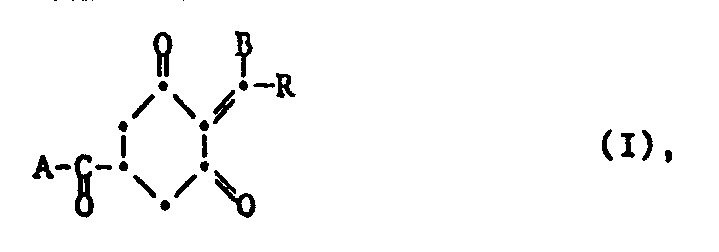
- the agent regulating plant growth according to the invention is characterized in that it is active ingredients in addition to inert ingredients a) a cyclohexanedione carboxylic acid derivative of the formula I.
- A is a residue OR2 or NR3R4, B hydroxyl, a radical -NHOR1 or a metal or ammonium salt thereof, R C1-C6 alkyl or C3-C6 cycloalkyl, unsubstituted or substituted by halogen, C1-C4 alkoxy or C1-C4 alkylthio, R1 C1-C6 alkyl, C1-C6 haloalkyl, C3-C6 alkenyl, C3-C6 haloalkenyl or C3-C6 alkynyl, R2, R3 and R4 are each independently hydrogen; C1-C6 alkyl, C1-C6 haloalkyl, C2-C10 alkoxyalkyl C2-C10 alkylthi
- the agents according to the invention have the property of inhibiting the vegetative growth of grasses, vegetation mixtures and weeds. While the total erosion of plant stands encourages the removal of the soil by wind and precipitation, the use of the agents according to the invention leads to a very strong growth reduction, which causes the formation or maintenance of a uniform, low plant cover and thus prevents soil erosion.
- This area of application includes, in particular, the reduction in the growth of grasses in the maintenance of grass plantings, such as those created as green areas, fruit tree crops, at airfields, on industrial sites or on automobile roads, railway embankments or bank embankments of water bodies. In all of these cases, periodic cutting of the lawn or grass cover is usually required. This is not only very expensive in terms of labor and machinery, but also poses considerable risks for the staff involved and road users in the transport sector.
- the agents according to the invention are particularly suitable for inhibiting the growth of grasses and weeds.
- the agents develop their effects extremely quickly even under variable environmental conditions and at the same time retain their effectiveness over a long period of time.
- the means thus prove to be superior to the individual components.
- Further advantages of the agents are the use of smaller application rates in addition to favorable effects on phytotoxicity, a better total effect and a broader spectrum of effects. The effect extends to dicotyledonous and monocotyledonous plants.
- the ratio of cyclohexanedione carboxylic acid derivative, active ingredient component of the formula I and sulfonylurea, active ingredient component of the formula II is generally 200: 1 to 1: 1, preferably 100: 1 to 10: 1.
- application rates are used which correspond to the following: 0.1 to 5 kg of active ingredient per hectare, preferably 0.1 to 2 kg, ie 100 g to 4 kg / ha of active ingredient component of the formula I and 1 to 500 g / ha of active ingredient component of the formula II.
- cyclohexanedione carboxylic acid derivatives of the formula I preference is given to those which correspond to the formula Ia wherein A and R have the meaning given under formula I, especially those in which A is the acid radical -OH or an ester radical -OR2 and R is a C3-C6-cycloalkyl radical and especially the compounds 1.1 ethyl 4- (cyclopropylcarbonyl) -cyclohexane-3,5-dione-1-carboxylate, 1.2 4- (cyclopropylcarbonyl) cyclohexane-3,5-dione-1-carboxylic acid, 1.3 4- (Cyclopropylcarbonyl) -cyclohexane-3,5-dione-1-carboxylic acid methyl ester, and 1.4 4- (Cyclobutylcarbonyl) cyclohexane-3,5-dione-1-carboxylic acid.
- phenylsulfonylureas which correspond to the formula IIa wherein EN or CH, X is methyl, methoxy or cyclopropyl, Q halogen, a radical -SO2N (CH3) 2, -CO-R1 or - (A) m R2, R1 is hydrogen, C1-C5-alkyl, C1-C5-alkoxy, C3-C5-alkenyloxy or C3-C5-alkynyloxy, A oxygen, sulfur, -SO-, -SO2- or -OSO2-, m zero or one, R2 C1-C5-alkyl, C2-C5-alkenyl, C2-C5-alkynyl, C1-C5-haloalkyl, C2-C7-alkoxyalkyl, C2-C5-haloalkenyl or C2-C5-haloalkynyl
- Particularly suitable sulfonylureas are: 2.1 N- (2- ⁇ -chloroethoxyphenylsulfonyl) -N ⁇ - (4-methoxy-6-methyl-1,3,5-triazin-2-yl) urea, 2.2 N- [2- (2-methoxyethoxy) phenylsulfonyl] -N ⁇ - (4-methoxy-6-methyl-1,3,5, -traizin-2-yl) urea, 2.3 N- (2-methoxycarbonylphenylsulfonyl) -N ⁇ - (4,6-bis-difluoromethoxypyrimidin-2-yl) urea, 2.4 N- (2- ⁇ -methoxyethoxyphenylsulfonyl) -N ⁇ - (4,6-dimethoxy-1,3,5-triazin-2-yl) urea, 2.5 N- (2-methoxycarbonylphenylsulfonyl)
- An agent having an advantageous effect and regulating plant growth according to the invention is characterized in that it is, in addition to inert ingredients, active components a) a cyclohexanedione carboxylic acid derivative of the formula Ia and b) contains a phenylsulfonylurea of the formula IIa.
- Particularly beneficial agents according to the invention contain, in addition to inert ingredients, a cyclohexanedionecarboxylic acid derivative of the formula Ia, in which A is the acid radical -OH, an ester radical -OR2 and R is a C3-C 6-cycloalkyl radical and a phenylsulfonylurea Formula IIa, in which E is nitrogen and Q has the meaning given above or a phenylsulfonylurea of formula IIb in which E and X have the meaning given above.
- active ingredient mixtures of one of the cyclohexanedione-carbone derivatives listed above and one of the phenylsulfonylureas listed individually above have shown very good activity, but especially the combination of ethyl 4- (cyclopropylcarbonyl) -cyclohexane-3,5-dione-1-carboxylate and N - (2- ⁇ -chloroethoxyphenylsulfonyl) -N ⁇ - (4-methoxy-6-methyl-1,3,5-triazin-2-yl) urea (combination of compound No. 1.1 with compound No. 2.1).
- agents which contain these active ingredients are distinguished above all by the fact that they specifically intervene in the metabolism of the plants.
- This targeted intervention in the physiological processes of plant development makes the agent according to the invention usable for various plant growth regulatory purposes, in particular for those which are related to the increase in yield in useful plants, the easier harvesting and the labor savings in measures on plant crops.
- the mode of action of plant growth regulators is that an active ingredient can have one or more different effects on plants.
- the effects of the substances essentially depend on the time of application, based on the development stage of the seed or the plant, on the amounts of active ingredient applied to the plants or their surroundings and on the type of application. In any case, growth regulators should have a positive influence on the crop plants in the desired manner.
- Plant growth regulating substances can be used, for example, to inhibit vegetative plant growth. Such inhibition of growth is economical among other things for grasses Interest, because it can reduce the frequency of grass cuts in ornamental gardens, parks and sports facilities or on the side of the road. It is also important to inhibit the growth of herbaceous and woody plants on the side of the road and in the vicinity of overhead lines or in general in areas where heavy growth is undesirable.
- growth regulators it is also important to use growth regulators to inhibit the growth in length of cereals, because shortening the stalk reduces or completely eliminates the risk of the plants twisting ("storing") before harvesting.
- growth regulators in cereals can cause stalk reinforcement, which also counteracts storage.
- An inhibition of vegetative growth allows a denser cultivation of the crop in many crop plants, so that an additional yield, based on the soil area, can be achieved.
- Another mechanism of increasing yield with growth inhibitors is based on the fact that the nutrients benefit the bloom and fruit formation to a greater extent, while vegetative growth is restricted.
- Growth regulators can often also be used to promote vegetative growth. This is of great benefit when the vegetative parts of the plant are harvested. A promotion of vegetative growth can also lead to a promotion of generative growth, so that e.g. more or bigger fruits come to training.
- increases in yield can also be achieved by intervening in plant metabolism without any changes in vegetative growth being noticeable.
- Growth regulators can also cause a change in the composition of the plants, so that a better quality of the harvested products is brought about. For example, it is possible to increase the sugar content in sugar beet, sugar cane, pineapple and citrus fruits or to increase the protein content in soy or cereals.
- the gender of the flowers can also be influenced.
- Growth regulators can also have a positive impact on the production or outflow of phytochemicals.
- One example is the stimulation of latex flow in rubber trees.
- growth regulators can also be used to increase the lateral branching by chemically breaking the apical dominance. This is e.g. Interest in plant propagation. However, it is also possible to inhibit the growth of the side shoots, e.g. to prevent the formation of side shoots in tobacco plants after decapitation and thus to promote leaf growth.
- the number of leaves on plants can be controlled in such a way that defoliation of the plants is achieved at a desired point in time.
- Such defoliation is of interest in order to facilitate mechanical harvesting, for example in the case of wine or cotton, or to reduce perspiration at a point in time at which the plant is to be transplanted.
- the use of growth regulators can prevent premature fruiting.
- Growth regulators can also be used to reduce the force required to detach the fruit from crops at the time of harvesting, so that mechanical harvesting of the plants is made possible or manual harvesting is facilitated.
- growth regulators it is also possible to accelerate or delay the ripening of the crop before or after the harvest. This is particularly advantageous because it can be optimally adapted to the needs of the market. Furthermore, growth regulators can in some cases improve the color of the fear. In addition, growth regulators can also be used to concentrate the maturity over time. This creates the conditions for e.g. Tobacco, tomato or coffee, a full mechanical or manual harvest can be done in just one operation.
- growth regulators can also influence the seed or bud bud of the plants, i.e. the endogenous annual rhythm, so that the plants, e.g. Pineapples or ornamental plants in nurseries, germinate, sprout or bloom at a time when they are usually not ready to do so.
- Growth regulators can also be used to delay bud budding or seed germination, e.g. to avoid damage from late frosts in areas at risk of frost. On the other hand, it is possible to stimulate root growth and / or the formation of shoots, so that the growth can be restricted to a shorter period of time.
- Growth regulators can also produce halophilia in crops. This creates the conditions for cultivating plants on saline soils.
- cover crops are used to inhibit excessive growth in tropical soil cover plants, the so-called cover crops.
- cover crops In tropical and subtropical monocultures, e.g. In palm plantations, cotton, maize fields, etc., in addition to the actual crop plants, ground cover plants, in particular legume species, are often planted, which serve to maintain or increase the soil quality (prevention of drying out, supply of nitrogen) and to prevent erosion (erosion by wind and water) .
- the active compounds according to the invention the growth of these cover crops can now be controlled and the growth height of these ground covering plants can thus be kept at a low level, so that healthy growth of the crop plants and the maintenance of a favorable soil quality is ensured.
- crop plants are all plants which produce crops in some form, such as seeds, roots, stems, tubers, leaves, flowers, and furthermore ingredients, such as oil, sugar, starch, protein, etc., and are grown for this purpose .
- These plants include, for example, all types of grain, such as wheat, rye, barley and oats, as well as rice, millet, maize, cotton, sugar beet, sugar cane, soybeans, beans and peas.
- the mixtures of the active ingredient components according to the invention are used in unchanged form or, preferably, together with the auxiliaries customary in formulation technology and are therefore used, for example, to emulsion concentrates, directly sprayable or dilutable solutions, diluted emulsions, wettable powders, soluble powders, dusts, granules, also encapsulations in e.g. polymeric materials processed in a known manner.
- the methods of application such as promising, atomizing, dusting, scattering or pouring are chosen in the same way as the type of agent, in accordance with the intended goals and the given circumstances.
- the formulations i.e.
- extenders e.g. with solvents, solid carriers, and optionally surface-active compounds (surfactants).
- Aromatic hydrocarbons preferably fractions C8 to C12, such as Xylene mixtures or substituted naphthalenes, phthalic acid esters such as dibutyl or di-octyl phthalate, aliphatic hydrocarbons such as cyclohexane or paraffins, alcohols and glycols and their ethers and esters such as ethanol, ethylene glycol, ethylene glycol monomethyl or ethyl ether, ketones such as cyclohexanone, strong -Methyl-2-pyrrolidone, dimethyl sulfoxide or dimethylformamide, and optionally epoxidized coconut oil or soybean oil; or water.
- Aromatic hydrocarbons preferably fractions C8 to C12, such as Xylene mixtures or substituted naphthalenes, phthalic acid esters such as dibutyl or di-octyl phthalate, aliphatic hydrocarbons such as cyclohexane or paraffin
- Natural rock flours such as calcite, talc, kaolin, montmorillonite or attapulgite, are generally used as solid carriers, for example for dusts and dispersible powders.
- highly disperse silica or highly disperse absorbent polymers can also be added.
- Porous types such as pumice, broken brick, sepiolite or bentonite come as granular, adsorptive granulate carriers as not sorptive carrier materials such as calcite or sand in question.
- a large number of pregranulated materials of inorganic or organic nature such as in particular dolomite or comminuted plant residues, can be used.
- suitable surface-active compounds are nonionic, cationic and / or anionic surfactants with good emulsifying, dispersing and wetting properties.
- surfactants are also to be understood as mixtures of surfactants.
- Suitable anionic surfactants can be both so-called water-soluble soaps and water-soluble synthetic surface-active compounds.
- the soaps are e.g. the alkali, alkaline earth or optionally substituted ammonium salts of higher fatty acids (C10-C22), e.g. the Na or K salts of oleic or stearic acid, or of natural fatty acid mixtures, e.g. can be obtained from coconut or tallow oil.
- the fatty acid methyl taurine salts should also be mentioned.
- the fatty sulfonates or sulfates are generally present as alkali, alkaline earth or optionally substituted ammonium salts and have an alkyl radical with 8 to 22 carbon atoms, alkyl also including the alkyl part of acyl radicals, for example the Na or Ca salt Lignin sulfonic acid, the dodecylsulfuric acid ester or a fatty alcohol sulfate mixture made from natural fatty acids.
- This subheading also includes the salts of sulfuric acid esters and sulfonic acids from fatty alcohol-ethylene oxide adducts.
- the sulfonated benzimidazole derivatives preferably contain 2 sulfonic acid groups and a fatty acid residue with 8-22 carbon atoms.
- Alkylarylsulfonates are, for example the sodium, calcium or triethanolamine salts of dodecylbenzenesulfonic acid, dibutylnapthalenesulfonic acid, or a naphthalenesulfonic acid-formaldehyde condensation product.
- Corresponding phosphates such as e.g. Salts of the phosphoric acid ester of a p-nonylphenol- (4-14) -ethylene oxide adduct or phospholipids in question.
- Suitable nonionic surfactants are primarily polyglycol ether derivatives of aliphatic or cycloaliphatic alcohols, saturated or unsaturated fatty acids and alkylphenols, which can contain 3 to 30 glycol ether groups and 8 to 20 carbon atoms in the (aliphatic) hydrocarbon radical and 6 to 18 carbon atoms in the alkyl radical of the alkylphenols.
- nonionic surfactants are the water-soluble polyethylene oxide adducts containing 20 to 250 ethylene glycol ether groups and 10 to 1000 propylene glycol ether groups with polypropylene glycol, ethylene diaminopolypropylene glycol and alkyl polypropylene glycol with 1 to 10 carbon atoms in the alkyl chain.
- the compounds mentioned usually contain 1 to 5 ethylene glycol units per propylene glycol unit.
- nonionic surfactants are nonylphenol polyethoxyethanols, castor oil polyglycol ethers, polypropylene-polyethylenoxyadducts, tributylphenoxypolyethoxyethanol, polyethylene glycol and octylphenoxypolyethoxyethanol.
- Fatty acid esters of polyoxyethylene sorbitan such as polyoxyethylene sorbitan trioleate, are also suitable.
- the cationic surfactants are primarily quaternary ammonium salts which contain at least one alkyl radical having 8 to 22 carbon atoms as N substituents and, as further substituents, have low, optionally halogenated alkyl, benzyl or low hydroxyalkyl radicals.
- the salts are preferably as Halides, methyl sulfates or ethyl sulfates, for example the stearyl trimethyl ammonium chloride or the benzyl di (2-chloroethyl) ethyl ammonium bromide.
- the preparations according to the invention generally contain 0.1 to 95%, in particular 0.1 to 80% of the active compound combination according to the invention in addition to 1 to 99.9% of a solid or liquid additive and / or 0 to 25%, in particular 0.1 to 25 % of a surfactant.
- Active ingredient mixture 1 to 20%, preferably 5 to 10% surfactant: 5 to 30%, preferably 10 to 20% liquid carrier: 50 to 94% preferably 70 to 85%
- Active ingredient mixture 0.1 to 10%, preferably 0.1 to 1% solid carrier: 99.9 to 90%, preferably 99.9 to 90%.
- Active ingredient mixture 5 to 75%, preferably 10 to 50% Water: 94 to 25%, preferably 90 to 30% surfactant: 1 to 40%, preferably 2 to 30%.
- Active ingredient mixture 0.5 to 90%, preferably 1 to 80% surfactant: 0.5 to 20%, preferably 10 to 20% liquid carrier: 5 to 95%, preferably 15 to 90%
- Active ingredient mixture 0.5 to 30%, preferably 3 to 15% solid carrier: 99.5 to 70%, preferably 99 to 85%.
- the use forms can be diluted down to 0.001% of active ingredient.
- the application rates are generally 0.01 to 10 kg / ha, preferably 0.025 to 5 kg AS / ha.
- the agents can also contain other additives such as stabilizers, defoamers, viscosity regulators, binders, adhesives and fertilizers or other active ingredients to achieve special effects.
- the active ingredient is mixed well with the additives and ground well in a suitable mill.
- Spray powder is obtained which can be diluted with water to form suspensions of any desired concentration.
- Emulsions of any desired concentration can be prepared from this concentrate by dilution with water.
- Ready-to-use dusts are obtained by mixing the active ingredient with the carrier and grinding it in a suitable mill.
- the active ingredient is mixed with the additives, ground and moistened with water. This mixture is extruded and then dried in an air stream.
- the finely ground active ingredient is applied evenly in a mixer to the kaolin moistened with polyethylene glycol. In this way, dust-free coating granules are obtained.
- the finely ground active ingredient is intimately mixed with the additives. This gives a suspension concentrate from which suspensions of any desired concentration can be prepared by dilution with water.
- Example 1 Growth inhibition test in a greenhouse
- the plants Avena sative, Lolium perenne, Solanum lycopersicum, Sinapis alba, Stellaria media and Phaseolus vulgaris are sown in plastic pots with a diameter of 12 cm, which are filled with sieved, sterilized land.
- the plants are kept under the conditions of exposure, temperature, moisture and watering necessary for good growth.
- 11-14 days after sowing, the young plants are then sprayed with the substance to be tested.
- the application is carried out in a dosage of the equivalent of 4 kg of active ingredient mixture and 500 l of water per hectare.
- the plants are kept in the greenhouse and observed.
- the tested mixtures showed clear inhibitory effects.
- the cereals Hordeum vulgare (summer barley) and Triticum (summer wheat) were sown in plastic pots with sterilized soil and irrigated as needed.
- the sprouts were sprayed about 21 days after sowing with the aqueous spray mixture of the active compound mixture according to the invention.
- the amount of active ingredient was the equivalent of up to 3 kg of active ingredient per hectare.
- the growth of the grain was assessed 28 days after application. It was found that cereal plants which had been treated with the active compound mixture according to the invention show a strong reduction in growth compared to untreated control plants. Growth rates of less than 10% were found.
- the grasses Lolium perenne, Poa pratensis, Festuca ovina, Dactylis glomerata, Festuca rubra, Agropyron repens, Bromus inermis, Cynosurus cristatus, and two types of clover were sown in the greenhouse in plastic trays with a mixture of earth and peat and sand (6: 3: 1) and watered as needed.
- the accumulated grasses were cut back weekly to a height of 4 cm and sprayed with the aqueous spray mixture of the active ingredient of the formula I, the active ingredient of the formula II and a mixture of both components about 40 days after sowing and one day after the last cut.
- the amount of active ingredient was the equivalent of 1000 g of active ingredient of the formula I, 10 g or 50 g of the formula II and 1000 + 10 g or 1000 + 50 g of mixture per hectare.
- the growth of the grasses was assessed 14-49 days after application, and it was found that the active compounds and combinations according to the invention brought about a noticeable growth inhibition. Particularly significant growth inhibition was achieved with the mixtures.
- the inhibitory effect of compounds 1.1 and 2.1 alone and in a mixture is compared below.
- the expected plant growth E for a given combination of two herbicides (cf. COLBY, SR, "Calculating synergistic and antagonistic response of herbicide combinations", Weeds 15, pages 20-22, 1967) can be calculated as follows:
- X percent growth inhibition (compared to untreated plants) when treated with a product I with p kg application rate per hectare
- Y percent growth inhibition when treated with a product II with q kg application rate per hectare
- E Expected growth inhibition as a percentage of the control plants after treatment with the mixture I + II at an application rate of p + q kg of active ingredient per hectare.
- the inhibitory effect compared to untreated plants (0%) is as follows.
- Example 4 Inhibition of growth in tropical ground covering plants (cover crops)
- Test plants of the cultivars Psophocarpus palustris, Centrosema plumieri and Centrosema pubescens are grown from cuttings in plastic trays with a soil / peat mixture (1: 3) and watered as required. After rooting, the plantlets are repotted in 11 cm pots. The plants are further grown in the greenhouse at a day temperature of 27 ° C. and a night temperature of 21 ° C., with an average light duration of 14 h (6000 lux) and a humidity of 70%. The test plants are cut back to a height of about 15 cm and sprayed 7 days after cutting back with a spray mixture of the active compound mixture according to the invention (equivalent to 0.3 or 3 kg of active substance per hectare). 4 weeks after application, the growth of the treated plants is compared to trimmed but untreated control plants. It can be determined here that mixtures of the compounds 1.1 to 1.4 and 2.1 to 2.12 trigger a significant inhibition of the growth of the soil covering plants.
Landscapes
- Life Sciences & Earth Sciences (AREA)
- Agronomy & Crop Science (AREA)
- Pest Control & Pesticides (AREA)
- Plant Pathology (AREA)
- Health & Medical Sciences (AREA)
- Engineering & Computer Science (AREA)
- Dentistry (AREA)
- General Health & Medical Sciences (AREA)
- Wood Science & Technology (AREA)
- Zoology (AREA)
- Environmental Sciences (AREA)
- Agricultural Chemicals And Associated Chemicals (AREA)
Abstract
A die Hydroxylgruppe einen Ester ode Amidrest,
B die Hydroxylgruppe einen Rest -NHOR₁ oder ein Metall- oder Ammoniumsalz davon,
R C₁-C₆-Alkyl, C₃-C₆-Cycloalkyl und
R₁ C₁-C₆-Alkyl, C₁-C₆-Halogenalkyl, C₃-C₆-Alkenyl, C₃-C₆-Halogenalkenyl oder C₃-C₆-Alkinyl
bedeuten und b) einen Sulfonylharnstoff der Formel II besteht

E N oder CH,
Z einen gegebenenfalls substituierten Phenyl-, Pyridyl-, Thienyl- oder 3,3-Dioxobenz-thioxinrest,
X Methyl, Difluormethoxy, Aethoxy, Methoxy oder Cyclopropyl und
Y Chlor, Methyl, Methoxy, Difluormethoxy, Methylamino, Dimethylamino oder Aethoxy bedeuten. Die Mischung eignet sich vor allem zur Hemmung des Wachstums von Gräsern und Unkräutern.
Description
- Die vorliegende Erfindung betrifft ein synergistisch wirkendes Gemisch, welches den Pflanzenwuchs reguliert und aus zwei Wirkstoffkomponenten besteht, ein Mittel welches dieses Gemisch enthält sowie die Verwendung dieses Mittels zu Regulierung, vor allem Hemmung des Pflanzenwuchses.
- Das erfindungsgemässe Mittel besteht aus einem Gemisch von zwei an sich bekannten Wirkstoffkomponenten. Beim ersten Wirkstoff handelt es sich um Cyclohexandioncarbonsäurederivate, welche mit herbizider und den Pflanzenwuchs regulierender Wirkung in der offengelegten Europäischen Patentanmeldung EP-A-126 713 beschrieben sind. Der zweite Wirkstoff ist ein Sulfonylharnstoff welchem bisher eher stark herbizide Eigenschaften zugeschrieben worden sind.
- Solche Sulfonylharnstoffe sind in der Literatur in grosser Zahl beschrieben und zum Teil auch schon im Handel erhältlich. Wirkstoffe, die erfindungsgemäss verwendet werden, sind beispielsweise in folgenden Literaturstellen bechrieben: DE-A 2 715 786, EP-A 4 163, EP-A 7 687, EP-A 13 480, EP-A 23 141, EP-A 23 422, EP-A 30 139, EP-A 30 142, EP-A 35 893, EP 44 209 EP-A 44 211, EP-A 44 212, EP-A 44 213, EP-A 44 807, EP-A 44 808, EP-A 44 809, EP-A 48 143, EP-A 51 466, EP-A 57 546, EP-A 70 802, EP-A 72 347, EP-A 73 562, EP-A 79 683, EP-A 82 108 EP-A 83 975, EP-A 84 020, EP-A 84 224, EP-A 85 028, EP-A 85 476, EP-A 87 780, EP-A 95 925, EP-A 96 002, EP-A 96 593, EP-A 99 339, EP-A 102 925, EP-A 107 979, EP-A 117 014 EP-A 108 708 und EP-A 120 814.
- Ueberraschenderweise vermag der Zusatz des Sulfonylharnstoffes die Pflanzenwuchs-regulierende respektive hemmende Wirkung der Cyclohexandion-carbonsäurederivate zu verändern und zu verbessern.
- Das erfindungsgemäss den Pflanzenwuchs regulierendes Mittel ist dadurch gekennzeichnet, dass es neben inerten Zutaten als Wirkstoffe
a) ein Cyclohexandioncarbonsäurederivat der Formel I
A einen Rest OR₂ oder NR₃R₄,
B Hydroxyl, einen Rest -NHOR₁ oder ein Metall- oder Ammoniumsalz davon,
R C₁-C₆ Alkyl oder C₃-C₆ Cycloalkyl, unsubstituiert oder substituiert durch Halogen, C₁-C₄ Alkoxy oder C₁-C₄ Alkylthio,
R₁ C₁-C₆ Alkyl, C₁-C₆ Halogenalkyl, C₃-C₆ Alkenyl, C₃-C₆ Halogenalkenyl oder C₃-C₆ Alkinyl,
R₂, R₃ und R₄ unabhängig voneinander je Wasserstoff; C₁-C₆ Alkyl, C₁-C₆ Halogenalkyl, C₂-C₁₀ Alkoxyalkyl C₂-C₁₀ Alkylthioalkyl; C₃-C₆ Alkenyl, unsubstituiert oder substituiert durch Halogen, C₁-C₄ Alkoxy oder C₁-C₄ Alkylthio; C₃-C₆ Alkinyl; Phenyl oder Aryl-(C₁-C₆)-alkyl, wobei der Phenylkern unsubstituiert oder durch Halogen, C₁-C₄ Alkyl, C₁-C₄ Alkoxy, C₁-C₄ Halogenalkyl, Nitro oder Cyan substituiert ist, eines von R₃ und R₄ auch Methoxy oder
R₃ und R₄ zusammen mit dem Stickstoffatom, an das sie gebunden sind, auch einen 5-6 gliedrigen, gesättigten Heterocyclus bilden, der im Ring ein Sauerstoff- oder ein weiteres Stickstoffatom enthalten kann,
und
b) einen Sulfonylharnstoff der Formel II

Q Halogen, Nitro, -SO₂N(CH₃)₂, -CO-R¹, -(A)m-R², Phenyl, Phenoxy, C₁-C₅-Alkyl, Halogenphenyl, Halogenphenoxy, C₁-C₅-Halogenalkoxy, C₁-C₅-Halogenalkylthio oder C₁-C₅-Halogenalkyl,
n die Zahl null oder eins,
E N oder CH,
X Methyl, Methoxy, Aethoxy, Difluormethoxy oder Cyclopropyl und
Y Chlor, Methyl, Methoxy, Difluormethoxy, Methylamino, Dimethylamino oder Aethoxy stehen, wobei
R¹ Wasserstoff, C₁-C₅-Alkyl, C₁-C₅-Alkoxy, C₃-C₅-Alkenyloxy oder C₃-C₅-Alkinyloxy,
A Sauerstoff, Schwefel, -SO-, SO₂- oder -O-SO₂-,
m die Zahl null oder eins und
R² C₁-C₅-Alkyl, C₂-C₅-Alkenyl, C₂-C₅-Alkinyl, C₁-C₅-Halogenalkyl, C₂-C₇-Alkoxyalkyl, C₂-C₅-Halogenalkenyl oder C₂-C₅-Halogenalkinyl bedeuten. - Die erfindungsgemässen Mittel besitzen die Eigenschaft, das vegetative Wachstum von Gräsern, Vegetationsmischungen und Unkräutern zu hemmen. Während bei einer totalen Vernichtung von Pflanzenbeständen die Abtragung des Bodens durch Wind und Niederschläge gefördert wird, führt der Einsatz der erfindungsgemässen Mittel zu einer sehr starken Wuchsreduktion, welche die Entstehung oder Erhaltung einer gleichmässigen, niedrigen Pflanzendecke bewirkt und so die Bodenerosion verhindert. In dieses Einsatzgebiet fällt insbesondere die Wachstumsreduktion bei Gräsern bei der Instandhaltung von Grasanpflanzungen, wie sie als Grünanlagen, Obstbaumkulturen, auf Flugplätzen, auf Industriegelände oder an Autostrassen, Eisenbahndämmen oder Uferböschungen von Gewässern angelegt werden. In all diesen Fällen ist normalerweise ein periodisches Schneiden des Rasens bzw. des Grasbewuchses erforderlich. Dies ist nicht nur im Hinblick auf Arbeitskräfte und Maschinen sehr aufwendig, sondern birgt im Verkehrsbereich erhebliche Gefahren für das betroffene Personal und die Verkehrsteilnehmer.
- Es besteht daher besonders in den vorgenannten Bereichen ein ausgeprägtes Erfordernis, die zur Erhaltung und Verfestigung des Bodens notwendige Grasnarbe einerseits zu erhalten und zu pflegen, andererseits aber mit einfachen Massnahmen die Pflanzen während der gesamten Vegetationsperiode auf einer mittleren Wuchshöche zu erhalten.
- Ueberraschendweise hat sich nun gezeigt, dass die erfindungsgemässen Mittel zur Hemmung des Wachstums von Gräsern wie auch von Unkräutern besonders gut geeignet sind. Die Mittel entfalten auch bei variablen Umweltbedingungen ihre Wirkung ausserordentlich rasch und behalten zugleich ihre Wirksamkeit über eine lange Zeitspanne. Die Mittel erweisen sich damit als überlegen gegenüber den Einzelkomponenten. Weitere Vorteile der Mittel sind der Einsatz kleinerer Aufwandmengen nebst günstiger Beeinflussung der Phytotoxizität, eine bessere Totalwirkung und ein breiteres Wirkungsspektrum. Die Wirkung erstreckt sich auf dicotyle wie monocotyle Pflanzen.
- In den erfindungsgemässen Mitteln beträgt das Verhältnis von Cyclohexandioncarbonsäurederivat, Wirkstoffkomponente der Formel I und Sulfonylharnstoff, Wirkstoffkomponente der Formel II im allgemeinen 200:1 bis 1:1 bevorzugt 100:1 bis 10:1.
- In der Regel werden Aufwandmengen verwendet, die den nachfolgend angegebenen entsprechen:
0,1 bis 5 kg Aktivsubstanz pro Hektar bevorzugt 0,1 bis 2 kg d.h. 100 g bis 4 kg/ha Wirkstoffkomponente der Formel I und 1 bis 500 g/ha Wirkstoffkomponente der Formel II. - Von den Cyclohexandion-carbonsäurederivaten der Formel I sind diejenigen bevorzugt, welche der Formel Ia entsprechen

1.1 4-(Cyclopropylcarbonyl)-cyclohexan-3,5-dion-1-carbonsäure-äthylester,
1.2 4-(Cyclopropylcarbonyl)-cyclohexan-3,5-dion-1-carbonsäure,
1.3 4-(Cyclopropylcarbonyl)-cyclohexan-3,5-dion-1-carbonsäuremethylester, und
1.4 4-(Cyclobutylcarbonyl)-cyclohexan-3,5-dion-1-carbonsäure. - Die Herstellung dieser Cyclohexandion-Carbonsäurederivate ist nicht Bestandteil dieser Erfindung, ihre Herstellung und Verwendung als Herbizide und zur Regulierung des Pflanzenwachstums ist in der offengelegten Europäischen Patentanmeldung 126 713 beschrieben.
- Von den Sulfonylharnstoffen der Formel II sind Phenylsulfonylharnstoffe bevorzugt, welche der Formel IIa entsprechen

E N oder CH,
X Methyl, Methoxy oder Cyclopropyl,
Q Halogen, einen Rest -SO₂N(CH₃)₂, -CO-R₁ oder -(A)mR₂,
R₁ Wasserstoff, C₁-C₅-Alkyl, C₁-C₅-Alkoxy, C₃-C₅-Alkenyloxy oder C₃-C₅-Alkinyloxy,
A Sauerstoff, Schwefel, -SO-, -SO₂- oder -OSO₂-,
m Null oder eins,
R₂ C₁-C₅-Alkyl, C₂-C₅-Alkenyl, C₂-C₅-Alkinyl, C₁-C₅-Halogenalkyl, C₂-C₇-Alkoxyalkyl, C₂-C₅-Halogenalkenyl oder C₂-C₅-Halogenalkinyl,
bedeuten, besonders diejenigen in denen E für N steht und Q die oben gegebene Bedeutung hat oder die Verbindungen der Formel IIb
- Besonders geeignete Sulfonylharnstoffe sind:
2.1 N-(2-β-Chloräthoxyphenylsulfonyl)-Nʹ-(4-methoxy-6-methyl-1,3,5-triazin-2-yl)harnstoff,
2.2 N-[2-(2-Methoxyäthoxy)phenylsulfonyl]-Nʹ-(4-methoxy-6-methyl-1,3,5,-traizin-2-yl)harnstoff,
2.3 N-(2-Methoxycarbonylphenylsulfonyl)-Nʹ-(4,6-bis-difluormethoxypyrimidin-2-yl)harnstoff,
2.4 N-(2-β-Methoxyäthoxyphenylsulfonyl)-Nʹ-(4,6-dimethoxy-1,3,5-triazin-2-yl)harnstoff,
2.5 N-(2-Methoxycarbonylphenylsulfonyl)-Nʹ-(4-cyclopropyl-6-methylpyrimidin-2-yl)harnstoff,
2.6 N-(2,2-Dioxo-3-methyl-1,2-benzthioxin-8-yl-sulfonyl)-Nʹ-(4-methoxy-6-methyl-pryrimidin-2-yl)harnstoff,
2.7 N-(2-Chlorophenylsulfonyl)-Nʹ-(4-methoxy-6-methyl-1,3,5-triazin-2-yl)harnstoff,
2.8 N-(2-Methoxycarbonylphenylsulfonyl)-Nʹ-(4-methoxy-6-methyl-1,3,5-triazin-2-yl)harnstoff,
2.9 N-(2-Methoxycarbonylphenylsulfonyl)-Nʹ-(4,6-dimethyl-pyrimidin-2-yl)harnstoff,
2.10 N-(2-Methoxycarbonyl-thien-3-ylsulfonyl)-Nʹ-(4-methoxy-6-methyl-1,3,5-triazin-2-yl)harnstoff,
2.11 N-(2-Aethoxycarbonylphenylsulfonyl)-Nʹ-(4-chlor-6-methoxy-pyrimidin-2-yl)harnstoff, und
2.12 N-(2-Methoxycarbonylphenylsulfonyl)-Nʹ-(4,6-diemethoxy-pyrimidin-2-yl)harnstoff. - Ein vorteilhaft wirkendes, erfindungsgemäss den Pflanzenwuchs regulierendes Mittel ist dadurch gekennzeichnet, dass es neben inerten Zutaten als wirksame Komponenten
a) ein Cyclohexandioncarbonsäurederivat der oben beschriebenen Formel Ia und
b) einen Phenylsulfonylharnstoff der Formel IIa enthält. - Besonders günstig wirkende erfindungsgemässe Mittel enthalten neben inerten Zutaten ein Cyclohexandioncarbonsäurederivat der Formel Ia, worin A den Säurerest -OH, einen Esterrest -OR₂ und R einen C₃-C ₆-Cycloalkylrest bedeuten und einen Phenylsulfonylharnstoff der Formel IIa, worin E Stickstoff bedeutet und Q die oben gegebene Bedeutung hat oder einen Phenylsulfonylharnstoff der Formel IIb worin E und X die oben gegebene Bedeutung haben.
- In der Praxis haben Wirkstoffgemische eines der oben einzeln aufgeführten Cyclohexandion-carbonderivate und eines der oben einzeln aufgeführten Phenylsulfonylharnstoffe sehr gute Wirkung gezeigt, besonders aber die Kombination 4-(Cyclopropylcarbonyl)-cyclohexan-3,5-dion-1-carbonsäure-äthylester und N-(2-β-chloräthoxyphenylsulfonyl)-Nʹ-(4-methoxy-6-methyl-1,3,5-triazin-2-yl)-harnstoff (Kombination von Verbindung No. 1.1 mit Verbindung No. 2.1).
- Es wurde nun überraschend gefunden, dass Mittel, welche diese Wirkstoffe enthalten, sich vor allem dadurch auszeichnen, dass sie gezielt in den Metabolismus der Pflanzen eingreifen. Dieser gezielte Eingriff in die physiologischen Vorgänge der Pflanzenentwicklung macht das erfindungsgemässe Mittel für verschiedene pflanzenwachstumregulatorische Zwecke verwendbar, insbesondere für solche, die mit der Ertragssteigerung bei Nutzpflanzen, der Ernteerleichterung und der Arbeitseinsparung bei Massnahmen an Pflanzenkulturen im Zusammenhang stehen.
- Für die Wirkungsweise von Pflanzenwachstumsregulatoren gilt nach der bisherigen Erfahrung, dass ein Wirkstoff eine oder auch mehrere verschiedenartige Wirkungen auf Pflanzen ausüben kann. Die Wirkungen der Stoffe hängen im wesentlichen ab von dem Zeitpunkt der Anwendung, bezogen auf das Entwicklungsstadium des Samens oder der Pflanze sowie von den auf die Pflanzen oder ihre Umgebung ausgebrachten Wirkstoffmengen und von der Art der Applikation. In jedem Fall sollen Wachstumsregulatoren die Kulturpflanzen in gewünschter Weise positiv beeinflussen.
- Pflanzenwuchsregulierende Stoffe können zum Beispiel zur Hemmung des vegetativen Pflanzenwachstums eingesetzt werden. Eine derartige Wuchshemmung ist unter anderem bei Gräsern von wirtschaftlichem Interesse, denn dadurch kann z.B. die Häufigkeit der Grasschnitte in Ziergärten, Park- und Sportanlagen oder an Strassenrändern reduziert werden. Von Bedeutung ist auch die Hemmung des Wuchses von krautigen und holzigen Pflanzen an Strassenrändern und in der Nähe von Ueberlandleitungen oder ganz allgemein in Bereichen, in denen ein starker Bewuchs unerwünscht ist.
- Wichtig ist auch die Anwendung von Wachstumsregulatoren zur Hemmung des Längenwachstums bei Getreide, denn durch eine Halmverkürzung wird die Gefahr des Umknickens ("Lagerns") der Pflanzen vor der Ernte verringert oder vollkommen beseitigt. Ausserdem können Wachstumsregulatoren bei Getreide eine Halmverstärkung hervorrufen, die ebenfalls dem Lagern entgegenwirkt.
- Eine Hemmung des vegetativen Wachstums erlaubt bei vielen Kulturpflanzen eine dichtere Anpflanzung der Kultur, so dass ein Mehrertrag, bezogen auf die Bodenfläche, erzielt werden kann.
- Ein weiterer Mechanismus der Ertragssteigerung mit Wachstumshemmern beruht darauf, dass die Nährstoffe in stärkerem Masse der Blüten- und Fruchtbildung zugute kommen, während das vegetative Wachstum eingeschränkt wird.
- Mit Wachstumsregulatoren lässt sich häufig auch eine Förderung des vegetativen Wachstums erzielen. Dies ist von grossem Nutzen, wenn die vegetativen Pflanzenteile geerntet werden. Eine Förderung des vegetativen Wachstums kann aber auch gleichzeitig zu einer Förderung des generativen Wachstums führen, so dass z.B. mehr oder grössere Früchte zur Ausbildung kommen.
- Ertragssteigerungen können in manchen Fällen auch durch einen Eingriff in den pflanzlichen Stoffwechsel erreicht werden, ohne dass sich Aenderungen des vegetativen Wachstums bemerkbar machen. Wachstumsregulatoren können ferner eine Veränderung der Zusammensetzung der Pflanzen bewirken, so dass eine bessere Qualität der Ernteprodukte herbeigeführt wird. So ist es beispielsweise möglich, den Gehalt an Zucker in Zuckerrüben , Zuckerrohr, Ananas sowie Zitrusfrüchten zu erhöhen oder Proteingehalt in Soja oder Getreide zu steigern.
- Unter dem Einfluss von Wachstumsregulatoren kann er zur Ausbildung parthenokarper Früchte kommen. Ferner kann das Geschlecht der Blüten beeinflusst werden.
- Mit Wachstumsregulatoren lässt sich auch die Produktion oder der Abfluss von sekundären Pflanzenstoffen positiv beeinflussen. Als Beispiel sei die Stimulierung des Latexflusses bei Gummibäumen genannt.
- Während des Wachstums der Pflanze kann durch Einsatz von Wachstumsregulatoren auch die seitliche Verzweigung durch eine chemische Brechung der Apikaldominanz vermehrt werden. Daran besteht z.B. Interesse bei der Stecklingsvermehrung von Pflanzen. Es ist jedoch auch möglich, das Wachstum der Seitentriebe zu hemmen, z.B. um bei Tabakpflanzen nach der Dekapitierung die Ausbildung von Seitentrieben zu verhindern und damit das Blattwachstum zu fördern.
- Unter dem Einfluss von Wachstumsregulatoren kann der Blattbestand von Pflanzen so gesteuert werden, dass ein Entblättern der Pflanzen zu einem gewünschten Zeitpunkt erreicht wird. Eine derartige Entlaubung ist von Interesse, um eine mechanische Beerntung z.B. bei Wein oder Baumwolle, zu erleichtern oder um die Transpiration zu einem Zeitpunkt herabzusetzen, an dem die Pflanze verpflanzt werden soll. Durch Einsatz von Wachstumsregulatoren lässt sich der vorzeitige Fruchtfall verhindern. Es ist jedoch auch möglich, den Fruchtfall, - zum Beispiel bei Obst -, im Sinne einer chemischen Ausdünnung bis zu einem bestimmten Ausmass zu fördern. Wachstumsregulatoren können auch dazu dienen, um bei Kulturpflanzen zum Zeitpunkt der Ernte die zum Ablösen der Früchte erforderliche Kraft zu vermindern, so dass eine mechanische Beerntung der Pflanzen ermöglicht, beziehungsweise eine manuelle Beerntung erleichtert wird.
- Mit Wachstumsregulatoren lässt sich ferner eine Beschleunigung oder auch eine Verzögerung der Reife des Erntegutes vor oder nach der Ernte erreichen. Dieses ist von besonderem Vorteil, weil sich dadurch eine optimale Anpassung an die Bedürfnisse des Marktes herbeiführen lässt. Weiterhin können Wachstumsregulatoren in manchen Fällen die Furchtausfärbung verbessern. Darüberhinaus kann mit Hilfe von Wachstumsregulatoren auch eine zeitliche Konzentrierung der Reife erzielt werden. Damit werden Voraussetzungen dafür geschaffen, dass z.B. Tabak, Tomaten oder Kaffee, eine vollständige mechanische oder manuelle Beerntung in nur einem Arbeitsgang vorgenommen werden kann.
- Durch die Anwendung von Wachstumsregulatoren kann auch die Samen- oder Knospenruhr der Pflanzen, also die endogene Jahresrhythmik, beeinflusst werden, so dass die Pflanzen, wie z.B. Ananas oder Zierpflanzen in Gärtnereien, zu einem Zeitpunkt keimen, austreiben oder blühen, an dem sie normalerweise hierzu keine Bereitschaft zeigen.
- Mit Wachstumsregulatoren kann auch erreicht werden, dass der Austrieb von Knospen oder die Keimung von Samen verzögert wird, z.B. um in frostgefährdeten Gebieten eine Schädigung durch Spätfröste zu vermeiden. Andererseits gelingt es, das Wurzelwachstum und/oder die Ausbildung von Sprösslingen zu stimulieren, so dass das Wachstum auf eine kürzere Zeitdauer beschränkt werden kann.
- Wachstumsregulatoren können auch eine Halophilie bei den Kulturpflanzen erzeugen. Damit werden die Voraussetzungen dafür geschaffen, dass eine Kultivierung von Pflanzen auf salzhaltigen Böden durchgeführt werden kann.
- Mit Wachstumsregulatoren kann auch eine Frost- und Trockenresistenz bei Pflanzen induziert werden.
- Unter dem Einfluss von Wachstumsregulatoren kann das Altern (die Seneszenz) von Pflanzen oder Pflanzenteilen gehemmt respektive verzögert werden. Eine solche Wirkung kann von hohem wirtschaftlichem Interesse sein, dadurch, dass bei behandelten Pflanzenteilen oder ganzen Pflanzen wie Obst, Beeren, Gemüse, Salat oder Zierpflanzen deren Lagerfähigkeit nach der Ernte verbessert oder verlängert werden kann. Ebenso kann durch Behandlung von Kulturpflanzen über eine Verlängerung der Phase photosynthetischer Aktivität eine beachtliche Ertragssteigerung erzielt werden.
- Ein weiteres wichtiges Anwendungsgebiet für Wuchshemmer ist deren Einsatz zur Hemmung eines übermässigen Wachstums bei tropischen Bodenbedeckungspflanzen, den sogenannten Cover crops. In tropischen und subtropischen Monokulturen, wie z.B. in Palmplantagen, Baumwoll-, Maisfeldern usw. werden neben den eigentlichen Kulturpflanzen oftmals Bodenbedeckungspflanzen, insbesondere Leguminosenarten angepflanzt, die zur Erhaltung oder Steigerung der Bodenqualität (Verhinderung der Austrocknung, Versorgung mit Stickstoff) und zur Verhinderung von Erosion (Abtragung durch Wind und Wasser) dienen. Durch Applikation der erfindungsgemässen Wirkstoffe kann nunmehr das Wachstum dieser Cover crops kontrolliert und somit die Wuchshöhe dieser Bodenbedeckungspflanzen auf einem niedrigen Niveau gehalten werden, so dass ein gesundes Gedeihen der Kulturpflanzen und die Aufrechterhaltung einer günstigen Bodenbeschaffenheit gewährleistet ist.
- Als Kulturpflanzen gelten im Rahmen vorliegender Erfindung alle Pflanzen, die in irgendeiner Form Ertragsstoffe, wie Samen, Wurzeln, Stengel, Knollen, Blätter, Blüten, ferner Inhaltsstoffe, wie Oele, Zucker, Stärke, Eiweiss usw., produzieren und zu diesem Zweck angebaut werden. Zu diesen Pflanzen gehören beispielsweise sämtliche Getreidearten, wie Weizen, Roggen, Gerste und Hafer, daneben vor allem Reis, Kulturhirse, Mais, Baumwolle, Zuckerrüben, Zuckerrohr, Soja, Bohnen und Erbsen.
- Die erfindungsgemässen Gemische der Wirkstoffkomponenten werden in unveränderter Form oder vozugsweise zusammen mit den in der Formulierungstechnik üblichen Hilfsmitteln eingesetzt und werden daher z.B. zu Emulsionskonzentraten, direkt versprühbaren oder verdünnbaren Lösungen, verdünnten Emulsionen, Spritzpulvern, löslichen Pulvern, Stäubemitteln, Granulaten, auch Verkapselungen in z.B. polymeren Stoffen in bekannter Weise verarbeitet. Die Anwendungsverfahren wie Versprüchen, Vernebeln, Verstäuben, Verstreuen oder Giessen werden gleich wie die Art der Mittel den angestrebten Zielen und den gegebenen Verhältnissen entsprechend gewählt.
- Die Formulierungen d.h. die den Wirkstoff der Formeln I und II und gegebenenfalls einen festen oder flüssigen Zusatzstoff enthaltenden Mittel, Zubereitungen oder Zusammensetzungen werden in bekannter Weise hergestellt, z.B. durch inniges Vermischen und/oder Vermahlen der Wirkstoffe mit Streckmitteln, wie z.B. mit Lösungsmitteln, festen Trägerstoffen, und gegebenenfalls oberflächenaktiven Verbindungen (Tensiden).
- Als Lösungsmittel können in Frage kommen: Aromatische Kohlenwasserstoffe, bevorzugt die Fraktionen C₈ bis C₁₂, wie z.B. Xylolgemische oder substituierte Naphthaline, Phthalsäureester wie Dibutyl- oder Di-octylphthalat, aliphatische Kohlenwasserstoffe wie Cyclohexan oder Paraffine, Alkohole und Glykole sowie deren Aether und Ester, wie Aethanol, Aethylenglykol, Aethylenglykolmonomethyl- oder -äthyläther, Ketone wie Cyclohexanon, stark polare Lösungsmittel wie N-Methyl-2-pyrrolidon, Dimethylsulfoxid oder Dimethylformamid, sowie gegebenenfalls epoxydiertes Kokossnussöl oder Sojaöl; oder Wasser.
- Als feste Trägerstoffe, z.B. für Stäubemittel und dispergierbare Pulver, werden in der Regel natürliche Gesteinsmehle verwendet, wie Calcit, Talkum, Kaolin, Montmorillonit oder Attapulgit. Zur Verbesserung der physikalischen Eigenschaften können auch hochdisperse Kieselsäure oder hochdisperse saugfähige Polymerisate zugesetzt werden. Als gekörnte, adsorptive Granulatträger kommen poröse Typen wie z.B. Bimsstein, Ziegelbruch, Sepiolit oder Bentonit, als nicht sorptive Trägermaterialien z.B. Calcit oder Sand in Frage. Darüberhinaus kann eine Vielzahl von vorgranulierten Materialien anorganischer oder organisher Natur wie insbesondere Dolomit oder zerkleinerte Pflanzenrückstände verwendet werden.
- Als oberflächenaktive Verbindungen kommen je nach der Art des zu formulierenden Wirkstoffgemisches nichtionogene, kation-und/oder anionaktive Tenside mit guten Emulgier-, Dispergier- und Netzeigenschaften in Betracht. Unter Tensiden sind auch Tensidgemische zu verstehen.
- Geeignete anionische Tenside können sowohl sogenannte wasserlösliche Seifen wie wasserlösliche synthetische oberflächenaktive Verbindungen sein.
- Als Seifen sind z.B. die Alkali-, Erdalkali- oder gegebenenfalls substituierten Ammoniumsalze von höheren Fettsäuren (C₁₀-C₂₂), wie z.B. die Na- oder K-Salze der Oel- oder Stearinsäure, oder von natürlichen Fettsäuregemischen, die z.B. aus Koskosnuss- oder Talgöl gewonnen werden können. Ferner sind auch die Fettsäure-methyl-taurin-salze zu erwähnen.
- Häufiger werden jedoch sogenannte synthetische Tenside verwendet, insbesondere Fettsulfonate, Fettsulfate, sulfonierte Benzimidazolderivate oder Alkylarylsulfonate.
- Die Fettsulfonate oder -sulfate liegen in der Regel als Alkali-, Erdalkali oder gegebenenfalls substituierte Ammoniumsalze vor und weisen einen Alkylrest mit 8 bis 22 C-Atomen auf, wobei Alkyl auch den Alkylteil von Acylresten einschliesst, z.B. das Na- oder Ca-Salz der Ligninsulfonsäure, des Dodecylschwefelsäureesters oder eines aus natürlichen Fettsäuren hergestellten Fettalkoholsulfatgemisches. Hierher gehören auch die Salze der Schwefelsäureester und Sulfonsäuren von Fettalkohol-Aethylenoxyd-Addukten. Die sulfonierten Benzimidazolderivate enthalten vorzugsweise 2 Sulfonsäuregruppen und einen Fettsäureerest mit 8-22 C-Atomen. Alkylarylsulfonate sind z.B. die Na-, Ca- oder Triäthanolaminsalze der Dodecylbenzolsulfonsäure, der Dibutylnapthalinsulfonsäure, oder eines Naphthalinsulfonsäure-Formaldehydkondenstionsproduktes.
- Ferner kommen auch entsprechende Phosphate wie z.B. Salze des Phosphorsäureesters eines p-Nonylphenol-(4-14)-Aethylenoxyd-Adduktes oder Phospholipide in Frage.
- Als nichtionisches Tensid kommen in erster Linie Polyglykolätherderivate von aliphatischen oder cycloaliphatischen Alkoholen, gesättigten oder ungesättigten Fettsäuren und Alkylphenolen in Frage, die 3 bis 30 Glykoläthergruppen und 8 bis 20 Kohlenstoffatome im (aliphatischen) Kohlenwasserstoffrest und 6 bis 18 Kohlenstoffatome im Alkylrest der Alkylphenole enthalten können.
- Weitere geeignete nichtionische Tenside sind die wasserlöslichen, 20 bis 250 Aethylenglykoläthergruppen und 10 bis 1000 Propylenglykoläthergruppen enthaltenden Polyäthylenoxidaddukte an Polypropylenglykol, Aethylendiaminopolypropylenglykol und Alkylpolypropylenglykol mit 1 bis 10 Kohlenstoffatomen in der Alkylkette. Die genannten Verbindungen enthalten üblicherweise pro Propylenglykol-Einheit 1 bis 5 Aethylenglykoleinheiten.
- Als Beispiele nichtionischer Tenside seien Nonylphenolpolyäthoxyäthanole, Ricinusölpolyglycoläther, Polypropylen-Polyäthylenoxyaddukte, Tributylphenoxypolyäthoxyäthanol, Polyäthylenglykol und Octylphenoxypolyäthoxyäthanol erwähnt.
- Ferner kommen auch Fettsäureester von Polyoxyäthylensorbitan wie das Poyloxyäthylensorbitan-trioleat in Betracht.
- Bei den kationischen Tensiden handelt es sich vor allem um quartäre Ammoniumsalzue, welche als N-Subsitituenten mindestens einen Alkylrest mit 8 bis 22 C-Atomen enthalten und als weitere Substituenten niedrige, gegebenenfalls halogenierte Alkyl-, Benzyl- oder niedrige Hydroxyalkylreste aufweisen. Die Salze liegen vorzugsweise als Halogenide, Methylsulfate oder Aethylsulfate vor, z.B. das Stearyltrimethylammoniumchlorid oder das Benzyldi-(2-chloräthyl)-äthylammoniumbromid.
- Die in der Formulierungstechnik gebräuchlichen Tenside sind u.a. in folgenden Publikationen beschrieben:
"Mc Cutcheon's Detergents and Emulsifiers Annual" MC Publishing Corp., Ridgewood, New Jersey, 1979
J. and M. Ash, "Encyclopedia of Surfactants" Vol. I-III, Chemical Publishing Co., Inc. New York, 1980-81
H. Stache "Tensid Taschenbuch", 2. Auflage, C. Hanser Verlag, München und Wien 1981. - Die erfindungsgemässen Zubereitungen enthalten in der Regel 0,1 bis 95 %, insbesondere 0,1 bis 80 % der erfindungsgemässen Wirkstoffkombination neben 1 bis 99,9 % eines festen oder flüssigen Zusatzstoffes und/oder 0 bis 25%, insbesondere 0,1 bis 25% eines Tensides.
- Insbesondere setzten sich bevorzugte Formulierungen folgendermassen zusammen: (% = Gewichtsprozent).
- Wirkstoffgemisch: 1 bis 20 %, bevorzugt 5 bis 10 %
oberflächenaktives Mittel: 5 bis 30% , bevorzugt 10 bis 20 %
flüssiges Trägermittel: 50 bis 94 % vorzugsweise 70 bis 85% - Wirkstoffgemisch: 0,1 bis 10 %, vorzugsweise 0,1 bis 1 %
festes Trägermittel: 99,9 bis 90%, vorzugsweise 99,9 bis 90 %. - Wirkstoffgemisch: 5 bis 75 %, vorzugsweise 10 bis 50 %
Wasser: 94 bis 25 %, vorzugsweise 90 bis 30%
oberflächenaktives Mittel: 1 bis 40 %, vorzugsweise 2 bis 30 %. - Wirkstoffgemisch: 0,5 bis 90 %, vorzugsweise 1 bis 80 %
oberflächenaktives Mittel: 0,5 bis 20 %, vorzugsweise 10 bis 20 %
flüssiges Trägermittel: 5 bis 95 %, vorzugsweise 15 bis 90 % - Wirkstoffgemisch: 0,5 bis 30 %, vorzugsweise 3 bis 15 %
festes Trägermittel: 99,5 bis 70 %, vorzugsweise 99 bis 85 %. - Während als Handelsware eher konzentrierte Mittel bevorzugt werden, verwendet der Endverbraucher in der Regel verdünnte Mittel. Die Anwendungsformen können bis hinab zu 0,001 % an Wirkstoff verdünnt werden. Die Aufwandmengen betragen in der Regel 0,01 bis 10 kg/ha, vorzugsweise 0,025 bis 5 kg AS/ha.
- Die Mittel können auch weitere Zusätze wie Stabilisatoren, Entschäumer, Viskositätsregulatoren, Bindemittel, Haftmittel sowie Dünger oder andere Wirkstoffe zur Erzielung spezieller Effekte enthalten.
-

- Der Wirkstoff wird mit den Zusatzstoffen gut vermischt und in einer geeigneten Mühle gut vermahlen. Man erhält Spritzpulver, die sich mit Wasser zu Suspensionen jeder gewünschten Konzentration verdünnen lassen.

- Aus diesem Konentrat können durch Verdünnen mit Wasser Emulsionen jeder gewünschten Konzentration hergestellt werden.

- Man erhält anwendungsfertige Stäubemittel, indem der Wirkstoff mit dem Träger vermischt und auf einer geeigneten Mühle vermahlen wird.

- Der Wirkstoff wird mit den Zusatzstoffen vermischt, vermahlen und mit Wasser angefeuchtet. Dieses Gemisch wird extrudiert und anschliessend im Luftstrom getrocknet.

- Der fein gemahlene Wirkstoff wird in einem Mischer auf das mit Polyäthylenglykol angefeuchtete Kaolin gleichmässig aufgetragen. Auf diese Weise erhält man staubfreie Umhüllungs-Granulate.

- Der fein gemahlene Wirkstoff wird mit den Zusatzstoffen innig vermischt. Man erhält so ein Suspensions-Konzentrat, aus welchem durch Verdünnen mit Wasser Suspensionen jeder gewünschten Konzentration hergestellt werden können.
- Im Gewächshaus werden in Kunststofftöpfen von 12 cm Durchmesser, welche mit gesiebter sterilisierten Landerde gefüllt sind die Pflanzen Avena sative, Lolium perenne, Solanum lycopersicum, Sinapis alba, Stellaria media und Phaseolus vulgaris angesät. Die Pflanzen werden unter den für ein gutes Wachstum erforderlichen Bedingungen von Belichtung, Temperatur, Feuchtigkeit und Wassergaben gehalten. 11-14 Tage nach der Ansaat werden die jungen Pflanzen dann mit der zu prüfenden Substanz gespritzt. Die Applikation erfolgt in einer Dosierung von umgerechnet 4 kg Wirkstoffgemisch und 500 l Wasser pro Hektar. Die Pflanzen werden weiterhin im Gewächshaus gehalten und beobachtet. Der Versuch wird 14 Tage nach der Behandlung ausgewertet und die Pflanzen werden auf Wachstum im Vergleich zu unbehandelten Pflanzen (= 100 % Wachstum), Grünfärbung, Chlorose, Nekrose und Bestockung kontrolliert.
Die geprüften Mischungen zeigten deutliche Hemmwirkung. - In Kunststofftöpfen mit sterilisierter Erde wurden die Getreidearten Hordeum vulgare (Sommergerste) und Triticum (Sommerweizen) im Gewächshaus angesät und nach Bedarf bewässert. Die Sprösslinge wurden ca. 21 Tage nach der Aussaat mit der wässrigen Spritzbrühe des erfindungsgemässen Wirkstoffgemisches besprüht. Die Wirkstoffmenge betrug umgerechnet bis zu 3 kg Aktivsubstanz pro Hektar. 28 Tage nach Applikation wurde das Wachstum des Getreides beurteilt. Hierbei konnte festgestellt werden, dass Getreidepflanzen, die mit - dem erfindungsgemässen Wirkstoffgemisch behandelt worden waren, im Vergleich zu unbehandelten Kontrollpflanzen eine starke Wuchsreduktion aufweisen. Es wurden Zuwachsraten von wengier als 10 % festgestellt.
- In Kunststoffschalen mit Erd-Torf-Sand-Gemisch (6:3:1) wurden die Gräser Lolium perenne, Poa pratensis, Festuca ovina, Dactylis glomerata, Festuca rubra, Agropyron repens, Bromus inermis, Cynosurus cristatus, sowie zwei Kleearten im Gewächshaus angesät und nach Bedarf bewässert. Die aufgelaufenen Gräser wurden wöchentlich bis auf 4 cm Höhe zurückgeschnitten und ca. 40 Tage nach der Aussaat und einen Tag nach dem letzten Schnitt mit der wässrigen Spritzbrühe des Wirkstoffes der Formel I, des Wirkstoffes der Formel II und einer Mischung beider Komponenten besprüht. Die Wirkstoffmenge betrug umgerechnet 1000 g Wirkstoff der Formel I, 10 g bzw. 50 g der Formel II und 1000 + 10 g bzw. 1000 + 50 g Mischung pro Hektar. 14-49 Tage nach Applikation wurde das Wachstum der Gräser beurteilt, dabei zeigte es sich, dass die erfindungsgemässen Wirkstoffe und Kombinationen eine merkliche Wuchshemmung bewirkten. Besonders deutliche Wuchshemmung wurde mit den Gemischen bewirkt. Die Hemmwirkung der Verbindungen 1.1 und 2.1 allein und im Gemisch wird unten verglichen.
- Ein synergistischer Effekt liegt dann vor, wenn die wuchshemmende Wirkung der Wirkstoffkombination I + II grösser ist als die Summe auf der Wirkung der einzeln applizierten Wirkstoffe.
- Das zu erwartende Pflanzenwachstum E für eine gegebene Kombination zweier Herbizide kann (vgl COLBY, S.R., "Calculating synergistic and antagonistic response of herbicide combinations", Weeds 15, Seiten 20-22, 1967) wie folgt berechnet werden:

- Dabei bedeuten:
X = Prozent Wuchshemmung (im Vergleich zu unbehandelten Pflanzen) bei Behandlung mit einem Produkt I mit p kg Aufwandmenge pro Hektar,
Y = Prozent Wuchshemmung bei Behandlung mit einem Produkt II mit q kg Aufwandmenge pro Hektar
E = Erwartete Wuchshemmung in Prozent zu den Kontrollpflanzen nach Behandlung mit dem Gemisch I + II bei einer Aufwandmenge von p + q kg Wirkstoffmenge pro Hektar. - Ist der tatsächlich beobachtete Wert höher als der zu erwartende Wert E, so liegt Synergismus vor.
- Der synergistische Effekt der Kombination der Wirkstoffe I und II wird in der folgenden Tabelle demonstriert.
- Die Hemmwirkung im Vergleich zu unbehandelten Pflanzen (0 %) ist wie folgt.

- In Kunststoffschalen mit Erde-Torf-Gemisch (1:3) werden Testpflanzen der Sorte Psophocarpus palustris, Centrosema plumieri und Centrosema pubescens aus Stecklingen angezogen und nach Bedarf gewässert. Nach dem Anwurzeln werden die Pflänzchen in 11-cm-Töpfe umgetopft. Die weitere Anzucht der Pflanzen findet im Gewächshaus bei einer Tagestemperatur von 27°C und einer Nachttemperatur von 21°C, bei einer mittleren Lichtdauer von 14 h (6000 Lux) und einer Luftfeuchtigkeit von 70 % statt. Die Testpflanzen werden auf eine Höhe von ca. 15 cm zurückgeschnitten und 7 Tage nach dem Zurückschneiden mit einer Spritzbrühe des erfindungsgemässen Wirkstoffgemisches (umgerechnet 0,3 bzw. 3 kg Aktivsubstanz je Hektar) besprüht. 4 Wochen nach Applikation wird das Wachstum der behandelten Pflanzen im Vergleich zu gestutzten, aber unbehandelten Kontrollpflanzen verglichen. Hierbei kann festgestellt werden, dass Gemische der Verbindungen 1.1 bis 1.4 und 2.1 bis 2.12 eine deutliche Wuchshemmung der Bodenbedecker-Pflanzen auslösen.
Claims (19)

B Hydroxyl, einen Rest -NHOR₁ oder ein Metall- oder Ammoniumsalz davon,
R C₁-C₆ Alkyl oder C₃-C₆ Cycloalkyl, unsubstituiert oder substituiert durch Halogen, C₁-C₄ Alkoxy oder C₁-C₄ Alkylthio,
R₁ C₁-C₆- Alkyl, C₁-C₆ Halogenalkyl, C₃-C₆ Alkenyl, C₃-C₆ Halogenalkenyl oder C₃-C₆ Alkinyl,
R₂, R₃ und R₄ unabhängig voneinander je Wasserstoff; C₁-C₆ Alkyl, C₁-C₆ Halogenalkyl, C₂-C₁₀ Alkoxyalkyl, C₂-C₁₀ Alkylthioalkyl; C₃-C₆ Alkenyl, unsubstituiert oder substituiert durch Halogen, C₁-C₄ Alkoxy oder C₁-C₄ Alkylthio; C₃-C₆ Alkinyl; Phenyl oder Aryl-(C₁-C₆)-alkyl, wobei der Phenylkern unsubstituiert oder durch Halogen, C₁-C₄ Alkyl, C₁-C₄ Alkoxy, C₁-C₄ Halogenalkyl, Nitro oder Cyan substituiert ist, eines von R₃ und R₄ auch Methoxy oder
R₃ und R₄ zusammen mit dem Stickstoffatom, an das sie gebunden sind, auch einen 5-6 gliedrigen, gesättigten Heterocyclus bilden, der im Ring ein Sauerstoff- oder ein weiteres Stickstoffatom enthalten kann, und

Z einen Rest

Q Halogen, Nitro, -SO₂N(CH₃)₂, -CO-R¹, -(A)m-R², Phenyl, Phenoxy, C₁-C₅-Alkyl, Halogenphenyl, Halogenphenoxy, C₁-C₅-Halogenalkoxy, C₁-C₅-Halogenalkylthio oder C₁-C₅-Halogenalkyl,
n die Zahl null oder eins,
E N oder CH,
X Methyl, Methoxy, Aethoxy, Difluormethoxy oder Cyclopropyl und
Y Chlor, Methyl, Methoxy, Difluormethoxy oder Methylamino, Dimethylamino, Aethoxy stehen, wobei
R¹ Wasserstoff, C₁-C₅-Alkyl, C₁-C₅-Alkoxy, C₃-C₅-Alkenyloxy oder C₃-C₅-Alkinyloxy,
A Sauerstoff, Schwefel, -SO-, SO₂- oder -O-SO₂-,
m die Zahl null oder eins und
R² C₁-C₅-Alkyl, C₂-C₅-Alkenyl, C₂-C₅-Alkinyl, C₁-C₅-Halogenalkyl, C₂-C₇-Alkoxyalkyl, C₂-C₅-Halogenalkenyl oder C₂-C₅-Halogenalkinyl bedeuten, enthält.


Esterrest -OR₂ und R₂ die im Anspruch 1 gegebene Bedeutung hat und
R eine C₃-C₆-Cycloalkylrest bedeutet.

E N oder CH,
X Methyl, Methoxy oder Cyclopropyl,
Q Halogen, -SO₂N(CH₃)₂, einen Rest -CO-R₁ oder -(A)mR₂,
R₁ Wasserstoff, C₁-C₅-Alkyl, C₁-C₅-Alkoxy, C₃-C₅-Alkenyloxy oder C₃-C₅-Alkinyloxy,
A Sauerstoff, Schwefel, -SO-, SO₂- oder -OSO₂-,
m Null oder eins,
R₂ C₁-C₅-Alkyl, C₂-C₅-Alkenyl, C₂-C₅-Alkinyl, C₁-C₅-Halogenalkyl, C₂-C₇-Alkoxyalkyl, C₂-C₅-Halogenalkenyl oder C₂-C₅-Halogenalkinyl,
bedeuten.


E N oder CH,
X Methyl, Methoxy oder Cyclopropyl,
Q Halogen, -SO₂N(CH₃)₂, einen Rest -CO-R₁ oder -(A)mR₂,
R₁ Wasserstoff, C₁-C₅-Alkyl, C₁-C₅-Alkoxy, C₃-C₅-Alkenyloxy oder C₃-C₅-Alkinyloxy,
A Sauerstoff, Schwefel, -SO-, -SO₂- oder -OSO₂-,
m Null oder eins,
R₂ C₁-C₅-Alkyl, C₂-C₅-Alkenyl, C₂-C₅-Alkinyl, C₁-C₅-Halogenalkyl, C₂-C₇-Alkoxyalkyl, C₂-C₅-Halogenalkenyl oder C₂-C₅-Halogenalkinyl bedeuten.


4-(Cyclopropylcarbonyl)-cyclohexan-3,5-dion-1-carbonsäure-äthylester,
4-(Cyclopropylcarbonyl)-cyclohexan-3,5-dion-1-carbonsäure,
4-(Cyclopropylcarbonyl)-cyclohexan-3,5-dion-1-carbonsäure-methylester oder
4-(Cyclobutylcarbonyl)-cyclohexan-3,5-dion-1-carbonsäure
und b) einen der Phenylharnstoffe
N-(2-β-Chloräthoxyphenylsulfonyl)-Nʹ-(4-methoxy-6-methyl-1,3,5,-triazin-2-yl)harnstoff,
N-[2-(2-Methoxyäthoxy)phenylsulfonyl]-Nʹ-(4-methoxy-6-methyl-1,3,5-triazin-2-yl)harnstoff,
N-(2-Methoxycarbonylphenylsulfonyl)-Nʹ-(4,6-bis-difluormethoxy-pyrimidin-2-yl)harnstoff,
N-[2-(2-Methoxyäthoxy)phenylsulfonyl]-Nʹ-(4,6-dimethoxy-1,3,5-triazin-2-yl)harnstoff,
N-(2-Methoxycarbonylphenylsulfonyl)-Nʹ-(4-cyclopropyl-6-methyl-pyrimidin-2-yl)harnstoff,
N-(2,2-Dioxo-3-methyl-1,2-benzthioxin-8-yl-sulfonyl)-Nʹ-(4-methoxy-6-methyl-pyrimidin-2-yl)harnstoff,
N-(2-Chlorophenylsulfonyl)-Nʹ-4-methoxy-6-methyl-1,3,5-triazin-2-yl)harnstoff,
N-(2-Methoxycarbonylphenylsulfonyl)-Nʹ-(4-methoxy-6-methyl-1,3,5-triazin-2-yl)harnstoff,
N-(2-Methoxycarbonylphenylsulfonyl)-Nʹ-(4,6-dimethyl-pyrimidin-2-yl)harnstoff,
N-(2-Methoxycarbonyl-thien-3-ylsulfonyl)-Nʹ-(4-methoxy-6-methy-1,3,5-triazin-2-yl)harnstoff,
N-(2-Aethoxycarbonylphenylsulfonyl)-Nʹ-(4-chlor-6-methoxy-pyrimidin-2-yl)harnstoff, oder
N-(2-Methoxycarbonlphenylsulfonyl)-Nʹ-(4,6-dimethoxy-pyrimidin-2-yl)harnstoff enthält.
Applications Claiming Priority (2)
| Application Number | Priority Date | Filing Date | Title |
|---|---|---|---|
| CH480385 | 1985-11-08 | ||
| CH4803/85 | 1985-11-08 |
Publications (2)
| Publication Number | Publication Date |
|---|---|
| EP0224441A1 true EP0224441A1 (de) | 1987-06-03 |
| EP0224441B1 EP0224441B1 (de) | 1990-06-20 |
Family
ID=4282814
Family Applications (1)
| Application Number | Title | Priority Date | Filing Date |
|---|---|---|---|
| EP19860810501 Expired - Lifetime EP0224441B1 (de) | 1985-11-08 | 1986-11-03 | Pflanzenwuchsregulierendes Mittel |
Country Status (4)
| Country | Link |
|---|---|
| EP (1) | EP0224441B1 (de) |
| JP (1) | JPS62114902A (de) |
| CA (1) | CA1283553C (de) |
| DE (1) | DE3672087D1 (de) |
Cited By (7)
| Publication number | Priority date | Publication date | Assignee | Title |
|---|---|---|---|---|
| EP0318433A3 (en) * | 1987-11-27 | 1990-02-14 | Ciba-Geigy Ag | Synergistic agent and method for selective weed control |
| EP0344533A3 (en) * | 1988-05-19 | 1990-04-04 | Kumiai Chemical Industry Co., Ltd. | Plant growth regulating composition and method for regulating growth of a plant |
| EP0338986A3 (de) * | 1988-04-19 | 1991-06-19 | Ciba-Geigy Ag | Pflanzenwuchshemmendes Mittel |
| EP0434613A3 (en) * | 1989-12-13 | 1991-10-09 | Ciba-Geigy Ag | Synergistic agent and method of regulating plant growth |
| EP0598404A1 (de) * | 1992-11-19 | 1994-05-25 | Kumiai Chemical Industry Co., Ltd. | Pflanzenwachstumsregulator-zusammensetzung |
| FR2700242A1 (fr) * | 1993-01-12 | 1994-07-13 | Rhone Poulenc Agrochimie | Mélange régulateur de croissance des plantes. |
| WO2013037735A1 (en) * | 2011-09-13 | 2013-03-21 | Basf Agrochemical Products B.V. | Method of controlling parasitic weeds with mixtures comprising herbicidal acetolactate synthase inhibitors and plant growth regulators |
Families Citing this family (1)
| Publication number | Priority date | Publication date | Assignee | Title |
|---|---|---|---|---|
| AU2009295830B2 (en) * | 2008-09-26 | 2014-10-23 | Basf Se | Use of acylcyclohexanedione carboxylic acid or salts thereof in combination with acylcyclohexanedione carboxylic acid esters for improving the development of gramineous plants |
Citations (1)
| Publication number | Priority date | Publication date | Assignee | Title |
|---|---|---|---|---|
| EP0126713A2 (de) * | 1983-05-18 | 1984-11-28 | Ciba-Geigy Ag | Cyclohexandion-carbonsäurederivate mit herbizider und das Pflanzenwachstum regulierender Wirkung |
-
1986
- 1986-11-03 DE DE8686810501T patent/DE3672087D1/de not_active Expired - Lifetime
- 1986-11-03 EP EP19860810501 patent/EP0224441B1/de not_active Expired - Lifetime
- 1986-11-06 CA CA000522295A patent/CA1283553C/en not_active Expired - Lifetime
- 1986-11-08 JP JP26650786A patent/JPS62114902A/ja active Pending
Patent Citations (1)
| Publication number | Priority date | Publication date | Assignee | Title |
|---|---|---|---|---|
| EP0126713A2 (de) * | 1983-05-18 | 1984-11-28 | Ciba-Geigy Ag | Cyclohexandion-carbonsäurederivate mit herbizider und das Pflanzenwachstum regulierender Wirkung |
Cited By (15)
| Publication number | Priority date | Publication date | Assignee | Title |
|---|---|---|---|---|
| EP0318433A3 (en) * | 1987-11-27 | 1990-02-14 | Ciba-Geigy Ag | Synergistic agent and method for selective weed control |
| EP0338986A3 (de) * | 1988-04-19 | 1991-06-19 | Ciba-Geigy Ag | Pflanzenwuchshemmendes Mittel |
| EP0344533A3 (en) * | 1988-05-19 | 1990-04-04 | Kumiai Chemical Industry Co., Ltd. | Plant growth regulating composition and method for regulating growth of a plant |
| EP0509562A3 (de) * | 1988-05-19 | 1992-11-25 | Kumiai Chemical Industry Co., Ltd. | Pflanzenwachstumsregulierende Zusammensetzung und Verfahren zur Wachstumsregelung einer Pflanze |
| EP0434613A3 (en) * | 1989-12-13 | 1991-10-09 | Ciba-Geigy Ag | Synergistic agent and method of regulating plant growth |
| CN1079637C (zh) * | 1992-11-19 | 2002-02-27 | 组合化学工业株式会社 | 植物生长调节剂组合物 |
| US5436225A (en) * | 1992-11-19 | 1995-07-25 | Kumiai Chemical Industry Co., Ltd. | Plant growth regulator composition comprising a cyclohexanone compound and adjuvants |
| EP0598404A1 (de) * | 1992-11-19 | 1994-05-25 | Kumiai Chemical Industry Co., Ltd. | Pflanzenwachstumsregulator-zusammensetzung |
| FR2700242A1 (fr) * | 1993-01-12 | 1994-07-13 | Rhone Poulenc Agrochimie | Mélange régulateur de croissance des plantes. |
| EP0607094A1 (de) * | 1993-01-12 | 1994-07-20 | Rhone-Poulenc Agrochimie | Mischung von Pflanzenwachstumsregulatoren |
| WO2013037735A1 (en) * | 2011-09-13 | 2013-03-21 | Basf Agrochemical Products B.V. | Method of controlling parasitic weeds with mixtures comprising herbicidal acetolactate synthase inhibitors and plant growth regulators |
| CN103841826A (zh) * | 2011-09-13 | 2014-06-04 | 巴斯夫农业化学品有限公司 | 用包含除草的乙酰乳酸合酶抑制剂和植物生长调节剂的混合物控制寄生杂草的方法 |
| EA024816B1 (ru) * | 2011-09-13 | 2016-10-31 | Басф Агрокемикэл Продактс Б.В. | Способы борьбы с паразитными сорняками при помощи смесей, включающих гербицидные ингибиторы ацетолактатсинтазы и регуляторы роста растений |
| US9681661B2 (en) | 2011-09-13 | 2017-06-20 | Basf Agrochemical Products B.V. | Method of controlling parasitic weeds with mixtures comprising herbicidal acetolactate synthase inhibitors and plant growth regulators |
| MD4518B1 (ro) * | 2011-09-13 | 2017-10-31 | Basf Agrochemical Products B.V. | Procedeu de combatere a buruienilor parazite cu amestecuri erbicide ce conţin inhibitori ai acetolactat sintazei şi regulatori de creştere a plantelor |
Also Published As
| Publication number | Publication date |
|---|---|
| DE3672087D1 (de) | 1990-07-26 |
| CA1283553C (en) | 1991-04-30 |
| EP0224441B1 (de) | 1990-06-20 |
| JPS62114902A (ja) | 1987-05-26 |
Similar Documents
| Publication | Publication Date | Title |
|---|---|---|
| EP0136976A2 (de) | Verwendung von Phenylpyrimidinen als Pflanzenregulatoren | |
| EP0126711A1 (de) | Herbizid wirksame und pflanzenwuchsregulierende Pyrimidin-Derivate, deren Herstellung und Verwendung | |
| EP0434613B1 (de) | Synergistisch wirkendes Mittel und Verfahren zur Regulierung des Pflanzenwuchses | |
| EP0818146B1 (de) | Synergistische herbizide Mittel | |
| WO2003096806A2 (de) | Pflanzenstärkungsmittel auf basis von phytohormonen | |
| EP0224441B1 (de) | Pflanzenwuchsregulierendes Mittel | |
| EP0768034B1 (de) | Herbizides synergistisches Mittel und Verfahren zur Unkrautbekämpfung | |
| EP0155911A1 (de) | Purinderivate zur Regulierung des Pflanzenwachstums | |
| EP1290944B1 (de) | Herbizides Mittel | |
| DE4236475A1 (de) | Herbizide Mittel zur Unkrautbekämpfung in Reiskulturen | |
| EP0133155A2 (de) | Mittel und Verfahren zur Steigerung des Ernteertrages | |
| EP0169815A1 (de) | N-Arylsulfonyl-N'-triazinyl- und -pyrimidinylharnstoffe | |
| EP0338986B1 (de) | Pflanzenwuchshemmendes Mittel | |
| DE3601066A1 (de) | Cyclohexenonderivate, ein verfahren zu ihrer herstellung sowie ihre verwendung als herbizide und das pflanzenwachstum regulierende mittel | |
| EP0378092A1 (de) | Herbizide Sulfonylharnstoffe, Verfahren zu ihrer Herstellung und ihre Verwendung | |
| EP0373472B1 (de) | Substituierte Sulfonylharnstoffe | |
| EP0287512A2 (de) | Pflanzenwuchsregulatoren | |
| EP0480306A1 (de) | Synergistische herbizide Mittel | |
| DE3941160A1 (de) | Lagerungsstabile salze von acyl-cyclohexandion-oximaethern mit herbizider und das pflanzenwachstum regulierender wirkung | |
| EP0347382A2 (de) | 5-(Pyrazol-1-yl)-benzoesäure-thiolester mit herbizider Wirkung | |
| EP0182740A2 (de) | Synergistisches Mittel und Verfahren zur selektiven Unkrautbekämpfung, insbesondere in Getreide | |
| DE19632424A1 (de) | Synergistische Wirkstoffkombinationen zur Bekämpfung von Schadpflanzen in Nutzpflanzenkulturen | |
| EP0175652A2 (de) | 5-Acylaminopyrimidine | |
| EP0230260B1 (de) | Cyclohexenonderivate, Verfahren zu ihrer Herstellung und ihre Verwendung als herbizide und das Pflanzenwachstum regulierende Mittel | |
| DE3639563A1 (de) | N-arylsulfonyl-n'-pyrimidyl(triazinyl) -harnstoffe |
Legal Events
| Date | Code | Title | Description |
|---|---|---|---|
| PUAI | Public reference made under article 153(3) epc to a published international application that has entered the european phase |
Free format text: ORIGINAL CODE: 0009012 |
|
| 17P | Request for examination filed |
Effective date: 19861105 |
|
| AK | Designated contracting states |
Kind code of ref document: A1 Designated state(s): BE CH DE FR GB IT LI NL |
|
| 17Q | First examination report despatched |
Effective date: 19890127 |
|
| GRAA | (expected) grant |
Free format text: ORIGINAL CODE: 0009210 |
|
| AK | Designated contracting states |
Kind code of ref document: B1 Designated state(s): BE CH DE FR GB IT LI NL |
|
| ITF | It: translation for a ep patent filed | ||
| REF | Corresponds to: |
Ref document number: 3672087 Country of ref document: DE Date of ref document: 19900726 |
|
| ET | Fr: translation filed | ||
| PGFP | Annual fee paid to national office [announced via postgrant information from national office to epo] |
Ref country code: GB Payment date: 19900903 Year of fee payment: 5 |
|
| GBT | Gb: translation of ep patent filed (gb section 77(6)(a)/1977) | ||
| PGFP | Annual fee paid to national office [announced via postgrant information from national office to epo] |
Ref country code: FR Payment date: 19900917 Year of fee payment: 5 |
|
| PGFP | Annual fee paid to national office [announced via postgrant information from national office to epo] |
Ref country code: DE Payment date: 19900926 Year of fee payment: 5 |
|
| PGFP | Annual fee paid to national office [announced via postgrant information from national office to epo] |
Ref country code: CH Payment date: 19901030 Year of fee payment: 5 |
|
| PGFP | Annual fee paid to national office [announced via postgrant information from national office to epo] |
Ref country code: BE Payment date: 19901116 Year of fee payment: 5 |
|
| ITTA | It: last paid annual fee | ||
| PGFP | Annual fee paid to national office [announced via postgrant information from national office to epo] |
Ref country code: NL Payment date: 19901130 Year of fee payment: 5 |
|
| PLBE | No opposition filed within time limit |
Free format text: ORIGINAL CODE: 0009261 |
|
| STAA | Information on the status of an ep patent application or granted ep patent |
Free format text: STATUS: NO OPPOSITION FILED WITHIN TIME LIMIT |
|
| 26N | No opposition filed | ||
| PG25 | Lapsed in a contracting state [announced via postgrant information from national office to epo] |
Ref country code: GB Effective date: 19911103 |
|
| PG25 | Lapsed in a contracting state [announced via postgrant information from national office to epo] |
Ref country code: LI Effective date: 19911130 Ref country code: CH Effective date: 19911130 Ref country code: BE Effective date: 19911130 |
|
| BERE | Be: lapsed |
Owner name: CIBA-GEIGY A.G. Effective date: 19911130 |
|
| PG25 | Lapsed in a contracting state [announced via postgrant information from national office to epo] |
Ref country code: NL Effective date: 19920601 |
|
| GBPC | Gb: european patent ceased through non-payment of renewal fee | ||
| NLV4 | Nl: lapsed or anulled due to non-payment of the annual fee | ||
| PG25 | Lapsed in a contracting state [announced via postgrant information from national office to epo] |
Ref country code: FR Effective date: 19920731 |
|
| REG | Reference to a national code |
Ref country code: CH Ref legal event code: PL |
|
| PG25 | Lapsed in a contracting state [announced via postgrant information from national office to epo] |
Ref country code: DE Effective date: 19920801 |
|
| REG | Reference to a national code |
Ref country code: FR Ref legal event code: ST |
|
| PG25 | Lapsed in a contracting state [announced via postgrant information from national office to epo] |
Ref country code: IT Free format text: LAPSE BECAUSE OF NON-PAYMENT OF DUE FEES;WARNING: LAPSES OF ITALIAN PATENTS WITH EFFECTIVE DATE BEFORE 2007 MAY HAVE OCCURRED AT ANY TIME BEFORE 2007. THE CORRECT EFFECTIVE DATE MAY BE DIFFERENT FROM THE ONE RECORDED. Effective date: 20051103 |