EP0224791A1 - Oligomere Diazaoxaspirodecane, ihre Herstellung und ihre Verwendung als Lichtschutzmittel für Polymere - Google Patents
Oligomere Diazaoxaspirodecane, ihre Herstellung und ihre Verwendung als Lichtschutzmittel für Polymere Download PDFInfo
- Publication number
- EP0224791A1 EP0224791A1 EP86115962A EP86115962A EP0224791A1 EP 0224791 A1 EP0224791 A1 EP 0224791A1 EP 86115962 A EP86115962 A EP 86115962A EP 86115962 A EP86115962 A EP 86115962A EP 0224791 A1 EP0224791 A1 EP 0224791A1
- Authority
- EP
- European Patent Office
- Prior art keywords
- formula
- alkyl
- diaza
- oxa
- oxo
- Prior art date
- Legal status (The legal status is an assumption and is not a legal conclusion. Google has not performed a legal analysis and makes no representation as to the accuracy of the status listed.)
- Granted
Links
- 229920000642 polymer Polymers 0.000 title claims abstract description 23
- 238000002360 preparation method Methods 0.000 title claims abstract description 5
- 230000001012 protector Effects 0.000 title 1
- 150000002118 epoxides Chemical class 0.000 claims abstract description 14
- 230000000087 stabilizing effect Effects 0.000 claims abstract description 7
- 230000000254 damaging effect Effects 0.000 claims abstract 2
- 150000001875 compounds Chemical class 0.000 claims description 32
- -1 aromatic mono- Chemical class 0.000 claims description 31
- IISBACLAFKSPIT-UHFFFAOYSA-N bisphenol A Chemical compound C=1C=C(O)C=CC=1C(C)(C)C1=CC=C(O)C=C1 IISBACLAFKSPIT-UHFFFAOYSA-N 0.000 claims description 20
- 239000003381 stabilizer Substances 0.000 claims description 19
- ISWSIDIOOBJBQZ-UHFFFAOYSA-N Phenol Chemical compound OC1=CC=CC=C1 ISWSIDIOOBJBQZ-UHFFFAOYSA-N 0.000 claims description 17
- 229910052739 hydrogen Inorganic materials 0.000 claims description 16
- 239000001257 hydrogen Substances 0.000 claims description 16
- 125000000217 alkyl group Chemical group 0.000 claims description 14
- PXKLMJQFEQBVLD-UHFFFAOYSA-N bisphenol F Chemical compound C1=CC(O)=CC=C1CC1=CC=C(O)C=C1 PXKLMJQFEQBVLD-UHFFFAOYSA-N 0.000 claims description 12
- 229940106691 bisphenol a Drugs 0.000 claims description 12
- 229920001577 copolymer Polymers 0.000 claims description 11
- 239000002253 acid Substances 0.000 claims description 10
- 150000001412 amines Chemical class 0.000 claims description 10
- 238000000034 method Methods 0.000 claims description 9
- PPBRXRYQALVLMV-UHFFFAOYSA-N Styrene Chemical compound C=CC1=CC=CC=C1 PPBRXRYQALVLMV-UHFFFAOYSA-N 0.000 claims description 8
- 125000003700 epoxy group Chemical group 0.000 claims description 7
- 125000004435 hydrogen atom Chemical group [H]* 0.000 claims description 7
- QTWJRLJHJPIABL-UHFFFAOYSA-N 2-methylphenol;3-methylphenol;4-methylphenol Chemical compound CC1=CC=C(O)C=C1.CC1=CC=CC(O)=C1.CC1=CC=CC=C1O QTWJRLJHJPIABL-UHFFFAOYSA-N 0.000 claims description 6
- 229930003836 cresol Natural products 0.000 claims description 6
- 125000002887 hydroxy group Chemical group [H]O* 0.000 claims description 6
- 239000000543 intermediate Substances 0.000 claims description 6
- 229920003986 novolac Polymers 0.000 claims description 6
- ABLZXFCXXLZCGV-UHFFFAOYSA-N Phosphorous acid Chemical compound OP(O)=O ABLZXFCXXLZCGV-UHFFFAOYSA-N 0.000 claims description 5
- 125000001931 aliphatic group Chemical group 0.000 claims description 5
- 239000000460 chlorine Substances 0.000 claims description 5
- 229910052801 chlorine Inorganic materials 0.000 claims description 5
- 239000000126 substance Substances 0.000 claims description 5
- DNIAPMSPPWPWGF-GSVOUGTGSA-N (R)-(-)-Propylene glycol Chemical compound C[C@@H](O)CO DNIAPMSPPWPWGF-GSVOUGTGSA-N 0.000 claims description 4
- 125000000732 arylene group Chemical group 0.000 claims description 4
- GDTBXPJZTBHREO-UHFFFAOYSA-N bromine Substances BrBr GDTBXPJZTBHREO-UHFFFAOYSA-N 0.000 claims description 4
- 229910052794 bromium Inorganic materials 0.000 claims description 4
- 125000001246 bromo group Chemical group Br* 0.000 claims description 4
- 125000002993 cycloalkylene group Chemical group 0.000 claims description 4
- 125000003386 piperidinyl group Chemical group 0.000 claims description 4
- 229920000098 polyolefin Polymers 0.000 claims description 4
- 229920001059 synthetic polymer Polymers 0.000 claims description 4
- ZAMOUSCENKQFHK-UHFFFAOYSA-N Chlorine atom Chemical group [Cl] ZAMOUSCENKQFHK-UHFFFAOYSA-N 0.000 claims description 3
- 125000002947 alkylene group Chemical group 0.000 claims description 3
- 125000003118 aryl group Chemical group 0.000 claims description 3
- 125000001589 carboacyl group Chemical group 0.000 claims description 3
- 125000004432 carbon atom Chemical group C* 0.000 claims description 3
- 239000003054 catalyst Substances 0.000 claims description 3
- 229920000193 polymethacrylate Polymers 0.000 claims description 3
- 239000007787 solid Substances 0.000 claims description 3
- 125000003903 2-propenyl group Chemical group [H]C([*])([H])C([H])=C([H])[H] 0.000 claims description 2
- LSNNMFCWUKXFEE-UHFFFAOYSA-M Bisulfite Chemical compound OS([O-])=O LSNNMFCWUKXFEE-UHFFFAOYSA-M 0.000 claims description 2
- LFQSCWFLJHTTHZ-UHFFFAOYSA-N Ethanol Chemical compound CCO LFQSCWFLJHTTHZ-UHFFFAOYSA-N 0.000 claims description 2
- OFOBLEOULBTSOW-UHFFFAOYSA-N Malonic acid Chemical compound OC(=O)CC(O)=O OFOBLEOULBTSOW-UHFFFAOYSA-N 0.000 claims description 2
- 125000003435 aroyl group Chemical group 0.000 claims description 2
- 125000001797 benzyl group Chemical group [H]C1=C([H])C([H])=C(C([H])=C1[H])C([H])([H])* 0.000 claims description 2
- 229910052799 carbon Inorganic materials 0.000 claims description 2
- 125000001309 chloro group Chemical group Cl* 0.000 claims description 2
- 230000006735 deficit Effects 0.000 claims description 2
- 229910052500 inorganic mineral Inorganic materials 0.000 claims description 2
- 239000011707 mineral Substances 0.000 claims description 2
- 239000003960 organic solvent Substances 0.000 claims description 2
- 230000001590 oxidative effect Effects 0.000 claims description 2
- 239000003444 phase transfer catalyst Substances 0.000 claims description 2
- 125000000843 phenylene group Chemical group C1(=C(C=CC=C1)*)* 0.000 claims description 2
- 229920000058 polyacrylate Polymers 0.000 claims description 2
- 229920000768 polyamine Polymers 0.000 claims description 2
- 229920005862 polyol Polymers 0.000 claims description 2
- 150000003077 polyols Chemical class 0.000 claims description 2
- 238000000354 decomposition reaction Methods 0.000 claims 1
- 239000004922 lacquer Substances 0.000 claims 1
- 239000004611 light stabiliser Substances 0.000 abstract description 6
- QVGXLLKOCUKJST-UHFFFAOYSA-N atomic oxygen Chemical compound [O] QVGXLLKOCUKJST-UHFFFAOYSA-N 0.000 abstract description 3
- 229910052760 oxygen Inorganic materials 0.000 abstract description 3
- 239000001301 oxygen Substances 0.000 abstract description 3
- YXFVVABEGXRONW-UHFFFAOYSA-N Toluene Chemical compound CC1=CC=CC=C1 YXFVVABEGXRONW-UHFFFAOYSA-N 0.000 description 30
- 239000000047 product Substances 0.000 description 16
- HEMHJVSKTPXQMS-UHFFFAOYSA-M Sodium hydroxide Chemical compound [OH-].[Na+] HEMHJVSKTPXQMS-UHFFFAOYSA-M 0.000 description 15
- 239000000203 mixture Substances 0.000 description 15
- 238000006243 chemical reaction Methods 0.000 description 10
- FNAZRRHPUDJQCJ-UHFFFAOYSA-N henicosane Chemical compound CCCCCCCCCCCCCCCCCCCCC FNAZRRHPUDJQCJ-UHFFFAOYSA-N 0.000 description 10
- KWYUFKZDYYNOTN-UHFFFAOYSA-M Potassium hydroxide Chemical compound [OH-].[K+] KWYUFKZDYYNOTN-UHFFFAOYSA-M 0.000 description 9
- 239000004593 Epoxy Substances 0.000 description 8
- WZZBNLYBHUDSHF-DHLKQENFSA-N 1-[(3s,4s)-4-[8-(2-chloro-4-pyrimidin-2-yloxyphenyl)-7-fluoro-2-methylimidazo[4,5-c]quinolin-1-yl]-3-fluoropiperidin-1-yl]-2-hydroxyethanone Chemical compound CC1=NC2=CN=C3C=C(F)C(C=4C(=CC(OC=5N=CC=CN=5)=CC=4)Cl)=CC3=C2N1[C@H]1CCN(C(=O)CO)C[C@@H]1F WZZBNLYBHUDSHF-DHLKQENFSA-N 0.000 description 7
- 150000002431 hydrogen Chemical group 0.000 description 7
- 239000013067 intermediate product Substances 0.000 description 7
- 239000007858 starting material Substances 0.000 description 7
- 150000007513 acids Chemical class 0.000 description 6
- HTZCNXWZYVXIMZ-UHFFFAOYSA-M benzyl(triethyl)azanium;chloride Chemical compound [Cl-].CC[N+](CC)(CC)CC1=CC=CC=C1 HTZCNXWZYVXIMZ-UHFFFAOYSA-M 0.000 description 6
- YGBMCLDVRUGXOV-UHFFFAOYSA-N n-[6-[6-chloro-5-[(4-fluorophenyl)sulfonylamino]pyridin-3-yl]-1,3-benzothiazol-2-yl]acetamide Chemical compound C1=C2SC(NC(=O)C)=NC2=CC=C1C(C=1)=CN=C(Cl)C=1NS(=O)(=O)C1=CC=C(F)C=C1 YGBMCLDVRUGXOV-UHFFFAOYSA-N 0.000 description 6
- 239000003973 paint Substances 0.000 description 6
- 239000000243 solution Substances 0.000 description 6
- 238000012360 testing method Methods 0.000 description 6
- 239000004743 Polypropylene Substances 0.000 description 5
- 150000002148 esters Chemical class 0.000 description 5
- 229920000570 polyether Polymers 0.000 description 5
- 238000006116 polymerization reaction Methods 0.000 description 5
- 229920001155 polypropylene Polymers 0.000 description 5
- 238000010992 reflux Methods 0.000 description 5
- 239000004925 Acrylic resin Substances 0.000 description 4
- 229920000178 Acrylic resin Polymers 0.000 description 4
- PKMUHQIDVVOXHQ-HXUWFJFHSA-N C[C@H](C1=CC(C2=CC=C(CNC3CCCC3)S2)=CC=C1)NC(C1=C(C)C=CC(NC2CNC2)=C1)=O Chemical compound C[C@H](C1=CC(C2=CC=C(CNC3CCCC3)S2)=CC=C1)NC(C1=C(C)C=CC(NC2CNC2)=C1)=O PKMUHQIDVVOXHQ-HXUWFJFHSA-N 0.000 description 4
- 229920000877 Melamine resin Polymers 0.000 description 4
- 239000004721 Polyphenylene oxide Substances 0.000 description 4
- 239000000654 additive Substances 0.000 description 4
- 230000015572 biosynthetic process Effects 0.000 description 4
- 229940126179 compound 72 Drugs 0.000 description 4
- 238000001035 drying Methods 0.000 description 4
- NAQMVNRVTILPCV-UHFFFAOYSA-N hexane-1,6-diamine Chemical compound NCCCCCCN NAQMVNRVTILPCV-UHFFFAOYSA-N 0.000 description 4
- 150000003839 salts Chemical class 0.000 description 4
- LYCAIKOWRPUZTN-UHFFFAOYSA-N Ethylene glycol Chemical compound OCCO LYCAIKOWRPUZTN-UHFFFAOYSA-N 0.000 description 3
- VEXZGXHMUGYJMC-UHFFFAOYSA-N Hydrochloric acid Chemical compound Cl VEXZGXHMUGYJMC-UHFFFAOYSA-N 0.000 description 3
- 229920002292 Nylon 6 Polymers 0.000 description 3
- 239000004698 Polyethylene Substances 0.000 description 3
- 239000004793 Polystyrene Substances 0.000 description 3
- 239000007983 Tris buffer Substances 0.000 description 3
- LJOOWESTVASNOG-UFJKPHDISA-N [(1s,3r,4ar,7s,8s,8as)-3-hydroxy-8-[2-[(4r)-4-hydroxy-6-oxooxan-2-yl]ethyl]-7-methyl-1,2,3,4,4a,7,8,8a-octahydronaphthalen-1-yl] (2s)-2-methylbutanoate Chemical compound C([C@H]1[C@@H](C)C=C[C@H]2C[C@@H](O)C[C@@H]([C@H]12)OC(=O)[C@@H](C)CC)CC1C[C@@H](O)CC(=O)O1 LJOOWESTVASNOG-UFJKPHDISA-N 0.000 description 3
- NIXOWILDQLNWCW-UHFFFAOYSA-N acrylic acid group Chemical group C(C=C)(=O)O NIXOWILDQLNWCW-UHFFFAOYSA-N 0.000 description 3
- 239000011575 calcium Chemical class 0.000 description 3
- 229910052791 calcium Inorganic materials 0.000 description 3
- 229940127204 compound 29 Drugs 0.000 description 3
- 229920001519 homopolymer Polymers 0.000 description 3
- 229910052751 metal Inorganic materials 0.000 description 3
- 239000002184 metal Substances 0.000 description 3
- 239000006078 metal deactivator Substances 0.000 description 3
- PXHVJJICTQNCMI-UHFFFAOYSA-N nickel Chemical class [Ni] PXHVJJICTQNCMI-UHFFFAOYSA-N 0.000 description 3
- 229920003023 plastic Polymers 0.000 description 3
- 239000004033 plastic Substances 0.000 description 3
- 229920000728 polyester Polymers 0.000 description 3
- 229920000573 polyethylene Polymers 0.000 description 3
- 229920006324 polyoxymethylene Polymers 0.000 description 3
- 229920002635 polyurethane Polymers 0.000 description 3
- 239000004814 polyurethane Substances 0.000 description 3
- XOUQAVYLRNOXDO-UHFFFAOYSA-N 2-tert-butyl-5-methylphenol Chemical compound CC1=CC=C(C(C)(C)C)C(O)=C1 XOUQAVYLRNOXDO-UHFFFAOYSA-N 0.000 description 2
- BGAJNPLDJJBRHK-UHFFFAOYSA-N 3-[2-[5-(3-chloro-4-propan-2-yloxyphenyl)-1,3,4-thiadiazol-2-yl]-3-methyl-6,7-dihydro-4h-pyrazolo[4,3-c]pyridin-5-yl]propanoic acid Chemical compound C1=C(Cl)C(OC(C)C)=CC=C1C1=NN=C(N2C(=C3CN(CCC(O)=O)CCC3=N2)C)S1 BGAJNPLDJJBRHK-UHFFFAOYSA-N 0.000 description 2
- IJGRMHOSHXDMSA-UHFFFAOYSA-N Atomic nitrogen Chemical compound N#N IJGRMHOSHXDMSA-UHFFFAOYSA-N 0.000 description 2
- OYPRJOBELJOOCE-UHFFFAOYSA-N Calcium Chemical compound [Ca] OYPRJOBELJOOCE-UHFFFAOYSA-N 0.000 description 2
- BRLQWZUYTZBJKN-UHFFFAOYSA-N Epichlorohydrin Chemical compound ClCC1CO1 BRLQWZUYTZBJKN-UHFFFAOYSA-N 0.000 description 2
- UFHFLCQGNIYNRP-UHFFFAOYSA-N Hydrogen Chemical compound [H][H] UFHFLCQGNIYNRP-UHFFFAOYSA-N 0.000 description 2
- FYYHWMGAXLPEAU-UHFFFAOYSA-N Magnesium Chemical compound [Mg] FYYHWMGAXLPEAU-UHFFFAOYSA-N 0.000 description 2
- 239000004640 Melamine resin Substances 0.000 description 2
- NBIIXXVUZAFLBC-UHFFFAOYSA-N Phosphoric acid Chemical compound OP(O)(O)=O NBIIXXVUZAFLBC-UHFFFAOYSA-N 0.000 description 2
- 239000004952 Polyamide Substances 0.000 description 2
- 229920002367 Polyisobutene Polymers 0.000 description 2
- PMZURENOXWZQFD-UHFFFAOYSA-L Sodium Sulfate Chemical compound [Na+].[Na+].[O-]S([O-])(=O)=O PMZURENOXWZQFD-UHFFFAOYSA-L 0.000 description 2
- QAOWNCQODCNURD-UHFFFAOYSA-N Sulfuric acid Chemical compound OS(O)(=O)=O QAOWNCQODCNURD-UHFFFAOYSA-N 0.000 description 2
- 239000004904 UV filter Substances 0.000 description 2
- HCHKCACWOHOZIP-UHFFFAOYSA-N Zinc Chemical compound [Zn] HCHKCACWOHOZIP-UHFFFAOYSA-N 0.000 description 2
- XECAHXYUAAWDEL-UHFFFAOYSA-N acrylonitrile butadiene styrene Chemical compound C=CC=C.C=CC#N.C=CC1=CC=CC=C1 XECAHXYUAAWDEL-UHFFFAOYSA-N 0.000 description 2
- 229920001893 acrylonitrile styrene Polymers 0.000 description 2
- 230000032683 aging Effects 0.000 description 2
- 150000001298 alcohols Chemical class 0.000 description 2
- 229910052782 aluminium Inorganic materials 0.000 description 2
- XAGFODPZIPBFFR-UHFFFAOYSA-N aluminium Chemical compound [Al] XAGFODPZIPBFFR-UHFFFAOYSA-N 0.000 description 2
- 239000003963 antioxidant agent Substances 0.000 description 2
- AYJRCSIUFZENHW-UHFFFAOYSA-L barium carbonate Chemical compound [Ba+2].[O-]C([O-])=O AYJRCSIUFZENHW-UHFFFAOYSA-L 0.000 description 2
- HQABUPZFAYXKJW-UHFFFAOYSA-N butan-1-amine Chemical compound CCCCN HQABUPZFAYXKJW-UHFFFAOYSA-N 0.000 description 2
- 150000001991 dicarboxylic acids Chemical class 0.000 description 2
- XBDQKXXYIPTUBI-UHFFFAOYSA-N dimethylselenoniopropionate Natural products CCC(O)=O XBDQKXXYIPTUBI-UHFFFAOYSA-N 0.000 description 2
- 238000001914 filtration Methods 0.000 description 2
- 238000010438 heat treatment Methods 0.000 description 2
- 239000011777 magnesium Substances 0.000 description 2
- 229910052749 magnesium Inorganic materials 0.000 description 2
- 150000002736 metal compounds Chemical class 0.000 description 2
- 150000002739 metals Chemical class 0.000 description 2
- 238000002156 mixing Methods 0.000 description 2
- 239000000178 monomer Substances 0.000 description 2
- 229910052759 nickel Chemical class 0.000 description 2
- GLDOVTGHNKAZLK-UHFFFAOYSA-N octadecan-1-ol Chemical compound CCCCCCCCCCCCCCCCCCO GLDOVTGHNKAZLK-UHFFFAOYSA-N 0.000 description 2
- 239000012074 organic phase Substances 0.000 description 2
- WXZMFSXDPGVJKK-UHFFFAOYSA-N pentaerythritol Chemical compound OCC(CO)(CO)CO WXZMFSXDPGVJKK-UHFFFAOYSA-N 0.000 description 2
- 150000002989 phenols Chemical class 0.000 description 2
- 239000000049 pigment Substances 0.000 description 2
- 229920002647 polyamide Polymers 0.000 description 2
- 229920001748 polybutylene Polymers 0.000 description 2
- 229920002223 polystyrene Polymers 0.000 description 2
- 239000000843 powder Substances 0.000 description 2
- 239000011541 reaction mixture Substances 0.000 description 2
- 150000003902 salicylic acid esters Chemical class 0.000 description 2
- 239000000344 soap Substances 0.000 description 2
- 229910052938 sodium sulfate Inorganic materials 0.000 description 2
- 235000011152 sodium sulphate Nutrition 0.000 description 2
- 238000003756 stirring Methods 0.000 description 2
- 229920003048 styrene butadiene rubber Polymers 0.000 description 2
- KDYFGRWQOYBRFD-UHFFFAOYSA-N succinic acid Chemical compound OC(=O)CCC(O)=O KDYFGRWQOYBRFD-UHFFFAOYSA-N 0.000 description 2
- 150000005846 sugar alcohols Polymers 0.000 description 2
- 238000009864 tensile test Methods 0.000 description 2
- 229920001897 terpolymer Polymers 0.000 description 2
- 125000000999 tert-butyl group Chemical group [H]C([H])([H])C(*)(C([H])([H])[H])C([H])([H])[H] 0.000 description 2
- 125000000391 vinyl group Chemical group [H]C([*])=C([H])[H] 0.000 description 2
- XLYOFNOQVPJJNP-UHFFFAOYSA-N water Substances O XLYOFNOQVPJJNP-UHFFFAOYSA-N 0.000 description 2
- 229910052725 zinc Inorganic materials 0.000 description 2
- 239000011701 zinc Substances 0.000 description 2
- 239000004711 α-olefin Substances 0.000 description 2
- ATLWFAZCZPSXII-UHFFFAOYSA-N (2-octylphenyl) 2-hydroxybenzoate Chemical compound CCCCCCCCC1=CC=CC=C1OC(=O)C1=CC=CC=C1O ATLWFAZCZPSXII-UHFFFAOYSA-N 0.000 description 1
- OJOWICOBYCXEKR-KRXBUXKQSA-N (5e)-5-ethylidenebicyclo[2.2.1]hept-2-ene Chemical compound C1C2C(=C/C)/CC1C=C2 OJOWICOBYCXEKR-KRXBUXKQSA-N 0.000 description 1
- APQIUTYORBAGEZ-UHFFFAOYSA-N 1,1-dibromoethane Chemical compound CC(Br)Br APQIUTYORBAGEZ-UHFFFAOYSA-N 0.000 description 1
- MQQKTNDBASEZSD-UHFFFAOYSA-N 1-(octadecyldisulfanyl)octadecane Chemical compound CCCCCCCCCCCCCCCCCCSSCCCCCCCCCCCCCCCCCC MQQKTNDBASEZSD-UHFFFAOYSA-N 0.000 description 1
- KQZLRWGGWXJPOS-NLFPWZOASA-N 1-[(1R)-1-(2,4-dichlorophenyl)ethyl]-6-[(4S,5R)-4-[(2S)-2-(hydroxymethyl)pyrrolidin-1-yl]-5-methylcyclohexen-1-yl]pyrazolo[3,4-b]pyrazine-3-carbonitrile Chemical compound ClC1=C(C=CC(=C1)Cl)[C@@H](C)N1N=C(C=2C1=NC(=CN=2)C1=CC[C@@H]([C@@H](C1)C)N1[C@@H](CCC1)CO)C#N KQZLRWGGWXJPOS-NLFPWZOASA-N 0.000 description 1
- IHWDIGHWDQPQMQ-UHFFFAOYSA-N 1-octadecylsulfanyloctadecane Chemical compound CCCCCCCCCCCCCCCCCCSCCCCCCCCCCCCCCCCCC IHWDIGHWDQPQMQ-UHFFFAOYSA-N 0.000 description 1
- XDEPMMNSBHDGLU-UHFFFAOYSA-N 10,10,12,12-tetramethyl-7-oxa-11,15-diazadispiro[5.1.5^{8}.2^{6}]pentadecan-14-one Chemical compound C1C(C)(C)NC(C)(C)CC21C(=O)NC1(CCCCC1)O2 XDEPMMNSBHDGLU-UHFFFAOYSA-N 0.000 description 1
- ZEGRDBLXXKDZLK-UHFFFAOYSA-N 11-acetyl-10,10,12,12-tetramethyl-7-oxa-11,15-diazadispiro[5.1.5^{8}.2^{6}]pentadecan-14-one Chemical compound C1C(C)(C)N(C(=O)C)C(C)(C)CC21C(=O)NC1(CCCCC1)O2 ZEGRDBLXXKDZLK-UHFFFAOYSA-N 0.000 description 1
- HECLRDQVFMWTQS-RGOKHQFPSA-N 1755-01-7 Chemical compound C1[C@H]2[C@@H]3CC=C[C@@H]3[C@@H]1C=C2 HECLRDQVFMWTQS-RGOKHQFPSA-N 0.000 description 1
- IVVLFHBYPHTMJU-UHFFFAOYSA-N 2,2,4,4-tetramethyl-7-oxa-3,20-diazadispiro[5.1.11^{8}.2^{6}]henicosan-21-one Chemical compound C1C(C)(C)NC(C)(C)CC21C(=O)NC1(CCCCCCCCCCC1)O2 IVVLFHBYPHTMJU-UHFFFAOYSA-N 0.000 description 1
- OMYHBYKSMIOYPY-UHFFFAOYSA-N 2,2,7,7,8,9,9-heptamethyl-1-oxa-4,8-diazaspiro[4.5]decan-3-one Chemical compound C1C(C)(C)N(C)C(C)(C)CC21OC(C)(C)C(=O)N2 OMYHBYKSMIOYPY-UHFFFAOYSA-N 0.000 description 1
- PJMWCYRMBJWCCG-UHFFFAOYSA-N 2,2,7,7,9,9-hexamethyl-1-oxa-3,8-diazaspiro[4.5]decan-4-one Chemical compound O1C(C)(C)NC(=O)C11CC(C)(C)NC(C)(C)C1 PJMWCYRMBJWCCG-UHFFFAOYSA-N 0.000 description 1
- ANOKNCMNJSANLV-UHFFFAOYSA-N 2,2,7,7,9,9-hexamethyl-1-oxa-4,8-diazaspiro[4.5]decan-3-one Chemical compound N1C(=O)C(C)(C)OC11CC(C)(C)NC(C)(C)C1 ANOKNCMNJSANLV-UHFFFAOYSA-N 0.000 description 1
- FSLGWDYCJVOOEF-UHFFFAOYSA-N 2,2-dibenzyl-7,7,9,9-tetramethyl-1-oxa-3,8-diazaspiro[4.5]decan-4-one Chemical compound C1C(C)(C)NC(C)(C)CC21C(=O)NC(CC=1C=CC=CC=1)(CC=1C=CC=CC=1)O2 FSLGWDYCJVOOEF-UHFFFAOYSA-N 0.000 description 1
- LZNCZMSWGKUJRV-UHFFFAOYSA-N 2,2-dibutyl-7,7,9,9-tetramethyl-1-oxa-3,8-diazaspiro[4.5]decan-4-one Chemical compound O1C(CCCC)(CCCC)NC(=O)C11CC(C)(C)NC(C)(C)C1 LZNCZMSWGKUJRV-UHFFFAOYSA-N 0.000 description 1
- BEKDPMYGKOILSL-UHFFFAOYSA-N 2,2-dibutyl-7,7,9,9-tetramethyl-1-oxa-4,8-diazaspiro[4.5]decan-3-one Chemical compound N1C(=O)C(CCCC)(CCCC)OC11CC(C)(C)NC(C)(C)C1 BEKDPMYGKOILSL-UHFFFAOYSA-N 0.000 description 1
- NCPRQKXQIZGBFN-UHFFFAOYSA-N 2,2-diethyl-7,7,8,9,9-pentamethyl-1-oxa-4,8-diazaspiro[4.5]decan-3-one Chemical compound N1C(=O)C(CC)(CC)OC11CC(C)(C)N(C)C(C)(C)C1 NCPRQKXQIZGBFN-UHFFFAOYSA-N 0.000 description 1
- YFCHXORLRMHHBR-UHFFFAOYSA-N 2,2-diethyl-7,7,9,9-tetramethyl-1-oxa-3,8-diazaspiro[4.5]decan-4-one Chemical compound O1C(CC)(CC)NC(=O)C11CC(C)(C)NC(C)(C)C1 YFCHXORLRMHHBR-UHFFFAOYSA-N 0.000 description 1
- MPKLAGULUQQJAJ-UHFFFAOYSA-N 2,2-diethyl-7,7,9,9-tetramethyl-1-oxa-4,8-diazaspiro[4.5]decan-3-one Chemical compound N1C(=O)C(CC)(CC)OC11CC(C)(C)NC(C)(C)C1 MPKLAGULUQQJAJ-UHFFFAOYSA-N 0.000 description 1
- DKCPKDPYUFEZCP-UHFFFAOYSA-N 2,6-di-tert-butylphenol Chemical compound CC(C)(C)C1=CC=CC(C(C)(C)C)=C1O DKCPKDPYUFEZCP-UHFFFAOYSA-N 0.000 description 1
- CLPSRUCCIUZWCD-UHFFFAOYSA-N 2,7,7,9,9-pentamethyl-1-oxa-4,8-diazaspiro[4.5]decan-3-one Chemical compound N1C(=O)C(C)OC11CC(C)(C)NC(C)(C)C1 CLPSRUCCIUZWCD-UHFFFAOYSA-N 0.000 description 1
- SKHNDGIIBYEGCP-UHFFFAOYSA-N 2,7,7,9,9-pentamethyl-2-(2-methylpropyl)-1-oxa-3,8-diazaspiro[4.5]decan-4-one Chemical compound O1C(CC(C)C)(C)NC(=O)C11CC(C)(C)NC(C)(C)C1 SKHNDGIIBYEGCP-UHFFFAOYSA-N 0.000 description 1
- REHHMHJWOCFKFB-UHFFFAOYSA-N 2,7,7,9,9-pentamethyl-2-(2-methylpropyl)-1-oxa-4,8-diazaspiro[4.5]decan-3-one Chemical compound N1C(=O)C(CC(C)C)(C)OC11CC(C)(C)NC(C)(C)C1 REHHMHJWOCFKFB-UHFFFAOYSA-N 0.000 description 1
- WTGMKMOPCSIVPD-UHFFFAOYSA-N 2,7,7,9,9-pentamethyl-2-(3-methylbutyl)-1-oxa-4,8-diazaspiro[4.5]decan-3-one Chemical compound N1C(=O)C(CCC(C)C)(C)OC11CC(C)(C)NC(C)(C)C1 WTGMKMOPCSIVPD-UHFFFAOYSA-N 0.000 description 1
- LCXZCCTWSNGLJR-UHFFFAOYSA-N 2,7,7,9,9-pentamethyl-2-nonyl-1-oxa-3,8-diazaspiro[4.5]decan-4-one Chemical compound O1C(CCCCCCCCC)(C)NC(=O)C11CC(C)(C)NC(C)(C)C1 LCXZCCTWSNGLJR-UHFFFAOYSA-N 0.000 description 1
- WESSIWGARAEXBH-UHFFFAOYSA-N 2,7,7,9,9-pentamethyl-2-nonyl-1-oxa-4,8-diazaspiro[4.5]decan-3-one Chemical compound N1C(=O)C(CCCCCCCCC)(C)OC11CC(C)(C)NC(C)(C)C1 WESSIWGARAEXBH-UHFFFAOYSA-N 0.000 description 1
- ALKRSZWBHCVSRY-UHFFFAOYSA-N 2,7,7,9,9-pentamethyl-2-pentyl-1-oxa-3,8-diazaspiro[4.5]decan-4-one Chemical compound O1C(CCCCC)(C)NC(=O)C11CC(C)(C)NC(C)(C)C1 ALKRSZWBHCVSRY-UHFFFAOYSA-N 0.000 description 1
- JPTWRXIEFZBASB-UHFFFAOYSA-N 2,7,7,9,9-pentamethyl-2-pentyl-1-oxa-4,8-diazaspiro[4.5]decan-3-one Chemical compound N1C(=O)C(CCCCC)(C)OC11CC(C)(C)NC(C)(C)C1 JPTWRXIEFZBASB-UHFFFAOYSA-N 0.000 description 1
- DCEINTKOLYATLN-UHFFFAOYSA-N 2,7,7,9,9-pentamethyl-2-propan-2-yl-1-oxa-3,8-diazaspiro[4.5]decan-4-one Chemical compound O1C(C(C)C)(C)NC(=O)C11CC(C)(C)NC(C)(C)C1 DCEINTKOLYATLN-UHFFFAOYSA-N 0.000 description 1
- XPYUEVYJZJQOAD-UHFFFAOYSA-N 2,7,7,9,9-pentamethyl-2-propan-2-yl-1-oxa-4,8-diazaspiro[4.5]decan-3-one Chemical compound N1C(=O)C(C(C)C)(C)OC11CC(C)(C)NC(C)(C)C1 XPYUEVYJZJQOAD-UHFFFAOYSA-N 0.000 description 1
- HPAWZZNLTONQRO-UHFFFAOYSA-N 2,7,7,9,9-pentamethyl-2-propyl-1-oxa-3,8-diazaspiro[4.5]decan-4-one Chemical compound O1C(CCC)(C)NC(=O)C11CC(C)(C)NC(C)(C)C1 HPAWZZNLTONQRO-UHFFFAOYSA-N 0.000 description 1
- FFINYSIAEWYYTE-UHFFFAOYSA-N 2,7,7,9,9-pentamethyl-2-propyl-1-oxa-4,8-diazaspiro[4.5]decan-3-one Chemical compound N1C(=O)C(CCC)(C)OC11CC(C)(C)NC(C)(C)C1 FFINYSIAEWYYTE-UHFFFAOYSA-N 0.000 description 1
- ISXYZUNPYNZJRH-UHFFFAOYSA-N 2,7,7,9,9-pentamethyl-2-undecyl-1-oxa-4,8-diazaspiro[4.5]decan-3-one Chemical compound N1C(=O)C(CCCCCCCCCCC)(C)OC11CC(C)(C)NC(C)(C)C1 ISXYZUNPYNZJRH-UHFFFAOYSA-N 0.000 description 1
- VCUXVXLUOHDHKK-UHFFFAOYSA-N 2-(2-aminopyrimidin-4-yl)-4-(2-chloro-4-methoxyphenyl)-1,3-thiazole-5-carboxamide Chemical compound ClC1=CC(OC)=CC=C1C1=C(C(N)=O)SC(C=2N=C(N)N=CC=2)=N1 VCUXVXLUOHDHKK-UHFFFAOYSA-N 0.000 description 1
- OEPOKWHJYJXUGD-UHFFFAOYSA-N 2-(3-phenylmethoxyphenyl)-1,3-thiazole-4-carbaldehyde Chemical compound O=CC1=CSC(C=2C=C(OCC=3C=CC=CC=3)C=CC=2)=N1 OEPOKWHJYJXUGD-UHFFFAOYSA-N 0.000 description 1
- NIDLGHUZBJNHNY-UHFFFAOYSA-N 2-(4-chlorophenyl)-7,7,9,9-tetramethyl-1-oxa-3,8-diazaspiro[4.5]decan-4-one Chemical compound C1C(C)(C)NC(C)(C)CC21C(=O)NC(C=1C=CC(Cl)=CC=1)O2 NIDLGHUZBJNHNY-UHFFFAOYSA-N 0.000 description 1
- HPILSDOMLLYBQF-UHFFFAOYSA-N 2-[1-(oxiran-2-ylmethoxy)butoxymethyl]oxirane Chemical compound C1OC1COC(CCC)OCC1CO1 HPILSDOMLLYBQF-UHFFFAOYSA-N 0.000 description 1
- KXTAOXNYQGASTA-UHFFFAOYSA-N 2-benzylidenepropanedioic acid Chemical compound OC(=O)C(C(O)=O)=CC1=CC=CC=C1 KXTAOXNYQGASTA-UHFFFAOYSA-N 0.000 description 1
- XAOVTJBZKLVUKH-UHFFFAOYSA-N 2-butyl-2,7,7,9,9-pentamethyl-1-oxa-3,8-diazaspiro[4.5]decan-4-one Chemical compound O1C(CCCC)(C)NC(=O)C11CC(C)(C)NC(C)(C)C1 XAOVTJBZKLVUKH-UHFFFAOYSA-N 0.000 description 1
- VNTGDYFQINTFSI-UHFFFAOYSA-N 2-butyl-2,7,7,9,9-pentamethyl-1-oxa-4,8-diazaspiro[4.5]decan-3-one Chemical compound N1C(=O)C(CCCC)(C)OC11CC(C)(C)NC(C)(C)C1 VNTGDYFQINTFSI-UHFFFAOYSA-N 0.000 description 1
- FBDRAGLNAYQTTO-UHFFFAOYSA-N 2-butyl-2-ethyl-7,7,9,9-tetramethyl-1-oxa-4,8-diazaspiro[4.5]decan-3-one Chemical compound N1C(=O)C(CCCC)(CC)OC11CC(C)(C)NC(C)(C)C1 FBDRAGLNAYQTTO-UHFFFAOYSA-N 0.000 description 1
- DPGCPSGJCLNQSL-UHFFFAOYSA-N 2-butyl-7,7,9,9-tetramethyl-1-oxa-3,8-diazaspiro[4.5]decan-4-one Chemical compound O1C(CCCC)NC(=O)C11CC(C)(C)NC(C)(C)C1 DPGCPSGJCLNQSL-UHFFFAOYSA-N 0.000 description 1
- XNYKZVIOOQMZGY-UHFFFAOYSA-N 2-butyl-7,7,9,9-tetramethyl-1-oxa-4,8-diazaspiro[4.5]decan-3-one Chemical compound N1C(=O)C(CCCC)OC11CC(C)(C)NC(C)(C)C1 XNYKZVIOOQMZGY-UHFFFAOYSA-N 0.000 description 1
- UTFFEWOZEQOCNP-UHFFFAOYSA-N 2-ethyl-2,7,7,9,9-pentamethyl-1-oxa-3,8-diazaspiro[4.5]decan-4-one Chemical compound O1C(CC)(C)NC(=O)C11CC(C)(C)NC(C)(C)C1 UTFFEWOZEQOCNP-UHFFFAOYSA-N 0.000 description 1
- UYXHKLJNLIWVRL-UHFFFAOYSA-N 2-ethyl-2,7,7,9,9-pentamethyl-1-oxa-4,8-diazaspiro[4.5]decan-3-one Chemical compound N1C(=O)C(CC)(C)OC11CC(C)(C)NC(C)(C)C1 UYXHKLJNLIWVRL-UHFFFAOYSA-N 0.000 description 1
- PCEWKOLQAOQWIN-UHFFFAOYSA-N 2-ethyl-7,7,9,9-tetramethyl-1-oxa-4,8-diazaspiro[4.5]decan-3-one Chemical compound N1C(=O)C(CC)OC11CC(C)(C)NC(C)(C)C1 PCEWKOLQAOQWIN-UHFFFAOYSA-N 0.000 description 1
- DLBQYCANILPAFB-UHFFFAOYSA-N 2-ethyl-7,7,9,9-tetramethyl-2-(3-methylbutyl)-1-oxa-4,8-diazaspiro[4.5]decane Chemical compound O1C(CC)(CCC(C)C)CNC11CC(C)(C)NC(C)(C)C1 DLBQYCANILPAFB-UHFFFAOYSA-N 0.000 description 1
- XZRZCOCBDIGULC-UHFFFAOYSA-N 2-ethyl-7,7,9,9-tetramethyl-2-pentyl-1-oxa-3,8-diazaspiro[4.5]decan-4-one Chemical compound O1C(CCCCC)(CC)NC(=O)C11CC(C)(C)NC(C)(C)C1 XZRZCOCBDIGULC-UHFFFAOYSA-N 0.000 description 1
- FUTTVMLSBZMLDD-UHFFFAOYSA-N 2-ethyl-7,7,9,9-tetramethyl-2-pentyl-1-oxa-4,8-diazaspiro[4.5]decan-3-one Chemical compound N1C(=O)C(CCCCC)(CC)OC11CC(C)(C)NC(C)(C)C1 FUTTVMLSBZMLDD-UHFFFAOYSA-N 0.000 description 1
- YJTUXMWINHFUDV-UHFFFAOYSA-N 2-heptyl-2,7,7,9,9-pentamethyl-1-oxa-4,8-diazaspiro[4.5]decan-3-one Chemical compound N1C(=O)C(CCCCCCC)(C)OC11CC(C)(C)NC(C)(C)C1 YJTUXMWINHFUDV-UHFFFAOYSA-N 0.000 description 1
- HVPKEBNEWNZOJG-UHFFFAOYSA-N 2-heptyl-7,7,9,9-tetramethyl-1-oxa-3,8-diazaspiro[4.5]decan-4-one Chemical compound O1C(CCCCCCC)NC(=O)C11CC(C)(C)NC(C)(C)C1 HVPKEBNEWNZOJG-UHFFFAOYSA-N 0.000 description 1
- FGZDRXOGXLJZBZ-UHFFFAOYSA-N 2-hexyl-2,7,7,9,9-pentamethyl-1-oxa-3,8-diazaspiro[4.5]decan-4-one Chemical compound O1C(CCCCCC)(C)NC(=O)C11CC(C)(C)NC(C)(C)C1 FGZDRXOGXLJZBZ-UHFFFAOYSA-N 0.000 description 1
- LEBCCNWRZKSQKN-UHFFFAOYSA-N 2-hexyl-2,7,7,9,9-pentamethyl-1-oxa-4,8-diazaspiro[4.5]decan-3-one Chemical compound N1C(=O)C(CCCCCC)(C)OC11CC(C)(C)NC(C)(C)C1 LEBCCNWRZKSQKN-UHFFFAOYSA-N 0.000 description 1
- MJEFGPWEUWAEFU-UHFFFAOYSA-N 2-hexyl-7,7,9,9-tetramethyl-1-oxa-3,8-diazaspiro[4.5]decan-4-one Chemical compound O1C(CCCCCC)NC(=O)C11CC(C)(C)NC(C)(C)C1 MJEFGPWEUWAEFU-UHFFFAOYSA-N 0.000 description 1
- MZZYGYNZAOVRTG-UHFFFAOYSA-N 2-hydroxy-n-(1h-1,2,4-triazol-5-yl)benzamide Chemical compound OC1=CC=CC=C1C(=O)NC1=NC=NN1 MZZYGYNZAOVRTG-UHFFFAOYSA-N 0.000 description 1
- HPFWYRKGZUGGPB-UHFFFAOYSA-N 4,6-dichloro-n-(2,4,4-trimethylpentan-2-yl)-1,3,5-triazin-2-amine Chemical compound CC(C)(C)CC(C)(C)NC1=NC(Cl)=NC(Cl)=N1 HPFWYRKGZUGGPB-UHFFFAOYSA-N 0.000 description 1
- UQAMDAUJTXFNAD-UHFFFAOYSA-N 4-(4,6-dichloro-1,3,5-triazin-2-yl)morpholine Chemical compound ClC1=NC(Cl)=NC(N2CCOCC2)=N1 UQAMDAUJTXFNAD-UHFFFAOYSA-N 0.000 description 1
- STEYNUVPFMIUOY-UHFFFAOYSA-N 4-Hydroxy-1-(2-hydroxyethyl)-2,2,6,6-tetramethylpiperidine Chemical compound CC1(C)CC(O)CC(C)(C)N1CCO STEYNUVPFMIUOY-UHFFFAOYSA-N 0.000 description 1
- NNPIUEDRDHISOS-UHFFFAOYSA-N 7,7,9,9-tetramethyl-2,2-dipentyl-1-oxa-4,8-diazaspiro[4.5]decan-3-one Chemical compound N1C(=O)C(CCCCC)(CCCCC)OC11CC(C)(C)NC(C)(C)C1 NNPIUEDRDHISOS-UHFFFAOYSA-N 0.000 description 1
- MZUIGDJSMDBQJW-UHFFFAOYSA-N 7,7,9,9-tetramethyl-2,2-dipropyl-1-oxa-3,8-diazaspiro[4.5]decan-4-one Chemical compound O1C(CCC)(CCC)NC(=O)C11CC(C)(C)NC(C)(C)C1 MZUIGDJSMDBQJW-UHFFFAOYSA-N 0.000 description 1
- YCQRPNPJWVFPSO-UHFFFAOYSA-N 7,7,9,9-tetramethyl-2,2-dipropyl-1-oxa-4,8-diazaspiro[4.5]decan-3-one Chemical compound N1C(=O)C(CCC)(CCC)OC11CC(C)(C)NC(C)(C)C1 YCQRPNPJWVFPSO-UHFFFAOYSA-N 0.000 description 1
- WRLMWXVIOMOONL-UHFFFAOYSA-N 7,7,9,9-tetramethyl-2-(2-methylpropyl)-1-oxa-3,8-diazaspiro[4.5]decan-4-one Chemical compound O1C(CC(C)C)NC(=O)C11CC(C)(C)NC(C)(C)C1 WRLMWXVIOMOONL-UHFFFAOYSA-N 0.000 description 1
- YFBQWUNKEOYZND-UHFFFAOYSA-N 7,7,9,9-tetramethyl-2-(2-methylpropyl)-1-oxa-4,8-diazaspiro[4.5]decan-3-one Chemical compound C(C(C)C)C1OC2(NC1=O)CC(NC(C2)(C)C)(C)C YFBQWUNKEOYZND-UHFFFAOYSA-N 0.000 description 1
- SIBDCELUDRDOLC-UHFFFAOYSA-N 7,7,9,9-tetramethyl-2-(3-methylbutyl)-1-oxa-3,8-diazaspiro[4.5]decan-4-one Chemical compound O1C(CCC(C)C)NC(=O)C11CC(C)(C)NC(C)(C)C1 SIBDCELUDRDOLC-UHFFFAOYSA-N 0.000 description 1
- VMGLIIAGNIRNHB-UHFFFAOYSA-N 7,7,9,9-tetramethyl-2-(3-methylbutyl)-1-oxa-4,8-diazaspiro[4.5]decan-3-one Chemical compound N1C(=O)C(CCC(C)C)OC11CC(C)(C)NC(C)(C)C1 VMGLIIAGNIRNHB-UHFFFAOYSA-N 0.000 description 1
- SHJUGCKHFKMRAR-UHFFFAOYSA-N 7,7,9,9-tetramethyl-2-(5-methylhexyl)-1-oxa-3,8-diazaspiro[4.5]decan-4-one Chemical compound O1C(CCCCC(C)C)NC(=O)C11CC(C)(C)NC(C)(C)C1 SHJUGCKHFKMRAR-UHFFFAOYSA-N 0.000 description 1
- PWZFAGQQUHKAMU-UHFFFAOYSA-N 7,7,9,9-tetramethyl-2-(5-methylhexyl)-1-oxa-4,8-diazaspiro[4.5]decan-3-one Chemical compound N1C(=O)C(CCCCC(C)C)OC11CC(C)(C)NC(C)(C)C1 PWZFAGQQUHKAMU-UHFFFAOYSA-N 0.000 description 1
- NUVKXXFBFNGCBJ-UHFFFAOYSA-N 7,7,9,9-tetramethyl-2-(7-methyloctyl)-1-oxa-3,8-diazaspiro[4.5]decan-4-one Chemical compound O1C(CCCCCCC(C)C)NC(=O)C11CC(C)(C)NC(C)(C)C1 NUVKXXFBFNGCBJ-UHFFFAOYSA-N 0.000 description 1
- FPKGPOAZKPXWKL-UHFFFAOYSA-N 7,7,9,9-tetramethyl-2-nonyl-1-oxa-3,8-diazaspiro[4.5]decan-4-one Chemical compound O1C(CCCCCCCCC)NC(=O)C11CC(C)(C)NC(C)(C)C1 FPKGPOAZKPXWKL-UHFFFAOYSA-N 0.000 description 1
- KKGIZJIRUDQLBA-UHFFFAOYSA-N 7,7,9,9-tetramethyl-2-pentyl-1-oxa-3,8-diazaspiro[4.5]decan-4-one Chemical compound O1C(CCCCC)NC(=O)C11CC(C)(C)NC(C)(C)C1 KKGIZJIRUDQLBA-UHFFFAOYSA-N 0.000 description 1
- NLSAZWMZQRHLCQ-UHFFFAOYSA-N 7,7,9,9-tetramethyl-2-pentyl-1-oxa-4,8-diazaspiro[4.5]decan-3-one Chemical compound N1C(=O)C(CCCCC)OC11CC(C)(C)NC(C)(C)C1 NLSAZWMZQRHLCQ-UHFFFAOYSA-N 0.000 description 1
- KJCUKHLBEOTLAY-UHFFFAOYSA-N 7,7,9,9-tetramethyl-2-phenyl-1-oxa-3,8-diazaspiro[4.5]decan-4-one Chemical compound C1C(C)(C)NC(C)(C)CC21C(=O)NC(C=1C=CC=CC=1)O2 KJCUKHLBEOTLAY-UHFFFAOYSA-N 0.000 description 1
- AZRWSSZSRZFGAR-UHFFFAOYSA-N 7,7,9,9-tetramethyl-2-phenyl-1-oxa-4,8-diazaspiro[4.5]decan-3-one Chemical compound C1C(C)(C)NC(C)(C)CC21OC(C=1C=CC=CC=1)C(=O)N2 AZRWSSZSRZFGAR-UHFFFAOYSA-N 0.000 description 1
- LVJZYDRSVZFGFF-UHFFFAOYSA-N 7,7,9,9-tetramethyl-2-propyl-1-oxa-4,8-diazaspiro[4.5]decan-3-one Chemical compound N1C(=O)C(CCC)OC11CC(C)(C)NC(C)(C)C1 LVJZYDRSVZFGFF-UHFFFAOYSA-N 0.000 description 1
- IPRLZACALWPEGS-UHFFFAOYSA-N 7,7,9,9-tetramethyl-2-undecyl-1-oxa-3,8-diazaspiro[4.5]decan-4-one Chemical compound O1C(CCCCCCCCCCC)NC(=O)C11CC(C)(C)NC(C)(C)C1 IPRLZACALWPEGS-UHFFFAOYSA-N 0.000 description 1
- KCDSTZWGKCXOHL-UHFFFAOYSA-N 8-acetyl-2,2,7,7,9,9-hexamethyl-1-oxa-4,8-diazaspiro[4.5]decan-3-one Chemical compound C1C(C)(C)N(C(=O)C)C(C)(C)CC21OC(C)(C)C(=O)N2 KCDSTZWGKCXOHL-UHFFFAOYSA-N 0.000 description 1
- ZNGBYFJRWQDSKM-UHFFFAOYSA-N 8-acetyl-2,2-diethyl-7,7,9,9-tetramethyl-1-oxa-4,8-diazaspiro[4.5]decan-3-one Chemical compound C(C)C1(OC2(NC1=O)CC(N(C(C2)(C)C)C(C)=O)(C)C)CC ZNGBYFJRWQDSKM-UHFFFAOYSA-N 0.000 description 1
- ZLXGQJMONIPLOQ-UHFFFAOYSA-N 9,9,11,11-tetramethyl-6-oxa-10,13-diazadispiro[4.1.57.25]tetradecan-14-one Chemical compound CC1(CC2(CC(N1)(C)C)OC1(CCCC1)C(N2)=O)C ZLXGQJMONIPLOQ-UHFFFAOYSA-N 0.000 description 1
- OJAZCTRNLAJSDX-UHFFFAOYSA-N 9,9,11,11-tetramethyl-6-oxa-10,14-diazadispiro[4.1.5^{7}.2^{5}]tetradecan-13-one Chemical compound C1C(C)(C)NC(C)(C)CC21C(=O)NC1(CCCC1)O2 OJAZCTRNLAJSDX-UHFFFAOYSA-N 0.000 description 1
- NLXLAEXVIDQMFP-UHFFFAOYSA-N Ammonia chloride Chemical compound [NH4+].[Cl-] NLXLAEXVIDQMFP-UHFFFAOYSA-N 0.000 description 1
- 229930185605 Bisphenol Natural products 0.000 description 1
- NLZUEZXRPGMBCV-UHFFFAOYSA-N Butylhydroxytoluene Chemical compound CC1=CC(C(C)(C)C)=C(O)C(C(C)(C)C)=C1 NLZUEZXRPGMBCV-UHFFFAOYSA-N 0.000 description 1
- KXDHJXZQYSOELW-UHFFFAOYSA-N Carbamic acid Chemical class NC(O)=O KXDHJXZQYSOELW-UHFFFAOYSA-N 0.000 description 1
- MBUBJICXKOANMO-UHFFFAOYSA-N Cl.C(C)C1(OC2(NC1=O)CC(NC(C2)(C)C)(C)C)CC Chemical compound Cl.C(C)C1(OC2(NC1=O)CC(NC(C2)(C)C)(C)C)CC MBUBJICXKOANMO-UHFFFAOYSA-N 0.000 description 1
- CLNGPXAAPKEVOU-UHFFFAOYSA-N Cl.CC1(CC2(CC(N1)(C)C)OC1(CCCC1)C(N2)=O)C Chemical compound Cl.CC1(CC2(CC(N1)(C)C)OC1(CCCC1)C(N2)=O)C CLNGPXAAPKEVOU-UHFFFAOYSA-N 0.000 description 1
- SYHHAICLAXMJLL-UHFFFAOYSA-N Cl.CC1(CC2(CC(N1)(C)C)OC1(CCCCC1)NC2=O)C Chemical compound Cl.CC1(CC2(CC(N1)(C)C)OC1(CCCCC1)NC2=O)C SYHHAICLAXMJLL-UHFFFAOYSA-N 0.000 description 1
- RWHWNOZLHMCQBD-UHFFFAOYSA-N Cl.CC1(OC2(C(N1)=O)CC(NC(C2)(C)C)(C)C)C Chemical compound Cl.CC1(OC2(C(N1)=O)CC(NC(C2)(C)C)(C)C)C RWHWNOZLHMCQBD-UHFFFAOYSA-N 0.000 description 1
- QUOBTYJNDCDGSE-UHFFFAOYSA-N Cl.CC1(OC2(NC1=O)CC(NC(C2)(C)C)(C)C)C Chemical compound Cl.CC1(OC2(NC1=O)CC(NC(C2)(C)C)(C)C)C QUOBTYJNDCDGSE-UHFFFAOYSA-N 0.000 description 1
- FBPFZTCFMRRESA-FSIIMWSLSA-N D-Glucitol Natural products OC[C@H](O)[C@H](O)[C@@H](O)[C@H](O)CO FBPFZTCFMRRESA-FSIIMWSLSA-N 0.000 description 1
- FBPFZTCFMRRESA-KVTDHHQDSA-N D-Mannitol Chemical compound OC[C@@H](O)[C@@H](O)[C@H](O)[C@H](O)CO FBPFZTCFMRRESA-KVTDHHQDSA-N 0.000 description 1
- FBPFZTCFMRRESA-JGWLITMVSA-N D-glucitol Chemical compound OC[C@H](O)[C@@H](O)[C@H](O)[C@H](O)CO FBPFZTCFMRRESA-JGWLITMVSA-N 0.000 description 1
- VGGSQFUCUMXWEO-UHFFFAOYSA-N Ethene Chemical compound C=C VGGSQFUCUMXWEO-UHFFFAOYSA-N 0.000 description 1
- 239000005977 Ethylene Substances 0.000 description 1
- IAYPIBMASNFSPL-UHFFFAOYSA-N Ethylene oxide Chemical compound C1CO1 IAYPIBMASNFSPL-UHFFFAOYSA-N 0.000 description 1
- OAKJQQAXSVQMHS-UHFFFAOYSA-N Hydrazine Chemical compound NN OAKJQQAXSVQMHS-UHFFFAOYSA-N 0.000 description 1
- 229930195725 Mannitol Natural products 0.000 description 1
- 239000004594 Masterbatch (MB) Substances 0.000 description 1
- 229920000459 Nitrile rubber Polymers 0.000 description 1
- 229920000571 Nylon 11 Polymers 0.000 description 1
- 229920000299 Nylon 12 Polymers 0.000 description 1
- CTQNGGLPUBDAKN-UHFFFAOYSA-N O-Xylene Chemical compound CC1=CC=CC=C1C CTQNGGLPUBDAKN-UHFFFAOYSA-N 0.000 description 1
- YIKSCQDJHCMVMK-UHFFFAOYSA-N Oxamide Chemical class NC(=O)C(N)=O YIKSCQDJHCMVMK-UHFFFAOYSA-N 0.000 description 1
- 229930040373 Paraformaldehyde Natural products 0.000 description 1
- JKIJEFPNVSHHEI-UHFFFAOYSA-N Phenol, 2,4-bis(1,1-dimethylethyl)-, phosphite (3:1) Chemical compound CC(C)(C)C1=CC(C(C)(C)C)=CC=C1OP(OC=1C(=CC(=CC=1)C(C)(C)C)C(C)(C)C)OC1=CC=C(C(C)(C)C)C=C1C(C)(C)C JKIJEFPNVSHHEI-UHFFFAOYSA-N 0.000 description 1
- 229920003171 Poly (ethylene oxide) Polymers 0.000 description 1
- 239000005062 Polybutadiene Substances 0.000 description 1
- 229920002396 Polyurea Polymers 0.000 description 1
- 239000004372 Polyvinyl alcohol Substances 0.000 description 1
- 229920001328 Polyvinylidene chloride Polymers 0.000 description 1
- XBDQKXXYIPTUBI-UHFFFAOYSA-M Propionate Chemical compound CCC([O-])=O XBDQKXXYIPTUBI-UHFFFAOYSA-M 0.000 description 1
- XUIMIQQOPSSXEZ-UHFFFAOYSA-N Silicon Chemical compound [Si] XUIMIQQOPSSXEZ-UHFFFAOYSA-N 0.000 description 1
- NINIDFKCEFEMDL-UHFFFAOYSA-N Sulfur Chemical compound [S] NINIDFKCEFEMDL-UHFFFAOYSA-N 0.000 description 1
- UCKMPCXJQFINFW-UHFFFAOYSA-N Sulphide Chemical compound [S-2] UCKMPCXJQFINFW-UHFFFAOYSA-N 0.000 description 1
- 239000003490 Thiodipropionic acid Substances 0.000 description 1
- ZJCCRDAZUWHFQH-UHFFFAOYSA-N Trimethylolpropane Chemical compound CCC(CO)(CO)CO ZJCCRDAZUWHFQH-UHFFFAOYSA-N 0.000 description 1
- 239000012963 UV stabilizer Substances 0.000 description 1
- 229920001807 Urea-formaldehyde Polymers 0.000 description 1
- BZHJMEDXRYGGRV-UHFFFAOYSA-N Vinyl chloride Chemical compound ClC=C BZHJMEDXRYGGRV-UHFFFAOYSA-N 0.000 description 1
- VMNKHSPZIGIPLL-UHFFFAOYSA-N [3-hydroxy-2,2-bis(hydroxymethyl)propyl] dihydrogen phosphite Chemical compound OCC(CO)(CO)COP(O)O VMNKHSPZIGIPLL-UHFFFAOYSA-N 0.000 description 1
- YIMQCDZDWXUDCA-UHFFFAOYSA-N [4-(hydroxymethyl)cyclohexyl]methanol Chemical compound OCC1CCC(CO)CC1 YIMQCDZDWXUDCA-UHFFFAOYSA-N 0.000 description 1
- 239000006096 absorbing agent Substances 0.000 description 1
- 150000001241 acetals Chemical class 0.000 description 1
- 239000004676 acrylonitrile butadiene styrene Substances 0.000 description 1
- 229920000122 acrylonitrile butadiene styrene Polymers 0.000 description 1
- 125000002252 acyl group Chemical group 0.000 description 1
- 239000000853 adhesive Substances 0.000 description 1
- 230000001070 adhesive effect Effects 0.000 description 1
- 238000007605 air drying Methods 0.000 description 1
- 150000001299 aldehydes Chemical class 0.000 description 1
- 150000007933 aliphatic carboxylic acids Chemical class 0.000 description 1
- 150000001336 alkenes Chemical class 0.000 description 1
- 229920000180 alkyd Polymers 0.000 description 1
- 229910000147 aluminium phosphate Inorganic materials 0.000 description 1
- 150000001408 amides Chemical class 0.000 description 1
- 235000019270 ammonium chloride Nutrition 0.000 description 1
- 230000003078 antioxidant effect Effects 0.000 description 1
- 239000002216 antistatic agent Substances 0.000 description 1
- 238000013459 approach Methods 0.000 description 1
- 239000010425 asbestos Substances 0.000 description 1
- 229910052788 barium Inorganic materials 0.000 description 1
- DSAJWYNOEDNPEQ-UHFFFAOYSA-N barium atom Chemical compound [Ba] DSAJWYNOEDNPEQ-UHFFFAOYSA-N 0.000 description 1
- 150000007514 bases Chemical class 0.000 description 1
- WPYMKLBDIGXBTP-UHFFFAOYSA-N benzoic acid Chemical compound OC(=O)C1=CC=CC=C1 WPYMKLBDIGXBTP-UHFFFAOYSA-N 0.000 description 1
- 150000001558 benzoic acid derivatives Chemical class 0.000 description 1
- 150000001565 benzotriazoles Chemical class 0.000 description 1
- 239000011230 binding agent Substances 0.000 description 1
- XITRBUPOXXBIJN-UHFFFAOYSA-N bis(2,2,6,6-tetramethylpiperidin-4-yl) decanedioate Chemical compound C1C(C)(C)NC(C)(C)CC1OC(=O)CCCCCCCCC(=O)OC1CC(C)(C)NC(C)(C)C1 XITRBUPOXXBIJN-UHFFFAOYSA-N 0.000 description 1
- NTXGQCSETZTARF-UHFFFAOYSA-N buta-1,3-diene;prop-2-enenitrile Chemical compound C=CC=C.C=CC#N NTXGQCSETZTARF-UHFFFAOYSA-N 0.000 description 1
- 150000004652 butanoic acids Chemical class 0.000 description 1
- 235000010354 butylated hydroxytoluene Nutrition 0.000 description 1
- 229910052793 cadmium Inorganic materials 0.000 description 1
- BDOSMKKIYDKNTQ-UHFFFAOYSA-N cadmium atom Chemical compound [Cd] BDOSMKKIYDKNTQ-UHFFFAOYSA-N 0.000 description 1
- CJZGTCYPCWQAJB-UHFFFAOYSA-L calcium stearate Chemical compound [Ca+2].CCCCCCCCCCCCCCCCCC([O-])=O.CCCCCCCCCCCCCCCCCC([O-])=O CJZGTCYPCWQAJB-UHFFFAOYSA-L 0.000 description 1
- 239000008116 calcium stearate Substances 0.000 description 1
- 235000013539 calcium stearate Nutrition 0.000 description 1
- 230000000711 cancerogenic effect Effects 0.000 description 1
- 235000013877 carbamide Nutrition 0.000 description 1
- 150000001721 carbon Chemical group 0.000 description 1
- BVKZGUZCCUSVTD-UHFFFAOYSA-N carbonic acid Chemical class OC(O)=O BVKZGUZCCUSVTD-UHFFFAOYSA-N 0.000 description 1
- 150000007942 carboxylates Chemical class 0.000 description 1
- 231100000315 carcinogenic Toxicity 0.000 description 1
- 238000000576 coating method Methods 0.000 description 1
- 229940125877 compound 31 Drugs 0.000 description 1
- 239000007859 condensation product Substances 0.000 description 1
- 229920006037 cross link polymer Polymers 0.000 description 1
- 150000004985 diamines Chemical class 0.000 description 1
- 150000001993 dienes Chemical class 0.000 description 1
- 235000014113 dietary fatty acids Nutrition 0.000 description 1
- 239000000975 dye Substances 0.000 description 1
- 230000000694 effects Effects 0.000 description 1
- 229920001971 elastomer Polymers 0.000 description 1
- 239000003995 emulsifying agent Substances 0.000 description 1
- 239000000839 emulsion Substances 0.000 description 1
- 239000003822 epoxy resin Substances 0.000 description 1
- 150000002170 ethers Chemical class 0.000 description 1
- 125000001495 ethyl group Chemical class [H]C([H])([H])C([H])([H])* 0.000 description 1
- 238000001704 evaporation Methods 0.000 description 1
- 230000008020 evaporation Effects 0.000 description 1
- 238000002474 experimental method Methods 0.000 description 1
- 239000000194 fatty acid Substances 0.000 description 1
- 229930195729 fatty acid Natural products 0.000 description 1
- 150000004665 fatty acids Chemical class 0.000 description 1
- 150000002191 fatty alcohols Chemical class 0.000 description 1
- 239000000835 fiber Substances 0.000 description 1
- 239000000945 filler Substances 0.000 description 1
- 238000010096 film blowing Methods 0.000 description 1
- 239000003063 flame retardant Substances 0.000 description 1
- 239000011888 foil Substances 0.000 description 1
- SLGWESQGEUXWJQ-UHFFFAOYSA-N formaldehyde;phenol Chemical compound O=C.OC1=CC=CC=C1 SLGWESQGEUXWJQ-UHFFFAOYSA-N 0.000 description 1
- 229910052736 halogen Inorganic materials 0.000 description 1
- 150000002367 halogens Chemical class 0.000 description 1
- LNEPOXFFQSENCJ-UHFFFAOYSA-N haloperidol Chemical compound C1CC(O)(C=2C=CC(Cl)=CC=2)CCN1CCCC(=O)C1=CC=C(F)C=C1 LNEPOXFFQSENCJ-UHFFFAOYSA-N 0.000 description 1
- AHAREKHAZNPPMI-UHFFFAOYSA-N hexa-1,3-diene Chemical compound CCC=CC=C AHAREKHAZNPPMI-UHFFFAOYSA-N 0.000 description 1
- XXMIOPMDWAUFGU-UHFFFAOYSA-N hexane-1,6-diol Chemical compound OCCCCCCO XXMIOPMDWAUFGU-UHFFFAOYSA-N 0.000 description 1
- 229920001903 high density polyethylene Polymers 0.000 description 1
- 239000004700 high-density polyethylene Substances 0.000 description 1
- 229930195733 hydrocarbon Natural products 0.000 description 1
- 150000002430 hydrocarbons Chemical class 0.000 description 1
- 150000003840 hydrochlorides Chemical class 0.000 description 1
- IXCSERBJSXMMFS-UHFFFAOYSA-N hydrogen chloride Substances Cl.Cl IXCSERBJSXMMFS-UHFFFAOYSA-N 0.000 description 1
- 229910000041 hydrogen chloride Inorganic materials 0.000 description 1
- 238000010348 incorporation Methods 0.000 description 1
- 238000001746 injection moulding Methods 0.000 description 1
- 230000002262 irrigation Effects 0.000 description 1
- 238000003973 irrigation Methods 0.000 description 1
- ZFSLODLOARCGLH-UHFFFAOYSA-N isocyanuric acid Chemical compound OC1=NC(O)=NC(O)=N1 ZFSLODLOARCGLH-UHFFFAOYSA-N 0.000 description 1
- 150000003951 lactams Chemical class 0.000 description 1
- 150000002596 lactones Chemical class 0.000 description 1
- 239000000944 linseed oil Substances 0.000 description 1
- 235000021388 linseed oil Nutrition 0.000 description 1
- 229920001684 low density polyethylene Polymers 0.000 description 1
- 239000004702 low-density polyethylene Substances 0.000 description 1
- 239000000314 lubricant Substances 0.000 description 1
- VZCYOOQTPOCHFL-UPHRSURJSA-N maleic acid Chemical compound OC(=O)\C=C/C(O)=O VZCYOOQTPOCHFL-UPHRSURJSA-N 0.000 description 1
- 239000000594 mannitol Substances 0.000 description 1
- 235000010355 mannitol Nutrition 0.000 description 1
- 239000000463 material Substances 0.000 description 1
- 150000007974 melamines Chemical class 0.000 description 1
- 239000000155 melt Substances 0.000 description 1
- 229910044991 metal oxide Inorganic materials 0.000 description 1
- 150000004706 metal oxides Chemical class 0.000 description 1
- GTIBACHAUHDNPH-UHFFFAOYSA-N n,n'-bis(benzylideneamino)oxamide Chemical compound C=1C=CC=CC=1C=NNC(=O)C(=O)NN=CC1=CC=CC=C1 GTIBACHAUHDNPH-UHFFFAOYSA-N 0.000 description 1
- WIBFFTLQMKKBLZ-SEYXRHQNSA-N n-butyl oleate Chemical compound CCCCCCCC\C=C/CCCCCCCC(=O)OCCCC WIBFFTLQMKKBLZ-SEYXRHQNSA-N 0.000 description 1
- 230000007935 neutral effect Effects 0.000 description 1
- 150000002815 nickel Chemical class 0.000 description 1
- 229910052757 nitrogen Inorganic materials 0.000 description 1
- 125000001400 nonyl group Chemical group [H]C([*])([H])C([H])([H])C([H])([H])C([H])([H])C([H])([H])C([H])([H])C([H])([H])C([H])([H])C([H])([H])[H] 0.000 description 1
- QIQXTHQIDYTFRH-UHFFFAOYSA-N octadecanoic acid Chemical compound CCCCCCCCCCCCCCCCCC(O)=O QIQXTHQIDYTFRH-UHFFFAOYSA-N 0.000 description 1
- 230000003287 optical effect Effects 0.000 description 1
- 238000010525 oxidative degradation reaction Methods 0.000 description 1
- UKNSWTYHXRNFOA-UHFFFAOYSA-N pentadecane hydrochloride Chemical compound Cl.CCCCCCCCCCCCCCC UKNSWTYHXRNFOA-UHFFFAOYSA-N 0.000 description 1
- 150000004707 phenolate Chemical class 0.000 description 1
- 239000002530 phenolic antioxidant Substances 0.000 description 1
- 229920001568 phenolic resin Polymers 0.000 description 1
- 125000001997 phenyl group Chemical group [H]C1=C([H])C([H])=C(*)C([H])=C1[H] 0.000 description 1
- XRBCRPZXSCBRTK-UHFFFAOYSA-N phosphonous acid Chemical compound OPO XRBCRPZXSCBRTK-UHFFFAOYSA-N 0.000 description 1
- 239000004014 plasticizer Substances 0.000 description 1
- 229920001084 poly(chloroprene) Polymers 0.000 description 1
- 229920001200 poly(ethylene-vinyl acetate) Polymers 0.000 description 1
- 229920002037 poly(vinyl butyral) polymer Polymers 0.000 description 1
- 229920002401 polyacrylamide Polymers 0.000 description 1
- 229920002239 polyacrylonitrile Polymers 0.000 description 1
- 229920013639 polyalphaolefin Polymers 0.000 description 1
- 229920002857 polybutadiene Polymers 0.000 description 1
- 229920001707 polybutylene terephthalate Polymers 0.000 description 1
- 239000004417 polycarbonate Substances 0.000 description 1
- 229920000515 polycarbonate Polymers 0.000 description 1
- 229920000647 polyepoxide Polymers 0.000 description 1
- 229920000139 polyethylene terephthalate Polymers 0.000 description 1
- 239000005020 polyethylene terephthalate Substances 0.000 description 1
- 229920001195 polyisoprene Polymers 0.000 description 1
- ODGAOXROABLFNM-UHFFFAOYSA-N polynoxylin Chemical compound O=C.NC(N)=O ODGAOXROABLFNM-UHFFFAOYSA-N 0.000 description 1
- 229920002689 polyvinyl acetate Polymers 0.000 description 1
- 239000011118 polyvinyl acetate Substances 0.000 description 1
- 229920002451 polyvinyl alcohol Polymers 0.000 description 1
- 239000004800 polyvinyl chloride Substances 0.000 description 1
- 229920000915 polyvinyl chloride Polymers 0.000 description 1
- 229920002620 polyvinyl fluoride Polymers 0.000 description 1
- 239000005033 polyvinylidene chloride Substances 0.000 description 1
- 230000001737 promoting effect Effects 0.000 description 1
- SCUZVMOVTVSBLE-UHFFFAOYSA-N prop-2-enenitrile;styrene Chemical compound C=CC#N.C=CC1=CC=CC=C1 SCUZVMOVTVSBLE-UHFFFAOYSA-N 0.000 description 1
- 235000019260 propionic acid Nutrition 0.000 description 1
- QQONPFPTGQHPMA-UHFFFAOYSA-N propylene Natural products CC=C QQONPFPTGQHPMA-UHFFFAOYSA-N 0.000 description 1
- 125000004805 propylene group Chemical group [H]C([H])([H])C([H])([*:1])C([H])([H])[*:2] 0.000 description 1
- IUVKMZGDUIUOCP-BTNSXGMBSA-N quinbolone Chemical compound O([C@H]1CC[C@H]2[C@H]3[C@@H]([C@]4(C=CC(=O)C=C4CC3)C)CC[C@@]21C)C1=CCCC1 IUVKMZGDUIUOCP-BTNSXGMBSA-N 0.000 description 1
- 230000005855 radiation Effects 0.000 description 1
- 229920005989 resin Polymers 0.000 description 1
- 239000011347 resin Substances 0.000 description 1
- 229910052895 riebeckite Inorganic materials 0.000 description 1
- 239000005060 rubber Substances 0.000 description 1
- 238000007493 shaping process Methods 0.000 description 1
- 229910052710 silicon Inorganic materials 0.000 description 1
- 239000010703 silicon Substances 0.000 description 1
- 239000002904 solvent Substances 0.000 description 1
- 239000000600 sorbitol Substances 0.000 description 1
- 239000003549 soybean oil Substances 0.000 description 1
- 235000012424 soybean oil Nutrition 0.000 description 1
- 230000006641 stabilisation Effects 0.000 description 1
- 238000011105 stabilization Methods 0.000 description 1
- 229910052712 strontium Inorganic materials 0.000 description 1
- CIOAGBVUUVVLOB-UHFFFAOYSA-N strontium atom Chemical compound [Sr] CIOAGBVUUVVLOB-UHFFFAOYSA-N 0.000 description 1
- 239000001384 succinic acid Substances 0.000 description 1
- 229910052717 sulfur Inorganic materials 0.000 description 1
- 239000011593 sulfur Substances 0.000 description 1
- 239000000725 suspension Substances 0.000 description 1
- 239000000454 talc Substances 0.000 description 1
- 229910052623 talc Inorganic materials 0.000 description 1
- 239000003784 tall oil Substances 0.000 description 1
- KKEYFWRCBNTPAC-UHFFFAOYSA-L terephthalate(2-) Chemical compound [O-]C(=O)C1=CC=C(C([O-])=O)C=C1 KKEYFWRCBNTPAC-UHFFFAOYSA-L 0.000 description 1
- 238000002411 thermogravimetry Methods 0.000 description 1
- 229920001169 thermoplastic Polymers 0.000 description 1
- 229920001187 thermosetting polymer Polymers 0.000 description 1
- 239000004416 thermosoftening plastic Substances 0.000 description 1
- 235000019303 thiodipropionic acid Nutrition 0.000 description 1
- VZCYOOQTPOCHFL-UHFFFAOYSA-N trans-butenedioic acid Natural products OC(=O)C=CC(O)=O VZCYOOQTPOCHFL-UHFFFAOYSA-N 0.000 description 1
- HVLLSGMXQDNUAL-UHFFFAOYSA-N triphenyl phosphite Chemical compound C=1C=CC=CC=1OP(OC=1C=CC=CC=1)OC1=CC=CC=C1 HVLLSGMXQDNUAL-UHFFFAOYSA-N 0.000 description 1
- SZPHBONKPMLMCA-UHFFFAOYSA-N tris(2-tert-butylphenyl) phosphite Chemical compound CC(C)(C)C1=CC=CC=C1OP(OC=1C(=CC=CC=1)C(C)(C)C)OC1=CC=CC=C1C(C)(C)C SZPHBONKPMLMCA-UHFFFAOYSA-N 0.000 description 1
- 150000003672 ureas Chemical class 0.000 description 1
- 239000002966 varnish Substances 0.000 description 1
- 229920002554 vinyl polymer Polymers 0.000 description 1
- 239000008096 xylene Substances 0.000 description 1
- XOOUIPVCVHRTMJ-UHFFFAOYSA-L zinc stearate Chemical compound [Zn+2].CCCCCCCCCCCCCCCCCC([O-])=O.CCCCCCCCCCCCCCCCCC([O-])=O XOOUIPVCVHRTMJ-UHFFFAOYSA-L 0.000 description 1
Classifications
-
- C—CHEMISTRY; METALLURGY
- C07—ORGANIC CHEMISTRY
- C07D—HETEROCYCLIC COMPOUNDS
- C07D498/00—Heterocyclic compounds containing in the condensed system at least one hetero ring having nitrogen and oxygen atoms as the only ring hetero atoms
- C07D498/02—Heterocyclic compounds containing in the condensed system at least one hetero ring having nitrogen and oxygen atoms as the only ring hetero atoms in which the condensed system contains two hetero rings
- C07D498/10—Spiro-condensed systems
-
- C—CHEMISTRY; METALLURGY
- C08—ORGANIC MACROMOLECULAR COMPOUNDS; THEIR PREPARATION OR CHEMICAL WORKING-UP; COMPOSITIONS BASED THEREON
- C08G—MACROMOLECULAR COMPOUNDS OBTAINED OTHERWISE THAN BY REACTIONS ONLY INVOLVING UNSATURATED CARBON-TO-CARBON BONDS
- C08G59/00—Polycondensates containing more than one epoxy group per molecule; Macromolecules obtained by polymerising compounds containing more than one epoxy group per molecule using curing agents or catalysts which react with the epoxy groups
- C08G59/14—Polycondensates modified by chemical after-treatment
- C08G59/1433—Polycondensates modified by chemical after-treatment with organic low-molecular-weight compounds
- C08G59/1477—Polycondensates modified by chemical after-treatment with organic low-molecular-weight compounds containing nitrogen
-
- C—CHEMISTRY; METALLURGY
- C08—ORGANIC MACROMOLECULAR COMPOUNDS; THEIR PREPARATION OR CHEMICAL WORKING-UP; COMPOSITIONS BASED THEREON
- C08G—MACROMOLECULAR COMPOUNDS OBTAINED OTHERWISE THAN BY REACTIONS ONLY INVOLVING UNSATURATED CARBON-TO-CARBON BONDS
- C08G65/00—Macromolecular compounds obtained by reactions forming an ether link in the main chain of the macromolecule
- C08G65/02—Macromolecular compounds obtained by reactions forming an ether link in the main chain of the macromolecule from cyclic ethers by opening of the heterocyclic ring
- C08G65/04—Macromolecular compounds obtained by reactions forming an ether link in the main chain of the macromolecule from cyclic ethers by opening of the heterocyclic ring from cyclic ethers only
- C08G65/22—Cyclic ethers having at least one atom other than carbon and hydrogen outside the ring
-
- C—CHEMISTRY; METALLURGY
- C08—ORGANIC MACROMOLECULAR COMPOUNDS; THEIR PREPARATION OR CHEMICAL WORKING-UP; COMPOSITIONS BASED THEREON
- C08K—Use of inorganic or non-macromolecular organic substances as compounding ingredients
- C08K5/00—Use of organic ingredients
- C08K5/16—Nitrogen-containing compounds
- C08K5/34—Heterocyclic compounds having nitrogen in the ring
- C08K5/35—Heterocyclic compounds having nitrogen in the ring having also oxygen in the ring
Definitions
- the present invention relates to new, sterically hindered amine light stabilizers, their preparation and their use for stabilizing synthetic polymers against the action of light, heat and oxygen.
- n is an integer from 1 to 4, preferably 1, m is an integer from 1 to 100, preferably 1 to 20, in particular 2 to 20,
- R1 is hydrogen, C1 to C4 alkyl, benzyl, allyl, C2 to C30 alkanoyl, C2 to C20 alkenoyl, C7 to C11 aroyl, C8 to C14 arylalkanoyl or C8 to C20 alkylaryl, preferably hydrogen Is C1 to C4 alkyl, C2 to C30 alkanoyl, especially hydrogen or acyl, very particularly preferably hydrogen, R2 is hydrogen or C1 to C4 alkyl, preferably hydrogen, R3 and R4 are identical or different and are hydrogen, C1- to C13-alkyl, preferably C1- to C9-alkyl, phenyl which is unsubstituted or substituted by chlorine or C1- to C4-alkyl, unsubstituted
- These new light stabilizers of the formula I are made from diazaoxaspirodecanes of the formula (VIIIa) or (VIIIb) wherein R1, R2, R3, R4 and Y have the meanings given above and T is a non-oxidizing mineral acid or an aliphatic or aromatic sulfonic or phosphonic acid, an aliphatic mono-, di- or polycarboxylic acid or an aromatic mono- or dicarboxylic acid, and Epoxides of the formula (IXa) or (IXb) wherein R5 and n have the meanings given above, wherein the compounds of formula (VIII) with a deficit from one to a fifth equi valent, based on the epoxy groups in the formulas (IXa) or (IXb), can be used.
- This reaction takes place in an inert organic solvent, for example toluene or xylene, in the presence of the 0.1- to 1.5-fold equivalent amount of a base, based on the compound (VIIIa) or the 1.2- to 2.5-fold equivalent amount of a base when using the compounds (VIIIb), preferably with the 0.3- to 1.2-fold or 1.3- to 2.2-fold equivalent amount of sodium hydroxide or potassium hydroxide, optionally adding a phase transfer catalyst.
- the reaction temperature is 40 to 180 ° C, preferably 50 to 150 ° C, particularly preferably 80 to 110 ° C.
- the intermediates obtained after this reaction step still contain epoxy groups, so that these intermediates in bulk or in solution, optionally in the presence of catalysts, can be converted into higher molecular weight compounds. This can e.g. by heating these intermediates to 100 to 240 ° C, preferably 140 to 210 ° C, especially 160 to 200 ° C.
- salts can also be added as catalysts, basic compounds such as BaCO3 for polyether formation, acidic compounds such as NH4Cl promoting the addition of the amine function to the epoxy group.
- the procedure can also be such that the intermediate products containing epoxide groups are not first isolated but brought to the higher temperatures mentioned in the reaction mixture and worked up after the polymerization or polyaddition has taken place.
- the degrees of polymerization / polyaddition can be influenced both by the ratio of the starting materials to one another and by the reaction conditions, so an increase in the content of epoxy compounds IX in relation to the diazaspirodecanes VIII leads to higher average molecular weights. Likewise, an extension of the polymerization / polyaddition time and an increase in the polymerization / polyaddition temperature lead to higher molecular weight products.
- reaction described above allows the preparation of compounds with a certain average molecular weight, which can be varied within wide limits.
- the starting materials of the formula (VIIIa) or (VIIIb) are in themselves good stabilizers, but are particularly satisfactory in terms of their compatibility with stabilizing polymers and volatility not.
- the stabilizers according to the invention do not have these disadvantages and surprisingly also show a significantly better antioxidative and light-stabilizing effect.
- Suitable compounds of the formula VIIIa are, for example: 1. 2-butyl-7,7,9,9-tetramethyl-1-oxa-3,8-diaza-4-oxo-spiro [4,5] decane 2. 2-iso-butyl-7,7,9,9-tetramethyl-1-oxa-3,8-diaza-4-oxo-spiro [4,5] decane 3. 2-pentyl-7,7,9,9-tetramethyl-1-oxa-3,8-diaza-4-oxo-spiro [4,5] decane 4.
- Suitable compounds of the formula VIIIb are the salts of the compounds of the formula VIIIa with protonic acids, for example hydrogen chloride, sulfuric acid, phosphoric acid, etc., for example the hydrochlorides of the compounds No. 1-68 given above.
- the following examples are given for illustration: 69. 2,2,7,7,9,9-hexamethyl-1-oxa-3,8-diaza-4-oxo-spiro [4,5] decane hydrochloride 70. 2,2,4,4-tetramethyl-7-oxa-3,14-diaza-15-oxo-dispiro [5.1.5.2] pentadecane hydrochloride 71.
- the compound of formula IX need not be in pure form for the conversion to the stabilizers according to the invention, but can also be used in the form of the corresponding technical quality epoxy resins.
- the new stabilizers can be easily incorporated into the polymers to be stabilized and are excellent for stabilizing them against light-induced oxidative degradation, i.e. their damage by exposure to oxygen, heat and light.
- the new stabilizers are characterized by their very good compatibility with the polymers to be stabilized.
- polymers to be successfully stabilized are: Polymers derived from mono- or di-unsaturated hydrocarbons, e.g. polyolefins such as polyethylene, which can optionally be crosslinked, polypropylene, polybutene-1, polyisobutene, polymethylbutene-1, polymethylpentene-1, polyisoprene, polybutadiene, polystyrene, copolymers of the homopolymers mentioned underlying monomers, such as ethylene-propylene copolymers, propylene-butene-1 copolymers, propylene-isobutene copolymers, styrene-butadiene copolymers and terpolymers of ethylene and propylene with a diene, such as, for example, hexadiene, dicyclopentadiene or ethylidene norbornene; Mixtures of the above-mentioned homopolymers, such as, for example, mixtures of polypropy
- Halogen-containing vinyl polymers such as polyvinyl chloride, polyvinylidene chloride, polyvinyl fluoride, polychloroprene, chlorinated rubbers and copolymers of vinyl chloride and vinylidene chloride with one another and with other olefinically unsaturated monomers.
- Polymers derived from ⁇ , ⁇ -unsaturated acids and their derivatives such as polyacrylates and polymethacrylates, polyacrylamides and polyacrylonitrile, and their copolymers with one another and with other vinyl compounds, such as acrylonitrile-butadiene-styrene, acrylonitrile-styrene and acrylonitrile-styrene Acrylic ester copolymers.
- Polymers derived from unsaturated alcohols and amines or their acrylic derivatives or acetals such as polyvinyl alcohol, polyvinyl acetate, stearate, benzoate, maleate, polyvinyl butyral, polyallylphthalate, polyallylmelamine and their copolymers with other vinyl compounds, such as ethylene-vinyl compounds, such as ethylene Vinyl acetate copolymers.
- Polyacetals such as polyoxymethylene and polyoxiethylene, and also those polyoximethylenes which contain ethylene oxide as a comonomer.
- Polyesters derived from dicarboxylic acids and dialcohols and / or from hydroxycarboxylic acids or the corresponding lactones such as polyethylene terephthalate, polybutylene terephthalate, poly-1,4-dimethylol-cyclohexane terephthalate.
- the new compounds can also be used as stabilizers in the resin and paint sector.
- examples are thermosetting and thermoplastic acrylic resins that are used for car paints, acrylic resin paints, these are the usual stoving paints and very particularly mixtures based on hot-crosslinkable acrylic resin and styrene as well as paints and coatings based on acrylic melamine resin and alkyd / acrylic / Melamine resin.
- Such varnishes can contain other conventional light stabilizers, phenolic antioxidants, pigments, dyes, metal deactivators, etc. as further additives.
- the stabilization of polyolefins, styrene polymers, polyamides, poly (meth) acrylates and of polyurethanes, for which the compounds are preferably suitable, is of particular importance.
- examples include high and low density polyethylene, polypropylene, ethylene-propylene copolymers, polystyrene, styrene-butadiene-acrylonitrile terpolymers; Mixtures of polyolefins or of styrene polymers and polyurethanes based on polyether or polyester.
- the new stabilizers are incorporated into the polymer compositions by generally customary methods.
- the incorporation can be carried out, for example, by mixing the compounds and, if appropriate, other additives into the melt by the methods customary in industry, before or during shaping, or by applying the dissolved or dispersed compounds to the polymer directly or by mixing them into a solution, suspension or Emulsion of the same, optionally with subsequent evaporation of the solvent.
- the amounts are 0.01 to 5, preferably 0.05 to 2.5 and in particular 0.1 to 1.0% by weight, based on the material to be stabilized.
- the new compounds can also be added to the plastics to be stabilized in the form of a masterbatch which contains these compounds, for example in a concentration of 1 to 50, preferably 2.5 to 20% by weight.
- plastics stabilized by the addition of the substances according to the invention may optionally also contain other known and customary additives, such as, for example, phenol and sulfide-based antioxidants, metal deactivators and light stabilizers, phosphite stabilizers, metal compounds, epoxy stabilizers and polyhydric alcohols.
- additives such as, for example, phenol and sulfide-based antioxidants, metal deactivators and light stabilizers, phosphite stabilizers, metal compounds, epoxy stabilizers and polyhydric alcohols.
- antioxidants are sterically hindered phenols such as 2,6-di-tert-butyl-4-methylphenol, 4,4 ⁇ -butylidene-bis- (2,6-di-tert-butylphenol), 4,4 ⁇ -thio- bis- (2-tert-butyl-5-methylphenol), 2,5-di-tert-butyl-4-hydroxianisole, 2,2-bis (3,5-di-tert-butyl) -2 -hydroxibenzyl) -malonic acid dioctadecyl ester, 1,3,5-tris (3,5-di-tert-butyl-4-hydroxibenzyl) -2,4,6-trimethylbenzene, 2,4,6-tri- (3, 5-di-tert-butyl-4-hydroxibenzyl) phenol, phenolic triazine compound such as 1,3,5-tris (3,5-di-tert-butyl-4-hydroxibenzyl) isocyanurate
- metal deactivators are N, N ⁇ -diphenyloxalic acid diamide, N-salizylal-N ⁇ -salizyloylhydrazine, N, N ⁇ -bis-salizyloylhydrazine, N, N ⁇ -bis- (5,5-di-tert-butyl-4-hydroxyphenylpropionyl) hydrazine , 3-salizyloylamino-1,2,4-triazole, bis-benzylidene-oxalic acid dihydrazide, tris [2-tert-butyl-4-thio (2 ⁇ -methyl-4 ⁇ -hydroxy-5 ⁇ -tert-butyl) phenyl-5 -methyl] phenyl phosphite, 2,2 ⁇ -oxamido-bis- [ethyl-3- (3,5-di-tert-butyl-4-hydroxiphenyl) propionate]
- the UV absorbers and light stabilizers include 2- (2 ⁇ -hydroxiphenyl) benzotriazoles such as 5-chloro-3 ⁇ , 5 ⁇ -di-tert-butyl- and 5-chloro-3 ⁇ , 5 ⁇ -di-tert.-amyl Derivative, 2-hydroxibenzophenones such as the 4-heptoxi, 4-octoxy or 4-dodecycloxy derivative, salicylates such as octylphenyl salicylate, nickel complexes such as the complex with 2,2 ⁇ -thio-bis-4- (1,1, 3,3-tetramethylbutyl) phenol and butylamine or other amines, or with 2-hydroxy-4-octoxibenzophenone, with dialkyldithiocarbamic acids or Dialkyldithiophosphonic acids, oxalic acid diamides and sterically hindered amines, e.g.
- Aliphatic, aromatic or aliphatic-aromatic such as e.g. Trisnonylphenyl phosphite, tris (2,4-di-tert-butylphenyl) phosphite, tris (2-tert-butylphenyl) phosphite or also esters of pentaerythritol phosphite.
- Metal compounds known as stabilizers are, for example: calcium, barium, strontium, zinc, cadmium, magnesium, aluminum and lead soaps of aliphatic carboxylic acids or oxicarboxylic acids with about 12 to 32 carbon atoms, salts of the metals mentioned with aromatic carboxylic acids such as benzoates or Salicylates and (alkyl) phenolates of these metals, furthermore organotin compounds, such as, for example Dialkyltin thioglycolates and carboxylates, as well as metal oxides, e.g. Oxides of calcium, magnesium, zinc, aluminum or silicon.
- Known epoxy stabilizers are, for example, epoxidized higher fatty acids such as epoxidized soybean oil, tall oil, linseed oil or epoxidized butyl oleate and epoxides of long-chain olefins and polyether epoxides.
- Polyhydric alcohols can be, for example, pentaerythritol, trimethylolpropane, sorbitol or mannitol, i.e. preferably alcohols with 5 or 6 carbon atoms and 2 to 6 OH groups.
- An effective stabilizer combination for poly- ⁇ -olefins e.g. High, medium and low pressure polymers of C2 to C4- ⁇ -olefins, in particular polyethylene and polypropylene or of copolymers of such ⁇ -olefins, based on 100 parts by weight of polymer, for example from 0.01 to 5 parts by weight of one of the compounds to be used according to the invention , 0.05 to 5 parts by weight of a phenolic stabilizer, optionally 0.01 to 5 parts by weight of a sulfur-containing costabilizer and optionally 0.01 to 3 parts by weight of a basic or neutral metal soap, such as Calcium stearate or zinc stearate or the corresponding oxides, optionally 0.01 to 5 parts by weight of a phosphite or phosphonite stabilizer and optionally 0.01 to 5 parts by weight of a known UV stabilizer from the group of the alkoxihydroxibenzophenones, 4-hydroxiphenylbenzotriazoles, benzylidenmalonic acid
- plastics stabilized according to the invention can be used in a wide variety of forms, e.g. as films, fibers, tapes, profiles or as binders for paints, adhesives or putties.
- the mixture was shaken out three times with 150 ml of water each time, the organic phase was dried over sodium sulfate and, after filtering, the toluene was distilled off. The residue was then heated to 200 ° C. for 4 hours at about 1 torr. 139.5 g of a very hard glass-like solid with a softening point> 250 ° C. and an average molecular weight> 5000 were obtained.
- the intermediate product was prepared according to Example 1, but this was then heated to 150 ° C. for 4 h.
- the brittle, glass-like product obtained had a softening point of 220 ° C. and an average molecular weight of about 5000.
- Example 2 was repeated, but the intermediate was only heated for 2 hours.
- the brittle, glass-like product obtained had a softening point of 175 ° C. and an average molecular weight of 3300.
- the procedure was as in Example 4, but using only 54.0 g (0.28 epoxide equivalents) of the bisphenol A epoxide.
- the brittle, amorphous product (122.4 g) had a softening point of approximately 150 ° C. and an average molecular weight of 2800.
- the mixture was then extracted three times with 50 ml of water each time, the organic phase was dried with sodium sulfate and, after the filtration, the toluene was distilled off.
- the intermediate product thus obtained was heated to 180 ° C. at about 1 torr for 4 h. This gave 82.3 g of a colorless, very hard product with a softening point of 250 ° C.
- This example shows the volatility of the stabilizers according to the invention in comparison to stabilizers of DE-PS 26 06 026 and DE-OS 26 34 957.
- volatilities were determined in an apparatus for thermogravimetric analysis. To this end, equal amounts (500 mg) of the compounds according to the invention or of the comparison substances were heated in a nitrogen stream (1 l / min) at a heating rate of 2 K / min to 300 ° C. and the loss of substance was measured in percent by weight.
- a mixture of was homogenized in a high-speed laboratory mixer. This mixture was sprayed in a Windsor injection molding machine of the type SP 50 at 240 ° C to 60x60x1 mm plates. T-shaped test specimens according to DIN 53 383 were punched out of these plates.
- test specimens were hung in a circulating air drying cabinet in a motor-driven frame with rotating trays and subjected to a temperature load of 140 ° C with a constant supply of fresh air.
- Example 25 A mixture of Test specimens were produced as in Example 25 and subjected to the heat aging resistance test. The results are shown in the following table:
- Test specimens according to DIN 53 455, form 3, were reduced and punched out on a scale of 1: 3 from the plates produced according to Example 25.
Landscapes
- Chemical & Material Sciences (AREA)
- Organic Chemistry (AREA)
- Health & Medical Sciences (AREA)
- Chemical Kinetics & Catalysis (AREA)
- Medicinal Chemistry (AREA)
- Polymers & Plastics (AREA)
- General Chemical & Material Sciences (AREA)
- Nitrogen And Oxygen Or Sulfur-Condensed Heterocyclic Ring Systems (AREA)
- Compositions Of Macromolecular Compounds (AREA)
- Polymers With Sulfur, Phosphorus Or Metals In The Main Chain (AREA)
- Heterocyclic Carbon Compounds Containing A Hetero Ring Having Nitrogen And Oxygen As The Only Ring Hetero Atoms (AREA)
- Polyethers (AREA)
- Heterocyclic Carbon Compounds Containing A Hetero Ring Having Oxygen Or Sulfur (AREA)
- Organic Low-Molecular-Weight Compounds And Preparation Thereof (AREA)
Abstract
Description
- Die vorliegende Erfindung betrifft neue, sterisch gehinderte Aminlichtstabilisatoren, ihre Herstellung und ihre Verwendung zum Stabilisieren von synthetischen Polymeren gegen die Einwirkung von Licht, Wärme und Sauerstoff.
- Bekannt ist die Umsetzung von Polyalkyldiazaspirodecanen mit Epichlorhydrin zu den entsprechenden Polyethern (vgl. DE-OS 29 41 004).
- Weiterhin sind Umsetzungen von Diazaoxaspirodecanen mit Epoxiden schon beschrieben worden (vgl. DE-OS 31 04 294).
- Die vorliegende Erfindung betrifft nun Verbindungen der Formel (I)

n eine ganze Zahl von 1 bis 4, vorzugsweise 1, ist,
m eine ganze Zahl von 1 bis 100, vorzugsweise 1 bis 20, insbesondere 2 bis 20 ist,
R¹ Wasserstoff, C₁- bis C₄-Alkyl, Benzyl, Allyl, C₂- bis C₃₀-Alkanoyl, C₂- bis C₂₀-Alkenoyl, C₇- bis C₁₁-Aroyl, C₈- bis C₁₄-Arylalkanoyl oder C₈- bis C₂₀-Alkylaryl vorzugsweise Wasserstoff, C₁- bis C₄-Alkyl, C₂- bis C₃₀ Alkanoyl, insbesondere Wasserstoff oder Acyl, ganz besonders bevorzugt Wasserstoff ist,
R² Wasserstoff oder C₁- bis C₄-Alkyl, vorzugsweise Wasserstoff ist,
R³ und R⁴ gleich oder verschieden sind und Wasserstoff, C₁- bis C₁₃-Alkyl, vorzugsweise C₁- bis C₉-Alkyl, unsubstituiertes oder durch Chlor oder C₁- bis C₄-Alkyl substituiertes Phenyl, unsubstitutiertes oder durch C₁- bis C₄-Alkyl substituiertes C₇- bis C₁₄-Aralkyl, vorzugsweise C₇- bis C₉-Phenylalkyl, oder zusammen mit dem sie bindenden Kohlenstoffatom einen unsubstituierten oder durch bis zu vier C₁- bis C₄-Alkylgruppen substituierten C₅- bis C₁₂-Cycloalkyl- oder Piperidinring bedeuten,
R⁵ bei n=1 C₂- bis C₁₈-Alkylen, vorzugsweise C₂- bis C₁₂-Alkylen, unsubstituiertes oder durch bis zu zwei C₁- bis C₄-, vorzugsweise C₁-Alkylgruppen substituiertes Phenylen, α, ω-Dicarboxi-C₁- bis C₈-Alkylen, einen Dicarboxy-C₆-Ring, C₇- bis C₁₄-Aralkylen, Cycloalkylen, Dicycloalkylen, Tricycloalkylen, Bismethylenmonocycloalkylen, Bismethylendicycloalkylen, Bismethylentricycloalkylen, Arylen, Bisarylenalkyl, wobei diese Reste auch durch Brom oder Chlor oder C₁- bis C₄-Alkylreste substituiert sein können, einen Rest
r = 1 bis 20 und R⁶ gleich C₂- bis C₁₂- bis C₁₂-Alkylen, Cycloalkylen, Dicycloalkylen, Tricycloalkylen, Bismethylenmonocycloalkylen, Bismethylendicycloalkylen, Bismethylentricycloalkylen, Arylen, Bisarylenalkyl, wobei diese Reste auch durch Brom oder Chlor bzw. C₁- bis C₄-Alkylreste substituiert sein können, bedeutet,
R⁵ bei n=2 den Rest eines trifunktionellen Alkohols oder Amins, den trifunktionellen Rest eines aliphatischen Alkohols, der noch weitere Hydroxylgruppen enthält, oder den trifunktionellen Rest eines Novolaks auf Basis Phenol, Kresol, Bisphenol-F oder Bisphenol A bedeutet,
R⁵ bei n=3 den tetrafunktionellen Rest eines aliphatischen Alkohols oder Amins, vorzugsweise den Pentaerythritylrest, oder eines Novolaks auf Basis Phenol, Kresol, Bisphenol-F oder Bisphenol-A oder den Rest
R⁵ bei n=4 einen pentafunktionellen Rest eines Polyols, eines Polyamins oder eines Novolaks auf Basis Phenol, Kresol, Bisphenol-F oder Bisphenol-A bedeutet,


Z Wasserstoff, ein Rest der Formel (III)
E für Wasserstoff, Hydroxyl, einen Rest der Formel (IV), (V) oder (VI)

- Diese neuen Lichtstabilisatoren der Formel I werden aus Diazaoxaspirodecanen der Formel (VIIIa) oder (VIIIb)
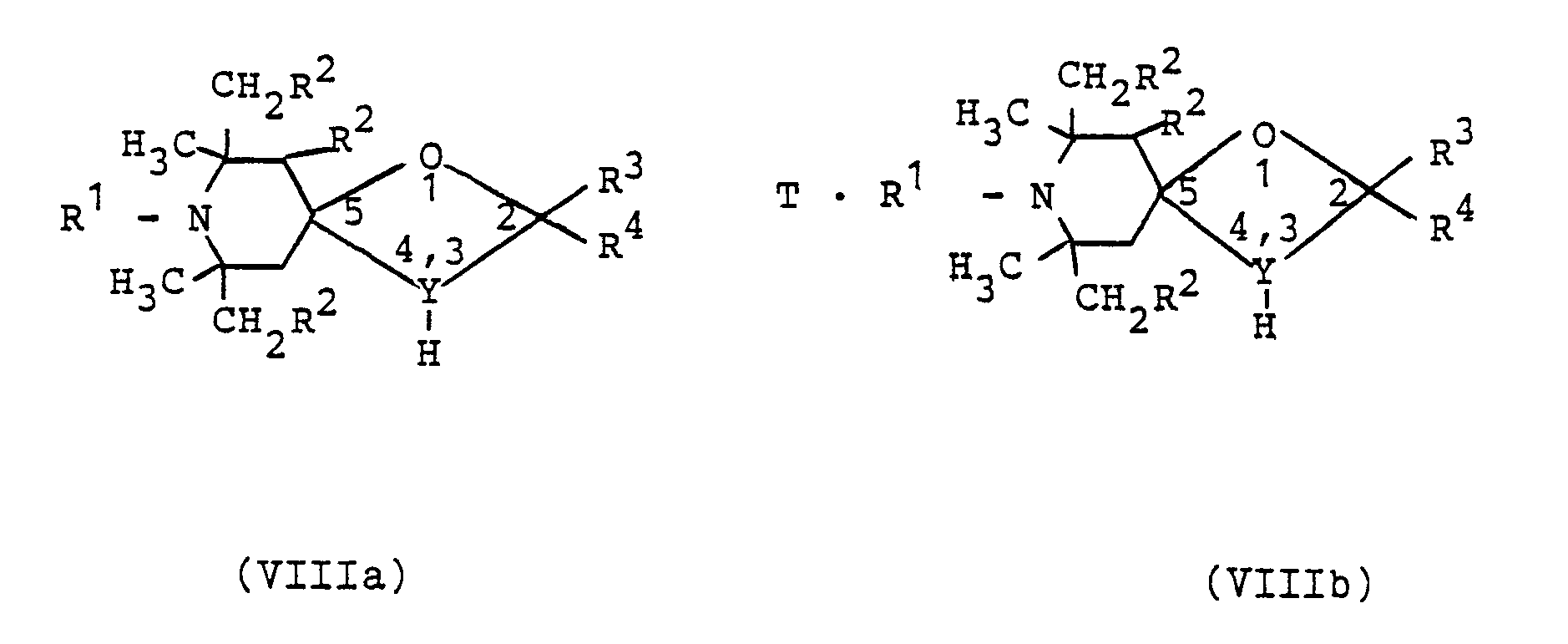

- Die nach diesem Reaktionsschritt erhaltenen Zwischenprodukte enthalten noch Epoxidgruppen, so daß diese Zwischenprodukte in Substanz oder in Lösung, gegebenenfalls in Gegenwart von Katalysatoren, in höhermolekulare Verbindungen überführt werden können. Dies kann z.B. durch Erhitzen dieser Zwischenprodukte auf 100 bis 240°C, vorzugsweise 140 bis 210°C, insbesondere 160 bis 200°C, erfolgen. Hierbei können auch Salze als Katalysatoren zugesetzt werden, wobei basische Verbindungen wie beispielsweise BaCO₃ die Polyetherbildung, saure Verbindungen, wie beispielsweise NH₄Cl, die Addition der Aminfunktion an die Epoxidgruppe fördern.
- Zur Herstellung der Polymeren bzw. Oligomeren kann man auch so verfahren, daß man die epoxidgruppenhaltigen Zwischenprodukte nicht erst isoliert, sondern in der Reaktionsmischung auf die genannten höheren Temperaturen bringt und nach erfolgter Polymerisation bzw. Polyaddition aufarbeitet.
- Die Polymerisations-/Polyadditionsgrade können sowohl durch das Verhältnis der Ausgangmaterialien zueinander als auch durch die Reaktionsbedingungen beeinflußt werden, so führt eine Erhöhung des Gehaltes an Epoxidverbindungen IX im Verhältnis zu den Diazaspirodecanen VIII zu höheren mittleren Molmassen. Ebenso führt eine Verlängerung der Polymerisations-/Polyadditionszeit sowie eine Erhöhung der Polymerisations-/Polyadditionstemperatur zu höhermolekularen Produkten.
- Bei der Bildung höhermolekularer Produkte können hierbei prinzipiell folgende Reaktionen ablaufen:
- Polyetherbildung aus den Epoxidgruppen (Polymerisation),
- Addition der Aminfunktion an die Epoxidgruppen (Polyaddition) und/oder
- Addition vorhandener Hydroxylgruppen an die Epoxidgruppen (Polyaddition). - Überraschenderweise läßt die oben beschriebene Reaktionsführung die Herstellung von Verbindungen mit einer bestimmten mittleren Molmasse zu, wobei diese in weiten Grenzen gezielt variiert werden kann.
- Gegenüber den Verbindung aus der DE-OS 31 04 294 besteht der große Vorteil darin, daß bei den erfindungsgemäßen Verbindungen das Arbeiten mit Epichlorhydrin, einem Stoff, der sich im Tierversuch eindeutig als krebserzeugend erwiesen hat, entfällt.
- Die Ausgangsmaterialien der Formel (VIIIa) oder (VIIIb) sind an sich bereits gute Stabilisatoren, befriedigen jedoch besonders bezüglich der Verträglichkeit mit dem zu stabilisierenden Polymeren und der Flüchtigkeit nicht. Die erfindungsgemäßen Stabilisatoren weisen diese Nachteile nicht auf und zeigen überraschender Weise auch eine deutlich bessere antioxidative und lichtstabilisierende Wirkung.
- Geeignete Verbindungen der Formel VIIIa sind beispielsweise:
1. 2-Butyl-7,7,9,9-tetramethyl-1-oxa-3,8-diaza-4-oxo-spiro-[4,5]-decan
2. 2-iso-Butyl-7,7,9,9-tetramethyl-1-oxa-3,8-diaza-4-oxo-spiro-[4,5]-decan
3. 2-Pentyl-7,7,9,9-tetramethyl-1-oxa-3,8-diaza-4-oxo-spiro-[4,5]-decan
4. 2-iso-Pentyl-7,7,9,9-tetramethyl-1-oxa-3,8-diaza-4-oxo-spiro-[4,5]-decan
5. 2-Hexyl-7,7,9,9-tetramethyl-1-oxa-3,8-diaza-4-oxo-spiro-[4,5]-decan
6. 2-Heptyl-7,7,9,9-tetramethyl-1-oxa-3,8-diaza-4-oxo-spiro-[4,5]-decan
7. 2-iso-Heptyl-7,7,9,9-tetramethyl-1-oxa-3,8-diaza-4-oxo-spiro-[4,5]-decan
8. 2-Nonyl-7,7,9,9-tetramethyl-1-oxa-3,8-diaza-4-oxo-spiro-[4,5]-decan
9. 2-iso-Nonyl-7,7,9,9-tetramethyl-1-oxa-3,8-diaza-4-oxo-spiro-[4,5]-decan
10. 2-Undecyl-7,7,9,9-tetramethyl-1-oxa-3,8-diaza-4-oxo-spiro-[4,5]-decan
11. 2-Phenyl-7,7,9,9-tetramethyl-1-oxa-3,8-diaza-4-oxo-spiro-[4,5]-decan
12. 2-(4-Chlor-phenyl)-7,7,9,9-tetramethyl-1-oxa-3,8-diaza-4-oxo-spiro-[4,5]-decan
13. 2-Ethyl-2,7,7,9,9-pentamethyl-1-oxa-3,8-diaza-4-oxo-spiro-[4,5]-decan
14. 2-Propyl-2,7,7,9,9-pentamethyl-1-oxa-3,8-diaza-4-oxo-spiro-[4,5]-decan
15. 2-iso-Propyl-2,7,7,9,9-pentamethyl-1-oxa-3,8-diaza-4-oxo-spiro-[4,5]-decan
16. 2-Butyl-2,7,7,9,9-pentamethyl-1-oxa-3,8-diaza-4-oxo-spiro-[4,5]-decan
17. 2-iso-Butyl-2,7,7,9,9-pentamethyl-1-oxa-3,8-diaza-4-oxo-spiro-[4,5]-decan
18. 2-Pentyl-2,7,7,9,9-pentamethyl-1-oxa-3,8-diaza-4-oxo-spiro-[4,5]-decan
19. 2-Hexyl-2,7,7,9,9-pentamethyl-1-oxa-3,8-diaza-4-oxo-spiro-[4,5]-decan
20. 2-Nonyl-2,7,7,9,9-pentamethyl-1-oxa-3,8-diaza-4-oxo-spiro-[4,5]-decan
21. 2,2,7,7,9,9-Hexamethyl-1-oxa-3,8-diaza-4-oxo-spiro-[4,5]-decan
22. 2,2,7,7,9,9-Heptamethyl-1-oxa-3,8-diaza-4-oxo-spiro-[4,5]-decan
23. 2,2-Diethyl-7,7,9,9-tetramethyl-1-oxa-3,8-diaza-4-oxo-spiro-[4,5]-decan
24. 2,2-Dipropyl-7,7,9,9-tetramethyl-1-oxa-3,8-diaza-4-oxo-spiro-[4,5]-decan
25. 2,2-Dibutyl-7,7,9,9-tetramethyl-1-oxa-3,8-diaza-4-oxo-spiro-[4,5]-decan
26. 2-Ethyl-2-pentyl-7,7,9,9-tetramethyl-1-oxa-3,8-diaza-4-oxo-spiro-[4,5]-decan
27. 2,2-Dibenzyl-7,7,9,9-tetramethyl-1-oxa-3,8-diaza-4-oxo-spiro-[4,5]-decan
28. 2,2,4,4-Tetramethyl-7-oxa-3,13-diaza-14-oxo-dispiro-[5,1,4,2]-tetradecan
29. 2,2,4,4-Tetramethyl-7-oxa-3,14-diaza-15-oxo-dispiro-[5,1,5,2]-pentadecan
30. 2,2,4,4-Tetramethyl-7-oxa-3,20-diaza-21-oxo-dispiro-[5,1,11,2]-heneicosan
31. 2,2,7,7,9,9-Hexamethyl-1-oxa-3,8-diaza-4-oxo-8-acetyl spiro[-4,5]-decan
32. 2,2,4,4-Tetramethyl-7-oxa-3,14-diaza-15-oxo-3-acetyl-dispiro-[5,1,5,2]-pentadecan
33. 2,2,4,4-Tetramethyl-7-oxa-3,20-diaza-21-oxo-3-acetyl-dispiro-[5,1,11,2]-heneicosan
34. 2,7,7,9,9-Pentamethyl-1-oxa-4,8-diaza-3-oxo-spiro-[4,5]-decan
35. 2-Ethyl-7,7,9,9-tetramethyl-1-oxa-4,8-diaza-3-oxo-spiro-[4,5]-decan
36. 2-Propyl-7,7,9,9-tetramethyl-1-oxa-4,8-diaza-3-oxo-spiro[4,5]-decan
37. 2-Butyl-7,7,9,9-tetramethyl-1-oxa-4,8-diaza-3-oxo-spiro[4,5]-decan
38. 2-iso-Butyl-7,7,9,9-tetramethyl-1-oxa-4,8-diaza-3-oxo-spiro[4,5]-decan
39. 2-Pentyl-7,7,9,9-tetramethyl-1-oxa-4,8-diaza-3-oxo-spiro[4,5]-decan
40. 2-iso-Pentyl-7,7,9,9-tetramethyl-1-oxa-4,8-diaza-3-oxo-spiro-[4,5]-decan
41. 2-iso-Heptyl-7,7,9,9-tetramethyl-1-oxa-4,8-diaza-3-oxo-spiro-[4,5]-decan
42. 2-Phenyl-7,7,9,9-tetramethyl-1-oxa-4,8-diaza-3-oxo-spiro-[4,5]-decan
43. 2,2,7,7,9,9-Hexamethyl-1-oxa-4,8-diaza-3-oxo-spiro-[4,5]-decan
44. 2,2,7,7,8,9,9-Heptamethyl-1-oxa-4,8-diaza-3-oxo-spiro-[4,5]-decan
45. 2,2-Diethyl-7,7,9,9-tetramethyl-1-oxa-4,8-diaza-3-oxo-spiro[4,5]-decan
46. 2,2-Diethyl-7,7,8,9,9-pentamethyl-1-oxa-4,8-diaza-3-oxo-spiro-[4,5]-decan
47. 2,2-Dipropyl-7,7,9,9-tetramethyl-1-oxa-4,8-diaza-3-oxo-spiro-[4,5]-decan
48. 2,2-Dibutyl-7,7,9,9-tetramethyl-1-oxa-4,8-diaza-3-oxo-spiro-[4,5]-decan
49. 2,2-Dipentyl-7,7,9,9-tetramethyl-1-oxa-4,8-diaza-3-oxo-spiro-[4,5]-decan
50. 2-Ethyl-2,7,7,9,9-pentamethyl-1-oxa-4,8-diaza-3-oxo-spiro-[4,5]-decan
51. 2-Propyl-2,7,7,9,9-pentamethyl-1-oxa-4,8-diaza-3-oxo-spiro-[4,5]-decan
52. 2-iso-Propyl-2,7,7,9,9-pentamethyl-1-oxa-4,8-diaza-3-oxo-spiro-[4,5]-decan
53. 2-Butyl-2,7,7,9,9-pentamethyl-1-oxa-4,8-diaza-3-oxo-spiro-[4,5]-decan
54. 2-iso-Butyl-2,7,7,9,9-pentamethyl-1-oxa-4,8-diaza-3-oxo-spiro-[4,5]-decan
55. 2-Pentyl-2,7,7,9,9-pentamethyl-1-oxa-4,8-diaza-3-oxo-spiro-[4,5]-decan
56. 2-iso-Pentyl-2,7,7,9,9-pentamethyl-1-oxa-4,8-diaza-3-oxo-spiro-[4,5]-decan
57. 2-Hexyl-2,7,7,9,9-pentamethyl-1-oxa-4,8-diaza-3-oxo-spiro-[4,5]-decan
58. 2-Heptyl-2,7,7,9,9-pentamethyl-1-oxa-4,8-diaza-3-oxo-spiro-[4,5]-decan
59. 2-Nonyl-2,7,7,9,9-pentamethyl-1-oxa-4,8-diaza-3-oxo-spiro-[4,5]-decan
60. 2-Undecyl-2,7,7,9,9-pentamethyl-1-oxa-4,8-diaza-3-oxo-spiro-[4,5]-decan
61. 2-Ethyl-2-butyl-7,7,9,9-tetramethyl-1-oxa-4,8-diaza-3-oxo-spiro-[4,5]-decan
62. 2-Ethyl-2-pentyl-7,7,9,9-tetramethyl-1-oxa-4,8-diaza-3-oxo-spiro-[4,5]-decan
63. 2-Ethyl-2-iso-pentyl-7,7,9,9-tetramethyl-1-oxa-4,8-diaza-spiro-[4,5]-decan
64. 2,2,7,7,9,9-Hexamethyl-1-oxa-4,8-diaza-3-oxo-8-acetyl-spiro-[4,5]-decan
65. 2,2-Diethyl-7,7,9,9-tetramethyl-1-oxa-4,8-diaza-3-oxo-8-acetyl-spiro-[4,5]-decan
66. 2,2,4,4-Tetramethyl-7-oxa-3,14-diaza-13-oxo-dispiro-[5,1,4,2]-tetradecan
67. 2,2,4,4-Tetramethyl-7-oxa-3,15-diaza-14-oxo-dispiro-[5,1,5,2]-pentadecan
68. 2,2,4,4-Tetramethyl-7-oxa-3,21-diaza-20-oxo-dispiro-[5,1,11,2]-heneicosan - Geeignete Verbindung der Formel VIIIb sind die Salze aus den Verbindungen der Formel VIIIa mit Protonsäuren, z.B. Chlorwasserstoff, Schwefelsäure, Phosphorsäure usw., beispielsweise die Hydrochloride der oben angegebenen Verbindungen Nr. 1- 68. Zur Erläuterung seien folgende Beispiele genannt:
69. 2,2,7,7,9,9-Hexamethyl-1-oxa-3,8-diaza-4-oxo-spiro-[4,5]-decan-hydrochlorid
70. 2,2,4,4-Tetramethyl-7-oxa-3,14-diaza-15-oxo-dispiro-[5.1.5.2]-pentadecan-hydrochlorid
71. 2,2,4,4-Tetramethyl-7-oxa-3,20-diaza-21-oxo-dispiro [5.1.11.2]-heneicosan-hydrochlorid
72. 2,2,7,7,9,9-Hexamethyl-1-oxa-4,8-diaza-3-oxo-spiro-[4,5]-decan-hydrochlorid
73. 2,2-Diethyl-7,7,9,9-tetramethyl-1-oxa-4,8-diaza-3-oxo-spiro-[4,5]-decan-hydrochlorid
74. 2,2,4,4-Tetramethyl-7-oxa-3,14-diaza-13-oxo-dispiro-[5.1.4.2]-tetradecan-hydrochlorid
75. 2,2,4,4-Tetramethyl-7-oxa-3,15-diaza-14-oxo-dispiro-[5.1.5.2]-pentadecan-hydrochlorid
76. 2,2,4,4-Tetramethyl-7-oxa-3,21-diaza-20-oxo-dispiro-[5.1.11.2]-heneicosan-hydrochlorid - Beispiele für die Epoxide der Formel IX sind:


- Die Verbindung der Formel IX müssen für die Umsetzung zu den erfindungsgemäßen Stabilisatoren nicht in reiner Form vorliegen, sondern können auch in Form der entsprechenden Epoxidharze technischer Qualität verwendet werden.
- Die neuen Stabilisatoren lassen sich problemlos in die zu stabilisierenden Polymeren einarbeiten und sind hervorragend zum Stabilisieren derselben gegen den lichtinduzierten oxidativen Abbau, d.h. ihre Schädigung durch Einwirkung von Sauerstoff, Wärme und Licht, geeignet. Neben der ausgezeichneten Stabilisatorwirksamkeit zeichnet die neuen Stabilisatoren ihre sehr gute Verträglichkeit mit den zu stabilisierenden Polymeren aus.
- Beispiele für erfolgreich zu stabilisierende Polymere sind:
Polymere, die sich von einfach oder doppelt ungesättigten Kohlenwasserstoffen ableiten, z.B. Polyolefine wie Polyethylen, das gegebenenfalls vernetzt sein kann, Polypropylen, Polybuten-1, Polyisobuten, Polymethylbuten-1, Polymethylpenten-1, Polyisopren, Polybutadien, Polystyrol, Copolymere der den genannten Homopolymeren zugrundeliegenden Monomeren, wie Ethylen-Propylen-Copolymere, Propylen-Buten-1-Copolymere, Propylen-Isobuten-Copolymere, Styrol-Butadien-Copolymere sowie Terpolymere von Ethylen und Propylen mit einem Dien, wie z.B. Hexadien, Dicyclopentadien oder Ethylidennorbornen; Mischungen der obengenannten Homopolymeren, wie beispielsweise Gemische von Polypropylen und Polyethylen, Polypropylen und Polybuten-1, Polypropylen und Polyisobuten oder von Butadien-Acrylnitril-Copolymerisaten mit einem Styrol-Butadien-Copolymerisat. - Halogenhaltige Vinylpolymere, wie Polyvinylchlorid, Polyvinylidenchlorid, Polyvinylfluorid, Polychloropren, Chlorkautschuke sowie Copolymere von Vinylchlorid und Vinylidenchlorid untereinander und mit anderen olefinisch ungesättigten Monomeren.
- Polymere, die sich von α,β-ungesättigten Säuren und deren Derivaten ableiten, wie Polyacrylate und Polymethacrylate, Polyacrylamide und Polyacrylnitril sowie deren Copolymere untereinander und mit anderen Vinylverbindungen, wie Acrylnitril-Butadien-Styrol-, Acrylnitril-Styrol- und Acrylnitril-Styrol-Acrylester-Copolymerisate.
- Polymere, die sich von ungesättigten Alkoholen und Aminen bzw. deren Acrylderivaten oder Acetalen ableiten, wie Polyvinylalkohol, Polyvinylacetat, -stearat, -benzoat, -maleat, Polyvinylbutyral, Polyallylphthalat, Polyallylmelamin und deren Copolymere mit anderen Vinylverbindungen, wie Ethylen-Vinylverbindungen, wie Ethylen Vinylacetat-Copolymere. Homo- und Copolymere, die sich von Epoxiden ableiten, wie Polyethylenoxid oder die Polymerisate, die sich von Bisglycidylethern ableiten.
- Polyacetale, wie Polyoximethylen und Polyoxiethylen sowie solche Polyoximethylene, die als Comonomeres Ethylenoxid enthalten.
- Polyurethane und Polyharnstoffe
Polycarbonat - Polyamide und Copolyamide, die sich von Diaminen und Dicarbonsäuren und/oder von Aminocarbonsäuren oder den entsprechenden Lactamen ableiten, wie Polyamid 6, Polyamid6/6, Polyamid 6/10, Polyamid 11, Polyamid 12.
- Polyester, die sich von Dicarbonsäuren und Dialkoholen und/oder von Hydroxicarbonsäuren oder den entsprechenden Lactonen ableiten, wie Polyethylenterephthalat, Polybutylenterephthalat, Poly-1,4-dimethylol-cyclohexanterephthalat.
- Vernetzte Polymerisate, die sich von Aldehyden einerseits und Phenolen, Harnstoffen und Melaminen andererseits ableiten, wie Phenol-Formaldehyd-, Harnstoff-Formaldehyd- und Melamin-Formaldehydharze.
- Die neuen Verbindungen lassen sich schließlich auch als Stabilisatoren auf dem Harz- und Lacksektor einsetzen. Beispiele sind duroplastsiche und thermoplastische Acrylharze, welche für Autolackierungen verwendet werden, Acrylharzlacke, das sind die üblichen Einbrennlacke sowie ganz besonders Mischungen auf der Basis von heiß-vernetzbarem Acrylharz und Styrol sowie Lacke und Beschichtungen auf der Basis von Acryl-Melaminharz und Alkyd/Acryl/Melaminharz. Derartige Lacke können als weitere Zusatzstoffe andere übliche Lichtschutzmittel, phenolische Antioxidantien, Pigmente, Farbstoffe, Metalldesaktivatoren etc. enthalten.
- Von besonderer Bedeutung ist die Stabilisierung von Polyolefinen, Styrolpolymerisaten, Polyamiden, Poly-(meth)-acrylaten und von Polyurethanen, für die sich die Verbindungen bevorzugt eignen. Beispiele hierfür sind Polyethylen hoher und niedriger Dichte, Polypropylen, Ethylen-Propylen-Copolymerisate, Polystyrol, Styrol-Butadien-Acrylnitril-Terpolymerisate; Mischungen von Polyolefinen oder von Styrolpolymerisaten sowie Polyurethane auf Polyether- oder Polyesterbasis.
- Die neuen Stabilisatoren werden nach allgemein üblichen Methoden in die Polymermassen eingearbeitet. Die Einarbeitung kann beispielsweise durch Einmischen der Verbindungen und gegebenenfalls weiterer Additive in die Schmelze nach den in der Technik üblichen Methoden, vor oder während der Formgebung, oder auch durch Aufbringen der gelösten oder dispergierten Verbindungen auf das Polymere direkt oder Einmischen in eine Lösung, Suspension oder Emulsion desselben, gegebenenfalls unter nachträglichem Verdunstenlassen des Lösungsmittels, erfolgen. Die Mengen liegen bei 0,01 bis 5, vorzugsweise bei 0,05 bis 2,5 und insbesondere bei 0,1 bis 1,0 Gew.-%, bezogen auf das zu stabilisierende Material. Die neuen Verbindungen können auch in Form eines Masterbatches, der diese Verbindungen beispielsweise in einer Konzentration von 1 bis 50, vorzugsweise 2,5 bis 20 Gew.-% enthält, den zu stabilisierenden Kunststoffen zugesetzt werden.
- Die durch den Zusatz der erfindungsgemäßen Substanzen stabilisierten Kunststoffe können gegebenenfalls noch andere bekannte und übliche Zusätze, wie beispielsweise Antioxidantien auf Phenol- und Sulfidbasis, Metalldesaktivatoren und Lichtschutzmittel, Phosphitstabilisatoren, Metallverbindungen, Epoxidstabilisatoren und mehrwertige Alkohole enthalten.
- Beispiele für Antioxidantien sind sterisch gehinderte Phenole wie 2,6-Di-tert.-butyl-4-methylphenol, 4,4ʹ-Butyliden-bis-(2,6-di-tert.-butylphenol), 4,4ʹ-Thio-bis-(2-tert.-butyl-5-methylphenol), 2,5-Di-tert.-butyl-4-hydroxianisol, 2,2-Bis-(3,5-di-tert.-butyl)-2-hydroxibenzyl)-malonsäuredioctadecylester, 1,3,5-Tris-(3,5-di-tert.-butyl-4-hydroxibenzyl)-2,4,6-trimethylbenzol, 2,4,6-Tri-(3,5-di-tert.-butyl-4-hydroxibenzyl)-phenol, phenolische Triazinverbindung wie 1,3,5-Tris-(3,5-di-tert.-butyl-4-hydroxibenzyl)-isocyanurat, Amide oder Ester der β-(3,5-Di-tert.-butyl-4-hydroxiphenyl)-propionsäure mit z.B. Octadecanol, 1,6-Hexandiol, 2,2ʹ-Thiodiethylenglykol, Pentaerythrit und Tris-hydroxiethylisocyanurat, Hexamethylendiamin, Ester der 3,3-Bis-(3-tert.-butyl-4-hydroxiphenyl)-butansäuren mit z.B. Ethylenglykol, Thiodipropionsäureester mit Fettalkoholen, Ca- oder Ni-Salze des 3,5-Di-tert.-butyl-4-hydroxibenzylphosphonsäureethylesters, Dioctadecylsulfid und - disulfid.
- Beispiele für Metalldesaktivatoren sind N,Nʹ-Diphenyloxalsäurediamid, N-Salizylal-Nʹ-salizyloylhydrazin, N,Nʹ-Bis-salizyloylhydrazin, N,Nʹ-Bis-(5,5-di-tert.-butyl-4-hydroxyphenylpropionyl)-hydrazin, 3-Salizyloylamino-1,2,4-triazol, Bis-benzyliden-Oxalsäuredihydrazid, Tris[2-tert.-butyl-4-thio(2ʹ-methyl-4ʹ-hydroxy-5ʹ-tert.-butyl)phenyl-5-methyl]phenylphosphit, 2,2ʹ-Oxamido-bis-[ethyl-3-(3,5-di-tert.-butyl-4-hydroxiphenyl)propionat]
- Zu den UV-Absorbern und Lichtschutzmitteln gehören 2-(2ʹ-Hydroxiphenyl)-benztriazole wie z.B. das 5-Chlor-3ʹ ,5ʹ-di-tert.-butyl- und 5-Chlor-3ʹ ,5ʹ-di-tert.-amyl-Derivat, 2-Hydroxibenzophenone wie z.B. das 4-Heptoxi-, 4-Octoxi- oder 4-Dodecycloxi-Derivat, Salizylate wie Octylphenylsalizylat, Nickelkomplexe wie z.B. der Komplex mit 2,2ʹ-Thio-bis-4-(1,1,3,3-tetramethylbutyl)-phenol und Butylamin oder anderen Aminen, oder mit 2-Hydroxi-4-octoxibenzophenon, mit Dialkyldithiocarbaminsäuren bzw. Dialkyldithiophosphonsäuren, Oxalsäurediamide und sterisch gehinderte Amine, z.B. Bis(2,2,6,6-tetramethyl-4-piperidinyl)sebacat, Polyester der Bernsteinsäure mit N-(2-hydroxyethyl)-2,2,6,6-tetramethyl-4-Hydroxi-piperidin, N,Nʹ-Bis(2,2,6,6-tetramethyl-4-piperidinyl)hexamethylen-diamin, 2,2,4,4-Tetramethyl-7-oxa-3,20 -diaza-21-oxo-dispiro-[5,1,11,2]-heneicosan, 1,1ʹ-(1,2-ethandiyl)bis-(3,3,5,5-tetramethylpiperazinon), Kondensationsprodukt von N,Nʹ-Bis(2,2,6,6-tetramethyl-4-piperidyl)hexamethylen-diamin mit Dibromethan oder mit 4-tert.-Octylamino-2,6-dichlor-1,3,5-triazin oder mit 4-(N-Morpholinyl)-2,6-dichlor-1,3,5-triazin, Tetrakris-(2,2-tetramethyl-4-piperidyl-1,2,3,4-butantetracarbonsäure.
- Als Phosphite sind aliphatische, aromatische oder aliphatisch-aromatische wie z.B. Trisnonylphenylphosphit, Tris-(2,4-di-tert.-butylphenyl)-phosphit, Tris-(2-tert.-butylphenyl)-phosphit oder auch Ester des Pentaerythritphosphits zu nennen.
- Als Stabilisatoren bekannte Metallverbindungen sind z.B.: Calcium, Barium-, Strontium-, Zink-, Cadmium, Magnesium-, Aluminium- und Bleiseifen aliphatischer Carbonsäuren oder Oxicarbonsäuren mit etwa 12 bis 32 C-Atomen, Salze der genannten Metalle mit aromatischen Carbonsäuren wie Benzoate oder Salizylate sowie (Alkyl-)-Phenolate dieser Metalle, ferner Organozinnverbindungen, wie z.B. Dialkylzinnthioglykolate und -carboxilate, sowie Metalloxide, z.B. Oxide des Calcium, Magnesium, Zink, Aluminium oder des Silicium.
- Bekannte Epoxistabilisatoren sind z.B. epoxidierte höhere Fettsäuren wie epoxidiertes Sojabohnenöl, Tallöl, Leinöl oder epoxidiertes Butyloleat sowie Epoxide langkettiger Olefine und Polyetherepoxide.
- Mehrwertige Alkohole können beispielsweise Pentaerythrit, Trimethylolpropan, Sorbit oder Mannit sein, d.h. bevorzugt Alkohole mit 5 oder 6 C-Atomen und 2 bis 6 OH-Gruppen.
- Eine wirksame Stabilisatorkombination für Poly-α-Olefine, wie z.B. Hoch-, Mittel- und Niederdruckpolymerisate von C₂- bis C₄-α-Olefinen, insbesondere Polyethylen und Polypropylen oder von Copolymerisaten derartiger α-Olefine besteht, bezogen auf 100 Gewichtsteile Polymer, beispielsweise aus 0,01 bis 5 Gewichtsteilen einer der erfindungsgemäß zu verwendenden Verbindungen, 0,05 bis 5 Gewichtsteilen eines phenolischen Stabilisators, gegebenenfalls 0,01 bis 5 Gewichtsteilen eines schwefelhaltigen Costabilisators sowie gegebenenfalls 0,01 bis 3 Gewichtsteilen einer basischen oder neutralen Metallseife, wie z.B. Calciumstearat oder Zinkstearat oder der entsprechenden Oxide, gegebenenfalls 0,01 bis 5 Gewichtsteile eines Phosphit- oder Phosphonitstabilisators sowie gegebenenfalls 0,01 bis 5 Gewichtsteilen eines bekannten UV-Stabilisators aus der Gruppe der Alkoxihydroxibenzophenone, 4-Hydroxiphenylbenzotriazole, Benzylidenmalonsäuremononitrilester oder der sog. Quencher, wie z.B. Nickelchelate. Als sonstige übliche Zusätze sind z.B. Weichmacher, Gleitmittel, Emulgatoren, Füllstoffe, wie z.B. Kreide, Talkum, Asbest, Pigmente, optische Aufheller, Flammschutzmittel und Antistatika anzusehen.
- Die erfindungsgemäß stabilisierten Kunststoffe können in verschiedenster Form angewendet werden, z.B. als Folien Fasern, Bändchen, Profile oder als Bindemittel für Lacke, Klebemittel oder Kitte.
- Der weiteren Erläuterung der Erfindung dienen nachstehende Beispiele.
- In einer 1-l-Rührapparatur mit Rückflußkühler, Innenthermometer und Tropftrichter wurden 72,8 g (0,02 mol) der Verbindung 30 in 300 ml Toluol vorgelegt und 1 g Triethylbenzylammoniumchlorid, 18,0 g (0,23 mol) 50 %ige Natronlauge und 77,2 g (0,40 Epoxidäquivalente) eines technishcen Bisphenol-A-Epoxids (Verbindung 82) zugegeben. Das Reaktionsgemisch wurde auf 90°C aufgeheizt und 4 h bei dieser Temperatur kräftig gerührt. Nach Beendigung der Umsetzung wurde 3mal mit je 150 ml Wasser ausgeschüttelt, die organische Phase über Natriumsulfat getrocknet und nach dem Filtrieren das Toluol abdestilliert. Dann wurde der Rückstand bei ca. 1 Torr 4 h lang auf 200°C erhitzt. Man erhielt 139,5 g eines sehr harten glasartigen Feststoffes mit einem Erweichungspunkt > 250°C und einer mittleren Molmasse > 5000.
- Es wurde das Zwischenprodukt gemäß Beispiel 1 hergestellt, welches dann jedoch 4 h auf 150°C erhitzt wurde. Das erhaltene spröde, glasartige Produkt hatte einen Erweichungspunkt von 220°C und eine mittlere Molmasse von ca. 5000.
- Das Beispiel 2 wurde wiederholt, jedoch wurde das Zwischenprodukt nur 2 h erhitzt. Das erhaltene spröde, glasartige Produkt hatte einen Erweichungspunkt von 175°C und eine mittlere Molmasse von 3300.
- Analog Beispiel 1 wurden 72,8 g (0,2 mol) der Verbindung 30 mit 57,9 g (0,30 Epoxidäquivalente) eines technischen Epoxides auf Basis Bisphenol-A (Verbindung 82) umgesetzt. Das Zwischenprodukt wurde bei ca. 1 Torr 4 h auf 180°C erhitzt. Man erhielt 120,5 g eines fast farblosen, spröden glasartigen Produktes mit einem Erweichungspunkt von 168°C und einer mittleren Molmasse von 3000.
- Es wurde wie in Beispiel 4 verfahren, wobei jedoch nur 54,0 g (0,28 Epoxidäquivalente) des Bisphenol-A-Epoxids verwendet wurden. Das spröde, amorphe Produkt (122,4 g) hatte einen Erweichungspunkt von ca. 150°C und eine mittlere Molmasse von 2800.
- Analog Beispiel 1 wurden 36,4 g (0,1 mol) der Verbindung 30 in 150 ml Toluol mit 23,2 g (0,12 Epoxidäquivalente) eines technischen Bisphenol-A-Epoxides (Verbindung 82) in Gegenwart von 0,5 g Triethylbenzylammoniumchlorid und 9,0 g (0,11 mol) 50 %iger Natronlauge umgesetzt. Das Zwischenprodukt wurde dann bei ca. 1 Torr 4 h auf 180°C erhitzt. Man erhielt 56,3 g eines farblosen, amorphen Feststoffes mit einem Erweichungspunkt von 135°C und einer mittleren Molmasse von 1960.
- Analog Beispiel 4 wurden 56,0 g (0,2 mol) der Verbindung 29 anstelle der Verbindung 30 umgesetzt. Man erhielt 105,3 g farbloses Produkt mit einem Erweichungspunkt > 250°C und einer Molmasse von 6800.
- Analog Beispiel 1 wurden anstelle der Verbindung 30 28,0 g (0,1 mol) der Verbindung 29 mit 27,0 g (0,14 Epoxidäquivalente) eines technischen Bisphenol-A-Epoxides (Verbindung 82) umgesetzt. Das Zwischenprodukt wurde 4 h bei ca. 1 Torr auf 180°C erhitzt. Es wurden 53,7 g farbloses Produkt mit einem Erweichungspunkt von 147°C und einer mittleren Molmasse von 2400 erhalten.
- Analog Beispiel 6 wurden anstelle der Verbindung 30 28,0 g (0,1 mol) der Verbindung 29 umgesetzt. Dabei wurden 50,5 g farbloses, amorphes Produkt mit einem Erweichungspunkt von 130°C und einer mittleren Molmasse von 1640 erhalten.
- Analog Beispiel 4 wurden anstelle der Verbindung 30 48,0 g (0,2 mol) der Verbindung 31 umgesetzt. Man erhielt 97, 8 g farbloses amorphes Produkt mit einem Erweichungspunkt von 145°C und einer mittleren Molmasse von 2580.
- In einer 1-l-Rührapparatur mit Innenthermometer, Rückflußkühler und Tropftrichter wurden 100 ml Toluol vorgelegt, 24,0 g (0,1 mol) der Verbindung 43 (Edukt I), 0,3 g Triethylbenzylammoniumchlorid, 9,0 g (0,11 mol) 50%ige Natronlauge und 38,6 g (0,20 Epoxidäquivalente) eines technischen Bisphenol-A-Epoxides (Verbindung 82; Edukt II) zugegeben und das Gemisch auf 90°C aufgeheizt und 4 h gerührt. Danach wurde 3mal mit je 50 ml Wasser ausgeschüttelt, die organische Phase mit Natriumsulfat getrocknet und nach der Filtration das Toluol abdestilliert. Das so erhaltene Zwischenprodukt wurde bei ca. 1 Torr 4 h auf 180°C erhitzt. Dabei wurden 82,3 g eines farblosen, sehr harten Produktes mit einem Erweichungspunkt 250°C erhalten.
- Die Durchführung erfolgte gemäß dem Beispiel 11.
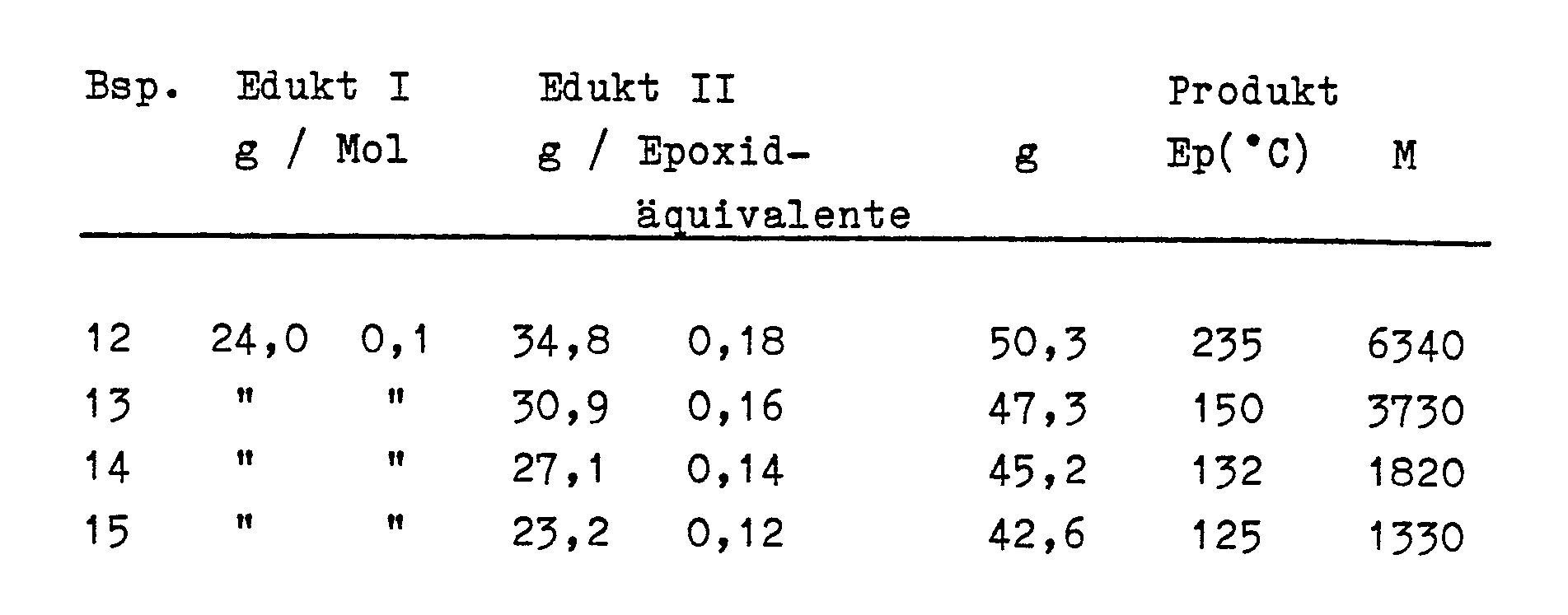
- Analog Beispiel 11 wurden anstatt der Verbindung 43 27,7 g (0,1 mol) der Verbindung 72 als Edukt I sowie 17,6 g (0,22 mol) 50 %ige Natronlauge eingesetzt

- Die Durchführung erfolgte wie im Beispiel 16, wobei hier jedoch kein Triethylbenzylammoniumchlorid zugesetzt wurde. Es wurden 46,0 g amorphes Produkt mit einem Erweichungspunkt von 138°C und einer mittleren Molmasse von 2100 erhalten.
- Es wurde analog Beispiel 19 verfahren, wobei die Edukte jedoch unter Rückfluß miteinander umgesetzt wurden. Man erhielt 47,3 g amorphes Produkt mit einem Erweichungspunkt von 139°C und einer mittleren Molmasse von 2400.
- In einem 1-l-Rührgefäß mit Innenthermometer und Rückflußkühler wurden 200 ml Toluol vorgelegt, 55,3 g (0,2 mol) der Verbindung 72 (Edukt I) 0,6 g Benzyltriethylammoniumchlorid und 19,8 g KOH-Pulver zugegeben und der Ansatz auf 90°C aufgeheizt. Dann wurden 52,5 g (0,30 Epoxidäquivalente) eines technischen Bisphenol-F-Epoxids (Verbindung 81, Edukt II) eingetragen und der Ansatz 2 h bei 90°C weitergerührt. Anschließend wurde zweimal druckfiltriert, das Toluol abdestilliert und das so erhaltene Zwischenprodukt bei 30 Torr 3 h auf 180°C aufgeheizt. Man erhielt 97,3 g amorphes, nahezu farbloses Produkt mit einem Erweichungspunkt von 125°C und einer mittleren Molmasse von 2300.
- Analog zu Beispiel 21 wurden 55,3 g (0,2 mol) der Verbindung 72 (Edukt I) mit 37,5 g (0,30 Epoxidäquivalente) eines technischen Butandioldiglycidylethers (Verbindung 77; Edukt II) umgesetzt. Man erhielt 79,8 g farbloses, amorphes Produkt mit einem Erweichungspunkt von 59°C und einer mittleren Molmasse von 1720.
- In einer 500-ml-Rührapparatur mit Rückflußkühler und Innenthermometer wurden 200 ml Toluol, 55,3 (0, 2 mol) der Verbindung 72, 19,8 g KOH-Pulver und 53,8 g (0,28 Epoxidäquivalente) eines technischen Bisphenol-A-Epoxids (Verbindung 82) zusammengegeben und auf 90°C aufgeheizt, 1 h gerührt, zweimal druckfiltriert und das Toluol ab destilliert. Das so erhaltene Zwischenprodukt wurde bei 30 Torr 3 h auf 180°C erhitzt. Man erhielt 96,6 g farbloses, amorphes Produkt mit einem Erweichungspunkt von 132°C und einer mittleren Molmasse von 2200.
- Dieses Beispiel zeigt die Flüchtigkeit der erfindungsgemäßen Stabilisatoren im Vergleich zu Stabilisatoren der DE-PS 26 06 026 und DE-OS 26 34 957.
- Die Flüchtigkeiten wurden in einer Apparatur zur thermogravimetrischen Analyse bestimmt. Gleiche Mengen (500 mg) der erfindungsgemäßen Verbindungen bzw. der Vergleichssubstanzen wurden dazu im Stickstoffstrom (1 l/min) mit einer Aufheizgeschwindigkeit von 2 K/min bis auf 300°C erhitzt und der Substanzverlust in Gewichtsprozent gemessen.

- Eine Mischung bestehend aus

- Zur Bestimmung der Wärmealterungsbeständigkeit wurden diese Prüfkörper in einem Umlufttrockenschrank in ein motorgetriebenes Gestell mit rotierenden Horden eingehängt und bei gleichmäßiger Frischluftzufuhr einer Temperaturbelastung von 140°C unterworfen.
- Die Zeit, nach der an einigen Stellen eine beginnende lokale Versprödung auftrat, nach DIN 53 383 gekennzeichnet durch Bildung verfärbter, trüber, teilweise abbröckelnder Stellen, wurde festgehalten.
- Die Ergebnisse zeigt folgende Tabelle:

- Aus einer Mischung bestehend aus


- Eine Mischung bestehend aus

- Zur Bestimmung der Lichtstabilität wurden diese Proben in einer Anordnung gemäß DIN 53 387 Nr. 5.1 Anmerkung 2 in einem Schnellbelichtungs- und Bewitterungsgerät RXenotest 450 (Original Hanau Quarzlampen GmbH) der Bestrahlung mit Wechsellicht unterworfen. Die Strahlungsintensität wurde durch 6 IR-Filter + 1 UV-Filter moduliert. Die Lichtbeständigkeit wurde nach DIN 53 387 (17 min Trockenperiode, 3 min Beregnung, Schwarztafeltemperatur 45 ± 5°C, relative Luftfeuchtigkeit während der Trockenperiode 70 bis 75 %) geprüft. Gemessen wurde die Reißdehnung auf einer Zugprüfmaschine bei einer Abzugsgeschwindigkeit von 5 cm/min nach einer bestimmten Belichtungszeit in Stunden.
- Die Ergebnisse sind in folgender Tabelle zusammengestellt.
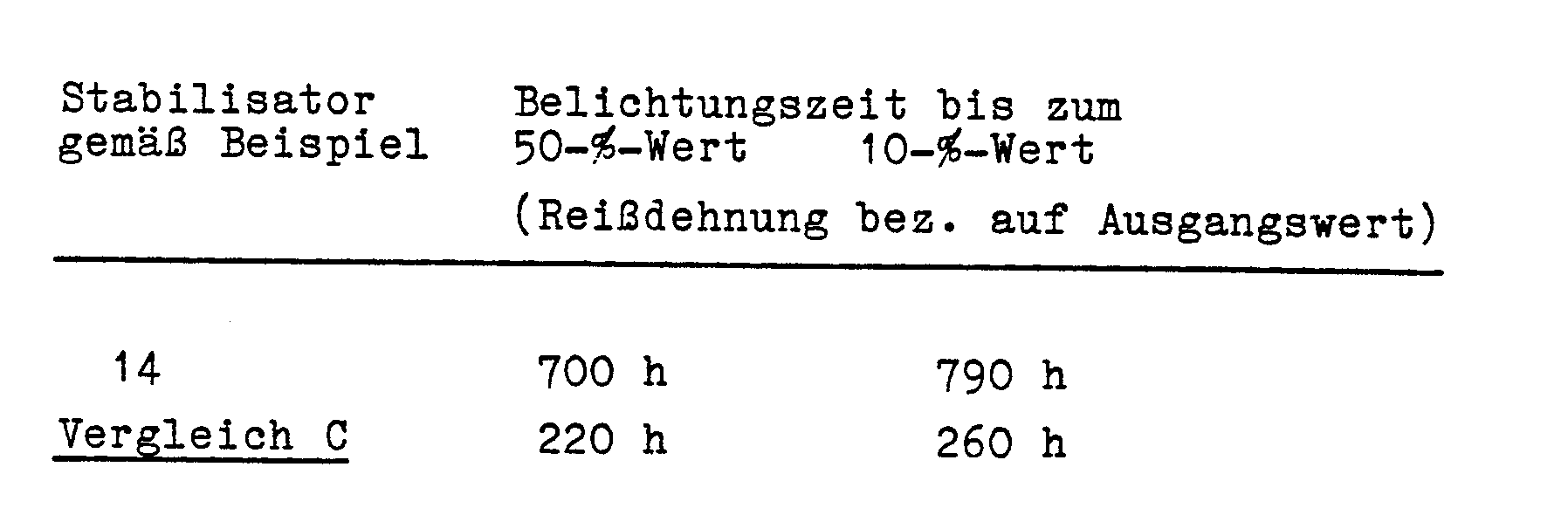
- Aus den gemäß Beispiel 25 hergestellten Platten wurden Prüfkörper nach DIN 53 455, Form 3, verkleinert im Maßstab 1:3 ausgestanzt.
- Zur Bestimmung der Lichtstabilität wurden diese Proben im Gerät Xenotest 450 der Bestrahlung mit Dauerlicht unterworfen. Verwendet wurden 6 IR- und 1 UV-Filter sowie eine Schwarztafeltemperatur von ca. 75°C (am Ende der Trockenperiode), 17 min Trockenperiode und 3 min Beregnung und eine relative Luftfeuchtigkeit während der Trockenperiode von ca. 70 %. Gemessen wurde die Reißdehnung auf einer Zugprüfmaschine bei einer Abzugsgeschwindigkeit von 5 cm/min nach bestimmten Belichtungszeiten. Aus diesen Daten wurden dann folgende Ergebnisse ermittelt:
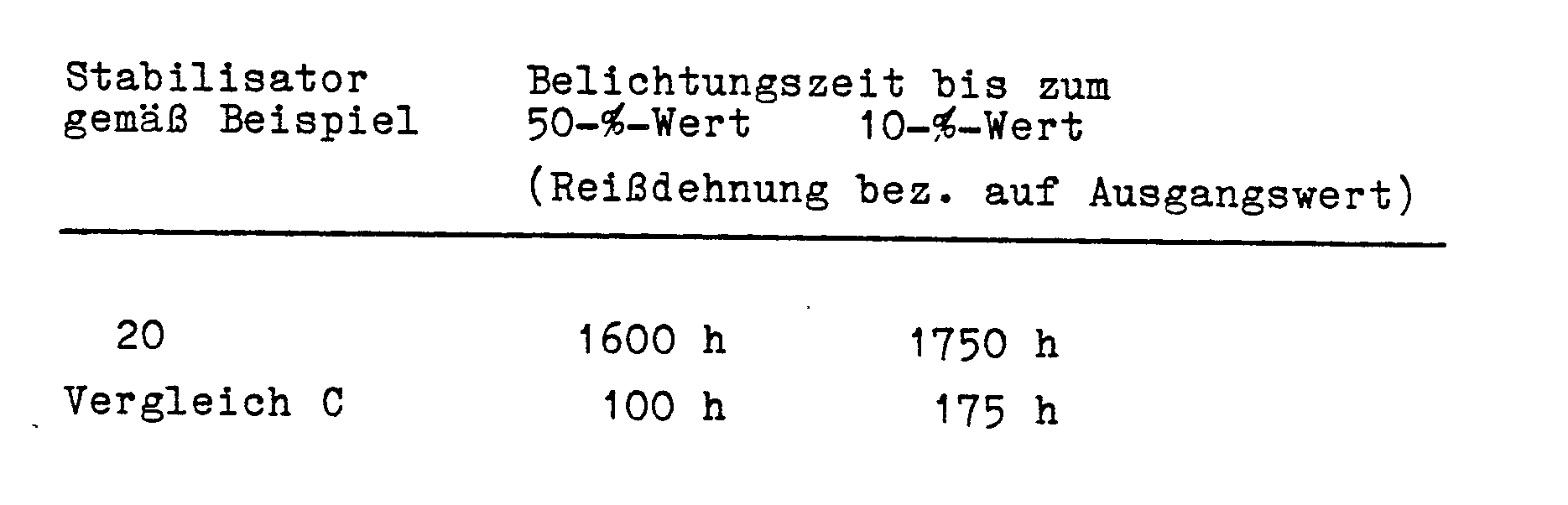
Claims (7)

n eine ganze Zahl von 1 bis 4 ist,
m eine ganze Zahl von 1 bis 100 ist,
R¹ Wasserstoff, C₁- bis C₄-Alkyl, Benzyl, Allyl, C₂- bis C₃₀-Alkanoyl, C₂- bis C₂₀-Alkenoyl, C₇- bis C₁₁-Aroyl, C₈- bis C₁₄-Arylalkanoyl oder C₈- bis C₂₀-Alkylaryl ist,
R² Wasserstoff oder C₁- bis C₄-Alkyl ist,
R³ und R⁴ gleich oder verschieden sind und Wasserstoff, C₁- bis C₁₃-Alkyl, unsubstituiertes oder durch Chlor oder C₁- bis C₄-Alkyl substituiertes Phenyl, unsubstituiertes oder durch C₁- bis C₄-Alkyl substituiertes C₇- bis C₁₄-Aralkyl
oder zusammen mit dem sie bindenden Kohlenstoffatom einen unsubstituierten oder durch bis zu vier C₁- bis C₄-Alkylgruppen substituierten C₅- bis C₁₂-Cycloalkyl- oder Piperidinring bedeuten,
R⁵ bei n=1 C₂- bis C₁₈-Alkylen, unsubstituiertes oder durch bis zu zwei C₁- bis C₄- Alkylgruppen substituiertes Phenylen, α,ω-Dicarboxi-C₁- bis C₈-Alkylen, einen Dicarboxy-C₆-Ring, C₇- bis C₁₄-Aralkylen, Cycloalkylen, Dicycloalkylen, Tricycloalkylen, Bismethylenmonocycloalkylen, Bismethylendicycloalkylen, Bismethylentricycloalkylen, Arylen, Bisarylenalkyl, wobei diese Reste auch durch Brom oder Chlor oder C₁- bis C₄-Alkyreste substituiert sein können, einen Rest

r = 1 bis 20 und R⁶ gleich C₂- bis C₁₂-Alkylen, Cycloalkylen, Dicycloalkylen, Tricycloalkylen, Bismethylenmonocycloalkylen, Bismethylendicycloalkylen, Bismethylentricycloalkylen, Arylen, Bisarylenalkyl, wobei diese Reste auch durch Brom oder Chlor bzw. C₁- bis C₄-Alkylreste substituiert sein können, bedeutet,
R⁵ bei n=2 den Rest eines trifunktionellen Alkohols oder Amins, den trifunktionellen Rest eines aliphatischen Alkohols, der noch weitere Hydroxylgruppen enthält, den trifunktionellen Rest eines Novolaks auf Basis Phenol, Kresol, Bisphenol-F oder Bisphenol-A bedeutet,
R⁵ bei n=3 den tetrafunktionellen Rest eines aliphatischen Alkohols oder Amins oder eines Novolaks auf Basis Phenol, Kresol, Bisphenol-F oder Bisphenol-A oder den Rest

R⁵ bei n=4 einen pentafunktionellen Rest eines Polyols, eines Polyamins, eines Novolaks auf Basis Phenol, Kresol, Bisphenol-F oder Bisphenol-A bedeutet,


Z Wasserstoff, ein Rest der Formel (III)

E für Wasserstoff, Hydroxyl, einen Rest der Formel (IV), (V) oder (VI)


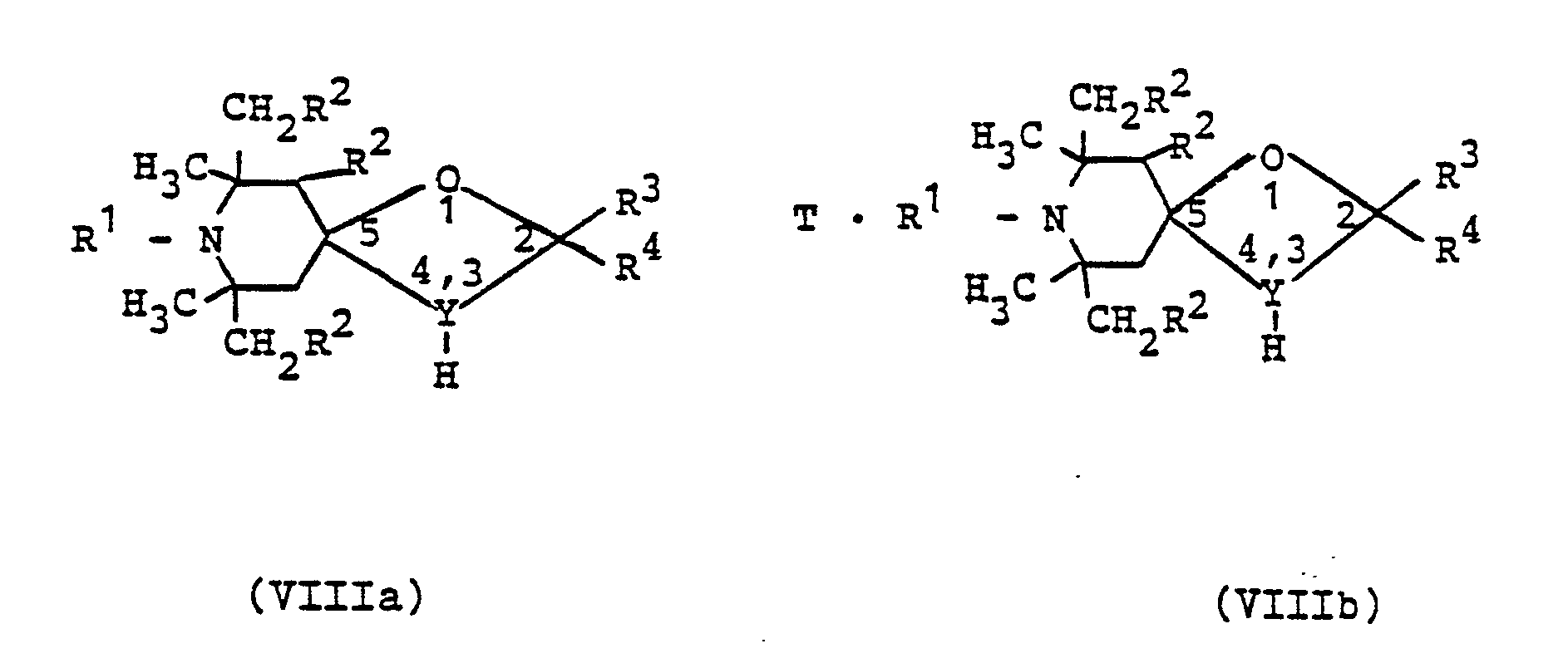

Priority Applications (1)
| Application Number | Priority Date | Filing Date | Title |
|---|---|---|---|
| AT86115962T ATE59852T1 (de) | 1985-11-26 | 1986-11-18 | Oligomere diazaoxaspirodecane, ihre herstellung und ihre verwendung als lichtschutzmittel fuer polymere. |
Applications Claiming Priority (2)
| Application Number | Priority Date | Filing Date | Title |
|---|---|---|---|
| DE3541664 | 1985-11-26 | ||
| DE19853541664 DE3541664A1 (de) | 1985-11-26 | 1985-11-26 | Oligomere diazaspirodecane, ihre herstellung und ihre verwendung als lichtschutzmittel fuer polymere |
Publications (2)
| Publication Number | Publication Date |
|---|---|
| EP0224791A1 true EP0224791A1 (de) | 1987-06-10 |
| EP0224791B1 EP0224791B1 (de) | 1991-01-09 |
Family
ID=6286806
Family Applications (1)
| Application Number | Title | Priority Date | Filing Date |
|---|---|---|---|
| EP86115962A Expired - Lifetime EP0224791B1 (de) | 1985-11-26 | 1986-11-18 | Oligomere Diazaoxaspirodecane, ihre Herstellung und ihre Verwendung als Lichtschutzmittel für Polymere |
Country Status (11)
| Country | Link |
|---|---|
| US (1) | US4797436A (de) |
| EP (1) | EP0224791B1 (de) |
| JP (1) | JPH0772236B2 (de) |
| AT (1) | ATE59852T1 (de) |
| AU (1) | AU586520B2 (de) |
| BR (1) | BR8605772A (de) |
| CA (1) | CA1285949C (de) |
| DE (2) | DE3541664A1 (de) |
| ES (1) | ES2002662A6 (de) |
| MX (1) | MX163461B (de) |
| ZA (1) | ZA868917B (de) |
Cited By (1)
| Publication number | Priority date | Publication date | Assignee | Title |
|---|---|---|---|---|
| CN107108982A (zh) * | 2014-12-19 | 2017-08-29 | 株式会社Adeka | 聚烯烃系树脂组合物 |
Families Citing this family (5)
| Publication number | Priority date | Publication date | Assignee | Title |
|---|---|---|---|---|
| DE3524542A1 (de) * | 1985-07-10 | 1987-01-22 | Hoechst Ag | 1-oxa-3-oxo-4,8-diaza-spiro-(4,5)decan- verbindungen |
| DE3541665A1 (de) * | 1985-11-26 | 1987-05-27 | Hoechst Ag | Substituierte diazaspirodecane, ihre herstellung und ihre verwendung als stabilisatoren fuer polymere |
| US5213897A (en) * | 1991-04-03 | 1993-05-25 | Elf Atochem North America, Inc. | Epoxy resins containing bound light stabilizing groups |
| GB9511486D0 (en) * | 1995-06-07 | 1995-08-02 | Sandoz Ag | Organic compounds |
| DE19735255B4 (de) | 1997-08-14 | 2007-08-23 | Clariant Produkte (Deutschland) Gmbh | Synergistisches Stabilisatorgemisch auf Basis von Polyalkyl-1-oxa-diazaspirodecan-Verbindungen und dessen Verwendung |
Citations (2)
| Publication number | Priority date | Publication date | Assignee | Title |
|---|---|---|---|---|
| EP0028318A1 (de) * | 1979-10-10 | 1981-05-13 | Hoechst Aktiengesellschaft | Ether auf Basis von Polyalkyl-1-oxa-diazaspirodecanen, ihre Herstellung, ihre Verwendung, sowie mit ihnen stabilisierte synthetische Polymere |
| DE3104294A1 (de) * | 1981-02-07 | 1982-08-19 | Hoechst Ag, 6000 Frankfurt | Substituierte diazaspirodecane, ihre herstellung, ihre verwendung als stabilisatoren fuer organische polymere, sowie die so stabilisierten polymeren |
Family Cites Families (3)
| Publication number | Priority date | Publication date | Assignee | Title |
|---|---|---|---|---|
| DE2606026C2 (de) * | 1976-02-14 | 1982-03-25 | Hoechst Ag, 6000 Frankfurt | 1-Oxa-3,8-diaza-spiro- [4,5] -decane, ihre Herstellung und ihre Verwendung als Lichtstabilisatoren |
| DE2634957C3 (de) * | 1976-08-04 | 1980-10-02 | Hoechst Ag, 6000 Frankfurt | l-Oxa-4,8-diaza-spiro- [43] -decane, ihre Herstellung und ihre Verwendung als Lichtschutzmittel |
| DE3541665A1 (de) * | 1985-11-26 | 1987-05-27 | Hoechst Ag | Substituierte diazaspirodecane, ihre herstellung und ihre verwendung als stabilisatoren fuer polymere |
-
1985
- 1985-11-26 DE DE19853541664 patent/DE3541664A1/de not_active Withdrawn
-
1986
- 1986-11-18 EP EP86115962A patent/EP0224791B1/de not_active Expired - Lifetime
- 1986-11-18 DE DE8686115962T patent/DE3676792D1/de not_active Expired - Fee Related
- 1986-11-18 AT AT86115962T patent/ATE59852T1/de not_active IP Right Cessation
- 1986-11-24 US US06/934,109 patent/US4797436A/en not_active Expired - Fee Related
- 1986-11-24 ES ES8603154A patent/ES2002662A6/es not_active Expired
- 1986-11-25 ZA ZA868917A patent/ZA868917B/xx unknown
- 1986-11-25 CA CA000523781A patent/CA1285949C/en not_active Expired - Fee Related
- 1986-11-25 JP JP61278913A patent/JPH0772236B2/ja not_active Expired - Lifetime
- 1986-11-25 AU AU65658/86A patent/AU586520B2/en not_active Ceased
- 1986-11-25 BR BR8605772A patent/BR8605772A/pt unknown
- 1986-11-26 MX MX4434A patent/MX163461B/es unknown
Patent Citations (2)
| Publication number | Priority date | Publication date | Assignee | Title |
|---|---|---|---|---|
| EP0028318A1 (de) * | 1979-10-10 | 1981-05-13 | Hoechst Aktiengesellschaft | Ether auf Basis von Polyalkyl-1-oxa-diazaspirodecanen, ihre Herstellung, ihre Verwendung, sowie mit ihnen stabilisierte synthetische Polymere |
| DE3104294A1 (de) * | 1981-02-07 | 1982-08-19 | Hoechst Ag, 6000 Frankfurt | Substituierte diazaspirodecane, ihre herstellung, ihre verwendung als stabilisatoren fuer organische polymere, sowie die so stabilisierten polymeren |
Cited By (2)
| Publication number | Priority date | Publication date | Assignee | Title |
|---|---|---|---|---|
| CN107108982A (zh) * | 2014-12-19 | 2017-08-29 | 株式会社Adeka | 聚烯烃系树脂组合物 |
| CN107108982B (zh) * | 2014-12-19 | 2020-03-13 | 株式会社Adeka | 聚烯烃系树脂组合物 |
Also Published As
| Publication number | Publication date |
|---|---|
| ATE59852T1 (de) | 1991-01-15 |
| EP0224791B1 (de) | 1991-01-09 |
| AU6565886A (en) | 1987-05-28 |
| DE3541664A1 (de) | 1987-06-11 |
| DE3676792D1 (de) | 1991-02-14 |
| US4797436A (en) | 1989-01-10 |
| AU586520B2 (en) | 1989-07-13 |
| JPS62129312A (ja) | 1987-06-11 |
| ES2002662A6 (es) | 1988-09-16 |
| CA1285949C (en) | 1991-07-09 |
| BR8605772A (pt) | 1987-08-25 |
| MX163461B (es) | 1992-05-18 |
| JPH0772236B2 (ja) | 1995-08-02 |
| ZA868917B (en) | 1987-07-29 |
Similar Documents
| Publication | Publication Date | Title |
|---|---|---|
| EP0024338B1 (de) | Neue Triazinderivate, ihre Herstellung und ihre Verwendung als Stabilisatoren für synthetische Polymere | |
| EP0028318B1 (de) | Ether auf Basis von Polyalkyl-1-oxa-diazaspirodecanen, ihre Herstellung, ihre Verwendung, sowie mit ihnen stabilisierte synthetische Polymere | |
| EP0029522B1 (de) | s-Triazinderivate, ihre Herstellung aus Halogentriazinylaminen und Polyaminen, und ihre Verwendung als Stabilisatoren | |
| EP0057885B1 (de) | Substituierte Diazaspirodecane, ihre Herstellung, ihre Verwendung als Stabilisatoren für organische Polymere, sowie die so stabilisierten Polymere | |
| DE2719131C2 (de) | ||
| EP0053775B1 (de) | Poly-bis-triazinylamine, Verfahren zu ihrer Herstellung, ihre Verwendung zum Stabilisieren von synthetischen Polymeren und die so stabilisierten Polymeren | |
| EP0402889B1 (de) | Polymere Polyalkyl-1-oxa-diazaspirodecane | |
| EP0025867B1 (de) | Alkylierte Diazaspirodecane, ihre Herstellung und Verwendung als Lichtschutzmittel | |
| EP0044499B1 (de) | Triazinylaminotriazine, ihre Herstellung, ihre Verwendung zum Stabilisieren von synthetischen Polymeren sowie die mit ihnen stabilisierten Produkte | |
| EP0981530B1 (de) | Verbindungen auf basis von polyalkyl-1-oxa-diazaspirodecan-verbindungen | |
| EP0224181B1 (de) | Substituierte Diazaoxaspirodecane, ihre Herstellung und ihre Verwendung als Stabilisatoren für Polymere | |
| EP0042554B1 (de) | Polytriazinylamine, Verfahren zu ihrer Herstellung, ihre Verwendung als Stabilisatoren für synthetische Polymere und mit diesen Verbindungen stabilisierte Polymere | |
| EP0176604B1 (de) | Hochmolekulare piperidingruppenhaltige Ester, Verfahren zu ihrer Herstellung, ihre Verwendung als Stabilisatoren für Polymere, sowie diese Verbindungen enthaltende Polymere | |
| EP0224791B1 (de) | Oligomere Diazaoxaspirodecane, ihre Herstellung und ihre Verwendung als Lichtschutzmittel für Polymere | |
| EP0065169B1 (de) | Poly-bis-triazinylaminotriazinylamine, ihre Herstellung, ihre Verwendung als Lichtschutzmittel für Kunststoffe und mit ihnen stabilisierte Kunststoffe | |
| EP0068083B1 (de) | Poly-bis-triazinylimide, ihre Herstellung, ihre Verwendung als Lichtschutzmittel für Polymere sowie die mit ihnen stabilisierten Polymeren | |
| EP0064752B1 (de) | Durch Piperidylgruppen substituierte Phosphazene, Verfahren zu ihrer Herstellung, ihre Verwendung als Stabilisatoren und die mit ihnen stabilisierten Polymermassen | |
| EP0043347A1 (de) | Halogenhaltige Benzimidazolonbisglycide und ihre Verwendung |
Legal Events
| Date | Code | Title | Description |
|---|---|---|---|
| PUAI | Public reference made under article 153(3) epc to a published international application that has entered the european phase |
Free format text: ORIGINAL CODE: 0009012 |
|
| AK | Designated contracting states |
Kind code of ref document: A1 Designated state(s): AT BE CH DE FR GB IT LI NL SE |
|
| 17P | Request for examination filed |
Effective date: 19870912 |
|
| 17Q | First examination report despatched |
Effective date: 19890213 |
|
| GRAA | (expected) grant |
Free format text: ORIGINAL CODE: 0009210 |
|
| AK | Designated contracting states |
Kind code of ref document: B1 Designated state(s): AT BE CH DE FR GB IT LI NL SE |
|
| REF | Corresponds to: |
Ref document number: 59852 Country of ref document: AT Date of ref document: 19910115 Kind code of ref document: T |
|
| REF | Corresponds to: |
Ref document number: 3676792 Country of ref document: DE Date of ref document: 19910214 |
|
| ITF | It: translation for a ep patent filed | ||
| ET | Fr: translation filed | ||
| GBT | Gb: translation of ep patent filed (gb section 77(6)(a)/1977) | ||
| PLBE | No opposition filed within time limit |
Free format text: ORIGINAL CODE: 0009261 |
|
| STAA | Information on the status of an ep patent application or granted ep patent |
Free format text: STATUS: NO OPPOSITION FILED WITHIN TIME LIMIT |
|
| 26N | No opposition filed | ||
| EAL | Se: european patent in force in sweden |
Ref document number: 86115962.2 |
|
| PGFP | Annual fee paid to national office [announced via postgrant information from national office to epo] |
Ref country code: FR Payment date: 19971015 Year of fee payment: 12 |
|
| PGFP | Annual fee paid to national office [announced via postgrant information from national office to epo] |
Ref country code: GB Payment date: 19971020 Year of fee payment: 12 |
|
| PGFP | Annual fee paid to national office [announced via postgrant information from national office to epo] |
Ref country code: NL Payment date: 19971031 Year of fee payment: 12 Ref country code: CH Payment date: 19971031 Year of fee payment: 12 |
|
| PGFP | Annual fee paid to national office [announced via postgrant information from national office to epo] |
Ref country code: AT Payment date: 19971103 Year of fee payment: 12 |
|
| PGFP | Annual fee paid to national office [announced via postgrant information from national office to epo] |
Ref country code: SE Payment date: 19971104 Year of fee payment: 12 |
|
| PGFP | Annual fee paid to national office [announced via postgrant information from national office to epo] |
Ref country code: BE Payment date: 19971125 Year of fee payment: 12 |
|
| PGFP | Annual fee paid to national office [announced via postgrant information from national office to epo] |
Ref country code: DE Payment date: 19980122 Year of fee payment: 12 |
|
| PG25 | Lapsed in a contracting state [announced via postgrant information from national office to epo] |
Ref country code: GB Free format text: LAPSE BECAUSE OF NON-PAYMENT OF DUE FEES Effective date: 19981118 Ref country code: AT Free format text: LAPSE BECAUSE OF NON-PAYMENT OF DUE FEES Effective date: 19981118 |
|
| PG25 | Lapsed in a contracting state [announced via postgrant information from national office to epo] |
Ref country code: SE Free format text: LAPSE BECAUSE OF NON-PAYMENT OF DUE FEES Effective date: 19981119 |
|
| PG25 | Lapsed in a contracting state [announced via postgrant information from national office to epo] |
Ref country code: LI Free format text: LAPSE BECAUSE OF NON-PAYMENT OF DUE FEES Effective date: 19981130 Ref country code: CH Free format text: LAPSE BECAUSE OF NON-PAYMENT OF DUE FEES Effective date: 19981130 Ref country code: BE Free format text: LAPSE BECAUSE OF NON-PAYMENT OF DUE FEES Effective date: 19981130 |
|
| BERE | Be: lapsed |
Owner name: HOECHST A.G. Effective date: 19981130 |
|
| PG25 | Lapsed in a contracting state [announced via postgrant information from national office to epo] |
Ref country code: NL Free format text: LAPSE BECAUSE OF NON-PAYMENT OF DUE FEES Effective date: 19990601 |
|
| GBPC | Gb: european patent ceased through non-payment of renewal fee |
Effective date: 19981118 |
|
| REG | Reference to a national code |
Ref country code: CH Ref legal event code: PL |
|
| PG25 | Lapsed in a contracting state [announced via postgrant information from national office to epo] |
Ref country code: FR Free format text: LAPSE BECAUSE OF NON-PAYMENT OF DUE FEES Effective date: 19990730 |
|
| EUG | Se: european patent has lapsed |
Ref document number: 86115962.2 |
|
| NLV4 | Nl: lapsed or anulled due to non-payment of the annual fee |
Effective date: 19990601 |
|
| REG | Reference to a national code |
Ref country code: FR Ref legal event code: ST |
|
| PG25 | Lapsed in a contracting state [announced via postgrant information from national office to epo] |
Ref country code: DE Free format text: LAPSE BECAUSE OF NON-PAYMENT OF DUE FEES Effective date: 19990901 |
|
| PG25 | Lapsed in a contracting state [announced via postgrant information from national office to epo] |
Ref country code: IT Free format text: LAPSE BECAUSE OF NON-PAYMENT OF DUE FEES;WARNING: LAPSES OF ITALIAN PATENTS WITH EFFECTIVE DATE BEFORE 2007 MAY HAVE OCCURRED AT ANY TIME BEFORE 2007. THE CORRECT EFFECTIVE DATE MAY BE DIFFERENT FROM THE ONE RECORDED. Effective date: 20051118 |