EP0225090A2 - Fussbodenplatten - Google Patents
Fussbodenplatten Download PDFInfo
- Publication number
- EP0225090A2 EP0225090A2 EP86308849A EP86308849A EP0225090A2 EP 0225090 A2 EP0225090 A2 EP 0225090A2 EP 86308849 A EP86308849 A EP 86308849A EP 86308849 A EP86308849 A EP 86308849A EP 0225090 A2 EP0225090 A2 EP 0225090A2
- Authority
- EP
- European Patent Office
- Prior art keywords
- tray
- side walls
- corners
- upper edge
- floor panel
- Prior art date
- Legal status (The legal status is an assumption and is not a legal conclusion. Google has not performed a legal analysis and makes no representation as to the accuracy of the status listed.)
- Withdrawn
Links
Images


Classifications
-
- B—PERFORMING OPERATIONS; TRANSPORTING
- B21—MECHANICAL METAL-WORKING WITHOUT ESSENTIALLY REMOVING MATERIAL; PUNCHING METAL
- B21D—WORKING OR PROCESSING OF SHEET METAL OR METAL TUBES, RODS OR PROFILES WITHOUT ESSENTIALLY REMOVING MATERIAL; PUNCHING METAL
- B21D51/00—Making hollow objects
- B21D51/16—Making hollow objects characterised by the use of the objects
- B21D51/26—Making hollow objects characterised by the use of the objects cans or tins; Closing same in a permanent manner
- B21D51/2646—Of particular non cylindrical shape, e.g. conical, rectangular, polygonal, bulged
-
- B—PERFORMING OPERATIONS; TRANSPORTING
- B21—MECHANICAL METAL-WORKING WITHOUT ESSENTIALLY REMOVING MATERIAL; PUNCHING METAL
- B21D—WORKING OR PROCESSING OF SHEET METAL OR METAL TUBES, RODS OR PROFILES WITHOUT ESSENTIALLY REMOVING MATERIAL; PUNCHING METAL
- B21D22/00—Shaping without cutting, by stamping, spinning, or deep-drawing
- B21D22/02—Stamping using rigid devices or tools
-
- E—FIXED CONSTRUCTIONS
- E04—BUILDING
- E04F—FINISHING WORK ON BUILDINGS, e.g. STAIRS, FLOORS
- E04F15/00—Flooring
- E04F15/02—Flooring or floor layers composed of a number of similar elements
- E04F15/024—Sectional false floors, e.g. computer floors
- E04F15/02405—Floor panels
- E04F15/02417—Floor panels made of box-like elements
- E04F15/02423—Floor panels made of box-like elements filled with core material
Definitions
- the present invention relates to floor panels.
- the floors are formed by load bearing floor panels supported by their edges on a lightweight metal grid several inches above a concrete slab to provide a ready space for routing and access to communication,power and mechanical services.
- the metal grid is supported by jacks.
- the floor panels can be supported directly on the jacks.
- the normal arrangement is for a jack to be positioned at each corner of each panel, one jack therefore providing support to four adjacent panel corners.
- One or more panels can be removed for access to the aforementioned services.
- such a panel has been formed by pressing or drawing from sheet steel to provide a tray or stiffening web having a base and side walls with the floor surface being formed by a flat sheet metal top plate being secured by welding or adhesive to horizontal flanges formed along the upper edges of the tray side walls.
- the panel walls are inclined at an acute angle to the vertical away from the panel centre to provide an outward taper to the panels. This ensures that adjacent panels engage by "line” contact along their upper edges and not over the whole area of the side walls since the latter would give rise to undue relative moment of the panels when in use.
- the panel In order to provide the panel with a "solid" feel the panel is infilled with chipboard prior to the top plate being fitted, the chipboard being secured in place by adhesive.
- One disadvantage of the above-described panel is that when tested for strength by the application of a point load, there is a tendency for the panel side walls to buckle.
- the tray or stiffening web therefore, has to be folded from relatively heavy gauge metal to provide sufficient strength.
- a further disadvantage is that it has hitherto proved impossible to draw the tray from sheet metal with the desired wall taper without the metal tearing and splitting at the tray corners.
- Such a tray therefore, is produced with open corners and these open corners represent a fire hazard. Should a fire occur in the space beneath an array of floor panels the panel open corners would allow the fire to spread relatively quickly through the chipboard infills in the panels and also to any flooring material covering the panels.
- the corners can, of course, be sealed by welding but the disadvantages of this are obvious in terms of time and cost.
- the present invention seeks to provide an improved method for manufacturing a load-bearing floor panel and tray therefor.
- the present invention provides a method of producing a tray for a load-bearing floor panel having side walls which are inclined outwardly of the tray and have closed corners, the method comprising the steps of: a) drawing said tray from sheet metal to a desired depth to provide a tray whose side walls are substantially vertical and are closed at the corners thereof; and b) subsequently redrawing said tray to incline an upper portion of said tray side walls outwardly of said tray while retaining said corners closed.
- the present invention also provides a floor panel having a tray drawn from sheet metal, the tray having a base and upstanding side walls wherein the corners of said side walls are closed and an upper portion of said walls is inclined outwardly of the panel.
- each side wall is provided with a flange for turning inwardly of the tray into a horizontal attitude to locate in a rebate formed in an outer edge region of the upper surface of an infill for the tray.
- the infill is preferably chipboard and the flanges form a flush fit with the upper surface of the infill.
- Producing a tray for a floor panel in accordance with the invention provides a floor panel the corners of which are closed, without any additional steps such as welding of the corners having to be undertaken. Having the upper portion of the tray side walls angled relative to the remainder of the side walls provides a wall stiffening feature together with the closed corners thus allowing a thinner gauge sheet material to be used than would otherwise be the case.
- Figure 1 shows a punch 10 having an upper die 11, and a lower die 12 in which a sheet metal blank is cold drawn in a first drawing operation, the metal blank having been stamped from a sheet metal, typically sheet steel.
- the metal blank is drawn into a cup-shaped tray 14 having a substantially planar base 16 and vertical side walls 18. The depth to which the tray is drawn will, of course, take into account the desired depth of the finished floor panel.
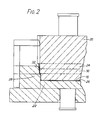
- the tray 16 is then redrawn in a second operation, shown in Figure 2, using a further punch 20 and lower die 22.
- the punch 20 has an upper die 24 which, together with the lower die 22, is shaped to effect the second cold drawing operation mainly on the upper portion of the side walls of the tray 16.
- Both dies have lower portions 26, 28 with cooperating vertical side walls and cooperating upper portions 30, 32 which are inclined outwardly.
- the inclined upper portions 30, 32 extend the full periphery of the die walls and, at their juncture with the vertical wall portions 26, 28 are laterally offset outwardly of the dies to effect a beading or "joggle" in the side walls of the tray 16, the joggle extending the full length of the side walls.
- the resulting shape of the tray 16 is best seen in Figures 3-5.
- Figure 5 the shape of the tray formed by the first drawing operation of Figure 1 is shown in dotted lines with the final shape of the tray resulting from the drawing operation of Figure 2 being shown in solid lines.
- the lower portion 26 of the upper die has a slightly smaller horizontal cross sectional shape than the upper die 11 of figure 1, with the lower portion 28 of the lower die 22 correspondingly shaped, to reduce the spacing of the lower wall portions 34 of the tray, this reduction being typically 2.5 or 3mm for each side wall.
- the joggle 36 and inclined upper wall portion 38 are also clearly shown in Figure 5.
- Figures 3 and 5 also show upper flanges 40 which are provided on the tray side walls, these being folded inwardly into a horizontal attitude, as shown in Figure 4, to sit flush in rebates formed in the upper surface edge region of a chipboard or other infill 42 previously secured in the tray, for example by adhesive.
- the top of the tray is then covered by a top plate which is secured to the flanges and infill, again conveniently by adhesive.
- the chipboard infill provides the panel with a solid feel.
- these flanges can be trimmed as waste material.
- Wood infills used with the trays occasionally exhibit a lack of consistency in the dimensions of the wood infills as a result of which the side walls of a tray might not fit flush against the side wall of the wood infill, at least along the whole of the uppermost edge of the tray side walls.
- the uppermost edge portion of each side wall of a tray may be deformed inwardly of the tray by an amount sufficient to ensure that when the wood infill is dropped into the tray contact between the side walls and the infill is made around the whole of the periphery of the infill.
- the uppermost portion of each side wall is deformed inwardly by an amount typically 0.2 mm. This is sufficient to compensate for any variations in the dimensions of the wood infills.
- the uppermost portions of the side walls of the latter are forced outwardly by the required amount.
- a small notch 44 is cut into each corner of the tray as shown in figure 6. This notch is typically 3 mm deep so that it is only the uppermost few millimetres of the side walls which is deformed inwardly.
- Cutting of the notches can be effected simultaneously with the trimming of waste material from the tray corners.
- the tray and wood infill Prior to the infill being dropped into the tray, the tray and wood infill are sprayed with an adhesive. After the wood infill is dropped into the tray the assembly is then passed beneath rollers which force the infill fully home into the tray.
- Inward deformation of the upper portion of the side walls of each tray can be effected conveniently during trimming of waste material from the side walls.
Landscapes
- Engineering & Computer Science (AREA)
- Architecture (AREA)
- Mechanical Engineering (AREA)
- General Engineering & Computer Science (AREA)
- Civil Engineering (AREA)
- Structural Engineering (AREA)
- Floor Finish (AREA)
Applications Claiming Priority (2)
| Application Number | Priority Date | Filing Date | Title |
|---|---|---|---|
| GB8528589 | 1985-11-20 | ||
| GB858528589A GB8528589D0 (en) | 1985-11-20 | 1985-11-20 | Floor panel |
Publications (2)
| Publication Number | Publication Date |
|---|---|
| EP0225090A2 true EP0225090A2 (de) | 1987-06-10 |
| EP0225090A3 EP0225090A3 (de) | 1989-06-07 |
Family
ID=10588512
Family Applications (1)
| Application Number | Title | Priority Date | Filing Date |
|---|---|---|---|
| EP86308849A Withdrawn EP0225090A3 (de) | 1985-11-20 | 1986-11-13 | Fussbodenplatten |
Country Status (2)
| Country | Link |
|---|---|
| EP (1) | EP0225090A3 (de) |
| GB (2) | GB8528589D0 (de) |
Cited By (4)
| Publication number | Priority date | Publication date | Assignee | Title |
|---|---|---|---|---|
| EP0405024A1 (de) * | 1989-06-27 | 1991-01-02 | High Accolade Limited | Bauplatte |
| GB2317129A (en) * | 1996-09-17 | 1998-03-18 | Francis Sidney Clark | Access Cover |
| WO2009042229A1 (en) * | 2007-09-28 | 2009-04-02 | Haworth, Inc. | Floor tile with adhesively bonded concrete and manufacturing process therefor |
| JPWO2021060274A1 (de) * | 2019-09-24 | 2021-04-01 |
Families Citing this family (4)
| Publication number | Priority date | Publication date | Assignee | Title |
|---|---|---|---|---|
| DE3741041A1 (de) * | 1987-02-19 | 1988-09-01 | Mahle Gmbh | Verfahren zur herstellung eines rahmens fuer aufgestaenderte doppelbodenplatten |
| RU2250317C1 (ru) * | 2004-08-13 | 2005-04-20 | Кардашев Сергей Николаевич | Плита, преимущественно, для сборки приподнятого пола |
| RU2250318C1 (ru) * | 2004-08-13 | 2005-04-20 | Кардашев Сергей Николаевич | Панель фальшпола |
| GB0419655D0 (en) * | 2004-09-06 | 2004-10-06 | Furmanite Internat Ltd | Building panels |
Family Cites Families (3)
| Publication number | Priority date | Publication date | Assignee | Title |
|---|---|---|---|---|
| DE1552082A1 (de) * | 1966-11-02 | 1970-01-29 | Siemens Elektrogeraete Gmbh | Verfahren zur Herstellung eines Blechwandteils |
| US3568390A (en) * | 1969-02-24 | 1971-03-09 | Liskey Aluminum | Reinforced floor panel structure |
| AU529459B2 (en) * | 1979-05-22 | 1983-06-09 | Tate Architectural Products Inc. | Load bearing panels |
-
1985
- 1985-11-20 GB GB858528589A patent/GB8528589D0/en active Pending
-
1986
- 1986-11-13 EP EP86308849A patent/EP0225090A3/de not_active Withdrawn
- 1986-11-20 GB GB08627811A patent/GB2183689B/en not_active Expired
Cited By (8)
| Publication number | Priority date | Publication date | Assignee | Title |
|---|---|---|---|---|
| EP0405024A1 (de) * | 1989-06-27 | 1991-01-02 | High Accolade Limited | Bauplatte |
| GB2317129A (en) * | 1996-09-17 | 1998-03-18 | Francis Sidney Clark | Access Cover |
| GB2317129B (en) * | 1996-09-17 | 1999-04-07 | Francis Sidney Clark | Access cover |
| WO2009042229A1 (en) * | 2007-09-28 | 2009-04-02 | Haworth, Inc. | Floor tile with adhesively bonded concrete and manufacturing process therefor |
| US7770345B2 (en) | 2007-09-28 | 2010-08-10 | Haworth, Inc. | Floor tile with adhesively joined concrete sub-blocks |
| US7810299B2 (en) | 2007-09-28 | 2010-10-12 | Haworth, Inc. | Manufacturing process for a floor tile |
| JPWO2021060274A1 (de) * | 2019-09-24 | 2021-04-01 | ||
| EP4035789A4 (de) * | 2019-09-24 | 2023-03-01 | Nippon Steel Corporation | Verfahren zur herstellung eines pressgeformten artikels, pressgeformter artikel und pressformvorrichtung |
Also Published As
| Publication number | Publication date |
|---|---|
| GB2183689A (en) | 1987-06-10 |
| GB2183689B (en) | 1989-02-15 |
| EP0225090A3 (de) | 1989-06-07 |
| GB8528589D0 (en) | 1985-12-24 |
| GB8627811D0 (en) | 1986-12-17 |
Similar Documents
| Publication | Publication Date | Title |
|---|---|---|
| US4560301A (en) | Heavy slope and skew sheet metal hanger and method of making same | |
| AU2005295722B2 (en) | Top flange hanger with strengthening embossment | |
| US4453364A (en) | Corrugated steel decking section | |
| AU2006313679B2 (en) | Method for manufacturing of cellular board, cellular board, method for producing cellular board element of steel plate strip, and production line | |
| US5452556A (en) | Metal-wood stud | |
| US8215597B1 (en) | Electrical box support tab construction | |
| EP0225090A2 (de) | Fussbodenplatten | |
| JPH0242735B2 (de) | ||
| US3905171A (en) | Building panels | |
| EP0529072A1 (de) | Fussbodenplatte und vorrichtung zur verbindung von fussbodenplatten | |
| US4753058A (en) | Elevated floor panel and method of manufacturing same | |
| US4010587A (en) | Nailable flooring construction | |
| US20040231272A1 (en) | Profiled metal sheet | |
| US3380217A (en) | Raised floor plate | |
| JPH06341180A (ja) | シャフト壁及びそのための水平金属間柱 | |
| JP7551683B2 (ja) | 床パネル | |
| US4856175A (en) | Method of manufacturing elevated floor panels | |
| GB2130615A (en) | Floor panels | |
| CN212336469U (zh) | 钢壳复合板叠合楼盖 | |
| JP7697920B2 (ja) | 床パネル、床パネル支持構造及び床パネル支持具 | |
| JP2821107B2 (ja) | 建築用の絞り部付形鋼部材、接合構造及びその製造方法 | |
| JPH02293104A (ja) | コンクリート板製作用の型枠装置 | |
| US2063654A (en) | Dividing strip anchor | |
| JP3803261B2 (ja) | 溝付デッキ床及びその製造方法 | |
| JPS6319473Y2 (de) |
Legal Events
| Date | Code | Title | Description |
|---|---|---|---|
| PUAI | Public reference made under article 153(3) epc to a published international application that has entered the european phase |
Free format text: ORIGINAL CODE: 0009012 |
|
| AK | Designated contracting states |
Kind code of ref document: A2 Designated state(s): AT BE CH DE ES FR GR IT LI LU NL SE |
|
| RAP1 | Party data changed (applicant data changed or rights of an application transferred) |
Owner name: PERMOID INDUSTRIES LIMITED |
|
| PUAL | Search report despatched |
Free format text: ORIGINAL CODE: 0009013 |
|
| AK | Designated contracting states |
Kind code of ref document: A3 Designated state(s): AT BE CH DE ES FR GR IT LI LU NL SE |
|
| STAA | Information on the status of an ep patent application or granted ep patent |
Free format text: STATUS: THE APPLICATION IS DEEMED TO BE WITHDRAWN |
|
| 18D | Application deemed to be withdrawn |
Effective date: 19891208 |
|
| RIN1 | Information on inventor provided before grant (corrected) |
Inventor name: PROCTER, GEORGE BARRY |