EP0225217A1 - (Chloro-3 propionyl)-2 fluoro-4 phénol, procédé pour sa préparation, et application à la préparation de la fluoro-6 chromanone-4 - Google Patents
(Chloro-3 propionyl)-2 fluoro-4 phénol, procédé pour sa préparation, et application à la préparation de la fluoro-6 chromanone-4 Download PDFInfo
- Publication number
- EP0225217A1 EP0225217A1 EP86402343A EP86402343A EP0225217A1 EP 0225217 A1 EP0225217 A1 EP 0225217A1 EP 86402343 A EP86402343 A EP 86402343A EP 86402343 A EP86402343 A EP 86402343A EP 0225217 A1 EP0225217 A1 EP 0225217A1
- Authority
- EP
- European Patent Office
- Prior art keywords
- fluoro
- chloro
- propionyl
- phenol
- carried out
- Prior art date
- Legal status (The legal status is an assumption and is not a legal conclusion. Google has not performed a legal analysis and makes no representation as to the accuracy of the status listed.)
- Withdrawn
Links
- 238000002360 preparation method Methods 0.000 title claims abstract description 12
- 238000000034 method Methods 0.000 title claims description 12
- JBCKVAMFAGXGNH-UHFFFAOYSA-N 3-chloro-1-(5-fluoro-2-hydroxyphenyl)propan-1-one Chemical compound OC1=CC=C(F)C=C1C(=O)CCCl JBCKVAMFAGXGNH-UHFFFAOYSA-N 0.000 title abstract 2
- SWBBIJZMIGAZHW-UHFFFAOYSA-N 6-fluoro-2,3-dihydrochromen-4-one Chemical compound O1CCC(=O)C2=CC(F)=CC=C21 SWBBIJZMIGAZHW-UHFFFAOYSA-N 0.000 title abstract 2
- 238000010438 heat treatment Methods 0.000 claims abstract description 6
- INUNLMUAPJVRME-UHFFFAOYSA-N 3-chloropropanoyl chloride Chemical compound ClCCC(Cl)=O INUNLMUAPJVRME-UHFFFAOYSA-N 0.000 claims abstract description 5
- RHMPLDJJXGPMEX-UHFFFAOYSA-N 4-fluorophenol Chemical compound OC1=CC=C(F)C=C1 RHMPLDJJXGPMEX-UHFFFAOYSA-N 0.000 claims abstract description 5
- 238000005917 acylation reaction Methods 0.000 claims abstract description 4
- 150000002170 ethers Chemical class 0.000 claims abstract description 4
- 230000010933 acylation Effects 0.000 claims abstract 3
- -1 3-Chloro-propionyl Chemical group 0.000 claims description 20
- ISWSIDIOOBJBQZ-UHFFFAOYSA-N Phenol Chemical compound OC1=CC=CC=C1 ISWSIDIOOBJBQZ-UHFFFAOYSA-N 0.000 claims description 20
- RQEMHCIRNVNLNO-UHFFFAOYSA-N 7-methoxy-3-(4-methoxyphenyl)-2-phenyl-2,3-dihydrochromen-4-one Chemical compound C1=CC(OC)=CC=C1C1C(=O)C2=CC=C(OC)C=C2OC1C1=CC=CC=C1 RQEMHCIRNVNLNO-UHFFFAOYSA-N 0.000 claims description 16
- 238000007363 ring formation reaction Methods 0.000 claims description 10
- XLYOFNOQVPJJNP-UHFFFAOYSA-N water Substances O XLYOFNOQVPJJNP-UHFFFAOYSA-N 0.000 claims description 8
- 239000002253 acid Substances 0.000 claims description 7
- 239000002904 solvent Substances 0.000 claims description 7
- LFQSCWFLJHTTHZ-UHFFFAOYSA-N Ethanol Chemical compound CCO LFQSCWFLJHTTHZ-UHFFFAOYSA-N 0.000 claims description 4
- 229910052784 alkaline earth metal Inorganic materials 0.000 claims description 4
- 238000006243 chemical reaction Methods 0.000 claims description 3
- 238000010992 reflux Methods 0.000 claims description 3
- 150000003839 salts Chemical class 0.000 claims description 3
- QEYMMOKECZBKAC-UHFFFAOYSA-N 3-chloropropanoic acid Chemical compound OC(=O)CCCl QEYMMOKECZBKAC-UHFFFAOYSA-N 0.000 claims description 2
- 125000001255 4-fluorophenyl group Chemical group [H]C1=C([H])C(*)=C([H])C([H])=C1F 0.000 claims description 2
- 239000003513 alkali Substances 0.000 claims description 2
- 150000001342 alkaline earth metals Chemical class 0.000 claims description 2
- 150000001412 amines Chemical class 0.000 claims description 2
- 230000017105 transposition Effects 0.000 claims 2
- 125000005907 alkyl ester group Chemical group 0.000 claims 1
- 150000004945 aromatic hydrocarbons Chemical class 0.000 claims 1
- 229910000000 metal hydroxide Inorganic materials 0.000 claims 1
- 150000004692 metal hydroxides Chemical class 0.000 claims 1
- 150000001875 compounds Chemical class 0.000 abstract description 5
- 238000005618 Fries rearrangement reaction Methods 0.000 abstract description 2
- ZTADAIQDWYNXNX-UHFFFAOYSA-N (4-fluorophenyl) 3-chloropropanoate Chemical compound FC1=CC=C(OC(=O)CCCl)C=C1 ZTADAIQDWYNXNX-UHFFFAOYSA-N 0.000 abstract 1
- 238000006798 ring closing metathesis reaction Methods 0.000 abstract 1
- OKKJLVBELUTLKV-UHFFFAOYSA-N Methanol Chemical compound OC OKKJLVBELUTLKV-UHFFFAOYSA-N 0.000 description 6
- 239000000203 mixture Substances 0.000 description 6
- 239000000047 product Substances 0.000 description 6
- IMNFDUFMRHMDMM-UHFFFAOYSA-N N-Heptane Chemical compound CCCCCCC IMNFDUFMRHMDMM-UHFFFAOYSA-N 0.000 description 4
- RDOXTESZEPMUJZ-UHFFFAOYSA-N anisole Chemical compound COC1=CC=CC=C1 RDOXTESZEPMUJZ-UHFFFAOYSA-N 0.000 description 4
- 0 C*c1cc(F)ccc1[O-] Chemical compound C*c1cc(F)ccc1[O-] 0.000 description 3
- YMWUJEATGCHHMB-UHFFFAOYSA-N Dichloromethane Chemical compound ClCCl YMWUJEATGCHHMB-UHFFFAOYSA-N 0.000 description 3
- XEKOWRVHYACXOJ-UHFFFAOYSA-N Ethyl acetate Chemical compound CCOC(C)=O XEKOWRVHYACXOJ-UHFFFAOYSA-N 0.000 description 3
- HEMHJVSKTPXQMS-UHFFFAOYSA-M Sodium hydroxide Chemical compound [OH-].[Na+] HEMHJVSKTPXQMS-UHFFFAOYSA-M 0.000 description 3
- YXFVVABEGXRONW-UHFFFAOYSA-N Toluene Chemical compound CC1=CC=CC=C1 YXFVVABEGXRONW-UHFFFAOYSA-N 0.000 description 3
- VSCWAEJMTAWNJL-UHFFFAOYSA-K aluminium trichloride Chemical compound Cl[Al](Cl)Cl VSCWAEJMTAWNJL-UHFFFAOYSA-K 0.000 description 3
- 230000015572 biosynthetic process Effects 0.000 description 3
- UZKWTJUDCOPSNM-UHFFFAOYSA-N methoxybenzene Substances CCCCOC=C UZKWTJUDCOPSNM-UHFFFAOYSA-N 0.000 description 3
- 239000000126 substance Substances 0.000 description 3
- 238000003786 synthesis reaction Methods 0.000 description 3
- HEDRZPFGACZZDS-UHFFFAOYSA-N Chloroform Chemical compound ClC(Cl)Cl HEDRZPFGACZZDS-UHFFFAOYSA-N 0.000 description 2
- RTZKZFJDLAIYFH-UHFFFAOYSA-N Diethyl ether Chemical compound CCOCC RTZKZFJDLAIYFH-UHFFFAOYSA-N 0.000 description 2
- VEXZGXHMUGYJMC-UHFFFAOYSA-N Hydrochloric acid Chemical compound Cl VEXZGXHMUGYJMC-UHFFFAOYSA-N 0.000 description 2
- KFZMGEQAYNKOFK-UHFFFAOYSA-N Isopropanol Chemical compound CC(C)O KFZMGEQAYNKOFK-UHFFFAOYSA-N 0.000 description 2
- WQDUMFSSJAZKTM-UHFFFAOYSA-N Sodium methoxide Chemical compound [Na+].[O-]C WQDUMFSSJAZKTM-UHFFFAOYSA-N 0.000 description 2
- NEHMKBQYUWJMIP-UHFFFAOYSA-N chloromethane Chemical compound ClC NEHMKBQYUWJMIP-UHFFFAOYSA-N 0.000 description 2
- 238000004128 high performance liquid chromatography Methods 0.000 description 2
- BWHMMNNQKKPAPP-UHFFFAOYSA-L potassium carbonate Chemical compound [K+].[K+].[O-]C([O-])=O BWHMMNNQKKPAPP-UHFFFAOYSA-L 0.000 description 2
- 231100000331 toxic Toxicity 0.000 description 2
- 230000002588 toxic effect Effects 0.000 description 2
- SCYULBFZEHDVBN-UHFFFAOYSA-N 1,1-Dichloroethane Chemical compound CC(Cl)Cl SCYULBFZEHDVBN-UHFFFAOYSA-N 0.000 description 1
- WSLDOOZREJYCGB-UHFFFAOYSA-N 1,2-Dichloroethane Chemical compound ClCCCl WSLDOOZREJYCGB-UHFFFAOYSA-N 0.000 description 1
- SAVHIWNJVXDOEG-UHFFFAOYSA-N 3,3-dimethoxy-4H-chromen-2-one Chemical compound COC1(C(OC2=CC=CC=C2C1)=O)OC SAVHIWNJVXDOEG-UHFFFAOYSA-N 0.000 description 1
- KKFRUMANXCNMIM-UHFFFAOYSA-N 3-chloro-1-(2-hydroxyphenyl)propan-1-one Chemical class ClCCC(=O)C1=C(C=CC=C1)O KKFRUMANXCNMIM-UHFFFAOYSA-N 0.000 description 1
- JVBRKFFBUNPQNV-UHFFFAOYSA-N 3-fluoro-3,4-dihydrochromen-2-one Chemical compound C1=CC=C2OC(=O)C(F)CC2=C1 JVBRKFFBUNPQNV-UHFFFAOYSA-N 0.000 description 1
- MSTDXOZUKAQDRL-UHFFFAOYSA-N 4-Chromanone Chemical compound C1=CC=C2C(=O)CCOC2=C1 MSTDXOZUKAQDRL-UHFFFAOYSA-N 0.000 description 1
- NLHHRLWOUZZQLW-UHFFFAOYSA-N Acrylonitrile Chemical compound C=CC#N NLHHRLWOUZZQLW-UHFFFAOYSA-N 0.000 description 1
- LRHPLDYGYMQRHN-UHFFFAOYSA-N N-Butanol Chemical class CCCCO LRHPLDYGYMQRHN-UHFFFAOYSA-N 0.000 description 1
- VMHLLURERBWHNL-UHFFFAOYSA-M Sodium acetate Chemical compound [Na+].CC([O-])=O VMHLLURERBWHNL-UHFFFAOYSA-M 0.000 description 1
- 150000007513 acids Chemical class 0.000 description 1
- 150000001298 alcohols Chemical class 0.000 description 1
- 239000003288 aldose reductase inhibitor Substances 0.000 description 1
- 229940090865 aldose reductase inhibitors used in diabetes Drugs 0.000 description 1
- 238000004458 analytical method Methods 0.000 description 1
- 229940054053 antipsychotics butyrophenone derivative Drugs 0.000 description 1
- 125000003118 aryl group Chemical group 0.000 description 1
- 239000002585 base Substances 0.000 description 1
- 230000009286 beneficial effect Effects 0.000 description 1
- 238000009835 boiling Methods 0.000 description 1
- 244000309464 bull Species 0.000 description 1
- 125000000484 butyl group Chemical group [H]C([*])([H])C([H])([H])C([H])([H])C([H])([H])[H] 0.000 description 1
- FFSAXUULYPJSKH-UHFFFAOYSA-N butyrophenone Chemical class CCCC(=O)C1=CC=CC=C1 FFSAXUULYPJSKH-UHFFFAOYSA-N 0.000 description 1
- MVPPADPHJFYWMZ-UHFFFAOYSA-N chlorobenzene Chemical compound ClC1=CC=CC=C1 MVPPADPHJFYWMZ-UHFFFAOYSA-N 0.000 description 1
- 238000001816 cooling Methods 0.000 description 1
- 239000012043 crude product Substances 0.000 description 1
- 238000007278 cyanoethylation reaction Methods 0.000 description 1
- 238000004821 distillation Methods 0.000 description 1
- 238000001035 drying Methods 0.000 description 1
- 150000002148 esters Chemical class 0.000 description 1
- 229930195733 hydrocarbon Natural products 0.000 description 1
- 150000002430 hydrocarbons Chemical class 0.000 description 1
- 125000004435 hydrogen atom Chemical group [H]* 0.000 description 1
- 230000007062 hydrolysis Effects 0.000 description 1
- 238000006460 hydrolysis reaction Methods 0.000 description 1
- XLYOFNOQVPJJNP-UHFFFAOYSA-M hydroxide Chemical compound [OH-] XLYOFNOQVPJJNP-UHFFFAOYSA-M 0.000 description 1
- 150000004679 hydroxides Chemical class 0.000 description 1
- 238000002955 isolation Methods 0.000 description 1
- 125000001449 isopropyl group Chemical group [H]C([H])([H])C([H])(*)C([H])([H])[H] 0.000 description 1
- 150000002576 ketones Chemical class 0.000 description 1
- 231100000053 low toxicity Toxicity 0.000 description 1
- 238000004519 manufacturing process Methods 0.000 description 1
- 229910052751 metal Inorganic materials 0.000 description 1
- 239000002184 metal Substances 0.000 description 1
- 229940050176 methyl chloride Drugs 0.000 description 1
- 125000002496 methyl group Chemical group [H]C([H])([H])* 0.000 description 1
- 239000012074 organic phase Substances 0.000 description 1
- 238000006116 polymerization reaction Methods 0.000 description 1
- 229910000027 potassium carbonate Inorganic materials 0.000 description 1
- 238000001556 precipitation Methods 0.000 description 1
- 125000001501 propionyl group Chemical group O=C([*])C([H])([H])C([H])([H])[H] 0.000 description 1
- 238000000746 purification Methods 0.000 description 1
- 239000002994 raw material Substances 0.000 description 1
- 238000011084 recovery Methods 0.000 description 1
- 238000001953 recrystallisation Methods 0.000 description 1
- 239000001632 sodium acetate Substances 0.000 description 1
- 235000017281 sodium acetate Nutrition 0.000 description 1
- LXANPKRCLVQAOG-NSHDSACASA-N sorbinil Chemical compound C12=CC(F)=CC=C2OCC[C@@]21NC(=O)NC2=O LXANPKRCLVQAOG-NSHDSACASA-N 0.000 description 1
- 229950004311 sorbinil Drugs 0.000 description 1
- 239000007858 starting material Substances 0.000 description 1
- 230000009466 transformation Effects 0.000 description 1
- 230000007704 transition Effects 0.000 description 1
Classifications
-
- C—CHEMISTRY; METALLURGY
- C07—ORGANIC CHEMISTRY
- C07D—HETEROCYCLIC COMPOUNDS
- C07D311/00—Heterocyclic compounds containing six-membered rings having one oxygen atom as the only hetero atom, condensed with other rings
- C07D311/02—Heterocyclic compounds containing six-membered rings having one oxygen atom as the only hetero atom, condensed with other rings ortho- or peri-condensed with carbocyclic rings or ring systems
- C07D311/04—Benzo[b]pyrans, not hydrogenated in the carbocyclic ring
- C07D311/22—Benzo[b]pyrans, not hydrogenated in the carbocyclic ring with oxygen or sulfur atoms directly attached in position 4
-
- C—CHEMISTRY; METALLURGY
- C07—ORGANIC CHEMISTRY
- C07C—ACYCLIC OR CARBOCYCLIC COMPOUNDS
- C07C45/00—Preparation of compounds having >C = O groups bound only to carbon or hydrogen atoms; Preparation of chelates of such compounds
- C07C45/45—Preparation of compounds having >C = O groups bound only to carbon or hydrogen atoms; Preparation of chelates of such compounds by condensation
- C07C45/46—Friedel-Crafts reactions
-
- C—CHEMISTRY; METALLURGY
- C07—ORGANIC CHEMISTRY
- C07C—ACYCLIC OR CARBOCYCLIC COMPOUNDS
- C07C45/00—Preparation of compounds having >C = O groups bound only to carbon or hydrogen atoms; Preparation of chelates of such compounds
- C07C45/51—Preparation of compounds having >C = O groups bound only to carbon or hydrogen atoms; Preparation of chelates of such compounds by pyrolysis, rearrangement or decomposition
- C07C45/54—Preparation of compounds having >C = O groups bound only to carbon or hydrogen atoms; Preparation of chelates of such compounds by pyrolysis, rearrangement or decomposition of compounds containing doubly bound oxygen atoms, e.g. esters
-
- C—CHEMISTRY; METALLURGY
- C07—ORGANIC CHEMISTRY
- C07C—ACYCLIC OR CARBOCYCLIC COMPOUNDS
- C07C49/00—Ketones; Ketenes; Dimeric ketenes; Ketonic chelates
- C07C49/76—Ketones containing a keto group bound to a six-membered aromatic ring
- C07C49/82—Ketones containing a keto group bound to a six-membered aromatic ring containing hydroxy groups
- C07C49/825—Ketones containing a keto group bound to a six-membered aromatic ring containing hydroxy groups all hydroxy groups bound to the ring
Definitions
- the present invention relates to (3-chloro-propionyl) -2 fluoro-4 phenol, to a process for its preparation, to its application to the preparation of fluoro-6 chromanone-4 as well as to a process for preparing the fluoro-6 chromanone-4 via (chloro-3 propionyl) -2 fluoro-4 phenol.
- Fluoro-6 chromanone-4 is a known compound used in the industrial synthesis of aldose reductase inhibitors such as sorbinil (DCI).
- Fluoro-6 chromanone-4 is conventionally obtained by cyanoethylation of fluoro-4 phenol followed by hydrolysis and cyclization; acrylonitrile used in the first step is a toxic product and delicate handling due to its volatility and its great tendency to polymerization; another major drawback of this synthesis is its poor yield, of the order of 65% in the best cases.
- fluoro-6 chromanone-4 can be obtained in a simple and safe manner and with an excellent yield by cyclization of (3-chloro-propionyl) -2 fluoro-4 phenol which can itself be prepared from easily accessible raw materials.
- Patents EP 0.031.795 and EP 0.063.799 describe butyrophenone derivatives; other related derivatives are also described in US Patent 3,784,643 and by R. Martin, Bull. Soc. Chim. n ° 2 (1985) p.239-242. However, these documents relate to different applications of the invention and do not envisage the preparation of fluoro-chromanone
- the subject of the present invention is therefore (3-chloro-propionyl) -2 fluoro-4 phenol, as well as a process making it possible to prepare it under good conditions and with good yield.
- the invention also relates to the application of (3-chloro-propionyl) -2 fluoro-4 phenol to preparation of fluoro-6 chromanone-4 by cyclization at room temperature or by simple heating.
- the subject of the invention is a process for the preparation of fluoro-6 chromanone-4 from readily accessible compounds, with satisfactory yield and avoiding the use of toxic products.
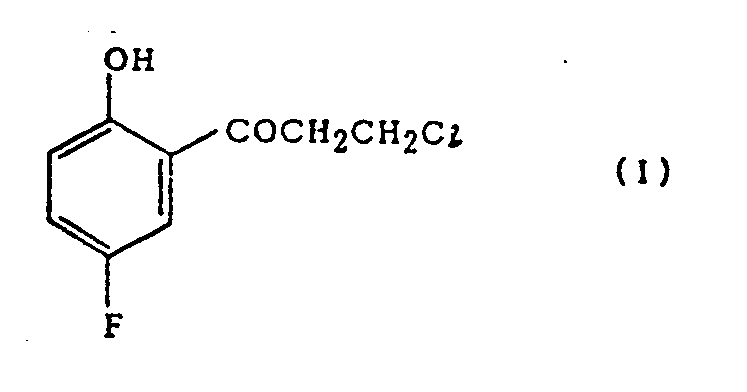
- the (3-chloro-propionyl) -2 fluoro-4 phenol can be represented by the formula (I) below:
- (3-Chloro-propionyl) -2 fluoro-4 phenol is a new body easily accessible from fluoro-4 phenol or an ether thereof, such as anisole, by Friedel acylation reaction and Crafts using 3-chloro-propionyl chloride according to the following scheme: where R represents a hydrogen atom or an alkyl radical, preferably methyl.
- Fluoro-4-phenol and its ethers, as well as chloro-3-propionyl chloride are commercially available substances.
- the transition to (3-chloro-propionyl) -2 fluoro-4 phenol sought, is carried out with a yield greater than 80%; the product is obtained with sufficient purity to make its isolation most often unnecessary.
- the (3-chloro-propionyl) -2 fluoro-4 phenol thus obtained can be applied to the preparation of fluoro-6 chromanone-4 of formula (II): by cyclization by simple heating, or at room temperature.
- This transformation can be carried out under a wide variety of conditions, preferably in a solvent which can be chosen from hydrocarbons, aromatic or not, such as toluene or heptane, alcohols such as methanol, ethanol, isopropanol or butanols, esters such as ethyl acetate, isopropyl or butyl, chlorinated solvents such as chloroform, dichloromethane, dichloroethane or chlorbenzene, acids, water, alone or as a mixture.
- a solvent which can be chosen from hydrocarbons, aromatic or not, such as toluene or heptane, alcohols such as methanol, ethanol, isopropanol or butanols, esters such as ethyl acetate, isopropyl or butyl, chlorinated solvents such as chloroform, dichloromethane, dichloroethane or chlorbenzene, acids, water, alone or as a mixture.
- an acceptor of the released hydrochloric acid can prove to be beneficial without however being necessary; preferably hydroxides or weak acid salts of alkali or alkaline earth metals or amines are used.
- the optimum temperature depends on both the solvent and the base used: for reasons of industrial convenience, it is often carried out at reflux temperature, but it is also possible, in certain cases, to carry out the reaction at room temperature, and in this case preferably in a basic medium, for example in the presence of a hydroxide or an alacaline metal salt.
- the choice of temperature as a function of the solvent and, where appropriate, of the acid acceptor, is within the reach of the skilled person.
- the cyclization yield is substantially quantitative, which makes it possible to obtain a crude product of excellent quality containing only traces of oligomers; further purification can be carried out if necessary by known means such as recrystallization, distillation or the like.
- a mixture of 160g of (3-chloro-propionyl) -2 fluoro-4 phenol, 272g of potassium carbonate and 640cm3 of water is brought to reflux for 30 minutes. After cooling to 30 ° C, filter, wash with water and dry.
Landscapes
- Chemical & Material Sciences (AREA)
- Organic Chemistry (AREA)
- Chemical Kinetics & Catalysis (AREA)
- Pyrane Compounds (AREA)
- Organic Low-Molecular-Weight Compounds And Preparation Thereof (AREA)
Abstract
Description
- La présente invention se rapporte au (chloro-3 propionyl)-2 fluoro-4 phénol, à un procédé pour sa préparation, à son application à la préparation de la fluoro-6 chromanone-4 ainsi qu'à un procédé de préparation de la fluoro-6 chromanone-4 par l'intermédiaire du (chloro-3 propionyl)-2 fluoro-4 phénol.
- La fluoro-6 chromanone-4 est un composé connu, utilisé dans la synthèse industrielle d'inhibiteurs d'aldose réductase tels que le sorbinil (DCI).
- La fluoro-6 chromanone-4 est classiquement obtenue par cyanoéthylation du fluoro-4 phénol suivie d'hydrolyse et de cyclisation; l'acrylonitirle utilisé dans la première étape est un produit toxique et de manipulation délicate du fait de sa volatilité et de sa grande tendance à la polymérisation; un autre inconvénient majeur de cette synthèse est son rendement médiocre, de l'ordre de 65% dans les meilleurs cas.
- Il est donc particulièrement important de pouvoir disposer d'un procédé utilisant des composés de faible toxicité, et procurant le produit recherché avec un meilleur rendement.
- Il a maintenant été découvert que la fluoro-6 chromanone-4 pouvait être obtenue de façon simple et sûre et avec un excellent rendement par cyclisation du (chloro-3 propionyl)-2 fluoro-4 phénol qui peut lui même être préparé à partir de matières premières facilement accessibles.
- Les brevets EP 0.031.795 et EP 0.063.799 décrivent des dérivés de la butyrophénone; d'autres dérivés voisins sont également décrits dans le brevet US 3.784.643 et par R. Martin, Bull. Soc. Chim. n° 2 (1985) p.239-242. Toutefois, ces documents concernent des applications différentes de l'invention et n'envisagent pas la préparation de la fluoro-chromanone
- La présente invention a donc pour objet le (chloro-3 propionyl)-2 fluoro-4 phénol, ainsi qu'un procédé permettant de la préparer dans de bonne conditions et avec un bon rendement.
- L'invention a également pour objet l'application du (chloro-3 propionyl)-2 fluoro-4 phénol à préparation de la fluoro-6 chromanone-4 par cyclisation à température ambiante ou par simple chauffage.
- Enfin, l'invention a pour objet un procédé de préparation de la fluoro-6 chromanone-4 à partir de composés facilement accessibles, avec un rendement satisfaisant et en évitant l'utilisation de produits toxiques.
- Le (chloro-3 propionyl)-2 fluoro-4 phénol peut être représenté par la formule (I) ci-après :

- Le (chloro-3 propionyl)-2 fluoro-4 phénol est un corps nouveau facilement accessible à partir du fluoro-4 phénol ou d'un éther du celui-ci, tel que l'anisole, par réaction d'acylation de Friedel et Crafts à l'aide du chlorure de chloro-3 propionyle selon le schéma suivant :

- On peut aussi transposer par la réaction de Fries, le chloro-3 propionate de fluoro-4 phényle suivant le schéma suivant :

- Le fluoro-4 phénol et ses éthers, de même que le chlorure de chloro-3 propionyle sont des substances disponibles industriellement. Dans les deux cas, le passage au (chloro-3 propionyl)-2 fluoro-4 phénol recherché, s'effectue avec un rendement supérieur à 80%; le produit est obtenu avec une pureté suffisante pour rendre son isolement le plus souvent inutile.
- Le (chloro-3 propionyl)-2 fluoro-4 phénol ainsi obtenu peut être appliqué à la préparation de la fluoro-6 chromanone-4 de formule (II) :

- On peut effectuer cette transformation dans des conditions très variées, de préférence dans un solvant qui peut être choisi parmi les hydrocarbons, aromatiques ou non, tels que le toluène ou l'heptane, des alcools comme le méthanol, l'éthanol, l'isopropanol ou les butanols, des esters comme les acétates d'éthyle, isopropyle ou butyle, les solvants chlorés tels que le chloroform, le dichlorométhane, le dichloroéthane ou le chlorbenzène, les acides, l'eau, isolément ou en mélange.
- L'utilisation d'un accepteur de l'acide chlorohydrique libéré peut se révéler bénéfique sans toutefois être nécessaire; on utilise de préférence les hydroxydes ou les sels d'acides faibles des métaux alcalins ou alcalino terreux ou encore les amines.
- La température optimale dépend à la fois du solvant et de la base employés : pour des raisons de commodité industrielle on opère souvent à la température de reflux, mais il est également possible, dans certains cas, d'effectuer la réaction à température ambiante, et dans ce cas de préférence en milieu basique, par exemple en présence d'un hydroxyde ou d'un sel de métal alacalin. Le choix de la température en fonction du solvant et, le cas échéant, de l'accepteur d'acide, est à la portée de l'homme du métier.
- Le rendement de la cyclisation est sensiblement quantitatif, ce qui permet d'obtenir un produit brut d'excellente qualité ne contenant que des traces d'oligomères; une purification ultérieure peut être effectuée si nécessaire par des moyens connus tels que le recristallisation, la distillation ou autres.
- La littérature chimique ne mentionne que très peu de tentatives de cyclisation en chromanones des ortho-(chloro-3 propionyl) phénols : ainsi F. MAYER (Chem. Ber. 57, 1924, p 200) obtient l'hydroxy-7 indanone-1 par action du chlorure d'aluminium sur l'ortho-(chloro-3 propionyl) phénol et non la chromanone espérée. Par ailleurs, l'action de l'acétate de sodium ou du méthylate de sodium sur l'ortho-(chloro-3 propionyl) diméthoxy-4,6 phénol conduit (J.A. DONNELLY, Tetrahedron 35, 1979, p 2883) respectivement aux cétones insaturées ou méthoxylées mais non à la diméthoxy chromanone que l'on aurait pu attendre.
- On constate donc que le (chloro-3 propionyl)-2 fluoro-4 phénol selon l'invention est particulièrement utile en permettant de réaliser une synthèse industrielle fort économique et d'une efficacité assez surprenante sur le plan chimique, de la fluoro-6 chromanone-4 dont l'importance industrielle est bien connue.
- Les exemples suivants illustrent l'invention sans en limiter la portée.
- Dans un réacteur de 2 litres on charge successivement et sans dépasser une témperature de 30°C 1 litre de dichlor-1,2 éthane, 320g de chlorure d'aluminium, 210ml de chlorure de chloro-3 propionyle et 252g de fluoro-4 anisole pluis on agite le mélange à température modérée pendant 15 heures.
- On chauffe ensuite à 40°C environ pendant 4 heures, soit jusqu'à la fin du dégagement de chlorure de méthyle.
- On hydrolyse à l'aide de 2 litres d'eau; la phase organique est lavée à l'eau puis concentrée sous vide moyen. Après reprise à l'heptane et séchage, on obtient 352g de produit beige clair, soit un rendement de 87%.
. Pureté (HPLC) = 99,4%
. F = 63°C - On chauffe à l'ebullition pendant 30mn un mélange de 2g de composé obtenu selon l'exemple 1 et 10g d'eau; l'analyse montre que l'on obtient un mélange de 80% de produit de départ et 20% de fluoro-6 chromanone-4.
- On agite pendant 1 heure à température ambiante un mélange de 5g de (chloro-3 propionyl)-2 fluoro-4 phénol, 2g de soude et 50cm³ de méthanol. Après addition de 100cm³ d'eau pour provoquer la précipitation du produit, on obtient 3,8g de fluoro-6 chromanone-4 soit un rendement de 93%. . F = 114°C
- On porte au reflux pendant 30mn un mélange de 160g de (chloro-3 propionyl)-2 fluoro-4 phénol, 272g de carbonate de potasium et 640cm³ d'eau. Après refroidissement à 30°C, on filtre, lave à l'eau et sèche.
- On obtient ainsi 127g de fluoro-6 chromanone-4 soit un rendement de 97%.
. F = 114°C
. Pureté (HPLC) = 98,5%
Claims (9)

- on effectue une acylation de Friedel et Crafts du fluoro-4 phénol ou d'un de ses éthers par le chlorure de chloro-3 propionyle, ou bien
- on effectue une réaction de transposition de Fries sur le chloro-3 propionate de fluoro-4 phényle.


- on effectue une acylation de Friedel et Crafts du fluoro-4 phénol ou d'un de ses éthers par le chlorure de chloro-3 propionyle, ou bien
- on effectue une réaction de transposition de Fries sur le chloro-3 propionate de fluoro-4 phényle
pour former le (chloro-3 propionyl)-2 fluoro-4 phénol de formule générale (I) :

Applications Claiming Priority (2)
| Application Number | Priority Date | Filing Date | Title |
|---|---|---|---|
| FR8515564A FR2588860B1 (fr) | 1985-10-21 | 1985-10-21 | (chloro-3 propionyl)-2 fluoro-4 phenol, procede pour sa preparation, et application a la preparation de la fluoro-6 chromanone-4 |
| FR8515564 | 1985-10-21 |
Publications (1)
| Publication Number | Publication Date |
|---|---|
| EP0225217A1 true EP0225217A1 (fr) | 1987-06-10 |
Family
ID=9324026
Family Applications (1)
| Application Number | Title | Priority Date | Filing Date |
|---|---|---|---|
| EP86402343A Withdrawn EP0225217A1 (fr) | 1985-10-21 | 1986-10-20 | (Chloro-3 propionyl)-2 fluoro-4 phénol, procédé pour sa préparation, et application à la préparation de la fluoro-6 chromanone-4 |
Country Status (3)
| Country | Link |
|---|---|
| EP (1) | EP0225217A1 (fr) |
| ES (1) | ES2000021A4 (fr) |
| FR (1) | FR2588860B1 (fr) |
Cited By (5)
| Publication number | Priority date | Publication date | Assignee | Title |
|---|---|---|---|---|
| US7842693B2 (en) | 2002-06-12 | 2010-11-30 | Chemocentryx, Inc. | Substituted piperazines |
| CN102603693A (zh) * | 2012-04-18 | 2012-07-25 | 苏州莱克施德药业有限公司 | 色满-4-甲酸乙酯的制备工艺 |
| CN104276936A (zh) * | 2013-07-12 | 2015-01-14 | 国家纳米科学中心 | 一种双芘类化合物及其荧光纳米聚集体和应用 |
| CN104447658A (zh) * | 2014-12-04 | 2015-03-25 | 杭州杜易科技有限公司 | 一种卤代4-色满酮衍生物的制备方法 |
| WO2022016309A1 (fr) * | 2020-07-20 | 2022-01-27 | Hangzhou Duyi Technology Co. Ltd. | Procédés de préparation de dérivés de chromanone substitués |
Citations (3)
| Publication number | Priority date | Publication date | Assignee | Title |
|---|---|---|---|---|
| US3784643A (en) * | 1970-12-11 | 1974-01-08 | Colgate Palmolive Co | Aryloxyalkylguanidines |
| EP0031795A1 (fr) * | 1979-12-21 | 1981-07-08 | Ciba-Geigy Ag | Hydroxyphénylcétones |
| EP0063799A2 (fr) * | 1981-04-27 | 1982-11-03 | Hoechst-Roussel Pharmaceuticals Incorporated | ((Fluoro-6-benzisoxazol 1,2-yl-3)propyl-3)-1-hydroxy-4-phénylpipéridines-4, leur préparation et leur emploi comme médicaments |
-
1985
- 1985-10-21 FR FR8515564A patent/FR2588860B1/fr not_active Expired
-
1986
- 1986-10-20 ES ES86402343T patent/ES2000021A4/es active Pending
- 1986-10-20 EP EP86402343A patent/EP0225217A1/fr not_active Withdrawn
Patent Citations (3)
| Publication number | Priority date | Publication date | Assignee | Title |
|---|---|---|---|---|
| US3784643A (en) * | 1970-12-11 | 1974-01-08 | Colgate Palmolive Co | Aryloxyalkylguanidines |
| EP0031795A1 (fr) * | 1979-12-21 | 1981-07-08 | Ciba-Geigy Ag | Hydroxyphénylcétones |
| EP0063799A2 (fr) * | 1981-04-27 | 1982-11-03 | Hoechst-Roussel Pharmaceuticals Incorporated | ((Fluoro-6-benzisoxazol 1,2-yl-3)propyl-3)-1-hydroxy-4-phénylpipéridines-4, leur préparation et leur emploi comme médicaments |
Non-Patent Citations (1)
| Title |
|---|
| BULLETIN DE LA SOCIETE CHIMIQUE DE FRANCE, no. 2, 1985, pages 239 - 242; R. MARTIN: "Isolement et identification des impuretés formées au cours de la synthèse industrielle de la fluoro-5 hydroxy-2 butyrophénone par transposition de Fries" * |
Cited By (11)
| Publication number | Priority date | Publication date | Assignee | Title |
|---|---|---|---|---|
| US7842693B2 (en) | 2002-06-12 | 2010-11-30 | Chemocentryx, Inc. | Substituted piperazines |
| CN102603693A (zh) * | 2012-04-18 | 2012-07-25 | 苏州莱克施德药业有限公司 | 色满-4-甲酸乙酯的制备工艺 |
| CN104276936A (zh) * | 2013-07-12 | 2015-01-14 | 国家纳米科学中心 | 一种双芘类化合物及其荧光纳米聚集体和应用 |
| CN104276936B (zh) * | 2013-07-12 | 2016-12-28 | 国家纳米科学中心 | 一种双芘类化合物及其荧光纳米聚集体和应用 |
| CN104447658A (zh) * | 2014-12-04 | 2015-03-25 | 杭州杜易科技有限公司 | 一种卤代4-色满酮衍生物的制备方法 |
| WO2022016309A1 (fr) * | 2020-07-20 | 2022-01-27 | Hangzhou Duyi Technology Co. Ltd. | Procédés de préparation de dérivés de chromanone substitués |
| CN114222734A (zh) * | 2020-07-20 | 2022-03-22 | 杭州杜易科技有限公司 | 一种制备取代色满酮衍生物的方法 |
| US11377434B2 (en) | 2020-07-20 | 2022-07-05 | Hangzhou Duyi Technology Co. Ltd. | Methods for preparing substituted chromanone derivatives |
| CN114222734B (zh) * | 2020-07-20 | 2023-12-08 | 杭州杜易科技有限公司 | 一种制备取代色满酮衍生物的方法 |
| CN117986220A (zh) * | 2020-07-20 | 2024-05-07 | 杭州杜易科技有限公司 | 一种制备取代色满酮衍生物的方法 |
| US12139468B2 (en) | 2020-07-20 | 2024-11-12 | Hangzhou Duyi Technology Co. Ltd. | Methods for preparing substituted chromanone derivatives |
Also Published As
| Publication number | Publication date |
|---|---|
| ES2000021A4 (es) | 1987-09-16 |
| FR2588860A1 (fr) | 1987-04-24 |
| FR2588860B1 (fr) | 1988-08-12 |
Similar Documents
| Publication | Publication Date | Title |
|---|---|---|
| EP0017332B1 (fr) | Composés hétérocycliques à activité pharmaceutique, procédés pour leur préparation et compositions les contenant | |
| EP0283364A2 (fr) | Procédé de préparation de monoesters ou diesters de l'acide endoéthano-9,10 dihydro-9,10 anthracène dicarboxylique-11,11, nouveaux monoesters ou diesters ainsi préparés et utilisation de ceux-ci pour la préparation de méthylidène-malonates symétriques ou asymétriques | |
| FR2963006A1 (fr) | Procede de preparation de derives de nitro-benzofurane | |
| CA1265816A (fr) | Procede de preparation de composes carbonyles ethyleniques | |
| FR2588860A1 (fr) | (chloro-3 propionyl)-2 fluoro-4 phenol, procede pour sa preparation, et application a la preparation de la fluoro-6 chromanone-4 | |
| EP0200840B1 (fr) | Procédé de préparation d'acides 6-alkoxy(inférieur)-1-naphtoiques, éventuellement halogénés en 5 et des esters correspondants | |
| EP0017578B1 (fr) | Acides 5-(2-hydroxy-3-thiopropoxy)chromone-2-carboxyliques, leurs sels et esters, procédé de préparation et médicaments | |
| EP0324692B1 (fr) | Procédé de préparation d'agents d'hydroxyalkylation, les nouveaux agents ainsi obtenus et leur emploi | |
| CA1250313A (fr) | PROCEDE DE PREPARATION DE COMPOSES INSATURES CHLORES EN .alpha. DE DEUX GROUPEMENTS ELECTROATTRACTEURS EN POSITION .beta. | |
| EP0346226A1 (fr) | Procédé de préparation de 4-aryl disubstitué-1-tétralones | |
| CA1298839C (fr) | Procede de preparation de l'acide (pyridyl-3)-3 1h,3h- pyrrolo [1,2-c] thiazolecarboxylique-7 dextrogyre | |
| CA1278309C (fr) | Procede de preparation d'aldehydes polyeniques | |
| CA1180022A (fr) | 4-methyl 3-formyl penten-1-oates d'alcoyle, leur preparation et leur application a la preparation de l'acide 4-methyl 3-formyl pent-3-en-1-oique | |
| CA2081372A1 (fr) | Procede de preparation d'hydroxyalkyl-1 nitro-5 imidazoles | |
| EP0059659B1 (fr) | Nouveaux dérivés de l'acide 4-méthyl 3-formyl pentanoique, leur procédé de préparation et leur application à la préparation de dérivés cycliques | |
| US6670510B2 (en) | Process for preparing 2,5-dimethoxy benzaldehyde | |
| EP0466583B1 (fr) | Procédé de préparation de la diméthyl-2,5 hydroxy-4 (2H)furanone-3 | |
| FR2853901A1 (fr) | Procede de preparation de derives de l'acide hexahydropyridazine-3-carboxylique | |
| DK175137B1 (da) | Fremgangsmåde til fremstilling af cycliske terpenoider | |
| CA1167041A (fr) | Procede de preparation de la chloro-7 tetrahydro-1,2, 3,4 quinolinone-4 | |
| EP0376824A1 (fr) | Procédé de préparaton de dérivés du chromanne et intermédiaires de synthèse | |
| EP0165124B1 (fr) | Procédé de préparation d'acides hydratropiques et de leurs esters, à partir de propiophénones | |
| FR2466450A1 (fr) | Procede industriel de purification et d'obtention d'itanoxone de qualite pharmaceutique | |
| FR2472569A1 (fr) | 1,2,3,4,4a,9b-hexahydro 4-hydroxy dibenzofurannes et leur procede de preparation | |
| FR2565971A1 (fr) | Nouvelle tetraenesulfone, sa preparation et son emploi |
Legal Events
| Date | Code | Title | Description |
|---|---|---|---|
| PUAI | Public reference made under article 153(3) epc to a published international application that has entered the european phase |
Free format text: ORIGINAL CODE: 0009012 |
|
| AK | Designated contracting states |
Kind code of ref document: A1 Designated state(s): AT BE CH DE ES FR GB GR IT LI LU NL SE |
|
| ITCL | It: translation for ep claims filed |
Representative=s name: NOTARBARTOLO & GERVASI S.R.L. |
|
| 17P | Request for examination filed |
Effective date: 19871107 |
|
| 17Q | First examination report despatched |
Effective date: 19880701 |
|
| STAA | Information on the status of an ep patent application or granted ep patent |
Free format text: STATUS: THE APPLICATION IS DEEMED TO BE WITHDRAWN |
|
| 18D | Application deemed to be withdrawn |
Effective date: 19881224 |
|
| RIN1 | Information on inventor provided before grant (corrected) |
Inventor name: GIBERT, DOMINIQUE Inventor name: WIRTH, DIDIER |