EP0225288A2 - Dispositif de surveillance de l'épaisseur d'un objet - Google Patents
Dispositif de surveillance de l'épaisseur d'un objet Download PDFInfo
- Publication number
- EP0225288A2 EP0225288A2 EP86810537A EP86810537A EP0225288A2 EP 0225288 A2 EP0225288 A2 EP 0225288A2 EP 86810537 A EP86810537 A EP 86810537A EP 86810537 A EP86810537 A EP 86810537A EP 0225288 A2 EP0225288 A2 EP 0225288A2
- Authority
- EP
- European Patent Office
- Prior art keywords
- thickness
- envelopes
- envelope
- monitoring
- differential transformer
- Prior art date
- Legal status (The legal status is an assumption and is not a legal conclusion. Google has not performed a legal analysis and makes no representation as to the accuracy of the status listed.)
- Withdrawn
Links
- 238000012544 monitoring process Methods 0.000 title claims description 23
- 238000000605 extraction Methods 0.000 claims abstract description 27
- 238000012545 processing Methods 0.000 claims description 27
- 238000006243 chemical reaction Methods 0.000 claims description 11
- 230000003750 conditioning effect Effects 0.000 claims description 3
- 238000001514 detection method Methods 0.000 claims description 2
- 230000001788 irregular Effects 0.000 claims 3
- 240000007320 Pinus strobus Species 0.000 claims 1
- 238000012806 monitoring device Methods 0.000 abstract description 26
- 230000007246 mechanism Effects 0.000 abstract description 9
- 238000005259 measurement Methods 0.000 description 10
- 238000000034 method Methods 0.000 description 5
- 230000008901 benefit Effects 0.000 description 4
- 230000001276 controlling effect Effects 0.000 description 4
- 230000008569 process Effects 0.000 description 3
- 230000035945 sensitivity Effects 0.000 description 3
- 239000003292 glue Substances 0.000 description 2
- 239000000463 material Substances 0.000 description 2
- 230000001105 regulatory effect Effects 0.000 description 2
- 238000000926 separation method Methods 0.000 description 2
- 238000012360 testing method Methods 0.000 description 2
- 230000003466 anti-cipated effect Effects 0.000 description 1
- 238000004364 calculation method Methods 0.000 description 1
- 238000004891 communication Methods 0.000 description 1
- 150000001875 compounds Chemical class 0.000 description 1
- 238000004590 computer program Methods 0.000 description 1
- 238000010276 construction Methods 0.000 description 1
- 230000003247 decreasing effect Effects 0.000 description 1
- 230000002939 deleterious effect Effects 0.000 description 1
- 238000013461 design Methods 0.000 description 1
- 238000010586 diagram Methods 0.000 description 1
- 238000001914 filtration Methods 0.000 description 1
- 230000005484 gravity Effects 0.000 description 1
- 230000002452 interceptive effect Effects 0.000 description 1
- 238000012804 iterative process Methods 0.000 description 1
- 230000005226 mechanical processes and functions Effects 0.000 description 1
- 230000002250 progressing effect Effects 0.000 description 1
- 230000004044 response Effects 0.000 description 1
- 238000004804 winding Methods 0.000 description 1
Images


Classifications
-
- B—PERFORMING OPERATIONS; TRANSPORTING
- B07—SEPARATING SOLIDS FROM SOLIDS; SORTING
- B07C—POSTAL SORTING; SORTING INDIVIDUAL ARTICLES, OR BULK MATERIAL FIT TO BE SORTED PIECE-MEAL, e.g. BY PICKING
- B07C1/00—Measures preceding sorting according to destination
- B07C1/10—Sorting according to size or flexibility
- B07C1/16—Sorting according to thickness or stiffness
-
- B—PERFORMING OPERATIONS; TRANSPORTING
- B43—WRITING OR DRAWING IMPLEMENTS; BUREAU ACCESSORIES
- B43M—BUREAU ACCESSORIES NOT OTHERWISE PROVIDED FOR
- B43M7/00—Devices for opening envelopes
- B43M7/02—Devices for both opening envelopes and removing contents
Definitions
- the present invention relates generally to an apparatus for monitoring the thickness of an object, an in particular, to the use of such an apparatus in connection with mail extraction equipment.
- a variety of applications require the careful monitoring of an object in terms of thickness so as to properly regulate the equipment which is being used to handle such articles.
- One such application involves the regulation of equipment which is presently conventionally used for the bulk processing of mail, particularly the bulk processing of mail for the extraction of contents.
- Many facets of the mail extraction process call for monitoring of the envelopes being opened, in terms of thickness, either to make sure that the envelopes can be successfully processed through the apparatus, or to "outsort" envelopes which are not to be processed for any of a number of reasons (e.g., mail which is not to be opened by the operator for reasons of security, mail which is not be opened by the operator because of its lesser importance).
- pre-sorting may be accomplished so as to make sure that only envelopes which are believed to contain invoices and checks for payment are immediately processed, leaving other envelopes of lesser importance for subsequent processing.
- Such an operation may be accomplished by passing the envelopes which are to be opened through a sorting mechanism which monitors each envelope in terms of the thickness, whereupon envelopes of the desired thickness are passed through the sorting mechanism to the extraction apparatus, while all other envelopes are diverted from the processing stream.
- a similar pre-sorting operation may be used to outsort mail which is not be handled by the operator for purposes of security.
- the diverted envelopes are preferably delivered to a secured container or the like, while all other envelopes are passed through the sorting mechanism to the extraction apparatus.
- the critical parameter to be monitored is thickness, i.e. the thickness of the envelope to be processed through the apparatus.
- thickness i.e. the thickness of the envelope to be processed through the apparatus.
- the decision as to whether or not to process an envelope will depend upon whether or not the envelope, together with its contents, is less than a desired thickness. The presumption is made that thicker envelopes do not contain the desired contents, and should not be processed.
- the decision as to whether or not to process an envelope will depend upon whether or not the envelope, together with its contents, exceeds a desired thickness.
- the thicker envelopes contain a credit card or the like, and should be diverted to the secured container.
- the means which are used to monitor envelope thickness are pivotal in assuring that the mail extraction process proceeds in accordance with its desired parameters.
- the difference in thickness between an envelope which is to be processed and an envelope which is not to be processed may be so small as to prevent reliable sorting by available mechanical sensing devices.
- a thickness monitoring device wherein a linear variable differential transformer (hereinafter LVDT) device is operatively coupled with a pinch roller mechanism so that variations in thickness which are detected by means of the pinch roller mechanism are converted, by means of the LVDT device, to electrical signals which may be processed to yield an accurate indication of thickness. Such processed signals may then be used to control various machine functions in accordance with the thickness of the object which is passing through the pinch roller mechanism, as desired in a particular application.
- LVDT linear variable differential transformer
- Such a thickness monitoring device finds particular utility in connection with mail extraction equipment in that such a device enables the envelopes being processed to be accurately monitored so that the mail extraction operation can proceed in accordance with relatively specific performance parameters. Due to the improved sensitivity of the LVDT sensor, and the availability of subsequent signal processing, the thickness monitoring device of the present invention is sufficiently versatile to enable an accurate determination to be made as to the number of articles which are contained in the envelope, and whether the contents are in appropriate condition to proceed to extraction. For example, certain contents of the envelope may have been folded to mailing, or the contents may be attached together with clips or staples. The thickness monitoring device according to the present invention is sufficiently versatile to enable such conditions to be detected.
- FIG. 1 illustrates a thickness monitoring device 1 in operative association with an envelope sorting apparatus 10.
- the thickness monitoring device 1 generally comprises a pinch roller assembly 2 which includes a stationary roller or series of rollers 3, and a moveable roller or series of rollers 4, which tangentially contact one another at the interface 5.
- the number of stationary rollers 3 and moveable rollers 4 which are used in a particular application will depend upon the nature of the sorting which is to be accomplished, and the articles which are to be sorted.
- a spring 6 is provided to urge the moveable rollers 4 into contact with the stationary rollers 3 so as to maintain the integrity of the interface 5 during operation of the thickness monitoring device 1.
- a connecting rod 7 operatively connects the moveable rollers 4 with the pole or slug 8 of a linear variable differential transformer (LVDT) device 9 so that movement of the rollers 4 with respect to the rollers 3 will cause reciprocation of the slug 8 within the LVDT device 9.
- LVDT linear variable differential transformer
- FIG. 1 illustrates use of the thickness monitoring device 1 in connection with an envelope sorting apparatus 10 such as is disclosed in U.S. patent application Serial No. 630,955, filed July 16, 1984, the subject matter of which is incorporated by reference as if fully set forth herein.
- the thickness monitoring device 1 according to the present invention will find equal utility in connection with other envelope sorting devices, and well as other devices which can be used in the processing of envelopes. It is also to be understood that the thickness monitoring device 1 according to the present invention will find utility in connection with applications other than the processing of envelopes, which may call for the accurate monitoring of thicknesses in the course of their operation.
- the envelope sorting apparatus 10 generally comprises an enclosure 11, the top 12 of which serves as a bin for receiving a series of envelopes for processing, and the interior 13 of which serves as a storage area for receiving envelopes which have been diverted from the stream of envelopes to be processed through the mail extraction device, as will be described more fully below.
- a reciprocating suction cup 14 is provided to sequentially engage each of a series of envelopes positioned on the top 12 of the enclosure 11, and to withdraw the engaged envelope 15 from the series for eventual contact with a vertical guide 16. From this position, the envelope 15 proceeds downwardly as a consequence of gravity, entering a pinch roll assembly 2 wherein the stationary rollers 3 are operatively associated with the vertical guide 16 and the moveable rollers 4 are operatively associated with a pivot 17. In this manner, the envelope 15 is caused to proceed through the pinch roller assembly 2, preferably in response to rotation of the stationary rollers 3, eventually passing between the vertical guide 16 and a stationary guide 18 for delivery to a deflector 19.
- Positioning of the deflector 19 is regulated by a connecting rod 20 which is reciprocated by a motor 21 in accordance with parameters which will be described more fully below. Consequently, the envelope 15 is capable of being monitored in terms of thickness as it is drawn through the pinch roller assembly 2 by rotation of the stationary rollers 3.
- the deflector 19 is then capable of being regulated in accordance with the monitored thickness of the envelope 15 so that it assumes either of two positions including a first position at 22 which passes the envelope 15 to the mail extraction device (not shown) for subsequent processing, or a second position at 23 which diverts the envelope 15 from the normal processing stream, for storage in the interior 13 of the enclosure 11.
- the interior 13 may be secured or unsecured, depending upon the nature of the envelopes which are being processed.
- any of a number of mechanical expedients may be used to interface the pinch roller assembly 2 with the LVDT device 9.
- this interface be accomplished by attaching the connecting rod 7 to the pivot 17 by means of a ball and socket joint 24, which is preferably attached to the uppermost end 25 of the pivot 17, near the moveable rollers 4.
- a ball and socket joint 24 is preferred in that the amount of play between the pivot 17 and the connecting rod 7 can be kept to a minimum, particularly if the ball and socket joint 24 is formed of an appropriate (e.g. self-lubricating, resilient) plastic material.
- the LVDT device 9 In operatively connecting the thickness monitoring device 1 and the envelope sorting apparatus 10, it is important for the LVDT device 9 to be kept as separated as possible from the other electrical components which are associated with the envelope sorting apparatus 10, to reduce noise and other deleterious effects. This is simply accomplished by lengthening the connecting rod 7 so that the LVDT device 9 is appropriately placed within the interior 13 of the enclosure 11, away from the electrical equipment which regulates its operation.
- the slug 8 is free to reciprocate according to changes in thickness which are sensed at the pinch roller assembly 2, responsive to reciprocation of the connecting rod 7. Consequently, the thickness of an envelope proceeding through the pinch roller assembly 2 is converted to an electrical signal which is developed at the output of the LVDT device 9.
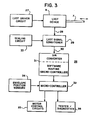
- Such an electrical signal is capable of being processed in accordance with the present invention by the circuit 26 which is illustrated in Figure 3.
- an LVDT driver circuit 27 is operatively coupled to the LVDT device 9 so that reciprocation of the slug 8 within the LVDT device 9 responsive to reciprocation of the connecting rod 7 will provide an appropriate output at 28. This output is then applied to an LVDT signal conditioner 29, which places the output of the LVDT device 9 in proper condition for subsequent processing.
- the LVDT device 9 is in essence a transformer wherein the primary and secondary windings of the transformer are variably coupled in accordance with positioning of the slug 8. Consequently, the LVDT device 9 is preferably driven with a sine wave, of appropriate frequency and amplitude to match the electrical characteristics of the LVDT device 9 selected for use. This signal is developed by the LVDT driver circuit 27, and serves to provide optimum performance in terms of sensitivity and speed.
- the output 28 of the LVDT device 9 is generally not yet appropriate for subsequent processing. Consequently, the output 28 is subjected to conditioning by the LVDT signal conditioner 29.
- the signals delivered from the LVDT device 9 will be small in amplitude, and will therefore have to be amplified.
- the output 28 will be a full-wave rectified signal.
- this signal will contain both a DC and an AC component, filtering of the signal is required so as to remove the non-DC components.
- filters may be used in this regard, preferably an active two-pole low-pass filter.
- the output 30 of the LVDT signal conditioner 29 will be a DC voltage which varies in proportion to the separation at the pinch roller assembly 2, and which is appropriate for subsequent processing as follows.
- the output 30 is applied to an analog-to-digital (A/D) converter 31.
- A/D analog-to-digital
- Digital conversion is preferred in that the resulting signal can be processed by a software oriented system, which serves to improved both the accuracy and the versatility of the resulting system.
- Such analog-to-digital conversion can proceed in either of two ways.
- a D/A converter in combination with a software controlled routine known as successive approximation.
- a microcontroller 32 which contains the necessary software routines.
- the microcontroller 32 is also capable of containing software routines for controlling various machine functions, either responsive to the thickness monitoring device 1 or other control elements of the envelope sorting apparatus 10, or responsive to other portions of the mail extraction device with which it is associated.
- Successive approximation in essence calls for interactive communication between the D/A converter and the associated software routines provided in the microcontroller 32 to develop an analog-to-digital conversion by iterative techniques.
- the D/A converter receives a digital sequence from the microcontroller 32, which it converts to an analog signal.
- This analog signal is compared to the DC output 30 of the LVDT device 9, and the digital sequence developed within the microcontroller 32 is accordingly increased or decreased. Successive comparisons are made until such time as the output of the microcontroller 32 compares with the output 30 of the LVDT device 9. At that time, the digital sequence residing in the microcontroller 32 is the digital representation of the analog output of the LVDT device 9.
- This digital sequence is then available for subsequent processing in the other software routines which are present in the microcontroller 32 to regulate operation of the apparatus with which the thickness monitoring device 1 is a ssociated, in this case the envelope sorting apparatus 10. It will be understood that such an iterative process requires significantly more processing time than would a conventionally available A/D converter. However, this increase in processing time is well within the design limitations of an envelope sorting scheme, and can be accomplished at considerably less cost.
- a scaling circuit 33 is provided which is operatively coupled to the LVDT signal conditioner 29.
- the microcontroller 32 not only serves to provide the calculations which are necessary for the operation of the thickness monitoring device 1, but also to control other aspects of the apparatus with which the thickness monitoring device 1 is associated. Consequently, the thickness monitoring device 1, through the microcontroller 32, will have access to those signals which are used to interface the microcontroller 32 with the associated apparatus.
- a number of sensors 34 will be provided to indicate the status of the envelopes as they progress along the transport path which conveys the envelopes through the apparatus. These position sensors 34 serve as a convenient means for indicating when the thickness monitoring device 1 is to commence operation.
- the microcontroller 32 Upon operation of the thickness monitoring device 1 as previously described, the microcontroller 32 is then in a position to control various aspects of the envelope processing apparatus by controlling the various motors 35 which are used to perform the mechanical functions of the extraction process. For example, in terms of the present discussion, such motor control may be used to regulate positioning of the deflector 19 by controlling operation of the motor 21. Consequently, the routing of an envelope either to the mail extraction device, or to separate storage, is automatically controlled in accordance with the measurements which are made at the pinch roller assembly 2 of the thickness monitoring device 1. Other operational controls are equally possible since the microcontroller 32 serves as a centralized means for controlling the entire extraction process.
- the microcontroller 32 may be addressed to provide various diagnostic/calibration functions which are useful during set-up and servicing of the apparatus in its various modes.
- a test/diagnostics circuit 36 is therefore provided which is operatively coupled to the microcontroller 32, and which is capable of interfacing with an operator or service technician by means of an appropriate display so as to provide the information which is needed for factory set-up, field service and/or operator diagnostics.
- microprocessor-based thickness sensing is that more complicated sensing schemes are capable of being developed simply by varying the software, without attendant variations in hardware. This leads to a number of advantages regarding system versatility.
- the microcontroller 32 by appropriately initializing the system, it is possible for the microcontroller 32 to establish a base line before each envelope is measured for thickness, as the series of envelopes are being processed. Since this will tend to account for mechanical variations and electrical drift, less expensive components may be used. Moreover, set-up of the system is greatly simplified, if not virtually eliminated. These enhancements are advantageously achieved by taking a thickness measurement just prior to the introduction of an envelope between the rollers 3,4, to establish a zero base line, and by accordingly initializing the microcontroller 32. Thickness measurement will then proceed as previously described, with this zero base line serving to account for system variations.
- the microcontroller 32 is also capable of selectively monitoring thickness in accordance with a pre-established pattern, if desired. Selective monitoring permits an accurate measurement of thickness to be made by avoiding portions of the envelope which are characterized by special features such as envelope folds, seams or glue lines. By proper strobing of the microcontroller 32, it is possible to make sure that thickness measurements only take place along the more predictable, planer portions of the envelope surface.
- Figure 4 graphically illustrates several characteristic curves which are typically developed at the output 30 of the LVDT signal conditioner 29, in an exemplary operation of the thickness monitoring device 1 according to the present invention.
- a sudden initial increase in output voltage occurs at 37, which corresponds to the leading edge of an envelope being drawn through the pinch roller assembly 2.
- the system would preferably be initialized as previously described.
- the output voltage proceeds to level off, at 38.
- a number of different voltage levels are developed. These correspond to different thicknesses representative of the number of items contained in the envelope.
- these levels correspond to a curve 39 which represents an envelope containing a single sheet of paper, a curve 40 which represents an envelope containing two sheets of paper, a curve 41 which represents an envelope containing three sheets of paper, and a curve 42 which represents an envelope containing four sheets of paper.
- each of the curves 39, 40, 41, 42 departs from the relatively planar configuration at 38, and undergoes a sudden increase in voltage, at 44.
- This region represents the passage of the closure flap of the envelope 15 through the pinch roller assembly 2. Thereafter, the trailing edge of the envelope 15 passes from the pinch roller assembly 2, at 45.
- the thickness measurement system of the present invention is also capable of compound operations if desired. For example, after initializing the system, it may be desirable to perform a "gross" sorting operation, to outsort undersirable envelopes (e.g., those containing credit cards), and to thereafter make a thickness measurement in the region 38 of each envelope which will enable the microcontroller 32 to make a subsequent determination as to the number of articles contained in the envelope, to assist in further processing. Other variations are also clearly possible.
- LVDT driver circuit 27 NE5520 LVDT device 9 - Model 100HR (Schaevitz) LVDT signal conditioner 29 - Op-amp OP01 A/D converter 31 - DAC08 (D/A Converter) and CMP01 (Comparator) Microcontroller 32 - 8748 (Microcontroller) and 8243 (I/O expander).
- LVDT driver circuit 27 NE5520 LVDT device 9 - Model 100HR (Schaevitz) LVDT signal conditioner 29 - Op-amp OP01 A/D converter 31 - DAC08 (D/A Converter) and CMP01 (Comparator) Microcontroller 32 - 8748 (Microcontroller) and 8243 (I/O expander).
- LVDT driver circuit 27 - NE5520 LVDT device 9 - Model 100HR (Schaevitz) LVDT signal conditioner 29 - Op-amp OP01 A/D converter 31 - DAC08 (D/A Converter) and CMP01 (Compar
Landscapes
- Length Measuring Devices With Unspecified Measuring Means (AREA)
- Controlling Sheets Or Webs (AREA)
- Sorting Of Articles (AREA)
- Measurement Of Length, Angles, Or The Like Using Electric Or Magnetic Means (AREA)
Applications Claiming Priority (2)
| Application Number | Priority Date | Filing Date | Title |
|---|---|---|---|
| US80269085A | 1985-11-27 | 1985-11-27 | |
| US802690 | 1985-11-27 |
Publications (2)
| Publication Number | Publication Date |
|---|---|
| EP0225288A2 true EP0225288A2 (fr) | 1987-06-10 |
| EP0225288A3 EP0225288A3 (fr) | 1988-03-30 |
Family
ID=25184439
Family Applications (1)
| Application Number | Title | Priority Date | Filing Date |
|---|---|---|---|
| EP86810537A Withdrawn EP0225288A3 (fr) | 1985-11-27 | 1986-11-25 | Dispositif de surveillance de l'épaisseur d'un objet |
Country Status (1)
| Country | Link |
|---|---|
| EP (1) | EP0225288A3 (fr) |
Cited By (8)
| Publication number | Priority date | Publication date | Assignee | Title |
|---|---|---|---|---|
| EP0376481A3 (en) * | 1988-12-28 | 1990-10-03 | Pitney Bowes, Inc. | High-throughput mailing machine timing |
| EP0376496A3 (fr) * | 1988-12-28 | 1992-12-02 | Pitney Bowes, Inc. | Dispositif de mesure de l'épaisseur du courrier |
| US5238123A (en) * | 1992-04-10 | 1993-08-24 | Agissar Corporation | Automated thickness and length detecting and sorting system for envelopes |
| WO1994004378A1 (fr) * | 1992-08-19 | 1994-03-03 | The Technology Partnership Plc | Appareil et procede de verification du contenu d'une enveloppe |
| EP0605065A1 (fr) * | 1992-12-31 | 1994-07-06 | Hadewe B.V. | Méthode et appareil pour vérifier si des documents ont été séparés d'une enveloppe ouverte |
| WO1997031727A1 (fr) * | 1996-02-28 | 1997-09-04 | Grapha-Holding Ag | Dispositif et procede pour le transfert selectif d'objets postaux |
| US5704246A (en) * | 1993-10-20 | 1998-01-06 | Bell & Howell Gmbh | Device for measuring the thickness of objects to be handled in document-handling machines |
| US6135292A (en) * | 1998-12-21 | 2000-10-24 | Pitney Bowes Inc. | Method and system for presorting mail based on mail piece thickness |
Family Cites Families (8)
| Publication number | Priority date | Publication date | Assignee | Title |
|---|---|---|---|---|
| US2891667A (en) * | 1954-08-17 | 1959-06-23 | Nat Steel Corp | Sheet classifiers |
| US3712468A (en) * | 1971-02-24 | 1973-01-23 | W Wenner | Device which scans and detects for contents in a package |
| GB1506232A (en) * | 1976-03-22 | 1978-04-05 | Forth Instr | Apparatus for measuring irregular thicknesses |
| US4353197A (en) * | 1977-07-08 | 1982-10-12 | Opex Corporation | Content activated envelope extraction |
| US4378109A (en) * | 1979-09-19 | 1983-03-29 | Tokyo Shibaura Denki Kabushiki Kaisha | Device for detecting the thickness of a paper sheet |
| JPS5677709U (fr) * | 1979-11-21 | 1981-06-24 | ||
| EP0064523B1 (fr) * | 1980-11-07 | 1986-07-23 | De La Rue Systems Limited | Dispositif pour detecter l'epaisseur de feuilles |
| ZA855343B (en) * | 1984-07-16 | 1986-02-26 | Opex Corp | Envelope sorting apparatus |
-
1986
- 1986-11-25 EP EP86810537A patent/EP0225288A3/fr not_active Withdrawn
Cited By (12)
| Publication number | Priority date | Publication date | Assignee | Title |
|---|---|---|---|---|
| EP0376481A3 (en) * | 1988-12-28 | 1990-10-03 | Pitney Bowes, Inc. | High-throughput mailing machine timing |
| EP0376496A3 (fr) * | 1988-12-28 | 1992-12-02 | Pitney Bowes, Inc. | Dispositif de mesure de l'épaisseur du courrier |
| EP0615213A3 (fr) * | 1988-12-28 | 1994-11-02 | Pitney Bowes Inc | Procédé de traitement à grande vitesse de courrier sur une machine à affranchir. |
| EP0615212A3 (fr) * | 1988-12-28 | 1994-11-02 | Pitney Bowes Inc | Méthode de traitement de courrier à grande vitesse. |
| US5238123A (en) * | 1992-04-10 | 1993-08-24 | Agissar Corporation | Automated thickness and length detecting and sorting system for envelopes |
| WO1994004378A1 (fr) * | 1992-08-19 | 1994-03-03 | The Technology Partnership Plc | Appareil et procede de verification du contenu d'une enveloppe |
| US5727692A (en) * | 1992-08-19 | 1998-03-17 | Stielow Gmbh & Co. | Apparatus and method for checking an envelope for contents |
| US5655668A (en) * | 1992-12-27 | 1997-08-12 | Hadewe B.V. | Method and apparatus for verifying whether documents have been separated from an opened envelope |
| EP0605065A1 (fr) * | 1992-12-31 | 1994-07-06 | Hadewe B.V. | Méthode et appareil pour vérifier si des documents ont été séparés d'une enveloppe ouverte |
| US5704246A (en) * | 1993-10-20 | 1998-01-06 | Bell & Howell Gmbh | Device for measuring the thickness of objects to be handled in document-handling machines |
| WO1997031727A1 (fr) * | 1996-02-28 | 1997-09-04 | Grapha-Holding Ag | Dispositif et procede pour le transfert selectif d'objets postaux |
| US6135292A (en) * | 1998-12-21 | 2000-10-24 | Pitney Bowes Inc. | Method and system for presorting mail based on mail piece thickness |
Also Published As
| Publication number | Publication date |
|---|---|
| EP0225288A3 (fr) | 1988-03-30 |
Similar Documents
| Publication | Publication Date | Title |
|---|---|---|
| US6141883A (en) | Apparatus for detecting the thickness of documents | |
| EP0225288A2 (fr) | Dispositif de surveillance de l'épaisseur d'un objet | |
| CA1121024A (fr) | Methode, dispositif et circuit de commande d'abaissement d'une table d'empilage | |
| US5464099A (en) | Method for the automated processing of documents and bulk mail | |
| EP0640740B1 (fr) | Commande adaptative pour lève-vitre avec force de pincement basée sur la rigidité d'un objet et de la position de la vitre | |
| CA2501028C (fr) | Detecteur du niveau de liquide d'un recipient faisant appel au contact d'une aiguille de pipettage | |
| US5460273A (en) | Apparatus for the automated processing of bulk mail having varied characteristics | |
| US6511064B1 (en) | Method and apparatus for multiple document detection using ultrasonic phase shift amplitude | |
| EP0571308A1 (fr) | Appareil et procédé pour l'extraction automatique du courrier et encaissement automatique | |
| US4449078A (en) | Apparatus for providing an optimal opening and closing of a door | |
| WO1988001543A1 (fr) | Appareil de traitement automatique de grands volumes de courrier et similaire | |
| GB2129572A (en) | Identification of metal cans | |
| WO1994004378A1 (fr) | Appareil et procede de verification du contenu d'une enveloppe | |
| AU625580B2 (en) | Mail thickness measuring apparatus | |
| EP0297527A2 (fr) | Procédé et appareil pour la correction de pneus pour leur uniformité | |
| CN109499907A (zh) | 一种自动圆柱薄片工件厚度分选机 | |
| US5238123A (en) | Automated thickness and length detecting and sorting system for envelopes | |
| US4724384A (en) | Apparatus and method for detecting the condition of completed ends | |
| CA2434250C (fr) | Systeme de detection de vibrations pour produit en rouleau | |
| US5590790A (en) | Apparatus including a vacuum pump for assessing the condition of a bank note by measuring airflow drawn through the bank note | |
| US7182339B2 (en) | Thickness measuring system, having improved software, for use within a mail handling system, and method of using same | |
| EP0086097A1 (fr) | Appareil et procédé de détection | |
| US5738622A (en) | Centrifugal separator and a method of detecting unbalance of a rotor | |
| US5725720A (en) | Detector for envelopes made of plastic, and flat article processing equipment including such a detector | |
| US7210570B2 (en) | Device for the dynamic weighing of postal items |
Legal Events
| Date | Code | Title | Description |
|---|---|---|---|
| PUAI | Public reference made under article 153(3) epc to a published international application that has entered the european phase |
Free format text: ORIGINAL CODE: 0009012 |
|
| AK | Designated contracting states |
Kind code of ref document: A2 Designated state(s): AT BE CH DE ES FR GB GR IT LI LU NL SE |
|
| PUAL | Search report despatched |
Free format text: ORIGINAL CODE: 0009013 |
|
| AK | Designated contracting states |
Kind code of ref document: A3 Designated state(s): AT BE CH DE ES FR GB GR IT LI LU NL SE |
|
| STAA | Information on the status of an ep patent application or granted ep patent |
Free format text: STATUS: THE APPLICATION IS DEEMED TO BE WITHDRAWN |
|
| 18D | Application deemed to be withdrawn |
Effective date: 19881001 |
|
| RIN1 | Information on inventor provided before grant (corrected) |
Inventor name: LILE, WILLIAM R. |