EP0225302A2 - Schnell befestigbare Vorrichtung zur Registrierung von Kieferbewegungen für einen Gebissartikulator - Google Patents
Schnell befestigbare Vorrichtung zur Registrierung von Kieferbewegungen für einen Gebissartikulator Download PDFInfo
- Publication number
- EP0225302A2 EP0225302A2 EP86850400A EP86850400A EP0225302A2 EP 0225302 A2 EP0225302 A2 EP 0225302A2 EP 86850400 A EP86850400 A EP 86850400A EP 86850400 A EP86850400 A EP 86850400A EP 0225302 A2 EP0225302 A2 EP 0225302A2
- Authority
- EP
- European Patent Office
- Prior art keywords
- bow
- patient
- arm
- ear
- pin
- Prior art date
- Legal status (The legal status is an assumption and is not a legal conclusion. Google has not performed a legal analysis and makes no representation as to the accuracy of the status listed.)
- Granted
Links
Images



Classifications
-
- A—HUMAN NECESSITIES
- A61—MEDICAL OR VETERINARY SCIENCE; HYGIENE
- A61C—DENTISTRY; APPARATUS OR METHODS FOR ORAL OR DENTAL HYGIENE
- A61C19/00—Dental auxiliary appliances
- A61C19/04—Measuring instruments specially adapted for dentistry
- A61C19/045—Measuring instruments specially adapted for dentistry for recording mandibular movement, e.g. face bows
Definitions
- the present invention relates to a face-bow device for cooperation between a human being and an articulator, for use in making dentures or parts thereof.
- the individual face dimensions must be considered. Accurate registrations obtained from the patient must be transferred to the articulator with precision.
- the registrations for the upper cast are preferably done with a face-bow device designed for obtaining precise data from the patient and accurately feeding this information into the articulator.
- the hinge axis location for the jaws in humans is situated ca l2 mm in front of the ear meatus.
- the face-bow devices have condylar rods which are placed at this location when obtaining registrations from the patient.
- the auditory pin is placed l2 mm behind the centrum of the condylar axis pin. This makes the registration pro cedure more comfortable for the patient and easier and quicker for the operator, who mostly is a dentist.
- the invention relates to a face-bow device preferably of this ear hinged type and has as its main purpose to provide very rapid mounting on the patient, but it can also relate to a face-bow device for registration from the normally hinged axis points using special end pieces.
- the main purpose of the invention is to provide a facebow, wherein the adjustment of the bow so that the ear pieces will fit into the patient's ears, is made before the bow is actually placed on the patient.
- a face-bow device which includes a bite fork on a bite fork support, an adjustment means, in which said bite fork support is insertable, a bow means extending from ear to ear in front of said patient's face, on which bow means said adjustment means is mountable, said bow means having two arms being firmly connected to each other, each arm having its free end formed and adapted to be placed in said patient's ear meatus, said face-bow device being characterized in that said arms have a rounded form and are made of a resilient material in order to be resiliently outbendable at least to such extent that a bow means having its free ends at a distance from each other adapted to the distance between the opening to said patient's ear meatuses in outbent condition is movable over the sides of said patient's face for placing said ear bow ends into said patient's ear meatuses.
- face-bow devices having the registered data from patients are mostly sent by mail from the operator, who mostly is a dentist, to some dental laboratory, where dental technicians place them in articulators to make the dentures. Therefore, some modern face-bow devices have the bite fork with the adjusted part of the face-bow removable from the actual bow part after registration on the patient. Only the adjusted part with the bite fork need be sent to the laboratory. This part is not bulky, which means that it can be sent in a smaller package.
- the adjusted part has as its main part a pin which has a guidance form at each end, one end fitting against the bow part and being provided with means to lock the pin and the bow part detachably but firmly together at a strictly predetermined relative configuration and orientation, and the other end fitting against a jig means connected to the lower part of the articulator.
- the other end of the pin is provided with means to lock the pin on the jig means on the plate together at a location and in an orientation, which is the same as if the pin had been connected to the bow part and the bow part were placed on the articulator with its ear pieces at the auditory pins or on the condylar axis.
- Still another problem with ordinary face-bow devices is that if the bow device is of the kind, for which the bow part at registration is to be adjusted to be seated in the orbital plane, the adjustment arrangement for this is such that the operator must use both his hands for the adjustment.
- Such an adjustment arrangement is sometimes a nose support device connectable to the face-bow at registration, the support aligning to the juncture of the upper portion of the nose and the forehead.
- the nose support device includes a nose resting means, a holding means having a first and a second arm extendable by manual adjustment, said arms having a predetermined angle of less than 90 degrees between their orientations, a means on said first arm to attach said first arm to said bow device, said second arm being connected to said nose resting means.
- a locking device is provided on the first arm to lock it in an upright position.
- the first arm has an extendable part in relation to the locking device having a thumb wheel to be rotated by an operator for extension or reduction of the arm length.
- the sloping arm includes a rather soft spring biased to push the end of the sloping part in the protruding direction and a locking screw to lock the extension of the sloping arm at the desired protruding length.
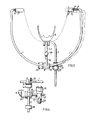
- the face-bow device includes a bow means l, which is a bar bent like a bow and made of a resilient material.
- the bow means l is made in one piece, which is to be preferred, and has such dimensions that it extends in front of a person's face from one ear to the other.
- the end sections of the bow means are bent to point towards each other and are straight.
- An ear piece 2 is placed on each end section of such size as to be comfortable to the patient when placed in the patient's ear at the opening of the ear canal.
- the bow form and the resilient material are chosen in order to make the bow arms resiliently outbendable to a maximum extent which can be chosen between l0 mm and 50 mm, preferably ca 25 mm.
- the bow means l can for instance be made by a bar of harddrawn aluminum or of spring steel.
- Fig. 3 On the left side of Fig. 3 the ear piece 2 is shown in a position, in which it just touches the skin of the patient in front of the ear.
- the protrusion of the ear piece is indicated when it is positioned for the largest possible distance to the opposite ear piece, i.e. in its innermost position.
- Fig. 3 On the right side in Fig. 3 the ear piece 2 is shown in a position, in which it is to be placed in the patient's ear meatus The bent out position is shown in dashed lines and the bow means position when seated on the patient is shown in solid lines on the right side of Fig. 3.
- the end of the bow proper is provided with a longitudinal notch or flat ground cut 3 and a plurality of lateral notches 4 extending from the longitudinal notch 3.
- the ear piece 2 is provided with an inwardly extending, transverse lip 5 adapted to the depth of the notches 3 and 4.
- the distance between the lateral notches is for instance 2.5 mm.
- the lip is suitably slightly resilient and the uttermost part of the end of the bow proper provided with a ringformed rib (not shown). In this way the ear piece is easily detachable from the bow means and can be sterilized or exchanged between measurements on different patients. This possibility can of course be provided in some other way.
- Adjusting the ear pieces for largest possible distance between their opposite front ends Moving the face-bow on to the patient. Estimating the space between the front ends of the ear pieces and the skin of the patient at the centric relation position. Removing the face-bow from the patient and adjusting the ear pieces first so that they can touch the skin at the centric position and then out 7.5 or l0 mm (3 to 4 notches) on each side (see the right side of Fig. 3). Then the face-bow can be expanded against its spring action and be placed on the patient in the external auditory meatus.
- the ear pieces are thus adjusted before the face-bow actually is placed on the patient. This is a great advantage both with regard to the patient's comfort and with regard to ease of operation for the operator.
- Figs. l to 5 The embodiment shown in Figs. l to 5 is of a type in which the bow means l is to be placed in the so-called orbital plane of the patient, which is the plane going through the hinge axis and orbital points situated just under the eyes. Therefore, a bite fork pin 7 with a bite fork 6 is mountable in an adjustment means placed under the bow means l and adjustable vertically, inwardly towards the patient's mouth and to varying slope angles.
- the bow means l preferably is a rod made in one piece.
- the adjustment part and its detachable mounting on the bow means l and also on a jig means 32 on the articulator can have the following design:
- a support 8 is fixedly provided at the middle of the bow and in a predetermined orientation, suitably 90°, to the bow plane.
- the support 8 is a practically cylindrical element having a central, axial through bore 9 and a transverse through canal (see Fig. 4) adapted to receive the bow l.
- the bore 9 has two sections having different diameters, the upper section having larger diameter than the lower. The upper section extends from the upper end of the support 8 to the upper part of the bow l when placed in the canal.
- the bow l is locked in the support 8 by a locking ring l0 having threads on its outside adapted to threads in the upper part of the bore 9.
- the support 8 must have a certain angular orientation to the bow plane, suitably 90 degrees. Therefore, the bow l has its side turned to the ring l0 plane in order to guide the support to take this orientation when the ring l0 is tightened. This is done at the factory and this connection may also then be sealed.
- the diameter of the lower section of the bore 9 is adapted to the diameter of a pin ll belonging to the adjustment part of the face-bow device detachable from the bow means l.
- the pin ll has, adjacent each end, a lock washer l2, l3 fixed in slots in pin ll.
- a cup-shaped locking nut l4,l5 surrounds each washer l2, l3.
- Each nut has its wider, open side turned outwardly and has a knurled outside.
- the inside diameter and threads of the upper nut l4 are adapted to the outer diameter and threads of the upper part of the support 8.
- the upper and the lower part of the pin ll have a bevel cut end l6 and l7, respectively. These ends are cut in the same manufacturing operation either simultaneously or consecutively in order to make sure that they have an exact angular orientation to each other.
- the upper end l6 contacts the bow l when inserted into the bore 9 and the locking nut l4 is screwed to the lower part of the support 8.
- the bevel end l6 guides the pin ll to be seated in a predetermined angular orientation and to be held firmly to the bow means.
- the upper part of the pin ll has also a longitudinal guiding cut l8 and the support 8 a guiding screw l9 in order to prevent the pin ll from being l80° incorrectly seated in the bore 9.
- the bite fork pin 7 is insertable in a first transverse bore in a locking clamp 20 for the bite fork.
- the locking clamp 20 has a second transverse bore perpendicular to the first bore and at another height position.
- a pin 2l extending from the end of a locking clamp 22 for the height position is inserted through the second transverse bore in the locking clamp 20.
- the locking clamp 22 has a transverse through bore, in which the pin ll is seated, and is locked to or unlocked from the pin ll by turning the knurled thumb nut 23.
- the locking clamp 20 for the bite fork pin 7 may have a separate thumb nut both for locking the locking clamp 20 to the pin 2l and for locking it to the bite fork pin 7. This is not shown in any of the figures. However, in order to have as few adjusting movements as possible, the locking clamp 20 in the shown embodiment, has only one knurled thumb nut 24 for locking both the pins 2l and 7 in just one operation. Both the locking clamps 20 and 22 are of a construction well known in the art and are therefore not described in detail.
- the pin ll, the bite fork 6 with its pin 7 and the two locking clamps 20, 22 and the locking nuts l4 and l5 is the adjustment part, which is sent to the lab after registration on a patient.
- the articulator is provided with a detachable jig plate 26 placed on its base plate.
- a detachable jig plate 26 placed on its base plate.
- holes must be provided in the plate 26 around protruding elements and to give room for elements to be attached to the base plate, such as the spring-loaded, tilting, telescopic bite fork support 29, the incisial table 27 and the guide table 28.
- the jig plate 26 can be guided to exact position by protruding ele ments on the base of the articulator, such as the pins 30 and 3l but other arrangements are possible, such as screwed joints or the like.
- a jig means 32 is connected to the plate 26 in its front end.
- the jig means 32 has a cylindrical form and has an axial bore 33, which diameter is adapted to the diameter of the pin ll.
- the support 33 has also its upper outer part provided with threads and adapted to the inner diameter and threads of the lower locking nut l5 on the pin ll.
- the jig means 32 has a transverse through bore in which a plug 34 having practically the same diameter as the pin ll is inserted.
- the protruding lower end of the pin ll is long enough to reach the plug 34 when inserted in the bore 33 from above with the locking nut l5 threadedly connected to the outside of the jig means 32. Thereby a firm, angularly guided connection between the jig means 32 and the pin ll can be obtained.
- the plug 34 need not be cylindrical, even if this is to be preferred, but can have another section than round, for instance squared.
- the guidance form of the ends l6 and l7 of the pin ll could have other forms than being obliquely cut, such as V-form or U-form, but just having it obliquely cut is very simple and gives just as good a performance as other guidance forms.
- the length of the pin ll is chosen such that when connected in the jig means 32 its upper end extends to such a height as it would be if the bow means l were properly seated with its ends connected to the condylar pins 35.
- the pin is strictly vertical in the embodiment shown in the Figures. This is to be preferred. However, it is quite possible to have a slight oblique orientation of the pin ll and hence the support 8 and the jig means 32, if only this is made alike for both the support and the jig and the pin length and the configuration of the bow means l is adapted to this orientation.
- the important feature is that the adjustment device has exactly the same position when placed on the articulator as it would have if it had been placed on the articulator together with its bow means l.
- a nose support is mountable on the top of the face-bow device just above the adjustment part ll to 24.
- the nose support includes a rod having straight end sections 37 and 38 and a curved part 39 therebetween.
- the lower end of the section 37 is shown at 36.
- the end sections 37 and 38 have a certain mutual angular orientation, such that when the end section 37 is mounted vertically with the curved part 39 up, the end section 38 is sloping down, at an angle of for instance 20 degrees to a horizontal plane.
- the curved part 39 is essentially formed as a part of a circle having a sector angle substantially greater than the angle between the sections 37 and 38.
- a cylindrical sleeve 42 is telescopically mounted over a part of the other end section 38.
- the sleeve 42 has a nose resting device 43 adapted to be seated on the patient at the juncture of the upper portion of the nose and the forehead and to be comfortable for the patient.
- the device 43 can have a variety of forms of which one is shown in the figures.
- a pressure spring 44 is inserted in the sleeve 42 between the outer end of the end section 38 and some end stop (not shown) in the sleeve 42.
- the sleeve 42 has an elongated opening 45 in the part of it telescopically mounted on the end section 38.
- a locking screw 46 is inserted in a threaded bore in the end section 38 through the elongated opening 45.
- the lowest part 36 of the section 37 has a cupformed nut 47 of practically the same configuration as the nuts l4 and l5 and has its inner diameter and threads adapted to the outer diameter and threads on the upper part of the support 8.
- the nut 47 is held against falling out by a swivel unit including a hollow cylinder 48 having a smooth inside and outside.
- the lower part 36 of the section 37 is shown inserted in the through opening of the cylinder 48.
- the outer diameter of the lower part of the cylinder 48 is less than the inner diameter of the top of the support 8.
- the cylinder 48 has a top neck section over which the opening of the nut 47 is placed, said opening having a greater diameter than the outer diameter of the neck section but a lesser diameter than the lower part of the cylinder 48.
- the neck section is inserted in the lower part of a nut 40 having a knurled wider top part 4l acting as a thumb wheel.
- the nut 40 and the neck section of the cylinder 48 are connected together against mutual movement in axial direction by a spring clip inside the lower part of the nut (not shown) in a way well known to those skilled in the art.
- the section 37 has threads along its whole length.
- the nut 40 has threads mating the threads on the section 37 at the inside of its upper part and is threaded on the section 37.
- any extendable connection which is adjustable by a thumb wheel can be provided instead, such as for instance an arrangement of bottle screw of turnbuckle type or the like.
- the operator When making registration of a patient's face the operator first sees to it that the sleeve 42 is locked in its innermost position and adjusts the ear pieces in the way described above.
- the bite fork 6 with its pin 7 is not yet mounted on the face-bow device and the operator now places the bite-fork device provided with a wax index into the patient's mouth and asks him to bite the fork and to keep biting.
- the clamps 20 and 22 on the adjustment device connected to the bow means l are loosened.
- the nose resting device 36 to 46 is turned to the side.
- the operator holds the bow means l lifted by one hand such that it is approximately horizontal,turns the nose support towards the patient's face, loosens the locking screw 46 with his other hand so that the sleeve 42 with the nose support device 43 is pushed out by the spring 44 and moves the bow slightly in vertical direction to have the device 43 properly seated on the upper part of the nose and tightens the screw 46.
- the spring 44 is strong enough to just push out the device 43 but weak enough to stop pushing to any noticeable extent when the device 43 has reached the nose.
- the bow means is moved vertically to rest in the orbital plane, which is a plane through the hinge axis points and the so-called orbital point under the eye of the patient. This is preferably done by the operator sighting at the patient's orbital point from the side and turning the nut 40 to raise or lower the bow means l to the exact position.
- the essential feature is that this adjustment can be made by only one hand in an easy way when sighting at the same time.
- the bow in face-bow devices of any type i.e. also of the type not having the bow lying in the orbital plane
Landscapes
- Health & Medical Sciences (AREA)
- Oral & Maxillofacial Surgery (AREA)
- Life Sciences & Earth Sciences (AREA)
- Engineering & Computer Science (AREA)
- Biomedical Technology (AREA)
- Biophysics (AREA)
- Dentistry (AREA)
- Epidemiology (AREA)
- Animal Behavior & Ethology (AREA)
- General Health & Medical Sciences (AREA)
- Public Health (AREA)
- Veterinary Medicine (AREA)
- Dental Prosthetics (AREA)
- Thermotherapy And Cooling Therapy Devices (AREA)
- Portable Nailing Machines And Staplers (AREA)
- Toys (AREA)
Priority Applications (1)
| Application Number | Priority Date | Filing Date | Title |
|---|---|---|---|
| AT86850400T ATE59766T1 (de) | 1985-12-05 | 1986-11-24 | Schnell befestigbare vorrichtung zur registrierung von kieferbewegungen fuer einen gebissartikulator. |
Applications Claiming Priority (2)
| Application Number | Priority Date | Filing Date | Title |
|---|---|---|---|
| US804635 | 1985-12-05 | ||
| US06/804,635 US4695252A (en) | 1985-12-05 | 1985-12-05 | Quick mount face-bow device for an articulator |
Publications (3)
| Publication Number | Publication Date |
|---|---|
| EP0225302A2 true EP0225302A2 (de) | 1987-06-10 |
| EP0225302A3 EP0225302A3 (en) | 1988-01-07 |
| EP0225302B1 EP0225302B1 (de) | 1991-01-09 |
Family
ID=25189452
Family Applications (1)
| Application Number | Title | Priority Date | Filing Date |
|---|---|---|---|
| EP86850400A Expired - Lifetime EP0225302B1 (de) | 1985-12-05 | 1986-11-24 | Schnell befestigbare Vorrichtung zur Registrierung von Kieferbewegungen für einen Gebissartikulator |
Country Status (6)
| Country | Link |
|---|---|
| US (1) | US4695252A (de) |
| EP (1) | EP0225302B1 (de) |
| JP (1) | JPH0757228B2 (de) |
| AT (1) | ATE59766T1 (de) |
| DE (1) | DE3676795D1 (de) |
| ES (1) | ES2020517B3 (de) |
Cited By (8)
| Publication number | Priority date | Publication date | Assignee | Title |
|---|---|---|---|---|
| DE3818620A1 (de) * | 1987-06-02 | 1989-02-23 | Teledyne Hanau | Dentaler gesichtsbogen |
| DE4211017A1 (de) * | 1992-04-02 | 1993-10-07 | Kaltenbach & Voigt | Zahnärztlicher Gesichtsbogen |
| DE4211018A1 (de) * | 1992-04-02 | 1993-10-07 | Kaltenbach & Voigt | Zahnärztlicher Gesichtsbogen |
| DE4221510A1 (de) * | 1992-07-01 | 1994-01-05 | Walter Georg Sebald | Registrierplattenhalteeinrichtung für die instrumentelle Funktionsdiagnostik auf dem Gebiete der Zahnheilkunde |
| DE19511029A1 (de) * | 1995-03-28 | 1996-10-10 | Synthese Dentale Forschungs Un | Übertragungsbogen |
| DE10260059A1 (de) * | 2002-12-19 | 2004-07-15 | Girrbach Dental Gmbh | Glabellastütze |
| BG902U1 (en) * | 2006-12-06 | 2007-10-31 | Андон ФИЛЧЕВ | MINI MAXI LIZEVA DAGA |
| IT202300009978A1 (it) * | 2023-05-17 | 2023-08-17 | Massimiliano Mosella | Sistema di rilevamento delle arcate dentarie |
Families Citing this family (22)
| Publication number | Priority date | Publication date | Assignee | Title |
|---|---|---|---|---|
| US4892480A (en) * | 1988-09-14 | 1990-01-09 | Levandoski Ronald R | Face bow |
| US5090901A (en) * | 1988-09-14 | 1992-02-25 | Levandoski Ronald R | Face bow and adjustable occlusal fork |
| DE4024979A1 (de) * | 1990-08-07 | 1992-02-13 | Feher Tibor | Vorrichtung zur schaedelbezueglichen montage des oberkiefermodells |
| DE59108871D1 (de) * | 1990-08-08 | 1997-11-13 | Michael Heinz Polz | Gesichtsbogen mit Bissgabelsäule und Artikulator-Adapter |
| US5320528A (en) * | 1991-02-05 | 1994-06-14 | Alpern Michael C | Dental articulator |
| US5160262A (en) * | 1991-02-05 | 1992-11-03 | Ormco Corporation | Dental articulator |
| US5738517A (en) * | 1995-10-23 | 1998-04-14 | Keller; Duane C. | Apparatus and method of fixed reference examination of dental patients |
| US5971756A (en) * | 1996-04-03 | 1999-10-26 | Fjelstad; Harold K. | Method and apparatus for creating patterns for dentures |
| US5810586A (en) * | 1996-04-03 | 1998-09-22 | Fjelstad; Harold K. | Method and apparatus for determining placement of patterns for dentures |
| US6109917A (en) * | 1998-02-13 | 2000-08-29 | Arlene M. Lee | System for establishing a reference plane for dental casts |
| USD430673S (en) * | 1999-07-30 | 2000-09-05 | Teledyne Industries, Inc. | Ear piece |
| US6152732A (en) * | 1999-07-30 | 2000-11-28 | Water Pik, Inc. | Facebow with sighting structure |
| CA2554988A1 (en) * | 2003-01-31 | 2004-09-30 | Naoki Nishihara | Dental face-bow |
| US20040242970A1 (en) * | 2003-05-28 | 2004-12-02 | Burns Lance S. | Methods and apparatus for retracting the soft tissues of the mouth |
| US20070196782A1 (en) * | 2004-09-07 | 2007-08-23 | Munenori Noguchi | Occlusal Surface Transfer Instrument, Articulator, Occlusal Surface Setting Instrument, And Method For Making Post Crown By Using Them |
| DE102006057220B4 (de) * | 2006-12-01 | 2020-10-15 | Dental Innovation Gmbh | Verfahren und Vorrichtung zum scharnierachsenbezogenen Transfer eines Kiefermodells |
| US9707367B2 (en) * | 2007-06-21 | 2017-07-18 | Resmed Limited | Auto-adjusting mask stabilizer |
| JP6332733B2 (ja) * | 2014-02-14 | 2018-05-30 | 有限会社メディコム | コンピュータ、コンピュータで実行される方法、及びコンピュータプログラム、並びにフェイスボウ |
| JP2016022228A (ja) * | 2014-07-22 | 2016-02-08 | 高橋 淳 | コンピュータ、コンピュータで実行される方法、及びコンピュータプログラム、並びにフェイスボウ |
| JP5866631B2 (ja) * | 2014-11-26 | 2016-02-17 | 朝日レントゲン工業株式会社 | 頭部固定装置 |
| IN2015MU01912A (de) * | 2015-05-15 | 2015-05-29 | Nandkumar Palaskar Jayant | |
| WO2020136445A1 (en) * | 2018-12-27 | 2020-07-02 | Feres Vieira Jose Custodio | Universal extra-oral support accessory for portable microscopes |
Family Cites Families (6)
| Publication number | Priority date | Publication date | Assignee | Title |
|---|---|---|---|---|
| US2579111A (en) * | 1947-10-27 | 1951-12-18 | Fleischhacker Max | Apparatus for the manufacture of denture models |
| US3084438A (en) * | 1959-08-24 | 1963-04-09 | David J Goodfriend | Dental method and apparatus |
| US3577855A (en) * | 1969-03-17 | 1971-05-11 | Lloyd Baum | Jaw hinge axis locator |
| US4330277A (en) * | 1980-03-21 | 1982-05-18 | Teledyne Hanau | Dental face bow |
| DE8233294U1 (de) * | 1982-11-26 | 1983-04-07 | Burckhardt, Rainer, Dr., 8480 Weiden | Vorrichtung zur dreidimensionalen Bestimmung der Bewegung des Unterkiefers, insbesondere der Unterkiefergelenke eines Patienten. |
| US4453917A (en) * | 1983-04-28 | 1984-06-12 | Gac International, Inc. | Face bow |
-
1985
- 1985-12-05 US US06/804,635 patent/US4695252A/en not_active Expired - Fee Related
-
1986
- 1986-11-24 DE DE8686850400T patent/DE3676795D1/de not_active Expired - Fee Related
- 1986-11-24 AT AT86850400T patent/ATE59766T1/de not_active IP Right Cessation
- 1986-11-24 EP EP86850400A patent/EP0225302B1/de not_active Expired - Lifetime
- 1986-11-24 ES ES86850400T patent/ES2020517B3/es not_active Expired - Lifetime
- 1986-12-03 JP JP28864286A patent/JPH0757228B2/ja not_active Expired - Lifetime
Cited By (10)
| Publication number | Priority date | Publication date | Assignee | Title |
|---|---|---|---|---|
| DE3818620A1 (de) * | 1987-06-02 | 1989-02-23 | Teledyne Hanau | Dentaler gesichtsbogen |
| DE4211017A1 (de) * | 1992-04-02 | 1993-10-07 | Kaltenbach & Voigt | Zahnärztlicher Gesichtsbogen |
| DE4211018A1 (de) * | 1992-04-02 | 1993-10-07 | Kaltenbach & Voigt | Zahnärztlicher Gesichtsbogen |
| DE4221510A1 (de) * | 1992-07-01 | 1994-01-05 | Walter Georg Sebald | Registrierplattenhalteeinrichtung für die instrumentelle Funktionsdiagnostik auf dem Gebiete der Zahnheilkunde |
| DE19511029A1 (de) * | 1995-03-28 | 1996-10-10 | Synthese Dentale Forschungs Un | Übertragungsbogen |
| DE10260059A1 (de) * | 2002-12-19 | 2004-07-15 | Girrbach Dental Gmbh | Glabellastütze |
| DE10260059B4 (de) * | 2002-12-19 | 2006-04-27 | Girrbach Dental Gmbh | Glabellastütze |
| BG902U1 (en) * | 2006-12-06 | 2007-10-31 | Андон ФИЛЧЕВ | MINI MAXI LIZEVA DAGA |
| IT202300009978A1 (it) * | 2023-05-17 | 2023-08-17 | Massimiliano Mosella | Sistema di rilevamento delle arcate dentarie |
| WO2024236612A1 (en) * | 2023-05-17 | 2024-11-21 | Massimiliano Mosella | System for detecting dental arches |
Also Published As
| Publication number | Publication date |
|---|---|
| ES2020517B3 (es) | 1991-08-16 |
| US4695252A (en) | 1987-09-22 |
| EP0225302B1 (de) | 1991-01-09 |
| JPS62142549A (ja) | 1987-06-25 |
| DE3676795D1 (de) | 1991-02-14 |
| EP0225302A3 (en) | 1988-01-07 |
| JPH0757228B2 (ja) | 1995-06-21 |
| ATE59766T1 (de) | 1991-01-15 |
Similar Documents
| Publication | Publication Date | Title |
|---|---|---|
| US4695252A (en) | Quick mount face-bow device for an articulator | |
| US6109917A (en) | System for establishing a reference plane for dental casts | |
| US6582931B1 (en) | Dento-facial analyzer | |
| US5188529A (en) | Device for static fixation of the jaw relation | |
| US4545572A (en) | Apparatus for holding the head of a patient for surgery | |
| EP0590208A2 (de) | Zahnärtzlicher Artikulator | |
| US5385471A (en) | Cerec inlay holder and inserter | |
| CN101257869A (zh) | 具有齿轮调整的颈圈 | |
| US5807102A (en) | Device for holding a preferably plate-form implement, serving for forming teeth, in particular a positioning calotte, in an articulator | |
| US6413085B1 (en) | System for improving the appearance of teeth | |
| US4417873A (en) | Dental articulator | |
| US4718850A (en) | Method for determining vertical dimension | |
| US5926882A (en) | Fabricating assembly and casting apparatus for prosthetic and orthotic devices | |
| CN104997530B (zh) | 口外牙科射线照相设备的颅支持器和定位患者的方法 | |
| CN108578125A (zh) | 一种重症病房用临床固定装置 | |
| US5724746A (en) | Dental recording apparatus | |
| EP3636213A1 (de) | Vorrichtung zur ausrichtung einer referenzzahnprothese, kit zur herstellung von zahnprothesen und verfahren zur herstellung von zahnprothesen damit | |
| US10820973B2 (en) | Position capturing device for tooth implants | |
| US1786915A (en) | Dental apparatus | |
| US4358269A (en) | Plasterless mounting dental articulator | |
| US3160955A (en) | Dental articulator and attachments therefor | |
| US4764113A (en) | Semi-adjustable dental articulator | |
| US4330277A (en) | Dental face bow | |
| US2701915A (en) | Dental instrument and method for reproducing and correcting with models articulationof the human jaws and teeth | |
| US2841871A (en) | Denture making equipment |
Legal Events
| Date | Code | Title | Description |
|---|---|---|---|
| PUAI | Public reference made under article 153(3) epc to a published international application that has entered the european phase |
Free format text: ORIGINAL CODE: 0009012 |
|
| AK | Designated contracting states |
Kind code of ref document: A2 Designated state(s): AT DE ES FR NL |
|
| PUAL | Search report despatched |
Free format text: ORIGINAL CODE: 0009013 |
|
| AK | Designated contracting states |
Kind code of ref document: A3 Designated state(s): AT DE ES FR NL |
|
| 17P | Request for examination filed |
Effective date: 19880314 |
|
| 17Q | First examination report despatched |
Effective date: 19891113 |
|
| GRAA | (expected) grant |
Free format text: ORIGINAL CODE: 0009210 |
|
| AK | Designated contracting states |
Kind code of ref document: B1 Designated state(s): AT DE ES FR NL |
|
| PG25 | Lapsed in a contracting state [announced via postgrant information from national office to epo] |
Ref country code: AT Effective date: 19910109 |
|
| REF | Corresponds to: |
Ref document number: 59766 Country of ref document: AT Date of ref document: 19910115 Kind code of ref document: T |
|
| REF | Corresponds to: |
Ref document number: 3676795 Country of ref document: DE Date of ref document: 19910214 |
|
| ET | Fr: translation filed | ||
| PLBE | No opposition filed within time limit |
Free format text: ORIGINAL CODE: 0009261 |
|
| STAA | Information on the status of an ep patent application or granted ep patent |
Free format text: STATUS: NO OPPOSITION FILED WITHIN TIME LIMIT |
|
| 26N | No opposition filed | ||
| PGFP | Annual fee paid to national office [announced via postgrant information from national office to epo] |
Ref country code: ES Payment date: 19941026 Year of fee payment: 9 |
|
| PGFP | Annual fee paid to national office [announced via postgrant information from national office to epo] |
Ref country code: FR Payment date: 19941129 Year of fee payment: 9 |
|
| PGFP | Annual fee paid to national office [announced via postgrant information from national office to epo] |
Ref country code: NL Payment date: 19941130 Year of fee payment: 9 |
|
| PGFP | Annual fee paid to national office [announced via postgrant information from national office to epo] |
Ref country code: DE Payment date: 19941213 Year of fee payment: 9 |
|
| PG25 | Lapsed in a contracting state [announced via postgrant information from national office to epo] |
Ref country code: ES Free format text: LAPSE BECAUSE OF NON-PAYMENT OF DUE FEES Effective date: 19951125 |
|
| PG25 | Lapsed in a contracting state [announced via postgrant information from national office to epo] |
Ref country code: NL Effective date: 19960601 |
|
| PG25 | Lapsed in a contracting state [announced via postgrant information from national office to epo] |
Ref country code: FR Effective date: 19960731 |
|
| NLV4 | Nl: lapsed or anulled due to non-payment of the annual fee |
Effective date: 19960601 |
|
| PG25 | Lapsed in a contracting state [announced via postgrant information from national office to epo] |
Ref country code: DE Effective date: 19960903 |
|
| REG | Reference to a national code |
Ref country code: FR Ref legal event code: ST |
|
| REG | Reference to a national code |
Ref country code: ES Ref legal event code: FD2A Effective date: 19961213 |