EP0225539A1 - Vollaromatische Polyetherester, deren Herstellung und Verwendung - Google Patents
Vollaromatische Polyetherester, deren Herstellung und Verwendung Download PDFInfo
- Publication number
- EP0225539A1 EP0225539A1 EP86116322A EP86116322A EP0225539A1 EP 0225539 A1 EP0225539 A1 EP 0225539A1 EP 86116322 A EP86116322 A EP 86116322A EP 86116322 A EP86116322 A EP 86116322A EP 0225539 A1 EP0225539 A1 EP 0225539A1
- Authority
- EP
- European Patent Office
- Prior art keywords
- mol
- formula
- polyether esters
- fully aromatic
- repeating units
- Prior art date
- Legal status (The legal status is an assumption and is not a legal conclusion. Google has not performed a legal analysis and makes no representation as to the accuracy of the status listed.)
- Granted
Links
- 239000004721 Polyphenylene oxide Substances 0.000 title claims abstract description 25
- 150000002148 esters Chemical class 0.000 title claims abstract description 25
- 229920000570 polyether Polymers 0.000 title claims abstract description 25
- 125000003118 aryl group Chemical group 0.000 title claims abstract description 24
- 238000002360 preparation method Methods 0.000 title claims 2
- 238000000034 method Methods 0.000 claims description 11
- 235000014113 dietary fatty acids Nutrition 0.000 claims description 8
- 229930195729 fatty acid Natural products 0.000 claims description 8
- 239000000194 fatty acid Substances 0.000 claims description 8
- 150000004665 fatty acids Chemical class 0.000 claims description 8
- 230000009477 glass transition Effects 0.000 claims description 5
- 125000002887 hydroxy group Chemical group [H]O* 0.000 claims description 3
- 238000004519 manufacturing process Methods 0.000 claims description 3
- CIUQDSCDWFSTQR-UHFFFAOYSA-N [C]1=CC=CC=C1 Chemical compound [C]1=CC=CC=C1 CIUQDSCDWFSTQR-UHFFFAOYSA-N 0.000 claims description 2
- 229910052801 chlorine Inorganic materials 0.000 claims description 2
- 125000001309 chloro group Chemical group Cl* 0.000 claims description 2
- WCYWZMWISLQXQU-UHFFFAOYSA-N methyl Chemical compound [CH3] WCYWZMWISLQXQU-UHFFFAOYSA-N 0.000 claims description 2
- 239000000178 monomer Substances 0.000 claims description 2
- 239000007790 solid phase Substances 0.000 claims description 2
- 125000003178 carboxy group Chemical group [H]OC(*)=O 0.000 claims 1
- 239000000835 fiber Substances 0.000 claims 1
- 238000000465 moulding Methods 0.000 claims 1
- 239000011541 reaction mixture Substances 0.000 claims 1
- WFDIJRYMOXRFFG-UHFFFAOYSA-N Acetic anhydride Chemical compound CC(=O)OC(C)=O WFDIJRYMOXRFFG-UHFFFAOYSA-N 0.000 description 15
- 239000007858 starting material Substances 0.000 description 11
- KKEYFWRCBNTPAC-UHFFFAOYSA-N Terephthalic acid Chemical compound OC(=O)C1=CC=C(C(O)=O)C=C1 KKEYFWRCBNTPAC-UHFFFAOYSA-N 0.000 description 10
- FJKROLUGYXJWQN-UHFFFAOYSA-N 4-hydroxybenzoic acid Chemical compound OC(=O)C1=CC=C(O)C=C1 FJKROLUGYXJWQN-UHFFFAOYSA-N 0.000 description 9
- KZTYYGOKRVBIMI-UHFFFAOYSA-N diphenyl sulfone Chemical compound C=1C=CC=CC=1S(=O)(=O)C1=CC=CC=C1 KZTYYGOKRVBIMI-UHFFFAOYSA-N 0.000 description 8
- 229920000642 polymer Polymers 0.000 description 7
- -1 p-hydroxyphenoxy Chemical group 0.000 description 5
- 229920000728 polyester Polymers 0.000 description 5
- 229940090248 4-hydroxybenzoic acid Drugs 0.000 description 4
- BGNXCDMCOKJUMV-UHFFFAOYSA-N Tert-Butylhydroquinone Chemical compound CC(C)(C)C1=CC(O)=CC=C1O BGNXCDMCOKJUMV-UHFFFAOYSA-N 0.000 description 4
- 238000005299 abrasion Methods 0.000 description 4
- 239000000155 melt Substances 0.000 description 4
- QIGBRXMKCJKVMJ-UHFFFAOYSA-N Hydroquinone Chemical compound OC1=CC=C(O)C=C1 QIGBRXMKCJKVMJ-UHFFFAOYSA-N 0.000 description 3
- 238000009833 condensation Methods 0.000 description 3
- 230000005494 condensation Effects 0.000 description 3
- 239000011521 glass Substances 0.000 description 3
- 238000005259 measurement Methods 0.000 description 3
- XCZKKZXWDBOGPA-UHFFFAOYSA-N 2-phenylbenzene-1,4-diol Chemical compound OC1=CC=C(O)C(C=2C=CC=CC=2)=C1 XCZKKZXWDBOGPA-UHFFFAOYSA-N 0.000 description 2
- IJGRMHOSHXDMSA-UHFFFAOYSA-N Atomic nitrogen Chemical compound N#N IJGRMHOSHXDMSA-UHFFFAOYSA-N 0.000 description 2
- 150000008064 anhydrides Chemical class 0.000 description 2
- VCCBEIPGXKNHFW-UHFFFAOYSA-N biphenyl-4,4'-diol Chemical group C1=CC(O)=CC=C1C1=CC=C(O)C=C1 VCCBEIPGXKNHFW-UHFFFAOYSA-N 0.000 description 2
- 229910052799 carbon Inorganic materials 0.000 description 2
- 239000003054 catalyst Substances 0.000 description 2
- 239000000126 substance Substances 0.000 description 2
- CNHDIAIOKMXOLK-UHFFFAOYSA-N toluquinol Chemical compound CC1=CC(O)=CC=C1O CNHDIAIOKMXOLK-UHFFFAOYSA-N 0.000 description 2
- MVARXWIWAPISMR-UHFFFAOYSA-N (4-hydroxyphenyl) benzenesulfonate Chemical compound C1=CC(O)=CC=C1OS(=O)(=O)C1=CC=CC=C1 MVARXWIWAPISMR-UHFFFAOYSA-N 0.000 description 1
- AUFZRCJENRSRLY-UHFFFAOYSA-N 2,3,5-trimethylhydroquinone Chemical compound CC1=CC(O)=C(C)C(C)=C1O AUFZRCJENRSRLY-UHFFFAOYSA-N 0.000 description 1
- UPHOPMSGKZNELG-UHFFFAOYSA-N 2-hydroxynaphthalene-1-carboxylic acid Chemical compound C1=CC=C2C(C(=O)O)=C(O)C=CC2=C1 UPHOPMSGKZNELG-UHFFFAOYSA-N 0.000 description 1
- WXNZTHHGJRFXKQ-UHFFFAOYSA-N 4-chlorophenol Chemical compound OC1=CC=C(Cl)C=C1 WXNZTHHGJRFXKQ-UHFFFAOYSA-N 0.000 description 1
- LQQKHWUVRBYGOY-UHFFFAOYSA-N C[NH+](c(cc1)ccc1OC)[O-] Chemical compound C[NH+](c(cc1)ccc1OC)[O-] LQQKHWUVRBYGOY-UHFFFAOYSA-N 0.000 description 1
- 230000010933 acylation Effects 0.000 description 1
- 238000005917 acylation reaction Methods 0.000 description 1
- 150000007933 aliphatic carboxylic acids Chemical class 0.000 description 1
- 239000012298 atmosphere Substances 0.000 description 1
- 125000004432 carbon atom Chemical group C* 0.000 description 1
- 238000006243 chemical reaction Methods 0.000 description 1
- AJPXTSMULZANCB-UHFFFAOYSA-N chlorohydroquinone Chemical compound OC1=CC=C(O)C(Cl)=C1 AJPXTSMULZANCB-UHFFFAOYSA-N 0.000 description 1
- 150000001875 compounds Chemical class 0.000 description 1
- 238000004821 distillation Methods 0.000 description 1
- 230000008030 elimination Effects 0.000 description 1
- 238000003379 elimination reaction Methods 0.000 description 1
- 238000001125 extrusion Methods 0.000 description 1
- 239000000945 filler Substances 0.000 description 1
- 239000006260 foam Substances 0.000 description 1
- 239000011888 foil Substances 0.000 description 1
- NWVVVBRKAWDGAB-UHFFFAOYSA-N hydroquinone methyl ether Natural products COC1=CC=C(O)C=C1 NWVVVBRKAWDGAB-UHFFFAOYSA-N 0.000 description 1
- 239000011261 inert gas Substances 0.000 description 1
- 238000001746 injection moulding Methods 0.000 description 1
- 230000007774 longterm Effects 0.000 description 1
- 239000002184 metal Substances 0.000 description 1
- 239000000203 mixture Substances 0.000 description 1
- 229910052757 nitrogen Inorganic materials 0.000 description 1
- 239000012299 nitrogen atmosphere Substances 0.000 description 1
- 239000012071 phase Substances 0.000 description 1
- 238000006068 polycondensation reaction Methods 0.000 description 1
- 229920006149 polyester-amide block copolymer Polymers 0.000 description 1
- 238000006116 polymerization reaction Methods 0.000 description 1
- 230000035484 reaction time Effects 0.000 description 1
- 230000009257 reactivity Effects 0.000 description 1
- 238000010992 reflux Methods 0.000 description 1
- 239000007787 solid Substances 0.000 description 1
- 239000000243 solution Substances 0.000 description 1
- 238000003756 stirring Methods 0.000 description 1
- 229920001169 thermoplastic Polymers 0.000 description 1
- 239000004416 thermosoftening plastic Substances 0.000 description 1
- 238000005809 transesterification reaction Methods 0.000 description 1
- 229910052882 wollastonite Inorganic materials 0.000 description 1
- 239000010456 wollastonite Substances 0.000 description 1
Classifications
-
- C—CHEMISTRY; METALLURGY
- C08—ORGANIC MACROMOLECULAR COMPOUNDS; THEIR PREPARATION OR CHEMICAL WORKING-UP; COMPOSITIONS BASED THEREON
- C08G—MACROMOLECULAR COMPOUNDS OBTAINED OTHERWISE THAN BY REACTIONS ONLY INVOLVING UNSATURATED CARBON-TO-CARBON BONDS
- C08G63/00—Macromolecular compounds obtained by reactions forming a carboxylic ester link in the main chain of the macromolecule
- C08G63/68—Polyesters containing atoms other than carbon, hydrogen and oxygen
- C08G63/688—Polyesters containing atoms other than carbon, hydrogen and oxygen containing sulfur
-
- C—CHEMISTRY; METALLURGY
- C08—ORGANIC MACROMOLECULAR COMPOUNDS; THEIR PREPARATION OR CHEMICAL WORKING-UP; COMPOSITIONS BASED THEREON
- C08G—MACROMOLECULAR COMPOUNDS OBTAINED OTHERWISE THAN BY REACTIONS ONLY INVOLVING UNSATURATED CARBON-TO-CARBON BONDS
- C08G63/00—Macromolecular compounds obtained by reactions forming a carboxylic ester link in the main chain of the macromolecule
- C08G63/02—Polyesters derived from hydroxycarboxylic acids or from polycarboxylic acids and polyhydroxy compounds
- C08G63/60—Polyesters derived from hydroxycarboxylic acids or from polycarboxylic acids and polyhydroxy compounds derived from the reaction of a mixture of hydroxy carboxylic acids, polycarboxylic acids and polyhydroxy compounds
- C08G63/605—Polyesters derived from hydroxycarboxylic acids or from polycarboxylic acids and polyhydroxy compounds derived from the reaction of a mixture of hydroxy carboxylic acids, polycarboxylic acids and polyhydroxy compounds the hydroxy and carboxylic groups being bound to aromatic rings
Definitions
- the invention relates to fully aromatic polyether esters which form a liquid-crystalline thread-forming melt below 300 ° C.
- the new fully aromatic liquid-crystalline polyether esters have the advantage that they do not require high processing temperatures and moreover have good long-term use properties even at elevated temperatures. They are also characterized by high abrasion resistance and chemical resistance.
- the liquid-crystalline state of the polyether esters can be detected with a polarizing microscope using a method described in DE-AS 25 20 810. Between crossed polarizers, the polymer melts, which are applied in a layer thickness of 10 ⁇ m between glass plates, have textures that can be assigned to a mesomorphic (nematic) phase.
- Preferred fully aromatic polyether esters contain, in addition to component a), 10 to 15 mol% of component c), 15 to 25 mol% of component d) and the sum of c) and d) equivalent molar amount of component b).
- Such fully aromatic polyether esters advantageously contain the repeating units e) and / or f) in an amount of 5 to 10 mol%.
- the fully aromatic polyether esters contain component g) in an amount of 5 to 20 mol%.
- Preferred fully aromatic liquid-crystalline polyether esters have a glass transition temperature of ⁇ 150 ° C, in particular ⁇ 160 ° C.
- the glass temperature should be measured using the DSC method as described by K.H. Illers and others in Macromolecular Chemistry, Vol. 127.1 (1969).
- Preferred are the liquid-crystalline polyether esters which have partial crystallinity at a temperature> 220 ° C. and ⁇ 280 ° C.
- the polyether esters according to the invention form a liquid-crystalline thread-forming melt at a temperature of ⁇ 300 ° C.
- liquid-crystalline polyether esters according to the invention can be prepared by various processes, as described, for example, in US Pat. Nos. 4,375,530 and 4,118,372.
- the bulk condensation generally comprises an alkanoylation stage in which the monomers used are reacted with anhydrides and a polymerization stage in which polycondensate is formed with the elimination of aliphatic carboxylic acids.
- a prepolymerization stage is interposed are described in DE-OS 3 320 118. However, such processes require reaction times of over 10 hours.
- the polyesters according to the invention are obtained in a one-step process in which the non-derivatized starting materials are reacted using anhydrides of lower fatty acids, for example fatty acids with 2 to 4 carbon atoms, in particular acetic anhydride.
- Catalysts are advantageous known to accelerate the polycondensation and transesterification reactions, used in an amount of 0.001 to 1% by weight, based on the starting materials.
- the starting materials are advantageously heated together with, for example, acetic anhydride in an at least 5% molar excess, based on the hydroxyl groups, expediently under an inert gas atmosphere and stirring to a temperature at which reflux can be observed.
- the temperature is advantageously increased in stages, for example at most 5 hours, preferably up to 2 hours, from 150 to 220 ° C., then the temperature is slowly increased to 250 to 350 ° C. Excess fatty acid anhydride and fatty acid are distilled off. To remove the last residues of fatty acid, it is advisable to use reduced pressure, for example up to 0.5 mbar, towards the end of the condensation.
- the fully aromatic liquid-crystalline polyether esters thus obtained are advantageously used in the solid state e.g. condenses at temperatures of 150 to 250 ° C until the desired viscosity. This solid phase condensation can take place both before and after a thermoplastic deformation.
- the fully aromatic liquid-crystalline polyether esters according to the invention are suitable for the production of threads, foils, foams and technical molded parts by injection molding or extrusion.
- the polymer can be processed from the melt at T> Tg, in particular at T ⁇ 200 ° C.
- Example 1 0.2 mol (30.3 mol.%) Terephthalic acid, 0.26 mol (39.4 mol.%) 4-hydroxybenzoic acid, 0.12 mol (18.2 mol.%) T-butyl hydroquinone, 0. 08 mol (12.1 mol.%) 4,4'-di (p-hydroxyphenoxy) diphenyl sulfone and 0.86 mol acetic anhydride are used as in Example 1.
- a glass transition temperature of 166 ° C results from DSC measurements.
- the inherent viscosity is 0.5 dl / g.
- the polymer can be processed from the melt at T> Tg, in particular at T ⁇ 200 ° C.
- Example 1 0.2 mol (27.03 mol.%) Terephthalic acid, 0.34 mol (45.94 mol.%) 4-hydroxybenzoic acid, 0.16 mol (21.62 mol.%) T-butyl hydroquinone, 0. 04 mol (5.41 mol.%) 4,4'-di (p-hydroxyphenoxy) diphenyl sulfone and 0.86 mol acetic anhydride are used as in Example 1.
- a glass transition temperature of 165 ° C results from DSC measurements.
- the inherent viscosity is 0.93 dl / g.
- the polymer can be processed from the melt at T> Tg, in particular at T ⁇ 200 ° C.
Landscapes
- Chemical & Material Sciences (AREA)
- Health & Medical Sciences (AREA)
- Chemical Kinetics & Catalysis (AREA)
- Medicinal Chemistry (AREA)
- Polymers & Plastics (AREA)
- Organic Chemistry (AREA)
- Polyesters Or Polycarbonates (AREA)
Abstract
- a) mindestens 10 Mol.% wiederkehrenden Einheiten der Formel I

- b) einer Summe der Komponenten a), c) und d) äquivalenten molaren Menge an wiederkehrenden Einheiten der Formel II

- c) 5 bis 20 Mol.% wiederkehrenden Einheiten der Formel III

- d) 10 bis 30 Mol.% wiederkehrenden Einheiten der Formel IV
Description
- Gegenstand der Erfindung sind vollaromatische Polyetherester, die unterhalb 300°C eine flüssig-kristalline fadenbildende Schmelze bilden.
- Es wurden schon eine Reihe von vollaromatischen flüssig-kristallinen Polyestern beschrieben. Solche Polyester haben jedoch keine ausreichende Wärmeformbeständigkeit und zudem ist deren Oberflächenqualität insbesondere deren Abriebfestigkeit unbefriedigend. In der EP-Anmeldung 115 967 wird beschrieben, daß aromatische Polyester, die aus Hydroxynaphthalincarbonsäure, Terephthalsäure und aromatischen Dihydroxyverbindungen aufgebaut sind, 10 bis 70 Vol.% Wollastonit zugesetzt werden sollen, um die Abriebfestigkeit zu verbessern. Der Zusatz von solchen Füllmitteln beeinträchtigt jedoch andere Eigenschaften des Polymeren. Entsprechend der EP-Ameldung 81900 sollen bei der Herstellung von anisotropen Polyesteramiden und Polyestern u.a. 4,4′-Di(p-hydroxyphenoxy)-diphenylsulfon als mögliche Ausgangsstoffe mitverwendet werden. Über die Oberflächenqualität der erhaltenen Produkte sowie deren Wärmeformbeständigkeit wird jedoch keine Aussage gemacht.
- Es war deshalb die technische Aufgabe gestellt, vollaromatische flüssigkristalline Polyetherester zur Verfügung zustellen, die unterhalb 300°C eine flüssig-kristalline fadenziehende Schmelze bilden und somit leicht verarbeitbar sind und dazu eine möglichst hohe Glasübergangstemperatur haben und sich darüber hinaus durch hohe Abriebfestigkeit und Chemikalienbeständigkeit auszeichnen.
- Diese technische Aufgabe wird gelöst durch vollaromatische Polyetherester, die unterhalb 300°C eine flüssig-kristalline fadenziehende Schmelze bilden, aufgebaut aus
- a) mindestens 10 Mol.% wiederkehrenden Einheiten der Formel I

- b) einer Summe der Komponenten c) und d) äquivalenten molaren Menge wiederkehrenden Einheiten der Formel II

- c) 5 bis 20 Mol.% wiederkehrenden Einheiten der Formel III

- d) und 10 bis 30 Mol.% wiederkehrenden Einheiten der Formel IV

- Die neuen vollaromatischen flüssig-kristallinen Polyetherester haben den Vorteil, daß sie keine hohen Verarbeitungstemperaturen bedürfen und darüber hinaus auch bei erhöhter Temperatur gute Dauergebrauchseigenschaften aufweisen. Ferner zeichnen sie sich durch hohe Abriebfestigkeit und Chemikalienbeständigkeit aus.
- Der flüssig-kristalline Zustand der Polyetherester kann mit dem Polarisationsmikroskop nach einer in der DE-AS 25 20 810 beschriebenen Methode nachgewiesen werden. Zwischen gekreuzten Polarisatoren weisen die Polymerschmelzen die in einer Schichtdicke von 10 µm zwischen Glasplatten aufgetragen sind, Texturen auf, die einer mesomorphen (nematischen) Phase zugeordnet werden können.
- Die erfindungsgemäßen Polyetherester sind aufgebaut aus
- a) mindestens 10 Mol.% wiederkehrenden Einheiten der Formel I

- b) einer Summe aus c) und d) entsprechend der molaren Menge an wiederkehrenden Einheiten der Formel II

- c) 5 bis 20 Mol.% wiederkehrende Einheiten der Formel III

- d) 10 bis 30 Mol.% wiederkehrenden Einheiten der Formel IV
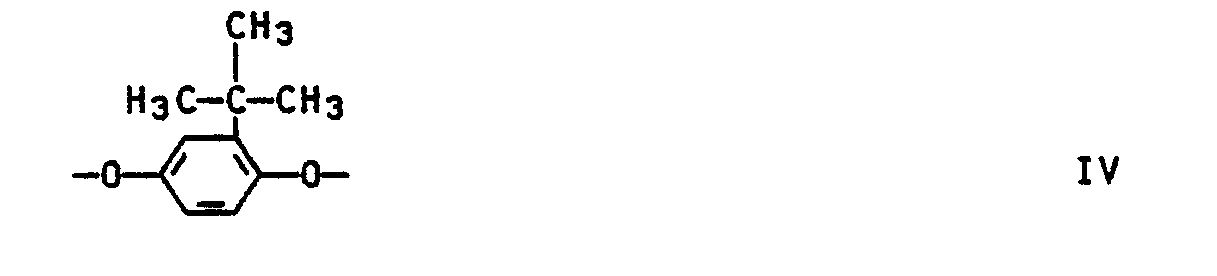
- Bevorzugte vollaromatische Polyetherester enthalten neben der Komponente a), 10 bis 15 Mol.% Komponente c), 15 bis 25 Mol.% Komponente d) sowie der Summe aus c) und d) äquivalenten molaren Menge der Komponente b).
- In anderen bevorzugten vollaromatischen Polyetherestern ist ein Teil der Einheiten d) ersetzt durch
- e) wiederkehrenden Einheiten der Formel V

- f) wiederkehrende Einheiten der Formel VI

- g) wiederkehrende Einheiten der Formel VII

- Vorteilhaft enthalten solche vollaromatischen Polyetherester die wiederkehrenden Einheiten e) und/oder f) in einer Menge von 5 bis 10 Mol.%. In einer anderen bevorzugten Zusammensetzung enthalten die vollaromatischen Polyetherester die Komponente g) in einer Menge von 5 bis 20 Mol.%.
- Es versteht sich, daß sich die Summe der Komponenten (a, b, c und d) auf jeweils 100 Mol.% ergänzen.
- Bevorzugte vollaromatische flüssig-kristalline Polyetherester haben eine Glastemperatur von ≧ 150°C, insbesondere ≧ 160°C. Die Glastemperatur soll dabei gemessen werden mit der DSC-Methode, wie sie beschrieben ist von K.H. Illers und anderen in Makromolekulare Chemie, Vol. 127,1 (1969). Bevorzugt sind die flüssig-kristallinen Polyetherester, die bei einer Temperatur > 220°C und < 280°C Teilkristallinität aufweisen. Die erfindungsgemäßen Polyetherester bilden bei einer Temperatur < 300°C, eine flüssig-kristalline fadenbildende Schmelze.
- Die erfindungsgemäßen flüssig-kristallinen Polyetherester können nach verschiedenden Verfahren hergestellt werden, wie sie beispielsweise in der US-PS 4 375 530 und US-PS 4 118 372 beschrieben werden.
- Die Massekondensation umfaßt allgemein eine Alkanoylierungsstufe, der die eingesetzten Monomeren mit Anhydriden umgesetzt werden und eine Polymerisationsstufe, in der Polykondensat unter Abspaltung von aliphatischen Carbonsäuren gebildet wird. Verfahren, bei denen eine Vorpolymerisationsstufe zwischengeschaltet wird, werden in der DE-OS 3 320 118 beschrieben. Solche Verfahren benötigen allerdings Reaktionszeiten über 10 Stunden.
- Nach einer vorteilhaften Arbeitsweise erhält man die erfindungsgemäßen Polyester in einem Einstufenverfahren, bei dem man die nicht derivatisierten Ausgangsstoffe unter Verwendung von Anhydriden niederer Fettsäuren, z.B. von Fettsäuren mit 2 bis 4 Kohlenstoffatomen, insbesondere Essigsäureanhydrid umsetzt. Vorteilhaft werden Katalysatoren, die be kanntlich die Polykondensation sowie Umesterungsreaktionen beschleunigen, in einer Menge von 0,001 bis 1 Gew.%, bezogen auf die Ausgangsstoffe, mitverwendet. Die Ausgangsstoffe werden zusammen z.B. mit Essigsäureanhydrid vorteilhaft in einem mindestens 5 %igen molaren Überschuß, bezogen auf die vorhandenen Hydroxylgruppen zweckmäßig unter Inertgasatmosphäre und Rühren auf eine Temperatur erhitzt, bei der Rückfluß zu beobachten ist. Vorteilhaft wird die Temperatur stufenweise gesteigert, z.B. höchstens 5 Stunden, vorzugsweise bis zu 2 Stunden auf 150 bis 220°C, anschließend wird die Temperatur langsam auf 250 bis 350°C gesteigert. Dabei werden übrschüssiges Fettsäureanhydrid und Fettsäure abdestilliert. Zur Entfernung der letzten Reste an Fettsäure ist es zweckmäßig gegen Ende der Kondensation verminderten Druck z.B. bis zu 0,5 mbar anzuwenden.
- Bemerkenswert und nicht vorherzusehen bei der Anwendung dieses Einstufenverfahrens ist zunächst die problemlose und vollständige Reaktion auch ohne Katalysatorzusatz zu den gewünschten Polymeren in einer relativ kurzen Zeit. Die ist umso erstaunlicher als durch die Vielzahl chemisch unterschiedlicher Hydroxygruppen eine Abstufung der Reaktivitäten und damit ein mangelhafter polymerer Aufbau zu erwarten war.
- Die so erhaltenen vollaromatischen flüssig-kristallinen Polyetherester werden vorteilhaft im festen Zustand z.B. bei Temperaturen von 150 bis 250°C weiter kondensiert bis zur gewünschten Viskosität. Diese Festphasenkondensation kann sowohl vor als auch nach einer thermoplastischen Verformung erfolgen. Die erfindungsgemäßen vollaromatischen flüssig-kristallinen Polyetherester eignen sich zur Herstellung von Fäden, Folien, Schäumen und technischen Formteilen durch Spritzguß oder Extrusion.
- Die Erfindung sei an folgenden Beispielen veranschaulicht.
- 0,2 mol (30,3 mol.%) Terephthalsäure, 0,26 mol (39,4 mol.%) 4-Hydroxybenzoesäure, 0,16 mol (24,24 mol.%) t-butyl-Hydrochinon, 0,04 mol (6,06 mol.%) 4,4′-Di(p-hydroxyphenoxy)diphenylsulfon sowie 0,86 mol Essigsäureanhydrid werden in einen Kolben mit Rührer, Stickstoffeinleitung und einem Destillationsaufsatz eingewogen: Unter N₂-Atmosphäre wird in einem Metallbad auf 100°C erhitzt. Die Temperatur wird dann in 30′ auf 150°C, in weiteren 100′ auf 200°C und anschließend in 120′ auf die Endtemperatur von 325°C erhöht.
- Anschließend wird der Druck auf 560 mbar und dann alle 10′ auf die Hälfte verringert. Das Endvakuum beträgt 10 mbar. Man erhält so eine hochviskose, fadenbildende mesomorphe Schmelze. Aus DSC-Messungen ergibt sich eine Glastemperatur von 156°C. Die inhärente Viskosität beträgt 0,9 dl/g, gemessen in 0,5 gew.%iger Lösung in p-Chlorphenol bei 50°C.
- Das Polymerisat läßt sich bei T > Tg, insbesondere bei T ≧ 200°C aus der Schmelze verarbeiten.
- 0,2 mol (30,3 mol.%) Terephthalsäure, 0,26 mol (39,4 mol.%) 4-Hydroxybenzoesäure, 0,12 mol (18,2 mol.%) t-butyl-Hydrochinon, 0,08 mol (12,1 mol.%) 4,4′-Di(p-Hydroxyphenoxy)-diphenylsulfon sowie 0,86 mol Essigsäureanhydrid werden wie in Beispiel 1 eingesetzt. Aus DSC-Messungen ergibt sich eine Glastemperatur von 166°C. Die inhärente Viskosität beträgt 0,5 dl/g. Das Polymerisat läßt sich bei T > Tg, insbesondere bei T ≧ 200°C aus der Schmelze verarbeiten.
- 0,2 mol (27,03 mol.%) Terephthalsäure, 0,34 mol (45,94 mol.%) 4-Hydroxybenzoesäure, 0,16 mol (21,62 mol.%) t-Butyl-Hydrochinon, 0,04 mol (5,41 mol.%) 4,4′-Di(p-hydroxyphenoxy)diphenylsulfon sowie 0,86 mol Essigsäureanhydrid werden wie in Beispiel 1 eingesetzt. Aus DSC-Messungen ergibt sich eine Glastemperatur von 165°C. Die inhärente Viskosität beträgt 0,93 dl/g. Das Polymerisat läßt sich bei T > Tg, insbesondere bei T ≧ 200°C aus der Schmelze verarbeiten.
Claims (9)


Applications Claiming Priority (2)
| Application Number | Priority Date | Filing Date | Title |
|---|---|---|---|
| DE3542813A DE3542813A1 (de) | 1985-12-04 | 1985-12-04 | Vollaromatische polyetherester, deren herstellung und verwendung |
| DE3542813 | 1985-12-04 |
Publications (2)
| Publication Number | Publication Date |
|---|---|
| EP0225539A1 true EP0225539A1 (de) | 1987-06-16 |
| EP0225539B1 EP0225539B1 (de) | 1989-08-02 |
Family
ID=6287560
Family Applications (1)
| Application Number | Title | Priority Date | Filing Date |
|---|---|---|---|
| EP86116322A Expired EP0225539B1 (de) | 1985-12-04 | 1986-11-25 | Vollaromatische Polyetherester, deren Herstellung und Verwendung |
Country Status (4)
| Country | Link |
|---|---|
| EP (1) | EP0225539B1 (de) |
| JP (1) | JPS62132922A (de) |
| CA (1) | CA1268892A (de) |
| DE (2) | DE3542813A1 (de) |
Cited By (5)
| Publication number | Priority date | Publication date | Assignee | Title |
|---|---|---|---|---|
| EP0242959A3 (en) * | 1986-04-23 | 1988-07-20 | E.I. Du Pont De Nemours And Company | Optically anisotropic melt forming aromatic copolyesters based on t-butylhydroquinone |
| WO2007110609A1 (en) * | 2006-03-27 | 2007-10-04 | Smith & Nephew, Plc | Polymer compositions and devices |
| EP2574637A1 (de) | 2011-09-30 | 2013-04-03 | Basf Se | Hochfeste Blends auf Basis von Polyarylenethern |
| WO2023285137A1 (en) | 2021-07-16 | 2023-01-19 | Basf Se | Thermoplastic molding composition with high temperature resistance comprising a thermotropic polymer |
| WO2023285136A1 (en) | 2021-07-16 | 2023-01-19 | Basf Se | Thermoplastic molding composition with high temperature resistance comprising a polyphenylene sulfide |
Families Citing this family (2)
| Publication number | Priority date | Publication date | Assignee | Title |
|---|---|---|---|---|
| DE3937107A1 (de) * | 1989-11-07 | 1991-05-08 | Akzo Gmbh | Formteil aus schaumkunststoff sowie seine herstellung |
| US9567463B2 (en) | 2011-09-30 | 2017-02-14 | Basf Se | High-strength blends based on polyarylene ethers |
Citations (2)
| Publication number | Priority date | Publication date | Assignee | Title |
|---|---|---|---|---|
| US4196275A (en) * | 1977-12-16 | 1980-04-01 | Owens-Illinois, Inc. | Thermoplastic polyesters prepared from bis(4-β-hydroxyethoxyphenyl)sulfone |
| EP0139303A2 (de) * | 1983-10-26 | 1985-05-02 | BASF Aktiengesellschaft | Vollaromatische Polyester und deren Herstellung |
-
1985
- 1985-12-04 DE DE3542813A patent/DE3542813A1/de not_active Withdrawn
-
1986
- 1986-11-19 JP JP61274268A patent/JPS62132922A/ja active Pending
- 1986-11-25 DE DE8686116322T patent/DE3664777D1/de not_active Expired
- 1986-11-25 EP EP86116322A patent/EP0225539B1/de not_active Expired
- 1986-12-03 CA CA000524449A patent/CA1268892A/en not_active Expired - Lifetime
Patent Citations (2)
| Publication number | Priority date | Publication date | Assignee | Title |
|---|---|---|---|---|
| US4196275A (en) * | 1977-12-16 | 1980-04-01 | Owens-Illinois, Inc. | Thermoplastic polyesters prepared from bis(4-β-hydroxyethoxyphenyl)sulfone |
| EP0139303A2 (de) * | 1983-10-26 | 1985-05-02 | BASF Aktiengesellschaft | Vollaromatische Polyester und deren Herstellung |
Non-Patent Citations (1)
| Title |
|---|
| CHEMICAL ABSTRACTS, Band 77, Nr. 10, 4. September 1972, Seite 25, Zusammenfassung Nr. 62684z, Columbus, Ohio, US; W.A. LEE et al.: "Internal plasticization of aromatic polyesters by alkyl side chains", & GT. BRIT., ROY. AIRCR. ESTAB., TECH. REP. 1971, TR 71223, 14 pp. * |
Cited By (7)
| Publication number | Priority date | Publication date | Assignee | Title |
|---|---|---|---|---|
| EP0242959A3 (en) * | 1986-04-23 | 1988-07-20 | E.I. Du Pont De Nemours And Company | Optically anisotropic melt forming aromatic copolyesters based on t-butylhydroquinone |
| WO2007110609A1 (en) * | 2006-03-27 | 2007-10-04 | Smith & Nephew, Plc | Polymer compositions and devices |
| US8729212B2 (en) | 2006-03-27 | 2014-05-20 | Smith & Nephew, Inc. | Polymer compositions and devices |
| EP2574637A1 (de) | 2011-09-30 | 2013-04-03 | Basf Se | Hochfeste Blends auf Basis von Polyarylenethern |
| WO2013045268A2 (de) | 2011-09-30 | 2013-04-04 | Basf Se | Hochfeste blends auf basis von polyarylenethern |
| WO2023285137A1 (en) | 2021-07-16 | 2023-01-19 | Basf Se | Thermoplastic molding composition with high temperature resistance comprising a thermotropic polymer |
| WO2023285136A1 (en) | 2021-07-16 | 2023-01-19 | Basf Se | Thermoplastic molding composition with high temperature resistance comprising a polyphenylene sulfide |
Also Published As
| Publication number | Publication date |
|---|---|
| DE3542813A1 (de) | 1987-06-11 |
| JPS62132922A (ja) | 1987-06-16 |
| CA1268892A (en) | 1990-05-08 |
| EP0225539B1 (de) | 1989-08-02 |
| DE3664777D1 (en) | 1989-09-07 |
Similar Documents
| Publication | Publication Date | Title |
|---|---|---|
| EP0230545B1 (de) | Vollaromatische Polyesteramide, deren Herstellung und Verwendung. | |
| EP0226078B1 (de) | Vollaromatische mesomorphe Polyester, deren Herstellung sowie Verwendung | |
| DE68929259T2 (de) | Aromatische Polyester, aromatische Polyesteramide und Verfahren zu deren Herstellung | |
| EP0139303B1 (de) | Vollaromatische Polyester und deren Herstellung | |
| DE2348697A1 (de) | Verfahren zur herstellung eines copolyesters | |
| EP0230551B1 (de) | Vollaromatische Polyestercarbamide, deren Herstellung und Verwendung | |
| DE2327668B2 (de) | Verfahren zur Herstellung eines segmentierten, thermoplastischen Mischpolyesterelastomeren | |
| EP0320600A2 (de) | Formmassen bestehend aus einem thermotropen, aromatischen Polyester | |
| DE3621519A1 (de) | Vollaromatische mesomorphe polyester, deren herstellung sowie verwendung | |
| EP0226839B1 (de) | Vollaromatische Polyester, deren Herstellung und Verwendung | |
| DE69006617T2 (de) | Cholesterischer, flüssigkristalliner, eine optisch aktive Gruppe enthaltender Polyester. | |
| EP0088741B1 (de) | Copolyester in der Form von flüssigen Kristallen und ihr Herstellungsverfahren | |
| DE69706277T2 (de) | Flüssigkristalline polymer zusammensetzungen | |
| EP0226847A1 (de) | Vollaromatische mesmorphe Polyetherester, deren Herstellung und Verwendung | |
| DE3542855A1 (de) | Vollaromatische mesomorphe polyesteramide, deren herstellung und verwendung | |
| EP0225539B1 (de) | Vollaromatische Polyetherester, deren Herstellung und Verwendung | |
| DE2720004A1 (de) | Copolyester sowie verfahren zu ihrer herstellung | |
| EP0374657A2 (de) | Neue thermotrope Polyester, Verfahren zu ihrer Herstellung sowie ihre Verwendung zur Herstellung von Formkörpern, Filamenten, Fasern und Folien | |
| EP0231468B1 (de) | Flüssig-kristalline Carbamidgruppen enthaltende Polykondensate, deren Herstellung und Verwendung | |
| EP0230550B1 (de) | Vollaromatische flüssigkristalline Polykondensate, deren Herstellung und Verwendung | |
| EP0088742B1 (de) | Copolyester in der Form von flüssigen Kristallen | |
| DE3622137A1 (de) | Vollaromatische mesomorphe polyester, deren herstellung sowie verwendung | |
| EP0469175A1 (de) | Copolyesteramide aus aromatischen und aliphatischen und/oder alicyclischen Einheiten und Verfahren zu ihrer Herstellung | |
| DE69023043T2 (de) | Vollaromatischer Copolyester. | |
| EP0340568A1 (de) | Thermotrope aromatische Polyester, Verfahren zu ihrer Herstellung und ihre Verwendung zur Herstellung von Formkörpern, Filamenten, Fasern und Folien |
Legal Events
| Date | Code | Title | Description |
|---|---|---|---|
| PUAI | Public reference made under article 153(3) epc to a published international application that has entered the european phase |
Free format text: ORIGINAL CODE: 0009012 |
|
| AK | Designated contracting states |
Kind code of ref document: A1 Designated state(s): BE CH DE FR GB IT LI LU NL SE |
|
| 17P | Request for examination filed |
Effective date: 19870509 |
|
| 17Q | First examination report despatched |
Effective date: 19881202 |
|
| GRAA | (expected) grant |
Free format text: ORIGINAL CODE: 0009210 |
|
| AK | Designated contracting states |
Kind code of ref document: B1 Designated state(s): BE CH DE FR GB IT LI LU NL SE |
|
| REF | Corresponds to: |
Ref document number: 3664777 Country of ref document: DE Date of ref document: 19890907 |
|
| GBT | Gb: translation of ep patent filed (gb section 77(6)(a)/1977) | ||
| ITF | It: translation for a ep patent filed | ||
| PG25 | Lapsed in a contracting state [announced via postgrant information from national office to epo] |
Ref country code: LU Free format text: LAPSE BECAUSE OF NON-PAYMENT OF DUE FEES Effective date: 19891130 |
|
| ET | Fr: translation filed | ||
| PLBE | No opposition filed within time limit |
Free format text: ORIGINAL CODE: 0009261 |
|
| STAA | Information on the status of an ep patent application or granted ep patent |
Free format text: STATUS: NO OPPOSITION FILED WITHIN TIME LIMIT |
|
| 26N | No opposition filed | ||
| PGFP | Annual fee paid to national office [announced via postgrant information from national office to epo] |
Ref country code: FR Payment date: 19901010 Year of fee payment: 5 |
|
| PGFP | Annual fee paid to national office [announced via postgrant information from national office to epo] |
Ref country code: SE Payment date: 19901011 Year of fee payment: 5 |
|
| PGFP | Annual fee paid to national office [announced via postgrant information from national office to epo] |
Ref country code: LU Payment date: 19901017 Year of fee payment: 5 Ref country code: CH Payment date: 19901017 Year of fee payment: 5 |
|
| PGFP | Annual fee paid to national office [announced via postgrant information from national office to epo] |
Ref country code: BE Payment date: 19901019 Year of fee payment: 5 |
|
| PGFP | Annual fee paid to national office [announced via postgrant information from national office to epo] |
Ref country code: GB Payment date: 19901115 Year of fee payment: 5 |
|
| PGFP | Annual fee paid to national office [announced via postgrant information from national office to epo] |
Ref country code: DE Payment date: 19901117 Year of fee payment: 5 |
|
| ITTA | It: last paid annual fee | ||
| PGFP | Annual fee paid to national office [announced via postgrant information from national office to epo] |
Ref country code: NL Payment date: 19901130 Year of fee payment: 5 |
|
| EPTA | Lu: last paid annual fee | ||
| PG25 | Lapsed in a contracting state [announced via postgrant information from national office to epo] |
Ref country code: DE Effective date: 19911122 |
|
| PG25 | Lapsed in a contracting state [announced via postgrant information from national office to epo] |
Ref country code: GB Effective date: 19911125 |
|
| PG25 | Lapsed in a contracting state [announced via postgrant information from national office to epo] |
Ref country code: SE Effective date: 19911126 |
|
| PG25 | Lapsed in a contracting state [announced via postgrant information from national office to epo] |
Ref country code: LI Effective date: 19911130 Ref country code: CH Effective date: 19911130 Ref country code: BE Effective date: 19911130 |
|
| BERE | Be: lapsed |
Owner name: BASF A.G. Effective date: 19911130 |
|
| PG25 | Lapsed in a contracting state [announced via postgrant information from national office to epo] |
Ref country code: NL Effective date: 19920601 |
|
| NLV4 | Nl: lapsed or anulled due to non-payment of the annual fee | ||
| GBPC | Gb: european patent ceased through non-payment of renewal fee | ||
| PG25 | Lapsed in a contracting state [announced via postgrant information from national office to epo] |
Ref country code: FR Effective date: 19920731 |
|
| REG | Reference to a national code |
Ref country code: CH Ref legal event code: PL |
|
| REG | Reference to a national code |
Ref country code: FR Ref legal event code: ST |
|
| EUG | Se: european patent has lapsed |
Ref document number: 86116322.8 Effective date: 19920604 |
|
| PG25 | Lapsed in a contracting state [announced via postgrant information from national office to epo] |
Ref country code: IT Free format text: LAPSE BECAUSE OF NON-PAYMENT OF DUE FEES;WARNING: LAPSES OF ITALIAN PATENTS WITH EFFECTIVE DATE BEFORE 2007 MAY HAVE OCCURRED AT ANY TIME BEFORE 2007. THE CORRECT EFFECTIVE DATE MAY BE DIFFERENT FROM THE ONE RECORDED. Effective date: 20051125 |